Skip to content
  • Home
  • Subscribe / donate
  • Events calendar
  • News
    • Local
    • National
    • Israel
    • World
    • עניין בחדשות
      A roundup of news in Canada and further afield, in Hebrew.
  • Opinion
    • From the JI
    • Op-Ed
  • Arts & Culture
    • Performing Arts
    • Music
    • Books
    • Visual Arts
    • TV & Film
  • Life
    • Celebrating the Holidays
    • Travel
    • The Daily Snooze
      Cartoons by Jacob Samuel
    • Mystery Photo
      Help the JI and JMABC fill in the gaps in our archives.
  • Community Links
    • Organizations, Etc.
    • Other News Sources & Blogs
    • Business Directory
  • FAQ
  • JI Chai Celebration
  • JI@88! video

Recent Posts

  • Story of Israel’s north
  • Sheltering in train stations
  • Teach critical thinking
  • Learning to bridge divides
  • Supporting Iranian community
  • Art dismantles systems
  • Beth Tikvah celebrates 50th
  • What is Jewish music?
  • Celebrate joy of music
  • Women share experiences 
  • Raising funds for Survivors
  • Call for digital literacy
  • The hidden hand of hate
  • Tarot as spiritual ritual
  • Students create fancy meal
  • Encouraging young voices
  • Rose’s Angels delivers
  • Living life to its fullest
  • Drawing on his roots
  • Panama City welcoming
  • Pesach cleaning
  • On the wings of griffon vultures
  • Vast recipe & story collection
  • A word, please …
  • מארק קרני לא ממתין לטראמפ
  • On war and antisemitism
  • Jews shine in Canucks colours
  • Moment of opportunity
  • Shooting response
  • BC budget fails seniors
  • Ritual is what makes life holy
  • Dogs help war veterans live again
  • Remain vital and outspoken
  • An urgent play to see
  • Pop-up exhibit popular
  • An invite to join JWest

Archives

Follow @JewishIndie
image - The CJN - Visit Us Banner - 300x600 - 101625

Byline: Cynthia Ramsay

Meet authors at book festival

Meet authors at book festival

Assaf Gavron (photo from JCC Jewish Book Festival)

As it does every year, the 31st annual Cherie Smith JCC Jewish Book Festival offers readers the chance to meet some of their favorite authors. Sean Michaels, the 2014 Scotiabank Giller Prize winner, starts it all off on Nov. 21 at the Jewish Community Centre of Greater Vancouver’s Rothstein Theatre. Among the festival’s many highlights are Israeli writer Assaf Gavron and American writer Nomi Eve, to whom the Independent had a chance to e-speak recently.

image - The Hilltop book coverGavron’s latest novel, The Hilltop (translated into English from Hebrew by Stephen Cohen), deals with one of the most contentious and emotion-laden aspects of the Israeli-Palestinian conflict: the settlements in the West Bank. It does so with humor and humanity – and an even eye, examining the larger societal issues through the troubled relationship of two troubled brothers. Family, bureaucracy, unintended consequences, and more, factor into the story.

JI: What is it about fiction that allows it to communicate controversial ideas or speak to controversial topics in a way that seems to be more easily received than other media, such as journalism, academia, documentary film?

AG: I think that usually when ideas are termed “controversial,” it is on a simplistic level – when you can sum it up in a sentence or two, it is easy to annoy, or touch a nerve, or whatever. The other forms of media you mention, like journalism or documentary, are also susceptible to this superficiality. Fiction gives you more time, and depth, to really get to the story and to the people behind it. And, whatever the subject is, it can’t remain on the simplistic level. Yes, hopefully it causes more thinking and a better understanding of complexities. I like that about reading fiction, but as to the reason why I choose to write, I think that, over the years, I learned that it is the kind of storytelling I am best at, and most comfortable with.

JI: When I used to ask my grandmother how she was doing, her response often was that she still had her sense of humor – once she lost that, then…. What purpose does humor serve in your writing, or is it “just” a matter of style?

AG: That’s how I write, it is part of me, part of how I communicate. I can identify with your grandmother. I think that it is important, and sane, not to take things too seriously. And not less so, probably more so, in situations that are perceived as sad and difficult and tragic. We must be able to smile. In writing, it is mainly entertainment. It is more fun and enjoyable to read something that makes you laugh. In my books, I would like to entertain as much as anything else, like making a point, educating, etc.

JI: Not everyone can put themselves into someone else’s shoes, something you seem to have mastered in your writing, including your latest novel, The Hilltop. Does that openness and empathy extend into your “real” life? What is it in your personal “toolkit” that allows you to at least write from multiple viewpoints with sincerity?

AG: I disagree. I think everyone can put themselves in someone else’s shoes. This is why people read books, go to movies, read newspapers or even just talk to each other – they are curious about the experiences of others and, when they hear or read or watch them, they are always imagining if it was them, what would they do, how would they react. But it is true that people are reluctant to identify or see the world through eyes of people they perceive as an enemy, or as very different, as an “other,” in the real life. Sure, I hope I’m as open in real life. I think it is crucial to fundamentally accept that there are others, and to attempt to get to know them. I guess that it is no more than this belief that is my “toolkit.”

JI: You write books, translate, create videogames, are in a band … could you share a little bit about your background and how you came to your expertise in these areas?

AG: First and foremost I’m a fiction writer. But I’m also a curious person, like to keep myself interested … so I tend to do other things as well. The band, for example, is a lifelong project of three friends, who decided to do this for the long run, with little interference to our “daily” life. This is why we release an album every six years and not more frequently. Translating and teaching I do sometimes for income and sometimes for interest. The computer game was a one-off project.

JI: Your write-up on Wikipedia notes that you were in Vancouver in 1997, studying “new media.” Do you still have Vancouver connections?

AG: I do! My first cousin lives there with her family. Having family was part of the reason I came, and what I heard and imagined of the city and the school, which offered what I was interested in studying at the time. I had a great year in Vancouver, had a lovely apartment in Kitsilano. That year, I also wrote what would be my second book. I have been back only once since then, in 2003, I think, so it’s been awhile. I’m really looking forward to this visit, my first as a writer.

JI: Where are you and your family currently based?

AG: We are in Omaha, Neb. I have been teaching here for the past year. I’m moving to your time zone, San Diego, in January for six months, and then next summer back home to Israel.

***

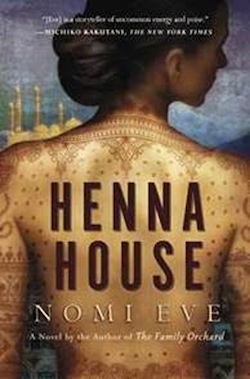
The main character in Nomi Eve’s second novel, Henna House, is Adara, born in Yemen in 1918, the year that Imam Yahya took control of the region. He passed many restrictive decrees, including the Orphans Decree, calling “for any Jewish child to be confiscated, converted and quickly adopted by a Muslim family if a father died,” writes Eve. When the story begins, Adara’s father is already ill.

image - Henna House book coverThe bulk of the novel follows Adara and her family – notably, two cousins – from the 1920s in Yemen to the early years of Israel, briefly touching upon Operation On Wings of Eagles, better known by its nickname Operation Magic Carpet, when almost 50,000 Yemenite Jews were airlifted to Israel between June 1949 and September 1950.

JI: Research is an essential part of your creative process, but you also said in one interview that reality limits your creativity. How did you navigate the need for both research/reality and imagination in your two novels, seeing as both are rooted in “real” historical spaces?

NE: History is much more than a backdrop in my fiction. It also provides soul and substance. But I never let myself feel straightjacketed by history. I make things up and let my readers know that this is fiction, not academic research that they are reading. In Henna House, the fact that I have a first-person narrator also helped me navigate this terrain. My narrator uses her memory and imagination to construct her own version of the past. Memory is porous, and doesn’t always hold truth. Memory is powerful and often finds truth in unlikely places.

JI: Have you reached your 100 Book Clubs goal?

NE: I did book club #143 tonight – it was a Skype visit to Toronto. I love my book club visits. Readers are my wildest dream, and I feel lucky each time I get to chat with a new group.

photo - Nomi Eve
Nomi Eve (photo from JCC Jewish Book Festival)

JI: In Henna House, you write about Mizrahi Jews. What is your background? Did you have a mix of traditions growing up, given that your father was from Israel?

NE: My family is Ashkenazi, but I have a Yemenite aunt. It is from her that I learned to love Yemenite Jewish culture. But most of what I learned about the history of the Jews of North Yemen and Aden I learned through my own research. The most fascinating things that I learned were about henna traditions, and the Orphan’s Decree. Both of these things became central to the plot of my book.

JI: Your two novels are both set in the past. What appeals to you about the past and imagining what it might have been like?

NE: I find it easier to write about the past than about the present. The past feels multi-dimensional to me, whereas the present feels one-dimensional. I think that I am attracted to the fierce power of memory and the perspective gained by the passage of time.

Assaf Gavron in conversation with Marsha Lederman takes place Sunday, Nov. 22, 8 p.m.; tickets are $18. Nomi Eve speaks with Israeli-Canadian writer Ayelet Tsabari on Tuesday, Nov. 24, at an intimate gathering at 6:30 p.m. ($16) and to a book club and book-lovers event at 8 p.m. ($18); to attend both, the price is $30. For tickets to these and other festival events, call 604-257-5111 or drop by the J in person. For tickets and the full festival lineup, visit jewishbookfestival.ca.

Format ImagePosted on November 6, 2015November 4, 2015Author Cynthia RamsayCategories BooksTags Assaf Gavron, Cherie Smith JCC Jewish Book Festival, Henna House, Hilltop, Nomi Eve
Community campaign

Community campaign

Neil Pollock, chair of the Jewish Federation annual campaign. (photo from Jewish Federation of Greater Vancouver)

There’s just under one month left to contribute to the Jewish Federation of Greater Vancouver annual campaign, which supports dozens of local community organizations, as well as partner agencies in Israel and overseas. The Jewish Independent spoke to this year’s campaign chair Neil Pollock via email about his reasons for being involved, and the importance of the campaign to the community.

JI: You’ve taken over the general chair position from Harvey Dales. I know you’ve done so much community work, but did he offer you any advice specific to the campaign that you could share?

NP: Harvey is a good friend, and working as his wingman for a few years before succeeding him as campaign chair was a tremendous learning experience for me. Harvey is, as we all know, a terrific leader and great asset to this community. In fact, if I recall correctly, it was at one of his last meetings as chair that Harvey inspired the concept for our new face-to-face incentive, which has been so well supported by donors and canvassers.

This year, every time a donor meets with their canvasser in person, an additional $500 will be donated to the campaign. It’s an important way we’re engaging in genuine conversations about our community and its needs, as well as donors’ values and interests. It’s also a key way in which we’re growing the campaign. If anyone reading this wants to meet face to face, but doesn’t have a canvasser, just contact the Federation office and they’ll set it up for you.

JI: What motivated you to take on the position of general chair?

NP: I thought I might be able to help out the community a little, and I was honored to be asked to serve. My wife, Michelle, and I have made a very conscious effort to live and practise our Jewish values – especially tikkun olam, chesed and tzedakah. We do this through our volunteer work in the community, and in our home with our children. It’s made our kids more aware of the responsibility we all share in building a better, stronger community, and of all of us being responsible for each other.

JI: The campaign theme is “Securing Our Future.” What does that mean to you in terms of the Jewish community?

NP: The theme has a few meanings. In one sense, it’s about community continuity and engaging the next generation – two of the priority areas for our work. We need to continue to fund young adult programming through Hillel and Axis. We also need to support innovative new Jewish education programs that will reach the more than 850 children in underserved areas who aren’t currently receiving any Jewish education. We live in this incredible city, but the cost of living is so high that many people are struggling with how they can stay connected Jewishly. Nearly half of community members are living outside the city of Vancouver, and funding new programs that reach them where they live is critical to their community involvement.

In a very literal sense, it’s about making sure everyone in our community feels safe. Our Federation has been very proactive in terms of security, conducting a community-wide training program and providing grants for security upgrades, but security is an ongoing need in our community. We need to increase funding for our community institutions so they remain safe, and ensure emergency preparedness.

What some people might not realize is that, every year, Jewish Federation receives more requests for support than there is funding available. On top of that, there are critical programs and services that need more funding than they currently receive. If we want to secure our community’s future, we need to close these gaps while at the same time addressing the issues of affordability and accessibility.

JI: Are there any special projects/ causes that the campaign is hoping to fund?

NP: We’re seeing a real shift in our community that’s creating issues of affordability and accessibility. More and more families are moving to underserved communities outside of the city of Vancouver. It’s just too expensive for them here. When they move, they become beyond the reach of most of our community institutions. We need to find new ways to make community accessible for them. For many of those who live close to the centre of Jewish community life, the cost of doing so is creating other barriers, notably affordability. The high cost of living here has a direct impact on the ability of regular families to engage in Jewish life. These are the issues Federation is addressing through the campaign and in coordination with its partner agencies.

JI: What is the campaign goal this year?

NP: Last year, we reached a record result of $8 million – and we are determined to surpass that. As community needs continue to grow and evolve, so must our response, so must the campaign.

JI: Until when does the campaign run?

NP: The campaign runs from September through to the end of November, which is very short, compared to other communities. One of the reasons we’re able to raise funds in such a condensed period is the incredible work of our canvassers. Supporting them in their work is something I’m passionate about, and we’re putting special emphasis on that this year. We’ve worked with a group of generous supporters to develop a new incentive: for every new canvasser who joins our team, an extra $1,000 will be donated to the campaign. Twice the mitzvah!

For more information and to donate, visit jewishvancouver.com.

Format ImagePosted on November 6, 2015November 4, 2015Author Cynthia RamsayCategories LocalTags campaign, Jewish Federation of Greater Vancouver, Neil Pollock
Welcome barbarians

Welcome barbarians

From Hofesh Shechter’s barbarians trilogy. (photo by Gabriele Zucca)

Before barbarians was even created, DanceHouse had included the Hofesh Shechter trilogy in its 2015/16 season.

“Programming work before you have had the chance to view and experience it yourself is always risky,” DanceHouse producer Jim Smith told the Independent in an email interview. “Programming work that has not even been completed or performed, some would say is even way beyond this risk, primarily because no one can speak to the work other than the artist who is in the process of making it. However, if we believe in an artist, if we have a relationship with their work and we can see they have developed a track record, then agreeing to present their new work before you get to see it is one of the highest compliments you can offer them. It also allows our audiences the opportunity to see work that is very fresh in its life, before it has been performed elsewhere around the world.

“In the current DanceHouse season,” he continued, “there are two artists whose works were confirmed before they were completed. Hofesh Shechter is one, and the other is Crystal Pite, with her collaboration with Jonathon Young of the Electric Theatre Company and their production titled Betroffenheit (which we will see in February).” Completing the season is Companhia Urbana de Dança in April.

Smith described Hofesh Shechter as “part of an international generation that is currently defining how dance is being made and carving out the state of the (dance) art.” He included Israel’s Sharon Eyal, the United Kingdom’s Wayne McGregor and Vancouver’s Pite in this generation of artists.

The Hofesh Shechter Company was at DanceHouse in 2009. Hosting the company again is very satisfying, said Smith, as it allows local “audiences the chance to see how his work has developed and evolved, allowing them to have a deeper relationship with his work.”

In promotional material, barbarians is described as being about “intimacy, passion and love.” In an interview with artslandia.com, Smith described it as “loud, visceral rage.” Acknowledging the potential incongruence, he said, “I would offer that in exploring the extremes that lead to my characterization of loud, visceral rage, it creates a contrasting space for notions of intimacy, passion and love to emerge, rather than simply being portrayed. I have heard Hofesh himself describe experiencing his work as a series of images that move faster than the mind can necessarily process or think through. He also says his work often reveals frustration and buried hope, and a lot of different emotions that relate to humans under pressure. I think barbarians could be viewed/experienced in this fashion.

“The barbarians program is three distinct works, which makes for a different flow to the evening, rather than one longer single work. There is highly precise movement, and there is baroque music, which gives the effect of things being controlled. However, there is also a sense of things breaking free and getting out of control. The last work on the program is a duet made for two long-standing dancers in the company, which I think reveals the collaborative approach between dancer and choreographer, and also the admiration that exists within those particular relationships.”

DanceHouse has hosted more than one Israeli choreographer or company over the years. Is there an Israeli style?

“There has been much discussion and observation about the work that is of Israeli dance artists and the Diaspora. (For example, Hofesh now resides in the U.K.) Many dance observers would say that it is Ohad Naharin of Batsheva Dance Company that is the central figure who led the Israeli dance domination that has been going on for the past number of years. Artists such as Shechter, but also Sharon Eyal and Andrea Miller – all of whom have been on the DanceHouse stage – are part of a generation that studied and worked with Naharin and Batsheva, and have gone on in the wake to carve out unique and distinctive choreographic voices. I don’t think there is an element or style that we can point to that characterizes or typifies the Israeli work, rather it is a larger sensibility, which you appreciate from experiencing a number of works of these artists and, of course, being able to contrast them with different work.”

barbarians is at Vancouver Playhouse Nov. 13-14, 8 p.m. For tickets, visit dancehouse.ca.

Format ImagePosted on November 6, 2015November 6, 2015Author Cynthia RamsayCategories Performing ArtsTags barbarians, DanceHouse, Hofesh Shechter, Jim Smith
Once at the Queen E.

Once at the Queen E.

Zander Meisner is a swing in the touring production of Once that will be in Vancouver Nov. 17-22. (photo by Once Tour Company © Joan Marcus)

Most of us can only dream about what it would be like to have a role in a Broadway production. Illinois-born Jewish community member Zander Meisner has four in the touring production of Once: The Musical, being presented in Vancouver by Broadway Across Canada Nov. 17-22 at Queen Elizabeth Theatre.

Meisner is a swing for the roles of Andrej, a Czech immigrant working in a fast-food joint; Svec, Andrej’s brother; Eamon, the manager of a recording studio; and Emcee, the host of a bar’s open mic night. This means that he has to be prepared to step into any one of these parts (“tracks”) on any given night – he has to know all of their music (including the playing of multiple instruments), choreography, dialogue, blocking onstage, manoeuvring backstage, and has to be able to pull off convincing Czech and Irish accents.

photo - Zander Meisner
Zander Meisner (photo from Broadway Across Canada)

“My method was a three- to five-month freak-out period in rehearsals in the first few months of tour in 2013, where I practised my face off,” explained Meisner in an email interview with the Independent. This was “followed by my first performances, which gave me the confidence to continue honing my musical skills and polish each character – and getting more and more excited (and less and less nervous) for my future performances. I go on a lot more frequently than I did on the beginning of tour, and these shows keep me sharp.”

In his early 30s, Meisner has been a musician and actor since his youth. He was born and raised in Deerfield, about an hour’s drive north of Chicago. His first role was a part in his high school’s production of Gypsy.

“Gypsy was more a transition from music to theatre than just my first show. I had played clarinet for six years at that point, and the small role I was cast in had me playing the clarinet onstage. Then I simply fell in love with theatre. High school gave me the opportunity to do musicals without any ‘nerdy’ choir prerequisites (which I ended up doing anyways). I pursued vocal performance and theatre at the Jacobs School of Music at Indiana University.”

A singer/songwriter, Meisner still performs on occasion despite being on tour with Once. “I book evenings called Zander and Friends,” wherein he and a “handful of super-talented friends” take over a bar for the night. “I’m the goofball emcee and headliner,” he said. “It’s beyond fun, and a great opportunity to do some music outside of Once. I have one scheduled in Raleigh, N.C., and I hope to have one in Boston.”

Meisner also tries to maintain a level of religious observance while on the road. “I do follow Judaism,” he said, “as I was raised Conservative, and try and follow tradition as best as possible with my crazy schedule (though not as well as my mother would like).”

This tour of Once closes on Dec. 27 in Boston. “It will have been 2.5 years!” noted Meisner, who will be doing Peter and the Starcatcher in January/February in Ithaca, N.Y., before heading back to New York City.

Once: The Musical is loosely based on the Academy Award-winning film about the whirlwind romance of an Irish musician and a Czech immigrant, “drawn together by their shared love of music.” It is award-winning in its own right, garnering eight Tonys, including best musical, for which it was also honored by the New York Drama Critics’ Circle, Drama Desk and Drama League, among others.

Tickets for Once at Queen E. start at $25 (plus service charges), and are available from ticketmaster.ca or 1-855-985-5000.

Format ImagePosted on November 6, 2015November 6, 2015Author Cynthia RamsayCategories Performing ArtsTags Broadway Across Canada, Zander Meisner
Winning equal rights

Winning equal rights

Anat Hoffman, right, and another member of Women of the Wall, standing at the entrance to the Kotel in January 2013, as Charedi men look away. (photo by Michal Patelle (Women of the Wall) via Wikimedia Commons)

For more than 30 years, Anat Hoffman has been fighting for individuals’ rights. Notably, her work with Women of the Wall, which won legal recognition in 2013 for women’s right to pray at the Kotel wearing prayer shawls and using a Torah. And her more than 10 years with the Israel Religious Action Centre, which has achieved government funding for non-Orthodox rabbis, earned multiple Supreme Court decisions recognizing Reform and Conservative conversions, and won a 2011 Supreme Court ruling making gender segregation on public buses illegal.

The self-described troublemaker will be in Vancouver Nov. 15-18, speaking to several community groups, as well as addressing the Jewish community as a whole on Nov. 16, 7:30 p.m., at Temple Sholom. Her topic – From the Back of the Bus to the Top of the Agenda.

“I’m talking about the achievements of a family of organizations – Women of the Wall, the Religious Action Centre, the Jerusalem Open House, the Association for Civil Rights in Israel, all sorts, we’re a cluster of organizations for social change, and I am such an admirer of my colleagues,” said Hoffman. “And we’re all looking at the same issues: how the monolithic interpretation of Judaism in the Jewish state is limiting and stunting our ability to enjoy Judaism and celebrate it.

“In this respect, more than any other, including security, economics … we must dialogue with the Diaspora Jews. You have a stake in it, and you have an opinion. Israel is way too important to be left to the Israelis.”

She doesn’t want Diaspora Jews to be silent, she said, because there are things that Israelis can learn from them. “I’m tired of Israeli arrogance, and the feeling that we know everything,” she said. “If we know everything, how come we are in the situation we are in today on our 67th anniversary? That’s number one: I am humbled by reality and I think we could use all the help we could get.

“The second thing is, I think it’s a joint project. I think it’s the most important project of the Jewish people…. The state of Israel, the fact that we have a sovereign Jewish state, is so exciting and so wonderful, and I think we’re involved in the most important dialogue in our lives – you and I. What are the values of the Jewish state? What are Jewish values anyway? Are they the values of the Book of Joshua – smite them, kill them, annihilate them? Or the values of Isaiah? Who do we listen to, and who do we act like? I’m an Isaiah person, he’s my steering committee. I read him for inspiration and I think if he were alive in Israel today, he’d be under administrative detention – the man had no mouth control.

“So, I am driven to speak to Diaspora Jews, involve them in this dialogue and tell them to stop being quiet. If you are quiet, don’t be surprised if Jerusalem turns into Tehran, don’t be surprised if you wake up one day and you’re ashamed to even be called Jewish because of what the Jewish state is doing. You have to make your statement known today – and, it turns out, the Israeli government is very sensitive to what Canadian Jews think…. You’re not using your fantastic nuisance value. You have so much of it and you don’t use it.”

Acknowledging that Canadians are “extremely harmony-seeking and somewhat conservative,” Hoffman said people should speak up “in whatever style fits you. If Israel arrests women wearing a tallis, praying out loud and trying to have a bat mitzvah at the holiest site of the Jewish people, if this is not something right, then you should mention it.”

The morning of her phone interview with the Jewish Independent, Hoffman had attended a b’not mitzvah at the Kotel, one girl had come from Brazil, the other from the United States. “I had to stand in front of them and explain that we don’t have a Torah scroll this morning because the rabbi [Shmuel Rabinowitz] refused to give me one for these two girls – he has 100 Torah scrolls for public use. I found a way to smuggle in a Torah, but I didn’t use it today. Why? Because I didn’t want to make the Jerusalem police look like horses’ asses today because they have other things on their plate,” she said, referring to the current spate of terror attacks.

Because of the security situation, Hoffman had written Rabinowitz to ask him to make an exception that one day, and to allow the women to use one of the Kotel’s Torahs, “so that we do not burden the police with our problem,” she said. “I didn’t even get an answer.”

photo - Anat Hoffman
Anat Hoffman (photo from Anat Hoffman)

Despite “30 years of troublemaking,” Hoffman said she has never felt unsafe or isolated. “Not only am I not persona non grata, I was elected and reelected to the city council of Jerusalem endless times. I have 24,000 voters in this right-wing, ultra-Orthodox city. I’ve never felt threatened. My phone number is published in the phone book…. Israel is a democracy and as someone with a dissenting voice – I always was a member of the opposition – I think I was rewarded for this.”

On the issue of gender segregation in public spaces, Hoffman said victory could be declared. “We certainly don’t see new segregations going on, and the new ones are punished by the government now.”

Of the challenges that remain, she said, “Freedom of religion and pluralism, recognition of the Reform and Conservative movements, recognition of women in religion, the issue of the Wall – on these issues of pluralism, the religious establishment is very, very strong in resisting any change because any change would mean the breaking of their empire.”

Also on the morning of her interview with the Independent, former chief rabbi of Israel Yona Metzger was indicted for allegedly accepting some $2 million in bribes. “They have a corrupt system and they’re fighting to keep it because they are very spoiled and used to it, and there’s a lot of resistance to change in that power structure. That structure is the next frontier.”

Calling the Women of the Wall, “the Little Engine that Could,” Hoffman said, “We’re pushing for equality and, in the end, we will win. Am I going to see the end of this struggle? I’m not sure, it’s taking too long. But is it going to be won? There is no doubt in my mind that it will be won.”

Hoffman said she is pushing for a model she learned about in a Limmud South Africa conference a number of years ago. The presenter – Simonne Horwitz – shared stories about the small Jewish community of Saskatoon. In the winter, people help each other get to synagogue, she said, “and they don’t care if you’re Orthodox, Reform or Conservative. And the congregation, the building of the synagogue, it’s Orthodox if a majority of Orthodox show and it’s Reform if the most Reform show, and the one structure can become whatever it is that the people want it to be at that moment.”

Horwitz told the small community’s stories “with so much humor, so much joy,” said Hoffman. “I come from the largest Jewish community in the world, and I have a lot to learn from Saskatchewan, Canada.”

Hoffman said about Israel, “I want us to recognize all streams. I want our structures of religion to be able to be as pluralistic as possible. I want freedom in the market called religious services, and may the best rabbi win.”

Hoffman encouraged everyone to come hear her speak. “I would like to make sure that people who are not liberal, feminist, peacenik, that they know that they are very, very welcome to come dialogue with me. I’m very interested in speaking to more than the choir. I love to dialogue with people who are willing to look at their opinions and check them out with this Israeli. There are Israelis of many kinds. Israelis like me don’t come to your area very often, and I would very much like to dialogue with people who disagree with me, in a civilized manner. Even if you leave me with your same opinions, at least you’ve aired them out a little bit…. It’s a Jewish thing to do. We’re asked to leave our comfort zone a few times a year: when we leave home to build a sukkah, when we throw every piece of bread from our house…. So, I invite very much those people who are not in my natural habitat to come and talk to me.”

She also stressed that it is not regular Israelis who object to the changes she and her colleagues and supporters are demanding, but rather “the establishment that has so much to lose. And it’s all the folly of Israel. By giving one stream the political power, huge political budgets and the ability to monopolize all religious services in Israel, we’ve corrupted something so important for Judaism – the free spirit of criticism, the art of argument. All this is gone now because there’s only one way. Since when do the Jews have a chief rabbi? We never had a pope, never. We’ve always argued. We argued with Moses, Moses argued with God, the prophets argued with the kings, the kings wanted to resign, God resigns, Moses throws his hands up! We’ve always argued. The Talmud is one long argument. We come from a fantastic core of arguments. It all ended with the state of Israel, the argument ended, there is an establishment, the Orthodox establishment, and it’s so bad for orthodoxy, bad for Israel and bad for Judaism.”

Format ImagePosted on October 30, 2015October 28, 2015Author Cynthia RamsayCategories IsraelTags Anat Hoffman, gender segregation, Israel, Israel Religious Action Centre, religious equality, Women of the Wall
Mosaics depict Judith story

Mosaics depict Judith story

Lilian Broca with the diptych “Judith Meeting Holofernes,” part of the Heroine of a Thousand Pieces: The Judith Mosaics of Lilian Broca exhibit that opens at Il Museo on Nov. 12. (photo from Lilian Broca)

Artist Lilian Broca calls her most recent subject – the apocryphal Judith, who slew the general Holofernes and saved her village – “a woman’s woman,” because “she was able to do what she wanted to do.” Granted, times have changed, and that’s not such an unusual phenomenon, but equality is still an issue for many, there are still oppressors, the world is still in need of repair, tikkun olam. Broca’s work reminds us of the power we each have, woman or man, to save, heal or improve at least a part of the world in which we live. And it does so in the most beautiful way.

Heroine of a Thousand Pieces: The Judith Mosaics of Lilian Broca opens at the Italian Cultural Centre’s Il Museo on Nov. 12, 7 p.m., with a reception. It is the artist’s second major mosaic series. Her first – seven years in the making – told the story of Queen Esther, the heroine of Purim.

“Throughout my career,” writes Broca in the Judith exhibit catalogue, “I have deliberately used powerful women figures from mythology as symbolic figures and role models whose experiences, I contend, shed light on today’s concerns, thereby becoming relevant to our contemporary society. In my last three series of artworks, I have profiled three exceptionally wise and fearless legendary figures: Lilith, Esther and now Judith.”

Over the years, she has worked with a variety of media, but the Queen Esther series called for a new medium: “In the Book of Esther, it is written that King Xerxes’ palace was magnificently adorned with a floor encrusted with rubies and porphyry in pleasing designs – in other words, mosaics.”

As with the Esther series, the nine panels depicting seven scenes from the story of Judith are created in Italian smalto glass. The panels range from 72 to 78 inches tall and 48 inches wide.

As a widow with no children or family, Judith was able “to act on her own without getting permission from the alpha male of her family,” Broca told the Independent. That allowed her to do what she did, “because women, as you know, in biblical times belonged to a male, either a husband, father, brother, son. She had none of those, and she was wealthy because her husband had left her quite wealthy. So, she was a woman’s woman, she was able to do what she wanted to do.”

In short, Judith wanted to save her village of Bethulia from the Assyrian army, which was under the command of General Holofernes, who answered to the ruler Nebuchadnezzar. A beautiful woman, she seduces her way into Holofernes’ camp and, eventually, into his tent, where she manages to get him so drunk that he passes out. She then cuts off his head with a sword, smuggling it out of the camp with the help of her servant. She presents it to the people of her village, while Holofernes’ army flees in disarray.

“We meet her at the point where she calls the town officials, and tells them that she’s going to be victorious,” and that she’s going to be successful with the help of God, explained Broca of the exhibit’s first panel. Judith doesn’t, however, tell them what she’s going to do.

photo - "Judith Praying in the Desert," by Lilian Broca, part of the Thousand Pieces: The Judith Mosaics of Lilian Broca exhibit
“Judith Praying in the Desert,” by Lilian Broca, part of the Thousand Pieces: The Judith Mosaics of Lilian Broca exhibit. (photo from Lilian Broca)

In the second panel, Judith is praying, asking God to help her deceive Holofernes and his men. Not knowing how women prayed at the time, Broca contacted Dr. Adolfo Roitman, curator of the Shrine of the Book at the Israel Museum (where the Dead Sea Scrolls are housed), but, despite his and other biblical specialists’ efforts, they weren’t able to answer that question. “So, I was left with my artistic licence,” said Broca. “I figured that light is always associated with the divine, and so I had a lot of photos of oil lamps dating from that century … and I decided to have her praying in front of that lit oil lamp, with that light, and her hands … she is begging God, she is arguing with God, she is having a dialogue, so I put her hands in a kind of gesticulating [position], up in the air.”

The third scene – one of the exhibit’s two diptychs – depicts Holofernes first meeting Judith in all her finery and beauty. “Judith, just like Esther, was articulate, spoke very well, and perhaps also God helped her,” said Broca. “She told the general a cockamamie story about God coming to her in her dreams and saying to her, you have to go down [to see him] because he will be the winner of the war, he’s a great leader, and I’m going to punish the people of Bethulia … because they broke the dietary laws. Well, that was true: they were starving, they had no water. The general knew that the Israelites had a very powerful God” who would protect them if they were faithful to Him and kept His laws. Judith continued, said Broca, “saying that God will tell her in three days’ time when is a good time to attack. During those three days, she will stay with him in the camp but, every night, she will go with her maid … to pray, and then come back to the camp. And then, on the third night, God will tell her. In the meantime, the general wanted to seduce her, that’s all he had on his brain.”

In this way, the sentry was used to seeing Judith coming and going, said Broca, which is why she was ultimately able to steal the severed head, hidden in a sack, out of the camp. The fourth scene of the exhibit is a diptych of Judith plying Holofernes with wine, the fifth panel shows Judith about to bring down the sword onto his neck, while the sixth has Judith and her maid running to Bethulia, sack and sword in hand. The final panel shows Judith raising the head for her people to see.

Broca started this work about four years ago. Roitman was in Vancouver giving a talk on the Dead Sea Scrolls and visited her studio. “When he saw Esther, he said, oh, now you have to do Judith.” He told her that Judith was likely written as a response to Esther, that Judith is the flipside of Esther. “And it is absolutely true,” said Broca. “When I read the story, I knew right then and there that my greatest dream in life is to have both Esther and Judith exhibited in one very large museum.”

Because they are completely different personalities, Broca used different methods in creating the two mosaic series. “Esther was executed in a Byzantine style, and that was because

Esther was a quiet, loyal little girl who manipulated men to do a dirty job, basically…. Judith, on the other hand, was a warrior from the get go.” Judith acted independently and “in a manly manner,” while Esther “acted within the accepted nature of women’s role in life,” said Broca. This is why the artist couldn’t create

Judith using “that very quiet, icon-like Byzantine style…. I had to use a more Baroque style to show her personality.” Judith’s depictions needed to have more action and movement, as well as more emotional facial expression.

Broca said that what attracted her to the stories of Judith and Esther, true or not, was that “these heroines illuminate the fundamental truth … and that is that one single individual, not just a group, male or female, can – and will – make a difference in a threatened community. Today, we have Malala [Yousafzai] – she is an example of such a heroine. And both Esther and Judith save their communities from being exterminated, or taken into slavery, as was the case with Judith, I believe.”

Both Esther and Judith are examples of women’s empowerment, and can serve as role models, said Broca. As well, the medium of mosaics bears its own message, not only connecting an ancient art with contemporary times, the past with the present, but also in that “our world is becoming more and more fragmented, and it’s essential that all these fractured elements should be put together in order to heal, to make the world whole once again.”

In the Esther series, the unifying motif that ran through the panels was a wrought-iron lattice that appeared in each one. Broca said she agonized for weeks over what would be the unifying motif in the Judith series. “Finally, I came up with this idea of a torn sketchbook page. The reason for that is because I thought, well, what am I doing? I’m revivifying or reenacting an ancient story, and I’m starting from scratch, and it’s from my personal vision.” Since she started with sketches that became the mosaics, she thought, “Why don’t I show the whole process?” The sketchbook also becomes a “21st-century prop,” something that brings the work, and the ancient story it tells, into the present. Included in the exhibit are Broca’s sketches and painted sketches (which are called cartoons). “In total,” she said, “there will be 14 pieces under glass accompanying the mosaics.”

photo - For visitors who want to take a piece of the exhibit home with them, Broca has created a series of mosaic silk scarves that will be available for purchase
For visitors who want to take a piece of the exhibit home with them, Broca has created a series of mosaic silk scarves that will be available for purchase. (photo from Lilian Broca)

The catalogue accompanying the Judith exhibit is comprehensive. It is a full-color, 94-page publication with essays by Broca and Roitman, as well as by Dr. Sheila Campbell, archeologist, art historian, curator and professor emerita of the Pontifical Institute of Medieval Studies; Dr. Angela Clarke, museum curator at the Italian Cultural Centre in Vancouver; and Rabbi Dr. Yosef Wosk, adjunct professor and Shadbolt Fellow in the humanities department at Simon Fraser University. The book’s foreword is written by Rosa Graci, curator at Joseph D. Carrier Art Gallery in Toronto, where the Judith series will be displayed from May 5-July 4, 2016.

The exhibit will be in Vancouver at Il Museo, 3075 Slocan St., until March 31, 2016. For hours and other information, visit italianculturalcentre.ca/events/museum. For more on Broca, visit lilianbroca.com. As well, three relevant stories are “Contemporary ancient art,” Nov. 18, 2011; “Piecing together a heroine,” March 21, 2008; and “Mosaics honor heroine,” April 30, 2004.

Format ImagePosted on October 30, 2015October 28, 2015Author Cynthia RamsayCategories Visual ArtsTags Il Museo, Lilian Broca, mosaics
What kind of Jew are you?

What kind of Jew are you?

Imagine finding a play so funny and thought-provoking that you just had to mount a production of it in your hometown – and you actually had the talent and wherewithal to do it.

Famous Artists Limited’s Bill Allman saw Joshua Harmon’s Bad Jews in London. He’s bringing it to Rothstein Theatre Nov. 10-21, directed by Jay Brazeau and starring two other members of the Jewish community, Amitai Marmorstein and Goldie Hoffman. Rounding out the cast are Alex Rose and Kayla Dunbar.

photo - Bill Allman
Bill Allman (photo from Famous Artists Limited)

“It’s really difficult to pick one or two moments of hilarity or emotion from a play that kept me laughing and thinking for its entire duration,” said Allman, “but I loved the raucous interaction between [cousins] Liam and Daphna and, in particular, watching Melody (that’s Liam’s shiksa girlfriend) react to them. The loudness and the verbal vitriol looks completely insane to her and yet the three cousins are sort of saying, ‘What? This is how people talk!’

“As for deep thought, much of the script gives the audience a chance to think about where faith and culture intersect and how these values affect daily life and interaction with others. The great thing about the play is that the characters are drawn in such a way as to illustrate a wide range of human experience and it doesn’t matter where you fall on the spectrum – there will be something in one or more of the characters that makes you say, ‘I’m like that.’ And you may laugh or you may wince but, inevitably, you’ll laugh because 10 seconds later, it’s somebody else’s turn to wince!”

Secular Liam, his “Jew-ish” brother Jonah and their staunch Zionist and Orthodox cousin Daphna fight over the right to their grandfather’s chai necklace after he dies; he had managed to get it (and himself) through the Holocaust, and they each attribute a different importance and symbolism to it. Witnessing the mayhem, as Allman noted, is Liam’s non-Jewish girlfriend, Melody.

“Which one of them is the ‘best’ Jew?” reads the promotional material. “Is it the religious and cultural zealot Daphna, who changed her name from Diana? What about her privileged cousin Liam, who missed Poppy’s funeral to go skiing with his non-Jewish girlfriend Melody? Or perhaps Liam’s brother, Jonah, the quiet one who would prefer not to get involved in the fight?”

photo - Amitai Marmorstein
Amitai Marmorstein (photo from Famous Artists Limited)

Marmorstein, who plays Jonah, was emailed by Brazeau with a request to read the script. “I’ve known Jay for awhile and have always been a very big fan of his,” Marmorstein told the Independent. “He arranged for Goldie and I to come in and read and talk about the play. He kept saying it wasn’t an audition even though it sort of was. I think he just didn’t want us to get nervous or anything. But the ‘non-audition’ went well, I guess, and Goldie and I were both offered roles.”

Director, writer, actor and producer Ben Ratner recommended Hoffman (who plays Daphna) to Brazeau. “Ben runs and teaches at Haven Studio, and I’ve trained with him a lot, working on many intense plays and scripts in multiple genres. So, it’s really thanks to Ben that I got this part,” she said, “both because of his recommendation and also thanks to his training.”

Hoffman was asked by Brazeau and Allman to read with Marmorstein, and she also recalled being told, “‘Don’t think of this as an audition, Goldie …’ they said and, as I jokingly thought to myself, the unsaid continuation of that line was, ‘… but this read will likely affect whether or not you get the part.’

Fortunately, I got the part, and I’m thrilled and truly honored to be playing such a fun role and being part of this ensemble.”

Characters that are a “type” can come off as superficial. When asked in what ways they infuse their characters with humanity and depth, Marmorstein said, “The best way to never be a stereotype is to work with great writing. Joshua Harmon has written such honest, original, devastating characters that our job becomes much, much easier. I think creating real, non-stereotypical characters is precisely what the art of acting is, so we just try to be creative and honest and hope people connect to it.”

photo - Goldie Hoffman
Goldie Hoffman (photo from Famous Artists Limited)

Hoffman went into more detail. “I think it’s important not to judge your character as good or bad, right or wrong,” she said. “Humans are complex individuals and it’s important to remember that when you portray any character. In fact, generally in real life, we don’t set out to be wrong or behave badly. Most of us try to go through life making good choices, and when we make bad ones or hurt people, we often don’t intend to or don’t even realize the impact of our words and actions. When playing a character, I try to portray their point of view, as best as I can understand it. In fact, after first reading the play, I was actually offended when first seeing Daphna described as a ‘zealot’ in online play reviews and synopses, because I see that term as quite negative, and I didn’t see (or want to see) her that way.

“I feel I really understand where Daphna is coming from, even if I don’t share all her views. In fact, I’d go as far as to say, this is a character that is closest to me of all the roles I’ve ever portrayed – to the point where it’s scary and even embarrassing. As for playing a certain ‘type,’ it’s true there is a certain stereotype and similarity many Jewish girls and women share and, yes, a lot of it does apply to me: brunette, outspoken, loud, animated and, yes, also stubborn and annoying – but also spunky, fun, caring, intelligent and funny (and clearly modest). Hey, let’s face it, get a bunch of Jewish girls in the room, and I challenge you to tell me many don’t look and sound like sisters. Daphna shares these qualities, too, but, at the same time, we’re of course all individuals, and so our views and outlooks on life can be extremely different.

“As far as her being real,” Hoffman continued, “to me, Daphna already is a real person, and I can completely see and hear her, so I only hope I can translate that successfully to the audience. Aside from the parts of her that I relate to, I even know several ‘Daphnas,’ especially being raised Jewish in both N.Y. and Montreal and now being in L.A. a lot, all big ‘Jew-towns.’ There is a unique experience that Jewish girls and women have, which I relate to. For example, facing certain sexist traditions and customs (especially if raised Orthodox), family dynamics, rivalries, pressures and high expectations and, of course, last but not least, we are aware of our brethren’s love of ‘shiksappeal,’ which my character’s cousin Liam has. Though, on that subject, having dated several non-Jewish guys, I say, ‘It’s all good, boys, ’cause it goes both ways.’”

Speaking of which, where would Hoffman put herself on the spectrum of the “bad Jews” depicted in the play?

“In many ways, I think the play is actually poking fun at that very notion of being a ‘bad Jew,’ as there’s really no such thing – or, if there is, well then, we’re all ‘bad Jews’ in one way or another. There is no right way to be Jewish, either religiously or culturally, and, as Jews, we grapple with what that identity means to us and how much we want it to affect our lives and sense of self,” she said.

That being said, Hoffman compared herself to aspects of both Daphna and Liam. “My experience and views about my ‘Jewishness’ continue to change and evolve, so I’ve been all over the map. For instance, as a kid, I was raised Chassidic, and then, as a teen, I became non-observant, but was still a believer. Then, I identified as ‘spiritually Jewish.’ Now, I no longer believe in Judaism, and I’m a secular humanist, but culturally or ethnically, I am definitely Jewish (whether I like it or not). I think this is something a lot of non-Jews have trouble understanding, because the term Jew can apply to both the religion Judaism, but also the Jewish culture, ethnicity, nation and community, as we are such an old people that we predate these modern terms.

“As for Israel, as you know, that’s such a sensitive and ambivalent issue for the Jewish community and something we all have different views on. For my character Daphna, Israel is extremely important and she plans to make her life there. I used to share her fervent Zionism as a teen, and even considered going to Israel as well, either to a kibbutz or to do one of their volunteer programs with Magen David Adom (their national emergency medical disaster, ambulance and blood-bank services as well as national aid society).

“I am still a supporter of Israel, though not without my criticism, just like with other countries; but, unlike Daphna, I don’t support Israel from a religious standpoint and don’t believe in the existence of holy lands. I can speak, read and write Hebrew (also some Arabic), and tend to really like and get along with Israelis and have a few friends and acquaintances in Tel Aviv who are in the arts scene. I think Israeli Jews are such a unique, interesting and strong people, and they’re very different from North American Jews. If I’m fully honest, I think they’re our cooler cousins, because they’re people who just ‘happen’ to be Jewish, versus we here who are taught our Jewish identity and worry about how it squares up with our national one, and who are, by and large, much more sheltered and privileged than they are. I also think Israelis are better looking than we are, but I know that’s up for debate. But c’mon, all those people mixing from all those different countries and backgrounds? You can’t compete with that!”

Turning more serious, Hoffman said she struggles “with the paradoxical dilemma of how to continue the survival of the Jewish people and Israel, while still supporting humanism, secularism, democracy and the belief that mixing is a great thing for humanity. I think this is a major theme the play deals with and questions, and something most Jews can relate to, as well as many non-Jews with strong cultural and ethnic identities and communities.”

Allman is an example of the latter. “I was baptized Presbyterian, but fall very squarely into the religiously lapsed category – I have 50 years of Christmas trees that far outnumber my appearances in an actual church,” he admitted. “The themes in Bad Jews are universal – they’re struggles with personal identity, with philosophy and with both the intimacy and disconnect that everyone struggles with in regards to the religion and culture of their ancestors.”

He added, “[T]here is a very intellectual aspect to Judaism that I find extremely compelling – and that aspect doesn’t exist in a vacuum, it’s tied to practical living. It is certainly behind our initiative to have Rabbi [Jonathan] Infeld come in on Nov. 19 for a talkback with the audience and cast after the show. We’re going to go after the issues behind the story! I love the deeply thoughtful traditions that can give birth to a work like Bad Jews – a work like this comes from inner turmoil and passion. Now that’s living!”

For tickets, click here or visit famousartists.ca. For the full interview with Goldie Hoffman, click here.


Format ImagePosted on October 30, 2015October 28, 2015Author Cynthia RamsayCategories Performing ArtsTags Amitai Marmorstein, Bad Jews, Bill Allman, Famous Artists Limited, Goldie Hoffman, Holocaust, identity issues

An interview with Goldie Hoffman

Goldie Hoffman is set to play the character of Daphna in Bad Jews, a play by Joshua Harmon. It will be in Vancouver at Rothstein Theatre from Nov. 10-21, directed by Jay Brazeau and produced by Famous Artists Limited. For the Jewish Independent article on the play, which includes portions of the interview below, click here. For tickets, click here.

JI: How hard was it for you to put yourself into your “bad” shoes, or in what ways are you similar and different with respect to the Jewish spectrum than your character?

GH: I’m wearing my “bad Jew” shoes as we speak! In many ways, I think the play is actually poking fun at that very notion of being a “bad Jew,” as there’s really no such thing – or, if there is, well then, we’re all “bad Jews” in one way or another. There is no right way to be Jewish, either religiously or culturally and, as Jews, we grapple with what that identity means to us and how much we want it to affect our lives and sense of self.

photo - Goldie Hoffman
Goldie Hoffman (photo from Famous Artists Limited)

That reminds me of the Jewish saying, “two Jews, three opinions,” and that’s something that I think aptly describes Jews, but is something we should be proud of – that we accept and even thrive on debate, discussion, questions and, of course, the fact that we can openly poke fun at the religion and culture. There’s definitely something very Fiddler on the Roof-esque about this play and the characters – each character deals with their Jewish identity, changing times, and the weight of historical and cultural legacy and community, in their own way.

With respect to my character, in some ways I’m both my character Daphna and her cousin Liam, or at least have been aspects of both of them at one time or another. My experience and views about my “Jewishness” continue to change and evolve, so I’ve been all over the map. For instance, as a kid, I was raised Chassidic, and then as a teen I became non-observant, but was still a believer. Then I identified as “spiritually Jewish.” Now I no longer believe in Judaism, and I’m a secular humanist, but culturally or ethnically, I am definitely Jewish (whether I like it or not). I think this is something a lot of non-Jews have trouble understanding, because the term Jew can apply to both the religion Judaism, but also the Jewish culture, ethnicity, nation, and community, as we are such an old people that we predate these modern terms.

As for Israel, as you know, that’s such a sensitive and ambivalent issue for the Jewish community and something we all have different views on. For my character Daphna, Israel is extremely important and she plans to make her life there. I used to share her fervent Zionism as a teen, and even considered going to Israel as well, either to a kibbutz or to do one of their volunteer programs with Magon David Adom (their national emergency medical disaster, ambulance, and blood bank services as well as national aid society).

I am still a supporter of Israel, though not without my criticism, just like with other countries; but unlike Daphna, I don’t support Israel from a religious standpoint and don’t believe in the existence of holy lands. I can speak, read and write Hebrew (also some Arabic), and tend to really like and get along with Israelis and have a few friends and acquaintances in Tel Aviv who are in the arts scene. I think Israeli Jews are such a unique, interesting and strong people, and they’re very different from North American Jews. If I’m fully honest, I think they’re our cooler cousins, because they’re people who just “happen to be Jewish,” versus we here who are taught our Jewish identity and worry about how it squares up with our national one, and who are by and large much more sheltered and privileged than they are. I also think Israelis are better looking than we are, but I know that’s up for debate. But c’mon, all those people mixing from all those different countries and backgrounds? – you can’t compete with that!

I realize I’m sounding a lot like Daphna now in my praise of Israelis, but again, it’s from a different angle. As an artist, I’m specifically very impressed with Israel’s amazing and thriving arts, culture and film scene, especially given all they deal with on the international and domestic front. As I said, I’m not without criticism, but I do feel Israel is unfairly castigated and vilified in the world and held to unfair double standards. I’m unfortunately disillusioned about the possibility of peace there, and can’t help but think of Israel and that entire region with a tinge of sadness. Still, I’m definitely overdue for a visit and would love to perform live there or work on an Israeli film.

However, all that said, I struggle with the paradoxical dilemma of how to continue the survival of the Jewish people and Israel, while still supporting humanism, secularism, democracy, and the belief that mixing is a great thing for humanity. I think this is a major theme the play deals with and questions, and something most Jews can relate to, as well as many non-Jews with strong cultural and ethnic identities and communities.

JI: Characters that are a “type” can come off as superficial. In what ways have you tried to infuse your character with reality/humanity to prevent them from becoming stereotypes?

GH: I think it’s important not to judge your character as good or bad/ right or wrong. Humans are complex individuals and it’s important to remember that when you portray any character. In fact, generally in real life, we don’t set out to be wrong or behave badly. Most of us try to go through life making good choices, and when we make bad ones or hurt people, we often don’t intend to or don’t even realize the impact of our words and actions. When playing a character, I try to portray their point of view, as best as I can understand it. In fact, after first reading the play, I was actually offended when first seeing Daphna described as a “zealot” in online play reviews and synopses, because I see that term as quite negative, and I didn’t see (or want to see) her that way.

I feel I really understand where Daphna is coming from, even if I don’t share all her views. In fact, I’d go as far as to say, this is a character that is closest to me of all the roles I’ve ever portrayed – to the point where it’s scary and even embarrassing. As for playing a certain “type,” it’s true there is a certain stereotype and similarity many Jewish girls and women share, and yes, a lot of it does apply to me: brunette, outspoken, loud, animated, and yes, also stubborn and annoying – but also spunky, fun, caring, intelligent and funny (and clearly modest). Hey, let’s face it, get a bunch of Jewish girls in the room, and I challenge you to tell me many don’t look and sound like sisters. Daphna shares these qualities, too, but at the same time, we’re of course all individuals, and so our views and outlooks on life can be extremely different.

As far as her being real, to me Daphna already is a real person, and I can completely see and hear her, so I only hope I can translate that successfully to the audience. Aside from the parts of her that I relate to, I even know several “Daphnas,” especially being raised Jewish in both N.Y. and Montreal and now being in L.A. a lot – all big “Jew-towns.” There is a unique experience that Jewish girls and women have, which I relate to. For example, facing certain sexist traditions and customs (especially if raised Orthodox), family dynamics, rivalries, pressures and high expectations, and, of course, last but not least, we are aware of our brethren’s love of “shiksappeal,” which my character’s cousin Liam has. Though on that subject, having dated several non-Jewish guys, I say, “It’s all good, boys, ’cause it goes both ways.”

JI: How did you come to hear about Bad Jews and audition for it?

GH: Our director, Jay Brazeau, contacted me after speaking with director, writer, actor, producer Ben Ratner, who recommended me to him. Ben runs and teaches at Haven Studio, and I’ve trained with him a lot, working on many intense plays and scripts in multiple genres. So, it’s really thanks to Ben that I got this part, both because of his recommendation and also thanks to his training. I was then asked to read with Amitai (who plays Jonah) in front of Jay and our producer Bill Allman in an informal non-audition audition. “Don’t think of this as an audition, Goldie …” they said, and as I jokingly thought to myself, the unsaid continuation of that line was, “… but this read will likely affect whether or not you get the part.” Fortunately, I got the part, and I’m thrilled and truly honored to be playing such a fun role and being part of this ensemble.

JI: Are you going to get a perm to play Daphna?

GH: Oh no, you’ve just outed me as a straight-haired chick! I’m honestly still debating if I should get a perm or not. I’ve had friends with the real “Jew-fro,” and used to be jealous of them, even with their complicated product-regimen they had to wrestle with, and, of course they were jealous of my straight locks. We want what we don’t have, right? I may curl my hair each night, and I’ve been experimenting, burning my fingers, while I curl my hair trying to get it just right so it looks realistic and doesn’t have that “fake curls look.” I know some actors have used extensions for this part, but I want to be able to use my hair in the scene. So, as I write this now, I’m leaning towards a perm, but we’ll see.

JI: As I don’t think we’ve had the pleasure of interviewing before, can you share a bit about your background? How you’re a dual citizen, and split your time between Vancouver and LA? In what other shows Vancouverites might have seen you recently? Whatever else you might like to add.

GH: Ah, now to sum up myself and my background quickly. As you can tell, I’ve clearly mastered the art of being concise.

Long story short, I don’t have the typical North American Jewish experience, because I was raised in more than one. I was born in Brooklyn, N.Y., into a Chassidic family. My mother was from Montreal, my father from San Diego, and their youthful act of rebellion was to leave their secular Jewish lives, and join an ultra-Orthodox Chassidic movement in N.Y., much to the dismay of their families. Talk about being “bad Jews” and trying to define what that means.

They had us 10 kids quickly, one after the other, and I spent my childhood growing up extremely religious with strict kosher rules, dress codes, and no television, secular music or books (though we were sometimes “bad Chassidic Jews” and cheated with books, and also went as a family to see some movies in Manhattan) – a time I now refer to as the fun “cult days.”

Their experiment with ultra-Orthodox Judaism ultimately didn’t work out for us, and my parents divorced. My mother went back to Montreal to be with her family, and we kids along with her. My father is still Chassidic actually, but I’d say he has his own version of it, and he lives in Vegas now. He is quite a character, and that’s putting it mildly, as is my mother, even more so than in the “typical Jewish parents” way.

In Montreal, we re-integrated into “normal” North American Jewish lifestyles, starting out as Modern Orthodox, but then with varying and changing levels of observance, and each of us being allowed to do our own thing. When I graduated, I was actually going to study law, like all good, smart Jewish girls, but changed my mind at the last second about having a stable life in order to pursue performance and the arts instead.

I got accepted into Studio 58’s professional theatre acting program, so that’s what brought me out here. It was pretty scary because I knew nothing about Vancouver, I knew no one here, and had no money to scout out the city beforehand. After studying, I decided to stay here and started acting and doing comedy. Having been here for several years and because I’m a dual American-Canadian citizen, I recently decided to make the jump to L.A., too, since there is more opportunity there – and, of course, because you can’t beat all that sun and ocean. I love being on the West Coast, though I poke fun at it often, because in many ways I’ll always be a bit of a fish out of water here as an ex-East Coaster. My aim is to try to juggle both cities, L.A. and Vancouver, as much as possible taking advantage of the acting and comedy opportunities both cities have to offer.

As far as other performances Vancouverites may have seen me in, I played Connie in Raving Theatre’s production of My Big Gay Italian Wedding, which was put on at the Cultch. I also played Natalie, in the local independent feature dark comedy, Thirty One Scenes About Nothing, which won best picture at the Oregon Independent Film Festival (OIFF) in Portland. I also perform lots of live stand-up and sketch around town. Last year, I ran a weekly comedy variety show, called The Comedy Cabaret, along with co-host Ruven Klausner, in which we performed various comedy characters and acts. We formed a comedic partnership, previously called Schtuptown (a nod towards our Jewish heritage), now called The Goldie & Ruven Show, in which we perform live and create comedy shorts which are published online.

You can follow me online at goldiehoffman.com, imdb.goldiehoffman.com, @theMizzGoldie or facebook.com/GoldieHoffman.

Posted on October 30, 2015October 28, 2015Author Cynthia RamsayCategories Performing ArtsTags Bad Jews, Goldie Hoffman, identity issues, Israel, orthodoxy
Not defined by illness

Not defined by illness

A scene from Semicolon: The Adventures of Ostomy Girl. (photo from Vancouver Jewish Film Festival)

The photo of Dana Marshall-Bernstein being hugged by her mother, Cari Marshall, captures the love at the heart of Semicolon: The Adventures of Ostomy Girl.

When the documentary was filmed, Dana was 25. She had been dealing with severe Crohn’s disease since she was 4 years old. With less than four inches of intestine left after numerous surgeries, she receives all her nutrition intravenously. At age 16, she had her first ostomy – surgery to make an opening in the body so that body waste can be discharged. Poop jokes flourish in the family, one of the many ways in which they cope, and the brief Ostomy Girl cartoon that is included in the film shows the sheer strength of will this young woman possesses.

Over the months of filming, Dana – who lives with her parents in Las Vegas – is in and out of Cleveland Clinic in Ohio, where she is treated by some seemingly amazing doctors, skill- and personality-wise, such as Dr. Feza Remzi. Her health gets worse and she finally makes the decision she understandably has resisted for so long – to be put on the transplant list for a small intestine.

At times, Dana seems younger than her years, so vulnerable; at other moments, her literal life-and-death concerns add years. Somehow, with the help of her parents – especially her mother, but also her father, Ed – Dana has led a relatively full life, as normally as possible. Somehow, she still has her sense of humor. Somehow, she has the courage and the energy to try and help others, through awareness and fundraising events for Cleveland Clinic and the Crohn’s and Colitis Foundation of America.

Semicolon screens at the Vancouver Jewish Film Festival (vjff.org) on Nov. 10, 3:30 p.m.

Format ImagePosted on October 30, 2015October 28, 2015Author Cynthia RamsayCategories TV & FilmTags chronic illness, Cleveland Clinic, ostomy, Vancouver Jewish Film Festival, VJFF
Lighthouse as beacon

Lighthouse as beacon

Left to right, Lighthouse Labs’ Jeremy Shaki, Josh Borts and Khurram Virani. (photo from Lighthouse Labs)

The Jewish Independent first heard of Lighthouse Labs in January of this year, when it received a press release about Lighthouse’s second annual HTML500, “where 500 people can learn basic HTML and CSS skills from Canada’s top 50 tech companies for free.” In its first year, the waitlist numbered 1,300. In its second, more than 2,000.

But HTML500 (thehtml500.com) offers merely a peek into what Lighthouse Labs (lighthouselabs.ca) teaches in its eight-week computer coding bootcamp – a bootcamp that this year also became available in Toronto and Calgary. Lighthouse co-founder Jeremy Shaki credited fellow co-founders Josh Borts and Khurram Virani – who are also founders and partners of the Toronto-based development company Functional Imperative – with the concept.

“I wish I could take credit for the idea of Lighthouse Labs, but I can’t,” Vancouver-based Shaki told the Independent. Borts and Virani, the latter of whom now also lives here and is Lighthouse’s head of education, “came up with it as it pertained to their space … and asked me if I wanted to be involved.

“Personally, I have always felt very strongly about learning by doing and that schools should have more tangible outcomes associated with their education. So, to get a chance to put all that into action in an exceptionally exciting space like tech was very lucky. There were definitely other models for this that we looked at, but we developed our own philosophy around outcomes and, specifically, that we felt that everyone graduating should be able to get a job.”

While Lighthouse Labs doesn’t guarantee employment, of course, it boasts a 100% placement rate. As its website explains, “Since some students have other goals, this refers to those students whose goal is to work as a full-time developer as soon as possible upon graduation. To date, 100% of our grads have gotten jobs in that capacity within three months!”

Shaki and Borts have known each other since high school. Both were born and raised in Montreal.

“I was raised ‘Jew-ish,’ as in I was taught the history, had dinners on all the holidays, had Friday night meals with my family and went to synagogue on the important dates,” said Shaki, who attended JPPS-Bialik Jewish school until heading to St. George’s High School, where he met Borts, who attended St. George’s from pre-kindergarten through high school.

Borts described his family as “modern Jewish.”

“While my father was raised Orthodox,” he explained, “by the time I was born, we had migrated down the path to Conservative and mainly practised during the High Holidays, etc., like most of my Jewish friends. When I was planning for my bar mitzvah, I had a good interaction with the rabbi at the Reform synagogue in Montreal, Temple Emanuel, so our family moved there, completing our move to Reform.

“Once I left for university to Waterloo (honors, bachelor of computer engineering), I found myself outside of the Jewish social groups that are ever-present in English Montreal and I was, therefore, forced to create my own traditions. So, while I no longer attend synagogue on every High Holiday (I do when I can make it back to Montreal), I host a break-fast and seder for my friends (both Jews and non-Jews), as well as light the Chanukah candles (because who doesn’t like the dreidel?).”

Shaki stayed in Montreal for university, attending Concordia, where, he said, “I took the extremely practical political science course which led to my career in – marketing.”

Always encouraged to work, Shaki had myriad jobs, “ranging from selling spa packages on the street to hiring staff” – and including a job, at 15, with “the famous Montreal bagel shop St. Viateur Bagels” – “but ended up working for an experiential marketing agency called Sugar Media out of Toronto. I stayed there for seven years, loving every day of it before ultimately beginning to run Lighthouse Labs,” where his title is “chief talking officer.”

photo - HTML500 offers a glimpse into what Lighthouse Labs teaches in its eight-week coding bootcamp
HTML500 offers a glimpse into what Lighthouse Labs teaches in its eight-week coding bootcamp. (photo from Lighthouse Labs)

Borts’ path to Functional Imperative and Lighthouse Labs began in University of Waterloo’s co-op program, from which he obtained a wide range of experience, he said, “from working for a nonprofit in Sub-Saharan Mali … to algorithmic and high-frequency trading. Upon graduation, I took a job with a proprietary trading group in Hong Kong, where I spent three years working on trading strategies.

“When I finally came back to North America,” he said, “I was approached with an opportunity to launch my own technology startup. While not in the finance space, the idea of being an entrepreneur really appealed to me and my risk-taking approach, so I jumped in and moved to Toronto to launch SocialStreet. Unfortunately, my lack of experience showed and it quickly failed. However, I learned a great deal about what it takes to run a successful startup, experience that I now am able to give back to the community in my role at Functional Imperative and Lighthouse Labs.”

Integral to both places is Virani. “While I have a computer engineering background,” explained Borts, “I didn’t have the experience of building scalable software solutions. Khurram, with over 10 years of experience in web development, was the perfect co-founder to be able to execute on our clients’ visions.”

Based in Toronto, Borts’ involvement with Lighthouse Labs includes being its chief financial officer. “In general,” he said, “my ability to speak both business and technology means that I am responsible for bridging the gap between what is best for the business and what can be done. I often am the one pushing for higher margins and faster growth, to the chagrin of Jeremy and Khurram.”

It’s hard to imagine faster growth for Lighthouse Labs, which started in Vancouver in 2013 and now not only is established in two other cities, but has dozens of instructors, mentors (“For every seven students,” says the website, “we have one superhero of a mentor ready to combat the villains of logic errors and low batteries”) and alumni mentors (graduates who help “students figure out careers as developers”).

“The success we had in the early going really helped us prepare for the future from the start,” said Shaki. “We were lucky to have made some fantastic partnerships with many different groups in the tech sector, and those groups helped open up opportunities to bring our business to other Canadian cities faster than we had originally expected.

“As for where we go from here, the main focus is to make sure we are able to deliver the same quality program consistently in the markets we have expanded to. That being said, we have some very ambitious projects that will be coming to fruition soon, but I’ll keep those ones to myself for the moment!”

Earlier this year, Shaki spoke at a conference at Simon Fraser University on a panel dealing with the topic Not Just Our Problem: Motivating People to Care About Women in STEM (science, technology, engineering and math). His comments shed light on another aspect of Lighthouse Labs’ success.

“There is a major movement going on in tech to get more women involved and we are as active as anyone,” he said. “On the panel, I spoke mostly about the language that we use to describe the tech industry in general and how, with some small changes, it makes for a big difference.

“We threw an event called HTML500 last February in four cities across the country and, with those language changes, we were able to attract over 50% female participation in a learn-to-code event. It was about making it open and inclusive instead of trying to depict coding as difficult and niche.

“We also made sure to have a lot of women mentors around, as it provided both the men and women showing up to learn the initial opportunity to learn from and respect a woman developer. I don’t know if you can change all the people who are already in the tech industry, but we definitely feel as though we can affect the people entering it for the first time.”

The language and approach Borts uses at Functional Imperative are also illuminating.

“One of the common misconceptions is that software developers are not creatives,” he said. “I may not be good with a paintbrush but, like other creatives, my team and I are abstract thinkers who thrive on innovation. My job is to harness my team’s insane creativity in a way that still ensures a quality product at the end of the ride. A couple of strategies we use at Functional Imperative include:

“Demo your work early and often. The sooner you can get feedback on your work, the more likely it is to match the project requirements. This is at the core of agile development methodology.

“Have someone else give you feedback on your code. This ‘peer review’ is essential for ensuring code quality.

“Eighty/20 rule: 80% of our projects should use technology my team already knows, while 20% can be riskier, allowing them to push the bounds of their knowledge.

“Tell them what you want, not how to get there.”

And it can only help that both Borts and Shaki love what they’re doing.

“I get to wake up every morning and create new things,” said Borts. “It is the dream of every engineer. This is both at Functional Imperative, where we help shape and deliver on the vision of our clients, and at Lighthouse, where I am helping build a world-class education institute that is at the forefront of changing how education is delivered. Every day brings a new problem to solve.”

As for Shaki, he looks forward to going to work because he has “an amazing team that are all passionate, goofy, hard-working and hilarious.

“I also love it because, when I made the switch from marketing to running a developer bootcamp, I made the conscious decision to do something that made a positive impact. We keep very small classes, so I get to meet all our students and watch as their lives change in the matter of eight weeks. That is extremely fulfilling, and a far cry from hawking other peoples’ products, no matter how much fun event marketing is.

“At this point, I get to have extremely intelligent discussions with intelligent people every day and talk about better ways of improving education. To be doing that as my job makes me happier than anything else I could be doing.”

Format ImagePosted on October 23, 2015October 22, 2015Author Cynthia RamsayCategories NationalTags Functional Imperative, HTML500, Jeremy Shaki, Josh Borts, Khurram Virani, Lighthouse Labs

Posts pagination

Previous page Page 1 … Page 72 Page 73 Page 74 … Page 84 Next page
Proudly powered by WordPress