
Skip to content

  • Home
  • Subscribe / donate
  • Events calendar
  • News
    • Local
    • National
    • Israel
    • World
    • עניין בחדשות
      A roundup of news in Canada and further afield, in Hebrew.
  • Opinion
    • From the JI
    • Op-Ed
  • Arts & Culture
    • Performing Arts
    • Music
    • Books
    • Visual Arts
    • TV & Film
  • Life
    • Celebrating the Holidays
    • Travel
    • The Daily Snooze
      Cartoons by Jacob Samuel
    • Mystery Photo
      Help the JI and JMABC fill in the gaps in our archives.
  • Community Links
    • Organizations, Etc.
    • Other News Sources & Blogs
    • Business Directory
  • FAQ
  • JI Chai Celebration
  • JI@88! video
image - Weizmann Canada Physics Tournament 2025
image - The CJN - Visit Us Banner - 300x600 - 101625

Recent Posts

  • Vrba monument is unveiled
  • Music to build bridges
  • A better future possible
  • Anne Frank exhibit on now
  • Human rights in sport
  • Telling the story of an icon
  • Crawl bigger than ever
  • JCC Maccabi in Toronto
  • A way to meet fellow Jews
  • Time to include
  • Add Jewish joy to the mix
  • Reminder of humanity’s light
  • From the archives … editorials
  • Year-round holiday recipes
  • מדוע עזבתי את ישראל ואינני חושב לחזור ארצה
  • OJC hosts Oct. 7 memorial
  • A journey beyond self
  • Antisemitism a problem
  • Young man is missed
  • Orr action sparks complaint
  • Prison sentence for hate
  • Etgar Keret comes to Vancouver
  • New fall lecture series
  • Series explores music
  • Doc on Zapiro screens Nov. 6
  • Joy of shared existence
  • Community milestones … October 2025
  • MAID vs Jewish values
  • Cheshvan a great month, too
  • Bull, bear or bubble?
  • From the archives … a coin, etc.
  • מדוע האנטישמיות הולכת וגואה בעולם
  • New bio gives Vrba his due
  • Joy brighter than ever
  • When approaches differ
  • New leadership at the JCCV

Archives

Follow @JewishIndie

Tag: Harpo Marx

The capacity for excellence

It’s a wonderful concept. A family flees from Russia in 1928. By 1933, they are running a lodge in Canada – the only place Jews can stay. Among their more known guests are the Marx brothers, in particular for the plot, Harpo. Jump to 2003 and the fourth generation, Emily Kogan runs away to her family’s lodge to escape her unraveling PhD thesis. While her academic future remains uncertain, her research brings clarity of her family’s history and of the connections that truly matter.
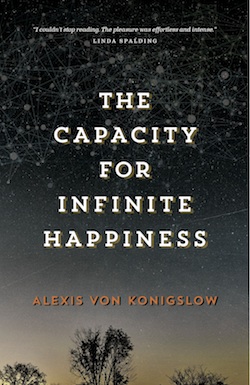
book cover - The Capacity for Infinite HappinessThe Capacity for Infinite Happiness (Buckrider Books) by Alexis von Konigslow is a solid first novel. Von Konigslow is a talented writer with a gift for language and storytelling. Straight away, she sets up the mystery and the tension, describing the scene as Emily’s great-grandmother, Ayala, prepares to flee Russia with her husband and daughter, Blima, Emily’s grandmother:

“Pay attention,” said the tall man.

He was so long that he seemed to be folded into the hallway. He was standing close to Blima’s mother, his big hands around her smaller ones, pressing papers into her palms. Blima had seen this man before, and she hadn’t liked him then either. She backed away, quietly so that they wouldn’t know she was there.

“Ayala, I need you to listen to me,” the man said again.

Ayala bowed into his chest. Blima shivered.

“I don’t want you to panic, or pretend that you’re bored. Here’s what I want you to do. When the officials ask to see your papers, I need you to pinch the little girl, pinch her hard. Don’t tell your husband that you’re going to do it. That way, she’ll be crying, you’ll both be concerned, everyone will want the scene to be over.”

Blima crouched down. She was the only little girl in the house.

“Also, make sure that your shirt is unbuttoned,” the man said, touching her mother’s blouse. “That will help.”

“I don’t want to do this,” said Ayala.

“As a plan, it’s perfectly safe. You’ll send these back by post. We’ll be together again before the end of the year.”

The questions that arise from this opening passage, notably about the man helping Ayala and her family, are central to the novel and keep you reading as it struggles to find its feet. The book’s format, which alternates between Harpo’s 1933 visit to the lodge and Emily’s 2003 visit, interrupts the flow at first and doesn’t become a tension-increasing device until about two-thirds of the way into the book. As well, while von Konigslow’s poetic writing is succinct, it is also repetitive on a few points: Harpo’s concerns about whether he’d make a good father; whether or not William, who Harpo meets in the woods on more than one occasion, is a real person or a figment of the actor’s imagination; and Emily’s ruminations about her thesis and her successive excuses for putting it off.

For almost 200 pages, The Capacity for Infinite Happiness is an OK read; its last 100-plus pages, however, as it becomes more focused and races towards “the reveals,” are excellent. A few minor edits would have made the novel a standout from start to finish. As it is, it is still worth reading for its unique premise, the quality of writing and its insights into Jewish life in the first half of the last century, the meaning of family, how we impact each other even across generations and, most important, love.
Posted on December 4, 2015December 3, 2015Author Cynthia RamsayCategories BooksTags Alexis von Konigslow, antisemitism, Harpo Marx
Hotel’s history full of stories

Hotel’s history full of stories

Harpo Marx and the Bodnes in the Rose Room. The hotel’s list of illustrious guests is almost literally endless. (photo from Algonquin Kid)

Michael Elihu Colby had the unique privilege to be brought up in New York’s legendary Algonquin Hotel. Well, not exactly brought up in it, but his grandparents owned it from 1946 to 1987 and he was there a lot.

Colby’s book, The Algonquin Kid (BearManor Media) is chock-a-block with stories from his experience as a youngster hanging around and also tales handed down through the years.

photo - Grandma Mary and Grandpa Ben Bodne
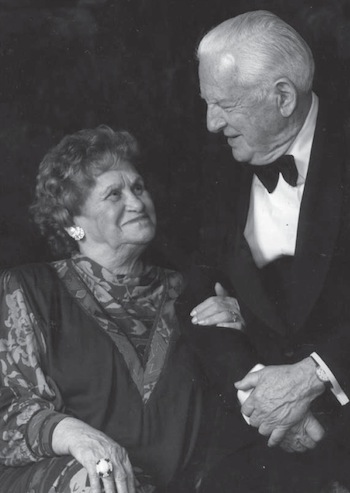
Grandma Mary and Grandpa Ben Bodne. (photo from Algonquin Kid)

Grandma Mary and Grandpa Ben Bodne loom large in the book, as they did in the hotel and, by extension, cultural life in New York City in the 20th century. The grandparents were from the southern United States and Ben became wealthy through oil during the Second World War and afterward sought to parlay his money into something else. Despite having no hotel experience, the couple threw themselves into the adventure.

The hotel was a dilapidated shadow of its former glory. On top of the million dollars the hotel cost, the family had to sink another $300,000 into making it decent. This renovation was not welcomed by all the guests. The hotel had residents who had lived there for 20 years and who were highly averse to change.

The book is fabulously gossipy and it would have been shorter, maybe, if Colby had listed the celebrities he didn’t run into. Tennessee Williams, Norman Mailer, William Saroyan and John Cheever were among the literary lights.

Although this was well past the hey-day of the famed Algonquin Round Table, some of those names were still hanging on, too.

Show biz figures included Ingrid Bergman, Kitty Carlyle, Tallulah Bankhead and Angela Lansbury, the latter two of whom lived at the hotel. Rosemary Clooney, Irving Berlin, Noel Coward, Ella Fitzgerald … the list is almost literally endless.

The Algonquin was welcoming to actors and artists blacklisted during the McCarthy era and also to African-Americans at a time when this was unusual. Among the bold-faced names in this category: Maya Angelou, Coretta King, Thurgood Marshall and Oscar Peterson.

The hotel staff included its own characters, like a telephone operator who had the skills of the CIA at tracking down anyone anywhere, and a quick-thinking maître D’: “When a guest found a fly in her salad, he popped it in his mouth, swallowed down the evidence, and exclaimed ‘Delicious! A raisin.’”

book cover - The Algonquin KidThis is a book of family stories and such stories, especially when the family is filled with characters, can improve with the telling. The author may or may not believe some of his own tales.

“Grandpa Ben claimed he first met a celebrity selling her a paper: he believed that woman, who tipped him generously, was Helen Keller,” writes Colby. Think for a moment about how likely that story is to be true.

How about this story of Grandma Mary welcoming Marilyn Monroe: “After greeting each other, Grandma remarked, ‘Marilyn, that’s the most beautiful mink you have on!’ Marilyn replied, ‘You think that’s something, you should see what’s underneath.’ She pulled open the mink, and wasn’t wearing anything. Not every kid can claim his grandmother was flashed by Marilyn Monroe.” Well, every kid can claim it.

Legendary Broadway librettist Alan Jay Lerner and composer Frederick Loewe were working in a ninth-floor hotel room, below the family’s 10th-floor apartment.

“One evening, Grandpa could no longer stand the ivories tinkling in Room 908 – one light below – disturbing his sleep. He phoned the hotel operator to ask Lerner and Loewe to quiet down, complaining, ‘I wouldn’t mind if they were writing something good, but this is just noise.’ It turned out Lerner and Loewe were creating the song ‘I Could Have Danced All Night.’”

Unlike others who visited or lived at the Algonquin, Colby is not among America’s greatest writers, but his stories are well worth the read.

Format ImagePosted on December 4, 2015December 3, 2015Author Pat JohnsonCategories BooksTags Algonquin Hotel, Ben Bodne, Harpo Marx, Marilyn Monroe, Mary Bodne, Michael Elihu Colby, New York
Proudly powered by WordPress