Skip to content
  • Home
  • Subscribe / donate
  • Events calendar
  • News
    • Local
    • National
    • Israel
    • World
    • עניין בחדשות
      A roundup of news in Canada and further afield, in Hebrew.
  • Opinion
    • From the JI
    • Op-Ed
  • Arts & Culture
    • Performing Arts
    • Music
    • Books
    • Visual Arts
    • TV & Film
  • Life
    • Celebrating the Holidays
    • Travel
    • The Daily Snooze
      Cartoons by Jacob Samuel
    • Mystery Photo
      Help the JI and JMABC fill in the gaps in our archives.
  • Community Links
    • Organizations, Etc.
    • Other News Sources & Blogs
    • Business Directory
  • FAQ
  • JI Chai Celebration
  • JI@88! video

Recent Posts

  • Story of Israel’s north
  • Sheltering in train stations
  • Teach critical thinking
  • Learning to bridge divides
  • Supporting Iranian community
  • Art dismantles systems
  • Beth Tikvah celebrates 50th
  • What is Jewish music?
  • Celebrate joy of music
  • Women share experiences 
  • Raising funds for Survivors
  • Call for digital literacy
  • The hidden hand of hate
  • Tarot as spiritual ritual
  • Students create fancy meal
  • Encouraging young voices
  • Rose’s Angels delivers
  • Living life to its fullest
  • Drawing on his roots
  • Panama City welcoming
  • Pesach cleaning
  • On the wings of griffon vultures
  • Vast recipe & story collection
  • A word, please …
  • מארק קרני לא ממתין לטראמפ
  • On war and antisemitism
  • Jews shine in Canucks colours
  • Moment of opportunity
  • Shooting response
  • BC budget fails seniors
  • Ritual is what makes life holy
  • Dogs help war veterans live again
  • Remain vital and outspoken
  • An urgent play to see
  • Pop-up exhibit popular
  • An invite to join JWest

Archives

Follow @JewishIndie
image - The CJN - Visit Us Banner - 300x600 - 101625

Byline: Cynthia Ramsay

Miller’s urgency to create

Miller’s urgency to create

Gallim Dance performs the Canadian première of Wonderland at Chutzpah! March 10-13. (photo by Yaniv Schulman)

Gallim Dance’s Wonderland premières in Canada at the Chutzpah! Festival March 10-13. It was inspired by artist Cai Guo-Qiang’s Head On, which is an awe-inspiring installation even when viewed only in photos. Ninety-nine wolves run into the sky, an arc of animals intent on moving forward and fast – right into a glass wall.

“I like this dance very much, which isn’t true of all my earlier works,” Andrea Miller, Gallim Dance founder and artistic director, told the Independent. “It’s the first of my works that I built like a story. It’s an absurdist narrative but a story nonetheless. I created four archetypal characters that depict the dangers of pack mentality. I use a broad range of music, from the Chordettes’ 1954 ‘Mr. Sandman,’ to Chopin, to indie singer-songwriter Johanna Newsom, to minimalist electronic music inspired by the circus.

“Seeing Head On at the Guggenheim Bilbao consolidated my mixed feelings about the war in Iraq,” she added. “As I was looking at the installation, I was making the dance in my head.”

The archetypes are “the fool, death, the lovers and Cassandra,” according to Gallim’s website. They “evolve in a universe influenced by the imagery of the American atomic age. Behind the smiles of an Esther Williams dream world, Wonderland reveals psychological and physical episodes of a herd acting as a unit through the uncoordinated behavior of self-serving individuals. Although pack mentality is a natural and ongoing strategy in the animal kingdom, among humans it can indicate a vicious, desensitized brutality and disregard for humanity – a concept that is at the core of Wonderland.”

Head On was part of Cai’s first solo show in Germany, at the Deutsche Guggenheim in Berlin in 2006. While communicating a universal message, the danger of people blindly following others, among its themes are the rise and fall of Hitler – Wolf’s Lair was one of Hitler’s headquarters – and the rise and fall of communism, as symbolized by the Berlin Wall.

Such heady source material is not unusual for Miller. The writings of Raymond Carver and Albert Camus, for example, were inspirations for Fold Here and Sit, Kneel, Stand, respectively.

“I used to read a lot,” said Miller, “but now I feel like I’ve replaced books with work emails and video. I’m currently in a literary desert, but I love reading. Anything can inspire me, not just books; I’m available for being influenced and inspired by what I live and see happening to people in the world.”

Mama Call was directly related to her Sephardi heritage.

photo - Gallim Dance founder and artistic director Andrea Miller
Gallim Dance founder and artistic director Andrea Miller. (photo by Peggy Jarrell Kaplan)

“I grew up in a Conservative Jewish home. My father grew up Orthodox and eventually became atheist and my mother was Catholic and converted to Judaism,” she said about her background. “Because we lived in Salt Lake City, one could feel, as Jews, like we were in a minority and the synagogue became a really important place for feeling part of a community. I guess because of that, Judaism has always been a strong presence in my life. I currently attend Shabbat services with my two children whenever we aren’t on tour. We also attend Catholic services with my boyfriend, their father. Truthfully, I can’t exactly delineate the contours of what is exactly Jewish in me, but I feel that it is a latent presence in my life. In any case, that’s ultimately a personal circumstance; everybody has their own personal circumstances.

“I feel that, in order to relate to humanity, to each other, to art, we must understand that our personal circumstances are just departure points, which we should be ready to transcend. In this sense, I am more drawn to the universal human condition than restricting my artistic research to my personal circumstances, whatever they may be (nationality, age, cultural background, ethnicity or spiritual beliefs). Mama Call began its inspiration with the Jewish Diaspora and eventually became a story of home for any immigrant or displaced person.”

Miller’s professional journey began in Salt Lake City at the Children’s Dance Theatre, which was developed by a Doris Humphrey disciple, she explained. “The philosophy behind the training was in discovering movement through improvisation and dramatic play, and I loved it.

“We moved to Connecticut when I was 9 and, by pure coincidence, I ended up dancing with another Humphrey master, Ernestine Stodelle, and learned the technique and repertory of Doris Humphrey and Charles Weidman. At that time, I became sort of a young expert in pioneering modern dance, hungry to interpret the works of [Martha] Graham, [José] Limón and choreographers of that era.

“I got into Juilliard, which baffles me to this day considering I had very little ballet training. In my first year at Juilliard, the director Benjamin Harkarvy would work often with me, imploring me to undo myself, my body, from the 1930’s esthetics. It took a year of identity crisis and it was then that I started obsessing over living choreographers and contemporary art. I met Ohad Naharin at Juilliard and, after graduating, joined the ensemble Batsheva.”

It was during her time with Batsheva, she said, that “choreography changed from a passion to an urgency.” When she left the ensemble, she started creating her own work. Back in New York, she founded Gallim in 2007.

“Early rehearsals of the company were at Juilliard between 9 p.m. (when the students typically had to leave the studios to rest) and midnight,” she said. “My first piece was a quarter evening called Snow. I made it for a performance by video application at Joyce SoHo. It went well and they invited us back for a solo week for which I created my first full evening, I Can See Myself in Your Pupil. After that, we were invited back for two weeks, where we repeated Pupil and premièred Blush. Ella Baff from Jacob’s Pillow saw it and booked it for the summer festival. Everything started moving from there. The next year, we were asked to open Fall for Dance and perform at the Joyce.”

Gallim Dance has become an internationally renowned company. Miller has won multiple honors and her work has been commissioned around the world. Also of note is the company’s financial viability and continued growth. According to its 2014 annual report, that year ended “with a balanced budget just over $700,000 and an increase in net assets of more than $46,000.” In addition to looking after itself, the company invests in community programs in its Brooklyn neighborhood and beyond.

“I don’t feel I have any innate talent in the hard skills of business but I seem to have an intuition for the soft ones,” said Miller when asked about her apparent business savvy. “One of my understandings for both my business and my choreography is that progress is incremental and incremental steps take giant leaps of creativity, risk, strategy, planning and commitment. I think I have a combination of chutzpah and common sense that helps me push us forward without threatening our sustainability. I’ve learned a lot about leadership and business from my dancers, staff and board.”

Early in the company’s history, Miller articulated her vision for Gallim Dance: “to play inside the imagination, to find juxtapositions in the mind and body that resonate in the soul, to investigate our limitations and pleasures, and to realize the endless human capacity for inspiration.”

“It describes where everything begins for me and how I relate to all art, not just mine,” she told the Independent. “I think this vision captures both the values I hold for the process of making dances, as well as the larger impetus for making dances at all.”

Gallim Dance performs Wonderland March 10-13, at Rothstein Theatre. For tickets ($29/$25/$21), call 604-257-5145 or visit chutzpahfestival.com.

Format ImagePosted on February 26, 2016February 25, 2016Author Cynthia RamsayCategories Performing ArtsTags Andrea Miller, Cai Guo-Qiang, Chutzpah!, Gallim Dance, Wonderland
The West Coast style

The West Coast style

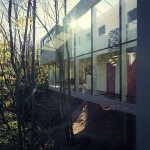
Oberlander Residence II, Vancouver. Peter Oberlander and Barry Downs, architects, 1969. Photograph by Selwyn Pullan, 1970. Courtesy of West Vancouver Museum.

New Ways of Living: Jewish Architects in Vancouver, 1955 to 1975, “focuses on two significant expressions of modernism in the practices of Jewish architects and landscape architects in Vancouver,” explained curator Chanel Blouin at the exhibit’s launch Jan. 28. “First, the integration of the West Coast Modern home into the natural landscape in a way that invites the outdoors in. And, second, in creating home designs that respond to the specific needs and living habits of the family within.”

For her research, Blouin interviewed architect Judah Shumiatcher; architects Kate and Erika Gerson, daughters of the late architect Wolfgang Gerson; University of British Columbia professors emeritus Andrew Gruft and Rhodri Windsor-Liscombe; Leslie van Duzer, head of UBC School of Architecture and Landscape Architecture (SALA) and author of House Shumiatcher; and landscape architect Cornelia Hahn Oberlander, whose late husband, architect Peter Oberlander, is featured in the exhibit, as well.

In addition to the interviews, Blouin traveled to the Canadian Centre for Architecture in Montreal to consult their collections, in particular that on Hahn Oberlander. A highlight of the online exhibit, which can be found at jewishmuseum.ca, is the photography of the houses featured, including photos by Michael Perlmutter, Selwyn Pullan and Fred Schiffer.

“Architecture and the design of cities have always been interests of mine, and I’ve known for awhile that there are and have been members of our community who are or were innovators in these fields,” said Michael Schwartz, coordinator of programs and development at the Jewish Museum and Archives of British Columbia, about the exhibit’s origins. “As we move from theme to theme in each of our exhibits and in each issue of The Scribe, it seemed fitting to turn the lens on this group. Chanel has a footing in architectural history, so when we hired her, this was the topic she was most drawn to. As she progressed through her research, it became clear what era and which individuals to focus on.”

Blouin was hired by the JMABC for the summer of 2015 with support from the Canadian Heritage program Young Canada Works. An extension to the grant allowed her contract to continue through January 2016, said Schwartz, “giving her time to dig much deeper into the topic and produce a more comprehensive result.”

Blouin, a master’s student in art history at UBC, will begin her PhD at University College London in September. “My current research was influenced by my work on New Ways of Living and considers the complex genealogy of the mid-century modern residential designs conceived by the Oberlanders and Wolfgang Gerson,” she told the Independent. “I want to examine how these figures’ exposure to Central European modern art and architecture of the Bauhaus and Werkbund in the Weimar period, as well as their exile and studies at the Architectural Association and the Harvard School of Design with Walter Gropius, influenced their practices in Vancouver.”

About 200 people attended the launch of the exhibit at Inform Interiors. There was a panel discussion between Blouin, Shumiatcher and Windsor-Liscombe; and Hahn Oberlander, the Gersons and van Duzer were in attendance. “There were also representatives from the Jewish Federation, the City of Vancouver and Canadian Heritage, all strong supporters of the JMABC,” said Schwartz.

In his opening remarks, Schwartz noted, “Not only are we very pleased to launch this new exhibit, New Ways of Living, but this week marks the 45th anniversary of the Jewish Museum and Archives of B.C.

“We have with us tonight our founder, Cyril Leonoff, who had the original vision of an organization that would preserve and celebrate the history of Jewish life in B.C…. With a small, dedicated corps of volunteers, Cyril collected documents and carried out oral history interviews with some of our community’s earliest pioneers – people who, in the 1960s, were already in their 80s and 90s.

“From this founding collection, our archives have since grown to comprise over 300,000 photographs, 750 oral history interviews and 300 metres of documents recounting all aspects of the rich 150-year history of our community.”

In the panel discussion, Blouin spoke about the process of developing and curating the exhibit. “I also provided an introduction to the major themes in the exhibit, such as the features of the West Coast style of architecture, site specificity and the important events that introduced Vancouverites to the modernist ethos in the postwar period,” she said. “Rhodri Windsor-Liscombe elaborated further on Jewish involvement in the development of the West Coast Modern home and considered questions of Jewish identity. Judah Shumiatcher shared the story of House Shumiatcher. He described the experience of designing his home and the challenges that the steep slope of the landscape posed as well as the property’s incredible views. We also had a lively Q&A period with many interesting questions from the audience.”

This interaction and excitement is why the JMABC does a launch event. While online exhibits are more cost-efficient and “have no expiry date,” said Schwartz, meaning that researchers around the world will be able to access this material years from now, “there is still value in creating an occasion for people to come together to learn about and celebrate our past. This is why events like the exhibit launch are so important; they give us the chance to dig deeper into the topic and share with our audience a glimpse into the exhibit creation process. This shared experience so essential to museums is generally missing from an online exhibit, hence the need to supplement the exhibit with public programs.”

Blouin said, “One of the most interesting ideas that I hope people will take away from this exhibit is the fact that Vancouver is home to an extraordinary regional style. Many iconic West Coast Modern homes are located in Point Grey and West Vancouver and it’s possible to visit some of them – the West Vancouver Museum provides annual tours. The West Coast style is complex and the Jewish architects who arrived to the city in the postwar period played a prominent role in its development. It’s a fascinating history!”

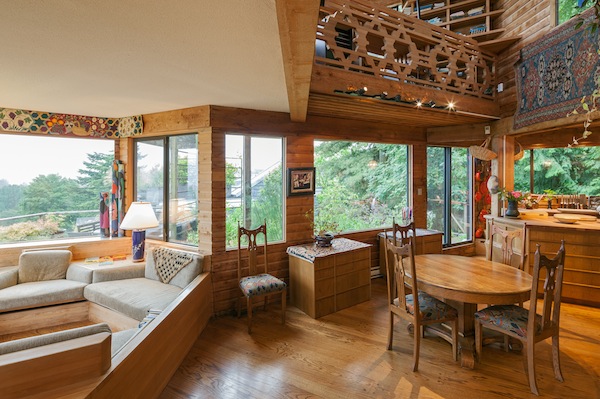
photo - Interior of House Shumiatcher, 2013. Judah Shumiatcher, architect, 1974
Interior of House Shumiatcher, 2013. Judah Shumiatcher, architect, 1974. Photo by Michael Perlmutter.

The exhibit online, the content of which Blouin wrote, explains that Vancouver “underwent a period of momentous transformation and modernization” after the Second World War. “Returning veterans and new immigrants alike prompted a need for more affordable housing, transportation systems, civic spaces and infrastructure. Between 1940 and 1970, Vancouver required 45,000 new housing units to accommodate the city’s growing population. The city’s expansion was informed by new thinking on improved civic living.”

Blouin explained, “The vibrant art and architecture community that converged around the newly founded School of Architecture at UBC introduced the modernist ethos in Vancouver through various means, including a series of Richard Neutra lectures. The first director of the school, Frederic Lasserre, and B.C. Binning promoted modern architecture in response to the shifting needs of the city.”

The regional domestic architecture of this period “was the post-and-beam house built of locally sourced cedar with wide overhangs and large horizontal windows. Regional West Coast innovations included an exposed timber frame, which allowed for open fluid spaces and immense freestanding ribbon windows oriented toward the picturesque views of the Pacific Northwest landscape.”

While parts of the modernist project will not carry into the future – Marine Gardens, for example, 70 family-sized units designed by Hahn Oberlander and Michael Katz in the 1970s, will be replaced by large residential towers comprising more than 500 units – it will leave a legacy, believes Blouin.

“I think the modernist project has and will continue to inform our thinking about sensitive architecture that responds to both the landscape and the people who inhabit their interiors,” she said. “I hope that New Ways of Living and similar projects, such as the UBC School of Architecture and Landscape Architecture (SALA) West Coast Modern homes book series, will raise awareness about the significance of the West Coast-style homes and the importance of preserving them as they become endangered by escalating land values.”


Format ImagePosted on February 26, 2016February 25, 2016Author Cynthia RamsayCategories LocalTags architecture, Chanel Blouin, Gerson, Jewish Museum and Archives of British Columbia, JMABC, Michael Schwartz, Oberlander, Shumiatcher, West Coast Modern
Join the wedding party

Join the wedding party

Left to right, Laura Luongo (Mindy), Melanie Preston (Georgeanne), Michelle Weisbom (Meredith), Devon Oakander (Tripp), Christine Reinfort (Trisha) and Yvette Benson (Frances) in Metro Theatre’s production of Five Women Wearing the Same Dress. (photo by Tracy-Lynn Chernaske)

The wedding reception thrown by Metro Theatre Vancouver will be one of the most engaging and fun that you’ve attended – without the hangover or other morning-after regrets. Well, not necessarily, anyway.

Five Women Wearing the Same Dress is at Metro to March 12 and it is well worth seeing. Not only will you be supporting a wonderful theatre space but some very entertaining theatre, as well.

Two Jewish community members are among the five women at this over-the-top Knoxville, Tenn., wedding – Michelle Weisbom as Meredith and Melanie Preston as Georgeanne. Meredith is the younger sister of the bride, Tracy, who none of the bridesmaids, including Meredith, like. Georgeanne was a friend of Tracy’s in high school but Tracy’s then fiancé, Tommy, caused a lasting rift. And Tommy is a recurrent topic among the bridesmaids – he is what you would call a real shmuck.

We meet the bridesmaids after the wedding, just as the reception at Tracy’s parents’ home is starting. The women are decked out in teal sleeveless taffeta dresses that wouldn’t look half bad but for the huge sash with a bow that wraps about the butt, and the hat with a bow to match.

Frances (Yvette Benson) is the first to take refuge in Meredith’s bedroom. Tracy and Meredith’s cousin, Frances is a believer, and every time she is offered a drink, a smoke, a joint, she declines, giving as her reason, “I’m a Christian.” One of the best exchanges in the play is between Frances and Trisha (Christine Reinfort), another former high school friend of the bride, who describes herself as “the reigning queen of the bad rep.” They argue about the difference between having the right to an opinion versus imposing your opinion on others, and Frances’ accusation at one point, “That is secular humanism talking!” is hilarious – and thought-provoking – in context.

Rounding out the bridal party is the groom’s sister, Mindy (Laura Luongo). A lesbian whose coming out was almost universally poorly received, except by her cousin Tripp, Mindy is high-strung and somewhat defensive. She is also clumsy and a compulsive eater, at least in stressful situations, which this wedding is for her and her fellow bridesmaids.

The one man in the cast is Tripp (Devon Oakander), who we meet late in the play, though we hear about him earlier, as Trisha finds him attractive and talks about him with the other women. She tries to resist his charms, as she has slept with many, many men to date and been hurt many times. The scene between Trisha and Tripp is delightful, though it is one spot at which the play loses a bit of its momentum. It is unclear why playwright Alan Ball (whose credits include American Dream, True Blood, Six Feet Under) needed have a male character in the play at all. Perhaps to defend his sex? Show clearly that there are some good men out there?

The only criticisms of Metro’s Five Women lie with the writer. He touches on a number of themes – religion, homophobia, AIDS, sexual abuse, drug use, race, wealth, etc. – and the points are sometimes lost. As well, there are a few moments where the story drags a bit. But director Don Briard has done a fantastic job with this production overall. All of the actors have just enough of a Southern twang that the play is well-situated geographically, and the set of the play, which premièred in 1993, puts it firmly in its temporal space. The actors have a great chemistry and interact with each other convincingly. You really will feel as if you’re the sixth bridesmaid in the room – though much more comfortably dressed.

Five Women is recommended for audiences age 16+. For tickets ($24/$21, two for $35 every Thursday), call 604-266-7191 or visit metrotheatre.com.

Format ImagePosted on February 26, 2016February 25, 2016Author Cynthia RamsayCategories Performing ArtsTags Alan Ball, Melanie Preston, Metro Theatre, Michelle Weisbom, weddings
Don’t let the fear overwhelm

Don’t let the fear overwhelm

Itai Erdal brings A Very Narrow Bridge to Chutzpah! March 5-13. (photo by Emily Cooper)

There’s the family into which you were born, and the families you create yourself. Itai Erdal has built a life in which he is surrounded by family, both on and off stage. He often shares vulnerable aspects of himself and his family in his work, and he is one of the more collaborative playwrights out there.

While A Very Narrow Bridge, which runs March 5-13 at this year’s Chutzpah! Festival, is about Erdal’s “relationship with his sisters, Judaism and the state of Israel,” it is written by Erdal, Anita Rochon (artistic director of the Chop theatre company) and Maiko Yamamoto (artistic director of Theatre Replacement), is directed by Rochon and Yamamoto, and co-stars Erdal, Anton Lipovetsky, Patti Allan and Tom Pickett. The original score is written and performed by Talia Erdal.

“It is a dream come true for me to work with my sister,” Erdal told the Independent. “She is a brilliant musician and I’ve always admired her talent and her spirit. Talia is much younger than me … and we’ve been very close from the day she was born. In the past few years, she has become religious and, since I am not religious at all, I was worried that it would pull us apart. This fear of mine is indeed addressed in this show, which makes her being here and participating in the show even more special.”

The play’s description is minimal: Erdal “relives a trial in order to obtain a get – a divorce document in Jewish religious law – where everything he knows is at stake.” Its title comes from a teaching of the founder of the Breslov Chassidic movement, Rabbi Nachman of Breslov (1772-1810): “All the world is a very narrow bridge, and the most important thing is not to be overwhelmed by fear.”

That certainly seems to be Erdal’s approach to creativity. A Very Narrow Bridge is not the first work in which he puts a part of his life on a public stage.

“I’ve always been a very candid and open person,” he said. “I am an extrovert and I enjoy telling stories and being the life of the party. Having said that, in all my shows I talk about very personal things and sometimes about things that are hard to reveal or even to admit to myself. But I’ve learned that when something is hard to talk about, it often makes for good dramatic material, and I really trust my collaborators, who are all brilliant and steer me in the right direction.”

And they have. How to Disappear Completely, which was also a collaborative writing effort, is a one-man show that deals with the last months of Erdal’s mother’s life before she passed away from lung cancer. First produced by Chop Theatre for Chutzpah! 2011, it has since been mounted in many other cities, and continues to tour. It was nominated for Jessie and Dora awards, which both honor excellence in theatre.

Rochon was one of the writers of How to Disappear Completely, and its producer. Erdal, who is also an award-winning lighting and set designer, has worked with Yamamoto before, as well.

“One of the things I like the most about theatre is the collaborative nature of the process, and knowing each other well and understanding each other’s strengths and weaknesses makes it that much more rewarding,” he said. “The three of us have done many shows together, in different capacities. I have lit five shows for Maiko’s company, Theatre Replacement, some of which she acted in, some of them she directed and all of them she produced…. All this familiarity makes for a very symbiotic process and a totally democratic room, where no one is precious about anything and the best idea always wins.”

Erdal is the artistic director of Elbow Theatre, which is presenting A Very Narrow Bridge. He explained how the collaboration with his fellow artistic directors on this work came about.

“I always wanted to do a show about my sisters and my complicated relationship with Judaism and the state of Israel, and I always wanted to work with my dear friend Maiko, so I approached her and pitched her this project about three years ago and we’ve been working on this project ever since.

“Initially, we thought that Maiko would be on stage with me, so we approached Anita, who is in my mind the most exciting director in Vancouver. When we started writing this play, the focus shifted from my sisters to a show about immigration and Judaism, we added the three rabbis and Maiko’s role has changed from performer to writer and director.

“Creating a show from scratch is very hard and you never know which direction it will take,” he added, “so it’s important to stay open and do whatever serves the play. The various directions this process took have led us to create an exciting piece of theatre that we are all proud of.”

Would A Very Narrow Bridge exist if Erdal had never left Israel?

“Since this play is about emigrating from Israel, I am sure I couldn’t have written it if I still lived there,” he said. “Even though I am very happy in Canada, immigration is a very hard thing to do and this show is about the lingering doubt in the back of every immigrant’s mind: Did I do the right thing? Would I have been happier had I stayed home?

“When I grew up in Israel, everybody around me was Jewish, so I never felt particularly Jewish. I knew that there were people in the world who weren’t Jews, but I had never met them. Since moving to Canada, I feel a lot more Jewish because I am defined as a Jew by my surroundings. It’s a bit like family: you take it for granted when it’s there and you start appreciating it when it’s gone. Moving to Canada made me appreciate my heritage and my family, and this show is about both.”

A Very Narrow Bridge runs March 5-10, 12-13, 7 p.m., in the Dayson Board Room of the Jewish Community Centre of Greater Vancouver. For tickets ($29/$25/$21), call 604-257-5145 or visit chutzpahfestival.com.

Format ImagePosted on February 19, 2016February 18, 2016Author Cynthia RamsayCategories Performing ArtsTags Chutzpah!, Israel, Itai Erdal, Judaism, Narrow Bridge
Exploring sound and space

Exploring sound and space

Israel’s Victoria Hanna is coming to Vancouver for the Chutzpah! Festival (photo from Chutzpah!)

Victoria Hanna is unique. There is no doubt that her concert at the Chutzaph! Festival on Feb. 23 will be one of the most uplifting and intriguing performances you’ve ever seen.

A longtime vocalist and performer, Hanna’s mainstream popularity skyrocketed last year when the video of her song “Aleph-Bet (Hosha’ana)” went viral. She describes herself as a voice artist, and the phrase does best describe her work. Though music is a large part of it, Hanna explores the sounds that we make when we speak, the physical mechanics required to form letters, diacritics (the nekudot in Hebrew) and words, their meanings and those of the space into which they travel. She uses her whole body as an instrument, singing, voicing beats, gesturing with her arms, tapping her chest, stamping her foot. She is mesmerizing to watch and hear.

“I am very curious about voice and speech,” Hanna told the Independent. “I had a stuttering problem and it made me enter deeply into the act of voice.”

When Forbes Israel chose the Jerusalem-based artist as one of the 50 most influential women in 2015, it noted as one of her most important messages: “If you have a disadvantage you can turn it into a kind of gift.”

Hanna grew up in Jerusalem in a religious family, “in which the language and elocution of prayer were valued, above all other arts,” notes her bio. Hence, her source material: texts such as Sefer Yetzirah (Book of Creation, traditionally ascribed to Abraham) and the writings of 13th-century kabbalist Rabbi Abraham Abulafia.

“I grew up hearing both Iraqi-Persian and Egyptian liturgy,” she said, “and it influenced my art in the sense that I am completely intrigued by the scales and accents.”

The way in which Hanna presents the melodies and the rhythms of the texts gives listeners a sense of meaning even if they don’t understand the words.

“When I sing in ancient Hebrew for audiences who do not speak Hebrew,” she explained, it provides “a better understanding that language is sound, and music crosses boundaries.”

She also crosses boundaries between the seen and the unseen, making tangible the intangible. She uses letters, nekudot (or vowels), syllables and her whole body to create choreography in the space sound inhabits. She refers to it as “voicing space.”

“The concept,” she said, “means ‘to fill the space with voice,’ giving the voice action. Voice in action has to react to space. When you intend to put the voice into space, then it is called ‘voicing space.’”

Her art includes song and spoken word.

“Singing has to do with the purity of voice and speaking has the intention to deliver information,” she explained. “These two levels are mentioned in the kabbalistic scripts as two different dimensions.”

Her performances also include theatre, music, of course, and video or some form of visual. In a 2015 lecture-performance at Tel Aviv University (TAU), which she has posted on her website, she uses a dry-erase board to illustrate various concepts.

A graduate of Nissan Nativ Acting Studio, Hanna has performed around the world – in Mumbai, Berlin, Sao Paolo and Boston, to name only a handful of the diverse places she has been. Her Chutzpah! show in Vancouver marks her first visit to Canada.

Hanna recently released her second single, “22 Letters,” a “kabbalistic rap from Sefer Yetzirah.” In the TAU lecture, she explains that there are 22 letters (in Hebrew). These foundation letters are engraved by the voice, carved with breath set in the mouth in five places: in the throat, in the palate, in the tongue, in the teeth, in the lips. With these 22 letters, God depicted what would be formed and all that would be formed; He made nonexistence into existence. She connects the creation of letters, writing, to human conception, birth. Therefore, our souls are full of letters, from head to foot, and the letters combine with the nekudot, alternating sounds, back and forth, in many melodies.

Her work is thought-provoking as well as entertaining, but is there some specific understanding that she is seeking, or that listeners are supposed to glean? “The exploration is the purpose,” she said, examining the “meeting point between voiced language and space.”

And it’s a journey that many are now following her on. As to what about her personal search speaks to so many people, she said, “I think that voice is a universal code, the basis of everything. The word was created by sound.”

For more on Hanna, visit victoriahanna.net. Her Feb. 23 performance at Rothstein Theatre starts at 8 p.m. For tickets ($29/$25/$21), call 604-257-5145 or visit chutzpahfestival.com, where the entire festival schedule can be found.

Format ImagePosted on February 12, 2016February 23, 2016Author Cynthia RamsayCategories MusicTags Chutzpah!, kabbalah, Victoria Hanna
Join Hotz at Just for Laughs

Join Hotz at Just for Laughs

Jeremy Hotz is coming to British Columbia, starting with a show in Kelowna on Feb. 25. (photo from Just for Laughs)

For a man whose current show is the International Man of Misery Tour, whose CTV special was What a Miserable Show This Is and whose DVD is called What a Miserable DVD This Is, Jeremy Hotz is a very funny and upbeat guy. He’s also really pleasant and cheerful on the phone.

Hotz spoke to the Jewish Independent on Jan. 27 from Toronto, where he was doing a press run for his show, which is being presented by Just for Laughs. The month-long Canadian tour started in Jasper, Alta., but then Hotz returned east to perform in Newfoundland. He is now making his way west and his first of four shows in British Columbia is in Kelowna on Feb. 25. The trip has him performing almost every day, sometimes twice in a day.

“I don’t work in the same order or anything,” he said. “A lot of stuff I make up is specific to the city that I’m in, so it’s quite fresh for me every single time I go on stage. I’m a very free-form comedian. I include the audience in the performance so they’re part of the show. It’s like a comic working without a net. That’s what seems to work the best for me, even though a lot of comics will tell you, ‘you should never do that.’ But, of course, everything that I’m told I shouldn’t do, I do. I put my hand in front of my face, I turn my back to the audience, I do everything wrong, but if you do all those wrong things together, I guess it works.”

Whereas many comedians have their prepared routine and will perform the same jokes from show to show, Hotz has several concepts that he carries from one performance to another – complaints about getting older, for example – but the content will be different. “That’s because I can’t remember the damn jokes,” he said.

He explained that he doesn’t plan anything out. “Planning gives me anxiety,” he said. “I suffer from this generalized anxiety disorder … and what happens to me right before shows when there’s stuff looming and coming up, it can get very bad, almost debilitating…. But, once I get out there, it just melts away, it’s gone. I feel much more comfortable in front of a theatre full of people than in a one-on-one conversation with a stranger.”

He said that he ended up being a comedian in part because he never really got any other jobs when he was younger. “I had to choose stand-up because it really was the only thing that was working for me.”

Humor has always been a part of his life.

“We were Jews, so when we got together for dinners, it was funny,” he said. First starting out as a comedian, “I didn’t even know there were comedy clubs. I didn’t understand why people would have to go to a club to see funny, and then I realized, oh, not all families are funny, I get it.”

While he had a bar mitzvah and attended Jewish school for six years as a kid, Hotz said, “My dad was the one that held the Jewish thing together in the family. My mother, of course, was Jewish as well, but she came from South Africa, like he did, and her family wasn’t observant. We observed the High Holidays, the Yom Kippurs, we had Passovers, things like that, but as far as going to the synagogue every Saturday, we didn’t do that.”

Born in South Africa, Hotz was a year old when the family moved to Canada; he has an older brother and a younger sister. He remained here until he moved to the United States in 1997.

“What happened was I went to the Just for Laughs comedy festival in Montreal and then these people from Disney gave me this big deal,” he explained. “They just threw a whole bunch of money at me to stand there and do nothing for a year. I guess they were keeping me off the market and they were saying they were going to do all these things with me. They did nothing, but they gave me that chunk of money and, on that money, I moved to Los Angeles.”

Joining his household soon will be a purebred long-haired chihuahua named Shackleton, after the polar explorer. Hotz is getting him from a longtime friend and had just seen the puppy while in Toronto for the press run. “We went on Canada AM and he was a fantastic little star,” said Hotz. “He’s only three months old.”

At best, Shackleton might be five pounds at his adult weight, Hotz added. “His nickname, of course, will be Shaq, which will be very funny because Shaq [O’Neal] is the big giant basketball player and this dog will be about five pounds.”

After the Just for Laughs tour, there will be a few projects to which Hotz will return his attention.

“We’re right now working on this documentary that’s going to bring to light this anxiety thing that I suffer from because it’s no joke,” he said. He described it as being “like an evil man that waits around the corner and can just pop out at any second.” While fine on stage, it’s generally “in full force” before the show, so he brings his brother, who’s a psychologist, on the road with him, at least for the beginning of the tours, “to get my head thinking about the right things.”

Even when acting in TV or film – Hotz is in Call Me Fitz, and has done other television shows and the movies My Favorite Martian and Speed 2 – the anxiety affects him. He was diagnosed about two and a half years ago.

In addition to the documentary, Hotz said he and his writing partner, Brian Hartt, have a couple of projects that they would like to have produced. On his wish list for himself is an HBO special.

“I’ve pretty much done the Lettermans and the Lenos and other specials, Comedy Central … but I’d like to do one HBO special. That would be something for me to do,” he said.

Hotz is looking forward to performing at Vogue Theatre. “I think it’s one of the best venues,” he said, “and I really hope that a lot of people are there. I know that there’s a comedy festival [jflnorthwest.com] going on at the right time, which they’ve made me part of, so hopefully that’ll be neat. And it’s a Just for Laughs thing, so that makes me feel all warm and fuzzy because they kind of launched my career. It’s very difficult to get out of Canada – because of Just for Laughs and the festival, that’s how I did it.”

While Montreal isn’t on this tour – and Hotz hasn’t done the main Just for Laughs festival for awhile – he said he’ll be there this July. While locals will be able to watch that performance on television, no doubt, his B.C. dates are a rare opportunity to see the award-winning comedian in person. Hotz is in Kelowna Feb. 25 (Kelowna Community Theatre), Vancouver Feb. 26 (Vogue Theatre), Nanaimo Feb. 27 (Port Theatre) and Victoria Feb. 28 (McPherson Playhouse). For tickets ($45.50), visit hahaha.com/en/jeremyhotz.

Format ImagePosted on February 12, 2016February 11, 2016Author Cynthia RamsayCategories Performing ArtsTags Jeremy Hotz, Just for Laughs
Applying Korczak’s lessons

Applying Korczak’s lessons

Dr. Mary Ellen Turpel-Lafond speaks at the fourth session of “How to Love a Child,” the Janusz Korczak Lecture Series. (photo by Cynthia Ramsay)

“Rights are paper tigers, just pieces of paper, unless there are people courageous enough to defend them, and unless there are mechanisms to enforce them and compel them. The child who has a right to be heard but no one listens to, and disappears without ever being heard, never really had a right to be heard,” warned B.C. representative for children and youth Dr. Mary Ellen Turpel-Lafond at the fourth session of “How to Love a Child,” the Janusz Korczak Lecture Series.

The Jan. 21 lecture at the University of British Columbia, which is part of a six-part series co-organized by the Janusz Korczak Association of Canada and UBC’s faculty of education, focused on The Human Rights of Aboriginal Children. Also speaking was Dr. Mike DeGagné, president and vice-chancellor of Nipissing University, who was the executive director of the Aboriginal Healing Foundation (AHF), which was established in 1998 with a grant from the federal government and wound down its work in 2014. Its mandate was “to encourage and support, through research and funding contributions, community-based aboriginal-directed healing initiatives which address the legacy of physical and sexual abuse suffered in Canada’s Indian residential school system, including inter-generational impacts.”

Dr. Grant Charles, associate professor at UBC School of Social Work, acted as moderator, and Janusz Korczak Association president Jerry Nussbaum also spoke, explaining briefly who was Janusz Korczak. The educator, writer and orphanage director – after whose book How to Love a Child the lecture series is named – not only wrote about his theories, but lived and died by them. When the Nazis created the Warsaw Ghetto in 1940, Korczak’s orphanage was forced to move there, and Korczak went with the children. In 1942, he and the almost 200 children in his care were taken to Treblinka, where they were murdered.

Nussbaum reminded the audience of Korzak’s philosophies on the rights of children and their direct influence on the content of the United Nations Convention on the Rights of the Child. Korczak believed that every child has a right to love, said Nussbaum, and that “children offered love and care will reciprocate with love and care.” Children have a right to be taken seriously, to education, to protest an injustice, among other rights. Nussbaum explained that Korczak believed that the health of a society could be gauged by the health of its children.

Despite protection under the UN convention, there are many children and youth who are marginalized and, in Canada, First Nations children are among those who are the most at risk. Dr. Jo-Ann Archibald, associate dean for indigenous education at UBC, gave an example of one of the research programs at the university’s faculty of education that is trying to ameliorate this situation. Called Awakening the Spirit, “it’s about revitalizing canoeing at Musqueam,” she explained. There is cooperation among different faculties and some students are involved, “but the most important part is the Musqueam communities that partner in this research. They are the ones who determined this particular project because they felt that they wanted to have something positive in their community for the young people, for the youth.”

Canoeing, she said, was a very important part of the community lifestyle, “it was a way to build family and community cohesiveness and also have fun and learn about the environment at the same time.”

The benefits of the research project, she said, “will be realized in educational materials, in the way of revitalizing important values, the Musqueam language, ensuring we have intergenerational learning.”

photo - Mike DeGagné
Mike DeGagné (photo from nipissingu.ca)

DeGagné has had 20 years of experience working with the repercussions of residential schools. He said his views about rights, “especially indigenous children’s rights, I color it with the history of residential schools.”

Often when there is a conversation within the community about indigenous issues, he said, it begins with the high rates of suicide, poverty, over-representation in the justice and child welfare systems, “the rosary of our grievances.” Given that indigenous children have rights, yet the grievances continue, he asked, “How can we be sure those rights are being supported and upheld?”

When AHF began, he said, grant applicants would ask, for example, whether the foundation had an approved list of elders that they could use. “We were astonished. Can you imagine in your own community … in your own spiritual context, asking if your priest was OK, if your rabbi was OK? This is the making of the colonial mind. After years of being subjected to doing it someone else’s way, even when we came along, we could not engender people doing it their way.” He described this as “a learned helplessness,” and a lack of trust in their own culture.

To move forward, it is important to talk of the past, he said. He used the metaphor of a pebble being dropped into a pond to describe the effects of the residential school system. The child’s abuse at the hands of an adult is at the centre, it is the pebble being dropped; the next ripple out is one child at a residential school abusing another child (“learned behavior”); the next is when that person leaves the school and returns to their community and starts a family in which violence takes place; then the violence between that family and another in the community. As we look at the outcome, standing on the outside, we see the high rates of suicide, family violence, neglected children, but we, as observers, “can’t see anything but the dysfunction and so infrequently do we get to examine what happened in the middle, what happened in that first instance of violence, what happened when that child’s human rights” were disregarded. “This is why we talk about history,” this is why 100 years of residential schools is important, he said.

To change the situation, he pointed to two necessities: the establishment of fairness, “the money that we spend on First Nations child welfare should be equal to the money that we spend in the rest of the population’s child welfare systems”; and transference of control to First Nations peoples of their lives, agendas and resources.

DeGagné commended the Truth and Reconciliation Commission on capturing the hearts and minds of Canadians and drawing them to indigenous issues, and for talking about system reform as opposed to tweaking or just adding money to a dysfunctional system. But, among his criticisms of the commission’s recommendations is that they do not make him uncomfortable. “It turns out that, in the reconciliation between you and me, indigenous people and non-indigenous people, that 93 of the 94 recommendations require that you do something…. I’d like to feel a lot more uncomfortable reading these recommendations because reconciliation is going to require that I work and that you work, and not that you come to stand by me, but that somehow I come to stand in the middle with you. And so, I think, too often with these recommendations, and this could be a reflection of the colonized mind, we are calling upon someone else to fix the problems with our community. That’s a concern of mine.”

The TRC, he added, also describes issues as if there has been no progress in the last 20 years – by the churches, universities, governments and others – towards reconciliation. “We have much to do, but we have to start by acknowledging the good work of all us and how much progress we’ve made.”

Turpel-Lafond spoke about how long it takes to change systems. “You have to really make that investment [in change], and it takes time,” she said.

AHF “laid the groundwork for thinking about healing” and the view of storytelling and its importance in healing, she said. “Stories, particularly the stories of grievances that aboriginal adults have – and many of our parents and grandparents have – are stories that needed to be told, that needed to be heard, that needed to be listened to.” AHF “gave resources for people to validate that process of allowing individuals who had been through residential school, their personal experience and their collective experience, to be told and listened to in a very sincere way in which they were supported, but also could create that medicine toward healing.”

Turpel-Lafond’s great-great-grandparents were the first two students at St. Michael’s Indian Residential School in Duck Lake, Sask. She spoke of the difficulties in sharing some of the stories with her own children. “Children are not always ready to hear those stories. I’m not trying to be over-protective, but we need to think about children’s well-being … how we tell the stories to children, when we tell stories to children, and how we can put those stories in a context.”

She then went on to speak about Korczak and the lecture theme, “How to love a child.” For her, Korczak represents what it means to love children, even “where it was extremely unpopular to love and support some children, who were considered to be less worthy, who were considered to be disposable…. And also to bring forward the idea that love is a kind of medicine with respect to our society…. We express our love for our own society and its furtherance by how we love our children because we create a vision of something we may not even be here to enjoy, that we create through that very values-based process.”

We’re not talking about creating the perfect system or bureaucracy, she said, noting that Treblinka was an attempt at a perfect system, “we’re talking about values.”

The love that Korczak represents for her in the context of indigenous children is an approach that does not come from a perspective of shaming, blaming, contempt or judgment. This is “a really serious problem that we continue to have for the current generation of indigenous children, which is, we want to save them but we still want to blame their parents, and that’s a very unhealthy attitude.” We need to come “from a perspective of love and understanding and context, and seeing … [how] multiple shocks … can just devastate families, not every family, but some families.”

A second lesson she takes from Korzcak’s views is “the idea that nobody owns your story, that you have to have the courage to say it.” People may relate to your story in various ways, “but the story, and telling it, the courage to do that, to talk about the difficult things, is a very important instinct related to love and, if you can’t bring that out and you don’t have enough people in your society who are courageous, then your society is doomed. And how do you build courageous people? … [I]t’s about love and acceptance and space, but it’s also about having very strong adults to allow people like kids to tell stories.” Korczak “represented that right to be heard,” she said, and he went even further, going against the mores of the day in that he wanted “no corporal punishment of children.”

She said that many indigenous children have been “raised in an environment deprived of the type of unconditional love, culture, language and the right to know who they were and where they were…. If you love people and you’re prepared to understand that grievance and suffering is not permanent, it can be redressed.”

But, adults who love children must see something in the children that the children may not see themselves because they’re mired in rejection. “There have to be positive, healthy adults who see their potential and support them to get to their potential. That’s a very important concept because, not surprisingly, guess what, some of the children who have been most abused and ill-treated can be the most challenging to engage with in terms of their emotional regulation, in terms of their contact with adults, in terms of their anger.”

The government label is that these children are “service resistant,” she said, which means, “we will leave you alone because you’re too angry for me even to listen to your story. But, if you take a page from Andrew Solomon [author of Far from the Tree: Parents, Children, and the Search for Identity] and Janusz Korczak, what would you say? I am able to rise above it and listen to this story and, if I’m a good, healthy adult that’s coming from a place of love, I can probably see what’s in the story and see how it can be a medicine for the future.”

The third lesson she takes from Korczak, her experience as an indigenous person and as an advocate for children is that “rights are an important medicine.” Rights are so important because “rights are a way to reframe incredible vulnerability and systematic disempowering … into a different context that overnight takes, for instance, that residential school experience and now makes it appalling, completely unacceptable, who would ever do that to children? Because they have a right to learn, they have a right to be safe, they have a right to be heard, they have a right to their language, [to their] culture transmitted from their parents to them, and there’s nothing threatening or harmful about that.”

In British Columbia, we have a long way to go. Of the children in care, more than 60% are indigenous children. While Turpel-Lafond said we are in a better place as a society than when she left home and went out in the world, “we are not in a place where indigenous children can in any way be guaranteed equal opportunities with other children in British Columbia. By accident of birth, they’re going to be born with significant disadvantages that will only be overcome based on what we decide to do.”

In the half-hour question and answer period that followed, one of the listeners shared her story of how her child had been abused by foster parents and, when she tried to remedy the situation, she could not find help, no matter to whom or to which government office she turned. Turpel-Lafond was at a loss to respond, other than to empathize and say we don’t have the answers, “but we’ve got to find a way to get them.”

The fifth lecture in the Korczak series takes place on Feb. 18, 7 p.m., and focuses on the topic Social Pediatrics in Canada and Vancouver. The final lecture on April 6 provides a summary of the series. To register and for more information, visit jklectures.educ.ubc.ca.

Format ImagePosted on February 12, 2016February 11, 2016Author Cynthia RamsayCategories LocalTags children's rights, First Nations, Grant Charles, Janusz Korczak, Mary Ellen Turpel-Lafond
Variety telethon’s 50th year

Variety telethon’s 50th year

Peter Barnett, fourth from the right, with the Variety telethon crew, in the 1970s/80s. (all photos from the Barnetts)

Variety – The Children’s Charity is holding its 50th Show of Hearts Telethon this year. The 23-hour event Feb. 13-14 will feature inspirational stories, live music and other entertainment. The funds raised will help Variety continue its support of B.C. children with special needs and the organizations that provide them care and services.

While the B.C. tent (or chapter) celebrates its 50th year, the international charity is almost 90 years old, having been started in 1927. There has always been strong representation by the Jewish community in Variety, including locally. As but examples, Howard Blank, who first volunteered when he was 13 years old, is the current B.C. president, and both Jeffrey and Peter Barnett are members of the local board of governors – they have been active in the organization for more than 45 years.

photo - Jeffrey Barnett
Jeffrey Barnett

“Variety’s roots were in the entertainment industry, when it all began with a baby being left in a theatre in Pittsburgh,” explained the Barnett brothers. “There were many Jewish people in the entertainment industry, from managers, performers, theatre owners, filmmakers, distributors, in the early ’30s, ’40s and ’50s. As a result, the backbone of membership was Jewish.”

Peter was the first of the Barnett family involved with Variety, said Jeffrey. “Peter first heard of Variety when he was 15 years old in London, England, where he was an apprentice at the Savoy Hotel in the food and beverage industry,” Jeffrey explained. “At the hotel, the Variety Club would host fundraising luncheons, and he would peek around the curtains to see the entertainers attending, and got a knowledge of what the charity was about and who they helped, and said to himself that he wanted to be involved in the organization.

photo - Peter Barnett
Peter Barnett

“He moved to Vancouver and saw a notice in the Vancouver Sun looking for new members and volunteers. So, he showed up. They said, do you have $35? He said yes, and became one of the early members of the newly established tent of the Variety Club of Western Canada. It started out with 15 men who gathered together to support special needs children.”

In its early days, explained the Barnetts, membership required that a certain amount of your income be related to the entertainment industry in some way, but the charity has since expanded. Anyone can become a member for an annual fee of $75, which gives you a vote at the annual general meeting, the chance to be elected to the board of directors and membership rates for events. Volunteers, of course, are always welcome, and there are partnership opportunities for businesses, as well as for people to hold their own fundraisers for Variety and to donate at telethon time.

photo - Left to right, Jeffrey Barnett, Big Miller and Jack Barnett, in the 1970s/80s
Left to right, Jeffrey Barnett, Big Miller and Jack Barnett, in the 1970s/80s.

Peter got Jeffrey involved with Variety, and Jeffrey became part of a small group that began to organize fundraising events, such as bed races on Granville Street, getting children involved with penny drives, luncheons and the annual telethon. Their father, Jack, was also a longtime volunteer, and all three men have served as chief barker/president of the Show of Hearts Telethon – Peter in 1973, Jack in 1976 and Jeffrey in 1980. Peter and Jeffrey’s mother, Edith, was a founding member of the Variety Ladies Auxiliary.

Both Peter and Jeffrey were encouraged by their parents – who served as role models in this regard – to help and contribute to the community. The brothers said their first involvement was with the Boy Scouts.

“It becomes a part of your life, relationships are developed, there is a camaraderie, and there is a lot of fun,” said Jeffrey. “It’s nice to do something selflessly to help other people. It makes me feel good.”

Among other endeavors, Jeffrey was involved in the B.C. Restaurant and Food Association, and is still involved with the annual Jewish Community Centre Sports Dinner. The Hebrew Free Loan Association has been one of Peter’s main concerns.

They both said they “enjoy the wonders of charity,” supporting, helping, contributing, and the fun they have in fundraising. Their biggest wish for Variety?

“To capture and engage young people to carry on the work that we have worked and nurtured over the many years,” said Jeffrey.

For Peter: “A wild dream – for medicine to catch up with the ills of today, that there would be no need for organizations like Variety.

Until that happens, however, there is a need, and people can help fulfil it in many ways, including by volunteering with, donating to and/or attending the Show of Hearts. Advance tickets for the telethon’s live performances at the Centre in Vancouver for Performing Arts on Saturday, Feb. 13, 7 p.m. (54-40, Aaron Pritchett, Five Alarm Funk and Vancouver Theatresports League, among others) and Sunday, Feb. 14, 2:30 p.m. (including Jim Byrnes, Chilliwack, Shari Ulrich and Colleen Rennison) are $50 and can be purchased via variety.bc.ca/ events/_entry/telethon. The entire telethon will be televised on Global BC.

Format ImagePosted on February 5, 2016February 4, 2016Author Cynthia RamsayCategories LocalTags Jeffrey Barnett, Peter Barnett, Show of Hearts, Variety BC
Gonna be a fun night

Gonna be a fun night

Jessica Kirson and Jon Steinberg (below) launch this year’s Chutzpah! Festival on Feb. 18. (photo from Chutzpah!)

Everyone who likes to laugh should attend the opening night of this year’s Chutzpah! Festival on Thursday, Feb. 18, at Rothstein Theatre. Watch a few of Jessica Kirson’s or Jon Steinberg’s routines and you’ll see the wisdom in Steinberg’s comment to the Independent: “Jessica and I, we have very different styles of comedy but we’re both very funny, so there’s something for everyone. If you come to the show and you don’t enjoy yourself, you may be the problem.”

Both seasoned and acclaimed performers, Kirson and Steinberg have long been funny.

“I was always the class clown,” Kirson told the Independent. “I had no idea that I wanted to do stand-up comedy. I had no idea I was capable. I never thought I could get on stage in front of people. I ended up taking a class and that’s what gave me the strength to actually perform. I was petrified. Once I did it, I fell in love with it.”

Whereas Kirson initially considered becoming a therapist, following her mother’s example, and went as far as graduate studies in social work, Steinberg’s path to stand-up was more direct.

photo - Jon Steinberg
Jon Steinberg (photo from Chutzpah!)

“As a kid, I always enjoyed making people laugh,” he said. “In high school, all my friends were into skateboarding but I was really bad at it. So, when my friend Toby made a skateboard video, I did some comedy sketches to go in between the clips of kids skateboarding. It was my way of being included.

“One night, I was out with a friend, walking in the rain with a paper bag full of doughnuts when the bag tore open and all the doughnuts rolled out into the street. I started telling people about it and they found it funny, and then I figured out how to tell it in a way that was funnier and eventually this would come to be known as ‘The Doughnut Story.’ The humor came from the disproportionate level of build-up to pay-off, and also how sad I was about losing all my doughnuts.”

The success of that story led to other stories that Steinberg and a buddy would write for Steinberg’s repertoire. Later, this buddy convinced him to run for high school president, “as a joke.”

“I had to deliver a speech in front of roughly 800 students,” said Steinberg. “That made my first open mic night in front of 35 people seem way less intimidating.”

His first time seeing live comedy was in Toronto at Yuk-Yuk’s.

“It was one of those nights with 10 comics on the bill, Russell Peters, Shaun Majumder, and many other great comics. Awhile after that, I did my first open mic at the Yuk-Yuk’s in Ottawa.”

Steinberg’s comic style is nerdy and calm, his hair being the most out-of-control aspect of his act. Kirson, on the other hand, exudes energy and her facial expressions are a sight to behold.

“I am very intense like my comic persona,” Kirson said. “I am definitely not as loud. I am not ‘on’ all of the time. A lot of people assume that of comedians and it is so not true. I am very silly and love to laugh at myself and ridiculous situations around me.”

She is edgy and pushes boundaries in her performances but is, ultimately, kind-hearted. “I never want to be mean-spirited to anyone,” she said. “If I feel like I am hurting someone’s feelings, I back off. I do, like most comics, love to get people thinking.”

Steinberg, too, steers clear of nastiness. “If I write something and I believe that it’s funny, and not mean-spirited, I’ll try it,” he said. “But if it consistently gets a poor reaction from audiences, I’ll drop it from my act. Some audiences are more sensitive than others, but my goal is to make people laugh, not to make them sad, so I won’t try to cram something down people’s throats and blame them for not liking it. So, if you’re at my show and I do a joke that you don’t like, just know that I may be in the process of figuring out I shouldn’t do that joke. You might only need to hear it once to realize that I shouldn’t have said it, but I may need to say it three or four times before I come to the same conclusion, so don’t spoil it for me by coming up to me after the show and telling me which jokes I shouldn’t do.”

Despite his extensive touring, the comedy festivals and television specials, Steinberg admits to still being a little nervous when doing stand-up. However, he said, “I find that helps keep me alert and in the moment. It’s like crossing the street – you need to be a little afraid of being hit by a car, just enough that you remember to look both ways, but not so afraid that you can’t cross the street.”

Kirson, too. “I get nervous at times,” she said. “I have done so many kinds of shows for so many years that I know what to expect from certain audiences. If I get fearful, I try to remember that I am seasoned, and most likely it will be fine. I get the most nervous doing television.”

And she has done a lot of television – on Comedy Central, Nickelodeon, VH1, Oxygen, Bravo, the Women’s Television Network, NBC, Fox, ABC, Showtime … the list goes on. The Jessy K Show YouTube channel has more than 100 videos with more than 2.5 million views in total.

“I started making silly videos with a friend of mine and posting them online. People loved them and it just grew from there,” said Kirson of the show’s genesis.

Many Canadians will recognize Steinberg from CBC Radio’s The Debaters.

“My first debate was in 2010,” he said. “That was when they were doing the TV version, which was taping in Vancouver. I came back to do another one of those shortly after. They stopped doing the TV version shortly after that, but the director of that was a guy named Brian Roberts, and after that he cast me in a kids’ TV show he was doing, which allowed me to quit my day job at an electronics recycling facility. So, The Debaters has been good for me in a lot of ways. I do around three to five of the tapings a year, it helps fill out my schedule, and it exposes me to a whole different audience. I have one coming up in March in Victoria.”

While their comedy isn’t Jewish per se, Judaism or Jewish culture are a part of who they are.

“I’m very proud to be Jewish,” said Kirson. “I love the traditions, the culture. It means, family, home, it is my rooting in life.”

For Steinberg, “the things that are most Jewish are those that secular and Orthodox Jews have in common, like bagels or potato kugel. I know a lot of people think that stuff is trivial, but it’s what we have in common.”

As to what else he’d like to do career-wise, Steinberg – who has appeared on the sitcom Spun Out and the drama Remedy – said, “I’d love to do more acting. I’ve done a bit, and it’s a lot of fun, but I’m happy just doing stand-up too. My goal isn’t to be famous, it’s just to make a living doing things I enjoy, so that can include stand-up, acting, writing, or things like The Debaters, which combines all three of those things.” In 2014, he released the album Between Me and the Wall.

Kirson also enjoys a breadth of activities. In addition to performing around the world, her TV appearances and her YouTube channel, the award-winning comedian has appeared in film and she recently launched her own podcast. While she would love to have her own television show so she can draw an even bigger audience, she said, “I make a good living at doing something I love. I’m very grateful.”

For more on Steinberg, visit jon-steinberg.com; for more on Kirson, jessicakirson.com. The comedians’ Feb. 18 Chutzpah! opener starts at 8 p.m. For tickets ($36, $21 for students), call 604-257-5145 or visit chutzpahfestival.com.

Format ImagePosted on February 5, 2016February 4, 2016Author Cynthia RamsayCategories Performing ArtsTags Chutzpah! Festival, comedy, Jessica Kirson, Jon Steinberg
From earth to the heavens

From earth to the heavens

Ayelet Rose Gottlieb will perform Shiv’a at Performance Works on Feb. 20. (photo by Gem Salsberg)

There are so many levels on which one can experience Ayelet Rose Gottlieb’s music, and her most recent releases are no exception. Shiv’a, which comes out today, is cathartic, simply enjoyable and everything in between. Her other recent release, Gomory, is ethereal and visceral, and everything in between. Two very diverse recordings, they exemplify Gottlieb’s range of talent.

Gottlieb will perform Shiv’a on Feb. 20, 9 p.m., at Performance Works on Granville Island, as part of Winterruption. She will be joined by a Vancouver-based string quartet led by violinist Meredith Bates, and by N.Y.-based drummer Ronen Itzik (originally from Jerusalem), who is coming to Vancouver especially for the performance. The concert is part of a double bill with singer-songwriter Alejandra Ribera.

Shiv’a has been years in the making. Gottlieb began it following the deaths of three close friends, and she has described the work as “a meditation on the process of mourning.”

“I composed the piece between 2007-2010, while I was living between Wellington, New Zealand, New York City and Jerusalem, Israel,” Gottlieb told the Independent. She met the quartet ETHEL in 2009, “and they and percussionist Satoshi Takeshi were very involved in the final stages of the composition process while I was still working on the piece.

“In 2011, we did an Indiegogo crowdfunding effort and, with 75 pre-orders of the album, we were able to fund the recording of the piece in N.Y.C. Since then, I gave birth to three other albums, and three babies, until finally, in 2015, Shiv’a found the right ‘home’ as part of the roster of 482music, a unique record label that features mostly N.Y.- and Chicago-based musicians.”

It was 482music that suggested releasing the recording as an LP rather than a CD. “For me,” said Gottlieb, “releasing music in this format has been a lifelong dream. LPs are my favorite format to listen to music in. I love the warmth of the sound and the physical feeling of holding a record. It also allows for a true feature to the artwork.

image - Noa Charuvi’s painting “Babel,” which Ayelet Rose Gottlieb chose for the cover of Shiv’a.
Noa Charuvi’s painting “Babel,” which Ayelet Rose Gottlieb chose for the cover of Shiv’a.

“I chose to use Noa Charuvi’s painting ‘Babel’ for the cover,” she continued, “as it seems to me to portray beautifully what I was trying to convey with the music of Shiv’a – something is broken, but that fragility holds much beauty, becomes abstract, allows for the imagination to roam. What was there before that is now lost? What will come in place of these ruins? What work needs to be done in order to clear the mess and rebuild? These same sentiments are found in Yehuda Amichai’s poem ‘An Old Toolshed,’ which serves as the epilogue to Shiv’a.”

When the Jewish Independent spoke with Gottlieb just over a year ago about her album Roadsides (“Music is the poetry of life,” Jan. 9, 2015), the Vancouver-based musician, who has called various places home, said she was still looking for her language here in the city. “I think this is an ongoing search,” she said when the JI caught up again with her about her two new releases. “I have a band here in Vancouver that I really love working with, though it has been a little while since we last had a gig. It features some of Vancouver’s most creative musicians – Aram Bajakian on guitar, Peggy Lee on cello, Dylan Van Der Schyff on drums and Meredith Bates on violin. Last spring, I composed a new song cycle, ‘12 Lunar Meditations,’ which they performed along with the Voice Over Mind Choir (led by D.B. Boyco) as part of the Western Front’s vocal festival. This was the first substantial piece of music I had composed since I moved here, and these musicians, Vancouver and the changes in my personal life, all blended into this composition.”

In addition to writing and performing her own material, Gottlieb forms part of the Mycale quartet, the group that recorded Gomory, part of John Zorn’s Masada project.

“John Zorn’s Masada project has been ongoing for over 25 years and has become a ‘cult’ project with a huge following worldwide,” explained Gottlieb. “These compositions all use the ‘Jewish scale,’ which gives them a klezmer-ish feel with a contemporary edge.

“In his second book of compositions for this project, The Book of Angels, Zorn commissioned different musicians to arrange and interpret his music. Among the musicians who participated in this Book of Angels series of recordings are guitarist Pat Metheny, trumpeter Dave Douglass, saxophonist Joe Lovano and many others. This is a magnificent list of artists for those of us who love jazz.”

And this is where Mycale comes in. Zorn formed the all-female a cappela quartet in 2009.

“We are Sofia Rei from Argentina, Malika Zarra from Morocco, Sara Serpa from Portugal (who joined the band in 2013 in place of Basya Schechter) and myself, from Israel,” said Gottlieb. “We all are band leaders and composers of our own individual projects and bring our musical styles into our arrangements of John Zorn’s music. We sing in Hebrew, Spanish, Portuguese, Arabic, Berber and French. John Zorn invited us to record two albums for this special series of recordings. The first was released in 2010 – Mycale: Book of Angels, Vol. 13 – and the latter was released in May of 2015, Gomory: Book of Angels, Vol. 25. We feel very honored to have been invited to participate in this incredible series, and especially to tour with Mr. Zorn globally as part of his Masada Marathon performances, which took us all over the world – Europe, Canada, U.S.A., Australia and South America.”

All of Zorn’s compositions in this work, added Gottlieb, are titled after angels and demons. “Gomory is a demon who disguises himself as a beautiful woman riding a camel,” she explained.

As for current and future projects, Gottlieb said, “My primary project right now is my family. My third little girl was born just one month ago, so we are all in search of a new rhythm to dance by. Other than that, I recently recorded a duo album (which is still in the works) with my longtime collaborator, pianist Anat Fort. I am hoping to keep performing and developing my new piece ‘12 Lunar Meditations,’ which, following the Vancouver debut, was performed in N.Y.C. last fall with some remarkable participants, including legendary jazz-vocalist Jay Clayton. I am working on some new collaborations here in Vancouver, which hopefully I’ll be able to share with you soon.”

In addition to the Feb. 20 concert at Performance Works, Gottlieb and Itzik will be giving a workshop at the Jewish Community Centre of Greater Vancouver (604-257-5111) on Feb 21, 2 p.m. Open to all, the cost to attend is $15 per person.

For more on Gottlieb and to purchase Shiv’a, Gomory or other of her recordings, visit ayeletrose.com.

Format ImagePosted on February 5, 2016February 8, 2016Author Cynthia RamsayCategories MusicTags Angels, Ayelet Rose Gottlieb, Gomory, John Zorn, Mycale, Noa Charuvi, Shiv’a, Winterruption

Posts pagination

Previous page Page 1 … Page 70 Page 71 Page 72 … Page 84 Next page
Proudly powered by WordPress