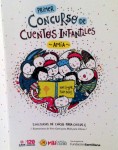
Cynthia Fidel was the coordinator of AMIA’s literary contest, which resulted in the publication Primer Concurso de Cuentos Infantiles. (photo by Rebeca Kuropatwa)
When the AMIA (Asociación Mutual Israelita Argentina) bombing occurred in Buenos Aires on July 18, 1994, there was already tension in Argentina between different religious and other groups. The bombing was a sad reminder of the need for diligence – and creativity – in mitigating hatred and fear.
After the bombing, it was very difficult for people to feel comfortable enough to return to the AMIA building, especially parents with small children. Hence, the Jewish education advisor for AMIA, Gabriela Wilensky, developed a program called AMIA for Kids. On two Sundays a month, she brought in top performers to engage children and their parents in forming fresh connections between families and AMIA.
In 2014, Wilensky came up with the first literary contest for kids that would have them explore the concepts of culture and identity. The idea was to involve the greater Buenos Aires community by partnering with 40 public and private schools, with children of all religions. Recently, the literary contest coordinator, Cynthia Fidel, moved to Winnipeg with her family.
“This contest was part of the 20-year anniversary of AMIA, which happened in 2014,” said Fidel. It was open to children from 8 to 12 years old.
When all was said and done, Fidel and Wilensky received 200 story submissions. With the help of a couple of local children’s book authors, 10 winning stories were selected to be published in a book called Primer Concurso de Cuentos Infantiles (First Contest of Fairy Tales) that was published by MILA for Kids, a division of MILA publishing house.
“They talked about different problems, ideas and questions regarding cultural diversity and identity,” said Fidel. “The first prize went to a girl who wrote about cultural diversity. It’s a collection of certain ideas and questions but, above all, it’s a collection of all the incredible imaginations of the kids.”
Now there is talk of launching a second literary contest, because of the success of the first. “They were really happy about what happened with the kids,” said Fidel.
The contest, which was open to children of all origins and faiths, has sparked dialogue between the kids. The main talking point has been respecting each other’s ideas and understanding that agreement is not needed to achieve mutual respect. Fidel loosely translated one of the first lines in the book’s preface: “Nobody is the same, nor worse or better, just different.”
Primer Concurso de Cuentos Infantiles is 84 pages long and includes the 10 winning stories, as well as an extra story written by several children together.
“Some of the stories talk about some kind of conflict situation and how they solved that situation,” said Fidel. “A recurring theme revolves around how they solved it and prevailed using dialogue.”
An excerpt from the book, as translated by Fidel, reads: “There was a society where some people had curly hair, so they thought they had the right to have more time in front of the mirror, to comb their hair. But, others who had different kinds of hair thought they deserved more time. There were others who were taller and they thought they deserved to cut their hair, while short people didn’t deserve that right.
“Until, one day, a girl wished in her heart that everybody would become equal and have the same characteristics. The wish came true and the entire world became grey – colorless and boring. She wished again to have colors and differences in her world, and everybody got their characteristics back. But, now, everyone loved their uniqueness and celebrated others’ uniqueness, too.”
Fidel is a strong believer that adults can learn a great deal from children. “From my experience,” she said, “it is amazing what you can learn from kids and their reflections if you give them the opportunity to express themselves.”
Fidel said the literary contest is a great representation of AMIA as a whole, as their main principles revolve around democracy and pluralism, and creating spaces for all through communal living and coexistence. “They promote those values,” said Fidel. “I’m very proud to have worked there.”
Current president and chief executive officer of the Canadian Institute for Advanced Research (CIFAR) Dr. Alan Bernstein has been a scientist all his life.
“When I was asked if I was interested in the [CIFAR] position, it was a natural evolution of my own journey through science, so I said yes immediately,” said Bernstein. “It’s a great organization and I’m having a tremendous amount of fun running it and making the kinds of changes I think are necessary to stay current and take CIFAR with the strengths when I started to the next level, which we are in the middle of doing.”
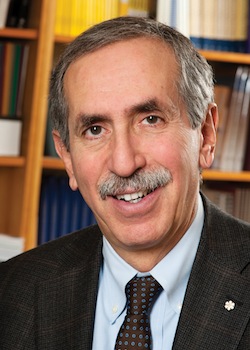
Dr. Alan Bernstein was inducted into the Canadian Medical Hall of Fame earlier this year. (photo from Alan Bernstein)
For more than 30 years, CIFAR has been bringing some of the top researchers in Canada and around the world together to focus on worldwide challenges. It provides a space for sustained, small-scale, intimate conversations between groups of investigators that come from diverse disciplines and perspectives.
“We need to take risks,” said Bernstein. “We expect our researchers to take risks. Tough questions are always, by definition, risky.
“We’ve always been global in the sense that half our fellows come from outside Canada. We have 14 programs divided into three broad initiatives. One is a brain initiative. The second is around … the environmental and physical sciences. And, the third one is around building stronger societies. Within that, there are a number of programs. Each program typically has 20-30 fellows who meet on a regular basis and discuss issues around their particular program.”
One program concerns child and brain development. “There are about 25 people in that program and they range from pediatricians to fruit fly neurogeneticists, psychologists, epidemiologists, molecular biologists and policy people,” said the doctor.
While all of the 25 have their own particular research program, they come to CIFAR to focus on one question, which, in this case, is how do we optimize child and brain development?
Fifteen years ago, Bernstein became the first president of the Canadian Institute of Health Research, the national funding agency for health research. It was a job he had to create. Seven years later, he joined CIFAR.
During his first five years there, Bernstein also ran a lab. “My lab was in Toronto at the Mount Sinai Hospital, where I’d been the director,” he explained. “I just found that, after five years, I wasn’t being fair to the people in my lab in the sense that I just couldn’t devote the kind of time, energy and brainpower to my own scientists that they deserved … and that the science deserved. So, I made the tough decision after a year of agonizing about it, to give up my lab.”
When he closed his lab, Bernstein made sure that everybody had a job. Although the transition was quite traumatic for him at the time, he realized he was still a scientist, that he did not need to run a lab to be one.
“I still do, maybe more so than before, think very deeply about science and read much more widely now than I ever used to,” said Bernstein. “Before, I only read about health research things, but now I read about everything – from cosmology and gravity to successful societies, and childhood development.”
In April of this year, Bernstein was one of six inductees into the Canadian Medical Hall of Fame. Laureates “are individuals whose outstanding contributions to medicine and the health sciences have led to extraordinary improvements in human health. Their work may be a single meritorious contribution or a lifetime of superior accomplishments. Pioneers in their field, they are role models and inspiration to young Canadians to pursue careers in the health sciences.”
“I was deeply honored,” said Bernstein of being chosen. “It’s a high honor, indeed. I know a lot about the Hall of Fame because when I was the president of CIHR, I had to chair the selection committee.… I had a chance to go to a lot of the ceremonies.
“It’s one of those things that your colleagues bestow on you, so it was especially meaningful to me, as these are my colleagues, saying, ‘Alan, we think your contributions to Canadian medicine and health research have been at a calibre that you’re deserving to be inducted into the Canadian Medical Hall of Fame.’”
Some of Bernstein’s family was able to be at the April 23 ceremony – his wife, sister and son. “So, that was also very nice for me,” he said. “Actually, it was very nice to be in Winnipeg. The ceremony moves around from year to year and, this year, it was in Winnipeg.”
Bernstein had not been back to Winnipeg for a long time and was looking forward to seeing some familiar faces and places. And also some new ones, such as visiting the Canadian Museum for Human Rights. “That was an especially moving experience,” he said. “I’m sure it is for everybody who goes there. It’s incredible.”
For the induction ceremony, a video was made in which some of his former students were interviewed, as well as some colleagues from his time at CIHR.
“Sir John Bell, who’s a Canadian, but also the Regis Professor of Medicine at Oxford University – a very accomplished, very senior guy in the global medical scene – also said some nice words about me,” said Bernstein.
“It’s always interesting to hear what other people think about you. It was very meaningful to me that a couple of my students – a post-op in my lab and one who’d been a student with me – spoke. To hear what they had to say from their perspective about what it was like to be in my lab, that meant great deal to me.”
What Bernstein found most moving about the video was the message that it conveyed – that the most important legacy a scientist leaves behind is the training of his or her students.
“Science is never-ending, so the art of doing science has to be passed from one generation to the next,” said Bernstein. “That’s just a privilege, to be able to interact with and help introduce young people to science.”
The nights were getting longer already, but when we changed the clocks a few weeks ago, it seemed to change very suddenly into a new season. For our cousins in
Israel, the days might be a bit brighter – a video of shirt-sleeved Tel Avivians dancing last week as an antidote to the terrorist mayhem was an inspiring and somewhat envy-inducing scene – but the spectre of violence there is real and immediate.
It was 68 years ago last Sunday that the United Nations voted for an independent Jewish state and an independent Arab state in Palestine. That was a day of jubilation, of momentous light, for Jews worldwide. Yet there is never total victory, never a moment when our enemies have permanently laid down sword, or stone or missile or knife.
In Jewish life, we light candles both to mark times of joy, as well as of grief. In Jewish rituals, the happy moments are tempered by the recollection of not-so happy moments.
At Chanukah, we light candles and curse the darkness. Hatred will not prevail. This is the message of Chanukah.
We see the darkness, but we do not succumb. We dance, as we saw in Tel Aviv. We give thanks for what we have, for the self-determination that is Israel and for the freedoms we enjoy in Canada. We rally ourselves and our neighbors to sponsor refugees and to raise funds for the Joint Distribution Committee to aid those who need it. Because we remember, or our parents do, what it is like to be refugees and to be in need. We advocate against climate change. We teach our children the values of tzedakah. We gather blankets and jackets for those in our own city who need warmth.
We will make our own light. We will celebrate not only our historical and contemporary victories, but life itself. We will love, laugh, dance, eat. L’chaim.
The last time there was a Liberal government in Canada, this country took a “go along to get along” approach to the annual Israel-bashing at the United Nations each autumn. Government officials offered excuses, but still our representatives at the General Assembly voted in favor of most of the one-sided attacks on the Jewish state.
Things changed when the Harper Conservatives came to office. They set Canada apart as a moral, often-isolated voice of reason in the bastion of anti-Zionists.
During the federal election this year, the Liberals promised that they would continue Canada’s support of Israel if they won the election. In their first significant test, they came through. This year’s General Assembly saw the usual raft of resolutions condemning Israel, while completely or largely ignoring the worst offenders of human rights in the world.
Proudly, Canada voted against them.
This is a very positive development, indicating that we will not slip into the ways of the past. As we had hoped, support for Israel – the only democratic regime in its region, a light to the nations in so many ways and, not insignificantly, the world’s only Jewish state – is not a partisan position, but a Canadian value.
In March 2013, 833,098 persons were served by food banks in Canada. Food bank use remains high and many Canadians depend on food banks for weekly, semi-monthly or monthly grocery items in order to put food on the table. One-half of the families being served include children and close to one-half are two-parent families. More than one-third of food bank recipients are children, many of whom are school age and go to bed hungry.
In Richmond, 1,300 persons are served each week by the Richmond Food Bank. Of the 1,300 recipients, there are 524 persons who actually attend this food bank and they represent 2.4 persons per household. The majority are seniors and people with mental health issues. These groups usually visit each week. Others who use the food bank are on low incomes and use the service as needed. Users must be Richmond residents. Once residency is proven, recipients are granted food packages on an honor system. The average value of a food hamper is about $100 and the food bank tries to ensure the five basic food groups are included.
The Jewish Food Bank in Vancouver serves 350 persons, of whom 55 are children under 18 years of age, and 95 are seniors. If, as it is estimated, 16% of the Jewish community lives on or below the poverty level, it is possible that many in need are not being served or are being served by other organizations. The value of each Jewish Food Bank hamper for a single individual, for example, is $54. Larger family units receive more food. This is in addition to food vouchers supplied by Jewish Family Service Agency. Food that is made available is seen as “supplementary,” enough to fill the gap until the next pay cheque or income. Food hampers are delivered every two weeks to those unable to attend for personal pick up.
For seniors, this is a very troubling scenario. As of two years ago, three out of five women in Greater Vancouver over 65 lived on an income of less than $25,000 per year (as reported by United Way). Many seniors on low, fixed incomes must make major decisions each month. Once rent is paid, are there enough funds for food or do they have to choose between prescription drugs (if not covered by a drug program) and food? Will there be funds for sundries, clothing and entertainment? Will there be enough money to eat out once or twice during the month? Most of us who live in the comfort of our warm homes take this for granted. For a good description of the need for affordable housing, see David Hume’s excellent article in the Nov. 23 Province.
It is generally accepted that food banks had their origins in the early 1980s during a major recession. Hunger was affecting the lives of many Canadians who were unemployed, unable to work, under-employed or whose incomes were below a living wage. It was to be a short-lived situation until the economy improved, as it eventually did, and the need for food banks diminished. However, today, food banks are an integral part of the social fabric. There are currently about 500 food banks across Canada, a sad commentary for a rich nation. In this writer’s opinion, food banks have become secondary extensions of weakened social safety nets. In this respect, food banks may be seen as undermining the state’s obligation to respect and fulfil its requirement to ensure that none of its citizens go hungry. Food banks are driven by poverty but in no way solve the problem of poverty. If anything, the goodwill they provide allows governments to opt out of taking their leadership role in decreasing the need for food banks.
Those persons who staff and volunteer at food banks are not “do-gooders looking for recognition.” Volunteers are the backbone of most not-for-profit organizations. The volunteers that I met while observing one food bank in action were made up mostly of senior citizens who were giving back to the community, who understood the plight of those being served and who served them with respect and genuine caring. Thousands of individual donors, many anonymous, provide millions of dollars each year in support. Many corporations take great pride in supporting food banks, in kind and in cash. They often make the public aware through advertising, hoping what they do will encourage other corporations to do the same.
Food banks will be needed for some time in the future until governments at all levels – federal, provincial and municipal – develop, embrace and put in place a viable national anti-poverty program. Food banks can collectively lobby for stronger and sustainable social safety nets for those in need. In a recent publication, Dignity for All: A National Anti-Poverty Plan for Canada (2013), a number of priorities were considered: income security, housing and homelessness, health, food security, early childhood education and care, jobs and employment. If two or three of these were prioritized and put into operation, it would bring many thousands into mainstream Canada.
Much has already been studied and written about poverty and its effects on too many Canadian citizens. It is time for a concerted and coordinated plan of action. Until that happens, thank G-d for food banks.
Ken Levitt is a vice-president of the Jewish Seniors Alliance of Greater Vancouver and a former chief executive officer of Louis Brier Home and Hospital.
Simon Fraser University biologist Dov Lank with some of the ruffs he and his team have been studying. (all photos from SFU Communications)
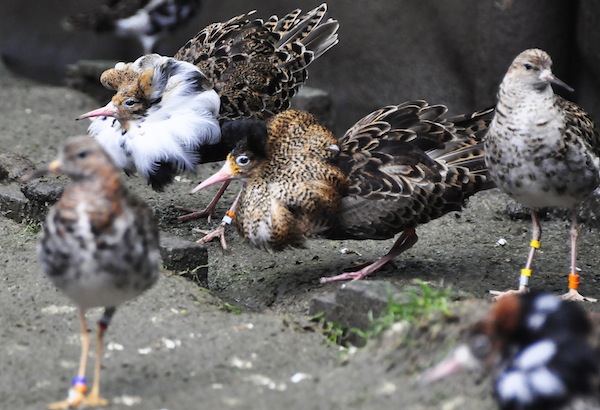
Simon Fraser University biologist Dov Lank and a team of researchers have identified the genes responsible for three different kinds of male ruff (Philomachus pugnax) – a species of wading bird. The ruff is the only bird species in which three kinds of males exist, each having its own approach to courtship and mating and with distinct physical characteristics. One is a fighter, the second is a “wingman” and the third is a cross-dresser.
The paper, “A supergene determines highly divergent male reproductive morphs in the ruff” was published on Nov. 16 in Nature Genetics. Researchers found that, 3.8 million years ago, an inversion occurred in the chromosomes of the ruff, creating a second kind of male. Then, half a million years ago, a second chromosomal rearrangement between the inversion and the original sequence occurred, creating a third kind of male. As a result, there are three types of male ruffs: one with ancestral sequences, another with an older kind of the inversion and a third with a newer kind of inversion.
Lank said, “Today, we have the tools to identify exactly what genes are involved and, over the next few years, we will describe how they work. These genes control differences in aggressive behavior and the expression of gender-specific traits, and the pathways and processes involved will provide a model with general applicability for vertebrates, including ourselves.”
Winnipeg Klezfest co-producers Bev Aronovitch, left, and Miriam Bronstein. (photo from Rady JCC)
After attending the week-long KlezKanada Laurentian retreat near Montreal, Miriam Bronstein and Beverly Aronovitch wondered, why not do the same in Winnipeg? And so, they began planning – the city’s first Klezfest took place at the Rady Jewish Community Centre on Oct. 10 and 11.
Bronstein, a retired music and high school drama teacher who continues to perform at the Fringe Festival, is also very involved with Soup Sisters, an organization that makes soup for women’s shelters. Aronovitch is a jazz musician, producer and retired teacher.
As both Bronstein and Aronovitch are of Eastern European decent, klezmer spoke to them. “I’m a singer, she’s a piano player, so we thought it might be fun to go spend time in that scene,” said Bronstein. “I never realized that I actually speak Yiddish because, as I grew up, my mother spoke Yiddish with me, but I only answered her in English. So, it’s actually quite remarkable that I can speak Yiddish.”
Of the KlezKanada experience, Bronstein said, “It was life changing. It reconnected me with that Eastern European community. It was very, very cool.”
At KlezKanada, Aronovitch and Bronstein enjoyed seeing people of all ages, from toddlers to 90-year-olds, dancing to the music, as well as McGill University students taking a klezmer course.
“There were people from all over the world, musicians from all over the world, and they weren’t all Jewish,” said Bronstein. “It was just such a scene that both of us just said, ‘Oh my gosh! We have to do this in Winnipeg!’ We just took it on when we came home. We didn’t forget about it. We just pursued it.”
Although KlezKanada was a week long, Bronstein and Aronovitch felt that the first such festival in Winnipeg had to be shorter, at least for starters. They began by booking the world-famous Klezmatics from New York and, with the help of Winnipeg’s own Finjan – Kinzey Posen, Shayla Fink, Myron Schultz and Daniel Koulack – they put together a full day of festivities. It kicked off with a Saturday night Klezmatics performance, followed by several Sunday workshops, culminating in a concert led by members of Finjan and the Klezfest faculty.
“We had a wonderful workshop about great Yiddish composers and beginner klezmer playing sessions, and then a more advanced session called Readers’ Romp,” said Bronstein.
“One idea we had that is unique to Winnipeg was that we very much wanted to cross borders and recognize we have many ethnic communities in Winnipeg, so we had a workshop called Common Roots,” she said. “We got Ukrainian musicians and Romanian musicians. We brought people in from the city and the theme was ‘Weddings.’ They played what you’d play at a Ukrainian wedding and then the members of Finjan played what you’d play at a Jewish wedding.”
Bronstein would like to expand on the Common Roots concept next time, as there is a big Eastern European contingency in Winnipeg. She’d also like to see annual Mamaloshen Festival of Yiddish Entertainment and Culture attendees participate in Klezfest.
With their first Klezfest behind them, Bronstein said, “We’re just kind of basking in the glow. It was hugely successful. In the end, everybody was dancing in the foyer. It was so wild, it was so thrilling. People were so elated to be part of it. I taught at the Jewish day school here and there were 25 high school students who were part of the event.
“There were some people, some non-Jews – a considerable amount considering it’s Winnipeg and it’s a small community in general – but it would be nice if it was even more widespread. I think that, the more we do it, we increasingly make the name known, and it will open up even more to the general community.”
Bronstein and Aronovitch would eventually like to see participants get to a point where they are able to lead a performance at the end of the festival. Bronstein envisions this as “a participatory type of performance, where people who did dance classes can present what they learned and people who did the playing workshops can be a part of the band.”
She added, “It was a pleasure to work with our fantastic working committee and the Rady JCC. Without them, it could not have happened.”
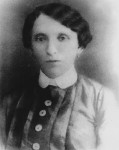
The author’s one photograph of her great-grandmother, Betty Brotman, “stiff-necked and corseted, with her dark hair combed tightly across her head.” (photo from Shula Klinger)
I have been researching my family history for many years, on and off. Much of my research has been online, using resources like JewishGen, the internet database of Jewish genealogical records. I have also found a home at Czernowitz-L, an email group hosted by Cornell University for people whose families come from what is now the Ukrainian city of Chernivtsi. Once known as “Jerusalem on the Prut,” Czernowitz – as it is still called by those who recall its Habsburg past – was once home to 50,000 Jews. Less than a third of this number survived the war.
Like many third-generation Czernowitzers, I write messages to Czernowitz-L in the hope that someone, somewhere, will remember hearing my family name and be able to point me in the direction of a lost relative. Very often, we hear nothing, but once in a blue moon, we strike gold.
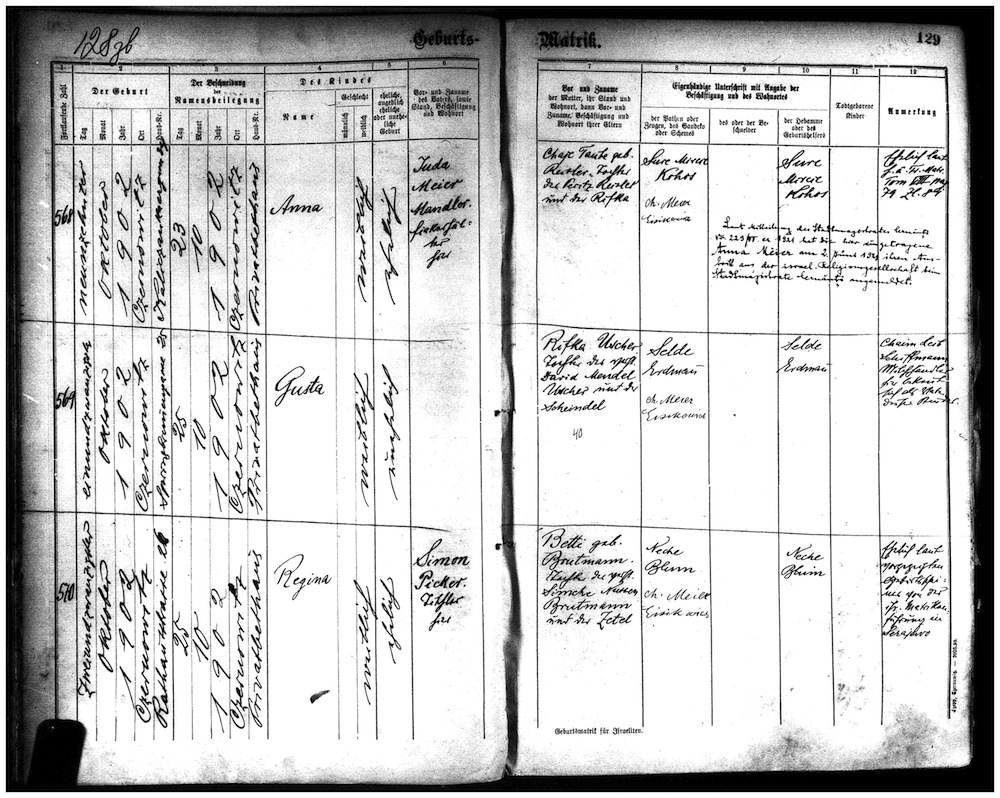
That’s what happened when I sent out an email asking list members if they knew of the family name Brotman. I had just received an image of my grandmother’s birth certificate from Czernowitz in 1902, which showed that Regina Picker’s mother, Betty, had been born a Brotman.
Shortly after I shared this information, I received an email from a lady in Portland, letting me know that she had married into the Brotman family in Oregon. She asked me if I would be interested in contacting one of her in-laws, whose mother had been a Brotman. He was very well-informed, she said. A conversation with him might yield some results. Not knowing that I lived here in Vancouver, she told me that Cyril Leonoff here. Naturally, I was thrilled and eager to talk to him as soon as I could.
Having corresponded with Cyril’s daughter, Anita, for awhile, we set a date and I drove over to meet them both. My children were very excited to find out if this man was a relative. I fielded the same question from them over and over again: “Are we 100% for sure, for sure related to him, Mommy? Or just 99%, do you think?”
On arriving at the Leonoff home, I was greeted by Anita. She showed us into the house, where a beautiful table had been set with fresh fruit and homemade poppy seed cake. Anita showed the children where to find some toy ships and I brought out my family photograph: my one photograph of my great-grandmother, Betty Brotman, stiff-necked and corseted, with her dark hair combed tightly across her head. Betty Brotman, who passed away at a young age, leaving her husband and children behind to survive the fall of the Habsburg Empire and the devastation of two world wars. But, back to the present.
Cyril asked me about the photo. I was eager to ask him a host of questions. Was I about to discover something extraordinary? Would I learn, after almost 20 years in Canada, that I had been living a few miles away from a relative, all this time? And after growing up in England, completely isolated from my extended family, was this man one of my elders? What did he know? What could he tell me? What did he remember of his people and their original home in Europe?
I watched his face as he calmly – and silently – looked at my photo. I tried to guess at what he was thinking. He suggested that we sit for tea before looking at his records upstairs. I accepted, glad of the tea, but thinking that this was a wonderful opportunity to practise mindfulness. Peace. Serenity in the face of burning curiosity and decades of longing for grandparents that I could talk to, family members who were able to tell me about their journeys, their struggles, their triumphs.
We sat quietly and poured tea while I tried not to boil over myself. We drank our tea and talked about the delicious poppy seed cake, which Anita’s daughter had made. And then Cyril asked me, “What are you looking for? What brings you here?”
His gaze was direct, his voice was polite. I told him the truth: I have no story, and I need one. My family was fractured, over and over, between Czernowitz, Cairo, Haifa and London. What little I do know of our history was told to me by an unreliable witness. A witness who had not wanted me, or anyone else, to find other, more reliable witnesses. A man who went to great lengths to separate his children from their story, or anyone that might refute his own accounts. A man who may have survived the war – and wars – physically, but who continued to fight their battles every day of his life, until he died. And, when he did die and I was finally able to say, rest in peace, it was truly the only peace he had ever had. He was traumatized, barely existing, unable to communicate or listen, to tell the whole truth or make any kind of authentic connection with another human being. My father, who I spent a lifetime trying to love, but who would never let me.
Cyril is 10 years older than my father was when he died. His intelligent gaze was steady and he listened quietly when I answered his questions. Difficult questions whose answers may well have been a lot longer than he had anticipated.
He didn’t respond directly, but we finished our tea slowly and he asked me up to his library. He said he had a book to show me. We climbed the stairs and entered a room with a high ceiling, filled with books. It reminded me of the shelves of my own family home, now gone. My father’s books.
Cyril walked over to a shelf by the window and removed a small volume of poetry. He opened it on a table and said, “I think you’ll want to see this.”
“This” was the inside cover of an old book inscribed in sepia copperplate. “Betty Brotman.”
“May I take a photograph of it?” I asked, after a few seconds, feeling a little superficial but not knowing where to put my happiness or my hands, other than on a camera.
“Yes,” said Cyril, so I did.
When the emotion had subsided and reason returned, I considered the facts: Cyril’s Betty may not be my great-grandmother, but still: there have been not one but three women named Betty in my family and the first was Betty Brotman. It isn’t impossible that his Brotmans were cousins to mine. It’s tenuous but, still, it’s a trace. A faint trace that proves we exist. That we left our mark on the world somewhere. That I am still connected to my people, even with my father’s concerted efforts to keep us all apart.
Cyril brought me to another room, where he kept his family records. He laid out a map showing where his family had come from. Indeed, our families were from nearby cities, again suggesting a possible link. He showed me his work on the history of Jewish farmers in Canada, where his branch of the Brotman family had homesteaded in 1889, and gave me some of his books to read. I thought about taking notes but was too moved to multitask. Simply sitting down with a man who might be a member of my family, who cared so deeply about his roots and was so proud of his family’s achievements, was overwhelming. He had done his own research and he had written it down – he had not hidden from it, or excised the story from memory. He is devoted to talking about and preserving it, just as I am.
And not only that, he wanted to talk to me, and he wanted to listen. To find out what I knew that might prove to be an irrefutable link between our families. He was curious; wanted names, dates, places.
“How old are you?” he asked me.
“Forty-four,” I replied, and cringed, feeling self-conscious. There was a pause.
“That old, eh?” he said, sounding shocked. Then he smiled – with his bright blue, 90-year-old eyes.
We looked around the room at framed photos and other artifacts of his family’s past. His record was abundant, both in photographs and documents. He pointed out a carved wooden picture frame that had been made by one of his relatives. I told him that my great-grandfather and my uncle were both carvers, that our family had worked in the lumber industry in Czernowitz. That our family had worked with trees for generations, in one way or another – whether as lumber, through sculpture or carpentry, or tree-planting in Israel in the 1940s. Another connection. Maybe.
The author’s grandmother’s birth certificate from Czernowitz in 1902, which shows that Regina Picker’s mother, Betty (“Betti”), had been born a Brotman (“Brutmann”). It also shows that Regina’s father, Betty’s husband, Simon Picker, was a carpenter. (image from Shula Klinger)
When it was time to go, my older son asked me again. “Is he a relation? Is he ours?” I told him, “Very possibly.” And, again, he wanted to know the percentage probability. “Ninety-nine percent, then,” Benjamin decided.
It was hard to leave. After so many years, I wanted to stay until I dealt with that niggling one percent of doubt. I wanted to be sure. I had to know.
I don’t know how much of Cyril’s story is really my story, which he has taken such pains to write down. I don’t know if his Betty knew my Betty, if they were cousins, second cousins, or even more remotely related than that – or not at all. And I may never find out.
But, then again, even if we are just an appendix to his main narrative, I had a chance to read between the lines. To meet the Leonoffs, to eat with them and to ask questions about our fractured family stories. Because what matters is that we tried to knit those fractures together, to heal the tremendous wounds created by the past and the efforts made by those who refused – or were unable – to heal them on their own.
Months later, my children still talk about “our 99% relative.” They are proud to have an elder in Vancouver and they mention Cyril regularly. I love to hear them talk about him with affection and respect.
When it comes to family, I have discovered that 8- and 4-year-olds aren’t too worried about evidence. They really don’t care about that missing one percent. And now, as my children are also my teachers, neither do I.
Shula Klingeris an author, illustrator and journalist living in North Vancouver. This article is written with grateful thanks to Anita and Cyril Leonoff.
Eight of 11 B.C. shluchim joined 5,200 other Chabad rabbis and guests in New York City Nov. 4-9 for the International Conference of Chabad-Lubavitch Emissaries. (photo by Shneor Shif)
Eight local B.C. rabbis made their way to New York City Nov. 4-9, joining a group of 5,200 Chabad rabbis and guests from 86 countries for the annual International Conference of Chabad-Lubavitch Emissaries (Kinus Hashluchim).
The conference, now in its 32nd year, offered a chance for the rabbis to recharge their batteries in an atmosphere of camaraderie and inspiration before returning to their communities. It also gave community members the opportunity to better appreciate the global impact of Chabad-Lubavitch and its underlying philosophy, and spend some quality time with fellow Jews from around the world.
Known as shluchim – the plural of shaliach, which means agent or emissary – these rabbis were dispatched by the Lubavitcher Rebbe, Rabbi Menachem Mendel Schneerson, zt’l, to communities all over the globe to dedicate their lives to serving the Jewish people. They work to connect Jews to their heritage, raise Jewish awareness and mitzvah observance, and teach Torah. Yet their mission is not only a spiritual one; the Rebbe charged them to discover what the unique needs of their respective communities are and to meet those needs by opening their hearts and homes to help every Jew in any way they can.
The rabbis arrived on Nov. 4 for five jam-packed days, which included extensive Torah classes, prayer with thousands, a range of workshops and talks and, of course, a visit to the Ohel, the resting place of the Lubavitcher Rebbe and his father-in-law, the previous Rebbe, Rabbi Yosef Yitzchak Schneersohn, zt’l.
This year’s conference carried added significance, being a Hakhel year, a year focused on unity gatherings in rededication to Torah and mitzvot. The biblical Hakhel took place once every seven years at the conclusion of the Sabbatical (Shmitah) year, and brought Jewish men, women and children to the Temple in Jerusalem to be inspired by the Torah, which was read by the king. During Hakhel in years past, the Rebbe would regularly urge Jews worldwide to assemble and inspire one another to increase their Torah observance and study.
This unity and rededication was perhaps best exhibited at the gala dinner on Sunday night in the South Brooklyn Marine Terminal. Powerful presentations on Hakhel were given by a Chabad Hebrew school student, a CTeen participant, an active student leader in Chabad on Campus, a middle-aged professional who first met the Rebbe as a young man and is now a member of his local Chabad community, and a Holocaust survivor. They all mentioned increasing their observance as a result of interaction with Chabad-Lubavitch emissaries.
Moshe Holtzberg, who is nearly 9 years old, is the surviving child of Rabbi Gavriel and Rivka Holtzberg, shluchim who were murdered in a November 2008 terror attack on their Chabad House in Mumbai, India. Moshe led the crowd of thousands in the recitation of psalms during the banquet.
The eight B.C. shluchim who traveled to New York were Rabbi Yitzchak Wineberg, executive director of Chabad-Lubavitch BC, Rabbi Yechiel Baitelman of Chabad of Richmond, Rabbi Binyomin Bitton of Chabad of Downtown Vancouver, Rabbi Meir Kaplan of Chabad of Victoria, Rabbi Schneur Wineberg of Chabad of East Vancouver, Rabbi Chalom Loeub of Chabad of the University of British Columbia, Rabbi Dovid Rosenfeld of Chabad-Lubavitch BC and Rabbi Mendel Mochkin of Chabad of the North Shore. Rabbi Falik Schtroks of Chabad of Surrey, Rabbi Bentzi Shemtov of Chabad of Nanaimo, and Rabbi Shmuly Hecht of Chabad of Kelowna were unable to attend the conference this year.
Leah Stern in Haiti, where she was helping orphaned and abandoned children. (photo from Leah Stern)
While London-based journalist and content producer Leah Stern was unable to be the guest speaker at this year’s Choices, the annual campaign event of Jewish Federation of Greater Vancouver’s women’s philanthropy, the Jewish Independent had the opportunity to chat with her over the phone prior to her scheduled talk. Hopefully, she will have the chance to come to Vancouver on another occasion, as she is a fascinating and accomplished person.
Born and raised in Miami, Stern made aliya after graduating university. In her career to date, she has been the face of the evening news on the Israel Broadcast Authority and a correspondent for CNN, she has liaised with the Vatican on behalf of the Israeli government and worked with nonprofits in South America. She is currently communications director in London, England, for OurCrowd, a high-tech, crowdfunding platform created by venture capitalist John Medved, for which she travels to Israel every couple of months. This is only a partial resumé.
JI: You made aliya in 2002. What led to that?
LS: Growing up in Miami Beach, everyone was very materialistic, focused on clothes, cars, houses, etc., and I wanted to run away from it all. My brother went to Israel to serve in an elite military group during the Second Intifada and my mother and I decided to follow him there. She went first, I came after.
JI: How did you get into journalism?
LS: That started with a program I saw in Miami on CNN with coverage of Scuds falling in Sderot and I saw a woman running in fear along the street. Suddenly, I thought, I need to be there in the thick of it all. When I finally went, I was only 21. At first, when I arrived, I could not find a job, so I folded laundry, made pizza and worked as a housekeeper.
JI: What happened next?
LS: I decided to volunteer for the Magen David Adom (MDA). That consisted of a week indoctrination course and then riding in the back of an ambulance to callouts. My first call was to a bus bombing in Jerusalem on May 18, 2003. I remember riding in the back of the ambulance, going at 100 miles an hour, running through red lights and then we came upon the shell of the bus. My first memory is seeing the bodies of college students my age, all sitting exactly as they were in that last moment before the explosion, one was reading a book, one was eating a sandwich. That picture still resonates with me today.
JI: Did that experience have an impact on your career?
LS: I did the MDA job for about three months. I was so affected by it I decided to … blog about it. I sent articles back to Miami. I wanted to give a different view than the jaded coverage by CNN and Fox. I thought I could make an impact on people by reporting the truth of what was happening through my eyes, and not through the eyes of the foreign press that did not understand the contextual background to the story.
JI: You also worked for the Jerusalem Post?
LS: Yes. I applied and got an internship as the funeral reporter. I did that for awhile but I wanted to go to the next level. So, I applied to IBA, the Israel Broadcast Authority, the only government-run, English-speaking channel in Israel, to be a news anchor. I bombed the audition. I said, “Baby Netanyahu” instead of “Bibi Netanyahu.” I thought I would never get the job. But the bureau chief called me that night and said, “You were absolutely terrible but there is something about you. Come in tomorrow for another screen test.” So, I studied the names of all of the people in the Knesset and practised in front of the mirror, and I got the job.
JI: What happened at IBA and where did you go from there?
LS: I started off as a newsreader but eventually my boss let me go out in the field. I went out as a one-woman band. I went and bought a video camera and all the equipment. I would mic myself up and take my camera out on a tripod and do the interview, write the text and send it to my editor in three-minute news package format while sitting in the front seat of my Peugeot. These were some of the most incredible days of my life, being in the thick of things.
Leah Stern on a CNN mentorship program with Wolf Blitzer at the Republican National Convention in Florida. (photo from Leah Stern)
It was during this time that I came to realize that there were so many stories that were not being covered, i.e. co-existence, Israeli doctors working with injured Palestinians, stories that I felt would change the world’s perception of what was happening in Israel. So, I started to tell them and sent some to CNN and they must have liked them because I got invited to Atlanta and met with Ted Turner, who offered me a job as a correspondent. Wolf Blitzer sort of took me under his wing.
JI: What were some of the stories you covered for IBA and CNN?
LS: I was sent all over, to Ethiopia to cover the migration of the Ethiopian Jews to Israel … to the Vatican to cover the funeral of Pope John Paul II in 2005. I went to Baghdad and Kabul and all over the Arab world.
JI: Were you concerned about any danger in covering some of these assignments?
LS: No. I was a CNN producer, an American journalist on an American passport and did not at any time feel in danger. I was running on pure adrenalin, and was determined to tell the story for people who did not have a voice.
JI: You accompanied the Israel Defence Forces during the disengagement from Gaza in 2005. What was that experience like?
LS: For me, this was the first time that I found myself reporting on a big story alongside the major players of the world media…. I had just interviewed Ariel Sharon and was forming my own opinion on this. I was conflicted, lots of questions were running through my mind, like, was the government right? What were these people entitled to? [Stern ended up making a documentary about the experience, called Disengagement (2006).]
JI: Were you treated any differently for being a woman reporter?
LS: War reporting is a man’s world. Here I was a young, blond, American, female journalist with not great Hebrew, with an English accent, with very seasoned male war reporters, trying to be one of the guys. I had to earn the respect. It was not easy. It took time.
JI: How did people react to you in the various areas you visited?
LS: Good reporters get people to open up to them and to trust them. You have to ask the tough questions, be relatable, get people to be real. I let people know I would tell their story … like they told it to me.
JI: Has your attitude towards covering the news changed over the years?
LS: I always remember the quote from Abba Eban, “To be a realist in Israel, you have to believe in miracles.” My time in Israel was one miracle after another. When I did my first stand up in front of the camera during the Second Lebanon War, a rocket landed near me and I was not afraid. I felt as if the camera would protect me and I was so dedicated to telling the story that I did not think of any danger. But one of my colleagues, Steve Sotloff, was beheaded by ISIS, and that was a wake-up call for me. I would not go back to some of those countries now even though I have been offered opportunities to report in Iran and Syria.
JI: In addition to reporting, you did a three-year diplomatic stint at the Vatican as a liaison for the Israeli government. What was that like?
LS: I studied Italian because I had to read 20 newspapers a morning and brief the Israeli ambassador on what Italians were saying about Israelis. Twice a week, I also got to sit in on meeting with Pope Benedict XVI and his cardinals…. I learned what it meant to be an Israeli diplomat in the Vatican. It was very interesting but it was also the first time I had to be careful about being open about my Israeli and Jewish status.
JI: What does your future hold?
LS: I am writing a book, but I am not sure what to focus on. I think writing a memoir is a bit egotistical at the age of 35. I have been roaming the world for 15 years, I am ready to put down some roots and I am getting married again next year.
JI: Do you have any advice for women considering career options like yours?
LS: I believe in tikkun olam, to make the world a better place. I think the best advice I can give is to be strong and to follow your dreams. Remember that small things make a difference. Don’t be afraid to try. Put yourself out there. Make an impact.
Tova Kornfeld is a Vancouver freelance writer and lawyer.