
Skip to content
  • Home
  • Subscribe / donate
  • Events calendar
  • News
    • Local
    • National
    • Israel
    • World
    • עניין בחדשות
      A roundup of news in Canada and further afield, in Hebrew.
  • Opinion
    • From the JI
    • Op-Ed
  • Arts & Culture
    • Performing Arts
    • Music
    • Books
    • Visual Arts
    • TV & Film
  • Life
    • Celebrating the Holidays
    • Travel
    • The Daily Snooze
      Cartoons by Jacob Samuel
    • Mystery Photo
      Help the JI and JMABC fill in the gaps in our archives.
  • Community Links
    • Organizations, Etc.
    • Other News Sources & Blogs
    • Business Directory
  • FAQ
  • JI Chai Celebration
  • JI@88! video

Recent Posts

  • עשרים ואחת שנים בוונקובר
  • Supporting the Iranian people
  • The power of photography
  • A good place to start
  • When boundaries have shifted
  • Guitar virtuosos play
  • Different concepts of home
  • Broadway’s Jewish storylines
  • Sesame’s breadth and depth
  • Dylan Akira Adler part of JFL festival
  • Mortality learning series
  • A new strategy to brighten up BC
  • Sharing latkes and light
  • Johnson awarded for human rights work
  • Cherished tradition ensured … Silber Family Agam Menorah
  • Nothing as lovely as a tree
  • Camp welcomes new director
  • Popular family camp expands
  • A life-changing experience
  • Benefits of being a counselor
  • Camper to counselor
  • האלימות בישראל מורגשת בהרבה מגזרים
  • טראמפ עוזר דווקא לנושא הפלסטיני
  • New rabbi settles into post
  • A light for the nations
  • Killed for being Jewish 
  • The complexities of identity
  • Jews in time of trauma
  • What should governments do?
  • Annie will warm your heart
  • Best of the film fest online
  • Guitar Night at Massey
  • Partners in the telling of stories
  • Four Peretz pillars honoured
  • History as a foundation
  • Music can comfort us

Archives

Follow @JewishIndie
image - The CJN - Visit Us Banner - 300x600 - 101625

Byline: SFU Communications

Researching unique species

Researching unique species

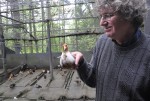
Simon Fraser University biologist Dov Lank with some of the ruffs he and his team have been studying. (all photos from SFU Communications)
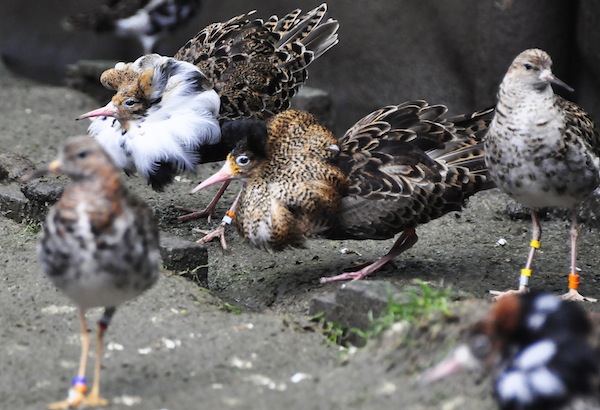
photo - The ruffs Dov Lank and his team have been studyingSimon Fraser University biologist Dov Lank and a team of researchers have identified the genes responsible for three different kinds of male ruff (Philomachus pugnax) – a species of wading bird. The ruff is the only bird species in which three kinds of males exist, each having its own approach to courtship and mating and with distinct physical characteristics. One is a fighter, the second is a “wingman” and the third is a cross-dresser.
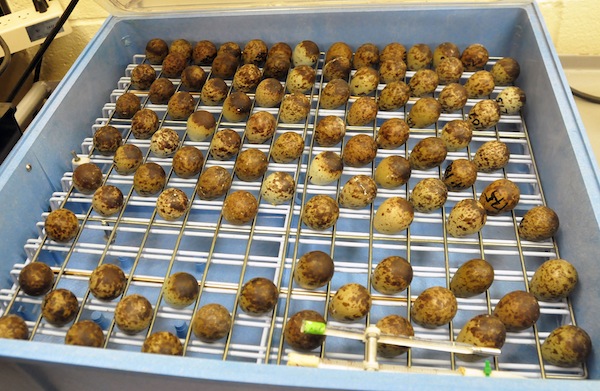
photo - ruff eggsThe paper, “A supergene determines highly divergent male reproductive morphs in the ruff” was published on Nov. 16 in Nature Genetics. Researchers found that, 3.8 million years ago, an inversion occurred in the chromosomes of the ruff, creating a second kind of male. Then, half a million years ago, a second chromosomal rearrangement between the inversion and the original sequence occurred, creating a third kind of male. As a result, there are three types of male ruffs: one with ancestral sequences, another with an older kind of the inversion and a third with a newer kind of inversion.

Lank said, “Today, we have the tools to identify exactly what genes are involved and, over the next few years, we will describe how they work. These genes control differences in aggressive behavior and the expression of gender-specific traits, and the pathways and processes involved will provide a model with general applicability for vertebrates, including ourselves.”
Format ImagePosted on December 4, 2015December 3, 2015Author SFU CommunicationsCategories LocalTags Dov Lank, Philomachus pugnax, SFU
Winston wins literary prize

Winston wins literary prize

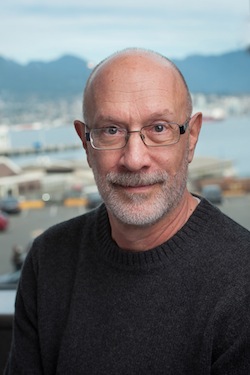
Simon Fraser University professor Mark Winston’s book on his lifetime as a world-leading bee expert – Bee Time: Lessons from the Hive – won this year’s Governor General’s Literary Award for nonfiction. According to the awards jury, Winston’s book “distils a life’s devotion to the study of bees into a powerful and lyrical meditation on humanity. This compelling book inspires us to reevaluate our own relationships both with each other and the natural world. Vital reading for our time.”

photo - Mark Winston
Mark Winston (photo from SFU Communications)

In Bee Time, Winston investigates the many influences bees have had on human society, and what we can learn from how bees have responded to their own societal challenges. Earlier this year, the book, published by Harvard University Press, was lauded with a Canadian Science Writers’ Association award.

“I look to the Governor General list every fall for good books to read, so for Bee Time to be on the list is an enormous thrill, and an extraordinary honor,” said Winston, who shares his reflections on three decades as a bee biologist in his award-winning book.

As one of the world’s authorities on bees and pollination, Winston has devoted his career to research and teaching, as well as writing and providing commentary on bees, environmental issues and science policy. Now a professor and senior fellow at Simon Fraser University’s Centre for Dialogue and founder of the Semester in Dialogue program (launched in 2002), he has written six previous books on topics from bees to the environment, and has been a consistently sought-out expert by national and international media.

“From altering our understanding of agricultural ecosystems to how urban planners are looking to bees to design more nature-friendly cities, I tried in Bee Time to offer practical views about the many lessons we can learn from bees, but also to express how grateful I am to bees for what they’ve taught me about collaboration, communication and interaction,” explained Winston, who continues to write a blog, winstonhive.com. A New York Times editorial he wrote (July 15, 2014) on the book was the most read NYT article for two consecutive days.

Among his many accolades, Winston is a co-winner of the Science Council of British Columbia’s 1992 Gold Medal in the natural sciences for his role in discoveries that resulted in an entirely new understanding of how bees communicate.

Governor General’s Literary Award recipients receive $25,000 and are celebrated at a gala event at Rideau Hall. This year, nearly 1,000 titles were submitted for the seven English-language categories. The awards are presented annually by the Canada Council for the Arts. For more details and a complete list of winners, see ggbooks.ca.

Format ImagePosted on November 27, 2015November 27, 2015Author SFU CommunicationsCategories BooksTags bees, Governor General’s, Mark Winston
Proudly powered by WordPress