Skip to content
  • Home
  • Subscribe / donate
  • Events calendar
  • News
    • Local
    • National
    • Israel
    • World
    • עניין בחדשות
      A roundup of news in Canada and further afield, in Hebrew.
  • Opinion
    • From the JI
    • Op-Ed
  • Arts & Culture
    • Performing Arts
    • Music
    • Books
    • Visual Arts
    • TV & Film
  • Life
    • Celebrating the Holidays
    • Travel
    • The Daily Snooze
      Cartoons by Jacob Samuel
    • Mystery Photo
      Help the JI and JMABC fill in the gaps in our archives.
  • Community Links
    • Organizations, Etc.
    • Other News Sources & Blogs
    • Business Directory
  • FAQ
  • JI Chai Celebration
  • JI@88! video

Recent Posts

  • Story of Israel’s north
  • Sheltering in train stations
  • Teach critical thinking
  • Learning to bridge divides
  • Supporting Iranian community
  • Art dismantles systems
  • Beth Tikvah celebrates 50th
  • What is Jewish music?
  • Celebrate joy of music
  • Women share experiences 
  • Raising funds for Survivors
  • Call for digital literacy
  • The hidden hand of hate
  • Tarot as spiritual ritual
  • Students create fancy meal
  • Encouraging young voices
  • Rose’s Angels delivers
  • Living life to its fullest
  • Drawing on his roots
  • Panama City welcoming
  • Pesach cleaning
  • On the wings of griffon vultures
  • Vast recipe & story collection
  • A word, please …
  • מארק קרני לא ממתין לטראמפ
  • On war and antisemitism
  • Jews shine in Canucks colours
  • Moment of opportunity
  • Shooting response
  • BC budget fails seniors
  • Ritual is what makes life holy
  • Dogs help war veterans live again
  • Remain vital and outspoken
  • An urgent play to see
  • Pop-up exhibit popular
  • An invite to join JWest

Archives

Follow @JewishIndie
image - The CJN - Visit Us Banner - 300x600 - 101625

Author: Elisheva Gray

Going from brokenness to wholeness

Going from brokenness to wholeness

From left to right, Julius Maslovat, Carmel Tanaka, MP Murray Rankin and MLA Rob Fleming at the Victoria Holocaust Remembrance and Education Society’s annual Kristallnacht Commemoration on Nov 9. (photo from Victoria Hillel)

The following remarks have been slightly modified from the original welcoming and closing addresses given at the Victoria Holocaust Remembrance and Education Society’s annual Kristallnacht Commemoration, which took place at Congregation Emanu-El on Nov 9.

Shalom and welcome. Thank you all for coming to share in this evening of remembrance and resiliency. It is a dark Monday night in November, but you have chosen to be here. That is a statement in itself, and we thank you for taking part in tonight’s program.

We are remembering Nov. 9, 1938, a tragic night of destruction that carried on into the next day and was a portent of things to come. Remembering events such as these, as painful as they are, is vital. We don’t need to dwell on them so much as we need to draw on them for the lessons they can offer us.

Rabbi Harry Brechner of Congregation Emanu-El reminded me recently that one of our congregants, Steffi Porzecanski, may her memory be forever blessed, was a witness to the Night of Broken Glass. She lived in Berlin at the time. She would talk about how you couldn’t walk on the streets afterwards without feeling and hearing pieces of glass crunching under your feet. By the end of the destruction, some 1,000 synagogues had been burned, windows smashed, Jewish property damaged, ritual objects and cemeteries desecrated and some 30,000 Jews sent to concentration camps.

Sometimes, words are not sufficient in the face of epic horrors. Rabbi Leo Baeck, who also lived in Germany during this period, and who was eventually sent to Theresienstadt concentration camp in 1942 but did ultimately survive, wrote a prayer some years before for Jews to read at Yom Kippur. This prayer was eventually banned by the Nazis. Near the end of the prayer, he says: “We are filled with sorrow and pain. In silence, will we give expression to all that which is in our hearts in moments of silence before our G-d. This silent worship will be more emphatic than any words could be.”
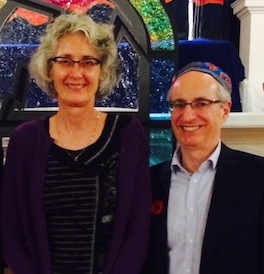
photo - Elisheva Gray, left, and Micha Menczer
Elisheva Gray, left, and Micha Menczer. (photo from Victoria Hillel)

This is where we would like to begin tonight – allowing the silence to speak. I ask you to join me in just looking around our sanctuary and at our windows. All of the colors and nuances of our magnificently crafted windows can’t be fully appreciated at night, but they are, nevertheless, beautiful windows. At our early morning service on Thursdays, those of us who come are often treated to an extraordinary light show, as the soft, morning light gently begins touching on the blue glass.

We have all experienced the sound of breaking glass. Can we even begin to imagine the quiet and tranquility being shattered by the sound of window glass suddenly crashing to the ground and breaking into a thousand pieces, as happened in synagogues throughout Germany and Austria, beginning on that November night in 1938. The only reason? Because we were Jews. How would we feel if we witnessed that happening here, in our sanctuary, in our community, to these very windows?

As a symbol of our desire to work together in unity, to respect one another’s differences and to strive for a community that has tolerance and respect at its centre we will rebuild a window together tonight, a window resembling one of our very own windows.

While we are blessed to live somewhere where we haven’t had to witness an event like Kristallnacht, we also must be realistic of the need to remain vigilant and caring for one another in a world where such events have taken place and could, potentially, take place again. The more fractured and fragmented our world becomes, the more vital it is for us to come together, to put our differences aside and see each other on that most human level, stripped of labels and roles and categories. We may all pick our fruit from different trees, but we all share the same garden.

Tonight, as we commemorate the tragic events of that fateful November night and all that followed in its wake, we also recognize the strength and resilience of our people, the courage of the survivors, and we look towards the future with hope for a world where no group is targeted for attack, as the Jews were on the Night of Broken Glass and in the years that followed.

We are truly honored to have Holocaust survivors with us tonight, as well second- and third-generation descendants, representatives of political leadership, law enforcement agencies, faith groups and persons targeted for their sexual orientation, religious or political beliefs, participating in this symbolic reconstruction and in our candlelighting ceremony.

Our candlelighters will light seven candles. Six of them represent the six million lives lost in the Shoah. The seventh candle represents the many other persecuted victims of the Shoah. It is also our candle of hope.

Closing remarks

I’d like to thank our wonderful planning committee, our readers, volunteers and musicians for their hard work and dedication. Thank you, as well, to Rabbi Harry for his help and for his words. We are, again, especially honored and deeply grateful to our survivors, descendants of survivors and everyone who helped us with our candlelighting and our window building, especially Julius Maslovat (child Holocaust survivor), the b’nai mitzvah children from Congregation Emanu-El, local grandchildren of Holocaust survivors, MP Murray Rankin, Rabbi Harry of Congregation Emanu-El, Very Rev. Ansley Tucker, Constable Rae Robirtis from Victoria Police Department and Carmel Tanaka (Victoria Hillel director, granddaughter of Holocaust survivors and interned Japanese-Canadians).

The many problems out there in the world sometimes seem too big and too overwhelming for us to solve. Rebuilding our window here tonight may seem small in comparison to the challenges that face us in the wider world. But tonight, as we gathered to remember a difficult chapter from our past, it is our hope that, together, we injected a little more shalom into the world.

In Hebrew, every word has a three-letter root from which other words are formed. From the same root for the word shalom, peace, comes the word shalem, whole, and shlemut, wholeness. Each time we inject more shalom into the world, we are, in essence, diminishing brokenness and creating more wholeness. A little shalom goes a long, long way.

Our window may be fragile, but it is full of possibility. The cracks are a necessary reminder of our vulnerability. They are the scars that must be there, reminding us of our past, reminding us of the Night of Broken Glass.

A window allows us to look in – in this case, looking into the past, back to Nov. 9, 1938. And a window allows us to look out. What is that world that we, as individuals and as a community, want to see when we look out? A window also shows us our reflection. Who do we see looking back at us? Who do we want to see?

Elisheva Gray is a member of the Victoria Holocaust Remembrance and Education Society and is on the planning committee for the Kristallnacht Commemoration in Victoria.
Format ImagePosted on December 11, 2015December 9, 2015Author Elisheva GrayCategories LocalTags Emanu-El, Hillel, Holocaust, Kristallnacht

Denkmal

This is not about Dachau, although
these things happened there.

When my son and I visited the Denkmal,
as the Germans refer to Dachau,
it was late afternoon,
and it was deserted.
The weather was rainy and cool.
Vancouver weather: warm for
December in Bavaria,
I was told.

We walked around, peering
curiously into the barracks
where the living dead stared with eyes
like those of African night mammals
at the stunned American cameramen,

and then we stepped into the “Duschbad,”
and then into the crematorium
and then back outside into
the drizzle –

Finally, I stopped to look at the bronze memorial
to the “Unknown Prisoner”: a stooped, skeletal
Muselmann
in rags, ashy and green from the wet Bavarian winters;

leaving a pebble on the pedestal, as I had been taught,
I turned to leave.

My son had lingered behind.

Fifteen, tough and big;
standing quietly in front of the pitted bronze,
his black football jacket dripping rain,
sloppy, untied Adidas hightops
and blue/white acid-dyed jeans soaking through –

he slowly reached up
to his soggy old Detroit Tigers
baseball cap,
and politely

between wet thumb and forefinger,

tipped the brim.

Graham Forst, PhD, taught literature and philosophy at Capilano University until his retirement and now teaches in the continuing education departments at Simon Fraser University, University of British Columbia and Banff School of Fine Arts. From 1975 to 2010, he co-chaired the symposium committee of the Vancouver Holocaust Education Centre.

Posted on December 11, 2015December 9, 2015Author Graham ForstCategories Op-EdTags Dachau, Denkmal, Holocaust

Ludicrous standards

Sweden’s Foreign Minister Margot Wallström has accused Israel of “extrajudicial executions” of Palestinian terrorists. The minister said, in the country’s parliament, that Israel has a right to defend its citizens, but went on to clarify that such defence should not include “extrajudicial execution” and accused Israel of a “disproportionate” response.

It is a familiar refrain from the European community, a place where Israeli products are being labeled as part of a boycott strategy, sometimes by vigilantes in makeshift uniforms patrolling shops and applying stickers to Israeli goods. Israel has a right to defend itself, in the world’s eyes, up to and until it actually begins to defend itself.

The issue is confused by some outside observers. It is true that Israel is a democratic state that respects the rule of law. But it is also a country at war with radical Islamist terrorism. There are, certainly, laws and judicial recourse for crimes, but when a murderous act is in the process of unfolding, the first objective of security forces is to end the situation. Certainly, the next objective should be ensuring that judicial process takes precedence by, for instance, shooting in the leg or otherwise disabling the attacker through non-lethal means. From half a world away, it is hard to judge the actions of frontline security personnel (or, at least, it should be more difficult than it seems to be) but we would hope that response is balanced with preservation of life and the addressing of crime through Israel’s admirable system of judicial oversight.

At the same time, we should be cognizant of double standards.

Remember just over a year ago, in October 2014, a terrorist murdered Cpl. Nathan Cirillo at the National War Memorial and then proceeded to Canada’s Parliament Buildings, where he was taken down, fatally, by the sergeant-at-arms, Kevin Vickers.

Vickers became a national hero. He was not condemned by the government of Sweden or anyone else. The Canadian government was not pilloried for “disproportionate” force or “extrajudicial execution.”

No, there are two sets of rules in this world. One set for Israel which, despite all the threats and existential challenges it faces, is expected to maintain the world’s highest standards – actually, ludicrous standards – of engagement, while everyone else gets a pass, including the tyrants whose governments currently sit on august bodies like the United Nations Human Rights Council.

Predictably and correctly, Israel’s foreign ministry lambasted the Swedish politician’s comments, dismissing them as “scandalous, delusional, rude, and detached from reality.”

“The [Swedish] foreign minister suggests that Israeli citizens simply give their necks to the murderers trying to stab them with knives,” the Israeli foreign ministry said in a statement. “The citizens of Israel and its security forces have the right to defend themselves. In Israel, every person who commits a crime is brought in front of a judge, including terrorists. The citizens of Israel have to deal with terrorism that receives support from irresponsible and false statements like that.”

The Swede’s comments are not unusual, although they are particularly flagrant. They are of a type we have seen repeatedly when Israel faces an upsurge in terrorism. The attitude it depicts reflects more concern for the murderers than it does for their victims. Rare is the word of support or empathy for Israel’s untenable position facing down individual terrorists incited by their government and society to stab, drive over or otherwise murder Jews.

The Swedish foreign minister’s words really speak volumes about where Europe’s sympathies lie these days.

Posted on December 11, 2015December 9, 2015Author The Editorial BoardCategories From the JITags antisemitism, Israel, Margot Wallström, Sweden, terrorism

Comparing refugee response

While American political discourse around whether to accept Syrian refugees smolders under the embers of xenophobia, Canadians have been opening their hearts and their wallets to bring in Syrian refugees.

Canada is one of the only countries with a private sponsorship option, which means that groups of ordinary citizens can provide funds and demonstrate their intention to provide emotional and logistical support to refugee families for one year, thus enabling the absorption of refugees whom the government might not otherwise have been able to afford.

Like many faith and neighborhood communities, Jewish communities, especially through synagogues, are on the frontlines of this effort.

It’s not often that a rabbi’s sermon gets reprinted in the daily newspaper of a major city, but such was the case for Rabbi Lisa Grushcow of Montreal’s Temple Emanu-El-Beth Sholom. “For too long, we have thought of religion in passive terms, counting how many people are sitting in the pews or paying dues,” she wrote. “All this is necessary but not sufficient. I want us to count how many lives we change, how many people we help, how many hearts we touch.” Her synagogue is sponsoring at least one refugee family.

Meanwhile, a sermon delivered on Kol Nidre this year by Rabbi Dan Moskovitz of Temple Sholom in Vancouver helped capture the hearts and minds of his congregants. “Tonight, I want to ask you to do something great. I want to ask you to save a life, the life of a stranger – because we were once strangers in the land, because we are human beings and that is the only similarity that we really need.” It didn’t take long for the congregation to come up with the $40,000 necessary to sponsor a refugee family. They are now fundraising to bring a second. Other synagogues across the city – including the Jewish Renewal Or Shalom, which is sponsoring three families – have followed suit. (See story, page 1.)

In Toronto, Jewish Immigrant Aid Services, one of nearly 100 organizations across the country that enjoys sponsorship agreement holder rights, has been flooded with sponsoring requests.

I spoke to Ryan Friedman of Darchei Noam and to Pippa Feinstein of First Narayever Congregation, two Toronto-based synagogues that are sponsoring refugees. Feinstein in particular noted that, while wanting to “ensure a safe place for any refugee family who is looking to come to Canada,” her congregation is aiming to launch “parallel awareness-raising activities” around the plight of persecuted minorities in the region.

Among those minorities are the Yazidi people of Iraq, who are being faced with a genocide – in the words of the United Nations High Commissioner for Human Rights – at the hands of ISIS. In collaboration with other faith groups, Winnipeg’s Jewish community has spearheaded an effort to sponsor multiple Yazidi refugees. As Belle Jarniewski described it, “When I saw the article about the mass grave [of the Yazidis], I really responded to it viscerally. It reminded me that we keep talking every year “never again” and, as Jews, we talk about this all the time, how important it is … and what are we doing about it?”

In my own city of Ottawa, Lori Rosove and Dara Lithwick of Temple Israel launched a community-wide effort to sponsor a refugee family. As Rosove explained it, “It’s the human thing to do.”

I, too, have helped launch a cross-denominational grassroots sponsoring effort, working through both Jewish Family Services of Ottawa and the United Church of Canada. Since a handful of us gathered in a neighbor’s living room in early September, we now number 250 participants and have raised $150,000 so far, enabling us to sponsor six families. So as to provide the suggested “soft-landing” that settlement agencies advise, each family will live with a neighborhood host for the first couple of months.

And what of pushback from community members? Moskovitz explained that, while 95% of his congregants have been enthusiastic, a few were not. “I met with each individual or group who registered a concern,” explaining the “rigorous UN screening and the Canadian screening [process].”

For their part, American Jewish groups have been doing what they can. There was the statement of moral clarity issued by 10 Jewish organizations. And there is a rabbis’ letter drafted by HIAS, urging their elected officials to “welcome the stranger.” In addition to lobbying Congress to accept refugees and supporting local resettlement agencies in their efforts, the U.S.-based Religious Action Centre of Reform Judaism has taken the initiative to help American congregations partner with Canadian ones in order to support their neighbors’ efforts. As RAC head Rabbi Jonah Pesner told me: “To sit at our [Passover] seder tables every year and [tell] the story, [starting with] ‘my father was a wandering Aramean,’ and to live through 5,000 years as a community of refugees, not to model for the world what it means to welcome the stranger would be an abdication of our legacy.”

So, while the U.S. Congress wrings its hands over whether to accept a meagre 10,000 souls, Canada (one-tenth the population) has pledged to receive 25,000 Syrian refugees by February, of which 10,000 are expected to be sponsored privately. When private citizens are empowered to help people from across the globe, the bluster and rhetoric can be bypassed while the real work of saving lives and opening hearts can take place.

Mira Sucharov is an associate professor of political science at Carleton University. She blogs at Haaretz and the Jewish Daily Forward. A version of this article was originally published on haartez.com.

Posted on December 11, 2015December 9, 2015Author Mira SucharovCategories Op-EdTags Dan Moskovitz, Or Shalom, refugees, Syria, Temple Sholom
Maccabi TA star visits

Maccabi TA star visits

Tal Brody, left, with Richard Poritz at the Vancouver screening of On the Map. (photo by Kyle Berger)

It was a warm Israeli summer in 1965 when Tal Brody made the journey across the Atlantic to visit Israel for the first time. It was a trip that would not only change his life, but also the entire world of basketball in Israel.

Immediately after being drafted 12th overall by the Baltimore Bullets of the National Basketball Association (NBA) – or 13th, depending on how you saw it, according to Brody – he represented the United States at the Maccabiah Games that summer, leading them to a gold medal victory. He also fell in love with Israel.

He returned home with an offer to play in Israel for a year with Maccabi Tel Aviv, Israel’s represented team in the European Championship League. What followed was what many have called the birth of basketball in Israel, highlighted by Brody’s now-famous “We are on the map” quote – the inspiration behind the new documentary On the Map, the Vancouver première of which Brody attended at the end of November.

“Maccabi Tel Aviv was a team that never went past the first round of the European Basketball Championships,” Brody explained of the time before he visited Israel. “They asked me to take them to another level. They said that, by joining them, it would lift the spirits of the country and make them proud. This appealed to me as a young Jewish kid, so I decided to take a year out of my life. But I never imagined I would go to Israel for more than a year.”

That season, Maccabi Tel Aviv made it all the way to the European Cup Finals versus Italy. While they didn’t win it all, Brody saw firsthand the impact that basketball had on the spirit of Israel, as well as oppressed Jews around Europe.

“I saw what happened to the country because of basketball,” he said. “As well, as we played games in Eastern Europe, where Jews were suffering from antisemitism, I saw how proud they were when the team from Israel would come. The Jewish communities would gather around our team and, as the years went by, we became the team that had the most support wherever we went.”

Brody’s one-year plan turned into a lifetime, peaking in 1977 when Maccabi Tel Aviv won the European Cup Championship, defeating the heavily favored Russian Red Army squad. It was after that victory that Brody exclaimed, “We are on the map – and we are staying on the map! Not only in sports, but in everything!”

Today, Brody is one of the most recognized sports figures in Israeli history. Currently serving as a goodwill ambassador for the country, he was named the Israel Sportsman of the Year in 1967, was awarded the Israel Prize – Israel’s highest civilian honor – in 1979 and received a lifetime achievement award in the Knesset just last May.

“Every year I go back to the NBA all-star weekend and the guys always ask me the same thing: ‘Tal, why did you go to Israel?’” he shared. “I said, ‘Guys, even today, if I was offered 2.7 mill, if I knew what I would be missing, I wouldn’t take that money.’ I would never give up those 48 years in Israel. It’s been amazing.”

Since Brody’s influence, Maccabi Tel Aviv has remained a competitive team in the European Cup, winning it six times now. Israel has also seen two players play in the NBA, with Omri Kasspi currently playing for the Sacramento Kings and Gal Mekel playing for the Dallas Mavericks in 2013.

“To see and to take that journey from the rise of Maccabi Tel Aviv and now to see two Israeli players in the NBA and what it has done for the country is a good feeling,” Brody said. “It’s been such a great ride for me.”

Brody’s visit to Vancouver and the screening of On the Map were facilitated by the Jewish Community Centre of Greater Vancouver. The film will be officially released by Hey Jude Productions in 2016.

Kyle Berger is Jewish Community Centre of Greater Vancouver sports coordinator, and a freelance writer living in Richmond.


Format ImagePosted on December 11, 2015December 9, 2015Author Kyle BergerCategories TV & FilmTags basketball, Israel, Maccabi Tel Aviv, NBA, Tal Brody
New chef at Weinberg

New chef at Weinberg

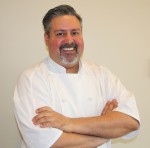
Shane McNeil, formerly of Bridges Restaurant, is the new executive chef at Weinberg Residence. (photo from Weinberg Residence)

For the Weinberg Residence’s recently hired executive chef Shane McNeil, formerly of Bridges Restaurant, his new job is about more than just cooking great-tasting kosher food.

“What I love about cooking is that it puts a smile on people’s faces, which gives me a lot of satisfaction. My philosophy on cooking is simple: use the freshest ingredients possible, local when available, and let the ingredients speak for themselves. I tend to use a nice light seasoning or sauce, so the quality of the ingredients really stands out,” explained McNeil, who began at the Jewish seniors home in September 2015. “I also like to check in with the residents pretty much every day. Getting that regular feedback from them is really important, as it helps me become a better chef and gives me the pleasure of knowing that I’m a bright spot in their day.”

McNeil’s lifelong passion for cooking began as a young man in Toronto, where he attended George Brown College’s Chef School, which counts several internationally recognized chefs among its graduates. He then relocated to Vancouver, where he excelled under the tutelage of local talents, chefs Scott Kidd and Chef Dino Gazzola of Raincity Grill and Bridges Restaurant.

photo - Shane McNeil’s incorporation of classic French culinary techniques with contemporary flair showcases the fresh, local and seasonal ingredients of the West Coast
Shane McNeil’s incorporation of classic French culinary techniques with contemporary flair showcases the fresh, local and seasonal ingredients of the West Coast. (photo from Weinberg Residence)

McNeil’s culinary acumen has already begun to have a considerable impact at the Weinberg Residence. His roasted sablefish with orange-ginger glaze and green-beans almondine, his Italian beef stew with garlic mashed potatoes and roasted corn and his sockeye salmon farfale with ratatouille are all garnering praise. His incorporation of classic French culinary techniques with contemporary flair showcases the fresh, local and seasonal ingredients of the West Coast.

“The food is absolutely delicious. He’s an excellent chef who’s open to suggestions. He made a polenta lasagna the other night that was absolutely wonderful and he makes the best cheese sandwiches I’ve ever tasted!” said resident Sheila Cantor.

The residence executive is also pleased. “We are extremely grateful and very excited to have such an exceptional chef on our team and we look forward to this exciting enhancement to our hospitality offering,” said Vanessa Trester, gerontologist and leader of the Weinberg.

To share the good news with the community about the new dishes being served at the Weinberg Residence, if you, your spouse or family member is considering assisted living or multi-level care, the Weinberg is currently offering a complimentary lunch when you book a tour. To make a reservation, call Trester at 604-267-4722.

Format ImagePosted on December 11, 2015December 9, 2015Author Weinberg ResidenceCategories LocalTags seniors, Shane McNeil, Vanessa Trester, Weinberg Residence

Spreading the lights of Chanukah

The Jewish Renewal synagogue in East Vancouver, Or Shalom, is marking the eight nights of Chanukah by honoring eight “lights” of life on the city’s east side.

“I had this idea that it would be really special to open ourselves out to our community and to really focus on the notion of Chanukah being a celebration of light emitting from darkness, or the notion of Chanukah as being about light that seems unlikely to continue to shine but miraculously does persevere,” explained Rabbi Hannah Dresner, spiritual leader of the shul. “I would really like our community to focus on what it means to be a human being that is a light in the community.”

The synagogue will have a celebration this Saturday night that recognizes the contributions of eight individuals and organizations that add light to the east side community.

Among the honorees are John Jardine of Vancouver’s Native Education College; firefighters from the hall nearest Or Shalom; a group within the Or Shalom congregation devoted to aiding refugees; Kim Leary, executive director of the Homework Club associated with Britannia Secondary School; members of the Habonim-Dror youth movement; Angela Marie MacDougal, the director of Battered Women’s Support Services; Mount Pleasant Neighborhood House; and Rev. Sally McShane of First United Church, which runs programs in the Downtown Eastside.

“Our miracle story is that, when the Temple in Jerusalem was desecrated, they came in afterwards and wanted to relight the candelabra that was kept lit all the time but there wasn’t enough oil, so they lit it anyway and the miracle that’s celebrated is that that oil was sufficient to keep the lamp lit until olives could be harvested and oil could be pressed and brought forward to the Temple,” Dresner said. “So the notion is that if you light the light and tend it, that there is an element of trust and faith that, if we do our work, then the divine energy will join us in uplifting our world.”

Eight Leading Lights takes place Saturday, Dec. 12, at Or Shalom, 710 East 10th Ave., with a potato bar supper at 5:30 p.m. and communal singing and candlelighting at 7 p.m.

Posted on December 11, 2015December 9, 2015Author Pat JohnsonCategories Celebrating the HolidaysTags Chanukah, Hannah Dresner, Or Shalom
Fighting for a recovery

Fighting for a recovery

Classmates congratulate Oz Attal, second from the left, after he completed Alyn Hospital’s Wheels of Love bike-a-thon. (photo from Canadian Friends of BTJ)

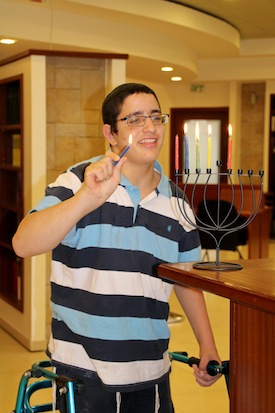
This Chanukah, Boys Town Jerusalem is celebrating its own miracle. Student Oz Attal is taking an active role in the school-wide celebrations. Just over three years ago, the then-12-year-old boy was hit by a bus as he was coming home from day camp. With severe head and internal injuries, he was in a coma for six weeks. The moment he regained consciousness, he began an intense, painstaking struggle to regain his function and independence. Today, pushing a walker, 16-year-old Oz (Hebrew for “strength”) has rejoined his class at Boys Town.

photo - Oz Attal participated in the school’s Chanukah celebrations this year
Oz Attal participated in the school’s Chanukah celebrations this year. (photo from Canadian Friends of BTJ)

“There wasn’t a day that Boys Town wasn’t there for Oz,” recalled his mother, Yael. “Rabbi Meir Linchner, dean of students, and principal Rabbi Elimelech Yaakov were at our side in the hospital almost immediately after the accident. Once Oz was conscious, the school sent a steady flow of classmates to visit him regularly. Even when Oz entered the Alyn Pediatric Rehabilitation Centre for what would become nearly a three-year stay, several teachers voluntarily came each week to tutor him. Although he could barely communicate, Oz clearly felt strong and loved.”

Watching Oz dart through Boys Town’s halls – and stairs – his mother noted that, two years ago, the doctors declared that her son would never walk again. Although Oz needs a walker for support, he cuts himself no slack when heading indoors or outdoors with his class. “Yet, with traumatic brain injury (TBI), no one can know the extent of the permanent injury,” she said. “For now, Oz’s left side is weak, and his hand shakes. Sadly, he has no long-term memory and no control over what he may say, yet he understands the academic material quite well. Most crucial, he has iron motivation.”

Last year, Oz began coming to Boys Town several hours, one day a week, accompanied by his mother. At the start of the school year, Linchner informed her that, for the four days that Oz is not in treatment at Alyn Hospital, he can return to his 11th-grade class, where Linchner himself is the main instructor. The classroom was then moved to a lower floor. “At first, I stayed at Oz’s side in class and also helped him manoeuvre his way through the halls between classes,” she explained. “Very soon, Rabbi Linchner informed me that BTJ had made arrangements for a ‘shadow’ to accompany Oz for the year and relieve me.” (At home, Oz’s seven siblings await her.)

Tears filled Oz’s eyes when he first took his seat in class, Linchner recalled. “His 36 classmates received him with love and extreme patience. They are now learning an invaluable lesson in how to give of themselves.”

Recently, the entire class joined Oz in a moment of triumph when he pedaled to the finish line of Alyn Hospital’s Wheels of Love bike-a-thon. Waving signs that said, “Oz the King!” his classmates and teachers heartily cheered for him.

“Oz has been blessed with an extraordinary family and a fierce will to live,” Linchner said. “For us, his teachers and classmates, it’s an honor to be a part of the miracle of Oz’s life.”

Format ImagePosted on December 11, 2015December 9, 2015Author Canadian Friends of BTJCategories IsraelTags Boys Town, Jerusalem, Oz Attal
סערת דונלד טראמפ

סערת דונלד טראמפ

דבריו החמורים של המועמד הרפובליקני לנשיאות בארה”ב, דונלד טראמפ, בגנות המוסלמים, מעוררת תגובות נזעמות גם בקנדה. (צילום: Gage Skidmore via wikimedia.org)

סערת דונלד טראמפ מגיעה גם לקנדה: פוליטיקאים קוראים להחרימו וחברי מועצות בערים קוראים להסיר את שמו מהמגדלים

דבריו החמורים של המועמד הרפובליקני לנשיאות בארה”ב, דונלד טראמפ, בגנות המוסלמים, מעוררת תגובות נזעמות גם בקנדה. טראמפ אמר השבוע במסגרת קמפיין הבחירות שלו שיש לאסור על המוסלמים להיכנס לארה”ב, בין אם כמהגרים או כתיירים. טראמפ מוביל עדיין בסקרים מול שאר המועמדים של המפלגה הרפובליקנית, אך הביקורת נגדו במפלגה ומחוצה לה, בארה”ב ומחוצה לה, רק הולכת וגדלה. טראמפ באימרותיו השנויות במחלוקת והפרובוקציות שלו נמצא במסלול הנכון להפוך לאחד האישים השנואים בעולם.

שר החוץ של קנדה, סטפן דיון, אמר בנוגע לטראמפ: “מעולם לא קרה בקנדה מה ששמענו כעת בארה”ב מטראמפ. אנחנו לא יכולים לקבל דבר כזה. אף מפלגה בקנדה לא תתקרב לדברים כאלה. אזרחי קנדה יתנגדו לנצח לאמירות שכוללות שנאת זרים כזו”. ראש ממשלת קנדה, ג’סטין טרודו, סירב להגיב ישירות על דברי טראמפ בטענה כי כל אחד בתפקידו אסור לו להגיב בנושאי פוליטיקה פנימית של מדינה אחרת, במיוחד כאשר מתנהלת בה מערכת בחירות. עם זאת טרודו ציין והוסיף כי: “אזרחי קנדה יודעים היטב היכן הוא עומד בנוגע לנושאים כאלה”.

מנהיגת האופוזיצה הזמנית מטעם מפלגת השמרנים, רונה אמברוז, דחתה את דבריו של טראמפ וטענה שהם מגוחחים. לדבריה: “זה בידי תושבי ארה”ב לבחור מי יהיה המנהיג הבא שלהם, אבל אני בטוחה שרבים ואפילו במפלגתו, חושבים שהתגובות שלו הן מגוחחות”. ואילו מנהיג המפלגה הדמוקרטית החדשה, טום מולקייר, טוען שהגיע הזמן לאסור על אנשים כמו טראמפ שמפזרים דברי שינאה, להיכנס לקנדה”.

במקביל חברי מועצה בעיריית טורונטו וונקובר גם הם יוצאים בחריפות נגד דברי טראמפ. מספר חברי מועצת העיר טורונטו דורשים להחליף השם “טראמפ” של מגדל המלון דירות בדאון טאון, בשם אחר. מגדל טראמפ בטורונטו פועל מאז ראשית 2012. גם חברים במועצת עיריית ונקובר דורשים אף הם להחליף את השם “טראמפ” של מגדל המלון דירות ברחוב ג’ורג’יה בדאון טאון, בשם אחר. מגדל טראמפ בוונקובר שבנייתו הולכת ונשלמת בימים אלה, יפתח בראשית שנה הבאה.

טראמפ מתכוון לבקר בישראל לקראת סוף השנה. במסגרת הביקור לפי מקורביו הוא ינסה לעלות להר הבית ואין ספק שפרובוקציה כזו מצידו, יכולה להצית את כל המזרח התיכון. ראש ממשלת ישראל, בנימין נתניהו, למרות שדחה את דבריו של טראמפ בגנות המוסלמים, כן הסכים להיפגש עימו כשיגיע לישראל.

ארגון או.אי.סי.די: ישראל וקנדה במקום טוב מבחינת נטל המיסים

ישראל וקנדה נמצאות במקומות מוכבדים מבחינת היקף נטל המיסוי בקרב שלושים וארבע המדינות, החברות בארגון או.אי.סי.די. ישראל הצטרפה לאו.אי.סי.די ב-2010 והחברות בו מחויבויות לערכי דמוקרטיה, שקיפות ודבקות בערכי כלכלת שוק ופיתוח כלכלי.

הארגון פרסם בשבוע שעבר את נתוני 2014 ונטל המיסים של חברותיו עומד על 34.2% בממוצע. המדינה עם נטל המיסוי הגבוה ביותר היא דנמרק עם 47.6%. אחריה: צרפת (45%), בלגיה (44.7%), איטליה (43.9%), פינלנד (43.7%), שבדיה (42.8%), אוסטריה (42.5%), נורבגיה (40.5%), לוקסמבורג (38.4%) והונגריה (38.4%) במקומות התשיעי והעשירי. גרמניה (36.5%) במקום השלושה עשר, בריטניה (32.9%) במקום השמונה עשר ואחריה ספרד (32.7%) במקום התשעה עשר. ישראל במקום העשרים ושלושה עם נטל מיסוי של 30.6%, ואחריה במקום העשרים וארבעה קנדה עם 30.5%. יפן (30.3%) במקום העשרים ושישה, אוסטרליה (27.5%) במקום העשרים ותשעה, אחריה במקום השלושים שוויץ (26.9%), ובמקום השלושים ואחד ארה”ב (25.4%). המדינה עם נטל המיסוי הנמוך ביותר היא מקסיקו (19.7%) במקום השלושים וארבעה.

Format ImagePosted on December 10, 2015December 10, 2015Author Roni RachmaniCategories עניין בחדשותTags Israel, Muslims, racism, Rona Ambrose, Stéphane Dion, tax, Trump, xenophobia
Challenging viewers’ beliefs

Challenging viewers’ beliefs

“Ganesha,” from Dina Goldstein’s Gods of Suburbia series. (photo © Dina Goldstein)

You have to speak more than one language if you want to read all of the articles on Vancouver photographer and Pop Surrealist Dina Goldstein’s art. English, of course, but also French, Italian, Spanish and Greek, for starters. Among other places, her work has been exhibited in Canada, of course, but also Poland, India, Colombia and, most recently, Holland.

She attended the Oct. 11 opening of In the Dollhouse at Rize Gallery in Amsterdam. “I try to get to all of my openings,” she told the Independent in an email interview. “Traveling and experiencing other cultures is the perk of being an artist. I enjoy being at the exhibition in person and seeing the reactions to my work. The galleries also like it when the artist is there to offer more perspective.”

In the Dollhouse is the second of three large-scale photographic series that Goldstein has created. The other two are Fallen Princesses and Gods of Suburbia. All three have been, or are being, exhibited in various places. About whether galleries pay artists to display their work, Goldstein explained, “The agreements vary from gallery to gallery, sales from the show are split between the gallery and the artist. There are some festivals that cover travel and accommodation in order for the artist to attend. I currently produce my own large-scale projects with the help of print sales and grant awards. These are print sales of my limited edition pieces from Fallen Princesses, In the Dollhouse and the Gods of Suburbia series (displayed on LED light panels).

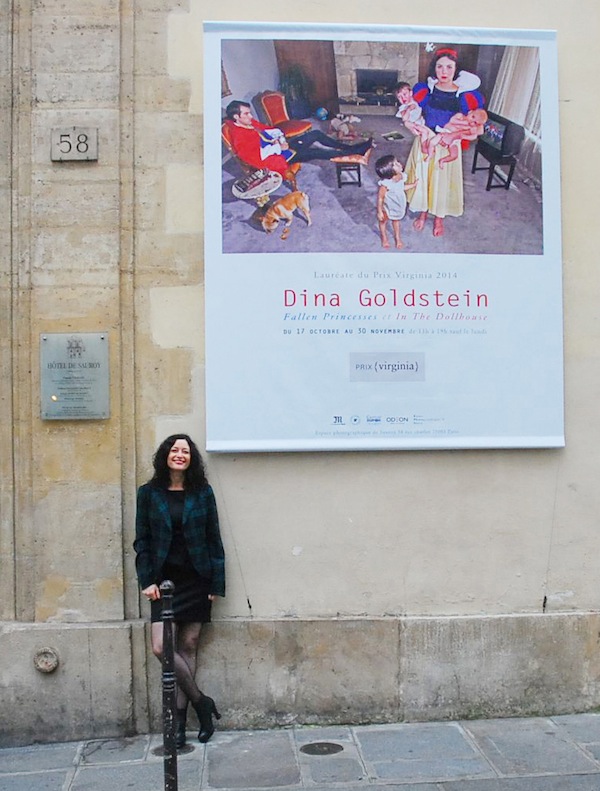
“There are also art competitions that award cash prizes. This was the case for me when I won the Prix Virginia in 2014 and was gifted 10,000 euros.”

photo - Dina Goldstein (photo from Dina Goldstein)
Dina Goldstein (photo from Dina Goldstein)

Goldstein has been a photographer for 25 years. “I started out quite young and worked very hard in my 20s and 30s to create a career for myself,” she said. “I was a photojournalist and traveled to war-torn regions. I freelanced, shooting covers and feature stories for magazines. (I was a staff photographer at the Jewish Western Bulletin.) I also photographed some cheeky ads with some brilliant art directors. People within the Vancouver Jewish community will remember me photographing weddings and bar mitzvahs; alongside, I created my own projects. Usually concentrated on the study of sub-cultures within society, I termed the work ‘photoanthropology.’ These images were documentary, photojournalistic.

“In 2009, I released my tableau series Fallen Princesses, which was an internet success and brought recognition to my personal work. I went on to realize more ambitious projects like In the Dollhouse in 2012, and Gods of Suburbia in 2014. I am now fully concentrated on producing my own large-scale conceptual series and have become a full-time artist.

“Storytelling has always been central in all of my work past and present,” she continued. “Documentary photography allowed me to create and share the stories of Palestinians in Gaza, gamblers at the racetrack, East Indian blueberry farmers in B.C., dog show dogs, bodybuilding state championships and teenagers dirty dancing at a bar mitzvah.”

Readers can see many of those images at dinagoldstein.com. They can also see images of her three large-scale series, all of which challenge viewers to question their beliefs, some of which were instilled in childhood. Is there an ideal body, an ideal marriage, an ideal anything? Can we rest assured that good ultimately prevails and evil is punished?

“Much of my work investigates the myth of perfection and the collective perception influenced by pop culture,” said Goldstein. “Western society today is influenced by pop culture, which informs us how to look, what to like, what to buy. Most people don’t even realize the effects of the unconscious collective that drives us to behave in certain ways. Perfection is not stable or sustainable in nature and in life. Also, there is an individual perspective about what is ‘good’ or ‘perfect.’ This is mainly the reason that I work with archetypes and stereotypes to relay my messages and offer some social critique. By twisting the storylines of beloved characters, I am able to provide some insight into the human condition, and expose the many flaws in the nature of humankind.”

Fallen Princesses takes the Disney version of 10 fairy-tale women, including Snow White, Sleeping Beauty, Jasmine and others, and “creates metaphor out of the myths of fairy tales, forcing the viewer to contemplate real life: failed dreams, addiction, obesity, cancer, the extinction of indigenous culture, pollution, war and the fallacy of chasing eternal youth,” reads the description on Goldstein’s website. Goldstein’s Snowy, for example, is pictured in an unkempt living room, holding two kids in her arms, with one child pulling on her skirt and yet another playing on the floor, where a dog eats potato chips that her beer-drinking, TV-watching prince has let fall.

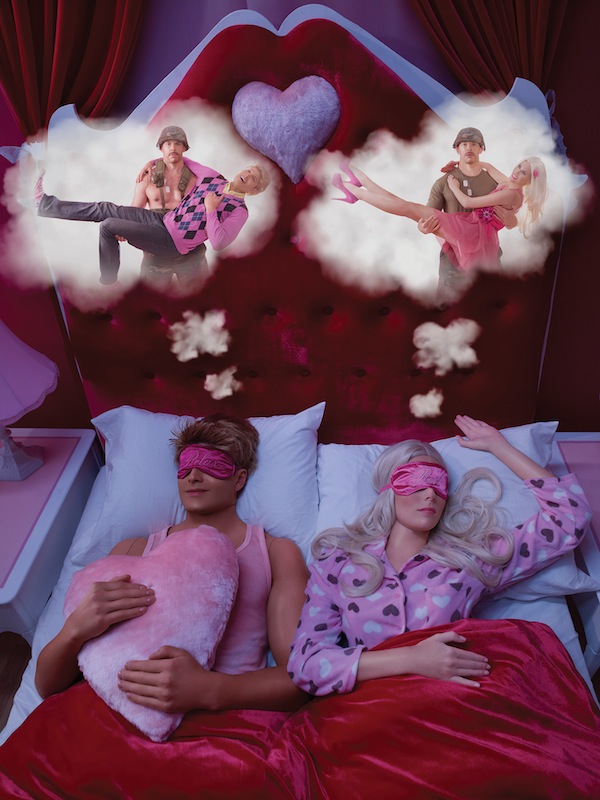
photo - “The Dream,” from Dina Goldstein’s In the Dollhouse series. (photo © Dina Goldstein)
“The Dream,” from Dina Goldstein’s In the Dollhouse series. (photo © Dina Goldstein)

In the Dollhouse also features an iconic couple long into their marriage: Barbie and Ken. In Goldstein’s version, Ken begins to understand and accept his homosexuality, and he seems to flourish as the narrative progresses, while Barbie “breaks down and confronts her own value and fleeting relevance.”

But why doesn’t Barbie take her dream car and leave Ken? And the princesses? Granted they likely haven’t been taught the life skills needed to deal with illness, raising a family, etc., but do they just accept their unhappily ever after, or do they rail against it? Are they victims or survivors, both or neither?

“Throughout history, the focus in storytelling has been on men and their outlook of this world,” said Goldstein. “Women’s desires and interests have mostly been marginalized. I feel lucky to live in a free Western society where women’s roles are now more prominent. As a woman experiencing this transformation, I take full advantage by creating art that fully expresses my thoughts and opinions. I create art with fictional characters that has elements of real life. What you see within a work is a moment in time (within the fictional life or these fictional characters). As Barry Dumka pointed out in his essay, yes,

Barbie has lost her head, but she is Barbie and that head can pop right back on. Unfortunately, humans don’t have that luxury. In my tableau, the princesses are thrust into everyday life within realistic environments. They, too, have to figure out how to function and thrive within a complex world.”

Goldstein’s website is fascinating. Not only is her artwork displayed there and her many interviews, but she has a section called Dig Deeper. There, visitors can spend hours reading intelligent, thoughtful analyses of her work, including the aforementioned essay by Dumka.

Despite the grim situation of the princesses, of Barbie, there is humor in Goldstein’s work – there’s something sardonic about seeing Ariel, the Little Mermaid, in an aquarium, Belle of Beauty and the Beast undergoing plastic surgery, or Ken wearing Barbie’s high heels, for example. In Gods of Suburbia, she portrays Satan as a tow-truck operator, Darwin is watching people play the slots at a casino, and Buddha is shopping at Wholey Foods.

“I try to keep everything in perspective,” said Goldstein. “Let’s face it, life can get overwhelming and too serious. I use humor to cope with all that the world throws at me. Also to create conversation about modern society and how we perceive it. I utilize satire, which is intelligent ridicule, and irony, because it creates a situation that differs radically from what is actually the case.”

In a Times of Israel interview, when asked if there was a particular God of Suburbia that moved her most, Goldstein said Ganesha.

“The Ganesha piece was inspired by personal memories,” she told the Independent. “My family moved from Israel to Canada in 1976. At that time, Vancouver was a small town and it had not yet experienced the mass Asian population that you see today. My first few years here were very difficult and, as a young child, it was hard to comprehend.

“Learning a new language whilst dealing with schoolyard bullies. Even in high school, and after many years of integration, I felt different somehow. Most of my family remained in Israel, so we would visit every couple of years for the whole summer. There, I got recharged with chutzpah and the realities of war. So, I became an Israeli/Canadian hybrid. Israeli in many ways and not the typical Canadian. However, these days I know that I’m fully Canadianized because I listen to the CBC radio all day!

“Ganesha is naturally odd, as he has an elephant head and a boy’s body. He is different because of his appearance (I didn’t have that problem) but also because of his unique culture. He is judged for how he dresses, what he eats and even what he believes in. He faces the same cruelty that I encountered in elementary school.”

While all of Goldstein’s art can be seen on her website, there is nothing that can compare to seeing it in person. Gods of Suburbia will travel to Montreal in February to be shown by Art Souterrain. And there also will be at least one local opportunity to see the exhibit next year.

“The Diamond Foundation has generously donated the whole Gods of Suburbia show to appear at the Capture Festival [in April],” said Goldstein. “The exhibition will take place at a new gallery on East 6th Avenue in Vancouver called SOMA.”

Format ImagePosted on December 4, 2015December 3, 2015Author Cynthia RamsayCategories Visual ArtsTags Dina Goldstein, Dollhouse, fairy tales, Fallen Princesses, Gods of Suburbia, Pop Surrealism, Prix Virginia

Posts pagination

Previous page Page 1 … Page 536 Page 537 Page 538 … Page 661 Next page
Proudly powered by WordPress