Among the many Shabbat 100 volunteers were, from left to right, Ben Felstein (Chabad Jewish Student Club and Israel on Campus), Daniella Malpartida (Jewish Students Association), Anna Kapron-King (Progressive Jewish Alliance), Lior Bar-el (JSA and PJA), Michelle Levit (CJSC), Sydney Switzer (CJSC), Katrin Zavgorodny (CJSC board), Jennifer Brodsky (CJSC) and Becca Recant (Hillel BC). (photo from Chabad at UBC)
More than 140 students, faculty and alumni gathered in University of British Columbia’s newly built AMS Student Nest on Jan. 22 for Shabbat 100, which was organized by Chabad Jewish Student Centre-Vancouver.
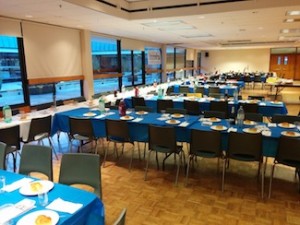
Prepared for the 140 guests to arrive for Shabbat 100. (photo from Chabad at UBC)
The event was co-sponsored by Jewish Federation of Greater Vancouver, Lohn Foundation, Chabad of Richmond and Great Canadian Superstore on Marine Drive, and co-hosted by Chabad Jewish Student Club, Hillel BC, and all of the Jewish clubs at UBC: Jewish Student Association, Progressive Jewish Alliance and Israel on Campus.
Guests enjoyed a three-course Shabbat dinner by Forty One Catering, and the evening included ice-breaker games, Shabbat songs and a presentation from each club.
Chabad hopes this will become an annual gathering. “It was so nice to see so many Jewish students coming together for this event,” said Rabbi Chalom Loeub of Chabad UBC. “We are on a high and look forward to bigger and better next year!”
A model of the Kaifeng synagogue at an exhibit at the Diaspora Museum in Tel Aviv in 2011. (photo by Sodabottle via commons.wikimedia.org)
With the Chinese New Year taking place next week, it is an appropriate time to reflect on the close and positive relationship between Jewish and Chinese peoples, which reaches back almost 2,000 years.
It might be simplest to begin with the fall of Jerusalem to the Romans in the year 70 of the Common Era. This was the climax of the first of three Jewish-Roman wars that would take place over the first and second centuries. The net result of these conflicts was the deaths of hundreds of thousands of Jews, the enslavement of many others, and those who managed to escape such tragedies fled as refugees. This scattering of Jews across the world we call the Diaspora ultimately resulted in the formation of the various communities we are familiar with today, such as the Ashkenazi, Sephardi and Mizrahi Jews. But there was a smaller, lesser-known Diaspora community that settled in China.
Between 206 BCE and 220 CE, China was ruled by the Han Dynasty. The Han established a vast international trading network that came to be known as the Silk Road. According to the oral history of the Chinese Jews, their ancestors first settled in China during the late Han Dynasty. Such a period would correspond with the Diaspora that followed the Jewish-Roman wars.
After the collapse of the Han Dynasty, the Silk Road trading network collapsed, but was reestablished in 639 CE during the Tang Dynasty. The Silk Road interconnected Tang Dynasty China with the wealthy states of India, East and North Africa, across Asia and into Europe. During the Medieval period, many Jews made their living as merchants. At this time, Christians and Muslims refused to trade directly with each other, and Jews earned great profits acting as intermediaries.
Many Jews traded along the Silk Road, the most prominent group of whom were the Radhanites, who inevitably found themselves in China. It is during this period that the first document indicating the presence of Jews in China has been found. It describes how a rebel leader executed foreign merchants and Jewish residents in the city of Guangzhou. Discovered at an important stop along the Silk Road in northwest China, the document dating to some point around the eighth or ninth centuries was written in a Jewish-Persian script on paper, which at the time would have only been available in China. Some historians have suggested that the Radhanites were responsible for bringing Chinese paper technology to Europe, although this theory is contested. The presence of Jews in Guangzhou at this time should not be surprising, considering it was an important port city linking Chinese and Middle Eastern trade. Guangzhou has one of the oldest mosques in the world and, at the beginning of the ninth century, may have had a population of as many as 100,000 foreigners.
In 908 CE, the Tang Dynasty fell, the Silk Road trading network again collapsed for several centuries and the prominence of the Radhanites declined. But this did not mean the end of the Jewish presence in China. Between 960 and 1279 CE, China was ruled by the innovative and prosperous Song Dynasty, with their capital city at Kaifeng. Kaifeng has been described as the New York of its day. It was a massive cosmopolitan city, a centre of global trade and the largest city in the world, reaching a population of 1.5 million people.
Though Jews would settle in other cities, such as Hangzhou, Ningbo, Ningxia and Yangzhou, most were in Kaifeng, and it became the centre of Chinese Jewry. The first synagogue was built in Kaifeng in 1163 CE. It was made of wood, in a Chinese architectural style. It would be destroyed and rebuilt many times throughout its history. The Jews of Kaifeng were held in high esteem by the Song emperors, and went on to pursue successful careers not only as merchants, but as court officials, scholars and soldiers. There is still a Kaifeng Jewish community today.
In the early 12th century, the first Jin emperor, Wanyan Aguda, unified the Jurchen, a group of tribal peoples living in Manchuria. The Jurchen waged war against the Song Dynasty and, in 1127, Jurchen forces conquered Kaifeng, an event that has come to be known as the Jinkang Incident. After this battle, the Song capital was moved south to Hangzhou, and many of the Kaifeng Jews accompanied the Song rulers in their migration. Nevertheless, there were some who stayed in Kaifeng. The Jurchen established the Jin Dynasty, and continued to wage war against the Song Dynasty for more than 100 years. Eventually, both the Jin and the Song were conquered by the Mongols in the 13th century.
In 1232, the Mongols besieged Kaifeng. During the conflict, the Jin used rockets against the Mongol invaders, which is the first use of rockets in warfare in recorded history; a technology all-too-familiar to the modern residents of Israel. In the mid-14th century, the Mongol rulers of China established the Yuan Dynasty, with their capital in Beijing. When Marco Polo traveled to Beijing in 1266, he wrote about the importance of Jewish merchants there.
In 1276, the Mongols conquered the Song capital of Hangzhou. In 1280, the Mongol emperor, Kublai Khan, issued a decree banning Jews from kosher practices and circumcision. Yuan Dynasty documents written in 1329 and 1354 issue a request of Jewish residents in China to go to Beijing to pay taxes. Though many atrocities occurred during the Mongol invasions, their rule was nevertheless marked by flourishing trade and the Jewish communities of China persisted.
At the site of the synagogue in Kaifeng, several stone steles have been recovered. The oldest, written in 1489, commemorates the construction of the synagogue in 1163. It describes how the Jews first entered China during the late Han Dynasty, and the Jinkang Incident, including how many of the Jewish population of Kaifeng fled to Hangzhou. Also inscribed on this stele were the following words: “The Confucian religion and this religion agree on essential points and differ in secondary ones.”
A second stone stele was made in 1512, which describes Jewish religious practices, which is fascinating considering it is written in Chinese. In 1642, a third stele commemorated the reconstruction of the synagogue in Kaifeng after it was destroyed by a flood. The synagogue was destroyed again by a flood in 1841, but was not rebuilt. This is likely due to the sociopolitical turmoil occurring in China at the time. It is interesting to note that, while Jews were persecuted, rejected and alienated by the nations of Europe, they were accepted and assimilated into Chinese culture.
During the 19th and early 20th centuries, persecution of Jews in Europe began again on a massive scale. The worst events of these times were the many pogroms in the Russian Empire, where hundreds of thousands of Jews were murdered, raped, robbed. Many Jews were forced to flee as refugees, some migrating to North America, some to Palestine, and some to China. The Russian Revolution in 1917 resulted in the deaths of around 250,000 Jews, and the orphaning of around 300,000 Jewish children. Many Russian Jews fled to the city of Harbin, in Manchuria, whose Jewish population reached 20,000. However, when the Japanese annexed Manchuria in 1931, many among that population left for Shanghai, Tianjin or Palestine.
Many Chinese intellectuals understood the plight of the Jewish people, and compared it to their own. The Chinese Nationalist and founder of the Republic of China, Dr. Sun Yat-sen, made the following comparison: “Though their country was destroyed, the Jewish nation has existed to this day…. Zionism is one of the greatest movements of the present time. All lovers of democracy cannot help but support wholeheartedly and welcome with enthusiasm the movement to restore your wonderful and historic nation, which has contributed so much to the civilization of the world and which rightfully deserves an honorable place in the family of nations.”
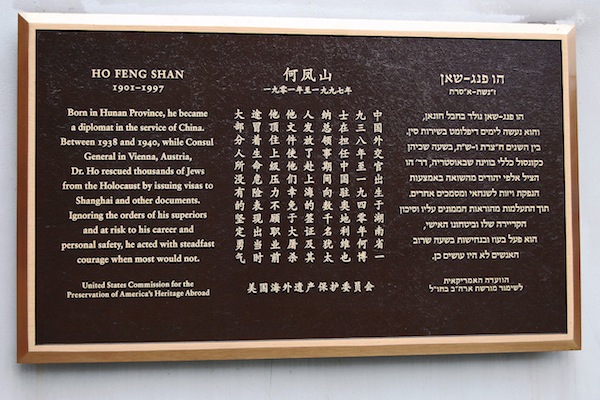
During the course of the Second World War, the Jewish population in China would swell to 40,000, many of whom resided in Shanghai. A number of Chinese diplomats helped smuggle in Jews using special protective passports. One such hero, a Chinese diplomat working in Vienna named Ho Feng Shan, helped Jews from Nazi-occupied Europe get to China, ultimately saving around 3,000 lives. Ho Feng Shan was posthumously awarded the title Righteous Among Nations by Yad Vashem in 2001.
A plaque erected at Shanghai Jewish Refugees Museum and Ohel Moishe Synagogue in China in honor of the late Chinese diplomat Ho Feng Shan (1901-1997) who saved thousands of Jews between 1938 and 1940. (photo by Harvey Barrison via commons.wikimedia.org)
In 1943, the Japanese forced the 20,000 Jews living in Shanghai into a ghetto that was around one square kilometre in size, with conditions described as squalid, impoverished and overcrowded. The Shanghai ghetto was also inhabited by some 100,000 Chinese residents.
The Nazis pressured the Japanese to execute the 40,000 Jews living in China, but the Japanese purposefully delayed the planned atrocity, ultimately saving the Jews’ lives. When the Japanese military governor of Shanghai informed the leaders of the Jewish community of the planned execution and asked them why the Germans hated them, one rabbi responded by saying “because we are short and dark-haired,” a reply that allegedly caused a smile to appear on the serious face of the governor. After the war, most of the Jews in China migrated to the newly formed state of Israel.
Ben Leyland is an Israeli-Canadian writer, and resident of Vancouver.
התאגיד הקנדי בומברדייה שמספק מזה למעלה מעשר שנים קטרים וקרונות לרכבת ישראל, החל לבדוק את האפשרות למכור מטוסי נוסעים לאיראן. (צילום: bombardier.com)
נתניהו לא אוהב את זה: קנדה החליטה להסיר הסנקציות נגד איראן בשלבים
קנדה שנחשבה עד לאחרונה ידידה קרובה ביותר של ישראל מצטרפת למחנה של מדינות המערב (בהן ארה”ב, האיחוד באירופאי ואוסטרליה), שהחליטו להסיר את הסנקציות הכלכליות נגד איראן. זאת לבקשת האו”ם לאור חתימת הסכם הפיקוח על תוכנית הגרעין של איראן. שר החוץ הקנדי, סטפן דיון, הודיע בפרלמנט לפני מספר ימים כי ממשלת הליברלים בראשות ראש הממשלה ג’סטין טרודו, תסיר את הסנקציות נגד איראן במספר שלבים. בין הסקנציות שיוסרו יכללו בהמשך גם נורמליזציה ביחסים בין קנדה ואיראן, ופתיחתה מחדש של שגרירות קנדה בטהרן. הממשלה הקודמת בראשות ידידה הקרוב של בנימין נתניהו, ראש ממשלת ישראל ומי שעמד בראשה, סטפן הרפר, סגרה את השגרירות בטהרן בספטמבר 2012 בטענה שאיראן היא איום על השלום והביטחון בעולם, במסגרת ניתוק היחסים הדיפלומטים בין שתי המדינות.
התאגיד הקנדי בומברדייה שמספק מזה למעלה מעשר שנים קטרים וקרונות לרכבת ישראל, החל לבדוק את האפשרות למכור מטוסי נוסעים לאיראן. בהקשר זה אמר דיון: “אם איירבוס מסוגלת לעשות את זה (התאגיד הצרפתי חתם על עיסקה עם איראן למכירת מאה ושמונה עשר מטוסים ר.ר) למה בומברדייה לא יהיה מסוגל לעשות זאת. באיזה דרך זה עוזר לקנדה, לאזרחי איראן או לישראל באם קנדה פוגעת בתעשייה שלה?”
בומברדייה סובל בשנים האחרונות מהפסדים כספיים גדולים שנאמדים בתשעה מיליון דולר אמריקאי, ופתיחת שוק חדש כמו איראן, יכולה לתרום מאוד לקופת התאגיד. איראן כידוע משוועת למטוסי נוסעים חדשים כיוון שצי המטוסים שלה ישן ביותר, והיא הצהירה כבר כי ברצונה לרכוש מאה ושישים מטוסים חדשים. חברות קנדיות נוספות מעוניינות לנהל מגעים עם האיראנים למכירת מרכולתם לאחר הסרת הסקנציות, והן רואות בשוק האיראני פוטנציאל גבוה, במיוחד לאור מצב הכלכלה בעולם. מומחה למסחר בינלאומי מטורונטו אומר כי חברות קנדיות רבות רואות באיראן הזדמנות גדולה לעסקים. יש לזכור ששמונים מיליון איש גרים באיראן, היא נחשבת למדינה עם חינוך ברמה גבוהה והיקף כלכלתה נאמד בארבע מאות מיליארד דולר. החברות שמגלות עניין באיראן שייכות בעיקר לתחומי ענפי הנפט, הגז, והטכנולוגיה, יצרניות מוצרי מזון ובעיקר חלב ובקר.
בינתיים ממשלת קנדה החדשה כבר כועסת על ישראל. הממשלה העבירה מסר חריף לישראל בשבוע שעבר, והביעה את דאגתה מהאלימות הגוברת בין הפלסטינים לישראלים, ומהמשך הבנייה בהתנחלויות. לדברי דיון: “קנדה כבעלת ברית איתנה וידידה של ישראל, קוראת לעשות את כל המאמצים על מנת להפחית את האלימות וההסתה ולסייע ביצירת תנאים לחזרה לשולחן המשא ומתן”.
יהודיה נדקרה באופן קשה במונטריאול אך לא על רקע אנטישמי
אישה יהודיה (בת 27) שמחזיקה בדרכון ישראלי וגרה במונטריאול, נפצעה ביום רביעי בשבוע שעבר על ידי גבר שדקר אותה. אירוע התקיפה החמור אירע בשדרות מונקלנד שבשכונת נוטרדאם-דה-גארס, בזמן שהאישה הלכה לבדה ברחוב שעות המאוחרות של הלילה. האישה שנפגעה בפלג גופה העליון הועברה במהירות לבית החולים הכללי של מונטריאול ומצבה הוגדר כקשה. היא לומדת באוניברסיטה לתואר שני ולא לבשה שום ביגוד עם סממן יהודי. לבקשת בעלה שמה לא הותר לפרסום
משטרת מונטריאול פתחה בחקירה מואצת של הפרשה והמניע לפגיעה באישה. השוטרים הצליחו לעצור את החשוד בדקירה (בן 25) שנמלט מהאזור. לדברי המשטרה לא מדובר באירוע על רקע אנטישמי. לחשוד ששמו הותר לפרסום (מתיו רוברז’) עבר פלילי והוא שוחרר בעבר על תנאי ונמצא בתקופת מבחן. רוברז’ כנראה היה נתון להשפעת סמים בעת שדקר את היהודיה.
Not one normally drawn to psychological thrillers, Little One intrigues me, in large part because its playwright, Hannah Moscovitch, has such an impressive track record. She has not only won multiple awards for her writing, but has done so while tackling an almost unbelievable breadth of heady topics, including, but not limited to gender politics, Stalinist Russia, the Holocaust, the Canadian military in Afghanistan, and the nature of time. In Moscovitch’s words, Little One “is an exploration of guilt, family, trauma and the limits of love.”
The synopsis for the play – which runs in New Westminster at Anvil Centre Theatre from Feb. 4-6 and in Vancouver at Firehall Arts Centre Feb. 9-13 – reads: “When 4-year-old Claire is adopted into the family, 6-year-old Aaron has to learn to ‘love’ his new monster of a sister. Told through the now-adult voices of its two main characters, Little One weaves stories of childhood horror and teenage humiliation into a twisted, wryly funny, and ultimately haunting narrative. One that asks how far you’d let a psychopath control your life, and what you’d do to regain it.”
Daniel Arnold and Marisa Smith in Little One. (photo by Kaarina Venalainen)
In a 2011 blog, Moscovitch pondered why she wrote Little One. In contemplating humor and darkness, she noted that the humor allows “the audience to relax and go with me into the darkness.”
In an email interview earlier this month with the Independent, Moscovitch expanded on this topic. “There is humor in life,” she said, “even in the bleakest circumstances (we know, for instance, from diaries written in the Warsaw Ghetto, that starving Jews, imprisoned there, being terrorized by Nazis, told jokes) and so I tend to want to include humor in my work in order to accurately represent life.
“I don’t know why I write about dark topics. They attract me. I also tend to write historical plays for some reason. I write a lot of works set in the 20th century. I can’t altogether explain my voice and my story instincts as a writer. My guess is, in dark circumstances, human nature is exposed, so I head to dark circumstances (war, disaster) to understand the human psyche.”
Now based in Toronto, Moscovitch was raised in Ottawa, which is where Little One is set. Given the complexity and emotional depth of her work, the Independent wondered what the dinner table conversation was like at home when she was growing up.
“My father is an economics and history professor (he teaches in the social work department at Carleton and his specialty is social policy) and my mother was a social worker and a researcher on women in unions and women in the workplace, so conversations growing up were on the serious side,” she explained. “Conversations were generally abstract, about ideas. Not much small talk.”
She seems very comfortable with having a play that ends with some questions unanswered.
“Clarity opens up one possibility in the minds of the audience. Ambiguity opens up two or more possibilities in the minds of the audience,” she explained. “It’s a sophisticated form of storytelling. Makes the story more complex.”
Moscovitch’s own story is relatively complex, and her path to writing a little winding. As high school came to a close, she auditioned for National Theatre School in Montreal, and then spent time in Israel on a kibbutz and in England when she wasn’t accepted. When she returned to Canada, she got into NTS, graduating from its acting program in 2001, though also being introduced there to playwriting. One of the plays she wrote as a student was workshopped by the Great Canadian Theatre Company in Ottawa.
Moving to Toronto, it only took her a few years to find her niche as a playwright. Her short play Essay premièred at the 2005 SummerWorks Festival; The Russian Play, in 2006, won the festival’s prize for best new production. Her first full-length play, East of Berlin, premièring at Tarragon Theatre in 2007, was nominated for a Governor General’s Award. And the rest, as the saying goes, is history. She has won multiple awards for her writing over the years, and her plays have been mounted in several different countries. She also writes for other media, including radio, TV and film.
In a 2014 article on kickasscanadians.ca, she said, “For me, there’s a big question about whether I want to be a Canadian playwright or an American TV writer.” Her answer so far is that she’s “a Canadian TV writer as well as playwright,” though she told the Independent, “My husband and I talk about moving to London or New York for a year, to meet new collaborators and immerse ourselves in a different theatre culture.”
In her work, she added, “I try to show Canada to Canadians. We see tons of work by Brits and Americans. Canadian audiences like to see themselves represented (is my sense).”
Other aspects that enter her plays derive from her cultural background, which is both Jewish (her father) and Catholic (her mother). She told the Jewish Daily Forward in 2013 that Judaism was the core of her identity and that she “write[s] a hell of a lot less Irish plays.” Since then, she told the JI, “I’ve written a play called What a Young Wife Ought to Know that draws on my Irish heritage! It’s set in a working-class Irish immigrant district of Ottawa in the 1920s.
Probably because I was immersed in my Jewish heritage growing up – including Hebrew school, temple, Jewish holidays, bat mitzvah, trips to the concentration camps in Poland and to Israel to work on a kibbutz – my Jewish side has always loomed larger in my imagination.”
She most identifies with Judaism’s traditions and holidays, “especially Passover and Shabbat. I’ve named my son Elijah. The oldness of our culture compels me, our 5,000-year history. I spent a lot of time reading about the Holocaust when I was younger and that’s influenced me profoundly.”
With such a talent in writing, it’s hard to believe that Moscovitch initially tried her hand at acting. “When I was younger,” she shared, “I wanted to be a lawyer or a librarian or a war journalist. I wrote poems and stories my whole childhood though. My mother tells me she knew I’d be a writer because I was always reading and writing growing up.”
As to her current projects, Moscovitch is as busy as ever.
“I have a première in Edmonton at U of A in March (The Kaufman Kabaret) and at the Stratford Festival in August (Bunny), I’m working on an opera with a Philadelphia-based composer named Lembit Beecher. Along with a number of collaborators, I’m co-adapting Fall On Your Knees by Ann-Marie MacDonald for the stage. I’m talking to a Japanese theatre company about writing a play about Hiroshima. I’m writing a project with Maev Beaty, Tova Smith and Ann-Marie Kerr about modern maternity (in development at the Theatre Centre). I’m talking to 2b theatre in Halifax about co-creating a project that would feature the lives of my Romanian great-grandparents, Chaim and Chaya (both of them arrived in Halifax when they immigrated to Canada).”
And dream projects? “There are a number of brilliant artists in Canada I’ve yet to work with,” she said. “I’m a big fan of Vancouver’s Electric Company!”
For tickets to Little One at Anvil Centre Theatre ($25/$15), visit ticketsnw.ca. For the Firehall Arts Centre performances ($23-$33), visit firehallartscentre.ca.
Lori Goldberg in front of one of her paintings. (photo from Lori Goldberg)
Lori Goldberg is one of the artists whose work has been chosen to be part of a special project in aid of what will be Abbotsford’s first residential hospice facility, Holmberg House, set to open this year.
“The Reach Gallery and the Abbotsford Arts Council, in partnership with the Abbotsford Hospice Society, selected several artists for the project,” explained Goldberg to the Independent. “After the artworks are completed, the Reach will host an event where donors will bid on them. The proceeds will be split between the Abbotsford Hospice Society, the Reach Gallery and the Abbotsford Arts Council. Some of the works will be placed in Holmberg House. Others will be used to cover medical equipment.”
The artists only receive a small honorarium for their work, which is due at the end of January. But payment comes in other forms. “I like the challenge of creating an uplifting and soulful work that would give the viewer peace and joy,” said Goldberg, who is coming off a fall 2015 solo show at the Zack Gallery called Urban Forest.
The forest theme, intertwined with the “true Canadian” theme, has been filling her canvases for the last several years.
“In the past, my art often involved objects,” Goldberg said. “I was a single mom with two growing sons and I realized recently that the objects and still life in my art meant me being domestic. The objects were all around me, part of my family life, and each object had a story to tell about their owners and the relationships between things and people. An object could be spiritual or mundane, and the stories could change with use.
“But, as my sons grew, I could expand myself. Before, most of my buyers were women. Now, I could reach further with my imagery. I traveled and I taught a lot, and the more I traveled, the more I realized how important my home was: Vancouver, Canada. I started exploring the theme of being Canadian in my art.”
One of the symbols of Canada in Goldberg’s eyes is a canoe. “Visually, the canoe represents something significant. Canoes took explorers across Canada.”
Red canoes float and bob on the water across Goldberg’s paintings. Some of them are big, others small, but all of them are empty. “A canoe is a vessel, and I make it empty on purpose. Everyone looking at my paintings can imagine themselves in the canoe. It is there for them. I did a lot of kayaking in my life, and the experience is similar. You’re on the water, paddling, and there is a landscape unfolding, sometimes peaceful, sometimes dangerous. There is a relationship between the persons in the boats and the landscape. There is a home there.”
For Goldberg, the color of the canoes – red – also represents Canada. “Like on our flag,” she said. “There are people who enjoy boating and water, and they like and buy these paintings. I have some new commissions of the canoes.”
Goldberg loves working on commissions. “I’m good with commissions. People who order them usually know my work, but we always discuss what size of the painting they need, if they want some specific colors, or if they have a story to tell. Maybe they have a cabin on a lake, and then I do research, make lots of sketches, and try to incorporate their familiar landscape details into the painting.”
More often than not, Goldberg’s canoes sail past wild, forested shores, shimmering with green leaves and filtered sunlight. “I like a punch of bright red inside the green,” the artist mused.
Forests, especially Canadian urban forests, have become another important theme in her art. “The forest is so close in Vancouver, just behind your windows. The city is all concrete, but when you step inside a forest, you shed the city, all its artificial neon colors, all the metal and plastic. It all peels off. You become part of nature, but you also become more exposed, more vulnerable, you feel alive. Nature inspires you, but it can also be dangerous, full of beasts and unknown perils. It’s beautiful and uplifting but also powerful. You have to respect it.”
The juxtaposition of the wilderness and the city, our cultural icons among the tangle of branches is a recurring motif in Goldberg’s forests. You could see a deer peeking from behind a tree, or people lugging their suitcases along the woodsy paths. “We all bring our luggage to the forest,” she said. “A forest is as much a metaphor of human lives as it is a real place. There is light and there are shadows there. Our cities are encroaching on the forest, but we need to become caregivers. In my small way, I do what I can, so we can find harmony with nature.”
The theme of urban Canadian forests resonates with many in Canada, and more and more people have become interested in Goldberg’s work. A few months ago, she and her paintings of canoes and forests were profiled in the magazines MontrealHOME, VancouverHOME and TorontoHOME.
More information can be found on the artist’s website, lorigoldberg.ca.
Olga Livshinis a Vancouver freelance writer. She can be reached at [email protected].
Shuk owner Alon Volodarsky, left, and chef Evy Swissa. (photo by Lauren Kramer)
Shakshuka is not a dish that’s easy to come by in Vancouver. Until recently, that is. When Shuk opened its doors on Oak and 41st in early December, this favorite Israeli breakfast item made it to the menu, among a host of other Mediterranean foods, including house-made hummus, Moroccan fish, falafel, borekas, labneh and hatzilim.
Shuk’s owner is the multi-talented Alon Volodarsky, 35, an Israeli from Haifa who moved to Vancouver eight years ago and has had careers in professional dance choreography, carpentry and home renovation. He also has owned a store selling remote-controlled toys.
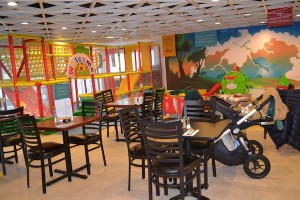
In addition to great food, Shuk has space in the large dining room to keep the 2- to 6-year-old crowd entertained. (photo by Lauren Kramer)
Soon after he arrived here, he tasted the food of chef Evy Swissa, who worked at Café 41, and quickly recognized his expertise. Volodarsky also noticed a dearth of establishments where parents could shmooze, enjoy good food and know that their kids were playing safely within eye- and earshot. So, when the opportunity arose to take over Café 41, he jumped at it. He invested $100,000 in a complete remodel and added a space for kids, with climbing structures in the large dining room to keep the 2- to 6-year-old crowd entertained. Then, he found a slab of cedar, cut and varnished it and made it a centrepiece bar in his new restaurant, Shuk. It’s a fabulous piece of carpentry.
Volodarsky hasn’t spared any expense transforming Shuk into a more sophisticated space, adding a state-of-the-art coffee machine, excellent lighting, a beautiful color scheme and quartz countertops. Dairy products are all chalav Yisrael and many of the ingredients he uses come from Israel, including
Israeli rosewater, tehina, za’atar, Moroccan spices and Turkish coffee by Elite. The kitchen is under Chabad supervision.
My shakshuka ($14.50) arrived on a skillet, presented on a wooden board accompanied by French fries in a neat stainless steel basket. (photo by Lauren Kramer)
My shakshuka ($14.50) arrived on a skillet, presented on a wooden board accompanied by French fries in a neat stainless steel basket. It was also served with pita that Volodarsky was quick to point out is deliberately Israeli-style, sourced from Toronto, and hummus, which Swissa makes in five-litre quantities daily and was so good I had to bring a container of it home. Other items on the menu included the $7 boreka plate (three borekas served with boiled egg, tahini and pickled cukes), the $14.95 falafel plate (seven balls with a side of hummus, fries, Israeli salad and pita), hatzilim ($14.50, served on top of tahini with tomato salsa and pita) and za’atar focaccia ($14.50). There’s also poutine ($7.50), French toast ($8.95), eggs benedict with salmon and avocado ($14.50), pasta and wraps containing fish or falafel.
The food is a mix of Mediterranean, Russian and Yemeni influences, Swissa said. “It’s comfort food that brings you back to Israel,” he confided, adding that the menu is fairly simple with daily specials bringing new items to the mix. The two specials the day I came in were Persian fish balls with couscous, spinach and carrots ($17.30) and flatbread with caramelized onion, goat cheese and pesto ($14).
Volodarsky looked pensively towards the children’s area, where his 3-year-old often releases energy on rainy Vancouver days. “The idea is to attract families with kids,” he said quietly. “Out front we have a quiet area for coffee and meetings, but in the back are most of our 76 seats, and Sundays it’s packed in there.”
The fact that the restaurant is kosher is a big drawcard for Vancouver’s Jewish community and Volodarsky and his team of nine are fighting the perception that kosher means “super expensive.”
“We’re really trying to keep our costs reasonable,” he said. Still, some 55% of diners are not Jewish, Swissa noted. “And they love hummus!”
Don’t miss the desserts – there’s a fabulous selection of delicacies including tahini ice cream, chocolate-banana mousse cups and butter popcorn mousse.
And, if you don’t have the time or energy for a Friday night meal, Swissa can handle that in a heartbeat, complete with the challah, for any orders, even as small as a family of one or two. “I need just 20 minutes forewarning,” he said. He makes 12 challot each Friday in three different flavors, and they disappear fast, so pre-orders are crucial.
Shuk is open Mondays through Thursdays, 8 a.m.-8 p.m.; Fridays, 8 a.m.-3 p.m.; and Sundays, 9 a.m.-8 p.m. There is free underground parking and free wifi. Before Feb. 10, Shuk’s grand opening, access to the kids play area is free. After that date it’s $5 per child, $2.50 per sibling or $30 for a month-long unlimited membership. For more information or reservations, 604 563-4141.
Lauren Kramer, an award-winning writer and editor, lives in Richmond. To read her work online, visit laurenkramer.net.
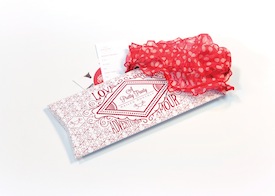
“Panty By Post is about shipping a piece of self-love in a little package,” says Natalie Grunberg. (photo from Natalie Grunberg)
Underwear. We all wear it and it’s not something most of us think too deeply about – until our own pairs look too disheveled, torn or worn out to warrant further use. But Vancouverite Natalie Grunberg thinks a lot about underwear – panties, specifically.
She started considering these hidden pieces of apparel on a trip to France in 2009. “I was inspired by the lifestyle I saw,” she told the Independent. “I loved the way the women dressed, the kind of confidence they have when they’re walking down the street and looking so lovely, even if it’s just to get a baguette.” As she spent time in French stores, she noticed the beauty of French underwear and lingerie and, not long after she landed at YVR, she started her own company, Panty By Post (pantybypost.com).
“I feel like there is value in putting yourself together well, and it starts with your underwear,” she said. “Panty By Post is about shipping a piece of self-love in a little package – the sexiness, self-respect and confidence of the French comes to your doorstep like self-esteem in a box.”
Grunberg, 39, is a native Vancouverite and member of Congregation Or Shalom who has been vacationing in France since the age of 14. That French influence had a profound impact on the Grunberg kids. Paul, Natalie’s brother, owns the French restaurant L’Abattoir in Gastown, while Natalie, formerly a high school teacher, gave up her day job two years ago to focus on her business. The learning curve was steep and those first five years, she said, were “like a mini MBA where I taught myself the skills I needed.”
At first, she imported sexy, lacy panties. Then she surveyed her customers to find out what they were looking for in terms of panties and bras. She learned that her mostly North American customers wanted beautiful underwear that was comfortable and durable, “nothing poofy or scratchy. They need to be able to wear them under their business suits or under their jeans,” she explained. So, she created her own label and forged a manufacturing relationship with a Colombian company. “I prefer working with Colombia over China because they offer really great working conditions and give their workers health care and support for single moms,” she said.
Monthly subscriptions start at $15 and increase depending on the style and type of panty. (photo from Natalie Grunberg)
Who buys panties by post? It’s an admittedly unusual way to source your underwear but Grunberg’s demographic ranges from 25 through 65. “Sometimes, it’s a mom buying for their daughter or themselves, other times a husband or boyfriend is purchasing for their partner, but this is not for the bargain shopper,” she insisted. “Our customer is not the Costco shopper who buys a Haines pack of 10 underwear. Rather, these are women and men who understand the quality and value of a good panty.”
The Panty By Post transaction starts on the internet with monthly panty subscriptions starting at $15 and increasing depending on the style and type of panty. Grunberg includes a handwritten note in each box of panties she ships and can personalize the notes if her customers have a specific message they want to relay. Some have been monthly subscribers for the seven years she’s been in business. Others prefer to use Panty By Post for special occasions like a bridal shower gift or Valentine’s Day treat.
There’s a massive difference in the mindset of French versus American women, Grunberg noted, and it goes well beyond the panties they choose. “French women focus on buying good quality instead of volume. They 100% understand the value of wearing beautiful underwear, not just for your partner, but for yourself. North American women are more focused on comfort and don’t see the value of those little details. We don’t care as much about quality because we’re more focused on buying a lot.”
Grunberg is determined to change that mindset. “It’s not OK to sacrifice beauty for practicality because we can have it all,” she said. “It’s not about impressing a man, it’s about taking pride in your appearance. I’m on a mission to change the panty drawers of North American women. I want to bring the experience of France directly to your door.”
Lauren Kramer, an award-winning writer and editor, lives in Richmond. To read her work online, visit laurenkramer.net.
When Joe Lieberman was named Al Gore’s running mate in 2000, there was some discussion about the potential for America’s first Jewish vice-president. With the exception of the dustiest corners of the internet, the discussion was respectful and more curious than bigoted. It was probably less heated than the issue of America’s first Catholic president that came up when John F. Kennedy ran in 1960 and, because the Republican base is made up of a great number of evangelical Christians, probably even less significant than Mitt Romney’s Mormonism in 2012.
Now that Bernie Sanders is a leading candidate for the Democratic nomination for this year’s U.S. presidential election, there has been almost no discussion of the potential for America’s first Jewish president; the discussion has been far more about the potential for America’s first avowedly socialist president.
After a seemingly interminable campaign, voting begins next week, launching the process of elimination that will determine the Republican and Democratic candidates for president this November. Voters in the first caucus state, Iowa, will gather in church basements and town halls on Feb. 1. In New Hampshire, eight days later, voters will cast ballots in the first primary of the season.
While American politics has always had many differences from European politics, the U.S. version this year seems to reflect, to some degree, the trend in Europe away from the centre. The Republican candidates are largely clustered on the right side of the spectrum, if not the far right. Donald Trump, the leading candidate according to polls, does not fit easily into ideological boxes, but his many very extreme comments appeal to at least some of the people we would describe as far right.
On the Democratic side, Sanders, an erstwhile low-profile junior senator from Vermont, who self-describes as a democratic socialist, is fomenting what is no doubt a very unwelcome sense of déjà vu for the once-presumptive Democratic nominee Hillary Clinton.
Clinton was to be the unbeatable Democratic candidate in 2008, until an almost unknown senator from Illinois caught fire and bolted into the White House on a wave of reformist zeal. While not a single ballot has been cast yet in the 2016 battle, Clinton’s inevitability has almost evaporated.
What is it that explains Clinton’s inability to seal the deal, even with voters in her own party?
Part of the issue is her gender. How could it not be? If elected, she would be the first female president. But is gender an advantage or disadvantage for her? Perhaps it is both. Part of the challenge and opportunity Barack Obama faced was around his race. Whether race or gender are, in the end, advantages or disadvantages depends on a huge range of factors, including time and place, and the individual embodying them.
However, perhaps gender, race or religion will be less significant in this election because voters seem to be craving something different altogether. Even left or right may not be such key factors as (apparent) authenticity.
After decades in the public eye, Clinton is a consummate politician. Yet consummate politicians, even exceptional diplomats, are not what Americans seem to be seeking right now. Quite the opposite. American voters, in both parties, seem to be gravitating to unorthodox figures who do not follow scripts. Clinton seems both orthodox and tightly scripted.
Say what you will about Trump, his xenophobia and verbiage seem absolutely authentic. On the other hand, whatever Sanders’ ability or inability may be to get elected and then get any sort of socialistic agenda through Congress, his channeling of Americans’ economic realities and fears appears equally authentic. Both men have captured something in the zeitgeist that scripted politicians have failed to exploit.
And, while the Democrats and Republicans battle it out, a third option looms. There has been talk that, should the Republicans nominate Trump and the Democrats Sanders, a third-party candidate might emerge, appealing to wide swaths of the centre and chunks of both the left and right. Former New York City mayor Michael Bloomberg – a Democrat-turned-Republican-turned-independent – is seriously considering a run and will announce his intentions by March, associates told the New York Times. Imagine a three-way presidential campaign – with two Jewish candidates. That would be an authentic landmark.
The sublime thing about liberal democracies is that they are based on the rights and responsibilities of individuals rather than groups. Unlike the kind of sectarian societies imploding in civil war in the Middle East, in a liberal democracy, it is the individual who chooses to go to the ballot box (or abdicate) or to attend a protest (or go to the movies), and it is the individual who must abide by the law or face punishment.
In robust multicultural societies like Canada’s, individuals are given another opportunity – to identify as an ethnic, religious or cultural group. While these groups are considered a boon to the fabric of society, all rights and responsibilities remain solely with the person. Which is why calls for Muslims in Canada and the United States to publicly denounce acts of terrorism committed by the Islamic State (ISIS) and others inspired by them, is understandable – but ultimately wrong.
Here’s where it’s understandable. Terrorism – defined as the targeting of civilians for political ends – is morally distasteful. When committed by a fellow citizen, the action is especially corrosive, leading to distrust and paranoia. When an act of terrorism is committed by a person or group claiming to act on behalf of a particular religion, it’s tempting to want everyone else from that religion to denounce the action.
Here’s where it’s wrong. As a Jew, I regularly urge my fellow Jews to stand up for injustice as Jews, to stand up against an array of Israeli policies that I find objectionable. I encouraged my Jewish community centre (when I was a board member) to undertake staff training around LGBTQ awareness, thus enabling it to declare itself an “LGBTQ safe zone,” as facilitated by the Jewish LGBTQ organization Keshet. As a Jew, and as a Jewish columnist in the Jewish press, I stand up for religious freedom in Israel, for human rights, for an end to the occupation and for racial and ethnic equality.
But let’s recall an incident last summer with Jewish pop singer Matisyahu. Organizers attempted to ban Matisyahu from performing at a music festival in Spain unless he denounced the Israeli occupation. Matisyahu is an American, not an Israeli. His only association with the Jewish state is that he himself is Jewish.
It was a distasteful act of political theatre on the part of the organizers precisely because they drew a faulty line of logic: Israeli occupation is morally objectionable to them, so all Jews (or at least famous ones) must take a public stand because they are Jews. (After a public outcry, the festival organizers backtracked.)
In a liberal democracy, whatever collective identities we hold – sexual, religious, ethnic and so on – are the domain of the private sphere unless we choose, as individuals, to act otherwise. So, while I hope my fellow Jews will take a stand against an array of social ills, and am aware that some don’t, I would be disgusted and disturbed if, say, a work colleague or a politician or a journalist in a local or national daily were to demand that I, because I happen to be Jewish, denounce one thing or another.
The upshot? Community conversations about dynamics relating to that community are crucial to have. But they are just that: community conversations. We must leave members of synagogues, mosques, churches, JCCs and other organizations to debate among themselves whether and how to publicly denounce actions committed in their name. The pages of the community newspaper may indeed be one useful forum among many for these tough conversations.
And perhaps the Jewish community, being more integrated, prosperous and secure than the Muslim community in North America, may even serve as a model. But demanding that sort of stand taking by others in a civic forum violates the delicate multicultural balance that is intrinsic to a liberal democracy, where the individual is the only meaningful object and subject of political action.
Mira Sucharov is an associate professor of political science at Carleton University. She is a columnist for Canadian Jewish News and contributes to Haaretz and the Jewish Daily Forward, among other publications. This article was originally published in the CJN.