Skip to content
  • Home
  • Subscribe / donate
  • Events calendar
  • News
    • Local
    • National
    • Israel
    • World
    • עניין בחדשות
      A roundup of news in Canada and further afield, in Hebrew.
  • Opinion
    • From the JI
    • Op-Ed
  • Arts & Culture
    • Performing Arts
    • Music
    • Books
    • Visual Arts
    • TV & Film
  • Life
    • Celebrating the Holidays
    • Travel
    • The Daily Snooze
      Cartoons by Jacob Samuel
    • Mystery Photo
      Help the JI and JMABC fill in the gaps in our archives.
  • Community Links
    • Organizations, Etc.
    • Other News Sources & Blogs
    • Business Directory
  • FAQ
  • JI Chai Celebration
  • JI@88! video

Recent Posts

  • Story of Israel’s north
  • Sheltering in train stations
  • Teach critical thinking
  • Learning to bridge divides
  • Supporting Iranian community
  • Art dismantles systems
  • Beth Tikvah celebrates 50th
  • What is Jewish music?
  • Celebrate joy of music
  • Women share experiences 
  • Raising funds for Survivors
  • Call for digital literacy
  • The hidden hand of hate
  • Tarot as spiritual ritual
  • Students create fancy meal
  • Encouraging young voices
  • Rose’s Angels delivers
  • Living life to its fullest
  • Drawing on his roots
  • Panama City welcoming
  • Pesach cleaning
  • On the wings of griffon vultures
  • Vast recipe & story collection
  • A word, please …
  • מארק קרני לא ממתין לטראמפ
  • On war and antisemitism
  • Jews shine in Canucks colours
  • Moment of opportunity
  • Shooting response
  • BC budget fails seniors
  • Ritual is what makes life holy
  • Dogs help war veterans live again
  • Remain vital and outspoken
  • An urgent play to see
  • Pop-up exhibit popular
  • An invite to join JWest

Archives

Follow @JewishIndie
image - The CJN - Visit Us Banner - 300x600 - 101625

Author: Pat Johnson

Hundreds scribe new Torah

Hundreds scribe new Torah

Nomi Fenson, left, and Debby Fenson help complete Congregation Beth Israel’s new sefer Torah with sofer Rabbi Moshe Druin. (Adele Lewin Photography)

Hundreds of people participated in a moving mitzvah over two recent weekends at Congregation Beth Israel. The congregation, still kvelling over its architecturally lauded new building, celebrated the arrival of a new Torah scroll, which was completed by members of the congregation with the help of a sofer, a Torah scribe.

It is one of the 613 mitzvot for each individual to scribe a Torah scroll: “And now, write for yourselves this song, and teach it to the Children of Israel. Place it into their mouths, in order that this song will be for Me as a witness for the Children of Israel.” (Deuteronomy 31:19)

The new sefer Torah was scribed in Israel, with the final 100 letters to be completed. A lottery was originally planned by the congregation to allocate the honor of scribing a letter, but a compromise was found to give the opportunity to everyone who wanted to participate.

“We asked if people would mind partnering with other families,” said Beth Israel’s Rabbi Jonathan Infeld. “And, despite the fact that we had 150 families or individuals who asked to participate, we had enough people who said they were willing to partner that everyone who asked to participate was able to do so.” In the end, about 600 people had a part in the process.
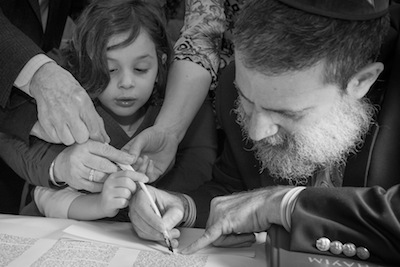
photo - Alexis with Rabbi Moshe Druin
Alexis with Rabbi Moshe Druin. (Adele Lewin Photography)

Participants had the opportunity to scribe with the guidance of Rabbi Moshe Druin, one of several “traveling sofrim” associated with a Florida-based enterprise called Sofer On Site, which facilitates events just like the one Beth Israel chose to undertake. Druin also helped complete a Torah scroll for Temple Sholom last year.

Each participant at Beth Israel proceeded through a variety of meaningful activity stations leading up to the scribing. Led by a volunteer guide, participants learned from teachers on a subject from the Torah. They then proceeded to a different area where they could decorate the new Torah binder, write a wish for the wishing tree, listen to storytelling or peruse the book corner. After handwashing, they prepared for the scribing, which they did with Druin. The sofer shared a teaching on the significance of each Hebrew letter and he filled in the letter as participants placed their hands on his hand or on the quill.

“The joy was palpable,” Infeld said of the event, which went all day Friday, Feb. 19, until Shabbat, then continued on Saturday night after Havdalah and again on Sunday. “The feeling of community was extremely strong.… Some people said this was one of the most meaningful experiences of their life and it was fantastic to see families of multiple generations participating in the activity.”

“It really is a once-in-a-lifetime experience,” said Audrey Moss, a congregation member who served as project chair for the Torah scribing and dedication. “The whole idea was that [participants] go through a spiritual journey. You prepare yourself spiritually and mentally before you go into the sanctuary for your one moment with Rabbi Druin…. I think Rabbi Druin really, really made the event.”

After the scribing, the Torah was dedicated on Shabbat the following weekend, when the congregation also celebrated the 10th anniversary of Debby Fenson’s role as ba’alat tefillah, Torah reader.

Fenson carried the Torah into the sanctuary and a music-filled procession welcomed the new scroll.

“We sang and walked the Torah around the entire shul so that everybody could see it and kiss it,” said Fenson, who admits that the dedication and surrounding ceremonies had a powerful effect on her.

“The whole morning was pretty emotional for me,” she said. “A lot of people came up to see me, and the dedication of the Torah was a special event.”

The Torah dedication was a first for both Fenson and Infeld. All of the synagogue’s existing Torah scrolls are more than 100 years old, said Fenson, so this was the first time a sefer Torah had been created specifically for the congregation. When the new synagogue was completed in 2014, the Torahs were carried into the ark, but this was different, Fenson said.

“People were very emotional and I was feeling that as well,” she said. “It was very exciting.”

Format ImagePosted on March 11, 2016March 10, 2016Author Pat JohnsonCategories LocalTags Beth Israel, Debby Fenson, Moshe Druin, sofer, Torah
Examining the cosmos

Examining the cosmos

Prof. Victoria Kaspi, winner of the 2016 Gerhard Herzberg Canada Gold Medal for Science and Engineering. (photo from McGill University)

McGill University Prof. Victoria Kaspi – the first woman to win the Gerhard Herzberg Canada Gold Medal for Science and Engineering – says that her Jewish background and her parents’ support have had a lot to do with how much she has accomplished.

“Questioning is so inherently Jewish,” she told the Independent. “I think this builds personality, skill, and derived pleasure from talking and thinking. Jews are very studious, loving the books. For some people, it’s the Torah; for others, it’s different types of books … just really enjoying the process of studying, thinking and analyzing. I think that’s what my Jewish background has brought to my work.”

Neither of her parents were scientists. “I just really like it,” she said. “I grew up loving math. My parents were pretty hands off and they certainly never discouraged me. I was sort of an oblivious kind of kid, so if there were cultural signals that I shouldn’t go into science, I must have missed them.

“I think my parents built up my confidence. They never questioned my decisions. When I said I want to go into science, they never asked why I’d want to do that. They used to buy me lots of math toys and puzzles as a kid. Probably my mom encouraged me. She used to play lots of games with me.

“I’m sure I had encouragement from teachers along the way and family as well,” she added. Describing science as “always a great love,” she said it was neither forced on her or strongly encouraged as a study or career path. But Kaspi is aware of the societal pressures on women to not go into science, especially now, with her own daughters.

“They are sometimes subtle and pointing them out can be petty, but when you notice them as an overall trend – where there’s lots of little, tiny subtle signals that, in the end, register very large – I think that needs some work,” said Kaspi of the pressures. “Why I didn’t suffer from that? I’m not sure. I’m hoping that this will improve with time.”

Kaspi uses radio and X-ray telescopes to examine the behavior of neutron stars, using the cosmos as a lab to study the nature of matter in extreme environments.

“The sort of work I’ve done has involved different types of neutron stars,” said Kaspi. “One, in particular, that I’ve done is magnetars, which are neutron stars with very high magnetic fields. They sometimes explode randomly and are just really interesting to study. But there are other things, too.”

photo - A satellite picture of the island of Montreal with an illustration of a neutron star for comparison. While relatively small, neutron stars are so dense that just one teaspoon would weigh about a billion tons
A satellite picture of the island of Montreal with an illustration of a neutron star for comparison. While relatively small, neutron stars are so dense that just one teaspoon would weigh about a billion tons. (photo from NASA)

Neutron stars are stars that have collapsed and are very dense. A black hole is a star that has collapsed onto itself, due to gravity being so strong that nothing can escape from the surface, not even light; hence, the name, black hole. Neutrons are close cousins of black holes, but some light does escape from them.

“The typical neutron star has as much matter in it as half a million planet earths, but is crushed down to the size of a city,” said Kaspi. “We think a typical diameter of a neutron star is something like 20 kilometres.

“If you’ve crushed all that matter into the size of a small city, you have matter that is extremely dense. If you went up to a neutron star with a teaspoon and you took a teaspoon of the matter, it would weigh something like a billion tons.”

Kaspi said, “We don’t understand the physics of it very well, and that’s one of the things we are hoping to learn by studying them. When studying these objects, we use very powerful computers and algorithms, digital signal processing, there’s a lot of hard work and managing of big data.

“People who study pulsars are snapped up by software companies, because they are really good at developing algorithms, thinking out of the box and finding creative solutions to big data problems.”

Pulsars are rapidly spinning neutron stars and emit a bright beam of light. They are observed through their flashes. If you wanted to go flying around the galaxy and needed a useful, simple way to know where you are, you could use a pulsar. “They all pulse very regularly,” said Kaspi. “You can use that to know where you are in the galaxy and which direction you want to go.”

Kaspi’s research group has used neutron stars to confirm Albert Einstein’s theory of general relativity.

“As scientists, we don’t believe just because a theory is beautiful, it has to be right,” she said. “You have to test it with experiments. These neutron stars allow you to do phenomenal tests of general relativity. Was Einstein right or not? There are other theories of gravity and we can test those, too.”

One of the biggest projects Kaspi is currently working on in Canada is the building of the Chime Telescope in Penticton. She is also looking into “fast radio bursts.”

Of this phenomenon, Kaspi said, “It’s something that’s a big mystery right now that we don’t understand. Astronomers are pretty puzzled over these things. They are very short, a few milliseconds, bursts of radio waves, little blips in the sky that go off randomly but frequently. We think a few thousand go off across the whole sky every day. The first one was discovered a decade ago. Until now, only about 20 have been recorded.”

Kaspi has earned international recognition and numerous awards for her work over the years. As for receiving the Herzberg medal, she said she feels honored, and added, “I may be the first [woman] for this prize, but I won’t be the last. There will be many more women in the future.”

Rebeca Kuropatwa is a Winnipeg freelance writer.

Format ImagePosted on March 11, 2016March 10, 2016Author Rebeca KuropatwaCategories NationalTags astronomy, Einstein, Herzberg medal, Kaspi, McGill, neutron star
A record $8.3 million raised

A record $8.3 million raised

At FEDtalks, the campaign opening event, left to right: Ezra Shanken, Jewish Federation of Greater Vancouver chief executive officer; Neil Pollock, general chair, 2015 Federation annual campaign; Lisa Pullan, chair, women’s philanthropy, 2015 campaign; Stephen Gaerber, Federation board chair; Alex Cristall, co-chair, major gifts, 2015 campaign; and Andrew Merkur, co-chair, major gifts, 2015 campaign. (photo from Jewish Federation of Greater Vancouver)

For the second year in a row, the Jewish Federation of Greater Vancouver annual campaign has closed with a record achievement, this time totaling $8.3 million. This represents an increase of approximately $300,000 from the previous year. Funds will support programs and services on which thousands of community members rely.

“The true power of this record result goes well beyond the impressive numbers. We can make incredible changes in this world when we give from our hearts, and that’s just what our thousands of donors and hundreds of volunteer canvassers have done. I am truly moved by their incredible acts of chesed (kindness) and tzedakah (justice, charity),” said general chair of the campaign Neil Pollock.

“I have witnessed firsthand the challenges in our community and the profound reach of the Federation annual campaign,” said Stephen Gaerber, Federation’s board chair. “The high cost of living in Vancouver has made it difficult for many community members to connect with Jewish life, either because they cannot afford to live centrally or because they cannot afford to participate. The Federation annual campaign addresses issues like these, builds connections between our community and our partnership region in Israel, and helps Jews in need around the world. This record campaign result will provide the support we and our partners need to touch more lives than ever before.”

The face-to-face incentive was one of the keys to this year’s success. It encouraged donors to meet in person with their volunteer canvassers. The 608 face-to-face meetings that took place were an opportunity to have meaningful conversations about shared values and commitment to community.

Federation welcomed 75 new volunteer canvassers as well as 225 new donors to the campaign this year. And Federation chief executive officer Ezra Shanken listed several other statistics in his weekly email message Feb. 19:

  • 1,007 donors increased their gifts
  • 292 volunteer canvassers
  • 1,459 community members attended campaign events
  • 409 campaign volunteers
  • 64 local programs and services supported
  • 17 Israel and overseas programs and services supported
  • 37 partner agencies supported
Format ImagePosted on March 11, 2016March 10, 2016Author Jewish Federation of Greater VancouverCategories LocalTags campaign, Federation, Shanken, tzedakah
Creating tech and jobs

Creating tech and jobs

Governor General of Canada David Johnston, left, with Chief Scientist of the State of Israel Avi Hasson. (photo by Sgt. Ronald Duchesne, Rideau Hall)

On March 1, Governor General of Canada David Johnston met Chief Scientist of the State of Israel Avi Hasson to discuss innovation and how Canada and Israel can enhance cooperation in this field. During Hasson’s visit, the Canada-Israel Industrial Research and Development Foundation released its latest impact report.

Established in 1994 under a formal mandate from the Government of Canada and the State of Israel, CIIRDF-funded projects cross many scientific disciplines, technologies and industrial sectors. These include biotechnology, agriculture, information and communications technologies, automotive, natural resource management, public safety and aerospace.

With base funding of $1 million per year from each of the governments of Canada and Israel, CIIRDF stimulates collaborative research and development between companies in both countries, with a focus on the commercialization of new technologies; pools Canadian and Israeli know-how to provide both countries with improved market access, sustainable competitive advantage and long-term market opportunity in global economies; strengthens ties between Canada and Israel, and delivers economic benefits to both countries; and leverages additional regional and sector-based funding that is matched by the government of Israel.

CIIRDF has engaged more than 1,000 participants in partnership development activities, including more than 400 industry leaders who actively contributed to R&D collaboration discussions. It has processed more than 230 bilateral R&D applications and funded 110 projects engaging more than 200 companies from Canada and Israel.

These alliances have enabled the joint development, marketing and sales of more than 50 technologically improved new products for global markets; generated $60 million in initial sales, and $300 to $500 million in additional economic value to collaborating companies; and created hundreds of jobs in both countries.

For the full impact report, visit racineinc.com.

Format ImagePosted on March 11, 2016March 10, 2016Author Embassy of IsraelCategories Israel, NationalTags Canada, Hasson, Israel, Johnston, technology, trade

Proudly in the middle

Slovakia’s elections on the weekend ushered into parliament for the first time a far-right neo-Nazi party of the sort that have made inroads in various parts of Europe over recent years. About the same time this was making news, Donald Trump urged supporters at a rally in Florida to raise their right hands in a pledge to vote. The ensuing scene was – as any sensible person would have foreseen – eerily redolent of a Nazi rally.

Since the collapse of the bipolar Cold War-era status quo, global politics has been unstable. Common enemies make for strange bedfellows and temporary alliances have been the pragmatic responses to regional brushfires, such as the alignment of Shia and Sunni Muslim factions with, respectively, Russian and Western powers. Some Sunni Muslim powers have even been making pleasant noises toward Israel, seeing it as an ally, however unlikely, against the Iranian menace.

These tactical alliances are taking place at a molecular level, too, if we can put it that way. Not only are strange alliances forming between nation-states (and, in some cases, non-state players like Iranian-backed Hezbollah and the Western-backed Free Syrian Army), but ideologies are merging at the edges. The far-right and the far-left, in some instances, are almost indistinguishable.

In their historical forms, communism and fascism in the form of Stalinism and Hitlerism, were the most adamant of enemies. Until they weren’t, thanks to a non-aggression pact, and then they were again, thanks to Hitler’s abrogation of the pact. For the great majority of people in the West who are democrats (whether liberal, conservative, libertarian, social democratic or whatever) the two ends of the political spectrum can look very similar. Both have been responsible for genocides causing millions of deaths and neither respects the human being’s right to individual freedoms.

From a Canadian perspective, we have been blessedly free of anything more than weak startup movements of the far-left and the far-right. The communist party, under different names, had minimal electoral success in the 1930s and 1940s. When the antisemitic far-right permeated the Social Credit movement and later the Reform party, they were fairly successfully shut down. Canada is a place of moderation, a trait we bear smugly (and, therefore, without our alleged national humility) while watching the machinations of American politics today.

Today’s far-left and far-right, which are more recognizable in their traditional forms in Europe, nevertheless have traded off some characteristics. In some instances, European far-right parties, who are almost unanimously anti-immigrant and anti-Muslim, have adopted a convenient philosemitism and pro-Zionism, seeing Israel as a bulwark against radical Islam. At the same time, we are witnessing a growth of not only anti-Zionism but overt antisemitism among components of the left. Notably, the Labor Club at Oxford University, the campus arm of Britain’s second-largest political party, has been recently criticized. According to reports, Oxford Laborites mocked Jewish victims of the Paris terror attacks, made light of Auschwitz, expressed solidarity with Hamas and defended the killing of Israeli civilians, routinely employ the term “Zio,” a slang for Zionist that is usually found only on the most extreme websites, and a former co-chair of the club has said that “most accusations of antisemitism are just the Zionists crying wolf.” It is little solace that the antisemitism seems to have emanated from the Momentum movement, a hard-left stream within the Labor party headed by Jeremy Corbyn, the party leader.

The Oxford debacle is among the most public of countless incidents of Jew-baiting and Jew-hating on the left, but there is much cross-pollination between groups like those who hold Israel Apartheid Weeks and other groups that proudly march under the “progressive” standard.

Antisemitism, it is so often said, is an early symptom of a societal sickness, the first sign of crazy. This is a bit simplistic, though, because antisemitism is so unique, so capable of metastasizing into whatever form of scapegoat a society requires, so ubiquitous and yet still so fundamentally not understood, that blanket statements about it are a fool’s game.

Perhaps it is safe to say this: antisemitism exists in many places, but it is now and has perhaps always been most prevalent at the fringes of the political spectrum. No one should be surprised that it is a dominant characteristic of the far-right as well as the far-left, particularly when those terms themselves seem to have more overlap, or at least more fluidity, than perhaps ever before.

Extremists exist in Canada, as they do elsewhere in the world, and so, too, do inequality and other social issues that have the ability to polarize us, if we let them. But, extremism does not seem to be intrinsic to our land. This good fortune is something we must not take for granted. While people may joke – an example, Why did the Canadian cross the road? To get in the middle! – we have a lot of which to be proud, and something valuable worth protecting. We also, perhaps, have something to teach the world about tolerance and moderation.

Posted on March 11, 2016March 10, 2016Author The Editorial BoardCategories From the JITags antisemitism, Canada, communism, extremism, fascism, Oxford
Cooking healthy, eating well

Cooking healthy, eating well

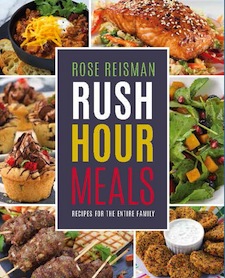
Rose Reisman’s newest cookbook is Rush Hour Meals: Recipes for the Entire Family. (photo from Rose Reisman)

Cookbook author, chef, television personality and columnist Rose Reisman helps people make better lifestyle choices.

After self-publishing a cookbook in 1988, she focused on healthy eating with Rose Reisman Brings Home Light Cooking (1993), which sold more than 400,000 copies. Since then, she’s been an oft-quoted expert on eating well, has appeared on TV and radio, worked as a teacher, and acted as a health and wellness consultant to businesses.

Reisman attended the Canadian School of Natural Nutrition to become a registered nutritional consultant. The mother of four ran a cooking school for four years, and then launched Rose Reisman Catering in 2004. She is also a nutritionist and adjunct professor at York University’s faculty of health, where she is a founding member of the university’s obesity task force.

Reisman also helps people eat well through the Personal Gourmet, a daily food delivery service launched in 2008 that offers both weight loss and healthy living plans she developed with the help of dieticians and weight management doctors. She has been a spokesperson for the national campaign of Breakfast for Learning and the national awareness campaign for the Canadian Breast Cancer Foundation, and has been an ambassador for the Canadian Diabetes Association.

book cover - Rush Hour Meals: Recipes for the Entire FamilyIn coming weeks, Reisman’s newest cookbook will be released, Rush Hour Meals: Recipes for the Entire Family. It will be her 18th – chai – book guiding readers to a better life.


When she first started cooking, she told the Independent, she was making “very delicious, high-fat foods when everybody flocked to my home. I continued to do that and I became a good cook using loads of butter and cream and chocolate…. But then I found my own family history wasn’t that healthy. I had lost my dad to heart disease in his 50s, my grandmother at 52 to diabetes type 2. Everybody had high blood pressure, high cholesterol and obesity, and I was an overweight child.

“This was all going on in my early 30s. I was slim and running every day, and I had lost the weight I had as a kid, and I figured I was fine. But then I went for a routine physical and my cholesterol was literally off the charts like somebody in their 60s or 70s who’d been eating steak every day.

“I realized that what I ate, even though I exercised and maintained a healthy weight, was still clogging my arteries, and my family history was such that I couldn’t afford to do it. It was then that I turned around, in 1993. I started researching healthier cooking, and I started to write my first book in healthy cooking. I’d written three or four books before that in higher fat meals.”

Like Reisman once did, many people equate being thin with being healthy.

“If you have skinny children, you kind of turn away as they’re eating junk because you think it’s not going to hurt them,” she said. “But what I started to learn is that cholesterol, diabetes, all of these things start when they’re children. Today, they’re finding kids in their early teens who have already got blocked arteries, high blood pressure, diabetes.”

She said that one child out of three born after 2000 will have diabetes type 2.

“I really encourage parents to be the role models at home,” she said. “I used to set the most delicious meals on the table, and they were good. I wasn’t talking vegan style, poached or steamed, but it was heart-healthy fat, and my kids would often turn up their noses. But, over the years, they picked it up, it was in the back of their minds and, today, all four of them, they’re adults, they’re really good eaters, they exercise.

“That’s one of the reasons that I launched into the books, the media, the catering company, the restaurant consulting,” she said, “because it’s really a great way to spread your message.”

It’s also a great way to spread less healthy messages. There are dozens of TV shows on food – a whole network, in fact.

“They call it ‘food porn,’” said Reisman. “It started back when I was entering the food world. I had my own TV show in 1998 to 2002. That was when the Food Network was just starting to get launched. I thought a show like that would never be successful, I thought no one would watch 24 hours a day of food. Boy, was I wrong. People loved it. And the shows got crazier and crazier, and more reality and more extreme.

“They’ve done these studies from Harvard that people who watch these shows are actually heavier than other people. Nobody really wants to watch a healthy cooking show. There’s only one or two healthy cooking shows…. It’s ridiculous. You’re piling up butter to your elbow when you’re mixing, and people just love watching that decadence.

“But, when Paula Deen came out, and she was diabetic, all of a sudden people went, ‘you know, you can’t be that heavy.’

“You don’t see in seniors homes obesity in people in their 80s. If you notice that, people die off in their 70s, 60s, from cancer, heart disease or stroke, or diabetes when you’re obese.”

For people just starting to cook for themselves, a mistake they make, said Reisman is “they can just whip something off, and not measure and not read the recipe.” She said that’s not really possible, “unless you really have a food gene,” and there are only “a handful of people like that. I’d say 99% of us can’t do that.”

Even with years of experience, Reisman still finds new foods that she both enjoys and that are healthy.

“A couple of foods that I like, that allow me to maintain a really healthy body weight, are quinoa and Greek yogurt,” she said. “Quinoa is the only seed-grain that’s considered a complete protein: a half a cup is equal to three ounces of chicken or fish. So, on the day that you don’t want to eat the hormone-injected chicken or the farm-raised fish, you can have quinoa. Put dressing on it, make it with tomato sauce, and it is a powerhouse of nutrients.

“But, the most important thing is, after you eat a bowl of quinoa versus say white rice in a Chinese food situation, [where] you burp, you eat again, you burp … with quinoa, you walk away full and you’ll find you won’t get hungry for about three hours. That’s because the glycemic index, your blood sugar, is rising very slowly, whereas with white rice or with white starch, what I call an empty grain, it’s rising quickly and then it crashes, which means you need more of that food.”

As for Greek yogurt, she said, “you can have it plain or mix it with berries for breakfast. You can even have Greek yogurt with quinoa. Greek yogurt has 18 grams of protein for three-quarters of a cup, which is unbelievable, more than you could ever imagine in eating fish or chicken in the morning, so it’s a super breakfast.”

And what about that morning coffee?

“I think coffee by itself is great, and the studies now prove more and more that it lowers cholesterol, it’s got some great antioxidant powers,” said Reisman. “The key is, you can’t be drinking coffee after coffee after coffee. If you’re starting to get anxious, or you’re not sleeping at night, you’re drinking too much!

“The problem is that coffee shops are mixing in whipping cream and syrup and tons of sugar,” she added. “If you have two double doubles every day, you’ll gain something like 12 to 13 pounds in a year, just from the cream and sugar in those two drinks. It’s not coffee. It’s candy.”

Dave Gordon is a Toronto-based freelance writer whose work can be found in more than 100 publications globally. His is managing editor of landmarkreport.com.

Format ImagePosted on March 11, 2016March 10, 2016Author Dave GordonCategories BooksTags health, Reisman

More to becoming an adult

It’s a bat mitzvah year in our family. We’ve booked the photographer, the caterer, the DJ and the invitation company. Our daughter is studying her parashah and learning to chant the Haftorah and maftir.

Now, it’s time to inject some social justice into the experience, in the form of what have come to be known as “mitzvah projects.” Coming of age in the 1980s, my generation was less social justice-oriented. So what exactly, I wondered, should a “mitzvah project” entail?

I turned to JEDLAB, the Jewish educators’ forum on Facebook. I discovered that there is an organization expressly founded to support kids in their mitzvah project strategies. Called Areyvut (Hebrew for “social responsibility”), the New Jersey-based group offers consulting services – from a free phone consultation to more extensive, fee-based ones – and direct organizing of an array of hands-on, direct-action-style activities in which party guests can participate. Called “chesed fairs,” these might include game-board painting for a social-services agency, hat-making for cancer fighters or cupcake-decorating for a local day centre. Clients need not live in the area, or even in the United States.

Elsewhere, Areyvut teams up with synagogues and youth groups to teach kids to be “mitzvah clowns” for residents of long-term care facilities.

I decided to take up Areyvut’s offer to engage in a free phone consultation on my daughter’s mitzvah project idea. She had chosen a complex topic – addressing the economic effects, particularly around access to housing, of urban gentrification. Talking to Areyvut’s staff reminded me that mitzvah projects need not be confined to financial giving. Advocacy and awareness can be just as important.

I decided to take some of these ideas to my own community. Through word of mouth, I initiated a b’nai mitzvah club to help develop mitzvah project ideas. At the first meeting, which we called “Hot Chocolate for Hot Issues,” I led a workshop to get the kids thinking about a given issue, how to identify deeper causes of the problem and how to consider the range of action one might take to address these problems.

For our mitzvah club this year, each child will identify a pressing issue around which he or she is passionate and then develop an action plan, a plan that should involve at least two of the following: fundraising, political advocacy, public awareness and direct action. Fundraising could involve donating a portion of bar or bat mitzvah gift money, or holding a bakeathon or danceathon. Political advocacy might involve letter-writing to elected officials. Public awareness could include an Instagram campaign increasing public understanding of the issue. And direct action means identifying a relevant organization at which the child can volunteer.

Sometimes, there is an identified need, but not an established organization dedicated to it. In these cases, Areyvut can support kids in being more ambitious – for example, in creating their own nonprofit organization. Billy’s Baseballs grew out of a bar mitzvah initiative where a child organized the sending of decorated baseballs to soldiers stationed abroad.

Daniel Rothner, Areyvut’s founder and director, puts it this way. As Jews, we are supposed to be a “light unto the nations,” engaged in making the world a better place, he told me. And the impact extends beyond the Jewish community, he added. He is also passionate about getting kids to think about the deeper causes. What of Dave, the homeless man who appears at the soup kitchen every week? Why does Dave need to come week after week?

Our own b’nai mitzvah club has come a long way from kids reciting the “today I am a fountain pen” joke. As my daughter said, the bar or bat mitzvah milestone means that “technically, you’re becoming a woman or a man and, once you are [an adult], you have a responsibility to help out with the issues in the world and in our community.”

Mira Sucharov is an associate professor of political science at Carleton University. She is a columnist for Canadian Jewish News and contributes to Haaretz and the Jewish Daily Forward, among other publications. This article was originally published in the CJN.

Posted on March 11, 2016March 10, 2016Author Mira SucharovCategories Op-EdTags Areyvut, bat mitzvah, JEDLAB, social justice, tzedekah
Saying what he wants

Saying what he wants

Ari Shaffir was in Vancouver Feb. 18-20 as part of Just for Laughs NorthWest. (photo from Ari Shaffir)

Ari Shaffir is a long, long way from his yeshivah. The 42-year-old stand-up comedian and actor who lives in New York and Los Angeles appeared in Vancouver Feb. 18-20 as part of Just for Laughs NorthWest and entertained packed audiences with his deep baritone and casual conversation, drawing plenty of laughter.

Shaffir grew up Orthodox and shomer Shabbat in Kemp Mill, Md., attending Hebrew academy and the Jewish day school before spending two years at Beth Midrash HaTorah, a now defunct yeshivah in Jerusalem. When he returned, he enrolled at Yeshiva University in New York. That was the year he lost his religion.

“Mostly it was inward reflection that caused me to turn away,” he said. “I was doing these religious things because I was expected to, and I was succeeding, but I’d never stopped to think why I was doing them. When I really thought about it, I didn’t see a belief inside me. It just wasn’t there.”

At 20, he left Yeshiva University for the University of Maryland, taking arts courses like English and screenwriting. His parents and friends were dismayed by his change in lifestyle. “My friends tried to talk me out of it,” he said. “They would be happier if I were dating a Jewish girl who was a completely worthless human being as opposed to Mother Teresa. When I thought about it, I started feeling mad and decided this is not the way I should live my life.”

When a friend moved to California, Shaffir decided to join him. “I’d done stand-up once in college and had always thought about it, because I was one of the funnier guys at school, but it didn’t seem like a legitimate career,” he said. “Initially, I tried to find a fun regular job, but couldn’t, so I did an open mic one time in California and that was it. I was totally focused.”

Shaffir’s career has been on an upward swing in recent years. His stand-up album Revenge for the Holocaust was released in 2012 and went to No. 1 on iTunes and amazon.com the week of its première. His show Passive Aggressive premièred on chill.com in 2013 and on Comedy Central in 2015, while his weekly storytelling series This is Not Happening premièred on Comedy Central in 2015. Season 2 of This is Not Happening will air this year, and it was recently picked up for a third season on Comedy Central. He hosts the podcast The Skeptic Tank, a weekly interview show that averages more than 100,000 downloads per week, and he just shot a feature film, Keeping Up with the Joneses, slated for release this spring.

He didn’t completely lose his cultural identity, if his performance on Feb. 18 was anything to go by. In one part of his show, he joked about visiting Germany and urinating outdoors anywhere he could, hoping to pee on Hitler’s grave. “If anyone tried to stop me, I’d play the Jew card,” he said. (The part about urinating outdoors was no joke, he admitted in a telephone interview. “I did that.”)

Shaffir says the Bible is now his least favorite book: “There’s a lot of holes in the story.”

He enjoys using material he learned in his religious life in a completely opposite way than how it was intended. “I get joy out of that,” he said. “For example, the Torah says if someone is coming to kill or rob you, you’re allowed to defend yourself up to the point of killing them. A child cost $500,000 to raise and they’re going to take that from you, so the Torah would tell you to kill them to protect your income.”

Defying his parents’ expectations and leaving the community of Kemp Mill wasn’t easy, and there are still things Shaffir misses from that life. “It took my parents years to get over it. My mother was more concerned with me losing the culture of Judaism, the songs on Pesach, the camaraderie. My dad was angry. He had swayed from religion for a little while, but I swayed way further. Years later, he realized he didn’t want to lose me as a son and we were able to move on.”

Shaffir’s casual, unassuming storytelling style accounts for his popularity. His stand-up routine is peppered with sex and toilet jokes, rants on why he hates kids and anecdotes from his travels. Throughout his routine, he appeared relaxed and at ease, and his hour-long performance went by quickly.

If he has any remaining link to his Jewish life, it’s cultural, Shaffir said. “When I hear a news story come on about Israel, my ears perk up a little more than they would about another country. Otherwise, I have nothing left to do with the religion. But I miss the community I had in Kemp Mill, where everyone knew me. You had this gigantic family that you’d see in synagogue every weekend. To lose all that – now I’m on my own and I’m just floating. You lose those friends. You can’t go to restaurants with them because we’re into different things. They’re into family and religion, I’m not into either.”

A page on his website is called Shroomfest and, on it, Shaffir has taken time to write everything he feels others should know about mushrooms. “That’s not a joke, it’s real, and I do it a few times a year,” he said. “I took a lot of time to write that and it helps a lot of people take mushrooms the right way.”

Shaffir described feeling free on stage to say what he wants, but when it catches up with him in a private setting, he feels some guilt and embarrassment. “I feel guilty about all sorts of stuff, not committing to women, not being monogamous. If I’m at a dinner party and it comes up that I had a threesome last week, then, yes, I’m embarrassed.

“I’m proud that I’m a free comedian,” he reflected. “I say and do what I want, what I feel is correct creatively, and both criticism and praise are irrelevant to me. I’m living as a stand-up comedian! It’s one of the coolest jobs in the world and I have an apartment I pay for, just by doing that!”

For a link to his podcast visit arishaffir.com/category/podcast.

Lauren Kramer, an award-winning writer and editor, lives in Richmond. To read her work online, visit laurenkramer.net.

Format ImagePosted on March 11, 2016March 10, 2016Author Lauren KramerCategories Performing ArtsTags comedy, Just for Laughs, Shaffir
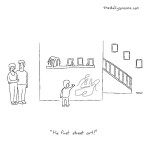
This week’s cartoon … March 11/16

This week’s cartoon … March 11/16

For more cartoons, visit thedailysnooze.com.

Format ImagePosted on March 11, 2016March 10, 2016Author Jacob SamuelCategories The Daily SnoozeTags art, thedailysnooze.com
Preparing for the summer

Preparing for the summer

A commercial gutter installation. (photo by Ethoseo via commons.wikimedia.org)

As the season transitions from winter to spring, it’s time to attend to some household maintenance tasks.

Exterior areas. Trim trees and remove vegetation from the siding and roofline. Have gutters and drains cleaned by a roofing contractor, add downspout extensions where needed, repair all damaged, disconnected or leaking gutters. Consider having the perimeter drains scoped by a drain tile specialist. Inspect, clean and repair all dirty vents. Take note of all exterior repairs, caulking and painting that will need to be done over the summer.

Decks and balconies. Remove all debris and clean any mildew from the floor surface, clear drains, check the function of sliding doors and screens, test guardrails for stability. Does anything need painting?

Roof and flashings. Have the roof properly inspected for damage, holes, loose flashing materials, outdated shingles, pooling, etc. Remove all debris and moss to prevent moisture issues.

Air conditioner. Have it serviced and the heat pump cleaned.

Furnace. Check the filter and replace or clean it.

Smoke detectors. If you have not done so in the last six months, test all smoke detectors. Replace them if they are older than 10 years. Instal carbon monoxide detectors in areas by gas-burning appliances and check them as well. Also, all smoke detectors should be interconnected and hardwired throughout the home. If one goes off in the basement, they should be heard on the top levels as well.

Electrical outlets. Make sure they are safe and grounded. Replace all broken cover plates, tighten loose ones. Test the GFCI (ground fault circuit interrupter) outlets and replace expired or damaged ones, both inside and out.

Washing machine. Inspect hose connections. These hoses are always under pressure, so replace rubber hoses with steel-braided ones to help prevent leaks.

Clothes dryer. Check that the vent duct is made from a smooth, rigid metal. Replace corrugated plastic or foil ducts, as they pose a fire hazard.

Attic. Check for signs of poor ventilation, pests, insulation issues, damaged sheathing, mold, duct connections and leaks. Repair all problems with the help of an attic contractor.

Spring cleaning. Purge or sell all items you don’t need. Check for other random tasks: replace light bulbs, do minor repairs to ceilings doors, windows, walls, etc.

Sean Moss is a professional home inspector with his company Sean Moss Home and Mold Inspections, homeinspectorsean.com.


Format ImagePosted on March 11, 2016March 10, 2016Author Sean MossCategories LocalTags home repair, spring cleaning

Posts pagination

Previous page Page 1 … Page 522 Page 523 Page 524 … Page 661 Next page
Proudly powered by WordPress