
Author: Jacob Samuel


כמו בסרטים
ג‘רוד סין שלמד לרקוד בתקופה כשהוא היה סטודנט, לא התבלבל לרגע והצטרף אל הצעיר ורקד עימו, אל מול הצעירים הנדהמים שליוו אותו במחיאות כפיים סוערות. (Vivid Media)
פלילים כמו כמו בסרטים 1: שוטר שנקרא לאירוע פלילי באונטריו רקד מול המצלמה
בדרך כלל שוטרים לא גורמים לאזרחים להרגיש בנוח והם מעדיפים להתרחק מהם עד כמה שאפשר. בוודאי שאף אחד לא מצפה שלובשי המדים המפחידים ירקדו ככה סתם ברחובות. אך מתברר שמה שקורה בדרך כלל רק בסרטים, קרה באחד הרחובות הסמוכים לקמפוס של המכון הטכנולוגי של אונטריו, במרכז העיר אושווה.
המשטרה הוזעקה על ידי אחד מהתושבים המקומיים שדיווח על מריבה אלימה מרובת משתתפים באחד הרחובות. השוטר ששמו ג’רוד סין, נהג במהירות למקום בניידת שלו מלווה כרגיל במקרים שכאלה, עם תאורה מהבהבת וסירנה. הוא החנה את הרכב בצד רחוב וכשיצא ממנו במהירות הבחין בבחור צעיר שזז בצורה מוזרה, מתחת לתאורת הרחוב, ומסביבו מתגודדים מספר גדול של צעירים סקרנים. לאחר כמה שניות של אבחנה קלט סין שלא מדובר בכלל באירוע אלים, אלא שהצעיר פשוט רוקד בסגנון היפ פופ וחבריו עומדים סביבו ומסתכלים, ואחד מהם אף מצלם אותו במצלמת וידאו.
סין שלמד לרקוד בתקופה כשהוא היה סטודנט, לא התבלבל לרגע והצטרף אל הצעיר ורקד עימו, אל מול הצעירים הנדהמים שליוו אותו במחיאות כפיים סוערות. לאחר שסיימו לרקוד והצעיר התחבק עם השוטר והודה לו, הוא הסביר את הרקע למעשיו: “אני סטודנט מהמכון הטכנולוגי המקומי שמתאמן בימים אלה לתחרות ריקודים חשובה מאוד. כן. אני רוצה לזכות בה”. אחד מחבריו העלה לרשתות החברתיות בהן יוטוב ופייסבוק את סרטון הווידאו של השוטר היפ פופ הרוקד עם הסטודנט, שזכה איך לא לצפיות רבות מאוד.
פלילים כמו בסרטים 2: בן 14 צבר כבר ארבעה עשרה הרשעות בדומה לגנגסטר
ילד בן 14 נמצא בדרך הנכונה והבטוחה לקריירה של גנגסטר אלים. הוא הספיק לצבור כבר לא פחות מ-14 הרשעות רק בשנה האחרונה. השופט במשפטו האחרון דיבר אליו ישירות ואמר לו בצורה ברורה: “אתה רק בן 14 ומדבר ממש כמו גנגסטר. מה טוב בזה. אין שום זוהר בחייהם של הגנגסטרים. אילו הם אנשים שנמצאים בצרות צרורות. אל תשכח זאת”.
הילד (שהמשטרה לא מפרסמת את שמו מפאת גילו הצעיר) מקמלופס נשפט בבית המשפט המחוזי בעיר, לאחר שממש איים לירות באחד מחבריו. הוא לא פחד לכתוב בדף הפייסבוק שלו את הדברים הבאים נגד אותו חבר: “באמת שלא אכפת לי אם יקח לשוטרים מספר חודשים למצוא אותי. אני אהרוג אותך לפני שאתפס על ידי כוחות המשטרה”. הילד המאויים שחשש לחייו טען בחקירתו במשטרה, כי חברו שאיים להרוג אותו נושא אקדח כל הזמן. הוא אף מאמין שהוא משתייך גם לאחת מכנופיות פשע של אזור קמלופס.
עורך דינו של הנאשם ציין במשפט כי מרשו פשוט כעס מאוד על חברו, שדיבר בגנות אמו. וכן הוא סובל מעת לעת מהתפרצויות כעס. עורך הדין הציע לשופט שהנאשם יבצע עבודות שירות לטובת הקהילה המקומית וכך ילמד את הלקח לעתיד. השופט חשב אחרת ולא קיבל את הצעת הסנגור של הילד. הוא החליט להטיל על נאשם מעצר בית למשך שבעים וחמישה יום תחת פיקוח הדוק בשעות הלילה. בנוסף הוא אסר עליו להחזיק בנשק וכן אסר עליו לבוא במגע עם הילד שהוא איים עליו. עם תום מעצר הבית הילד יהיה בפיקוח קצין מבחן במשך שמונה עשר חודשים. השופט הוסיף וציין עוד כי אם הילד המסוכן יפר את תנאי העונש שנקבעו לו הוא ישלח הישר לכלא, ממש כמו גנגסטר.

Karasick gives to SFU library
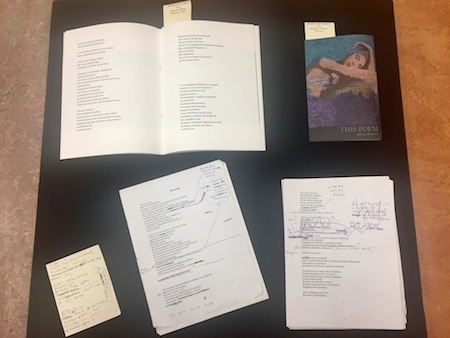
Adeena Karasick has donated her archive to the Collection of Contemporary Literature at Simon Fraser University’s Bennett Library. (photo from Adeena Karasick)
Critically acclaimed poet and Vancouver native Adeena Karasick was in her hometown last month to celebrate the donation of her archive to Simon Fraser University.
The Collection of Contemporary Literature at SFU’s Bennett Library contains one of the biggest selections of avant-garde poetry in North America. “The collection has been building since 1965,” said Tony Power, the librarian-curator who oversaw the addition of Karasick’s works. “The collection features many of the poets whose tradition Karasick is associated with, such as Michael McClure and Robin Blaser. Karasick was influenced by her teacher, Warren Tallman, who also influenced, for example, Fred Wah, George Bowering and Daphne Marlatt. These are all poets who are featured in the Bennett Library collection.
“Karasick has a very high profile for a poet,” Powers added, “and a certain amount of notoriety for her more daring works.”
Karasick told the Jewish Independent that the Feb. 23 event, in which her personal notebooks became, in effect, public artifacts, was “surreal.”
“I was honoured to be included in this collection, one of the greatest collections in North America of contemporary poets and avant-garde renegades, provocateurs and risk-taking challengers of esthetics,” she said.
Karasick, whose work has been called “beautiful linguistic carnage” by Word Magazine, specializes in non-narrative, intimate works that are most concerned with the play of language itself.
“I am interested in using language to create different effects of meaning production, highlighting language as a physical, material, construct. Play, jouissance [delight], as Jew-essence,” she explained with a smile.
Karasick regularly plays with Jewish themes in her work, whether it’s the invocation of the Kotel (a wall made of words in more ways than one) at the heart of Dyssemia Sleaze, or the Hebrew letter mem, which inspires Mêmewars.
“In the kabbalah, the world is created through language,” she said. “That’s also the way I view things.”
Karasick’s speech is peppered with words like “intervention,” “transgression,” “disruption,” “nomadicism” and “vagrancy.” She aims, she explained, to “destabilize and subvert linguistic power structures with the hope of instigating new ways of seeing. My poetry uses playfulness and celebrates a sense of creative homelessness, a mashing up of poetry, critical theory and visuality.”
Asked how she felt about being a postmodern artist whose work has been called “an impressive deconstruction of language and meaning” by Canadian Literature, in an age where the American president, it could be said, was much maligned for engaging in similar activity, she pointed to Jewish postmodern philosopher Emanuel Levinas (1906-1995).
“I’m not saying there’s no truth. There is truth. There is what happened,” she said. “The search for the truth cannot be solitary or uniperspectival though, and cannot be an imposition of ‘the truth’ on others in a totalitarian way. Levinas said that truth itself arises out of discourse … it rests in the ethical relation between people, where a search for the truth can take place. Truth requires humility and multiplicity.”
Born in Winnipeg, Karasick’s family moved to Vancouver when she was six months old, and she grew up here. She had her bat mitzvah at Congregation Beth Israel and was very much a part of the local Jewish community. She went to the University of British Columbia for her undergraduate degree, did her master’s at York in Toronto and her doctorate at Concordia, in Montreal, in “French feminist post-structural theory and kabbalistic hermeneutics.”
Karasick now teaches at Pratt Institute in New York and is enjoying a growing distinction as one of the premier avant-garde poets of her generation. She is becoming known for her innovative use of video as well as the printed page.
In 2018, Karasick will release a new book, Alephville, a poem composed of faux Facebook updates. “I was un-nerved by the timing,” she said, referencing the administration of U.S. President Donald Trump, “by the fact that it is basically a poem composed of ‘alternative facts.’”
Also next year, Karasick will debut her “spoken-word opera” Salomé: Woman of Valour, a feminist reinterpretation of the biblical character. She co-wrote the piece with Grammy Award-winning musician Frank London of the Klezmatics. They met through KlezKanada, an annual klezmer camp that has been meeting in the Laurentians for 20 years, the poetry division of which Karasick has been director for the last six years.
Karasick wrote the libretto for Salomé: Woman of Valour and London composed the music, an original score that blends Arabic, klezmer, jazz and bhangra. The nomadic and subversive piece will première at next year’s Chutzpah! Festival.
Matthew Gindin is a freelance journalist, writer and lecturer. He writes regularly for the Forward and All That Is Interesting, and has been published in Religion Dispatches, Situate Magazine, Tikkun and elsewhere. He can be found on Medium and Twitter.

Family History series launch
Don’t Break the Chain is the first publication of what the Jewish Museum and Archives of British Columbia hopes will become a Family History series.
The Jewish Museum and Archives of British Columbia has released the first book in what it hopes will become a Family History series. Don’t Break the Chain: The Nemetz Family Journey from Svatatroiske to Vancouver was published in collaboration with the Ben and Esther Dayson Charitable Foundation, and was researched by Shirley Barnett and Philip Dayson.
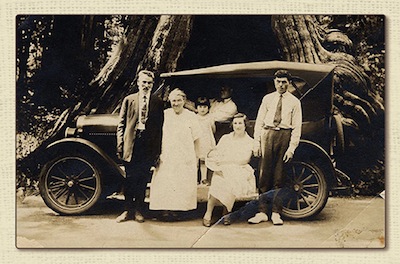
Barnett described her family as founders and workers behind the scenes of the Vancouver Jewish community.
“One of my mother’s sisters helped build Congregation Schara Tzedeck, the Louis Brier Home and funeral chapels, while another sister founded Jewish Family Services and visited the poor, people in prisons and mental hospitals. My mother ran charity events for Jewish Vancouver from the age of 18 and her brother started Camp Hatikvah,” she said. “They brought a lot of strength to the community. The next generation, which was mine and included 23 of us, has made significant contributions to Jewish Vancouver, too.”
There was plenty of raw material to draw from for the book, given the fact that Barnett’s six brothers had created memoirs and Dayson had begun creating family trees 25 years ago. The project became challenging when she opted to include charts and photographs of children, grandchildren and great-grandchildren.
“I established contact with members of the family I never knew, siblings who’d had arguments and people estranged from the family, and it took a very soft approach, getting them to respond with photographs,” she explained. “I wasn’t looking to mend fences or interfere in anyone’s life, I just wanted to write a book!”
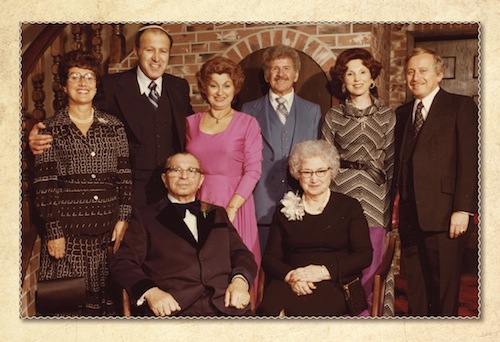
Ultimately, with the assistance of graphic designer Barbi Braude and Facebook, she was able to source all the photographs required to complete the book.
Michael Schwartz, director of community engagement at the JMABC, said the Nemetz family journey would resonate among many other Jewish families in Vancouver.
“The story of leaving Europe, getting here and eventually bringing their family to Canada has parallels for many in our community and is a fascinating tale,” he said. “The Nemetz family has a very interesting history and many siblings of the early generation have accomplished great things and had an important impact on the community as a whole.”
The museum is hoping to partner with other families who are interested in creating similar books. Barnett described the creation of the book as a joint venture. “My brother and I contributed the money to the museum and archives, which then allowed us to use their name, resources, and to co-publish this,” she said. “I’d like to see the Wosk, Groberman and Waterman families – all large, extended families with deep roots in Vancouver – do a book like this.”
The launch of Don’t Break the Chain is being celebrated at a hosted brunch at the Jewish Community Centre of Greater Vancouver on April 2, 11 a.m. If you are interested in attending, call the museum 604-257-5199.
Lauren Kramer, an award-winning writer and editor, lives in Richmond. To read her work online, visit laurenkramer.net.
An opportunity lost
Mykhailo Chomiak edited a Ukrainian-language Nazi newspaper in occupied Poland. It happens that Chomiak was the maternal grandfather of Chrystia Freeland, Canada’s foreign minister.
This fact is a matter of historical record, but apparently Russian operatives were shopping the story around as if it were fresh – and as if they believe Canadians will hold Freeland, and perhaps by extension the Liberal government, responsible for Chomiak’s past.
A writer on the Canadian online media outlet rabble.ca went so far as to accuse Freeland of a cover-up, which is nonsense, since she was acknowledged for her help editing an article on the subject that was written 20 years ago by her uncle, John-Paul Himka, an historian.
Freeland called it “public knowledge that there have been efforts, as U.S. intelligence forces have said, by Russia to destabilize the U.S. political system.… I think that Canadians, and indeed other Western countries, should be prepared for similar efforts to be directed at us.” She is absolutely correct. Russia almost certainly was involved in the U.S. presidential election and may indeed be responsible for the fact that Donald Trump is now in the White House.
Nevertheless, it seemed like a missed opportunity for Freeland not to use the chance to acknowledge some of the complexities and complicities around her grandfather’s history.
Let’s step back for a moment and realize that Canadians are relatively fortunate that, whatever enormous sacrifices Canadian families made during the Second World War, the war itself never reached our shores. For families in Europe at the time, many of whose descendants are, through immigration, now Canadians, the war impacted every aspect of civilian life. Possibly millions of people are responsible for acts of heroism or betrayal that are lost to history. Had it not been for the writings of a member of her own family, Freeland’s grandfather’s story might have been another largely forgotten piece of that war’s far-encompassing awfulness.
Who can estimate how many Canadians have ancestors who engaged in complicity (or worse) with Hitler’s regime, or with Stalin’s, or with any number of less-renowned tyrants and bad ideologies worldwide? We do not rest from seeking redress for the worst crimes during history’s worst times, but behaviours that do not constitute war crimes have rarely received the full attention of the media and public that Chomiak’s case has garnered in the past days. And we certainly do not – and should not – place any blame at the feet of grandchildren for events that took place before they were born. Freeland has done absolutely nothing wrong.
Still … she could have done something better. She could have (and perhaps by the time you read this, she will have) turned this into a teaching moment for Canadians.
The parents or grandparents of some Canadians may have chosen to, or been forced to, engage in actions we see as abhorrent. We cannot change the past. But we can potentially make a better future by acknowledging it, openly identifying wrongs and committing ourselves to better actions than that exhibited by some of our forebears. As examples, present-day Canadians have begun a process of reconciliation around the genocide perpetrated against indigenous Canadians, and Canadian governments have apologized for actions against Japanese-Canadians and the passengers of the Komagata Maru and the MS St. Louis.
In Freeland’s case, she is right to warn Canadians that Russia is attempting to undermine the credibility of our country’s foreign minister. But she should go further and insist that no Canadian – whether the country’s top diplomat or a new Canadian who was sworn in as a citizen yesterday – is guilty of acts undertaken by their grandparents. A few words about the complexity of historical memory could also be helpful. And it would be valuable for the federal government to make a firm public declaration that blackmailing or smearing a Canadian based on the acts of an ancestor will fail in its mission.
Community security update
The following joint statements were issued by the Jewish Community Centre of Greater Vancouver and the Jewish Federation of Greater Vancouver. They can be read in full at jewishvancouver.com, where readers can also find out more about the community’s security initiatives. On March 14, JCCGV, Federation and the Centre for Jewish and Israel Affairs announced that the Government of British Columbia will provide $100,000 to fund security infrastructure at Jewish community institutions.
March 12:
At approximately 9 a.m. … Sunday, March 12th, the Jewish Community Centre of Greater Vancouver (JCC) received another email bomb threat – the second in less than a week. The JCC followed its security protocols and evacuated the building. The Vancouver Police Department (VPD) was on site and cleared the building, which [was] reopened [the same day]. Other community institutions have been alerted.
Both bomb threats remain under investigation by the VPD, who had already increased their patrols of Jewish community institutions last week. We would like to thank the VPD again for their immediate response, their concern for public safety and their ongoing support.
Anytime a threat is received we take it very seriously, and we encourage you to stay vigilant. If you see something suspicious, say something….
March 7:
At approximately 9 p.m., Tuesday, March 7th, the Jewish Community Centre of Greater Vancouver (JCC) received an email bomb threat that turned out to be a hoax. While there was never a real threat to personal safety, we take all matters concerning security very seriously – in fact, the JCC had just conducted a drill last week. When the email was received, JCC followed their established protocols and evacuated the building without incident. It was after regular building hours and so offices and services were closed, however, there was a concert taking place in the theatre at the time.
The Vancouver Police Department (VPD) conducted a thorough search of the building and declared the building safe to be reopened…. The incident remains under investigation by VPD, and we will continue to work closely with them. We would like to extend our appreciation to the VPD for their immediate response and concern for public safety.
False alarms such as this are a good reminder to us all to stay vigilant, and we are taking the following extra precautions: we have asked VPD to step up their patrols of Jewish community institutions; we have notified all Jewish community organizations and advised them to ensure they have updated protocols in place; [and] Jewish Federation’s Community Security Advisory Committee is staying on top of the situation and will update Jewish community organizations as needed.
We remain committed to working together to keep Jewish community institutions safe and welcoming places where you and your family can feel comfortable taking part in community activities.
More crucial issues at hand
Islamophobia and antisemitism have again reared their ugly heads this year, including with mosque burnings and desecrations of Jewish cemeteries in the United States. In response to the attacks on the St. Louis cemetery, Muslim-American activist Linda Sarsour helped launch a crowdfunding campaign to help rebuild. A few days out from its March 20 closing, launchgood.com had raised more than $160,000 – its goal was $20,000.
Sadly, some in the Jewish community – in both the United States and Canada – have sought to discredit Sarsour and her gesture of solidarity. I have seen accusations of Sarsour being an antisemite and of supporting Hamas, so I’ve been spending time trying to dig up the proof. But no one who levies these charges seems to be able to produce a shred of evidence.
Here’s what I did see: a two-minute video circulating in the right-wing blogosphere, which is meant to incriminate Sarsour. But there was nothing incriminating in the video. Sarsour even mentions Israel’s “right to exist,” something that landed her in hot water, ironically, with some in the Palestine solidarity movement. As Haaretz reported, she has actively told her followers to avoid using antisemitic language when criticizing Israel’s actions in Gaza, calling that kind of discourse “unacceptable.”
She is accused of shilling for Sharia law. I have seen her make tongue-in-cheek remarks about Sharia, pining for better maternity leave in America and forgiven credit card debt. It seems right-wingers could use a sharper irony sensor.
Finally, I have seen a photo showing her posing in a group with someone who apparently had ties to Hamas. She herself has denied Hamas ties. It’s tough to accuse someone of supporting a group when she denies all links. She doesn’t sound like a very loyal or helpful supporter to me.
Now, she is certainly no Zionist. In 2012, she tweeted, “Nothing is creepier than Zionism.” She supports BDS (boycott, divestment and sanction of Israel) and a one-state solution. If that’s the full and entire body of actual evidence linking Sarsour to the unsavoury views of which she’s accused, then we need to focus on that alone.
Is it beyond the pale to oppose Zionism? And is BDS antisemitic? According to the U.S. State Department’s definition of antisemitism – which relies on the “3 Ds” definition: demonization, delegitimization and double standards when it comes to Israel – one could argue that, in its opposition to Zionism (which, in its current manifestation, precludes Palestinian refugee return), it is. The trouble is, the 3 Ds definition of antisemitism is hugely problematic. It implies that opposing a particular ideology – even one that strains under its own weight to maintain ethnic privilege within a democratic framework – means that one is promulgating hatred of Jews. The logic just doesn’t hold up.
So, without actual evidence for Sarsour’s so-called antisemitism, I smell a toxic brew of Islamophobia and misogyny. A strong, vocal Muslim-American woman with a Brooklyn accent who stands at the podium of the half-a-million-strong Women’s March on Washington (which she co-chaired) and mentions that she’s her occupied-territories-residing grandmother’s “wildest dream” might just be a bit much for those who think Muslims deserve to be taken down a notch or that Palestinians living under occupation are not deserving of basic rights.
If that’s what it is – Islamophobia and anti-Palestinian prejudice – then I wish they would just say so. It would give me more time to devote to other matters rather than asking for evidence where none exists.
Speaking of antisemitism, we should be asking why President Donald Trump took so long to condemn recent antisemitic incidents, humiliated a Jewish reporter who politely challenged him on this, and appointed a top advisor – Steve Bannon – who is linked to trafficking in antisemitism and other forms of racism. And we must ask why the forces of antisemitism and Islamophobia have been so rapidly unleashed. We must stand together against all forms of antisemitism, Islamophobia and racism, as Sarsour would have us do.
Mira Sucharov is an associate professor of political science at Carleton University. She is a columnist for Canadian Jewish News and contributes to Haaretz and the Jewish Daily Forward, among other publications. A version of this article was originally published by CJN.
Bill S-201 passes 220 to 60
The Centre for Israel and Jewish Affairs (CIJA) lauded the House of Commons’ March 8 passage of a private member’s bill to prevent genetic discrimination, which survived a last-minute push by Prime Minister Justin Trudeau to oppose it on jurisdictional grounds.
Bill S-201, which was put to a free vote, passed 220-60, with dozens of Liberals joining the Conservatives, NDP and Green Party in support of the legislation. It now goes to the Senate for technical amendments and is expected to become law by the spring.
The bill was introduced by former senator James Cowan and spearheaded through the House by Liberal MP Rob Oliphant. It is designed to prevent insurance companies and employers from denying coverage and employment to people who have a genetic predisposition to various illnesses. It also prohibits any person from requiring an individual to undergo a genetic test or to disclose the results of a genetic test as a condition of providing goods or services or entering into or continuing a contract. The enactment amends the Canada Labour Code and the Canadian Human Rights Act.
The Canadian Coalition for Genetic Fairness (CCGF), which had been lobbying for a change to the law for six years, applauded its passage. “It’s a good day because of the vote. It’s been a long time coming,” said Bev Heim-Myers, chair of the 18-member CCGF and chief executive officer of the Huntington Society of Canada.
People have been denied rental accommodations, insurance coverage and have been let go from jobs because of concerns they might one day contract serious diseases. “Many people are refusing to get a genetic test for fear of discrimination,” but the benefits of testing can be substantial, leading to early diagnosis, prevention in some cases and early, targeted treatment, she said.
CIJA, a member of CCGF, also applauded the vote. The bill’s passage is “a milestone in protecting the health and well-being of all Canadians,” said CIJA chair David Cape. “Everyone should feel comfortable to take potentially lifesaving genetic tests without fear of punitive consequences.
“As this is an issue of overlapping federal-provincial responsibility, we encourage the provinces to bring forward complementary legislation to provide full protection against genetic discrimination for all Canadians,” he added.
Trudeau opposed the bill on constitutional grounds, arguing that, by regulating insurance companies, the bill was intruding into areas that come under provincial jurisdiction.
Liberal MP Randy Boissonnault introduced motions to remove several of the bill’s sections that arguably were areas of interest to the provinces, but those amendments were rejected. Prior to the vote, he told the House that the federal government had received letters from the governments of Quebec, Manitoba and British Columbia voicing concern that the bill infringed on provincial jurisdiction on regulating contracts and on the provision of goods and services. However, a House committee that studied the bill heard from constitutional lawyers who said it did not intrude on provincial jurisdiction.
Noah Shack, CIJA’s director of policy, said the Jewish community in particular should benefit from the new law. Once enacted, “It’s something that will save lives,” he said.
Ashkenazi Jewish women have a greater chance of carrying a mutated BRCA gene than women in the general population, giving them an increased risk of developing breast cancer or cervical cancer; men carrying the gene have an increased risk of developing prostate cancer. Because of concerns they might be turned down for insurance, people refrain from getting tested for the mutation, increasing the chances they won’t take preventive measures to address the disease, Shack said. “It creates a disincentive for getting tested in the first place.”
Heim-Myers said that, after the bill passes, CCGF’s efforts will turn to the provinces, which will be urged to amend their human rights laws to prevent genetic discrimination.
– For more national Jewish news, visit cjnews.com
Sadikov resigns SSMU post
Igor Sadikov, the McGill University student under fire for his “punch a Zionist today” tweet more than a month ago, resigned his remaining student government post, thereby preempting a vote by his peers on his removal.
On March 8, Sadikov stepped down from his position as arts representative on the Students’ Society of McGill University (SSMU) legislative council, a day before that body was set to debate a motion to impeach him. The action was “for impropriety and for violation of the provisions of the [SSMU] constitution” related to the tweet.
Sadikov cited “personal reasons related to mental health” for his decision to go. On Feb. 23, when the council motion was tabled, the third-year mathematics and political science student resigned from the SSMU board of directors, claiming pressure was being exerted by the university administration. He has not elaborated on his departure, and even the McGill Daily, of which he is a former news editor and frequent contributor, could not reach him for comment. He also didn’t comment about the resignation on his social media accounts.
It was on his personal Twitter account on Feb. 6 that Sadikov posted the infamous tweet, for which he apologized, calling it an ill-considered joke. While he is anti-Zionist, Sadikov described himself as Jewish and noted that his parents are Zionists, and he vowed to gain a better understanding of differing views on the political philosophy.
Nevertheless, pro-Israel groups on and off campus continued to call for his ouster, decrying the tweet as hateful and an incitement to violence, and they were unconvinced Sadikov had shown true remorse.
Both the Daily and another student newspaper, the McGill Tribune, reported that Sadikov’s March 8 resignation came days after allegations that he had been psychologically abusive in a relationship with another McGill student.
The day following his resignation, SSMU president Ben Ger resigned, citing personal reasons. Two other directors have also left. At press time, the SSMU was in the midst of executive elections.
On Feb. 22, the Arts Undergraduate Society voted not to oust Sadikov, while, nine days prior, the board of directors defeated an impeachment motion, but did formally censure Sadikov. On Feb. 15, following a meeting convened by McGill principal Suzanne Fortier, the SSMU executive “recommended” that Sadikov stand down.
Meanwhile, names continue to be added to an online petition demanding that Sadikov be expelled from McGill for incitement to violence. It was launched last month by Montrealer Murray Levine, who identifies himself as an activist and fundraiser who attended McGill.
By March 10, there were more than 2,000 signatures. The majority appear to be from outside the McGill community. Levine said that, when 3,000 names are collected, the petition will be presented to Fortier.
– For more national Jewish news, visit cjnews.com
Medical help in dying
In June 2016, it became legal in Canada for a doctor or nurse practitioner to assist someone with their death, as long as they meet certain criteria under the law.
“We’ve been providing this service here ever since,” said Dr. Stefanie Green, who lives and practices in Victoria. “I am one of the medical-assistance-in-dying providers here in British Columbia. Before that, I was primarily a maternity doctor for 20 years, where I took care of babies and newborns.”
As it happened, the Jewish Independent caught up with Green at the end of a day she spent doing circumcisions. The doctor explained that she finds it uniquely interesting dealing with both the beginning and end of life. “There are a lot of similarities to me,” she said. “There’s a lot of overlap in terms of the emotion and skills involved.”
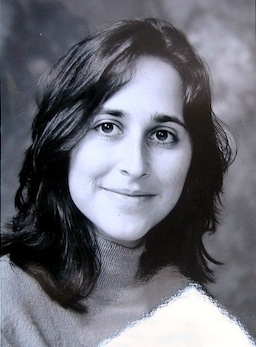
Growing up in Halifax and then doing her medical training in Montreal, Green made her way west almost 15 years ago.
Helping patients die on their own terms has been an increasing part of her practice, with about 70% of people choosing to end their lives at home, and the rest in a care home or hospital.
Medical assistance in dying is only available to people who meet specific criteria in Canada. These criteria include:
- The patient needs to be an adult, over the age of 18.
- The patient doesn’t have to be a Canadian citizen, but they must be eligible for Canadian health-care insurance.
- Patients need to be suffering from what is considered a grievous and irremediable condition; for example, a serious illness, disease or disability in an advanced state that is irreversible, causing unbearable suffering, and, ultimately, leading to the person’s natural death in the foreseeable future.
- The request needs to be made voluntarily; there can be no coercion by family, doctors or anyone else. It has to come directly from the patient and be made by the patient when she/he is capable mentally of doing so.
“If someone is interested, they have to make the request,” said Green. “There’s a specific form in every province that has to be filled out … that has to be witnessed as a legal document.
“Once the request is made legally, then someone like myself – a physician or nurse practitioner – would do an assessment with them, with the family, with the family doctor or specialist, with their records, and make sure they meet the criteria.”
If satisfied at this point, a second assessment is conducted by someone else. Only if both assessments find that the patient meets the criteria, can the patient then be considered eligible and have the power to give the go-ahead if they so choose.
The law stipulates a 10-day waiting period after the request is made before the procedure can happen, unless there are very specific circumstances that require it be otherwise. The procedure itself can be done in one of two ways.
The patients themselves can administer the medication by drinking a liquid the doctor or nurse practitioner provides. The mixture is made by a pharmacy, picked up by the doctor or nurse practitioner, and given to the patient. The nurse practitioner or doctor stands by to ensure all goes smoothly. “It’s not the tastiest of drinks and takes about an hour-and-a-half to be complete,” said Green.
The other option, which more people in Canada are currently choosing, is the physician-administered route. In this case, the doctor picks up the medicine from the pharmacy and brings it to the patient wherever they are. The physician administers it intravenously into an arm and the process takes about 15 minutes.
In the IV procedure, it is a mixture of medications. The first medication is an anti-anxiety medication to relax the patient. Due to its strength, it causes most patients to fall into a light sleep. The second medication is a local anesthetic used to numb the vein being used in order to avoid the chance that it could irritate the patient when the rest of the medication is administered. The third medication moves the patient from a light sleep into a deep sleep and then coma. Many people pass away during that sleep, but not always. The fourth medication paralyzes the body, so if anything is moving, like the respiratory muscles, it will be stopped. The heart will stop soon thereafter.
According to Green, there are a number of countries around the world that have some form of a medical-assistance-in-dying (MAID) team, but Canada is one of only four countries that allows both the patient-administered and physician-administered options.
“I think we allowed it and pushed forward on the law because Canadians feel very strongly that this is a very humane act,” said Green. “It’s something they want to have available.
“What our Supreme Court has decided is that this is actually a constitutional right of Canadians for this care. This is the ability of a physician or nurse practitioner to help someone who wants to end their life at the very end of their life, and who needs help to do so. That’s what this is – a very humane, peaceful and dignified act.
“I think the last poll I saw, 87% of the Canadian public supports this kind of care. I think that this is very respectful of the idea of patient autonomy. That’s what drives this.
“I think that, from an ethical point of view, as a physician, I have the duty to help heal people and to do the best I can to promote healthy life. At the same time, I’m also bound to reduce suffering. There’s a bit of a dichotomy there as a physician. In Canada, the law is reflective of the right of the patient; it’s not about the conflicted duty of the physician.”
From a Jewish perspective, Green does not anticipate any issue from the community. So far, she has done one case within the Jewish community (of a total of 31) and has not had any trouble.
At the time of her interview with the Independent, the MAID program had overseen two to three percent of all deaths on Vancouver Island over the previous six to eight months.
“People ask me a lot about how I feel about this work and what it’s like to do this work,” said Green. “I just want to stress that I do really believe this is a deep privilege to be involved in this care. I feel like I’m helping people. I find it very rewarding at the end.
“I don’t do it for the reward,” she said, “but have been absolutely overwhelmed by the gratitude expressed by the patients I work with and their families. It’s been surprising to me, the extent of that. I want people to know that the service is available and that it’s legal. There are people out there willing to provide this care, and I think it’s a great step forward in Canada. I’m very proud of the work I do.”
Rebeca Kuropatwa is a Winnipeg freelance writer.