JCC Maccabi in Toronto

The Team Vancouver delegation at the 2025 JCC Maccabi Games in Pittsburgh, Pa. (photo from  JCCGV)

When the Jewish community of Greater Toronto hosts the JCC Maccabi Games this summer, it will mark the first time that the Jewish teen athletics event has taken place north of the border since Vancouver hosted in 2006. And Team Vancouver, based out of the Jewish Community Centre of Greater Vancouver, will bring a delegation of at least 20 athletes to be a part of it.

The JCCs of Toronto will welcome approximately 1,600 Jewish teens from around the world Aug. 2-7, 2026, for this annual Olympic-style sporting event. The games will take over venues around Greater Toronto, offering a variety of team and individual sports.

“With the political climate being what it is these days, it’s really fantastic timing to finally have a set of games in Canada again,” said Kyle Berger, delegation head for Team Vancouver. “I can feel the excitement already building and we expect to be taking our largest delegation since before COVID.”

The JCC Maccabi Games, which engages 3,000-4,000 Jewish teens each summer, is focused on athletic competitions, but, Berger said, the true meaning of the games lies in the unique Jewish peoplehood experience it offers.

“From the powerful opening ceremonies, with the parade of athletes, and through the week of competition and special events, there is nothing that brings Jewish teens together like the JCC Maccabi experience,” he said. “This will be my 23rd set of games, but, when Team Israel enters the opening ceremony, with 10,000 people all waving their Israeli flags, cheering and singing together in a safe environment, it gives me goosebumps every time.”

Berger was involved with the games when Vancouver hosted in 2006 and said he appreciates how much hosting this event can bring a community together.

“Much like the way hosting the Olympics in 2010 brought the cities of Vancouver and Whistler together, hosting the JCC Maccabi Games really is a full-community experience,” he said. “And anytime it is in Canada, it’s special to be part of it and show off our amazing country. We will enter the opening ceremony with extra pride this year.”

The games in Toronto, which will take place at the same time as another set of games in Kansas City, will be one of the larger sets of games in recent years. Athletes aged 13-17 as of the date of the games will be able to compete in their choice of team or individual sports that include ice hockey – with a girls division for the first time – baseball, basketball, softball, volleyball, soccer, tennis, swimming, dance, track and golf.

Aside from the opening ceremony, the games will feature social events for the athletes and coaches, as well as Jewish and Israeli cultural programming, social action projects and an emphasis on the six middot (Jewish values) of tikkun olam (repairing the world), respect, joy, pride, big-heartedness, and Jewish peoplehood.

JCC Maccabi, a signature program of the Jewish Community Centre Association of North America, is part of the overall umbrella of the Maccabi World Union, which also includes the Maccabiah Games in Israel.

For more information about the JCC Maccabi Games or the opportunity to have your teen be part of Team Vancouver this summer, contact Berger at kyle@jccgv.bc.ca or check out jccgv.com/program-category/maccabi-games. 

– Courtesy Jewish Community Centre of Greater Vancouver

A way to meet fellow Jews

OneTable dinners – a platform for young professionals to meet on Shabbat – are occurring in 700 cities, including Toronto, but not yet Vancouver. (photo from OneTable)

My son moved to Florida in August, choosing the Sunshine State for its large Jewish community, great weather and the many outdoor recreational possibilities it offers when Vancouver is soaked with rain. He quickly found opportunities to engage with young Jewish professionals like himself, through a synagogue, but also through OneTable Shabbat dinners.

“I had an amazing Shabbat experience,” he told me, as he explained how it works.

Someone agrees to host a Shabbat dinner for a certain number of people, who each bring an item to help with the meal. OneTable reimburses the host $10 per person, which doesn’t cover the costs, but it helps, particularly if the host is feeling cash-strapped.

In my son’s case, the meal was take-out sushi, which was completely fine with the 20-somethings gathered around that Florida table. They talked, laughed and ate together, kindling new friendships and inspiring my son to play host at a OneTable Shabbat soon.

My curiosity piqued, I started making inquiries about OneTable. What a great fit this would be for Vancouver, I thought, given how difficult it is to make new Jewish friends here. That’s especially true for young Vancouverites looking for Jewish partners in a city with an intermarriage rate of 43%, according to a 2011 study and intermarriage rates in Canada have increased, according to another study that came out this year, so likely Vancouver’s has, too. 

But it’s also a challenge for Gen Xers like me. What an incredible idea, to surround yourself with potentially new Jewish friends at a home table defined by challah and shared food! Alas, OneTable is not offered here.

Irit Gross, chief advancement officer at OneTable, described how the organization began in 2014, when two philanthropists united to address the epidemic of loneliness that was occurring. Young Jewish adults were focusing heavily on their mobile phones, and disassociating themselves from the traditional Jewish institutions where their parents and grandparents had socialized. 

OneTable sent out a survey, asking young people what it would take to get them to choose Shabbat on a Friday night, rather than another option. 

“People were socializing online, so we knew we needed to meet them in a virtual space,” Gross said. “We began investing in a platform similar to Airbnb, where, as a host, you could go online and post your dinner and, as a guest, you could join one. That’s the essence of how we started, with the goal of people going online to be offline.”

The $10 per person remuneration was added when OneTable realized money was a barrier to millennials wanting to host five to 10 people in their homes. The reimbursement allows the host to elevate their offering; for example, by buying better wine, or a nicer tablecloth for the event.

That first year, OneTable began in the Jewish heartbeat of North America – New York City. As the organization fundraised and collaborated with local federations in other cities, it quickly expanded to Chicago, Los Angeles, Boston and Miami.

“We knew where the young adults were and went to set up shop in those locations,” said Gross. Today, OneTable dinners are occurring in 700 cities, including Toronto, and 49 states, as well as Washington, DC.

The organization has engaged 320,000 unique individuals, with many returning for more. “Those 320,000 people have come back and either guested or hosted two or three times. That engagement rate shows that our goal and mission of creating a Shabbat ritual is coming to fruition and happening in the community,” she said.

Prior to Oct. 7, 2023, OneTable was engaging 40,000 unique individuals annually. “After Oct. 7, that jumped to 82,000 unique people, meaning we doubled in 2023 and sustained that increase in 2024,” Gross noted. “It’s been a marker for our organization, catapulting us to really think not just about how we’re addressing millennials, but, also, bringing Gen Zs together.”

After reading reports about how Jews across many different age groups were looking for ways to find community, OneTable expanded its offerings, though its core audience remains the 20-to-30-something demographic, which accounts for 95% of its time and budget.

The organization’s research is far from over. “We’re still trying to figure out how to stay relevant and continue to be the number one choice for young adults in their 20s and 30s, so they can create their own Shabbat rituals,” said Gross.

Five years ago, the UJA Federation of Greater Toronto requested collaboration with OneTable, beginning a conversation that would take two years before the program launched. OneTable began operating in Toronto in 2023 with a three-year funding grant, and Gross said Toronto has been one of its most successful communities. 

OneTable is not in Vancouver, and there seems to be no conversations about it coming here. Prior to Oct. 7, the Ronald S. Roadburg Foundation reached out to OneTable.

“I think it’s a great organization, but we’re not funding in the space of young adult engagement,” said Mark Gurvis, the foundation’s chief executive officer. “If we were funding young adult engagement, we’d fund this for sure. Federation’s involvement is the key for this, and whether we’ll step in with Federation remains to be seen.”

I asked the Jewish Federation of Greater Vancouver about the possibility.

“While Vancouver doesn’t have OneTable, we’re fortunate to have many organizations that host meaningful Shabbat dinners and gatherings that bring people together throughout the community,” said Caryl Dolinko, Federation’s communications and marketing director.

“We are continuing to develop a family-connector model to strengthen engagement. We’re also happy to explore other initiatives and opportunities that are out there in the community, as we would love to do with OneTable.”

She continued, “Our focus remains on supporting the many partner organizations and community initiatives that already create opportunities for meaningful Shabbat experiences and peer connection.”

Dolinko gave the example of Axis, a Federation initiative for Jews in their 20s and 30s. “Last year, Axis held 15 events for 682 unique participants, with 345 attending multiple events,” she told the Independent. The network connected 32 volunteers to community organizations and maintains active WhatsApp and Instagram engagement, she said.

“We are restructuring our PJ program to prioritize mixed-heritage families and have expanded PJ Library access into public school libraries, pediatrician offices and other community spaces,” she added.

With an intermarriage rate like ours in Vancouver, I’d argue that the current model is not working. But no one is asking me.

I moved to this city to start my family, in 2000. Now, a quarter-century later, three of my children have left for other cities and countries, where their odds of meeting Jewish partners are much better. My youngest will follow in two years. I miss them desperately, but I want them to spread their wings – and I want them to marry someone Jewish.

Gross understands all too well that funding dollars need to go to other worthy initiatives. 

“There are a lot of people out there fighting against hate,” she noted. “I don’t know if there are enough people fighting for the joy of Jewishness, the special rituals that remind us why we love our traditions.”

For more information, visit onetable.org. 

Lauren Kramer, an award-winning writer and editor, lives in Richmond.

Editor’s note: This article has been updated from the print version to better reflect Jewish Federation of Greater Vancouver’s commitment to youth engagement in the community.

Time to include

More than one in four Canadians aged 15 and older, about 27% of the population, are living with a disability, according to the latest data from Statistics Canada. That’s an increase from 22% in 2017, and the numbers are expected to continue rising as our population ages and mental health challenges become more prevalent.

This isn’t just a statistic. It’s a reality for more than eight million people. Yet, despite these numbers, many of us in the disability community still find ourselves on the margins of Canadian society – overlooked, underestimated and too-often excluded.

I am neurodiverse. I have a cognitive disability, and I am a self-advocate for the disability community. I speak from experience and from the heart because I know what it feels like to be left out.

One of my earliest and most painful memories happened nearly 30 years ago, but it still lingers. In elementary school, there was a class camping trip I’d looked forward to for weeks. I stayed up all night baking chocolate chip cookies to share with my tentmates. But, when I got to school, I learned no one wanted to share a tent with me. That night, I slept alone in a tent that flooded during a rainstorm. I was soaked, cold and humiliated.

It wasn’t an isolated experience. I remember birthdays where I was the only classmate not invited, weekends without playdates, and watching other kids plan sleepovers I was never part of. These moments left marks, not just as a child, but as an adult working to change things for others.

I share these stories not to seek sympathy, but to urge action, because these experiences are still happening. Many of us with disabilities face uncomfortable, unkind or dismissive attitudes simply because we are different.

While some people make a sincere effort to be open-minded and inclusive, others respond to our presence with unease or judgment. We are frequently excluded from mainstream media, social spaces and cultural narratives. When we are represented, it’s often through inaccurate, stereotypical or tokenizing portrayals. This must change.

We need a cultural shift in how Canada understands, engages with and includes people with disabilities. That starts with honest conversations and with listening. Are you assuming what we need instead of asking? Are you speaking for us rather than with us?

There’s a powerful phrase within the disability rights movement: “Nothing about us without us.” It means decisions that affect our lives must include our voices. That should be the standard in education, policy, health care, the arts, employment, everywhere.

The next time you interact with someone who is different, pause. Consider your assumptions. Choose empathy, choose respect and choose inclusion.

Remember: more than a quarter of Canadians have a disability. We are your neighbours, your co-workers, your classmates and your friends. We are part of Canadian culture. We belong. 

Alison Klein is a self-advocate.

Add Jewish joy to the mix

In Grade 9, the English teacher rotates table placements monthly because sitting with different students helps expose everyone to new worldviews. In general, this makes sense; discussions about literature require us to hear lots of opinions. This was also where, last week, my kid got exposed to a view that our household could have done without.

I didn’t know about the rotating seating until one night at dinner, when my kid asked if I knew of a short video that I could recommend. He needed to explain to a classmate that “all Jews are rich” was an antisemitic stereotype. Both parents stalled for a moment as we sought more information.

It turns out that other tablemates shut down this classmate immediately. They told her to be quiet and do her schoolwork. Let’s call the student Anna. These other female classmates’ backgrounds were Filipina and African Muslim. While grateful, my kid can’t wait until the seat assignments will be changed. He believed that Anna got her information about the Gaza war and Jews from TikTok and that maybe fighting this misinformation with facts, using shortform videos, would help.

When pressed, we learned my kid didn’t have a social media connection with Anna for forwarding information, nor did we think she would watch the video. After all, Anna’s grandmother was Palestinian and liked Jews, saying we were cousins. We parents concluded that someone in Anna’s life or online introduced hateful stereotypes to her. That’s what she believed – not her grandmother.

My husband retold the story of when his family was forced to couch surf. They were homeless for a year. My father-in-law, a young architect without financial backing, sold their family home to fund future work, including their new, half-built house. When the bank lost the deposited cheque from the house sale, they had nowhere to go. My husband, a kindergartener, his toddler brother and his mother spent the year at his grandparents’ New York Lower East Side apartment. My father-in-law had to stay with his parents in New Jersey. When the awful lost cheque episode resolved, they finally moved into their half-built house. They washed their dishes at the only faucet – in the bathtub. My husband could have gone on: his grandfather, raised in Mezrich, Poland, lived in a home that they shared with their cow for winter warmth and financial security. His great-grandmother had 13 children. This included three sets of twins, but none of the twins survived.

Our son said he didn’t want to share any family information. Our truths didn’t matter to Anna, he thought. He didn’t want this kid spouting hate to think he cared or even discussed this with his family. He wanted her to think her prejudice hadn’t affected him. He felt, aside from showing a video to counteract it, he’d get nowhere in explaining how she’d upset him.

This reaction correlates to a JTA article by Ilana Horwitz, a Tulane University professor. Noting that her Jewish studies students didn’t choose topics concerning antisemitism or Israel, she asked why. Her students are constantly facing antisemitism outside her classroom online and in person. Their anxiety about “saying the wrong thing” when it comes to Israel means that they don’t want any more discussions or pressure than they already face. Exhausted, they come to her class to find ways to deepen and strengthen their Jewish knowledge and history and find “Jewish joy.” They want “to remember what we’re fighting for.”

My child’s experiences echo some of the code-switching I did as a teenager in Virginia more than 35 years ago. As an adult, I realized that my Jewish identity, practice and ideals were carefully separated and toned down when we were a small minority amid Christian Southerners who were perhaps ignorant at best when it came to treating Jews as equals. Not much has changed, although, in Winnipeg, the majority culture is coded as secular Christian rather than religious, and there are many more Muslims, Hindus, Sikhs and other religious traditions around.

I recently attended a Jewish-Christian interfaith event on the 60th anniversary of Nostra Aetate, when the Pope decreed that the Catholic Church should guard against antisemitism and that Jews hadn’t killed Jesus. The event’s planners had great intentions. The speakers were good. Rabbi Lisa Grushcow (PhD) and Dr. Murray Watson, a Catholic theologian, brought thoughtful, intellectual views on the subject. They didn’t shy away from much-needed dialogue as a bulwark against rising hate. Unfortunately, the event moderation left something to be desired. The well-intentioned Catholic senior citizens, who rose during the Q&A to speak, didn’t have critical questions. Instead, they wanted to “testify” about the “great Jewish boss” they’d had or seek reassurance that it was OK to disagree with the nice “quite Orthodox Jewish couple” in their senior living facility when it came to the West Bank/Judea and Samaria. I couldn’t help myself. Leaning over to a Jewish friend, I whispered that it’s good there are these amazing Jewish examples mentioned, because of what it suggested about the rest of us “no-goodniks”!

After several awkward moments, I felt relieved when the event ended. As a small minority in Canada, we need allies and connections. We cannot afford to give up on building bridges with others. First, we might make deep friendships and gain positive community, but also, with rising hate, it’s important to have allies (like those school tablemates) who stand up and tell haters to stop when they spout prejudice.

That said, this work to counter antisemitism isn’t solely our problem. Perhaps my teen and those students at Tulane are right. We should devote more energy to our Jewish joy, culture and history. Let’s embrace all the good, rich parts of our identities and re-invest in our learning and celebration. My kid, and most of his tablemates, didn’t want to give hateful stereotypes any airtime. In this instance, he was probably right. Lots has changed since I dealt with this in high school. I was often forced to give all the explanations and information about Jews, since I was the only Jew there. Then, afterwards, there was Jew-hate spewed towards me anyway.

What’s changed is our understanding of what causes criminal behaviour. We now recognize that a short skirt doesn’t cause sexual assault. Nothing we do specifically, as Jewish individuals, brings on this hate. Nothing the modern state of Israel or individual Jews do created this ancient hatred. It’s not our behaviour or fault. We don’t have to own this or fight this alone. Antisemitism is an old symptom of a much more invasive disease of ignorance and hate.

The solutions are complicated. Meanwhile, let’s consider shutting down these biases when they pop up, just as they did in my kid’s Grade 9 class. Let’s offer some Jewish joy to the mix – and let’s also remind one another that it’s not all on us. What causes antisemitism? Antisemites. 

Joanne Seiff has written regularly for the Winnipeg Free Press and various Jewish publications. She is the author of three books, including From the Outside In: Jewish Post Columns 2015-2016, a collection of essays available for digital download or as a paperback from Amazon. Check her out on Instagram @yrnspinner or at joanneseiff.blogspot.com.  

Reminder of humanity’s light

The passage across the Øresund, the body of water that separates the Danish peninsula from Sweden, is, at its narrowest, about the same distance as Horseshoe Bay to Bowen Island. But the waters can be treacherous – especially when it’s 1943 and the waters are swarming with Gestapo Kriegsmarine boats. Yet, for two weeks at the beginning of October 1943, 7,000 Danish Jews – about 95% of Danish Jewry (including the wonderful Victor Borge) – were safely transported across the Øresund in small fishing boats to the “sacred soil” of neutral Sweden.

In his new book, A Light in the Northern Sea: Denmark’s Incredible Rescue of Their Jewish Citizens During WWII, Tim Brady, author of the popular story of the Dutch Resistance Three Ordinary Girls, uses his excellent narrative skills to outline in detail how Danish Jews were warned about Nazi deportation plans, how they escaped and how they were treated when they arrived in Sweden. 

image - A Light in the Northern Sea book coverBrady has described himself as a storyteller, rather than as a professional historian, but he has done his research and he tells this story in great detail. As he did with Three Ordinary Girls, Brady brings history alive with the telling of stories through the eyes of participants, rather than simply cold facts. The eyes here are, for the most part, those of the remarkable Dutch resistance fighter Jurgen Kieler, whose recently published memoirs (encouraged by Elie Wiesel) would not have been available to earlier rescue historians.

Readers might be surprised that the “light in the northern sea” of the title refers to welcoming Sweden, not, as you might expect, given the book’s subtitle, Denmark. But, as Brady is quick to point out, the Swedish “light” was not always bright – before, and early in the war, Sweden had demanded that Germany mark the passports of Jewish emigrés with a “J” so they could be more easily refused, and Sweden refused potential Jewish immigrants who were not financially independent. 

However, as Brady notes, largely due to the enormously influential intercession of the great Danish Nobelist Niels Bohr (a dedicated Nazi-hater) with the Swedish government, Sweden’s position regarding the Jewish immigrants changed radically by October 1943, when it decided to admit all 7,200 Jews fleeing the recently occupying Nazis in Denmark. 

Swedes almost universally opened their homes to the Danish Jews. The refugees were also made to feel comfortable in churches, community centres, hotels and schools, as welfare agencies constructed camps, provided clothing and household items, and helped them find employment. Also, as Brady notes, during the post-rescue months of the Danish resistance, Sweden provided a 25 million kroner (about $70 million in today’s dollars) credit to help Denmark train and organize the Danish Brigade revolutionary group. 

Interestingly, the “rescue of Denmark’s Jewish citizens” referred to in the book’s subtitle has a double reference for Brady. On the one hand, there is the escape across the Øresund. But there is a second “rescue” described in the ending chapters of the book. These chapters deal with the 1943-45 undertakings of the Danish resistance, including detailed accounts of both their successful and non-successful sabotage activities. However, most of these Danish fighters were ultimately captured, and Brady carefully narrates their terrible experiences in German concentration camps. But, once again, the Danish Jews were “rescued.” Thanks to a coordinated effort of the Swedish Red Cross and the Danish government, most of the Danish concentration camp prisoners were returned to Denmark in the remarkable “White Bus Rescue” that was made possible in March 1945 by negotiations instigated between the Swedish diplomat Folke Bernadotte and Heinrich Himmler, which Brady describes at the end of his book. 

When put into historical perspective, as Brady is careful to do, the rescue of 95% of Danish Jewry, while utterly unique in Europe, was not completely surprising. At no time had Danish Jews been required to wear a yellow star. Moreover, King Christian X, while greeting his Danish subjects, would never salute the occupying Nazis, and would habitually visit Denmark’s Great Synagogue on Rosh Hashanah. (King Christian, in contradiction to popular myth, never wore the yellow star – but he would later be placed under house arrest.) As well, Jews lived comfortably in Copenhagen; for 100 years, they had enjoyed full human rights and become very active in arts, politics and philanthropy. For these reasons, as Brady explains, and also because the Danish population was, in his words, “peculiarly democratic,” Germany hesitated to “twist the arms of Denmark regarding its Jewish problem” (no less was Denmark anxious to “poke the Third Reich bear,” as Brady puts it).

But how did the Danish Jews know about the Nazis’ plans to deport them? To answer this question, Brady emphasizes the courageous actions of Nazi diplomat Georg Duckwitz, whom history should celebrate as a kind of Raoul Wallenberg- or Oskar Schindler-type figure. With his life on the line, Duckwitz tipped off Danish authorities when, in September 1943, the Nazis decided to solve the Danish “Jewish problem” in the way history shows they “solved” other problems. Duckwitz also, after tipping off Danish authorities, courageously traveled to Stockholm to tell Sweden’s prime minister about the impending roundup of Danish Jews.

As a result of Duckwitz’s actions, Danes were warned in time of the impending roundup and, when the Gestapo came calling, there was no one home. Almost all (except the very ill and disabled who did end up deported) were in neighbours’ homes or schools, churches, hospitals or safe houses, preparing for their trip to Sweden. 

Once the fishing boats were assembled, the flight to Sweden began in earnest. The boats were usually crammed; children and babies were usually sedated; and the passage was often rough, as high winds would often raise waves four to six metres high. 

As an aside, in 1989, the annual Holocaust Symposium at the University of British Columbia arranged by the Vancouver Holocaust Education Centre focused on the Danish rescue. The speakers were a Danish Jewish woman who was rescued and a Danish fisherman who was among the rescuers. In the Q&A portion of their presentation, the fisherman admitted that he and the other rescuers charged as much as 1,000 kroner ($5,000 in today’s Canadian money) per “Jewish ticket.” Brady notes this, but finds it “understandable,” since the fishermen’s livelihood was at stake in crossing the Gestapo-infested Øresund.

All in all, the Danish rescue, as Brady presents it, is truly a remarkable story – and a welcome reminder that, even in the roughest seas and at the darkest times, the basic light of humanity can shine brightly. 

Graham Forst, PhD, taught literature and philosophy at Capilano University until his retirement and now teaches in the continuing education department at Simon Fraser University. From 1975 to 2010, he co-chaired the symposium committee of the Vancouver Holocaust Education Centre.

From the archives … editorials

Almost every year that the Jewish Independent has entered the American Jewish Press Association’s Simon Rockower Awards for Excellence in Jewish Journalism competition, the paper has been recognized for its editorials. We have won for other articles, too, in several different categories, but have taken away the most honours for our editorials. This year, for instance, we took first and second place! (See jewishindependent.ca/ji-editorials-win-twice.)

The JI’s editorial board, Pat Johnson, Basya Laye and I, don’t always agree initially on what the editorial’s stance will be. Our back-and-forths, exchanging our different views and coming to a consensus, is one of my favourite parts of running the paper. It’s a key reason, I believe, that the editorials have been so award-winning.

Another reason is that the three of us have read and worked on the Jewish Independent for so many years, and we’ve been part of this community for so many years. We are grateful for those on whose shoulders we stand. The wisdom of previous generations, and that of our own generation, inspires how we look at what’s happening here and elsewhere in the world.

As I looked through the JI archives, I came across the first editorial I wrote for the paper, when it was still called the Jewish Western Bulletin, and before Pat, Basya and I became a team. I also clipped out just some of the thousands of editorials that have been written over the years. There are so many recurring themes, including communal and democratic responsibilities and the importance of free speech. The editorials variously try to calm, cajole, educate or empower readers. 

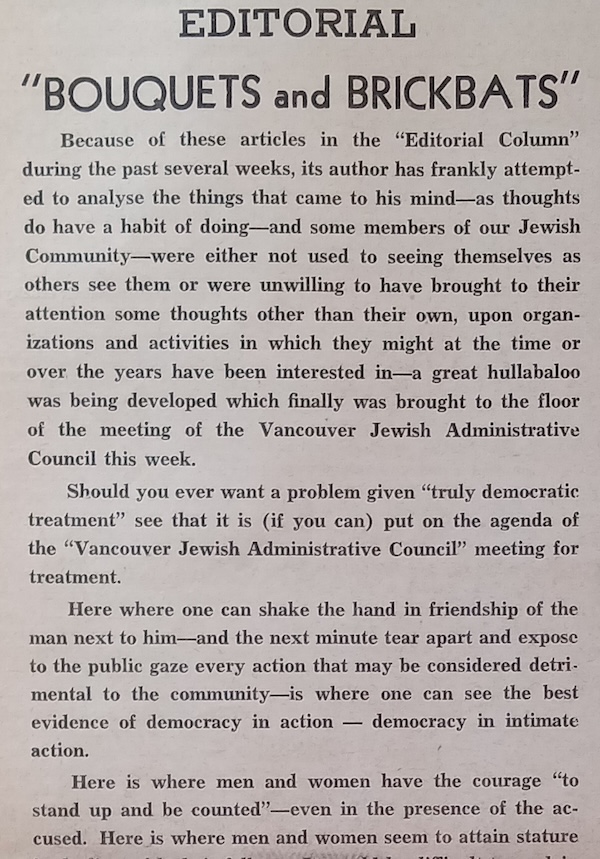
image - April 13, 1945, editorial in JWB
April 13, 1945: The paper’s editorials were brought under community review. Associate editor Goodman Florence describes the meeting that took place and comes to the conclusion that, “He who aspires to express himself must expect to receive both ‘bouquets and brick-bats’ – and if he is intelligent he will use them both.”
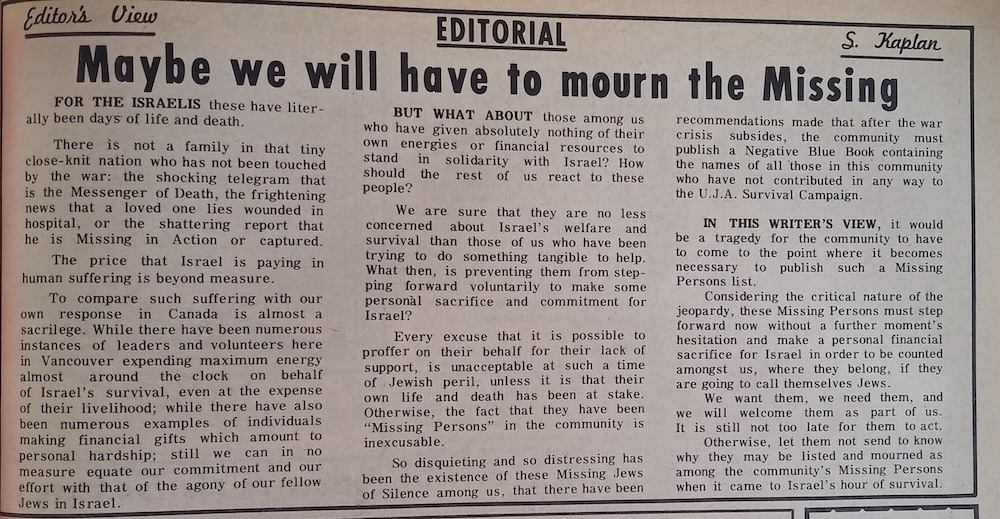
image - Oct. 26, 1973, editorial in JWB
Oct. 26, 1973: Jewish Western Bulletin editor Sam Kaplan calls out community members who’ve not contributed funds to Israel in the wake of the Yom Kippur War. The editorial floats the idea of publishing a list of these “Missing Jews of Silence.”
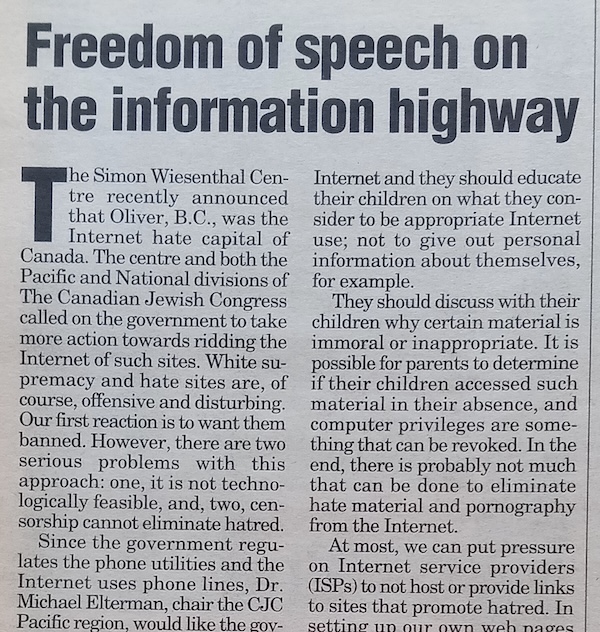
Feb. 6, 1998, editorial in the JWB
Feb. 6, 1998: My first editorial for the paper argued for limited  regulation of the internet, concluding that state censorship is more dangerous than free speech, including hate speech.

Year-round holiday recipes

Tori Avey’s Honey Apple Bundt Cake before being dusted with sugar powder or decorated with icing. (photo by Shelley Civkin)

Rosh Hashanah may well be in the rearview mirror, but Tori Avey’s Honey Apple Bundt Cake (toriavey.com/honey-apple-cake) is guaranteed to be a staple on your dinner table, no matter the time of year. It’s definitely not your typical yontif honey cake that doubles as a brick. Filled with shredded apples, it not only satisfies your sweet tooth but is off-the-charts moist.

Except for the apple-shredding part, which I do by hand, this recipe is fast and easy. I used to have a food processor with a shredder attachment but I never used it, so I gave it to my niece. I also used to have a Bundt pan, but I rarely used it, so I gave it to my niece. She now has an extensive collection of high-end small kitchen appliances. And I borrow from her. My point is that this cake was a colossal hit at my Rosh Hashanah dinner table, and is one recipe I’ll be making on the regular. You’re welcome.

HONEY APPLE BUNDT CAKE

3 large eggs
3/4 cup honey
1/2 cup white sugar
1/4 cup light brown sugar
1 1/4 cups canola oil
1 1/2 tsp vanilla
3 cups all-purpose flour
1 tsp baking powder
1 tsp baking soda
1 1/2 tsp cinnamon
3/4 tsp salt
1/4 tsp allspice (optional)
dash ground cloves (optional)
4 apples (peeled, cored, shredded)
3 tbsp powdered sugar

Preheat oven to 325˚F. Peel, core and shred your apples. 

In a large mixing bowl, beat the eggs until they’re frothy. Whisk in the honey, white sugar, brown sugar, oil and vanilla. In a separate medium-sized bowl, mix the flour, baking powder, baking soda, cinnamon, salt and spices (optional) together. Incorporate the flour mixture into the liquid, and stir to blend. Fold in the shredded apples (I used Ambrosia or Fuji but you can use any kind you like) and their juice.

Spray your nine-inch Bundt pan with cooking spray, making sure to evenly coat the entire inner surface. Pour the batter into the pan. Since Bundt pan sizes vary (I use a 10-to-15-cup pan), make sure the batter fills the pan three-quarters full or less – don’t fill beyond that or your cake might overflow during baking. Use a spatula to gently smooth the batter on the top so it’s flat and even all the way around the pan.

Bake the cake for 75 to 90 minutes. If you’re using a dark-coloured Bundt pan, it may bake faster, so start checking at 50 minutes. When the edges darken and pull away from the sides of the pan, and the cake is brown all the way across the top, insert a toothpick (or wooden shish kabob skewer) into the thickest part of the cake. If it comes out clean, it’s done. It’s a very moist cake, so it’s easy to undercook it. Bake it a little longer if you’re unsure, but not too long or it’ll dry out.

Let the cake cool for 10 minutes, then invert it onto a flat plate. Tap the Bundt pan gently to release the cake, then let the cake cool completely before you dust it with powdered sugar. Since the cake is moist, it tends to soak up the powdered sugar, so only add it right before serving. I put three tablespoons of powdered sugar into a small handheld mesh sieve and sprinkled it on top of the cake by tapping the sieve. If there’s any cake left over, keep it in the fridge, covered.

If you happen to be a fan of drizzled icing, this next part is for you. To make an icing, sift one cup of powdered sugar into a mixing bowl. Add a quarter teaspoon of vanilla extract and half a tablespoon of water or non-dairy creamer. Whisk the sugar and liquid to blend, adding the liquid very slowly, until it just comes together. Add additional liquid by half teaspoonfuls, mixing constantly, until the mixture has the texture of very thick honey. When you pull a spatula through the icing and it takes a few seconds for the gap to close again, the texture is right.

Pour the icing into a sealable plastic bag. Close the bag, leaving a small bit open to vent, and push the icing towards one lower corner of the bag. Cut the very tip of that corner off the bag. Squeeze gently to drizzle the icing over the cake. Let the icing dry completely before serving – this takes 30-60 minutes. Slice and enjoy!

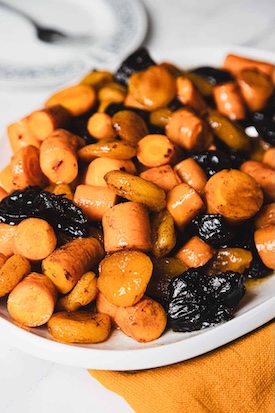
Another new Rosh Hashanah recipe I tried convinced me that not all tzimmes are created equal. Ksenia Prints’ Russian Jewish Carrot Tzimmes (immigrantstable.com/my-grandmas-russian-jewish-carrot-tzimmes) is definitely a cut above and checks all the boxes for rich depth of flavour. Some of my Rosh Hashanah guests actually asked if they could take some home! 

RUSSIAN JEWISH CARROT TZIMMES

2 lbs carrots peeled & cut into 2-inch pieces
7 oz pitted prunes
7 oz dried apricots
zest of 2 oranges, in strips
juice of 2 oranges
4 tbsp honey
1/4 cup brown sugar
3 tbsp butter
1 tsp ground cinnamon
1/2 tsp ground ginger
1/4 tsp ground cardamom (optional)
salt to taste

photo - Ksenia Prints’ Russian Jewish Carrot Tzimmes
Ksenia Prints’ Russian Jewish Carrot Tzimmes. (photo from immigrantstable.com/my-grandmas-russian-jewish-carrot-tzimmes)

Preheat oven to 350°F.

Blanch carrots in boiling salted water for 5 minutes, then drain.

In a large ovenproof dish, combine carrots, prunes, apricots and orange zest.

Combine orange juice, honey, brown sugar, melted butter, cinnamon, ginger and cardamom (optional), and pour this over the carrot mixture. Toss to coat. 

Cover the dish with foil and bake for 30 minutes. Remove foil, stir, and continue baking uncovered for 30 to 40 minutes, until carrots are tender and the sauce has thickened and reduced to a glaze. Season with salt to taste and let rest for 10 minutes before serving.

The orange zest strips become almost candied and the glaze is sweet and slightly spicy. This dish freezes perfectly and offers a deep, rich flavour that only gets better with time. Seriously. You can make it in advance, like I did, then defrost and reheat it in the microwave. No one was the wiser. And everyone was happy.

The $64,000 question is this: Why do we save these delicious recipes only for holidays? Get thee to the oven now!

Shelley Civkin, aka the Accidental Balabusta, is a happily retired librarian and communications officer. For 17 years, she wrote a weekly book review column for the Richmond Review. She’s currently a freelance writer and volunteer.