Skip to content
  • Home
  • Subscribe / donate
  • Events calendar
  • News
    • Local
    • National
    • Israel
    • World
    • עניין בחדשות
      A roundup of news in Canada and further afield, in Hebrew.
  • Opinion
    • From the JI
    • Op-Ed
  • Arts & Culture
    • Performing Arts
    • Music
    • Books
    • Visual Arts
    • TV & Film
  • Life
    • Celebrating the Holidays
    • Travel
    • The Daily Snooze
      Cartoons by Jacob Samuel
    • Mystery Photo
      Help the JI and JMABC fill in the gaps in our archives.
  • Community Links
    • Organizations, Etc.
    • Other News Sources & Blogs
    • Business Directory
  • FAQ
  • JI Chai Celebration
  • JI@88! video

Recent Posts

  • Sharing her testimony
  • Fall fight takes leap forward
  • The balancing of rights
  • Multiple Tony n’ Tina roles
  • Stories of trauma, resilience
  • Celebrate our culture
  • A responsibility to help
  • What wellness means at JCC
  • Together in mourning
  • Downhill after Trump?
  • Birth control even easier now
  • Eco-Sisters mentorship
  • Unexpected discoveries
  • Study’s results hopeful
  • Bad behaviour affects us all
  • Thankful for the police
  • UBC needs a wake-up call
  • Recalling a shining star
  • Sleep well …
  • BGU fosters startup culture
  • Photography and glass
  • Is it the end of an era?
  • Taking life a step at a time
  • Nakba exhibit biased
  • Film festival starts next week
  • Musical with heart and soul
  • Rabbi marks 13 years
  • Keeper of VTT’s history
  • Gala fêtes Infeld’s 20th
  • Building JWest together
  • Challah Mom comes to Vancouver
  • What to do about media bias
  • Education offers hope
  • Remembrance – a moral act
  • What makes us human
  • המלחמות של נתניהו וטראמפ

Archives

Follow @JewishIndie
image - The CJN - Visit Us Banner - 300x600 - 101625

Month: October 2024

International music mix

International music mix

The Israeli Chamber Project’s semi-staged production of Arnold Schoenberg’s Pierrot Lunaire features soprano Hila Baggio. The Vancouver Recital Society presents the production on Dec. 1. (photo from Israeli Chamber Project)

Celebrating the 150th birth year of Arnold Schoenberg, the Israeli Chamber Project will present a semi-staged production of his expressionist cabaret Pierrot Lunaire on Dec. 1 at Vancouver Playhouse, hosted by the Vancouver Recital Society.

A collaboration with Israeli Opera star Hila Baggio and stage director Shirit Lee Weiss, this production premièred in 2016. The program also includes Igor Stravinsky’s Scenes from Petrushka and Maurice Ravel’s La Valse, both arranged by Yuval Shapiro into chamber versions created especially for the Israeli Chamber Project. Joining Baggio (soprano) in the performance will be Guy Eshed (flute), Tibi Cziger (clarinet), Daniel Bard (violin/viola), Sivan Magen (harp), Michal Korman (cello) and Assaff Weisman (piano).

The Vancouver Recital Society’s 2024-2025 season, which started in September, features performances from a diverse group of artists from Canada and around the world. The next event – Oct. 20 at the Playhouse – features pianist Tamara Stefanovich, whose broad repertoire reaches from before Johann Sebastian Bach to beyond Pierre Boulez.

A two-concert Brahms Fest Nov. 3 at Vancouver Playhouse brings together eight musicians from three countries to celebrate the work of Johannes Brahms. The Castalian String Quartet, violist Timothy Ridout, cellist Zlatomir Fung and pianists Angela Cheng and Benjamin Hochman join forces in various groupings to play iconic works such as the String Sextet No. 2 in G major, and the Piano Quintet in F minor.

Guitarist Raphaël Feuillâtre – born in Djibouti, on the northeastern coast of Africa, and raised in the small city of Cholet in Western France – makes his Vancouver debut Nov. 24 at the Playhouse. Meanwhile, Montenegrin guitar virtuoso Miloš returns to the VRS Jan. 26, also at the Playhouse.

Grammy Award-winning Canadian soprano and conductor Barbara Hannigan will make her VRS debut with French pianist Bertrand Chamayou. At the Chan Centre for the Performing Arts Nov. 30, her performance will feature works by Olivier Messiaen, Alexander Scriabin and John Zorn.

photo - Evgeny Kissin in 2021. The Russian-born Jewish pianist performs here April 16
Evgeny Kissin in 2021. The Russian-born Jewish pianist performs here April 16. (internet photo)

Pianist Tom Borrow made his Canadian debut on the VRS stage in 2023 and wowed the VRS audience with his talent. He returns Feb. 16 for a concert at the Playhouse. And, on Feb. 23,  tenThing, an all-female brass ensemble from Norway, led by trumpeter Tine Thing Helseth, will blow the roof off the Playhouse when they play a varied program that includes works by Edvard Greig, George Gershwin and Astor Piazzolla. 

South Korean pianist Yuncham Lim will make his Vancouver debut playing Bach’s Goldberg Variations at the Orpheum March 2, while Swedish/Norwegian violinist Johan Dalene, with pianist Sahun Sam Hong, makes his Canadian debut March 23 at the Playhouse.

British pianist Steven Osborne comes to the Playhouse March 30, and cellist Jean-Guihen Queyras and pianist Alexander Melnikov perform there April 6.

Pianist Evgeny Kissin’s April 16 performance at the Chan Centre will feature works by Ludwig von Beethoven, Frédéric Chopin and Dmitri Shostakovich. And, when cellist Yo-Yo Ma returns to the VRS May 6 at the Orpheum, he will play a selection of his favourite pieces and share stories about an extraordinary life dedicated to music.

Full details of the VRS 2024-2025 performances are available online at vanrecital.com. Tickets start at $28 and can be purchased on the website or by phone at 604-602-0363. 

– Courtesy Vancouver Recital Society

Format ImagePosted on October 11, 2024October 9, 2024Author Vancouver Recital SocietyCategories MusicTags Evgeny Kissin, Hila Baggio, Israeli Chamber Project, opera, Vancouver Recital Society, VRS
Humanizing hostages’ plight

Humanizing hostages’ plight

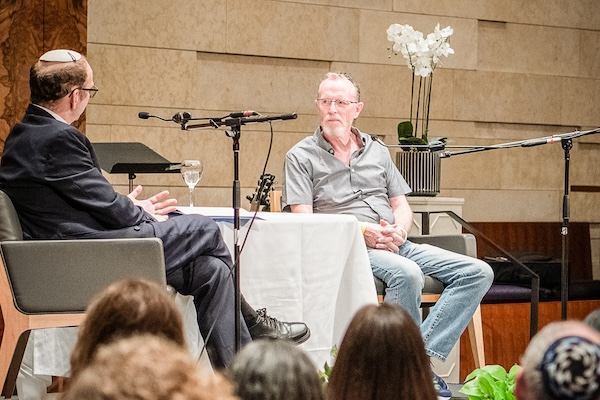
Rabbi Jonathan Infeld, left, in conversation with Thomas Hand at Congregation Beth Israel. (Adele Lewin Photography)

Emily Hand was a healthy 8-year-old girl with chubby cheeks on Oct. 7, 2023, when she was abducted by Hamas terrorists from a sleepover at a friend’s home on Kibbutz Be’eri. When she was released, 50 days later, she was a pale, gaunt 9-year-old who would not speak above the faintest whisper.

Emily and her dad, Thomas Hand, were in Vancouver this month, where the father was part of Congregation Beth Israel’s Selichot program Sept. 28. He spoke with the Independent in advance of the conversation he had with Rabbi Jonathan Infeld at the synagogue.

On Oct. 7 last year, Emily was at the home of her friend Hila Rotem-Shoshani. After the terrorists invaded the kibbutz and the murderous rampage subsided, Thomas Hand had no idea where his daughter was. It was almost midnight that evening when the Israel Defence Forces made it to Be’eri and rescued the survivors. In the chaos of the moment, Hand was told that his daughter was dead.

His immediate response was relief.

“It’s a terrible thing to say,” said Hand, “but I was more relieved and at peace that she was at peace and not being terrorized or beaten or threatened or in the hands of the Hamas.”

Eventually, it would become known that, of Be’eri’s approximately 1,100 residents, about 100 were murdered and about 50 taken hostage to Gaza. Be’eri’s surviving residents were removed to a location near the Dead Sea.

After a few days, Hand was informed that there was no evidence that Emily had been murdered. Her remains were not found and neither was any of her DNA. Hand has no explanation for how the misunderstanding occurred. His former wife, however, was found dead. (Emily’s mother died of cancer when Emily was 2.)

Now, Emily was officially missing. 

A kibbutz member mentioned to Hand that they had seen Raaya Rotem “and her two children” led away at gunpoint. Hand knew that Rotem has only one daughter – Emily’s friend Hila – and that was his confirmation that Emily had been abducted alive.

“When they told me that she was actually alive, I was in the nightmare of not knowing what the hell was going to happen to her,” he said.

It is now known that Emily, Hila and Raaya were taken to Gaza, moved from location to location for the first couple of days and then held in a house along with several other hostages.

They lived in constant terror and were given very little food – a quarter of a pita a day sometimes, though they could smell the plentiful food their captors were cooking. Their accommodations were squalid, they were watched while using the toilet and warned to remain totally silent.

Doing what he could to raise global awareness of his daughter’s situation, as well as those of the other hostages, Hand launched a campaign, beginning with a trip to Ireland. Hand had made aliyah from Ireland and Emily, as a result, is a dual citizen. Hand then traveled to the United States and appeared on American TV, further humanizing the plight of the hostages and their families.

In November last year, during the temporary ceasefire, Emily was one of 105 hostages freed. She was released along with Hila. Hila’s mother Raaya was released a couple of days later.

Hand has no clear memories of their reunion, except that he would not allow himself to believe it would happen until they locked eyes. 

“Anything could go wrong,” he said of the temporary ceasefire negotiations and promised release of the hostages. “Not until the very last second did I really believe that she was coming back, only when I saw her eyes.”

The joy of reunion was mixed with the harsh reality of what she had endured. 

“She came back a different child,” Hand said, reflecting on her transformation from an innocent 8-year-old to a much-matured child shaped by trauma. The changes were most immediately noticeable physically. “Her cheekbones were sharp, her body much thinner.”

The effects of being threatened for more than two months to remain silent did not dissipate immediately either.

“When she came back, she was whispering, just moving her lips,” he said. “Her confidence was shattered.”

Since Emily’s release, the Hands – she has an older brother, 29, and a sister, 27 – have been working to help her recover. Therapies, including horse riding, dog training, theatre and singing, have played a crucial role in rebuilding her confidence. Regular psychological support in Tel Aviv, despite being a two-hour drive, has also been essential. 

“She’s very strong, very resilient,” said her father. 

The Hand family has relocated to a semi-permanent residence near Be’er Sheva while they await the reconstruction of Be’eri, to which he is determined to return. 

“It’s been my home for over 30 years. I raised my eldest kids and Emily there,” he said. “It’s paradise. I want to go back home.”

Not all kibbutz members feel the pull to return, he acknowledged, though he estimates that 75% of the surviving members hope to rebuild there. Security, of course, is the foremost concern.

“The government needs to be different, and Hamas needs to be as weak as we can possibly make them because I need to feel safe in my own home before I would ever bring Emily back there again,” he said.

Reflecting on the international response to the crisis, Hand expressed frustration.

“Why is the UN or all the governments in the world not putting the pressure on Hamas to stop?” he asked.

To critics of Israel’s actions in Gaza, he is defiant. “We have to defend ourselves, and we will defend ourselves,” he said, “no matter what the world says or thinks.”

As Emily continues her recovery, Hand remains focused on a mission.

“Our primary concern now is getting the hostages back,” he said. 
Format ImagePosted on October 11, 2024October 10, 2024Author Pat JohnsonCategories LocalTags Beth Israel, Emily Hand, hostages, Israel, Oct. 7, Thomas Hand
Kibbutz residents returning

Kibbutz residents returning

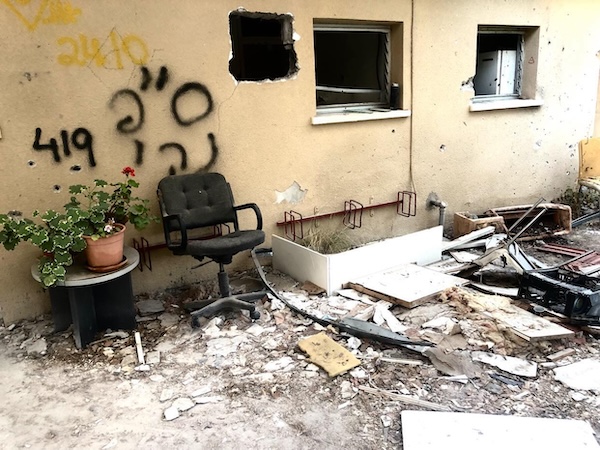
The medical centre at Kibbutz Be’eri, where at least five people were murdered Oct. 7, 2023. (photo by Melanie Preston)

I’m sitting in the dining hall at Kibbutz Be’eri, as people begin to enter for their Sunday lunch at 11:39 a.m. Sunday is like Monday here in Israel, the work week being Sunday through Thursday.

I’d never spent time on a kibbutz until now, except for a few days on my Birthright trip, which was my introduction to Israel. But now, I’m not only on a kibbutz, but on Kibbutz Be’eri, less than five kilometres away from Gaza, less than a year after the worst terror attack on Israeli soil.

On Oct. 12, 2023, in the Times of Israel article “Be’eri’s residents are gone, but their homes attest to the horrors they endured,” there was this incredible statement by Doron Spielman from the Israel Defence Forces’ Spokesperson’s Unit: “In the same way that Auschwitz is the symbol of the Holocaust, Be’eri is going to become the symbol of the [Oct. 7] massacre. The level of inhumanity of Hamas fighters surprised even us, Israelis who had no illusions about what Hamas is.”

And, yet, here I am, bearing witness as approximately 200 kibbutz members of the 1,100 total, have returned to live here. This does not include any children, due to the war next door in Gaza, and, of course, the traumatic memories of Oct. 7. 

The majority of Be’eri’s residents have just been moved from the Dead Sea-area hotels that housed them for the past year to Kibbutz Hatzerim, 45 minutes away from Be’eri, a wonderful community who rushed to build a new section of homes to accommodate them. This is where the families with children are now settling in and where school has just begun.

But there are many residents, couples with grown children, or singles without children, who have chosen to return to Be’eri. At first, they only commuted here to work during the week, but they are now choosing to stay full-time. They are determined to be back at home, to establish new routines, care for the grounds, hang out at the local pub and prove to the world and to the enemies who tried to destroy them and their spirit that they have done anything but that. The spirit in Be’eri is hurting, yes, but it is also fierce, and it will not be extinguished.

Last week, Israel’s Channel 12 aired a new documentary showing the horror that took place here on Black Saturday. It included footage from cameras all over the kibbutz, and the camera they kept returning to was right outside the dining hall in which I am writing right now.

How different it was to watch this documentary, how odd to watch the silent camera footage, how chilling, when I knew the reality on Oct. 7 was sirens blaring the entire day, due to thousands of rockets overhead, and screams from those being attacked all over Be’eri, in neighbouring communities and all over the nearby desert and forests, as young adults ran to try and escape the Nova music festival, many meeting a violent death.

I watched the tick, tick, tick of the digital clock in the corner of the TV screen on this documentary as Hamas terrorists methodically made their way through offices and the kibbutz’s medical centre, where at least five workers were massacred, and homes and children’s rooms, trapping people together and smoking and burning people to death, shooting them if they attempted escape, like Narkis Hand was forced to do when an RPG hit her home, setting it instantly on fire.

Narkis Hand was Thomas Hand’s former wife and the mother of his older children, Natali and Aiden. Thomas Hand’s younger daughter, Emily, then age 8, was kidnapped by Hamas terrorists with her friend Hila and Hila’s mother Raaya for 50 days, though he was originally told she had been killed.

The first and only time I had been to Be’eri before now was last February, when I visited with a different resident, Adam Rapoport, whose older brother Yonatan was murdered at some point between “6:29 a.m. and the end of day,” noted the documentary, as the silent clock in the upper left-hand corner went tick, tick, tick on Oct. 7.

photo - Adam Rapoport by the Dead Sea
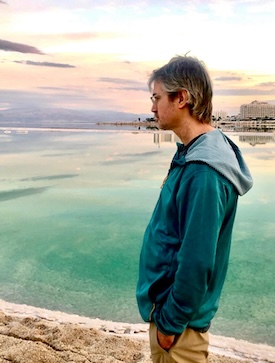
Adam Rapoport by the Dead Sea. (photo by Melanie Preston)

Like many others from these communities, Adam will never know exactly what happened to his brother that day, other than that he saved his kids’ lives by ordering them under the bed, where they would spend 11 hours listening to the horrors taking place in the peaceful community they’d grown up in. Six-year-old Aluma and 9-year-old Yosef would later tell their uncles that Dad had said he was going out to get the terrorists money at the ATM.

“There were just too many … bodies … to learn what happened, and that was just at Be’eri,” Adam told me back in February, at the Dead Sea hotel where he and other evacuees were staying, the day before he brought me here to bear witness.

This was an invasion into homes that lasted an entire day and involved such gore that I hesitate to go into detail.

It involved shooting a 3-month-old baby in the head, in front of her mother, in Kibbutz Be’eri, and burning an entire family alive from neighbouring Kibbutz Nir Oz, including all three young children.

It involved murdering parents in front of their children and then kidnapping the children – and these sons and daughters have still not returned home. Some are confirmed dead in Gaza and are bodies waiting to be brought back, like Adam’s best friend Itay Svirsky, which was how I initially met Adam and began learning about this community, while others are likely still alive in captivity, starving and suffering in ways human beings should not be permitted to suffer. But the Red Cross has done nothing for the hostages since the very beginning. 

In Israel, we have waited, prayed, hoped and fought. We have gone to weekly rallies in Tel Aviv and Kiryat Gat, saying the hostages’ names and counting the days, chanting “Achshav, achshav, achshav.” (“Now, now, now.”) 

We have had to silence our phones, as constant notifications appear, notifying us of the nonstop rockets entering our airspace and our cities from Hezbollah in Lebanon, the Houthis in Yemen and other groups in Iraq and Syria, while ongoing predictions about whether Iran will or won’t do something big (and when they will or won’t do it) are discussed and analyzed.

But, since arriving on Kibbutz Be’eri last month, I have felt a shift.

It’s a unique kind of optimism I have never quite seen. It’s pride and it’s love and it’s strength and it’s resolve and it’s “F—- you, we’re not leaving.” It’s coming from returning Kibbutz Be’eri members, it’s coming from people like myself who have come to Be’eri since Oct. 7 to help with the land and to work, to add to the life being rebuilt here and to help heal the collective broken heart of this community.

I fell in love with Israel because I fell in love with its people. I am here in Israel to tell the stories of what happened on Oct. 7, 2023, and is still happening, at every moment of every day for these incredible people, these people of Kibbutz Be’eri and elsewhere, who have come back to their lives and are attempting “normality” on their beautiful land. 

Melanie Preston is a Canadian-born, American-raised, Jewish writer and traveler who discovered Israel at the age of 26, immigrated to the country and stayed for seven years. She flew to Israel alone on Nov. 16, 2023, from her home in Charlotte, NC, and was there to March of this year. She returned to Israel last month to continue writing about the hostages and impacts of October 7th on Israeli society. She intends to spend more time with the survivors of Kibbutz Be’eri as it is rebuilt. To support her work and read more of it, go to melanie-preston.com, or visit her GoFundMe (Raising Awareness on Israel’s War).

Format ImagePosted on October 11, 2024October 12, 2024Author Melanie PrestonCategories IsraelTags Adam Rapoport, Kibbutz Be’eri, Narkis Hand, Oct. 7, Thomas Hand
Relations at low ebb: Shamir

Relations at low ebb: Shamir

Claudia Goldman, left, presents Bev Corber with the Claudia Goldman Award for Excellence in Leadership. (photo by Pat Johnson)

Diplomatic relations between Israel and Canada have never been worse, according to Israel’s envoy to Toronto and Western Canada. 

“The relationship between Israel and Canada is at an all-time low,” said Idit Shamir, consul general of Israel for Toronto and Western Canada. “Canada, according to many, has abandoned Israel, the only democratic ally they have in the region.”

Speaking via remote video link to the opening event of the Vancouver branch of CHW (Canadian Hadassah-WIZO) Sept. 22, Shamir cited, among other things, the Canadian government’s legitimizing of Hamas information, rather than Israeli government sources, when commenting on the conflict.

“Many times, they have been proven as mistaken,” said Shamir. “Not as many times, they have taken the time to correct themselves.”

Canadian Jews are asking themselves if there is a future for their families in Canada, the envoy said. 

“This is a question that I don’t think was asked here before Oct. 7, and that’s very, very sad,” said Shamir.

Israelis and Canadians alike were shocked by the alarming spike in antisemitism in Canada and worldwide in recent years, but especially in the past 12 months, she said. 

Shamir addressed concerns about the climate on university campuses and even in public elementary and secondary schools. She spoke just after the controversy erupted over an officially sanctioned Toronto public school field trip to what evolved into an anti-Israel rally. 

Making Jews unwelcome on campuses will have negative repercussions for the entire society, she said.

“Jews have been instrumental in the university system here, and pushing them out is going to have a serious impact on the future of Canada,” she warned.

Regrettably, Shamir said, Canada has been the launchpad over the years for several negative developments, including Israel Apartheid Week, which began at the University of Toronto before spreading internationally, and, more recently, the concept of “anti-Palestinian racism,” which was adopted as policy by the Toronto and District School Board. The idea, she said, paints any expression that is critical of the prevailing Palestinian narrative as racist.

“When you see that happening already at the elementary school level, we can imagine the depth of indoctrination that is going on in the universities,” said Shamir.

On the positive side, the consul general said, opinion polls indicate that most Canadians support Israel. 

“Most Canadians can understand that … we didn’t choose this war,” she said. “We are fighting a war for our survival, for the survival of the only Jewish democracy and country in the world. And now we understand more than ever the need for a safe haven for Jews.”

Among the 101 hostages remaining in captivity, Shamir said, the Israeli government believes more than half remain alive. The body of Judy Weinstein Haggai, a dual Canadian-Israeli citizen who is known to have been killed, remains in Gaza.

“The hostages are the utmost priority,” Shamir said, “releasing the ones who are alive and returning the bodies of those who are not.”

She linked the Gaza conflict to wider geopolitical issues, pointing to Iranian-backed forces launching missiles from Lebanon, Iraq and even Yemen. She was speaking before Iran launched more direct attacks on Israel Oct. 1.

“We cannot forget that Iran is behind this, and we can see that rockets are coming from Iranian-sponsored sources in places we would not have imagined,” she said.

In response to these challenges, the consul general called for unity among the Jewish community and its allies, stressing the need for resilience and solidarity.

Noting that “Jews are coming together and becoming a united force to be reckoned with in Canada,” Shamir said members of the Jewish community must remain vigilant and continue to fight antisemitism and support Israel.

The envoy lauded CHW’s long-standing efforts to empower women and children, provide health care and assist displaced Israelis.

“It’s a labour of love that touches hearts and changes lives every single day,” she said.

The CHW Vancouver event, held at the Richmond Country Club, benefited the Michal Sela Forum, an Israeli organization dedicated to preventing domestic violence through innovative technology and collaboration.

photo - Toby Rubin, president of CHW Vancouver, presents the inaugural Dolly Jampolsky Volunteer Extraordinaire Award to Jampolsky
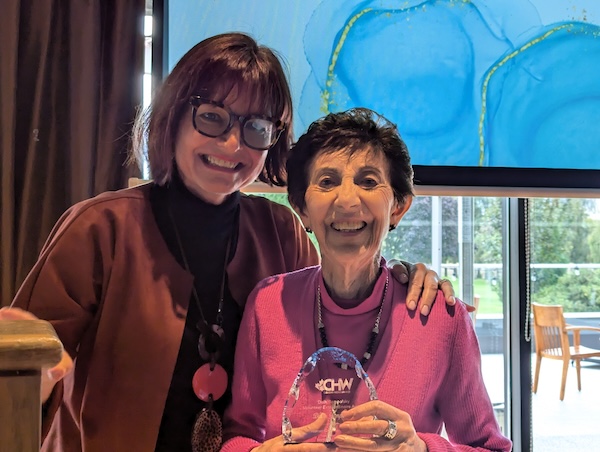
Toby Rubin, president of CHW Vancouver, presents the inaugural Dolly Jampolsky Volunteer Extraordinaire Award to Jampolsky. (photo by Pat Johnson)

Longtime CHW leaders Beverley Corber and Dolly Jampolsky were the honourees. Corber received the Claudia Goldman Award for Excellence in Leadership, and Jampolsky received the inaugural Dolly Jampolsky Volunteer Extraordinaire Award. Sylvia Cristall and Claudia Goldman were inducted into the CHW Lillian Freeman Society by Lisa Colt-Kotler, national chief executive officer of CHW, who spoke at the opening and interviewed the consul general. Toby Rubin, president of CHW Vancouver, emceed the event. 

Format ImagePosted on October 11, 2024October 10, 2024Author Pat JohnsonCategories LocalTags Canada, Canadian Hadassah-WIZO, CHW, Idit Shamir, Israel, politics
Stilwell joins Weizmann

Stilwell joins Weizmann

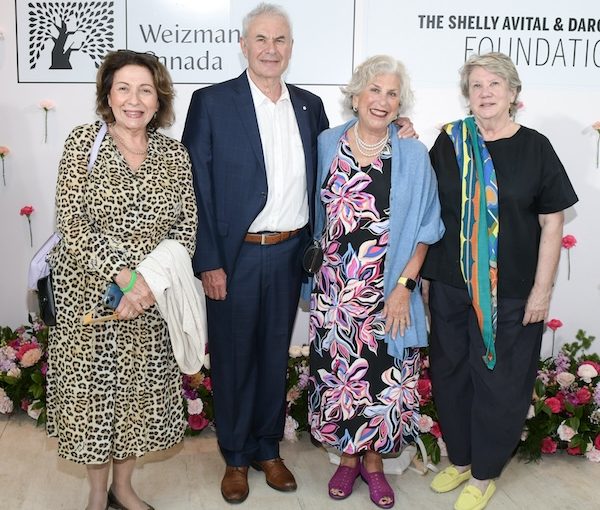
Left to right: Weizmann Canada national board members Dr. Rose Geist, Dr. Arthur Slutsky (chair), Myra Slutsky and Dr. Moira Stilwell at the Healing Power of Science gala on Sept. 17. (photo from Weizmann Canada)

Former BC MLA Dr. Moira Stilwell recently joined Weizmann Canada’s national board of directors. She traveled to Toronto last month for the group’s first in-person gathering since before the pandemic. While there, she attended the organization’s Healing Power of Science gala, which spotlights the vital importance of science education in building resilience in Israel and around the world.

For 60 years, Weizmann Canada has been the national philanthropic arm representing the Weizmann Institute of Science in Rehovot, Israel, which marks its 90th anniversary this year. For more information, visit weizmann.ca. 

– Courtesy Weizmann Canada

Format ImagePosted on October 11, 2024October 10, 2024Author Weizmann CanadaCategories LocalTags Moira Stilwell, science, Weizmann Canada

Virtuoso musician, impresario

The reasons why Wendy Atkinson, who owns Ronsdale Press, wanted to publish Have Bassoon Will Travel: Memoir of an Adventurous Life in Music by the late George Zukerman, are the reasons people should read it. Zukerman had a long and impressive solo career as a bassoonist, was a pioneer in organizing concerts and tours, and gave remote communities across Canada the rare chance to hear classical music performed live. 

“She recognized that his anecdotes capture a vital period in Canada’s musical history and are vivid reminders of the lengths musicians will go to tour our vast country,” reads the afterword. “George’s memoirs go beyond simply capturing a life. He expanded the cultural reach of classical music in Canada; no small feat and Canada is better for it.”

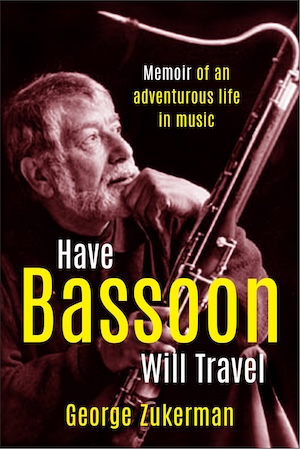
image - Have Bassoon Will Travel book coverHow Zukerman’s memoir came to be is an example of the communities he created in his life. When he died Feb. 1, 2023, in White Rock, the manuscript had been written, but it took several volunteers – each with their own connections – to bring it to publication quality and get it printed. After reading Have Bassoon Will Travel, you will know why they did it. Not only was Zukerman a world-class musician and impresario, but he was a world-class human being: humble, funny, innovative, hardworking, fairness-driven, adventuresome, the list goes on.

Zukerman was born in London, England, on Feb. 22, 1927. Well into the book he talks about how he never liked his name, George – his parents, both American citizens living abroad, named him after the United States’ first president, George Washington. His middle name, Benedict, was in honour of 17th-century Jewish philosopher Baruch (Benedict) Spinoza, who was expelled by his community for his ideas. Zukerman also discusses his surname, the spelling of which differs across family thanks to the North American melting pot. There is something to be said about living up to one’s name, and Zukerman certainly was a leader in his fields of music, both as performer and impresario; he certainly forged his own path, uplifting the place of the bassoon in the orchestral world, creating opportunities for fellow musicians to perform and bringing classical music to the remotest of areas; and he lived in several places and traveled, mostly for work, around the world.

It is incredible how much of life is directed by (seeming) happenstance. Zukerman’s first encounter with the bassoon was at 11-and-a-half years of age. It was an accidental meeting, as his older brother showed him around the London prep school Zukerman was about to attend.

“We wandered past the windows of a basement chapel and glanced down to where an orchestra was rehearsing,” writes Zukerman. “A row of tall pipes seemed to reach for the ceiling. I could see and hear very little through the moss-covered stone walls and grimy opaque windows of the old school, and I wondered what on earth these strange-looking instruments were. My brother, already in Form IV, authority on much, including most musical matters, declared them to be bassoons, and the piece in rehearsal the annual Messiah. We walked on to explore my new school, and any awareness that I would spend my life playing that instrument would have been uncannily prescient. The bassoon remained buried deep among early memories.”

His next encounter was as random. As the Second World War began, the family – less Zukerman’s journalist father, who joined later – left London for New York City. There, Zukerman attended the newly established High School of Music and Art. 

“By way of an audition,” he shares, “I played [on the piano] my one and only party piece (a simple Beethoven sonatina). To my surprise as much as anyone else’s, I was admitted to the class of 1940! Dare I suspect that my acceptance had as much to do with short pants and an English accent as with any evident musical skill?”

On the first day of school, the kids were told to pick an instrument. “No British prep school could have readied me for such democratic and independent action, so I hesitated,” writes Zukerman. “On all sides of me, the pushy American kids ran furiously and grasped what they could most easily identify. The violins, clarinets, flutes, trumpets, cellos and drums disappeared into groping hands. When I finally reached the shelf, all that remained was an anonymous black box. I lifted it gently and carried it toward a teacher standing nearby. ‘Excuse me, Sir,’ I asked timidly, ‘but what is this?’

“He looked down, and a broad smile covered his face. ‘Why, you are our bassoonist!’ he declared.”

With faint remembrance of the tour with his brother, he thought, “Was I now going to play such an instrument?”

Indeed, he was, and to eventual great acclaim, both as part of orchestras and as a soloist. But, as you can imagine, bassoonist was not exactly a living-wage career, at least not in Zukerman’s time, and his parallel career arose from a need for more work. Having learned during his time with the St. Louis Sinfonietta in the 1940s about community concerts – where money was raised in advance through subscriptions rather than individual ticket sales, and no contracts were signed until the money to pay for everything had been raised – Zukerman, who was by then living in Vancouver, brought the idea to Canada. His offer to an American company to be their representative here declined, Zukerman decided to do it on his own. 

“Canada was coming of age, and Canadian communities were ready to make their own concert plans and to welcome Canadian groups and soloists, even if at the time they were equally unknown,” he writes. “Within a decade, Maclean’s magazine would write that I had successfully outsmarted the Americans at their own game.”

It is fascinating to read of Zukerman’s efforts to expand the reach of classical music in Canada and other countries – he visited the Soviet Union eight times between 1971 and 1992, as performer and concert organizer, and brought Soviet musicians to Canada to tour. Decades earlier, he spent a year-plus in Israel, part of the nascent Israel Philharmonic. He was also part of the Vancouver Symphony Orchestra in its early days, and of the Vancouver Jewish community – Abe Arnold, publisher of the Jewish Independent’s predecessor, the Jewish Western Bulletin, had a small but notable impact on Zukerman’s life.

Have Bassoon Will Travel is a truly engaging read. The way in which Zukerman writes is like how he would have spoken, though likely more concise and organized. The effect is that we the reader are having a chat with him, reminiscing. We get a feel for what life was like back in the day for a musician and entrepreneur. We feel nostalgia for a time many of us never experienced personally.

Posted on October 11, 2024October 10, 2024Author Cynthia RamsayCategories BooksTags autobiography, bassoon, business, entrepreneurship, George Zukerman, history, impresario, Israel Philharmonic, memoir, music, travel, Vancouver Symphony Orchestra
Happy Sukkot 2024!

Happy Sukkot 2024!

Format ImagePosted on October 11, 2024October 10, 2024Author Beverley KortCategories Celebrating the HolidaysTags cartoon, Sukkot

Posts pagination

Previous page Page 1 … Page 3 Page 4
Proudly powered by WordPress