Skip to content
  • Home
  • Subscribe / donate
  • Events calendar
  • News
    • Local
    • National
    • Israel
    • World
    • עניין בחדשות
      A roundup of news in Canada and further afield, in Hebrew.
  • Opinion
    • From the JI
    • Op-Ed
  • Arts & Culture
    • Performing Arts
    • Music
    • Books
    • Visual Arts
    • TV & Film
  • Life
    • Celebrating the Holidays
    • Travel
    • The Daily Snooze
      Cartoons by Jacob Samuel
    • Mystery Photo
      Help the JI and JMABC fill in the gaps in our archives.
  • Community Links
    • Organizations, Etc.
    • Other News Sources & Blogs
    • Business Directory
  • FAQ
  • JI Chai Celebration
  • JI@88! video

Recent Posts

  • BGU fosters startup culture
  • Photography and glass
  • Is it the end of an era?
  • Taking life a step at a time
  • Nakba exhibit biased
  • Film festival starts next week
  • Musical with heart and soul
  • Rabbi marks 13 years
  • Keeper of VTT’s history
  • Gala fêtes Infeld’s 20th
  • Building JWest together
  • Challah Mom comes to Vancouver
  • What to do about media bias
  • Education offers hope
  • Remembrance – a moral act
  • What makes us human
  • המלחמות של נתניהו וטראמפ
  • Zionism wins big in Vegas
  • Different but connected
  • Survival not passive
  • Musical celebration of Israel
  • Shoppe celebrates 25 years
  • Human “book” event
  • Reclaiming Jewish stories
  • Bema presents Perseverance
  • CSS honours Bellas z”l
  • Sheba Promise here May 7
  • Reflections from Be’eri
  • New law a desecration
  • Resilient joy in tough times
  • Rescue dog brings joy
  • Art chosen for new museum
  • Reminder of hope, resilience
  • The national food of Israel?
  • Story of Israel’s north
  • Sheltering in train stations

Archives

Follow @JewishIndie
image - The CJN - Visit Us Banner - 300x600 - 101625

Month: November 2018

Training local doctors

Training local doctors

Prof. Mark Eidelman, director of the pediatric orthopedics unit at Rambam’s Ruth Rappaport Children’s Hospital, second from the left, with African colleagues at the Black Lion Hospital in Addis Ababa. (photo from Rambam Medical Centre)

Dozens of doctors from Ethiopia and neighbouring countries recently participated in a practical course, the first of its kind, which trained them to fix pediatric orthopedic deformities. The course, held for the first time in Africa, was led by Prof. Mark Eidelman, director of the pediatric orthopedics unit at Rambam’s Ruth Rappaport Children’s Hospital.

Fifty doctors participated in the four-day course. Some of them had already completed their internships, while others were still interns. They attended lectures about different treatment types, attended workshops and participated in surgeries. The Black Lion Hospital in Addis Ababa, Ethiopia, hosted the course, which was sponsored by CURE International. CURE is a nonprofit organization that assists children in developing countries suffering from medical issues, in cooperation with POSNA, the Pediatric Orthopedics Society of North America.

The Ethiopian hospital’s pediatric orthopedic services are directed by two doctors from England who relocated to Ethiopia several years ago. The doctors created the course in order to give treatment tools to local medical teams dealing with one of the most common problems in the country.

“Against the backdrop of genetic diseases and problems, and especially since there is a great lack of knowledge, infrastructure and treatment capabilities with regard to pediatric orthopedic deformities, there are many people in Ethiopia with problems that are taken care of in other countries at much earlier stages,” said Eidelman. “In Israel, like in many other Western countries, they know how to diagnose problems … and treat them in a timely manner. This helps these patients to enjoy a higher quality of life and prevent their conditions from deteriorating. Now, for dozens of local doctors, there are tools and knowledge to help their patients.”

Joining Eidelman on this recent mission were two doctors from the United States: one who was Eidelman’s teacher, Prof. John Herzenberg, a senior doctor in the field from Baltimore; and Prof. Christof Radler, who is also renowned in his field.

According to Eidelman, the main problem in training African doctors is the difficulty of traveling to the United States to receive training there. “The institutions in Baltimore are considered the best in the field in terms of training and teaching, and the city hosts the leading conferences and courses,” he said. “Unfortunately, most of these doctors don’t manage to secure entry visas for the U.S. and, as such, are denied access to this information. This is the reason why we decided to bring the training to them. At the end of a successful course, we decided to continue with this initiative and, in the near future, I’m supposed to return to Ethiopia in order to train additional doctors.”
Format ImagePosted on November 30, 2018November 29, 2018Author American Friends of RambamCategories WorldTags Africa, Ethiopia, healthcare, Mark Eidelman, orthopedic, pediatrics, Rambam Health Care Campus
Pinson writes definitive book

Pinson writes definitive book

If I wrote that I had been trying to get a review copy of Rising: The Book of Challah by Rochie Pinson (Feldheim Publishers) since November 2016, readers would find that hard to believe, but the book only arrived at my door recently.

Pinson, who grew up in Vancouver, is co-founder of the IYYUN Centre for Jewish Spirituality with her husband, Rav DovBer Pinson, in Carroll Gardens, Brooklyn. They have four children. She mentors women and teaches various classes. She also conducts a challah-baking workshop, which she teaches worldwide, including in Vancouver.

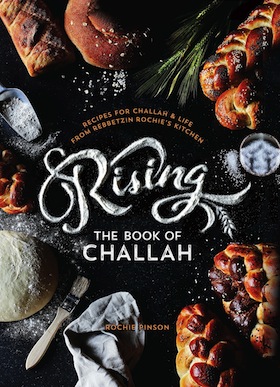
image  - Rising book coverFor Rising, Pinson has written 352 pages about challah. This book is about her philosophy, spirituality, history and everything you wanted to know about challah. And, yes, it includes recipes – 38 of them for challah and seven for toppings.

“The intent of challah,” writes the rebbetzin, “is to reveal our innate power to nurture and nourish, and reclaim our mothering potential in all the forms it can take.”

Section I, “The Story of Challah,” explains how, as a new bride, Pinson arrived in Kobe, Japan, which had no kosher bakery, and soon got into making 40 challot a week for the Jewish community.

The book then expands to other information about challah, spirituality and other topics, including a detailed examination of each ingredient and information on the concept of “rising.”

Section II is the cookbook, with reviews and details of ingredients and equipment and troubleshooting.

There are eight recipes, including her own classic challah recipe, gluten-free challah and vegan challah; eight holiday specialties, like apple-and-honey challah and pretzel challah; six recipes from around the world, including Moroccan challah, Yemenite challah and Bukharian challah; nine challah innovations, such as a “fish” challah (shaped like a fish with salmon, tuna, mushrooms and other vegetables), a deli challah (with deli meats) and a rainbow challah (using food colouring); and eight recipes for leftover challah, like babka, cinnamon bars and French toasts. Rising also has recipes for seven different challah toppings, including cream cheese frosting, and accompaniments for other dishes, such as challah stuffing and challah croutons.

Section III is called “Laws and Customs,” which is mainly self-explanatory, though it also includes challah meditations. A glossary and index conclude the book.

There are more than 100 colour photographs in Rising and many sketches, such as 37 ways to braid and shape a challah.

Rising really is the definitive “everything you ever wanted to know about challah” book, written with love and nurturing. It contains a huge amount of information, including the story of Pinson’s life “as realized through challah baking, and challah baking as a metaphor for balanced, integrated nurturing of our self and our loved ones.”

This is the book to give to anyone who bakes challah, and to anyone else who might be contemplating it.

Sybil Kaplan is a journalist, author, compiler/editor of nine kosher cookbooks and a food writer for North American Jewish publications, who lives in Jerusalem where she leads weekly walks of the Jewish food market, Machaneh Yehudah, in English.

Format ImagePosted on November 30, 2018November 29, 2018Author Sybil KaplanCategories BooksTags baking, challah, cookbook, Judaism, Rochie Pinson
History through Eva’s eyes

History through Eva’s eyes

Gabriella Goliger’s Eva Salomon’s War is an intriguing novel. (photo by Ben Welland))

Award-winning Canadian author Gabriella Goliger has written Eva Salomon’s War (Bedazzled Ink Publishing, 2018), an intriguing novel set between the rise of the German Nazi state and the founding of the state of Israel – two complex historical phenomena whose aftershocks we are still experiencing. But, for Eva Salomon, those huge events are mainly engines moving her own story forward from timid German-Jewish adolescent to courageous Israeli young woman. The novel takes us through many intricacies of the competing historical strands that form the background of Eva’s life. Readers familiar with various bits and pieces of the history can connect the dots through her eyes.

Written as a first-person bildungsroman, the book opens as the Nazis close in on the Jews, who are wondering which of the many possible responses to embrace. Should they stay and resist? Stay, pray and keep their heads down? Should they emigrate, and, if so, where? Should they join the movement to build a Zionist workers’ state in Palestine? So many choices, so many unknowns, and so much peril attached to each decision.

Eva’s beloved older sister, Liesel, immigrates to a socialist kibbutz in the Galilee. Sixteen-year-old Eva and her embittered, widowed father migrate to Tel Aviv. We know what happens to the relatives who feel too old to make the trip.

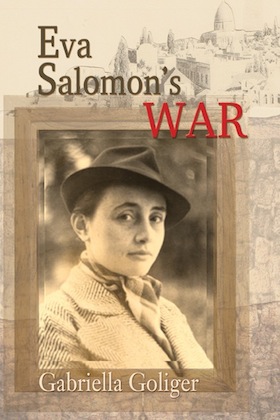
image - Eva Salomon’s War book coverThe character of Eva is loosely based on Goliger’s own aunt. Letters between Eva and Liesel give us many illustrative details of Jewish life in Palestine in those years. In Breslau, they had enjoyed middle-class lives. In Palestine, they quickly have to learn working-class skills and they have to adapt to their shabby new realities among people with no time for pity or introspection.

Kibbutz life is physically harsh but relieved by the high level of ideological commitment between the comrades: “I sleep in a tent and the food is plain, but I never have to think about where my next meal is coming from. Everything is communal and allotted to me, down to my shoes and socks.” Eva flees the misery of life in her father’s tiny flat and finds a place to live with Malka, a Hungarian Jewish seamstress who helps her accommodate to her reduced circumstances.

Malka transforms Eva from a ragged miserable waif to a well-dressed young woman who can make her way in the vibrant, uncertain Jewish Palestinian world. Eva learns the meaning of “ein breirah” – no choice – a theme resonating not only throughout the novel but throughout the decades to the present day as one formative part of Israeli Jewish culture.

Eva finds work as an ozerit (cleaning lady) and starts putting together a life of sorts. She finds a music shop that affords her a bit of pleasure – “my refuge, my paradise” – phonograph records feeding her delight in classical music and her longing for romance. Fittingly, it is where she meets Constable Duncan Rees of His Majesty’s Palestine Police. Their romance encapsulates many conflicting layers of identity, culture, desire and belonging.

Throughout the novel, most of the characters are rent by doubts and competing loyalties. Only the fanatics of all stripes know certainty. The portrayal of Eva’s unbending Orthodox father, seemingly bereft of feeling for his wayward daughter, I found puzzling. We never see anything through his eyes, never understand his inner realities.

Eva is at war with her father, with all rigid religious and political belief systems, with her situation of loving the wrong person, and with her own competing claims of duty. Her personal war intersects with the fighting in Europe, the fighting between Arabs and Jews, the infighting between the various Zionist factions and, crucially, with the growing resistance to the British presence in Palestine.

Eva is a Jewish refugee. Duncan is charged with upholding British laws controlling Jewish immigrants. Despite the growing cultural-personal-political tensions, Eva enjoys their romance. She experiences pleasure and the delights of physical intimacy, which she keeps secret as much as possible. “The more he was my secret, the tighter, I felt, was our bond.” Their emotional intimacy is harder to sustain. One feels it can’t last and I wondered throughout how Goliger was going to handle it (no spoiler here).

The British White Paper on Palestine brings it all to a head. Tensions explode into violence all over the land, from many different directions, aimed at “traitors” to all the intersecting causes. For each faction, “we” are highly individuated and the others are an undifferentiated “they.” Eva, essentially an apolitical person, is helplessly caught up in the sectarian brutality.

One can’t help but read the novel through the prism of the tragic unfolding of events since 1948. Goliger vividly illustrates the human urgencies propelling Arabs and Jews in all directions, and the emotional realities behind all the ideologies.

Near the end, I was reminded of Anne Frank’s “In spite of everything, I still believe people are good at heart.” Eva reflects, “I believe a better world is dawning because … because ein breirah. I must.”

Deborah Yaffe lives in Victoria, where she formerly taught in the women’s studies department of the University of Victoria. An active secular Jewish feminist since reading Elana Dykewomon and Irena Klepfisz in the 1980s, she is grateful for the many Israeli individuals and organizations working against Jewish persecution of Arab Israelis and Palestinians.

Format ImagePosted on November 30, 2018November 29, 2018Author Deborah YaffeCategories BooksTags Gabriella Goliger, historical fiction, Holocaust, Israel, Palestine
Creating their own changes

Creating their own changes

Blake Mycoskie, founder of TOMS, with Hannah Alper. Mycoskie is one of the role models Alper features in her book Momentus: Small Acts, Big Change. (photo from callmehannah.ca)

In Momentus: Small Acts, Big Change (Nelson Trade, 2017), Toronto-based teen activist Hannah Alper profiles people who are doing humanitarian work. Each chapter is devoted to a person who is doing significant tikkun olam (repairing the world) in any number of areas, from the environment to indigenous rights to mental health.

Alper uses a specific formula to describe what her book is essentially about: issue + gift = change. The issue is something an individual is passionate about, whatever the cause might be. The gift is something a person is blessed with or a hobby they might enjoy or want to pursue. With just these two aspects, individuals can change the world.

In the introduction of Momentus, Alper briefly talks about how she got involved in humanitarian work. She and her parents were coming back from a Digital Family Summit, which is a conference to help young individuals use the internet safely. Blogging was never something she had envisioned herself doing, but this conference changed her mind. While still there, she began her own blog, titled “Call Me Hannah.”

Initially, she did not know what she would write about. Then, her parents gave her some encouraging words. They told her to write what she was passionate about. Being 9 years old at the time, Alper was learning about the environment and the problems animals were facing because of habitat loss and deforestation. It especially bothered her because these were problems caused by humans.

Alper began to receive comments from people who were actually trying to do what she advised in her writing. She herself became involved in the World Wildlife Fund and Environmental Defence. But, even though she enjoyed helping these organizations, she felt that something was still missing.

Because of her blog, Alper was invited to WE Day as media. WE was founded by Canadian brothers Craig and Marc Kielburger, and WE Days across North America, the United Kingdom and the Caribbean bring thousands of change-minded people together to celebrate their contributions and be inspired by one another and by well-known speakers. Alper explains that people cannot buy a ticket to a WE Day, but earn an invitation to it through their work.

image - Momentus book coverTwo years after her first WE Day, Alper helped promote the event as a representative of the organization. During her first tour, she shared the story of Nobel Prize winner Malala Yousafzai. On the second, she co-hosted a social empowerment section and, in Momentus, she briefly talks about her time meeting other young people during a WE Day tour in 2014. She says that seeing others who were also trying to create change was refreshing to witness.

Role models in different categories have been a main inspiration for Alper’s work and each chapter of her book focuses on one of these mentors and the work they are doing. She hopes that, by highlighting such role models, readers will come to understand that they, too, can make a difference, no matter how old they are, or where their interests and passions lie.

The Kielburgers, Yousafzai, Lilly Singh and Brad Montague are among the change-makers included in Momentus, as is one of Alper’s biggest role models, Severn Cullis-Suzuki, whose father is David Suzuki. Watching a 1992 video in which Severn spoke at the United Nations Earth Summit made Asper realize that she had the ability to take a stance on environmental issues – and that her voice could be heard and make a difference.

“My greatest hope from this book is that people finish it and believe that they have the fullest power and capacity to make a difference,” writes Alper on her blog. “Then, they go out into their community [and take] action. I cannot tell you how excited I am to see how people create their own change.”

One voice can impact so many that a chain reaction can occur when it comes to solving problems. Reading about young people who are passionate about fixing or improving deep-rooted problems is inspiring. As the proverb says, “If you want to go fast, go alone. If you want to go far, go together.”

Chloe Heuchert is a fifth-year history and political science student at Trinity Western University.

Format ImagePosted on November 30, 2018November 29, 2018Author Chloe HeuchertCategories BooksTags Hannah Alper, Momentus, tikkun olam
Unique science fiction volume

Unique science fiction volume

Emanuel Lottem, left, and Sheldon Teitelbaum. (photo by Roni Sofer)

After four years of hard work, Sheldon Teitelbaum and Emanuel Lottem have completed the first instalment of Zion’s Fiction: A Treasure of Israeli Speculative Literature.

Today, Montreal-born Teitelbaum lives with his family in Los Angeles, but, before that, he lived in Israel for many years – starting with five years in the Israeli army, a period of service that included the 1982 Lebanon War.

“I lived to tell the tale and, when I came back, I received an offer from some local magazines and newspapers, including the Jewish Post & News [in Winnipeg], to write pieces for them, which I accepted, in addition to working on the night desk as a sub-editor,” Teitelbaum told the Independent.

Then, he was hired by the Weizmann Institute of Science as a writer, which he did for a couple of years before moving with his family to California. There, he began writing for the Los Angeles Times, as well as writing a number of articles for the New York Times, Wired, Entertainment Weekly and other publications, while also working at University of Southern California as a science writer.

About Zion’s Fiction, Teitelbaum said, “It is not a book of my stories. I have absolutely no apparent talent in writing stories. But, I have been involved in Israeli science fiction and have been reading it for 40 years. And, it occurred to me at a certain point that the local (Israeli) fiction had reached a level of confidence that merited the attention of the world. As a result, I called up my partner, Emanuel Lottem, who is Israel’s premier interpreter, translator actually, of science fiction … and, I Skyped him and said, ‘You know, I just want to lay down two words to you – Zion’s fiction.’ Apparently, his jaw dropped. It just says the whole story.”

Teitelbaum contacted science fiction grandmaster Robert Silverberg, who he has interviewed in the past, and pitched the idea. Silverberg was hooked and agreed to provide a foreword and to connect them with agent Eddie Schneider of JABberwocky Literary Agency in New York.

As it turned out, publishing houses were not interested and, if not for the last publishing house on their list, they would have had to wait even longer to see their idea in print.

Once they had a publishing house, next came the difficult task of determining what would go into the book.

“We actually had twice as many stories than we needed,” said Teitelbaum. “We decided to save them for the next volume. However, we had a book launching at the Israeli Science Fiction convention in September, and we met with the head of the Israeli Society for Fantasy and Science Fiction. In conjunction with them, we’d publish their newly released volume – a collection of the best of the best of the Geffen winners of the last 17 years.”

(The Geffen Awards are named after the late Amos Geffen, one of the first editors and translators of science fiction in Israel.)

“As you might know,” continued Teitelbaum, “translation is a hideously expensive engagement. And they were gracious enough to take on the initial translation with Emanuel, and I was ready to hunker down with the actual line editing.”

All 16 stories that were selected for the first volume of Zion’s Fiction have received positive reviews worldwide. They are very different from the kind of speculative fiction people read in the West, according to Teitelbaum.

For most Israelis, when it comes to science fiction, Teitelbaum said, “It’s a thing that’s extremely fragile – more fragile than you’d find anywhere else in the world … because, when Hezbollah bombs starts flying, everyone’s nose is to the ground … and there ain’t no room for the fantasy.

“Not to mention that Israel is situated at a crossroads fortress called Megiddo, which the Greeks gave the name Armageddon, which is a lodestone for apocalyptic worry and fretting all over the world … and especially in Israel, [where] nobody does a better job of trying to put off disaster by writing about it.”

The Israeli science fiction that is broadly popular is that which deals with near-future developments in society, with specific connections to what is going on politically.

In terms of readership, Teitelbaum feels Zion’s Fiction will appeal to academics, noting, “There are several Jewish studies programs in North America and Europe [interested]. As someone who volunteers at the local high school my kids went to, teaching science fiction as a course for senior English, I know that, if you want to get kids to read, this is one of the ways to do it.

“I also know that Introduction to Science Fiction in undergraduate classes has upwards of 600 people, and I’d hope this series would ultimately provide academics with a reason to fashion courses on the subject of the Israeli fantastique.”

Teitelbaum also thinks that Zion’s Fiction could serve as an excellent gift for anyone with a soft spot for Israel or an interest in Israeli writing, or for science fiction lovers wanting to explore a unique segment in the genre.

“Unlike American Jewish science fiction, which hits you over the head with issues of religion and intermarriage and, you know, all of the shtetl nonsense, Israeli science fiction is a lot more subtle,” said Teitelbaum. “It doesn’t deal with the Holocaust directly in most instances, although you can see that it’s an underlying theme.

“It takes place in the near future, rather than the far. It’s a little more realistic than you would find in American science fiction. It doesn’t concern itself with Jewish folklore from the old country. It wears its Israeliness easily. Its Israeli characters are identifiable as Israelis.”

Zion’s Fiction is widely available and has already been translated for sale in countries such as Japan, Korea and Russia, with interest expressed in Turkey and Germany. For more information, visit zionsfiction.com. To order the book, go to amazon.com.

Rebeca Kuropatwa is a Winnipeg freelance writer.

Format ImagePosted on November 30, 2018November 29, 2018Author Rebeca KuropatwaCategories BooksTags Emanuel Lottem, Israel, sci-fi, science fiction, Sheldon Teitelbaum
Moving but challenging book

Moving but challenging book

There are many puzzling things about the book God is in the Crowd. It is published by a prominent Canadian publishing house (McClelland and Stewart) but was printed in the United States. It is written by an American-Israeli, Tal Keinan, who was the beneficiary of a first-class prep school education, Exeter, in New England, and was the recipient of an MBA from Harvard. His book is, in some ways, a hodgepodge of personal reminiscences of life in a broken family in America, encounters with various strands of American Judaism, and a passage to Israel, where he beat the odds and became a fighter pilot in the Israeli air force.

Keinan’s English prose style is exceptionally moving, literate and attractive. This is especially true in the section where he describes the rigours of his training and, later, in a discourse filled with self-reproach when he discovers that he has bombed the wrong target during an attack in Lebanon. The author’s thoughts on flying and his lyrical, almost poetical, style reminds this reviewer of French author Antoine de Saint Exupery’s book Night Flight, in which the rhapsody of flying is celebrated with fervour and a certain panache.

Among the many subjects that Keinan tackles in this strangely compelling personal journal is the current configuration of Israel’s population, which he sees as a tripartite collective composed of territorialists, theocrats and secularists. Although his predilection is for the third category, he has much to say about the religious origins of Israel and the Jewish people. In fact, he credits Rabbi Yehudah Hanassi with resuscitating Judaism after the destruction of the Great Temple of Jerusalem through his compilation of the Mishnah in the first century of the Common Era.

Because he finds the world Jewish community dangerously fragmented, and Israel unresponsive to smaller start-up enterprises, Keinan, who founded Koret, a fund for small businesses, and who is active in the Steinhardt Foundation (Birthright), proposes a very ambitious program to galvanize young Jews through, among other things, a vibrant Jewish summer camp experience, higher education in Jewish sources and a commitment to financial obligations to sustain these three essentials. His ideas are complex but he does provide extensive details to buttress his argument.

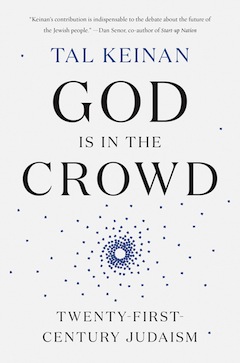
image - God is in the Crowd book coverThose who look for logical and sequential ideas in this challenging book will be somewhat disappointed in its title, which claims that “God is in the crowd,” an idea the author promotes in ways that are not entirely clear despite the praise heaped on Keinan by six distinguished commentators whose views are on the back of the book jacket, as well as an endorsement on the front of the jacket by Lord Jonathan Sacks. This reviewer must have missed something in his reading of the chapters in which the author talks about “crowd wisdom.”

Based on an experiment to discern how many gum balls were displayed in a large glass container at one of his investment shows, Keinan suggests that the collective guesses were closer to the correct number than individual number choices and, from this observation, the author leaps into generalizations about how Jewish unity among Diaspora Jews was secured by “crowd wisdom,” no matter the geographical, religious or cultural disposition of the disparate communities. Keinan tends to annoy the reader by discoursing on this idea and then abruptly changing his agenda by addressing other concerns, and then returning to the “crowd wisdom” theme.

Despite the ambiguities in his discussion of “crowd wisdom,” Keinan has one section in this autobiographical memoir that merits high praise. During his service in the Israeli air force, the author developed a friendship and admiration for a fellow pilot – a secular kibbutznik who was a model for Keinan both in terms of aeronautics and moral compass. The friendship continued after their air force service and then, one day, years later, Keinan saw that his old buddy was wearing a kippah. Keinan writes with a heavy heart that the longtime friendship dwindled slowly and finally dissolved.

Arnold Ages is distinguished emeritus professor at the University of Waterloo in Ontario.

Format ImagePosted on November 30, 2018November 29, 2018Author Arnold AgesCategories BooksTags Israel, memoir, Tal Keinan
Alternatives to potato latkes

Alternatives to potato latkes

(photo from Joy/flickr.com)

An old folk proverb says, “Chanukah latkes teach us that one cannot live by miracles alone.”

Jewish food writer and cookbook author Joan Nathan contends that the word latke is not Yiddish, as everyone presumes, but stems from “a Russian word, latka, and a pastry, from obsolete Russian, oladka, or flat cake of leavened wheat dough.” This, in turn, probably came from a Middle Greek word, eladion, or oil cake, stemming from elaion, meaning olive oil.

Potato pancakes do seem to have originated among poor Eastern European Jews, but potatoes did not become a staple until the mid-19th century. John Cooper, in Eat and Be Satisfied: A Social History of Jewish Food, comments that Jews from Lithuania ate pancakes made from potato flour for Chanukah and had borrowed the idea from the Ukrainians, who made a potato pancake dish with goose fat called kartoflani platske, which they ate for Christmas. Since Chanukah fell about the same time, and there were plenty of geese to provide goose fat or schmaltz, we could conclude that schmaltz became a substitute for oil. Jews living in the Pale of Settlement in the 17th century probably adapted it for Chanukah as a way to dress potatoes differently for the holiday. Cooper also states that many Eastern European Jews ate buckwheat latkes for Chanukah, while Polish Jews made placki (pancakes) from potato flour and fried them in oil.

But what happens when you get tired of potato latkes? Here are some variations for Chanukah.

OLD JERUSALEM ZUCCHINI PANCAKES
Adapted from The Delights of Jerusalem by Rena Valero (Steimatzky, 1985). Recipe makes 20 patties.

6 zucchini
salt, to taste
salt and pepper to taste
1 diced onion
2 tbsp chopped parsley
2 tbsp chopped dill
2 large eggs
1/2 cup matzah meal
1 tbsp vegetable oil
oil for frying

  1. Grate unpeeled zucchini into a strainer. Sprinkle with salt and drain for 30 minutes. Squeeze to remove remaining liquid.
  2. In a mixing bowl, combine zucchini, salt, pepper, onion, parsley, dill, eggs and matzah meal and one tablespoon oil.
  3. Heat oil in a frying pan. Form zucchini mixture into patties. Fry for a few a minutes on each side. Drain on paper towels.

CARROT-PARSNIP LATKES
makes 16 patties

5 grated parsnips
2 grated carrots
1/4 cup flour
2 eggs
1 tsp dry chives or onion
1 tsp dry parsley
1/2 tsp salt
oil

  1. Grate parsnips and carrots into a mixing bowl and toss with flour.
  2. Add eggs, chives or onion, parsley and salt and mix.
  3. Heat oil in a frying pan. Make latkes by hand, add to oil, and fry until brown on both sides. Drain on paper towels.

VEGETABLE FETA LATKES
makes 10 to 12 patties

1 cup grated carrots
2 1/2 cups grated zucchini
1 cup grated potatoes or grated kohlrabi
1/2 tsp salt
3 eggs
salt and pepper to taste
3/4 cup flour
1/2 cup chopped fresh parsley
1/2 cup crumbled feta cheese
1/5 cup vegetable oil

  1. Place carrots, zucchini and potato (or kohlrabi) in a colander. Cover with cheesecloth or paper towels and squeeze out as much liquid as possible. Sprinkle salt and let them drain 15 minutes, then squeeze in paper towels.
  2. Place vegetables in a mixing bowl. Add eggs, salt and pepper, flour, parsley and cheese.
  3. Heat oil in a frying pan. Form mixture into patties. Fry in hot oil until brown on both sides. Drain on paper towels.

Applesauce & sour cream

Recently, someone asked me, why applesauce and sour cream for latkes? I wrote to my American Jewish food expert friend, Joan Nathan, but she didn’t know, so I Googled latkes and applesauce, found a blogger who voiced an idea, and I thought it made sense.

He suggested that, maybe, one year before Chanukah, a shopkeeper somewhere in Eastern Europe placed his annual order for potatoes to his dry goods provider. He wrote potatoes in Hebrew as tapuah adama. Somehow, the word adama was inadvertently erased and ended up being tapuach, the Hebrew word for apple. The supplier read the order and scratched his head, wondering why the shopkeeper didn’t want potatoes for Chanukah. But, due to the limits of communication back in those days, he couldn’t check with him in time, so he went ahead and filled the order, sending a bushel of apples.

When the shopkeeper saw the apples instead of potatoes, he wondered what to do with them but then figured, surely they would be a treat for Chanukah. He was able to sell the idea to the townspeople to buy apples, and some clever women decided to cook the apples – hence, applesauce. By the end of the holiday, everyone was raving about the apples and apple dishes.

In the Encyclopedia of Jewish Food, Gil Marks wrote that Greek Jews had a tradition that the Maccabees ate duck with apples to celebrate their victory, and that this was extended to serving apple rings, apple fritters and applesauce.

John Cooper, in Eat and Be Satisfied, reasons that the only fat for frying latkes was schmaltz, so the only topping could be applesauce.

Another source says apples were eaten on Rosh Chodesh, the start of a new month. Hungarian Jews made apple cake and strudel or tart for Rosh Hashanah, while Indian Jews dip apple in honey and rose water and Sephardi Jews make apple compote. Ashkenazi Jews serve apple strudel on Sukkot, and children place apples at the end of a flag stick for Simchat Torah.

As for sour cream, well, made in its fermented form, it was popular in the Slavic region. The idea of boiled potatoes eaten with sour cream was associated with Eastern European Jews, so, if they found a substitute for the schmaltz when frying their latkes, they could well have used sour cream as an accompaniment.

Sybil Kaplan is a journalist, author, compiler/editor of nine kosher cookbooks and a food writer for North American Jewish publications, who lives in Jerusalem where she leads weekly walks of the Jewish food market, Machaneh Yehudah, in English.

Format ImagePosted on November 30, 2018November 30, 2018Author Sybil KaplanCategories Celebrating the HolidaysTags Chanukah, cooking, Jewish culture, latkes
Hot pancakes for breakfast

Hot pancakes for breakfast

(photo by Brandon Martin-Anderson)

According to my research, some type of pancakes was made by ancient Greeks and Romans, or even earlier; Christians made them before Lent to use up foods they could not otherwise consume. The earliest pancakes were made with spelt flour and the word “pancake” first appears in a 15th-century English document. North American-style pancakes likely began in the form of Johnnycakes, a savoury flatbread made with cornmeal, which are at least 500 years old.

Given their long history, and because they are fried, perhaps during Chanukah, a few pancake breakfasts would be appropriate – and tasty. Here are a few recipes to try.

BASIC BREAKFAST PANCAKES
makes 12 pancakes

1/2 cup flour
1/2 tsp baking powder
1 tbsp sugar
1 egg
1 tbsp melted margarine or butter
1/3 cup milk
cinnamon (optional)
vanilla (optional)
oil for frying

Combine flour, baking powder, sugar, egg, melted margarine or butter and milk in a mixing bowl and blend. Heat oil in a frying pan. Spoon batter around pan and fry until brown on both sides. Keep warm in an oven until ready to serve.

LEMON RICOTTA PANCAKES
Adapted from a Food &Wine recipe from 2002. Makes four servings.

1 cup part-skim ricotta cheese
2 large eggs
2 large egg whites
1/2 cup flour
1 tbsp vegetable oil
1 tsp finely grated lemon peel
2 tsp honey
oil for frying

Blend cheese, egg, egg whites, flour, oil, lemon peel and honey until smooth. Heat griddle or frying pan with oil. Spoon the batter around pan for pancakes. Cook until golden on both sides. Keep warm until ready to serve.

BANANA PANCAKES
makes four servings

3 sliced bananas
2 tbsp orange juice
1 tbsp sugar
1 cup flour
1/2 tsp baking powder
1 egg
1/2 cup milk
2 tbsp melted butter or margarine
1/4 tsp vanilla
1 tsp orange peel
vegetable oil

  1. In a bowl, combine orange juice and sugar. Add banana slices and let stand.
  2. In a mixing bowl, combine flour, baking powder, egg, milk, melted butter or margarine, vanilla and orange peel.
  3. Drain banana slices and add to batter.
  4. Heat oil in a frying pan. Spoon the batter around pan for pancakes. Cook until brown on both sides. Keep warm until ready to serve.

Sybil Kaplan is a journalist, author, compiler/editor of nine kosher cookbooks and a food writer for North American Jewish publications, who lives in Jerusalem where she leads weekly walks of the Jewish food market, Machaneh Yehudah, in English.

Format ImagePosted on November 30, 2018November 30, 2018Author Sybil KaplanCategories Celebrating the HolidaysTags Chanukah, cooking, pancakes

Trio of favourite potato soups

Everyone has their favourite soup when the fall weather turns into winter. Mine is potato soup. I don’t remember who made this for me, whether it was my grandmother or my mother, or when or how it became my favourite. In sharing these recipes with readers, I hope to share some of the warmth and comfort they have given me over the years.

The first mention of potatoes in the Americas seems to be in the journals of Magellan and Columbus, where they are called “batatas.” They were brought to southern and central America when Pizarro conquered Peru, and spread via Spanish forts and ships.

In Ireland, the potato was introduced in 1565, and it quickly became the main element of the Irish diet – to the extent that, when the Irish potato crop failed in 1847, one-and-a-half million Irish died, with another million emigrating, mostly to America.

The potato also helped feed the starving masses of Europe when famine struck in 1770. The French leader Parmentier set up potato soup kitchens to feed people and, to this day, potato soup bears his name in the French language. Here are some recipes from my files.

POTAGE FERMIÈRE (FARMERS SOUP)
makes three to four servings

1 small finely chopped onion
1 1/2 tsp butter or margarine
1 diced potato
3 cups water
3 tsp pareve chicken powder
1 sliced leek
1/4 tsp dry tarragon
salt and pepper to taste
3 tbsp non dairy creamer or milk
1 1/2 tsp finely chopped parsley
grated Parmesan cheese

  1. Sauté onion in butter or margarine in a soup pot.
  2. Add potato, water and chicken soup powder; cover and bring to a boil. Reduce heat and simmer 15 minutes.
  3. Add leek, tarragon, salt and pepper and pareve cream or milk. Cover and simmer 10 minutes longer or until leeks are tender.
  4. Mash with potato masher or puree in blender. Garnish with parsley. Have Parmesan cheese in a bowl for each person to sprinkle over soup.

CREAMY POTATO SOUP
This recipe comes from The Kosher Palette (Joseph Kushner Hebrew Academy), edited by Susie Fishbein and Sandra Blank. It makes 24 servings.

3 tbsp oil
8 peeled, cubed potatoes
6 peeled, thinly sliced carrots
3 tbsp flour
1 tsp salt
1 tsp paprika
8 cups water
1 cup non-dairy creamer
1 peeled onion
2 ribs sliced celery
2-3 bay leaves
finely chopped parsley

  1. Heat oil in a soup pot. Add potatoes and sauté three to five minutes, stirring constantly.
  2. Add carrots and stir. Stir in flour, salt and paprika. Add water, creamer, onion, celery and bay leaves. Bring to a boil. Reduce heat, cover and simmer one-and-a-half hours, stirring occasionally. Remove onion, celery and bay leaves.
  3. Serve with warm, crusty bread. Garnish with parsley. Soup may be served chunky or smooth processed in a blender.

POTATO CUCUMBER SOUP
This recipe is adapted from a magazine but I don’t know which one or when. Its origins are Polish, Russian or Ukrainian. It makes nine servings.

6 peeled, quartered potatoes
2 cups water
1 1/2 tsp chicken soup powder
1 tbsp minced onion
2 tsp salt
1/8 tsp pepper
2 cups pareve creamer or milk
2 1/2 cups peeled cucumbers
1 tsp dill weed

  1. In soup pot, heat potatoes, water, chicken soup powder, onion, salt and pepper. Reduce, cover and simmer 15 minutes or until potatoes are fork tender.
  2. Mash potatoes. Add creamer or milk and cucumbers. Bring to a boil. Reduce heat and simmer 10 minutes. Stir in dill.

Sybil Kaplan is a journalist, author, compiler/editor of nine kosher cookbooks and a food writer for North American Jewish publications, who lives in Jerusalem where she leads weekly walks of the Jewish food market, Machaneh Yehudah, in English.

Posted on November 30, 2018November 30, 2018Author Sybil KaplanCategories LifeTags cooking, potato soup, winter
Playfulness and style

Playfulness and style

Ralph Lauren in 1978. (photo by Edgar de Evia)

Born 79 years ago, in New York, to Frieda and Frank Lifshitz, immigrants from Belarus, Ralph Lifshitz, better known as Ralph Lauren, has become a universal household name.

The youngest of four siblings clothed in hand-me-downs, the fashion legend never imagined becoming a designer – he did, however, yearn to be the next Joe di Maggio or Cary Grant. His favourite pastimes were sports, listening to the radio, watching TV and movies. And it is from these influences that his dream to design clothing came.

At 16, Lifshitz switched to the name Lauren after experiencing years of ridicule. At the same time, he embraced and embellished his own sense of style, buying oversized and rugged clothing from the army surplus store because he liked how they made him feel, and had an aspect of originality. His preference for military-style clothing predated his draft to the American army, in which he served two years. It was in the army that his respect for the uniform further developed and he incorporated the style into many of his subsequent designs.

In the years that followed, Lauren began working by day for a buying company while studying at night. It was during this period that he had the idea of making ties from scraps, and making and selling his unconventional ties turned into a profitable side business.

While working for men’s fashion house Brooks Brothers, Lauren tried to get them to sell his ties, but to no avail. Moving on to work for tie manufacturer Beau Brummell, an upscale men’s brand, Lauren’s potential started to be realized, as he acquired a “drawer” in their showroom of the Empire State Building to sell his flamboyant ties. In 1967, Lauren started the label Polo, the name reflecting his love of sports, and his creations’ international and sophisticated vibe. Lauren sewed on each label, together with his new bride, Ricky. He also made all the deliveries himself, to the likes of Neiman Marcus and Bloomingdales. During the first year, Polo made $500,000. The young Jewish boy from the Bronx’s design career was on its way.

By 1968, Lauren was making his own suits, which were, once again, offbeat; not what his colleagues were wearing. Lauren believes that fashion is all about playfulness, expressing one’s individuality and not conforming to one look. He has held this belief through his many years in the industry, and it has no doubt provided the foundation of what he has built into a multibillion-dollar empire.

photo - Maartje Verhoef walking the Ralph Lauren spring-summer 2015 fashion show
Maartje Verhoef walking the Ralph Lauren spring-summer 2015 fashion show. (photo by Christopher Macsurak)

Lauren’s classic innovations include making women feel that wearing a tuxedo was sexier than a gown; turning tailored men’s shirts unisex; and transforming American folk art (patchwork) into fashionable sweaters, coats and dresses, borrowing from cowboys’ attire the rich colour of turquoise, fringed jackets and boots.

Lauren’s talents did not end at the design table. He used the platform of advertising unconventionally, working with real people, not models, in ads that covered multiple pages to tell a story through his clothing’s many different looks and fabrics. This creative approach was developed in part with photographer Bruce Weber.

Lauren has outfitted Wimbledon players, won the Coty Award for both women and men’s wear, opened the first freestanding store in Europe by an American designer, and established a home collection. Other highlights include being the costume designer for Woody Allen and Diane Keaton in the Oscar-winning movie Annie Hall, and creating a men’s and women’s fragrance in 1978 that is still emblematic. Upon receiving a lifetime achievement award in 1992, presented to him by actor Audrey Hepburn, he said, “I don’t design clothes, I design dreams.”

Ricky, Lauren’s wife of more than five decades, is one of his muses. Her elegant and natural style has been a continuous inspiration for him and it is her sense of self that he tried to emulate in his clothing designs. Together, the couple built the Ralph Lauren brand not only as a fashion domain but as a family business, operated with their two sons and daughter.

In addition to his material and creative successes are Lauren’s contributions to philanthropic causes. Among them, Lauren and cancer surgeon Dr. Harold P. Freeman founded the Ralph Lauren Centre for Cancer Care in Harlem, N.Y., in 2000, with the resources of the Polo Ralph Lauren Foundation and the Memorial Sloan Kettering Cancer Centre. The residence, care and support facility’s mission is “to fight health disparities in the community … [and] become a beacon for quality, dignity and accessibility in cancer care.”

Ariella Stein is a mother, wife and fashion maven. A Vancouverite, she has lived in both Turkey and Israel for the past 25 years.

Format ImagePosted on November 30, 2018November 30, 2018Author Ariella SteinCategories WorldTags business, clothing, fashion, history, Ralph Lauren

Posts pagination

Previous page Page 1 Page 2 Page 3 … Page 8 Next page
Proudly powered by WordPress