Skip to content
  • Home
  • Subscribe / donate
  • Events calendar
  • News
    • Local
    • National
    • Israel
    • World
    • עניין בחדשות
      A roundup of news in Canada and further afield, in Hebrew.
  • Opinion
    • From the JI
    • Op-Ed
  • Arts & Culture
    • Performing Arts
    • Music
    • Books
    • Visual Arts
    • TV & Film
  • Life
    • Celebrating the Holidays
    • Travel
    • The Daily Snooze
      Cartoons by Jacob Samuel
    • Mystery Photo
      Help the JI and JMABC fill in the gaps in our archives.
  • Community Links
    • Organizations, Etc.
    • Other News Sources & Blogs
    • Business Directory
  • FAQ
  • JI Chai Celebration
  • JI@88! video

Recent Posts

  • Sharing her testimony
  • Fall fight takes leap forward
  • The balancing of rights
  • Multiple Tony n’ Tina roles
  • Stories of trauma, resilience
  • Celebrate our culture
  • A responsibility to help
  • What wellness means at JCC
  • Together in mourning
  • Downhill after Trump?
  • Birth control even easier now
  • Eco-Sisters mentorship
  • Unexpected discoveries
  • Study’s results hopeful
  • Bad behaviour affects us all
  • Thankful for the police
  • UBC needs a wake-up call
  • Recalling a shining star
  • Sleep well …
  • BGU fosters startup culture
  • Photography and glass
  • Is it the end of an era?
  • Taking life a step at a time
  • Nakba exhibit biased
  • Film festival starts next week
  • Musical with heart and soul
  • Rabbi marks 13 years
  • Keeper of VTT’s history
  • Gala fêtes Infeld’s 20th
  • Building JWest together
  • Challah Mom comes to Vancouver
  • What to do about media bias
  • Education offers hope
  • Remembrance – a moral act
  • What makes us human
  • המלחמות של נתניהו וטראמפ

Archives

Follow @JewishIndie
image - The CJN - Visit Us Banner - 300x600 - 101625

Month: February 2017

Wrestling with complexities

Wrestling with complexities

In Wrestling Jerusalem, which is at Chutzpah! March 1 and 2, Aaron Davidman tries to understand the complexities of the Israeli-Palestinian conflict. (photo by Ken Friedman)

Most of us have an opinion on the Israeli-Palestinian conflict. But how many of us have listened to others’ perspectives, really considered them and tried to understand them? Aaron Davidman has. And he will share his emotional and thought-provoking journey with Chutzpah! Festival audiences March 1 and 2.

Written and performed by Davidman, Wrestling Jerusalem, directed by Michael John Garcés, is Davidman’s personal journey, as an American Jew, to understand a situation that is often polarizing and over-simplified. The play gives voice to 17 different characters – all performed by Davidman – who represent the breadth, depth and complexity of the conflict; its political, religious and cultural aspects.

As personal as it is, however, Davidman was commissioned to write the play by Ari Roth, who, in 2007, was the artistic director of Theatre J, which is based in Washington, D.C. After 18 years with Theatre J, Roth founded Mosaic Theatre Company, also in Washington, in 2014, and is still its artistic director.

“He asked me to write a solo performance piece investigating the deaths of Rachel Corrie and Daniel Pearl and reflect on the public conversation in America about the Israel-Palestine issue,” Davidman told the Independent about the commission. “The play started there and, as I developed it, it became much more personal and those two subjects no longer relevant to my investigation, which became about the multiple perspectives and competing narratives at the heart of the conflict.”

Davidman is not only a playwright and actor, but also a director and producer. He received a master of fine arts in creative writing and playwriting from San Francisco State University and is a graduate of the University of Michigan; he received his theatrical training at Carnegie Mellon University.

Davidman was raised in Berkeley, Calif., he said, “by Jewish-identified but not religious parents, with a social justice context.”

In an interview with CJN, when Wrestling Jerusalem had its Canadian première in Toronto in November, Davidman said he “fell in love with Israel as a Jewish homeland” when he first visited the country, in 1993, at age 25. “I spent six months living there and had a really incredible spiritual and Jewish identity-forming experience. That story is in the play,” he told CJN.

In the process of researching, writing and performing Wrestling Jerusalem, Davidman told the Independent, “My views about the importance of engagement have deepened, as has my conviction that understanding the ‘other’ is a vital part of the process of reconciliation.”

The play, which premièred in 2014, has also been made into a feature film, directed by Dylan Kussman, which was released in 2016.

“The transcendent themes of the piece remain front and centre now more than ever in a world that is growing only more polarized,” said Davidman. “This piece stands for understanding multiplicity and complexity as humanity’s best chance to live together.”

To facilitate understanding, talk-backs often take place after performances.

“We try to have community conversation – I prefer that term to ‘talk-back’ – after performances and screenings because the piece opens people up,” Davidman said. “They’ve just had a fairly unique experience concerning this topic and there is hunger to process it. It’s a densely written piece and unpacking it and allowing people to hear where they each are coming from in response has proven to be very useful and moving.”

As for advice for people wanting to try and move the public – or even personal – discussion to a more nuanced or empathetic space, Davidman said, “Listen deeply. Don’t know so much. Try to connect.”

Wrestling Jerusalem is at Rothstein Theatre March 1-2, 8 p.m., with audience conversations after both performances, featuring Rabbi Dan Moskovitz of Temple Sholom and Aaron Davidman. For tickets ($29.47-$36.46), call 604-257-5145 or visit chutzpahfestival.com. The festival’s other theatre offering combines Cree storytelling, Chekhovian character drama and comedy, performed by Edmonton-based, award-winning improv troupe Folk Lordz – Todd Houseman and Ben Gorodetsky of Rapid Fire Theatre – on Feb. 22, 8 p.m., at Rothstein Theatre. The festival also features dance, music and comedy.
Format ImagePosted on February 10, 2017February 8, 2017Author Cynthia RamsayCategories Performing ArtsTags Chutzpah!, Israeli-Palestinian conflict, Jerusalem, peace

Choose to shine light

While settling into a fresh hotel room, one may be tempted to open drawers and doors, survey the facilities, and thumb through the room service menus or local entertainment guides that are usually provided to help guests plan outings. There’s often a Gideons Bible in a bedside table as well.

But guests in six Coast Hotels in British Columbia recently got more than they expected when they flipped through the pages of Apple Town, a magazine in English and Japanese that they found among the room offerings. Instead of suggestions for day trips or restaurant options, the magazine proffered antisemitism.

“‘International finance capital’ means ‘Jewish capital,’” one article reads. “Jewish people control American information, finance and laws, and they greatly benefit from globalization because they move their massive profits to tax havens so they don’t have to pay any taxes. Many Jewish people support the Democratic party. They are the top 1% as described by Thomas Piketty, and the remaining 99% feel dissatisfaction and anger towards them.”

Shortly after the “literature” was brought to wide public attention last week through social media, individuals and Jewish advocacy agencies, including the Centre for Israel and Jewish Affairs (CIJA), demanded that the hotel chain remove the offending materials. In short order, Coast Hotels complied and the president of the company declared that the antisemitic opinions “in no way reflect the values of Coast Hotels, its leadership team or its employees” and that the company does not believe “there is any room for commentary that causes offence or concern to any group.”

Yet, how does material like this find its way into B.C. hotel rooms in the first place?

A few months ago, Coast Hotels was purchased by Japan’s APA Group. That corporation’s president, Toshio Motoya, is a prominent figure in right-wing Japanese politics. (APA is an acronym for “Always Pleasant Amenities,” which contradicts the experience of some who thumbed through Apple Town magazine last week.) Motoya supports the militarization of Japan and is an historical revisionist who whitewashes Japan’s actions in the Second World War. He claims that the Nanking massacre and the use by Japanese soldiers of sex slaves, euphemistically called “comfort women,” are fictions perpetrated by China and Korea.

In the fashion of Henry Ford, who in the early part of the 20th century distributed antisemitic and historically dubious propaganda through his car dealerships, Motoya’s political imaginings are featured in Apple Town, which is apparently distributed through his hotels.

Kudos to all those who took action to have the magazines removed from B.C. hotels. But we do wonder about how many other hotel guests in Japan and possibly elsewhere in APA’s chain are getting antisemitic amenities with their complementary toiletries.

This is, of course, one small incident in a world that seems to be experiencing a flurry of hateful expressions. But in such darkness there is always room for light. The actions of a few can have a positive impact, as the outcry against Apple Town indicates.

The hundreds of people who gathered in Vancouver Saturday night to mourn the six people murdered at Muslim prayers in Quebec on Jan. 29 are another example. Nothing can bring back the lives of those murdered, but demonstrations such as this – and others that occurred across the country – can help heal the fears and isolation of the targeted community.

And then there are smaller acts of decency, like those of passengers on a New York subway car on the weekend. The train car had swastikas drawn in felt pen on every window and on every advertisement. Across one ad was written “Jews belong in the oven.” Passengers took it upon themselves to remove the graffiti with hand sanitizer and tissues. It was a small collective act that resonated across social media.

The world today has many situations that can cause us anxiety and sadness. One of the simplest and wisest axioms of our tradition declares it is better to light a candle than to curse at the darkness. Each of us has the potential to shine a little light through our actions and words. That is important to remember in times like these.

Posted on February 10, 2017February 8, 2017Author The Editorial BoardCategories From the JITags antisemitism, Apple Town, CIJA, Coast Hotels, Motoya

Come together, right now

Canadians – and concerned citizens worldwide – are reeling from the horrific attack on a Quebec City mosque (the Centre Culturel Islamique de Québec) on Jan. 29 that left six dead and others wounded. Amid the revulsion and grieving, here are some possible lessons.

We can’t ignore the Trump factor. While Islamophobia has long preceded U.S. President Donald Trump, by all indicators, Trump’s hatefulness – capped by his wide-reaching travel ban – has unleashed additional hatred against Muslims and other minorities.

Since the election, the Southern Poverty Law Centre has recorded more than 700 incidents of “hateful harassment” across the United States. Despite our ingrained public ethic of multiculturalism, Canada is clearly not immune.

Price-tag-style attacks might have come to Canada. What West Bank Palestinians are tragically used to, Canadians might be now experiencing as well. It is probably no coincidence that Prime Minister Justin Trudeau stepped forward to declare his government’s intention to take in refugees barred by Trump’s executive order. But Trudeau’s welcoming pledge might also have unleashed more hatred in dark corners of Canada against anyone who can too easily be “othered.”

West Bank Palestinians are all too often the target of this kind of retribution. Whenever the Israeli government appears to retract support for the settlement enterprise – in the form of evacuations of illegal outposts, for example, violent settlers enact what they call “price-tag” attacks against Palestinian life, limb and property. These, too, of course, are terrorist attacks.

Some Israelis have created a counter movement – rather than price tag (tag mechir), they enact acts of kindness and solidarity (tag me’ir, light tag). The many Women’s Marches in Canadian cities countrywide to coincide with the Women’s Marches in the United States were an example of this approach. So was the vigil at Ottawa’s Parliament Hill the day after the murders, to stand in solidarity with the victims of the mosque attack. We will need many more moments of connection in the weeks and months to come.

Quebec has a fraught history with multiculturalism. Is it a coincidence that the attack occurred in Quebec rather than in a different province? Maybe. But just maybe this hateful violence stems from the province’s difficult relationship to multiculturalism. While Canada enshrined multiculturalism into law in 1971 – the first country to do so – Quebec’s history with multicultural policies, probably owing to the province’s concern with maintaining its own minority-language identity, is much more fraught.

In 2013, Quebec attempted to enact a failed Charter of Values (Charte de la laïcité), which sought to ban “conspicuous” religious symbols from being worn by public sector employees. A decade ago, the town of Hérouxville, also in Quebec, issued its own “code of conduct,” widely seen as a dig at immigrants.

Said one storeowner in 2013 interviewed for the Globe and Mail, “Immigrants are welcome to come to Quebec, but when they come, they have to adapt to our ways.”

Banning religious symbols – as the province had sought to do in 2013 – is not the same as murdering people in cold blood, of course. But this kind of flat intolerance against religious expression can all too easily become twisted in the mind of a hateful and violence-prone individual to commit the unthinkable.

It is terrorism. Despite the bigoted propensity by some to use the word terrorist to delegitimize and dehumanize certain ethnic or religious groups, this term does have a clear definition and we should use it when warranted, if only to make sure we keep using it correctly. Simply put, terrorism is violence for political ends.

An attack on a centre of worship is intended to instil fear in society around that target group – the worst kind of collective dehumanization. This is politics of the ugliest and most hateful kind.

Misinformation unleashes further hatred. On the Monday morning after the attack, the media were reporting the names of two supposed suspects, one of whom was apparently of Moroccan origin. Some right-wing news outlets made hay from this, circulating the information even once the media clarified that he was apparently a witness, not a suspect. As of now, the sole suspect is 27-year-old Alexandre Bissonnette, who has since been charged with six counts of murder.

Come together, right now. In a statement following the attack, Trudeau said it is “heart-wrenching to see such senseless violence. Diversity is our strength and religious tolerance is a value that we, as Canadians, hold dear.”

While I hesitate to use the kinds of binaries that have arguably led the world to this point, I am tempted to say that the coming days and weeks will reveal two types of people on this continent: ones who are here to support one another against the forces of hatred, Islamophobia, antisemitism, misogyny and xenophobia; and ones who are aiding and abetting those terrible forces. Among those who stand on the side of goodness and compassion, the time is now for solidarity across every fissure.

Mira Sucharov is an associate professor of political science at Carleton University. She is a columnist for Canadian Jewish News and contributes to Haaretz and the Jewish Daily Forward, among other publications. A version of this article was originally published on haartez.com.

Posted on February 10, 2017February 8, 2017Author Mira SucharovCategories Op-EdTags hate crimes, Islamophobia, mosque, Quebec, terrorism
Importance of transparency

Importance of transparency

Stav Daron’s application to the Island School of Building Arts was initially rejected because he is Israeli. After public pressure, the school reversed its decision and apologized. (photo from facebook.com/stav.daron)

Now that the sawdust has settled on the controversy around the Gabriola Island-based Island School of Building Arts’ initial rejection of an Israeli applicant based on his nationality, we can assess the implications. According to various reports, the school’s manager had responded to a prospective Israeli applicant, telling him that they are “not accepting applications from Israel” owing to “the conflict and illegal settlement activity in the region.” After pressure from the Centre for Israel and Jewish Affairs, Friends of the Simon Wiesenthal Centre and B’nai Brith Canada, the school reversed its decision and issued an apology on its website.

The rejection of the student was a move that not only likely contravened the B.C. Human Rights Code – which forbids service-providers to deny services to clients based on national origin, among many other things – but served to embarrass the school. But there are some deeper layers that deserve examination here.

First, we need to ask what the role of BDS (boycott, divestment and sanctions against Israel) is in all of this. Many would interpret the school’s move as an instance of BDS. In one sense, they would be right; in another, they would be wrong. BDS entails commercial, academic and cultural boycotts, in addition to calling for divestment from companies helping the occupation and, in the most unlikely scenario, getting other countries to institute sanctions against Israel. Importantly, the academic boycott aspect of BDS does not call for targeting individuals unless, like deans or university presidents, they are representing an Israeli academic institution in an official capacity.

While it’s not clear to me whether the Island School is an accredited academic institution or a private business, I will discuss it in the context of the academic boycott since that’s what probably comes to mind for most readers.

Though detailed BDS guidelines exist, not all would-be BDS activists are necessarily aware of them. And, even if they are aware of them, they might end up applying their own standards. There is anecdotal evidence that individual Israeli academics are indeed harmed or even directly targeted by BDS. My interview with a BDS activist at Syracuse University, for an article I published in Haaretz, pointed to this kind of slippage. All this is to say that BDS may have a spillover effect – and a chill factor – far beyond its intended boundaries.

On the other hand, while the decision was ill-conceived, this same spotlight enabled a light to be shone on problematic Israeli policies. This won’t persuade groups for whom Israel can do no wrong, but the school’s initial action – which the school’s representative said was intended to stay in line with the school’s “moral compass” – may have served its aim, as clunky as the action was.

We can also ask what the role of public shaming is in propelling international change. Scholars have noted that countries can be shamed into compliance – whether to adhere to international law, to ante up humanitarian aid in the wake of a disaster or to offer debt relief. These kinds of dynamics work best when it is governments being targeted. To focus political action on an individual outside the context of any national representation, which is what Island School did, is deeply problematic. Here, I would point to the controversy around the Egyptian judo athlete rejecting his Israeli opponent’s handshake at the 2016 Olympics as a grey area. The Olympics ideally take place outside of politics but athletes are, of course, representing their country and there may be political theatre playing out on some stages, however disappointing it may be. But this was not the case with the Israeli applicant to the Island School who was representing no one but himself.

Finally, the brazenness of the act enabled Jewish groups in Canada to take swift action. The school could have quietly rejected the applicant with little fanfare, but the manager’s honest and forthright emails left no doubt as to what motivated the decision. This meant that the full story circulated quickly on media and social media, and pressure from national Jewish groups succeeded in quickly getting the decision reversed. This means that, perhaps, as painful as it was, we can be glad when actions are taken in a transparent way, making strategies around pressure and counter-pressure much more straightforward. This is ultimately a good thing for buttressing an active civil society, even if we don’t all agree on the policies being protested.

Mira Sucharov is an associate professor of political science at Carleton University. She is a columnist for Canadian Jewish News and contributes to Haaretz and the Jewish Daily Forward, among other publications.

Format ImagePosted on February 10, 2017February 8, 2017Author Mira SucharovCategories Op-EdTags anti-Israel, BDS, boycott, Daron
Removing graffiti full-time

Removing graffiti full-time

Corey Fleischer volunteers most of his time to removing hateful graffiti. (photo from Corey Fleischer)

When Montrealer Corey Fleischer finished university, he was unsure of what career path to take. In the interim, to pay the rent, so to speak, he started Provincial Power Washing.

Reflecting back on those days, Fleischer said, “I hated what I was doing – washing a lot of trucks, houses, decks, residential and commercial – zero substance. I’m a person who thrives off substance.”

One day, while heading to a job, Fleischer happened to spot antisemitic graffiti out of the corner of his eye.

“I was driving downtown here, in Montreal, and I saw a swastika on a cinderblock in a very busy part of town,” he said. “I had the equipment needed to remove it, so I got out of the truck and did just that. I got back in my truck, not thinking anything of it.”

From that day on, whenever Fleischer came across such graffiti, he would stop and remove it. As well, in the evening, after returning home from work, he would grab a bite to eat, shower and go out to look for racist, antisemitic and homophobic graffiti to remove.

“I would scour the city for hate crimes – back alleys, on walls, anywhere,” said Fleischer. “I found another one (swastika) and then another one. And then I started noticing, as the graffiti-removal side of my business began growing … I realized this was a real problem around town. It became my pastime. I quit hockey and softball and everything. It’s what I spent all my time doing. It fulfilled my life.”

For the first several years, it was only Fleischer’s parents and close friends who knew what he was doing. Then, he received a call from the local B’nai Brith Canada office to confirm his address, as they wanted to include him in a community newsletter mailing. While Fleischer refused to give out his address, he told the BBC that he had pictures of 40 swastikas that he had removed over the past five years, if that was of interest.

The BBC representative, said Fleischer, “literally couldn’t understand what was coming out of my mouth. She couldn’t believe that’s how I was spending my time. So, I sent her the pictures. They sent out a blogger to come and follow me, to do a story on what I was doing.

“Lo and behold, my life at that moment completely changed. People started seeing what I was doing and wanted to get involved. It went from removing 40 to 50 hate crimes in five years … [to] a couple hundred last year alone. The increase was pretty crazy.”

Fleischer now has thousands of followers wanting to get involved, so he has many more reports coming in, asking for free hate-graffiti removal. He said he has gone from spending about 10% of his company time removing hate graffiti to 95%. And, thanks to social media, the movement Fleischer started has gone global.

“People are calling me from all over the world, trying to figure out how to remove hate crimes in their area,” said Fleischer. “And, I basically put it together and have the removal done – wherever the people are calling from – with a local company.

“For most people dealing with hate crimes, it’s not a comfortable situation. People don’t know what to do with them or how to act when they see them. I happen to thrive in uncomfortable situations. I’ll go and organize. If I can’t find a local company to remove it, I’ll contact the local government, mayors, statesman, whoever, to get it done.

“For example, there was an attack on a Jewish cemetery in New York state. Their whole cemetery was defaced with swastikas and hate symbols. And somebody called me up from the town, saying they’d seen my videos and they’d been staring at these swastikas on their cemetery for two weeks – right around Yom Kippur. So, they called me to find out what could be done.”

After Fleischer hung up the phone, he began calling power washers. As it was a small town, it was hard to find someone, so Fleischer called the mayor and the local government. Within two days, all the graffiti was gone.

“When people figure out who I am and what I’m doing, they tend to spring into action quicker than if it was another situation,” said Fleischer. “Although I started the movement, it’s not just me getting it done. It’s people in the community, that I like to call ‘my army.’ I’m just a tool that was given to these people in order to remove these hate crimes. I’m just the instrument.”

While removing the hateful graffiti is, of course, good, Fleischer pointed out that it does not deal with the root of the problem. So, he decided to collaborate with Montreal-based Overture with the Arts, a not-for-profit that provides mainly after-school art classes to high school students. One of its programs is targeted at educating students about the Holocaust through a series of spoken word workshops about Anne Frank. OWTA opted to include a talk by Fleischer in the program.

“Instead of thinking about the actual guys who are putting on the hate crime, I had to find another way to make a difference in our society and in our communities,” said Fleischer of his speaking role. “I had to think of a way to make another difference by educating our youth, our future.

“When I was growing up and was going to high school, I was never taught about the Holocaust. I was never taught about the biggest massacre, the biggest tragedy, in human history.

“Before I started this whole movement, I didn’t even fully understand…. I knew what a swastika was, I knew it was bad, but I didn’t understand everything that was going behind it.”

The first two schools at which Fleischer spoke were classroom-sized talks, but this quickly expanded into full auditoriums. Schools now flood him with requests to come and speak.

“I had two calls this morning from schools calling me, out of the blue, trying to figure out how I can come to their schools,” said Fleischer in his interview with the Jewish Independent. “The school tour is called Erasing Hate.”

Fleischer received a peace medal last year from the YMCA (Young Men’s Christian Association) for his efforts with Erasing Hate, along with 30 Auschwitz survivors.

“To think I’m even in the same bubble with people like that, with something I started doing as a pastime, because I followed my heart, is mind-blowing. It’s really something else,” he said.

“Hopefully, we won’t, in the future, be ignoring hate crimes on the street and the future – our kids, the kids in schools – will understand that you don’t need to be silent. You can wake up, open your mouth and you can make a difference. That’s what this has turned into.”

For more information, Fleischer is on Instagram (@ErasingHate) and Facebook.

Rebeca Kuropatwa is a Winnipeg freelance writer.

Format ImagePosted on February 10, 2017February 8, 2017Author Rebeca KuropatwaCategories NationalTags antisemitism, Corey Fleischer, graffiti, hate crimes, homophobia, Quebec, racism, tikkun olam
Mobile legal services

Mobile legal services

About five percent of Adam Brosgall’s legal practice is dedicated to offering mobile services. (photo from Adam Brosgall)

While providing mobile legal services is only a small portion of what lawyer, notary public and commissioner of oaths Adam Brosgall does, it distinguishes him.

“Most people manage to make it into my office, but some clients have special circumstances that require me to visit them,” Brosgall told the Independent.

Practising law since 1999, Brosgall – who grew up in Vancouver and is quite involved in the local Jewish community with his wife and their two young children – opened his own firm in 2010. His office is located on Howe Street, right across from the Vancouver Law Courts.

“One of my main focuses is international business transactions, helping people with their overseas legal matters,” said Brosgall. “If a client needs to send a contract, agreement, power of attorney or other official documentation from Canada to another country, each document needs to be properly legalized. This obscure legal procedure is also known as ‘Apostille certification.’ I prepare their documentation and make sure it’s processed properly through various government entities, consulates and embassies in Vancouver, Toronto or Ottawa.”

Brosgall often deals with the Israeli consulate in Toronto and their embassy in Ottawa. “As there’s no Israeli diplomatic mission in Vancouver, a lot of people who don’t want to travel to Toronto or Ottawa to deal with their legal issues will retain me to handle their affairs,” he explained.

Since starting up his own firm, Brosgall has noticed a need in many communities for mobile legal services. Quite often, the clients for these services are elderly people who are home- or hospital-bound.

“Sometimes, they might need to prepare a will, a POA [power of attorney] or a representation agreement for personal care,” said Brosgall. “These are the three major documents people should get done as they age, ensuring everything is in order. If they haven’t done that, often their younger relatives will call me and ask me to come to their house, a care home or hospital.

“People give me the information I need over the phone or by e-mail. Then, I prepare all the documents in my office and make sure everything is perfect. I then take everything to the client, along with my seals, stamps and various payment methods.

“I offer a very seamless service. After I receive their instructions, I take care of everything – I visit them, take the documents with me and notarize their signature while I’m there…. I work very carefully behind the scenes but, from the client’s perspective, it seems instantaneous. When I leave, they have everything they need.”

Brosgall’s mobile services are also offered to businesses that need documents signed by multiple people in one office. In these situations, Brosgall can save a business a substantial amount of time by visiting their office, as opposed to each individual needing to travel to his office.

“Sometimes, actors who are very busy and are staying in a hotel in Downtown Vancouver can’t take time off from the set,” said Brosgall. “Their manager or assistant will call me and say they need me to come to their hotel and meet them in the lobby at a certain time, so they can sign some kind of contract the film studio or agency needs the actor to sign.”

According to Brosgall, anything that he can do in his office, he can also do at a remote location.

The term notarization can mean two things – witnessing a signature or preparing a certified copy of a document. In the first instance, Brosgall witnesses on-site the signing of a document and puts his stamp and seal on it to signify that he saw it being done and that the parties involved understood the document. In the latter instance, when people need to have a certified copy of something, such as their passport or driver’s licence, he said, “I just make a photocopy while I’m at the office or they provide me with copies and I’ll compare them to the original and certify it’s a true copy.”

The mobile service comes with a fee that is dependent on distance, time spent away from the office and the nature of the documentation. The mobile service fee is added to Brosgall’s standard document processing fee.

Brosgall advertises his service on Google using Adwords, and also publishes articles on his website, which are then picked up by Google and other search engines.

“So, if you Google ‘mobile notary in Vancouver,’ my website will be at the top or close to the top of the page, and people call,” he said. “And, when people call, I’m always very helpful and responsive.”

He also promotes his services “the old-fashioned way,” he said. “I attend different hospitals and nursing homes and such. Whenever I am there, I speak to the social workers, the nurses or the staff and leave my business card. Quite often, it will be the nursing home or the hospital that will recommend my services. In this way, people hear of me by word-of-mouth.”

Some cases are more urgent than others, of course. “Some people are in a rush because their relative might be at the end of life and there can’t be any delays,” said Brosgall. “Those, I give my full attention, because I want to make sure things are done quickly. I get their info and circumstances from their relatives and draft their documentation that same day. Then, I’ll usually head out to meet them the next day.”

There have been times, he said, when “someone calls me at noon and I’m at the hospital at three. I prioritize things and, if they want the whole family to be around, I adjust my schedule to accommodate everyone.”

With a busy international legal practice, Brosgall said his mobile service only represents about five percent of his business, but fills a need and helps the community.

“Although it’s a relatively small portion of my law practice, when I do get out of my office, I often find myself in all sorts of interesting situations and environments,” he said. “I’ve worked with movie stars while they’re working out in gyms, business leaders in corporate boardrooms … elderly people in long-term care or at home…. The list goes on and on.

“Sometimes I feel less like a lawyer and more like a social worker, psychologist or family counselor when I’m on my mobile visits. People often reach out to me in extremely urgent and critical situations. A solid understanding of the law, excellent communication skills, thorough preparation and good bedside manners all go hand in hand.”

For more information, visit vancouvernotary.biz, call 604-685-2326 or e-mail [email protected].

Rebeca Kuropatwa is a Winnipeg freelance writer.

Format ImagePosted on February 10, 2017February 8, 2017Author Rebeca KuropatwaCategories LocalTags Adam Brosgall, lawyer, legal services
Eight rungs of tzedakah

Eight rungs of tzedakah

Little Free Libraries are open 24/7 in cities across Canada. (photo by Josie Tonio McCarthy)

Have you heard of the Little Free Library movement? It’s a way for neighbours to exchange books. Throughout Winnipeg, Vancouver and other cities, there are little freestanding houses, a little bigger than a birdhouse. If you have a book you no longer want, you can leave it. If you’re looking for a book to read? You can take a book whenever you want. These Little Free Libraries are open 24/7.

Walking to our closest Little Free Library has become an important destination for me and my twins. It’s free, good exercise, and encourages our love of reading and learning. My twins often argue over which book to donate. Our house is overflowing with books. In order to take home a new storybook, we have an “even-exchange” policy.

Recently, I read on the National Public Radio (NPR) website about a similar U.S. movement, but, instead of books, the little house is a food pantry for the hungry. One family calls theirs a “blessing box.” Others call it a “little free pantry.” Sometimes, only one family stocks it with food, diapers or toothpaste. Sometimes, a whole neighbourhood takes part. The article mentioned that, in one neighbourhood, most of the food is taken between midnight and 7 a.m.; in another, the food comes and goes continuously. It’s a way of helping others anonymously. You don’t have to face someone at a food bank to admit your family is hungry and cannot afford food.

When I read this, I wanted to build one of these little food pantries right away, but then realized that, in a cold Canadian climate at this time of year, canned food or other stuff won’t do well outdoors. Even if that freestanding unheated food pantry doesn’t work out right away, the concept still made me want to do better than I’d been doing.

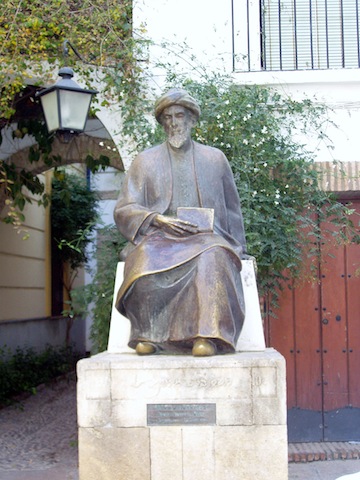
photo - Amadeo Ruiz Olmos’ statue of Maimonides stands in the Jewish Quarter of Córdoba, Spain. Maimonides compared tzedakah to a ladder with eight rungs, each of which you climb bringing you closer to heaven
Amadeo Ruiz Olmos’ statue of Maimonides stands in the Jewish Quarter of Córdoba, Spain. Maimonides compared tzedakah to a ladder with eight rungs, each of which you climb bringing you closer to heaven. (photo by Howard Lifshitz via commons.wikimedia.org)

I thought about a worksheet I’d used to teach religious school, maybe 20 years ago. I can’t find that piece of paper anymore but I remembered the point. It was about Maimonides’ ladder of tzedakah (justice, or charity). Maimonides (Rambam), a great Jewish scholar and teacher in the 12th century, lived in Spain and Egypt. I borrowed the following summary from the Jewish Teen Funders Network website, to remember the details.

Maimonides believed that tzedakah is like a ladder. It has eight rungs, from bottom to top. Each step you climb brings you closer to heaven.

1. The person who gives reluctantly and with regret.
2. The person who gives graciously, but less than one should.
3. The person who gives what one should, but only after being asked.
4. The person who gives before being asked.
5. The person who gives without knowing to whom he or she gives, although the recipient knows the identity of the donor.
6. The person who gives without making his or her identity known.
7. The person who gives without knowing to whom he or she gives. The recipient does not know from whom he or she receives.
8. The person who helps another to become self-supporting by a gift or a loan or by finding employment for the recipient.

To put this tzedakah approach into practice requires work. Many of us are stuck on the first five rungs of the ladder. I’m going to skip the first two rungs, because, while many of us may have only achieved this level, I’m going to act like we’re better than that. Right?

For instance, our membership dues to a synagogue or other Jewish organizations are acts of tzedakah, but usually of the third-rung kind. (If we could afford to donate more, we sink below No. 3.) We occasionally may get up to No. 7, when donating to a food bank. If you decide to “sponsor” something in the community and your name is pasted all over the event, that’s No. 5. It means, for instance, that while you do not know who ate the kiddush lunch you sponsored, everyone who is there knows your name. So, while some do this to celebrate a special event with their community, others do this named sponsorship because they like the attention. It’s tzedakah, sure, but it’s also about ego.

We could change the way we do our “tzedakah” business. We could push our Jewish community higher up Maimonides’ ladder. Here are some ideas.

Instead of “name in lights” sponsorship, we could donate anonymously to support a community meal, event or service. This could perhaps allow an organization to sponsor a free event. Maybe a congregation could have a nicer kiddush lunch on a Saturday or have an oneg on a more regular basis. It could boost the financial situation of an essential community function, like operational costs (heat, lights, water?), educational events, building renovation or maintenance. It could raise the salary of someone who works for the Jewish community. It could create new employment for someone in our community. It could offer a loan or gift to someone who needs a step-up to begin supporting himself or herself.

Ach! I hear you saying. I’m no moneybags. I can’t pay for someone’s salary. Fine.

If these sound too hard, lower your goals. Could you consistently offer a small amount of money or time when asked to help? Could you pay membership dues early? Could you donate food to the food bank every time you grocery shop? Maybe empty the change from your pockets every Friday afternoon to put in a pushke (collection box)?

Making a difference and working your way up that ladder can start small. It can be as simple as being gracious about donating. What about volunteering time or thanking others who donate? Many of us have the capacity to climb this metaphorical ladder. Shall we ascend those rungs together?

Joanne Seiff, a regular columnist for Winnipeg’s Jewish Post and News, is the author of a new book, From the Outside In: Jewish Post Columns 2015-2016. This collection of essays is now available for digital download, or as a paperback from Amazon. See more about her on joanneseiff.blogspot.com.

Format ImagePosted on February 10, 2017March 31, 2017Author Joanne SeiffCategories Op-EdTags charity, Little Free Library, Maimonides, tikkun olam, tzedakah
Israel’s first whisky distillery

Israel’s first whisky distillery

Tours and tastings of Milk and Honey distillery can be booked on certain days. (photo by Ariel Fields)

Is a Bronfman family saga about to begin again? While it has a ways to go before reaching the heights of the once-mighty Seagram empire, Milk and Honey, Israel’s first whisky distillery, may one day have the last laugh. In the meantime, its young investors and workers seem to be having a good time.

I was raised to believe Jews don’t drink anything stronger than wine or the occasional beer. There were, of course, notable unexplained exceptions, as on Shabbat and holidays, when men drank schnapps or Slivovitz at the synagogue’s kiddush. My tasting and tour of Milk and Honey has forced me to change my thinking.

About four years ago, a small group of friends, all Israeli high-techies and entrepreneurs, got together to create Israel’s first whisky distillery. While it is a bit hard for me to comprehend people actually “dreaming” about starting a whisky business, don’t we attribute Herzl to saying, in 1902, “If you will it, it is no dream; and if you do not will it, a dream it is and a dream it will stay”? And this group did pick a pretty Zionist name for its company.

Located in south Tel Aviv, about a 15-minute walk from Old Jaffa, the physical plant is less than a half-block long. The building is basically divided into two sections, the liquor-making facility and the visitors centre. One section looks out on the other from a full-length no-secrets-here glass divider. Six people currently work at Milk and Honey.

As a newbie to whisky-making, I did not know that basically just three ingredients go into single malt whisky: malting barley, water and yeast. Milk and Honey uses Israeli-sourced water. The barley is imported from England’s Muntons company and then mashed at Milk and Honey. The rest of the process – the fermentation, distillation and maturing – also take place on-site.

Milk and Honey has an Israeli-made fermentation tank. One of its two stills is new, but the other was constructed in 1983. It has a capacity of 9,000 litres. To my way of thinking, copper would give the whisky a funny taste, but our guide said they purposely built the still from copper, in order to give the whisky a more delicate taste.

The whisky maturation room has an elaborate alarm system, especially against fires, as the whisky is stored in combustible, wooden barrels.

In big whisky-producing countries such as the United States, Ireland, Scotland and Japan, single malt whisky needs to sit in its cask (barrel) for three years. While lots of people complain about Tel Aviv’s high humidity and temperatures, these factors might ultimately be advantageous to this type of business. Estimates are that the heat and humidity will speed up Milk and Honey’s whisky maturation process, making it two to 2.5 times faster than the above countries’ products.

Still, it will be awhile before Milk and Honey single malt whisky is sold en masse in bottles. The company does plan, however, to market some kind of limited series, which will be periodically released over the next three years.

In the meantime, Milk and Honey has started selling a few types of other liquor, including one called New Make and another called Levantine Gin.

As its name implies, the New Make does not go through barrel aging; its chief use is apparently for cocktail-making. The Levantine Gin is noteworthy for its Middle East quality – it is made with za’atar, a Middle East plant with a thyme-like taste, and other botanicals purchased locally at Tel Aviv’s Levinsky Shuk (Market). While not mentioned by our in-house guide, the use of za’atar ties this liquor to ancient Jewish roots (no pun intended). Za’atar (or “eizov,” in Hebrew) is mentioned in the Torah: in Exodus, Leviticus and Numbers, and references are also made in Kings I and Psalms. Moreover, although he did not prescribe za’atar specifically for hangovers, 12th-century philosopher, astronomer and physician Maimonides (aka Rambam) prescribed za’atar for headaches.

Impressively, these two products have already won awards. Just the day before I visited Milk and Honey, the Levantine Gin had won a gold medal and the New Make a silver at the 2016 Terravino Mediterranean International Wine and Spirit Challenge. Not a bad start for a new company.

All of Milk and Honey’s liquor is certified kosher. Tours and tastings are available on Tuesdays, Thursdays and Fridays by prior arrangement. See mh-distillery.com/visit-our-distillery.

Deborah Rubin Fields is an Israel-based features writer. She is also the author of Take a Peek Inside: A Child’s Guide to Radiology Exams, published in English, Hebrew and Arabic.

Format ImagePosted on February 10, 2017February 8, 2017Author Deborah Rubin FieldsCategories IsraelTags distilleries, Israel, whisky
News, democracy and trust

News, democracy and trust

The Shattered Mirror: News, Democracy and Trust in the Digital Age, released on Jan. 26 by the Public Policy Forum, shines a light on the news industry in Canada, revealing it is reaching a crisis point as the decline of traditional media, fragmentation of audiences and the rise of fake news pose a growing threat to the health of our democracy.

When the PPF began thinking about a study on the state of the news media in Canada, in early 2016, the headlines were all bad. Within a fortnight in January 2016 alone, Rogers Media and Postmedia announced new rounds of staff reductions, Torstar revealed plans to close its printing plant, and Confederation-era newspaper titles in Guelph, Ont., and Nanaimo, B.C., were shuttered, the first of six daily papers to close, merge or reduce their publishing schedules before year’s end. The situation wasn’t much better on the broadcast news side, where revenues, especially in local television, followed the downward track of the newspaper industry, inducing the Canadian Radio-television and Telecommunications Commission to step in.

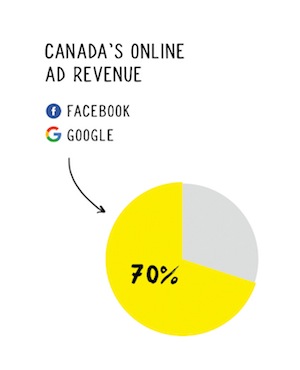
chart - Online ad revenue pie chart from Shattered Mirror ReportA parliamentary committee was formed. News companies and industry associations queued up with complaints of inequities in the marketplace. The Government of Canada contracted with the PPF, a non-partisan and independent think-tank, to assess the situation and make recommendations on what, if anything, should be done.
“The question for Canadian policy-makers is not whether given news outlets are in trouble, but whether democracy itself has been placed at risk in the process,” states The Shattered Mirror. “To the extent public policy has a role to play, it should be focused on maintaining the flow of information essential to a healthy society and ensuring the development of the digital arteries of the new information system – not preserving the press as we know it. The digital revolution is real, but with it have arisen challenges: fragmentation, distortion and adjusting to new business and storytelling models.”

After six months of study and discussions with close to 300 people, the report proposes recommendations aimed at ensuring that the news media and journalists continue in their role as the watchdogs over elected representatives and public institutions, and the connective tissue within communities.

“This report is not about the journalists, with whom I feel great solidarity, but rather the role they play, and what we may be putting at risk if we are inattentive,” writes Edward Greenspon, president and chief executive author of the PPF and the report’s author. Greenspon spent more than 30 years as a journalist before joining the PPF.
“[Digital] platforms, with daily audiences 10 times larger than those of major newspapers or TV broadcasters, are not just the new intermediaries of the public square but control the commanding heights of the marketplace of ideas,” the report says. “Their models are based on truth neutrality. Moreover, they only give the appearance of being a common space. Rather, they calculate and reinforce the prejudices of the like-minded, who either assign themselves to echo chambers or find themselves invisibly assigned by algorithms into filter bubbles. Both run counter to the concept of the media as an agent of common understanding.”

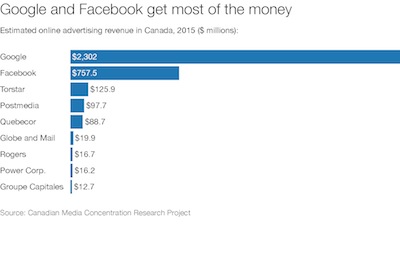
The dominance of Google and Facebook delivers another blow to Canada’s main providers of news: the loss of revenue with which to fund quality journalism at scale. “They pocket two of every three digital ad dollars spent in Canada and, in recent months, have generated 82% of the ads served up with digital news.

chart - Internet revenue, from Shattered Mirror Report“Google’s share of the Canadian digital market is almost 10 times that of the daily newspaper industry and 60 times that of community newspapers. A comparison of digital revenues for all newspapers and TV programs shows they bring in about one-seventh of the total of the two U.S. platform giants.”

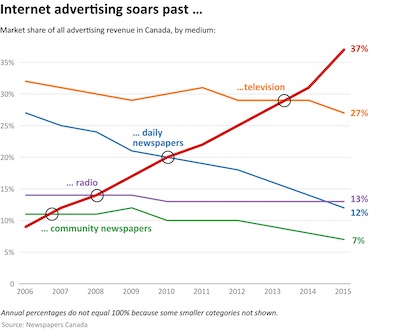
One result of this inequity? “Since 2010, there have been 225 weekly and 27 daily newspapers lost to closure or merger in more than 210 federal ridings,” notes the report. Small market TV stations have closed and many others, like surviving newspapers, have cut service and journalistic staff. Information supplied by Canada’s main media unions points to an estimated 30% reduction in journalism jobs since 2010.

Among the 12 recommendations are proposals for a new “local mandate” for Canada’s national wire service, The Canadian Press, ensuring there are more journalistic “boots on the ground” to supplement coverage of courts, legislatures and city halls; an indigenous journalism initiative to put more resources into communities and governments that are often overlooked; the launch of a service that provides much-needed legal advice to smaller outlets providing investigative and accountability journalism; and the creation of a research institute that would examine news and democracy issues more closely, including the distribution of fake news.

The report also calls for changes to Section 19 and 19.1 of the Income Tax Act to support civic-function journalism in Canada, whether by incentivizing Canada-centred news organizations to do more reporting or, for those that don’t, creating a revenue stream to support a Future of Journalism and Democracy Fund.

chart - Decline in newspaper ads, from Shattered Mirror ReportThree recommendations deal with CBC’s special role in Canadian news, including a call to relieve the CBC of the need to sell online advertising in order to promote production of civic-function journalism over chasing clicks.
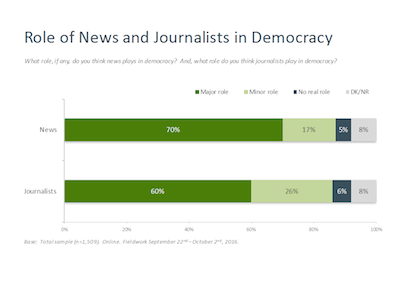
Included in the PPF study is public opinion research by Earnscliffe Strategy Group, which conducted focus groups and surveyed more than 1,500 adult Canadians. Respondents “were very aware that ‘a lot of bogus and untrue news and information appears online’ (83%)…. Whereas seven out of 10 respondents completely or mostly trust their newspapers, radio and television, the figure drops to 15% for news acquired via social media.”

As chronicled by Craig Silverman, media editor of BuzzFeed, false news stories in the United States began to spike in August after the firing of Facebook editors, on top of the downgrading of material posted by established news organizations. Between August and election day in November, stories from hyper-partisan and hoax sources actually pulled ahead of real news, registering 8.7 million acts of engagement versus 7.4 million.

“While fake news takes just moments to make up, real news often requires days, weeks and even months of digging and verifying,” notes the PPF report, the title of which, The Shattered Mirror, pays homage to the 1970 groundbreaking Senate report on the mass media called The Uncertain Mirror. “Unfortunately, the state of the news media’s job in reflecting society back to itself is no longer uncertain,” Greenspon said.

chart - Democracy poll, from Shattered Mirror Report“Never have Canadians had access to more information,” states the report. “But the capacity to produce original news, particularly of a civic nature, is severely constrained by the unsolved riddle of how to finance the cost of journalism in the digital age.”

The PPF media study was partially funded by Canadian Heritage and ISEDC (Innovation, Science and Economic Development Canada); the McConnell, Atkinson and Max Bell foundations; and four corporations, CN, TD Bank, Ivanhoe Properties and Clairvest Investments. However, the findings and recommendations are the PPF’s alone.

Greenspon concludes that Canada has already reached a “crunch point” in terms of the state of the news industry and its ability to fulfil its democratic responsibilities. “This report is meant to offer insight into the state of news two decades into its existential crisis, as well as ideas for how to respond,” he writes. “We hope it will stimulate a necessary debate and necessary action, while understanding no story is ever at its end.”

The full report can be downloaded at shatteredmirror.ca.

Format ImagePosted on February 10, 2017February 8, 2017Author Public Policy ForumCategories NationalTags democracy, journalism, media, Shattered Mirror
Goodbye, airport

Goodbye, airport

An Arkia plane lands at Eilat Airport. (photo from Ashernet)

Ever since 1949, Eilat Airport has been an important link between the resort city of Eilat on the Red Sea and the busy central part of Israel. However, it is due to close later this year when the newly constructed Ramon Airport opens some 20 kilometres north of Eilat. The land that the Eilat Airport currently occupies will be used to build a new city centre consisting of hotels, shops and a residential area, as well as a new rail terminal.

Format ImagePosted on February 10, 2017February 8, 2017Author Edgar AsherCategories IsraelTags airport, Eilat

Posts pagination

Previous page Page 1 … Page 3 Page 4 Page 5 Next page
Proudly powered by WordPress