Greens’ policy on Israel

On Saturday, Dec. 3, at a meeting in Calgary, the Green Party of Canada (GPC) passed a resolution updating the party’s position on the Israel-Palestine conflict. It puts the entire onus for the conflict’s continuation on Israel, specifically on Prime Minister Binyamin Netanyahu.

“The possibility of a two-state solution is diminishing directly due to the Netanyahu government’s support for illegal expansion and increasingly brutal military occupation,” reads the Dec. 4 statement on the Green party’s website. “Even over 200 former members of Israeli Defence Forces (‘Security First’ [plan for West Bank, Gaza]) have decried the worsening security situation for Israelis and Palestinians – and laid the blame directly on Prime Minister Netanyahu’s policies. The former Israeli military officers have raised the alarm of a ‘humanitarian crisis in Gaza’ and the diminishing chances for a two-state solution.

“Clearly,” continues the statement, “Canada needs to do more to register with the Israeli government that flouting international law and threatening the security of its own people while violating the human rights of Palestinians is not acceptable. In doing so, Canada must continue to condemn violence from the militant elements of Palestinian society.”

While rejecting the boycott, divestment and sanction movement – as its goals “do not include supporting the right of the state of Israel to exist” and are “incompatible with Green party policy”– the addendum to the party’s policy “is based on clear differentiation between ‘legal’ Israel, as within the 1967 borders, a democracy respecting the rights of citizens of all ethnicities within its borders, and ‘illegal’ Israel – the occupied territories beyond Israel’s legal borders. The Palestinian civilians within the occupied territories are subjected to virtual continual abuses of their human rights. The occupied territories are maintained under a brutal military occupation. Products from illegal Israel should not be granted the preferred trading status of products of legal Israel.”

With this in mind, the Green party would like to see the Canada-Israel Free Trade Agreement renegotiated, the “termination and indefinite suspension of all military and surveillance trade and cooperation” between Canada and Israel, and the repeal of “the House of Commons resolution condemning the BDS movement.”

According to the Dec. 3 article “Greens vote for new Israel policy without BDS” by James Munson on ipolitics.ca, “Approximately [350] members voted on the ‘compromise’ resolution that purged the party’s policies of any reference to the Palestinian-led boycott, divestment and sanctions (BDS) movement, which pressures companies, governments and institutions with ties to Israel.”

The article cites Green party president Ken Melamed as saying, “The party wanted to be careful not to align with a particular organization or movement. The essence of it, I think, is that the party feels that diplomatic approaches to achieving peace and justice in the Middle East have been ineffective and it’s time to move to economic actions.”

The article said that, according to Melamed, about 85% of those who voted at the meeting supported the resolution – others opposed or abstained – but that it still had to be voted on electronically by all 20,000 party members before it became official policy.

Shimon Koffler Fogel, chief executive officer of the Centre for Israel and Jewish Affairs (CIJA), condemned the resolution. In a Dec. 3 statement, he noted, “The new policy is rife with historical distortions and places the Green party at odds with the Canadian consensus that BDS is discriminatory and counter-productive to peace. The Ontario legislature just voted by a tenfold margin to reject the differential treatment of Israel, underscoring how out of touch the Green party has become.

“Elizabeth May and the party’s leadership have turned their backs on the mainstream Jewish community, including the many Jewish Greens who no longer feel welcome. Despite repeatedly flagging that the anti-Israel vote was scheduled to take place on the Jewish sabbath, senior Green party officials insisted on holding the vote today, thereby excluding many Jewish Green party members from voting. This is an alarming development and a stunning failure of leadership.”

The December resolution replaces a resolution that was passed at the Green party convention in August.

In the backgrounder to Fogel’s statement, CIJA notes, “The party’s decision to endorse economic penalties against Israel is incompatible with the wishes of the party’s grassroots. A survey of Green members conducted by the party after their convention revealed that, of 2,800 respondents, 28% agreed with the decision to support BDS, 44% wanted it repealed and 28% thought it should be amended to remove any reference to a specific movement or country.”

The backgrounder further explains, “The text’s exclusive recognition of Palestinians as ‘the indigenous people’ of the region implies that Jewish people have no ancestral or indigenous roots in Israel. This misleading suggestion contradicts millennia of archeological and documentary evidence.”

And, CIJA warns, “The one-sided nature of the resolution and its call for extreme measures against Israel puts the Green party outside the international consensus for achieving peace, which emphasizes the need for both parties to compromise and negotiate.”

Note: This article has been edited to reflect later reports that about 350 party members voted on the resolution, versus the number cited on ipolitics.ca, which was approximately 275.


Ontario rejects BDS

On Dec. 1, the Ontario legislature voted 49-5 to pass Motion 36, which rejects the boycott, divestment and sanctions (BDS) movement aimed at Israel. The motion was backed both by the Liberals, who form the government, and the opposition Progressive Conservatives.

Tory MPP Gila Martow (Thornhill), who introduced the motion, noted in the legislature prior to the vote that: “BDS is boycotting not just Israel, but all Jews and other supporters of Israel.”

She explained that the BDS movement and its proponents have created a hostile environment at universities.

“We’re trying to make a statement about attitudes in society. I genuinely feel this is the first step in helping our students feel comfortable on campus. They’re choosing what program to study based on what campus they feel comfortable at,” she told the Independent.

“This is not just about BDS – we already went through this with Israel Apartheid Week. I think we need to make it clear from the government on down, we will not allow any type of antisemitism to masquerade as free speech.”

She hopes this message reverberates with school administrators.

“They’ve had tools at their disposal they haven’t bothered to use [to fight campus antisemitism] and I would suggest they might make a bigger effort than they did in the past,” she said.

Martow tipped her hat to the Centre for Israel and Jewish Affairs (CIJA) for their community advocacy on the motion, while Joel Reitman, Greater Toronto Area co-chair of CIJA, noted: “[J]ust as Ontarians rightly oppose all forms of discrimination, our province rejects BDS and other bigoted campaigns against Israelis.”

In a statement, Sara Lefton, CIJA’s vice-president, Greater Toronto Area, added: “It also demonstrates that elected officials across party lines recognize that BDS is tainted by antisemitism. Just as we are grateful that the legislature has taken this stand, we are proud that – in just a few short days – thousands of Ontarians took unified action to urge MPPs to support this motion.”

Adam Minsky, president and chief executive officer of United Jewish Appeal, said: “From students to seniors, from rabbis to grassroots activists, from left to right, our community came together to take tangible action to support Israelis and defeat BDS. The result speaks for itself – and testifies to the power of Israel advocacy to unite and strengthen our community.”

The text of Motion 36 reads: “That, in the opinion of this House, the Legislative Assembly of Ontario should:

“Stand firmly against any position or movement that promotes or encourages any form of hatred, hostility, prejudice, racism and intolerance in any way;

“Recognize the longstanding, vibrant and mutually beneficial political, economic and cultural ties between Ontario and Israel, built on a foundation of shared liberal democratic values;

“Endorse the Ottawa Protocol on Combating Antisemitism;

“And reject the differential treatment of Israel, including the boycott, divestment and sanctions movement.”

The motion was a retry, of sorts, of May 19’s Bill 202, “The Standing Up Against Antisemitism in Ontario Act,” defeated by a vote of 39-18.

That particular bill recognized the BDS movement as “one of the main vehicles for spreading antisemitism and the delegitimization of Israel globally and [one that] is increasingly promoted on university campuses in Ontario.”

At the time, Martow said that a bill like 202 “has teeth,” and could have financial consequences, versus a motion or a resolution. The failed bill would have compelled the province and its post-secondary institutions to withdraw business interactions with companies supporting BDS. As well, a bill would require passing three readings and unanimous consent, Martow told the Independent – something she wasn’t sure would be possible, so a motion was chosen this time around instead.

For the May bill, the Progressive Conservatives voted in favor, in addition to a single Liberal, Mike Colle, while the NDP as a whole rejected the bill, as they did the recent motion.

Dave Gordon is a Toronto-based freelance writer whose work has appeared in more than a hundred publications around the world.

Inspired by Standing Rock

The story of Chanukah is a narrative of the victory of a small group of righteous fighters against a powerful empire. It is a redemptive story of standing for one’s beliefs (and existence) and triumphing in the end.

The end of 2016 is a time when redemptive stories are even more welcome and the decision by the U.S. government last weekend to accede to the defiance of protesters in North Dakota is just such a story. Plans to run an oil pipeline through a cemetery and under a water reservoir near the Standing Rock Sioux Reservation were kiboshed. This doesn’t mean an alternative route won’t see the project completed, but it does alleviate the immediate fears the people had of the potential destruction of their water supply and further desecration of sacred sites, some of which have already been bulldozed.

The example of the Standing Rock Sioux and their allies from all over the country who stood up to the oil company is already being held up as a model for British Columbians, many of whom spent the weekend fuming over an announcement by Prime Minister Justin Trudeau. The prime minister declared that cabinet had approved the Kinder Morgan Trans-Mountain pipeline – which would see the number of tankers transporting bitumen from Burnaby, through Burrard Inlet, to Asia, increase to 34 per month from five – as well as another pipeline to the United States, while rejecting the Northern Gateway pipeline, which would have sent diluted bitumen to Asia via northern British Columbia. The incongruity of the decision – that the government recognizes the pristine fragility of the northern coast, but not that of the southern coast – is among the causes of outrage. Other concerns involve larger global issues of fossil fuels and the range of options that could, if we are going to use this non-renewable resource, at least reduce the negative environmental impacts.

Ahavat ha’beriot, love for (God’s) creation, is at the heart of Jewish identity. There is also the commandment to not stand by the blood of your neighbor; that is, do not behave passively in the face of violence toward others. While there was violence at Standing Rock, the greater threat was to the livelihood of the community there, based on the necessity of potable water. Likewise, the potential for ecological disaster as a result of the increased tanker traffic along Vancouver’s coast could destroy much creation, while the commitment to non-renewable fuels exemplified by the pipeline infrastructure will have global consequences.

Protecting creation is at the heart of First Nations identity as well, as was so articulately expressed at Standing Rock and which has also been demonstrated by reaction to Western Canadian pipelines, much of the opposition to which is led by indigenous people. Among the most heartening aspects of the Standing Rock story was the solidarity between indigenous and non-indigenous peoples.

Even if we disagree on this issue – we who drive cars or otherwise exploit non-renewable resources should demonstrate commitment to reducing emissions with our actions as well as our words – the lesson of Standing Rock goes beyond this single topic.

The United States and much of the world is experiencing a political upheaval. Particular challenges will emerge from the stunning U.S. election result, which handed the White House and both chambers of Congress to a party that rejects much of what has been termed “progressive” – environmental regulations, equality for women and minorities, protections for workers and a long list of other advances that cannot now (if they ever could) be taken for granted.

In the face of a Washington that is uniformly Republican, there may be a renewed need for public demonstrations that advance alternative viewpoints. People stood up at the coincidentally but aptly named Standing Rock. People may have to do the same in many places, including Burrard Inlet, during the coming years.

We need not be modern Maccabees to take such a stand. It is highly unlikely that any of us will see our lives threatened for opposing a pipeline, or acting within the law to advance or oppose some other viewpoint. Conversely, if action is not taken, if voices do not coalesce to demand alternatives to our world’s rapacious appetite for fossil fuels, all of creation may well be threatened.

Nominate a mensch

The Centre for Judaism of the Lower Fraser Valley is looking for nominations for its annual Lamplighter Award, which honors a child who has performed an outstanding act of community service.

Candidates must be between the ages of 6 and 18 and nominations of potential recipients must include two references describing the child’s community service. The chosen lamplighter will receive the award Dec. 29 at the Semiahmoo Shopping Centre at a 7 p.m. ceremony attended by Rabbi Falik and Simie Schtroks, directors of the Centre for Judaism, White Rock Mayor Wayne Baldwin and representatives of the cities of Surrey, White Rock, Langley and Delta.

Last year, Richmond twins Sarah and Amy Aginsky received the award for their work hosting a street store for the homeless and impoverished. The project, a one-day pop-up store, gave “shoppers” the opportunity to select apparel and shoes without the exchange of money.

“Chanukah celebrates the victory of light over darkness and goodness over evil,” said Simie Schtroks. “This is a most appropriate opportunity to motivate and inspire young people to make this world a brighter and better place. By filling the world with goodness and kindness, that light can dispel all sorts of darkness.”

To nominate a candidate for the award, contact Simie Schtroks as soon as possible at c4j@shaw.ca.

Writing Lives project

This fall, a select number of Langara College students embarked on a project to write the memoirs of local Holocaust survivors, capturing personal stories from the Second World War. The project is called Writing Lives: the Holocaust Survivor Memoir Project.

Writing Lives is an eight-month collaboration between Langara’s English and history departments, the Vancouver Holocaust Education Centre (VHEC) and the Azrieli Foundation. In the first half, students learn about the history and impact of the Holocaust. In the second half, students are paired with local Holocaust survivors associated with the VHEC.

“Writing Lives provides an opportunity for students to immerse themselves in the history of the Holocaust beyond physical textbooks,” said Rachel Mines, Langara English instructor, and project coordinator. For example, on Nov. 9, students commemorated Kristallnacht (The Night of Broken Glass) by lighting candles in memory of the violent anti-Jewish events that took place on Nov. 9 and 10, 1938. The course also regularly features a series of guest speakers from different organizations giving their perspective on the events surrounding the Holocaust.

“I feel grateful for the opportunity to investigate the events and prejudices that served as a catalyst for the Holocaust. With the help of survivors, professors, librarians and fellow students, I am learning that individuals, communities and organizations all have agency when it comes to fighting racism, and how we can work together to prevent such tragedies in the future,” said Lucille Welburn, a peace and conflict studies student who is taking the course.

Robin Macqueen, a Langara instructor and chair of the health sciences division, is auditing the course out of personal interest. He said: “This is a fantastic opportunity to engage with and honor people who survived a time of unimaginable prejudice. I’m getting a lot out of the course, and enjoy being a student again.”

For the VHEC, survivor testimonies are seen as a useful and powerful method for teaching about the Holocaust.

“Holocaust testimony provides a connection with people, culture, persecution and survival,” said Ilona Shulman Sparr, education director for the VHEC. “Eyewitness testimonies have proven to be a powerful and effective teaching tool, which affords a personal connection to the events of the Holocaust as we hear survivors’ accounts of their experiences. Testimonies provide a way for students to connect with survivors’ stories and gain an understanding of events that other sources can’t give them.”

This spring, students will be matched with Holocaust survivors to write their memoirs. The memoirs will be archived at the Azrieli Foundation and the VHEC, with a possibility of being published for public awareness.

Young talent in Music Man

Meghan Gardiner as Marian and Jay Hindle as Harold Hill in The Music Man. (photo by David Cooper)

Few children know what they want to do as a career. Even fewer start on their career goals before they are 10 years old. Yet, having celebrated his bar mitzvah in May, Julian Lokash, 13, has already set a firm foundation for his future. He dreams of running a school for the arts when he is an adult, and he seems to be doing everything right so far to reach that goal.

An irrepressible talent, Julian has focused his life around performing. He has used his summer vacations for the past three years to be a cast member in various productions at Theatre Under the Stars (TUTS) in Stanley Park. Rehearsals take two months and then performances are every other night for the remaining two months of the summer. In TUTS, he has performed in Oliver, Shrek and Beauty and the Beast.

TUTS is interesting because it is performed on a stage that is only two-thirds covered, leaving the front part of the stage, the apron, exposed to the elements. “It’s really fun but when it rains, we get wet and the stage can be really slippery,” said Julian about the challenges of being in an outdoor show in Vancouver. He admitted that some nights he came home covered in mosquito bites. This doesn’t dampen his enthusiasm, however. He plans to try out again for whatever show TUTS decides to present this summer.

photo - Julian Lokash is part of the production’s cast
Julian Lokash is part of the production’s cast. (photo by Brent Lokash)

Although he had a big smile on his face when describing his role in Beauty and the Beast, where he played Mustard in the ensemble, Julian has played a leading role in a professional production. Last December, he starred as James in James and the Giant Peach at Carousel Theatre.

This year, Julian is once again appearing on stage in a December production, this time at Gateway Theatre in Richmond in the classic musical The Music Man.

Being part of a professional production while going to school is a significant accomplishment and shows the level of dedication Julian has to his craft. Rehearsals for The Music Man began on Nov. 6 and carried on until the show opened on Dec. 8.

“We practise six nights a week and, once we start shows, we only have Mondays off,” said Julian. There are even days in the schedule where there are both a 2 p.m. matinée and an 8 p.m. show. He is pretty much giving up his winter break for the production.

When he was in elementary school, Julian was the only one in his French immersion class who was heavily involved in theatre.

“I had friends but no one else was into what I was. Now that I’m in high school in the [Lord Byng Secondary School] arts program, it’s so much better. Everyone thinks the same way as me, has the same interests,” he said. “Half of my classes now are with kids from the arts program. Social studies, English and science are taught from an arts perspective.”

Julian’s peers are now other singers, dancers and actors, who understand the commitment he has to acting, and his teachers are sympathetic to absences he may have due to his rehearsal or performance schedule.

His dance teacher is also used to him taking off long periods from classes. “I take tap, jazz and ballet at Westside Dance. It’s just a few blocks from my house. When I’m in rehearsal, I just have to miss dance,” said Julian.

Julian occasionally has voice lessons and was recently a guest soloist for the Cantata Choir, a semi-professional choir based in Vancouver. His acting training is from Arts Umbrella and Carousel Theatre for Young People.

With such a busy schedule, Julian acknowledges he could not do it without the support of his parents. He is looking forward to his upcoming performance in The Music Man, and continuing on with the Arts Mini program at Lord Byng.

When asked what he thinks of The Music Man, Julian was enthusiastic.

“It’s a very lively musical. It’s infused with humor and the characters are well developed. They really have their own personalities. I think kids can definitely enjoy it as much as adults do.” He said that anyone who likes music and dancing will love The Music Man.

The Music Man runs until Dec. 31. For tickets, visit gatewaytheatre.com.

Michelle Dodek is a freelance writer living in Vancouver.

Internet access and poverty

On Nov. 24., writer Penny Goldsmith spoke at King David High School about PovNet, a B.C.-based anti-poverty network.

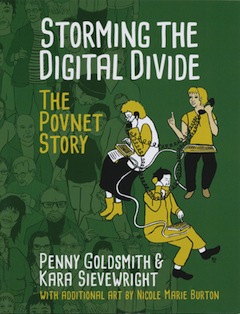
When Storming the Digital Divide: The PovNet Story was published in August by Lazara Press, the Jewish Independent received a copy. A history told in words and through illustrations about the B.C.-based online anti-poverty community network, the JI waited until school started, as it seemed the perfect topic for King David High School teacher Aron Rosenberg’s social justice class. And it was.

Once students were into the rhythm of classes and the High Holidays had passed, Rosenberg met with Penny Goldsmith – PovNet founder and a longtime community organizer and advocate – to determine how to address the subject. Goldsmith wrote Storming the Digital Divide, while B.C. artist, writer and activist Kara Sievewright – who has been PovNet’s web coordinator and illustrator since 2005 – created the images, and there are additional drawings by artist, researcher and educator Nicole Marie Burton of Ad Astra Comix, which publishes comics with social justice themes.

Before Goldsmith even did her presentation to Rosenberg’s class on the morning of Nov. 24 – appropriately enough, a day that fell during KDHS’s Random Acts of Chesed Week – the students had homework. In pairs, they had to choose a bubble from the 12-page timeline laid out in the book, which, as the book notes, highlights “selected issues that are an important part of the history of work done by the many advocates and marginalized community members who use PovNet in British Columbia. It also scans the history of technology and organizing as it affects the anti-poverty movement in British Columbia.”

The timeline goes from 1971 – “The first email is sent” – to 2015, which contains several key developments, such as the province’s first seniors’ advocate (Isobel Mackenzie) being appointed and the release of a 40-page report in which “nine social services agencies from across B.C. have asked the ombudsperson of B.C. to launch a systematic investigation into service reductions at the Ministry of Social Development and Social Innovation (the welfare ministry) that shut out many eligible people from accessing social assistance.”

For Goldsmith’s presentation, students were asked to consider their chosen bubble with respect to a few questions: “What does the information in the bubble mean for poor people? For anti-poverty advocates who work with them? For you?” Divided into groups, a table spokesperson shared some of the thoughts that arose from the brief group discussion of the questions. Student Leora Schertzer, in her role as master of ceremonies, made sure that every student who wanted to contribute aloud was invited to do so.

Alternating between group discussion and Goldsmith’s talk, which included visuals of some of the book’s illustrated pages, the students considered questions that Goldsmith and Rosenberg had prepared in advance, such as “What do you think the digital divide might mean?” “What do you think the difference is between charity and anti-poverty work?” and “How do you envision a future online world?”

Once the students had a chance to think about the issues, Goldsmith offered her thoughts, using portions of the book, beginning with an explanation of its title.

“From trying to get a job, finding adequate housing and accessing government services … to networking with fellow advocates and fighting for social change, the internet is now at the very least an essential service,” said Goldsmith. Regarding the accessing of government services, she gave the example of qualifying for welfare, which requires the completion of a 90-screen online application.

She offered a few definitions. “Collins English Dictionary defines the digital divide as ‘the gap between those people who have internet access and those who do not.’ Simple,” she said. “Dictionary.com expands the definition to include ‘the gap between those who are computer literate and those who are not.’ An important addition. Other dictionaries expand the definition to include marginalized communities in developing countries.

“According to a report from the Public Interest Advocacy Centre published in July 2016,” she said, “one-half of low-income Canadians are trading off other household goods or services in order to pay their communications bill – almost one in five (17%) indicated they went without other essential goods such as food, medicine or clothing in order to pay a communications bill.”

A lack of money is not the only barrier to internet access.

“An online space can, by its very structure, leave out marginalized communities,” Goldsmith explained. “If English is not your first language, online communication is not always as easy as being in the same room together with your peers. If accessing a computer is an issue, particularly in rural communities, if technology is daunting – people get left out of the conversation.”

It is these barriers that PovNet also works to diminish.

“PovNet is an online community of social justice advocates, activists, community workers and marginalized people who work in the anti-poverty world in British Columbia and across Canada,” said Goldsmith. “It hosts a public website that provides up-to-date information about welfare, housing and homelessness, unemployment, disability and human rights issues.

“PovNet’s community of users is vast,” she continued. “A disability rights organizer in Nelson goes to the PovNet website to get some information for a community workshop she is doing that night about changes to disability bus passes. A tenant in the Lower Mainland of Vancouver goes online to find an advocate to help him deal with a landlord trying to evict him. Several workers at a women’s centre in a small northern British Columbia town sign up for an online course at PovNetU about dealing with debt because they have so many clients coming into the women’s centre who are being harassed by a local collection agency.

“But what’s important,” she said, “is that everyone who wants to, has to have access to PovNet. That means money for computers, and government commitment to universal bandwidth and internet access. It also means that all of PovNet’s diverse communities have to feel that the network belongs to them.”

book cover - Storming the Digital DivideStorming the Digital Divide contains many illustrated stories from the online anti-poverty community, which bring the facts and figures closer to home, as well as the impact of PovNet over the 20 years since it began in 1997. While Goldsmith is no longer the organization’s executive coordinator – a post she filled for 18 years, until 2015 – she remains passionate about its work. And some of it rubbed off. Here are some of the comments students wrote after her talk.
• “Penny’s presentation exposed me to how reliant our society and greater world is on the internet…. Those who are unable to access the internet or technology are at an automatic disadvantage for workplace opportunities and almost all information.” (Justine Balin)

• “Listening to Penny’s presentation last week gave me an insight into the challenges that people without access to the internet face. Hearing about how some people have to choose between paying for internet access or having dinner made me realize how much I take having internet for granted. I also realized how big of a luxury it is to have my own computer and the privacy that comes with owning my own device. Before hearing Penny speak, I never realized how large of an issue internet access was…. Hearing about PovNet and how they advocate for internet access for those who need it really opened my eyes to a social justice issue that I would have otherwise been oblivious to.” (Talia Buchman)

• “In ‘A PovNet Timeline,’ I chose to focus on the [2008] bubble that states that over 40% of people who died in B.C. of HIV-AIDS died because they never received the necessary treatment because they were poor. Reading this bubble disturbed me quite a bit. I was mostly disturbed because we, as a country, try so hard to be the best society we can possibly be (i.e. equal rights), however still tend to fail at the situation with people living in poverty. We advertise that Canada has free health care, but do we really?” (Michelle Nifco)

• “The cost to live in British Columbia has been rising steadily and the welfare rate has also been rising but not as fast as the cost of living. I am fortunate enough to not be relying on welfare and hope that I will never need to rely on it, but many Canadians rely on welfare cheques every month to keep a roof over their head and food in their stomachs.” (Elle Poirier)

• “What I found immensely important about my experience with Povnet’s work was what they called ‘A PovNet Timeline: A Selective History of Poverty, Anti-Poverty Organizing & Technology in B.C.’ The timeline was extremely motivational and taught me that if citizens have enough passion and drive, they can influence the powers that be, even when it may seem that said powers are completely inflexible or severely rigid. This premise was explored throughout a variety of different events within the timeline.” (Anthony Schokalsky)

Storming the Digital Divide ($12.95) is available from lazarapress.ca.


Shabbat Across UBC

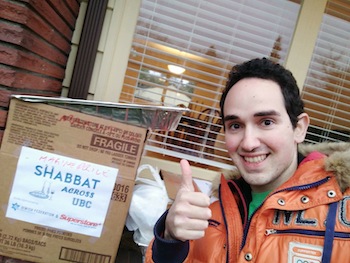
Chabad on Campus, student and other volunteers and Shabbat hosts made Shabbat Across UBC on Nov. 18 possible. (photos from Chabad at UBC)

On Nov. 18, more than 75 students celebrated Shabbat with Chabad on Campus at the University of British Columbia but, this time, they only arrived at Chabad after dinner. Instead of hosting the meal at the Chabad House as usual, there were six different dinners hosted by student volunteers in their residence buildings, after which the students met up at Chabad, where they shared dessert and got a chance to know one another.

photo - Chabad on Campus, student and other volunteers and Shabbat hosts made Shabbat Across UBC on Nov. 18 possibleRabbi Chalom Loeub, who runs Chabad at UBC with his wife Esti, delivered food and supplies, and the hosts invited their friends and neighbors and ran the meal.
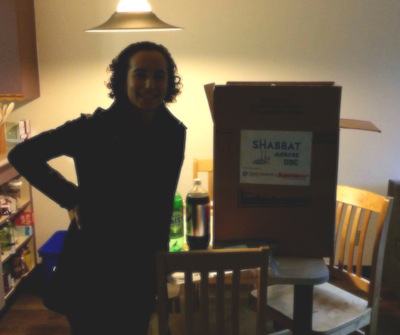
Cordelia Sank is a second-year UBC theatre production student, who volunteered to co-host a dinner in the Fairview Residence block. “Getting the chance to bring together all of the other Jewish students in my residence was very special and inspiring for me,” she said, “and I look forward to attending many more of these dinners in the future.”

photo - Chabad on Campus, student and other volunteers and Shabbat hosts made Shabbat Across UBC on Nov. 18 possibleThe event was a big success, drawing in both seasoned Chabad members and new students, some of whom were experiencing Shabbat for the first time. UBC president Santa J. Ono wrote a letter of congratulation, praising the event as a “wonderful initiative … to build community at UBC.”
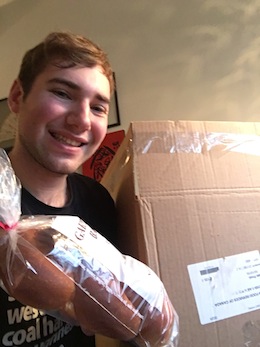
Hani Gorgy is a third-year exchange student visiting from Israel, who has attended many Shabbat meals, classes and programs at Chabad on Campus. “I’ve always felt that Shabbat dinner is a time of spiritual joy,” she said. “Being invited to Shabbat dinners here in Vancouver made me feel welcomed and safe. Meeting so many Jewish people here helped me feel like I’m part of the community.”

photo - Chabad on Campus, student and other volunteers and Shabbat hosts made Shabbat Across UBC on Nov. 18 possibleWeekly Shabbat dinners are only one of the programs that Chabad at UBC offers, including social programs, Torah classes, kosher meals on campus, support and holiday programming for the Jewish community at UBC and other colleges and universities across Vancouver.

The Shabbat Across UBC event was made possible by the sponsorship of the Jewish Federation of Greater Vancouver and the Marine Drive Superstore. Chef Menajem of Forty-One Catering created an impeccable spread, and the student volunteers and Shabbat hosts made this annual event a reality.

For more information about this or other events, contact the Chabad Jewish Student Centre at 778-712-7703, chabadubc@gmail.com or chabadubc.com.

Sydney Switzer is a fourth-year student at Emily Carr University and president of the Chabad Jewish Student Club.

Getting through Chanukah

It’s that time of year again! For many, the holiday season is spent with family and is filled with nothing but joy, love, laughter, gratitude and giving. If this is you, you can go ahead and stop reading now…. This piece is for those of us who don’t live on the Hallmark Channel.

Let’s be honest with ourselves. We love our family. At the same time, getting together with our families or our in-laws around the holidays can get stressful, awful or even painful. Some people end up in my therapy office after the holidays, shattered from family celebrations.

If you’re tired of the stressful dynamics in your family, maybe this year it’s time to try something a little different. Let’s call this an early Chanukah list.

Set boundaries. Setting boundaries is the foundation for standing up to the family difficulties that we deal with every year. Maybe the lessons we learned in childhood were to not “stir the pot” and to avoid conflict. The end result of this is that we end up acting as if we are OK when, quite frankly, we aren’t.

When your mother–in-law pulls up an old dig about your weight, you don’t have to sit quietly and let your blood pressure go through the roof. Instead, you can say, “I don’t like it when you make comments about my weight.”

Another way to set boundaries is to put space between yourself and whatever or whomever you’re trying to set boundaries with. You may not be able to control what others say, but you can certainly move yourself to another room or go for a walk.

Don’t regress. Perhaps you always got dragged into being the mediator or the scapegoat in your family when you were growing up. When we, as adults, spend time with our families in the present, we tend to slip back into old roles. Don’t be who you were when you were 14. Be who you are now, even if your family doesn’t see it. If they continue to define you as your past, don’t stoop to their level by doing the same to them. Be the grown-up in the room.

Don’t be held back by the prospect of negative outcomes. You might plan to do things differently around your family, but it doesn’t mean the results will be rosy. You might set boundaries and get a lot of backlash.

This is not advice for the faint of heart. It’s advice to help you survive your family holiday. These are suggestions for people who are tired of getting sucked into the same old family patterns, and are ready to find their voice and get unstuck.

There’s no way to know for sure how your holiday will turn out as you try some of these ideas. At best, you might become a catalyst for actual change in your family and holidays might get better.

But, whether family time improves or continues on as it always has, you can at least know that you are taking charge of your life and taking steps toward a happier you.

Enjoy the latkes!

Lynn Superstein-Raber is a registered psychologist who helps people overcome depression, anxiety and relationship problems. For more information, visit lynnsuperstein.com.

Unite in acts of chesed

May 24, 2017, marks the 50th anniversary of a united Jerusalem. In honor of this occasion, the Afikim Foundation, in cooperation with the Israel Ministry of Diaspora Affairs, is launching the Jerusalem50 Global Unity Torah, a global movement that celebrates a reunited Jerusalem with acts of kindness.

“The Global Unity Torah will provide Jews worldwide an unprecedented communal platform to do good and inspire goodness in others,” said Rabbi Raphael Butler, founder of the Afikim Foundation. To purchase a letter, the currency is not in dollars but in acts of kindness.

Individuals and families from all walks of Jewish life will unite with organizations, congregations, agencies, schools and Jewish groups from all corners of the globe to “purchase” their letter(s) in the Torah with acts of chesed (kindness).

With an interactive site in five languages, jerusalem50.org, a social media campaign, pamphlets designed and published in five languages, wall hangings of the sites of Jerusalem set to display in communities around the world, and a traveling exhibition on Jerusalem, the Jerusalem50 movement is set to launch.

“As an innovative incubator, Afikim is where profound Jewish ideas take flight, and we envision Jerusalem50 having a poignant and lasting impact on the Jewish people,” said Butler. “By using kindness as an impetus for change and Jerusalem as a uniting factor, we can transform our world.”

For more information on the Afikim Foundation, visit afikimfoundation.org.