Thousands gather

(photo by Mendel Grossbaum / Chabad.org)

Rabbis dance with their colleagues at a banquet at the Brooklyn Marine Terminal Pier 8 on Nov. 27. They were among the 5,600 rabbis and guests from 90 countries who gathered in New York for the International Conference of Chabad-Lubavitch Emissaries, an annual event aimed at reviving Jewish awareness and practice around the world. This year’s conference carried added significance, as the North American Jewish community marked 75 years since the Lubavitcher Rebbe – Rabbi Menachem M. Schneerson, z”l – and his wife, Rebbetzin Chaya Mushka, z”l, arrived on U.S. shores from wartorn Europe in 1941. (Courtesy of Chabad.org)


טרודו וקסטרו

מנהיגה לשעבר של קובה, פידל קסטרו, שנפטר ב-25 בנובמבר. (צילום: Antônio Milena/ABr via Wikimedia Commons)

ג’סטין טרודו מאבד גובה: תמיכתו בפידל קסטרו גרמה לראש ממשלת קנדה לראשונה לחטוף מכל עבר

ראש ממשלת קנדה מטעם המפלגה הליברלית, ג’סטין טרודו, חטף לראשונה ביקורת קשה מאוד מבית ומחוץ, לאור תמיכתו הנלהבת במנהיגה לשעבר של קובה, פידל קסטרו, שנפטר ב-25 בנובמבר. רבים ממנהיגי העולם המערבי בהם ארה”ב וכמובן מנהיגי האופוזיציה (מהמפלגה הקונסרבטיבית) לממשלת טרודו בקנדה, ביקרו אותו קשות לאור הדבריו שאמר לזכרו של קסטרו. המועמד לנשיאות בארה”ב מטעם המפלגה הרפובליקנית, מרקו רוביו (שהפסיד לדונלד טראמפ), הגדיל לעשות כשאמר: “האם הצהרה זו אמיתית או פרודיה? כי אם זה אמיתי זה מביש”. ואילו פרשן יחסי החוץ של הוול סטריט ג’ורנל, ברט סטיבנס, העיר: “הודעה מחפירה של ג’סטין טרודו. לא ג’סטין, פידל לא ‘שירת’ את העם הקובני. הוא הפך את העם למשרתיו במשך 60 שנה”.

המנהיג הקובני היה ידידו של אביו פייר אליוט טרודו, שהיה המנהיג המערבי הראשון שביקר אותו באי ב-1976, מאז משבר הטילים עם ארה”ב והאמברגו האמריקני. קסטרו לא שכח וב-2000 הגיע להלוויית טרודו במונטריאול. טרודו הבן מיהר לצאת בהצהרה כתובה לאחר שנודע שקסטרו נפטר. בה אמר בין היתר: “פידל קסטרו היה מנהיג גדול מהחיים, ששירת במשך כמעט חצי מאה. היה מהפכן ונואם אגדי, שהביא לשיפור עצום במערכת החינוך וכן מתנגדיו הכירו בהתמסרותו ובאהבתו האדירה לעם הקובני, שרחש חיבה עמוקה ומתמשכת למנהיג”.

האמנם טרודו? מומחה לנושאי קובה וקסטרו, הסופר ובמאי הסרטים, ירון אביטוב, שחי בעבר בקובה, כתב בימים האחרונים רשימה על קסטרו שפורסמה בעיתון מעריב. בין היתר כתב אביטוב: “קסטרו היה אחד העריצים האכזריים ביותר בתולדות המאה ה-20 ונחשב לאכזר ומרושע. הוא רדף את מתנגדיו ורבים הושלכו לכלא ונמקו שם, בעיקר סופרים ועיתונאים. לאורך השנים מאות אלפים גלו מקובה, או ניסו לברוח ממנה למיאמי ברפסודות רעועות, וחלקם נטרפו על ידי כרישים. את הבשורה המהפכנית, שהייתה אמורה לשמש מודל וחיקוי במאבק נגד האימפריאליזם, השחיתות והסיאוב, המיר קסטרו ברודנות מושחתת ומסואבת, שרק מרקסיסטים עיוורים עוד דוגלים בה. במהלך כהונתו העשיר קסטרו את קופתו הפרטית על חשבון העם שהסתפק בנזיד עדשים, עד שזכה להיכלל ברשימת מאה עשירי העולם של המגזין פורבס. קסטרו הפך את קובה לאחת המדינות העניות המרודות בעולם. מדינה שרוב תושביה משתכרים סכומים שלא היו מספיקים לרכישת פלאפל ברחוב דיזינגוף. רוב תושבי קובה מתחננים בפני תיירים שירכשו עבורם תרופות שאין להשיגן, לא מעט מבנותיה מציעות את מרכולתן בשוק הבשר האכזרי, מדינה שסובלת מהפסקות חשמל ומים תכופות, מרבית אוכלוסייתה ניזונה מפנקסי קיצוב וכל אדם שפותח את הפה עלול להיות מושלך למאסר ממושך, ואף גרוע מכך”.

החשש מדונלד טראמפ: ארכיון האינטרנט האמריקני יצור עותקי גיבוי בקנדה

לאור החשש ממדיניותו הבעייתית והמסוכנת של הנשיא הנבחר של ארה”ב מטעם המפלגה הרפובליקנית, דונלד טראמפ, ארכיון האינטרנט האמריקני החליט ליצור עותקי גיבוי לעת חרום בקנדה. בהנהלת הארכיון הדיגיטלי חוששים כי טראמפ מסוגל להפעיל צנזורה קשה שתפגע בחופש הפעולה שלהם, ולכן הוחלט ליצור ‘אתר ראי’ שלא במפתיע ימוקם בשרתים הקנדיים שמעבר לגבול. עלות יצירת עותקי הגיבוי בקנדה תעלה מיליוני דולרים והארכיון מחפש עתה מקורות מימון ותרומות, להפעלת הפרוייקט המסובך.

הארכיון הדיגיטלי האמריקני (שהוא ארגון שלא למטרות רווח) פועל מזה כעשרים שנה, ומאחסן כל העת עמודי רשת. יצויין כי מדי שבוע הארכיון גדל בכשלוש מאות מיליון עמודי רשת חדשים, שכוללים ספרים, סרטונים, תוכנות, מוסיקה ועוד.

Garfinkel aims for Victoria

Gabe Garfinkel is running for the B.C. Liberal nomination in Vancouver-Fairview. (photo from Gabe Garfinkel)

Gabe Garfinkel says he has the combination of youth and experience that makes him an ideal candidate for the B.C. Legislature.

Garfinkel recently announced his candidacy for the B.C. Liberal nomination in Vancouver-Fairview. The 31-year-old former assistant to Premier Christy Clark added that representing the Jewish community is an important part of his reason for running.

Garfinkel attended Vancouver Talmud Torah elementary (as did both his parents) and Prince of Wales secondary before obtaining a BA in political science at the University of British Columbia. During his time at UBC, he did a semester at Hebrew University and says Middle East issues have long been an area of interest.

His first job after university emerged out of a volunteer position. The Canadian Jewish Political Affairs Committee (CJPAC), for which he had volunteered as a student, hired him as outreach coordinator, based in Toronto. CJPAC is a national, independent, multi-partisan organization that aims to engage Jewish and pro-Israel Canadians in the democratic process and to foster political participation.

“I was the guy that was going into community groups, to community centres, to high schools, to summer camps, to campuses, to Hillels across the country and essentially telling them why they should get involved in politics,” Garfinkel told the Independent. “I was selling a few different programs, but what I was really doing was [building] up an army of hundreds of Jewish community members across the country that were in most cases in high school or university and giving them a voice and a vehicle to represent their own community’s interests in government.”

When he returned to Vancouver, Garfinkel followed his own advice. He walked into the campaign office for federal Liberal candidate Joyce Murray and volunteered. After the election, the MP hired Garfinkel to work in her constituency office.

“I saw firsthand how hard an MP can work and how an MP can make a difference in their constituents’ lives,” he said.

Garfinkel volunteered on the successful campaign of Margaret MacDiarmid, who was elected MLA for Vancouver-Fairview in 2009. She went on to serve in several portfolios in the B.C. Liberal government, including labor and education. MacDiarmid was defeated in 2012 by New Democrat George Heyman, who Garfinkel will be up against if he wins the Liberal nomination. (The Independent will invite all Jewish candidates in the election, which includes Heyman, to be interviewed and profiled.)

Garfinkel also volunteered on the leadership campaign of Clark, who went on to become premier.

“I was drawn to her because I saw the energy and charisma she could bring and the care she had for people,” he said. “I helped put together her youth campaign and young professional team. I played a small role in helping her win and it was great.”

When Clark became premier, Garfinkel served as executive assistant and advisor to several cabinet ministers before being called to the premier’s office and offered a job by Clark. He was the premier’s executive assistant until the 2012 election, when he left government to work for the party. He was on the campaign staff that oversaw the B.C. Liberals’ stunning come-from-behind victory that gave Clark her first full four-year mandate. His role in the election was working with multicultural communities and media.

After the election, Garfinkel returned to the premier’s office as director of community and stakeholder relations.

“The government does so many things and my job was to bring along stakeholders in all these decisions, and making sure that the decisions were being made not from the lens of the government, but from the lens of the people they affected the most,” he said.

In 2013, Garfinkel joined FleishmanHillard, an international public relations and marketing firm. He developed a particular interest in health policy and worked for health-care clients in the nonprofit and private sectors at FleishmanHillard and, since leaving that company, as a self-employed consultant.

He also has gained experience in small business.

“Just over a year ago, I realized that my dad’s business needed some help,” he said. Both his parents, Sandi Karmel and Larry Garfinkel, are social workers, but his father left social work to start Native Northwest, which creates products featuring the works of local First Nations artists.

“It’s been a really great experience helping him run a small business,” he said. “I have such a great time because you never know what’s going to hit you every day and you never underestimate the sheer amount of small hurdles you need to get by in running a business.”

While his new candidacy has required him to take a leave, Garfinkel was until recently on the allocations committee of the Jewish Federation of Greater Vancouver and also sat on the Local Partnership Council for the Centre for Israel and Jewish Affairs. He still volunteers for CJPAC, speaking to groups, usually young people, about the political process, and he is a longtime volunteer for Cystic Fibrosis Canada.

“It’s been important to me because we have a very close family friend who has the disease and for years I’ve been fighting internally for government to help make changes, and now I took that advocacy outside of government,” he said.

In addition to general awareness, advancing the cause of cystic fibrosis includes promoting organ donation and access to life-saving medications.

“Christy Clark’s government has been able to make a lot of positive changes on the organ registry,” Garfinkel said. “There are more avenues for people to sign up and be an organ donor.… It’s a lot easier now than it used to be.”

Nonetheless, he said, there remains a long way to go to increase the number of donors.

Garfinkel was formed by the Jewish community, he said, and has been deeply influenced by his grandmothers. While both his grandfathers passed away when he was young, Garfinkel cites his grandmothers as models of community engagement. His late paternal grandparents, Marsha and Israel (Izzy) Garfinkel, were members of Schara Tzedeck, while his maternal grandparents, Ethel and the late Jonah (Johnny) Karmel, were Beth Israel members. Ethel Karmel was a leader in the preservation of the Cambie Heritage Boulevard, lobbying successfully to have the Cambie Skytrain route go underground, and is an artist with an upcoming exhibition (see Community Calendar for details).

His grandparents’ and parents’ models of community service, he said, helped make him the person he is.

“You understand the interest of looking out for other people, you understand the importance of tikkun olam,” said Garfinkel, who also credits summers at Camp Miriam for building his Judaism and social conscience.

In his race for the nomination, Garfinkel said he is relying on his experience drawing people into the political sphere.

“My background’s in engaging people into the political process so they can have a voice,” he said. “In many cases, it’s been the Jewish community and young people, but also multicultural and new Canadians, where there is some kind of disconnect between them and the government that’s supposed to represent them.”

His candidacy is resonating in particular with young people, he said. In many cases, young people are asking him basic questions about the political system, which indicates to Garfinkel that they feel alienated from it.

“People don’t feel represented,” he said. “First and foremost, I want to make sure people have a voice and I want to fight for them in Victoria.”

His own experience is similar to that of many his age, he added.

“I have a small apartment in the riding and I’m afraid that a bigger place nearby is already out of reach,” he said. “I see transportation and transit as really important because it allows people to spend more time with their families and it protects the environment.”

The riding of Vancouver-Fairview runs from False Creek to 33rd Avenue between Main and Granville, and also includes areas west of Granville from Cornwall to Fourth Avenue east of Burrard, and east of Arbutus from 4th to 16th.

“I think there’s a general consensus that this is a great neighborhood to live in, but it’s not always easy to live here,” said Garfinkel. “If you look at things like housing affordability, it’s something that affects a lot of people here and a lot of future generations as well.”

The election is slated for May 9, 2017, but first Garfinkel has to win the B.C. Liberal nomination. The date for the nomination meeting has not been set and, therefore, neither has the deadline for joining the party in order to vote at the meeting. Garfinkel expects the meeting to be called for January, which means the membership cut-off will be in the coming few weeks.

He believes his comparatively young age combined with his experience in government is good preparation to be an MLA.

“I thought maybe I should wait until I’m older and have more money in my bank account and a longer resumé, but I realized that I have energy now, I have the desire now and have some really great experience I can bring to the table,” he said. “I’m ready.”


Landscapes alive with color

Sandy Blass’ solo exhibit No Other Country is at Zack Gallery until Dec. 12. (photo by Olga Livshin)

Artist Sandy Blass’ first solo show in Canada – No Other Country, a series of landscapes – opened last week at Zack Gallery.

Blass has always liked painting, and received her fine arts degree from the University of Calgary in 1984. She worked an office job full-time, raised her family in Calgary and painted as a hobby. Only after her children grew up could she allow herself the joy of following her heart into the arts. Although she still works – part-time at the Jewish Family Service Agency in Vancouver – she now considers herself a full-time artist.

Two important events contributed to her recent emergence as a full-time artist: first, she visited Israel for the first time in 2012; second, she moved to British Columbia in 2014.

Her show’s title, No Other Country, comes from the Hebrew song “I Have No Other Country,” about Israel, although, for Blass, a Jewish Canadian born and raised in Calgary, the sense of belonging is broader. “I belong in both places,” she said in an interview with the Independent, “Canada and Israel.” Her painting “Under the Same Sky,” an abstract play of lines and colors shaped like clouds, feels like the artist’s manifesto, reflecting her love for both countries.

Blass’ discovery of Israel and all things connected to Judaism came late in life. “My parents were Holocaust survivors. We didn’t talk about anything Jewish or about the war,” she explained. “Sometimes, my parents whispered about it but they never talked to me. Our home was secular and full of anxiety. My father always told me not to let anyone know that I was a Jew. Of course, after his concentration camp experience as a young boy, his fear was justified. I never questioned it.”

The older she grew, the more she wanted to learn about her roots and her family history. “I felt that I was missing something,” she said. “My father didn’t want to talk about the past, but my aunt did. She told me some of my family story when I was in my 20s. Later, I started painting with regard to my family history, exploring it through my imagery. I started going to shul. And, finally, I went to Israel.

“The first time – I traveled there in 2012 – I felt like I came full circle. I have family there, those who survived the war in Europe and immigrated to Israel afterwards. Since then, I’ve visited every year. I have even been thinking about aliyah, but not yet. I don’t feel that it is the right time.”

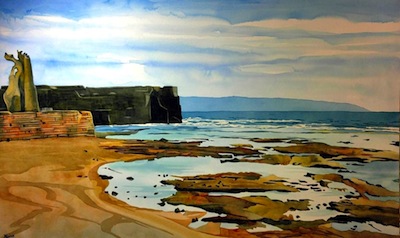
image - "Akko Beach" by Sandy Blass
“Akko Beach” by Sandy Blass.

After that first visit, Israel found a permanent place in the artist’s heart and in her paintings. “Since I reconnected with my Jewish identity, I paint both Canadian and Israeli landscapes,” she said. “I traveled to Europe, too, but I never painted there.”

Blass’ bright, vibrant compositions are half real and half abstract, although they are always linked to a particular place. “The sky is always imaginary though,” she said with a smile. “I love painting sky and water. Blue and green are my favorite colors. I love painting reflections, whether in the ocean, a mountain lake, a sea, or just a puddle. This way, water and sky come together, and the best medium to express their coupling is watercolors.”

She paints her landscapes exclusively in watercolor, her favorite medium. “I fell in love with watercolor in high school,” she said. “I love its flow, the transparency of colors. I tried other media over the years – oils and acrylic – but nothing worked for me, while I flourish in watercolors.”

Although watercolor is not the most popular type of paint for professional artists – the majority throughout the centuries has preferred oils – she is in good company. “Watercolors have a respectable place in art history. Joseph Turner, one of the foremost British landscape painters, worked in watercolors,” she said, listing well-known artists who used the same medium she does. “Toni Onley, one of the few Canadian artists represented at the Tate Gallery in London, worked in watercolors. I also want to make inroads into contemporary art in watercolors.”

One of the reasons for her love of watercolor, surprisingly, is that the paintings are not finished when the artist puts down her brush. “I don’t have complete control. The painting is only done when the water stops flowing, dries thoroughly,” she explained. “I experiment with the water flow sometimes. I have a special art table where I paint, and I might change the angle of the surface to affect the water flow. The results could be interesting. Also, the time it takes to dry could be important. Vancouver is more humid than Calgary, so it takes more time for the paintings to dry here. I like the end results better.”

No Other Country continues until Dec 12. To learn more about Blass’ work, visit blassart.com.

Olga Livshin is a Vancouver freelance writer. She can be reached at olgagodim@gmail.com.

Finding community on coast

Members of the Gibsons-area Jewish community gather for a pre-Rosh Hashanah dinner. (photo by Lehe Spiegelman)

Young Jewish families are looking for affordable living, just like everyone else. What they are finding is that the Lower Mainland just doesn’t provide opportunities for family-work-life balance, so they are seeking it further afield. One such frontier is the Sunshine Coast. Close enough to commute into Vancouver via ferry if necessary for work, the communities of Gibsons, Roberts Creek, Sechelt and beyond are looking more appealing than ever before.

There is a real draw for Jewish community members right now: a growing community of young Jewish families interested in Jewish education and community events. This fall, Rebecca Porte and Lehe Spiegelman started a weekly Hebrew school for their children and other interested families. They have also been community-building though Shabbat dinners and other activities that include the range of generations.

A native of Vancouver, Porte attended Vancouver Talmud Torah and Congregation Beth Israel growing up. When work took her to Gibsons, she fell in love with the community. “It’s like being in a Jewish community but in a different way. It’s intimate living in a small community,” she said.

Porte’s husband, Steve, grew up in Oyama, B.C., a very small community, so the transition to Gibsons was natural for him. Career advancement drew them back to Vancouver for a few years, where their young daughters also attended VTT. Upon returning to Gibsons, the family felt something was missing: the girls needed more formal Jewish education and community.

Spiegelman has three children and lives on a farm close to Gibsons. She and Porte became friends and decided to work together to bring a stronger sense of Jewish community to the Sunshine Coast.

“We wanted to make something happen,” Porte told the Independent. “We started by created an avenue to Jewish education for our kids – it’s always about the kids, right?”

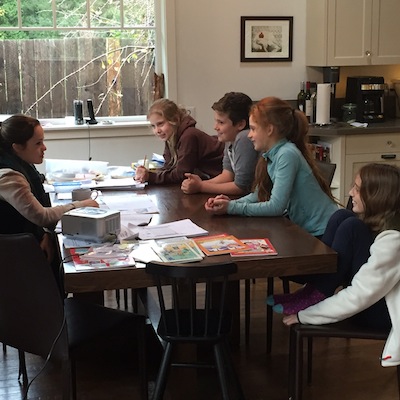
photo - Teacher Corin Neuman with students Maya, Sahra, Sarra and Ocean
Teacher Corin Neuman with students Maya, Sahra, Sarra and Ocean. (photo by Lehe Spiegelman)

Together, Spiegelman and Porte secured a teacher, Corin Neuman, who travels to Gibsons from Vancouver for weekly lessons with 10 children from six different families. Neuman travels every Thursday afternoon to work for 3.5 hours with individuals and small groups at different levels. The focus is on holidays and culture, some children speak Hebrew at home and others are just beginning to learn.

A big challenge of this program is cost. To ensure that this Jewish educational experience is accessible for all families who want to participate, Porte and Spiegelman are subsidizing the lessons themselves.

“We have a $90 shortfall each week,” said Porte. “We’ve applied for a grant from [Jewish] Federation and are looking for other grants … but because we’re really just trying to get it going, we’ll cover the costs for this year.”

Porte added that Spiegelman is an awesome teammate in this venture, not only in her financial generosity but also her hospitality.

While education is the foundation of a communal experience, food is another crucial part of being Jewish together. Spiegelman opened her home for the first two Shabbat dinner initiatives the duo planned. The first dinner, which took place just before Rosh Hashanah, had more than 30 people and included challah-baking beforehand with the kids. On Nov. 18, they hosted a second dinner, with a similar number of participants, although not all the same people. The duo’s next plan is to have a Chanukah party that includes older members of the Jewish community who have been on the coast for years.

“When we first came to Gibsons, before we had kids, Steve taught private guitar lessons. It is kind of funny: all of the Jewish parents in Roberts Creek had their kids doing guitar lessons, so we were invited to things back then,” said Porte.

“I know there have been Jews who have been connected to each other on the Sunshine Coast for many years,” she added. “What we’re doing is building a network of younger families, creating a hub as well as regular Jewish education. I’m curious to know how many Jews are on the Sunshine Coast – I have no idea! We know right now there are enough to have a Jewish network, enough people for our kids to sing a Jewish song together and do some Israeli dancing. It’s important for us because it’s good for the kids.”

For more information on how to connect with this blossoming community, e-mail Porte at becporte@gmail.com.

Michelle Dodek is a Vancouver freelance writer and community volunteer who tries to get to the Sunshine Coast with her family as often as she can, weather permitting.

Fires take a huge toll

Prime Minister Binyamin Netanyahu examines arson damage in Beit Meir. (photo from Ashernet)

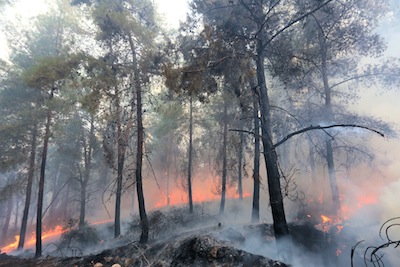
photo - Latrun forest fire
Latrun forest fire. (photo from Ashernet)

Last week’s wave of fires across northern and central Israel is estimated to have caused, so far, some half a billion shekels in damage, and total projections are higher. Several thousand homes have been either destroyed completely, or partially destroyed in the infernos.

In many cases, the fires have been set deliberately. Drones equipped with UV detection equipment filmed several instances of arsonists setting fire to brushwood around the Jerusalem region and in the north near Haifa, and several suspects have been arrested. Matters have been made worse by the fact that the winter rains have not yet started and the forests are very dry. Also, the temperatures have been higher than usual in most parts of the country.

photo - Prime Minister Binyamin Netanyahu talks with firefighters from Croatia, who came to assist in putting out the fires in northern and central Israel
Prime Minister Binyamin Netanyahu talks with firefighters from Croatia, who came to assist in putting out the fires in northern and central Israel. (photo by Kobi Gideon / GPO via Ashernet)

Several countries, including the United States, Greece, Croatia, Cyprus and Turkey, have sent fire-fighting aircraft to Israel to assist in getting the fires under control. The Palestinian Authority also sent firefighters to assist the Israeli teams to control the infernos.

On Nov. 27, Prime Minister Binyamin Netanyahu toured one of the worst-affected areas, just west of Jerusalem, in Beit Meir. The prime minister saw at least 10 homes that had been destroyed and many others showing serious fire damage, making even those uninhabitable.

JNF Canada has started an emergency campaign, every dollar of which will go to rehabilitation and clean-up efforts. For more information, visit jnf.ca or call 604-257-5155.

Does the truth still matter?

A recently released study from the graduate School of Education at Stanford University engaged 7,800 middle school, high school and college students to evaluate the information they received on the internet. The report said there was a “stunning and dismaying consistency” in the responses from the students, demonstrating an inability to discern information based on whether it originated from activist groups, neutral sources or advertising, and students routinely could not tell the difference between news articles from legitimate sources and unreliable webpages, nor between ostensibly balanced news coverage and opinion pieces.

The aftermath of the recent U.S. presidential election has seen commentators raise alarms over “fake news” – stories planted on social media with the deliberate intent to mislead. Obviously, this is another wrinkle in the whole issue of discerning fact from fiction. Then there is the ability of wholly unchecked assertions to go viral and be taken as fact by hundreds of thousands of people.

The New York Times analyzed one example of how these things can happen. In Austin, Tex., a man with just 40 Twitter followers saw a lineup of buses in downtown Austin on Nov. 9, the day after the election. That evening, crowds gathered in Austin, protesting the election of Donald Trump the night before. The man put two and two together and tweeted that “Anti-Trump protesters in Austin today are not as organic as they seem. Here are the buses they came in. #Fakeprotests #Trump2016 #Austin.”

The due diligence the man performed was a Google search to determine whether there were any major conferences being held in Austin and he found none. It turns out the buses were hired by a software company that was holding a conference for more than 13,000 people. Nevertheless, the tweet, which implies that the anti-Trump protesters were bused into town by some nefarious organizer, was shared 16,000 times on Twitter and 350,000 times on Facebook.

This was an example of a “story” not being adequately researched and proven. It is a slightly different species from the deliberately false “news” stories that popped up during the election with headlines like “Pope Francis shocks world, endorses Donald Trump for president” and “FBI agent suspected in Hillary email leaks found dead in apartment in murder-suicide.” Both of these, and countless more like them, were intentionally false, yet shared by thousands of people who believed – or wished – them to be true.

Comedian Jon Stewart used to refer to his program The Daily Show as “fake news,” but in fact it was parody and satire, taking a grain of truth and riffing humor and social commentary from it. This differs as well from sites like The Onion or Canada’s The Beaverton, which are not intended to be taken seriously, but sometimes are.

Then there is, to bring it full circle, the forms of legitimate journalism – news and analysis – which are generally well-researched, with facts corroborated and sources verified, but are often received by consumers as something else. In other words, people will take falsified news as fact and decry factual reporting as made-up.

On Sunday, Trump himself tweeted, without a shred of evidence, “I won the popular vote if you deduct the millions of people who voted illegally.” With vote counting (inexplicably) still underway, Trump has easily won the electoral college and, therefore, the presidency, but Hillary Clinton is currently 2.2 million votes ahead of Trump in the popular vote.

This sort of assertion from a sore winner is typical of the man, who seems to lie even when there is no advantage, as if to keep in practice. Throughout the campaign,

Trump routinely told untruths, which helps explain why the Oxford dictionary chose “post-truth” as its international word of the year for 2016.

Tens of millions voted for Trump despite, or possibly because of, his awkward relationship with the truth, suggesting that truth doesn’t matter like we once assumed it did. Or that people don’t care what the truth is, so long as what is said, published or posted conforms to or supports their preexisting opinions. People are willing to hear (or read, say or write) falsehoods and accept them as true if they wish them to be, rather than question their own beliefs or situation at all.

The unwillingness or inability to differentiate truth from fiction has long been a concern. Purveyors of lies – in advertising, politics, daily life – have been doing their deeds for centuries. Yet the ability in the internet age for people to select “news” that supports their worldview, or to be duped by people with agendas, has opened whole new universes of falsehood. Scarier, by far, is the apparent insouciance with which many people approach the issue. Some of us are satisfied with fiction if it suits our preferred version of fact. In such a case, we are not facing a problem of media literacy. We are facing a more serious affront to the very idea of reality.

Much work to be done

It has been a difficult month for me and I know it has been for many of you. Though I feel more and more like a Canadian with each passing year and I am a rabbi in this community, I still have an emotional connection to family and events in America (“the old country”). Like many around the world, I am grieving a loss, not of an election, but of a promise and a vision of a more hopeful, kind, tolerant and peaceful world.

The election of Donald Trump as president of the United States is a reminder of the power of fear and the fragility of the human spirit. There is no denying that a majority of the global population of Western countries feels threatened by unrelenting change – immigration, globalization, terrorism, multiculturalism. Many conflate slowing or stopping the pace of change with preserving their heritage, their privilege. The election of nationalistic leaders around the globe, of which Trump is only the latest, is an unfiltered primal scream of the fragility and fear consuming Western civilization.

As Jews, we are always hyper-aware of these kinds of tectonic shifts in societal norms. When what was once considered beyond the pale of decency becomes mainstream, we rightfully get worried.

That the U.S. election took place on the anniversary of Kristallnacht only served to remind us of the thin veneer of civility that exists in society and how fragile it is against the pressures of a global economy and existential threats to safety and security.

Here in Canada we have seen an increase in antisemitic incidents since the American election. Perhaps they are unrelated, but our “radar” for these kinds of things tells us otherwise. Anger and resentment have been given licence and agency by this recent campaign. Perhaps they would have no matter the winner but, whenever this happens, it is never “good for the Jews.”

Throughout the Torah, God tests the Jewish people. He puts them in the most vexing of situations. Temples are destroyed, false prophets rise among them, they are attacked from within and they are attacked from without. In each instance, the people rise above the challenges and are stronger because they confronted the challenge and found a way to persevere in spite of it.

I don’t think God brought us Trump or those world leaders like him, but I do think this is a test of our character and our humanity as individuals, as Jews and as Canadians, a test with great implications.

The biblical prophets were ignored and often derided, and yet they stood up and spoke truth to power. In the end, sometimes decades later, they were always proven right. The situation developed just as they said it would and the people suffered greatly, but they recovered, eventually healed and were restored.

I am 46 years old. For my generation, this is our time to lead, and the world will look to us to address these problems. This is the great test of my generation, one that began on 9/11. A test of our humanity, a test to prove that love does trump hate, that we can be good and prosperous, that America and other nations can be great without tearing each other and their citizens down in the process.

I am lucky to be in Canada right now, but election night made clear what we already knew: we are not there yet. There is work to be done here, too, as well as in America and around the globe. We are not impervious to the isolationist forces and economic circumstances that brought Trump to power.

Rabbi Tarfon used to say: it is not upon you to complete the task, but you are not free to idle from it (Avot 2:21). The time for mourning is ending. We must rise from our grief and get back to work – for there is much to be done.

Dan Moskovitz is senior rabbi at Temple Sholom.

More bridges to build

The entire Jewish community was shocked to witness a spike in antisemitic vandalism in November, with incidents reported in Montreal and Toronto, and at three synagogues and a Jewish community centre, as well as at non-Jewish sites, in our nation’s capital.

The Centre for Israel and Jewish Affairs (CIJA) worked closely with targeted institutions and local police to ensure effective measures were taken to protect the community in Ottawa, and the police arrested a suspect who now faces serious criminal charges.

While these ugly crimes remind us that antisemitism – the world’s oldest hatred – still exists, solidarity demonstrated by many proves we are not alone in this battle. Countless leaders, including the prime minister, various members of Parliament, the mayor of Ottawa, police officials, the United Way, and leaders in the Christian, Sikh and Muslim communities, have denounced these incidents. In so doing, they have reminded us of the value of our efforts to build bridges with non-Jewish leaders and communities. Our voices are stronger when united in common cause. From the many communities whose interests, values, and concerns we share, I highlight just three recent examples of CIJA partnerships making an impact.

In October, CIJA was honored to meet with His Holiness Mirza Masroor Ahmad, caliph of the Ahmadiyya Muslim community. Numbering some 10 to 20 million globally, Ahmadis face persecution in much of the Muslim world. In Pakistan, they are denounced as “non-Muslim,” face systemic discrimination and are the target of harassment and terrorist attacks.

CIJA has built a relationship with the Ahmadiyya community of Canada, with whom we have established dialogue and joined in calling on the Canadian government to prioritize religious freedom abroad. The caliph (a non-political position) recently commented on the thriving Ahmadi community near Haifa and underscored his community’s belief in the need to respect all faiths. Canadian Ahmadiyya leaders have shared both their appreciation for Israel as the freest country in the Middle East and their opposition to boycotts targeting the Jewish state.

CIJA continues to enjoy warm friendships with several major Christian organizations, including the Canadian Conference of Catholic Bishops (CCCB), the Evangelical Fellowship of Canada and various mainstream Protestant denominations.

Last November, CIJA and the Canadian Rabbinic Caucus launched a partnership agreement with CCCB, including a shared commitment to join forces in countering antisemitism and hatred in all its forms. We’ve since worked with CCCB on issues as diverse as Holocaust commemoration, the persecution of Middle East Christians and – in a unique Jewish-Catholic-Evangelical-Muslim partnership – a campaign calling for a national, well-funded palliative care strategy. This latter issue is especially crucial given Canada’s aging population and evidence that far too many patients cannot access high-quality end-of-life care.

We have also mobilized the support of various Christian groups and others, including Sikhs and Muslims, in our effort to strengthen Canada’s hate crime laws. Currently, vandalism targeting places of worship is automatically treated as a hate crime with serious penalties, a designation not applied to incidents involving community centres and schools associated with an identifiable group. Working with our interfaith partners, we are urging MPs to support Bill C-305 to close this loophole in the Criminal Code.

And, while Canadian society has witnessed a generational shift regarding LGBTQ rights, many in this community continue to face bigotry. CIJA is proud to be part of the four-member executive committee overseeing Trans Equality Canada, a coalition leading the advocacy efforts for Bill C-16, which extends hate crime and anti-discrimination protections to the transgender community. This historic legislation passed the House of Commons in November and is now with the Senate.

CIJA’s role in this campaign is unique. We’re the only ethnic or religious community organization at the forefront of what is, arguably, the most important issue concerning the Canadian LGBTQ community today: the rights of transgender Canadians.

This work mirrors the efforts of local CIJA offices and grassroots Jewish groups across Canada building ties with their respective LGBTQ organizations and Pride festivals. For their work in Montreal, our team received an award from the LGBT Chamber of Commerce of Quebec.

These relationships don’t just advance human rights. They help ensure we have allies within the LGBTQ community when anti-Zionists attempt to import their bigoted agenda into Pride, just as, in October, Halifax Pride voted down a resolution to ban any mention of Israel from its events.

This is just a sample of the partnership work we’re doing to build a better society for the Jewish community and all Canadians. But it’s a work in progress, and there are countless communities with whom we will seek opportunities to strengthen ties through issues of common cause. If you have suggestions or would like to get involved, connect with us at info@cija.ca.

Shimon Koffler Fogel is chief executive officer of the Centre for Israel and Jewish Affairs.