Steven Rothfeld is a travel photographer with an emphasis on culinary cuisine. He has written more than 10 books of photography and lives in Napa Valley, Calif. His cookbook Israel Eats (Gibbs Smith Publishers) came out earlier this year.
In the introduction, Rothfeld describes how he met an Israeli on a train in Italy in 1984. The fellow passenger asked Rothfeld why he hadn’t been to Israel. Twenty-five years later, reading Amos Oz’s memoir, Rothfeld’s imagination started working. In 2010, he finally made the trip.
“I encountered a world I had never imagined existed in Israel,” he writes, referring in large part to the vibrant cuisine.
He had worked on three books previously with chef Nancy Silverton so, when he conceived of Israel Eats, he asked her to join him.
Silverton is a chef, baker and author of eight cookbooks. She won the James Beard Foundation’s outstanding chef award of 2014 and lives in Los Angeles. She had been intrigued by Yotam Ottolenghi and Sami Tamimi’s cookbook Jerusalem and, in Israel, she discovered that “the cuisine of Israel is an extraordinary layering of flavors.”
And, writes Rothfeld, “Contemporary Israeli cuisine reflects a global consciousness rooted in a vast, mind-boggling array of cultural influences and traditions.”
Rothfeld and Silverton’s enthusiasm infuses this book.
After Haaretz journalist Ronit Vered explains the history of Israel’s cuisine from the 1950s to today, Rothfeld and Silverton embark on a tour of Israel – Tel Aviv-Jaffa, the north, the centre, the south, Jerusalem and the Judean hills, concluding with the “ecosystem of Israel Eats,” meaning the people who contributed to the book.
Each “chapter” has an introduction, with accounts of places Rothfeld and Silverton visited and people they met, and is followed by the recipes, each with its own introduction, source and beautiful color photographs.
Some of the recipes are from restaurants and chefs, others are from individuals and some are by Silverton. This is not a kosher cookbook but only five recipes are strictly non-kosher and most of those could be adapted by leaving out one ingredient that would not change the tone of the recipe; only one recipe is not adaptable. There are 90 recipes in total, and here are a couple.
HALLOUMI CHEESE FLOWER (two servings: “A single flower will only make you crave a bouquet.”)
3 tbsp olive oil 1 ripe, medium-size tomato, halved and thinly sliced 3 to 4 ounces halloumi or mozzarella cheese, thinly sliced salt and freshly ground pepper 3 large garlic cloves, thinly sliced 1 small fresh green chili, thinly sliced 10 cilantro sprigs
Heat oil in a heavy eight-inch skillet over medium heat. Arrange tomato slices in the skillet in the shape of a circle. Top the tomato slices with cheese slices. Sprinkle with salt and pepper. Arrange the garlic and chili slices atop the cheese. Bunch the cilantro sprigs in the centre of the skillet. Continue cooking until cheese is soft but not totally melted. Serve immediately.
VANILLA ICE CREAM WITH CHERRY TOMATO JAM (four to six servings: “an excellent and surprisingly tasty marriage”)
1 pound cherry tomatoes 1 2/3 cups sugar 2 tbsp water 1 tbsp black peppercorns 2 pints vanilla ice cream chopped fresh mint leaves
Combine the tomatoes, sugar, water and peppercorns in a medium-size heavy pot and bring to a boil. Reduce heat and simmer, stirring occasionally until the mixture is thick and syrupy and reduced by half, about one hour.
Divide the ice cream among bowls. Spoon the tomato jam over the ice cream. Garnish with mint.
Sybil Kaplanis a journalist, foreign correspondent, lecturer, food writer and book reviewer who lives in Jerusalem. She also does the restaurant features for janglo.net and leads walks in English in Jerusalem’s market.
When the Second Temple was destroyed, its menorah was said to have been taken to Rome. This is depicted, with the menorah being carried by Jewish slaves, in a carving on the inside of the Arch of Titus. (photo by Steerpike via Wikimedia Commons)
In the Temple of Jerusalem stood a seven-branched candelabrum or menorah, which was lit each day by the high priest. There were also other candelabra for ornamental purposes. When Antiochus removed the Temple menorah, Judah Maccabee had a duplicate built – called a candlestick with lamps upon it, in one Apocrypha translation – and he lit it, although there is no mention of oil to light it.
When the Second Temple was destroyed, its menorah was said to have been taken to Rome. This is depicted, with the menorah being carried by Jewish slaves, in a carving on the inside of the Arch of Titus.
Lighting a chanukiyah, or eight-branched candelabrum with one to serve as the shamash (one who lights the others), is a popular Chanukah custom. Originally, eight individual ceramic or stone lamps with wicks were lit with olive oil. Jews from Yemen and Morocco also used rough stone lamps with scooped-out places for the wicks and the higher one for the shamash.
At some point, people began the custom of hanging their lamps on the left side of the door, opposite the mezuzah, because Jews were commanded to affirm the miracle in public. When it became dangerous to display the chanukiyah out of doors, people began lighting them inside the house, frequently placing them by a window.
A wide variety of those chanukiyot, in diverse decorative styles and materials, have been preserved throughout the years.
As early as the 12th century, replicas of the Chanukah menorah, with the two additional branches, were found in synagogues, so that poor people and strangers could still benefit from lighting. Eventually, this design was used for home chanukiyot, but some people criticized the custom of lighting in the home. As well, discussions ensued about on which wall to place the synagogue chanukiyah – by the 16th century, lighting the candelabra in the synagogue became established as an addition to lighting one at home.
According to Michael Kaniel in A Guide to Jewish Art, in Morocco in the 11th century, the chanukiyah was the most widely used ritual object. They were made with a wide variety of materials: gold, silver, brass, bronze, iron, lead, glass, wood, glazed ceramics, terra cotta, bone, pomegranate shells, walnut shells and bark. Then, the brass style became popular, with North African Arab designs of flowers, foliage, fruits and animals. Those from Iraq often used the hamsa, the open hand symbol against the evil eye.
Chanukiyot dating back to 13th-century Spain and southern France display a straight row of holders with a back plate. One can also find chanukiyot made of bronze from the time of the Renaissance (14th century), depicting Judith with the head of Holofernes, who she killed, thereby saving her people, but that’s a story for another time.
European chanukiyot, mostly after the 17th century, were made in brass with animals symbolic of Jewish folk art. Later on, they appear in silver and were commissioned from silversmiths; European artisans often created chanukiyot from silver, using plant designs.
An 18th-century lamp from Germany depicts the prayers for lighting the candles. A 19th-century lamp, either from Libya or Morocco, is made of ceramics. Twentieth-century designs in Morocco were of silver and used animals and plants in the design.
Originally, wicks and oil were used, but, in the 18th and 19th centuries, many people replaced these with candles. Traditional Jews, particularly in Jerusalem, still use wicks and oil and hang the chanukiyah outside the house in a glass-enclosed container.
Electric chanukiyot atop public buildings are also customary in Israel as are home-style chanukiyot of all varieties, displayed in stores, offices and public places.
The primary rule for a “kosher” chanukiyah is that all eight holders should be at the same level, with the shamash placed higher than the others.
Sybil Kaplanis a journalist, foreign correspondent, lecturer, food writer and book reviewer who lives in Jerusalem. She also does the restaurant features for janglo.net and leads walks in English in Jerusalem’s market.
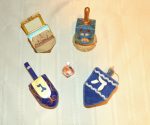
Dreidels from the author’s dreidel collection. Clockwise from the top left: a hand-painted dreidel with an open top; a hand-painted dreidel on a base; a felt dreidel; a hand-painted dreidel; and, in the centre, a tiny hand-painted glass dreidel. (photo by Barry Kaplan)
Dreidel is the most popular game for Chanukah. In Hanukkah: Eight Nights, Eight Lights, Malka Drucker writes that it evolved 2,000 years ago when the Chanukah story took place, at a time when Antiochus ruled over Judea in ancient Israel. “Groups of boys who had memorized the entire Torah would secretly study together until they heard the footsteps of the Syrian soldiers. Then they would quickly pull out spinning tops … and pretend to be playing games,” she writes.
Whether this is true or not, we do know that, by the Middle Ages, the game became more complicated, as rules were borrowed from a German gambling game. According to Encyclopedia Judaica, during the long nights of Chanukah, while the lights were burning, it became customary to pass the time by spinning tops and playing the ancient “put and take” game. This was in fulfilment of the commandment that the Chanukah lights should not be used for any utilitarian purpose – “they are only to be seen.”
While playing cards and other games has been prohibited by the rabbis over the years, as the games were considered frivolous because they took away from Torah study, the custom continued.
In medieval Germany, dice were used for the game, and they were inscribed with N, G, H and S. N stood for nichts, nothing; G stood for ganz, all; H was for halb, half; and S meant stell ein, put in. All players would hold an equal number of nuts, raisins or coins. Each player would put one in the middle, and the first player would spin the dice. Each letter stood for a move in the game – putting in or taking out nuts, raisins or coins, according to where the dice landed.
Later, boys carved tops or dreidels out of wood or poured hot lead into a form to make a spinning top. The letters were then changed to Hebrew and said to stand for the Hebrew letters nun, gimmel, hey and shin. The rabbis were less reluctant for boys to play with these tops because the letters were interpreted to stand for the phrase, “Nes gadol hayah sham,” “A great miracle happened there.”
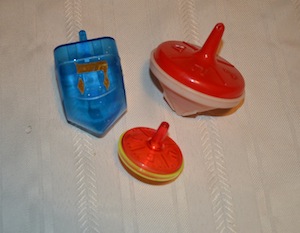
An assortment of plastic dreidels. The two larger tops have removable lids. (photo by Barry Kaplan)
In modern Israel, the Hebrew letter shin is replaced by a peh, standing for poh, meaning here – “A great miracle happened here.”
The rabbis felt even more comfortable about the game when it was also realized that, when the Hebrew letters, which have numerical value, are added together, they total 358, the same number of letters as the word for Messiah. (Nun is 50, gimmel is three, hey is five and shin is 300.) The letters of the word Messiah or Mashiach in Hebrew are mem, which is 40, shin which is 300, yud which is 10 and chet which is eight. Since the Jews are still waiting for the Messiah, this would show the way for a miracle.
Another mystical interpretation of the Hebrew letters is described by Philip Goodman in The Hanukkah Anthology. He writes that nun stood for nefesh (Hebrew for soul); gimmel stood for guf (body); shin stood for sechal (mind); and hey stood for hakol (all), implying all the characteristics of humankind.
Among the most-sung Chanukah songs are those about the spinning top – dreidel, in Yiddish, and s’vivon, in Hebrew.
The origin of the song “I Have a Little Dreidel” – “I have a little dreidel, I made it out of clay, and when it’s dry and ready, then dreidel I shall play!” – was the subject of an interesting article by Melanie Mitzman a few years ago in Hadassah Magazine. She wrote that Joshua Jacobson, a professor of music and Jewish studies at Northeastern University, explained that the song was originally in Yiddish and the opening line was “I made it out of lead.”
Samuel Goldfarb is said to have penned the English lyrics, and Goldfarb, a Jewish liturgical composer employed by the Bureau of Jewish Education of New York between 1925 and 1929, wrote the melody for the English version. Goldfarb’s granddaughter, Susan Wolfe, recalls telling her public school class that her grandfather had written “The Dreidel Song,” but they did not believe her.
The popular Hebrew song for this game is “S’vivon”: “S’vivon, sov, sov, sov.Chanukah hu chag tov,” “Spinning top, turn, turn, turn. Chanukah is a good holiday.”
As for dreidel games, here are the rules for three.
Put and take
On the sides of the dreidel are the four letters described above. To play the game, each player puts in one or more nuts or coins as agreed. A player spins the dreidel. If it falls on N, the player does nothing. If it falls on G, the player gets all. If it falls on H, the player takes half. If it falls on S, the player takes the whole pot. The next player takes their turn after each player once again contributes to the pot.
Endurance
All players spin the dreidel at a given signal. The player whose dreidel spins the longest is the winner.
Play for score or time
This game uses the fact that each Hebrew letter of the dreidel has a numerical value: N = 50, G = 3, H = 5 and S = 300. Players agree on a specific score to reach or time in which to play. Each player spins the dreidel. The scorekeeper credits each player with the numerical value of the letter on which his or her dreidel falls. The game continues until a player reaches the agreed-upon score or until the allotted time has passed, in which case the player with the most points wins.
Sybil Kaplanis a journalist, foreign correspondent, lecturer, food writer and book reviewer who lives in Jerusalem. She also does the restaurant features for janglo.net and leads walks in English in Jerusalem’s market.
Alan Dean was the world’s largest manufacturer and distributor of Chanukah menorahs.
“You what!” Zoe’s father was yelling at her. Again. “You traded my lamp?”
Nothing Zoe did seemed good enough for Dad. Her room was too messy. Her grades weren’t high enough. Her clothes were too expensive, too ratty or too “inappropriate.” He was always screaming at her.
“I didn’t mean …” Zoe began. She gazed into the first light burning on the new chanukiyah and tried to hold back the tears.
Ever since her mother had died, Zoe had tried to take good care of her father. Only 12 and a half, she wasn’t a good cook. She didn’t like cleaning the toilets. But all she wanted was to help.
Her dad’s office was a mess. The whole house was a mess. Alan Dean was the world’s largest manufacturer and distributor of Chanukah menorahs. There were candelabras all over the place. They were in the bedrooms, the kitchen, dining room, living room, even in the bathrooms. Every single morning, there was shouting about something that had gone missing: a wallet, keys, a cellphone, a cleaning bill, a shoe.…
That morning, Zoe had taken a black plastic garbage bag into the office to clean out some clutter. Which was when she got a weird text on her phone.
“@Jenny.Hunter New Lamps for Old. Want to trade?”
Zoe happened to be staring at this old, dusty and tarnished chanukiyah on her father’s bookshelf. It was squat and primitive. Her father hadn’t touched it in years.
Before she could think too much, she replied and, a moment later, there was a knock at the door.
“I was in the neighborhood,” Jenny said, smiling into the video intercom. She was a well-dressed woman, a little old, and her teeth could use braces. “Do you have a lamp to trade?”
Zoe was careful. “Let me see yours.”
The woman opened an aluminum suitcase from which she pulled a beautiful stainless steel Chanukah menorah. It was very sharp and very shiny.
Zoe nodded and opened the door a crack. “Why would you trade that for an old lamp?”
The woman smiled again. “Call it a present. Or an almost free sample, with the hope that your father will buy more.”
Now Zoe smiled. Dad always liked a bargain. She nodded, took the steel menorah and gave the woman the old brass one.
“Finally it is mine!” the woman said with something that sounded like a cackle.
Before Zoe could change her mind, the woman was gone. It was as if she had vanished.
That evening, her father was distracted. He didn’t even notice the new chanukiyah until after they’d said the blessings and Zoe lit the candles.
Then he saw it. “Where did that come from?”
“I traded it for your old lamp,” Zoe answered, happily.
Her father rushed into the office. When he came back, he began yelling.
“You went into my private space and…. Don’t you start,” Dad shouted. “Don’t you start quivering that lower lip. Don’t you start tearing up.…”
Which was when Zoe lost it.
Alan Dean stared as his beautiful daughter cried.
He didn’t know what to do. He never knew what to do.
For seven generations, the Dean family had produced boys, and the story had been passed from father to son at the bar mitzvah. The lamp was found in a cave. A genie inside gave each owner three dangerous wishes – guard the magic lamp and use it well.
When his daughter was born, Alan was surprised, even upset.
His wife forbade him from calling her Aileen.
“It has to stop sometime,” Shana had said. “A new girl, a new beginning.”
And she was right. Al’s life, which was always about business, had broadened into a wonderful family, until Shana had passed.
Alan hadn’t told his daughter that their fortune was based on a magical lamp. Zoe wasn’t 13 yet, and he didn’t want her to laugh, but mostly because Shana had been the last one to touch it.
“Make enough so we are happy,” Shana had said as she rubbed the chanukiyah. “And not a single one more.”
The genie, which was now barely a flicker said, “Your wish is my command.”
Instantly, the entire factory was automated, with only enough jobs to keep all the existing employees busy, while increasing production tenfold. The whole system was computerized and efficient. Orders came in, and candlesticks went out. No one worked too hard. The bank accounts swelled. It was every businessman’s dream!
Then Shana had gotten sick and, in one day, she died.
Alan’s world collapsed. After a week of shiva, when he’d finally wandered into his office, he saw the lamp on the shelf and his heart broke.
Could a wish have saved her? In the mournful chaos, he had completely forgotten the power of the lamp. He couldn’t bear to touch it, and it had gathered dust on the shelf. His wife was gone, but he still had his work. He had thrown himself back into it, and barely had any time for his daughter.
Now the lamp that had sustained his family for centuries was gone, too, and he knew that the factory would soon go silent.
Zoe stood in front of him, tears running down her face.
How could he do this to her? Yes, he was unhappy, but his daughter didn’t have to be.
Shana had known. “Make enough so we are happy,” she had wished. “And not a single one more.”
Alan thought for a moment. His mind tallied the amounts in the bank, the value of the factory and the land. The good will of the Alan Dean brand name. He would sell it all. It would be enough.
Alan wrapped his arms around Zoe’s shoulders and pulled her close. He hadn’t done that in years.
“It’s OK,” he said. “Let me tell you the story of that lamp. It has always been a story of magic and wealth, greed and fear, but now I think for us there will be a happy ending.”
Zoe felt warm and safe in her father’s arms.
The lights from the Chanukah candles flickered.
The End.
Mark Binderis a Jewish author and storyteller who tours the world sharing stories for all ages. His life in Chelm stories and his latest collection, Transmit Joy! an audio storybook, are available on audio download and CD.
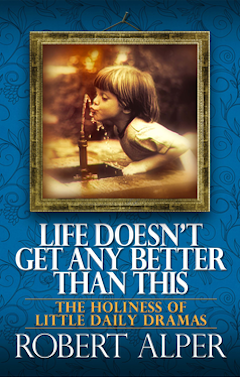
This story comes from the book Life Doesn’t Get Any Better Than This: The Holiness of Little Daily Dramas (Read the Spirit, 2015).
***
My father used to take showers with the lady next door.
It was all pretty kosher. We rented half of a “duplex” house at 89 University Avenue in Providence, and the Winn family occupied the other half. “Duplex” means different things in various places; in Providence, a “duplex” was a house with two separate entrances and two mirror-image units. Ours had three floors and a basement suitable for Cub Scout den meetings.
The way the house was designed, the bathrooms on the second floor shared a common wall, tub alongside tub and toilets back to back. The insulation was fairly thick, but subdued sounds could get through, and soon after the Winn family moved into 91 University Avenue, my father and Ruth Winn discovered that they observed similar morning shower routines. The muffled knocking back and forth on the tiles at 7:15 a.m., then a cute neighborhood joke, is now a piece of family folklore.
My mother and Ruth became friends immediately; 40 years later and 400 miles apart, they still dearly love each another. Laughter is what started it all off, but it was a hurricane called Carol that really brought us all together.
For eight days, Providence was without electricity, and neighbors drew closer to one another. Cold food went into the Keoughs’ old gas refrigerator at 85 University Avenue, while our battery-operated radio was the source for news and entertainment. The Winns’ vast quantities of sporting equipment helped everyone pass the time until that late afternoon when we were sitting on our porches and my mother suddenly yelled, “The lights are on!” Everyone rushed inside.
The bonding held.
The Winns’ oldest son Cooper David Winn IV and I were classmates, though never best friends. Still, we spent lots of time together, as neighboring kids do, and some of the most memorable moments occurred around the December holidays. Chanukah at my house. Christmas at his house.
Mutual envy.
For me, Chanukah generally meant one gift from my parents per night, but factoring in additions from grandparents, other relatives and friends, I averaged 16 to 20 each season. Not bad. I would even feel a bit on the smug side as I walked to school in the morning reporting to Cooper on the prior night’s take.
That is, I felt smug until early Christmas morning, when I would race over to the Winns’ side of the house to inspect the mountains of presents, the massive quantities strewn about the living room, such a volume of stuff that even the recognition in later years that the haul included a suspiciously large amount of underwear and socks could not make me rationalize away my jealousy.
The feeling of Chanukah has remained with me: our old tin menorah and the look, the smell, the soft, smooth texture of its candles, sometimes dripping their orange wax across my fingers. There were the traditional songs, the latkes and applesauce, and our one decoration, “Happy Chanukah,” printed on colorful paper dreidels and placed across the dining room entryway. The sign was worn, faded, but it was our tradition, and for eight days it transformed the room into a chamber of happy expectation.
Most of my presents were modest. I loved to make Revell models of antique cars, and so something like a Stanley Steamer one night might be followed by a Stutz Bearcat the next. Another year it was accessories for my small American Flyer train set: one night it might be a new caboose, and another night a little building to place near the tracks. I remember categories of gifts, but the particulars have long faded.
Except for two presents that I’ve never forgotten.
The first was a 26-inch English bicycle. It arrived on the year when I went for the gold in the “eight small presents or one big present” option game. Friday was the designated night and, as soon as the candles were lighted and the songs sung, I dutifully complied with the “Close your eyes tight” directive. The waiting seemed to go on forever as I listened to my father’s grunts and a bumping noise coming up the cellar steps. When he approached the dining room, I heard the rhythmic, metallic sound of a spinning tire, and knew that my yearlong series of unsubtle hints had been acknowledged.
Later we went to synagogue and, before the service began, I stood in the foyer for what seemed like hours, watching as every person entered, brushing the snow off their coats and stomping their boots. I scanned the arrivals, looking for Joey or Sammy or Ricky or anyone else I knew. “Guess what! I got an English bike!”
Other Chanukahs, though, were not as festive. My parents constantly struggled financially, one of the consequences of my father’s checkered career and made worse, later, by the albatross of medical bills from my sister’s long illness.
My father was always involved in the paper business. During the eight years when we lived on University Avenue, he worked for at least six different companies in waste paper, paper chemicals and wholesale tissue. Each position would begin with optimism and end with him returning home one night carrying his electric typewriter.
He always bounced back, always landed another job somewhere, somehow. Yet the process was draining, and the weeks or months between paychecks grim. One of those dark periods coincided with Chanukah.
I knew things were tough that season. We didn’t starve, but everything had to be cut back as we tried to make do on the salary my mother earned fitting women into corsets at the Peerless Department Store. “I know it’s hard,” she would say, “but some day our ship will come in.” I believed her. Sometimes I could even visualize “our ship,” a small speck on the horizon slowly, surely heading right for us.
“Our ship,” burdened with riches, was still far out to sea when Chanukah began. This year, I knew, would not be like other years. The grandparents and a few of my parents’ friends came through, but, my parents explained, I would need to understand that they just couldn’t afford presents this time. Just this year. Next year will be better.
Chanukah overlapped Christmas, fortuitously. The Winns were busy with their preparations, so I didn’t see much of Cooper. I was glad school was already on vacation; there was no need to report to friends on my Jewish version of an empty stocking.
That Christmas morning I didn’t rush next door.
On the final night of Chanukah, my parents surprised me with a gift. It was a small one, they warned. Nothing very special. But I’d been so understanding of what was happening that they wanted me to have it. I felt a slight twinge of guilt over their sacrifice as I accepted the little package.
Inside the box was a plastic model for my collection, a replica of a Chris Craft cabin cruiser. Probably cost about $2.95. I glued it together the next day and, for years, until I went off to college, the little boat sat on a shelf in my bedroom. It was far from being my fanciest model. Long discarded, the thought of it means more to me now than it ever did back then.
When I look back on all those Decembers of my childhood, those often wonderful days of mystery, anticipation, celebration, I know for a fact that I received many dozens of presents over the course of the years. They form an indistinct blur. After all, a long time has passed.
In truth, of all those gifts, I can actually remember only two. Only two. One was 26-inch English bicycle. Shiny black, three-speed, with a headlight powered by a generator that spun alongside the tire and its own silver air pump latched to the frame.
The other was a plastic model boat.
Rabbi Bob Alper(bobalper.com) is a full-time stand-up comic, performing internationally.
A young Dawn Lerman with her grandmother, Beauty (photo from Dawn Lerman via JNS.org)
In her memoir My Fat Dad, New York Times wellness blogger and nutritionist Dawn Lerman (@dawnlerman) shares her food journey and that of her father, a copywriter from the Mad Men era of advertising. Lerman spent her childhood constantly hungry, as her father pursued endless fad diets from Atkins to Pritikin, and insisted the family do the same to help keep him on track. As a child, Lerman felt undernourished both physically and emotionally, except for one saving grace: the loving attention of her maternal grandmother, Beauty. Below is an adapted excerpt from My Fat Dad, in addition to a recipe for a healthier version of a Chanukah staple.
***
When I lived in Chicago, Jewish holidays were spent either at my Grandma Beauty’s house or my Bubbe Mary’s house. My grandmothers lived near each other on Chicago’s north side. I saw Beauty every weekend, but I would only see Bubbe Mary, my father’s mother, on occasional holidays. While my grandmothers had a lot in common – they were both amazing cooks – they were also very different.
Beauty adored me, but Bubbe Mary did not seem to have much time to see me. Also, Beauty was all about being healthy, using a lot of fresh fruits and vegetables in all her dishes. Bubbe Mary was all about recreating the dishes that made her feel closer to Old World traditions she left behind in Romania.
Every year at Chanukah, the whole family was invited to Bubbe Mary’s for a traditional Jewish dinner. She even included my mom’s parents, Beauty and Papa. What I loved most about holiday gatherings at Bubbe Mary’s house was seeing my first cousins, whom I adored but rarely ever saw – and listening to both grandmothers speak Yiddish. I never knew what they were saying, but something about the sound of the dialect combined with intense hand gestures and the aromas of the Jewish food left a lasting imprint.
Bubbe Mary grew up in Romania and traveled by boat to the United States when she was 13. She traveled with some of her sisters and brothers, but many family members were left behind.
Bubbe Mary used schmaltz to cook everything – from matzah balls to latkes to chicken livers. Everything was fried with schmaltz, which she kept in a glass jar above her stove. For Chanukah, she often went through a whole jar. She fried and grated so many potatoes for the latkes that her knuckles would bleed. She made sure if you were eating at her home there was plenty of food, and you would not leave without a full belly and a doggy bag.
The most memorable Chanukah at Bubbe Mary’s was when I was 8, the last one before my family moved to New York, and one of the last times I ever saw her.
If nothing else, The O.C., the popular 2003-07 American television show that featured the overblown dramas of hyper-privileged Orange County teens and their self-obsessed parents, can be credited with making a household name of “Chrismukkah” – the handy portmanteau that character Seth Cohen used to describe his interfaith family’s fusing of Christmas and Chanukah.
With intermarriage on the rise, many Jews in Canada and the United States are partnered or raising children with spouses of Christian backgrounds. Jewish Federations of Canada-United Israel Appeal’s 2011 National Household Survey found that the intermarriage rate in this country is 25%, about half the rate in the United States.
With Christmas being the centrepiece of the Christian calendar in the West – even for the increasing number of North Americans who celebrate Jesus’ birthday only culturally – many intermarried Jews find themselves in a quandary: should they embrace “Chrismukkah,” observe Christmas and Chanukah separately, or focus on creating an exclusively Jewish home by just celebrating the Festival of Lights.
While every family’s situation is different, it seems that many interfaith couples are finding ways to mark both holidays, but with the emphasis on each one’s cultural value.
This lines up with findings from the Pew Research Centre’s 2013 study A Portrait of Jewish Americans, which notes that younger generations of American Jews – 32% among Jewish millennials – often identify themselves as Jewish on the basis of ancestry, ethnicity or culture rather than religion. This matched the broader U.S. public’s shift away from religious affiliation, which is particularly prevalent among those in the 18-to-29 age range.
As for “Chrismukkah,” the Pew report found that about one-third of Jews surveyed said they’d had a Christmas tree in their home the year prior. Among those married to non-Jews, that number was 71%.
Tyler Irving isn’t Jewish, but his wife is, and the couple had their first child last year.
“So far, I’ve found it pretty easy to celebrate both sets of holidays,” he said. “We’ve been thinking about holidays as chances to reflect on culture, spend time with family and build strong bonds, and putting less emphasis on the religious aspects.”
Because Christmas is when they visit Irving’s parents, who live in the country, he expects that his own kids will view Christmas as a time to “be with Grandma and Grandpa,” while Chanukah will be “the chance to go to spend time with Bubbie and Zaide.”
Arielle Piat-Sauvé grew up in Quebec with a Jewish mother and a Catholic father.
“We always celebrated both holidays,” she said. “We went to my dad’s family for Christmas, though we did have a tree and did gifts at our own home. On Chanukah, we’d light the candles and do something with my [maternal] grandma and cousins. When I was younger, I’d get a gift for each night, but that wore off.”
If the two holidays coincided, her family would first light the Chanukah candles and then go to her grandparents’ for Christmas dinner. She stressed that neither holiday celebration focused on their religious components, but tradition and family time.
“Often, it’s easier for families to add than subtract,” said Rabbi Jordan Helfman of Toronto’s Holy Blossom Temple, a Reform synagogue that has among its members quite a few interfaith couples.
Interfaith families with children enrolled in Holy Blossom’s supplementary religious school are asked not to celebrate Christmas in their own homes, but going to a non-Jewish relative’s place for Christmas is OK, Helfman explained.
“My experience is it’s not hard for children to make that distinction, especially when the parents are clear about, ‘This is what we do in our house, and this is what Grandma does in her house.’ Kids are smarter than we give them credit for,” he said.
Rabbi Tina Grimberg of Congregation Darchei Noam, Toronto’s Reconstructionist synagogue, said her congregation has a number of interfaith families, many of whom get involved in the shul’s Chanukah festivities, or who light candles in their own homes.
“Do I go into people’s homes and see Christmas trees? Not often at all. Do trees come up in [interfaith congregants’] homes on Dec. 24? Most likely not … though if people do celebrate both Christmas and Chanukah, they don’t tell me,” she said.
Just because a non-Jewish partner hasn’t converted doesn’t mean Christmas is central in their life, she emphasized. And, ultimately, when addressing interfaith families’ practice of Judaism, there’s a larger conversation at play.
“It’s about how to live life in a Jewish context when you have deep roots in another reality. It’s not about, ‘I’m Jewish because I don’t celebrate Christmas.’ It’s ‘How many Jewish things do I do … do I do Shabbat, go to synagogue, have a seder, do mitzvot, say Shema in the morning?’” she said. “Some people will still have a tree, because it honors their grandma, while others feel they have enough of a rich Jewish life that they no longer need it.”
Rabbi Jillian Cameron is director of the Boston chapter of InterfaithFamily, a U.S. organization that supports interfaith couples exploring Jewish life. It provides families with educational materials and connections to inclusive organizations, programs and local clergy.
She stressed that, while she doesn’t see a single trend with regard to how families led by intermarried couples approach the holidays, at this time of year, many of them are focused on figuring out how to be respectful of both Chanukah and Christmas, whether they celebrate the holidays in their own home or that of an extended family member.
While Christmas can be tough to give up for many who are raised with it, Cameron said, the religious element is secondary to “the family connections, the music, the smells, the tree … there’s a big pull to the sensory nature of Christmas.”
She added that this speaks to the wider trend of younger people finding value in tradition, but focusing on things outside of the theological realm.
While families with one Jewish and one Christian parent observe the holidays at this time of year in all sorts of incarnations, it’s clear that many, as in the general population, are most concerned about preserving tradition and a sense of family togetherness.
האם הנדל”ן בוונקובר הוא בועה שעומדת להתפוצץ? (צילום: Cynthia Ramsay)
יש הטוענים ששוק הנדל”ן של אזור ונקובר הוא בועה שעומדת להתפוצץ כל רגע, והם אף דואגים להזהיר את הציבור הרחב מפני כיביכול סכנה גדולה זו. הבנק השוויצי יו.בי.אס טוען שוונקובר היא העיר שנמצאת בסכנה הגדולה בכל העולם להפוך לבועת נדל”ן, לאור עליות המחירים הבלתי פוסקות של השוק. ונקובר נמצאת במקום הראשון בדירוג של הבנק שבחן שמונה עשר מרכזים פיננסיים ברחבי העולם, לפי עליית מחירי הנדל”ן בשנה האחרונה. אחרי ונקובר ברשימת תשע הערים המסוכנות כיוון שהנדל”ן בהם מוגדר כבועה (על ידי הבנק) באות: לונדון, שטוקהולם, סידני, מינכן, הונג קונג, סן פרנסיסקו, אמסטרדם, ציריך ופריז. לפחות אנו נמצאים ברשימה טובה ומכובדת של ערים מובילות וידועות בעולם, כל אחת בתחומה.
בבנק מודים כי אי אפשר להוכיח את קיומן של בועות עד שהן מתפוצצות “אך יש לבועות בשוקי הנדל”ן סימנים טיפוסים מוכרים מההיסטוריה”. למשל: התרחבות הפער שבין המחירים להכנסות המקומיות של התושבים ולדמי השכירות, ועיוותים בכלכלה הריאלית כמו הלוואות מוגזמות ופעילות בנייה. את עליית המחירים ברוב הערים שנבדקו מייחסים ביו.בי.אס למספר גורמים משותפים: ריביות נמוכות שמעודדות את התושבים להוציא יותר כסף, זרימה של רוכשים זרים (שרבים מהם באים מאסיה) שמחפשים מקום בטוח להשקיע בו, וכן אופטימיות מבחינת המשקיעים לגבי התשואות של הנדל”ן המקומי.
לטענת הבנק שוק הנדל”ן של ונקובר מונשם בצורה מלאכותית, כאשר בעשר השנים האחרונות מחירי הנדל”ן הוכפלו, וגם החלשות הדולר הקנדי מעודדת משקיעים זרים להשקיע כאן.
הפתעה מלוכלכת: בעל בית גילה שדייריו הפכו את ביתו לגן חיות
בעל בית בעיר קינגסטון שבמחוז אונטריו גילה לתדהמתו יום אחד שהדיירים שהשכירו את ביתו, הפכו את המקום לגן חיות. לאחר מאבק משפטי ממושך הוא הצליח לפנותם מביתו ולהחזיר את המקום למה שהיה – בית.
סיימון אנדרו השכיר את ביתו המרווח (שכולל שלושה חדרי שינה) לפני כשנה לזוג עם ילד, שנראו לו נחמדים ואמינים בתחילה. הוא סמך על חושיו ולא חשד בכלום. לאחר מספר חודשים אנדרו הגיע לביקור בבית ונדהם ממה שראו עיניו. הדיירים הביאו לביתו מספר לא מבוטל של בעלי חיים, והבית נראה והריח ממש כמו גן חיות. רשימת בעלי חיים בבית של אנדרו כללה בין היתר: עיזים, ארנבים, תרנגולות, ציפורים, כלבים וחתולים. הבית היה מטונף וערמות זבל וגללי צואה הצטברו בכל פינה. אנדרו דרש מייד מהדיירים להתפנות מהנכס ולאכזבתו הם סרבו בתוקף.
בצר לו נאלץ בלת הבית לפתוח בהליך משפטי לפנותם (לאחר שגם הפסיקו לשלם לו שכר דירה) שנמשך ונמשך חודשים רבים, והסתיים כעבור חצי שנה. עם הפינוי אנדרו השכיר משאית גדולה שפינתה במספר סבבים לא פחות מתשעה טון של זבל מהבית. אחרי כן הגיעה התור של חברת ניקוי לנקות את הבית בצורה יסודית ולהיפטר מריחות השתן והצואה. אחריה הגיעה חברת שיפוצים לתקן את הנזקים הרבים שנגרמו לבית. עלויות הניקוי והשיפוץ הגיעו ליותר משלושים אלף דולר. בנוסף נאלץ אנדרו לשלם את החשבונות גדולים שהדיירים לא כוסו. מדובר על חשמל בגובה של אלף ארבע מאות דולר, חשבון גז בגובה של אלף שבע מאות דולר וחשבון טלפון, אינטרנט וכבלים בגובה אלפיים דולר. אנדרו למד את הלקח היקר והוא חליט שיהיה מה שיהיה אך הוא לא ישכיר את ביתו לאיש לעולם. עתה הוא מחפש מקורות לממן את עלויות הניקוי והשיפוץ לבית שהפך לגן חיות במשך כשנה.
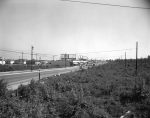
Cambie Street, looking south from 41st Avenue, 1952. (photo from City of Vancouver Archives via jewishmuseum.ca/oakridge)
On Nov. 23, the Jewish Museum and Archives of British Columbia had both its annual general meeting and launched its newest online exhibit, Oakridge.
JMABC board president Perry Seidelman called the AGM to order and noted a major absence.
“Forty-five years ago,” he said, “Cyril Leonoff became our founding president and was at our side throughout all of those years. However, sadly, this ongoing support ended this year with Cyril’s passing. There is so much that can be said about Cyril but tonight I will only say that he has been and will continue to be missed. It goes without saying that we would probably not be here tonight if it was not for Cyril Leonoff.”
Seidelman then went on to list some of the year’s accomplishments, including ongoing speaking engagements and historical tours, as well as the recording of 35 new oral history interviews and the digitization of “various family fonds, the Mountain View Cemetery Restoration Committee fonds and the Temple Sholom fonds.”
He noted that the digitization of “the oldest books from Congregation Emanu-El (1861 through 1901 approximately)” was complete and they will be online soon, that several online exhibits had been mounted during the year, and that the museum’s “largest collection by far, the Canadian Jewish Congress, Pacific Region, fonds, has begun to be processed, with immense research potential.”
The museum handled hundreds of research requests, he said, and “received donations ranging from fiction manuscripts to synagogue records to WWII records.”
Seidelman noted that longstanding JMABC member (and a past president) Bill Gruenthal was recognized by “Jewish Seniors Alliance for years of extraordinary volunteer work” and that archivist Alysa Routtenberg had “recently completed her first year as archivist as Jennifer Yuhasz’s successor. It has proven to be a nearly seamless transition with a continuing and increasing inflow of documents and interviews and regular transmission of the vast history of which we are guardians.”
He thanked JMABC administrator Marcy Babins, JMABC coordinator of programs and development Michael Schwartz, Shirley Barnett for her leadership in the restoration of the Jewish section of Mountain View Cemetery, Cynthia Ramsay for editing the JMABC’s annual journal, The Scribe, and donors and funders, including the Jewish Federation of Greater Vancouver. He bid farewell to three members of the board – Barnett, Chris Friedrichs and Barbara Pelman – and welcomed four new members: David Bogoch, Alan Farber, Alex Farber and Carol Herbert.
After the AGM was the Oakridge launch.
“With this exhibit,” said Schwartz, “we set out to document an important period in our community history; a moment when a population boom coincided with financial stability and postwar optimism to cause our community to grow both in size and stability in a way rarely seen before or since. This era set a new foundation for our community that we have built upon and relied upon ever since.
“This exhibit places this period in context with events happening both before and since. It asks why and how many Jewish families and institutions chose to establish themselves in Oakridge.”
Compiled over two years, the Oakridge research team was Erika Balcombe, Junie Chow, Elana Freedman and Josh Friedman, with Schwartz. A large portion of the exhibit comprises oral history interview excerpts from community members Harry Caine, Vivian Claman, Irene and Mort Dodek, Gail Dodek Wenner, Wendy Fouks, Debby Freiman, Sarah Jarvis, Ed Lewin, Sandy Rogen, Ken Sanders, and Seidelman.
“Irene deserves double thanks,” said Schwartz, “as we have included an excerpt of an interview that she carried out with Bea Goldberg and Marjorie Groberman in 1996. Naturally, I thank Bea and would certainly thank Marjorie were she still with us.”
Schwartz also gave thanks to JMABC colleagues Babins and Routtenberg, as well as Yuhasz, “each of whom devoted much time and energy to this project,” and the board of directors.
At the turn of the last century, explained Schwartz, “there were essentially two interconnected Jewish communities: the affluent Reform Jews in the West End and the Orthodox, working-class Jews in the East End, what today we call Strathcona…. Over time, the Jews of the East End grew more financially stable and began to relocate to the new neighborhood of Fairview in the 1920s and ’30s.”
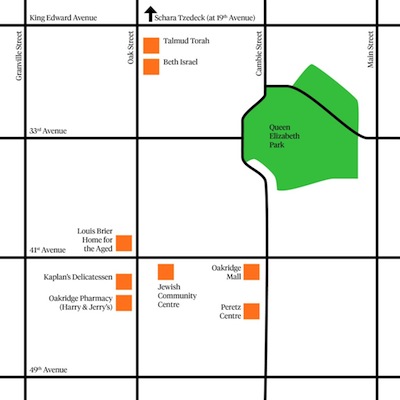
He noted, “If the Great Depression hadn’t hit, it seems likely that Oak and 12th Avenue would have been the heart of the Vancouver Jewish community. Instead, campaigns to build Beth Israel, Talmud Torah and a new Schara Tzedeck were put on hold until after the war. All three projects were completed in 1948. By that time, the city had continued to expand southward, so these three facilities were built closer to King Edward Avenue.
Oakridge Mall at 41st and Cambie opened in 1960 and provided a commercial hub for the neighborhood, which attracted many young families – Jewish and not – to the area. (image from jewishmuseum.ca/oakridge)
“This southward shift was further encouraged by another important event,” he continued. “In 1950, the CPR, the Canadian Pacific Railway, released a parcel of land stretching from 41st Avenue and Granville Street to 57th Avenue and Main Street. The city identified the middle third of this land for residential development and worked with Woodward’s and other developers to construct Oakridge Mall as an anchor for the new neighborhood.
“This neighborhood didn’t attract exclusively Jews, but it arrived at a perfect moment for our community.”
There was a lot of material from which the researchers had to choose. “The work was to pare it down to a manageable size, a representative cross-section of the community,” said Schwartz. “As you can imagine, everyone we spoke to had a very different experience. For instance, Vivian Claman and Ed Lewin shared with us the experience of survivor families.”
In the exhibit, said Schwartz, Lewin comments, “The survivors and their children were almost like a sub-community of the Jewish community. We kind of did everything together, we were like an extended family.”
“In general, the Baby Boomers we spoke to had happy memories of their childhoods,” said Schwartz, giving the example of Claman.
“We played in the street – we would be gone all day,” she says in the exhibit. “We played kick the can! I mean, those were the days that you would go outside and you would just play till it was dark or till your parents yelled and said come in for dinner. There was a lot of hanging out.”
That’s not to say everything was perfect. Schwartz noted Mort Dodek’s comments in the exhibit.
“One other thing that you have to understand is that there was a lot of antisemitism at that time,” says Dodek. “There were people who were uncomfortable living in Shaughnessy, a lot of Jewish people were not comfortable there. The Shaughnessy Golf Course was there, and it was restricted, no Jews were allowed to join that club.”
And Irene Dodek notes, “When we first moved to Vancouver in 1947, my parents went out with a real estate man to look at a house at 25th between Oak and Granville, and the real estate agent told my father, ‘This is a good neighborhood because no Jews or Chinese are allowed.’”
Schwartz also pointed out that there were divisions within the Jewish community, citing Seidelman and Mort Dodek’s comments from the exhibit.
“The rabbi of Schara Tzedeck would not go to Beth Israel, would not be seen to enter, whereas today they have the Rabbinical Association, all the rabbis get on really well together and they seem to respect each other’s different levels of observance, whereas in those days they didn’t,” says Seidelman.
“If you want to talk about splits in the community,” says Dodek, “there was a terrific split between the people who were involved with the Peretz shul and people who were involved with, say, Talmud Torah…. It was not religious and believed that the main language to speak for a Jewish person was Yiddish. And, of course, the people at the Talmud Torah, the language to speak, of course, with the establishment of the state of Israel, was Hebrew.”
“Another theme that emerged through our interviews,” said Schwartz, “was the way gender roles were changing and have changed since the 1960s. Men always worked outside the home, but women rarely did. This was beginning to change, but very slowly. Without full-time jobs, women had the time to dedicate to volunteer organizations like Hadassah and National Council of Jewish Women. Both organizations accomplished a great deal in the 1950s, ’60s and ’70s, but have struggled in the years since, as fewer young women have the time to devote to this type of work.”
For anyone wanting to know more about the role of women in the community, Schwartz recommended the museum’s 2013 exhibit More Than Just Mrs., which can be found online.
“Oakridge, like each of our exhibits, serves three functions,” said Schwartz, listing those functions: a chance to grow the museum’s archives, to increase awareness of the JMABC and of Jewish life in the province, and to reflect on how the community has changed over time.
For the Oakridge exhibit, he noted, the majority of the oral history interviews “were undertaken by volunteer and student interns, giving them valuable experience in the art and science of oral history interviews. Thanks to projects like this, including other exhibits and our annual journal, The Scribe, our oral history collection has grown substantially in recent years, bringing our current total to 762 interviews.
“Just this month,” he added, “we held two interviewer training sessions as the first phase of our Southern African Diaspora Oral History Project…. Through this project, we intend to interview hundreds of community members who arrived here from South Africa and the neighboring countries in the 1970s, ’80s and ’90s.”
With respect to increasing awareness, Schwartz said, “Many of you will remember the launch of our modern architecture exhibit New Ways of Living back in January of this year. This event had an attendance of over 150 people, many of whom were not Jewish and found out about the event through our partners, Inform Interiors and the UBC School of Architecture and Landscape Architecture. Similarly, our 2015 exhibit, Fred Schiffer: Lives in Photos, attracted more than 800 people over its two-week run, again with much thanks to our partners, Make Gallery and Capture Photography Festival…. Each new exhibit has a specific thematic focus which draws in a new audience.”
As for reflection on the Oakridge years, Schwartz pointed to the expansion of the Jewish community. “Families,” he said, “have settled into neighborhoods throughout the city and the region in general.”
Referring to the Oakridge area, he concluded, “[I]f fewer and fewer Jews live in this neighborhood, does it make sense for the Oak Street corridor to remain the hub of much Jewish activity? This remains to be seen.”
Mauro Perelmann is coming from Brazil to lead a Dec. 17 musical tribute to Naomi Shemer and Leonard Cohen. (photo by Natan Guterman Fotografia)
On Dec. 17, Congregation Beth Israel will host a tribute concert to Israeli singer songwriter Naomi Shemer. The brainchild of Brazilian musical director, composer and arranger Mauro Perelmann, who appeared at Or Shalom last winter, the tribute show was originally created for a performance in Rio de Janeiro, Brazil. Following its success there, Perelmann is bringing the show to Vancouver, featuring local singers Stephen Aberle, Debby Fenson and Wendy Rubin.
The Vancouver concert – which will also include a tribute to Canadian icon Leonard Cohen, who passed away since the initial plans were made – is the result of extensive collaboration both internationally and within the Jewish community here. With the help of Perelmann’s friend Yom Shamash and sponsored by Congregation Beth Israel, Limmud Vancouver and Or Shalom, the concert features Shemer’s “best and most beautiful songs,” said Perelmann.
The archetypal Sabra, Shemer was born in 1930 at Kvutzat Kinneret, the Galilee kibbutz her parents helped found. Like other celebrated artists, she served in the Israel Defence Forces as part of the Nahal entertainment group, and went on to study at the Rubin Academy of Music in Jerusalem, now the Jerusalem Academy of Music and Dance.
After studying both classical and folk guitar in his home city of Rio de Janeiro, Perelmann followed in Shemer’s footsteps at the Rubin Academy. He studied there for a period of four years, 1976-1980, and it changed his life.
Raised in a secular Jewish home, both he and Shamash were members of Hashomer Hatzair, the Zionist youth group. Perelmann described his time in Israel as “a very touching experience, very important to my life.” On returning to Rio, he said, “I began to work as a musician, composer, arranger in Brazil. I returned to klezmer, to Hebrew and Israeli music. I began to work here in the Jewish community.”
Nowadays, Perelmann’s work follows “three branches,” he said: Jewish music; vocal music for choirs and other groups; and soundtracks for television and movies.
With only two weeks between his arrival in Vancouver and the concert, Perelmann has rehearsed with the three local singers via Skype. It was the first time he had used this technology to rehearse music.
“I sent them the scores with the voices written down and we used the technology to shorten the distance between us. It worked well! They went to the same place, I heard them singing, gave them feedback. When I arrive in Vancouver, we’ll rehearse with the whole band.”
Perelmann speaks passionately of Shemer’s compositions. He referred to her as “the voice of Israeli culture until the 1970s: the love of nature, of the people,” and added, “any Jew raised with music must know Naomi Shemer.” He described a wide-ranging repertoire, from touching love songs like “Umbrella for Two,” to lyrics describing scenes of everyday Israeli life, childhood and nature. Shamash described Shemer as the representation of “our idealized vision of a just, socialist and Zionist Israel.”
Concert-goers can, of course, look forward to hearing Shemer’s most celebrated work, “Yerushalayim Shel Zahav.” Made famous by Shuli Natan’s passionate renditions, it is a hauntingly nostalgic work, commemorating the end of the Six Day War of 1967. Combining a magical mix of open-hearted optimism and steely conviction, Shamash commented, “it was a kind of national anthem,” which united both a country and a generation of Jews around the world.
While it is widely regarded as a second national anthem of Israel, the song is not without controversy. In response to questions about the origins of the melody in Basque folk music, Perelmann said, “it happens in music; it wasn’t a conscious decision.”
And Shemer is known to have raised questions from Amos Oz, and others, over the perceived politics in “Yerushalayim Shel Zahav.” Describing the Jerusalem marketplace as “empty” without Jews, one might imagine that Shemer’s song disregards the presence of Arab Israelis. However, as Perelmann explained, Shemer clarified, “If there are no Jews there, then it is empty to me.”
Among the other Shemer songs to be featured at the Vancouver concert are “Al Kol Eleh,” “Hurshat Ha’Eucalyptus” (her song about the trees of Kvutzat Kinneret), “Lu Yehi,” “Orhim Lakayitz” and “Mahar.”
Vancouver singer Fenson treasures memories of “sitting around a campfire singing songs,” and described a lifelong relationship with Shemer’s music. “I received a book of Naomi Shemer songs for my bat mitzvah,” she shared. “Part of learning to speak Hebrew came from reading and singing those songs. Later, I used Naomi Shemer’s songs (and others) to help a friend who was also learning the language.”
As for the Cohen component of the concert, Shamash said, “The idea to add a small tribute to Leonard Cohen came from the Canadian singers…. The news of Leonard Cohen’s passing hit everyone hard, especially because it came two days after Donald Trump’s election. All of a sudden, the world looked darker and the need to grieve and mourn became more urgent. We all needed to see the light through the cracks of the broken world. I was asked to call Mauro to add a few Leonard Cohen’s songs. He understood. Hallelujah.”
The Shemer and Cohen tribute at Beth Israel on Dec. 17 starts at 8 p.m. Tickets are available at brownpapertickets.ca or at the door.
Shula Klingeris an author, illustrator and journalist living in North Vancouver. Find out more at niftyscissors.com.


 After Haaretz journalist Ronit Vered explains the history of Israel’s cuisine from the 1950s to today, Rothfeld and Silverton embark on a tour of Israel – Tel Aviv-Jaffa, the north, the centre, the south, Jerusalem and the Judean hills, concluding with the “ecosystem of Israel Eats,” meaning the people who contributed to the book.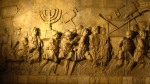
 The way the house was designed, the bathrooms on the second floor shared a common wall, tub alongside tub and toilets back to back. The insulation was fairly thick, but subdued sounds could get through, and soon after the Winn family moved into 91 University Avenue, my father and Ruth Winn discovered that they observed similar morning shower routines. The muffled knocking back and forth on the tiles at 7:15 a.m., then a cute neighborhood joke, is now a piece of family folklore.
 Beauty adored me, but Bubbe Mary did not seem to have much time to see me. Also, Beauty was all about being healthy, using a lot of fresh fruits and vegetables in all her dishes. Bubbe Mary was all about recreating the dishes that made her feel closer to Old World traditions she left behind in Romania.