Skip to content
  • Home
  • Subscribe / donate
  • Events calendar
  • Business Directory
  • FAQ
  • News
    • Local
    • National
    • Israel
    • World
    • עניין בחדשות
      A roundup of news in Canada and further afield, in Hebrew.
  • Opinion
    • From the JI
    • Op-Ed
  • Arts & Culture
    • Performing Arts
    • Music
    • Books
    • Visual Arts
    • TV & Film
  • Life
    • Celebrating the Holidays
    • Travel
    • The Daily Snooze
      Cartoons by Jacob Samuel
    • Mystery Photo
      Help the JI and JMABC fill in the gaps in our archives.
  • Community Links
    • Organizations, Etc.
    • Other News Sources & Blogs
  • JI Chai Celebration
  • JI@88! video

Recent Posts

  • SFU honours Gloria Gutman
  • Lifting people’s spirits
  • Wedding a ray of light
  • Indigeneity and Zionism
  • Rule of law broken: councilor
  • Football and its roles
  • The burden of defence
  • Fish Café returns after fire
  • All right in what goes wrong
  • Nuns & mermaids at TUTS
  • Camp offers holiday retreat
  • Students and mentors inspire
  • Once-in-a-lifetime trip
  • 100 dancers, one heart
  • Money for the sciences
  • What “Jewish food” means
  • Have a cookie, schnitzel too
  • Federation now across BC
  • Israel fighting for its existence
  • Deal strengthens Iran
  • Patriotic belonging diminishes
  • A campaign to engage
  • Upstanders’ first live event
  • Responding to Carney
  • Having your own home
  • Music a family tradition
  • Musical to warm heart
  • Community milestones … June 2026
  • Sharing her passion for Israel
  • Or Shalom reopens its doors
  • JFS from past to future
  • Need holistic approach
  • Sharing stories, advice
  • Journalist shares fears
  • Skills to live together
  • Road to independence

Archives

Follow @JewishIndie
image - CJN box ad Rockowers 2026

Tag: Zack Gallery

Modern ancient Jewish tales

Modern ancient Jewish tales

“Golem,” by Dina Goldstein. Pigment print on paper. 32 x 40 3/8 inch. (© Dina Goldstein)

Artist Dina Goldstein is a proven storyteller, so it’s not surprising that she was asked to take part in the exhibit Jewish Folktales Retold: Artist as Maggid, which opened at the Contemporary Jewish Museum in San Francisco on Sept. 28. Metro Vancouverites will also have the chance to see her photographic interpretations of 11 “classic Jewish tales” – Snapshots from the Garden of Eden – at the Zack Gallery this month.

Jewish Folktales Retold was inspired by the book Leaves from the Garden of Eden: One Hundred Classic Jewish Tales by Howard Schwartz (Oxford University Press, 2008). As CJM executive director Lori Starr explains on the exhibit’s website: “Schwartz elucidates four varieties of these tales: fairy tales, folktales, supernatural tales and mystic tales. Fairy tales, he writes, are ‘fantasies of enchantment.’… Folktales ‘portray the lives of the folk as they imagined them, with … magical and divine intervention.’… Supernatural tales portray fears about the powers of evil entities and, finally, mystical tales are teaching stories of the great rabbis.”

“I was asked to participate over a year and a half ago,” Goldstein told the Independent. “At first, I discussed this with the curator, Pierre-François Galpin. At that time, I was planning on starting another series and I told Pierre-François that I just couldn’t take this on, as I saw it as quite an ambitious project.”

But, Goldstein was curious enough that she asked Galpin – who worked with CJM chief curator Renny Pritikin on the exhibit – to send her Leaves from the Garden of Eden so she could take a look.

“After receiving it,” she said, “I found that I really enjoyed reading these ancient stories. I told him that I could possibly photograph a few pieces as a contributing artist.

“I became intrigued by a few specific characters in the book and proceeded to take on more than I had anticipated at the beginning. I continued to photograph 11 pieces for the exhibit. I also decided to photograph the series in black-and-white large-scale tableau.”

Goldstein had free creative rein. “The museum did not give me any direction at all,” she said. “In fact, I came back to them with the chosen characters and ideas that I had for the retelling of these folktales. They did not see the work until it was completed.”
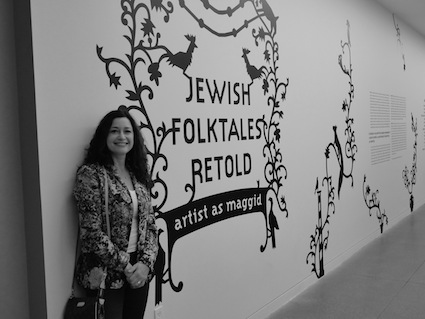
photo - Dina Goldstein was one of the artists whose work was commissioned by the Contemporary Jewish Museum in San Francisco for the exhibit Jewish Folktales Retold: Artist as Maggid
Dina Goldstein was one of the artists whose work was commissioned by the Contemporary Jewish Museum in San Francisco for the exhibit Jewish Folktales Retold: Artist as Maggid. (photo from Dina Goldstein)

The characters Goldstein has reinvented for contemporary audiences include Lilith (from the story “The Queen of Sheba”), Elijah (“The Cottage of Candles”), Golem (“The Golem”), King Solomon (“The King’s Dream”), the Princess in the Tower (in the story of the same name), the positive spirit Ibbur (“The Soul of the Ari”), the malicious spirit Dybbuk (“The Dybbuk in the Well”), the Tree of Life (“An Apple from the Tree of Life”) and Ashmodai (“The Bride of Demons”). She has also created an image inspired by the story “The Hair in the Milk.”

“I selected characters that were relevant and reappear throughout many of the tales in the collection,” Goldstein told the Independent. “I chose characters from each of the four types of tales: folktales, fairy tales, supernatural and mythical tales.”

She created two images for Ashmodai.

“I very much enjoyed this narrative, ‘The Bride of Demons,’ with relevant themes of desire and retribution,” said Goldstein. “The story is quite long, so I wanted to create a diptych to illustrate and interpret it in my own way.”

The Snapshots catalogue explains, “A devil king, Ashmodai is mentioned in talmudic legends and Renaissance Christianity. He is regarded as the demon of lust and is responsible for twisting people’s sexual desires.”

In one of the Ashmodai images, a woman in a bridal dress looks happily at herself in a half-length mirror; there are other mirrors in the room, which show her from different angles. In the second image, we see what looks like a garden, with the woman, buried, screaming, only her head and bridal veil above ground. The quote accompanying this disturbing scene is, “… And he longed to look at her … but he remembered the words of the rabbi and did not turn his gaze away from the king of demons. If he had, he would have seen his bride buried in the earth up to her neck, for she was almost lost to the Devil.”

All of Goldstein’s tableaux are striking, fascinating to explore and contemplate.

“I very much enjoyed uncovering these richly textured ancient tales and short stories, which include magnificent characters: kings and queens, princes and princesses, witches, mystics and malevolent wandering spirits,” she said. “Each of the characters face extraordinary challenges – placed in front of them by fate – that they must overcome. Every society is replete with myths and legends that transform and bend into parables that attempt to make order of life. It is this impact on culture, old and new, that led me to create a body of work that plays with satire, metaphor and irony.”

Goldstein’s photographic creations challenge viewers’ perceptions, asking them to reconsider the stories they’ve been told. Her collections include Fallen Princesses, which imagines how 10 of Disney’s princesses would face the challenges of real women; In the Dollhouse, which focuses on Ken and Barbie’s not so happily ever after; Gods of Suburbia, which brings various deities down to earth; and Modern Girl, which looks at consumerism in Western culture using the imagery of Chinese pinup girls from the 1930s.

The creative process for Snapshots from the Garden of Eden was similar to that of these previous works.

“I do my usual research online and then I hit the library for historical references,” said Goldstein. “I like to get a sense of how these characters have been depicted in art throughout history, what has been written about them from various sources. Many of these characters are actual historical figures. Others are supernatural and exist in various forms throughout the stories.”

It took her eight months to produce and photograph the series, she said. “Much of my work is in preproduction, organizing the cast and crew, the locations, and collecting all of the props and costumes and details that are germane to the final result of the piece.”

She concluded, “I am very fortunate to live in the city which has so much talent to utilize. All of the cast and crew are from Vancouver. I reached out on Facebook and social media to find all sorts of strange items – people pulled together to help out. I am thankful to Gordon Diamond, who has been a great supporter of my work throughout the years. Gordon will donate the series for viewing at the Jewish Community Centre in December.”

And, because of that, local community members will have the chance to see Goldstein’s work at the Zack. Snapshots from the Garden of Eden opens Dec. 14, 7 p.m., and runs until Jan. 20.
Format ImagePosted on December 1, 2017November 29, 2017Author Cynthia RamsayCategories Visual ArtsTags Dina Goldstein, folk tales, Judaism, photography, Zack Gallery
Granirer exhibit, book linked

Granirer exhibit, book linked

Pnina Granirer’s current art exhibit, which is at the Zack Gallery until Dec. 12, features work highlighted in her memoir, Light Within the Shadows. (photo by Olga Livshin)

Pnina Granirer has always been an experimenter. She enjoys trying new artistic techniques, forms and directions. Consistently ignoring the trends, she has forged her own path towards meaning and beauty.

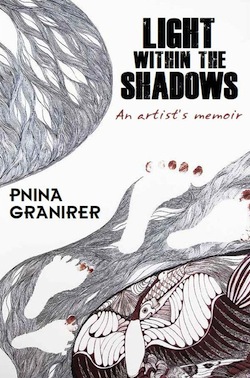
Granirer’s memoir, Light Within the Shadows, was launched on Nov. 16, as part of the Cherie Smith JCC Jewish Book Festival. The event was held in conjunction with the opening of her solo show at the Zack Gallery. As the exhibit includes some of the same paintings and drawings Granirer highlighted in the memoir, it serves as a mini-retrospective of her artistic life.

“People often told me, you had such an interesting life, you should write about it,” she said in an interview with the Independent. So, she did. “I wrote bits and pieces over the years, but my painting always interfered. I’d get distracted by a painting or a series and I would forget what I wrote before. I realized that I couldn’t paint and write at the same time.”

The concept of time is significant. “Time is what differentiates visual art from any other creative expression, like writing or music,” she explained. “According to some research, people in a museum spend an average of three seconds in front of a painting. But, to read a book or listen to a symphony or watch a movie, they have to spend hours. The same is true from the creator’s point of view. When I look at my painting, I see everything at once, all the details. I know what and where I have to fix. But, when I looked at my manuscript, I needed to read from the beginning to remember the details I had written in the previous chapters. I needed time.”

To solve this dilemma, she stopped painting about four years ago to concentrate on writing. “I wanted to tell my story and, for that, I needed words. Painting wasn’t enough anymore,” she said.

Granirer started by reading a number of memoirs. She took creative writing classes. She delved into history and studied old family photographs, while researching her family roots. And she wrote.

“By 2015, I had a very long manuscript, but I still didn’t have the ending. Then, in June 2015, we visited Romania, the country of my birth, for the first time in 65 years. When we came back, I ended up in a hospital. Had two surgeries. Suddenly, I knew what the ending was. I was fortunate. Serendipity is the new motto of mine. Of course, my life was not all roses, but I cherished everything good that happened to me.”

A consummate professional in everything she does, Granirer knew that finishing a manuscript was only half the job. “I needed to structure it in a way that would make sense,” she said. “I decided on a story in three acts to highlight the three stages of my life, three languages, three countries: Romania, Israel, North America.”

She also had to deal with one of the most important considerations for any memoir writer: the people who feature in the book, especially the ones who are still alive. Granirer was very sensitive about the issue. “When you write a memoir,” she said, “you have to think about other people’s feelings, of course, but it was my book, my life. I tried to avoid offending anyone, but I felt I had to be as honest as possible. I didn’t lie. If I couldn’t say anything nice about someone, I often skipped that person. I did mention some disappointments in the book but, mostly, I focused on how lucky I was.”

After that, it was time for test readers. “I asked a few people to read the manuscript, and the feedback was very encouraging. Then I found a wonderful editor – Pat Dobie. She did a stellar job. She cut off about half the text, everything that wasn’t my story, but rather historical background or stories of the other members of my family. Pat said it takes the reader away from my story. She also rearranged some sections and paragraphs to make the flow better.”

The next step – publication. Again, Granirer embarked on a period of extensive research. “I thought about traditional publishing and contemplated looking for an agent, but I didn’t have the time,” she said. “I’m in my 80s. When you send a book to an agent or a publisher, you have to wait for a year to get an answer, and it might not be a yes. But, even if it is, and they accept it, it would take another year or two until publication.”

To skip that waiting time, she published the book herself, with the help of Granville Island Publishing. “They were great,” said Granirer.

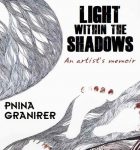
Yet more research was needed to choose the right title and the right cover. Of course, the cover would be one of her paintings; that was never in question. It was an artist’s memoir after all. But which painting? After browsing through her archives, Granirer finally picked the painting that became the cover. “It has my son’s footprints, when he was young, like a child’s journey. It seemed fitting,” she explained.

Selecting which illustrations should accompany each of her story’s three phases was another crucial task. “Some of the paintings I included are still in my studio, others have been sold, but I have the JPG files,” she said.

Now, she is deeply involved in the next stage of the publishing business – promotion. As she does everything in her life, she approaches it with panache and determination. In her publishing endeavour, like in her art, she is aiming for total success.

Granirer’s art is at the Zack until Dec. 12.

Olga Livshin is a Vancouver freelance writer. She can be reached at [email protected].

Format ImagePosted on November 24, 2017November 23, 2017Author Olga LivshinCategories Books, Visual ArtsTags Jewish Book Festival, memoir, Pnina Granirer, Zack Gallery
Granirer paints with words

Granirer paints with words

I am the proud owner of a Pnina Granirer work. More importantly, I am privileged to know the wonderful human being who is Pnina Granirer. After reading Light Within the Shadows: A Painter’s Memoir, I now know more about her art, its influences and styles, and her life, its joys and challenges. I also discovered that she writes as beautifully as she paints, and has a warm sense of humour.

Each chapter features a relevant quote from people throughout history, something they said or, most often, wrote; people as diverse as Roald Dahl, Anne Frank and Shakespeare. In these and her own words, Granirer imparts not only her life story but her philosophies on creativity, education, identity, family, business.

“There are people who plan their lives meticulously, step by step – I have never been one of them,” she writes. “Of course, I had goals, but these were like signposts to be reached one by one, short-term endeavours without a specific plan for the faraway future. I rather liked the idea of floating along, steering my boat from time to time and hoping that I would reach my destination, whatever it was meant to be.”

And the 82-year-old has experienced many destinations on her continuing journey. In a May interview with the Vancouver Sun, she talked about having written a book twice the size of what was published.

“There were a lot more historical references, many stories about family members and some more memories – it was too long and had to be cut,” Granirer told the Independent.

About the possibility of another book, she said, “I’m thinking about this and how I could use some of the chapters that have been cut, but, at the moment, I’m far too busy with getting through with the exhibition. I need a quiet space in order to begin thinking about writing and hope that I’ll begin doing just that early in 2018.”

book cover - Light Within the Shadows Granirer will do an artist’s talk at the Sidney and Gertrude Zack Gallery on Nov. 16 to open an exhibit of her work mounted in conjunction with the Cherie Smith JCC Jewish Book Festival because the occasion also represents the launch of her memoir. The event is sponsored by National Council of Jewish Women. This is especially appropriate because one of the topics that Granirer explores in her memoir is the difficulty of being a mother, a wife and an artist. About the 1970s, when her two sons, David and Dan, were young, she remarks, “I had little contact with the visual arts community in general and its avant-garde segment in particular. I didn’t have much time for forging professional ties, as my world consisted of my husband and my sons, who were a great source of joy and a well of inspiration for my art.” In this period, she not only produced much work, but also took on teaching.

Her memoir – which includes pages of colour photographs of her work – is divided into three acts. It takes readers from Romania, her birthplace and where she grew up, surviving the Holocaust; to the safety of Israel in 1950, to where first her father, then the family, fled from the dangers of communist Romania; to the United States in 1962, where her husband Eddy, a math professor, could find work, as the recently initiated American-Russian space race saw Americans “pouring money and resources into research, hoping to be the first to put a man on the moon…. Mathematics, the cornerstone and essential building block of scientific research, was suddenly in high demand all over North America.” Three years later, the Granirers would make their way to Vancouver.

Granirer talks about luck throughout the memoir and, specifically, about a couple of “old hackneyed sayings” being true, that of being “in the right place at the right time” and of being “born under a lucky star.” “Events beyond our control do change the course of our lives,” she writes. And, while they don’t always do so for the better, Granirer chooses, at least in looking back, to appreciate her good fortune.

“Of course, I never even thought of being lucky at the time,” she admitted to the Independent. “One just lives one’s life as it comes along and only later, in retrospect, one sees the whole picture. Getting older allowed me to have a better perspective of the past and writing the memoir brought it all together. We kept saying for years how lucky our family was to live in Vancouver, but day by day there were ups and downs and the occasional complaints when unfortunate events happened – and they did. The memoir was a watershed for me and helped me see the serendipitous moments in my life when fate could have gone easily the other way.”

The light and shadows of the book’s title not only apply to the vividness of remembered moments and the darkness in which forgotten moments lie, but also the grey areas through which we must travel in life – the uncertainties, the aforementioned circumstances beyond our control.

When asked if she was a naturally optimistic person or developed into one, she said, “I probably am more of the former, although that does not mean that there are not times when I feel as if the world is collapsing on me. There have been hard times for me in the past, but somehow I seem to manage to get through. I just try to deal with the black thoughts, when they come. Nothing is really black-and-white, it’s through the shadows that we have to find our way.”

In addition to geopolitics, health and other uncontrollable issues, Granirer also had to negotiate the politics of the art world, in which she had to deal with many curators who “did not seem to be interested in art and artists, except as tools for enhancing their own careers.”

“… meeting someone who loves a painting and wishes to live with it, who wants to learn the details of its creation and is convinced that owning it will enrich his or her life, is the most rewarding experience for an artist.”

Nonetheless, she persevered – “Early in my career,” she writes, “I decided to follow my own course, regardless of the cost.” She did so, even as she realized that, in her profession, “being different was not considered an asset, but a liability.” Though admitting that all artists, including herself, crave recognition, she writes that “meeting someone who loves a painting and wishes to live with it, who wants to learn the details of its creation and is convinced that owning it will enrich his or her life, is the most rewarding experience for an artist.”

To mark her 80th birthday, in 2015, and her 50th year in Canada, Granirer gave many others a gift. “Established galleries usually charge the artist 50% commission for each work sold, in exchange for space and promotion,” she explains. “Why not invite the public … for 10 days and offer the commission to my collectors instead.” It was because of this generosity that I was able to buy my first Granirer.

After this exhibition and sale, Granirer and her husband headed back to Romania, 65 years after they had left the country. It was a meaningful visit with at least three serendipitous occurrences. But, back in Vancouver, she ended up in hospital. Sixteen days later, after two surgeries for diverticulitis, she made it home. “I counted my blessings and told myself how much worse it could have been,” she writes. “What if it had happened while I was in Romania?”

She returns to the memoir’s opening paragraph about getting older, in which she remarks, “Simple words like ‘later,’ ‘next year,’ ‘tomorrow,’ ‘not now,’ become risky, unsure and speculative.” But there is also much to look forward to, she says. At the time of writing, it was an international exhibit in Costa Rica and one in Spain. Currently, she’s preparing for the Zack Gallery exhibit and the launch of the memoir. The event takes place Nov. 16, 6 p.m., and admission is free. It will be a great opportunity to meet the artist – and pick up a copy of Light Within the Shadows.

Format ImagePosted on November 3, 2017November 3, 2017Author Cynthia RamsayCategories BooksTags art, Cherie Smith JCC Jewish Book Festival, memoir, Pnina Granirer, Zack Gallery
From graceful to outrageous

From graceful to outrageous

From the left: Zack Gallery’s Linda Lando and jewelry artists Julie Kemble and Barbara Cohen. (photo from Zack Gallery)

Just as our clothing defines us to some degree, so does the jewelry we wear. Our choices often reflect not only our likes or dislikes, but how brave we are and how adventurous. The current group show at the Zack Gallery, called Light, features a range of unusual jewelry, from stylish and graceful, to whimsical, to outrageous. Practically everything on display, with the exception of a couple of metal sculptures, could be worn, and the gallery supplies a mirror for those intrepid souls who dare to try the pieces on.

Presented by the Vancouver Metal Arts Association, the exhibit introduces jewelry made not only of traditional materials, like silver, but of many unorthodox materials and objects, some of which have never been considered for adornment, until recently.

“These pieces remind me of far-away places, of mystery and romance. Some of them – you need a large personality to wear,” said Julie Kemble, the association’s liaison for the show.

photo - Zula, wearing her own creation, which is on display at the Zack Gallery
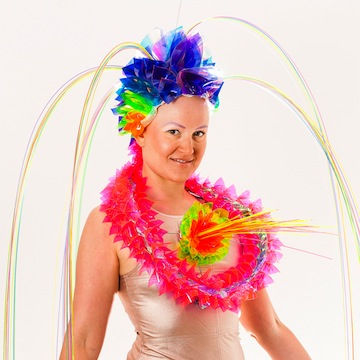
Zula, wearing her own creation, which is on display at the Zack Gallery. (photo from Zula)

According to Kemble, the show’s title, Light, invokes different interpretations. “We want to bring light into our works, into the lives of our artists and the people who wear our creations,” she said, adding that the association encourages artists to use alternative materials as well, like plastic or fabrics.

As did several other participants in the exhibit, Kemble started out as an amateur artist. She was a university teacher for many years.

“I always liked art,” she told the Independent. “At first, it was a hobby, but it is much more now. I began with textiles and gravitated towards metal and jewelry about 20 years ago. Metal allows a certain immediacy. You see right away what’s coming out of your hands.”

She explained that this show is the association’s fifth annual one and the second at the Zack. “We want to increase the profile of art jewelry in Vancouver,” she said. “That’s why this is a juried show. We invited the judges and jewelry artists from across Canada.”

Some of those artists are professionals, while others are taking their first steps on the artistic road. One of the beginners is Raymond Schwartz, but nobody would guess that by looking at his sterling silver necklaces. Elegant, sophisticated and relatively smaller than some other pieces on display, they represent a more traditional approach to jewelry.

“I’m brand new to jewelry,” he said. “I started two years ago. I’ve always been artistic, always liked doing things with my hands, but my business was construction. Now, I’m getting older, so I began making jewelry. It’s like construction, but making mini things. I also paint oils, but jewelry allows both creativity and working with my hands; it fills the void.”

This show is Schwartz’s first, although he has already sold some of his pieces.

Barbara Cohen, meanwhile, is a professional jewelry-maker with years of experience. “My background was in textile before I switched to metal. Now, I’m moving away from metal, too, using more of other materials,” she said. “I like the scale of jewelry. It is portable art.

“It’s also the most understated form of communication. When you wear a piece of original jewelry, it often starts conversations. I curated several jewelry exhibitions. Sometimes, I would wear a piece from the show, and people would admire it and ask me where it came from. They didn’t notice it in a display case but they noticed it around my neck. Jewelry should be worn. That’s why we have a mirror in the gallery, so people could see themselves wearing our art.”

Her necklaces, asymmetrical and quirky, draw the eye. Their patterns and textures make people wonder and try to decipher the artist’s ideas. They definitely start conversations.

Zula, also a professional artist, represents an extreme trend in jewelry-making. Her pieces, part of her new Neon Love collection, are a bright acrylic extravaganza, playful and flashy and fairly large. They use geometric shapes and are not for the faint of heart. It is a new development for the young artist, an experimental departure from her more traditional plant-patterned collection in silver and copper.

“I had a health crisis recently,” Zula explained. “I lost my hair to alopecia. Now I’m bald, but I chose not to wear a wig. I asked myself, what is my identity now? If I was a brunette before, am I still a brunette? I had this colourful plastic in my studio and I started playing with it. I needed to be edgy, and my new pieces provide that. They interact with light.”

Many other artists are part of the Light exhibit, which runs until Nov. 12.

Olga Livshin is a Vancouver freelance writer. She can be reached at [email protected].

Format ImagePosted on October 27, 2017October 25, 2017Author Olga LivshinCategories Visual ArtsTags Barbara Cohen, Julie Kemble, Raymond Schwartz, Vancouver Metal Arts Association, Zack Gallery, Zula
Poetry inspired by abstract art

Poetry inspired by abstract art

On Sept. 25, a group of writers gathered to write and share poems sparked by the paintings of Waldemar Smolarek, now on display at Zack Gallery. (photo by Olga Livshin)

Poetry events at the Sidney and Gertrude Zack Gallery have become a regular feature in the last few years. Every couple of months, writers of Pandora’s Collective meet at the gallery to read their poems inspired by the art. They held their latest gathering on Sept. 25.

The abstract paintings currently on display at the Zack seem to have been created to inspire poetry. Waldemar Smolarek’s work is known to gallery patrons. Smolarek’s first show at the Zack, in 2012, was posthumous – he died in 2010 – but his art is alive, infused with vibrant colours and the artist’s unique frenetic energy.

Smolarek, a proponent of purely abstract compositions, filled his canvasses with dynamic currents. His lines, in every imaginable hue, fly like arrows. His multicoloured balls dance like polka dots. His vivid splashes of blue and peach flow into each other, seemingly at random, but there is logic in the twists and turns of the artist’s brush. His art invites people to delve into their own psyche, and the poets of the evening responded to the paintings’ visual challenge with a wide variety of works: long and short, light-hearted and lamenting. Some poems were inspired by one specific painting, while other rhyming flights of fancy encompassed the entire gallery.

As the event was a collaboration between the Zack Gallery and the Isaac Waldman Jewish Public Library, Helen Pinsky, the head librarian, gave a short introduction before passing the microphone to Leanne Boschman, the host of the evening.

Although it was her first time as host, Boschman has participated in the Zack Gallery poetry evenings twice before. “The first time, the exhibition included the artist’s journal and sketches, and I found it fascinating to see the artistic journey in progress,” she told the Independent. “The second time, it was a show of abstract photographs…. I like abstract art in connection to my poetry. I can play loosely with colours and shapes and words. It’s harder when the art shows specific people or places. With abstract art, the poet is free to follow her own associations. Sometimes, it’s a story; sometimes, a feeling or a question.”

Most of the participating poets agreed with her assessment, and Smolarek’s art was a rich source for many pieces. The audience, although not large, was extremely generous in support of anyone at the mic, both the listed readers and the brave volunteers who took part in the open mic portion of the event. The friendly atmosphere, combined with the bright paintings and Boschman’s humorous but factual introductions of every reader, made the evening a joyful celebration of colours and words.

The first poet who read, Suzy Malcolm, has been writing poetry since she was a teenager. “It’s my fifth time at the Zack,” she said. “I prefer abstract art for my poetry. It feels like a gift to write about colours and shapes.” She writes poetry for children as well as adults, and her poems at this event reflected both sides of her poetic endeavours.

Eva Waldauf, the next reader, started writing poetry when she was around 40. “I’m a visual artist,” she said. “Once, I had to write a poem for a class, and I liked it. I thought it was fun; thought, ‘I could do it,’ so I began writing poetry.” Her poems were not written on the spot. “I visited the gallery last week to see the paintings, so I would have time to write and edit my poems. I like to come prepared.” Although she admitted to always being nervous before reading her poems, one wouldn’t have guessed it from her performance. Her reading, relaxed and expressive, enhanced by expansive gestures, revealed a good actress as well as an original poet.

The next presenter, David Geary, staged his poems as letters to Smolarek. His presentation was comical. As if playing a game, he strode around the gallery and enrolled everyone in the audience and all the paintings as his willing and laughing playmates.

As a counterpoint to his irreverent show, Sita Carboni’s poetry resonated with mournful tunes. One of the co-founders of Pandora’s Collective, Carboni noted that, with art like Smolarek’s, a poet is free to explore in any direction. Her poetry, contemplative and deep, included a goodbye to someone she lost recently, and she couldn’t finish her reading because of the tears that choked her.

Warren Dean Fulton also prefers abstract art for his poetry. “Abstract art allows you to project your own feeling and emotions. It is speaking to your subconscious. The poet is much less free with portraits or landscape.”

Fulton has participated in the poetry readings at the Zack before. “It is interesting to hear how the same paintings could inspire such different interpretations,” he mused. As he likes to improvise with his poetry, he hadn’t seen Smolarek’s work before that evening.

The last poet of the night, Amanda Wardrop, is also an experienced writer and reader. A schoolteacher, Wardrop said she finds poetry everywhere: in her interactions with students, in figurative art and in abstract art. “Different poetry, that’s all,” she said. “Figurative art often results in a narrative, while abstract art pushes one to a more emotional response.” She did her research before coming to the reading that night, and her poetry touched on the artist’s technique: layers and textures, as they related to our lives.

The night concluded with a lively musical performance by Kempton Dexter, who played his guitar, sang and joked to the delight of the audience.

Olga Livshin is a Vancouver freelance writer. She can be reached at [email protected].

***

Balls collide and come apart,
Lines zigzag and soar,
Feeding moxie to my heart
Fields awash with colour.

Reds and blues and greens explode
Shards and doodles frolic,
Polka dots in quirky mode,
Joyful and symbolic.

– Olga Livshin, inspired by the artwork of Waldemar Smolarek


Format ImagePosted on October 6, 2017October 5, 2017Author Olga LivshinCategories Performing Arts, Visual ArtsTags abstract art, Pandora's Collective, poetry, Waldemar Smolarek, Zack Gallery
Celebration of Venice

Celebration of Venice

Artist Iza Radinsky at Zack Gallery. (photo by Olga Livshin)

Just over 500 years ago, in 1516, the Venetian Republic forcibly moved 700 Venetian Jews to an island, the abandoned site of a 14th-century foundry. In doing so, they created the first ghetto. The word ghetto means “foundry” in the old Venetian dialect.

photo - Rachel Singel
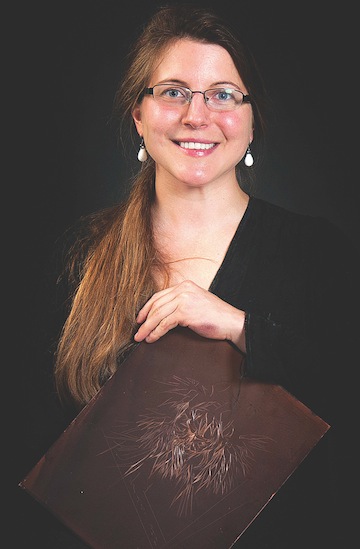
Rachel Singel (photo from Rachel Singer)

The Venetian ghetto had two access bridges, both guarded at night, and boats also patrolled the canals. Despite the isolation and other restrictions, the republic was relatively tolerant. Inside the ghetto, Jews were free to practise their religion and traditions; they were not forced to convert, as was the case in Spain and many other places throughout Europe. The ghetto became known as a place of study and scholarship, and its population grew from 700 in 1516 to more than 6,000 a hundred years later. The area – which existed until 1797, when Napoleon conquered the republic and gave equality to all citizens – remains a centre of Jewish culture.

Many Jewish and Italian organizations in North America and Europe have commemorated the 500th anniversary of the Venetian ghetto in some way. Here in Vancouver, Zack Gallery, in conjunction with Il Museo at the Italian Cultural Centre, are presenting Stories from the Stones of Venice: The Art of Rachel Singel and Iza Radinsky. The exhibit was the brainchild of Singel, an artist, printmaker and assistant professor at the University of Louisville, in Kentucky.

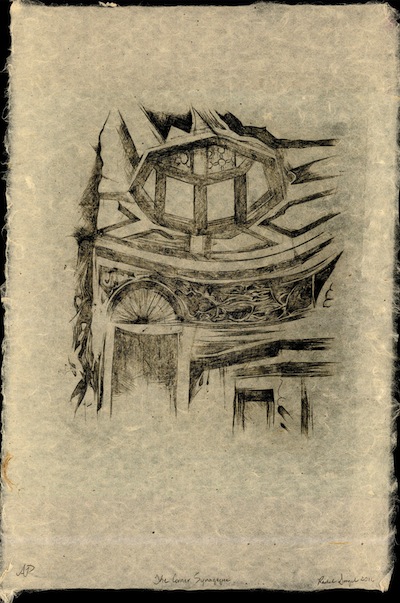
“The year 2016 marked the 500th year since the establishment of the Jewish ghetto in Venice,” she said in an email interview with the Jewish Independent. “To honour the historical anniversary and the influence of this uniquely urban space, I worked onsite in Venice for two months to create a series of etchings illustrating the buildings, structures and streets of the ghetto.”

That was not Singel’s first visit to Venice. “I first went to Venice in 2012 for an artist residency,” she said. “I have had the opportunity to return to Venice every year since. My artworks have been increasingly influenced by Venice and its fragile state…. The last two years, I have also brought my students to the Scuola Internazionale di Grafica Venezia.”

photo - “The Corner Synagogue” by Rachel Singel
“The Corner Synagogue” by Rachel Singel. (photo from Rachel Singer)

Singel has exhibited her 10 ghetto prints at the international school and at the Jewish community centre in Louisville.

“Each of the 10 images seeks to call attention to the Venetian ghetto’s importance, not only as an architectural complex within the confines of Venice, but also its worth internationally. Its structures are resonantly symbolic, representing the community’s resolute will to survive and prosper in what was an exceedingly hostile social environment.”

When Singel heard about the exhibition that was being planned at Il Museo – The Venetian Ghetto: A Virtual Reconstruction 1516-2017, which opened on July 25 – she looked into the possibility of engaging with their event. “I reached out to the Zack Gallery director, Linda Lando, about exhibiting my prints at the JCC,” Singel said.

Lando liked the idea of a Venice exhibition, but 10 small prints were not enough to fill the Zack, so Lando invited Radinsky, a local artist, to exhibit her paintings of Venice in the same show.

“Linda Lando saw five of my paintings of Venice before,” Radinsky said. “She asked me if I had more and if I would like to participate in a two-artist show together with Rachel Singel. I was happy to.”

Radinsky’s 14 large paintings and Singel’s prints form the Zack exhibit.

“I love Venice,” Radinsky said. “I first visited it in 2006, with my 86-year-old father. I was awed by the city. It was as beautiful as in the old masters’ paintings I admired as a child in the museums of Moscow and St. Petersburg, even better. Afterwards, every time I go to Europe, I visit Venice. It draws me. It’s quiet there, no cars. People walk and gondolas float on the canals. Nothing artificial, just earthy colours, red roofs, water and sky – and reflections in the canals.”

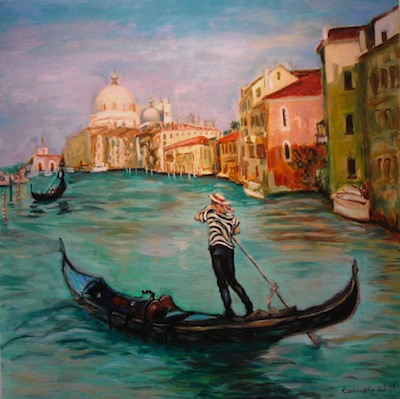
photo - “Gondolier” by Iza Radinsky
“Gondolier” by Iza Radinsky. (photo from Iza Radinsky)

In her paintings, gondolas and gondoliers look as intrinsic to the ancient city as the sunlight and shadows, the unique water streets and multiple bridges of Venice. The muted colours coalesce into one another, creating combinations that have no names. The sky and the water blend together, weaving one fantastic, living canvas.

“Venice is built on water,” Radinsky explained. “Because of the dampness, it’s hard to maintain the paint of the outside walls of the buildings. The paint often flakes off, and green mold grows close to the water. But gondolas – those look luxurious. Lots of gilt and bright colours, golden ornaments and lush fabrics and cushions for the passengers. Every gondola is an amazing piece of art. In the past, gondolas were part of the Venetian fleet. They could ram into an enemy ship, and their sharp iron bows could cut like knifes. Now, they are tourist attractions, and gondoliers are very friendly and knowledgeable. They wear special hats and traditional striped shirts. They have to study long and hard to learn manoeuvring in the narrow canals. They have to pass an exam and get a licence.”

The artist’s eyes glowed with enthusiasm as she talked about her beloved Venice. “I’ve been there four times already and I want to go again,” said Radinsky.

Stories from the Stones of Venice opened at Zack Gallery on July 27 and continues until Sept. 3.

Olga Livshin is a Vancouver freelance writer. She can be reached at [email protected].


Format ImagePosted on August 18, 2017August 16, 2017Author Olga LivshinCategories Visual ArtsTags antisemitism, ghetto, history, painting, Venice, Zack Gallery
Artists’ work complementary

Artists’ work complementary

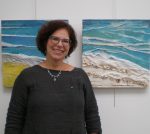
Artists Michael Abelman and Victoria Scudamore share the walls at Zack Gallery in the exhibit Sea to Sky. (photo by Olga Livshin)

In the exhibit Sea to Sky at Zack Gallery, the artists’ works complement each other. Michael Abelman’s seascapes and floral compositions lean towards the pensive and are a little wistful, while Victoria Scudamore’s abstract paintings add splashes of colour and joy to the gallery walls.

“I’ve always liked crafts, since I was a child,” Scudamore said in an interview with the Independent, “but I could never draw. I was a realtor for 30 years. Then, seven years ago, I fell off my bike and broke a wrist. A month later, I decided to take an art class. I thought: I couldn’t draw anyway, I would just have fun.”

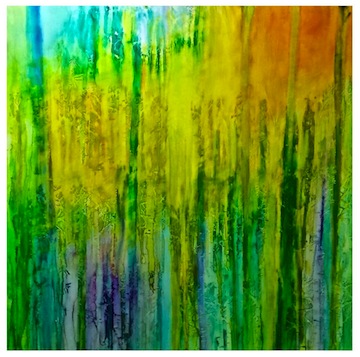
image - “Chakra Forest” by Victoria Scudamore
“Chakra Forest” by Victoria Scudamore.

She did have fun. But, also during that class, she discovered the style of intuitive, abstract painting and fell in love with it. “It resonated with me,” she recalled. She started taking more classes. “Art became a real passion of mine,” she said. “Now I have to paint every day. I don’t feel whole if I don’t paint. This is my first show, and I’m very excited about it.”

Her elation is unmistakable as she talks about her creative process.

“I’m an abstract expressionist. I try to capture emotions in my paintings,” she explained. “I want to show movement, colours in motion, to show connections. To paint abstract, I need to be in a dreamy space. I often listen to ’70s rock music and sometimes I dance when I paint. Once, I accidentally knocked off a bottle of ink onto one of my paintings, but I didn’t throw it away. I saw something in the pattern of the ink stains and painted over it, used it.”

Scudamore feels adventurous in her approach to art, ready to respond to any stimulus, be it a forest, a seashore, a flower, a bird, an ink stain or a stray thought. “I often paint two paintings at a time,” she said. “I feel freer to explore this way. Like a scientist, I experiment with colours, shapes and textures. Sometimes, I fall in love with a certain palette and do a series based on those colours. It’s all intuitive. I never know where I’ll end up when I start a painting. The beginning is the most exciting moment for me, a mystery. I’m child-like when I paint. I’m in the realm of fun.”

Her happiness in creating art makes her brave and self-confident. “I don’t compare myself with other artists,” she said. “Sure, Michael [Abelman] has been painting for 20 years; he has much more experience than I do, but I think artists shouldn’t compare with each other. It steals joy. We are all on different paths, our own paths.”

Abelman agrees with that sentiment. “I’ve been painting for 20 years but only showing for five years,” he said. “Like Victoria, I don’t compare myself with other artists, only with myself. My art is changing, evolving.”

Sea to Sky is Abelman’s second show at the Zack. His solo show in 2014 was a rainbow explosion of flowers but, this year, his paintings demonstrate a different level of maturity. Although half of his paintings are still flowers, their colours are more pastel and the ambience more contemplative. “It feels like another stage in my art and in my life,” he said. “Maybe I’m getting older.”

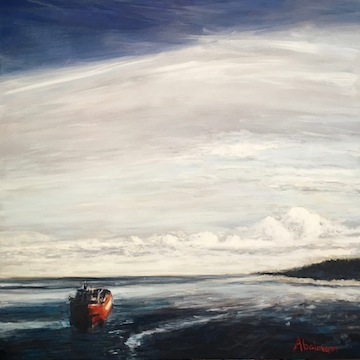
image - “Red Ship Entering Bay” by Michael Abelman
“Red Ship Entering Bay” by Michael Abelman.

Half of his exhibited paintings this year are ships: in winter and in summer, in the morning mist and in the glowing sunset. “I painted ships before but, recently, I find myself drawn to them. My ship paintings are quiet, while the flowers are always louder, exuberant with colours. I still paint flowers, but I wanted more. If you could find beauty in a tulip you could find beauty in a ship, too. I wanted to show it.”

Abelman said ships reflect a sense of exploration but also of loneliness. “A ship is always alone amid the vast ocean, and even near the shore,” he said. “You could see lots of ships in Vancouver. They arrive and depart daily. I take pictures of them when I walk along the waterline, then I take different things from different photos for my paintings.”

He constantly works on improving his skills and widening his range of expression. “Professionally,” he said, “I’m an accountant, but I never tried so hard in accounting as I do in art; never enjoyed accounting so much either. In art, I’m driven. I want to succeed, to be better. I don’t care if I sell, but I want to paint better. I’ve been taking art classes for years, and the more I learn, the more I realize how much I still need to learn.”

Like Scudamore, he paints every day but, unlike his partner in the show, his deep immersion in art doesn’t come easily. “Painting is hard for me,” he admitted. “You go into your own world for hours at a time. It’s a form of meditation. I have to focus, so no music for me when I paint. Sometimes, I listen to the news, but mostly I concentrate on my art.”

The exhibit Sea to Sky continues until July 30. For more information, check out the artists’ websites: victoriascudamore.com and michaelabelmanpaints.blogspot.ca.

Olga Livshin is a Vancouver freelance writer. She can be reached at [email protected].

Format ImagePosted on July 14, 2017July 11, 2017Author Olga LivshinCategories Visual ArtsTags art, Michael Abelman, painting, Victoria Scudamore, Zack Gallery
Artworks on healing

Artworks on healing

Gail Dodek Wenner conceived the group exhibit Physician Heal Thyself … and Others, which is at Zack Gallery until June 25. (photo by Olga Livshin)

The new exhibition at Zack Gallery, Physician Heal Thyself … and Others, includes four artists, all of them local physicians near retiring or recently retired. Regular visitors to the gallery probably will be familiar with the work of two of them – Ian Penn and Carl Rothschild, who have exhibited at the gallery before – but maybe not that of Arturo Manes and Gail Dodek Wenner.

Rothschild’s contribution to the show is a selection of small, colourful paintings, which look like snapshots of his garden or a street around the corner. Each one is accompanied by a poem written by the artist. Together, they represent his impression of his home city and its healing potential.

photo - “Preventative Medicine” by Carl Rothschild
“Preventative Medicine” by Carl Rothschild. (photo by Olga Livshin)

Penn’s part of the show is more dramatic. It includes a video and several photographed pages from his journal, where he documented the before and after of his complicated spinal surgery in 2016. His display fits the theme of the show almost too perfectly for comfort.

Manes’ paintings – his method of spiritual healing – are based on Roman Vishniac’s book of black-and-white photographs, A Vanished World.

“The Shoah has been for me a defining event not only in Jewish history but human behaviour, which I’m trying to come to grips with,” Manes said in an email interview. “Black-and-white photographs in Vishniac’s book impressed me greatly…. I used those images of my people prior to the Holocaust as a template for my paintings. By adding colour and a free rendering, I hoped to express the feelings the photographs have evoked.”

He said Physician Heal Thyself is the first exhibit in which he has participated, although he has been painting since childhood. “I’m not an artist – I’m a physician who paints. I was honoured to be invited by Dr. Gail Wenner to be a part of this show.”

Dodek Wenner invited the other doctors to participate in the show, as well. It was she who came up with the theme.

“I always loved art, but I loved science, too,” she told the Independent. “I chose medicine as my career, but art has always been my hobby.”

As an artist, she is very versatile. At one point or another, she has tried various media: painting, ceramics, textiles, photography, Hebrew calligraphy. In practising medicine, however, she stayed true to one direction: mothers and babies. “In the past 26 years, I delivered 2,000 babies,” she said. “But I made the decision to stop delivering. It’s time for a change.”

One of the precursors of her decision was going back to school, to Emily Carr University. In 2009, she received a diploma in fine art technique.

photo - “Weaver” by Arturo Manes
“Weaver” by Arturo Manes. (photo by Olga Livshin)

“I took a class, Business of Art,” she recalled. “One of the assignments was to pitch an idea for a show to an art gallery. I chose a theme: healing, what it means to be a doctor and what Judaism says about healing. I chose the Zack Gallery, and I decided to invite several Jewish physicians to participate. All for a school assignment. I didn’t actually do it at that time. I did mention it to Yosef Wosk, who is a friend, and he said it was a great idea.”

A few years later, Wosk reminded her of the idea, and she finally contacted Zack Gallery director Linda Lando. “I pitched the idea to Linda in 2016,” Dodek Wenner said. “We brainstormed it and came up with a few names of Jewish physicians who were artists.”

That was the first step. The next step was to determine what she wanted to paint for the show. “I needed to explore what healing meant to me,” Dodek Wenner explained. “Personally, I always went to my parents’ beach house when I needed to do some healing. So, I thought, what was it about the ocean that healed me?”

After some contemplation, she came up with four steps of healing. “The first one is the acknowledgement: yes, there is a problem. There is a fear, and a doctor has to acknowledge that fear in her patient. Next comes compassion, which leads to the doctor assuring her patient: I can help you. The third one is wisdom. Doctors have a huge body of knowledge. They study for many years, and they share their knowledge with the patient, use what they know for healing. Last is comfort. Comforting the patient is very important at every stage of the healing process.”

After formulating these concepts in her head, she explored what Judaism says about healing. “I looked in the siddur, the Jewish prayer book, and found all four of those concepts of healing, both body and soul, in the first couple pages,” she said.

She knew she was on the right track but wasn’t sure how to showcase her ideas through art. “I went to the beach house again, walked along the shore, and I knew,” she said. “The ocean represents all four facets of healing, too.”

Her paintings, two distinct series of five paintings, are all different interpretations of the shoreline. The ocean is sometimes quiet, sometimes turbulent and the colours of the waves fluctuate from light blue to deep green. The foam, created with the use of medical gauze, plays in the sand among the shells. The shells are real, collected by the artist along the same beach she loves so much. “I scooped them with a cup,” she said.

“My paintings don’t show one particular place,” she added. “They are the essence of a shoreline. Each piece is different, but they all connect.”

Physician Heal Thyself opened on May 25 and continues until June 25.

Olga Livshin is a Vancouver freelance writer. She can be reached at [email protected].

Format ImagePosted on June 2, 2017May 31, 2017Author Olga LivshinCategories Visual ArtsTags art, Arturo Manes, Gail Dodek Wenner, healing, medicine, Zack Gallery
Artists’ views of friendship

Artists’ views of friendship

Orly Ashkenazy’s “Strings.” (photo by Olga Livshin)

The Festival Ha’Rikud group exhibit at Zack Gallery, Celebrating Friendship, presents 23 artists in a variety of styles and media. Each artist, in his or her own special way, explores the theme of friendship.

Photographer Judy Vitek interpreted the theme literally. The children in one of her photos and the texting teenage girls in another live hundreds of miles apart, on different continents, but their friendships are unmistakable.

photo - Gaye Collins’ “Friendship through the Sands of Time”
Gaye Collins’ “Friendship through the Sands of Time.” (photo by Olga Livshin)

On the other end of the spectrum, the abstract canvas by Lauren Morris could be seen as a medley of lines and colours, intertwining and mixing like friends at a party. Or perhaps it is a firework explosion. Or a flower bouquet a friend brought one summer afternoon.

Flowers bloom in Carl Rothschild’s paintings as well, but there is nothing abstract in his imagery. Maybe the artist glimpsed his poppies and lilies in a friend’s garden or on a neighbouring street. Cheerful and unblemished, his flowers are his friends. They wave their bright petals in recognition of their creator’s love for his home city.

In contrast to Rothschild’s decidedly local milieu, Gaye Collins’ painting, “Friendship through the Sands of Time,” feels like an exotic metaphor. Two black figures stroll away from the viewer through a vague landscape, reminiscent of yellow dunes or poetic imagination. The painting is dreamlike, and the figures undefined. Friends or lovers, they tell a story everybody knows, but nobody remembers.

Another metaphor, Jennie Johnston’s small and elegant quilt, is a labyrinth, a place of search and contemplation, a path leading into the heart. Whose heart? Everyone must decide for themself.

photo - Lori-ann Latremouille’s “Flowers of Friendship”
Lori-ann Latremouille’s “Flowers of Friendship.” (photo by Olga Livshin)

Between conceptuality on one hand and photographic precision on the other, two paintings stand out – two of the few where faces play the major role. While Yodhi Williamson’s “Chance Meeting on 4th Ave” conveys the simple joy of accidentally bumping into an old friend, Lori-ann Latremouille’s “Flowers of Friendship” channels a more complex narrative. In it, undertones of doubt and surprise mingle with recognition and kinship in the artist’s deceptively transparent double portrait.

Faces also appear in Sima Elizabeth Shefrin’s two tiny fabric panels, but here they resemble primitivistic art, innocent and childlike, ideas rather than portraits. In both panels, an Arab and a Jew refuse to succumb to the current political facts – they want to be friends.

Hope also emits from Alina Smolyansky’s shining piece “Jerusalem Domes of Faith.” Three temples of three different faiths grow out of the same root, united inside one hand, one hamsa, one finite world.

photo - Alina Smolyansky’s “Jerusalem Domes of Faith”
Alina Smolyansky’s “Jerusalem Domes of Faith.” (photo from the artist)

Pamela Cohen explores a different aspect of hope: an aerial view of a brightly coloured patchwork of countries and borders. Could friendships develop across those delineated borders, as the artist implies? Or is it wishful thinking?

Orly Ashkenazy’s composition “Strings” doesn’t feel very hopeful, although its meanings resonate on many sublayers. At first glance, the painting is a random collection of rough face drawings. They look like pencil sketches. A tangle of cotton strings stretch and intersect, cross and turn, connecting those faces. The strings bind them, bind us all; however, a splash of red paint runs from top to bottom of the painting, dividing it into two separate parts like a river of blood. No string crosses the river, no connection manifests between its two sides.

photo - A tapestry by Vladimira Fillion-Wackenreuther
A tapestry by Vladimira Fillion-Wackenreuther. (photo from the artist)

Another work, a tapestry by Vladimira Fillion-Wackenreuther, pays tribute to Prague, the city of the artist’s youth. Tinged with nostalgia, the woven image is playful, uplifting. It reflects Prague’s medieval architecture, its culture-infused streets and traditional Czech marionettes. The city is indisputably the weaver’s friend, and she invites all of us to join in the friendship.

Many other artists are featured in the show – Aurel Stan, Ava Lee Millman Fisher, Beryl Israel, Claire Cohen, Gail Davidson, Joel Libin, Joyce Ozier, Monica Gewurz, Marion Eisman, Patricia Haley-Tsui, Sidi Schaffer – and each has enriched the concept of friendship with his or her unique perspective, talent and skills.

The exhibit opened May 4 and runs until May 22.

Olga Livshin is a Vancouver freelance writer. She can be reached at [email protected].


Format ImagePosted on May 12, 2017May 9, 2017Author Olga LivshinCategories Visual ArtsTags art, JCCGV, Zack Gallery
Transforming the landscape

Transforming the landscape

A photograph of Deadvlei in Namibia, by Judi Angel, is part of the exhibit Eye Lines, at Zack Gallery until April 30.

Five years ago at Zack Gallery, Judi Angel had a solo show of photographs from her time as a volunteer in Asia and Africa. Most of her work from that period was portraits of people she met during her travels. By contrast, her new solo exhibit, also the product of her travels, features no people – instead, her latest works transform landscapes into geometry, into lines, colours and shapes. The title of the new Zack show, Eye Lines, reflects the artist’s new approach.

“Each photo in this show has a leading line,” Angel said in an interview with the Jewish Independent. “That line attracts the viewer’s gaze, builds a narrative. It takes your imagination on a journey. You look at the image and you ask questions. Where are we? Where are we going? How do we get there? What is beyond the frame?”

Her fascination with lines started in recent years. “I took a photography class on developing your own style,” she said. “I hadn’t noticed how much I use lines in my images until I went back over my photos, thousands of them. Then the lines emerged as something important, so I decided to exploit that direction and enjoy what comes of it.”

She doesn’t consider herself a professional photographer, despite the artistic quality of her photos. “Photography is a serious hobby for me. I’m not trying to make a living with it,” she said. “I want it to be fun and challenging. I’m looking for new ways to express my vision of the world.”

photo - Judi Angel
Judi Angel (photo from Judi Angel)

Awhile ago, she began experimenting with her craft. Layering, double exposure, conceptual photography and a new medium for her images – sublimation printing on aluminum – are only some of the new things she has played with recently. But finding unusual images and original angles are still her primary goals.

“Five years ago, when my husband and I volunteered in impoverished countries, my photos were like a documentary. Now, I want to experiment more,” she said. “We still travel, but the trips are shorter. We don’t want to leave home for long periods of time; we have eight grandchildren. But we often travel specifically to places I want to photograph, like Africa – it is a visual feast for a photographer.”

Earlier this year, she and her husband traveled to Namibia. “We went there particularly for photography,” she explained. A few photos in the exhibit come from one of the major Namibian tourist attractions, a ghost town, called Kolmanskop, in the Namib Desert. According to Angel, Kolmanskop was a mining town founded in the earlier 1900s by German settlers to mine diamonds. The miners built their town in their homeland’s style.

“It had all the amenities: a hospital, a casino, a school, even a ballroom,” she said. “Unfortunately, by the middle of the 20th century, the mine’s diamond production petered out and the town was abandoned.”

Today, only sand and tourists move among the empty buildings, and Angel’s photographs demonstrate the power of both. The desert irrevocably reclaims its own, encroaching on the former human dwellings, creeping in through broken windows and open doors. The rippling sand dunes inside the houses look eerie, almost alien beneath the pastel-coloured walls.

A different alien landscape meets the travelers outside, in the desert. Angel’s photos of the desert reflect the stark contrast of blue sky and yellow sand. The colours are blinding. “There is a new railway there, in the desert, but the sand always moves. It covers the rails every day and has to be constantly cleared,” she said. Her photograph of a sand dune a couple of metres high, piling across the straight line of rails, is awe-inspiring and achingly beautiful.

Another unique desert photograph sports three colours instead of two. A grove of dead trees stretch their long-dry branches upward, adding dark brown to the blue-and-yellow combination of the desert. “The trees have been there for 600 years,” said Angel. “The dryness of the desert preserves the wood from rotting and crumbling, so they just stand there.”

Most other pictures in the exhibit reveal architectural elements, as seen through the artist’s lens. Several of them are in the monochrome palette, while all the desert pictures use colour. “I like colour, especially the warm yellows, reds and blues, but sometimes, black-and-white is the only option,” she explained. “In my geometrical photos, black-and-white emphasize lines, while colours would be distracting.”

Her architectural photos are not precise copies of real life but rather an enhanced fantasy, a capriccio on an urban theme. One of her favourite image-manipulation programs is Photoshop. “Some photographers say that using Photoshop means cheating, but I don’t think so,” she said. “Photoshop is my tool, like paintbrushes for an artist. It has so many creative possibilities, and I experiment with them.”

Angel’s experimentations led her to join the Capture Photography Festival, and the current show at the Zack is part of the festival. Launched in 2013, this year’s festival presents photography at more than 70 galleries and community spaces throughout Vancouver.

“I like visiting their shows – so many outstanding artists,” said Angel, noting, “They have judges to ensure that every participating photographer and every exhibition are on a decent level.”

Eye Lines opened at the Zack on March 30 and will continue until April 30. To learn more about Angel’s work, visit judiangel.com.

Olga Livshin is a Vancouver freelance writer. She can be reached at [email protected].

Format ImagePosted on April 7, 2017April 4, 2017Author Olga LivshinCategories Visual ArtsTags Judi Angel, photography, Zack Gallery

Posts pagination

Previous page Page 1 … Page 7 Page 8 Page 9 … Page 12 Next page
Proudly powered by WordPress