Skip to content
  • Home
  • Subscribe / donate
  • Events calendar
  • News
    • Local
    • National
    • Israel
    • World
    • עניין בחדשות
      A roundup of news in Canada and further afield, in Hebrew.
  • Opinion
    • From the JI
    • Op-Ed
  • Arts & Culture
    • Performing Arts
    • Music
    • Books
    • Visual Arts
    • TV & Film
  • Life
    • Celebrating the Holidays
    • Travel
    • The Daily Snooze
      Cartoons by Jacob Samuel
    • Mystery Photo
      Help the JI and JMABC fill in the gaps in our archives.
  • Community Links
    • Organizations, Etc.
    • Other News Sources & Blogs
    • Business Directory
  • FAQ
  • JI Chai Celebration
  • JI@88! video

Recent Posts

  • המלחמות של נתניהו וטראמפ
  • Zionism wins big in Vegas
  • Different but connected
  • Survival not passive
  • Musical celebration of Israel
  • Shoppe celebrates 25 years
  • Human “book” event
  • Reclaiming Jewish stories
  • Bema presents Perseverance
  • CSS honours Bellas z”l
  • Sheba Promise here May 7
  • Reflections from Be’eri
  • New law a desecration
  • Resilient joy in tough times
  • Rescue dog brings joy
  • Art chosen for new museum
  • Reminder of hope, resilience
  • The national food of Israel?
  • Story of Israel’s north
  • Sheltering in train stations
  • Teach critical thinking
  • Learning to bridge divides
  • Supporting Iranian community
  • Art dismantles systems
  • Beth Tikvah celebrates 50th
  • What is Jewish music?
  • Celebrate joy of music
  • Women share experiences 
  • Raising funds for Survivors
  • Call for digital literacy
  • The hidden hand of hate
  • Tarot as spiritual ritual
  • Students create fancy meal
  • Encouraging young voices
  • Rose’s Angels delivers
  • Living life to its fullest

Archives

Follow @JewishIndie
image - The CJN - Visit Us Banner - 300x600 - 101625

Tag: youth

Out-tripping’s many benefits

Out-tripping’s many benefits

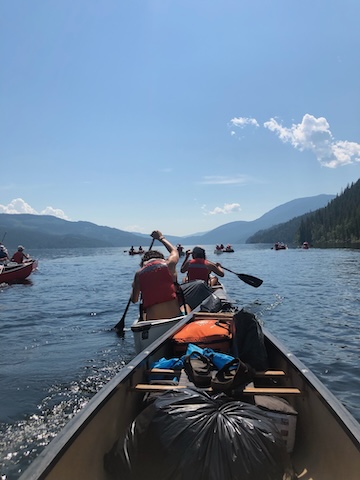
Canoe trips are a vital part of the camp experience, not only because of the physical activity they involve but also because of the deep personal growth they foster. (photo from Camp Hatikvah)

At Camp Hatikvah, one of the most enriching aspects of the summer experience for older campers is the out-tripping program. Designed to expose campers to the beauty of the outdoors while introducing them to a blend of adventure, skill-building and personal growth, the program is a cherished part of the Camp Hatikvah experience. It is also central to the camp’s mission of fostering resilience, independence and community.

Each year, the camp’s Kochot and staff-in-training (SIT) campers embark on canoe trips that vary in length and difficulty, ensuring that each trip is tailored to their abilities and experiences. These journeys are much more than a chance to paddle; they provide campers with opportunities to push their limits, learn new skills and bond with their peers.

photo - Each year, the camp’s Kochot and staff-in-training (SIT) campers embark on canoe trips that vary in length and difficulty
Each year, the camp’s Kochot and staff-in-training (SIT) campers embark on canoe trips that vary in length and difficulty. (photo from Camp Hatikvah)

The Kochot campers are introduced to the concept of out-tripping through shorter trips that offer a taste of outdoor adventure. The one-night and two-night trips, depending on age, provide an introduction to sleeping outdoors, cooking meals and navigating the natural world. These trips are designed to balance activity and relaxation, with plenty of time for swimming and socializing, all within nature. For many, this is the first time they sleep away from home, and the experience is a significant milestone in their personal development.

As campers get older, the trips become more challenging. The SIT campers take on a more intensive excursion that tests their physical endurance and leadership abilities. The trek to Shuswap Lake involves paddling for several hours each day, setting up camp at new locations each night, and working together to navigate the challenges of outdoor living. Through this five-day journey, the SIT campers develop valuable life skills, including resilience, adaptability and teamwork.

Canoe trips are a vital part of the camp experience, not only because of the physical activity they involve but also because of the deep personal growth they foster. They teach campers about responsibility, independence and the importance of working as part of a team. Campers learn to rely on one another as they work together to navigate the water, set up camp and manage the logistics of living outdoors. They also gain a profound appreciation for the natural world, learning to respect and care for the environment while enjoying its beauty.

The lessons learned on these trips extend far beyond the trip itself. Campers return to camp with a stronger sense of self, greater confidence and a newfound appreciation for the outdoors and for their fellow campers. Whether they are paddling across a serene lake or cooking dinner under the stars, the skills they develop and the memories they create during these trips become an essential, and beautiful, part of the Camp Hatikvah experience.

To learn more, visit camphatikvah.com. 

– Courtesy Camp Hatikvah

Format ImagePosted on January 17, 2025January 15, 2025Author Camp HatikvahCategories LocalTags Camp Hatikvah, canoeing, Jewish summer camp, out-tripping, youth
Why work at summer camp?

Why work at summer camp?

(photo from Camp Kalsman)

We know that today’s university and college students have lots of choices for summer jobs – but here are 10 reasons why working at a Jewish summer camp is the absolute best opportunity for someone who’s starting to think about a professional career.

1. Leadership skills

Regardless of your major, working at a summer camp puts you in a prime place to develop job-marketable skills. As a counselor, you’ll be overseeing large groups of children, and that work translates well into excellent management and personnel skills. You may also qualify for college/university credit, so check with your adviser.

2. Change campers’ lives

Campers love coming to summer camp, which many consider a second home. Summer camps hire fun, energetic people who are motivated to give campers the best summer ever and to make them want to come back, year after year. There’s no question that campers look up to their counselors more than anyone else. You’re directly responsible for helping young people learn about themselves, challenge themselves and explore their Jewish identities. During this formative time, you have the chance to become a camper’s hero.

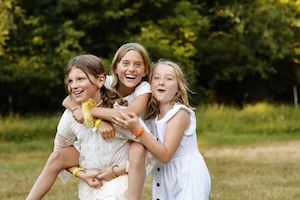
photo - campers having fun (photo from Camp Kalsman)
(photo from Camp Kalsman)

3. The great outdoors

Most summer camps give you access to the best of nature. Set among the trees with an expansive view of the sky, you can hike, swim, mountain bike, zipline through the forest, stargaze, kayak and so much more. As far as offices and work locations go, it doesn’t get much better than that.

4. Opportunity to grow

Camp staff become a community within itself. You’ll end up inspiring and learning from one another, experiencing much of the same joy and wonder as the campers. Plus, you’ll make friends with people who live across North America and even abroad, as many Jewish camps hire summer staff from Israel.

5. Bigger than yourself

Jewish camp works. Those who attend and work at camp are more likely to feel a strong connection to their Jewish community, which can mean lighting Shabbat candles, feeling a personal connection to Israel and attending a synagogue. Camp gives you the skills to change the world and connect to something bigger than yourself.

6. Save money

Think of how much you’ll save when food and housing are provided for you!

7. Be nurtured and cared for

Camps take the health and well-being of their counselors and campers very seriously. For example, URJ Camp Newman, a Reform Jewish summer camp in Santa Rosa, Calif., applies the CARE philosophy to everything they do: the philosophy is based upon the principles of community, acceptance, role-modeling, and that each and every individual is created b’tzelem Elohim, in the image of God.

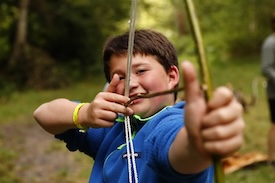
photo - camper doing archery
(photo from Camp Kalsman)

8. Goals and interests

Because there are so many roles to fill and because you come with so many additional strengths and skills, camp directors will strive to match your passions to your role at camp so that you get the most out of your experience.

9. Jumpstart career

Camp is for the career-driven. Seriously!

10. Buzzfeed agrees

If you need even more reasons to apply for a camp counselor position, BuzzFeed has 20 more reasons working at a summer camp will be your best job ever: buzzfeed.com/sarahmcf/20-reasons-why-working-at-summer-camp-is-the-best-k6jl. 

For information on working at URJ Camp Kalsman, which is southeast of Arlington, Wash., about a two-and-a-half-hour drive from Vancouver, visit campkalsman.org/work-at-camp.

Format ImagePosted on January 17, 2025January 15, 2025Author Alaina Yoakum REFORMJUDAISM.ORGCategories LocalTags Camp Kalsman, employment, Jewish summer camp, summer job, youth

A summer camp moment

image - cartoon featuring summer campers lining up at the camp clinic, by Beverley Kort

Posted on January 17, 2025January 15, 2025Author Beverley KortCategories Visual ArtsTags health care, Jewish summer camp, youth
Scholarships available

Scholarships available

Students in the scholarship program at the Weizmann Institute in Rehovot, Israel, will do hands-on research and get to know the region. (photo from Weizmann Canada)

Weizmann Canada has scholarships for seven exceptional science students from Canada to participate in the Dr. Bessie F. Lawrence International Summer Science Institute (ISSI). The scholarship program – which will take place at the Weizmann Institute of Science in Rehovot, Israel, from June 30 to July 25, 2025 – is open to students between the ages of 18 and 20, including graduating high school seniors, gap-year students and first-year bachelor’s degree students.

ISSI offers a rigorous scientific experience, providing students with the opportunity to participate in hands-on research. During the program, students collaborate in small research groups, guided by institute researchers, on topics matching their skills. They use the latest tools, like electron microscopes and particle accelerators. Senior scientists enhance the experience with lectures and courses. The program culminates in team presentations of group theses based on their laboratory work.

Students will also have an opportunity to immerse themselves in a diverse scientific environment at a field school located in the Judean and Negev deserts. Expert guides from the Sde Boker field school will lead hikes that focus on the ecological, geographical and archeological features of this region.

Participants selected for this program will receive a full scholarship valued at more than $10,000, which covers airfare and all expenses incurred during their stay at the institute.

For more about the program and to apply by March 1, 2025, visit weizmann.ca/international-summer-science-institute. For assistance, reach out to Weizmann Canada’s educational program officer, Morgan Leibner, at [email protected].  

– Courtesy Weizmann Canada

Format ImagePosted on December 20, 2024December 19, 2024Author Weizmann CanadaCategories LocalTags International Summer Science Institute, ISSI, scholarships, science, students, youth
Help team get to Israel

Help team get to Israel

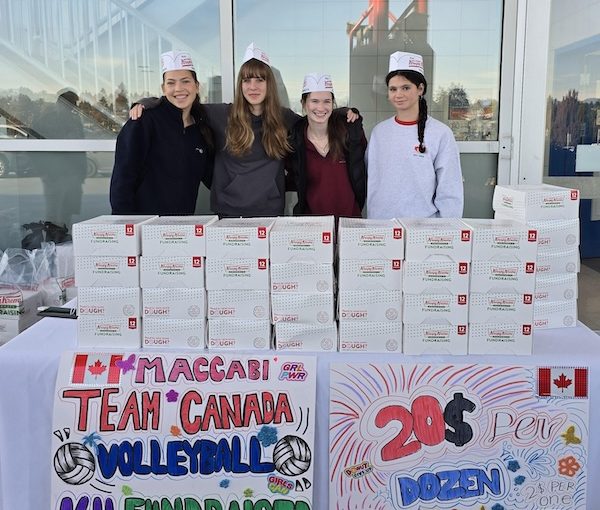
BC members of Team Canada U16 Junior Girls Volleyball sell donuts to raise funds to travel to Israel next summer. (photo from Maccabi Canada)

Young volleyball players and their families are calling on the community for assistance to send their team to Israel for the 2025 Maccabiah Games next July.

Team Canada U16 Junior Girls Volleyball includes 10 athletes, including four from Vancouver, five from Toronto and one from Winnipeg. The team is fundraising to cover the expenses, which amount to almost $10,000 per participant.

“These girls are devoting themselves to bringing their best game to the Maccabiah Games next summer,” said Roman Pereyaslavsky, the team manager. “It is not only a powerful goal for them, but the celebration of international athletic competition in Israel next year is also a huge message of solidarity with the people of Israel at this time of unprecedented challenge.”

The girls and their parents do not underestimate the hurdles they face in raising the funds to make the trip to Israel possible.

“Traveling to Israel and competing as Canadian representatives with Jewish girls from around the world is a massive dream,” said Liel Lichtmann, a Richmond Grade 10 student and member of the national volleyball team. “We are fundraising every way we know how and we are confident we can make this happen. We hope our community will make our dream a reality.”

Donations are welcomed and deeply appreciated at secure.maccabicanada.com/p2p/donate/388314/participant/5427623/en-CA. Further information is available by contacting [email protected]. 

– Courtesy Maccabi Canada

Format ImagePosted on December 20, 2024December 19, 2024Author Maccabi CanadaCategories LocalTags fundraising, Israel, Liel Lichtmann, Maccabiah Games, Roman Pereyaslavsky, sports, volleyball, women, youth
Ageism is everywhere

Ageism is everywhere

Panelists Margaret Gillis, left, and Dr. Melanie Doucet were the experts featured at this year’s Simces & Rabkin Family Dialogue on Human Rights, which focused on ageism.

“Ageism is anytime we make an assumption, a judgment, a stereotype, or discriminate based on age. And this can go in any direction. You’ve often heard people say, ‘too young to understand,’ ‘too old to understand.’ It can be directed toward oneself. It manifests in our interrelationships with others. And it is evident in our institutions and organizations. In fact, it is everywhere,” said Zena Simces in her remarks at the sixth annual Simces & Rabkin Family Dialogue on Human Rights, which took place over Zoom on Oct. 28.

Ageism impacts many aspects of life, said Dr. Simon Rabkin. “It affects our health, both physical and mental,” he said. “Studies have shown that psychosocial impacts of ageism include low self-esteem, self-exclusion, lack of self-confidence and loss of autonomy, both for older and younger people. The data indicate that workplace ageism is associated with increased depression and long-term illness. Importantly, studies have found that older persons with more negative self-perceptions of aging have significantly reduced longevity.”

Simces and Rabkin set the stage for the dialogue, which was called Too Old, Too Young: A Conversation on Ageism and Human Rights. It featured Margaret Gillis, founding president of the International Longevity Centre Canada (ILCC) and co-president of the International Longevity Centre Global Alliance, and Dr. Melanie Doucet, an associate with the Centre for Research on Children and Families at McGill University, who is a former youth in care. The discussion was moderated by Andrea Reimer, an adjunct professor at the University of British Columbia’s School of Public Policy and Global Affairs, who herself survived as a street-involved youth.

Gillis focused on the impact of ageism on older persons. She gave examples of human rights violations taking place in Canada, including that Canada’s long-term care homes have been under strain and in need of reform for at least two decades. She said an estimated one in 10 older Canadians experiences some form of elder abuse, adding that such abuse is underreported. She spoke about ageist employment practices and negative media representations of older persons.

“Ageism is toxic to the global economy and to health,” she said. “For instance, a US study showed a massive $63 billion per year impact on the economy as a result of ageism in health care. Perhaps one of the most distressing aspects of ageism is its prevalence, the World Health Organization finding one in every two persons is ageist.”

Nonetheless, not much is being done about it, said Gillis.

“I should note that there are protections against ageism in the Canadian Human Rights Code and the provincial human rights codes. But, the problem is, this takes time, money and know-how and our legislation and court process are not well-equipped to remedy complex situations like ageism easily and cost-effectively.”

Gillis encouraged people to join the Canadian Coalition Against Ageism, which she established. It comprises organizations and individuals who are working to confront ageism and bring about changes, based on the WHO global report on ageism. 

She advocates for the adoption of a United Nations Convention on the Rights of Older Persons. 

“In general, a convention is a method to achieve positive change by combating ageism, guiding policy-making and improving the accountability of governments at all levels, which we most certainly need,” said Gillis. “A convention would also educate and empower, and we’d see older people as rights holders with binding protections under international law.”

Doucet spoke about the human rights of younger persons, specifically youth who age out of the care system. She explained that youth age out of care at the age of majority and that, in British Columbia, about 1,000 youth age out annually.

A video Doucet made as part of her doctoral research included data on the difficulties most young people exiting care experience: 200 times the risk of homelessness, post-traumatic stress disorder rates on par with war veterans, and fewer than 50% finish high school.

Statistics Canada Census data from 2016 indicated that nearly 63% of youth ages 20 to 24 were still living with their parents, with almost 50% staying home until the age of 30. “And I’m sure those statistics have even increased since the pandemic,” said Doucet.

“Youth in care don’t have that luxury. They’re legislated to leave the system at age of majority. So, they’re deemed too old to remain in the child-welfare system after they reach age 18 or 19, depending on where they live in Canada, but, yet, too young to be sitting at the table when policy decisions are being made that impact them, sometimes even at their own intervention planning meetings with social workers.”

Additionally, in the last 20 years or so, a new developmental phase – “emerging adulthood,” which occurs between the ages of 19 and 29 – has been acknowledged in the academic literature, said Doucet. “It’s a phase that encompasses young people who are not necessarily children anymore but they’re not quite adults, and it provides room for identity exploration, trial and error, obtaining post-secondary education, and just figuring out one’s own place in the world. Youth in care aren’t able to experience this crucial developmental phase because of the legislated age cutoffs.”

There are studies that measure the benefits to both the youth affected and society at large of extending the age cutoff: “a return of $1.36 for every $1 spent on extending care up to age 25,” Doucet said.

Meanwhile, the cost of not extending care is high. For example, youth in care lose their lives up to five times the rate of their peers in the general population, she said. Poverty is more prevalent, as is homelessness, as previously noted.

“Out of the 36 countries in the global north, Canada is one of the six that does not have federal legislation to protect the rights of youth in care,” said Doucet. “While Canada has ratified the UN Convention on the Rights of the Child [CRC], it only provides human rights protections for children and youth until the age of 18. So, youth in care who are transitioning into adulthood actually don’t fit within the UN CRC because they’re deemed too old, even though they are a vulnerable population that experiences multiple human rights violations. This highlights that age-based discrimination is very much entrenched into the mainstream child welfare system in Canada.”

In the question-and-answer period, Gillis outlined three recommendations in the UN’s report on ageism: education/awareness campaigns; changes to laws, programs and policies, starting with long-term care and other basic human rights; and intergenerational work. We need to look at what other countries are doing, the evidence, best practices, she said, and pensions and other financial programs must keep up with cost-of-living.

Doucet spoke about initiatives she and her colleagues have undertaken.

“We developed what we’re calling the equitable standards for transitions to adulthood for youth in care. We released those in 2021, myself and the National Council of Youth in Care Advocates, which is comprised of people with lived experience from across the country, youth-in-care networks, and a couple of ally organizations, like Away Home Canada and Child Welfare League of Canada. This was our way to provide a step-by-step rights-based approach that centred on lived expertise, research and best practices, to guide how youth in care need to be supported as they transition to adulthood.”

There are eight pillars: financial, educational and professional development, housing, relationships, culture and spirituality, health and well-being, advocacy and rights, emerging adulthood development. And each pillar has an equitable standards evaluation model. For example, about housing: “Every young person should have a place they can call home, without strict rules and conditions to abide by.” 

“The ultimate goal [of] this project for us is, eventually, we are living in a society where the term ‘aging out’ no longer exists for youth in care, that they transition to adulthood based on readiness and developmental capacity instead of an arbitrary age,” said Doucet.

The Simces & Rabkin Family Dialogue on Human Rights was introduced by Angeliki Bogiatji of the Canadian Museum for Human Rights, which is a partner of the annual event. Juanita Gonzalez of Equitas – International Centre for Human Rights Education, also a program partner, closed out the proceedings. 

Format ImagePosted on November 8, 2024November 7, 2024Author Cynthia RamsayCategories NationalTags ageism, discrimination, elder persons, health, human rights, law, Margaret Gillis, Melanie Doucet, policy, Simon Rabkin, United Nations, youth, youth in care, Zena Simces
Richmond teen speaks in New York

Richmond teen speaks in New York

CTeen Shabbaton Havdalah in Times Square this past February. (photo from Chabad Richmond)

Richmond teenager Miriam Kriche addressed a global  audience at the CTeen (Chabad Teens) International Jewish Teen Summit in New York City during the group’s annual Shabbaton. She shared her story of overcoming adversity and emerging as a local leader, guided by Rabbi Yechiel Baitelman of Chabad Richmond. Kriche’s story highlights the resilience and strength of Jewish youth, particularly significant in the wake of the events since Oct. 7.

Active in CTeenU and the Richmond CTeen chapter – projects of Chabad Richmond and the Bayit – Kriche has made significant contributions through her volunteer work with the Hebrew school and support for Holocaust survivors. Her journey is marked by personal challenges and a transformative trip to Israel.

The summit, which took place in New York Feb. 22-25, brought together more than 3,000 participants from 58 countries. It provided a platform for Jewish teens to connect, share their stories, and reinforce their commitment to their heritage and values during challenging times.

Kriche’s speech, infused with personal anecdotes and reflections on Jewish identity, encouraged her peers to find their purpose and connect with their community. Her message, which centred on the belief that everyone has a place and a role within the Jewish tradition, underscored the summit’s aim to empower Jewish youth.

She shared her journey of facing bullying and alienation, which led her to question her identity and purpose. She spoke of a trip to Israel that rekindled her faith and connection to her Jewish roots, inspiring her to embrace her heritage and lead with conviction.

The CTeen Summit featured a series of workshops, leadership training sessions and a Havdalah ceremony in Times Square.

“In a world where our youth are bombarded with countless challenges to their faith and identity, teens like Miriam Kriche stand as living examples, empowering the teens to hold strong and be ambassadors of their faith back home,” said Rabbi Mendy Kotlarsky, vice-chair of CTeen International.

Kriche’s participation and the presence of the Richmond delegation at the summit demonstrate the impact of youth leadership in fostering strong Jewish identities.

“Our teens have returned invigorated, ready to lead and make a difference within our community and beyond,” said Baitelman. “This experience has not only deepened their connection to their Jewish identity but has also empowered them to be a source of strength and inspiration to their peers.”

CTeen Richmond, sponsored by Chabad Richmond and the Bayit and led by Rabbi Schneur and Tamara Feigelstock, is a part of CTeen, a network of Jewish teenagers encompassing more than 730 chapters, focused on empowering Jewish teenagers to become leaders in their communities through acts of kindness, community service and a strong commitment to their values.

For more information about CTeen Richmond and upcoming events, contact Rabbi Feigelstock at 604-716-2770. 

– Courtesy Chabad Richmond

Format ImagePosted on April 12, 2024April 10, 2024Author Chabad RichmondCategories LocalTags Chabad Richmond, CTeen, Judaism, Mendy Kotlarsky, Miriam Kriche, Schneur Feigelstock, Yechiel Baitelman, youth

2024 public speaking contest

The Jewish Federation of Greater Vancouver’s Public Speaking Contest has been happening annually in Vancouver since 1989 and is open to students in grades 4 to 7. The registration deadline for this year’s event – which takes place March 7, 7 p.m., at the Jewish Community Centre of Greater Vancouver – is Feb. 26.

For the contest, students are asked to prepare a speech of three minutes or less, choosing from a variety of topics connected to Judaism and Israel. Speeches are delivered on the evening of the contest in front of an audience, with two judges who assess the speeches based on content and presentation. 

Prizes are awarded to the top three speeches in each age group. While there are winners in every section, participation is valued above everything else, and all participants receive a prize and a certificate. 

Those students who are Hebrew-speaking or interested in the Hebrew language are encouraged to deliver their speech in Hebrew. Hebrew speeches have their own grouping and are judged on effort and content, not on their level of Hebrew fluency. 

The contest is a great learning experience, good preparation for bar or bat mitzvah, and a skill increasingly needed in our present political climate. For a flavour of the contest, there is a film on YouTube, posted by Larry Barzelai, which was commissioned for the 13th anniversary of the contest in 2018. Barzelai established the contest in memory of his father, a few years after his brother established one in Hamilton, Ont. (See jewishindependent.ca/young-speakers-deliver.)

The topics for the Public Speaking Contest are:

1. Talk about one person from either Tanach or the Talmud and highlight one important life lesson we can learn from them.

2. What makes a piece of art or music Jewish? Is it Jewish just because the person who created it is Jewish or does it have to have something Jewish embedded into it (i.e. a Jewish symbol, tradition or value)?

3. If you were to create a TikTok highlighting the Vancouver Jewish community what would it be about?

4. There are many different ways for Israelis to serve their country. Select one way Israelis do this and discuss why it is important to the country.

5. What is in a name? Talk about your name, what it means and why your parents chose that name.

6. We all have experience where we are the only or one of the only Jewish people. Talk about what it is like to be the only or one of the only Jews in your school, in one of your afterschool activities or at camp.

7. You are planning a trip to Israel. Name one place in Israel that you would like to visit and explain why you would like to visit that place.

8. Rambam (Maimonides), in his eight levels of tzedakah, says the highest form of giving is to enable someone to support themselves. Why do you think this is the highest form of tzedakah?

9. We have a continuing concern about climate change and the environment. What does the Torah say about caring for the land and how can we integrate Jewish values with environmental protection?

10. Topic of your choice.

For more information about the contest, contact Lissa Weinberger at [email protected]. To register, visit jewishvancouver.com/psc2024. 

– From jewishvancouver.com

Posted on February 9, 2024February 8, 2024Author Jewish FederationCategories LocalTags Israel, Judaism, Larry Barzelai, public speaking, youth
Most magical place on earth

Most magical place on earth

Mairav Robens-Paradise, right, has found her community, and so much more, at Camp Miriam. Her closest, deepest relationships are the friendships she has made through camp. (photo from Camp Miriam)

Last summer was my 11th year at Camp Miriam. Even before my first year, in 2012, I dreamed about sneaking onto the school bus parked in the Jewish Community Centre of Greater Vancouver parking lot as we dropped off my older brothers to go to what I understood to be the most magical place on earth. Over a decade later, I can confidently say that description is an understatement.

I grew up attending public school, where my siblings and I made up the majority of the Jewish population. I don’t recall my immense excitement to go to camp being consciously related to my Judaism, but unbeknownst to 8-year-old me, it would forever alter my connection to my sense of self and my community. Camp Miriam fostered the environment that allowed me to grow into my Jewish identity. At camp, you are surrounded with people who all relate to their Judaism in different ways, both culturally and religiously, and are given the tools and safety to form that unique, personal relationship.

I am currently in my second year of university at McGill, in Montreal, living with two friends from camp. It has been incredibly important to me to have a Jewish community nearby, especially over the past several months, and my roommates are just a fraction of the connections Camp Miriam has given me.

The strength of the friendships I have made over my years of involvement with the camp overpowers any other facet of my life. The values we learn, the skills we practise and the tools we gain at camp equip us to manage complex interpersonal relationships, resolve conflicts and gain independence. Whether it’s learning how to tie knots for camping, defusing relational tensions or discussing social justice, chanichimot (campers) and madrichimot (counselors) alike do so in a secure and empowering environment. Now, as a student who lives away from home, Camp Miriam and its extensive community keep me tethered and grounded to my Judaism and my personal values.

Camp Miriam’s unique structure as a youth-led camp provides empowerment to its entire community. Over the last two years working as a madricha (counselor), I have been trusted with a multitude of responsibilities. Last summer, I had a tafkid (role) that consisted of organizing the programming that occurs during Shabbat. Some of our traditions every Friday include everyone dressing in their nicest clothes and competing for the cleanest cabin award. These small but significant means of welcoming in Shabbat in fun ways foster an exploratory environment for kids to form their connections to Judaism at their own pace.

As a kid, my favourite part of Shabbat was rikud (dance), when all of camp gathers for Israeli dancing. Now, as a madricha, my favourite part is Havdalah, which is a ceremony held every Saturday night to signify the end of Shabbat. Last summer, we introduced live music to our Havdalah tradition, which we listen to while everyone is gathered in a circle watching the ceremonial candle burn. These shared moments all contribute to creating an incredibly strong community of Jewish youth.

As I’m writing this article, I’m sitting in the living room of a member of my national kvutzah (age group/cohort), surrounded by the company of 18 other Jewish members of Habonim Dror North America, the larger movement that Camp Miriam is a part of. This experience really encapsulates what Camp Miriam has given me as a Jew. The closest, deepest relationships I have are the friendships I have made through camp. It’s just not about making friends, learning and forming your identity, but also about finding your community. As I look around, I come to realize – I owe a lot to Camp Miriam. 

Mairav Robens-Paradise is a second-year student at McGill University in Montreal. Last summer was her 11th year at Camp Miriam.

Format ImagePosted on January 12, 2024January 11, 2024Author Mairav Robens-ParadiseCategories LocalTags Camp Miriam, friendships, identity, Judaism, youth
Building teen togetherness

Building teen togetherness

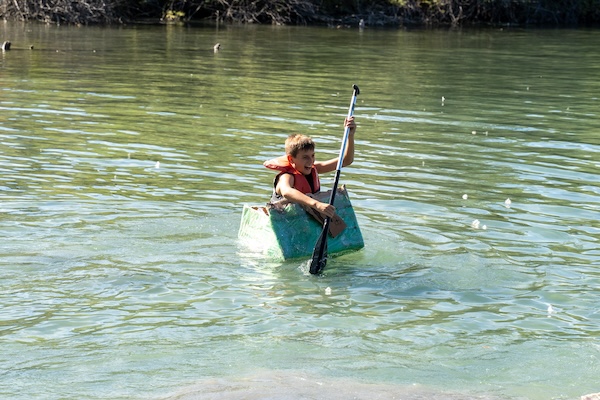
Yachad activities in summer 2023 included one where campers were given a large box, tape, bubble wrap and scissors and told to make a functioning boat. (photo from Camp Hatikvah)

In the summer of 2023, Camp Hatikvah introduced a new activity just for their 13- and 14-year-old campers called Yachad. Named after the Hebrew word for together, Yachad was introduced with the aim of fostering connections and breaking down the barriers that sometimes divide today’s teenagers. 

“Motivating teenagers to step out of their comfort zones can be a challenge. With this in mind, our goal was to design something new that breaks the ice, melts away self-consciousness, and brings campers together,” said Liza Rozen-Delman, executive director.

Knowing their audience well, Camp Hatikvah decided that friendly competition would be the key to success. 

At the beginning of the summer, campers were organized into “house” teams and told that this would be their team for the whole summer while they competed for end-of-session prizes like a trip to the ice cream store. 

photo - In one of the Yachad activities, campers had to dress up like the characters of a movie they picked out of a hat
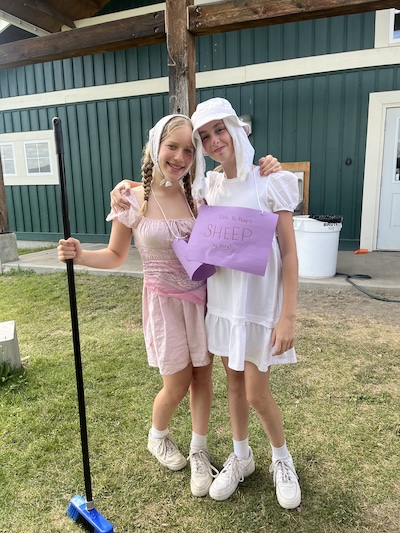
In one of the Yachad activities, campers had to dress up like the characters of a movie they picked out of a hat. (photo from Camp Hatikvah)

Every second day or so, these teams would engage in wacky daytime competitions that required more enthusiasm than skill. From dress-up competitions to hilariously messy slime wars, Yachad quickly became a favourite activity among campers.

“We never knew what was coming next,” said one 14-year-old camper, “so each time Yachad came around we were filled with anticipation and excitement.” 

The heart of Yachad lies in its unique approach to team building. Without knowing it, campers are learning myriad skills like communication and adaptability (shh … don’t tell them). 

“The program is centred on the belief that shared experiences have the power to forge lasting bonds. In the midst of extraordinary escapades, campers not only form new individual friendships but also contribute to building a tight-knit community – a community that embodies the very essence of Camp Hatikvah’s mission,” said Rozen-Delman. 

photo - Another Yachad activity challenged campers to make an ugly Hanukkah sweater
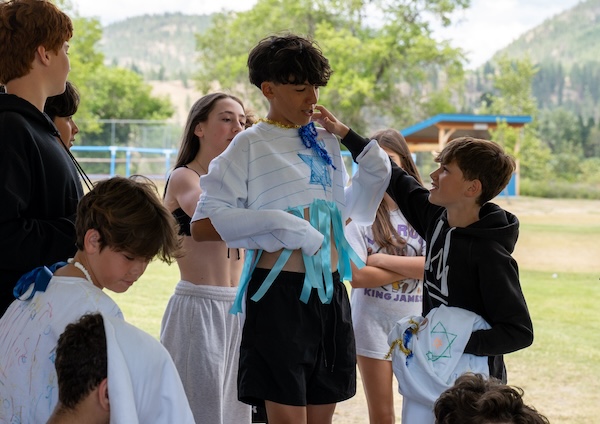
Another Yachad activity challenged campers to make an ugly Hanukkah sweater. (photo from Camp Hatikvah)

Last year’s activities included “noodle fencing,” where campers jousted with floppy pool noodles; a “wedding dress challenge,” where campers designed a dress using a spool of tulle; an “ugly Hanukkah sweater challenge,” where campers were given a sweatshirt and all sorts of tacky Hanukkah décor to attach onto it; and a “Disney challenge,” where the team needed to dress up like the characters of a movie they picked out of a hat.

“The highlight for me was the boat regatta,” shared a camper. “We were each given a large box, tape, bubble wrap and scissors and told to make a functioning boat. One of our teammates then had to go onto the lake in it to see if it floated. Ours didn’t last long and it was hilarious.”

“Yachad celebrates the joy of togetherness, unleashing the power of pure, unfiltered fun,” said Rozen-Delman. “In a world that is so heavy, it’s really just what these kids need.”

Looking ahead, Camp Hatikvah is already planning a repertoire of creative and crazy Yachad activities for the summer of 2024 – the sillier the better, as Camp Hatikvah knows the power of fun in bringing kids together and building community. 

– Courtesy Camp Hatikvah

Format ImagePosted on January 12, 2024January 11, 2024Author Camp HatikvahCategories LocalTags Camp Hatikvah, identity, teenagers, Yachad, youth

Posts pagination

Previous page Page 1 Page 2 Page 3 … Page 10 Next page
Proudly powered by WordPress