Skip to content
  • Home
  • Subscribe / donate
  • Events calendar
  • Business Directory
  • FAQ
  • News
    • Local
    • National
    • Israel
    • World
    • עניין בחדשות
      A roundup of news in Canada and further afield, in Hebrew.
  • Opinion
    • From the JI
    • Op-Ed
  • Arts & Culture
    • Performing Arts
    • Music
    • Books
    • Visual Arts
    • TV & Film
  • Life
    • Celebrating the Holidays
    • Travel
    • The Daily Snooze
      Cartoons by Jacob Samuel
    • Mystery Photo
      Help the JI and JMABC fill in the gaps in our archives.
  • Community Links
    • Organizations, Etc.
    • Other News Sources & Blogs
  • JI Chai Celebration
  • JI@88! video

Recent Posts

  • SFU honours Gloria Gutman
  • Lifting people’s spirits
  • Wedding a ray of light
  • Indigeneity and Zionism
  • Rule of law broken: councilor
  • Football and its roles
  • The burden of defence
  • Fish Café returns after fire
  • All right in what goes wrong
  • Nuns & mermaids at TUTS
  • Camp offers holiday retreat
  • Students and mentors inspire
  • Once-in-a-lifetime trip
  • 100 dancers, one heart
  • Money for the sciences
  • What “Jewish food” means
  • Have a cookie, schnitzel too
  • Federation now across BC
  • Israel fighting for its existence
  • Deal strengthens Iran
  • Patriotic belonging diminishes
  • A campaign to engage
  • Upstanders’ first live event
  • Responding to Carney
  • Having your own home
  • Music a family tradition
  • Musical to warm heart
  • Community milestones … June 2026
  • Sharing her passion for Israel
  • Or Shalom reopens its doors
  • JFS from past to future
  • Need holistic approach
  • Sharing stories, advice
  • Journalist shares fears
  • Skills to live together
  • Road to independence

Archives

Follow @JewishIndie
image - CJN box ad Rockowers 2026

Tag: youth

Nominate a mensch

The Centre for Judaism of the Lower Fraser Valley is looking for nominations for its annual Lamplighter Award, which honors a child who has performed an outstanding act of community service.

Candidates must be between the ages of 6 and 18 and nominations of potential recipients must include two references describing the child’s community service. The chosen lamplighter will receive the award Dec. 29 at the Semiahmoo Shopping Centre at a 7 p.m. ceremony attended by Rabbi Falik and Simie Schtroks, directors of the Centre for Judaism, White Rock Mayor Wayne Baldwin and representatives of the cities of Surrey, White Rock, Langley and Delta.

Last year, Richmond twins Sarah and Amy Aginsky received the award for their work hosting a street store for the homeless and impoverished. The project, a one-day pop-up store, gave “shoppers” the opportunity to select apparel and shoes without the exchange of money.

“Chanukah celebrates the victory of light over darkness and goodness over evil,” said Simie Schtroks. “This is a most appropriate opportunity to motivate and inspire young people to make this world a brighter and better place. By filling the world with goodness and kindness, that light can dispel all sorts of darkness.”

To nominate a candidate for the award, contact Simie Schtroks as soon as possible at [email protected].

Posted on December 9, 2016December 7, 2016Author Centre for JudaismCategories LocalTags Lamplighter Award, tikkun olam, youth
Mystery photo … Nov. 25/16

Mystery photo … Nov. 25/16

United Synagogue Youth Cycle-athon, 1971. (photo from JWB Fonds, JMABC L.09838)

If you know someone in this photo, please help the JI fill the gaps of its predecessor’s (the Jewish Western Bulletin’s) collection at the Jewish Museum and Archives of B.C. by contacting [email protected] or 604-257-5199. To find out who has been identified in the photos, visit jewishmuseum.ca/blog.

Format ImagePosted on November 25, 2016January 17, 2017Author JI and JMABCCategories Mystery PhotoTags Jewish life, JMABC, USY, youth
Mystery photo … Sept. 30/16

Mystery photo … Sept. 30/16

[Chant Torah?] at Beth Israel Synagogue, 1979. (photo from JWB fonds, JMABC L.09865)

If you know someone in this photo, please help the JI fill the gaps of its predecessor’s (the Jewish Western Bulletin’s) collection at the Jewish Museum and Archives of B.C. by contacting [email protected] or 604-257-5199. To find out who has been identified in the photos, visit jewishmuseum.ca/blog.

Format ImagePosted on September 30, 2016January 17, 2017Author JI and JMABCCategories Mystery PhotoTags Beth Israel, Jewish life, Judaism, synagogues, youth
Youth mentorship program

Youth mentorship program

Kathleen Muir, youth services coordinator at the Jewish Community Centre of Greater Vancouver. (photo from Kathleen Muir)

Chill Chat, a peer mentorship program that began a few years ago but seemed to disappear, has been reignited in Vancouver as a hub for youth programs in the community.

The program’s revitalization can partly be attributed to the new Jewish Community Centre of Greater Vancouver youth services coordinator, Kathleen Muir, who has returned to her hometown of Vancouver after getting a degree in social work at the University of Calgary. She brings with her a wide rage of experience, including working in the areas of homelessness and addiction, and suicide prevention and intervention, as well as with disabilities organizations in Calgary and impoverished school districts in Barbados.

Chill Chat is “a peer-to-peer mentorship program” for Jewish youth aged 12 to 22, explained Muir in an interview with the Independent, “but it’s customized to needs and interests, so it really means that anyone who is interested, there is a place for them.”

She said, “You can go into it if you have a disability or if you don’t have a disability, you can go into it if you have any mental health concerns or if you don’t.”

Chill Chat is a three-tiered system, where the mentees are mainly in grades 8 and 9, but with some in grades 7 and 10, and the mentors are in Grade 10 and up.

“You have the grades 11 and 12 that are both going to give support and receive support from Hillel and [the Jewish Students Association at the University of British Columbia],” she said. “What’s really cool about that and something that I love is that it really makes it clear that you can receive help and also be able to give help and, just because you are receiving help doesn’t mean you don’t have the ability or expertise to give out help, too.”

About the role of Chill Chat in the Vancouver Jewish community, Muir said, “We are creating this huge network fabric for support that’s going to be across the board and, because Chill Chat is based on informal support of calling the person or meeting up with them, rather than [come,] sit down, workshop, go home. You have these groups of people who are able to call each other whatever time they need, who are able to provide support that a service that is 9-5 can’t provide.”

When Muir joined the JCC staff, Chill Chat was focusing more on supporting kids with disabilities, but she wanted to broaden that scope because, she said, “we’ve all been there and needed some kind of advice.”

And the program is now better supported itself. “We have so many different stakeholders who know about the program, who know how it’s run and who are highly invested in it, so it doesn’t just fall on to me,” said Muir.

Chill Chat has partnerships with a variety of organizations, such as the CIJA, CJPAC, JCC Maccabi, Festival HaRikud, the Duke of Edinburgh Award and Queerious. This allows the program to “really meet the needs that the participants want,” said Muir.

“If you have a kid that is already interested in athletics, then pairing up with a mentor and both of them working towards JCC Maccabi – they are working towards a common goals together,” she said by way of example.

The commitment for participants is that they communicate once a week in some way, in any form, “from Snapchat to a telegram,” and, once a month, mentors and mentees have to meet up face-to-face.

The meet-ups can be facilitated by the JCC, which hosts a Chill Chat Chill each month, where, said Muir, “we get together, we watch a movie, have a pizza party, go ice skating. Once a month we also have a Chill Chat Ed and we bring in educators to talk about what a mentoring relationship is like and how to support each other. We have an amazing partnership coming in November with CIJA and CJPAC, who are going to bring in people in the political world to do a world café and speak one-on-one with out mentors and mentees”

To take part in Chill Chat, teens and young adults can email Muir at [email protected], call her at 604-257-5111, ext. 308, or complete the form at thecalloutjcc.com/#!get-connected/c2022. There is a meet-and-greet picnic on Sept. 25, from 11 a.m. to 1 p.m., in the JCC Teen Lounge.

Zach Sagorin is a Vancouver freelance writer.

Format ImagePosted on September 16, 2016September 16, 2016Author Zach SagorinCategories LocalTags Chill Chat, JCC, mentorship, Muir, outreach, youth
A universalist tikkun olam

A universalist tikkun olam

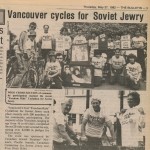
Growing up, the writer was involved in community campaigns to help free Soviet and other Jews suffering state-sponsored, organized persecution. These campaigns were international and Vancouver youth also participated in them. Here are but two of the many items in the JWB about these causes: top one is from 1982; below, from 1976.

I was recently reminded of a fashion-activist item many Jewish teens of my generation wore: the stainless-steel Soviet Jewry bracelet. Etched with the name and date of arrest of a single Jewish dissident in the Soviet Union, each bracelet transmitted to the wearer a deep and penetrating sense of social justice and tribal consciousness. I wore mine proudly, and recall being equally pleased to be selected from my seventh grade class to present handmade cards of encouragement to Avital Sharansky, the wife of jailed activist Anatoly Sharansky (later Israeli politician Natan Sharansky), when she visited Vancouver in the mid-1980s on her global campaign to secure his release.

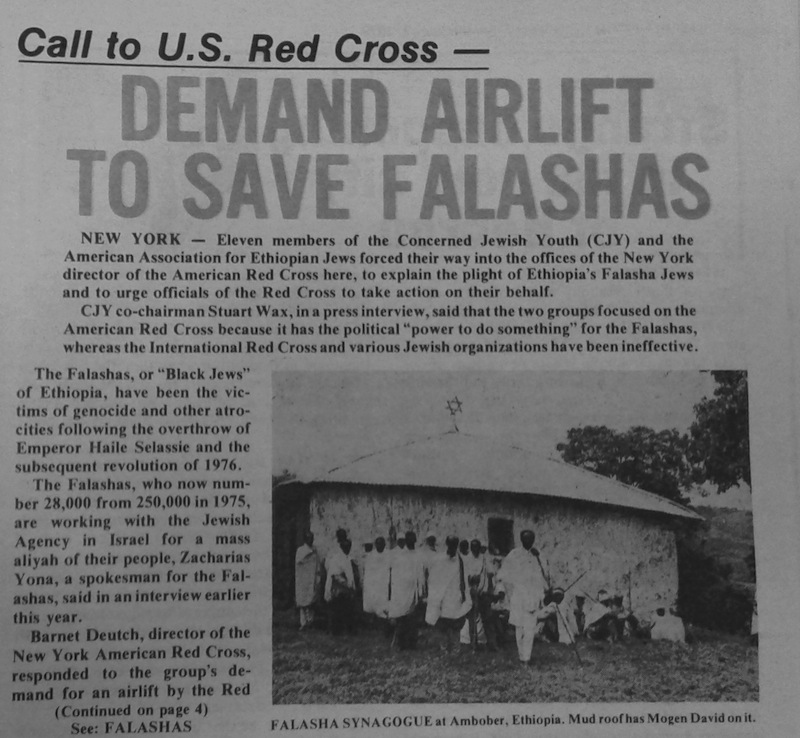
Growing up, the writer was involved in community campaigns to help free Soviet and other Jews suffering state-sponsored, organized persecution. These campaigns were international and Vancouver youth also participated in them. Here are but two of the many items in the JWB about these causes: this is from 1976.

With the last of the Jewish communities having been freed from state-sponsored, organized persecution (other campaigns as my generation was growing up included the freeing of Ethiopian and Syrian Jews), there is little in the way of that Soviet Jewry bracelet campaign to bind today’s Jewish teens together in such a single, uncontroversial way. The modern state of Israel represents an ongoing cause, of course, but that issue is much more fraught: should a Jewish teen wear a bracelet etched with the name of a fallen Jewish soldier, or the name of one of the 182 Palestinian children currently (as of February 2015) being held in Israel detention – according to data provided by Defence for Children International? When it comes to social justice and activist solidarity, the issue of Israel is clearly complex.

I decided to poke around to see what Jewish teens these days are concerned with when it comes to issues and activism. What I found was a dizzying array of causes. From the website of the Orthodox NCSY (National Conference of Synagogue Youth), I found reports of teens volunteering with Habitat for Humanity and with Oklahoma tornado victims. Both USY (Conservative Judaism’s United Synagogue Youth) and NFTY (the Reform movement’s North American Federation of Temple Youth) select an annual theme to guide their social action and tikkun olam efforts: for 2014, USY chose “a focus on acceptance and tolerance including but not specific to gender, special needs, LGBTQ and racial equality,” according to its website. NFTY chose a similar theme for 2014-15: sexuality and gender equality. Habonim-Dror, which has various active local chapters, or kenim (nests), included a Maryland referendum initiative, for example, to campaign for undocumented high school graduates to become eligible to pay in-state university tuition fees.

Other Jewish educators I polled from the Jewish educators’ network JEDLAB reported that their teens are involved in various issues, including suicide prevention, food banks, poverty, water issues, peace/conflict resolution, mental health awareness and advocacy, women’s rights and empowerment, LGBTQ activism, medical marijuana, vaccines, human trafficking, transgender acceptance, orphans in western Kenya and child soldiers.

A report from the Jewish Teen Funders network attempts to aggregate data from 71 Jewish teen foundations in the United States and Canada during 2013-14, showing where the total of nearly $1 million in philanthropic dollars went. Across 362 grants awarded, the top five issue-areas in descending order were: youth, education, special needs, chronic illness and poverty.

And none of this even begins to capture the array of charitable and social awareness efforts represented in today’s mitzvah projects popular among 12- and 13-year-olds marking their bat and bar mitzvahs, a trend that was absent in my generation, as I recall, anyway. As a complement to that, here in Ottawa, my own shul has been running a monthly b’nai bitzvah class by Cantor Jeremy Burko, which has been including discussion of Jewish-history-informed social justice topics, such as labor conditions in the fashion industry.

What’s the takeaway from this big picture? On one hand, there is no longer a single cause (if there ever was one) that unifies Jewish teens. And that means that tribalism is likely being replaced by a sense of universalism: the sense that social justice must necessarily cross ethnic and religious boundaries. On the other hand, today’s Jewish teens are no doubt indeed being united in the very belief that through Jewish social action, they can repair the world in a global, nuanced and holistic sense. So, while I admit to feeling some nostalgia for the simplicity of the worldview embodied in the Soviet Jewry bracelet I wore with pride and even some excitement, I think we should feel buoyed by the youthful energy and optimism in our midst that the world is ours – and theirs – for the repairing.

Mira Sucharov is an associate professor of political science at Carleton University. She blogs at Haaretz and the Jewish Daily Forward. This article was originally published in the Ottawa Jewish Bulletin.

Format ImagePosted on May 15, 2015May 14, 2015Author Mira SucharovCategories Op-EdTags Soviet Jewry, tikkun olam, youth

Posts pagination

Previous page Page 1 … Page 9 Page 10
Proudly powered by WordPress