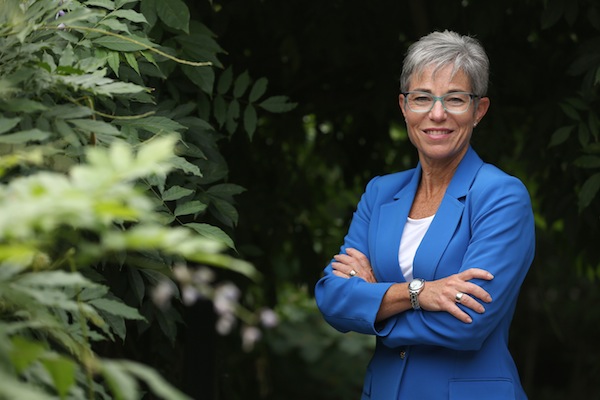
Selina Robinson (photo from Selina Robinson)
Premier John Horgan sent Selina Robinson a message: “A mensch is a good thing, right?”
Robinson, the NDP government’s minister of municipal affairs and housing, is seeking reelection in the riding of Coquitlam-Maillardville. She sees herself as the Jewish maven around the cabinet table.
“I said yes, who called you a mensch?” Robinson recalled. “He just wanted to double-check.”
As she and other New Democrats campaign toward the Oct. 24 provincial election, Robinson and fellow cabinet member George Heyman spoke with the Jewish Independent. (In this issue, we also speak with Jewish candidates and spokespeople for other parties.)
As minister of housing, Robinson takes pride in the development of a major initiative called Homes for B.C.: A 30-Point Plan for Housing Affordability in British Columbia. Her ministry engaged with housing groups, renters, developers, economists, local government officials, planners and other thinkers. Then they convened people in a “World Café,” an engagement exercise in which people from different perspectives sit at a table and must come to agreed-upon recommendations on a topic.
“It was from that that we picked the best ideas and so it really came from all sides of the housing sector rather than pitting them against each other,” she said, acknowledging that she had to convince some to buy into the process because bureaucracy is not always amenable to novel approaches.
She cited two particular areas that she wants to “kvell about.” BC Housing, the agency that develops, manages and administers a range of subsidized housing in the province, is building housing on First Nations land.
“The feds, I don’t think, are building a lot of Indigenous housing and they’re supposed to,” she said. “No other province has stepped up to do that.… You’re a British Columbian and you need housing … if it’s land on reserve, it’s land on reserve – we’ll build housing.”
By providing housing in First Nations communities, it also helps people remain at home, rather than moving to the city, where housing is even more expensive and possibly precarious, she said.
“I’m very proud of that,” Robinson said.
The other point of pride is, Robinson admitted, “a geeky piece of legislation.” When she stepped into the role as the government’s lead on housing availability and affordability, she recognized that there is no data on what kind of housing exists and what’s needed.
“Local governments are responsible for land-use planning and deciding what kind of housing goes where – this is going to be multifamily, this is going to be single-family – but, if you were to ask them, how much do you have, how much more multifamily do you need, they couldn’t tell you, because nobody was collecting the data.”
She brought forward legislation that mandated local governments to do a housing needs assessment every five years to identify whether more housing options are needed for different age groups and types of families.
She also cited the government’s development of social housing, through the allocation of $7 billion over 10 years to build 39,000 units. So far, 25,000 units are either open, in construction or going through the municipal development process.
“My biggest worry is that the Liberals [if they are elected] will cancel all of those that are still in the development stage because they did that in 2001 when they formed government,” she said. “We’re so far behind the eight ball because they did that. I’m not saying it would have fixed everything, but, if there were another 5,000 units of housing out there, it wouldn’t be as bad as it is because there would be another 5,000 units.”
Every Friday, Robinson lights Shabbat candles and then shares a reflection on social media about her week.
“Lighting the Shabbat candles just grounds me in my identity,” she said. “I make myself take 10 minutes on a Friday at sundown to stop and to clear my head and to remind myself why I do the work. It’s not for the pay. It’s not for any of that; it’s not worth it. It’s who I am, what are my values and what’s important to me? What did I hear this week that reminds me of why this work is important?”
Robinson admitted she’s being partisan in saying that she believes NDP values are Jewish values.
“From my perspective, taking care of the world – whether it’s the environment, the people and all that’s within it – is our collective responsibility,” she said, adding with a laugh: “I think all Jews are New Democrats who just don’t know it yet.”
* * *
George Heyman, minister of environment and climate change strategy, is seeking reelection in the riding of Vancouver-Fairview. He is a son of Holocaust refugees, who escaped the Nazis with the help of Chiune Sugihara, the Japanese diplomat in Lithuania who illegally issued visas to about 6,000 Jews, many of whose descendants now live in Vancouver.
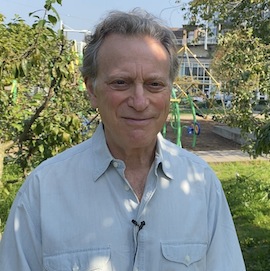
In 2019, Heyman took a family trip to Poland, which broadened his awareness of his family’s history and where he met family members he never knew he had. The Independent will run that story in an upcoming issue.
Speaking of his record in government, Heyman expressed pride in bringing in CleanBC, which he calls “a very detailed, independently modeled set of measures to get us to our 2030 target and beyond.”
He also said the government “completely revamped the province’s Environmental Assessment Act, incorporating the principles of the UN Declaration of the Rights of Indigenous Peoples.”
Collaborating with the First Nations Leadership Council, the government adapted the legislation to bring in affected local communities at the beginning of a project, before a proponent spends millions of dollars then has to go back to the drawing board due to local concerns.
“We’ve been investing in clean technology, we’ve approved transit plans that were stalled for years that the mayors of Metro Vancouver thought were critically important,” Heyman added. “We’re going to see the Broadway [SkyTrain] line commence to relieve the tremendous congestion on the Broadway corridor, both on buses and on the roads. And we’ll be working on ultimately being able to work with UBC and the city and the federal government to extend that to UBC.”
The government, he said, updated the Residential Tenancy Act to address tenants who were being threatened with eviction for suspect renovations and that saw people getting notices of rent increases as high as 40% because of loopholes in the act.
“We closed those loopholes, we held rent increases to the cost of living unless there is a legitimate demonstrated need to do renovation and repair and it’s fair to receive some compensation rent to pay for that,” he said.
Like Robinson, Heyman cited the construction of affordable housing, as well as supportive housing, to get homeless people off the street and provide them with services they need. He said the government has created 20,000 childcare spaces in the province “with significant fee reductions for families as we work our way toward a $10-a-day program.” Increased staffing in schools, mandated by a Supreme Court decision during the previous regime, is also an accomplishment, he said, as well as adding more investments in new schools for seismic upgrades, fire safety and heating and ventilation systems.
On the opioid crisis, Heyman acknowledged a surge in deaths since the beginning of the pandemic. “While there is much more to do, we managed to flatten the level of deaths up until COVID hit,” he said.
Also parallel to the pandemic was a realization of “the terrible state of many of our long-term-care homes.”
“We saw that deteriorate under the previous government,” he said. “With COVID, we saw the results of that. We saw people dying because workers were having to go to two or three different care homes, increasing the risk of infection, simply to cobble together a living. We took measures to allow our healthcare workers to work in one institution without suffering the loss of pay and we’re also investing in more beds and more equipment for long-term-care homes.”
New Democrats have been governing in a minority situation with the support of the Green party since 2017. Horgan called the snap election on Sept. 21, facing criticism for breaking fixed election date legislation and going to the polls during a state of emergency.