Skip to content
  • Home
  • Subscribe / donate
  • Events calendar
  • News
    • Local
    • National
    • Israel
    • World
    • עניין בחדשות
      A roundup of news in Canada and further afield, in Hebrew.
  • Opinion
    • From the JI
    • Op-Ed
  • Arts & Culture
    • Performing Arts
    • Music
    • Books
    • Visual Arts
    • TV & Film
  • Life
    • Celebrating the Holidays
    • Travel
    • The Daily Snooze
      Cartoons by Jacob Samuel
    • Mystery Photo
      Help the JI and JMABC fill in the gaps in our archives.
  • Community Links
    • Organizations, Etc.
    • Other News Sources & Blogs
    • Business Directory
  • FAQ
  • JI Chai Celebration
  • JI@88! video

Recent Posts

  • Last hostage home
  • New bill targets hate crimes
  • Concerning actions
  • Recipes not always required
  • Survivor urges vigilance
  • Seniors profoundly affected
  • Farm transforms lives
  • Musical legacy re-found
  • A range of Jewish literature
  • A concert of premieres
  • Variety telethon on Feb. 22
  • Victoria club’s many benefits
  • Avodah dedicated to helping
  • Artists explore, soar, create
  • Life’s full range of emotions
  • Community needs survey closes March 29
  • Jerusalem marathon soon
  • Historic contribution
  • Chronicle of a community
  • Late-in-life cartoonist
  • Cashflow vs growth portfolio
  • My new best friend is Red
  • ישראלים רבים ממשיכים לתמוך בטראמפ ועדיין אינם מבינים במי מדובר
  • עשרים ואחת שנים בוונקובר
  • Supporting the Iranian people
  • The power of photography
  • A good place to start
  • When boundaries have shifted
  • Guitar virtuosos play
  • Different concepts of home
  • Broadway’s Jewish storylines
  • Sesame’s breadth and depth
  • Dylan Akira Adler part of JFL festival
  • Mortality learning series
  • A new strategy to brighten up BC
  • Sharing latkes and light

Archives

Follow @JewishIndie
image - The CJN - Visit Us Banner - 300x600 - 101625

Tag: memorial

Lessons of Kristallnacht

Lessons of Kristallnacht

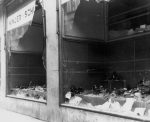
Kristallnacht, which took place 80 years ago this month, saw hundreds of synagogues burned, Jewish-owned businesses destroyed, 100 Jews murdered and 30,000 incarcerated. (photo from commons.wikimedia.org)

Kristallnacht, which took place 80 years ago this month, was the “Night of Broken Glass” that saw hundreds of synagogues burned, Jewish-owned businesses destroyed, 100 Jews murdered and 30,000 incarcerated. The state-sanctioned pogrom was staged to look like a spontaneous uprising against the Jews of Germany, annexed Austria and occupied Sudetenland. It is frequently seen as the beginning in earnest of the Holocaust. According to Prof. Chris Friedrichs, who delivered the keynote address at the annual Kristallnacht commemorative evening Nov. 8, global reaction to the attack, which took place on the night of Nov. 9-10, 1938, sent messages to both Nazis and Jews.

“The world was shocked,” said Friedrichs, professor emeritus of history at the University of British Columbia. “Newspapers in the free countries of Europe and all over the Americas reported on these events in detail. Editorials thundered against the Nazi thugs. Protests took place. Demonstrations were held. Opinion was mobilized – for a few days. But soon, Kristallnacht was no longer front-page news. What had happened was now the new normal in Germany, and the world’s attention moved elsewhere. And this is what the Nazis learned: we can do this, and more, and get away with it. Nothing will happen.

“And the Jews of Germany learned something too,” said Friedrichs, himself a son of parents who fled the Nazi regime. “By 1938, many Jews had emigrated from Germany – if they could find a country that would take them. But many others remained. Much had been taken away from them, but two things remained untouched: their houses of worship and their homes. Here, at least, one could be safe, sustained by the fellowship of other Jews and the comforts and consolations of religious faith and family life. But now, in one brutal night, these things, too, had been taken from them. Their synagogues were reduced to rubble, their shops vandalized, their homes desecrated. Nothing was safe or secure. The last lingering hopes of the Jews still living in Germany that, despite all they had suffered at the hands of the Nazis, they might at least be allowed to live quiet private lives of work and worship with family and friends, collapsed in the misery of fire, smashed glass, home invasions, mass arrests and psychological terror on Nov. 9, 1938.”

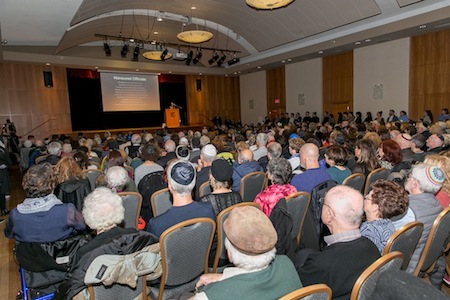
Friedrichs’ lecture followed a solemn procession of survivors of the Holocaust, who carried candles onto the bimah of Congregation Beth Israel. The evening, presented by the Vancouver Holocaust Education Centre (VHEC) and Beth Israel, was funded by the Jewish Federation of Greater Vancouver annual campaign, with support from the Robert and Marilyn Krell Endowment Fund of the VHEC and the Azrieli Foundation, which provided every attendee with a copy of Dangerous Measures, the memoir of Canadian Joseph Schwartzberg, who witnessed Kristallnacht and fled Germany with his family soon after.

“We are gathered tonight in the sanctuary of a synagogue,” said Friedrichs, who retired in June, after 45 years of teaching and researching at UBC. “A synagogue should indeed be a sanctuary, a quiet place where Jews can gather, chiefly but not only on the Sabbath, for prayer, worship and contemplation. Recent events have reminded us only too bitterly that this is not always the case.

“Our minds are full of mental images of what happened in Pittsburgh less than two weeks ago, but I invite you to call up a different mental image,” he said, taking the audience back to the time of Kristallnacht. “Think of a synagogue. Just a few days earlier, on the Sabbath, Jews had gathered there, as they have gathered in synagogues for 2,000 years, for prayer, worship and fellowship with other Jews. But now, suddenly, in the middle of the night, a firebomb is thrust through a window of the synagogue. As the window glass shatters to the floor, the firebomb ignites a piece of furniture. Within minutes the fire spreads. Soon the entire synagogue is engulfed in flames. It is an inferno. The next morning, the walls of the synagogue are still standing, but the interior is completely gutted. No worship will ever take place there again.”

Friedrichs paused to note that some in the audience would recall a similar attack that destroyed Vancouver’s Reform synagogue, Temple Sholom, on Jan. 25, 1985. He recounted the reaction of police and firefighters, civic leaders and the general public, who rallied around the Vancouver congregation at the time, and compared that with the reactions of non-Jews in Germany and the territories it controlled at the time of Kristallnacht.

“Police and firefighters are on the scene,” Friedrichs said of the situation during Kristallnacht. “But the firefighters are not there to put out the blaze. They are there only to make sure the fire does not spread to any nearby non-Jewish buildings. The police are there only to make sure no members of the congregation try to rescue anything from the building.

“The next morning, crowds of onlookers gape at the burnt-out shell of the synagogue. Some of the furnishings and ritual objects have survived the blaze, so they are dragged out to the street and a bonfire is prepared. But first, the local school principal must arrive with his pupils. Deprived of the opportunity to see the synagogue itself in flames during the night, when they were asleep, the children should at least have the satisfaction of seeing the furnishings and Jewish ritual objects go up in smoke. Most of those objects are added to the bonfire, but not all. Not the Torah scrolls – the Five Books of Moses, every single word of which, in translation, is identical to the words found in the first five books of every Christian Bible. No, the Torah scrolls are not added to the bonfire. They are dragged out to the street to be trampled on by the children, egged on by adult onlookers, while other adults rip apart the Torah covers to be taken home as souvenirs.

“And now consider this: events like this did not happen in just one town,” Friedrichs said. “The same things took place in hundreds upon hundreds of cities and towns throughout Germany and Austria, all on the very same evening and into the next morning. There were minor variations from town to town, but the basic events were exactly the same, for it was a nationwide pogrom, carefully planned in advance.”
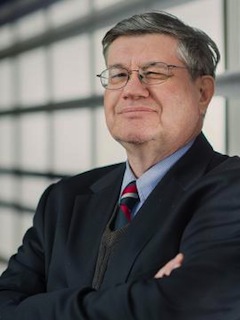
photo - Prof. Chris Friedrichs
Prof. Chris Friedrichs (photo from VHEC)

Friedrichs, who devoted 25 years to serving on the organizing committee of the Kristallnacht commemorative committee, including eight as president, reflected on the history of Holocaust remembrance in Vancouver, including the decision to single out this date as one of the primary commemorative events of the calendar.

“Why should we commemorate the Shoah at this particular time in November?” he asked. “Consider this: 91 Jewish men died on Nov. 9th and 10th, 1938. Yet, on a single day in the busy summer of 1944, up to 5,000 Jewish men, women and children might be murdered in the gas chambers of Auschwitz on one day. Why not select some random date in August 1944 and make that the occasion to recall the victims of the Shoah? Why choose Kristallnacht?”

The earliest Holocaust commemorations in the city, he said, citing the work of local scholar Barbara Schober, was an event in 1948 marking the Warsaw Ghetto Uprising.

People who had founded the Peretz School in Vancouver, in 1945, hoped to preserve the memories and values of the East European Jewish culture, which had been almost totally wiped from the map, he said. “Yet, rather than focus on the six million deaths, their intention was to honour those Jews who had actually risen up to fight the Nazi menace – the hopeless but inspiring efforts exemplified above all by the heroic resistance of the Warsaw Ghetto fighters who used the pathetically meagre supply of weapons they could find to resist the final liquidation of the ghetto by the Nazis in the spring of 1943,” said Friedrichs. “That effort failed, but it was not forgotten.”

This event continued, with the support of Canadian Jewish Congress, into the 1970s, he explained.

“There was an emerging concern that Jews should not just recall and pay tribute to the victims of the Shoah,” said Friedrichs. “The increasing visibility of the Holocaust denial movement made it apparent that Jews should also make their contribution to educating society as a whole – and especially young people – about the true history of what had happened. Prof. Robert Krell and Dr. Graham Forst undertook to establish an annual symposium at UBC at which hundreds of high school students would learn about the Holocaust from experts and, even more importantly, from hearing the first-person accounts of survivors themselves. It was in those years, too, that the Vancouver Holocaust Education Society was established to coordinate these efforts. The survivor outreach program, through which dozens of survivors of the Shoah in our community spoke and continue to speak to students about what they experienced, became the cornerstone of these educational efforts. Their talks are always different, for no two survivors ever experienced the Shoah the same way, but the ultimate object is always the same – not just to teach students what happened to the Jews of Europe between 1939 and 1945, but to reflect on the danger that racist thinking of any kind can all too easily lead to.”

But this was education, he noted, not commemoration.

“With the decline of the Warsaw Ghetto event in Vancouver, the need to commemorate the Shoah came to be filled in other ways. One of those ways was the emergence of the Vancouver Kristallnacht commemoration. The origins of this form of commemoration lie right here in the Beth Israel congregation. In the late 1970s, members of the Gottfried family who had emigrated from Austria in the Nazi era, now members of Beth Israel, proposed that their synagogue host a commemoration of Kristallnacht.”

Friedrichs spoke of the burden carried by each of the survivors who carried candles onto the bimah moments earlier.

“You might think that a candle is not very hard to carry, but, for each one of these men and women, the flame of the candle has reignited painful memories stretching back 70 or 80 years, to a dimly remembered way of life before their world collapsed,” he said. “These men and women survived, and sometimes a few of their relatives did as well, but all of them, without exception, you’ve heard this before, had family members – whether parents, grandparents, uncles, aunts, siblings, or cousins – who were murdered. One could not reproach these men and women if they had chosen to stay home on a night like this. But, instead, they are here.

“Many of these men and women have done more, even more, as well,” he continued. “For many of them have done something for years and continue to do so even now: to speak of their experiences to students in the schools of our province. To stand in front of two or three or four or five hundred students of every race and every heritage and describe life in the ghetto or the camp or on the death march or the anxiety of living in hiding and being pushed into a basement or a closet every time some unwanted visitor arrived – this is not easy. But there is a purpose. The young people of our province are barraged with images and messages and texts telling them that people of certain religions or races or heritages are inferior and unwanted members of our society. They must be told just what that kind of thinking can lead to. No textbook, no video, no lecture can do the job as powerfully as hearing a survivor describe exactly what he or she experienced during the Shoah.”

Corinne Zimmerman, vice-president of the VHEC, welcomed guests and introduced the candlelighting procession. Cantor Yaacov Orzech chanted El Moleh Rachamim, the memorial prayer for the martyrs. UBC Prof. Richard Menkis delivered opening remarks and Helen Pinsky, president of Beth Israel, introduced Sarah Kirby-Yung, a Vancouver city councilor who read a proclamation from the mayor. Nina Krieger, executive director of the VHEC, introduced Friedrichs. Beth Israel’s Rabbi Jonathan Infeld provided closing remarks, and Jody Wilson-Raybould, minister of justice and member of Parliament for Vancouver Granville, sent greetings on behalf of the Government of Canada.
Format ImagePosted on November 16, 2018November 15, 2018Author Pat JohnsonCategories LocalTags antisemitism, Beth Israel, Chris Friedrichs, history, Holocaust, Kristallnacht, memorial, speakers, VHEC, Warsaw Ghetto
In solidarity against hatred

In solidarity against hatred

Selina Robinson, minister of municipal affairs and housing, speaks at the local memorial for the victims of the shooting at Tree of Life synagogue in Pittsburgh. (photo by Alan Katowitz)

On Sunday afternoon, Oct. 28, the day after a gunman opened fire on Shabbat worshippers in Pittsburgh in the Tree of Life synagogue, hundreds gathered at the Jewish Community Centre of Greater Vancouver for a vigil for the victims.

Eleven congregants were murdered and four police officers wounded before the shooting suspect, Robert Bowers, was apprehended, in what the Anti-Defamation League is calling the greatest antisemitic massacre in American history. Above the crowd in the Wosk Auditorium at the JCCGV, a projector showed a version of the logo of the Pittsburgh Steelers that had been created in the wake of the shooting – it had one of the iconic stars replaced by a Star of David.

The local response was so large that a separate service had to be held in the community centre’s atrium. The Jewish Independent attended the vigil in the auditorium, which was opened by Rabbi Hannah Dresner, spiritual leader of Or Shalom Synagogue and head of the Rabbinical Association of Vancouver.

“We must stand with other minorities to combat hatred with nobility, goodness, and with radical love,” said Dresner. “We must strengthen our empathy with marginalized peoples and do the job, each of us, that is uniquely ours, to create a heaven right here on earth. But first, we must grieve a Jewish loss.”

The rabbi closed with reading a poetic translation of Psalm 23, which is traditionally read at funerals.

Rabbi Jonathan Infeld of Congregation Beth Israel said, “I’ve lived for the last 13 years in Vancouver but was born in and grew up in Pittsburgh. I went to Tree of Life many times as a teenager. HIAS [Hebrew Immigrant Aid Society], the organization the deranged individual was most upset about, was the organization that brought my parents to the sanctuary of Pittsburgh.”

The shooter, who had yelled, “All Jews must die!” before opening fire, had written on Facebook before the attack that he was incensed by Jewish support for immigrants and refugees, who he believed were entering the United States to slaughter white people.

“The massacre took place in Squirrel Hill, in Mr. Rogers’ neighbourhood, where Fred Rogers taught us the Torah verse, ‘you shall love your neighbour as yourself,’ so well,” Infeld noted. “The response to something like this is repairing the world.”

He appealed to everyone present, and all Jews, to fill every synagogue to capacity in the coming weekend. “I ask that all synagogues in Vancouver be filled, with not one seat empty,” he said.

photo - Karen James, chair of the board of the Jewish Federation of Greater Vancouver, addresses the community in the Wosk Auditorium
Karen James, chair of the board of the Jewish Federation of Greater Vancouver, addresses the community in the Wosk Auditorium. (photo by Alan Katowitz)

Karen James, chair of the board of the Jewish Federation of Greater Vancouver, then spoke, followed by Selina Robinson, minister of municipal affairs and housing, who read a statement from B.C. Premier John Horgan.

“British Columbians’ hearts are broken, hearing the devastating news of the shooting at the Tree of Life synagogue in Pittsburgh. Everyone should feel safe in a place of worship,” said Horgan in his statement. “My caucus and I and everyone in the House reject antisemitism, racism, discrimination, intolerance and bigotry. When these rise up, we must stand up united and denounce them together in the strongest of terms. An attack like this is a deep violation of safety and security. Our thoughts are with the families of those targeted and Jewish people around the world.”

Robinson was among many officials present, including Bruce Ralston, minister of jobs, trade and technology; Ravi Kahlon, parliamentary secretary for sport and multiculturalism; Howard Chow, Vancouver Police Department deputy chief constable; Irene Lanzinger, president of the B.C. Federation of Labour; and several members of the Legislative Assembly. Richmond North Centre MLA Teresa Wat changed a flight to be there.

“I am quite connected to the Jewish community,” Wat told the Jewish Independent, “especially the Bayit congregation in Richmond. When I saw what’s happening, I felt really sad. We need to combat this kind of attack on humankind as a global village. Everyone is related and, if it happens to one ethnic group, it can happen to any other. I am happy to see this vigil and hope that all ethnic groups will gather in solidarity to condemn this kind of atrocity.”

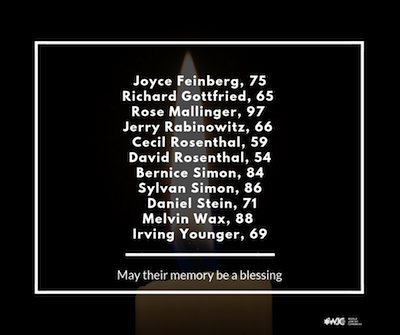
image - the names of those who were murdered in Pittsburgh shootingRabbi Dan Moskovitz of Temple Sholom led a candlelighting in remembrance of the victims, with help from Rabbi Adam Rubin of Beth Tikvah. Moskovitz read the names of each victim and shared something from their biography. “In the Jewish tradition,” said Moskovitz, “we need the names. To say Kaddish, to pray, to remember.”

Rabbi Aaron Bisno of Congregation Rodef Shalom in Pittsburgh then joined the service in the auditorium on video, thanking the Vancouver Jewish community for their solidarity. He told the story of being at his synagogue on the day of the shooting – where he was doing a baby naming for two Jewish fathers who had adopted a child – and hearing the news and having to tell the congregation that they were on lockdown until the shooter was apprehended. Bisno urged the crowd to “repair the world when we find it fractured instead of blaming each other for that which we find uncomfortable. I give you my most sincere blessing of gratitude.”

Rabbi Shlomo Gabay of Congregation Beth Hamidrash chanted El Male Rachamim (God Full of Compassion), a traditional prayer of mourning. Rabbi Philip Gibbs read an English translation.

Many non-Jewish community clergy were present at the vigil, including Dr. Kala Singh and Pritam Singh of the Sikh community, Prof. Harry O. Maier of the Vancouver School of Theology and Haroon Khan of the Al Jamia Masjid mosque.

Matthew Gindin is a freelance journalist, writer and lecturer. He is Pacific correspondent for the CJN, writes regularly for the Forward, Tricycle and the Wisdom Daily, and has been published in Sojourners, Religion Dispatches and elsewhere. He can be found on Medium and Twitter.

Format ImagePosted on November 2, 2018November 1, 2018Author Matthew GindinCategories LocalTags antisemitism, memorial, Pittsburgh shooting
Bennett makes official visit

Bennett makes official visit

Israeli Minister of Jews in the Diaspora and Minister of Education Naftali Bennett addresses a memorial in Pittsburgh on Oct. 28. (Alexi Rosenfeld courtesy Ashernet)

On Sunday, Oct. 28, Israeli Minister of Jews in the Diaspora and Minister of Education Naftali Bennett addressed a memorial vigil at the Soldiers and Sailors Memorial Hall and Museum in Pittsburgh, for the 11 members of the Jewish community murdered in the shooting attack at the Tree of Life synagogue the day before.

Bennett was visiting the city as an official emissary of the Government of Israel, to offer strength and support to the Jewish community following the tragedy. The minister met during the day with leaders of the Pittsburgh Jewish community, and wider American Jewry, as well as with Pennsylvania Governor Tom Wolf, Pittsburgh Mayor Bill Peduto and members of Congress representing the state.

In an emotional meeting, Bennett sat with Rabbi Jeffrey Myers, spiritual leader of the Tree of Life congregation. During the attack, Myers had led many of his congregants to safety.

“Our whole nation is feeling the pain you are feeling here after this heinous hate crime,” Bennett told the leaders of the Pittsburgh community. “I want to extend my condolences to the families of the victims. People who have seen so much in their lives could not imagine they would be gunned down in Shabbat prayer.”

The minister visited the site of the attack and met with ZAKA (Israel’s volunteer emergency response force) and other emergency crews, who had helped the local police, who he also thanked for their great bravery.

Addressing the memorial vigil – attended by more than 4,000 people from the Jewish and non-Jewish communities in the city, including the governor and mayor, senators and members of Congress, President Donald Trump’s Special Envoy Jason Greenblatt, Israeli Ambassador Ron Dermer and New York Israel Consul General Danny Dayan – he said, “Today, we stand in the shadow of death, in the shadow of evil, in the shadow of a cowardly terror attack on Jews who were in synagogue to pray – the deadliest antisemitic attack in the history of the United States.”

He added, “But, today, I met the people and the leaders of the community here in Pittsburgh and I didn’t see death. I saw life, strength. I saw a warm community of love and unity. I saw the Tree of Life, which will never be uprooted by hatred.”

He said, “We stand together, as Jews from all communities united, as well as members of all faiths. Together we stand. Americans and Israelis. People who are, together, saying no to hatred. The murderer’s bullet does not stop to ask, Are you Conservative or Reform, are you Orthodox? Are you right-wing or left-wing? It has one goal, and that is to kill innocent people. Innocent Jews.”

Bennett told the thousands at the memorial that he came to offer the support and condolences of all the Israeli people.

“Nearly 80 years since Kristallnacht, when the Jews of Europe perished in the flames of their houses of worship, one thing is clear,” he said. “Antisemitism, Jew-hating, is not a distant memory. Antisemitism is a clear and present danger. From Sderot [in southern Israel] to Pittsburgh, the hands that fire missiles are the same hands that shoot worshippers. We will fight against the hatred of Jews and antisemitism wherever it raises its head, and we will prevail.”

Stressing the shared values that bond the American and Israeli peoples together, Bennett concluded, “Freedom will overcome. Unity will defeat division. Love will defeat hatred. Light will defeat darkness. Am Yisrael Chai.”

Format ImagePosted on November 2, 2018November 1, 2018Author Edgar Asher ASHERNETCategories WorldTags antisemitism, memorial, Pittsburgh shooting
A moment of silence

A moment of silence

Sunday morning’s cabinet meeting in Israel. (photo from IGPO via Ashernet)

On Oct. 28, at the regular Sunday morning cabinet meeting in Israel, Prime Minister Binyamin Netanyahu, together with ministers, stood for a moment of silence. At the meeting, Netanyahu said, “The entire people of Israel grieve with the families of the people who were murdered in the shocking massacre at the Tree of Life synagogue in Pittsburgh [on Oct. 27]. On behalf of myself, the Government of Israel and the people of Israel, from the depth of our hearts, I send our condolences to the families who lost their loved ones. We all pray for the swift recovery of the wounded.”

He added, “It is very difficult to exaggerate the horror of the murder of Jews who had gathered in a synagogue on Shabbat and were murdered just because they were Jews. Israel stands at the forefront with the Jewish community of Pittsburgh, with all Jewish communities in the U.S. and with the American people. We stand together, at the forefront, against antisemitism and displays of such barbarity.

“I call upon the whole world to unite in the fight against antisemitism everywhere. Today, regretfully, we refer to the United States, where the largest antisemitic crime in its history took place, but we also mean, of course, Western Europe, where there is a tough struggle against the manifestations of a new antisemitism. Of course, there is also the old and familiar antisemitism, and that of radical Islam. On all these fronts, we must stand up and fight back against this brutal fanaticism. It starts with the Jews, but never ends with the Jews.”

Format ImagePosted on November 2, 2018November 1, 2018Author Edgar Asher ASHERNETCategories IsraelTags antisemitism, Israel, memorial, Netanyahu, Pittsburgh shooting
We must focus on justice

We must focus on justice

(photo by Alan Katowitz)

Hundreds of Vancouverites came together Sunday night, driven by the need for community after the news that 11 congregants were murdered during services at a Pittsburgh synagogue a day earlier.

The attack – the deadliest terror act against a Jewish community in North American history – devastated the Pennsylvania Jewish community and elicited grief, alarm and solidarity among Jews across the continent and beyond. As some commentators have said, shock may not have been a foremost response. The very fact that we in Vancouver and Jews almost everywhere else pass by security personnel and infrastructure every time we enter a Jewish facility conditions us to expect that something like this might happen.

The assembly at the Jewish Community Centre of Greater Vancouver, convened by the Rabbinical Association of Vancouver, drew hundreds of people, mostly Jews but also members and clergy of other faith communities, as well as elected officials and other individuals. The words from the speakers – mostly rabbis – were powerful and thoughtful, though perhaps the words were less significant than the simple sense of commonality of emotion among those assembled.

In the hours and days since the incident, so many of us have tried to somehow assimilate the meaning and implications of the violence.

Extremism has been growing worldwide. Antisemitism, racial supremacism, nativism and other dangerous tendencies have infiltrated societies throughout the Western world. We have seen political successes for once-fringe parties in Europe and, most recently, in South America. In the online and general discourses in North America, extremist commentary has become so commonplace that it approaches the mainstream, if that is not an oxymoron. Words have consequences. All actions, good and evil, begin as ideas, move into language and ultimately manifest in behaviours.

This raises the matter of free expression. While some seek to smother the expression of hateful and other repugnant ideas, the events of last weekend present an argument for more, not less, discussion. Open dialogue of all ideas, including appalling ones, is not just a theoretical value. It allows us to monitor antisocial ideas, rather than pushing them under rocks. The perpetrator’s long record of deranged rants about Jews did not prevent this tragedy. But knowledge of such ideas and those who hold them represent our best chance for preventing repetition of such terror acts. (This sort of knowledge is critical to intelligence-gathering services. In Israel, recent reports indicate, 10 potential attacks are thwarted for every one that is successfully executed.)

Americans’ access to guns is also raised as an issue when things like this happen. We have little optimism of seeing this matter resolved in our lifetimes. It is notable, though, that, in what should be a moment of national mourning, the U.S. president has aimed to score political points by advancing the idea that the synagogue should have been, essentially, an armed defensive encampment. This idea is not a solution. It is a capitulation to a dystopic reality. A better president would have had words of national unity and consolation.

While we seek healing as a community, welcome condolences from so many allies, and wish blessings on the murdered and comfort for the survivors, we also now enter unfamiliar realms. In many mass murder incidents, the perpetrator does not survive the attack. In this case, he has. We will watch as the victims’ families confront this terrible act through the justice system, hoping for something approaching closure. Some people are already calling for vengeance, and the death penalty is a possible punishment for the perpetrator, which raises additional quandaries for those among us for whom state-sanctioned killing is an evil unto itself.

The larger issue facing us in the coming weeks is that true justice, in a practical sense, must convey to all people that this is a society that rejects and condemns not only the act that took place Saturday, but the ideas that inspired it and other heinous hate crimes. The mantra of Simon Wiesenthal’s life, which was devoted to as proper a response as possible to the greatest crime perpetrated against the Jewish people, was “justice, not vengeance.” This was in keeping with the ancient obligation of Judaism – justice, justice, you shall pursue.

We grieve, we mourn, we console. But, through these processes and after, we continue what our tradition has demanded for millennia, the ultimate bulwark to this and every other wrong: we seek justice.

Format ImagePosted on November 2, 2018November 1, 2018Author The Editorial BoardCategories WorldTags antisemitism, Judaism, memorial, Pittsburgh shooting
Recalling a lost aunt

Recalling a lost aunt

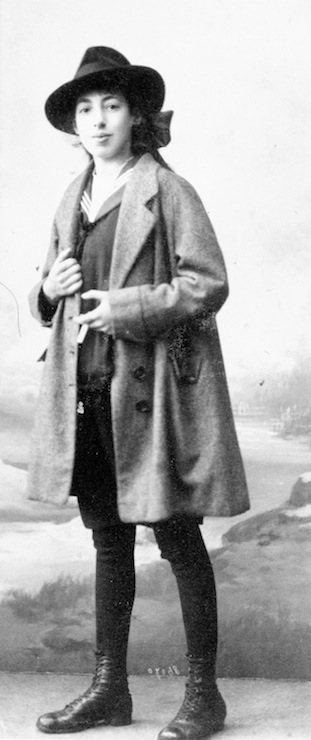
Rosetta van Dam, circa 1920. (photo from Louise Sorensen)

The Dutch Holocaust Memorial of Names has provided the opportunity to write and have published a piece about a person named on the memorial. I contributed stories about six of my murdered relatives, and wrote one of those stories in English, about my Aunt Rosa.

photo - Rosetta van Dam, circa 1920Rosetta van Dam (1904-1942), or Ro, was my mother’s younger sister. She was the first in the family to be deported and murdered, on Aug. 3, 1942, in the first Auschwitz gas chamber, at the age of 38. She had responded to the Nazi call to report for “labour in Germany.”

Ro lived in Rotterdam at the family home on Bergweg 99, where I was born and where she had her own room on my grandparents’ floor. Ro was totally withdrawn and had virtually no social life. She always wore a girl scout uniform, with heavy wool knee-high socks and sandals. She likely would have preferred men’s clothing but it was totally taboo at the time for women to dress in that way.

Ro’s voice was very deep and I believe now that she may have been transsexual or, in any event, a lesbian. I was told that my grandparents had been dragging her to a number of doctors, of course with no result. She ended up a virtual hermit, usually disappearing to her room. I think she did some secretarial work, perhaps for my grandparents’ business.

From 1929 to 1936, we lived in the same Rotterdam house. As a toddler and preschooler, I was too young to understand my aunt, but was curious and eager to please her.

Several years ago, I visited Auschwitz and learned that Ro never reached the Birkenau gas chambers because they were not yet in operation on Aug. 3, 1942. I was informed of this while standing in that very gas chamber, the only one that had not been destroyed, feeling deeply sad about my aunt.

Louise Sorensen was born in the Netherlands in 1929, where she lived with her parents and older sister. In May 1940, when the Nazis occupied Holland, they lived in a suburb near Amsterdam. Two years later, the Nazis ejected them from their home and the family was forced into the Amsterdam ghetto. By January 1943, they were separated and hidden in various locations throughout the country until the Canadians liberated them on April 17, 1945. Sorensen immigrated to Vancouver in 1959; her Danish husband has passed away and she has two sons and three grandsons. She has been active with the Vancouver Holocaust Education Centre since its inception: she was a board member for 10 years and has been speaking in schools and to other audiences for about 30 years. This article also appeared in VHEC’s Zachor.

Format ImagePosted on November 3, 2017November 1, 2017Author Louise SorensenCategories WorldTags Amersterdam, Holocaust, memorial, Netherlands, Rosetta van Dam
Netherlands builds memorial

Netherlands builds memorial

A bird’s-eye view of the Holocaust Memorial of Names to be built in Amsterdam. (photo from holocaustnamenmonument.nl)

More than 70 years after the Second World War, a memorial in Amsterdam will be erected with the names of all the Dutch Holocaust victims. This will finally provide the Netherlands with a tangible memorial where the 102,000 Jewish victims and 220 Sinti and Roma victims can be commemorated individually and collectively.

Up to now, no memorial in the Netherlands has listed each individual Holocaust victim by name. For surviving relatives, a place to commemorate family members is invaluable. In addition, a memorial listing the more than 102,000 names serves as a reminder to current and future generations of the dangers of racism and discrimination.

Between 1933 and 1945, the Nazis murdered an estimated six million Jews and hundreds of thousands of Sinti and Roma. Of the 140,000 Jews who lived in the Netherlands in 1940, 102,000 did not survive the war.

Not all Jews were murdered in the gas chambers of the extermination camps Auschwitz-Birkenau, Treblinka, Belzec, Majdanek, Chelmno and Sobibor. Many were murdered in mass executions or died as a result of sickness, hunger, exhaustion or slave labour. The Dutch Holocaust Memorial of Names commemorates all these victims.

Designed by Polish-Jewish architect Daniel Libeskind, whose studio is headquartered in New York City, the Dutch Holocaust Memorial of Names will be located in the heart of the Jewish Quarter of Amsterdam. The memorial consists of the four Hebrew letters that make up the word zachor, to remember. When visitors enter the memorial, they find themselves in a labyrinth of passageways flanked by two-metre-tall brick walls that convey the message, “In memory of.” Inscribed on each of the 102,000 bricks is a name, date of birth and age of death, in such a way that the name of each victim can be touched.

In combination with the highly reflective geometric forms of the steel letters, the brickwork connects Amsterdam’s past and present. A narrow void at the point where the brick walls meet the metal forms makes it appear that the steel letters float, symbolizing the interruption in the history and culture of the Dutch people.

Anyone can adopt a name on the memorial by donating 50 euros. For more information, visit holocaustnamenmonument.nl.

Format ImagePosted on November 3, 2017November 1, 2017Author Dutch Holocaust Memorial of NamesCategories WorldTags Amsterdam, Daniel Libeskind, Holocaust, memorial, Netherlands

Marking memorial’s 30th year

On Sunday, Sept. 24, 11 a.m., at Schara Tzedeck Cemetery in New Westminster, the annual High Holidays Cemetery Service, presented by the Vancouver Holocaust Education Centre, Congregation Schara Tzedeck and the Jewish War Veterans, will mark the 30th anniversary of the Holocaust Memorial. On April 26, 1987, 1,300 numbers of the community, including Holocaust survivors and their families, attended the unveiling of the memorial, on which more than 900 names of family members who perished during the Holocaust were inscribed. Survivor Lillian Boraks-Nemetz wrote the following poem after that unveiling 30 years ago.

The Six Million
Written in dedication of the Holocaust Monument in Schara Tzedeck Cemetery

In this cemetery
far away from where They died
you stand dwarfed by this giant monument
your feet sinking lower and lower into the earth
your soul graining deeper and deeper
into the black granite.

You stand an alien to this earth
a born again human
sixty odd years away from the factories of death
of mercy – pleading voices scattered to deaf winds.

You stand in this cemetery
on the anniversary of the Holocaust
staring with hollow eyes
at simulated graves of strangers finally named
who once went to sleep in a common ditch
souls torn from peace like bones from flesh –

a child’s name upon your lips
a child’s fist pressing upon your breath
to break the granite silence
to speak to shout to scream the truth
to silence forever the mad dogs who
deny the happening of Shoah.

You remember as you stand here
waiting your turn to honour the Dead
how you stood with Them then
in line for death only you didn’t die
running away on all fours
through the contaminated sewers like a rat.

You say Kaddish and for a single moment
become one with the living and the dead.
Then you, the survivor, slip away into an alien world
where your soul must learn to sustain alone,
The Six Million.

Posted on September 22, 2017September 21, 2017Author Lillian Boraks-NemetzCategories LocalTags Holocaust, Jewish war veterans, memorial, Schara Tzedeck, Vancouver Holocaust Education Centre, VHEC

How we memorialize the past

The most recent racist conflagration in the United States was ignited, ostensibly, by the removal (or threatened removal) of Confederate commemorative statues and plaques. We say ostensibly because it seemed some people were just itching for a fight and this issue popped up.

Each community, or each society, must determine who and what it commemorates. It is understandable that African-Americans, among others, would be offended by statues and other historical monuments that adulate those who defended slavery in the U.S. Civil War. Those who decry their removal as an “erasing of history” seem to be unfamiliar with the concept of libraries and museums, which are among the foremost repositories of history. Remembering history is different from venerating it. For example, a statue of Confederate General Robert E. Lee in front of a courthouse is an affront to equality before the law. The same statue in a museum could provide an opportunity for reflection and discussion.

Outside Budapest is a curious outdoor museum featuring dozens of statues and monuments from the communist era. It is a kitschy museum but it invites guests to ponder the propaganda of earlier eras, even admire some of it from a perspective of artwork, but it is decidedly not a place of veneration. It is a clear statement that such works, if they are to be publicly displayed, should be positioned in a way that does not esteem the ideas that inspired them, but instead invites observers to reflect on their meanings and the often catastrophic outcomes of their ideologies.

Similarly, the preservation of Auschwitz and other places of Nazi terror was not done in honour of that terrible time and the evil that defined it, but for the opposite reason: to ensure that future generations face the reality of that history and to inspire people to seek a better future. Context is crucial.

While Americans battle their demons, some Canadians have taken issue with our history and how it is commemorated. The government of Sir John A. MacDonald, Canada’s first prime minister, was responsible for implementing the residential schools system, a past with which most Canadians are only now beginning to grapple. Last month, the Ontario elementary teachers’ union said MacDonald’s name should be stripped from the nine schools in that province that are named for him. By that logic, we would eliminate his visage from our $10 bills and remove his statues and other likenesses from our public spaces.

Should we? Well, if Canadians had a thoroughgoing national discussion on the subject and a consensus clearly emerged that what was bad about MacDonald outweighs that which was good, then yes. But we should not jump in willy-nilly, thoughtlessly applying the values of today upon people of the past. To be clear: the residential schools system was an atrocity and a national disgrace; we know this now. How we attempt to rehabilitate our country and make amends for this awful history is a discussion in which we are immersed. The veneration of figures who were party to that history invites a legitimate and thoughtful reconsideration – neither those whose knee-jerk reaction is to tear down statues, nor those who reflexively balk at the very idea, are exhibiting the sort of approach we need. Ontario’s elementary school teachers, for example, may have missed the mark. If ever there were a teaching opportunity, it would be to engage young Canadians in critical thinking about why their school is named for the first prime minister, why some people think that’s problematic, and how empathy toward minorities is key to a better future.

But we should be careful in determining the measuring stick we apply. In considering the legacies of any public figure who lived more than a couple of decades ago, we would be hard-pressed to find one who would measure up to today’s standards on the rights and roles of Canadian indigenous peoples, Jews, women, gay people, or really any minorities. One might even argue: Who are we to judge? Are we assuming this generation has reached the moral summit of civilization? The state of the world today suggests we have much left to do to advance tikkun olam. Future generations will not likely give us any great kudos for perfecting humanity.

In the end, we cannot fathom how our descendants will view us and our behaviours. If, as now seems tragically inevitable, human-created climate change wreaks havoc on our world, future generations may look at our car driving, energy consumption and jet vacations as the direct cause and remove the names and likenesses of even the best of our generation from their schools and public squares.

By all means, we should consciously consider representations of our past and whether they are appropriate or inappropriate for our times. It is a discussion worth having, but we should have that discussion before we go racing around tearing down monuments and renaming schools.


Posted on September 1, 2017August 30, 2017Author The Editorial BoardCategories From the JITags Charlottesville, history, memorial, racism
A visit to Mount Herzl

A visit to Mount Herzl

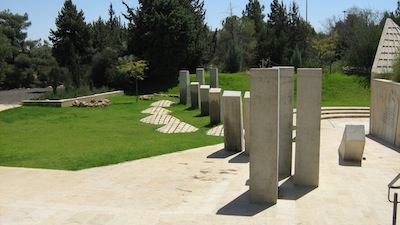
On Mount Herzl is a memorial to the more than 4,000 Ethiopian Jews who died attempting to reach Israel. (photo by Deborah Rubin Fields)

The 29th of the Hebrew month of Cheshvan – this year, it fell on Nov. 30 – is a day of celebration for the Israeli Ethiopian community and a national Israeli holiday. Late in the afternoon, thousands of people gather in Talpiot (southern Jerusalem) on the Haas Promenade for Sigd, the day marking the acceptance of the Torah, and celebrating their history and culture.

photo - The memorial to Ethiopian Jews is multifaceted
The memorial to Ethiopian Jews is multifaceted. (photo by Deborah Rubin Fields)

Despite the enormous loss of life and the discrimination faced by Israelis of Ethiopian descent, Sigd still is, in part, a prayer to make it possible to reach Israel. The Knesset legislated the Sigd Law in 2008, which made 29 Cheshvan a national holiday. The Knesset also legislated 28 Iyar (the Hebrew month that falls roughly in May) as the memorial day for community members who died making the journey to Israel. And, the year prior, in 2007, the Israeli Ministry of Immigration and Absorption in cooperation with the World Zionist Organization and the Israeli Defence Ministry unveiled a memorial to the more than 4,000 Ethiopian Jews who died attempting to reach Israel. Located on Mount Herzl, this stirring monument gives official recognition to the community’s largely unknown suffering. Until it was commemorated, the only existing monument stood in southern Jerusalem, at Kibbutz Ramat Rachel.

Starting at the end of 1979 and continuing for some four years, the Ethiopian Jewish community uprooted itself en masse to fulfil its dream of coming to Israel. It was both a physically exhausting and mentally terrifying journey. In Ethiopia’s forests and Sudan’s deserts, thousands were robbed, beaten, raped and even murdered. If there are graves for the fallen, they are far away from Eretz Yisrael.

The Mount Herzl memorial reminds visitors not just of the Ethiopian villages, but of an entire life left behind. Explanations are mounted in Amharic, Hebrew and English. In Hebrew, eight panels dramatically narrate 1) the exodus from Ethiopia from a boy’s perspective, 2) the events along the way, as explained by the group’s head, 3) life in Sudanese refugee camps, from a mother’s recollections, and 4) the actual departure for Israel, as related by the kes, or religious head of the community.

To learn more about Ethiopian Jews’ journey to reach Israel, Baruch’s Odyssey: An Ethiopian Jew’s Struggle to Save His People by Baruch Tegegne, as told to Phyllis Schwartzman Pinchuk, and the children’s book The Storyteller’s Beads by Jane Kurtz are recommended reads. As for movies, there are Mekonen: The Journey of an African Jew, directed by Rivka Shore; Live and Become, directed by Radu Mihaileanu; Zrubavel, directed by Shmuel Beru; and Yiftach’s Daughter, directed by Einat Kapach.

Deborah Rubin Fields is an Israel-based features writer. She is also the author of Take a Peek Inside: A Child’s Guide to Radiology Exams, published in English, Hebrew and Arabic.

Format ImagePosted on December 2, 2016December 1, 2016Author Deborah Rubin FieldsCategories IsraelTags aliyah, Ethiopia, memorial, Sigd

Posts pagination

Previous page Page 1 … Page 4 Page 5 Page 6 Next page
Proudly powered by WordPress