
Skip to content
  • Home
  • Subscribe / donate
  • Events calendar
  • Business Directory
  • FAQ
  • News
    • Local
    • National
    • Israel
    • World
    • עניין בחדשות
      A roundup of news in Canada and further afield, in Hebrew.
  • Opinion
    • From the JI
    • Op-Ed
  • Arts & Culture
    • Performing Arts
    • Music
    • Books
    • Visual Arts
    • TV & Film
  • Life
    • Celebrating the Holidays
    • Travel
    • The Daily Snooze
      Cartoons by Jacob Samuel
    • Mystery Photo
      Help the JI and JMABC fill in the gaps in our archives.
  • Community Links
    • Organizations, Etc.
    • Other News Sources & Blogs
  • JI Chai Celebration
  • JI@88! video

Recent Posts

  • SFU honours Gloria Gutman
  • Lifting people’s spirits
  • Wedding a ray of light
  • Indigeneity and Zionism
  • Rule of law broken: councilor
  • Football and its roles
  • The burden of defence
  • Fish Café returns after fire
  • All right in what goes wrong
  • Nuns & mermaids at TUTS
  • Camp offers holiday retreat
  • Students and mentors inspire
  • Once-in-a-lifetime trip
  • 100 dancers, one heart
  • Money for the sciences
  • What “Jewish food” means
  • Have a cookie, schnitzel too
  • Federation now across BC
  • Israel fighting for its existence
  • Deal strengthens Iran
  • Patriotic belonging diminishes
  • A campaign to engage
  • Upstanders’ first live event
  • Responding to Carney
  • Having your own home
  • Music a family tradition
  • Musical to warm heart
  • Community milestones … June 2026
  • Sharing her passion for Israel
  • Or Shalom reopens its doors
  • JFS from past to future
  • Need holistic approach
  • Sharing stories, advice
  • Journalist shares fears
  • Skills to live together
  • Road to independence

Archives

Follow @JewishIndie
image - CJN box ad Rockowers 2026

Tag: lifestyle

New year, new attitude

One of my twins urges us, after every meal, to offer him dessert. What started as a “desserts on Shabbat, weekends and holidays” and “dessert is a sometimes food” became ”let’s have dessert after nearly every lunch and dinner,” all summer long. He has a sweet tooth. He can often sway us with temptations. It’s hard to resist.

My other twin is often self-limiting when it comes to food. He eats lots of fruits and vegetables, gets full quickly, and often tells his brother, “no, it isn’t a dessert night.” He’s sometimes a little too much into self-denial. It’s a weird sort of sibling pressure and a complicated dichotomy to manage as a parent.

Recently, I studied page 53 of the talmudic tractate Ketubot (marriage contracts). Dr. Sara Ronis offered an introduction from My Jewish Learning. She highlighted an episode in this page of Talmud that describes just how tricky peer pressure can be. It’s a complicated story, so I’m going to summarize Dr. Ronis’s account. Rav Pappa’s son is marrying Abba of Sura’s daughter. They’re writing up the ketubah. Rav Pappa invites his colleague, Yehuda bar Mareimar, along. Abba is a person of limited financial means and Rav Pappa talks through all the potential financial constraints without letting his colleague get a word in edgewise. Then Rav Pappa insists Yehuda should come inside for the ketubah writing.

Yehuda sits silently. Abba feels worried that Yehuda is angry with him. Abba feels pressured and writes an enormous amount of dowry into the marriage contract. It’s all the money he has. Then Abba says (paraphrasing here): “What, you still won’t talk? I have nothing left!”

Yehuda sees the damage and finally speaks up. “Well, don’t act for my sake, this isn’t OK with me.” Then Abba says to Yehuda, “OK, I’m going to retract this.” Then the kicker comes. Yehuda responds (again paraphrasing): “I didn’t speak up so you would be ‘that kind’ of person who retracts a legal document.”

Essentially, this story is a tragedy about social pressure. Even silence can wreck things when a person is very sensitive to peer pressure and power dynamics.

In the great dessert debate at my house, I’ve observed how variable brothers who love each other can be when it comes to this kind of pressure. I’ve got one twin like Rav Pappa (talks a blue streak, seems occasionally clueless and sometimes applies pressure when it comes to dessert) and another kid, maybe like Abba, who is overly self-conscious and senses his parents’ hesitancy. He feels the social pressures so strongly that he overdoes it and self-limits sometimes even when the dessert is offered.

Over the High Holy Days every year, we’re listing a whole slew of sins and failures. Even though the landscape has changed and some of us may be streaming services rather than attending in person, the liturgy doesn’t change. Some of us feel heavily concerned and pressured to repent for the community for every sin on the list, even the ones that well, frankly, we couldn’t possibly have committed. Others of us are not engaged or aware of the pressure, possibly still out in the metaphorical synagogue hallway during services, still trying to cut deals or make potential business connections with others.

It used to be, in a pre-pandemic world, in many congregations, that women would wear new clothing and new hats, in a “see and be seen” Jewish New Year version of the Easter Parade. The pressure to dress up in a certain way is another kind of social pressure.

Perhaps the first step towards understanding the complexity of our social pressures and how to manage these interactions is to recognize that they exist. Once you “see” some of these issues, it’s hard to un-see them. We can then begin to reflect on how to manage the pressures and do better.

I’ll be honest. Although I love dessert, I also have the self-limiting guilty dessert tendencies. Finding that “middle ground” between the all-dessert-all-the-time routine and the “we don’t deserve dessert’” is a path we all may struggle to find. Acknowledging this dynamic and saying out loud that Twin A should stop pressuring us to eat sweets and Twin B should allow himself a scoop of chocolate ice cream sometimes – this is part of speaking and observing this aloud.

When my kids attended Chabad preschool, their birthday parties included cupcakes with lots of icing and a special moment. Each year, the teacher would ask my twins what new mitzvah (commandment) they would take on to celebrate their new age. Like Rosh Hashanah, it was a new year and a chance for self-reflection. The answers of 2-, 3- or 4-year-olds were typically funny ones, but the social pressure was realistic and pushed them towards doing good things. It was often something like, “I’m going to be nicer to my brother” or “I’m going to try to hit people less when I’m angry.”

Sometimes I wonder if we, as adults, could use the pandemic changes to step back, recognize the social complexities around us, and treat Rosh Hashanah and Yom Kippur differently. It’s a whole new year, like those preschool party mitzvah choices. We might experience vastly different things from social situations. We may be heavily influenced by powerful people like Yehuda bar Mareimar. Perhaps we’ve been overexcited and clueless like Rav Pappa. Or, like Abba of Sura, we lose everything because we feel pressured to do things against our own best interests.

Here’s to a meaningful, restful and contemplative holiday, full of love and, yes, good food, including – moderate amounts of – dessert. Wishing you a sweet, honey-filled and happy 5783!

Joanne Seiff has written regularly for CBC Manitoba and various Jewish publications. She is the author of three books, including From the Outside In: Jewish Post Columns 2015-2016, a collection of essays available for digital download or as a paperback from Amazon. Check her out on Instagram @yrnspinner or at joanneseiff.blogspot.com.
Posted on September 16, 2022September 14, 2022Author Joanne SeiffCategories Op-EdTags Judaism, lifestyle, parenting, Rosh Hashanah, Talmud

Introspection’s the hard stuff

Before the pandemic, we were once at synagogue on Shabbat when the clergy person leading the family service reminded us that, hey, Elul was here, and we could hear the shofar blown if we came to morning minyan. The next day, Sunday, one of my kids decided we needed to go hear the shofar. It was just a normal Sunday. The minyan was small, largely comprised of senior citizens. My elementary school-aged kid rocked and wiggled in his seat. Most of the adults there smiled and gave him high fives and handshakes and made him feel welcome.

When I explained our shofar mission, they nodded. They all understood why we were there. My kid was given honours and made to feel special. When it was time to hear the shofar, he sat up and listened intently. It was one of those times when I thought, “Oh, we should try to come to minyan to hear this every day.”

This was one of those moments when my aspirations were much higher than my capabilities. Years later, I can’t pretend we’ve ever made it to morning minyan regularly again, even virtually, even during Elul. Maybe, someday, I’ll be one of those senior citizens in the frequent minyan attendee club. For now, I’m rushing to get everyone up, fed and out the door to school and work.

Still, I think that morning minyan experience may stick in a kid’s mind. The Elul shofar is a quintessential wake-up sound for many Jews. It’s the time to think about how the year has gone. We can focus on what’s ahead on the Jewish calendar, how we can make amends and do better in the future. What will change next year? What, most likely, will stay the same?

Is this wake-up ritual true of everyone? No, of course not. I recently saw a TikTok reel of a man, probably in his 20s or early 30s, with a beard. The guy was joking that he observed Jewish holidays through food, and then jokingly said, “Rosh Hashanah? That’s the one with the matzo balls, right?” Maybe I haven’t remembered the skit’s details quite right, but I wasn’t its intended audience. I inadvertently cringed. It was grating to me, jarring, like driving the wrong way down a one-way street.

Here was this guy, probably an influencer, showing everyone that he not only wasn’t religiously literate, but also thought Ashkenazi food was the only essential part of the ritual or the holiday. I mean, food is part of Jewish ritual, don’t get me wrong, but, it rubbed me the wrong way.

Here is a full-blown Jewish adult. And yet, he doesn’t think knowing anything about his ethno-religious identity or choosing to observe anything in regards to its religious context is his responsibility. As a Jewish woman who cares about this stuff, this irked me, because with his masculinity comes a lot of privilege in some parts of the Jewish world. He might be so privileged that he doesn’t even have to know any of this but he still would count in an Orthodox minyan and I don’t.

Our household philosophy is that, if people may potentially harass us or kill us for our Jewish identities, we should know more about who we are and why – and try to find joy or meaning in it. Focusing on Jewish knowledge and joy is kind of a “thing” for us.

This is when I have to remind myself, hey, it doesn’t matter how knowledgeable or observant or ignorant this guy on TikTok is. He’s still Jewish. I am no more or less Jewish than he is. It’s not a competition.

Elul is for introspection. It’s also the time to admit that we are all works in progress. I sure need to keep working. As we grow, learn and age, we can recognize and understand new and different things. Hardest, of course, is to recognize what we don’t know: our biases, intolerances and prejudices. We all have these blind spots. This emphasis, each year, on working on ourselves is valuable in many ways, not least of which is trying to be more inclusive and kind.

Elul is also about wonder – through our senses, when we hear, see, touch, smell and, yes, taste the holiday. It’s the primal feeling we get when hearing the shofar, or the release one gets after a heartfelt apology to a loved one. That wonder continues into Tishri, throwing our bread (like sins) in the water at Tashlich. The wonder is in sweet honey on apples and other holiday symbols. It’s in this season, in the northern hemisphere, when the days shorten and get cooler, the trees lose their leaves and we start again.

As I write this, it’s still summer. I’m the first to say that I’m not ready to embrace Elul. It’s coming though, no matter what. In preparation, we’ve already been apple picking at a neighbour’s tree. We got honey from a local farm. The food part is easy. It’s the introspection that’s the work – and I’m looking forward to hearing the shofar remind me to get busy doing it.

L’shanah tovah (Happy New Year) in advance. May the year ahead be sweet.

Joanne Seiff has written regularly for CBC Manitoba and various Jewish publications. She is the author of three books, including From the Outside In: Jewish Post Columns 2015-2016, a collection of essays available for digital download or as a paperback from Amazon. Check her out on Instagram @yrnspinner or at joanneseiff.blogspot.com.

Posted on September 2, 2022September 1, 2022Author Joanne SeiffCategories Op-EdTags Elul, Jewish calendar, Judaism, lifestyle, TikTok

Working to embrace change

We’re hoping the school bus will know to pick up our twins at the right address when school starts. They’re starting Grade 6 this fall. We’ve finally gotten good at figuring out the back-to-school letter, so we send them with most of the right supplies.

Yesterday, I took them shoe shopping, because, apparently – even though kids’ feet grow all year round – you can only buy sneakers for them before school starts. I even know where their lunch kit is located. Last year, the kids got good at packing their lunches – with mom supervision, of course.

I dread the start of school. It’s full of pitfalls. Inevitably, the bus doesn’t come, maybe one twin has a conflict and gets in trouble, or the teacher isn’t connecting with the other one. Things don’t always go smoothly. I have to line everything up as well as I can and hope for the best.

We’d be way ahead of schedule if it weren’t for one thing. We moved this summer. We only moved a short distance. It’s a little less than two kilometres if you walk from our old house, built in 1913, to our new one, also built in 1913. The differences lay in the neighbourhoods, zoning and a few other details.

Our “old” house was entirely habitable, aside from some walls cracked by nearby construction. It’s currently for sale as I write this. We staged it with our furniture and now we’re sleeping on the floor at the “new” house.

Our current home is almost twice as big as the previous one. It has a bigger yard in a quieter neighbourhood, amazing woodwork, a library, leaded glass, two enclosed sun porches, a second floor open-air porch, and more. It’s got all the fine details one might expect of a house built for a doctor who was the head of the Manitoba College of Physicians and Surgeons in 1913. It’s also got only one working bathroom – several remain broken – and only about half of a kitchen. The other half of the kitchen was demolished due to some, umm, small issues like freezing pipes, and structural concerns that need to be fixed.

We moved for a variety of reasons, but we loved how close the new home would be to the synagogue we attend most of the time. To be more clear, the synagogue we used to attend in person and now mostly livestream, due to the pandemic! We imagined that the easy walking distance would be great if Shabbat observant relatives came to stay, for instance. We like walking in nice weather. Then? Things changed.

It turned out the synagogue needs to do big renovations. It has just “moved out” of the building for two years to have asbestos removed, the HVAC system fixed and a few other updates done. Services will now be held in two other places in the Jewish community – both of which require driving. Oh well.

Change is challenging. Our dog isn’t ready to be by herself in the new house. She let us know this yesterday. She broke out of the third floor bedroom, where we had left her for an hour, complete with her dog bed, the radio on, a dollop of frozen peanut butter, and several other treats. She greeted us, in high anxiety, at the first floor front door with all the same toys surrounding her. While we appreciate her intelligent, Houdini-like abilities, we still do sometimes need to leave home. This morning, we signed up to a new dog daycare at the last minute so we could attend a weekend bat mitzvah for a family with whom we’re close.

I could go on with examples because, with the pandemic fluctuations, the house move and other work changes, our life is really keeping us on our toes just now. Like many people, we’re continuing to roll with it. What else can we do?

Around us, we see people nostalgic for some mythical normal they want to get back to experiencing. I’m stymied by this because, at least in Manitoba, even as pandemic restrictions go away, more people continue to die due to COVID. It ain’t over yet, folks.

When I bump into friends or neighbours while walking the dog, everybody asks how we’re managing. We’re probably more deadpan or low-key than people expect. I mean, what are our other options?

At the dinner table, I mentioned these exchanges with my husband and he said, “You know, I’m out of bandwidth right now. I hope that I act appropriately and keep moving.” That is when it hit me that, during these times of big stress, it isn’t uncommon to act this way. We function automatically. When I taught high school, my students called it “home training.” Jewish tradition might call it “derech eretz” or “how to behave.” We’re all doing the best we can, relying on basic skills and manners learned in childhood about how to do the right thing.

We hope that, in every autopilot email, conversation with a neighbour or phone call, we’re behaving in an upright and kind way. Right after we mention this lack of bandwidth, we remember how lucky and grateful we are. We have a home, food and clothing. During this summer of “the great move,” we’re doing fine. We’re not facing any of the many awful things that Jews have had to face. It’s not the Inquisition, a pogrom, the Holocaust or, in 2022, time spent in bomb shelters in Israel or Ukraine.

In Pirkei Avot 2:5, Hillel offers a long list of instructions for how to behave, including: “In a place where there are no people, strive to be a person.” Every day, if Jews recite any prayers at all, we’re reminded to be grateful, caring, appreciative people. The emphasis is to be a mensch, an upright, good person, even in a moment when no one else might be acting as such, or when no one else is around.

It’s really easy to get worked up and dread transitions and the start of new challenges. It’s harder for me to step up, not just face these changes, but to embrace them with good humour and enthusiasm. I wake up each day, heave myself up from the mattress on the floor, recite a very informal Modeh Ani (a prayer of gratitude for waking up) and hope I will meet the day with the right intention. Someday soon, when our furniture makes the move, too, I hope it will feel like less of an effort to get up and meet the challenge.

I hope you have a great start to the school year, and that you are also celebrating some big milestone events! Here’s hoping it all goes smoothly.

Joanne Seiff has written regularly for CBC Manitoba and various Jewish publications. She is the author of three books, including From the Outside In: Jewish Post Columns 2015-2016, a collection of essays available for digital download or as a paperback from Amazon. Check her out on Instagram @yrnspinner or at joanneseiff.blogspot.com.

Posted on August 19, 2022August 18, 2022Author Joanne SeiffCategories Op-EdTags change, COVID, home, Judaism, lifestyle, school
Never waste life’s many gifts

Never waste life’s many gifts

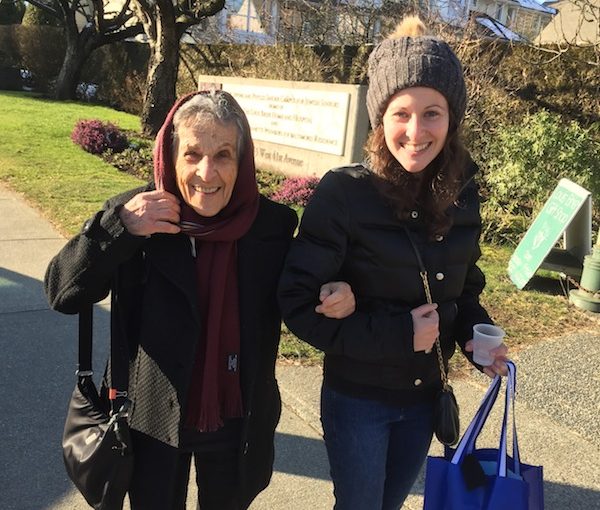
The author with her grandmother. (photo from Becca Wertman-Traub)

In the story of the Jewish people, it is not just about our patriarchs but the matriarchs, too. I grew up knowing that both my grandparents, Babi and Zaida, were Holocaust survivors. Zaida would tell me his stories – I know them backwards and forwards from how he spoke about them. But Babi, who was just 13 when the Second World War began, did not really tell hers.

She did talk about her brother – Shaike – who was taken to his death by the Nazi SS when he came out of the house to help young Frieda carry a pail of water. He was taken to a police station and killed in its basement along with numerous other Jews from the town. And she told us that her father, mother, sister and another brother all perished in the Holocaust. But not much else. She was too busy making blintzes, perogies, chicken patties, chicken soup with kreplach and more for her family.

Thankfully, though, she did have the extreme courage to tell her full story to the University of Southern California Shoah Foundation, where I learned the details of how she survived. Frieda’s childhood home in Kamionka-Strumilowa, Poland, became part of a ghetto. During the liquidation of the ghetto, Frieda and her brother, sister and mother hid in a hiding space in the wall and managed to survive, when the rest of the Jews of the town were taken to their deaths at Belzec extermination camp.

Following the liquidation, the German’s declared the town “Judenfrei,” free of Jews, but Frieda and her remaining family were still there. Since their home was located on the edge of the ghetto, they jumped off the balcony, surpassing the ghetto’s fence, and walked to Busk, a town 30 kilometres away, where they had heard that Jews were still living. They went to the Busk ghetto and lived with an aunt. Frieda’s mother died of typhoid there, and Frieda was left with her brother and sister. Unannounced, the Nazis started liquidating the ghetto, and Frieda again hid but was separated from her brother and sister – she never saw them again.

While in the Busk ghetto, Frieda worked as a gardener for a German man who said, if she returned to Kamionka-Strumilowa, he would help hide her. At the time, Frieda did not believe such a thing was possible and simply mentioned it to her cousins. However, after the liquidation, with no immediate family, she decided to give it a shot and walked back to her hometown by herself. The man took her to the village of Obydiv, where she met Mr. Svets, a Polish farmer. Frieda hid in this Polish farmer’s barn for 12 months and, today, his sister-in-law Janina Pelc is listed among Yad Vashem’s Righteous Among the Nations.

Frieda was one of just 20 from a town of 3,000 Jewish people who survived the Holocaust and lived to tell her story.

And did she live!

Babi and Zaida met after the war and moved to Vancouver in 1949. Babi was always walking, or speed-walking, usually leaving Zaida behind so she could do laps back and forth around him. She just could not sit still, whether it was cooking for her three children and, later, eight grandchildren, or cleaning the entire kitchen with a single square of paper towel – there could never be any waste. I remember sitting at Babi and Zaida’s kitchen counter as a little kid and Babi giving me milk in a tiny shot glass because “if you finish this, you get some more.”

Babi played tennis at Richmond Country Club, exercised at the Jewish Community Centre of Greater Vancouver, and dined at the finest restaurants and cafés in downtown Vancouver.

Even when Zaida passed away, she was not done living. Right up until the end, my dad took her out for coffee.

In September, just a few days before my wedding, we were out for coffee and she took my left hand, looked at me and said, “Is he Jewish? Is he from a good family?” I said yes, and reminded her that she was coming to the wedding.

At 95, she came to my wedding. And she danced at it – to none other than “Od Lo Ahavti Di,” Hebrew for “I have not loved enough.”

Babi appreciated life and everything it had to offer to its fullest, never allowing any of its gifts to go to waste. We mustn’t either.

May her memory be for a blessing.

Becca Wertman-Traub grew up in Vancouver and currently lives and works in Jerusalem.

Format ImagePosted on July 22, 2022July 20, 2022Author Becca Wertman-TraubCategories Op-EdTags Frieda Wertman, Holocaust, lifestyle, memoir, reflections, Vancouver

Reuse, recycle, make anew

I was driving down the back lane, kids in the car, when I saw a neighbour. I stopped and rolled down the window for a chat. The neighbour’s children lived nearby and they were looking for flooring to refinish the landing on their stairs. Our family, through an ordering snafu, ended up with more flooring than needed. In fact, we’d avoided using any new flooring at all. We had asked our clever contractors to help us reuse 110-year-old quarter-sawn oak flooring from elsewhere in the house and the floor refinishers hadn’t needed any of the new “special order, not returnable” flooring. I asked the neighbour if her kids were still interested in it, because we had a lot. She said she’d ask.

The neighbour then asked me if we were doing serious “purging.” I smiled and said it was more like “redistribution.” She laughed, saying she’d have to remember that. She liked this way of seeing things.

We like to think of ourselves as a family that reuses, recycles and repairs things. While we’re not purists, we try to limit what ends up in the trash as compared to the compost. We try to give away or repurpose the things we no longer can use for their original purpose.

If one imagines three kinds of models for one’s household economies, there are sometimes three terms bandied about. A linear economy involves “take, make, use and waste.” A recycling economy involves something like “take, make, use, recycle, make, use … on repeat and eventually … waste.” A circular economy has a much more complicated chart or trajectory, involving words like “take, make, use, repair, make, reuse, return, make, recycle” but very little becomes waste. Everything is used.

The talmudic-era rabbis were part of a circular and recycling economy. We know it wasn’t entirely circular (most ancient civilizations weren’t) because archeologists keep finding the detritus of all those communities. Ask anyone interested in history about this. They wax rhapsodic about pottery shards, bone fragments, mosaics and more – these are essentially the great finds that finally broke completely. These trash bits were thrown down a privy a hundred to couple thousand years ago. Even that ancient trash has its use now: it tells us a lot about societies long gone.

I thought about all this as I began to study the talmudic tractate of Ketubot as part of Daf Yomi. In the practice of studying a page a day, it takes 7.5 years to finish reading the whole Babylonian Talmud. Nevertheless, this page-a-day approach is superficial. It’s just too much text for me to study in detail, so I try to explore one thing every day that I find interesting.

In Ketubot 4, there is a discussion about what to do if a death happens right when a wedding is supposed to take place. The short version is, well, it depends, according to the introduction offered by Rabbi Heather Miller for My Jewish Learning. However, in many circumstances, the wedding is supposed to happen even if someone has to leave a dead body nearby in another room. Why? There are several reasons.

One important reason is that there was no refrigeration. If a wedding feast was prepared and it couldn’t be sold to someone else, the food shouldn’t be wasted. It can’t be assumed that there was enough food to just waste a whole wedding feast. The rabbis really valued “bal taschit,” or “do not waste,” which comes from the Torah, from Deuteronomy 20:19.

Also, if the bride’s mother or the groom’s father died, it was essential to continue with the wedding. These parents had important roles in the planning of the wedding. Canceling the event would take away from their children’s opportunity to benefit from that work. A bride depends on her mother to help her get ready and setting up a wedding later, after a mourning period, would mean a do-over. The bride’s mother wouldn’t be alive to help then, either.

In a discussion with my online Talmud study group, it was pointed out that, in many cases, rabbis throughout history will find every way possible to help people not waste. If a poor family makes a potential kashrut mistake, asks the rabbi what to do and the rabbi knows they will be hungry without the food, the rabbi finds a way to enable the family to eat the food.

This tradition gives me hope for Jewish sustainability in the future. Here are legitimate Torah and Talmud references that encourage us to avoid waste and to reuse and value others’ work. It gives me extra motivation to recycle when it’s difficult to do so, or to patch and reuse a pair of pants yet again.

In some Jewish situations, these notions of avoiding waste are not always followed. Think of a big holiday meal or Kiddush, where everyone used disposable paper products and plastic utensils and, afterwards, it all went in the trash. Consider some well-to-do congregations where holiday services are a fashion show, and where being seen in new clothing is more valued than just being appropriately dressed. These are instances where perhaps we’ve fallen prey to a consumerist, linear economy.

It’s still possible to dress up or wear something new or different on a special occasion. It’s OK to occasionally make more trash than usual, too. However, doing it on a regular basis is not just bad for the earth now. It also affects us in terms of climate change. It’s probably also a violation of the rabbinic obligation to avoid waste.

It’s true that cleaning, decluttering and renovation trends these days are all about how much can be discarded. Maybe it’s time to save the old growth lumber. Reuse something really good. It’s also good to pass along that new flooring so it, too, can be used sustainably rather than discarded. Don’t just throw everything out and produce more waste. Reuse, recycle, make anew … the rabbis said so.

Joanne Seiff has written regularly for CBC Manitoba and various Jewish publications. She is the author of three books, including From the Outside In: Jewish Post Columns 2015-2016, a collection of essays available for digital download or as a paperback from Amazon. Check her out on Instagram @yrnspinner or at joanneseiff.blogspot.com.

Posted on July 22, 2022July 20, 2022Author Joanne SeiffCategories Op-EdTags climate crisis, environment, Judaism, lifestyle, Talmud

נסיעה שנייה לישראל

חזרתי מנסיעה שנייה לישראל בסוף חודש מאי. בראשית חודש פברואר טסתי בדחיפות לישראל כיוון שאמי היתה מאושפזת במצב קריטי בבית החולים איכילוב שליד ביתה, לאחר שנחנקה מחתיכת תפוח שהיתה בסלט שאכלה. היא נפטרה לאחר מספר ימים ונקברה בדיוק באותו יום בו אבי נקבר, שנה קודם לכן. הנסיעה השנייה לישראל במאי בוצעה על ידי כדי לעזור לאחי להמשיך ולפנות דברים מדירת הורי, במקביל לחתימה על מסמכים שונים בפני עורך הדין של המשפחה. זו בעצם הפעם הראשונה מאז שעזבתי את ישראל לפני למעלה משבע עשרה שנים (בראשית שנת אלפיים וחמש), שאני מגיע לשני ביקורים בשנה. מודה אני שזה יותר מדי בשבילי. הטיסות הארוכות, השינויים בזמנים וכן באופי של שתי המדינות (ישראל וקנדה) מעייפים מאוד

הביקור הנוכחי בישראל היה קצר ונועד כאמור לטיפול בעניינים משפחתיים ולא מפגשים חברתיים. לכן לראשונה מאז עזבתי את ישראל, לא הודעתי מראש לאף אחד מחברי שאני מגיע. למעט אחי ואשתו, באותה סיבה לא פגשתי את שאר חברי המשפחה. כיוון שהספקתי לעמוד בכל המחויבויות ניצלתי את מספר הימים המועט שנשאר לי לפגוש מספר קטן של חברים קרובים. למרות ההיכרות הארוכה, אותה שפה (עברית) בה אנו מדברים, הרגשתי הפעם יותר מתמיד כמה אנו רחוקים זה מזה. אין ספק שהמגורים מחוץ לישראל, הפכו אותי לרחוק וזר מול מה שקורה במדינה, ובעיקר אצל אלה שגרים בה. אינני בטוח שהייתי היום יכול לגור בישראל. זו מדינה שהולכת ומשתנה תדיר ולצערי לכיוון הלא נכון

לפני שטסתי בחזרה לוונקובר הצלחתי להסתובב קצת ברחובותיה העמוסים לעייפה של תל אביב. ומה מצאתי: רעש קשה שחלקו נובע מבניית רכבת תחתית, פקקים אינסופיים ובעיקר ישראלים שלא אכפת להם מכלום. הם מדברים בטלפונים בכל מקום, מעשנים בכל פינה, צופרים נון-סטופ בעת הנהיגה הפרועה שלהם ועוד ועוד. בכל ביקור אני שם לב שגם בתל אביב כמות חובשי הכיפות הולך וגדל. הזכרתי זאת לבעלת בית קפה בכיכר מסריק והיא הגיבה במשפט אחד: “כמות הדתיים והבורים הולך וגדל”. כנראה שהיא צודקת

לאחרונה שמענו שהממשלה החילופית בראשות בנט ולפיד לראש הממשלה הנצחי – נתניהו, לא הצליחה במשימתה להחזיק קדנציה שלמה, ובחירות חדשות יערכו במהלך חודש אוקטובר. לפיכך יש סיכוי גדול שנתניהו שעומד למשפט על מעלליו הלא חוקיים, יחזור שוב לכס השלטון, לאחר שישב כבר על כיסא ראש הממשלה במשך כחמש עשרה שנים. זה הדבר האחרון שישראל צריכה כיום, וזה הדבר העיקרי שימשיך להזיק למדינה ולאזרחיה. נתניהו הוא מלך מלכי הפילוגים. בתקופת שלטונו ההסתה נגד גורמי אכיפת החוק ובית המשפט גדלה באופן משמעותי, כמו גם השסע בין האזרחים: דתיים מול חילוניים, ימנים מול שמאליים, ספרדים מול אשכנזים ויהודים מול ערבים

כשאני מסתובב כיום בישראל אני מרגיש זר לחלוטין. אינני מתחבר למה קורה במדינה, אינני אוהב את התנהגות הישראלים וסדר העדיפות שלהם. גם מבחינה תרבותית אני מרגיש כיום רחוק וזר. זה לא מתאים לי יותר. הישראלים הופכים יותר ויותר ללאומניים, ימנים ודתיים. במקום דו שיח יש יותר שנאה ואלימות מילולית (ולפעמים גם פיזית), במקום סדר יום חדש ובריא יותר למדינה ולאזרחיה: ישראל חוזרת לאחור והדת תופסת מקום מרכזי בחיים

כשעזבתי את תל אביב בטיסה בחזרה לוונקובר, נשמתי עמוקות וניסיתי לארגן את מחשבותי. למסקנה אחת ברורה הגעתי: בשנים הקרובות אינני מתכוון לחזור ולבקר בישראל

Posted on July 13, 2022July 7, 2022Author Roni RachmaniCategories עניין בחדשותTags Canada, Israel, lifestyle, politics, travel, טיולים, ישראל, סגנון חיים, פוליטיקה, קנדה

The romance of good bagels

Winnipeg has had a bagel renaissance. It’s not exactly a bagel mecca, and these are definitely not the New York City bagels my husband was raised eating. However, the recent bagel trends here are a step forward.

In the earlier days of the pandemic, summer 2020, my kids and I were out at the park when we met another family who seemed to recognize us, I’m not sure from where. I was surprised when they struck up a conversation but we had such a nice moment. Now that we’ve all spent so much time on our own, I have come to realize how important these outdoor encounters can be to our health and well-being.

Towards the end of the chat, these kind strangers handed us a bagel, straight from a brown paper bag that contained a couple dozen, as my twins were missing snack and getting hangry (hungry angry). We divided it up and ate. Ohhh. It was good. Not exactly a Montreal bagel, more like a combination between a New York City and a Montreal bagel, but definitely better than anything I’d ever had in Winnipeg.

I rushed home to tell my husband how to acquire more of these. Bagelsmith was, at that time, almost an underground bakery with a simple website. It didn’t have an open storefront, due to the pandemic, but if you got online right at 8 p.m. Sunday night, you could get bagels delivered on, say, a Tuesday or Thursday afternoon. There were also schmears, but these all had strange things mixed in with the cream cheese, which my purist spouse could not abide even considering. Soon, we were up to ordering three or four dozen of these at a time.

It should be noted that these bagels have a hole in the centre and are properly boiled but, although we enjoy sesame, poppy or everything bagels, they have way too many seeds for our taste. In fact, we’ve collected the seeds from the bottom of a paper bag, filled a spice jar with them and used them for challah toppings. (That is way too many seeds for a house with kids in it. They get everywhere and our dog doesn’t like them!)

I clarify all this because we have been treated to all kinds of bagels over the years that, quite frankly, are not bagels. Round things with a hole perhaps, but they haven’t been boiled, or boiled things that have no hole, or varieties that are absolutely abhorrent to a purist. The Big Nope – blueberry bagels. We’ve lived in a variety of places, including North Carolina, Kentucky and Buffalo, N.Y., and had to do without, because some bagels aren’t worth the calories.

My husband spent part of his childhood getting pletzels and biales from Kossar’s on the Lower East Side in New York and bagels from Russ and Daughters. (Of course, in New York City, there are a lot of good bagel places!) His grandparents and the extended Eastern European family have strong memories of what things should taste like. He has very high standards. Years ago, on a work trip to Montreal, his colleague and good friend (who happens to be Muslim), took my husband on a tour of all the famous Montreal bagel places. Then, the friend loaded him up with so many bagels and so much Montreal smoked meat that it was hard to carry it all home on the plane. This is the kind of love they have for each other, a perfect experience – two longtime colleagues who affectionately value each other through food!

Back to Winnipeg … as the bakery grew and the pandemic situation changed, there were times when we could not get these bagels delivered. The bakery was downtown in a spot that wasn’t far away but was hard to negotiate by car. I even figured out that the bagel baker had children who went to our kids’ school. However, when everybody’s in remote school, that morsel of information is useless. When we couldn’t get them delivered, we went without. This wasn’t a life or death situation. I baked our bread regularly and, when the local bakery was open, we got sourdough bread, baked in a wood-fired oven.

You may think that I could try harder, and maybe that’s true. I bake lots of bread, but draw the line at any recipe that takes more than 24 hours or is fidgety. I leave croissant production, bagel boiling and sourdough to the experts. After one multi-day sourdough experiment in hot weather in Kentucky, we agreed that, while the pink thing I grew was definitely alive, it wasn’t likely to be edible or safe. Lucky for me that my husband is a scientific researcher, because that weird starter attempt was not worth the risk to health and safety.

OK, back to our bagels. A huge thing has happened. Our favourite, artisanal, expensive bagel bakery has opened a second shop, and it’s easy to get to and just about in the neighbourhood. Today was the grand opening. It was also our 24th wedding anniversary.

My husband went out in between work meetings and came home with two dozen – yes, 24 – bagels. No, it’s not flowers or wine or a fancy meal, but to my partner, this is as good and romantic as it gets.

Bagels are an ethnic delight for Polish Jews. To be honest, I wasn’t raised with steady access to good bagels, growing up in Virginia. Bagels weren’t my (more North American assimilated, with some Western European roots) family’s biggest food focus. However, the Talmud speaks to this, too. We have a papercut, framed in our kitchen, of this phrase. Check out Pirkei Avot 3:17 – “No bread, no Torah. No Torah? No bread.” If you don’t have food, you can’t learn properly and without learning? You can’t earn your bread, either.

So, here’s to a good bagel, and a person, a partner, with whom I can continue to learn and grow. Here’s to another 24 years. L’chaim! B’tayavon. Enjoy your meal. Eat in good health!

Joanne Seiff has written regularly for CBC Manitoba and various Jewish publications. She is the author of three books, including From the Outside In: Jewish Post Columns 2015-2016, a collection of essays available for digital download or as a paperback from Amazon. Check her out on Instagram @yrnspinner or at joanneseiff.blogspot.com.

Posted on July 8, 2022July 7, 2022Author Joanne SeiffCategories Op-EdTags bagels, food, Judaism, lifestyle, Winnipeg

Hitting the high seas & citrus

Who among us enjoys using a 400°F oven during the summer? That would be: Nobody. Ever. For me, summer is synonymous with barbecuing, which is first cousin to steak, hamburgers, chicken and grilled veggies.

Recently introduced to tuna steaks, I’ve now gone over to the light side. On a recent trip to Victoria, good friends had us over for dinner and served one of the best meals we’ve eaten in years. While most of the component parts were healthy, some were deliciously questionable, in terms of caloric heft (see lemon mousse below). The star of the meal, by a long shot, however, was the marinated tuna steak, grilled on the barbecue. Even though it was more well done than I prefer, it was still juicy, incredibly flavourful and tender. I like my tuna steak with grill marks on the outside and pink rareness on the inside. Most good fish restaurants serve it like that. Despite the variance in preferences, our friend cooked it to perfection. As with all good things, I like to share my enjoyment with others. So, you’re welcome.

You can buy frozen tuna steaks at lots of stores. Fresh is even better, but not always available. For your culinary edification, did you know that Pacific bluefin tuna are approximately five feet long and weigh about 130 pounds? (Think: that’s bigger than me!) Apparently, the world record for the largest bluefin tuna caught was set in Nova Scotia in 1979. It weighed in at a whopping 1,496 pounds. How do you even land something like that? It’s like the Tuna That Ate New York. The tuna we had was cut into petite steaks of about five inches by three inches, and was one-inch-thick perfection.

MARINATED TUNA STEAKS
(serves 4)

4 4-ounce tuna steaks
1/4 cup orange juice
1/4 cup soy sauce
2 tbsp olive oil
1 tbsp lemon juice
2 tbsp chopped fresh parsley
1 clove garlic, minced
1/2 tsp chopped fresh oregano
1/2 tsp ground black pepper
salt to taste

In a large non-reactive dish (does this mean it’s even-tempered?), mix together the orange juice, soy sauce, olive oil, lemon juice, parsley, garlic, oregano and pepper. Place the tuna steaks in the marinade and turn it over to coat. Cover and refrigerate for at least 30 minutes. Bring to room temperature before grilling/frying. Preheat grill at high heat, or pan sear on high in a frying pan.

Lightly oil grill grate or frying pan. Cook the tuna steaks for approximately five minutes, then turn and baste with the marinade. Cook for an additional five minutes, or to desired doneness. I’ve read recipes that call for as little as a 45-second-per-side cooking time, so, use your own discretion. Discard any remaining marinade.

Serve it up with a side of guacamango salad (see below), and you’re sure to get a thank you note. Add some tri-coloured baby new potatoes and, voila, just like that, your guests/partner/pets will think you’re Julia Child!

Despite all evidence to the contrary, I can cook and not give people E. coli. I have been known to give my husband and I food poisoning from bad lamb. In my defence, it was a full moon and I was unsupervised. I’ve also been known to accidentally coat snapper in icing sugar instead of flour. Because Harvey and I were in our “courting” phase, he ate it nonetheless. I went out for takeout sushi. This is one of Harvey’s favourite stories. Mostly, I just cook stuff that it’s humanly impossible to screw up. Or, I let Harvey cook and, since he thinks that cooking is like doing a chemistry experiment, I say, knock yourself out Science Guy.

Never heard of my newly created gaucamango salad? Feast your tastebuds.

SHELLEY’S GUACAMANGO SALAD

2 large, ripe Ataulfo mangoes, diced
2 large, ripe avocados, diced
lime juice, to taste
olive oil
fresh mint, chopped roughly
blueberries (optional)

Mix all the ingredients together and tell me this isn’t the freshest-tasting summer salad you’ve ever eaten. Just try me.

As I’ve told you before, this accidental balabusta puts a premium on fast, easy meals, especially during the summer months. And, preferably, recipes that call for fewer than six ingredients, including spices. However, I made an exception for the lemon mousse, which breaches my boundaries for both patience and level of patchkerey. But, man, is it worth it! I usually never try recipes that involve separating eggs, because, well … it’s just dicey. Add in the double boiler element and we’re moving precariously into Ina Garten territory. But my friend’s rendition of this was just so darn good, I couldn’t not try it. If you’re a lemon lover, you won’t be disappointed. If you’re a sourpuss, you also won’t be disappointed.

LEMON MOUSSE DESSERT

2 lemons
1 pouch gelatin powder
4 eggs (separated)
60 grams (or 4 3/4 tbsp) sugar
1 pinch of salt
250 grams (or 1 cup) whipping cream

Wash the lemons. Zest the peel of one lemon and set it aside. Squeeze the juice of both lemons and set it aside.

Separate the eggs. Whisk sugar into the egg yolks.

In a double boiler, heat the egg yolk/sugar mixture and whisk continuously until very hot (but not boiling). If you’re like me and don’t own a double boiler, just set a bowl on top of a pot of hot water instead.

Slowly whisk in the gelatin powder, then add the lemon juice and zest. Put mixture into the fridge to cool, whisking occasionally.

Beat the egg whites with a pinch of salt until firm. Beat the whipping cream.

Once egg yolk/lemon mixture is cooled, gently mix in the egg whites and whipping cream until just combined. Pour into a glass serving bowl for a pretty presentation. Chill in the fridge for a few hours and then garnish with raspberries on top.

This dessert is both fluffy and light, despite all the whipping cream. And the lemon zest gives the richness a welcome bit of texture and zhuzh. This lemon mousse is a spectacular, tart addition to any meal, plus it looks über impressive. Go ahead, boldly go where no accidental balabusta has gone before. Until now. B’tayavon!

Shelley Civkin, aka the Accidental Balabusta, is a happily retired librarian and communications officer. For 17 years, she wrote a weekly book review column for the Richmond Review. She’s currently a freelance writer and volunteer.

Posted on July 8, 2022July 7, 2022Author Shelley CivkinCategories LifeTags Accidental Balabusta, baking, cooking, lemon mousse, lifestyle, recipes, tunafish

The importance of attribution

There’s a story in the Babylonian Talmud, in Tractate Yevamot 96b, that cut close to home when I studied it. It’s a brief episode but it addresses modern interpersonal issues. It features Rabbi Elazar, who goes to the beit midrash (study hall) and quotes halachah (Jewish law). However, Elazar makes a big mistake – he doesn’t attribute this teaching to Rabbi Yohanan, who taught it. This news gets back to Yohanan. And it doesn’t sit well.

Now, the backstory. Rabbi Yohanan, according to Rabbi Dan Ornstein’s My Jewish Learning summary online, is seen as “dangerously oversensitive” and quick to anger. Yohanan also apparently had (at least) 10 sons and they all died. He is so sad that, in Tractate Berakhot 9b, he is carrying around a tooth (or a bone?) from his youngest child who died.

Back to the current story: rabbis Ami and Asi, Yohanan’s students, try to calm him. They say anger isn’t good and offer a story about Elazar and Rabbi Yosei, who get so angry with each other that they tear a Torah. Yohanan becomes angrier, because they are comparing Yohanan and Yosei (teachers) with a student (Elazar).

Along comes Rabbi Yaakov bar Idi, who takes a different approach. He explains that everyone knows that all of Elazar’s teachings come from Rabbi Yohanan, who is, in their time, “our iteration of Moses.” In fact, “Everyone knows Elazar is quoting you, even when he doesn’t quote you by name. You have nothing to fear.”

This diplomacy soothes Yohanan, who then corrects Ami and Asi, pointing out this was a great way to manage the situation.

There was so much in this story that affected me. First, there’s the matter of, in modern terms, “copyright.”  Everybody deserves credit for their work. It’s not right to just claim somebody else’s ideas, images or innovations as your own.

There’s also the issue of context. Rabbi Yohanan had great personal tragedy and loss. People with this much trauma might be sensitive or angry – and that’s entirely understandable.

It’s also awful to try and “teach” your instructor through the example of one of their poorly behaved students. It disregards Yohanan’s wisdom and authority. Recognizing this trauma and honouring elders means treating them with respect instead of talking down to them, as rabbis Ami and Asi did.

The talmudic story continues: the teachings of a great person speak to us from beyond the grave. Yohanan’s legacy is his teaching of Jewish law and Torah. It’s erased if Elazar fails to acknowledge where it came from. When a person loses their children and hopes that his students will help his name live on? It’s demoralizing and infuriating when his students “erase” him instead.

OK, yes, but this is just an old story, why did it matter to me?

As an author, I care about copyright issues. Most authors don’t earn more than, at most, a dollar when each book is sold. Most writers (myself included) cannot make a living on their books or other writing. So, seeing bootlegged downloads of my books on the internet is infuriating – it’s just another way to “erase” a person’s value and intellectual property.

Then, there’s the issue of our personal story and how it affects our work. We’ve all known people who’ve suffered losses or struggled. Rabbi Yohanan is a good example. Perhaps some learn from this suffering and gain wisdom. Yet Yohanan’s students condescend to him and belittle his anger because “he might tear a Torah” like one of his students? This is not consolation. It’s demeaning.

Rabbi Ornstein uses the word “flattery” to describe what Yaakov bar Idi did, saying that everyone knew Elazar got everything he knew from Yohanan. I think that’s the wrong take. In trying to soothe Yohanan, Yaakov bar Idi gives him respect and credit. This shows how much our work means to us. As a good teacher, when calm, Yohanan made the experience a lesson for his other students. In other words, everything is Torah – we can learn how to be better people from any situation, no matter how upsetting or demeaning.

Occasionally, work situations pop up that “put us in our place” or give us context about what we do. Recently, I opened up my work email to discover I’d lost seven-plus months of emails from my inbox. Now, of course, an organized person would have addressed every issue, filed every email, and had an empty inbox. I hang on to things, I don’t spend enough time on tidying, and I keep things so I can think about them. Mea culpa.

After trying every technical solution available, it became clear that those emails were gone forever. No idea what happened. I had to let go of the panic and the upsetting situation. I hope my work has value, and that people will get in touch if they want to work with me.

Losing my emails this way felt like being erased. Middle-aged women, who are also caregivers, often earn less for the hours we work. We earn nothing for the hours of household labour we do to take care of those around us. It’s natural to feel angry about this. Rabbi Yohanan’s anger reminds that we all want to be acknowledged, have our work valued and respected. It’s not hypersensitive or unreasonable to want to leave a legacy to others. Taking on someone else’s teaching without attribution, as Elazar did, is the erasure that happens to many of us, and Rabbi Yohanan shows us that anger is a human response. Yaakov ben Idi suggests that acknowledging his teacher with respect is the compassionate way forward.

In a perfect world, my inbox would magically repopulate. I’d get offers from new clients showing my value as a writer and editor. My elementary school twins would suddenly acknowledge and thank me for all those meals and chauffeur moments. In reality, we all have to remind ourselves to reach out, acknowledge others, and treat them with respect. It doesn’t always happen automatically. Yohanan’s students valued his wisdom but they had to learn to acknowledge his work and recognize that his feelings mattered, too.

In this way, Rabbi Yohanan’s wisdom teaches us from beyond the grave. We must not erase others’ contributions. An erasure or even an empty inbox doesn’t make anybody’s life fulfilling. We must validate and value each other.

Joanne Seiff has written regularly for CBC Manitoba and various Jewish publications. She is the author of three books, including From the Outside In: Jewish Post Columns 2015-2016, a collection of essays available for digital download or as a paperback from Amazon. Check her out on Instagram @yrnspinner or at joanneseiff.blogspot.com.

Posted on June 24, 2022June 22, 2022Author Joanne SeiffCategories Op-EdTags copyright, Judaism, lifestyle, Talmud

Celebrate good moments

We experienced a remarkably sunny and beautiful spring day this week. It was an unusual day as our twins had a “well-child” physical at the pediatrician’s, something we hadn’t done in several years because of the pandemic. We took the morning off school and work. The appointment was remarkably smooth and quick. There was a park with swings near the medical building, deemed perfect by the kids. The bakery was open on the way home so we got a piece of rich chocolate cake and croissants for a snack.

As I drove my kids to school after lunch, so they could catch the second half of the school day, we all remarked on the amazing weather. There was a tendency then in our discussion to wish away the intense flooding, mud and big snowstorms we’d had in Winnipeg. Flooding and snow have been a huge problem in Manitoba this year, too much of a good thing after three years of drought. We agreed that there was nothing wrong with a good snowstorm, but that the muck we’d lately endured was a drag.

I tried to stop the negative thoughts popping up and ask my kids to please help me just cherish the sunny, warm, new bright green grass moment we’d had. We arrived at school. I walked them across a busy intersection, and drove home.

In the past, our pediatrician trips sometimes might take three hours. It was a combination of complicated medical issues, a wait to be seen, and negotiating the hospital corridors, tests and crowded, expensive parking lots. We used to joke that after returning home with the twins after vaccinations, they got baby Tylenol and we deserved a stiff drink. If you’ve had a history of health challenges, even a “regular” appointment can be stressful and I was exhausted after our relatively smooth experience that morning.

I’ve learned from reading a page of Talmud a day and doing Daf Yomi that my tendency to focus on the details and worry about every eventuality is nothing new. It’s not at all special. The rabbis of the Babylonian Talmud explored every detail when they figured out what the laws and issues could be around Jewish life, law and observance. When the text seemed brief, commentators filled in the blanks. We have thousands of years of recorded details and “what ifs” in our tradition. Thinking about every detail and overthinking every eventuality is a Jewish tradition! It’s no wonder that we may have anxiety over getting everything right and wondering about how things will go in advance – it’s literally part of our oral Torah and identity.

Sometimes these details can mean life and death. While it seems dark to drag this thought into such beautiful spring weather, I was struck by how many generations of anti-Jewish hatred have forced us to be on our guard. Many Jewish families carry two passports or have escape plans ready because they remember that their families have had to do it before: to escape the Holocaust, the Farhud, pogroms, banishments, the Inquisition, and beyond. Heck, after the destruction of the Temple in Jerusalem, Jews were the definition of the original diaspora, as many were sold into slavery throughout the Roman Empire. Historically, we have good reason to be on edge.

Back at home, after the medical appointment, I was tasked with organizing the first birthday party for our twins in years. Counting up RSVPs resulted again in focusing on the details while reminding myself of the huge gains we’d made. Recovering from what was a traumatic birth experience, with one twin in neo-natal intensive care, is always tough for me to celebrate each year. Despite the big fuss some people make over birthdays, it can be a rotten series of flashbacks for me to manage. I remember the obstetrician’s surprise when he asked how I saw the outcome of my twin pregnancy, which was a struggle. I explained that my goal was to live through it, as that was what Jewish law valued most, the life of the mother. If I came out with one or two healthy infants at the end, well, that would truly be an amazing miracle.

Now, I have two healthy and active almost-11-year-olds. Things change and we must focus on the joyful moment, the present, and enjoy the sunny days we’ve got.

All of these mundane family events happened on May 24, when many elementary school children were gunned down with their teachers in Uvalde, Tex. While my kids spent their afternoon at school in Winnipeg, the news spread that there had been another mass shooting in the United States. While the details aren’t all clear yet, the pattern is too familiar. Many families are being torn apart by horrible, unnecessary loss. Still others will face endless numbers of very difficult medical appointments ahead, for which I feel so much empathy and pain. Everyone should be able to go to school, the grocery store or their place of worship in safety. Every life taken by this awful violence is too many.

Our tradition tells us to cherish every single life, to do everything possible to save a person. Every moment and detail counts when something so precious is at stake. Still, we also have to find ways to pause and savour the details that make meaning. We need to find the moments that give us joy. We’ve got blessings to say, like the all-purpose Shehecheyanu, to embrace those grateful, new experiences and we’ve got specific ones for seeing rainbows, eating delicious snacks, and more. It’s a crucial part of our Jewish identities to use ritual tools to balance joyous, celebratory details in the moment with the real and dark feelings that come from tragedy.

May we all have chances this summer to celebrate, embrace the sunshine, and grow things – and pleasure. May we gather only for good moments.

Joanne Seiff has written regularly for CBC Manitoba and various Jewish publications. She is the author of three books, including From the Outside In: Jewish Post Columns 2015-2016, a collection of essays available for digital download or as a paperback from Amazon. Check her out on Instagram @yrnspinner or at joanneseiff.blogspot.com.

Posted on June 3, 2022June 1, 2022Author Joanne SeiffCategories OpinionTags family, health, history, Judaism, lifestyle, survival, Talmud

Posts pagination

Previous page Page 1 … Page 8 Page 9 Page 10 … Page 24 Next page
Proudly powered by WordPress