Galilee as a food-tech hub

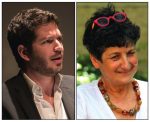
Former chief scientist of Israel Avi Hasson, left, and MK Dr. Erel Margalit. (photo from Noa Yaar)

Having the Upper Galilee be the world’s food-tech hub is the dream of Israeli Member of Knesset Erel Margalit, who recently announced he will run for leadership of the Labour party. And the work has started in the form of Israel Initiative 2020 (ii2020).

Leading the establishment and development of the food-tech hub in Kiryat Shmona is Michal Drayman, a partner and chief financial officer of Jerusalem Venture Partners (JVP). She has 11 years of high-tech experience and 14 years’ experience in the agro-bio medical activity area of investment.

For Drayman, ii2020 is her volunteer job, and she describes her role as “vice-chairman.” The initiative started up nearly four years ago, focusing much of its work in Israel’s upper north and south.

“We decided to focus on agri-food development in the Eastern Galilee, which is made up of a group of 22 municipalities, from Tiberius in the south, up to Metula in the north and the Golan Heights in the east,” she told the Independent.

They began working with the region in January 2014, holding brainstorm sessions and doing about six months of research with 10 leaders from the region to pinpoint a focus, which became agriculture.

“Anything that can be grown on earth can be grown in the Eastern Galilee,” said Drayman. “Because of the difference in height, climate, water and land, it allows them to grow anything from tropical things to cherries, apples and everything in between.

“We also discovered that the area already has a lot of activity when it comes to agro-bio research – in particular, with Migal, a foundation founded in the early ’70s that has about 115 employees, 65 PhDs and about 50 laboratories developing food and agro-bio activity.”

With Tel-Hai College to develop the academic focus – most of its 5,000 students are studying agriculture, bio-technology, food and nutrition – the region is well-positioned in the field.

As Drayman and team sought an even more specific focus, they decided on medical food, which means any food promoting health and preventing illness. “With this, we’re taking into consideration modified food, functional food, macro-bio activities, and how it will affect us concerning nutrition going forward,” said Drayman.

While work in this field is being done on a large scale by the Volcani Centre, as well as by other institutions throughout Israel, it has rarely reached the market. It took Drayman only six months to get consensus from area municipalities that medical food would be their focus, after which she began on the year-long process of writing up a plan.

“Bio-technology and health, there’s so much to do that, with the right investment, we see the potential of growing something significant in that area,” she said. “In food tech, there’s a lot of innovation and research, but not a lot of invested money. Much of the work that is done is void of being able to monetize it. That’s true of the world, not just in Israel.”

Looking at how food companies impact health by what they put into the food they make – ingredients such as sugar and salt, for example – Drayman and team are working with the industry to change regulations, especially food labeling. The goal is to give customers clear information about the nutrition content in the product they are buying.

“The idea is that companies cannot just [add] sugar whenever they don’t have another ingredient and want to fill [the product] with something very cheap,” said Drayman. “We’re going to show … a red stop light on food. If it has too much salt or sugar, it will be identified on the wrapping.

“The food industry is going through significant change,” she added. “Regulations, GDP talks, and the fact that people are more educated and understanding about what we’re eating, will affect how we’ll be when we get older. If we’re going to make sure we’re eating proper nutrition, then probably we’re going to affect a lot of the illnesses and reduce the amount of obesity.”

Exactly three years from the initiation of the project, with the 22 municipalities participating, the government approved about 80% of Drayman and team’s submitted budget. Next, they will speak with various multinational companies to see if they will invest in research and development in the area.

“One of the things that’s already in process is the movement of the Volcani Centre that is currently in the Tel Aviv area to the Galilee,” said Drayman. “It was declared, but I’m less optimistic about how fast it will happen. But it was declared it will happen, which is huge, because we’re talking about 5,000 scientific people doing research. So, moving that kind of activity would be significant.”

The municipality of Kiryat Shmona has allocated a building to house the new food innovation centre and funds are being collected to allow for the renovations, with Jewish National Fund picking up half of the $6 million tab.

“Basically, we want it to be an iconic building in the centre of Kiryat Shmona, something that will be visible from the road,” said Drayman. “It will have an accelerator for food-tech activities and activities with kids and education – trying to have two percent of top-tier students working together with the accelerator, incubator and entrepreneurship … being part of a success story.

“We’re going to also have music, because we don’t want to have it only as a high-tech building. We want to make sure we have regular people being part of it, living the scene, and not isolating this kind of activity.”

To raise the remainder of the needed funds, Drayman is working to create a consortium of five multinational companies that would run the accelerator and, subsequently, create and run an incubator.

“The accelerator, as opposed to regular accelerators that only do mentoring and primarily help when you’ve started to build a theme … we want to do proof of concept with our accelerator,” said Drayman. “We’d like to invest money, not only time and support, from high-tech people. We want to actually invest money and run the project for four to 12 months to identify an actual R&D project or research and bring it to commercialization.

“Assuming it’s able to be commercialized, then we’d like to take it into the space of an incubator and invest larger amounts of money to be able to run the project until an actual company is created.”

As of press time, IBM was considering providing data analytics.

For more information or to get involved with ii2020, contact Noa Yaar at noa@ii2020.org or 1-781-530-8025.

Rebeca Kuropatwa is a Winnipeg freelance writer.

Homemade shakshuka

Shakshuka is a combination of flavours, aromas and colours that appeals to all our senses. (photo from Café FortyOne)

Choosing a dish that defines us gastronomically is an impossible task because Jewish cuisine comprises a long and varied history of aromas and flavours fused by our many journeys around the world. But, if we narrow our task to discussing a representative Israeli dish, then shakshuka might be it.

Although there are many variations, shakshuka is generally made with stewed tomatoes, spices and eggs. It is one of the foods most loved by Israelis and it is a dish that has been enjoyed by countless tourists to the country. It is said that its secrets were brought to Israel by Jewish immigrants from North Africa but, for me, it also has a taste of home. My parents used to prepare it to pamper us, using the recipe of my grandparents from Turkey and giving it an Argentine touch. And there is nothing like shakshuka as an example of how certain foods have traveled with us throughout our history and to the different countries in which we have settled.

Shakshuka means “a mixture.” It is a combination of flavours, aromas and colours that appeals to all our senses. In Israel, it is often eaten for breakfast, a bright and spicy way to start the day. But it is also an excellent dish for lunch or for a special brunch.

Like many great dishes, there are as many versions of shakshuka as there are cooks who have made it, and it can be found on café and restaurant menus throughout the world. Modern culinary interpretations enhance the basic dish with salsa, with all kinds of vegetables, including eggplant and kale, and with cheeses such as feta. Some even incorporate meat into the recipe, modifying it according to personal taste. Some variations replace the tomatoes entirely – for example, there is a version that replaces the tomato sauce with one of spinach and cream.

Although there are many ways to cook shakshuka, from the Mexican version called huevos rancheros to the Turkish menemen, my shakshuka cuts to the traditional. The recipe below will give you a lovely shakshuka, rich in flavour. Once you have mastered the basics, you can add your own touch by using other ingredients that you like. However, this dish has one must: it must be accompanied by pita, challah or one of your favourite breads. Why? Simply because the sauce is really delicious and you will not want to leave a drop of it in the pan.

But, enough talk. This recipe I’m sharing is special – it is the one my family uses and which has given us many beautiful memories. It makes enough for two people.

SHAKSHUKA

5 ripe large tomatoes
1 large chopped onion
1 red pepper
4 garlic cloves (if you find it too strong, remove the centre)
2 tbsp extra virgin olive oil
4 eggs
touch of kosher sea salt
2 tbsp paprika
pinch of cumin
chopped parsley for decoration
tomato paste or concentrated tomato (optional, for a stronger taste)

  1. Pour the olive oil in a frying pan over medium heat. Add the onions and sauté until lightly softened, stirring occasionally. Add the red pepper and garlic, frying for a few minutes until they are soft and lightly browned.
  2. Add chopped tomatoes, paprika, cumin and salt. Stir until all ingredients are well mixed, then cover and simmer for about 10 minutes. The idea is for the tomatoes to become soft.
  3. Once the tomatoes are cooked, stir and then make two holes with a spoon in the surface of the sauce. Break an egg into each one of the holes. Arrange the eggs and the surrounding sauce so that the egg whites are below the surface of the sauce.
  4. Cover and let simmer for five to seven minutes, until the egg whites are cooked but the yolk is still runny.
  5. Sprinkle with chopped parsley and serve immediately in the pan it was cooked in, along with pita (or other bread), hummus and an Israeli salad.

Yamila Chikiar co-owns Café FortyOne with her husband, Daniel Presman.


החלטות ממשלת ישראל פוגעות

הכותל (צילום: Golasso)

יו”ר מועצת המנהלים של הג’ואיש פדריישן: “החלטות ממשלת ישראל פוגעות במרקם היחסים המיוחד בין הקהילות בקנדה לישראל”

“ההחלטות האחרונות שהתקבלו על ידי ממשלת ישראל פוגעות מאוד מרקם יחסים המיוחד שקיים בין הקהילות בקנדה לישראל”. דברים חמורים אלה נאמרים על ידי יו”ר מועצת המנהלים של הג’ואיש פדריישן של מטרו ונקובר, קרן ג’יימס. זאת, בתגובת להחלטות הממשלה על הקפאת מתווה הכותל שהיה אמור לאפשר להכשיר את החלקה הדרומית, שם יהיה ניתן לקיים תפילה שוויונית. וההחלטה בנושא חוק הגיור שקובע כי כל הגיורים יהיו רק במסגרת הרבות הראשית בישראל, וכן תהיה בחינה של כל הגיורים שכבר קיימים. משמעות הדבר שיהודים שמשתכיים לזרמים שונים ביהדות דבר שמאפיין את הרוב הגדול של יהדות התפוצה, יהדותם לא תהיה מוכרת על ידי ישראל. אם כן גל המחאות הקשות נגד החלטת הממשלה שהתחיל בקרב יהודי ארה”ב מתפשט גם לקנדה. יש לזכור שבקנדה יש כיום את הקהילת היהודים השלישית בגודלה בעולם, מחוץ לישראל.

ג’יימס (ילידת 1952) כיום היא אשת עסקים שגרה בוונקובר, ועבר נמנתה על נבחרת השחייה של קנדה לאולימפיאדת מינכן שערכה ב-1972, בה נרצחו תשעה ספורטאים ושני מאמנים של נבחרת ישראל על ידי טרוריסטים.

ג’יימס ביקרה בחודש שעבר בישראל כולל אצבע הגליל, במסגרת השותפות של שש קהילות יהודיות בקנדה (מוונקובר, אוטווה, קלגרי, אדמונטון, וויניפג והליפקס) עם האזור שבצפון. השותפות בין הקהילות לאצבע הגליל כוללת קצאת מיליוני שקלים לטובת מערכות החינוך והרפואה באזור, וכן פעילויות משותפות עם אחד עשר בתי ספר באזור, משלחות נוער ותורמים רבים. ג’יימס מזכירה שהקהילה היהודית בוונקובר מקיימת מערכת יחסים מיוחדת עם אצבע הגליל לאורך עשרים השנים האחרונות, שכוללת השקעות כספיות גדולות, על מנת לשפר את איכות החיים של התושבים המקומיים. “במהלך שנים אלו נבנה גשר חי בין שתי הקהילות, שכולל חברויות רבות של בני משפחה אחת גדולה, של עם אחד”.

ג’יימס מוסיפה: “כל זה עומד בניגוד מוחלט להחלטות ממשלת ישראל בנושא מרחב תפילה שיווני בכותל ובנושא חוק הגיור, שמעניק לרבנות שליטה על הגדרת מי הוא יהודי. ובכך מעמיד את הסטטוס של אלפי יהודים בסימן שאלה”. היא מדגישה כי החלטות הממשלה בסוגיות חשובות אלה פוגעות במשמעות התפיסה של מה זה להיות עם אחד, והממשלה שולחת מסר לרוב היהודים בצפון אמריקה כי היא איננה מכירה ביהדותם. “זה מעמיד את המשך תמיכתם של יהודי התפוצות בישראל במצב של סיכון משמעותי. ולכן המצב כרגע הוא חמור ביותר”.

לדברי ג’יימס היא משתייכת לאחד מבתי הכנסת הגדולים ביותר של ונקובר, בו גברים ונשים יושבים ומתפללים ביחד. וכן נשים חובשות כיפה וטלית אם כך הן חפצות. לא מעט גברים ונשים מבית כנסת זה עשו עלייה לישראל. סגנון תפילה זה המשותף לגברים ונשים הוא הנורמה המקובלת עבור מרבית היהודים החיים בצפון אמריקה. ג’יימס מסיימת בדברים אלה: “אני מאמינה כי הזהות המשותפת של כולנו כעם יהודי אחד, ללא קשר לזרם היהדות אליו כל אחד מאתנו בוחר להשתייך, גדולה ומשמעותית לגשר על כל שוני באשר הוא”.

יצויין כי הקונסולית הכללית של ישראל בקנדה, גלי ברעם, שלחה מברק למשרד החוץ בישראל כי קיבלה מסרים חריפים מבכירים בקהילות היהודיות בטורונטו וונקובר, שמזהירים כי שתי החלטות הממשלה יחמירו את הניכור כלפי ישראל, בקרב הדור הצעיר של יהודי קנדה. לדבריה אחד הרבנים בקנדה אמר לה כי סטודנטים יהודים אומרים שמה שישראל עושה זו אנטישמיות”.

Marketing of technology

Yonatan Avraham, student ambassador of HUstart, left, and Tamir Huberman of Yissum are two of the four speakers who will be participating in Jerusalem of Gold: Capital of Innovation & Tech on July 16. (photos from CFHU Vancouver)

“I have always loved the thrill you feel while creating your own project, seeing it grow and being responsible for the outcomes – and the satisfaction you feel while convincing a stranger to give his or her resources (time or money) for your product,” said Yonatan Avraham, student ambassador of HUstart, Hebrew University of Jerusalem’s entrepreneurship centre, about what excites him about being an innovator and entrepreneur.

Avraham is one of four speakers who will participate in Jerusalem of Gold: Capital of Innovation & Tech, which will take place on July 16 at the Jewish Community Centre of Greater Vancouver. The event is being hosted by Canadian Friends of the Hebrew University, the Jerusalem Foundation and JCCGV. Avraham will be joined by Lior Schillat of Jerusalem Institute for Policy Research; Maya Halevy of Bloomfield Science Museum Jerusalem; and Tamir Huberman of Yissum, HU’s technology transfer company. The Jewish Independent’s interviews with Schillat and Halevy appeared in last week’s issue (see jewishindependent.ca/jerusalem-a-high-tech-hub).

“All of the speakers are coming from Israel especially for this tour in Western Canada. We will be in Vancouver on July 16, Calgary on July 17 and Edmonton on July 18,” said Dina Wachtel, Western region executive director of CFHU, of the tour, which celebrates the 50th anniversary of the reunification of Jerusalem.

“Tamir is going to give a talk on Friday, July 14, at Simon Fraser University titled The Power of Social Networks: Boosting the Marketing of Innovations, organized by Fred Popowich, executive director of Big Data Initiative at Simon Fraser University,” she said. “Part of our mandate is to create these living bridges between Hebrew U and our local universities; hence, this is part of this initiative.”

Huberman is Yissum’s vice-president of business development and director of information technology. At the JCCGV, he will talk on Marketing Innovation: Changing Israel and the World.

In the press material, Huberman notes, “As the only university in Israel with a school of agriculture, research in non-GMO hybrid seeds at Hebrew U is changing the way millions of people eat now and into the future.” He also notes that Mobileye, which recently sold to Intel for $15.3 billion US, was founded by HU Prof. Amnon Shashua.

Yissum “operates on a royalty-based model which channels proceeds from successful products back to the researchers, their labs and the university itself,” he explains. It also generates funds “by attracting corporations to collaborate with Hebrew University labs to find the answers the businesses are seeking.”

About what B.C. (and other) universities could learn from HU, Huberman told the Independent, “I believe that the top lessons are how to be more effective and how to remove barriers for doing business. In most cases, tech transfer companies around the world are [viewed] as a bureaucratic entity that complicates things. The greatest lesson is making adaptations that would make things simpler for the companies that want to do business with us…. The second lesson is the realization that, for each new technology, there either has to be someone in the world that would be interested in acquiring a licence, or someone in the world that knows the technology does not have a chance. It is the ‘job’ of the tech transfer to find that ‘someone’ and, from my experience, the best way to do that is by using social networks. The revolution of social media allows getting fast replies from people all around the world, even if you’ve never met them.”

Huberman has always loved innovation and, he said, “it was a big dream of mine to be an inventor and work with new inventions.”

While working for the company Medis from 1996 to 2002, he was exposed to the world of patents and the process of writing patents as an inventor. “After my own experience as an inventor,” he said, “I knew I had to find a place that works with new patents at a massive scale.”

It was his “strong passion for new patents and ideas that was the top reason for joining Yissum,” he said. “Second was the opportunity to work with some of the most brilliant researchers in their fields. Third was my realization that there was something missing at the time before I joined Yissum, which had to do with the very low use of the internet in order to expose the technologies from the universities to the world.

“Before I arrived at Yissum, I made a simple search using freely available patent databases and saw that only a small fraction of the patents I found [were] on the tech transfer websites. When I realized this, I had a vision of changing how tech transfer companies worked…. My dream materialized when I created the first portal for all the technologies at Yissum and later created the ITTN website (Israel Technology Transfer Organization). ITTN was the first website in Israel that allowed all of the inventions from academic institutions in Israel to be found in one central portal.”

He added, “I believe that there is a lot that can be done to make a better and faster connection between companies seeking talent or innovation to the offerings of universities…. [B]uilding a portal that connects more universities in Israel and the world could help make that matching much more efficient.

“Another realization is that tech transfer companies traditionally showcase technologies and I believe that this is not the best approach…. [T]he portals should focus on the researchers and their capabilities, rather than just the patents that a small portion of them invented. We have multiple examples of companies that were interested in researchers that we did not even know [because] they never had any patents.”

One of the jobs of HUstart – of which Yissum is part, along with HU’s science faculty and business school – is to provide “practical education, support, mentorships and connections needed” for students and others “to become effective entrepreneurs.”

Avraham is a third-year physics student at Hebrew U and is in the first cohort of the new Physics and Entrepreneurship program, which connected him – during his second year of study – with his business partners. Avraham and fellow students Michael Levinson and Tom Zelanzy co-founded the start-up Gamitee, which “links social media and shopping websites, making it possible for friends to easily invite others to join them in a shopping experience.”

Avraham has other ideas, such as one for an “infant sleeper that monitors a baby’s vital signs, a technology that could potentially prevent SIDS.” And he and his wife – who is an archeologist – also run a tutoring business. In Vancouver, he will speak on The Making of a Serial Entrepreneur.

“I think they have a lot of similarities,” he said about physics and building a tech start-up. “In both, you need to solve complex questions and problems that are comprised of several independent factors. Both of them are professions that people rarely choose. And they are both very, very hard to understand. I think my physics background [increased] my range of abilities needed [to be] an entrepreneur.”

Jerusalem of Gold: Capital of Innovation & Tech is open to the public. Tickets are $45, though students who register at the CFHU office can receive a free ticket. For tickets and the speakers’ bios, visit cfhu.org, email vanc@cfhu.org or call 604-257-5133.

Express your opinion

The good news is we’re again debating “who is a Jew.” This is good news, of course, only because it’s a topic that divides Jews mostly when external threats abate enough to allow the luxury of pilpul around denominational rights and definitions.

We can only assume that the state of the world – the Iranian threat, the unhinged American administration, Syria in collapse – looks fine enough from the Israeli prime minister’s office that we have the freedom to indulge in family squabbles.

A year-and-a-half ago, the Israeli government finally agreed to create an egalitarian prayer space at the Western Wall. The Charedim who legally control Israel’s Jewish religious character, including practices at the Wall, have imposed a strict gender division on prayer and ritual at the holy site. This has sent the message to Conservative, Reform and other non-Orthodox Jews that the holy site is not wholly theirs and, by extension, that their forms of Judaism are not authentic or proper. The creation of an egalitarian section was hailed as putting an end to a painful and divisive aspect of Israeli-Diaspora relations.

An egalitarian space would permit families to visit the Kotel together, allow girls to read from the Torah during their bat mitzvahs and give women the right to pray out loud, rather than following the existing rules by which women must pray quietly so that their voices may not be heard by men on the other side of the divided plaza. The agreement for a new egalitarian space would not alter the existing men’s and women’s areas, but rather add a new, third space, south of the traditional prayer areas.

At the time the agreement was reached, Anat Hoffman, chair of the board of Women of the Wall, a group that has been at the fore in advancing the goal of an egalitarian space and whose members are routinely arrested for praying at the Kotel with prayer shawls, said the decision by Israel’s cabinet was an acknowledgment “that there is more than one way to be Jewish.”

Last week, the Netanyahu government changed its mind and decided there is not.

Bending to pressure from the ultra-Orthodox members of his coalition, the proverbial tail that so often wags the dog in Israel’s political system, Netanyahu called a snap vote on whether the decision taken in January 2016 to create the egalitarian space should indeed proceed. Ministers who last year voted in favour last week voted against.

In for a penny, in for a pound, the government at the same time advanced a bill that would reinstate the Orthodox monopoly on conversions and lifecycle events, including marriage and burials. Among the implications is that Jews not converted under the auspices of the Chief Rabbinate – in other words, by Conservative, Reform or other non-Orthodox rabbis – would not be recognized as Jews.

On most issues, Israel should take Diaspora concerns into consideration only secondarily to what is right for Israel. We have said in this space before, for instance, that Israeli defence policies should be determined with the security of Israelis as the priority, not the comfort of Diaspora Jews who have to live with the political consequences, but not the life-and-death consequences facing Israelis.

This is different. Rules regarding prayer at the Western Wall – who, where and how – should be made with the interests of the Jewish people – not just Israelis – foremost in mind. Of course, if the rules were made with the majority of Israelis in mind, they would reflect the diversity of religious observance both in Israel and in the Diaspora. Instead, what we have is a narrow reflection of ultra-Orthodox priorities that is more a result of political realities in the Knesset than religious reality anywhere outside that chamber.

Ultimately, these decisions are a result of political, not religious, considerations. The political needs of the Netanyahu government’s coalition appear to be superseding the Jewish state’s respect for diversity and pluralism within the global Jewish peoplehood.

“We believe in Jewish unity, not uniformity,” states a letter to Netanyahu signed by scores of Canadian rabbis. “The spectrum of Jewish practice is diverse, but it need not lead to divisiveness. Our differences are eclipsed by all that unites us: millennia of shared history and a shared future. What happens to Jews today – no matter where they live or where they attend synagogue – invariably affects us all.… We are an indivisible people, which is why we are deeply concerned by these and any other actions that unnecessarily foment division within amcha.”

Most of us do not have a vote in Israel, but each of us has a voice. The Centre for Israel and Jewish Affairs is urging each of us to contact the Israeli embassy to express our views on this vital matter. Please do.

Jerusalem a high-tech hub

Lior Schillat of Jerusalem Institute for Policy Research and Maya Halevy of Bloomfield Science Museum Jerusalem will speak at Jerusalem of Gold: Capital of Innovation & Tech on July 16. (photos from CFHU Vancouver)

“Hebrew University is probably the only university that ‘founded’ a state rather than vice versa, as the cornerstone for the university was laid on July 24, 1918, and, on April 1, 1925, the Mount Scopus campus was opened,” Dina Wachtel, Western region executive director, Canadian Friends of the Hebrew University, told the Independent. “The contemporary history of the city of Jerusalem and the story of the Six Day War is intertwined with the story of the university – what better way to celebrate that than by bringing in four of Jerusalem’s change-makers?”

The July 16 TED Talk-style event at the Jewish Community Centre of Greater Vancouver – hosted by CFHU, the Jerusalem Foundation and JCCGV – “is a celebration of the start-up nation and the role the city is playing in becoming a centre for innovation and technology,” said Wachtel. “Thus, it is also the story of how innovation improves the lives of humanity in this world regardless of boundaries of any kind: geographical, political, ethnic, religious.”

At the event called Jerusalem of Gold: Capital of Innovation & Tech, the speakers will be Lior Schillat, director general of Jerusalem Institute for Policy Research; Maya Halevy, executive director of Bloomfield Science Museum Jerusalem; Yonatan Avraham, student ambassador of HUstart, the university’s entrepreneurship centre; and Tamir Huberman, vice-president of business development and information-technology director of Yissum, the technology transfer company of Hebrew U. The Jewish Independent interviewed each of the presenters in anticipation of their Vancouver visit, and will feature Schillat and Halevy this week, and Avraham and Huberman on July 7.

Schillat will talk about Jerusalem’s Population: What Does the Future Hold? But first, what about the Jerusalem of the past – what would have inspired a Canadian Jew to make aliyah 50 years ago?

Actually, said Schillat, in the 20th century, the biggest wave of immigrants from countries such as Canada came right after the Six Day War.

“If you’re Canadian and you’re making aliyah in ’67 and you’re choosing Jerusalem for your home, I guess the main reason you would do that would be because of the spiritual effect the glorious victory of 1967 would have on you,” said Schillat.

“If you are a bit more practical, you also understand that, with this victory, Jerusalem, for the first time since 1948, became again the centre of the country … centre in the geographical meaning and also the centre of attention as to what was going on in the country.”

Fifty years later, he said, while “we still haven’t reached some kind of stability in the situation in Jerusalem,” the city “is one of the most interesting … cities in Israel, and why is that? First of all, it’s Jerusalem, meaning it’s beautiful, it has stories that are in the heart of billions of people all over the world…. I would say the Jerusalem brand is stronger than any other brand in Israel, including the Israeli brand itself…. So, if you would come to Jerusalem, it would be because you want to spend your life in a way that is a bit more meaningful than … in any other city in Israel, in any other Western country.”

In Jerusalem, he said, “from the moment you wake up until the moment you go to sleep, you live for something, for an idea. It’s true for everyone – of course it’s true for religious people, but it’s also … true for secular people. Life here just has much more meaning. You know, it’s not for nothing that Jerusalem is 10% of the Israeli population but 25% of civic society organizations are based here. And if you look at Israel’s biggest struggles or debates, many of them were generated from the Jerusalem society.”

Jerusalem is a completely different city than it was 50 years ago, said Schillat. “Jerusalem is one of the most advanced high-tech ecosystems in the world today…. When you look at the numbers, you see that, today, Jerusalem is considered among the 30 biggest ecosystems in the world. And some of the researchers even say that they would consider it for next year among the 20.”

It’s not the tech hub that Tel Aviv is, he acknowledged, but, in proportion to its population, Jerusalem rates high on the tech scene. And this shouldn’t be surprising, he said.

“People here are using their minds all the time, and high-tech is exactly that – it’s how you use your mind in order to create gain, in order to create technology that could help better the world…. The number of technological companies in this city has more than doubled in the last four years. The number of employees in high-tech is growing 15% every year for the last three years.”

Schillat gave as the best example of Jerusalem’s growing prominence in this area the recent acquisition by Intel of Jerusalem-based company Mobileye for $15.3 billion. Not only that, he said, but Intel also has decided to base in Jerusalem its international research and development centre for autonomous cars.

“I don’t see the Jerusalem of the future as being another New York or another Frankfurt or another Tel Aviv; it won’t be a financial centre. I see it as a city of knowledge; of creating fruits from thinking, from knowledge, from discussion. And I also think that Jerusalem is facing now the amazing challenge, and very hard challenge, of integrating into this group of thinkers and builders the more weak populations…. The real test for Jerusalem for the next 50 years would be, ‘Did you integrate the Charedi groups, did you integrate the Arab groups into this economic development model of a city of thinkers, or did you just go with this idea by yourself, meaning just a small elite group of thinkers went with it by themselves and left the majority of the city behind?”

One facility that is trying to integrate various population groups is Bloomfield Science Museum. Founded and operated by the Jerusalem Foundation and HU, the museum is supported by the national and municipal governments. Its website describes science “as a common language that disregards physical borders, cultural and religious differences and enables dialogue among participants with a common interest and diverse backgrounds.” Halevy will talk on the topic Raising a Start-up Nation.

“There is much research that shows that young kids love science and science classes,” she said, “but they don’t see themselves in a STEM [science, technology, engineering and mathematics] career, mainly because they believe that having a STEM career is being a scientist, which they think it is to work alone in a lab, and can be relevant only to the best scholars. Our role is to show the variety of opportunities that STEM learning can open for them in a future career.”

Bloomfield serves as a lab and hub for education programs, she said. “As a lab, we develop new approaches, new pedagogy, new tools, and we test those with a variety of people, as we are also a hub for all the communities in Jerusalem.”

The museum collaborates with institutions around the world, as well. A current exhibit that will travel to Ottawa, among other places, is the Bicycle Exhibition 2 x 200. The new Canada Science and Technology Museum is set to open in November after extensive renovations and the exhibit is scheduled to arrive there after a few other stops.

The idea for the exhibit came when Halevy was on a visit to Ottawa in October 2015, at the request of then-Israeli ambassador to Canada Raphael Barak, “who wished to develop cooperation among cultural institutions from Canada and Israel.”

Visiting the museum while it was under renovation, Halevy saw the collection of bicycles it had in storage and learned that 2017 would mark 200 years since this invention.

“So we decided to focus our cooperation on a bicycle exhibition,” she said, “to use their collection and to add interactive exhibits – we are very experienced in this field – and the idea was that we will develop and build the whole exhibition in Jerusalem and later on it will travel to Ottawa.

“We were lucky to find two more partners, from Germany and Italy, that loved the concept of the exhibition and that wished to join us, so the tour will start in Jerusalem, will move to Bremen (July 2018) and then to Naples (July 2019) and will end in Ottawa (2020). We were also approached by other museums that wish to present the exhibition after the partners’ tour ends.”

Bloomfield signed a letter of intent with Ontario Science Centre last year. “The main idea is to develop our cooperation around the culture of innovation and to start developing this culture from an early age, as the future of both our economies is based today on innovation and entrepreneurship,” explained Halevy. “We plan to develop together an interactive exhibition and special programs for young children and youth and to connect them to each other. We wish to open the exhibition and launch the programs in 2018 – 70 years to the establishment of Israel. During my time in Toronto, I will have a meeting with the CEO and president of the Ontario Science Centre, Dr. Maurice Bitran, to discuss it more in-depth.”

As for other collaborations with Canadian institutions, Halevy said, “We might develop new collaborations on my tour, as I plan to visit my colleagues from Calgary and Vancouver.”

Jerusalem of Gold: Capital of Innovation & Tech is open to the public. Tickets are $45, though Wachtel said, “Students who are interested in coming to the event are welcome to register at our office and receive a free ticket.” For tickets, the speakers’ bios and other information, visit cfhu.org, email vanc@cfhu.org or call 604-257-5133.

Expanding food savvy

Kat Romanow is director of food programming at the Museum of Jewish Montreal. (photo from Kat Romanow)

Kat Romanow has taken upon herself the challenge of teaching people more about Jewish food in one of Canada’s most Jewish cities.

“I started studying Judaism in my undergrad and, at the end of it, food was something that sparked my interest,” said Romanow. “I ended up going to Boston for a summer to do an internship and it was there that all of this coalesced.

“Jewish food is what I want to study academically. I also felt a connection to Judaism – Shabbat dinners, shul … I get the non-academic Jewish things, and it was there I realized I felt a deep connection to it. That’s when I knew I wanted to convert. It’s a connection I didn’t necessarily feel in Catholicism, but I found in Judaism – the community, rituals … things that really speak to me and bring meaning to my life.”

Romanow was born and raised in Montreal and is currently the director of food programming at the Museum of Jewish Montreal, where she runs and manages Fletchers, the museum’s restaurant.

Founded in 2010, the museum offers walking tours of historic Jewish neighbourhoods, numerous online exhibits and a large oral history collection. And, now that they have a physical space – which they acquired about a year ago – they also offer lectures, workshops and pop-up exhibitions.

Romanow majored in Jewish food history at Concordia University and, in conjunction with the museum and a friend, developed a walking tour called The Wandering Chew.

“We aimed to teach people about lesser-known Jewish food traditions through pop-up dinners, cooking workshops and other food events,” said Romanow. “That’s where I got the cooking experience, holding pop-up dinners for 30 to 40 people. We’d find the community we wanted to explore, interview people from the community, including getting their recipes, put together a menu and do a dinner.”

The goal was to expand people’s knowledge about Jewish food. “Here, in Montreal, you automatically think of bagels and smoked meat,” said Romanow. “But, our aim was to go beyond that and show people that Jewish food is very diverse and is made up of a lot of different cuisine and dishes.”

At Fletchers, they serve foods during the day that draw from the flavours of the diverse communities highlighted on the walking tours. And, in the evening, one can find a variety of workshops, meals and cookbook launches.

Romanow has been selected to represent Montreal at the ROI (Return on Investment) Summit in Jerusalem July 2-6. The summit brings together 150 of the brightest Jewish minds from around the world to brainstorm ideas for the future.

“I’m really excited,” said Romanow. “It’s also my first time going to Israel. For the summit, I’m most excited about getting to meet all these other young Jews doing really cool projects … making connections and sharing ideas. We’ll learn from each other and build off of what we’re all doing. So, I think, coming out of this, I’ll be full of new ideas and inspiration. I’ve already received emails and I can see potential future collaboration.”

Romanow is planning to stay in Israel after the summit, to visit the country, experience the Israeli food scene and get some new ideas for Fletchers.

Something she has found lately is that people in their 20s and 30s are becoming more open to exploring different ways of making the food they grew up with different, putting their own mark on it.

“There’s now a community of younger Jews who are reintroducing people to what Jewish food is,” said Romanow. “I want to keep adding to the menu and keep holding more and more events, so that people can really engage with their Jewish identity through food on a regular basis.

“But, I also aim to write a cookbook about exploring Jewish food in the Diaspora. That’s what I’ve been doing with the Wandering Chew. I think the cookbook is the next step. I’m in the process of writing the proposal, so hopefully in the next few years it will come out.”

For now, Romanow plans to delve deeper into local Jewish food history, as she balances running Fletchers, the Wandering Chew dinners and walking tours of the local Jewish food scene, which are called Beyond the Bagel.

Through Beyond the Bagel, Romanow said, “We go to places like Schwartz’s and we eat bagels. But, I did all kinds of archival research and oral history interviews … and so you get to go deeper into the history of these places.

“At our space (at the museum), we also have a boutique where we sell things related to Jewish history and Montreal – books, locally made products. And we use it as an event space … concerts, lectures and many more.

“Right now, we have Yiddish classes there, too, and photo exhibits that change throughout the year related to Jewish culture. We’re not a traditional museum, one that you go into and look at objects. You can come to the space, grab a bite, browse the boutique and also go on one of the walking tours or onto the website.”

For more information, visit imjm.ca.

Rebeca Kuropatwa is a Winnipeg freelance writer.

Canada, Israel, Jews

When Canada belatedly opened its door to Jewish refugees – to some of the surviving remnant after the Holocaust – it did so not out of an abundance of humanitarianism but because of economic necessity, the need for skilled and unskilled workers in a booming economy.

Regardless of the motivation, that influx of refugees redefined Jewish identity in Canada. The increased Jewish population and the institutions they spawned essentially built the community we know today.

As former Vancouverite Adara Goldberg described in her book Holocaust Survivors in Canada: Exclusion, Inclusion, Transformation, 1947–1955, the institutions that we now see as the organized Jewish community were created for and by the refugees and immigrants who came after the war. By contrast, those who came to the United States after the war were greeted by and largely assimilated into a strong Jewish community already in progress.

This has had several corollaries. The worldview of Canadian Jewish institutions – and, though not easily verifiable, probably a majority of Jewish Canadians individually – is imbued with the understandable anxieties imprinted on those who witnessed the rise of fascism and lived through it.

On the flip side, the Canadian Jewish community as we know it can be said to have been born almost contemporaneously with the state of Israel. Again, while Zionism is entwined with the American Jewish community, that community had many other preexisting cultural and political dimensions. In Canada, the rebirth and survival of the Jewish state occurred at the most impressionable period in the community’s history. As well, the idea of Jewish self-determination as the surest path to individual and collective security resonated powerfully with a community disproportionately made up of survivors of the Shoah. Moreover, Canada’s approach to multiculturalism, especially after 1967, differed from the American “melting pot” and suspicion of “dual loyalties.”

So, the nature of Diaspora-Israel relations is different for Canadians versus Americans. Yet, some of the challenges are the same.

A new essay by David Hazony, editor of the American Jewish magazine The Tower, takes a new tack on the topic of American Jewry’s existential challenges. The Jewish population is not only declining, he notes, but changing. The only demographic that is flourishing is the Orthodox, which is not necessarily reflective of what would have been recognized as “American Jewry” in the 1950s and ’60s. The two most-recognized paths to avoid assimilation, he says, are currently orthodoxy and aliyah – but he suggests a third way.

Hazony posits that the answer to challenges facing American Jews right now is a little more Israel. The essay reviews concerns that American (read: Diaspora) Jews and Israelis are talking across a widening divide. Hazony’s suggestion is that Americans, who have for generations viewed Israel as a political cause, begin to integrate Israeliness as a cultural characteristic and embrace it as the future of their Diaspora identity. For instance, he says, Diaspora Jews immersing ourselves in Israeli cinema, even with subtitles, will give us a remedial entry point into the culture.

Language – not an easy thing to learn, particularly for notoriously unilingual Americans, Hazony acknowledges – is another important entry point.

“Without Hebrew,” he writes, “any approach to Israeliness will be like walking into an enormous library in a foreign language but relegated to the tiny English-language section.”

He suggests a network of Hebrew language and culture centres modeled on the French example. How many times have you driven by the Alliance Française building south of Oakridge?

Finally, travel. Just 27% of Americans have visited Israel more than once, he notes. To understand a place, you have to go there.

The essay is fascinating and offers ideas that could both strengthen Diaspora communities and narrow the gap between us and our Israeli cousins.

As Canada Day festivities unfurl in the coming days, we will see the familiar dictum “The world needs more Canada.” In some ways, we can proudly say, the world would indeed be a more peaceful, cooperative and respectful place if Canadian models were emulated elsewhere. Like any country, we have our flaws, our oppressive history and current inequalities. But, as countries go, we’re pretty good.

Hazony is taking a similar tack, arguing that Diaspora Jews need a little more Israeliness.

In Vancouver, we are very fortunate that our Jewish community centre has, for longer than we can remember, recognized the vital importance of connections with Israel. A plethora of other Israel-related organizations keep these bonds strong.

While pondering what is great about Canada in the coming week, we might also reflect on the value of integrating more Israeli culture into our lives. It can enrich us individually and enhance Canadian multiculturalism, too.

Roots cultivates peace

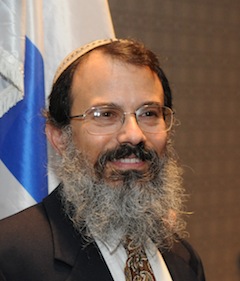
Left to right: Ali Abu Awwad, Shaul Judelman and Rabbi Hanan Schlesinger. (photo by hiddensparksphotography.com)

By bringing together Jewish settlers and Palestinian refugees, Roots is trying to help achieve peace.

Rabbi Hanan Schlesinger is one of the leaders of this group, which was established in 2014 by Ali Abu Awwad and Shaul Judelman. In being involved, Schlesinger said he is following in the steps of Rabbi Menachem Froman, who, “for most of his career, for three or four decades, advocated getting Palestinians who we live among to come to a point of dialogue, reconciliation and understanding.

“Froman’s students started a movement called Eretz Shalom, Land of Peace,” explained Schlesinger. “This organization did some activities to bring together Palestinians and Israelis, but really never made it off the ground. When he died, in 2013 … the students who were following in his footsteps, in terms of dialogue connections between Palestinians and Israelis, felt that they had better do something to continue his legacy…. Otherwise, it’s going to be gone.

“Those students, with his widow, in the last week of January 2014, had a little event together with some Palestinians they’d met, which brought together about 15 people from each of the sides. And, 95% of the people there were Israelis and Palestinians who’d met the other side during their lifetime, [were] involved a little bit in reconciliation. The one person there who had never been before was me.”

Schlesinger was deeply affected by the event. He had lived in Gush Etzion for 30 years, and had never met a Palestinian. And, upon meeting some of them, he realized how distorted his idea was of Palestinians.

“I went into a spiritual introspection of revisiting who I was and what I was doing on this land,” Schlesinger told the Independent. “And I forced myself to begin a journey that was leading me to examine many of my core beliefs – realizing it wasn’t just me and my people, that there was another people here who also belong here.

“Without really meaning to, I found myself creating a movement that was embodying this need to open up eyes and hearts, and continue my spiritual process, as well as help others in the spiritual process … that we, the Jews, are not the only ones in this land … that there are other people here and we need to take into account their existence, their humanity, their needs, their suffering.”

Schlesinger met with Palestinians who had been working toward a solution for more than a decade, but only with secular Israelis in Tel Aviv. Until Schlesinger made the connection, they had not sat down with Jewish settlers.

“They’d never met their own neighbours, who are religious Jews, who are deeply connected to the land in a religious, historical sense,” said Schlesinger.

As was the case with Schlesinger, these Palestinians began to undergo a transformation in their understanding. The Israelis with whom they had spoken before then had explained Zionism as of 1948, sometimes as far back as the 1880s. But the secular Israelis had never explained, because, Schlesinger said, they didn’t really know themselves, the ancient Jewish connection to the land – the land from the Jordan to the Mediterranean.

“These Palestinians were getting to know the foundations of Zionism and the Jewish history, culture and religion … just as I was getting to know the fact that there are Palestinians and that they have been living here for many, many years,” said Schlesinger. “Both sides were undergoing revelations.”

Seeing these positive results on a micro-level, with one another, they decided to create a foundation for macro-transformation.

photo - Rabbi Hanan Schlesinger
Rabbi Hanan Schlesinger (photo from Roots)

According to Schlesinger, the Oslo Accord did not go far enough. He explained, “It didn’t involve religious Jews or settlers who are deeply connected to the roots of the conflict, the land and history. It marginalized them and swept under the rug, ignoring the roots of the conflict. On the Palestinian side, it didn’t involve observant Muslims. It didn’t involve people deeply connected to the land and history – the people today that they call ‘Hamas.’”

With about a thousand people from each side stepping up and coming to events, Schlesinger understands this is only a drop in the bucket. But, he takes solace in the fact that this is only the beginning.

“Those who do hear of us on both sides, most are critical or skeptical … [seeing us as] ridiculous or traitorous … [because we believe] the other side is worthy to talk to … is human,” said Schlesinger. “It’s really hard going, an uphill struggle. I’ll even say that, especially for our Palestinian partners, it’s particularly challenging. They’re being confronted in their societies and are asking themselves how they can allow themselves to go against the accepted narrative.”

Roots has created different activities with a focus on the youth, keeping in mind the larger goal of transforming Israeli and Palestinian societies.

“For the Palestinians, in their society, ‘dialogue’ is a dirty word,” said Schlesinger. “Dialogue is just a way for the Israelis to buy time before they completely take over their land and destroy them…. Again, their narrative is that Israelis just want to talk and that nothing comes of it.

“When we organize our summer camp and photography workshop, we have to really make it clear to Israelis that the goal is not [only] to get to know the Palestinians. The goal is to get to know them, so that we will have a foundation to bring peace and justice.”

Roots is now working with high school students, where the youth meet three times a month and have joint activities, meals, field trips and conversations about identity, narrative and truth. “This is creating ongoing connections that are powerful,” said Schlesinger.

The group is working to develop political awareness on both sides. They are finding that this aspect is moving much faster on the Palestinian side, as their situation is more dire.

“For the Israelis living here, life is more or less normal,” said Schlesinger. “Every once in awhile, someone is attacked with a knife or a gun and someone may be killed or injured, and that’s a terrible tragedy. But, most people are not killed in terrorist attacks and most don’t have children with relatives killed. Most people have normal lives.

“On the Palestinian side, it’s different. They live under military occupation every single day and they are suffering: suffering from poverty, disenfranchisement and from having their dignity stripped of them.

“I say all that to explain that although on the Israeli side the status quo, is not so bad and most people are willing to live with it … on the Palestinian side, the status quo is insufferable. Our hope is nothing less than peace, justice and reconciliation.”

A documentary has been made about Roots. Called The Fields, it focuses on the founding leaders on both sides – Schlesinger and Judelman on the settlers’ side and Awwad and Khaled Abu Awwad on the Palestinian side. A trailer of it can be watched at friendsofroots.net.

Rebeca Kuropatwa is a Winnipeg freelance writer.

Mourning, traveling, celebrating – Israel in photos

Prime Minister Binyamin Netanyahu with David Malka, father of Border Police officer Hadas Malka, who was stabbed to death by a Palestinian terrorist outside Jerusalem’s Old City on June 16. (photo by Kobi Gideon / Israel Government Press Office via Ashernet)

photo - Prime Minister Netanyahu and his wife Sara, with El Al’s first ultra-Orthodox female pilot, Nechama Spiegel Novak, as they set out to Salonika, Greece, on June 14
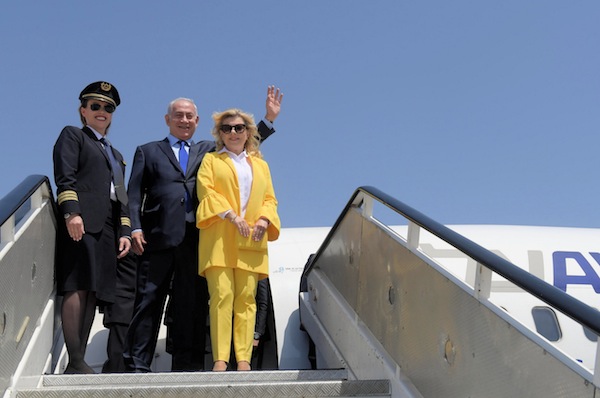
Prime Minister Netanyahu and his wife Sara, with El Al’s first ultra-Orthodox female pilot, Nechama Spiegel Novak, as they set out to Salonika, Greece, on June 14. (photo from IGPO via Ashernet)
photo - More than 200,000 people attended the Tel Aviv Gay Pride Parade June 9
More than 200,000 people attended the Tel Aviv Gay Pride Parade June 9. (photo by Guy Yechiely via Ashernet)
photo - Netanyahu in his office June 7 with U.S. Ambassador to the United Nations Nikki Haley
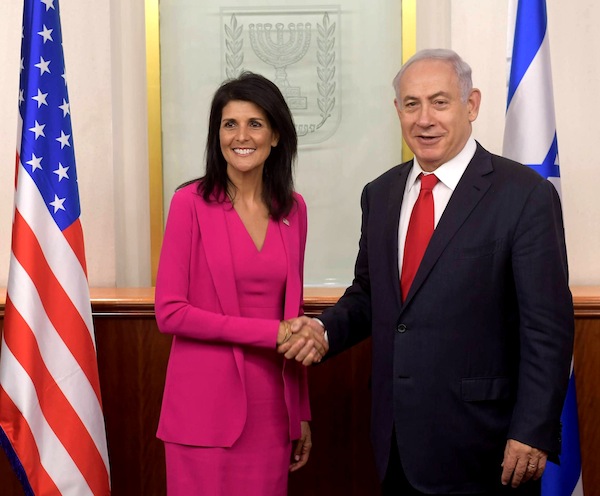
Netanyahu in his office June 7 with U.S. Ambassador to the United Nations Nikki Haley. (photo by Amos Ben Gershom / IGPO via Ashernet)
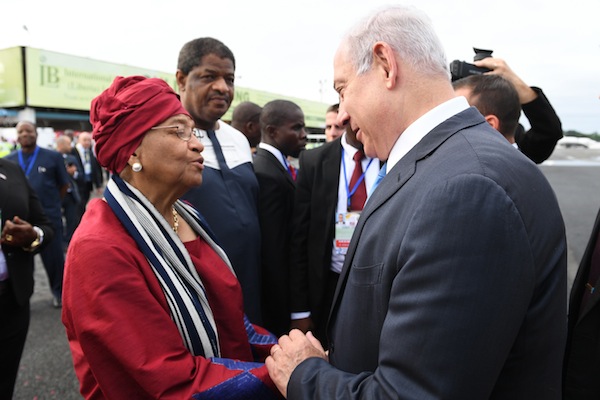
photo - Netanyahu is welcomed to Monrovia by Liberian President Ellen Johnson Sirleaf on June 4
Netanyahu is welcomed to Monrovia by Liberian President Ellen Johnson Sirleaf on June 4. (photo by Kobi Gideon / IGPO via Ashernet)