Ultimate Frisbee and peace

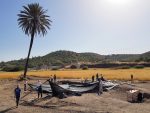
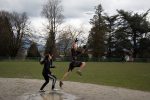
Stratford Hall Sabres and Ultimate Peace leaders-in-training in action this past April. (photo from Ultimate Peace)

Ultimate Peace uses team sports – specifically Ultimate Frisbee – as a vehicle for peace education in the Middle East (and beyond). It starts with throwing a Frisbee but leads to friendship, trust, shared leadership opportunities and powerful life lessons in communities where conflict is rife.

Founded on the core principles of mutual respect, friendship, non-violence, integrity and fun, a group from Ultimate Peace embarks on a North American Friendship Tour every year. Karym Barhum is the Middle East regional director for UP. Originally from Ein Rafa, an Israeli Arab village about 15 kilometres northwest of Jerusalem, he described this year’s cohort of 14 Israelis as “Arab, Jewish, Muslim and Christian youth living in very close proximity. They don’t go to the same schools, they just live in [separate] communities: Arabs with Arabs, Jews with Jews.”

This year, Ultimate Peace added a Vancouver leg to their usual itinerary. Following a stop in Seattle, a group of 15-to-18-year-olds was in Vancouver April 11-16. This part of the tour was made possible by Danie Proby and Ari Nitikman, co-founders of and head coaches at UltiPros; both are alumni of Stratford Hall school on Commercial Drive. Working with their connections, Proby and Nitikman set the ball rolling for an extraordinary experience for both the visitors and their hosts.
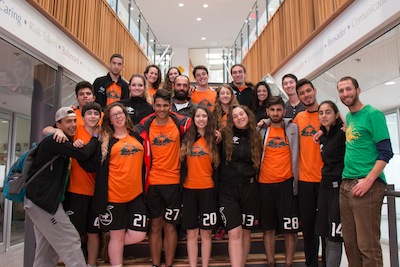
photo - Ultimate Peace leaders-in-training and staff
Ultimate Peace leaders-in-training and staff. (photo from Ultimate Peace)

UP alumni and leaders visit schools, community centres, places of worship, homes and universities to spread awareness of UP’s Leaders-in-Training program. Barhum said it is a tremendous opportunity to see people “accepting everybody no matter who you are. We hope they’ll come back to the Middle East as ambassadors of UP, so they can educate others on how to accept differences.”

Samantha Gayfer, director of community development at Stratford Hall, said the school teaches students “they have a responsibility to give back and make a difference.”

Having arranged for Stratford Hall to host the UP event, families from the school billeted the 14 visiting students, who also spoke at other schools during their time here.

Gayfer described the billeting experience as “outstanding.”

“Arrangements were made for kosher and halal diets,” she said, “and the Jewish players had Passover while they were here. They organized a full meal with cultural and religious understanding.”

The impact of this gesture was not lost on her. “These are kids from families who live three miles from each other but never visit each other’s homes. Now they’re good friends.”

Naturally, there were questions. Gayfer asked the Arab students what their parents thought about their involvement in Ultimate Peace. The answer was always, “My family supports this.”

While she conceded that liberal parents are the most likely to enrol their kids in programs like this, it doesn’t take away from the power of showing Canadian kids what is possible, even in troubled regions. If such friendships are possible among Arabs and Jews in Israel, what can’t we achieve here in peacetime? she asked. “The more families you touch, the better,” she said, “to show that it’s not an insurmountable challenge, that we could live cohesively together.”

During their stay, Ultimate Peace won a tournament – a highlight of their trip. Gayfer said it was “an amazing experience for the kids.”

UP is an opportunity for youth to educate others about life in Israel. In talking about how one can be part of positive change by learning about multiple perspectives, they are also modeling new kinds of relationships: relationships that are necessary before conflict can diminish on a larger scale.

Stratford Hall student Matthew Chiang said he had an “awesome and unforgettable” experience with Ultimate Peace. “The kids were awesome, super-enthusiastic, funny and kind,” he said. “Personally, the two kids that stayed over at my house, Ohad and Faris, had a lot of common interests with me, such as ping pong, Rubik’s Cubing, playing cards, Ultimate, and even shopping. I had never met a person from Israel and I had no idea that they were so similar to me.”

Asked what he thought of the group as a whole, he described it as strong and cohesive. “The Jewish and Muslim students seemed like great friends who got along really well…. My family and I talked to them about their culture and religion. They seemed open and spoke without conflict,” he said.

“Kids involved in this program can send a message to adults that, although there is heavy conflict and anger here, in the end, we are all people who share interests and hobbies,” he said. “Ultimate really breaks the barrier in that conflict and embraces two different ideas and shares one common goal – to have fun.”

He added, “I think Ultimate Peace has strengthened the bond between Jewish and Muslim people and has started to break the barrier between them.”

As well as promoting physical and mental fitness, Ultimate Peace teaches life skills like leadership and communication and reinforces the importance of hope, kindness and collaboration.

“I thoroughly enjoyed how kind they were and how many common interests we had,” said Chiang. “Ultimate Peace is such a great organization with such an important purpose. I’m glad that I had the opportunity to be a part of their journey and I hope that I see them again.”

Barhum is already seeing the impact of UP’s tour on the students. “Many of them are making plans for a twinning program between schools in North America and schools in Israel. This would allow the Israeli kids to take turns playing host to overseas students.” Not satisfied with a single trip to Canada, he said, “They are looking to develop a stable program.”

None of this would be possible with the UP infrastructure behind it. Barhum described a spirit of openness and optimism in the leadership of the program.

“The board of directors trust and allow me and my staff to do things differently, always trying out new ideas,” he said. “They allow us to be open, to learn from others and to be able to change if necessary. This is one of the big things that inspires me and keeps me doing my job.”

The Vancouver stop, he said, was “a highlight – seeing our kids learning new stuff, recognizing that it is possible to live and share their lives with others from a different culture or religion.”

To learn more about and to contribute to Ultimate Peace, visit ultimatepeace.org.

Shula Klinger is an author, illustrator and journalist living in North Vancouver. Find out more at niftyscissors.com.

Helping one village at a time

With solar panels, Innovation: Africa – founded by Sivan Ya’ari, centre – is helping bring light and water to African villages. (photo from Sivan Ya’ari)

“Growing up in Israel, we were a poor family,” recalled Sivan Ya’ari, founder of Innovation: Africa. “But the poverty I saw in Africa was true poverty. We can’t compare.”

Ya’ari spent part of her childhood in France, which later helped her land a job with Jordache, a jeans manufacturing company based in the United States that had some factories in French-speaking African countries.

“After spending time in villages and traveling to other countries, I realized that the main challenge in Africa, the main reason why Africa is still in poverty, is the lack of energy,” she told the Independent. “Because there is no energy, they can’t get access to medicine, vaccines – because there is no refrigeration. Because there is no energy, people don’t get access to good education. But, most importantly, people don’t have access to water.”

Ya’ari had imagined Africa to be a continent with little water, but she discovered there is actually plenty of water in Africa. However, the water is located in aquifers and, to get to it, you need to pump it – and to do that, you need energy.

“Growing up in Israel, I remember seeing solar panels on every building,” she said. “So, when I came and learned a bit more about energy, I thought, maybe we just need to transfer some of the knowledge and some of the technology to remote villages to give them a chance to access water and education.”

Ya’ari enrolled in Columbia University’s master’s in energy program and began fundraising to bring energy solutions to Africa.

As a student, Ya’ari started in one village, and then another, continuing to the point that, today, she has brought the technology – a large pump run by solar panels – to about 140 villages, and counting. The water is pumped into a large holding tank and then, with the help of gravity, flows to different taps that are installed throughout a village.

“Usually, we’re putting one tap two kilometres from the water pump system, another tap four kilometres from it and another … in all directions,” said Ya’ari. “So, with one water pump system, we’re able to reach many villages and people.”

Once the concept proved successful, Ya’ari founded Innovation: Africa, which operates in seven African countries. “In every country, we have an office with a local manager,” she said. “In Uganda, for example, we have seven full-time local people working who have all been trained. They are managing and doing the work on the ground.

“We first hire a company that does geological surveys. This provides information about how deep the aquifers are, how much water we can find and where would be best to drill. Then we hire a drilling machine company and have local contractors do the rest – installing the pump, the water tank, involving the community (meaning, the villagers) who decide where to instal the different taps.

“Once this is all installed, sometimes, in some villages, we instal an extra tank – only for irrigation technology (Netafim) that we bring from Israel – and then we provide irrigation pipes to the village.”

Each pump provides 30,000 litres on average per day per system.

Innovation: Africa recently received an award from the United Nations for their remote monitoring system – another technology that came from Israel.

“It’s off-grid, remote monitoring, so, at any point, we are able to remotely know how much water we’re pumping into every village,” explained Ya’ari. “If something breaks, meaning a pump hasn’t pumped water in 24 hours, we are notified about it by the system; not only us, but the local contractors and the local managers.”

Most of the funding has come from individuals and foundations, often with one individual or family sponsoring a village. On Innovation: Africa’s website (innoafrica.org), there is information about how to become a sponsor.

“We have a bar or bat mitzvah … choosing an orphanage to adopt and then they are traveling with their parents to be there when the kids get light for the first time,” said

Ya’ari. “We have families adopting villages. It’s very transparent, personal and concrete. The donors appreciate that they also have access to the remote monitoring. At any point on their phone, they are able to see how much energy was produced or consumed and how much water was pumped. They also know if something breaks. They are connected to the villagers. They go back and visit.”

According to Ya’ari, many children, especially girls, are kept out of schools in Africa so that they can walk the great distances necessary to get water.

“I believe that the best return on the investment is when we bring water to a village,” said Ya’ari. “What we found is that people are spending hours a day looking for water. Most of the time, the water they find is dirty and is not good for drinking. Once we bring clean water, the people are healthier. The changes we see … the children are going to school. We see a lot more girls going and getting an education. We see that they are growing food.

“What inspires me is the number of businesses villagers are able to grow with access to water. They are able to grow food and sell it in the market. They are making bricks and making their homes, no longer made with mud. We see livestock…. They are making more money.

“And, for the medical centres, it’s tremendous,” she said. “Once we provide a little energy and we buy a small fridge, then people come in from the capital to the village to help. The doctor, with energy, she can actually work.”

When it comes to the cost to make this happen, it is about $5,000 to light a classroom and $18,000 to light a whole school, including the homes of the teachers. To bring water to a entire village, it costs around $50,000.

No governments are involved in these projects. It is all about people on one end of the world helping out people on another end.

“Unfortunately, there is no shortage of villages waiting,” said Ya’ari. “In the seven countries that we operate, we have a long list of schools needing light and water centres. It has a lot to do with funding and people to adopt the villages. We have the people on the ground and the technology.”

Rebeca Kuropatwa is a Winnipeg freelance writer.

Israeli food evolution

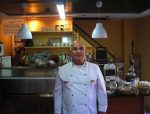
Chef David Polivoda (photo from David Polivoda)

When people reflect on Israel’s transformation since the establishment of the state in 1948, they often focus on geographic, political, economic and social changes. Slightly less tumultuous, but no less dramatic, has been Israel’s culinary development. In a country where people like to eat, and to eat a lot, the past 69 years has witnessed an amazing transition in Israeli food habits.

In the first years of statehood, for example, salad fixings were hard to come by, largely due to Israel’s tzena, or austerity program (1949-1959). Yet, even well after the lifting of the tzena, a salad meant finely chopped tomatoes and cucumbers, maybe with some onion and parsley, with a little lemon juice and olive oil. And this remains a classic Israeli salad. However, the days of such limited ingredients have come and gone.

While certain fruits and vegetables are, of course, seasonal – when you see ample supplies of strawberries and artichokes, you know Pesach is on the way – there is no end to the variety now available. Israeli farmers seem to have mastered the ability to grow just about everything. And this is just the tip of the iceberg, as former chef David “Poli” Polivoda explained about the evolution of Israeli food and palates.

First, a bit about Polivoda’s professional background. He began cooking shortly after his army service. Back then, he lived on a kibbutz by the Dead Sea, where he was part of a soldiers’ group that settled in the area. After his discharge, he studied carpentry and animation, but discovered – to the chagrin of the animation studio director – that his true vocation was cooking. He began his career in the Kibbutz Ein Gedi kitchen and, afterward, in its guesthouse.

Since then, Polivoda has worked in Jerusalem corridor guesthouses, on Magic One cruise ships, at the Osem food conglomerate, at various elite Jerusalem hotels, including the King David, and has done chef stints in Europe and in the United States. He also has been a restaurant inspector and now gives culinary tours of Jerusalem’s Mahane Yehuda.

photo - Chef David Polivoda’s sculpted fruit bowl
Chef David Polivoda’s sculpted fruit bowl. (photo from David Polivoda)

When he first started out, cooking as a profession was not highly regarded. Nowadays, there are countless cookbooks, culinary websites and workshops, televised cooking shows and chef competitions – his chosen profession has earned a “wow” rating. In Israel, Polivoda said there are several places to learn to be a professional chef and there are certificates and national (government) achievement-based licences, as well as more than one association of Israeli chefs.

When he was starting out, a typical meal in a nice hotel meant a steak dinner. Meat was, and still is, relatively expensive, and much of it is imported. Back then, there were few restaurants and the average Israeli’s financial situation did not permit dining out. At home, Israelis typically ate an evening meal of bread, salad, eggs, cheese and plain yogurt (pretty close to what people ate for breakfast).

Polivoda said kashrut limitations have resulted in a lot of creativity as far as food preparation is concerned. For example, Italian cooking has become very popular with Israelis, despite the prohibition against mixing milk and meat – in downtown Jerusalem alone there are at least six kosher Italian dairy restaurants. Israeli chefs have learned to successfully produce tasty meatless Italian dishes.

With respect to hotel meals, Polivoda said the meals are generally much larger than those most Israelis would eat at home. He said in a hotel restaurant, people eat at least a third more. In hotels, buffets are set up for breakfast, lunch and dinner and the focus is on a display of abundance, he explained. Salads were, and remain, an important part of the buffet, but, according to Polivoda, an economic reason lies behind the plentiful spread – a buffet means less wait staff is needed.

He explained that, while hotel management seeks a high level of prepared food, it wants to have it made as cheaply as possible. Thus, restaurants might lower their costs by using cheaper raw ingredients. Two examples of this are Israeli mock chopped liver made from eggplant, rather than from liver, and “Ben-Gurion rice” or ptitim, which are really tiny pieces of hard wheat, that is, pasta.

Still, Polivoda said it is the chef who makes the lasting impression on guests, not the eatery’s manager. And, he said, when people eat out today, they expect more than they did in the past.

Eating habits in Israel have changed for a variety of reasons.

First, Israel is economically better off overall. Many Israelis can afford to travel abroad and those who do come back want to re-experience the tastes they enjoyed during their travels.

As well, Israel now imports a wide range of food products, so people are exposed to more variety. Additionally, the Israeli food industry not only services the increasingly cosmopolitan local population, but has made major inroads in exporting agricultural products.

Finally, Polivoda noted that, on the one hand, Israelis are proud of their cultural background while, on the other hand, they try to turn everything into a business. One result is a broader diversity of choices, with more ethnic restaurants trying to cater to an increasingly diverse population.

However, it’s a tough industry, and Polivoda predicted that many restaurants would come and go, as there are people who go into the business without understanding how hard it is to stay afloat. Meals will become somewhat less plentiful, he said, also noting that there is much waste in the industry.

He presented two optimistic points: prices for dining out will decrease and, as the in-gathering of exiles continues, with newcomers wanting to enjoy something from their roots, ethnic food will continue to have a place in Israeli cuisine.

Deborah Rubin Fields is an Israel-based features writer. She is also the author of Take a Peek Inside: A Child’s Guide to Radiology Exams, published in English, Hebrew and Arabic.

Capester reports violations

Capester offers a platform that allows users to report parking violations by filming and submitting legally admissible videos anonymously. (screenshot)

A great idea for an app was born out of a maddening experience for Ohad Maislish, an Israeli who walked with crutches for years following a skydiving accident. When he arrived for Shabbat dinner at his brother’s house, the sole handicap spot was occupied by a car without the proper permit. Since parking inspectors don’t work on Friday nights, he had to go to a police station and file a report, wait for the case to be processed and face the possibility of testifying in court in front of the offender.

Why couldn’t he simply use his smartphone to document the incident? The police explained that because videos can be doctored, such evidence wouldn’t stand up in court. So, Maislish, who started work at Microsoft’s Haifa research and development centre at age 17, called upon his background in computer science – and some friends with digital security and legal expertise – to create Capester, a platform enabling users to report parking violations by filming and submitting legally admissible videos anonymously.

In October 2014, with seed investment from BRM Capital and OurCrowd First, the founders spent 18 months perfecting a mobile app that would meet the court’s standards, assuring that the videos cannot be fabricated or altered. They worked closely with lawyers, including digital evidence expert Haim Ravia, chair of the internet, cyber and copyright group of the Pearl Cohen law firm in Herzliya.

Capester authenticates the video and sends it to the relevant local authority, which then determines whether to ticket the vehicle owner.

“We approached municipalities and each one had its own general counsel examine our legal opinion before approving Capester,” Maislish told Israel21c.

The app is available for Android and iOS from Google Play and the App Store. For each properly documented violation video, Capester – which is based in Petah Tikva – makes a donation to Access Israel, a nonprofit organization promoting accessibility and improved quality of life for people with disabilities in Israel.

“As a private company, we can’t issue tickets but only provide a platform for supplying evidence,” Maislish stressed. “If you record a violation in India, for example, it has to be in a place where we have an agreement with the relevant authority.”

He is not ready to reveal details of future marketing plans. “We are constantly looking to expand our services,” he said.

Moving violations

In related news, two new apps also help Israeli motorists stay safer on the roads.

The National Road Safety Authority, the Israel Police Traffic Department and the nonprofit Nativ Batuach (Safe Lane) organization have partnered to create the Guardians of the Road program. Using an app developed for the project at the Technion-Israel Institute of Technology, approved volunteers continuously photograph the road and vehicles visible through their windshield. When they see a traffic violation, they prompt the system by voice to deliver a video report to a control centre in the National Road Safety Authority for further evaluation and possible action by the police.

As well, a private startup, Nexar, has launched what it calls the world’s first AI (artificial intelligence) dashcam app. Nexar employs machine vision and sensor fusion algorithms to leverage a smartphone’s sensors to analyze and understand the car’s surroundings and provide documentation in case of accidents. Using this vehicle-to-vehicle network, Nexar also can warn users in real time of dangerous situations beyond their line of sight, effectively giving drivers more time to react. Founded by Eran Shir and Bruno Fernandez-Ruiz in early 2015, the company raised $10 million from Aleph, Mosaic Ventures, True Ventures and Slow Ventures. It has offices in Tel Aviv, New York and San Francisco.

Israel21c is a nonprofit educational foundation with a mission to focus media and public attention on the 21st-century Israel that exists beyond the conflict. For more, or to donate, visit israel21c.org.

Automakers in Israel

The 911 Turbo S Exclusive Series, Porsche Museum, Stuttgart, 2017. (photo from newsroom.porsche.com)

Porsche is establishing an innovation office in Tel Aviv, investing an eight-figure sum in the Magma and Grove venture capital funds. Further investments in start-ups and funds are planned. “Israel is a key market for IT experts and engineers. It has more start-ups per capita than any other country in the world. This talent and technological know-how coupled with the great expertise offered by our employees creates the ideal breeding ground for future business models,” said Porsche’s Lutz Meschke. He added that close collaboration with Israeli experts is necessary so that the company can quickly assess new technologies, develop good relationships and pilot appropriate solutions.

The Magma Venture (MV) fund is focused on artificial intelligence and automotive: with investments in numerous start-ups, like Waze, MV is one of the major venture capital (VC) funds in Israel and has $600 million US under management. Grove Ventures is a VC company with a volume of $100 million US; its primary early-stage investment areas are the internet of things (IoT), Cloud technologies and artificial intelligence.

– porsche.com

***

Mercedes Benz, General Motors, BMW, Ford, Honda, Uber, Volkswagen, Renault and Volvo also have opened R&D centres in Israel and/or invested in Israeli technology since 2016. The Honda Silicon Valley Lab, Volvo, Hertz International and Israel’s Ituran are sponsoring DRIVE, a new smart-mobility accelerator, co-working space and prototyping lab in Tel Aviv.

Jerusalem-headquartered Mobileye, prominent in the engineering of self-driving cars, was acquired by Intel in March for $15.3 billion US. Mobileye is partnering with the Massachusetts Institute of Technology and corporations including Microsoft to establish an international transportation lab in the Israeli port city of Ashdod.

– Abigail Klein Leichman, Israel21c

***

Prof. Yoram Shiftan, head of transportation research at the Technion-Israel Institute of Technology, said Israel “is one of the major contributors to driverless automated car technology.”

– JNS.org


Ignorance and power

Rebecca Katzman is graduating from the School of Social Work at Ryerson University in Toronto this spring. Now that she is leaving the institution, she has decided to go public with an incident that happened when she applied for a field education placement at a Jewish agency.

The story emerged recently and Katzman shared the experience firsthand in the Canadian Jewish News last week.

For her third-year work experience placement, she asked the school’s coordinator to investigate possible opportunities at UJA Federation or the Prosserman Jewish Community Centre. The school official responsible, Heather Bain, denied Katzman’s request, telling her that her choices were incompatible with the values of the school.

“I did not follow up with Prosserman JCC or UJA because after looking into them, some of their values seem to be in opposition to the values of the school,” Bain wrote in an email to Katzman, adding that the agencies both appear to have a “strong anti-Palestinian lean.” Later, Katzman said, Bain suggested that Katzman could work with the Jewish organizations only if she came in with an agenda to “bring a critical awareness to the setting.”

“It seemed that she implied that I could only work at these agencies if I came in with an anti-Israel agenda,” Katzman wrote in CJN.

When pressed by Katzman, Bain acknowledged that she did not do her own investigation into the organizations, but relied on the advice of colleagues who are members of Jews Against Israeli Apartheid. She added that she might change her position if she discovered that “both agencies (were) supporters of Palestinian solidarity movements.”

It turns out Bain may have underestimated who she was dealing with. Katzman was not only active in student organizations supporting Israel and opposing antisemitism on campus, she was a StandWithUs Emerson Fellow, part of what is described as a “prestigious one-year fellowship program that recruits, trains, educates and inspires pro-Israel college students to become an elite cadre of leaders on college campuses across North America.”

StandWithUs provided Katzman with pro bono legal counsel. Even so, despite legal assistance and a history of involvement in Jewish activism, Katzman did not go public until her time at Ryerson was over. How many students in Canada have had similar experiences but lacked the resources or fortitude to stand up to it?

It is clear that Bain’s extraordinary decision was based on almost complete ignorance of the reality of the organizations she besmirched, having been arrived at on the advice of individuals who come from an extreme anti-Israel position. For a person in a position of power to set policies, this is disgraceful.

It takes courage to stand up to this sort of injustice. Those who choose – or who, like Katzman – are forced to confront it deserve our encouragement, support and gratitude.

Ramat Beit Shemesh well

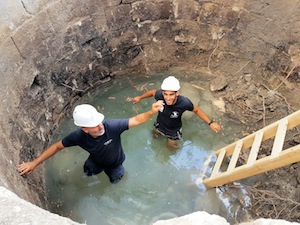
Students from the Paran and Hinaton pre-military preparatory programs took part in the discovery.  (photo from Israel Antiquities Authority via Ashernet) 

photo - IAA counselor and a student in the well
IAA counselor and a student in the well. (photo from Israel Antiquities Authority via Ashernet)

Late last month, the Israel Antiquities Authority (IAA) uncovered an Ottoman-period well, hundreds of years old, as part of the work being carried out by Netivei Israel Co. to widen Highway 38, north of the main entrance to Ramat Beit Shemesh. Students from the Paran and Hinaton pre-military preparatory programs took part in the discovery of the well that is about 3.5 metres in diameter and joins a series of wells that have been documented over the years along Route 38. The palm tree is an indicator that there is nearby a source of groundwater. 

Caravan welcomes Vazana

Amsterdam’s Noam Vazana will play in Vancouver and Victoria next week. (photo by Robin Daniel Fromann)

Multifaceted Jerusalem-born, Amsterdam-based musician Noam Vazana comes to Canada this month for the first time. She plays in Calgary June 6, Vancouver June 7 and Victoria June 8.

Vazana’s B.C. dates are presented by Caravan World Rhythms, whose managing artistic director is Robert Benaroya, and she will perform with local guitarist and composer Itamar Erez, who also hails from Israel.

“I heard about Itamar through a joint musician friend, Yishai Afterman, and through the presenter of the show, Robert Benaroya,” Vazana told the Independent. “We got to know each other by phone and on Chat. Our first shows together will be in Vancouver and Victoria.”

Vazana’s music has myriad influences, including classical, pop, jazz and Sephardi. She composes, and has two CDs to her credit, Daily Sketch (2011) and Love Migration (2014). Performing regularly on stages around the world, she returns to the Netherlands after her shows in Canada, but has Poland, Morocco, Germany, France and Israel also on her tour schedule.

“This is an amazing year, performing 90 concerts in 12 countries,” she said. “I consider myself very lucky to combine my two greatest passions, music and traveling. I get inspired from new people and new places. I get excited every time before I go on tour – the night before, I can hardly sleep because I can already feel new experiences at my doorstep, waiting to accompany me or take me over or be a part of who I’m about to become. Bob Dylan said once that an artist is always in the state of becoming; somehow, it seems that in order to stay creative I always have to be on the way to somewhere.”

One of the unique aspects of her performance is that she plays the piano and trombone – at the same time.

“My first encounter with the trombone was in an explanatory concert the local orchestra gave at my school,” she said of her somewhat unusual choice of wind instrument. “They were demonstrating several instruments and, the moment I heard the trombone, I fell in love with its rich tenor sound. Another thing that appealed to me is that the trombone is an orchestral or combo instrument, so mostly you play it in a formation. When playing classical piano, especially the old-fashioned way, my teachers always told me it was forbidden to try when I asked to improvise and learn chords and songs. So, I mainly kept to the scores and played alone as a child. It sounded cool to me to play in an orchestra and get to play things that were out of the classical context I was already exposed to.”

The trombone stands she uses had to be invented, she said, “and designed especially for the purpose of playing trombone and piano simultaneously.”

“I first used a model I designed myself from a tripod used to support a window-shopping mannequin,” she explained. “It was working quite well but had one main flaw: it was centred right in front of me, in the middle of the keyboard, so I had to be very creative with the piano parts and manoeuvre around it when moving between the registers.

“Then I had a second prototype designed by an engineer who had good intentions but his strength lay in theory and not in mechanical skill. I was struggling to set up the stand during a soundcheck and the owner of the venue told me he knew a blacksmith who might be able to help me. That guy is amazing, autodidact with phenomenal skill, designing motorcycle engines from scratch. He mended the flaws of the second model and eventually created a much lighter third prototype, which is the stand I use today. I have two different models, one for pianos and the other for keyboard.”

Vazana also leads a Sephardi group called Nani, and she will be performing some songs from that repertoire on her tour. While the spark for Nani was kindled in Morocco, its source lies further back.

“At our house, Israeli culture was eminent,” said Vazana. “My father grew up in a kibbutz and I was brought up part traditional, part secular. Foreign languages were forbidden at home and, although my mother spoke fluent Moroccan Arabic and French, my father insisted she talk to me only in Hebrew.

“My grandmother on my mother’s side spoke Ladino and Moroccan Arabic and never assimilated in the Israeli culture, so some of my first memories include her speaking Ladino with my aunt and singing Ladino lullabies for me. She passed away when I was 12 – you can imagine that, throughout my childhood, she was very old and I didn’t get to spend a lot of time with her.

“In both 2012 and 2013, I was invited to play at the Tanjazz festival in Tangier and I took these opportunities to explore the cities where my families originated from, Casablanca and Fez. On my second visit to Morocco, in 2013, during one of my many walks down the narrow streets of Fez’s medina, I heard people singing on the street behind me. As I made way to them, there came more and more people, singing and playing drums and wind instruments, all to a familiar melody. The procession ended in a square and, as I arrived there – I was one of hundreds of people, young and old – I suddenly realized this is a melody that my grandmother used to sing for me in Ladino. It was a special moment and the rest of my travels in Morocco called memories of my grandmother back to me. I felt drawn to a root that was longing to be rediscovered.

“When I got back home,” she said, “I started researching more and more about the Ladino language and culture and started combining a song or two in Ladino in my regular shows. Slowly, I studied the language over the course of a year and developed a substantial repertoire. It resulted in recording a new Ladino album that will be released in September 2017, and winning the Sephardic music award … at the International Jewish Music Festival in Amsterdam,” which took place last month, May 4-8.

Vazana first visited Amsterdam on tour with an orchestra, as a classical trombone player, she said. “At the time, I was a student at the music academy in Jerusalem and this was intended as a 10-day work trip and another 10 days to explore the Netherlands, as it was my first visit. I checked some information about local musicians and schools and applied for lessons with musicians from the Concertgebouw Orchestra.

“After having a lesson with their bass trombonist,” she said, “he asked me if I’d be willing to come back for another lesson with his colleague, the principal trombone player. After a 45-minute lesson, they both decided to invite me to study with them at the Royal Conservatory of Amsterdam, with an internship at the Concertgebouw Orchestra. The day later, I found myself attending a rehearsal with the orchestra, absolutely mind-blowing, because it was the best orchestra I ever heard live (and the No. 1 in Europe at the time). It didn’t take a lot more to convince me to quit my studies in Jerusalem and transfer to Amsterdam.”

This move forms the creative foundation of Vazana’s second album, which won the ACUM (Israel Association of Composers, Authors and Publishers of Musical Works) album prize, charted No. 14 on the iTunes bestselling chart and No. 2 on DPRP’s (Dutch Progressive Rock Page’s) best albums of 2015. It was financed in part by crowdfunding, through which 800 advance copies were sold. (There is a video, set to her song “Waiting,” in which Vazana personally delivers the CD to various supporters, giving each of them a hug. It can be found at youtube.com/watch?v=tW5Y2IEjgI0.)

Love Migration is a very personal and exposed album, combining parallel stories about two migrations: my first migration to follow my heart, which is music, while longing to find a feeling of home. The second migration is the long-distance relationship I had with an Israeli guy whom I met just as my EU visa was approved, eventually resulting in him migrating to live with me so I could continue to follow my dream,” explained Vazana. “The process took three years to evolve into stories one can retell [with] perspective…. It could have turned many ways, but my personal search eventually led me (and still is leading me) towards taking the feeling of home with me wherever I go. It has been a long journey, but life is a journey and I feel that I evolve every day anew. In my song ‘Lost and Found,’ I describe that sensation: “Every time I look in the mirror / Every time I stand in the corner / Every time I knock something over / It’s a way for starting over / It’s a way to see it anew.”

Vazana and Erez’s Vancouver concert is at Frankie’s Jazz Club June 7, 8 p.m., and their Victoria appearance is at Hermann’s Jazz Club June 8, 8 p.m. Tickets to both shows are $20 at the door and $15 in advance. Visit caravanbc.com or call 778-886-8908.

The year it all changed

On May 24, Israelis celebrated the 50th anniversary of the reunification of Jerusalem in the streets around the Jerusalem Great Synagogue. (photo from Ashernet)

Everything changed in 1967. Fifty years ago, Canada celebrated its 100th birthday, hosting an Expo in Montreal and, at least in the narrative we like to tell ourselves, came into our own as a country.

We became a country in 1867, “came of age,” historians tell us, at Vimy Ridge, in 1917, gained full autonomy from Britain’s Parliament in 1931, and adopted our very own constitution in 1982. But 1967 is when we stopped being a baby-country and became a confident, adult-like state on the world stage.

It’s possible that few Canadians pinpoint 1967 as a particular turning point. The various measures of Canadian pride – the U.S. exchange rate, hockey titles, military engagements, pop cultural contributions – have ebbed and flowed in the successive decades. National unity saw multiple flashpoints, from the October Crisis just three years after the euphoria of the Centennial, to the referenda of 1980 and 1995, the latter of which almost ended the nation. Free trade and globalization altered us once again.

“Canadianness” itself changed dramatically in this half-century, from a concept rooted in British heritage to a recognition of “two founding nations” to celebrating multiculturalism and a belated recognition of the rights and tragic history of indigenous peoples resulting directly from our national project. In this time, too, Canada has gone from a staid, comparatively conservative place to one of the most liberal countries in the world. Institutionalized antisemitism, which was still rife in the Canada of 1967, has become almost entirely absent (although incidents and acts of antisemitism, like much else, continue to occur).

While nothing really substantive changed overnight, 1967 is a symbolic moment in Canadian history.

For Israel, 1967 had symbolism but, in very real, tangible and irreversible ways, it was a year when everything changed. While it didn’t happen overnight, it did take a mere six days. The Six Day War, which began June 5, 1967, literally and figuratively reshaped Israel, the Middle East, Diaspora Jewry and global diplomacy.

In its early years, Israel experienced exponential population growth like almost no country on earth has seen. It went from the proverbial desert to a blooming success, first through innovations in agriculture and, later, in technology and almost every other sector of human endeavour. A successful nation was born. But the Jewish state was never accepted by the neighbours it defeated in 1948-’49 and, in 1967, war came again.

Yet the result was so quick and so decisive that some viewed it as a sign of Divine intervention or evidence of chosenness. More realistically, it was a people holding their ground because there was no alternative.

The experience affected not only Israelis but Jews everywhere. Canadian Jews and others in the Diaspora volunteered, sent money, prayed and organized. Less than two decades after it had begun, Jewish self-determination in the ancient land and modern state of Israel hung by a thread. And then victory.

The anxiety before and jubilation after transformed into something new and unexpected. The control by Israel over the West Bank (formerly part of Jordan) and the Gaza Strip (which had been under Egyptian control) led to a new dynamic in Israel – and in the world’s approach to Israel. Having been seen as the underdog, Israel in 1967 transformed – in the eyes of the world and, to an extent, in the eyes of Israelis themselves – into a powerful regional force.

The occupation has been the defining foreign policy concern for Israel for half a century now and affects the way Israel is treated on the global stage. Jerusalem, reunified under Israeli control during the war, is a flashpoint of local and international conflict over competing claims. Israelis will likely be forced to reckon with the legacy of 1967 for many years to come, as it seeks to protect both the democratic and Jewish natures of the state, as well as reaffirming its commitment to minority rights and to pluralism.

Despite this overarching conflict and its associated violence and threats, Israel has developed an economy and culture that is a human-made miracle of the modern world. The list is familiar and endless: scientific and academic achievement, technological innovation, global emergency response, lifesaving medical advancements. Even Israel’s intelligence capabilities, born of necessity, are so advanced that the president of the United States foolishly can’t help bragging to adversarial foreign despots that he has insider intel.

Amid all these challenges and hard work, Israelis self-report in international studies to be among the happiest people on the planet. (Canadians also rank high.) Even with room for improvement, this reality is perhaps the greatest achievement of all.

המכביה העשרים

טקס פתיחת משחקי המכביה יערך באצטדיון טדי בירושלים בשישה ביולי. (צילום: Lyulyev Danny)

נבחרת קנדה למשחקי המכביה העשרים תגיע עם למעלה משש מאות ספורטים ותשתתף בשמונה ענפים שונים. והם: כדורגל, טניס, שחייה, כדורעף חופים, טריאלתון, סופטבול, כדור בסיס ורכיבה על אופניים. נבחרות הנוער והצעירים של קנדה למכביה יתחרו בשלושה ענפים: כדורסל, כדורגל והוקי.

כוכב נבחרת הבוגרים הקנדית הוא ג’וש בינשטוק (בן השלושים ושש) שנחשב לשחקן כדורעף החופים מהטובים בעולם, ומיקומו הוא תשע בטבלה העולמית. הוא השתתף כבר בשתי מכביות ונשא את הדגל הקנדי בטקס פתיחת המכביה הקודמת. בינשטוק זכה פעמיים באליפות של קנדה למשחקי כדורעף חופים. יש סיכוי שגם ברון נוסבאום (בן העשרים וארבע) שנחשב לכוכב חדש בכדורעף החופים של קנדה, יגיע אף הוא למכביה בישראל. נוסבאום הגיע למקום השלישי באליפות העולם עד לגיל 19.

בין הספורטאים מוונקובר ניתן למנות את כריסטופר קייפ (בן הארבעים וארבע) שישתתף בריצת חצי מרתון במכביה. קייפ שהחלים מניתוח קשה לפני כחצי שנה מקווה להשיג תוצאה מכובדת בריצה של שעה ו-45 דקות.

ספורטאי בולט נוסף בנבחרת הקנדית הוא המתאבק משה קליימן. הוא הספורטאי הקנדי הראשון שגדל והתחנך בישיבה. קליימן שגר באינגלווד שבניו ג’רסי משמש מאמן כושר במקצועו. הוא נעזר בתרומות מהציבור למימון נסיעתו לישראל.

image - Maccabiah 2017 logoהמכביה העשרים תתקיים בין הארבעה בחודש יולי ל-18 ביולי, ומרבית המשחקים מטבע הדברים יערכו בירושלים. מדובר במכביה הגדולה ביותר שנערכה אי פעם וישתתפו בה למעלה מעשרת אלפים ספורטאים וכעשרים ושתיים אלף מלווים (בהם חברי משפחה וחברים, חברי משלחות של שמונים מדינות מרחבי העולם. בסך הכל יתקיימו כשלושת אלפים תחרויות בארבעים ושבעה ענפי ספורט שונים (בהם: כדורגל, כדורסל, טניס, אתלטיקה, כדור בסיס, רכיבה על אופניים, הוקי, שחייה, ג’ודו, קט-רגל, קארטה, גולף, טריאלתון, סופטבול וכדורעף). במכביה יוענקו אלפיים ומאה מדליות מזהב, כסף וברונזה לספורטאים המצטיינים.

טקס פתיחת משחקי המכביה יערך באצטדיון טדי בירושלים בשישה ביולי, וכן טקס הסיום יתקיים בו ב-17 בחודש. תחרויות המכביה יערכו בכל רחבי הארץ אך מרביתם יתקיימו כאמור בירושלים, בסימן חמישים שנה לאיחוד העיר (לאור החלטת ממשלת ישראל). משחקי הנוער והצעירים של המכביה בהשתתפות כשלושת אלפים בני נוער יערכו כולם במתחם הספורטן בחיפה.

ממשלת ישראל העבירה עשרים ושישה מליון ש”ח למימון משחקי המכביה העשרים, כאשר תקציב השיווק של האירוע יעמוד על 5.5 מיליון שקל. יו”ר מכבי התנועה העולמית הוא יאיר המבורגר, מנכ”ל מכבי התנועה העולמית הוא אייל טיברגר, יו”ר המכביה העשרים הוא עו”ד אמיר פלד, יו”ר הטקסים והאירועים של המכביה הוא נעם סמל ומנהל הקריאייטיב של המכביה הוא איתי בלאיש.

את לפיד משחקי המכביה העשרים זכה להזניק הג’ודאי הישראלי אורי ששון (שזכה במדליית ארד במשחקים האולימפיים שנערכו בריו דה ז’ניירו אשתקד). הוא העניק את הלפיד לנשיא ראובן ריבלין ב-26 בחודש דצמבר. אחרי האירוע בבית הנשיא בירושלים יצא הלפיד למסע בן שישה חודשים שיסתיים בטקס הפתיחה של המשחקים, כאמור באצטדיון טדי בשישה ביולי.

מכבי התנועה העולמית מקיימת את המכביה מדי ארבע שנים מאז שנת 1932. מדובר במפעל הציוני-יהודי בתחום הספורט הגדול ביותר בעולם. בתנועה העולמית חברים כארבע מאות אלפי חברים משישים מדינות שונות.

יצויין כי שלושת הקריטריונים המהותיים המאפשרים לספורטאים להשתתף במכביה הם: לפחות אחד מההורים הביולוגים של הספורטאי הוא יהודי. המשתתף לא פעיל בשום דת אחרת מלבד היהדות. אם המשתתף התגייר התהליך נעשה רק על ידי אחד מהמוסדות המוכרים.