Skip to content
  • Home
  • Subscribe / donate
  • Events calendar
  • News
    • Local
    • National
    • Israel
    • World
    • עניין בחדשות
      A roundup of news in Canada and further afield, in Hebrew.
  • Opinion
    • From the JI
    • Op-Ed
  • Arts & Culture
    • Performing Arts
    • Music
    • Books
    • Visual Arts
    • TV & Film
  • Life
    • Celebrating the Holidays
    • Travel
    • The Daily Snooze
      Cartoons by Jacob Samuel
    • Mystery Photo
      Help the JI and JMABC fill in the gaps in our archives.
  • Community Links
    • Organizations, Etc.
    • Other News Sources & Blogs
    • Business Directory
  • FAQ
  • JI Chai Celebration
  • JI@88! video

Recent Posts

  • Sharing her testimony
  • Fall fight takes leap forward
  • The balancing of rights
  • Multiple Tony n’ Tina roles
  • Stories of trauma, resilience
  • Celebrate our culture
  • A responsibility to help
  • What wellness means at JCC
  • Together in mourning
  • Downhill after Trump?
  • Birth control even easier now
  • Eco-Sisters mentorship
  • Unexpected discoveries
  • Study’s results hopeful
  • Bad behaviour affects us all
  • Thankful for the police
  • UBC needs a wake-up call
  • Recalling a shining star
  • Sleep well …
  • BGU fosters startup culture
  • Photography and glass
  • Is it the end of an era?
  • Taking life a step at a time
  • Nakba exhibit biased
  • Film festival starts next week
  • Musical with heart and soul
  • Rabbi marks 13 years
  • Keeper of VTT’s history
  • Gala fêtes Infeld’s 20th
  • Building JWest together
  • Challah Mom comes to Vancouver
  • What to do about media bias
  • Education offers hope
  • Remembrance – a moral act
  • What makes us human
  • המלחמות של נתניהו וטראמפ

Archives

Follow @JewishIndie
image - The CJN - Visit Us Banner - 300x600 - 101625

Tag: Holocaust

Reflections on first meeting

This academic year marks the second session of Writing Lives, a two-semester project at Langara College, coordinated by instructor Dr. Rachel Mines. Writing Lives is a partnership between Langara, the Vancouver Holocaust Education Centre and the Azrieli Foundation. Last fall, students learned about the Holocaust by studying literary and historical texts. In January, students began interviewing local Holocaust survivors and will write their memoirs on the basis of the interviews. Students are keeping journals of their personal reflections on their experiences as Writing Lives participants. Students used their most recent journal entry to reflect on their first meetings with the survivor with whom they are partnered. Here are a few excerpts.

Prior to meeting our survivor partner, one of our group members spoke to him on the phone, and she described him as a person “who doesn’t let anything past him.” It seems he’d tested her on her ability to say the word “Holocaust” without shuddering an apology.

It is clear that our partner refuses to spend his time telling his story to anyone who cannot handle it. On one hand, his attitude is a comfort; I believe we will be able to show him that not only are we unafraid to hear his story, but also that we care deeply about helping him tell it authentically. On the other hand, this adds to the building anxiety about our interviews and our worries about writing the memoir. Producing a memoir that our survivor is 100% proud of is my biggest goal and also my biggest fear. I feel that telling the story of another person’s life is a tremendously huge responsibility, and I do not take it lightly.

– Chelsea Riva

We actually met D. before our first meeting: he came to our class to give a talk last semester. Our first interview was arranged at his home, and D. was as warm and friendly as before. So was his wife, and they took good care of us. They helped us with our coats and insisted that we did not have to take our shoes off. D. said we must have walked a long way, and it was the shoes that kept us walking comfortably; therefore, we should not take them off. I immediately recalled what Primo Levi wrote in his book Survival in Auschwitz. Yes, shoes are of the utmost importance, and D. has experienced that. However, we quickly realized that the house was immaculately clean, and so was the light beige carpet that we were stepping on with our shoes! Anyway, while I was worrying about the carpet, the meeting began.

– Bonnie Pun

When I first met D.S., I was apprehensive. The culmination of the past four-and-a-half months was finally at hand, and I was set to be the lead interviewer for our group – not a task that fell lightly on my shoulders.

Moira and he came into the room and she introduced him (she had met him previously). D.S. smiled so widely that his eyes crinkled, and he shook each of our hands in turn. When we were done, D.S. said a few words about himself and then quickly launched into a very compressed, detailed story about his life.

We had been expecting a more casual, getting-to-know-you first interview, and none of us had been expecting to take in such a massive amount of information – although, in hindsight, I’m glad we did. At the end of the interview, after D.S. had given us advice about meeting deadlines and making sure we had enough time to edit and rework parts of his story, we breathed a sigh of relief – it had gone well.

The opportunity to have a question-and-answer session with a person who has survived such great personal trauma is incredible. D.S. is a wonderful storyteller, and the interviews so far have been a continuously rewarding experience.

– Susan Scott

Some of the stories that D.S. shared with us at that first meeting were hard to absorb. I think I didn’t really want to understand what he was saying, as a way of protecting myself, so I wouldn’t show I was affected while I was in the room with him. It was only after I listened to the recorded interview that I could even start to imagine the events that he had endured. It sunk into me that this was a real thing that had happened to a real man, one who sat in front of me, ready to share his pain and perseverance with us. For that, I am grateful and honoured.

What D.S., the other survivors, the Vancouver Holocaust Education Centre, the Azrieli Foundation and Langara College are doing through the Writing Lives program is so immensely important – something I have come to understand on a new level after that meeting. I think the point is to affect others in the way that this one meeting affected me. It’s to try and understand people’s suffering as best we can, though we will never feel their pain, and to use that understanding to become better people, and not be complicit in others’ suffering in the future.

– Moira Henry

Posted on March 2, 2018July 2, 2020Author Writing Lives studentsCategories LocalTags Azrieli Foundation, Holocaust, Langara College, memoir, survivors, VHEC
A new foundational resource

A new foundational resource

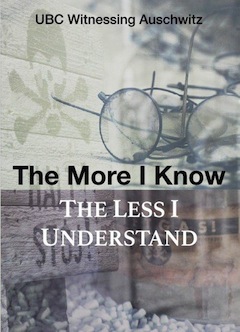
The book The More I Know, the Less I Understand (Auschwitz-Birkenau State Museum, 2017) summarizes the findings of University of British Columbia students in various fields of Holocaust research and the implications of Nazi German crimes committed in Central and Eastern Europe.

It is often claimed that, since the events of the Holocaust took place more than 70 years ago, most of the available information has already been collected and there is little chance of gaining new knowledge about what happened. This claim, often made without substantial questioning, has been debunked by, among others, a group of UBC students who traveled to Poland on the Witnessing Auschwitz Program from 2014 to 2016.

The young scholars conducted extensive fieldwork and consulted with world-class experts in Holocaust studies at the Auschwitz-Birkenau State Museum, the Emanuel Ringelblum Jewish Historical Institute and other organizations; they also used primary-source archival documents. Each of the student essays in The More I Know, the Less I Understand is accompanied by footnotes prepared by experts in the field. The essays show that many complexities of human life and politics, and historic processes associated with the Holocaust and the Second World War, remain understudied. Over the course of the Witnessing Auschwitz Program, the students found more questions to ask with every answer they were able to uncover.

The uniqueness of this volume and its substantial contribution to the market of knowledge rests on the comprehensiveness of the analysis – largely resulting from the diverse areas of expertise of the individual scholars. Furthermore, the authors in the book write on various subjects that have largely remained untouched in Canadian academia: the profitability of the work camps for the German economy; the artistic expression of prisoners; moral dilemmas, such as betrayal of others for the sake of survival; and complex emotions such as love.

book cover - The More I Know, the Less I UnderstandImportantly, various authors in this volume critique the methods by which the contemporary public is educated about events that took place before and during the Holocaust. For example, a common misconception exists, often reinforced through the education system and media, that the rationale for the crimes committed by the Nazi German regime was primarily rooted in ideological conviction. The essays in The More I Know, the Less I Understand collectively show that the motivations behind Nazi German actions prior to and during the Second World War were far more complex.

In early chapters, a number of the scholars correctly point out that the state of the economy was a major motivator for the leadership of the Third Reich. For example, Maria Dawson, in her chapter, “The Role of Food in the Development and Implementation of Nazi German Policies,” writes that the ethnic cleansing of Poles, commonly tied to the ideological motives of Nazi Germany, was substantially rooted in the perceived need of the Nazi regime for agricultural land to support their war effort. Joe Liu, in his chapter, “Deciphering Business Relationships in Nazi German-occupied Europe,” notes that the collection of data on prisoners entailed the development and modernization of mass data collection technology, particularly aided by IBM. The More I Know, the Less I Understand is full of such details, which are often surprising. The book not only breaks common misconceptions about the Holocaust, but provides a comprehensive picture of some of the real reasons behind Nazi crimes.

Because educating Canadian scholars and the public at large about the Holocaust will continue to be important for future generations, the methods of education on the subject must evolve. Helena Bryn-McLeod writes that, because of its importance in our daily environment, the Auschwitz-Birkenau State Museum recently joined various dominant social media networks. Since more people are using the internet than are reading books, social media is, as Bryn-McLeod identifies, “a new mode of remembering.”

Social media can also be an effective tool for the storage and capture of memories in an environment where there are fewer and fewer remaining survivors and other primary carriers of Holocaust memories. Moreover, Bryn-McLeod notes that social media conveys information to readers in similar ways as traditional forms of representation, such as journals and books – through photographs and other visuals – so little content will be lost with the transition to this new mode of memory. However, she acknowledges that, with the internet, new concerns have emerged, such as visitors taking offensive photographs in front of memorial sites and posting them. So, while the rise of fast-access media enables educators to reach a broader audience, Bryn-McLeod warns that ethical issues will continue to arise.

The More I Know, the Less I Understand holds valuable lessons. Notably, it highlights the dangers of adopting radical ethno-nationalistic positions, which, historically, have yielded catastrophic results. In his writing, Mark Twain brilliantly noted that “history does not repeat itself, but it does rhyme.” With the rebirth of populist political discourses in the West and elsewhere, the collection of works in The More I Know, the Less I Understand stresses that it is our responsibility, as a society, through education and awareness, to prevent certain chapters from history to rhyme with future chapters. Ultimately, this unique publication should be a foundational resource in Canadian scholarly environments – and elsewhere – where the subjects of the Holocaust and the Second World War are covered.

Dani Belo is a PhD student at the Norman Paterson School of International Affairs (NPSIA) at Carleton University in Ottawa, specializing in international conflict analysis and resolution. He is the editor-in-chief of the Paterson Review of International Affairs, associate editor at iAffairs Canada and contributing author in various publications for the NATO Association of Canada and the Canadian Global Affairs Institute. His area of research is international security, evolution of Russia-NATO relations, and inter-ethnic relations in the post-Soviet region.

***

The More I Know, the Less I Understand can be purchased at the UBC Bookstore or from the Auschwitz-Birkenau State Museum.

Format ImagePosted on February 23, 2018February 28, 2018Author Dani BeloCategories BooksTags Auschwitz-Birkenau State Museum, history, Holocaust, Nazi, UBC, University of British Columbia
Denying facts not a solution

Denying facts not a solution

For years, Poles have bristled at terms like “Polish death camps” or “Polish concentration camps.” Rightly so. Places like Auschwitz-Birkenau were Nazi German camps on Polish soil. Calling them Polish camps was misleading and imputed the murder of millions of Polish Jews (and many other Poles) to Poles themselves. This is a linguistic formulation that should be avoided.

But it should not be illegal. There are few, if any, words that should be illegal, in our judgment. But the Polish government thinks otherwise and has passed a law that penalizes any suggestion that Poland was complicit in the Holocaust. So, anyone who uses such terminology as “Polish death camps” could face fines or up to three years’ jail time.

However, while the camps were German, there has never been any question about the willing complicity of plenty of Poles in the extermination of most of their Jewish compatriots. Many Poles were conscripted into the Nazi killing program, but others willingly advanced the mission. Notably, the murder of Jews in Poland did not end with the Nazis’ defeat. There were many instances of Holocaust survivors returning to their homes after the war only to be murdered by their former neighbours, the most notorious example being the Kielce pogrom of July 1946, in which about 40 Jews were killed and as many injured. To utter these facts in Poland now is presumably illegal. On the other hand, it is presumably not illegal to state the fact that many Poles risked their lives to save the lives of Jewish Poles.

The dreadful and confusing new law has been condemned by the American and Israeli governments, among others. Israel’s criticism hit a particular nerve with Andrzej Zybertowicz, an advisor to the Polish president and a sociology professor at Nicolaus Copernicus University. He suggested that Israel’s response to the law resulted from a “feeling of shame at the passivity of the Jews during the Holocaust” and he accused Israel of “clearly fighting to keep the monopoly on the Holocaust.” He went on to say: “Many Jews engaged in denunciation, collaboration during the war. I think Israel has still not worked it through.”

The irony is as stark as it is distressing, that Zybertowicz could accuse Israel of failing to work through its Holocaust history when his own country has just codified its own refusal to do just that.

Conversely, Germany has just announced that it will acknowledge as Holocaust survivors Jews who lived in Algeria under the Nazi-collaborationist Vichy French regime. This means about 25,000 people will be eligible for some compensation under the Conference on Jewish Material Claims Against Germany. This is a positive development, no matter how late it has come.

These two very different present-day actions, 73 years after the liberation of the camps, are but two examples of how we are still navigating the facts of the Holocaust. We are still determining, among much else, who are to be included among the perpetrators and who among the victims. And these are not even the much more difficult, perhaps impenetrable, moral questions and issues raised by the Holocaust. We have not come close to understanding the patterns of antecedents, the human and historical prerequisites that allowed the Holocaust to happen – and which permit genocides to continue happening.

Format ImagePosted on February 16, 2018February 14, 2018Author The Editorial BoardCategories From the JITags Andrzej Zybertowicz, genocide, history, Holocaust, Israel, Poland
Survivor shares story

Survivor shares story

Holocaust survivor David Ehrlich speaks on Jan. 25. (photo by Pat Johnson)

David Ehrlich grew up in a small city in Hungary, sleeping in the kitchen of the family’s three-room house – “not three bedrooms, God forbid, three rooms” – and it was through the kitchen curtains early one morning that he saw three bayonets before he heard a knock at the door.

“I opened the door, they came into the kitchen and they said to me in German – there were two Hungarian gendarmes and one German soldier or officer or whoever he was – ‘I want you to bring in the family into the kitchen.’”

Young David gathered his parents, sister, three brothers and grandmother and they assembled in the kitchen, where they were told to be on the street in 30 minutes to prepare for deportation to a work camp.

Ehrlich shared his story Jan. 25 at a commemoration marking International Holocaust Remembrance Day (which was Jan. 27). The afternoon event, which took place at the University of British Columbia, was presented by the Vancouver Holocaust Education Centre, Hillel BC, the department of Central, Eastern and Northern European studies at UBC (CENES) and the Centre for Israel and Jewish Affairs, with support from the Akselrod family in memory of Ben Akselrod.

After two weeks in a makeshift ghetto on a local farm, the 7,000 Jews were forced onto trains, said Ehrlich. Seventy people were pushed into each car.

“These were not cattle cars,” he clarified. “I wish they had been cattle cars because [cattle cars] are ventilated.” There was one little hole at the top of the car, covered with barbed wire, and a child would occasionally be lifted up to look out to see if the signs outside were in Hungarian, German or Polish.

“But, soon enough, the train stopped,” he said. “They opened up the door … and there were some signs and some smells and some visions that I’ll never forget as long as I live. The place had electric lights … barbed wire all over in all directions.

“Little people – I thought they were little, but they were prisoners – came up to the train and said leave everything there, stand in line, five abreast. And we did that and walked over to this man with a stick in his hand and he was doing the selection. Who is going to live, who is going to die.… They played God. About 10 minutes or so later, we were separated from our family.”

While he was receiving his uniform, Ehrlich got his first lesson in what this place – Auschwitz – was all about.

“Did you say goodbye to your family?” the man asked Ehrlich.

“I said, why should I? I’m going to see them probably this afternoon. He said, while you were taking a shower, your family was gassed and, while we talk here, their bodies are probably being burned in the crematorium.”

Ehrlich’s brothers were almost immediately sent on to Melk, a sub-camp of Mauthausen, in Austria.

Because Hungarian Jews were among the last to be deported to the camps, the Soviet army was already advancing from the east by the time Ehrlich arrived at Auschwitz and the prisoners were sent on a death march westward. He, too, ended up in Melk and found someone from his hometown who knew the fate of his brothers. They had been sent to the hospital a few days earlier. Ehrlich knew that the hospital was a farce and that being sent there meant certain death.

“That was probably my lowest point in the whole deal because I always felt that I’d meet up with my brothers someplace,” he said. “I did, only a week too late.”

As the Russians kept on moving westward, the Nazis marched Ehrlich and the others further, this time to Ebensee, Austria.

“One day – it was a nice sunny day – we went outside and the loudspeaker came on and the president of the camp said, I’ve got good news for you. I have received orders from the Reich that we are to take you into the mine and blow it up with you in it. But I’m not going to do that – that’s the good news. For the first time since I’m in the services of the Third Reich, I’m going to disobey this order.”

He told the prisoners that they were free. The next day, they heard tanks on the cobblestone streets.

“And a guy that was probably 20 years old – like a kid, he looked like me – got out of the manhole and said to us in Yiddish, ‘Ich bin ein Amerikaner Jude,’ ‘I am an American Jew.’”

After liquids, then vitamins, eventually solids, Ehrlich regained some of his health. After two months, he still weighed less than 100 pounds, but he was ready to go home.

“But going home for Holocaust survivors, whether it was to France or to Germany or to Poland, it was the same thing,” said Ehrlich. “Canadian soldiers, American soldiers came back from the war, they came back to their community, to their parents and to their country. We went back and there was nobody there. My sister [who had been liberated in Lithuania] was there but we lost everybody else.”

Ehrlich wasn’t going to stay behind the Iron Curtain. He and a friend wanted to see Paris, planning eventually to head for pre-state Israel.

“But, while we were waiting in Paris, there were rumours that Canada was looking for orphans to go to Canada,” he said. “I went to work as soon as I came to Canada. I was going on 19. I went to work and I’ve been paying taxes ever since.”

The story has a good ending, Ehrlich told his audience.

“I married a wonderful girl – she’s right here, the little grey-haired girl – 65 years ago and we’re still together and we brought up three wonderful sons.”

Rabbi Philip Bregman told the survivors: “We are tremendously aware of how precious you people are who lit these candles and came in today as personal witness.”

The commemoration also featured Prof. Uma Kumar, of CENES, who said the Holocaust is a contemporary issue because antisemitism is a contemporary issue. “For this reason,” she said, “it is everyone’s duty to reflect on what happened.”

Format ImagePosted on February 2, 2018February 1, 2018Author Pat JohnsonCategories LocalTags Akselrod, CENES, David Ehrlich, Hillel BC, Holocaust, survivor, UBC, VHEC
אתגרי הביטחון

אתגרי הביטחון

לאור אתגרי הביטחון השונים הג’ואיש פדריישן של אזור מטרו ונקובר מינתה לאחרונה את דניאל היידנריך, לתפקיד מנהל הביטחון של הארגון. (צילום: jewishvancouver.com)

אנטישמיות בקנדה: גם בית כנסת בוויקטוריה קיבל מכתב שנאה

לרשימת בתי הכנסת ברחבי קנדה שקיבלו מכתבי שנאה מצטרף גם בית הכנסת קהילת עמנואל בוויקטוריה. לפי הערכה למעלה מאחד עשר בתי כנסת ברחבי קנדה קיבלו עד כה את מכתבי השנאה האנונימיים המדוברים. מחלקות פשעי שנאה של משטרות קנדה בערים השונות, פתחו בחקירה לבדוק את זהות שולחי מכתבי השנאה לבית כנסת ברחבי המדינה בחודש האחרון. עד כה ידוע שהמכתבים נשלחו למוסדות היהודים בערים הבאות: טורונטו (ארבעה בתי כנסת), מונטריאול (שני בתי כנסת), אוטווה, המילטון, קינגסטון, קלגרי, אדמונטון (שני בתי כנסת) וכן כאמור ויקטוריה.

המכתבים כוללים ציור של צלב קרס על מגן דוד צהוב עם דם נוטף, בצרוף הסלוגן “היהודים חייבים במיתה” גן כן עם דף נוטף. בשלב זה לא ברור האם קמפיין השנאה היה קשור לחג החנוכה שחל באותם ימים, או להכרזתו החד צדדית של נשיא ארה”ב דונלד טראמפ, כי ירושלים היא בירת ישראל, או שמדובר בפעילות אנטשימית “רגילה”.

ראש ממשלת קנדה, ג’סטין טרודו, אמר בתגובה לפרשה החמורה: “למעשי שנאה ואנטישמיות אלה אין מקום במדינתנו ואנו לא נסבול זאת”. לפי נתוני הלשכה המרכזית לסטטיסטיקה מכלל פשעי השנאה ברחבי קנדה כשלושה עשר אחוז מתבצעים כנגד הקהילה היהודית המקומית.

בבני ברית קנדה מציינים כי בשנת 2016 נרשמה עלייה משמעותית בהיקף של עשרים ושישה אחוז בפשעי שנאה נגד יהודים במדינה (1728 מקרים בסך הכל), לעומת השנה החולפת (2015). בבני ברית מוסיפים עוד כי 2016 הוותה שנת שיא בפעולות האנטישמיות מתוך 35 השנים האחרונות, שבהן הארגון מנהל רשום בנושא.

מכחישת שואה קנדית נעצרה בגרמניה

משטרת גרמניה עצרה לפני מספר ימים את מוניקה שייפר, מכחישת השואה שגרה בעיירה גא’ספר שבאלברטה. המשטרה המקומית חוקרת את שייפר לאור טענותיה שהשואה לא התקיימה – דבר הנחשב לעבירה פלילית בגרמניה. שייפר הגיעה למינכן כדי לתמוך במכחישת שואה אחרת סילביה סטולץ, שמשפטה מתנהל בימים אלה. סטולץ שימשה בעברה עורכת דין הורשעה כבר על הכחשת השואה. לטענת שייפר (שהיא בת להורים מגרמניה) השואה היא השקר העיקש ביותר בתולדות העולם. היא מציינת כי לא נהרגו בשואה שישה מיליון יהודים והיא אומרת בפשטות כי זהו שקר השישה מיליון.

לראשונה: מנהל ביטחון בפרדציה היהודית של ונקובר

לאור אתגרי הביטחון השונים הג’ואיש פדריישן של אזור מטרו ונקובר מינתה לאחרונה את דניאל היידנריך, לתפקיד מנהל הביטחון של הארגון. בתוכנית של עדיפויות אסטרטגיות ל-2020 נקבע כי יש צורך למנות מנהל מיוחד לעניניי ביטחון.

היידנריך שמכהן בתפקיד מאז חודש אוקטובר האחרון, הספיק להיפגש עם ראשי למעלה מעשרים ארגונים שונים שפועלים בקהילה, כדי לעמוד מקרוב על צרכי הביטחון שלהם, שיבואו לידי ביטוי בבקשותיהם לקבלת תקציבים כספיים מהממשלה הפדרלית. במקביל נעשה מאמץ לחזק את הקשר בין הארגונים לבין כוחות הביטחון המקומיים.

בתפקידו בפדרציה היידנריך מתמקד בשלושה תחומים עיקריים: אבטחה שוטפת של הקהילה היהודית והמוסדות השונים המסונפים אליה, קיום סדנאות מקצועיות כדי לסייע ולהדריך את הארגונים היהודים בנושא רמת הביטחון הנדרשת לאבטחתם, הפעלת רשת מתנדבי ביטחון לסייע למערך הביטחון של הארגונים השוינם ובעיקר באירועים.

היידנריך שירת במשך כעשרים שנה בצבא הבריטי. לאחר מכן שימש במשך כשלוש עשרה שנים יועץ לענייני ביטחון בארגונים שונים בעולם (בהם בעיראק ואפגניסטן, קפריסין ודרום אפריקה). בוונקובר הוא שימש בין היתר ראש האבטחה של קניון אוקרידג’ ולאחר מכן מנהל הביטחון של מלון הדירות טראמפ ונקובר.

Format ImagePosted on January 17, 2018January 17, 2018Author Roni RachmaniCategories עניין בחדשותTags antisemitism, Congregation Emanu-El, Daniel Heydenrych, hate mail, Holocaust, Jewish Federation, Monika Schaefer, security, אנטישמיות, ביטחון, ג'ואיש פדריישן, דניאל היידנריך, מוניקה שייפר, מכתבי שנאה, קהילת עמנואל, שואה
Perpetrators offers new insights

Perpetrators offers new insights

Who could shoot at close range two million children, women and men who were standing at the sides of graves they had just been forced to dig? And then, when this process proved inefficient, who could herd four million more into cement bunkers and drop cyanide pellets on top of them? Were they monsters?

“Monsters do exist,” Primo Levi once said, “but they are too few in number to be truly dangerous. More dangerous are the common men, the functionaries ready to believe and act without asking questions.”

Christopher Browning, in his famous 1992 study of Holocaust perpetrators, Ordinary Men, came to the same appalling conclusion: the killers were simple, middle-class working men, “believing Christians” from all walks of life (including thousands of priests and seminarians), just witlessly and anxiously “following orders” and blindly obeying peer pressure, not, in most cases, virulent antisemites.

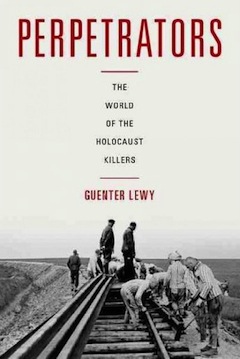
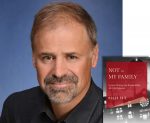
book cover - Perpetrators: The World of the Holocaust KillersThe controversial nonagenarian scholar Guenther Lewy, the author of Perpetrators: The World of the Holocaust Killers (Oxford University Press, 2017), and son of a camp survivor, begins his new study of Holocaust perpetrators with the same question: “How could such terrible deeds happen in the heart of Christian Europe and among a nation known for its poets and thinkers? What had converted so many seemingly ordinary people into killers, willing participants in what is the worst crime in modern history?”

Lewy’s study is the first English-language volume to make use of the 49-volume collection of 929 German trial records of Holocaust perpetrators recently published by the University of Amsterdam (it is not made clear why the records were not published in Germany). He also draws upon an enormous accretion of “previously untapped” sources such as the 50,000 letters and diaries of Wehrmacht soldiers recently released by German archives, as well as victim recollections and, most importantly, hundreds of trial records of Nazi functionaries, beginning in Nuremberg in 1945 and continuing to the present day. Of the 1,200 citations in the 25-page bibliography and the 600 footnotes, by far most of them are from the late 1990s to the present.

Lewy’s conclusion is similar to Levi’s and Browning’s: the perpetrators were not characteristically sadists or psychopaths, or even necessarily antisemites, but simply obtuse followers of orders, vassals to peer pressure, or simply “ordinary people” trying to advance their careers.

Lewy’s graphic details and conclusions will be familiar to readers of Saul Friedlander’s monumental Nazi Germany and the Jews, 1939-1945: The Years of Extermination (2007), but Lewy’s access to the most recent documentation brings some new and important facts to light.

First, the whole notion of a “clean Wehrmacht” can now be dismissed. Lewy proves conclusively that there was close contact between the Wehrmacht and the SS and particularly the 38 “Totenkopf” (“Death’s Head”) divisions of the Waffen-SS: new evidence shows that Jews were “squarely in the crosshairs of the Wehrmacht” and that the number of members of the Wehrmacht who took part in the murder of Jews “is in the tens of thousands.”

Second, Lewy’s close study of the new material available allowed him to conclude that “not a single person who asked to be relieved [from duty in the killing squads] was tried by a military court” and, in fact, “most of their requests were granted.” Lewy found 85 cases of Wehrmacht soldiers who refused to shoot civilians: all were simply transferred to other duties. The significance of this finding, of course, is that it puts the lie to the excuse frequently made by the killers that they “had no choice” and “had to follow orders.” (Lewy points out, significantly, that Yad Vashem has in fact recognized 45 Wehrmacht soldiers as “saviours of Jews.”)

In the sixth chapter of Perpetrators, “Flawed Justice,” Lewy makes his most significant mark. Here, Lewy reveals that, of the 200,000 or so former Nazi killers who, through 2005, were investigated by German authorities, fewer than 10% had charges brought against them; and, of these, only half were convicted. Light sentences were the norm; and only eight of the 2,000 former members of the Einsatzgruppen investigated received life sentences. Most of these examples of “flawed justice,” Lewy concludes, had to do with the fact that so many judges were “tainted” as former party members, and that German law (unlike Canadian law) distinguished between perpetrators and accomplices, usually finding the latter innocent, as they were “only following orders,” that they were only “tools” or were not “unseemingly zealous” in their murderous actions. (Two years ago, German courts finally adopted Canadian/American style “common design,” sharing the guilt between perpetrators and accomplices.)

In his final chapter, “Explaining the Holocaust,” Lewy concludes that nobody, ultimately, can simply give up his freedom. Situation, genetics, conditioning are all significant, but “they do not dictate or determine character.” In fact, recalling how anxiously in 1945 the Nazis strove to cover up what they had done led Lewy to conclude that “even Hitler and the members of his immediate entourage probably knew deep down that they were doing wrong.”

And, as Lewy concludes, in his last sentence, “The fact that so few avoided evil orders remains an ineradicable blot on an entire German generation and a cross that their descendants continue to bear.”

Perpetrators is a valuable addition to a long story, one which may never be conclusively told.

Graham Forst, PhD, taught literature and philosophy at Capilano University until his retirement and now teaches in the continuing education department at Simon Fraser University. From 1975 to 2010, he co-chaired the symposium committee of the Vancouver Holocaust Education Centre.

Format ImagePosted on January 12, 2018January 10, 2018Author Graham ForstCategories BooksTags Guenther Lewy, history, Holocaust, Nazis, Perpetrators

Survivor’s talk inspires

“There are as many Holocaust stories as there are Holocaust survivors,” said David Ehrlich, a survivor outreach speaker of the Vancouver Holocaust Education Centre, to open his afternoon talk at Langara College. On Oct. 31, a class of 20 students and several faculty members and guests heard Ehrlich – a Hungarian survivor of Auschwitz who immigrated to Canada via Paris in the late 1940s – tell his personal story.

This class is part of a program called Writing Lives: The Holocaust Survivor Memoir Project. In the first term, its students produce research papers on prewar European Jewish communities like the one that Ehrlich called home; in the second term, they will interview survivor-partners and together write memoirs of the survivors’ experiences.

Ehrlich is an evocative speaker. He spoke lovingly of his family home in Transylvania (now part of Romania). “We had a three-room home, and we were middle-class. But we had no running water and no electricity, not for another 20 years,” he said. “Kids don’t know any better. I thought that we had it well: chicken on Friday night, bread on the table, it was wonderful!”

But he also told of his experience with antisemitic violence, the hard choices made by families who tried to avoid a Nazi roundup, and life in Auschwitz. He silenced the room when he spoke of stepping off a train boxcar at Auschwitz: “I’ll never forget the view when the sliding doors opened, or the noise that the doors made,” he said.

The students – who in this term’s research papers attempt to imaginatively reconstruct Jewish life before the Second World War’s devastation – responded with questions about Ehrlich’s journey to Canada. He spoke of the family that he made in Canada: a wife and three sons. He made his story accessible to the audience of all ages.

The students admired Ehrlich and a bond was formed during his talk, which was about an hour long. When he finished speaking, there was a respectful silence, and no student seemed willing to be the first to break it. Teachers from Langara began the question-and-answer session and, once the ice was broken, the students filled the remaining time with questions. Ehrlich in turn shared relevant wisdom for Writing Lives’ participants.

“You are educated and smart,” he told them. “There comes a time where you’ve got to learn to put up with people who are different because you have to get along. Start practising by getting along with your fellow students.”

Indeed, Writing Lives features groups in which students collaborate on research and, ultimately, on memoirs with the course’s survivor-partners. These collaborations require empathy. Ehrlich conducted himself as an exemplar of empathy, stating, “I can’t hold the grandchildren of Nazi-era Germans accountable for the Holocaust,” and the students’ response to his talk suggests that they, too, understand empathy’s importance. The course thus offers an excellent venue for students’ development of collaborative skills and of compassion. It provides a space in which students can grow closer together.

The afternoon also contained humour and reference to contemporary subjects. Ehrlich joked that he was now willing to use various German-made appliances and recalled that the heavy rainfall during a roundup of Hungarian Jews paled in comparison to Vancouver’s weather. Ehrlich also demonstrated strong knowledge of news and politics by interspersing references to American and Canadian current events into his remarks. He shared his general optimism about the post-Holocaust situation, stating, “After three or four generations, the Germans are coming clean; they are behaving like good nations do. It’s the only country in the world where you cannot say that the Holocaust didn’t exist.” He added, “We in Canada are very lucky – multicultural – and there’s no way that one minority group could be persecuted as in the Holocaust.”

His audience appreciated his graceful, optimistic tone. One enthusiastic student baked dozens of cupcakes to celebrate Ehrlich’s recent birthday.

Ehrlich’s talk will guide Writing Lives’ students through the remainder of the program. They will respond to it in one of their weekly written submissions, and the experience of interacting with a Holocaust survivor foreshadows the interviews that they will conduct in early 2018. They could not have asked for a better guide.

William Chernoff is a student in the Writing Lives program. Coordinated by instructor Dr. Rachel Mines, the two-semester program is a partnership between Langara, the Vancouver Holocaust Education Centre and the Azrieli Foundation.

Posted on December 1, 2017November 29, 2017Author William ChernoffCategories Op-EdTags Azrieli Foundation, David Ehrlich, Holocaust, Langara College, VHEC, Writing Lives

The Holocaust in literature

This academic year marks the second session of Writing Lives, a two-semester project at Langara College, coordinated by instructor Dr. Rachel Mines. Writing Lives is a partnership between Langara, the Vancouver Holocaust Education Centre and the Azrieli Foundation. This fall, students are learning about the Holocaust by studying literary and historical texts. In January, students will begin interviewing local Holocaust survivors and will write their memoirs on the basis of the interviews. Students are keeping journals of their personal reflections on their experiences as Writing Lives participants. Many students used their most recent journal entry to reflect on the value of literature in transmitting Holocaust memory. Here are a few excerpts.

The role of literature in preserving history is controversial but important. Understandably, there are people who are reluctant or even vehemently opposed to recording the Holocaust through the lens of art, concerned that the act of rewriting events in a fictional context may undermine the significance of the tragedy. Others may worry that historical inaccuracies are inevitable in these artistic works, thus doing a disservice to the victims and betraying their memories.

I would argue otherwise: that literature and historical facts can and should build upon one another, used to educate and not obscure. For me, reading our history textbook this semester has not always been easy, but reading the short story A Ghetto Dog by Isaiah Spiegel took the experience to a different level. Such is the power of narrative. As Menachem Kaiser wrote in his article “The Holocaust’s uneasy relationship with literature” (The Atlantic, Dec. 28, 2010), “literature affects us in ways that even the most brutal history cannot.” Literature makes the event close, immediate and personal. It’s hard for me to imagine being a Jew in Second World War Europe, but personal accounts and narratives come close to letting us immerse ourselves in the tragedy.

– Athina Leung

In his article “The Holocaust’s uneasy relationship with literature,” Kaiser argues that Holocaust literature is an important part of history. It can provide the emotional connection that reading facts cannot. It is a window to understand what people felt without having to experience the ordeal that the characters or author went through. Literature has the power to move the human heart. Facts are important, but they do not give the reader the ability to connect with history in ways that a more emotional and personal experience can provide.

– Tina Macaspac

I found the assigned reading, “The Holocaust’s uneasy relationship with literature,” to be incredibly relevant and thought-provoking. This article discusses the various difficulties associated with Holocaust literature, including the opinion by some historians that the only valid way to recount the Holocaust is through historical facts and memoirs. I agree that acquiring factual knowledge about the Holocaust is integral, and that reading historical documents is essential. However, I find myself disagreeing with the perspective that Holocaust literature is distasteful or discrediting to the Holocaust. Rather, literature provides an alternative, more emotional perspective that one cannot acquire from reading a fact-based history textbook. This week, for example, we read the short story A Ghetto Dog, which narrates the tale of the Jewish widow Anna and her dog Nicky. While I was aware of the facts (in this case, Jews being rounded up by Nazi troops) from a historical perspective, the story emphasized the feelings of helplessness and exhaustion that Holocaust victims and survivors felt. It touched a part of me in a way that facts and statistics could not.

– Emma Proctor

In A Ghetto Dog, the widow Anna and her dog Nicky are persecuted under the Nazi regime and forced to move into a ghetto. It is very clear from the beginning that Nicky is extremely important to Anna, and that he is her last remaining tie, not only to her deceased husband, but to her home.

The Nazis took livestock and any useful animals away from the Jewish people in order to make a profit. The livestock had value, which is why they were kept alive. People’s dogs, however, were not valuable to the Nazis, and that is one reason the dogs were killed.

Another reason was psychological. To the Nazis, it was important to wound people emotionally in order to conquer them. In the story, there were Jewish children dragging their dogs on ropes and leashes, bringing their pets, beloved family members, to be put to death. Dogs were part of a support system and, as with Anna, were reminders of home. To kill these dogs was to kill hope of return. The deaths of dogs were a stern reminder that just as easily as they could kill animals, Nazis could kill humans.

– Yukiko Takahashi-Lai

Posted on November 17, 2017November 15, 2017Author Writing Lives studentsCategories Op-EdTags Azrieli Foundation, Holocaust, Isaiah Spiegel, Langara College, literature, Menachem Kaiser, VHEC, Writing Lives
Brave choice to stage Taken

Brave choice to stage Taken

A scene from United Players’ production of Taken at Midnight, which is at the Jericho Arts Centre until Nov. 26. Seen here are Brian Hinson as the Nazi Dr. Conrad and Suzanne Ristic as Irmgaard, Hans Litten’s mother. (photo by Nancy Caldwell)

As a Jew, a lawyer and a child of a Holocaust survivor, I am embarrassed to say that I had never heard of Hans Litten until I saw United Players’ production of Taken at Midnight, which runs to Nov. 26 at Jericho Arts Centre.

Litten was a brilliant young Jewish-German lawyer, known for his defence of opponents of the Nazi movement. In 1931, he had the audacity to subpoena Adolf Hitler as a witness in the trial of four Nazis charged with murder, and subjected him to a grueling three-hour cross-examination, exposing the Nazi party for what it really was – a murderous bunch of thugs. Litten called Hitler “a cross between Baron Munchhausen and Attila the Hun.”

Unfortunately for Litten and the world, within two years Hitler was in power and he started to exact his revenge on his opponents. At midnight on Feb. 28, 1933, after the Reichstag (German parliament) fire, Litten, along with thousands of others, was arrested or, as the Nazis euphemistically called it, taken into “protective custody” at a series of concentration camps. Litten became known as “Hitler’s personal prisoner” – the cocky Jewish lawyer who had dared to expose the Fuhrer’s weaknesses – and, over the years, was subjected to brutal torture and unspeakable degradation as punishment. Despite the valiant efforts of his mother, Irmgaard, to obtain his release over the five years of his incarceration, Litten ultimately committed suicide in Dachau in 1938, which was a bit messy for the Nazis, as they wanted their political prisoners to die accidentally or naturally, not by taking their own lives.

The irony is that Litten was not technically Jewish. His mother was not Jewish and his father had converted to Christianity (to make things easier). As Litten says in the play, “I am an atheist Jew and, prior to that, I was an atheist Lutheran.” Of course, that made no difference to the Nazis, who went back three generations to ferret out Jewish blood.

Playwright and filmmaker Mark Hayhurst’s 2010 BBC films The Man Who Crossed Hitler and To Stop a Tyrant planted the seeds for this staged work. It had its West End (London, England) debut in 2014. Reviewers called it a “masterpiece of theatre not to be missed.” Now, United Players has taken on the formidable task of presenting this gripping story to Vancouver audiences. From the minute you walk into the theatre, the dark, shadowy, stark set – an elevated wooden platform fronted by barbed wire positioned between two floor-to-ceiling red banners emblazoned with black swastikas – is a harbinger of the grim things to come.

The entire cast, mostly comprised of veteran actors, is stellar and, as an ensemble, makes this a truly remarkable theatrical experience. Particular mention has to be made of the two main protagonists – Suzanne Ristic as Irmgaard and Sean Anthony as her son. Ristic is sublime in her portrayal of this strong, heroic woman who takes on the Gestapo establishment in a relentless battle to free her son. She often takes centre stage to talk directly to the audience, thereby breaking down the fourth wall, making for a very intimate encounter. And Anthony plays his difficult role with dignity, yet shows uncompromising defiance. We ache as we watch his physical and mental decline – his transformation from ordinary citizen to bloodied, head-shaven prisoner; a business suit to the striped concentration camp uniform, replete with the obligatory yellow Star of David.

Supporting, but not lesser, performances come from the rest of the cast.

photo - Irmgaard Litten (played by Suzanne Ristic) tries everything to save her son Hans (Sean Anthony) from the Nazis in Taken at Midnight
Irmgaard Litten (played by Suzanne Ristic) tries everything to save her son Hans (Sean Anthony) from the Nazis in Taken at Midnight. (photo by Nancy Caldwell)

Brian Hinson as Dr. Conrad, Irmgaard’s Gestapo contact, portrays a man of culture and intelligence who appreciates this feisty woman and appears to feel affection for her. The scene where they share an ice cream on a summer’s afternoon in a park seems incongruous, juxtaposed against the darkness of this play. Yet it speaks to some form of humanity even in the worst of times.

Litten’s cellmates – Erich Muhsam, an anarchist (played by Richard Hersley) who refers to Hitler as “the Austrian transvestite,” and Carl von Ossietzky, a newspaper editor and winner of the 1935 Nobel Peace Prize (played by Jewish community member Michael Kahn) – show the camaraderie and trust that can evolve from difficult circumstances. The triumvirate produces an amusing reenactment of Hitler’s cross-examination, providing an island of levity in their sea of despair.

Douglas Abel plays Fritz Litten, Hans’ father, as a calm counterpoint to his wife’s intense persona. John Harris, with his posh English accent, is Lord Clifford Allen, an English diplomat, patrician and pacifist who Irmgaard seconds in her quest for her son’s freedom. Allen is able to secure a meeting with Hitler to discuss the matter, but to no avail. Allen’s political attitude highlights the European appeasement zeitgeist of the early 1930s – that Germany was just experiencing growing pains and Hitler was an effective statesman, not a threat to the world. If only it had been so.

The play provides an historical lesson in the rise to power of the fascist Nazi regime and the consequences of speaking truth to power, but, at its heart, it is the story of the love of a mother for her son and her fight, at great personal risk, to try and save him.

As director Michael Fera, states in his notes, this is “an informative and deeply engrossing play about the high price paid for resisting tyranny,” and is as relevant today as it was in 1933. “People are living it now, again. History is repeating itself in many ways.”

Taken at Midnight is a tough watch and an emotional ride but well worth a trip to the Jericho Arts Centre. Kudos to artistic director Andree Karas for having the courage to stage this work. The show runs to Nov. 26, Thursdays to Sundays, 8 p.m., with 2 p.m. matinées Nov. 12, 19 and 26. For more information, visit unitedplayers.com or call 604-224-8007, ext. 2.

Tova Kornfeld is a Vancouver freelance writer and lawyer.

Format ImagePosted on November 10, 2017November 9, 2017Author Tova KornfeldCategories Performing ArtsTags Holocaust, Jericho Arts Centre, Nazis, theatre, United Players
Retribution and restoration

Retribution and restoration

Hidden in the spine of a 1947 edition of Anne Frank’s The Diary of a Young Girl, in its original Dutch, is a piece of paper with the German words, “Die Vergeltung,” or retribution. (photo by Shula Klinger)

I ran into Richard Smart in North Vancouver in early September. It was at Urban Repurpose, a nonprofit store that sells used building materials and an eclectic mix of donated household items. Many of these items are vintage and, if you’re interested in local history or looking for artistic inspiration, it’s also a treasure trove.

Employing skills handed down over three generations of his family in England, Smart restores and sells antique books using tools that have “barely changed for centuries.” And, since a homeschooling mom never misses an opportunity to educate the children, I asked him if we could come by the Old English Bindery to see him at work. In mid-October, he invited us to see how a broken book could be repaired.

Smart showed us book presses, tools for applying gold leaf to the bindings of books, piles of ancient, beautifully decorated papers and, of course, the books themselves – travel writing, fiction, nonfiction, massive tomes of human anatomy, bigger than any book you’d see in print nowadays. He also applied gold leaf to the kids’ index fingers, which delighted us all.

photo - Het Achterhuis. Anne Frank’s The Diary of a Young Girl
Het Achterhuis. Anne Frank’s The Diary of a Young Girl. (photo by Shula Klinger)

Just before we left, Smart showed me a small, bubble-wrapped book. I looked down as he held it out. Its title: Het Achterhuis. Anne Frank’s The Diary of a Young Girl.

“It’s a first edition,” he said. There was a pause, to let this information seep in. He pointed to the front left edge. “I only did minor repairs on it, here.”

I stared at my hands, holding this 1947 edition of The Diary of a Young Girl, in its original Dutch. Looking down, just breathing. Thinking about how, a mere two years before this book was published, Anne and her sister Margot were still alive. In captivity, but alive. Anne was still writing, contemplating the nature of the human soul.

A moment later, Smart pointed to the inside of the spine, where it had separated from the contents. “Look at that,” he said, and pointed to some words in German: “Die Vergeltung.”

“I looked it up,” he said, and here he became animated. “It means retribution. Or payback.”

I was already choking back the emotion of holding this 70-year-old edition of The Diary, but now this?

I asked how the text had gotten there, when the book had come apart, if it had been placed there during the original binding.

“Bookbinders often used scraps of paper to pad the inside of a spine,” he explained. “But to choose this particular piece of paper? Just think about that.”

By then, my head was full of questions, all competing for my attention. Unfortunately, my two children were also competing for my attention. The little one was extremely curious about the book presses, but the big one was edging toward the door. Also, as interested as they are in world history, this wasn’t the time to tell them about the Holocaust, so we left.

Over the next few days, I learned more about the book’s earlier life and Smart’s plans for its future. “This book needs to go back to its community,” he said. When asked if it there had been any fanfare at the Dutch auction, he said, “It was just an ordinary estate sale.”

Since the original dust jacket was missing, Smart has made a case for it. Working to match it to the cover’s original colour, he chose a pale blue leather inlay for the lid and patterned, or “paste,” paper for the sides.

photo - In the spine of this 1947 edition of The Diary of a Young Girl is a piece of paper with the German words, “Die Vergeltung,” or retribution
In the spine of this 1947 edition of The Diary of a Young Girl is a piece of paper with the German words, “Die Vergeltung,” or retribution. (photo by Shula Klinger)

I also wrote to Anne Frank House in Amsterdam. Gertjan Broek replied, saying, “There are still a few mysteries around the first edition of Anne Frank’s Het Achterhuis.” He agreed that “randomly available” pages from other books were often used to pad spines – “paper was a scarce resource in those years,” he noted.

This was probably the case with the page used in Smart’s edition of Het Achterhuis. Die Vergeltung was published in Bayreuth, Germany, in 1941 and reprinted in 1944. In Broek’s view, the typefaces were a match. Broek didn’t know if this was true for all of the 3,000 books in this first run, but he said he’d ask his colleagues.

A few days – and a good deal of anxious email-checking – later, Broek wrote again. “Three experts in book restoration have told me they have never seen a first edition copy of Het Achterhuis with this kind of print.”

And that is where the story rests, for now. I would love to paint a more detailed picture of the bookbinder at a workbench in 1947. I picture hands cutting out a page of that German book, laying it into the backbone of Anne’s book. Was the bookbinder just doing a job, or taking a degree of satisfaction in leaving a deliberate, but hidden, commentary inside this now-iconic piece of work?

There’s another layer to the tale.

In an age where people are rushing around permanently plugged into an online world, bookbinders like Smart have an unusual job. Every day, instead of racing ever forwards, he steps into worlds that have passed, touches books first purchased by people who haven’t lived for centuries. As he preserves their books, it’s as if he offers a passage between their time and ours.

Amid all of these remarkable works, Anne’s stands out as a beacon. “Books like Anne’s make this work worthwhile,” said Smart, who is keen to sell his copy of Het Achterhuis, but to an organization, not a private individual. “I had an offer on it but I refused it,” he said. “I have my heart set on it going into an institution that will display the story.”

So, in preserving precious books, Smart is doing far more than simply offering a service, repairing material goods. He is acting as a guardian of history.

Smart also wonders about the binder of this copy of copy of Het Achterhuis, “the moment of looking for a spine liner and putting that particular one in. What was going through his mind, in 1947?” On reading this in Smart’s email, I replied that, really, the book was priceless.

Later that day, he emailed again. “This one copy is priceless, as you say. Not financially but historically. Just imagine the story told by everyone that sees this book in a museum. It would bring people in, just to see this, and talk about it. That is worth so much for everyone in this world.”

Responding to my expression of gratitude for his professional conscience, he said, “Faith is everything.”

Shula Klinger is an author, illustrator and journalist living in North Vancouver. Find out more at niftyscissors.com.

Format ImagePosted on November 10, 2017November 10, 2017Author Shula KlingerCategories BooksTags Anne Frank, Holocaust

Posts pagination

Previous page Page 1 … Page 27 Page 28 Page 29 … Page 43 Next page
Proudly powered by WordPress