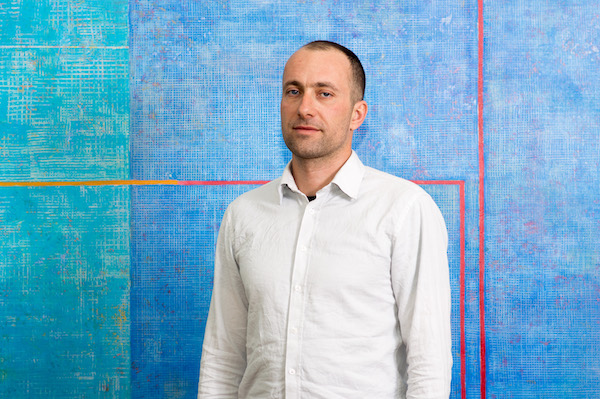
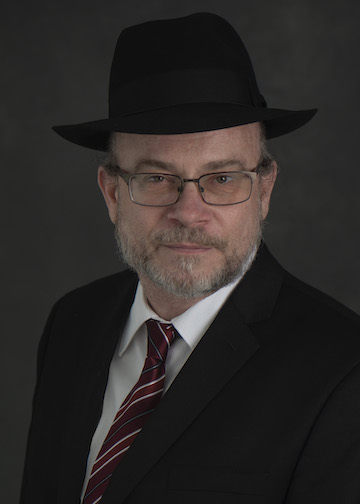
Dr. Kamil Kijek of the University of Wrocław, in Poland. (photo from University of British Columbia)
For Polish Jews who survived the Holocaust, the question of where to begin life anew after the cataclysm was not as clear as it might seem in hindsight.
Looking back at the successive tragedies of postwar life for Jews in Poland, it might seem obvious that the blood-soaked homeland held little hope for the future. The choices for survivors limited their options, though, and the faith that, surely, the worst had passed played a role in the decision by tens of thousands to try rebuilding their families on the soil of their ancestors.
The disastrous history of Jews in postwar Poland was the subject of a special presentation at the University of British Columbia by Dr. Kamil Kijek, an assistant professor in the Jewish studies department at the University of Wrocław, in Poland. Speaking virtually from Poland to students in-class and to a wider audience online, Kijek addressed the decision faced by Polish Jewish communities to stay in or leave post-Holocaust Poland. He was speaking to a class led by Dr. Ania Switzer, a sessional lecturer at UBC, who was born in communist Poland and who is a translator and historian specializing in Jewish studies and Holocaust education.
“Most of Poland did not become the desert of Jewish life right away,” said Kijek. “It happened over time.”
About 50,000 Jews survived the Holocaust in Polish territory. In early 1946, about 136,000 Polish Jews returned from the Soviet Union, where they had survived the war, and a few thousand others found their way back from other parts of Europe. By July 1946, there were about 200,000 Jews in Poland, compared with about 3.3 million in 1938.
The vast majority of Jews who remained in or returned to Poland after the war did not take up life in the places they had been born. The borders of the country had shifted enormously, with the Soviets taking large swaths of what had been eastern Poland and Poland being compensated with formerly German lands in the west. Jews, along with other displaced Poles, were encouraged to take up residency in these newly acquired places in the west of the country, replacing Germans who were expelled.
“It is almost impossible to understand the tragedy of the people the moment when they are freed,” said Kijek. “We need to understand that the end of the war and so-called freedom actually was a time of psychological collapse for most of these people.… These people, when they come back to the places [of their origin], they see their whole communities destroyed and it’s the first time they are sure that most of their friends and family were killed.”
Significant American and other Western funds flowed into the Jewish communities of the country, intended to rebuild Jewish society there. Hebrew schools, synagogues and other institutions were constructed and supported by the Jewish Joint Distribution Committee and other international Jewish welfare and aid agencies.
The postwar period saw continuous upheaval in Poland, with civil war between pro- and anti-communist forces. It was not immediately clear that Poland would fall to communism, nor was it apparent at the time that, even if that did transpire, an Iron Curtain would fall across the continent. Polish Jews in the immediate aftermath of the war maintained close and supportive personal and institutional connections with family and Jewish organizations abroad. A degree of political pluralism revived before the country fell into the Soviet orbit.
Government oppression was not the only concern, though. On July 4, 1946, a pogrom in the southern Polish city of Kielce saw 42 Jews murdered and more than 40 injured. This was just the most deadly and well-known of a series of attacks against Jewish survivors after the war. The immediacy of antisemitic violence by their Polish neighbours disabused many Jews of the hope that they could rebuild a life in the country of their birth.
An exodus followed, but Kijek noted that, while contemporary observers might have seen abandoning Poland as an obvious choice, for people then, there were many considerations. They may not have had any money to facilitate relocation. At middle age or later, it might be natural to resist relocating to a place where one’s language is not spoken and one’s work experience is not transferable. And the prewar barriers that left European Jews to their fate remained largely in place: Western countries still did not open their borders to refugees.
Events unfolded quickly as the communists gained the upper hand in the country, the Cold War arose and the state of Israel was founded, providing at least a place where fleeing Polish Jews could find a welcome.
About 100,000 Jews were still in Poland in 1948, when an estimated 30,000 made aliyah. There was a tremendous amount of judgment, even suggestions of sedition, toward Jews who remained in Poland when Israel existed as an alternative, said Kijek.
“For Zionist leaders, any decision to stay in Poland was an act of a kind of national treason or an act of not understanding the lessons of the Holocaust,” he said, adding that those who remained were not all driven by ideological commitment to communism. The remaining Polish Jews represented a cross-section of Jewish society, including Orthodox, socialist and Zionist individuals. Eventually, even Zionist organizations accepted that not all Jews would make aliyah.
About one-third of Polish Jews who survived the war remained in Poland by 1950, but the emergence of the Cold War isolated them from Jews worldwide.
“All these ties are suddenly cut off in the end of 1948 and 1949,” said Kijek. The burgeoning of Hebrew schools and Jewish cultural organizations was stanched by a communist crackdown on “Zionist” institutions. The state nationalized much of the Jewish community’s remaining assets.
A liberalization occurred after the Stalin era and a number of Jews were able to flee Poland in the late 1950s. Those Jews who remained in Poland into the 1960s were, to a large extent, living a non-Jewish life and may have believed that their identity was no longer a barrier to whatever success they could attain in the country. However, following the 1967 Six Day War, in which Soviet-backed Arab countries were defeated by Israel, and 1968 student demonstrations that posed a genuine threat to the continued dominance of the communist regime, the scapegoat of “Zionism” emerged again, with Jews being accused of disloyalty to Poland, some being forced from their jobs, and the final mass exodus of Polish Jews occurred.
When the communist regime fell, in 1989, there were an estimated 5,000 to 10,000 Jews in Poland, the last remaining of a millennia-old civilization.
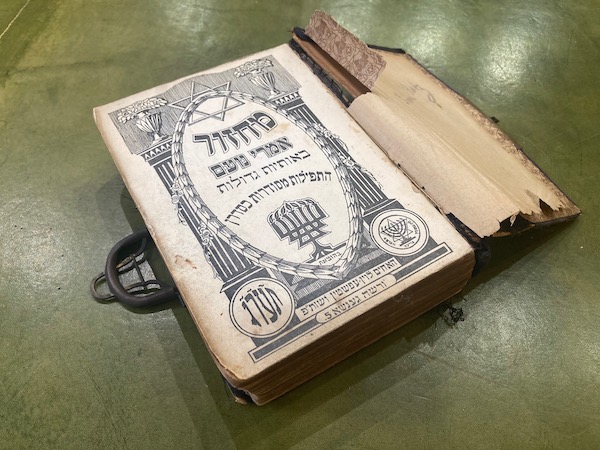
The author’s family Machzor, which was printed in Warsaw in 1913, was most likely owned by her grandfather. (photo by Shula Klinger)
Growing up, I was never taken to shul. I never saw my parents pray, read religious texts or attend any Jewish community events. I saw my maternal grandfather’s tallit case once or twice; I don’t know if he attended shul regularly. These ritual items were simply family artifacts, not elements of our daily lives.
At school, I went to Shabbat with a school friend and muddled through, not knowing the customs. I went to Jewish assembly twice a week and learned the Shema – sort of – from the other girls. With an Israeli father who spoke fluent Hebrew, I didn’t know where I fitted in. Religious Jews weren’t “our people.” My father’s religion was Zionism, not Judaism. I was English, but, at the same time, I wasn’t.
My mother passed away in 2020. As I went through her belongings, I was startled to find a Machzor (prayer book for the High Holidays) that had belonged to – I presume – her father, Dr. Bernard (Boris) Stein. It was coming apart and not just from age; it had clearly been well-used.
This was a deeply moving discovery for me. It told me that my family had once kept the High Holidays, that my ancestors did attend services and were indeed part of a spiritual community.
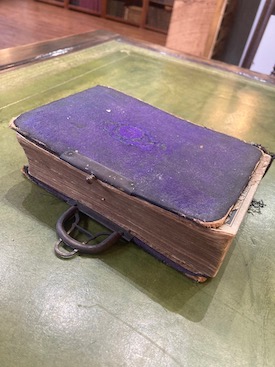
The prayer book’s worn, shabby velvet has been repaired more than once. Once bound in a rich purple velvet, glue marks are all that is left of the cover ornament. The buckle is mostly intact but the spine is roughly stitched together with cotton thread. This is not the work of a professional artisan; maybe it’s the handiwork of my grandfather himself. He was used to handling a needle and thread, though as a surgeon.
From the Cyrillic text in the front, I learned that the book was published by Levin-Epstein in Warsaw. Why would my grandfather, who was born in Lithuania and raised in South Africa, have owned a Polish Machzor?
According to Nathan Cohen in Warsaw: The Jewish Metropolis, Warsaw did not rise to prominence in Eastern European Jewish life until the second half of the 19th century. This was a result of the czar’s 1836 decree that closed down Jewish printing houses in the Russian empire. Only select printers in Vilna and Zhitomir were allowed to print in Hebrew characters. Warsaw, however, was outside the boundaries of this region, so the Jewish printing industry moved there instead. My family prayer book was published in 1913.
Once bound in a rich purple velvet, glue marks are all that is left of the cover ornament. (photo by Shula Klinger)
And what of our Machzor’s future? I don’t want to pack it up and hide it away. I want it to be a family heirloom for generations to come, and for my children to see it as they grow up. They are proud of their heritage and will also want to see that the book is well cared for.
I sought the advice of a professional. Having worked with local bookbinder Richard Smart on a Jewish Independent story about Anne Frank in late 2017, I returned with the book and a new set of questions.
Could the book be repaired? Smart said no, because “any new suede isn’t going to blend in nicely with the old … it’s very fragile.” However, he came up with another option for conserving it: building a custom box. This way, he said, “it’ll stay in one piece, but it also keeps its history of having been handled and used.” I like this approach because it prevents the book from coming to further harm, but it also preserves it as evidence of my ancestors’ religious lives.
While the book will not be in circulation, I am heartened by the knowledge that it will, at least, be safe. Even if it doesn’t form a part of my own religious practice, it won’t be discarded or tucked away like a souvenir. This Machzor will be treated in a manner that befits an ancient treasure: laid carefully in a box that is made by hand. I’m proud to be its guardian until it passes to the next generation of our family.
To see a video of Smart reaching his decision about the Machzor, visit @oldenglishbindery on Instagram.
Shula Klinger is an author and journalist living in North Vancouver.
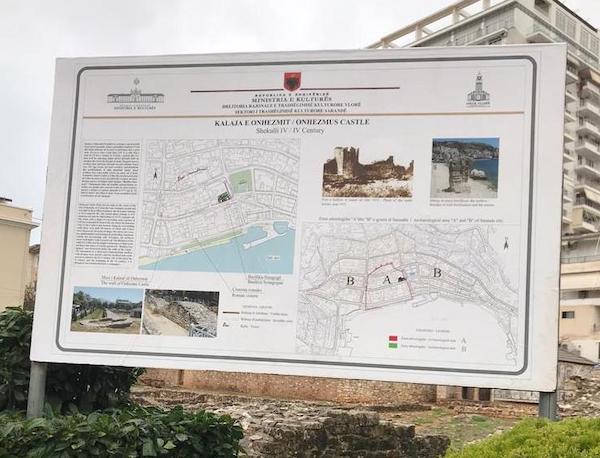
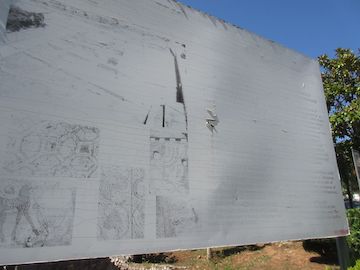
The signage at the site of 1,700-year-old synagogue ruins in Albania was recently replace after a Canadian tourist informed the municipal government of the old signs’ illegibility. (photo from Dave Gordon)
During a trip to Albania in September 2022, Toronto-based Jewish journalist Dave Gordon visited the city of Saranda with a couple of friends. They especially wanted to see the 1,700-year-old synagogue ruins.
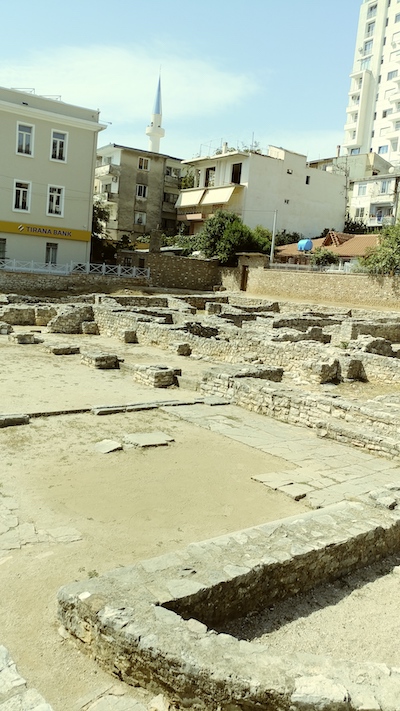
As Gordon describes it, the site is roughly the size of two side-by-side tennis courts. What remains are myriad roofless stone walls of just a couple feet tall, which once separated various rooms, including a study and two mikvaot (Jewish ritual baths). A representative of Albania’s culture ministry happened to be at the site when Gordon was there, handing him a leaflet with information about the site’s history and background. It said Israeli archeologists unearthed floor mosaics – now buried with a foot of sand, to protect them from the elements – that displayed a menorah and a deer, regarded in Judaism as a symbol of beauty, majesty and God’s mercy.
Additionally, the literature said the synagogue likely crumbled after either an earthquake or a Slavic invasion, and was abandoned in the last quarter of the sixth century. In the 21st century, there was more deterioration – this time, with the printed panels describing what is on the site.
Gordon was “shocked and disappointed” to see that the signage was in disrepair, faded by neglect. Two panels, each measuring some four feet wide by two feet deep, were blanched by the sun, so white that the lettering and imagery were illegible.
“My face turned the same colour as these signs,” Gordon told the Jewish Independent, for which he has written many articles. “This is part of my heritage, my history and people, and it was like it was another Jewish landmark sadly disappearing from memory.”
The signage at the site of the synagogue ruins in Albania when Dave Gordon visited. (photo from Dave Gordon)
On Dec. 12, 2022, Gordon took action. He Googled the Saranda municipality offices’ emails.
“This is shameful for two reasons: your tourists will not be able to obtain much knowledge about the important landmark, and it shows little care from your city’s cultural department to maintain the signage,” he wrote.
“This is highly disrespectful, and I cannot understand why the two signs were permitted to deteriorate,” he continued, adding that he hoped to bring others to Saranda and “would love for them to take photographs of the new signage and publicize this wonderful jewel of archeology.”
A representative from the municipal offices wrote back, two days later: “For the problem in question, we have reported the need for scientific reconceptualization, the preparation and installation of information panels, and we have contacted the Directorate of Cultural Heritage … a copy of your complaint will be sent to the responsible institution and we hope that very soon we will have a better presentation of this monument.”
In the beginning of January, Gordon followed up with an email, asking if the inquiry had landed in the right hands. To his great surprise, on Jan. 20, the Ministry of Culture of Albania sent him this reply: “In response to your email, we inform you that the new information boards have been installed to the Synagogue of Saranada…. Please find attached the photos of the new signage.”
Esmeralda Kodheli, the ministry’s representative, added, “Thank you, too, for promoting our cultural and historical heritage.”
“Quite amazing!” Gordon told the JI. “To print detailed signs and place them, inside of 30 working days – and during the Christmas season, no less. And who was I? Just some guy from Canada writing some emails.”
The site of the synagogue ruins in the city of Saranda. (photo from Dave Gordon)
Gordon said he felt “disbelief, delight and honoured, all at the same time,” and felt like his “little bit of activism” made a tangible difference, reminding him that anyone can enact change.
“I am pleased as anything that this amazing site of Jewish history now has dignity restored,” he said.
Dr. Ruki Kondaj, one of the friends who accompanied Gordon on his trip, is an Albanian-Canadian. He said about Gordon: “He’s done great work through his lobbying to restore the signage, and I’m so happy with his passion and determination. Together we discovered traces of Jewish history that tourists will know more about.”
Albania has various sites of Jewish interest, including the Solomon Museum in Berat, as well as an upcoming Holocaust museum in Tirana and a future Jewish history museum in Vlora, which also is home to “Jewish Street,” marked by a plaque on a home in the city centre, marking the one-time bustling Jewish area. Albania refused to cooperate with the Nazis, deciding as a nation to save its Jews, and even welcoming Jewish refugees from neighbouring countries. For more on Albania’s Jewish history, visit jewishindependent.ca/albanias-many-legends.
Jonathan Wasserlaufis a freelance writer, and a political science major and law student based in Montreal.
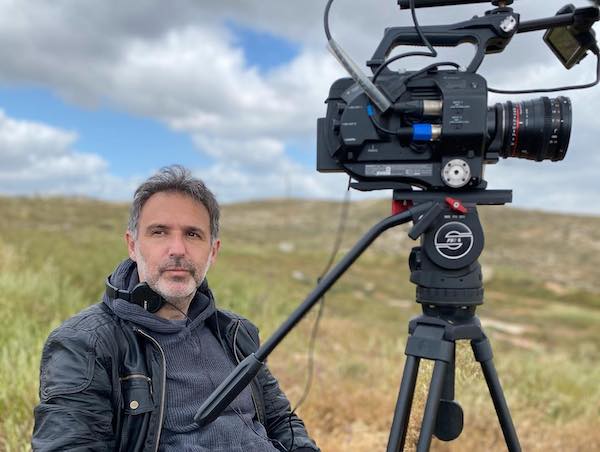
Igal Hecht filming Secrets of the Land. (photo from Chutzpa Productions Inc.)
The Western Wall area, with thousands of metres of subterranean space, contains much that is yet to be discovered. The latest find in this space is a market. While not open to the public, people can get a glimpse of the ancient market on the new Yes TV documentary series Secrets of the Land, directed, produced and written by Israeli-Canadian filmmaker Igal Hecht.
Each episode of Secrets of the Land, which is presented by Chutzpa Productions Inc., takes viewers behind the scenes of substantial excavations in Israel, and features some of the region’s top archeologists and most historically significant sites. The series debuted March 15, and runs each week for 13 episodes.
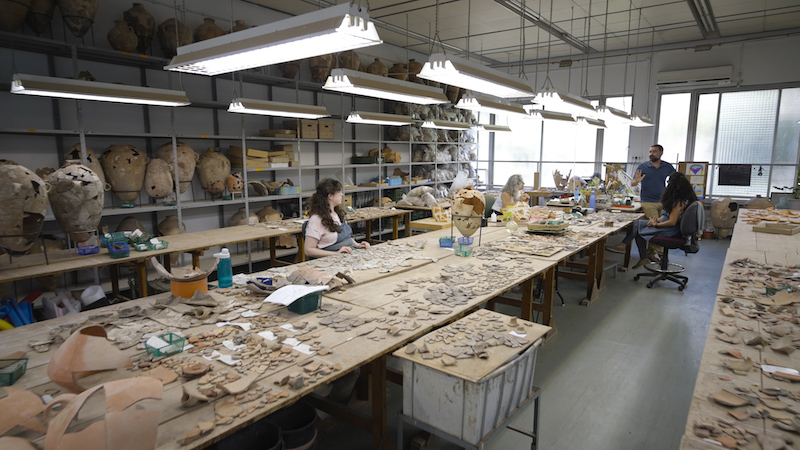
In addition to on-site discoveries, Hecht visits the labs that explore the meanings of each artifact.
“I realized that the way archaeology is explored today is very CSI,” said Hecht, referring to the popular television series. “The excavations themselves might be low-tech, but everything that comes after, such as carbon dating and things along those lines are very high-tech.”
One of many examples is when archeologists found grape seeds in 2,000-year-old donkey feces and, through that, determined the types of people who lived in the area.
Prof. Erez Ben-Yosef speaking with colleagues in the archeology lab at Tel Aviv University. (photo from Tel Aviv University / Chutzpa Productions Inc.)
Hecht and his crew – which included Lior Cohen, Gabriel Volcovich, Nikki Greenspan and Julian Hoffman – take viewers on a journey through various parts of the Holy Land. Hecht said he learned something every step of the way.
“I had very little knowledge [of archeology],” Hecht told the Independent. “In fact, in the show, I don’t pretend that I do. That makes the show work. I am there experiencing the discoveries in the same manner that the audience does, as they watch at home.”
Among many sites, the crew visited Timna, the location of Solomon’s Mines, where Hecht was awed by the landscape. “The rock formation is something you’d see in Petra in Jordan or the Grand Canyon,” he said. “There’s so much beauty and history to explore there.”
Other locales included Tower of David, also known as the Citadel, located near the Jaffa Gate entrance to the Old City of Jerusalem. There’s also an episode about Shiloh, in Samaria, or the West Bank, where the Israelites, prior to King David’s time, set up a sanctuary and city, and where the Ark of the Covenant was housed for hundreds of years. Meanwhile, Magdala is home to an ancient city from the first century, where recent excavations revealed the Migdal Synagogue, dating from the Second Temple.
Over the past quarter-century, Hecht has been involved in the production of more than 50 documentary films and more than 20 television series. His projects have appeared on Netflix, BBC, Documentary Channel, CBC, HBO Europe, and others. Secrets of the Land is the latest in a string of Jewish-themed films, such as A Universal Language, which taped six comedians performing in Israel. An upcoming project includes The Jewish Shadow, a documentary that explores the lives of Soviet Jews in 1970s Ukraine.
For Hecht, Secrets of the Land wasn’t merely a project, but very much a passion to do his part to help the Jewish people.
“I think the biggest takeaway for Jewish audiences is the historical and unbreakable connection of the Jewish people to that land,” he said. “That archeology truly proves that the Jews were, in fact, living in Judea and Samaria, Jerusalem and all over the Fertile Crescent thousands of years ago.”
Dave Gordon is a Toronto-based freelance writer whose work has appeared in more than 100 publications around the world. His website is davegordonwrites.com.
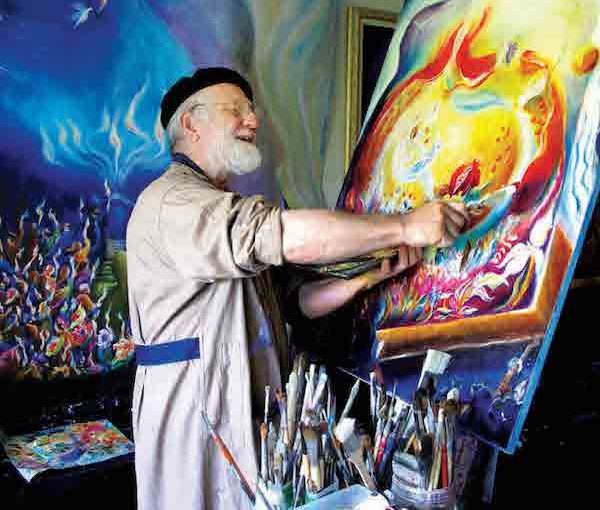
Mordechai Edel is among the artists featured in the latest edition of The Scribe, which will be released April 19 at VanDusen Botanical Garden. (photo from JMABC)
The Jewish Museum and Archives of British Columbia (JMABC) is releasing its 40th issue of The Scribe, which celebrates the lives of B.C. Jewish residents by focusing on one sector each edition. The official release of the Visual Arts Issue will take place on April 19, 7 p.m., at VanDusen Botanical Garden, in the Floral Hall.
The 2022/23 issue features a cross-section of the province’s Jewish visual arts community, including painters, sculptors, mixed media artists, illustrators, textile artists, art educators, art consultants, an art curator and a gallery owner. Features are based on interviews recently documented for the JMABC and interviewees represent several cities and many islands. They include Ron Appleton, Miriam Aroeste, Hinda Avery, Suzy Birstein, Tanya Bub, Olga Campbell, Janis Diner Brinley, Mordechai Edel, Janet Essevia, Jessica Freedman, Linda Frimer, Monica Gewurz, Lori Goldberg, Pnina Granirer, Barbara Heller, Jeannie Kamins, Stacy Lederman, Julia Lucich, Anna Lutsky, Cynthia Minden, Suzy Naylor, Joyce Ozier, Nora Patrich, Marcia Pitch, Jack Rootman, Sidi Schaffer, Phyllis Serota, Elizabeth Shefrin, Carla Stein and Mia Weinberg.
“The Visual Arts Issue of The Scribe is surely one of the most dynamic and visually stunning publications in its 40-issue history,” said Daniella Givon, JMABC president. “Jewish individuals have made significant contributions to our province’s arts and culture sector throughout our history in B.C., and 2023 is a fitting time to take an historical snapshot of artists who are working and thriving here.”
Carol Crenna, managing editor of The Scribe Visual Arts Issue, added, “It’s been an extraordinary experience to meet this group of talented Jewish artists, many internationally known. They are fearlessly innovative, inspiring individuals with the strength and ability to push boundaries and bridge beliefs. They’re also wonderful storytellers with rich life experiences. I found their personal stories fascinating, and often entertaining, but, most important, they made me think differently.”
The publication’s launch will include a silent auction of artworks donated by many of the artists highlighted in the issue. The keynote speaker of the event will be journalist Marsha Lederman, Western arts correspondent for the Globe & Mail. Refreshments will be served. All proceeds are in support of the JMABC.
Residents of Prince George might be forgiven for thinking there is more than one person named Eli Klasner in their midst. Among his many concurrent pursuits, the Toronto native is directing the Community Arts Council of Prince George, leading a fundraising initiative for Ukrainian refugees and serving on the board of the Jewish Museum and Archives of British Columbia.
Living in Prince George is the fulfilment of a lifelong dream for Klasner. Since childhood, he had entertained the notion of living on the Canadian frontier or the Far North. When he was younger, he also made a commitment to himself that, by the time he celebrated his 40th birthday, he would do whatever it was that excited him.
For philanthropist Eli Klasner, living in Prince George is a dream come true. (photo from Eli Klasner)
As events unfolded, he was able to do just that after running businesses in Toronto and Vancouver. In 2017, while Klasner was working for a nonprofit, the possibility of moving to Prince George presented itself.
“I was just charmed by the roughness and climate adversity and, significantly, by the opportunities I saw both as a participant in arts and culture but also to identify that there are Jewish people here and in this area,” Klasner told the Independent.
The friendliness and accessibility of locals reaffirmed his desire to stay. “Soon after I was here, I visited City Hall and asked who is the mayor? ‘Well, that’s his office there. If you want to say hello, just go on in and introduce yourself.’ I like that. Coming from Toronto, you don’t just walk in and put your feet up on the mayor’s table. I thought that was very appealing,” Klasner recalled.
His executive director position with the arts council quickly transformed into a full-time schedule as he came to realize that the city could use support with its arts facilities. Klasner’s role in Prince George’s artistic rejuvenation includes working on a new creative hub, a new performing arts centre and, in March, the gala opening of a retired heritage church that was turned into a concert hall.
“Taking the executive director job here helped solidify that I need to settle down and find a place to live permanently. At that point in my life, I thought a lovely arts council with a lovely little gallery and gift shop would be a lot of fun,” said Klasner, who during his youth studied music in various European capitals.
For two years of his stay in Prince George, Klasner lived in a cabin in the woods, along with two hound dogs and two cats. “I moved a little off the grid,” he said. “That, for me, was the boyhood dream of living in the woods, chopping wood, growing a garden in the summer and being close to wildlife and nature. It was an amazing experience.”
Then came 2020. Klasner contracted the coronavirus at the outset of the pandemic. “COVID is an interesting part of the journey of being up here in this odd, unusual place,” he said. “It was certainly a challenge, but, also, when you live through something like that, you really come to appreciate life when you have good health, and the bounty that comes with good health.”
From a Jewish cultural perspective, one of Klasner’s recent projects has been the performance of Different Trains, a piece written for string quartet, with pre-recorded tape, by American Jewish composer Steve Reich that revolves around the Second World War and the Shoah. After being approached last year by the Prince George Symphony Orchestra, Klasner was able to arrange to have the work performed to mark Holocaust Remembrance Day this past January.
“I found it to be a remarkable process of respect and inclusion and terrifically ambitious for a small-town symphony to want to take on such a challenging and groundbreaking piece of music,” Klasner said.
Afterwards, several members of the local Jewish community were invited on stage to say a few words. The crowd, according to Klasner, was very moved by the event. “People got to sit, ask questions and talk about Holocaust and persecution. I found it a unique thing to happen in a place like Prince George. Where else is something like this done in Canada that does not have a significant Jewish population?”
Prince George, like other parts of northern British Columbia, Klasner noted, used to have a thriving Jewish community, starting with the immigrants who arrived in the 1880s. Many of the first local businesses were started by Jews, and the first Jewish female elected to public office in Canada was in Prince George, when Hanna Director became chair of the city’s school district.
From the Second World War to the 1970s, the community dwindled. The Sefer Torah that was in Prince George was sent down to Vancouver and is in storage.
However, there has been a resurgence in Jewish life, Klasner said. “What we started to do is hold community events around holidays and festivals, wanting to expose the young generation to the culture and history of Jewish celebrations and milestones, holidays and festivals. We are quite open to people who might want to come but who are not Jewish to see a Hannukah celebration and what kind of foods we eat around Rosh Hashanah, etc. There has been a lot interest in the community.”
The Jewish Museum and Archives, Klasner said, helped him understand some of the history and heritage of the Jewish community in the area. This, in turn, helped Klasner get other members of the community involved to share stories about what life in Prince George was like at one time or another. For example, there were photos of a seder in Prince George just after the war, when so many Jews wanted to be involved that a community hall had to be used.
“When there was an opening on the board of the Jewish Museum and Archives, I thought it was an opportunity to help them have province-wide representation, rather than just the Lower Mainland, the Island and the Okanagan,” he said.
Jewish values were integral in Klasner’s recent efforts to assist Ukrainian refugees in his community. When a new endowment fund was created to help the newcomers, he reached out to the organizers to help propel their fundraising.
“I was overwhelmed at the possibilities of life when people open up their hearts to strangers in their land and by the idea of opening up one’s heart and mind and wallet to people in the community – and what a Jewish attribute as well. Our families were once accepted here as refugees,” he said. “Our life on earth depends on the fact that Canada accepted refugees.”
From June 9 to 11, Prince George will host another of Klasner’s ventures, the B.C. Gourmet Arts Festival. Now in its second year, the event features scores of local artisans and presents culinary delights of the region and country.
“I love life and the opportunity to be busy and creative and help people and get involved,” Klasner said. “Life is awesome.”
Sam Margolishas written for the Globe and Mail, the National Post, UPI and MSNBC.
The harrowing history of Ukraine’s past was recounted recently in the annual lecture honouring Rudolf Vrba, the late Vancouver scientist whose 1944 escape from Auschwitz brought the most concrete proof of the Nazi “Final Solution” to the world.
Dr. Nataliia Ivchyk delivered the 2023 Rudolf Vrba Memorial Lecture, titled The Holocaust in Ukraine: Violence, Gender and Memory. Ivchyk is at the University of British Columbia on a visiting fellowship that was created by Dr. Richard Menkis and Dr. Heidi Tworek to bring to Vancouver a Ukrainian scholar at risk. Ivchyk is associate professor in the department of political sciences at Rivne State University for the Humanities in her hometown of Rivne, Ukraine, and her work is focused on public history and memory politics.
Ivchyk’s presentation was based on survivor testimonies held at the USC Shoah Foundation, and narrowed in on the experiences of Jews in the western Ukrainian region of Volhynia and Podilia. Of the approximately 27,000 Jews who lived in Rivne (then known as Rovno) in 1937, it is estimated that just around 1,200 survived to the 1944 liberation by the Red Army. In a single day, on Nov. 6, 1941, about 21,000 Jews were murdered by Einsatzgruppe C and Ukrainian collaborators. The surviving Jews were imprisoned in the Rovno Ghetto, which was created the following month. In July 1942, remaining Jews, about 5,000, were transported to a stone quarry and murdered.
About 1.5 million Jews died in Ukrainian territory during the war years, most of them shot in what has been called the “Holocaust by bullets.”
“The Holocaust has long remained on the margins of collective memory in Ukraine,” said Ivchyk. Babyn Yar, a ravine outside Kyiv where more than 33,000 Jews were murdered over two days in 1941, has become a national symbol of Holocaust remembrance, she said. “However, the local level of remembrance remained low.”
There are many other sites of atrocities that were committed in Ukraine. “Some are marked by monuments, others are still forgotten and lost,” she said.
Of the several thousand Jews who survived the initial mass executions, anyone over the age of 13 was forced into slave labour.
“Nobody wanted to work for the Germans,” Ivchyk quoted one survivor, “but we had to. We hoped it would somehow balance our relationship with the Germans and would help us survive.”
Violence against women was mainly carried out by Ukrainian collaborators, she said, though Nazis also took part.
“I remember many times Germans came at night, knocked on the windows, took away beautiful girls,” Ivchyk quoted a survivor. “Sometimes, they raped and killed them right away. Sometimes, they said we will come again.”
Rabbis became a particular target of violence against men, given their social and symbolic status, and their role as spiritual leaders.
In the Soviet era, historical memorialization was subordinated to the priorities of the regime.
“The Holodomor [the deliberate Soviet famine that killed millions of Ukrainians], the deportation of Crimean Tatars, the Holocaust and the genocide of the Roma – all of these events were suppressed in collective memory by the Soviet regime,” she said.
Today, support in Ukraine for Holocaust memorialization is ambivalent.
“The activities of the state today do not prohibit academic, educational or public activities in the field of Holocaust remembrance, but neither does it act as a financial or ideological initiator,” she said.
The Vrba event was funded by the Holocaust education committee of UBC’s department of history, which is responsible for the annual lecture, as well as a number of other organizations, including the Vancouver Holocaust Education Centre and the Diamond Chair in Jewish Law and Ethics.
Menkis, associate professor of modern Jewish history at UBC and chair of the Holocaust education committee, noted that the event recognizes Vrba’s contributions to two primary areas to which Vrba’s life was devoted: Holocaust education and science, particularly pharmacology. The annual lectures alternate between these topics.
Menkis told the audience how Vrba and his friend Alfréd Wetzler made the momentous decision to escape from Auschwitz after overhearing conversations around the planned deportation of Hungarian Jewry. After a difficult and dangerous trek, the pair reached northern Slovakia, where they compiled a report documenting the layout of Auschwitz and the extermination process there.
“Although the report is credited with saving many lives,” said Menkis, “Vrba and Wetzler were keenly aware that more decisive action could have saved more. After the war, Dr. Vrba continued to speak about Auschwitz and his experiences. His book, I Cannot Forgive, written with Alan Bestic, was first published in 1963 and has been issued in a number of translations and re-editions since. He is also well known for his unforgettable testimony in Claude Lanzmann’s [documentary film] Shoah and perhaps less well-known but also important was his effective testimony in the Canadian trials against Holocaust denier Ernst Zundel.”
Vrba’s widow, Robin, attended the event virtually. Vrba died in 2006.
When we think about Israel’s prominence now, with its population approaching 10 million, and its contributions in so many fields being far out of proportion to its size, it is sobering to recall its early beginnings, and its fragility, when it issued its Declaration of Independence 75 years ago.
On the day that Israel’s independence was declared, May 15,1948, forces from five Arab countries invaded to join internal resistance to Israel’s existence, which had begun in November 1947 with the United Nations declaration of the Partition Plan. The war continued until January 1949, through multiple calls for a ceasefire by the United Nations, as the Arab side saw their hopes for a quick victory reversed.
The government of Israel changed its stance during this time. Initially concerned only with preserving the UN Partition Plan, which involved non-contiguous pieces of territory, as its forces gained the initiative, it sought to establish borders having a greater chance of being more defensible in a hostile neighbourhood.
During the early period, Israel managed to establish the beginnings of a standing army, navy and air force, as well as a commando unit, assembled by bits and pieces from around the world. With unleashed immigration, available soldiery increased every day during the war period. As the war proceeded, every man, and every unmarried woman, in Israel over the age of 25 was eventually subject to mobilization. It has been said that the Jews’ secret weapon in the face of the existential threat they confronted was that there was no other place for them to go.
Many of the indigenous Arabs fled the country during the hostilities, sometimes at the urging of the invading troops, but there were also populations expelled, where Israeli forces faced hostility. Jews in the country had faced increasing violence from their Arab neighbours and, during the war, in areas occupied by Arab forces, particularly in the Old City, but also in the West Bank, there were Jewish residents who were summarily murdered.
Many of the battles were fierce and bloody, with substantial losses of people and material on both sides. Attacks on isolated settlements by Arab units were often aimed at overcoming the resistance of poorly armed residents living in strategic locations. The strength of their commitment to defending their homes often carried the day.
By the end of the struggle, more than 6,000 Israelis had been killed – one-third of the fallen were individuals who were survivors of the Holocaust. Estimates of the number of Arabs/Palestinians killed in the war vary from 5,000 to 10,000.
In the end, Israel retained its allocated portion under the partition and won some of the territory that had been ascribed to the Arab side by the UN plan. Israel withdrew from territories it still occupied in the Egyptian Sinai and in southern Lebanon when hostilities were ended by a ceasefire.
Israel inherited a de-facto Egyptian presence in the Gaza Strip and a Jordanian annexation of the Old City of Jerusalem, and what was ancient Judea and Samaria became the West Bank and under Jordanian control. These were a portion of the areas that had been allocated to the Palestinians by the UN Partition Plan. It was at great cost that control of West Jerusalem was retained.
Israel was attacked again in 1967 and in 1973, successfully defending itself and extending Jewish occupation in further areas that were a part of the country’s historic past, including the Old City and the West Bank. In the 1967 war, Israel seized and, in 1981, annexed Syrian territory, the Golan, high ground from which it was constantly being bombarded.
Under the later Oslo agreements, the Palestinian Authority (PA) was established to allow Palestinian self-government in the heavily populated areas of the West Bank. Israel unilaterally withdrew from the Gaza Strip in 2005. In a 2006 Palestinian election, the Hamas terrorist group became the elected government, but the PA (led by Fatah) refused to relinquish power. Hamas seized control of the Gaza Strip by force, and remains a continuous source of violence. In Lebanon, the terrorist group Hezbollah remains a factor, while Israel has managed to contain Iranian efforts to establish themselves in Syria.
In recent years, there have been alliances made with neighbouring Arab countries. Some of these countries recognize their common cause with Israel to counter efforts by Iran for hegemony. Many of these countries are seeking benefits from the technological advances made in Israel in sectors like agriculture, medicine, cybersecurity and defence. Research and development has been a priority investment by the succession of Israeli governments since its adoption of the private enterprise model for its economy. Foreign investment has poured into Israel, helping fund economic growth, and placing Israel among the world’s highest in GDP per capita.
The standard of living of Israel’s Arab citizens has also risen with increasing integration and exceeds that of citizens in neighbouring Arab countries, or those under PA administration. Perhaps this is another reason for the move to normalize relations with Israel by several Arab countries under the Abraham Accords.
As Israel’s 75th anniversary approaches, several problems remain to be tackled. Concerns over security and increased Jewish settlement in disputed areas are among the factors that led to the election of a government coalition many consider extremist, with some policy proposals, such as the judicial reforms, raising alarm among centrist and left-leaning elements. These have led to mass protest demonstrations in Israel and abroad. Demands from the ultra-religious sector who have gained political power, if realized, could impair the lifestyles of many in the general population. As well, there has been a wave of terrorist attacks recently and there is concern that this may lead to revanchist policies targeting Palestinian citizens.
At 75 years old, the state of Israel continues to be a happening place.
Max Roytenberg is a Vancouver-based poet, writer and blogger. His book Hero in My Own Eyes: Tripping a Life Fantastic is available from Amazon and other online booksellers.
Eleanor Boyle’s Mobilize Food! Wartime Inspiration for Environmental Victory Today offers concrete ideas for how food systems can be transformed. (Julie Doro Photography)
I plan to make the Honourable Woolton Pie. Just for fun, not necessarily because I think it’ll taste wonderful, though it might. Named after Lord Woolton (Frederick Marquis), who was appointed minister of food in 1940 Britain, it represents several of the British government’s goals during the war years: it was “meatless, thrifty, filling, and made use of domestically produced in-season foods.” The recipe is in Eleanor Boyle’s latest book, Mobilize Food! Wartime Inspiration for Environmental Victory Today (FriesenPress, 2022). The book is the only reason I know who Woolton is. More importantly, the book offers many reasons to feel less naïve for mostly believing that humankind can save ourselves and the planet before we kill ourselves and the planet.
Mobilize Food! is an optimistic examination of Second World War rationing and other wartime policies in England and how the lessons from that period could help us counter the climate crisis by changing our food systems, to start. Lest one think that Boyle is a pie-eyed dreamer, she has solid credentials – a bachelor’s in psychology, a master’s in food policy and a doctorate in neuroscience. The Vancouverite also has been a journalist and she taught for many years. She wrote the book High Steaks: Why and How to Eat Less Meat (New Society, 2012).
Despite all of Boyle’s education and experience, she still believes that radical change is possible. This is heartening in and of itself. But it’s the 42-page bibliography that I found more assuring. The recommendations Boyle makes in Mobilize Food! are based on extensive research. And they consider what individuals, governments and businesses are already doing, as well as what they could be doing more of (which is a lot). She is not arguing for a socialist utopia, or a utopia of any sort, though she does imagine more engaged, civic-minded communities than I think currently exist anywhere in the world. That said, she gives an example of a city that apparently has ended hunger – Belo Horizonte, Brazil, “which in 1993 declared access to food as every citizen’s right. It then implemented food price subsidies, supply and market regulation, supports for urban agriculture, education on food preparation and nutrition, and job creation in the food sector.”
How does this relate to Second World War Britain? As did Britain during the 1940s, Belo Horizonte set up state-subsidized restaurants that are open to everyone (to avoid stigmatizing people on lower incomes), it feeds kids in the public education system every day, it partners with private grocery stores so that they can sell cheaper fruits and vegetables, and it supports family farms, among other actions “that help democratize food.”
Boyle provides copious data and examples of how the food industry, as it stands, is contributing to climate change “by contributing at least a quarter of human-caused GHGs [greenhouse gases].” It does this through its use of fossil fuels, the cultivation of monocultures (“vast, unnatural acreages of single-species crops”) and destroying ecosystems by removing or burning vegetation, among other activities. One of the eye-opening stats is: “Some analysts calculate the contribution of livestock to overall anthropogenic GHGs as at least 30% and as high as 51%.”
Boyle argues persuasively that how we produce and consume food can be transformed. The first half of Mobilize Food! runs through all that Britain did to make significant changes, “from national agricultural policy to the family dinner plate. They didn’t wait for dire food shortages or society-wide agreement of exactly how to proceed. Even before war was declared, government set up a high-powered food committee to craft plans for making food systems crisis-ready.” They used multiple strategies and strived for general engagement using PR campaigns and other tools. “The programs were simple but transformational,” writes Boyle, “based on shifts toward domestically produced, plant-rich and minimally processed foods. Together those programs adequately fed the population – and, in many ways, better than prewar, by providing broader and more equitable access to food and enhanced health [reducing diabetes and heart disease, for example].”
The wartime measures also show that people can change how they eat and act, she notes. But leadership is key – Lord Woolton was very charismatic, it seems, and, on the larger scale, Boyle writes, “Only governments have the mandate for the public good, the oversight for national strategy and the legislative levers. Only public officials can do the necessary system-wide planning, coordinate sectors, forge agreements across regions, and make the tough decisions.” Lastly, such massive change relies on everyone participating: “We’ll need to think systems-wide and involve every segment of society, every community, every food-related business and civic organization, and every one of us.”
Boyle admits this all “sounds like fantasy. But, as the story of World War II Britain shows, such a transformation has occurred.” Am I personally convinced we have what it takes to mobilize so drastically? The larger whole is still too much for me to contemplate, but I can eat even less meat and fewer processed foods, buy more from local growers, invest in businesses that improve the environment and/or social outcomes, support politicians who are working toward a healthier and more inclusive society. No doubt, there is much more that I could be doing, but it’s a start.
I’m glad that I read Mobilize Food! Full of images (including awesome wartime PR posters), data and stories from people who lived through the war effort, it is engaging on many levels. It reminded me that what seems impossible may not actually be so. And the importance of hope – combined with action – cannot be overstated.
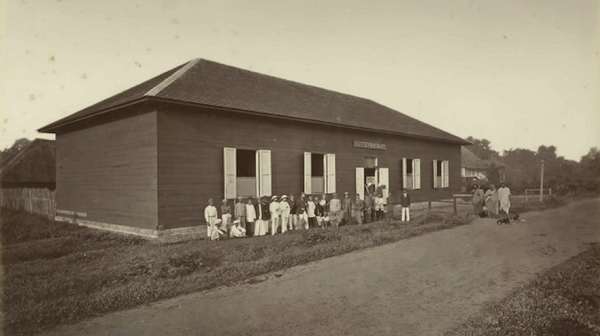
Hüttenbach in Medan in 1880s. (photo from KITLV Album Or. 27.377)
Jewish communities in Indonesia have always been tiny, though their history is long. Jewish merchants are recorded in Sumatra as early as the 10th century, and diasporic and Israeli newspapers regularly report on the very small groups of Jews now living in Indonesia. (A 2022 article estimated that there were only 50 Indonesian Jews, and perhaps 500 Jewish expatriates.) However, the largest communities with the most substantial record are those in the late colonial cities of Batavia (now Jakarta), Surabaya and Manado.
The digitization of Dutch archives, both from European publications and the colonial newspapers, has facilitated research about the history of Jewish groups in the Indonesian archipelago. In this article, we offer some notes towards a history of some Jewish merchants in Medan between the 1870s and 1940s, as tobacco plantations on Sumatra’s east coast developed.
The Deli region on the east coast of Sumatra was not developed until the mid-1860s, when a few Dutchmen accepted an invitation from the sultan of Deli to establish tobacco plantations in the area. By the late 1890s, it had become one of the most profitable parts of the Dutch empire.
Deli tobacco leaves were “thinner than cigarette paper, and softer than silk,” and quickly the plantation zone’s tobacco became highly valued. The result was a brown “gold rush” of Deli tobacco in the late 1870s, attracting German, Swiss, English and Polish planters, as well as Dutch, to the new “dollar land.” Planters, tolerated and sometimes abetted by colonial authorities, instituted a brutal and often murderous system of exploitation of imported Chinese and Javanese labour.
Before long, merchants established themselves to serve the European population’s taste for European goods and technology. Among these new arrivals were several Jews, including Ashkenazi Jews from the Netherlands, Austria and Germany, as well as others who relocated from existing Baghdadi Jewish communities in Penang and Singapore. There are also scattered accounts of Jews in the Dutch army serving in Sumatra.
Mercantile opportunities
We know very little about how many Jews tried their luck in the eastern coast of Sumatra, but we have not yet found any evidence of a synagogue (as in Surabaya) or a dedicated cemetery (as in Aceh). The most consistent record of the community available today is not from the colony but rather from Amsterdam’s Nieuw Israëlietisch Weekblad (New Jewish Weekly). The first mention we have found in that newspaper was a report of an August 1879 anonymous donation of 60 guilders originating in the Sumatra’s east coast and destined for the Dutch branch of the Alliance Israélite Universelle, an international Jewish educational charity.
Between 1899 and 1901 the NIW published letters from N. Hirsch, a non-commissioned officer initially writing from the fortress of Fort de Kock (now Bukit Tinggi). In his letters, when not speculating that some Indonesians might be descendants of the lost tribes, Hirsch is troubled by the challenges of Jewish life in the Indies, without religious or community institutions. Months after his first letter, Hirsch joyfully reported the arrival of a kosher butcher and, in 1901, having since moved to Padang, on holding the first religious services at his home.
However, the bulk of sources concern a few European Jewish merchants who became prominent in Medan. Among the first Europeans to come to Deli were members of the Hüttenbach family, an established and assimilated merchant family from the German Rhineland city of Worms. The eldest son, August Hüttenbach, began working for the German-Jewish company Katz Brothers in Penang in 1872 at the age of 22. Katz Brothers, which had arrived in Penang in 1864 at the height of the tin rush, invested in all kinds of business, including supplying ships for freight. When the Dutch-Aceh war broke out in 1873, the company provided logistics and supplies to the Dutch military, and the Hüttenbach family’s shipping business ran a regular service to the Aceh ports.
While August became a prominent merchant in the British Straits settlement colony port of Penang (now in Malaysia), his younger brothers Jacob and Ludwig Hüttenbach settled across the Strait of Malacca, in Deli. In 1875, they opened the first European store in the harbour settlement of Labuhan Deli to cater to all the needs and requirements of the Dutch government, plantations and industrial groups.
Gradually, the family firm developed into a general merchandise company supplying all sorts of goods from Europe, and even establishing its headquarters in Amsterdam and another office in London. With their own shipping lines at their disposal, they were for a time the only importer in Deli. When the Hüttenbach enterprise moved its Sumatran operations inland to the developing city of Medan in the 1880s, the street on which they established their business was named Hüttenbach Street (today Jalan Ahmad Yani VII).
Hüttenbach enterprises supplied all manner of goods and services, ranging from live water buffalos and Brazil nuts to Bordeaux wines. It furnished machinery, tools, motors, electrical goods, harnesses, saddles, guns, ammunition, watches and clothing, and served as an agent for brands including Ford, Cadbury, Heineken and Guinness Stout, as well as other European trading, insurance and manufacturing companies. In the 1910s, its annual imports totalled 1,200,000 guilders and it supplied across the whole of Sumatra.
At the turn of the 20th century, Jacob and Ludwig retired to Europe and left Heinrich Hüttenbach (1859-1922), the youngest of the brothers, in charge of the company. Heinrich, who had been a well-known planter in Malaya, moved to Medan to run the company. A small glimpse of the brutality of plantation life is visible in the German primer Heinrich wrote to provide instruction for Europeans learning plantation Malay (Anleitung zur Erlernung der Malayischen Sprache), including instructions such as: Lu orang bôhong. Lu bukan sakit. Lu malas sadja. Saja mau kassi pukul sama lu. (You are a liar. You are not sick. You are just lazy. I will hit you.)
Selling to the sultans
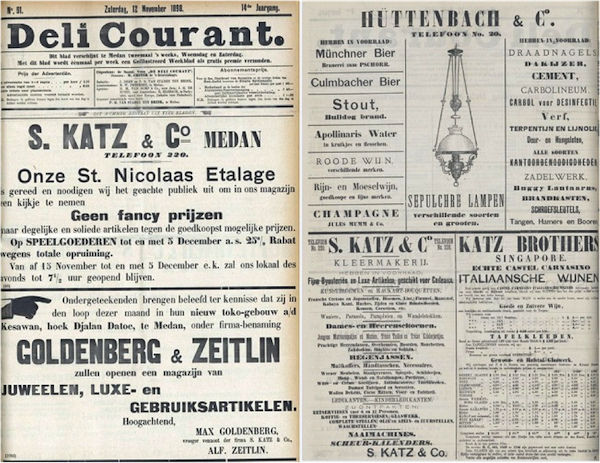
Medan’s growth attracted other Jewish merchants, who also opened stores selling European consumer items such as clothes and luxury goods. Two German Jews, Louis Kellermann of Leipzig and Max Goldenberg of Hamburg, opened the S. Katz & Co. shop in the Kesawan shopping street. The Katz Brothers, a prominent firm of Singapore and London, did not appreciate what appeared to be an appropriation of their name, and put a notice in the local newspaper, the Deli Courant, making clear that no connection existed. We cannot know whether Katz’s implication – that Kellermann and Goldenberg were seeking to capitalize on a familiar trading name for their profit – was correct.
Advertisements from S. Katz, Goldenberg & Zeitlin, and Hüttenbach in the Deli Courant, 1899. Katz Brothers was a well-known company in Singapore and S. Katz was a company in Medan not related to Katz Brothers in Singapore.
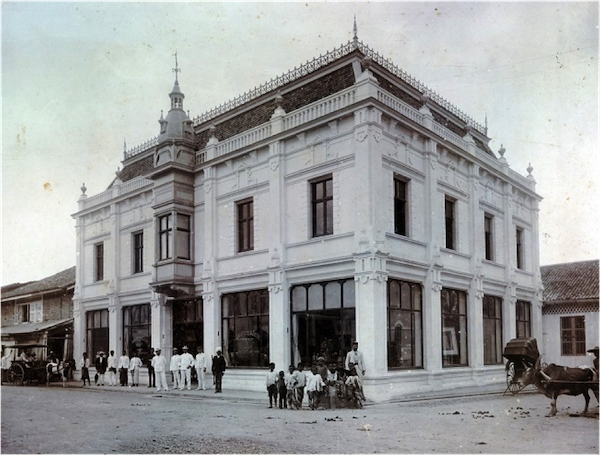
Among S. Katz’s employees was Russian-born Alfred Aron Arnold Zeitlin (1863–1938). Partnering with Goldenberg, Zeitlin opened a new store called Goldenberg & Zeitlin in November 1898, on the same main shopping strip, Kesawan Street. Majestic by all accounts, they specialized in the importation on luxury items such as jewelry, music boxes, typewriters, hunting rifles, glassware, curtains, suitcases, cigars and so on.
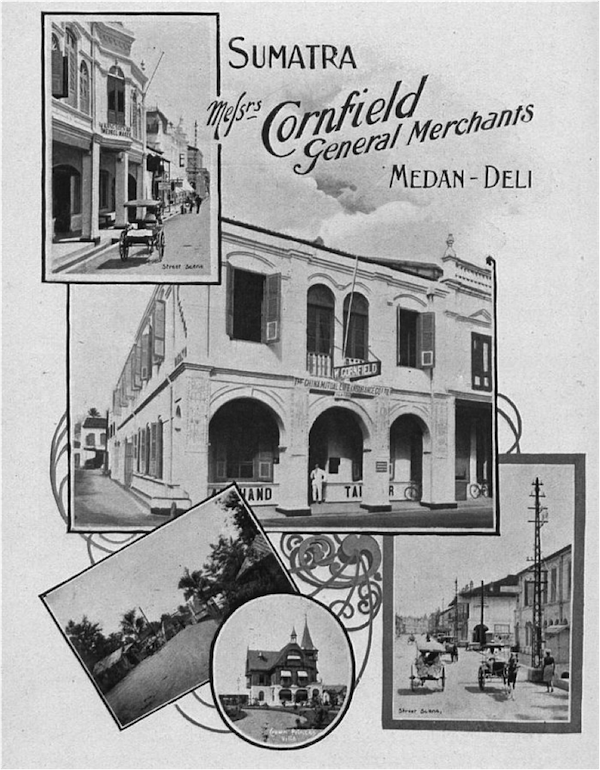
Other competitors were not far behind. An English-language travel guide to Sumatra in 1912 highlighted one of them: “A visit should also be paid to the establishment of Messrs. Cornfield. The firm are the official suppliers to the various sultans, and make a specialty of superior diamond jewelry of every description, although their stock includes well-selected continental fancy goods, pictures and also the latest modes.”
The Goldenberg & Zeitlin building at Kesawan around 1890. The company later became M. Goldenberg & Co. and was acquired by a German company. It was seized by the Dutch when Germany invaded Holland in 1940. The building has been demolished and turned into shophouses. (photo from Stafhell & Kleingrothe, KITLV 154472)
Wilhelm Cornfield (1862–1908), an Austrian Jew, had come to Deli in the 1880s, first working as a cutter at the S. Katz shop. In 1893, Cornfield started his own business as a tailor, offering European clothing with imported fabrics. Before long, he carried a complete range of clothes and luxury goods from London and Paris.
The first generations of merchants eventually left or passed away and were replaced by their children. When Wilhelm Cornfield passed away in 1908, his children expanded their father’s business. In particular, his son Isidore (1885-1923) became an investor in many luxury stores in North Sumatra, and also owned tea and coconut plantations on the east coast of Sumatra.
Heated competition
Jewish merchants competed to import European consumer goods, their firms merging, dividing and often clashing with one another. In 1915, the Hüttenbachs’ company split into a wholesaler business and the retail business. The retail business was managed by Isidore Cornfield while Heinrich Hüttenbach maintained the import interests. This split, however, caused a legal dispute between Hüttenbach and Cornfield about the management of the new department store. In the end, Cornfield won the case and opened Medan’s Warenhuis(Warehouse) in 1920, the first department store in Sumatra, the remains of which still stand. The Hüttenbach firm, on the other hand, was declared bankrupt in December 1921, after 46 years of business, due to the global financial crisis and mismanagement.
The bankruptcy resulted in Heinrich Hüttenbach’s return to Amsterdam. A few months later, he went missing on a passage from Amsterdam to London, and was declared dead five years later. The Cornfields, too, suffered great misfortune. Isidore and his wife, opera singer Henriette Zerkowitz, returned to Vienna, where he died of heart disease in October 1923 at the age of 38. By 1939, now run by his brother Adolf, the Cornfield fashion store, in financial trouble, was liquidated, closing its doors in July 1939 after more than 50 years of trading. Most likely, as the Depression caused a decline in demand for Sumatra tobacco, consumer luxury goods were no longer a viable business.
Cornfield advertisement in Isles of the East: An Illustrated Guide by W. Lorck, published by Royal Packet Steam Navigation Co. (KPM) in 1912.
Like many other German and Dutch Jews, most of these merchants were assimilated to European society and identified with national groups in the colony. They belonged to Dutch and German clubs and contributed to patriotic celebrations. Indeed, Hirsch complained of the European Jewish merchants that they represented themselves as Christians, were lost in bitter competition with one another, and were utterly lacking in piety. With many secular and/or assimilated Jews, there seems to have been little impetus to form Jewish institutions.
Dutch Jews and war
At the end of the First World War, there was high demand for expatriates to come to the Deli region to manage plantations and serve the colony. Many Dutch Jews responded and went to work for plantations, Dutch companies or the government; there are also a few examples of Jewish doctors. But newspaper archives suggest that numbers remained tiny, and only from the mid-1920s is it possible to speak of community activities.
One tantalizing biography from the 1920s is that of writer, painter and planter László Székely, born to a Jewish family in what is now eastern Hungary, with a birth name given as László or Smiel Ziechrman. Arriving in Sumatra in 1914, his life and work is rather overshadowed by an affair with a Dutch planter’s wife, Madelon Lulofs, that scandalized Deli colonial society. After divorce and remarriage to Székely, Lulofs, in works such as Rubber (1931), became one of the principal literary voices critical of Dutch colonial power. Székely also wrote literary sketches of his own, mostly for the Hungarian press. His novel, translated into English as Tropic Fever: The Adventures of a Planter in Sumatra (1937), provides a candid picture of colonial planters’ life in Sumatra, now considered an important social commentary on that vanished society. The couple settled in Budapest in 1930.
When Germany invaded the Netherlands in May 1940, the Jewish community raised funds to support relief efforts, but, by March 1942, Sumatra, too, had fallen to the Japanese. Some Jewish families found themselves under threat at both ends of the world: persecuted in Europe on the basis of their Jewish identity, and in the Indies as Dutch enemies of the Axis Japanese. Adolf Cornfield died in a Japanese internment camp. A Dutch Jewish physician who worked on the east coast of Sumatra, Dr. Hans Koperberg, was also captured and imprisoned by the Japanese. In a book of poetry titled Bittere pillen en scherpe pijlen (Bitter Pills and Sharp Arrows), he wrote about his experiences of being moved from one camp to another, dedicating his book “to my two sisters murdered by the Huns, Uncle Dr. Felix Catz and Aunt Brama and to all the friends murdered by the Japs.”
Our investigations have so far found little record of Jews in Sumatra after the Second World War. Survivors left for the Netherlands or perhaps Australia and, by 1958, Sukarno had expelled all Dutch citizens from Indonesia.
Budiman Minasnyis a professor of soil landscape modeling at the University of Sydney with an interest in Indonesia colonial history. Josh Stenberg is a senior lecturer in Chinese studies at the University of Sydney. An earlier version of this article was published in Inside Indonesia 146: Oct-Dec 2021.