Skip to content
  • Home
  • Subscribe / donate
  • Events calendar
  • Business Directory
  • FAQ
  • News
    • Local
    • National
    • Israel
    • World
    • עניין בחדשות
      A roundup of news in Canada and further afield, in Hebrew.
  • Opinion
    • From the JI
    • Op-Ed
  • Arts & Culture
    • Performing Arts
    • Music
    • Books
    • Visual Arts
    • TV & Film
  • Life
    • Celebrating the Holidays
    • Travel
    • The Daily Snooze
      Cartoons by Jacob Samuel
    • Mystery Photo
      Help the JI and JMABC fill in the gaps in our archives.
  • Community Links
    • Organizations, Etc.
    • Other News Sources & Blogs
  • JI Chai Celebration
  • JI@88! video

Recent Posts

  • Legal help for students
  • Revisiting myth of Lilith
  • Wrong person rebuked
  • Canada’s mixed messages
  • Questions for museum
  • Symposium on antizionism
  • Making soccer political
  • CJPAC lauds Pulver’s impact
  • City recognizes Vrba’s legacy  
  • Organ donation saves lives
  • Theodore’s March premiere
  • A healing Shabbaton
  • Supplying healthy food
  • A chime of metal tags
  • Yellowknife seder a first
  • Ishai energizes, unifies
  • A Lag b’Omer to remember
  • Expanding the healing
  • Hannah Senesh – a unique hero
  • Community milestones … May 2026
  • Sharing her testimony
  • Fall fight takes leap forward
  • The balancing of rights
  • Multiple Tony n’ Tina roles
  • Stories of trauma, resilience
  • Celebrate our culture
  • A responsibility to help
  • What wellness means at JCC
  • Together in mourning
  • Downhill after Trump?
  • Birth control even easier now
  • Eco-Sisters mentorship
  • Unexpected discoveries
  • Study’s results hopeful
  • Bad behaviour affects us all
  • Thankful for the police

Archives

Follow @JewishIndie
image - The CJN - Visit Us Banner - 300x600 - 101625

Tag: archives

New draw to Ben-Gurion site

New draw to Ben-Gurion site

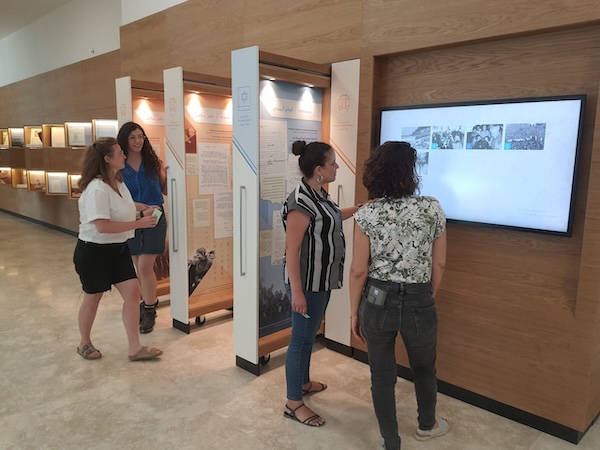
In 2023, Ben-Gurion University of the Negev opened a new home in Sde Boker for the David Ben-Gurion archives. (photo from Ben-Gurion University)

For visitors to Israel – and for Israelis looking for an engaging getaway – there is a relatively new destination in the country’s south.

In 2023, Ben-Gurion University of the Negev opened a new home for the David Ben-Gurion archives, with a dramatic exhibition hall to attract visitors. In addition to the many artifacts and documents on display, the exhibitions include interactive activities that allow visitors to speculate how the first prime minister would have responded to various scenarios.

Ben-Gurion was Israel’s first prime minister and the dominant political figure for the country’s first decade-and-a-half, during which time he served concurrently as minister of defence. In addition, no individual is more associated than Ben-Gurion with Israel’s development of the Negev and the entire south of the country.

The new archives facility rounds out a network of Ben-Gurion-related sites in the Sde Boker area, where Ben-Gurion built a desert home and enjoyed his retirement.

David Berson, Ben-Gurion University Canada’s executive director for British Columbia and Alberta, says the facility makes Sde Boker even more of a must-see for visitors to Israel. 

There had been an archive at the Sde Boker campus, allowing deep research into Ben-Gurion’s papers and other materials, but these were photocopies because the university did not have the archival capacity to accommodate the originals in the environment they required. The originals were held in Tel Aviv at an Israel Defence Forces archive.

“Everything was there, but it was a reasonable facsimile, as we like to say,” said Berson.

That changed with the opening two years ago of the purpose-built Ben-Gurion Heritage Archive, which includes a 280-square-metre (more than 10,000-square-foot) exhibition hall.

“All the real, genuine archives have been transferred there,” Berson said. “The exhibition hall is basically an interactive tale of David Ben-Gurion’s heritage and questions about things like the ultra-Orthodox serving in the army, his relationship to the diaspora, the Altalena affair, all sorts of different things, as well as his correspondence with Hebrew school students from all over the world, leaders, his perspectives on religion, etc., etc.”

The facility is a partnership between BGU and the Ben-Gurion Heritage Institute, an educational and commemorative organization committed to keeping Ben-Gurion’s ideals alive, especially his emphasis on developing the Negev. Among other things, they operate the museum at Ben-Gurion’s kibbutz home and other educational programming.

The Ben-Gurion Promenade, a project designed to honour his legacy and connect significant landmarks associated with his life, takes visitors on a 3.5-kilometre walk from his residence at Kibbutz Sde Boker to his burial site overlooking Nahal Zin, and taking in the new archives and exhibition hall. The accessible path is lined with native desert plants and interpretive signs about Ben-Gurion’s life and vision.

photo - The David Ben-Gurion archives includes a 280-square-metre exhibition hall
The David Ben-Gurion archives includes a 280-square-metre exhibition hall. (photo from Ben-Gurion University)

The archives are part of a larger complex that also houses the Ben-Gurion Research Institute for the Study of Israel and Zionism, and the Azrieli Centre for Israel Studies. 

Ben-Gurion’s eponymous university has three campuses in the country’s south.

The main Marcus Family Campus, in Beersheva, is home to the university’s faculties of engineering and sciences, health sciences, humanities and social sciences, business and management, computer science and cybersecurity, among others, and several advanced research institutes. It is adjacent to the Soroka University Medical Centre, where BGU medical students train. The campus is also home to the 10-year-old Advanced Technology Park, which is a joint venture of BGU, the City of Beersheva and real estate development company Gav Yam. The park is part of a national effort to develop the Negev region into a global centre for cybersecurity, defence technologies and tech innovation.

At the Sde Boker campus, about 30 kilometres to the south of Beersheva, specialties include desert studies, environmental science, hydrology, solar energy, sustainability and climate research, and arid agriculture. It is also home to the Jacob Blaustein Institutes for Desert Research.

The Eilat campus, at the country’s southern-most tip, on the Red Sea, specializes in marine biology and biotechnology, hospitality and tourism management, regional development studies, and interdisciplinary undergraduate programs that allow students from the south to do their initial studies in the area before completing their degrees at the Beersheva campus or elsewhere.

Sde Boker has always been a sort of pilgrimage site for Ben-Gurion fans and history buffs. But, because tourism to Israel has plummeted in the past year-and-a-half, most of the visitors so far have been comparative locals, Berson said, including leaders of the security services and military, educators and other Israelis.

When tourism picks up, Berson hopes the archives will make Sde Boker even more of a destination on the visitors’ map.

“It’s a wonderful national treasure,” said Berson. “But it’s also something that’s not on people’s radar screens abroad. We really want to encourage people to come and visit there, put it on their itineraries.” 

Format ImagePosted on April 11, 2025April 10, 2025Author Pat JohnsonCategories Israel, TravelTags archives, Ben-Gurion University, David Ben-Gurion, history, Israel, Israeli history, Sde Boker, tourist attractions, travel
Seeking diverse voices

Seeking diverse voices

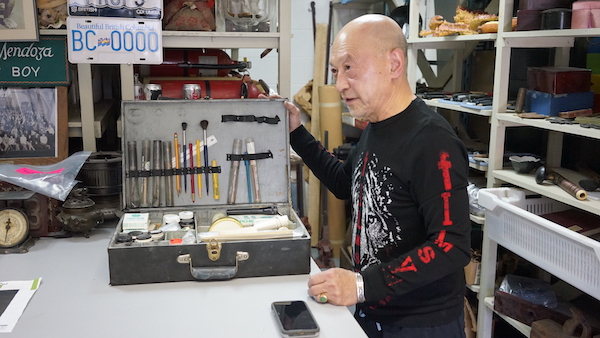
Jimmy Chow, Burnaby resident and prop master since 1973. Burnaby Village Museum’s Many Voices Project is focusing on stories from people and communities who haven’t had the opportunity to add to the historical record. (photo from Burnaby Village Museum, BV022.21.25)

With its Many Voices Project, Burnaby Village Museum is focusing on stories from people and communities who haven’t had the opportunity to add to the historical record, including members of the Jewish community who have a Burnaby connection.

The museum is documenting the diverse lives of people connected to Burnaby, capturing stories of all areas of life in the city, including school, work, recreational activities, social events, family activities, and more. Anyone who has a meaningful and personal connection to Burnaby has an important story. However, to date, the museum has more personal accounts and historical information about people with British or European backgrounds, and is seeking to continue diversifying its collections by interviewing a wider range of people. This may include cultural minorities, people of colour, and sexually and gender diverse people.

How will interviews be used?

The Burnaby Village Museum is the primary historical resource for the City of Burnaby. It encourages understanding, appreciation and enjoyment of and participation in Burnaby’s unique history, and fosters a shared sense of community and identity for the citizens of Burnaby and visitors.

A big organization, the museum offers many ways to connect and learn. It has a heritage village and carousel, but also runs school programs, summer camps and public programs for people of all ages and backgrounds. In addition, it manages a collection of 50,000 historical artifacts, as well as archival materials, many of which are on display in the village. However, about 60% of the collection is stored in a secure vault and made accessible online via the website heritageburnaby.ca. The museum is always collecting and refining its holdings, and taking new donations that help tell the story of Burnaby’s history. The oral histories conducted will become a part of this growing archival collection.

The information contained in such interviews is invaluable. Museum researchers who work on new exhibition content and educational programs draw heavily on these historical records to help tell stories. They use the information to write text and shape how stories are told.

Why interviews?

Oral history interviews are a rich and textured way to capture history. Voice recordings capture more personality, details and subtleties than can the written word. Many people don’t have more than an hour or two to devote to the museum, and that is completely understood. An interview captures a tremendous amount of information in a relatively short period of time.

Why online?

Heritage Burnaby is the city’s searchable database for all things history. It holds community assets, heritage services and historic collections and adds new holdings daily. Many researchers – genealogists, reporters, university professors and museum professionals – access records regularly. Through Heritage Burnaby, this work benefits many more people than those who work at the museum.

Alternatives to interviews?

Sometimes sitting down for an interview can be intimidating, especially if you haven’t done something like this before. The museum is always collecting artifacts, original photographs, documents and ephemera related to life in Burnaby. Consider looking at your collections and family items, and making a donation to the museum, which aims to preserve its collections in perpetuity so that people many generations from now can see what life was like in Burnaby.

The museum also has options for those who would like to be interviewed but would prefer to use a pseudonym, or have their recording released at a later time.

Want to know more?

Burnaby Village Museum has a few open house events coming up that people are welcome to join. These events will be held on the afternoons of June 24, July 22 and Aug. 19. Come meet the team conducting the interviews. These sessions also will provide a private tour of the museum’s collections vault, where the archives are held. This will be followed by a short tour of the village, highlighting the ways that oral histories have been used in exhibitions.

For more details and times, register with Kate Petrusa, assistant curator. Petrusa is also the person to contact if you or anyone you know would like to share stories with the museum, or have questions about the Many Voices Project. She can be reached at 604-297-4559 or [email protected].

– Courtesy Burnaby Village Museum

Format ImagePosted on June 23, 2023June 22, 2023Author Burnaby Village MuseumCategories LocalTags archives, Burnaby, Burnaby Village Museum, diversity, history, Many Voices Project, oral histories
MONOVA’s new space

MONOVA’s new space

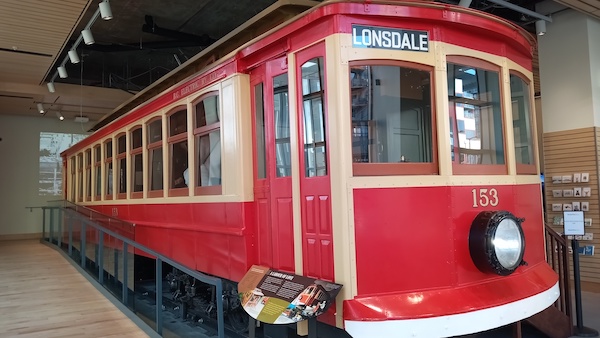
Housed in the lobby of the Museum of North Vancouver, visitors can once more hop on Streetcar #153, which carried passengers along the Lonsdale Line from 1912 to 1946. (photo by Cynthia Ramsay)

This story took me a long time to write. Everything I read about the Museum of North Vancouver (MONOVA) set me off on another path of exploration. I’ve watched (really) old home movies, looked at countless archival photos, perused online exhibits – all of this after I was treated in December to a tour of the museum’s beautiful new space at 115 West Esplanade. Such is the seemingly never-ending amount of wonder the museum offers.

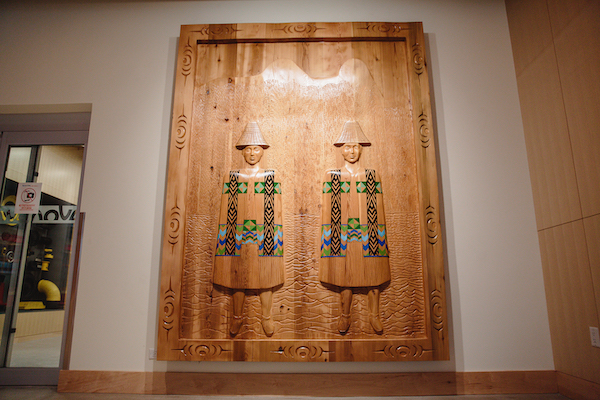
Days after the official opening on Dec. 4, curator Barbara Hilden walked me through the exhibits. I arrived early and had time to buy a few things in the gift shop – there are some excellent books, clothing, toys and other merchandise for sale. I also walked through the restored electric Streetcar #153, which carried passengers up and down the Lonsdale Line from 1912 to 1946, and admired Squamish (Sḵwx̱wú7mesh) artist Wade Baker’s cedar carving of Sch’ich’iyuy (the Two Sisters).

“The red cedar Sch’ich’iyuy panel is based on the ancient Sḵwx̱wú7mesh Sister’s Mountain Transformer legend,” says Baker on MONOVA’s website. “The twins were raised from childhood to be leaders for their people. They asked their father, the siyam, the chief, to bring peace to the warring tribes along the coast. He could not refuse their request and fires were lit all along the coast to signal a great welcoming feast to bring peace. For their efforts, the twins were immortalized in the mountain peaks you see today that watch over us.”

photo - The museum’s lobby features a cedar carving of Sch’ich’iyuy (the Two Sisters) by Squamish carver Wade Baker
The museum’s lobby features a cedar carving of Sch’ich’iyuy (the Two Sisters) by Squamish carver Wade Baker. (photo by Alison Boulier)

Beyond the museum lobby is a sparse area and a space for activities, a moveable wall separating the two. Visitors then walk through a corridor with images of trees on the walls, their branches continuing onto the ceiling. The Indigenous Welcome Circle, which highlights Squamish and Tsleil-Waututh (Səl̓ílwətaɬ) stories and items, is the anchor of the room. There is the notable presence and prominence of Indigenous involvement in the displays and, the day before the new museum’s opening, there was a memorandum-of-understanding signing ceremony that included members of the Tsleil-Waututh and Squamish nations.

“The MOUs affirm our commitment to working with Tsleil-Waututh and Squamish nations as equal partners,” Hilden told the Independent in an email interview after the tour. “MONOVA formed the Indigenous Advisory Committee several years ago to inform our programming, collecting, curatorial and operational activities. We rely on IVAC members to direct our strategic priorities in these areas and others, and to liaise with the nations. These needs do not diminish with opening our new location; on the contrary, their importance only increases. IVAC will continue to exist and we anticipate it growing larger and more robust as we look to incorporate Indigenous ways of knowing throughout the institution.”

Exhibits in the new permanent gallery include the Indigenous Welcome Circle, as well as themed displays – on sports, women in wartime, shipbuilding on the North Shore, and more. Interactive children’s displays help young visitors understand, for example, how to load a cargo ship and what various animals eat and what their poop looks like (this was a particularly fun exhibit, I must admit). An interactive map takes people through the history of the North Shore by water, trail, rail and road. Panels on one of the walls take us from the late 1700s to the present day with several photos and brief descriptions of notable events, good and bad, listed chronologically. There is a section – Truth and Reconciliation – dedicated to residential school survivors.

The museum’s first feature exhibition is called You Are Here @ The Shipyards. “It discusses the changing nature of North Vancouver’s lower Lonsdale area, from Indigenous settlement to working shipyards to contemporary tourist destination,” explained Hilden. “The exhibition features historic objects, archival photos and film … [and] will open in the spring of 2022 and run for one year. In the future, it’s anticipated that our calendar will be a mix of internally curated and traveling exhibitions.”

The North Vancouver Museum opened in 1972 in the old Pacific Great Eastern Historic Railway Station and moved to Presentation House in 1976, where it remained until last year. With the new location, came the new name, MONOVA.

“It’s taken more than 50 years, a multitude of meaningful discussions with community members and Indigenous leaders, countless volunteer hours, and painstaking research to amass a collection of more than 9,000 artifacts, but, after 20 years of planning, finally, the Museum of North Vancouver is ready to welcome the public,” reads the press release announcing the December opening.

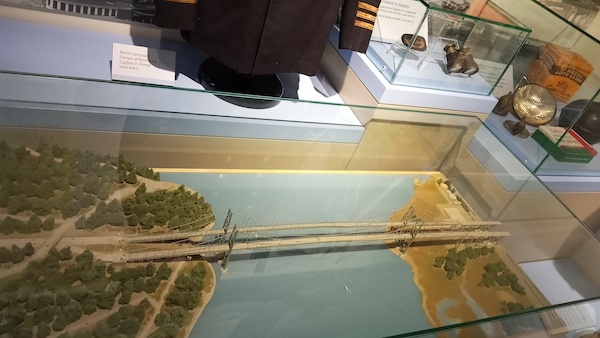
photo - Squamish Nation partnered with architect Moshe Safdie in the 1990s and proposed building a twin span next to the original, congested Lion’s Gate Bridge, but rehabilitation work of the existing bridge was undertaken instead. This model is currently on display at MONOVA
Squamish Nation partnered with architect Moshe Safdie in the 1990s and proposed building a twin span next to the original, congested Lion’s Gate Bridge, but rehabilitation work of the existing bridge was undertaken instead. This model is currently on display at MONOVA. (photo by Cynthia Ramsay)

In addition to the exhibits and activities that take place at 115 West Esplanade, there are many online exhibits. Archivist Dr. Jessica Bushey noted that two – Walter Draycott’s Great War Chronicle, and Climbing to the Clouds: A People’s History of B.C. Mountaineering – were created by the North Vancouver Museum and Archives, all departments working together.

“These were very large endeavours, taking nearly a year to create and involving consultants and partners,” said Bushey. “More recently, the archives team has focused on creating online exhibitions drawing upon archival materials that provide virtual access to the collections and offer a companion to on-site exhibitions at the archives building in Lynn Valley. These are smaller in scale, but strong in their interactivity and showcasing of archival photographs, moving images and oral histories.”

Currently, there is no specific Jewish connection in any of the material on display, but the museum is actively seeking additions to its collection.

“At the moment,” said Hilden, “we have materials exhibited from North Vancouver’s Ismaili, Iranian and Japanese communities. All the exhibits in our long-term gallery are designed to be flexible and changed out regularly, so we do anticipate updating and rotating these stories as more communities become aware of MONOVA and our desire to represent all North Shore stories.”

She said, “We would be thrilled to hear of more Jewish connections. We currently have very few tangible objects in our collection that would help us tell these stories, and I’d love to hear from members of North Van’s Jewish community.”

“The archives of North Vancouver is very interested in acquiring donations of archival materials from the Jewish community working, residing and thriving in the city and district of North Vancouver,” agreed Bushey, also noting the archives’ current lack of these materials.

“We have one file on Samuel Davis Schultz, who was a judge and alderman in North Vancouver and founded the honour roll of North Vancouver High School in 1912, a photograph of S. Schultz and a 2014 copy of the special issue of the Western States Jewish History quarterly journal, which focuses on the Davies and Schultz families. Lastly, we have the photographs from a City of North Vancouver 2000 millennium project on Diversity on the North Shore, which included the Jewish community and led to the publication From Far and Wide: Cultural Diversity in North Vancouver,” said Bushey.

“If anyone has archival records (e.g., correspondence, photographs, albums, diaries, home movies, business records etc.) they would like to donate,” she added, “they can email the archives with the particulars and we will get in touch.”

“MONOVA considers donations that have a close connection to the community of North Vancouver,” said Hilden. “The artifacts don’t need to be extremely old or extremely valuable to be considered. Sometimes, the most thought-provoking pieces are those that tell quotidian stories of everyday life. (Of course, the old and valuable belongings are welcome also!) We care for everything in our collection and, when we make the decision to acquire a piece, we commit to preserving, conserving and making it available for generations to come.”

To connect with the museum or archives, visit monova.ca.

Format ImagePosted on February 25, 2022February 23, 2022Author Cynthia RamsayCategories Arts & CultureTags archives, history, MONOVA, museums, North Vancouver, Squamish Nation, Tsleil-Waututh
A love of the school’s stories

A love of the school’s stories

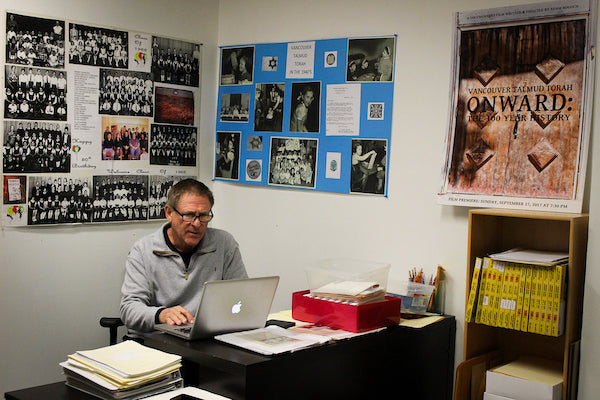
David Bogoch is keeper of the Vancouver Talmud Torah archives and chair of the school’s alumni fund. (photo from facebook.com/vttschool/photos)

David Bogoch is on the board of the Vancouver Talmud Torah Foundation. He is also the collector and keeper of the school’s archives. Previously, he was on the school’s board of directors for eight years – a position he took for a unique reason.

“At my dad’s shiva, the president of the board at that time, David Kauffman, tapped me on the shoulder and asked if I would be on the board at the school,” explained Bogoch about how he became involved. “At that time, with my father’s spirit in the room, I felt I had no choice but to say yes. Talk about timing.”

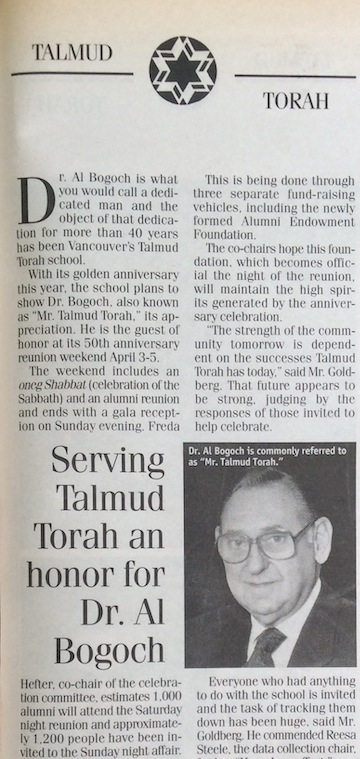
Dr. Al Bogoch was the guest of honour at Vancouver Talmud Torah’s 50th anniversary at its current location, in 1998. He was recognized for his more than 40 years of dedication to the school. He acted in many capacities over those years, including as president of the board of directors, as one of the founders of the VTT Foundation, which was established in 1974, and as a main driving force of four of the school’s expansions. On the occasion of the golden anniversary, the Alumni Endowment Foundation was launched.

In addition to his duties as archivist, David Bogoch is also chair of the school’s alumni fund.

“The board was portfolio driven, so I chose alumni,” he told the Independent. “I inherited the job from Carla van Messel. I figured it would be the least political and most fun. I knew at least 100 alum I could call and it all started from there.”

In going through the boxes in his father’s basement, Bogoch found tons of old Talmud Torah paperwork. “He had kept everything to do with his time on the board in the 1960s,” said Bogoch. “Other past presidents had given him their collections and, together, amassed a lot of what is in the archives today.

image - Vancouver Talmud Torah’s 50th anniversary, which honoured Dr. Al Bogoch, “Mr. Talmud Torah,” was the topic of this March 20, 1998, Jewish Western Bulletin article by Faith Bloomfield
Vancouver Talmud Torah’s 50th anniversary, which honoured Dr. Al Bogoch, “Mr. Talmud Torah,” was the topic of this March 20, 1998, Jewish Western Bulletin article by Faith Bloomfield.

“Today, the archive has thousands of photos and documents, from 1918 to the present,” he continued. “There are so many interesting stories which make up the 100-plus years of the school history. I looked up every issue in the library of the old Jewish Western Bulletin and the Jewish Independent to help tell the history of the school and the community of the times. Where would we be without the ability to search through the newspaper of old?”

While many stories have captured his interest, Bogoch said, “One story which caught my attention was in the board meeting minutes from 1944. The community wanted to build its own new Talmud Torah day school but were unable to because of lack of building supplies because of the world war. They also wanted to buy a school bus but couldn’t because of gas rations due to the war.

“Some people like jigsaw puzzles, others like bridge or golf,” he said. “My game of choice is the history of the school and all the people who either attended or were involved with the school. I love the good stories of friendship; I suffer when I hear the bad stories of tough times for students or parents or teachers. By knowing what has gone on in the past, I hope to impart those stories to the people of the present and the future, so we can try to avoid mistakes made before.”

Some of those stories are included in the one-hour documentary Vancouver Talmud Torah Onward: The 100-Year History. Written and directed by Bogoch’s son, filmmaker Adam Bogoch, the documentary was released in September 2017, as part of the school’s centenary celebrations. It can be viewed at youtube.com/ watch?v=ifoAqk3EKb0.

VTT obviously means a lot to David Bogoch, who also attended the school. “All of my lifelong friends came from Talmud Torah,” he said. “Most alum I come in contact with also share the same experience – our ties to the Jewish community stem from our shared experiences of school years. Between school, shul or camp, that is where we forge our community ties that bind.”

Bogoch is working toward making the VTT archives more widely accessible.

“The school,” he said, “is currently trying to put the photos and archival material on the school website so that everyone can search through and find the memories of their time, or of their family’s era.

Format ImagePosted on May 7, 2021May 7, 2021Author Cynthia RamsayCategories LocalTags Adam Bogoch, Al Bogoch, archives, David Bogoch, education, history, Vancouver Talmud Torah, VTT Onward

Share your COVID story

The COVID-19 pandemic has impacted the lives of everyone in our local Jewish community, as it has impacted people around the world. Daily events like school, work, visiting with friends and family, as well as grocery shopping and other errands, have been transformed by public health recommendations.

The Jewish Museum and Archives of British Columbia has a responsibility to collect and document history as it happens – and needs your help to document this historic time. What are the important aspects of this moment that our community should recall years from now?

Each of us is experiencing this crisis in our own unique way, and the Jewish Museum and Archives wants to gather as many of those experiences as possible. Not sure what to say? The museum can help with that. The JMABC has recruited the assistance of Carly Belzberg, a specialist in guided autobiography, who will be helping community members put their experience into words.

The museum would like to know how daily routines around your house, including work, school and fitness have changed; how you’re staying in touch with family and friends; and what Jewish traditions look like for your family this year. For example, how did you celebrate Passover? How are you keeping Shabbat?

If you are interested in sharing your experiences, or simply would like to learn more about this project, contact JMABC archivist Alysa Routtenberg at [email protected].

Posted on May 15, 2020May 14, 2020Author JMABCCategories LocalTags archives, coronavirus, COVID-19, history, Jewish museum, memoir
Mystery photo … May 31/19

Mystery photo … May 31/19

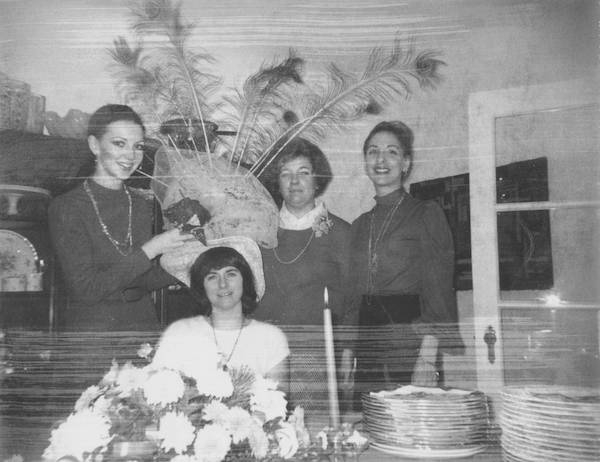
Rochelle Levinson is second from the right. (photo from JWB fonds, JMABC L.10738)

If you know someone in this photo, please help the JI fill the gaps of its predecessor’s (the Jewish Western Bulletin’s) collection at the Jewish Museum and Archives of B.C. by contacting [email protected] or 604-257-5199. To find out who has been identified in the photos, visit jewishmuseum.ca/blog.

Format ImagePosted on May 31, 2019May 30, 2019Author JI and JMABCCategories Mystery PhotoTags archives, history, Jewish museum
Mystery photo … April 19/19

Mystery photo … April 19/19

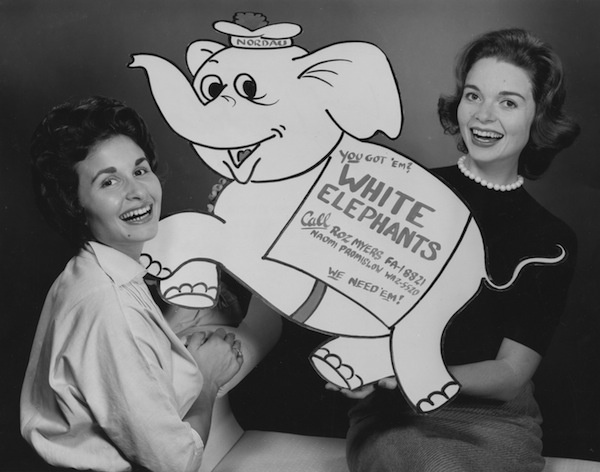
Two unidentified women hold a White Elephant sign for Hadassah Bazaar collection, 1953. (photo from JWB fonds, JMABC L.10545)

If you know someone in this photo, please help the JI fill the gaps of its predecessor’s (the Jewish Western Bulletin’s) collection at the Jewish Museum and Archives of B.C. by contacting [email protected] or 604-257-5199. To find out who has been identified in the photos, visit jewishmuseum.ca/blog.

Format ImagePosted on April 19, 2019April 17, 2019Author JI and JMABCCategories Mystery PhotoTags archives, Hadassah Bazaar, history, Jewish museum
Adding to Einstein Archives

Adding to Einstein Archives

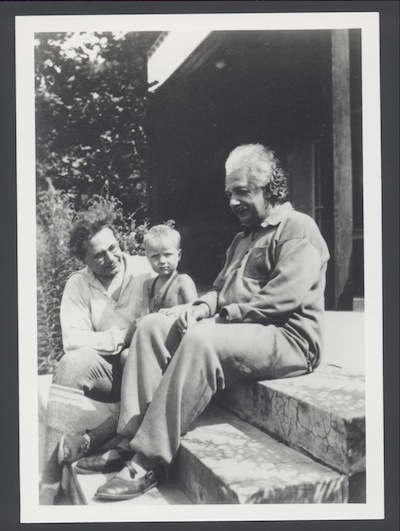
A newly acquired photograph of Albert Einstein, left, with his lifelong friend Michele Besso. (HU photo courtesy Ashernet)

photo - Albert Einstein, right, with his grandson Bernhard, centre, and son, Hans Albert
Albert Einstein, right, with his grandson Bernhard, centre, and son, Hans Albert. (HU photo courtesy Ashernet)

One hundred and ten pages of Albert Einstein’s handwritten notes and other documents and photos have been added to the Albert Einstein Archives at the Hebrew University in Jerusalem. This latest material (dating mainly from 1944 to 1948) was acquired by the university thanks to a donation by the Crown-Goodman Foundation, which bought it for an undisclosed sum from Gary Berger, a North Carolina doctor. After Einstein’s death in 1955, most of his more than 80,000 scientific and personal papers were left to the Hebrew University. Einstein, who was one of the founders of the university and a great supporter of the Jewish state, was invited to become president of Israel, but declined the offer, implying that he did not feel worthy of such honour.

Format ImagePosted on March 15, 2019March 14, 2019Author Edgar AsherCategories IsraelTags Albert Einstein, archives, Hebrew University, history
Mystery photo … Sept. 21/18

Mystery photo … Sept. 21/18

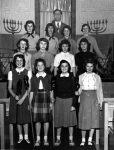
Congregation Beth Israel, circa 1955. (photo from JWB fonds, JMABC L.09737)

If you know someone in this photo, please help the JI fill the gaps of its predecessor’s (the Jewish Western Bulletin’s) collection at the Jewish Museum and Archives of B.C. by contacting [email protected] or 604-257-5199. To find out who has been identified in the photos, visit jewishmuseum.ca/blog.

Format ImagePosted on September 21, 2018September 20, 2018Author JI and JMABCCategories Mystery PhotoTags archives, Beth Israel, history, Jewish museum
Come celebrate our history

Come celebrate our history

Jewish Museum and Archives of British Columbia archivist Alysa Routtenberg holds a minute book from Victoria’s Congregation Emanu-El, circa 1920. (photo from Alysa Routtenberg)

The documents and artifacts collected, processed and housed by the Jewish Museum and Archives of British Columbia are part of “everyone’s story,” JMABC archivist Alysa Routtenberg told the Independent in a recent interview. She encouraged people to donate material, join museum walking tours and visit the archives.

Routtenberg, who was born and raised in Vancouver, did her undergraduate studies in history and art history at the University of British Columbia before heading to Montreal for two years to earn her master’s of library information and archival studies at McGill University. In the summer of 2014, she had the opportunity to work in her field at the JMABC and, when she completed her studies, the museum’s then-archivist, Jennifer Yuhasz, was getting ready to move on and Routtenberg won the job.

“I ended up moving back to Vancouver, and was lucky enough to get this position not that long after I moved back to start my career as an archivist here,” she said.

Routtenberg’s family has been very involved in historical societies and groups for generations, and she always has loved her family’s library and the study of history.

“We did a lot of trips – like Fort Langley and all sorts of museums and things – so I always knew I wanted a career in history,” she said. “It was just a matter of figuring out the practicality of what that looked like.”

The JMABC originally started out as the Jewish Historical Society of British Columbia in 1971. Its founding president was Routtenberg’s grandfather, Cyril Leonoff, who passed away last year. Since its beginnings, the museum’s mandate has evolved, but the core objective has stayed the same – to preserve, collect and share the history of Jewish people in British Columbia.

The museum and archives makes information “accessible so people can come in and research,” said Routtenberg. “Then, we try to use that material in our public programming, whether that be with walking tours, lectures or physical exhibits. It’s all about celebrating and sharing the history. It’s a fairly short history compared to Jewish people in other provinces, but that doesn’t mean it’s any less important.”

The oldest material in the archives is from 1862 – from Congregation Emanu-El in Victoria. While not Canada’s oldest synagogue, it is the oldest synagogue in continuous use in the country. It’s been open and operational ever since it was started a couple years after Jews first arrived in the province.

“They were mostly coming up from California during the gold rush,” said Routtenberg of these pioneers. “And then, they developed businesses and, within a couple years, wanted to start a synagogue. So, that’s our oldest material. They are pretty special … very beautiful … handwritten notebooks and things.”

The first Jewish arrivals, she said, “set up businesses where they sold supplies to the guys who were going off panning [for gold]. So, that’s what allowed them to build a community. They built a business, a home, then a synagogue…. A couple guys called themselves wholesalers, selling every kind of supply. And then, as soon as there were actually people staying in Victoria and wanting to live there … I know there were a couple clothing stores and then a women’s clothing store, specifically, and a fur store … that sort of thing.”

As others did, Jews kept trickling into British Columbia, moving west with the hope of a better life, with more space. In the 1920s and 1940s, the Jewish community got big population boosts and communal groups began to be organized. Some community groups and businesses have now been around for three or four generations.

“There were furniture and scrap metal dealers … and we’ve collected a lot of those stories, fortunately, while those people were still with us,” said Routtenberg. “We’ve been able to write a couple of books about them,” she said, referring to the JMABC’s annual journal, The Scribe. The museum also publishes a newsletter, The Chronicle, twice a year.

Routtenberg’s job is to collect and preserve all the historical artifacts from the Jewish community, and the artifacts are divided into two major groups.

One group is family collections, which includes letters, photos, certificates and any other correspondence or paper material a family produced over the years. In that area, the JMABC has many great collections from a range of people.

“They were involved with any number of organizations,” said Routtenberg. “We’ll have their handwritten notes from meetings from the 1950s. We’ll have their letters back and forth with relatives across the country. Those are the sorts of things we have in the family collection.”

The second group focuses on community organizations, with collections from the Jewish Community Fund and Council, the Canadian Jewish Congress and the Hebrew Free Loan Association, as but three examples. The material in these collections includes correspondence, meeting minutes, agendas, publications they produced, information relating to events, etc.

“We’re very lucky in that most of the synagogues in the city have agreed to donate their materials to us,” added Routtenberg. “We collect the material related to the synagogue’s administration, meeting minutes, member lists, committee minutes, photos, events and publications.”

One important aspect of Routtenberg’s job is to reach out to and speak with people and organizations, to explain what it is that the JMABC does, what types of things it collects and, at times, making house calls to help sort materials.

“Once materials have been fully processed, everything is in a file and we know exactly what it is, what the dates are, and where to find it,” said Routtenberg. “So, that’s the main job we do.

“We deal with a lot of research requests as well,” she added. “A lot of people call or email and they are researching their family, asking what information we might have about them. Also, a lot of students, from high school to doctoral students, contact us when they are doing projects and want to know about a theme.

“I’ll make notes about those. I’ll try to answer right away, but often it requires some searching. Usually, looking through material in the archives needs to wait for a volunteer to be available or I encourage people to come in themselves.”

Routtenberg especially enjoys getting to dig into a box, and she has made some exciting discoveries.

“Something I love finding are handwritten letters,” she said. “We have a number of collections in the archives that are very thorough. There’s one that’s [between] a couple who was in Vancouver and Montreal in 1920, and they wrote letters back and forth.

“They met in Montreal, I believe, and then were secretly engaged for I think six months or so. And they wrote letters everyday, sometimes twice a day, back and forth. It’s those kinds of things that people don’t necessarily think is important, but they tell us so much about what life was like back then – things they struggled with and thought about. They are just beautiful.”

The archives are meant to preserve everyone’s history, not just the visible part of the community, stressed Routtenberg.

“If we don’t preserve our history, no one else will,” she said. “That’s what it comes down to at the end of the day. It’s really easy for people to think they’re not important, that their stuff isn’t important, thinking there is no reason why we would want it. People, all the time, bring stuff from the 1970s and 1980s, and they think it’s not important … but, if we don’t do it now, it never gets to be 150 years old.

“And we get so many research requests – we average 650 to 700 per year. These are all people with a wide range of questions wanting to know about the Jewish community. I don’t want to have to sit there and explain something, because I happen to know it – I want the evidence to back it up, providing the original documents for people to be able to come and look through.

“We’ve really been trying to promote community ownership of these archives,” she said. “They’re not this thing to be locked away from the public. They’re really everyone’s story.”

For more information, visit jewishmuseum.ca.

Rebeca Kuropatwa is a Winnipeg freelance writer.

Format ImagePosted on March 17, 2017March 14, 2017Author Rebeca KuropatwaCategories LocalTags Alysa Routtenberg, archives, British Columbia, history, Jewish museum, JMABC

Posts pagination

Previous page Page 1 Page 2 Page 3 Next page
Proudly powered by WordPress