A scene from Semicolon: The Adventures of Ostomy Girl. (photo from Vancouver Jewish Film Festival)
The photo of Dana Marshall-Bernstein being hugged by her mother, Cari Marshall, captures the love at the heart of Semicolon: The Adventures of Ostomy Girl.
When the documentary was filmed, Dana was 25. She had been dealing with severe Crohn’s disease since she was 4 years old. With less than four inches of intestine left after numerous surgeries, she receives all her nutrition intravenously. At age 16, she had her first ostomy – surgery to make an opening in the body so that body waste can be discharged. Poop jokes flourish in the family, one of the many ways in which they cope, and the brief Ostomy Girl cartoon that is included in the film shows the sheer strength of will this young woman possesses.
Over the months of filming, Dana – who lives with her parents in Las Vegas – is in and out of Cleveland Clinic in Ohio, where she is treated by some seemingly amazing doctors, skill- and personality-wise, such as Dr. Feza Remzi. Her health gets worse and she finally makes the decision she understandably has resisted for so long – to be put on the transplant list for a small intestine.
At times, Dana seems younger than her years, so vulnerable; at other moments, her literal life-and-death concerns add years. Somehow, with the help of her parents – especially her mother, but also her father, Ed – Dana has led a relatively full life, as normally as possible. Somehow, she still has her sense of humor. Somehow, she has the courage and the energy to try and help others, through awareness and fundraising events for Cleveland Clinic and the Crohn’s and Colitis Foundation of America.
Semicolon screens at the Vancouver Jewish Film Festival (vjff.org) on Nov. 10, 3:30 p.m.
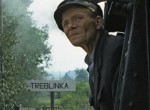
Henrik Gawkowski, as seen in Shoah, directed by Claude Lanzmann. (photo from Les Films Aleph/Why Not Productions)
The French intellectual who created what many view as the definitive documentary of the Holocaust is himself the subject of a documentary, called Claude Lanzmann: Spectres of the Shoah.
Commentators in the film are unanimous that Shoah, Lanzmann’s nine-and-a-half-hour study of the Holocaust, is a masterpiece. They also agree that Lanzmann is himself a piece of work.
A former friend calls him a megalomaniac. Another commentator says he is “a very challenging individual.” Through interviews with Lanzmann, the viewer gets a sense of what they are talking about.
Over a 12-year odyssey of interviewing and filmmaking, what Lanzmann set out to create was a film, in his words, “not about the Shoah, but a film that would be the Shoah.”
His first challenge was how he would approach a topic so enormous and distressing.
“What is my theme?” he asks during interviews for the documentary. “The heart of the Shoah, what is it?”
On this he concludes: “Shoah is not a film about survival. And, as it is not a movie about survivors … the survivors are not in Shoah, Shoah is a film about death.”
He recounts an incident that left him hospitalized for a month after a former SS officer’s wife discovered a hidden camera in his bag and Lanzmann and his female assistant were chased, beaten and bloodied by thugs associated with the war criminal. In another instance, Lanzmann relates how he almost drowned while swimming off the coast of Israel. He recalls that he had no gratitude to the individual who saved him and speculates that perhaps he had intended suicide because he knew he could not finish the film in the two years he had been given, with the instruction to keep it under two hours.
As Lanzmann goes on at length about his artistic struggles and the terrible toll the project took on his spirit, a viewer’s empathy may fade. Considering the subject matter of Shoah, lamentations on the difficulties of making a film – however monumental – come across as startlingly self-absorbed. Given the advance billing of Lanzmann’s character with which the documentary begins, the film comes full circle, providing a character sketch of a difficult individual who has done a remarkable thing.
Claude Lanzmann: Spectres of the Shoah double bills with What Our Fathers Did: A Nazi Legacy at the Vancouver Jewish Film Festival (vjff.org) on Nov. 11, 3:30 p.m.
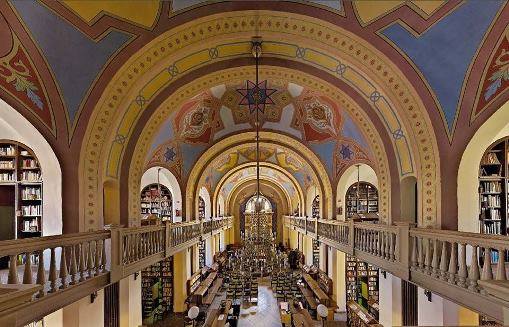
Left to right: Nico Slobinsky of Centre for Israel and Jewish Affairs, Pacific Region; His Excellency Balint Odor; Ezra Shanken of Jewish Federation of Greater Vancouver; and Andre Molnar, Hungarian honorary consul. (photo from Beth Israel)
On Oct. 15, Congregation Beth Israel hosted an exhibition of Eastern European synagogues, sponsored by the Hungarian government. In his welcoming address at the opening, His Excellency Balint Odor, Hungarian ambassador, explained that Hungary is currently heading up the International Holocaust Remembrance Alliance (IHRA).
“IHRA is very relevant today in fighting spiraling antisemitism across Europe and around the world,” he said. “The mandate of IHRA is to combat all forms of racism, hate incitement and antisemitism, as well as promoting Holocaust education. This year, IHRA has focused a great deal of effort on illustrating the depth of Jewish culture in the region, in particular the synagogue.”
The synagogue in Baja, Hungary. (photo from exhibit catalogue by Rudolf Klein)
The traveling exhibit showcases renovated synagogues throughout East-Central Europe, from 1782-1944, some of which are still in use. Unlike in Germany and Austria, where the majority of synagogues were destroyed, many survived in Eastern Europe. From the 1970s onward, local municipalities restored and renovated synagogues. This work escalated following the fall of the Berlin Wall and the influx of foreign financial support.
The panels show a variety of different styles, ranging from cottage shuls to “palatial” synagogues. The richness and diversity of these places of worship are reminders of how vibrant Jewish life was in Europe prior to the Shoah.
The role of the presidency of IHRA offers Hungary the opportunity to confront its history and look back at the role the Hungarian state played in the genocide. Close to half a million Hungarian Jews perished during the Holocaust. Most of these people died in 1944 following the occupation of Hungary. At that time, every third victim in Auschwitz was a Hungarian Jew. Today, the Hungarian Jewish community is the largest in East-Central Europe. Most Hungarian Jews live in the capital, Budapest, which has some 20 working synagogues.
As Rabbi David Bluman said in his welcome of the ambassador: “The synagogues we see in this exhibit are not just the past, they are also the present for those who worship in them, and will be the future for European Jewry. This is very relevant for us here in our beautiful new synagogue – our present, our future.“
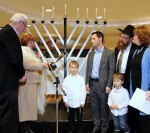
Yosef Nider, centre, receives the inaugural Lamplighter Award last year. (photo from Centre for Judaism)
Do you, or does someone you know, qualify for the Centre for Judaism Young Lamplighter Award? Has anyone you know between the ages of 5 and 18 made a unique effort to illuminate their world by performing extra special deeds of goodness and kindness?
Last Chanukah, on Dec. 21, Yosef Nider, 7, received the Centre for Judaism Young Lamplighter Award at the annual public menorah lighting in the Semiahmoo Shopping Centre. White Rock Mayor Wayne Baldwin, Surrey Mayor Linda Hepner and Rabbi Falik and Rebbetzin Simie Schtroks, co-directors of the Centre for Judaism of the Fraser Valley, presented Yosef with an engraved trophy, as well as a cash prize.
“Chanukah celebrates the victory of light over darkness and goodness over evil. This is a most appropriate opportunity to motivate and inspire young people … with a little light, they can dispel all sorts of darkness,” said Simie Schtroks.
“We were delighted to bestow this honor upon young Yosef because he turned the painful experience of dealing with his grandfather’s terminal cancer into an opportunity to do good for others. With his parents’ support, he organized an event – highlighted by his own violin performance – A Concert for a Cure, which raised $10,000 for cancer research,” she added.
Jeff Nider, Yosef’s father, described the experience. “We were blown away by the events of the evening, and it was such an honor for my wife and I to be the parents of a child who won the Lamplighter Award,” he said. “Yosef started out simply wanting to do something to help his grandfather, but what he eventually accomplished resulted in such a ripple effect. We truly are amazed and feel both humbled and proud of Yosef.”
When Yosef heard that he would be passing the light forward to the next recipient, he said, “I felt really happy to get this award. I hope that other kids will also do something good for the world after hearing about this award. The award is on my dresser in my room. I also got to buy a really cool Lego set.”
The deadline to submit a nominee for this year’s Lamplighter Award is Nov. 22, 2015. Include with the nomination at least one letter of recommendation written by a rabbi, teacher, principal, mentor, doctor or other verifiable source. Send all the material and direct any questions to Simie Schtroks, [email protected].
The award ceremony takes place on Dec. 13, 5:30 p.m., at the Semiahmoo Mall menorah lighting. Everyone is welcome.
Group of B’nai B’rith men, circa 1960. (photo from JWB fonds, JMABC L.12156)
If you know someone in this photo, please help the JI fill the gaps of its predecessor’s (the Jewish Western Bulletin’s) collection at the Jewish Museum and Archives of B.C. by contacting [email protected] or 604-257-5199. To find out who has been identified in the photos, visit jewishmuseum.ca/blog.
לתפקיד ראש ממשלת קנדה החדש והעשרים ושלושה במספר, נבחר ג’סטין טרודו, מהמפלגה הליברלית, במקומו של סטיבן הרפר מהמפלגה השמרנית. טרודו יקים ממשלת רוב לאחר שזכה בכארבעים אחוז מהקולות שיקנו לו 184 מושבים (לעומת 36 מושבים בבחירות הקודמות), בפרלמנט שכולל 338 מושבים. הרפר (56) ששימש ראש הממשלה במשך כתשע וחצי שנים, ונחשב למנהיג המקורב ביותר לראש ממשלת ישראל, בנימין נתניהו, קיווה שיצליח שוב להרכיב ממשלה חדשה ונכשל בגדול. הוא קיבל כשלושים ושניים אחוז מהקולות, שיקנו לו 99 מושבים (לעומת 159). הרפר הודיע שלא ישמש ראש האופוזיציה, אך ימשיך לייצג את אזורו בקלגרי. לדעת הפרשנים הוא יפרוש מהר מאוד מהפוליטיקה ויחפש עבודה בתחום העסקי. אין ספק שמרבית תושבי קנדה (שבעים ואחד אחוז לפי הסקרים) רצו בחילופי שלטון, תוך שהם מאסו במדיניות הנגטיבית של הרפר.
המפלגה הדמוקרטית החדשה נחלה מפלה קשה וזכתה לכעשים אחוז בלבד מהקולות, שיקנו לה 44 מושבים (לעומת 95). מפלגת הבלדנים של קוויבק קיבלה כחמישה אחוזים מהקולות, ועלתה ל-10 מושבים (לעומת 3), ואילו מפלגת הירוקים קיבלה כשלושה אחוזים מהקולות, עם מושב אחד (לעומת שניים).
הרפר ניהל מדיניות חוץ ניצית תוך שהוא מגן על ישראל בכל מצב, דבר שפגע ביוקרתה של קנדה בעולם, וביכולתה לשמש מתווכת בין ישראל לפלסטינים. טרודו צפוי לנקוט במדיניות יותר מאוזנת במזרח התיכון. לפני הבחירות הוא אמר: “הסכם הגרעין עם איראן הוא צעד בכיוון הנכון. עם זאת איראן רחוקה עדיין מלהצטרף לקהילה הבינלאומית לאור תמיכתה בטרור. האפשרות היחידה להשיג שלום במזרח התיכון היא באמצעות פתרון שתי המדינות, תוך שמירה על בטיחונה של ישראל”. טרודו ציין כי הקמפיין להחרמת ישראל הוא סוג חדש של אנטישמיות. על מדיניות הרפר הוא אמר: “העובדה שהרפר בחר להפוך את התמיכה בישראל לוויכוח פנימי, היא דבר לא טוב לא לקנדה ולא לקהילה היהודית בקנדה”.
טרודו (43) הוא ראש הממשלה הראשון בקנדה שגם אביו (פייר אליוט טרודו) היה ראש הממשלה. הוא נבחר למועמד לתפקיד לפני שלוש שנים, ומאז פתח בקמפיין בחירות חיובי וארוך, שכלל מפגשים עם מאות אזרחים בכל רחבי קנדה. עם זכייתו בבחירות הוא אמר: “הקנדים הראו שהם רוצים שינוי אמיתי ופוליטיקה חיובית. הם מאמינים שיכול להיות טוב יותר. אנו מייצגים את כל הקנדים על כל הגוונים שבהם, וניישם את מה שלמדנו בשיחות עם הציבור. לאור זאת בנינו את הפלטפורמה הזו, התנועה הזו. אתם רוצים ממשלה שתבטח בכם ואנו רוצים שאתם תבטחו בנו. זו תהיה ממשלה פתוחה שפעילותה שקופה, ותכבד את המוסדות השונים במדינה. אנו חוזרים להיות מה שקנדה הייתה בעבר”.
טרודו מתכוון ליצור גרעון תקציבי של כעשרה מיליארד דולר במשך השלוש השנים הקרובות, כדי שהממשלה תוכל לבצע השקעות גדולות מאוד בתשתית, לעזור למעמד הביניים ולחלשים, וליצור הרבה מאוד מקומות עבודה חדשים. ראש הממשלה החדש הבטיח להביא לקנדה עשרים וחמישה אלף פליטים מהמזרח התיכון עד לסוף השנה. וכן להפוך את עישון המריחואנה לחוקי. הוא גם מתכוון לטפל משמעותית בנושא התחממות כדור הארץ.
הרפר נכשל עם הקמפיין ההפחדה שלו שכלל הוצאת עשרים וחמישה מיליון דולר על מודעות וסרטונים נגטיבים נגד טרודו, אותו תיאר חסר ניסיון ולא מוכן לתפקיד. מרבית הציבור לא אהב את השלטון הכוחני והמרוכז של הרפר, שלא שמר על זכויות האזרח ואיכות הסביבה, ולא דאג לפליטים.
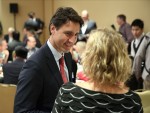
Justin Trudeau schmoozes after a speech to the Richmond Chamber of Commerce in July. (photo from Justin Trudeau’s Office)
As Justin Trudeau’s Liberal party swept to a majority victory Monday night, it was British Columbia that finally made a difference. Without the 17 seats the Liberals took here, Trudeau would have won, but with a minority mandate – albeit a big one.
The Liberals swamped Vancouver and its suburbs, winning some seats that few, if any, observers anticipated they were even competitive in, particularly in the eastern suburbs. The North Shore was a Liberal sweep. In Vancouver South, the Conservatives lost their only foothold in the city as incumbent Wai Young lost to Liberal Harjit Sajjan.
Liberals Joyce Murray (Vancouver Quadra) and Hedy Fry (Vancouver Centre), the only two Liberals elected from British Columbia in 2011, trounced their respective opponents. Murray more than doubled the votes of her nearest competitor, a Conservative, and Fry almost tripled the vote of the second-place New Democrat.
The new riding of Vancouver Granville, slicing through the centre of the city north to south, is a microcosm of what appears to have happened locally and nationally. Several organizations had formed to encourage Canadians who opposed Harper’s Conservatives to vote strategically for the candidate most likely in their riding to defeat the Conservative. In Granville, Leadnow, probably the most prominent of the anti-Harper organizations, urged voters in the riding to back New Democrat Mira Oreck. This drew a backlash from Liberals, who said their candidate was either tied or ahead of the New Democrat in the available public opinion polls and the Vancouver Sun noted the friendship between Oreck and the head of Leadnow. In the end, so-called “change voters” seem to have looked at the national polling trends – which, by the end of the campaign, showed the Liberals slightly ahead of the Conservatives and NDP support dissipating – and turned red. In the end, Liberal Jody Wilson-Raybould took nearly 44% of the vote, with Oreck and Tory candidate Erinn Broshko effectively tied at 26%, Oreck edging out the Tory by 38 votes for second place; Green candidate Michael Barkusky took about three percent. Oreck and Barkusky are members of the Jewish community.
There were no clearly evident trends in ridings across the country with concentrations of Jewish voters. In the Montreal riding of Mount Royal, held until the election by retiring Liberal Irwin Cotler, Anthony Housefather, the Liberal candidate and mayor of the suburb of Cote-Saint-Luc, beat Conservative Robert Libman by a comfortable margin. Both Housefather and Libman are Jewish.
In Thornhill, the Toronto-area riding with the country’s largest concentration of Jewish voters, Conservative incumbent Peter Kent trounced Liberal Nancy Coldham. In Eglinton-Lawrence, incumbent Conservative finance minister Joe Oliver, the most senior Jewish official in Ottawa, lost by a significant margin to Liberal Marco Mendicino. In York Centre, another Toronto riding with large numbers of Jewish voters, Tory Mark Adler was narrowly defeated by Liberal Michael Levitt. Adler is known nationally mostly for his foibles, such as calling out to advisers of Prime Minister Stephen Harper at the Western Wall in Jerusalem to be included in a photo opportunity and, several weeks ago, for seeming to exploit his family’s history in the Holocaust for political gain.
In 2011, post-election surveys indicated that Jewish voters supported the Conservative party by large margins. Though such indicators are not yet available for this week’s election, it appears that Jewish voters are far from being a monolithic bloc.
In The Singing Abortionist, Dr. Henry Morgentaler comes across as an enigmatic figure. (photo from Vancouver Jewish Film Festival)
This year’s Vancouver Jewish Film Festival will entertain, inform and challenge viewers, from its opening event – YidLife Crisis, a film all in Yiddish (with English subtitles), and its Yiddish-speaking stars/writers Jamie Elman and Eli Batalion as guests – to its final screening, the French film Once in a Lifetime, based on the true story of an inner-city high school in Paris. This week, the Jewish Independent gives you a glimpse into the festival, which runs Nov. 5-12 at Fifth Avenue Cinemas.
A difficult national hero
There are few surnames in Canada that can evoke such visceral and opposite reactions as Morgentaler. Henry Morgentaler is the name most associated with abortion – with providing abortion services to women, with fighting abortion laws, and for eventually leading a case to the Supreme Court of Canada that resulted in the permanent overturning of Canada’s abortion statute.
To allies, he is a hero. To enemies, he is “Hitler,” as countless people scream at him in footage in the documentary The Singing Abortionist. (He was known to hum or sing a few lines while performing abortions, including one he performed on CTV’s W5 program, which ran the procedure in its five-minute entirety.) Yet even to allies – including his children – he is, as one biographer described him, a “difficult hero.”
In interviews before his death in 2013, Morgentaler acknowledged that everything he did in life was with the aim of earning the love of women. This guided him in becoming the foremost advocate in the country for women’s reproductive choice, but it also led to his reputation as a “womanizer.”
Morgentaler was a relatively unknown doctor when he felt morally bound to begin offering abortions, a crime that carried a potential life sentence for the doctor and two years in prison for the patient. Across 20 years of legal battles, including a stint in prison, Morgentaler led the legal and PR battle for choice, which culminated in his case before the Supreme Court of Canada that, in 1985, struck down Canada’s abortion law.
In this one-hour film, Morgentaler comes across as an enigmatic figure. He admits to megalomania, albeit with a guffaw. His children speak about their own conflicted relationships with him. His lawyer says Morgentaler was an easy target for anti-abortion forces to caricature as a “strange-looking, hook-nosed Jew.” Morgentaler is both introspective about his motivations but clearly suppresses, according to those around him, his experiences as a Holocaust survivor.
But Morgentaler’s career – particularly his lifelong devotion to the fight for abortion rights – is a direct result of his suffering under Nazism. He was a forced laborer in the Lodz Ghetto before it was liquidated and its residents sent to Auschwitz. The film follows Morgentaler on his only return to the place where he lost his mother, and where he and his brother survived. The experience, he tells the filmmaker, taught him that, “Just the fact that something is law does not necessarily mean it is good or justified or it’s rational.”
– PJ
Monumental reconstruction
Before the Holocaust, Poland had about 200 wooden synagogues, a richness of liturgical architecture that one expert said “rivals the greatest wooden architecture anytime in history, anywhere in the world.” All were lost.
That American expert, Rick Brown, began a project to painstakingly reconstruct from photographic and other records a prime example of that lost history. Working, first, with his students at the Massachusetts College of Art, the project eventually expanded to include more than 300 people, mostly students, from 46 universities and 11 countries.
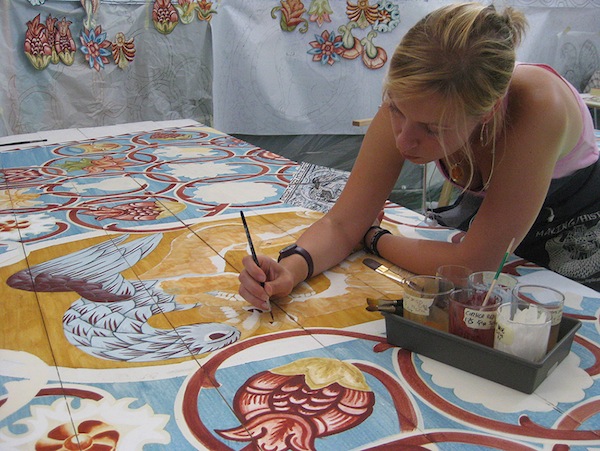
Raising the Roof tells the story of how a team of hundreds recreated the painted roof and ceiling of Gwozdziec Synagogue in Poland. (photo from VJFF)
The undertaking was monumental. Using only the tools that were available at the time, and working on site over successive summers in Poland and Ukraine, the team recreated the intricately constructed and painted roof and ceiling of Gwozdziec Synagogue. (Gwozdziec is actually in Ukraine, but was part of the greater Polish territory during the heyday of synagogue architecture and its synagogue is both one of the most dramatic and one with the most information available to aid the team in recreating it.)
Brown and his group didn’t know what they would do with the to-scale project when it was completed, but fate intervened. The POLIN Museum of the History of Polish Jews had been designed to accommodate exactly such a replica. After years of tree-felling, lathing, metalworking, complex joinery and scrupulous research on building techniques and paint colors, the roof and ceiling were raised into place at the Warsaw museum.
Raising the Roof, the film that tells the story of the project, is fascinating on multiple fronts. It involves many people with divergent motivations, including Jews, non-Jews, Americans, Poles, artists and even volunteers with no particular skill beyond enthusiasm. There are poignant reflections on the meaning of the original architecture, its loss and regeneration. Underpinning the entire project is the memory of the lost civilization of Polish Jewry, from which 70% of today’s Jews have ancestry, and whose architecture and culture can be reclaimed, but whose existence cannot.
– PJ
Being high and low in Haifa
If you can hand yourself over to filmmaker Elad Keidan and immerse yourself in the sights of Yaron Scharf and especially the sounds created by Aviv Aldema, Afterthought is a worthwhile journey.
Uri Klauzner as Moshe, left, in Afterthought, Elad Keidan’s first feature. (photo from VJFF)
The Israeli film’s Hebrew title, Hayored Lema’ala, “down up,” basically sums up what happens on the outward level. Moshe, whose name and story we don’t find out till almost the very end, goes off in search of his wife’s lost earring, which leads to other discoveries about his wife and their relationship. As he starts his exploration up the stairs to the top of Mount Carmel in Haifa, Uri begins his descent to the port, where, we eventually find out, he is planning on catching a freighter abroad, both to finish writing a book and to avoid army reserve duty, as well as to run away from mistakes he has made. The two men pass the same sights, sounds and people at different points in the day, and they encounter each other, stopping for a brief chat – Moshe was Uri’s third-grade teacher, it turns out.
The English title for the film comes from a conversation Moshe overhears in a coffee shop. A man tells his friend about how he wishes that, after a talk with his mother, for example, he could call his mom and leave a message with everything that he actually wanted to say, or meant to say.
Afterthought is Keidan’s first feature, and it is a solid debut despite the slow pace. Viewers are ultimately rewarded by the internal ups and downs of the main characters, the men’s reflections on life, friends and family, and the people they meet along the way. Aldema’s radio snippets, machine and human noises, music selections and other sound effects are a character in and of themselves, and are worth the price of admission alone. These, together with Scharf’s cinematography – which is not flashy, but subtly effective – and the acting of Itay Tiran as Uri and Uri Klauzner as Moshe make for a movie that will not only have you thinking of it afterwards, but of your own life, the choices you have made, and the people you hold dear.
– CR
For the film schedule, tickets and information on all the festival’s offerings, visit vjff.org.
Left to right, Lighthouse Labs’ Jeremy Shaki, Josh Borts and Khurram Virani. (photo from Lighthouse Labs)
The Jewish Independent first heard of Lighthouse Labs in January of this year, when it received a press release about Lighthouse’s second annual HTML500, “where 500 people can learn basic HTML and CSS skills from Canada’s top 50 tech companies for free.” In its first year, the waitlist numbered 1,300. In its second, more than 2,000.
But HTML500 (thehtml500.com) offers merely a peek into what Lighthouse Labs (lighthouselabs.ca) teaches in its eight-week computer coding bootcamp – a bootcamp that this year also became available in Toronto and Calgary. Lighthouse co-founder Jeremy Shaki credited fellow co-founders Josh Borts and Khurram Virani – who are also founders and partners of the Toronto-based development company Functional Imperative – with the concept.
“I wish I could take credit for the idea of Lighthouse Labs, but I can’t,” Vancouver-based Shaki told the Independent. Borts and Virani, the latter of whom now also lives here and is Lighthouse’s head of education, “came up with it as it pertained to their space … and asked me if I wanted to be involved.
“Personally, I have always felt very strongly about learning by doing and that schools should have more tangible outcomes associated with their education. So, to get a chance to put all that into action in an exceptionally exciting space like tech was very lucky. There were definitely other models for this that we looked at, but we developed our own philosophy around outcomes and, specifically, that we felt that everyone graduating should be able to get a job.”
While Lighthouse Labs doesn’t guarantee employment, of course, it boasts a 100% placement rate. As its website explains, “Since some students have other goals, this refers to those students whose goal is to work as a full-time developer as soon as possible upon graduation. To date, 100% of our grads have gotten jobs in that capacity within three months!”
Shaki and Borts have known each other since high school. Both were born and raised in Montreal.
“I was raised ‘Jew-ish,’ as in I was taught the history, had dinners on all the holidays, had Friday night meals with my family and went to synagogue on the important dates,” said Shaki, who attended JPPS-Bialik Jewish school until heading to St. George’s High School, where he met Borts, who attended St. George’s from pre-kindergarten through high school.
Borts described his family as “modern Jewish.”
“While my father was raised Orthodox,” he explained, “by the time I was born, we had migrated down the path to Conservative and mainly practised during the High Holidays, etc., like most of my Jewish friends. When I was planning for my bar mitzvah, I had a good interaction with the rabbi at the Reform synagogue in Montreal, Temple Emanuel, so our family moved there, completing our move to Reform.
“Once I left for university to Waterloo (honors, bachelor of computer engineering), I found myself outside of the Jewish social groups that are ever-present in English Montreal and I was, therefore, forced to create my own traditions. So, while I no longer attend synagogue on every High Holiday (I do when I can make it back to Montreal), I host a break-fast and seder for my friends (both Jews and non-Jews), as well as light the Chanukah candles (because who doesn’t like the dreidel?).”
Shaki stayed in Montreal for university, attending Concordia, where, he said, “I took the extremely practical political science course which led to my career in – marketing.”
Always encouraged to work, Shaki had myriad jobs, “ranging from selling spa packages on the street to hiring staff” – and including a job, at 15, with “the famous Montreal bagel shop St. Viateur Bagels” – “but ended up working for an experiential marketing agency called Sugar Media out of Toronto. I stayed there for seven years, loving every day of it before ultimately beginning to run Lighthouse Labs,” where his title is “chief talking officer.”
HTML500 offers a glimpse into what Lighthouse Labs teaches in its eight-week coding bootcamp. (photo from Lighthouse Labs)
Borts’ path to Functional Imperative and Lighthouse Labs began in University of Waterloo’s co-op program, from which he obtained a wide range of experience, he said, “from working for a nonprofit in Sub-Saharan Mali … to algorithmic and high-frequency trading. Upon graduation, I took a job with a proprietary trading group in Hong Kong, where I spent three years working on trading strategies.
“When I finally came back to North America,” he said, “I was approached with an opportunity to launch my own technology startup. While not in the finance space, the idea of being an entrepreneur really appealed to me and my risk-taking approach, so I jumped in and moved to Toronto to launch SocialStreet. Unfortunately, my lack of experience showed and it quickly failed. However, I learned a great deal about what it takes to run a successful startup, experience that I now am able to give back to the community in my role at Functional Imperative and Lighthouse Labs.”
Integral to both places is Virani. “While I have a computer engineering background,” explained Borts, “I didn’t have the experience of building scalable software solutions. Khurram, with over 10 years of experience in web development, was the perfect co-founder to be able to execute on our clients’ visions.”
Based in Toronto, Borts’ involvement with Lighthouse Labs includes being its chief financial officer. “In general,” he said, “my ability to speak both business and technology means that I am responsible for bridging the gap between what is best for the business and what can be done. I often am the one pushing for higher margins and faster growth, to the chagrin of Jeremy and Khurram.”
It’s hard to imagine faster growth for Lighthouse Labs, which started in Vancouver in 2013 and now not only is established in two other cities, but has dozens of instructors, mentors (“For every seven students,” says the website, “we have one superhero of a mentor ready to combat the villains of logic errors and low batteries”) and alumni mentors (graduates who help “students figure out careers as developers”).
“The success we had in the early going really helped us prepare for the future from the start,” said Shaki. “We were lucky to have made some fantastic partnerships with many different groups in the tech sector, and those groups helped open up opportunities to bring our business to other Canadian cities faster than we had originally expected.
“As for where we go from here, the main focus is to make sure we are able to deliver the same quality program consistently in the markets we have expanded to. That being said, we have some very ambitious projects that will be coming to fruition soon, but I’ll keep those ones to myself for the moment!”
Earlier this year, Shaki spoke at a conference at Simon Fraser University on a panel dealing with the topic Not Just Our Problem: Motivating People to Care About Women in STEM (science, technology, engineering and math). His comments shed light on another aspect of Lighthouse Labs’ success.
“There is a major movement going on in tech to get more women involved and we are as active as anyone,” he said. “On the panel, I spoke mostly about the language that we use to describe the tech industry in general and how, with some small changes, it makes for a big difference.
“We threw an event called HTML500 last February in four cities across the country and, with those language changes, we were able to attract over 50% female participation in a learn-to-code event. It was about making it open and inclusive instead of trying to depict coding as difficult and niche.
“We also made sure to have a lot of women mentors around, as it provided both the men and women showing up to learn the initial opportunity to learn from and respect a woman developer. I don’t know if you can change all the people who are already in the tech industry, but we definitely feel as though we can affect the people entering it for the first time.”
The language and approach Borts uses at Functional Imperative are also illuminating.
“One of the common misconceptions is that software developers are not creatives,” he said. “I may not be good with a paintbrush but, like other creatives, my team and I are abstract thinkers who thrive on innovation. My job is to harness my team’s insane creativity in a way that still ensures a quality product at the end of the ride. A couple of strategies we use at Functional Imperative include:
“Demo your work early and often. The sooner you can get feedback on your work, the more likely it is to match the project requirements. This is at the core of agile development methodology.
“Have someone else give you feedback on your code. This ‘peer review’ is essential for ensuring code quality.
“Eighty/20 rule: 80% of our projects should use technology my team already knows, while 20% can be riskier, allowing them to push the bounds of their knowledge.
“Tell them what you want, not how to get there.”
And it can only help that both Borts and Shaki love what they’re doing.
“I get to wake up every morning and create new things,” said Borts. “It is the dream of every engineer. This is both at Functional Imperative, where we help shape and deliver on the vision of our clients, and at Lighthouse, where I am helping build a world-class education institute that is at the forefront of changing how education is delivered. Every day brings a new problem to solve.”
As for Shaki, he looks forward to going to work because he has “an amazing team that are all passionate, goofy, hard-working and hilarious.
“I also love it because, when I made the switch from marketing to running a developer bootcamp, I made the conscious decision to do something that made a positive impact. We keep very small classes, so I get to meet all our students and watch as their lives change in the matter of eight weeks. That is extremely fulfilling, and a far cry from hawking other peoples’ products, no matter how much fun event marketing is.
“At this point, I get to have extremely intelligent discussions with intelligent people every day and talk about better ways of improving education. To be doing that as my job makes me happier than anything else I could be doing.”
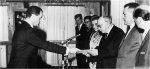
Ambassador Rolf Pauls of Germany presents his credentials to Israeli president Zalman Shazar on Aug. 19, 1965. (photo from picture-alliance/dpa via CIJA)
On Aug. 19, 1965, Ambassador Rolf Pauls of Germany presented his credentials to Israel’s president Zalman Shazar. The tension and solemnity of the occasion were evident in everyone’s faces. Formal intergovernmental relations were being launched between Israel and Germany in the dreadful shadow of the Shoah.
Three milestones paved the way for this historic rapprochement.
The Luxembourg Agreement of 1952, which constituted the Federal Republic of Germany’s assumption of responsibility for the consequences of the Holocaust.
The meeting in March 1960 between David Ben-Gurion, Israel’s first prime minister, and Konrad Adenauer, West Germany’s first chancellor.
The 1961 trial of Adolf Eichmann.
The Luxembourg Agreement formed the foundation for opening dialogue, which after long years of deliberate, mutual and courageous effort culminated in the meeting between Ben-Gurion and Adenauer. The Eichmann trial helped change the two countries’ perception of each other, making it possible to look forward to a different future.
This spring, we marked the 50th anniversary of the establishment of formal diplomatic ties between Germany and Israel on May 12, 1965, a landmark day in the history of both countries. These 50 years have been marked by the rapid development of relationships and contacts in all fields and the burgeoning of a friendship that has become part of the bedrock of international affairs.
Initiated by the pioneering efforts of the scientific community in both countries, German-Israeli ties now cover every possible field of human endeavor and achievement, from scientific research and technological innovation, to youth exchange programs, civic partnerships, municipal exchanges, cultural collaborations, sport, tourism, and so much more.
Today, a quarter of all Israelis have visited Germany, while more than 700,000 young people have participated in bilateral exchange projects. Meanwhile, a trade relationship worth a mere $100 million in 1960 has grown to $7.4 billion in 2013, making Germany Israel’s third most important trading partner, after the United States and China. Israel, in turn, is Germany’s second most important trading partner in the Near and Middle East.
At the governmental level, building upon the deep desire of both peoples, our countries have worked consistently to expand and deepen mutual trust and understanding, as well as the platforms for exchange and interaction that make it possible for these to flourish. Visits at the highest political levels – laden with meaning and symbolism – have developed into regular exchanges, including annual government-to-government consultations and close coordination between trusted partners.
At the core of Adenauer’s and Ben-Gurion’s efforts was the recognition on the German side of the need to demonstrate in the most concrete terms – to itself, to Israel and the Jewish world, and to the broader international community – that the country had detached from its Nazi past and was committed to the responsibility for that past. For Israel, close relations with Germany were a geopolitical imperative for the young state, a matter of securing its future in the family of nations, without forgetting the past.
The unique relationship built by our two nations in the five decades of our ties has helped both countries normalize our international standing, entrench our security and economic well-being and make meaningful contributions to global society. This success is founded upon three key principles: Germany’s ironclad commitment to the security of Israel, for which every Israeli is grateful; our mutual commitment to remembrance and education of the next generation; and our mutual understanding that the well-being of our people requires that we work together to build a safe and prosperous future for all.
German-Israeli relations are built on this dual commitment to the past and the future. A unique trust and a real friendship have been courageously fashioned out of the abyss created by the horrors of the Nazi era. We are proud of what our two countries have achieved together and full of optimism for what lies ahead.
D.J. Schneeweissis consul general of Israel to Toronto and Western Canada, and Josef Beck is consul general of the Federal Republic of Germany to Vancouver and Western Canada. This article was first published in the Canadian Jewish News and Das Journal. The Centre for Israel and Jewish Affairs, Pacific Region, and the German Consulate General in Vancouver are hosting a concert on Oct. 29 in celebration of the 50th anniversary year.