Anti-Jewish remarks

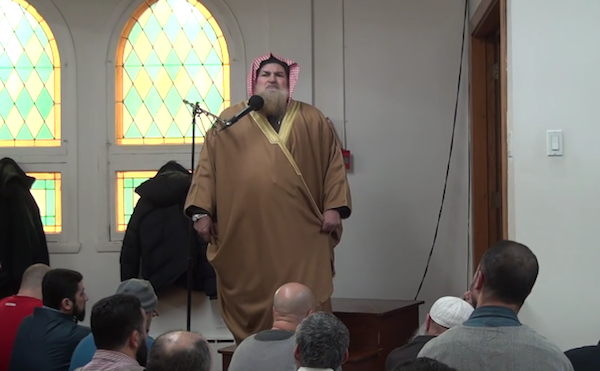
Sheikh Muhammad bin Musa Al Nasr is captured in a YouTube video dated Dec. 23, 2016, addressing a prayer meeting at Dar Al-Arqam in Montreal East. (screenshot from cjnews.com)

More videos of anti-Jewish sermons being delivered in mosques in Canada have come to light, the latest from the Dar Al-Arqam mosque in Montreal and the Al-Hikmah mosque in Toronto.

Sheikh Muhammad bin Musa Al Nasr is captured in a 20-minute YouTube video dated Dec. 23, 2016, addressing a prayer meeting at Dar Al-Arqam in Montreal East.

According to a translation of the Arabic by the Toronto-based online publication CIJNews, he says Jews are “the most evil of mankind” and that Allah has ordained that they be killed by Muslims.

“At the end of time when the Muslims will triumph over the most evil of mankind [and] the human demons, the stone and the tree will say: O Muslim, O servant of Allah, O Muslim, O servant of Allah, there is a Jew behind me; come and kill him; but the tree Gharqad would not say, for it is the tree of the Jews,” the translation says.

Musa Al Nasr is identified as a visiting Jordanian cleric.

Similar messages have been delivered by Sheikh Abdulqani Mursal, an imam at Al-Hikmah in North York, reports CIJNews editor Jonathan Halevi, who is described as a reserve lieutenant-colonel in the Israel Defence Forces and a senior researcher of radical Islam at the Jerusalem Centre for Public Affairs.

Apparently drawing from Islamic scripture, Mursal taught that “the fate of the Jews is … to be killed by Muslims,” Halevi writes.

He read a hadith, or saying of Muhammad, that: “You will fight against the Jews and you will kill them until even a stone would say: Come here, Muslim, there is a Jew [hiding himself behind me], kill him.”

Whatever the source of these sentiments, Jewish groups decry them as hateful, incitement, possibly hate crimes.

The Centre for Israel and Jewish Affairs (CIJA) said the published excerpt of Musa Al Nasr’s talk “mirrors, word for word, a similar genocidal declaration” in the charter of Hamas, which is designated as a terrorist organization by Canada.

“We are deeply troubled and angered that yet another imam has dehumanized Jews and glorified violence against them,” stated CIJA Quebec co-chair Rabbi Reuben Poupko.

Even more disturbing, he said, is that the mosque would disseminate Musa Al Nasr’s “incitement to violence and hatred” on the internet.

CIJA has submitted the latest material to police to determine if it violates Canada’s Criminal Code.

“We condemn these appalling sermons which … are a dangerous rejection of Canada’s core values of tolerance, pluralism and non-violence,” he said. “In light of similar incidents recently exposed in Montreal and Toronto, there is a real concern that the airing of hateful rhetoric – including antisemitism – has become routine at some mosques.”

B’nai Brith Canada has filed a formal complaint with police because it believes that this is hate speech. Musa Al Nasr is a “prominent member of the hardline Salafist movement in Jordan, where he lectures at the al-Ahliyya University in Amman,” it asserts.

According to B’nai Brith’s research, he delivered lectures more than a dozen times at Al-Arqam, which were recorded and uploaded on YouTube.

B’nai Brith chief executive officer Michael Mostyn expressed frustration that police have yet to lay charges in connection with a complaint it made in February when a video was exposed of another imam at another Montreal mosque pleading for the death of Jews.

The 2014 sermon by Sayed AlGhitawi, a guest imam at the Al-Andalous Islamic Centre, called on Allah “to destroy the accursed Jews” and “kill them one by one.”

“When will Canada finally recognize that we are not immune to racism and antisemitism, and that it is this type of rhetoric that directly leads to radicalization all over the world?” Mostyn asked. “What will it take before charges are laid for criminal incitement in Canada?”

– For more national Jewish news, visit cjnews.com

Bill S-201 passes 220 to 60

The Centre for Israel and Jewish Affairs (CIJA) lauded the House of Commons’ March 8 passage of a private member’s bill to prevent genetic discrimination, which survived a last-minute push by Prime Minister Justin Trudeau to oppose it on jurisdictional grounds.

Bill S-201, which was put to a free vote, passed 220-60, with dozens of Liberals joining the Conservatives, NDP and Green Party in support of the legislation. It now goes to the Senate for technical amendments and is expected to become law by the spring.

The bill was introduced by former senator James Cowan and spearheaded through the House by Liberal MP Rob Oliphant. It is designed to prevent insurance companies and employers from denying coverage and employment to people who have a genetic predisposition to various illnesses. It also prohibits any person from requiring an individual to undergo a genetic test or to disclose the results of a genetic test as a condition of providing goods or services or entering into or continuing a contract. The enactment amends the Canada Labour Code and the Canadian Human Rights Act.

The Canadian Coalition for Genetic Fairness (CCGF), which had been lobbying for a change to the law for six years, applauded its passage. “It’s a good day because of the vote. It’s been a long time coming,” said Bev Heim-Myers, chair of the 18-member CCGF and chief executive officer of the Huntington Society of Canada.

People have been denied rental accommodations, insurance coverage and have been let go from jobs because of concerns they might one day contract serious diseases. “Many people are refusing to get a genetic test for fear of discrimination,” but the benefits of testing can be substantial, leading to early diagnosis, prevention in some cases and early, targeted treatment, she said.

CIJA, a member of CCGF, also applauded the vote. The bill’s passage is “a milestone in protecting the health and well-being of all Canadians,” said CIJA chair David Cape. “Everyone should feel comfortable to take potentially lifesaving genetic tests without fear of punitive consequences.

“As this is an issue of overlapping federal-provincial responsibility, we encourage the provinces to bring forward complementary legislation to provide full protection against genetic discrimination for all Canadians,” he added.

Trudeau opposed the bill on constitutional grounds, arguing that, by regulating insurance companies, the bill was intruding into areas that come under provincial jurisdiction.

Liberal MP Randy Boissonnault introduced motions to remove several of the bill’s sections that arguably were areas of interest to the provinces, but those amendments were rejected. Prior to the vote, he told the House that the federal government had received letters from the governments of Quebec, Manitoba and British Columbia voicing concern that the bill infringed on provincial jurisdiction on regulating contracts and on the provision of goods and services. However, a House committee that studied the bill heard from constitutional lawyers who said it did not intrude on provincial jurisdiction.

Noah Shack, CIJA’s director of policy, said the Jewish community in particular should benefit from the new law. Once enacted, “It’s something that will save lives,” he said.

Ashkenazi Jewish women have a greater chance of carrying a mutated BRCA gene than women in the general population, giving them an increased risk of developing breast cancer or cervical cancer; men carrying the gene have an increased risk of developing prostate cancer. Because of concerns they might be turned down for insurance, people refrain from getting tested for the mutation, increasing the chances they won’t take preventive measures to address the disease, Shack said. “It creates a disincentive for getting tested in the first place.”

Heim-Myers said that, after the bill passes, CCGF’s efforts will turn to the provinces, which will be urged to amend their human rights laws to prevent genetic discrimination.

– For more national Jewish news, visit cjnews.com

Sadikov resigns SSMU post

Igor Sadikov, the McGill University student under fire for his “punch a Zionist today” tweet more than a month ago, resigned his remaining student government post, thereby preempting a vote by his peers on his removal.

On March 8, Sadikov stepped down from his position as arts representative on the Students’ Society of McGill University (SSMU) legislative council, a day before that body was set to debate a motion to impeach him. The action was “for impropriety and for violation of the provisions of the [SSMU] constitution” related to the tweet.

Sadikov cited “personal reasons related to mental health” for his decision to go. On Feb. 23, when the council motion was tabled, the third-year mathematics and political science student resigned from the SSMU board of directors, claiming pressure was being exerted by the university administration. He has not elaborated on his departure, and even the McGill Daily, of which he is a former news editor and frequent contributor, could not reach him for comment. He also didn’t comment about the resignation on his social media accounts.

It was on his personal Twitter account on Feb. 6 that Sadikov posted the infamous tweet, for which he apologized, calling it an ill-considered joke. While he is anti-Zionist, Sadikov described himself as Jewish and noted that his parents are Zionists, and he vowed to gain a better understanding of differing views on the political philosophy.

Nevertheless, pro-Israel groups on and off campus continued to call for his ouster, decrying the tweet as hateful and an incitement to violence, and they were unconvinced Sadikov had shown true remorse.

Both the Daily and another student newspaper, the McGill Tribune, reported that Sadikov’s March 8 resignation came days after allegations that he had been psychologically abusive in a relationship with another McGill student.

The day following his resignation, SSMU president Ben Ger resigned, citing personal reasons. Two other directors have also left. At press time, the SSMU was in the midst of executive elections.

On Feb. 22, the Arts Undergraduate Society voted not to oust Sadikov, while, nine days prior, the board of directors defeated an impeachment motion, but did formally censure Sadikov. On Feb. 15, following a meeting convened by McGill principal Suzanne Fortier, the SSMU executive “recommended” that Sadikov stand down.

Meanwhile, names continue to be added to an online petition demanding that Sadikov be expelled from McGill for incitement to violence. It was launched last month by Montrealer Murray Levine, who identifies himself as an activist and fundraiser who attended McGill.

By March 10, there were more than 2,000 signatures. The majority appear to be from outside the McGill community. Levine said that, when 3,000 names are collected, the petition will be presented to Fortier.

– For more national Jewish news, visit cjnews.com

Medical help in dying

In June 2016, it became legal in Canada for a doctor or nurse practitioner to assist someone with their death, as long as they meet certain criteria under the law.

“We’ve been providing this service here ever since,” said Dr. Stefanie Green, who lives and practices in Victoria. “I am one of the medical-assistance-in-dying providers here in British Columbia. Before that, I was primarily a maternity doctor for 20 years, where I took care of babies and newborns.”

As it happened, the Jewish Independent caught up with Green at the end of a day she spent doing circumcisions. The doctor explained that she finds it uniquely interesting dealing with both the beginning and end of life. “There are a lot of similarities to me,” she said. “There’s a lot of overlap in terms of the emotion and skills involved.”

photo - Dr. Stefanie Green believes it “is a deep privilege to be involved in this care”
Dr. Stefanie Green believes it “is a deep privilege to be involved in this care.” (photo from Dr. Stefanie Green)

Growing up in Halifax and then doing her medical training in Montreal, Green made her way west almost 15 years ago.

Helping patients die on their own terms has been an increasing part of her practice, with about 70% of people choosing to end their lives at home, and the rest in a care home or hospital.

Medical assistance in dying is only available to people who meet specific criteria in Canada. These criteria include:

  1. The patient needs to be an adult, over the age of 18.
  2. The patient doesn’t have to be a Canadian citizen, but they must be eligible for Canadian health-care insurance.
  3. Patients need to be suffering from what is considered a grievous and irremediable condition; for example, a serious illness, disease or disability in an advanced state that is irreversible, causing unbearable suffering, and, ultimately, leading to the person’s natural death in the foreseeable future.
  4. The request needs to be made voluntarily; there can be no coercion by family, doctors or anyone else. It has to come directly from the patient and be made by the patient when she/he is capable mentally of doing so.

“If someone is interested, they have to make the request,” said Green. “There’s a specific form in every province that has to be filled out … that has to be witnessed as a legal document.

“Once the request is made legally, then someone like myself – a physician or nurse practitioner – would do an assessment with them, with the family, with the family doctor or specialist, with their records, and make sure they meet the criteria.”

If satisfied at this point, a second assessment is conducted by someone else. Only if both assessments find that the patient meets the criteria, can the patient then be considered eligible and have the power to give the go-ahead if they so choose.

The law stipulates a 10-day waiting period after the request is made before the procedure can happen, unless there are very specific circumstances that require it be otherwise. The procedure itself can be done in one of two ways.

The patients themselves can administer the medication by drinking a liquid the doctor or nurse practitioner provides. The mixture is made by a pharmacy, picked up by the doctor or nurse practitioner, and given to the patient. The nurse practitioner or doctor stands by to ensure all goes smoothly. “It’s not the tastiest of drinks and takes about an hour-and-a-half to be complete,” said Green.

The other option, which more people in Canada are currently choosing, is the physician-administered route. In this case, the doctor picks up the medicine from the pharmacy and brings it to the patient wherever they are. The physician administers it intravenously into an arm and the process takes about 15 minutes.

In the IV procedure, it is a mixture of medications. The first medication is an anti-anxiety medication to relax the patient. Due to its strength, it causes most patients to fall into a light sleep. The second medication is a local anesthetic used to numb the vein being used in order to avoid the chance that it could irritate the patient when the rest of the medication is administered. The third medication moves the patient from a light sleep into a deep sleep and then coma. Many people pass away during that sleep, but not always. The fourth medication paralyzes the body, so if anything is moving, like the respiratory muscles, it will be stopped. The heart will stop soon thereafter.

According to Green, there are a number of countries around the world that have some form of a medical-assistance-in-dying (MAID) team, but Canada is one of only four countries that allows both the patient-administered and physician-administered options.

“I think we allowed it and pushed forward on the law because Canadians feel very strongly that this is a very humane act,” said Green. “It’s something they want to have available.

“What our Supreme Court has decided is that this is actually a constitutional right of Canadians for this care. This is the ability of a physician or nurse practitioner to help someone who wants to end their life at the very end of their life, and who needs help to do so. That’s what this is – a very humane, peaceful and dignified act.

“I think the last poll I saw, 87% of the Canadian public supports this kind of care. I think that this is very respectful of the idea of patient autonomy. That’s what drives this.

“I think that, from an ethical point of view, as a physician, I have the duty to help heal people and to do the best I can to promote healthy life. At the same time, I’m also bound to reduce suffering. There’s a bit of a dichotomy there as a physician. In Canada, the law is reflective of the right of the patient; it’s not about the conflicted duty of the physician.”

From a Jewish perspective, Green does not anticipate any issue from the community. So far, she has done one case within the Jewish community (of a total of 31) and has not had any trouble.

At the time of her interview with the Independent, the MAID program had overseen two to three percent of all deaths on Vancouver Island over the previous six to eight months.

“People ask me a lot about how I feel about this work and what it’s like to do this work,” said Green. “I just want to stress that I do really believe this is a deep privilege to be involved in this care. I feel like I’m helping people. I find it very rewarding at the end.

“I don’t do it for the reward,” she said, “but have been absolutely overwhelmed by the gratitude expressed by the patients I work with and their families. It’s been surprising to me, the extent of that. I want people to know that the service is available and that it’s legal. There are people out there willing to provide this care, and I think it’s a great step forward in Canada. I’m very proud of the work I do.”

Rebeca Kuropatwa is a Winnipeg freelance writer.

New LGBTQ+ council

Earlier this month, the Centre for Israel and Jewish Affairs (CIJA) announced the establishment of an LGBTQ Advisory Council. “Our LGBTQ+ family and friends are an integral part of the Jewish people and Canadian society as a whole,” said CIJA chair David J. Cape in a statement. “We are excited to launch this vital initiative, which brings together a talented and diverse group of leaders and young professionals for the goal of strengthening our ties with the LGBTQ+ community. We look forward to working with the LGBTQ+ Advisory Council, which will play a crucial role in providing CIJA with guidance on policies and issues, while expanding our capacity to connect with the broader LGBTQ+ community on matters of common cause.”

Tom Chervinsky, chair of CIJA’s LGBTQ+ Advisory Council, said, “As someone who is Jewish and gay, I am heartened to see both the support and importance that the organized Jewish community is placing on building strong bridges of friendship and cooperation with the LGBTQ+ community. Our Jewish and sexual/gender identities are fundamental to who we are. Being able to integrate our whole selves into the fabric of both these communities makes each community, and all of Canada, stronger. It is an honour to get to work with so many dedicated Canadian volunteers to help make that possible.”

The council consists of 14 members from seven provinces. It includes both Jewish and non-Jewish members with a diverse range of professional and political backgrounds, including experience in law, academia, business, politics, advocacy and Jewish community work. A full list of members, including biographies, may be found at cija.ca/lgbtq.

CIJA has been involved in various LGBTQ+ advocacy activities, even before the creation of the council. This involvement includes sponsoring outreach events at various Pride festivals across Canada and serving as one of several organizations on the executive of Trans Equality Canada, a coalition urging Parliament to pass Bill C-16 to strengthen human rights and hate crimes protections for the transgender community.

Six weeks in Ottawa

This graphic designed by Andrea Schwartz represents Yiddish as growing and dynamic. It serves as the graphic for all of University of Ottawa’s Yiddish activities.

Yiddish is the language of a thousand years of European Jewish civilization and the shared language of most of the Jewish immigrants who settled in Canada. Over the last century, Yiddish has evolved a rich literature, musical tradition, theatre and cinema. Today, there are many innovative initiatives to explore Yiddish, including the digitization of all of Yiddish literature and new movies and television. As part of this Yiddish renaissance, the University of Ottawa is offering an opportunity to learn and engage with the language and culture in a Yiddish Summer Institute.

Running daily from May 1-June 13, this introductory course in Yiddish language and culture will allow diverse students to learn to speak, read, write, sing and explore Yiddish literature and culture in an intensive format that is unique in Canada. The program consists of daily Yiddish language classes in the mornings plus weekly cultural activities including theatre workshops, film screenings and performances. It concludes with a fieldtrip to Yiddish Montreal, including a visit to Yiddish-speaking Chassidic neighbourhoods and a live theatre performance.

Students who have successfully completed the course will receive six university credits and be able to hold a basic conversation like a native speaker; read a Yiddish newspaper or other text with the help of a dictionary; write about a variety of topics and in multiple formats (letters, poetry, short film scripts, etc.); and know at least 20 Yiddish songs. They will also be familiar with many aspects of Yiddish culture, from Eastern Europe through present-day Canada, including music, literature, theatre and film.

The course is open to all students – university students as well as mature students – and no previous background is required aside from a willingness to work hard in a rigorous university class. It will be of particular interest to students who require Yiddish language reading knowledge for their research; are interested in Yiddish performance of theatre or music; who want to learn more about Eastern European Jewish culture; who wish to be able to translate out of or into Yiddish; who seek to be creative in Yiddish; who enjoy learning new languages or for whom Yiddish is a family or heritage language. For students coming from outside of the Ottawa area, on-campus housing is available, as is funding to offset the cost of travel. As a bonus, the course takes place at the University of Ottawa’s downtown campus during the city’s Tulip Festival, as well as the country’s 150th birthday celebrations.

As a scholar and instructor of Yiddish with more than 20 years’ experience teaching Yiddish to children and adults in university and community settings including New York’s YIVO summer program and the Yiddish Book Centre in Amherst, Prof. Rebecca Margolis, Vered Jewish Canadian Studies Program, University of Ottawa, is excited to be able to offer this intensive course at her home university.

All information regarding the program, registration, financial support and housing is found at yiddishottawa.com. Registration opens at the end of March, first-come, first-served. For more information, contact Margolis, the coordinator and instructor of the course, at rmargoli@uottawa.ca.

Removing graffiti full-time

Corey Fleischer volunteers most of his time to removing hateful graffiti. (photo from Corey Fleischer)

When Montrealer Corey Fleischer finished university, he was unsure of what career path to take. In the interim, to pay the rent, so to speak, he started Provincial Power Washing.

Reflecting back on those days, Fleischer said, “I hated what I was doing – washing a lot of trucks, houses, decks, residential and commercial – zero substance. I’m a person who thrives off substance.”

One day, while heading to a job, Fleischer happened to spot antisemitic graffiti out of the corner of his eye.

“I was driving downtown here, in Montreal, and I saw a swastika on a cinderblock in a very busy part of town,” he said. “I had the equipment needed to remove it, so I got out of the truck and did just that. I got back in my truck, not thinking anything of it.”

From that day on, whenever Fleischer came across such graffiti, he would stop and remove it. As well, in the evening, after returning home from work, he would grab a bite to eat, shower and go out to look for racist, antisemitic and homophobic graffiti to remove.

“I would scour the city for hate crimes – back alleys, on walls, anywhere,” said Fleischer. “I found another one (swastika) and then another one. And then I started noticing, as the graffiti-removal side of my business began growing … I realized this was a real problem around town. It became my pastime. I quit hockey and softball and everything. It’s what I spent all my time doing. It fulfilled my life.”

For the first several years, it was only Fleischer’s parents and close friends who knew what he was doing. Then, he received a call from the local B’nai Brith Canada office to confirm his address, as they wanted to include him in a community newsletter mailing. While Fleischer refused to give out his address, he told the BBC that he had pictures of 40 swastikas that he had removed over the past five years, if that was of interest.

The BBC representative, said Fleischer, “literally couldn’t understand what was coming out of my mouth. She couldn’t believe that’s how I was spending my time. So, I sent her the pictures. They sent out a blogger to come and follow me, to do a story on what I was doing.

“Lo and behold, my life at that moment completely changed. People started seeing what I was doing and wanted to get involved. It went from removing 40 to 50 hate crimes in five years … [to] a couple hundred last year alone. The increase was pretty crazy.”

Fleischer now has thousands of followers wanting to get involved, so he has many more reports coming in, asking for free hate-graffiti removal. He said he has gone from spending about 10% of his company time removing hate graffiti to 95%. And, thanks to social media, the movement Fleischer started has gone global.

“People are calling me from all over the world, trying to figure out how to remove hate crimes in their area,” said Fleischer. “And, I basically put it together and have the removal done – wherever the people are calling from – with a local company.

“For most people dealing with hate crimes, it’s not a comfortable situation. People don’t know what to do with them or how to act when they see them. I happen to thrive in uncomfortable situations. I’ll go and organize. If I can’t find a local company to remove it, I’ll contact the local government, mayors, statesman, whoever, to get it done.

“For example, there was an attack on a Jewish cemetery in New York state. Their whole cemetery was defaced with swastikas and hate symbols. And somebody called me up from the town, saying they’d seen my videos and they’d been staring at these swastikas on their cemetery for two weeks – right around Yom Kippur. So, they called me to find out what could be done.”

After Fleischer hung up the phone, he began calling power washers. As it was a small town, it was hard to find someone, so Fleischer called the mayor and the local government. Within two days, all the graffiti was gone.

“When people figure out who I am and what I’m doing, they tend to spring into action quicker than if it was another situation,” said Fleischer. “Although I started the movement, it’s not just me getting it done. It’s people in the community, that I like to call ‘my army.’ I’m just a tool that was given to these people in order to remove these hate crimes. I’m just the instrument.”

While removing the hateful graffiti is, of course, good, Fleischer pointed out that it does not deal with the root of the problem. So, he decided to collaborate with Montreal-based Overture with the Arts, a not-for-profit that provides mainly after-school art classes to high school students. One of its programs is targeted at educating students about the Holocaust through a series of spoken word workshops about Anne Frank. OWTA opted to include a talk by Fleischer in the program.

“Instead of thinking about the actual guys who are putting on the hate crime, I had to find another way to make a difference in our society and in our communities,” said Fleischer of his speaking role. “I had to think of a way to make another difference by educating our youth, our future.

“When I was growing up and was going to high school, I was never taught about the Holocaust. I was never taught about the biggest massacre, the biggest tragedy, in human history.

“Before I started this whole movement, I didn’t even fully understand…. I knew what a swastika was, I knew it was bad, but I didn’t understand everything that was going behind it.”

The first two schools at which Fleischer spoke were classroom-sized talks, but this quickly expanded into full auditoriums. Schools now flood him with requests to come and speak.

“I had two calls this morning from schools calling me, out of the blue, trying to figure out how I can come to their schools,” said Fleischer in his interview with the Jewish Independent. “The school tour is called Erasing Hate.”

Fleischer received a peace medal last year from the YMCA (Young Men’s Christian Association) for his efforts with Erasing Hate, along with 30 Auschwitz survivors.

“To think I’m even in the same bubble with people like that, with something I started doing as a pastime, because I followed my heart, is mind-blowing. It’s really something else,” he said.

“Hopefully, we won’t, in the future, be ignoring hate crimes on the street and the future – our kids, the kids in schools – will understand that you don’t need to be silent. You can wake up, open your mouth and you can make a difference. That’s what this has turned into.”

For more information, Fleischer is on Instagram (@ErasingHate) and Facebook.

Rebeca Kuropatwa is a Winnipeg freelance writer.

News, democracy and trust

The Shattered Mirror: News, Democracy and Trust in the Digital Age, released on Jan. 26 by the Public Policy Forum, shines a light on the news industry in Canada, revealing it is reaching a crisis point as the decline of traditional media, fragmentation of audiences and the rise of fake news pose a growing threat to the health of our democracy.

When the PPF began thinking about a study on the state of the news media in Canada, in early 2016, the headlines were all bad. Within a fortnight in January 2016 alone, Rogers Media and Postmedia announced new rounds of staff reductions, Torstar revealed plans to close its printing plant, and Confederation-era newspaper titles in Guelph, Ont., and Nanaimo, B.C., were shuttered, the first of six daily papers to close, merge or reduce their publishing schedules before year’s end. The situation wasn’t much better on the broadcast news side, where revenues, especially in local television, followed the downward track of the newspaper industry, inducing the Canadian Radio-television and Telecommunications Commission to step in.

chart - Online ad revenue pie chart from Shattered Mirror ReportA parliamentary committee was formed. News companies and industry associations queued up with complaints of inequities in the marketplace. The Government of Canada contracted with the PPF, a non-partisan and independent think-tank, to assess the situation and make recommendations on what, if anything, should be done.

“The question for Canadian policy-makers is not whether given news outlets are in trouble, but whether democracy itself has been placed at risk in the process,” states The Shattered Mirror. “To the extent public policy has a role to play, it should be focused on maintaining the flow of information essential to a healthy society and ensuring the development of the digital arteries of the new information system – not preserving the press as we know it. The digital revolution is real, but with it have arisen challenges: fragmentation, distortion and adjusting to new business and storytelling models.”

After six months of study and discussions with close to 300 people, the report proposes recommendations aimed at ensuring that the news media and journalists continue in their role as the watchdogs over elected representatives and public institutions, and the connective tissue within communities.

“This report is not about the journalists, with whom I feel great solidarity, but rather the role they play, and what we may be putting at risk if we are inattentive,” writes Edward Greenspon, president and chief executive author of the PPF and the report’s author. Greenspon spent more than 30 years as a journalist before joining the PPF.

“[Digital] platforms, with daily audiences 10 times larger than those of major newspapers or TV broadcasters, are not just the new intermediaries of the public square but control the commanding heights of the marketplace of ideas,” the report says. “Their models are based on truth neutrality. Moreover, they only give the appearance of being a common space. Rather, they calculate and reinforce the prejudices of the like-minded, who either assign themselves to echo chambers or find themselves invisibly assigned by algorithms into filter bubbles. Both run counter to the concept of the media as an agent of common understanding.”

The dominance of Google and Facebook delivers another blow to Canada’s main providers of news: the loss of revenue with which to fund quality journalism at scale. “They pocket two of every three digital ad dollars spent in Canada and, in recent months, have generated 82% of the ads served up with digital news.

chart - Internet revenue, from Shattered Mirror Report“Google’s share of the Canadian digital market is almost 10 times that of the daily newspaper industry and 60 times that of community newspapers. A comparison of digital revenues for all newspapers and TV programs shows they bring in about one-seventh of the total of the two U.S. platform giants.”

One result of this inequity? “Since 2010, there have been 225 weekly and 27 daily newspapers lost to closure or merger in more than 210 federal ridings,” notes the report. Small market TV stations have closed and many others, like surviving newspapers, have cut service and journalistic staff. Information supplied by Canada’s main media unions points to an estimated 30% reduction in journalism jobs since 2010.

Among the 12 recommendations are proposals for a new “local mandate” for Canada’s national wire service, The Canadian Press, ensuring there are more journalistic “boots on the ground” to supplement coverage of courts, legislatures and city halls; an indigenous journalism initiative to put more resources into communities and governments that are often overlooked; the launch of a service that provides much-needed legal advice to smaller outlets providing investigative and accountability journalism; and the creation of a research institute that would examine news and democracy issues more closely, including the distribution of fake news.

The report also calls for changes to Section 19 and 19.1 of the Income Tax Act to support civic-function journalism in Canada, whether by incentivizing Canada-centred news organizations to do more reporting or, for those that don’t, creating a revenue stream to support a Future of Journalism and Democracy Fund.

chart - Decline in newspaper ads, from Shattered Mirror ReportThree recommendations deal with CBC’s special role in Canadian news, including a call to relieve the CBC of the need to sell online advertising in order to promote production of civic-function journalism over chasing clicks.

Included in the PPF study is public opinion research by Earnscliffe Strategy Group, which conducted focus groups and surveyed more than 1,500 adult Canadians. Respondents “were very aware that ‘a lot of bogus and untrue news and information appears online’ (83%)…. Whereas seven out of 10 respondents completely or mostly trust their newspapers, radio and television, the figure drops to 15% for news acquired via social media.”

As chronicled by Craig Silverman, media editor of BuzzFeed, false news stories in the United States began to spike in August after the firing of Facebook editors, on top of the downgrading of material posted by established news organizations. Between August and election day in November, stories from hyper-partisan and hoax sources actually pulled ahead of real news, registering 8.7 million acts of engagement versus 7.4 million.

“While fake news takes just moments to make up, real news often requires days, weeks and even months of digging and verifying,” notes the PPF report, the title of which, The Shattered Mirror, pays homage to the 1970 groundbreaking Senate report on the mass media called The Uncertain Mirror. “Unfortunately, the state of the news media’s job in reflecting society back to itself is no longer uncertain,” Greenspon said.

chart - Democracy poll, from Shattered Mirror Report“Never have Canadians had access to more information,” states the report. “But the capacity to produce original news, particularly of a civic nature, is severely constrained by the unsolved riddle of how to finance the cost of journalism in the digital age.”

The PPF media study was partially funded by Canadian Heritage and ISEDC (Innovation, Science and Economic Development Canada); the McConnell, Atkinson and Max Bell foundations; and four corporations, CN, TD Bank, Ivanhoe Properties and Clairvest Investments. However, the findings and recommendations are the PPF’s alone.

Greenspon concludes that Canada has already reached a “crunch point” in terms of the state of the news industry and its ability to fulfil its democratic responsibilities. “This report is meant to offer insight into the state of news two decades into its existential crisis, as well as ideas for how to respond,” he writes. “We hope it will stimulate a necessary debate and necessary action, while understanding no story is ever at its end.”

The full report can be downloaded at shatteredmirror.ca.

BBC’s advocate in the West

Ryan Bellerose, left, in Jerusalem with Michael Dickson of Stand With Us. (photo from Ryan Bellerose)

Ryan Bellerose is not the first Métis to stand with Israel, though he might end being one of the most influential, as he works to increase B’nai Brith Canada’s presence and advocacy voice in Alberta and British Columbia.

Based in Calgary, Bellerose became BBC’s advocacy coordinator for Western Canada just over four months ago. Like many Métis of his generation, he was raised Roman Catholic but, later in life, found his way back to indigenous spirituality and decided that Catholicism was not for him.

“I try to worship the creator the way Cree people do, rather than the way white people do,” he told the Independent.

Growing up, Bellerose read about Israel and felt a kinship with Israelis insofar as the struggles they have endured concerning their ancestral land and rights. The Métis here in Canada have had less success with similar struggles, he said.

That’s how his connection to Israel started, said Bellerose. “On top of that, on my mother’s side, my great-grandmother was really pro-Israel. She grew up in Norway during WWII. She was very pro-Israel, because she was very anti-Nazi Germany.

“She would drink Manischewitz wine everyday at 4 p.m. As a kid, I asked her one time why she drinks it, because she’d always make a face when drinking it. She told me, ‘I drink this because it shows the world that the Jews didn’t die and that the Nazis lost.’”

It would not be until Bellerose was in university that it became clear in his mind why he, himself, was pro-Israel. A Jewish friend at the University of Alberta helped him see just how similar the Métis and Jewish narratives are.

“I didn’t realize she was Jewish and I used to hang out with her a lot,” recalled Bellerose. “She’d always invite me over for dinner at her house on Friday. They weren’t super-observant Jews, but they still lit candles and had Shabbat dinner. They didn’t eat meat on Friday … all things that my family did, too. So, I just thought that they were super-Catholics, and I told my grandma that my friend is totally super-Catholic and that she’d love this girl.”

What Bellerose did not yet realize at the time was that his friend was being bullied at the U of A to a degree he had never seen before. Growing up in northern Alberta, Bellerose had experienced a lot of racism and prejudice, but nothing, he said, like these verbal attacks on his friend.

“What was a shock to me was this girl – blond-haired, blue-eyed, who played on sports teams and was super-smart academically – was being bullied to the point that she was considering suicide,” said Bellerose. “We’d be walking across the quad at the U of A and someone would yell, ‘Baby killer!’ I just always assumed they must be yelling at someone else or maybe even yelling at me, because there’s no way they would be yelling at her.”

This occurred a few times before Bellerose learned that his friend had participated in several pro-Israel events and that it was some very anti-Israel U of A students who were shouting such slurs at her.

“It’s one of those things that … it’s very difficult for a rational, moral human being to even wrap their heads around…. I think that’s why a lot of Canadians don’t understand the depth of this,” said Bellerose.

“It’s simply because she used to wear an IDF T-shirt and she was Jewish. So, I mean, the excuse would be anti-Zionism, but the truth is that it is antisemitism.

“I’m supposed to be one of her close friends and, yet, I had absolutely no idea what she was going through. I should be more sensitive than that as a Métis person who has experienced that kind of thing. It really bothered me that I didn’t see it. That was when I decided that I’m not going to stand there and be quiet when this kind of stuff happens.”

Soon after, in 2002, Bellerose was on his way to his football locker when he encountered an “apartheid wall” in his way. It was made out of papier-mâché and cardboard, and had bloody handprints on it. As the wall was blocking his way, Bellerose asked politely if they could move it. A female student responded to him, “Now, you understand the persecution the Palestinians deal with on a daily basis.”

Bellerose said, “I looked at her and said that my [Métis] people were still allowed to be killed in 1939 in Canada … that nobody will do anything about that … so don’t lecture me about oppression. I lost my cool with her and said that they should either move the wall or I would. They didn’t, so I walked over and ripped it down. I was angry, so I flipped their table over. They had a bucket of propaganda and I kicked that over.”

Fast-forward about 10 years, and Bellerose has joined Calgary United with Israel. He began his involvement helping organize events on a volunteer basis, while working full-time. During his spare time, he would argue with antisemites in comment sections of published articles, but eventually realized that he would be able to get his message out a lot more quickly if he educated influential people instead, on both sides of the conflict.

Bellerose said many people in the world, out of ignorance, believe that the Palestinians are on the side of complete right in the conflict, painting Jews as occupiers as opposed to people returning to their homeland.

“That’s literally how this whole idea that the Palestinians are the native people and the Jews are the white European colonizers came about…. That’s how it was spread so easily,” said Bellerose. “Arabs flipped that narrative…. If I allowed the argument that the Arabs are indigenous to the land of Israel, then I might as well turn around and say that white people are now indigenous to Canada. A lot of native people don’t understand that until you literally put it into those terms.”

Bellerose has a fairly significant following on social media, partly because he used to play football and partly because he is a sometimes controversial personality who makes people uncomfortable. B’nai Brith Canada began following Bellerose, too, and was especially impressed with his imploring Jews to be proactive in their advocacy and unapologetic.

“I firmly believe that the biggest part of this problem is that, a lot of times, until recently, Jewish advocates were kind of taught not to talk about the settlements,” said Bellerose. “I’m here to talk about the good things about Israel. Of course, the truth is there’s a lot to criticize – but there’s so much more to be proud of.”

When BBC hired Bellerose, he could hardly believe he would be paid to do what he loves doing and would do anyway.

“I tell people that I’m going to be more professional, swear a little less,” he quipped regarding his role with BBC. But, he added, B’nai Brith itself has become “less apologetic, more proactive … a little more in your face.”

Bellerose especially likes working with young adults, as he strongly believes there are many young people who are not connected with their identity because they don’t really understand it.

Bellerose is also working hard to build bridges between aboriginals and Jews. “I think that, by building these bridges, eventually we can help you and you can help us, and it will make the world a better place,” he said. “This is best done through what I call ‘relationship advocacy.’ Instead of going out and telling everyone how wonderful Israel is and how wonderful Jews are, I think it works much better when Jewish people invite somebody for Shabbat. The moment they see you as a human being and not an abstract concept, you build a relationship with that person. And, when that person has a relationship with you, they are way more likely to stand up for you, way more likely to actually get involved.”

Rebeca Kuropatwa is a Winnipeg freelance writer.

Illness, not weakness

Can We Talk About … event committee, left to right: Karen Dana (event co-chair), Jenn Ritter (event co-chair), Harriet Zimmer, Rietta Floom, Einat Paz-Keynan (JCFS staff), Meytal Lavy (JCFS staff), Michael Landsberg, Sherry Lercher-Davis, Randee Pollock (JCFS staff), Danita Aziza (JCFS board chair), Pam Vine, Tara Greenberg and Jill Atnikov. (photo from Jewish Child and Family Service Winnipeg)

On Nov. 3, as part of Jewish Child and Family Service Winnipeg’s series Can We Talk About …, TSN celebrity Michael Landsberg spoke about Darkness and Hope – Depression, Sports and Me.

Landsberg has suffered from anxiety for as long as he can remember, and depression for the past 18 years.

“In 2009, I spoke about it publicly for the first time,” Landsberg shared with those gathered at Shaarey Zedek Synagogue. “I told everybody I knew. I just hadn’t used the platforms available to me to discuss it [until then], because I didn’t think it was relevant to anyone’s life.

“One day, when I was, by chance, interviewing someone who had suffered from depression, I asked him about it. I commented that I, too, had suffered. The next day changed my life.”

Landsberg received emails from people saying that the interview had been the first time they had heard two men discussing their struggles with depression; in particular, without sounding embarrassed or seeming weak.

“Because of that, they said their lives were changed,” said Landsberg. “Since that moment, I’ve tried to do exactly the same thing over and over again in as many venues as I can, including in Winnipeg.”

Landsberg tries to find ways to bring the topic to the fore whenever he feels it’s appropriate or thinks he has the opportunity to make a difference, whether it’s a public talk he’s headlining or a discussion on radio, TV or the internet.

“Every time I say I suffer from this illness and I’m not ashamed, embarrassed or weak, it changes someone’s life,” he said. “My coming out gave a purpose to this illness. It allowed me to take this poison that’s been inside me, that’s detracted from my life…. It allowed me to help someone else … so my poison is someone else’s medicine. That makes me feel good and makes me feel like I have a place in the world other than the one I was occupying before.”

According to Landsberg, before going public, his level of contribution to society was neutral, like most people’s. But, since coming out and talking about how his depression makes him feel and how it robs his self-confidence and self-esteem – yet he’s not ashamed of it – he’s no longer neutral.

“I think what I have to share most of all is me,” he said. “The more deep I go, the more details I give, the more of my struggles – not just that I’m struggling, but how my struggles feel – the more valuable it is to someone else. You want people to say, in the audience, ‘That’s me.’ And ‘Oh my gosh. My husband has that illness and I never knew that’s what was going on in his head. I understand better now.’

“I think we’re in a time now when every person is really deciding what side of history they’re on. Do you want to be on the side of history that’s changed the way we deal with mental health or do you want to be on the other side? I try to encourage people to get on the right side of it.”

Landsberg has always been a sharer and encourages others to share their struggles. As there is a deep sense of hopelessness and loneliness when it comes to depression, he said it is critical to encourage others to listen and realize they are not alone with the illness.

“More so than any event than I’ve ever been to, I was riveted and was really grabbed by several of the questions [posed to me in Winnipeg],” Landsberg told the Independent. “They weren’t so much questions as they were statements about audience members’ own situations.

“If you have a good night and you do it the right way, and there’s an audience that’s engaged that way, you’ll hear stories that have never before been shared – empowering people to share.

“My analogy is always, what I’d really like to do, is to have everyone in Canada who suffers from this illness [get together] – in the basement of a synagogue or a church, where Alcoholic Anonymous meetings take place – and [have] each of us draw from the collective strength and, at the same time, make deposits into that strength. When you turn to someone for help, you ultimately give them strength just by asking for it. That’s the spirit we felt in Winnipeg.”

One female audience member shared that she has had cancer and that it has come back, adding that she has suffered from depression for 15 years. Landsberg recalled, “She said, ‘You know, I have to be honest with you, I’ll take the cancer over the depression.’

“Also, an army veteran shared that he served in the army for 12 years and that, when he returned to Canada, there were 13 of them in his army group who had served and that, now, there are only two – the other 11 took their own lives. He said, ‘I was in the closet, so to speak, and felt desperately alone and unable to reach out. I watched a TV show you [Landsberg] did two years ago and thought, wow, if he can share, I can, too.’

“That’s enough reason to keep doing this for the rest of my life – just the knowledge that doing something that’s so easy for me, takes no effort, is a joy, [is helping]. To get up on stage and use my struggles for someone else’s benefit … it’s so easy, yet the payoff can be so massive.”

When it comes to helping a loved one who suffers from depression, Landsberg said one should start by admitting they cannot fully understand, as they have never had the disease. Then, they should ask their loved one what they want from them.

“That’s a huge thing – telling me what not to do,” said Landsberg. “The second thing is to reduce guilt. Many of us who have this illness like to please those around us. But, when we’re sick, we lose that ability, because we’re not ourselves – we can’t. I feel terribly guilty when I’m not the person I want to be.

“The people around me aren’t living their lives better because I’m there. Quite the opposite. I feel terrible that I’m actually worrying them, that I’m actually making the room worse because I’m in it. But, if you reduce my guilt, it will make a difference.”

As for someone who discovers they have the disease, Landsberg suggested education, as the more one knows about one’s illness, the more they can be an advocate and fight.

“Then, establish the thought that I will fight for my happiness,” he said. “And that’s incredibly difficult to commit to because the illness takes the life, the drive, out of us. It makes us apathetic. It makes us really incapable of doing stuff, or highly challenged to do stuff.

“If you commit to fighting for your happiness, that’s a big step. If you commit to sharing, that’s a big step. Sharing is incredibly difficult for most people because they feel shame and embarrassment. They feel like their illness is a weakness.

“You can overcome that, to some extent, by educating yourself. When you go on the internet and Google ‘depression’ and get five billion hits, you realize that 10% of the population right now may be feeling similar to you.

“People take their lives – 4,000 every year in Canada, 40,000 in the United States, and there are 25 attempts likely for every ‘successful’ suicide … that means 100,000 suicide attempts. We know there’s at least 10 to one that think about suicide, but don’t attempt it; suicide becomes appealing to them and plays out over and over in their brain.

“If you start realizing you’re just like a million other people in this country, then you’ll realize this is a sickness, not a weakness. All of these people, people that take their lives because they’re in so much pain, that’s not weakness.”

Landsberg added that speaking with someone who you know is struggling with depression is the easiest way to start sharing and healing, as you know they will not judge you and that they understand you.

“Winnipeg people liked what I did, so they went home with something,” said Landsberg. “But, I think I went home with more. I took away more than I left. What I took away were stories from people who I felt privileged to listen to…. I just loved it.”

For more information, visit sicknotweak.com.

Rebeca Kuropatwa is a Winnipeg freelance writer.