Mitch Joel is an expert in digital marketing, a sought-after speaker and an author.
Twenty years ago, the president of Mirum – a marketing agency operating in more than 45 offices around the globe, with more than 2,500 employees – was the editor of In Montreal, a newspaper geared to the university-aged set of Federation CJA. Among other endeavours along his media path, he was editor of two boutique music magazines and he co-launched Distort Entertainment.
Last week, Joel was one of the keynote speakers at the Call to Action Conference in Vancouver. His professional mission, he told the Independent, is to help companies “figure out how to transform their business in this digital world,” while “taking large, complex, usually highly regulated organizations and brands, and helping them make a big shift.”
In 2002, Joel joined digital marketing company Twist Image, whose clients included Home Depot, Microsoft, Fujifilm and other corporations and financial institutions. Three years ago, Twist was acquired by WPP, the largest marketing communications network in the world – worth $30 billion US – and it became Mirum.
To keep his proverbial finger on the pulse of industry trends, Joel uses a skill set honed early in his career.
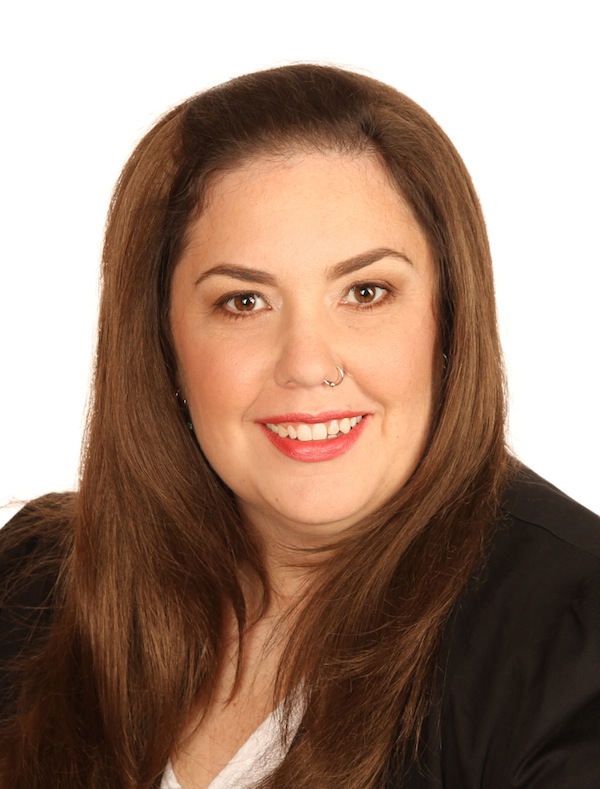
Mitch Joel, president of Mirum marketing agency. (photo from Mitch Joel)
“My first real job was in journalism,” he said. “A ‘nose for news’ doesn’t just apply to journalists, it applies to life. It’s a curiosity. It’s not really satiable, so I can’t imagine not having an entrepreneurial spirit, even if I was an entry-level employee.”
In addition to having one’s antennae always up, Joel encourages businesspeople to not fly solo, if they can help it. “Choosing that partner – making sure it’s the right fit – is really critical,” he said, noting that Mirum’s corporate leaders complement each other in their abilities. “We each hate what the other one is doing,” he said, with a chuckle.
Knowing one’s strengths and weaknesses is important, and so is knowing to whom your product or service is directed, he said. Joel is less interested in making broad generalizations of any generation – be it boomer, Gen X or millennial – than on the type of consumer.
“Selling to moms is very different than if we are selling to healthcare professionals. Selling to healthcare professionals is very different than selling to a group you are trying to get to open a checking account,” he explained. “I know a lot of people are making a lot of money on, ‘How do you speak to millennials?’ I think it is really hard to look at millennials and say they are a segment. You are talking about people of different gender, people of different interest levels, people of different education, people of different geography.”
In addition to his speaking engagements and corporate marketing advising, Joel has imparted some of his advice via two bestselling books. His first, Six Pixels of Separation, was named after his popular blog and podcast, and his second, CTRL ALT Delete, was named one of the best business books of 2013 by Amazon.
In CTRL ALT Delete, Joel discusses “flow,” a figurative time-management, three-legged stool, consisting of the personal, communal and professional. It’s a balancing act with which the husband and father of three still struggles.
“I just try to make sure that there is a balance of that stool because, if one leg is shorter than the other, it’s going to tip over,” he said.
But that doesn’t mean that work and family can’t overlap.
“I don’t consider it stressful to look at my inbox or think about a project when I’m not in the office. And vice versa, when I’m in the office, I might take off because there’s something with my kids, or there’s another thing I can do, and I can pick up on the work a little bit later,” he explained. “I’m not 100% successful all the time at hitting that balance, and there are moments when that stool looks like it’s tipping over dramatically. But, I’m aware of it and I think about it, and I focus on that – and I don’t beat myself up over it.”
Dave Gordonis a Toronto-based freelance writer whose work has appeared in more than 100 publications around the world.
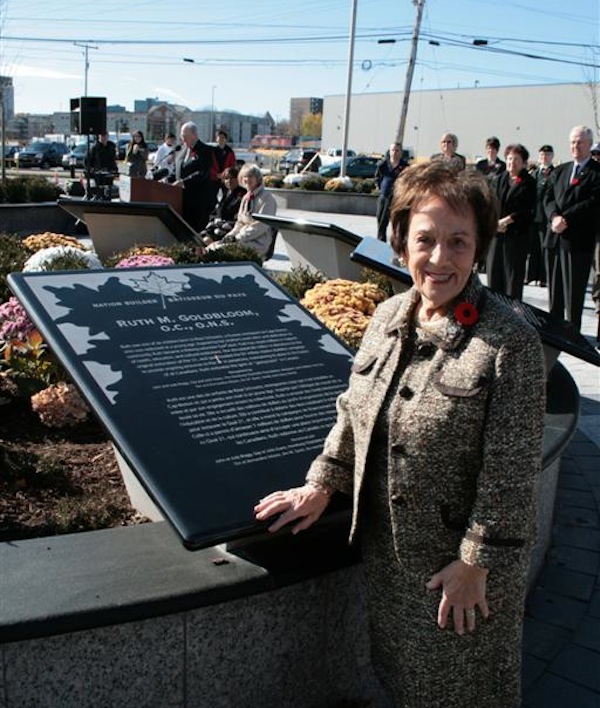
Ruth Goldbloom stands in Nation Builder Plaza in front of the Canadian Museum of Immigration at Pier 21 in Halifax. (photo from CMI at Pier 21)
The museum at Pier 21: National Historic Site opened on Canada Day, 1999. Built to commemorate the almost one million immigrants who passed through Halifax’s Pier 21 between 1928 and 1971, it was renamed the Canadian Museum of Immigration at Pier 21 and designated as a national museum in 2011.
But back to June 30, 1999, the day before it all began. There was a luncheon for the people who had helped turn a shed on the water into a comprehensive museum. Chief among them was Ruth Goldbloom, without whom the museum likely never would have been established. Goldbloom was chair of the Pier 21 Society from 1993 to 1999, and remained active on the board afterward. In 2004, she created and chaired the Pier 21 Foundation, a role that she maintained until just before her death in 2012.
Also present at the luncheon was Rosalie Silberman Abella, who passed through Pier 21 in 1950 as a 4-year-old refugee. In 2004, she became the first Jewish woman appointed to the Supreme Court of Canada.
At the luncheon, Silberman Abella shared two stories. Her parents were married in Poland the day that the Second World War broke out, she said. Her infant brother was killed, and her father’s side of the family was wiped out in the Holocaust. Her parents spent four years in concentration camps, but both survived. In 1946, Silberman Abella was born in a displaced persons camp in Germany.
“It was their way of proving to the world – and themselves – that their spirit was not broken,” she said in her speech, referring to her parents.
After years of trying, the Silbermans were granted entry into Canada. Silberman Abella’s father, a lawyer by trade, was not permitted to practise law in Canada until he became a citizen – but he couldn’t wait the five years it would take to become a citizen to work, as he had a young family to support. So, he became an insurance agent, and inspired his daughter to go into law. He died just before she graduated.
“But he knew somehow it would turn out alright for his family because he was confident in Canada’s generosity,” said Silberman Abella at the lunch. “And how generous it has been! The child my parents had to rebuild their hearts in Germany in 1946 became a judge in Canada in 1976. Remarkable.”
Canada Day, she continued, is her birthday. And what better present could there be than coming back to Pier 21?
“I will never forget how lucky we were to be able to come to Canada, but I will also never forget why we came,” she said. “These are the two stories which complete me – one joyful and one painful – and which merge in the next generation into a mother’s irrevocable gratitude to a country which has made it possible for her children to have only one story – the joyful story, the Canadian story, the story that started at Pier 21.”
Every immigrant has their two stories, at least, from before and after coming to Canada. And countless many of these stories would have been lost to time, a bit more detail lost with each retelling, were it not for the efforts of Goldbloom.
Goldbloom was born Ruth Schwartz in New Waterford, N.S., on Dec. 5, 1923. She was known for her family’s hardware store and for her tap dancing.
“This sense of charity and giving back to the community – at all the community fundraisers and anything, she would always dance at those events, so the spirit was always in her,” said Carrie-Ann Smith, chief of audience engagement at Pier 21.
Smith was one of Pier 21’s first employees. She started working there in 1998, before the museum opened, and continued working with Goldbloom until Goldbloom passed away.
“She just stayed, she just kept volunteering. She was constantly here. She never had an office, we always moved her around,” said Smith of Goldbloom. “I miss her so much.”
The idea to turn Pier 21 into a national site started with J.P. LeBlanc, founding president of the Pier 21 Society. LeBlanc was a retired immigration officer with the modest goal of acquiring an Historic Sites and Monuments Board of Canada plaque to put on the outside of the old Pier 21 building. Before he could complete his goal, however, he developed bone cancer. Around that time, he attended a Dalhousie graduation ceremony where Goldbloom was giving the convocation address.
“This was the ’80s, when people really weren’t looking back and thinking of Canada as a country of immigrants,” said Smith. “And that was the theme of [Goldbloom’s] talk, that we as a country have never really thanked our immigrants. [LeBlanc] knew that he was going to get much sicker, and he was really taken with what she said and how passionate she was about honouring the immigrants that built Canada.”
LeBlanc asked Goldbloom if she would take over the Pier 21 Society, and she did. She began fundraising almost immediately, and decided that a simple plaque wasn’t enough. For years, she worked to create the museum. She traveled the country on her own money, raising awareness and funds about the project, and used her knowledge to lobby the government.
In 1995, Halifax hosted the G7 Summit. Traditionally, the summit’s host city receives a gift and, for Halifax, it was a promise from then-prime minister Jean Chrétien to help build a museum at Pier 21. The deal was, if Goldbloom could raise $4.5 million, then the municipal, provincial and federal levels of government would work together to match that donation.
“It sounds so modest now,” said Smith of the $9 million that brought the museum into being.
The Wheel of Conscience commemorates the voyage of the St. Louis, whose 937 Jewish refugee passengers were refused entry into Canada and other countries in 1939. (photo from CMI at Pier 21)
When it opened, the museum contained exhibits about the history of immigration in Canada, as well as a database of more than one million immigration records. Smith remembers the very first person who ever asked for an immigration record.
“When I showed her the record, she started crying,” said Smith. “I just didn’t realize how profound the impact of that [immigration record] collection was going to be. Her husband had just died days before, and she wanted to make sure she had the original European spelling of his last name on his grave.”
Marianne Ferguson is another woman who received a surprise on the first day the museum opened. (See “Making Canada home.”) Ferguson had come through Pier 21 in March 1939, a Polish immigrant who had escaped Europe months before the start of the Second World War. While the pier was put to military use during the war, Ferguson volunteered there once it reopened, helping refugees get settled in Canada.
By 1999, Ferguson was an established member of the Halifax Jewish community. She would always ask Goldbloom to help her out at shul, but Goldbloom was too busy. To make it up to Ferguson, Goldbloom planned a surprise for her on the opening day.
“When I got to the pier, I didn’t know what to look for,” said Ferguson. “[Goldbloom] said, ‘I’m not going to tell you, you have to find it yourself.’ And I didn’t know, what am I looking for?… I had my son Randy with me that day, he says, ‘Oh, come here, here’s something from you.’”
It was a quote from an essay Ferguson had written in 1942 as a 16-year-old schoolgirl in Canada: “Everyone asked them to take us with them, but that, too, was impossible.” The essay can be found on Pier 21’s website. The “everyone” refers to Ferguson’s extended family, all of whom died in the Holocaust.
Ferguson only had kind words to say about Goldbloom, calling her “the heart of Pier 21.”
Goldbloom would prove that multiple times over the years.
“By about 2002, 2003, it was getting pretty rough to pay the bills,” said Smith. “It was just really a shed on the waterfront, one of the windiest spots in the country, and it was expensive to heat and light … when you’re a National Historic Site, we had that status by then, that just means they can’t tear down the building. That’s all it means, it didn’t come with any funding.”
So, Goldbloom decided to set up a foundation to raise money for the museum. Instead of going door-to-door and asking a million people for $7, she decided to ask seven people for $1 million. These people would be called “Nation Builders.”
“When she had the six Nation Builders, all of her friends chipped in and made her the seventh Nation Builder,” said Smith. “That allowed us to have an endowment. That’s what she wanted – that security for us.”
This year, to celebrate Canada’s 150th anniversary, the museum is putting on a special exhibit called Canada: Day 1, which looks at what the first day in Canada is like for arriving immigrants. Since Goldbloom was born in Canada, she never had that experience. But, as she would regularly point out, the only indigenous people in Nova Scotia are the Mi’kmaq – almost everyone living in Canada can connect their history to an immigrant at some point. She dedicated much of her life to commemorating immigrants’ contributions to this country and her story is inextricably entwined with that of Canadian immigration and Pier 21.
Alex Roseis a master’s student in journalism at the University of King’s College in Halifax. He graduated from the same school in 2016 with a double major in creative writing and religious studies, and loves all things basketball. He wrote this article as part of an internship with the Jewish Independent.
Kat Romanow is director of food programming at the Museum of Jewish Montreal. (photo from Kat Romanow)
Kat Romanow has taken upon herself the challenge of teaching people more about Jewish food in one of Canada’s most Jewish cities.
“I started studying Judaism in my undergrad and, at the end of it, food was something that sparked my interest,” said Romanow. “I ended up going to Boston for a summer to do an internship and it was there that all of this coalesced.
“Jewish food is what I want to study academically. I also felt a connection to Judaism – Shabbat dinners, shul … I get the non-academic Jewish things, and it was there I realized I felt a deep connection to it. That’s when I knew I wanted to convert. It’s a connection I didn’t necessarily feel in Catholicism, but I found in Judaism – the community, rituals … things that really speak to me and bring meaning to my life.”
Romanow was born and raised in Montreal and is currently the director of food programming at the Museum of Jewish Montreal, where she runs and manages Fletchers, the museum’s restaurant.
Founded in 2010, the museum offers walking tours of historic Jewish neighbourhoods, numerous online exhibits and a large oral history collection. And, now that they have a physical space – which they acquired about a year ago – they also offer lectures, workshops and pop-up exhibitions.
Romanow majored in Jewish food history at Concordia University and, in conjunction with the museum and a friend, developed a walking tour called The Wandering Chew.
“We aimed to teach people about lesser-known Jewish food traditions through pop-up dinners, cooking workshops and other food events,” said Romanow. “That’s where I got the cooking experience, holding pop-up dinners for 30 to 40 people. We’d find the community we wanted to explore, interview people from the community, including getting their recipes, put together a menu and do a dinner.”
The goal was to expand people’s knowledge about Jewish food. “Here, in Montreal, you automatically think of bagels and smoked meat,” said Romanow. “But, our aim was to go beyond that and show people that Jewish food is very diverse and is made up of a lot of different cuisine and dishes.”
At Fletchers, they serve foods during the day that draw from the flavours of the diverse communities highlighted on the walking tours. And, in the evening, one can find a variety of workshops, meals and cookbook launches.
Romanow has been selected to represent Montreal at the ROI (Return on Investment) Summit in Jerusalem July 2-6. The summit brings together 150 of the brightest Jewish minds from around the world to brainstorm ideas for the future.
“I’m really excited,” said Romanow. “It’s also my first time going to Israel. For the summit, I’m most excited about getting to meet all these other young Jews doing really cool projects … making connections and sharing ideas. We’ll learn from each other and build off of what we’re all doing. So, I think, coming out of this, I’ll be full of new ideas and inspiration. I’ve already received emails and I can see potential future collaboration.”
Romanow is planning to stay in Israel after the summit, to visit the country, experience the Israeli food scene and get some new ideas for Fletchers.
Something she has found lately is that people in their 20s and 30s are becoming more open to exploring different ways of making the food they grew up with different, putting their own mark on it.
“There’s now a community of younger Jews who are reintroducing people to what Jewish food is,” said Romanow. “I want to keep adding to the menu and keep holding more and more events, so that people can really engage with their Jewish identity through food on a regular basis.
“But, I also aim to write a cookbook about exploring Jewish food in the Diaspora. That’s what I’ve been doing with the Wandering Chew. I think the cookbook is the next step. I’m in the process of writing the proposal, so hopefully in the next few years it will come out.”
For now, Romanow plans to delve deeper into local Jewish food history, as she balances running Fletchers, the Wandering Chew dinners and walking tours of the local Jewish food scene, which are called Beyond the Bagel.
Through Beyond the Bagel, Romanow said, “We go to places like Schwartz’s and we eat bagels. But, I did all kinds of archival research and oral history interviews … and so you get to go deeper into the history of these places.
“At our space (at the museum), we also have a boutique where we sell things related to Jewish history and Montreal – books, locally made products. And we use it as an event space … concerts, lectures and many more.
“Right now, we have Yiddish classes there, too, and photo exhibits that change throughout the year related to Jewish culture. We’re not a traditional museum, one that you go into and look at objects. You can come to the space, grab a bite, browse the boutique and also go on one of the walking tours or onto the website.”
Isaac Greenberg grew up speaking Hebrew, and he was raised with Shambhala, as well. (photo by Alex Rose)
With his lean frame folded behind a small coffee table at Just Us Café in Halifax, with his large wire-frame glasses and thinning hair, Michael Chender looks somewhat like Larry David. But although Chender shares David’s sense of humour and perhaps some of his neuroticism, the soft-spoken and measured Chender embodies little else of the Curb Your Enthusiasm star’s notorious annoyance and impatience with other people. That is not a coincidence.
Chender is a Jewish Buddhist, or Jew-Bu, one of a number who call Halifax home. Most of the Jew-Bus in Halifax follow a tradition called Shambhala.
In Tibetan folklore, Shambhala is a mythical kingdom that represents a just and good society. It is also the inspiration for a worldwide movement, which has its headquarters in Halifax.
The movement was started by Tibetan Buddhist Chögyam Trungpa Rinpoche (Rinpoche is a Tibetan honorific). He escaped Chinese-occupied Tibet in 1959 at 19 years old, already a renowned sage. According to Chender, in Tibet, older teachers would come and ask the teenage Trungpa questions.
By the 1970s, Trungpa had settled in Boulder, Colo., where his Western following began to develop in earnest. He wanted to teach meditation in the West in a secular language. He taught that everyone was possessed with a fundamental goodness, and that life is worth living. A central philosophy of Shambhala is spiritual warriorship, which is accomplished by living a life of fearlessness, gentleness and intelligence.
Trungpa was known for both his incredible mind and for being an eccentric. He encouraged his followers to take pride in their heritage, so on Robbie Burns Day he would dress up in a kilt and celebrate with his Scottish disciples, and he would work Yiddish phrases like “oy vey” into his lectures. In 1986, Trungpa moved the headquarters of the Shambhala community to Halifax. In 1987, he died there of liver failure at the age of 48.
“He decided that Colorado was too speedy, materialistic, flashy, and that we should move to a simpler, more peaceful, calm place,” said David Greenberg, a former Jew-Bu and current Christian. He was raised outside Boston as an atheist Jew, and is conversant in Hebrew. He is the grandson of Rabbi Simon Greenberg, the founder of the University of Judaism at Los Angeles, a branch of the Jewish Theological Seminary of America.
When Greenberg was 17, he started reading Trungpa’s teachings, and joined the Shambhala community for the first time at 22. He met his wife through Shambhala and, together, they had four children. Eventually, the couple divorced and, in 2009, Greenberg converted to Christianity. Nonetheless, he said he felt more Jewish when he became a Buddhist, and even more Jewish now as a Christian; it’s allowed him to appreciate his Jewishness and not just take it for granted. For example, he said, he explains the Hebrew meanings of Bible verses to his fellow churchgoers.
Michael Chender knows what he likes about Judaism and what he wants to take from it. (photo by Alex Rose)
Chender feels similarly.
“I began to feel much more Jewish after I became a Buddhist,” said Chender. “My being Jewish … it’s deep in the bones, an ethnic thing. I’m very proud of my people.”
Chender calls himself an Upper West Side Manhattan product of the late 1960s – a Woody Allen-type kid who was high-strung and philosophical, the kind who was worried about the world ending millions of years in the future. For him, being Jewish meant viewing the world through Allen’s lens, not beneath a phylactery on his forehead. Religion was never a key component of his Jewish identity – he only knew one observant family growing up – but the culture and heritage always were. He is proud of the Jewish intellectual and moral tradition.
Chender knows what he likes about Judaism and what he wants to take from it. Not every Jew-Bu has such a concrete self-identity.
Isaac Greenberg is David Greenberg’s son, and a university student in Halifax. He grew up speaking Hebrew, and he was raised with Shambhala, as well. After his parents divorced, his mother moved him and his three siblings to Halifax. He was 11 at the time, and he lost his connection with Judaism for almost a decade. When his mother left Shambhala, when he was 17, he lost touch with that community, too.
“After first year of university, I kind of lost my mind … I just became totally untethered. I broke up with the person I was dating for a year-and-a-half, which set off this total spiral of insecurity and not figuring myself out. And then you just grasp the things that you know,” said Greenberg, noting that Judaism and Shambhala are his “foundations.”
Towards the end of his second year, he wanted to reconnect with Judaism. He was dating a Jewish woman, he said, “and she invited me to a seder and she was talking all about Judaism. And I was like, ‘Oh, I remember these things, and they were really great times.’”
Since then, he has been making a conscious effort to become more involved in the local Jewish scene. But he’s not entirely sure how.
“I kind of feel like an outsider,” he said.
As to why some Jews find their way to Buddhism, Chender said there are three common links between Judaism and Buddhism. The first one is appreciation for the critical mind, of inquiry and analysis. The second one is the importance of humour. The third is the truth of suffering.
“As my grandmother said to me when I was telling her about Buddhism, ‘You’ve gotta tell me this?’ We kind of know the truth of suffering in our bones,” said Chender. “So, it was like really coming home to some long-lost cousins who, actually, whatever they’ve been doing the last few thousand years, they had figured some sh*t out…. I wouldn’t go so far as to speculate where the lost tribes went or came from, but, you know.”
Alex Roseis a master’s student in journalism at the University of King’s College in Halifax. He graduated from the same school in 2016 with a double major in creative writing and religious studies, and loves all things basketball. He wrote this article as part of an internship with the Jewish Independent.
Marianne, left, with her father, Otto Echt, and sister Brigitte. (photo from Canadian Museum of Immigration [CMI] at Pier 21)
Marianne Ferguson’s family missed the train that was supposed to take them to Montreal from Halifax. Just 13 at the time, she and her sister were mostly excited at the prospect of something new, although they were sorry to leave friends and family behind in Europe. Their parents, however, were apprehensive, worried about starting a new life in a foreign country. And that was before they got stuck in Halifax – where, almost eight decades later, Ferguson, née Echt, still calls home.
In Europe, the Echts had lived in a little resort town called Brosen, just outside of the Free City of Danzig, which is today the Polish city of Gdansk. Ferguson’s father, Otto, was a pharmacist and a hobby farmer, and they lived well. Her mother, Meta, had multiple maids; the children – Marianne, Brigitte and Reni – had a nanny, and every spring and autumn a dressmaker would come into their home for a week to create new wardrobes for the upcoming season. When Adolf Hitler came to power, Ferguson’s family was relatively unaffected in the beginning. Even so, her parents saw what was coming and began making contingency plans.
Ferguson’s father kept homing pigeons on his farm. He would go to Poland to deposit money, and send the pigeons back home with coloured ribbons tied to them for Ferguson’s mother to decipher. A yellow ribbon meant he had arrived, for example, while a red ribbon meant he had deposited the money. He was able to get away with this scheme because the guards at the Polish border assumed he was entering his pigeons into competitions.
The Echts continued living in Brosen as the situation deteriorated for Jewish families. When the fair-haired Ferguson traveled to Hebrew school in Danzig with her sister, Hitler Youth would yell at her to ‘Stop walking with that Jew!’ When the Jewish children in the region were no longer allowed to attend school with their peers, the Jews of Brosen opened their own school on a local estate. The estate was at the end of a long street inhabited by Nazis, and it was understood the Jewish children all had to be in school and off the street by 8 a.m.
One day, when Ferguson was about 11 or 12, her streetcar to school was late. As she was walking alone down the long street to her school, a man sent his police dog after her. The dog attacked her, biting her on the elbow.
“And all of a sudden, somebody raised me up. Must have been an angel, really,” said Ferguson in a recent interview with the Independent from her nursing home in Halifax.
It was the milkman. He put Ferguson in his wagon, drove her to school and deposited her inside the gate. Ferguson said that man saved her life.
For her parents, it was the last straw. They decided they had to get out. A member of the Canadian consulate informed them that the country was not accepting pharmacists. Fortunately, though, the consulate worker saw their little farm and suggested sending them as farmers. And so it was that the Echts found themselves coming through Pier 21 in Halifax on March 7, 1939.
When they arrived at the pier, someone called their names and frightened Ferguson’s father. How did people here know who they were? But the woman calling them was Sadie Fineberg, from Jewish Immigrant Aid Services (JIAS). When the Echts missed their train, Fineberg put them up in a boarding house run by a Yiddish-speaking woman, and many Jewish families came to visit them.
Marianne Ferguson (photo from CMI at Pier 21)
“My parents said, ‘The people were so nice to us, and how do we know what it’s going to be like in Montreal? Maybe we should stay in Nova Scotia.’ And then they helped us with finding the farm, they drove us out … and we moved over there,” said Ferguson.
The farm was in nearby Milford, about a 45-minute drive from downtown Halifax. The Echts had to stay and work the farm for seven years as a condition of their immigration and, after their term ended, they moved to Halifax. Fineberg became a close family friend, and her nephew Lawrence became Ferguson’s husband.
Ferguson’s extended family was not so lucky. Her parents had applied to bring 11 of them over to Canada, and they were supposed to arrive later in the year. Cutting through all the red tape took time, but the process seemed to be progressing. Ferguson’s 11 family members went to meet their boat in Hamburg – but it wasn’t there. That day was Sept. 1, 1939, and the Second World War had just broken out.
“My father had bought a second farm. We were so lucky, it was right next to our farm. We thought we would all be together in the two farms. But it wasn’t meant to be. They were all killed,” said Ferguson.
When the war ended, Ferguson began volunteering with JIAS, helping Jewish refugees find their way in Canada. Many of the displaced persons were children traveling alone. Ferguson remembers one 17-year-old boy in particular who came through Pier 21 in 1948 and needed money to get to Montreal. Ferguson and her mother gave him $20 and some food. They also told him that he would become a good citizen, and he should work hard and make something of himself. Meanwhile, Ferguson continued to volunteer at Pier 21 until it closed in 1971. She began volunteering there again when it reopened as a museum in 1999.
Unbeknownst to Ferguson, the boy listened to her. His name was Nathan Wasser, and he had survived multiple camps in the Holocaust, including Auschwitz. He was trained as an electrician in Munich after the war, so that’s the work he first did after arriving in Montreal. In 1952, he met his wife-to-be, Shirley, at a parade for Queen Elizabeth, who was still a princess at the time. Together, they started a family, having a daughter and a son, and he ventured into the business world. Wasser eventually came to own his own shopping centre.
Marianne Ferguson volunteered at Pier 21 when it was an immigration facility and again when it reopened as a museum. (photo from CMI at Pier 21)
Through it all, Wasser – who passed away in 2015 – kept in mind the two women who had helped him when he first came to Canada as a scared and overwhelmed teenager.
“So I said to him, ‘You know, you have this vision of two volunteers. Would you like to go back to Pier 21?’” said his wife Shirley Wasser in a phone interview with the Independent. “And he said, ‘Well, I’ll never find anything.’”
Despite his doubts, Wasser contacted the Atlantic Jewish Council in 2003. The council connected him to Ferguson (her mother had already passed away), and they arranged to meet when the Wassers visited Halifax later that year.
On the appointed day, Ferguson and her granddaughter waited in the lobby of Pier 21 for a man with a blue shirt. Unfortunately, it seemed as if every man was wearing a blue shirt that day. Finally, a couple entered. The man was wearing a blue shirt and carrying flowers.
“My granddaughter said, ‘I think that’s for you.’ And, you know, he recognized me,” Ferguson recounted as she started to tear up.
Ferguson and Wasser stayed in touch until Wasser’s death, and she is still in contact with his wife. Whenever the Wassers came to Halifax, the Fergusons would have them over for Shabbat dinner on the Friday, then the Wassers would take out the Fergusons for dinner on the Saturday. Every birthday and holiday, Nathan Wasser would send a bouquet of flowers to Ferguson.
“He had no words for her, how grateful and how appreciative he was to the pier and the volunteers,” said Shirley Wasser. “I think [Ferguson] was one of the finest ladies I’ve ever encountered.”
“He did save his money and he listened to what we were saying. He said he owed it to us to do well. He was so grateful,” said Ferguson, speaking of her late friend somewhere between laughter and tears.
Alex Roseis a master’s student in journalism at the University of King’s College in Halifax. He graduated from the same school in 2016 with a double major in creative writing and religious studies, and loves all things basketball. He wrote this article as part of an internship with the Jewish Independent.
East Coast Bakery opened in Halifax on May 14 last year. (photo by Alex Rose)
Gerry Lonergan wants to put Halifax on the bagel map. “Why do Montreal and New York own bagels?” he asked. “Two cities shouldn’t own bagels. Why can’t Halifax own them?”
Lonergan’s East Coast Bakery celebrates its one-year anniversary May 14. Since he opened last year, he’s been churning out quality bagels. The bakery came in third in a local newspaper’s poll for best new business after being open for only 45 days – and the voting had started two weeks before the store’s first day.
Although Lonergan is from Montreal, he is adamant that his bagels are their own style, which he calls East Coast. There are a few things that set them apart.
The first is sourdough: Lonergan is the only baker he knows who uses it for his bagels. The second is that his bagels are kosher, even though Lonergan himself isn’t Jewish.
With a laugh, he noted that Chabad Rabbi Mendel Feldman “said if I do become Jewish I wouldn’t be able to open on Saturday, so it works for everybody in the community.”
Gerry Lonergan (photo by Alex Rose)
About his decision to go kosher, Lonergan explained, “If I went kosher, it was another level of auditing, of standards, of quality that I felt a lot of people would have trouble following my example, so it would give me a leg up in it from a business standpoint. But, also, I thought it was the right thing to do, it would just add that extra bit of authenticity to these bagels.”
Halifax Jewish community member Josh Bates helped Lonergan get started. The two met when a mutual friend told Bates he had to try Lonergan’s bagels, when Lonergan was still making them from home.
“In terms of becoming kosher, I also introduced him to the Chabad rabbi who kosher-izes his bagels, if that’s the word,” said Bates.
Bates works in the mayor’s office and, although he didn’t help Lonergan in any official capacity, he was able to use his knowledge to help in other ways.
“He had a few questions around building code, getting approvals, finding a location. I introduced him to the executive directors of a couple different business improvement districts in Halifax,” explained Bates.
With a background in the electronics industry, where he streamlined production processes, Lonergan knew how he wanted his bakery to function and what he would need to make it happen. The entire back of the bakery is open concept, so the customer can see as the bagels and challot are made every step of the way.
It was important for Lonergan to find the perfect place to set up shop, in part because his machines need three-phase power, which wasn’t available in every potential location. One of those machines turns tubes of dough into rings, which are then each individually hand-stretched before being boiled in a pot of honey-water. The machine churns out the rings at a rate of 3,600 an hour, or one a second.
While living in Montreal, Lonergan visited Halifax a few years ago and knew it was the place he wanted to be.
“I came for a five-day trip and I just fell in love. I just said, ‘Wow the people are so nice, the ocean is amazing.’ I just saw lots of opportunity here, and I saw there was a need for what I wanted to do here. There was a need for artisanal bread, artisanal bagels,” he said. “Within 48 hours of that trip, I said, ‘That’s it, I’m moving.’ I came home and put my house up for sale within about five days.”
In less than a year, East Coast Bakery has become something of a Halifax institution. Aside from his bagels and challot, which are based on old family recipes, Lonergan hopes to add hamantashen by next Purim. But even if he keeps the menu the same, Bates said the quality of Lonergan’s baked goods should ensure the bakery’s success.
“No matter how good a bagel is, it’s always better when it’s fresh out of oven…. I like a thin sweet bagel right out of the oven and, until East Coast Bakery opened, you couldn’t get that in Halifax,” he said.
And the challah? “Best challah I’ve ever had,” Bates said. “When I go in there and buy a bag, I have hard time not finishing an entire loaf on my walk home.”
Alex Roseis a master’s student in journalism at the University of King’s College in Halifax. He graduated from the same school in 2016 with a double major in creative writing and religious studies, and loves all things basketball. He wrote this article as part of an internship with the Jewish Independent.
Andrea Silverstone, coordinator of Shalom Bayit at Jewish Family Service Calgary. (photo from Andrea Silverstone)
A study of domestic violence in Jewish communities in the Prairie provinces was recently completed.
“The study has been a desire of mine probably since the day we started,” said Andrea Silverstone, Shalom Bayit coordinator at Jewish Family Service Calgary, “because a lot of what we know about domestic violence in the Jewish community is based on anecdotal information, suppositions, copying what is in the non-Jewish community or research from other jurisdictions outside our own.
“We were doing a good job of addressing the needs of the clients who walked in the door, some of the prevention programs we had in the schools and the community … [but] it wasn’t research-based in the sense of understanding the scope of the issue across the Jewish communities in the Prairie provinces.”
Silverstone would have loved to do a Canada-wide study, but her supporter, Resolve, which is a tri-party research body conducting community-based action, has a set research mandate of focusing exclusively on the Prairie provinces: Saskatchewan, Manitoba and Alberta.
Over the years, Silverstone has done a lot of work with Resolve and has an extensive background in dealing with domestic violence in her capacity at Shalom Bayit, which addresses everything from bullying and harassment to child abuse, elder abuse and spousal abuse.
“There was a research study done in 2004 by Jewish Women International that was fairly comprehensive,” said Silverstone. “So, we reached out to them, asking to borrow the methodology of their study, which they allowed. We also thought it would be a good comparison.”
Silverstone and the Resolve team, led by Dr. Nicole Letourneau of the University of Calgary, then approached Jewish Child and Family Service in Winnipeg, Jewish Family Services in Edmonton and various Jewish community organizations in Saskatchewan, asking them to be involved.
Silverstone found that getting people to work on this topic was easy – both the academics and community groups – as domestic violence has touched most people in one form or other.
“Everyone wanted to better understand the scope and needs around domestic violence in the Jewish community,” said Silverstone. “I don’t think anyone needed to be convinced [that there was an issue worth studying]…. It was just a matter of figuring how to best do this, so we that we weren’t taxing already taxed resources.”
The study involved two parts in terms of gathering data. The first part had participants take 20 to 25 minutes to fill out a survey based on the JWI survey. About 280 people filled this out.
Once the surveys were collected, the researchers asked two questions: Was there anything surprising? And, what did they understand from it?
“Those were the two data question points that helped us build the results of the study,” explained Silverstone. “We knew we’d have data to compare to mainstream populations. In terms of rates of people reporting that they are survivors of domestic violence, it is about the same as the general population. Twenty percent of the people who answered our study said they were victims of domestic violence. And, in the general population, those numbers are anywhere from 25 to 40%.”
The other aspect, she added, is “of those who experience domestic violence, their experience of it, in terms of physical and financial toll, is about the same, except for in our reported rates in the study of domestic violence in the form of emotional abuse – that is higher than the general population. They report about half to 60% of the domestic violence they experience is verbal [in the general population] and, in our survey, it was 82%.”
Silverstone said this divergence may be because Jews are very verbal people. Another possibility is that people tend to perceive verbal abuse as a more acceptable kind of domestic violence – they refrain from physically hitting their partner, but they won’t stop themselves from yelling or name-calling. “This is probably an area we should be researching further,” said Silverstone.
For Silverstone, there were some surprises when it came to the survey results, such as the low number of people who would consult with their rabbi about their situation – only three percent of those surveyed.
“Something that struck me,” she added, “which was also a finding of the JWI study, is that the top three sources victims utilize in domestic violence situations are friends, family and private therapists. Friends and family are, by far, the highest. It made me realize that we need to be focused on teaching friends and family in the Jewish community how to recognize domestic violence, to respond appropriately and then to refer people.”
Currently, Silverstone is in the process of determining which kinds of programs should be implemented and what kind of awareness-raising campaigns the community should be taking on, based on the survey results.
The first step is to educate friends and family about how to be good supports, she said. “There is all sorts of other research out there about what are called ‘informal supports.’… If the informal supporter has a healthy response, the person is going to go get help. If they don’t, that person is going to shut down and not seek help again for a long time. I think it’s important that we get that straight.”
Silverstone feels strongly that there is a need to dig deeper and find out why people are not using rabbis. “Is this because we’re not doing a good enough job of helping rabbis be effective supporters? Are they not talking about the issue enough? Do people not feel safe? Because they are a great resource if we can tap into them.”
Another big issue that came to light through the survey is that of safe housing for victims and that victims are not finding shelters to be helpful. Silverstone wants to examine this further.
If you or someone you know is experiencing domestic violence, contact the Jewish Family Service Agency at 604-257-5151, the bc211 help line at 211 if you live in Metro Vancouver, the Fraser Valley, Squamish-Lillooet or Sunshine Coast, or VictimLinkBC at 1-800-563-0808.
Beginning June 1, 40 million commemorative bank notes will be distributed through Canada’s financial institutions. The $10 note, celebrating the 150th anniversary of Confederation, features Sir John A. Macdonald, Sir George-Étienne Cartier, Agnes Macphail and James Gladstone. Macdonald was Canada’s first prime minister and one of the Fathers of Confederation. Cartier, also one of the Fathers of Confederation, was a principal architect of Canadian federalism and a proponent of Confederation as a means of safeguarding French Canada and other minorities. Macphail was a champion of equality and human rights who, in 1921, became the first woman elected to the House of Commons in Canada. Gladstone, or Akay-na-muka (his Blackfoot name), committed himself to the betterment of indigenous peoples in Canada and, in 1958, became Canada’s first senator of First Nations origin. The back of the note emphasizes Canada’s natural landscapes. For more information, visit bankofcanada.ca/banknote150.
The ribbon-cutting at the launch of the Canadian Jewish Experience exhibit. From left to right: Dr. Mark Kristmanson of the National Capital Commission; Supreme Court Justice Michael J. Moldaver; Ottawa Police Chief Charles Bordeleau; Rabbi Reuven Bulka of Machzikei Hadas Synagogue; Catherine Bélanger, widow of the late member of Parliament Mauril Bélanger; Tova Lynch of CJE; Linda Kerzner of Jewish Federation of Ottawa; and Cantor Daniel Benlolo of Congregation Kehilat Beth Israel. (photo from CJE)
A new exhibit opened in Ottawa on April 2, to mark the contribution of Jews to Canada and to celebrate the 150th anniversary of Confederation. The Canadian Jewish Experience: A Tribute to Canada 150 is on display in the lobby of 30 Metcalfe St., just two blocks from Parliament Hill, and is open to the public daily from 9 a.m.-6 p.m.
The Canadian Jewish Experience is composed of specially created, bilingual exhibit panels illustrating nine major themes, such as contributions in war and diplomacy, public service, human rights, business growth, arts, culture and sport. A traveling version of the CJE exhibit will be available for display in other cities in Canada.
A parallel website has also been created to present more detailed information about the CJE exhibit topics and about many extraordinary Canadians. The website will provide information about venues for the lecture series and locations where the traveling exhibit can be viewed.
The Canadian Jewish Experience will also present a speaker series to highlight the contributions of Jewish Canadians to the development of Canada.
CJE has produced a special exhibit panel called Remembering Louis Rasminsky, which describes the work of Rasminsky, who was the first-ever Jewish person to be governor of the Bank of Canada. This will be on display at the Bank of Canada headquarters in Ottawa.
At the exhibit opening, CJE committee head Tova Lynch thanked donors from across Canada for the financial assistance they provided. In particular, she acknowledged its major donors: the Asper Foundation and Bel-Fran Charitable Foundation (Samuel and Frances Belzberg) from Vancouver.
“The CJE is an example of the tremendous love which Canadians have for our country,” Lynch added, praising the National Capital Commission for its cooperation. “Through our partnership with the National Capital Commission, CJE has an excellent downtown facility at the centre of events celebrating Canada’s 150th birthday.”
Lynch also noted, “Excitement is building as we approach Canada Day 2017. CJE will tell Canada’s Jewish story to many thousands of visitors to Ottawa in 2017.”
She pointed out that “Jewish Canadians have played a key role in all facets of life in Canada. Their accomplishments reflect the challenges and successes experienced by Canada in its first 150 years.”
The Jewish connection to Canada dates back to the mid-1700s. “The first Jewish Canadians arrived more than 100 years before Confederation,” noted Senator Linda Frum. “We’ve been here for a quarter of a millennium, but many Canadians don’t know the role we’ve played to make our country strong and vibrant. The Canadian Jewish Experience will help to change that.”
Ottawa Mayor Jim Watson said that the national capital is the appropriate home for the Canadian Jewish Experience. “In 2017, Ottawa will be at the centre of celebrating Canada’s 150th birthday and Jewish people have played a key role in all facets of life in the city. In fact, their accomplishments here reflect all the themes of the Canadian Jewish Experience, including being elected mayor.”
Other Jewish leaders and organizations who have assisted the Canadian Jewish Experience project include Victor Rabinovitch, former president and chief executive officer of the Canadian Museum of Civilization (now the Canadian Museum of History); the leaders of Jewish federations across Canada; and the Centre for Israel and Jewish Affairs. CJE is also supported by members of Parliament from all federal parties, Senator Frum, former senator Jerry Grafstein and Rabbi Dr. Reuven Bulka. Sandra Morton Weizman of Calgary is the curator of the CJE exhibit and virtual exhibit.
Canadian Young Judaea’s National Leadership Conference in February, which had participants from Vancouver, Montreal, Toronto and Halifax. (photo from CYJ)
Many of Metro Vancouver’s residents are from other parts of Canada. It is no surprise, therefore, that many members of Vancouver’s Jewish community are familiar with Canadian Young Judaea (CYJ). But the memories of CYJ date back even further than most anyone can recall because CYJ is celebrating its 100th anniversary.
Started by 11-year-old Dov Joseph in 1910 in Montreal as a Zionist club, CYJ was officially proclaimed at the 15th Zionist Convention in Winnipeg in 1917. Within eight years, there were 75 clubs across Canada and, by 1935, national membership reached 5,000. Jews in small towns like Timmins, Ont., and Melville, Sask., formed groups and organized activities.
“There was a ken (group) in every city that had a Jewish population,” said CYJ national director Risa Epstein about the organization at its peak. “In Ontario alone, CYJ was active in Niagara Falls, St. Catharines, Sarnia/Petrolia, North Bay, Sudbury, Peterborough, to name a few. In the West, you could find CYJ in Vancouver, Edmonton, Calgary, Winnipeg, Saskatoon, Moose Jaw, Regina and many smaller communities and, of course, it was in every small town in the Atlantic region.”
In the beginning, the appeal of CYJ was its purpose, its focus on Zionism at a time when antisemitism was rampant throughout Europe and in Canada (and elsewhere) as well. The Zionist dream was that of young Jews taking control of their fate, according to acclaimed Canadian poet A.M. Klein, who served as the editor of The Judaean from 1928-32. Klein wrote in 1931, “Jewish life, as at present constituted, with barrenness and emptiness, its utter meaninglessness, its haphazard activity, stands as an imperious challenge to Canadian Jewish youth.”
Epstein described the nature of CYJ in less fiery terms. “It was born out of the desire of young Jews in Montreal to have a group to come to and discuss and dream about a Jewish homeland,” she said. “It later grew from a city-based organization to summer camps and Israel programs.”
The camps were established as early as 1942 in Quebec, followed by Camp Kadima in Nova Scotia in 1943. Ontario, Manitoba, Saskatchewan and Alberta also had CYJ-affiliated camps. British Columbia was the last to add a camp, in 1956, known originally as Camp Hatikvah-Massada in Oyama.
After the establishment of the state of Israel in 1948, the Zionist dream was realized and CYJ took steps to affiliate with youth group Hanoar Hatzioni in Israel. As a result of the newfound excitement about making aliyah, a number of Young Judaeans went to study in Israel. In the 1950s, camps were established across the country that simulated the kibbutz experience.
Today, according to Epstein, CYJ has more than 2,000 members (7 to 18 years old) from across Canada. As the concentration of the Jewish population has shifted, so have the active centres for CYJ activities. They are now active in the major centres of Toronto, Montreal and Vancouver and are still operating in Halifax. Their summer programming engages close to 750 staff (18 to 22 years old), many of whom are alumni of CYJ camps.
Programming during the non-summer months is organized by age groups. The offerings include leadership-training opportunities, which often parlay into jobs at summer camps. CYJ also provides some programs for parents, alumni events and special training for program directors of the camps.
Every city where CYJ has a presence has JOLT (Jewish Outreach Leadership Training). “It consists of two meetings a month,” explained Epstein. “The first is an educational session and the second is an outreach related to the topic of the first. An example is learning about Jewish veterans in Canada and a bake sale to raise money for the veterans.” She mentioned that participation in JOLT is growing in Vancouver and elsewhere.
CYJ has an historic link with another uniquely Canadian grassroots Zionist organization: Canadian Hadassah-WIZO (CHW). CYJ is and has always been the youth arm of CHW. Epstein said the Biluim Israel trip raises funds for CHW daycares in Israel and includes a day spent volunteering at one of those daycares. In turn, CHW provides funding for some CYJ activities.
Along with this year’s regular programming, including camps and trips to Israel with Biluim Israel, national CYJ is planning a centennial celebration on Aug. 27 at Camp Shalom in Gravenhurst, Ont. The event will run from 11 a.m.-4 p.m and is intended for families. “There will be food, camp-like activities, displays, shira [singing] and rikud [dancing]. It will be an amazing event and we are hoping that there will be over 400 people,” said Epstein.
All Young Judaeans are invited to the celebration. For more information, contact the national CYJ office at 416-781-5156 or e-mail Epstein at risa@youngjudeaea.ca.
Michelle Dodekis a freelance writer living in Vancouver.