Prize for social justice

Kirkland Lake students paint a mural as part of the Indigenous Awareness project. (photo from Toronto Heschel School)

The Toronto Heschel School has announced the recipients of its first-ever social justice Prize for Teaching Excellence 2016. The top award goes to Erin Buchmann at the Kirkland Lake District Composite School in Ontario, which took first prize for its Indigenous Awareness program. Second prize goes to Todd Clauer at Hyman Brand Hebrew Academy, a Jewish day school in Overland Park, Kan., for its Upper School Social Justice Project.

Heschel, a Toronto Jewish school, invited educators around the world – including public, private and religious schools of all denominations – to share how they bring social justice into the classroom through heritage, culture or religion. The call was issued in THINK Magazine, Heschel School’s semi-annual educational thought publication, last November. It invited educators to submit their original class projects and school initiatives that met the following criteria: Is it rooted in heritage, culture or religion; does it inspire social responsibility in children; and has it been implemented successfully?

Toronto Heschel is committed to encouraging today’s youth to be citizens of the world by celebrating and recognizing teachers who use their students’ identity and cultural values to incorporate social justice learning as part of the everyday school curriculum. The award received entries from across Canada, the United States and Israel, and collected many inspiring stories of teachers and students committed to making positive change in the world.

photo - The completed mural, which was painted by Kirkland Lake students as part of the Indigenous Awareness project
The completed mural, which was painted by Kirkland Lake students as part of the Indigenous Awareness project. (photo from Toronto Heschel School)

Buchmann took top honors for the project Indigenous Awareness, based on the Seven Grandfathers’ teachings – core cultural values that teach responsibility to self-govern, take care of the land and one another by standing up for social justice. Students created a large mural in the school, installed an art installation called “Red Dress” around the school and dramatized the Seven Grandfathers’ teachings in a play. The project resulted in a 100% pass rate in the class, where there had been 50% failure level before. The school is also now expanding its aboriginal studies program to include a junior and senior course in 2016.

“We are so proud to win the Prize for Teaching Excellence,” said Buchmann. “The Truth and Reconciliation Commission calls on Canadians to act to promote equality and fairness. We are creating opportunities for students to explore and celebrate their individual identities and heritage while promoting social justice for all. By encouraging and supporting students to take action, we are taking steps towards reconciliation, promoting awareness of social issues and creating a more inclusive environment in our school and our community.”

The Upper School Social Justice Project, which won the second Prize for Teaching Excellence 2016, is implemented across three years of high school. Clauer teaches his students that their Jewish heritage teaches them to embrace and pursue justice through everyday advocacy for the dignity of all peoples, and all faiths.

The project saw Hyman Brand students focus their study and engagement on inequity in access to health care in their community; promoting voter engagement; and campaigning for free, universal, early childhood education. The project, conducted in partnership with a local charter school, also took students – Jewish and African-American, more advantaged and less advantaged, city centre and suburban – on a civil rights journey across the southern United States.

Named for Rabbi Abraham Joshua Heschel, the Toronto Heschel School was founded in 1996 to give children the spirit of awe and wonder as they learn. The school teaches social justice through the philosophy and social action leadership modeled by Heschel. It is a pluralistic Jewish day school, which means it welcomes all Jewish children; it now has more than 270 students (junior kindergarten through Grade 8) from Reform, Conservative, Reconstructionist, Orthodox and secular families. Jewish thinking and ethics are integrated throughout the curriculum to deepen learning, enrich school culture and inspire social responsibility. For more information, visit torontoheschel.org.

May defends new resolution

Green Party of Canada leader Elizabeth May. (photo from cjnews.com)

Federal Green Party of Canada Leader Elizabeth May said she was able to support a revised policy on the Israeli-Palestinian conflict because it rejects the boycott, divestment and sanctions (BDS) movement against Israel, but still puts the onus on the Jewish state to move towards a two-state solution.

At a special general meeting held Dec. 3-4 in Calgary, 350 members voted to pass a policy titled “Measures to pressure the government of Israel to preserve the two-state solution: addendum to current

Middle East policy.” It replaced a policy titled “Palestinian self-determination and the movement for boycott, divestment and sanctions” that passed in August at a Green party convention in Ottawa.

“It needs to be said very clearly that the BDS movement does not understand the issue properly and is in fact undermining the peace process itself,” May told the CJN the day after the addendum passed.

Immediately following the August convention, May firmly opposed the policy that supported the BDS movement.

“The reason I couldn’t accept our policy in August is because it looked very much as though we were adopting the BDS movement. And the BDS movement, although there are well-meaning people who support it, when you get down to it, their core goals do not include at all … the right of the state of Israel to exist,” May said.

At that time, May considered stepping down as leader as a result but, following a family vacation, she ultimately announced she would stay on as leader, partly because the party’s executive council agreed to call a special meeting to give members the opportunity to revisit the BDS resolution.

The amended policy states, among other things, that the “Palestinian people are among the indigenous people of the geographic region now designated as Israel and the OPT [occupied Palestinian territory],” and it supports “only non-violent responses to violence and oppression, including economic measures such as government sanctions, consumer boycotts, institutional divestment, economic sanctions and arms embargoes.”

It calls for a ban on products produced “wholly or partly within or by illegal Israeli settlements, or by Israeli businesses directly benefiting from the illegal occupation,” and it calls on the Canadian government to repeal the House of Commons resolution that condemned the BDS movement last February.

According to a statement by Thomas Woodley, president of Canadians for Justice and Peace in the Middle East, Green members voted 85% in favor of the revised policy.

Although the policy remains critical of Israel and still supports boycotts, divestment, sanctions and arms embargoes, its drafters were careful not to specifically endorse the international BDS movement. May insists the Green party is committed to a two-state solution.

“We condemn anyone who imagines that they don’t support, unequivocally, the right of the state of Israel to exist. That prefacing is critical to understanding the addendum,” she said.

“We’ve never been a party that was afraid to say out loud that we are critical of the decisions of the Israeli government from time to time. I think many Israelis are also critical of the decisions of the government from time to time.”

May said retired Israeli generals and intelligence officers who accuse Israeli Prime Minister Binyamin Netanyahu of undermining the peace process and weakening security for Israelis “make the case better than we can as Canadian Greens that there needs to be a course correction on the occupation, expansion of illegal settlements and so on…. We’d rather be aligning ourselves with criticisms that come from within the state of Israel, than with a movement that doesn’t understand the critical necessity to defend the right of the state of Israel to exist.”

May said she understands that the policy won’t sit well with many members of the Jewish community, but added, “There are a limited number of mechanisms that governments and parties can use to signal to a foreign government that we think you’re making a mistake here, while at the same time, remaining allies.”

Shimon Koffler Fogel, chief executive officer of the Centre for Israel and Jewish Affairs, said in a statement that the group condemns the resolution, “which confirms the Green party has been co-opted by extreme activists who – in their obsessive campaign of prejudice against Israelis – threaten the party’s own credibility and relevance in Canadian politics.

“The new policy is rife with historical distortions and places the Green party at odds with the Canadian consensus that BDS is discriminatory and counter-productive to peace. The Ontario legislature just voted by a tenfold margin to reject the differential treatment of Israel, underscoring how out of touch the Green party has become.”

The statement also pointed to the policy’s assertion that Palestinians are Israel’s “indigenous people,” and the implication that Jews have no ancestral or indigenous roots in Israel.

“Elizabeth May and the party’s leadership have turned their backs on the mainstream Jewish community, including the many Jewish Greens who no longer feel welcome,” he said, adding that despite calling attention to the Green party that the vote would take place on Shabbat, excluding observant Jews from the vote, the vote was held on Dec. 3.

Although May rejected the idea of boycotting Israel, she made a distinction between “legal Israel” and “illegal Israel.”

“I’d go out of my way to buy a product that is labeled a product of Israel from within the legal boundaries of Israel. But, personally, I prefer not to buy products that come from an area that is in illegally occupied territories, which, again, even retired members of the Israeli Defence Forces are saying are making life less secure for legal Israel.”

B’nai Brith Canada chief executive officer Michael Mostyn said he was encouraged by the rejection of the BDS movement.

“No matter how the party came to this position, it is a positive thing for Canadians that, once again, the antisemitic BDS movement has been rejected. It is especially significant given the amount of energy, time and resources being poured into the promotion of the antisemitic BDS movement by certain factions within the Green party.”

That being said, Mostyn added there is still misinformation in the policy.

“For example, the very characterization of settlements as ‘illegal’ under Article 49 of the Geneva Convention is either a deliberate misreading of that document, or complete ignorance of international law,” he said.

– For more national Jewish news, visit cjnews.com

A leader by example

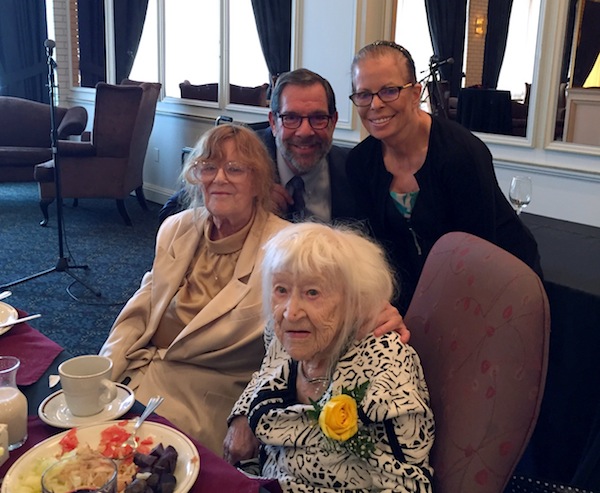
Janice Middleman, left, Rabbi Shaul Osadchey and Bobbie Osadchey, with Florence Middleman in the foreground. (photo from Rabbi Shaul Osadchey)

While it is becoming more commonplace to see people reach the age of 100 in fair health, it remains rare that an individual reaches the age of 110. So, Florence Middleman has beat the odds. And one person in particular has helped her achieve this milestone – her daughter, Janice Middleman.

Florence’s parents moved to eastern Canada at the turn of the last century. At the time, Alberta was vying to become a province. “They went east and recruited, and asked my grandparents and many others to be homesteaders,” said Janice. “As they stayed on the land a certain length of time and worked the land and raised animals, the land would become theirs.

“So, my grandparents came to Alberta and were homesteaders for quite awhile. It was during the dry-land period. There were many dust storms. At some point, they had to put the animals in the house and had to stay in the shelter on the hill they’d built for the animals – to protect themselves and the children from the dust storms.

“After a period of time, they moved to a small town near Edmonton, called Daysland. My grandfather, Max Goldberg, was a tailor. He made the red jackets for the Mounties, as well as everybody else’s clothes.

“My grandmother, Molly, was a midwife and spoke many languages. She delivered all the babies in the town and also accompanied the doctor on his rounds, as many people were immigrants who couldn’t speak English. She translated, so he could treat them.”

Florence was about 19 when the family moved to Edmonton and opened a store. She married Harry Middleman, who had moved from Montreal to Edmonton during the First World War. Janice was their only child.

The family moved to Calgary. While she lived in Toronto during her university years, Janice returned to Calgary afterward to be close to her parents. She took more university courses in Calgary.

When Harry passed away in 1985, Janice moved in with Florence. She found a flexible job she could do from home, while also caring for her mom, as there was no other family in the city.

Florence had four brothers who all passed away many years ago. Janice likes to describe her mom as having won the gene pool by living so long. “She’s got a tremendous spirit, plus the marvels of medicine as well,” said Janice.

Florence worked until the age of 68 as a librarian at an elementary school. She would have continued working and the library tried hard to keep her on, but, at the time, there was a law in place that you had to retire at the age of 65.

“When she did retire, she took a nap every day,” said Janice. “She has just a very, very good attitude. Besides working and helping to support our family, she volunteered at shul, Hadassah, the Red Cross and the Cancer Society – just to name a few.

“She had an interest in everybody, in Judaism, a belief in God, and kept a kosher home. She had an interest in the world. She appreciated everything and the beauty of nature, and appreciated children, animals and people in general. She still does.

“She always had a lot of friends. Regrettably, most of them are gone now, but she always had a lot of friends. She realized how important it was to give to the world. That’s also part of Judaism, to make the world a better place.”

When asked about her keen interest in child welfare and education, Florence said, “I worked at Glamorgan elementary school, including their library and the rest of the school, and bonded with the students. I was well liked by the children and got to know their likes and dislikes, their needs for education and their quality of life.

“One boy was Jewish and asked me if the library had any Jewish books. There were none in the library, so I brought some from home for him to read. He was very happy to have them.”

Janice added, “After that, my mother was very instrumental in inspiring the school to have multicultural books in their library. It spread to all the schools after that, a great deal due to her influence.”

Florence shared that some of her most-loved reading includes many “biographies, books on Judaism and prayer … biographies on artists, politicians like Abe Lincoln, history, art books, history of art, Canadian history, and all different countries.”

Janice noted, “She was and still is interested in countries and how they got where they are. She has a great love for literature, like Shakespeare, Dickens and William Blake. Also, my mother has written and continues to write our family history, as well as short stories and poetry.”

Florence had this to say about the most-treasured people in her life, such as her daughter, Janice: “I keep good people around me who care about other people, care about doing good works and doing good things in the world. My parents contributed greatly to the town of Daysland.”

As to whether she has any words of wisdom she would like to impart to readers, Florence said, “Keep on going. Surround yourself with good people who have good thoughts and care about their families, friends, the world, who care about contributing to the world and making it a better place and doing good work.

“Volunteer,” she added. “Give to charity when you can. Enjoy Judaism in any manner you are able. Give your time to your friends. Listen to them when they need you. Have a positive attitude. Be optimistic. Be grateful for what you have – your health, family, friends, home, food on the table and clothes on your back.

“Don’t think of the past or what you don’t have. Enjoy every moment, the moments you are in. Keep liking everyone. Don’t forget to thank people in your lives, in your family, and to appreciate everything you have.

“And take time to be good to yourself,” she concluded. “Take a nap every afternoon to refresh yourself. Be good to everyone. Be good to your family and friends. Don’t forget to thank God everyday for everything you have. Before Friday, during the week, don’t forget to be grateful to God and to everyone for everything in your life.”

Rebeca Kuropatwa is a Winnipeg freelance writer.

Greens’ policy on Israel

On Saturday, Dec. 3, at a meeting in Calgary, the Green Party of Canada (GPC) passed a resolution updating the party’s position on the Israel-Palestine conflict. It puts the entire onus for the conflict’s continuation on Israel, specifically on Prime Minister Binyamin Netanyahu.

“The possibility of a two-state solution is diminishing directly due to the Netanyahu government’s support for illegal expansion and increasingly brutal military occupation,” reads the Dec. 4 statement on the Green party’s website. “Even over 200 former members of Israeli Defence Forces (‘Security First’ [plan for West Bank, Gaza]) have decried the worsening security situation for Israelis and Palestinians – and laid the blame directly on Prime Minister Netanyahu’s policies. The former Israeli military officers have raised the alarm of a ‘humanitarian crisis in Gaza’ and the diminishing chances for a two-state solution.

“Clearly,” continues the statement, “Canada needs to do more to register with the Israeli government that flouting international law and threatening the security of its own people while violating the human rights of Palestinians is not acceptable. In doing so, Canada must continue to condemn violence from the militant elements of Palestinian society.”

While rejecting the boycott, divestment and sanction movement – as its goals “do not include supporting the right of the state of Israel to exist” and are “incompatible with Green party policy”– the addendum to the party’s policy “is based on clear differentiation between ‘legal’ Israel, as within the 1967 borders, a democracy respecting the rights of citizens of all ethnicities within its borders, and ‘illegal’ Israel – the occupied territories beyond Israel’s legal borders. The Palestinian civilians within the occupied territories are subjected to virtual continual abuses of their human rights. The occupied territories are maintained under a brutal military occupation. Products from illegal Israel should not be granted the preferred trading status of products of legal Israel.”

With this in mind, the Green party would like to see the Canada-Israel Free Trade Agreement renegotiated, the “termination and indefinite suspension of all military and surveillance trade and cooperation” between Canada and Israel, and the repeal of “the House of Commons resolution condemning the BDS movement.”

According to the Dec. 3 article “Greens vote for new Israel policy without BDS” by James Munson on ipolitics.ca, “Approximately [350] members voted on the ‘compromise’ resolution that purged the party’s policies of any reference to the Palestinian-led boycott, divestment and sanctions (BDS) movement, which pressures companies, governments and institutions with ties to Israel.”

The article cites Green party president Ken Melamed as saying, “The party wanted to be careful not to align with a particular organization or movement. The essence of it, I think, is that the party feels that diplomatic approaches to achieving peace and justice in the Middle East have been ineffective and it’s time to move to economic actions.”

The article said that, according to Melamed, about 85% of those who voted at the meeting supported the resolution – others opposed or abstained – but that it still had to be voted on electronically by all 20,000 party members before it became official policy.

Shimon Koffler Fogel, chief executive officer of the Centre for Israel and Jewish Affairs (CIJA), condemned the resolution. In a Dec. 3 statement, he noted, “The new policy is rife with historical distortions and places the Green party at odds with the Canadian consensus that BDS is discriminatory and counter-productive to peace. The Ontario legislature just voted by a tenfold margin to reject the differential treatment of Israel, underscoring how out of touch the Green party has become.

“Elizabeth May and the party’s leadership have turned their backs on the mainstream Jewish community, including the many Jewish Greens who no longer feel welcome. Despite repeatedly flagging that the anti-Israel vote was scheduled to take place on the Jewish sabbath, senior Green party officials insisted on holding the vote today, thereby excluding many Jewish Green party members from voting. This is an alarming development and a stunning failure of leadership.”

The December resolution replaces a resolution that was passed at the Green party convention in August.

In the backgrounder to Fogel’s statement, CIJA notes, “The party’s decision to endorse economic penalties against Israel is incompatible with the wishes of the party’s grassroots. A survey of Green members conducted by the party after their convention revealed that, of 2,800 respondents, 28% agreed with the decision to support BDS, 44% wanted it repealed and 28% thought it should be amended to remove any reference to a specific movement or country.”

The backgrounder further explains, “The text’s exclusive recognition of Palestinians as ‘the indigenous people’ of the region implies that Jewish people have no ancestral or indigenous roots in Israel. This misleading suggestion contradicts millennia of archeological and documentary evidence.”

And, CIJA warns, “The one-sided nature of the resolution and its call for extreme measures against Israel puts the Green party outside the international consensus for achieving peace, which emphasizes the need for both parties to compromise and negotiate.”

Note: This article has been edited to reflect later reports that about 350 party members voted on the resolution, versus the number cited on ipolitics.ca, which was approximately 275.

Ontario rejects BDS

On Dec. 1, the Ontario legislature voted 49-5 to pass Motion 36, which rejects the boycott, divestment and sanctions (BDS) movement aimed at Israel. The motion was backed both by the Liberals, who form the government, and the opposition Progressive Conservatives.

Tory MPP Gila Martow (Thornhill), who introduced the motion, noted in the legislature prior to the vote that: “BDS is boycotting not just Israel, but all Jews and other supporters of Israel.”

She explained that the BDS movement and its proponents have created a hostile environment at universities.

“We’re trying to make a statement about attitudes in society. I genuinely feel this is the first step in helping our students feel comfortable on campus. They’re choosing what program to study based on what campus they feel comfortable at,” she told the Independent.

“This is not just about BDS – we already went through this with Israel Apartheid Week. I think we need to make it clear from the government on down, we will not allow any type of antisemitism to masquerade as free speech.”

She hopes this message reverberates with school administrators.

“They’ve had tools at their disposal they haven’t bothered to use [to fight campus antisemitism] and I would suggest they might make a bigger effort than they did in the past,” she said.

Martow tipped her hat to the Centre for Israel and Jewish Affairs (CIJA) for their community advocacy on the motion, while Joel Reitman, Greater Toronto Area co-chair of CIJA, noted: “[J]ust as Ontarians rightly oppose all forms of discrimination, our province rejects BDS and other bigoted campaigns against Israelis.”

In a statement, Sara Lefton, CIJA’s vice-president, Greater Toronto Area, added: “It also demonstrates that elected officials across party lines recognize that BDS is tainted by antisemitism. Just as we are grateful that the legislature has taken this stand, we are proud that – in just a few short days – thousands of Ontarians took unified action to urge MPPs to support this motion.”

Adam Minsky, president and chief executive officer of United Jewish Appeal, said: “From students to seniors, from rabbis to grassroots activists, from left to right, our community came together to take tangible action to support Israelis and defeat BDS. The result speaks for itself – and testifies to the power of Israel advocacy to unite and strengthen our community.”

The text of Motion 36 reads: “That, in the opinion of this House, the Legislative Assembly of Ontario should:

“Stand firmly against any position or movement that promotes or encourages any form of hatred, hostility, prejudice, racism and intolerance in any way;

“Recognize the longstanding, vibrant and mutually beneficial political, economic and cultural ties between Ontario and Israel, built on a foundation of shared liberal democratic values;

“Endorse the Ottawa Protocol on Combating Antisemitism;

“And reject the differential treatment of Israel, including the boycott, divestment and sanctions movement.”

The motion was a retry, of sorts, of May 19’s Bill 202, “The Standing Up Against Antisemitism in Ontario Act,” defeated by a vote of 39-18.

That particular bill recognized the BDS movement as “one of the main vehicles for spreading antisemitism and the delegitimization of Israel globally and [one that] is increasingly promoted on university campuses in Ontario.”

At the time, Martow said that a bill like 202 “has teeth,” and could have financial consequences, versus a motion or a resolution. The failed bill would have compelled the province and its post-secondary institutions to withdraw business interactions with companies supporting BDS. As well, a bill would require passing three readings and unanimous consent, Martow told the Independent – something she wasn’t sure would be possible, so a motion was chosen this time around instead.

For the May bill, the Progressive Conservatives voted in favor, in addition to a single Liberal, Mike Colle, while the NDP as a whole rejected the bill, as they did the recent motion.

Dave Gordon is a Toronto-based freelance writer whose work has appeared in more than a hundred publications around the world.

Advance in treatment

Dr. Mark Freedman, left, and Dr. Harold Atkins. (photo from Ottawa Hospital)

A Canadian research team led by Dr. Mark Freedman and Dr. Harold Atkins at Ottawa Hospital has managed to reverse severe multiple sclerosis (MS) using a patient’s own stem cells.

Freedman is a professor of neurology at the University of Ottawa, a senior scientist at the Ottawa Hospital Research Institute and the director of the Multiple Sclerosis Research Clinic.

“Considering the fact that, when I got into this business, no one even knew what MS was, then, following that, they didn’t know what to do with it, there were certainly no treatments available,” Freedman told the Independent. “So, we had to gain an understanding of some of the processes involved…. We’ve since come up with therapies that have been very effective in dealing with the disease.”

According to Freedman, “MS is a condition that refers to very specific immune system irregularity where, instead of being the defence of the body, the body mistakenly believes that the lining (called myelin), the insulation of the wires of the central nervous system, contains something foreign and proceeds to reject it. This rejection is going to live as long as the body believes the myelin is foreign or that foreign parts exist in it … which means, it’s a lifelong disease, as the immune system will continue to attack the myelin.”

Freedman went on to describe the immune system as an army in our body that is both there to protect us from foreign bodies, like viruses and cell mutations, such as cancer, and is also there to help us heal.

The problem is, in cases where the immune system turns on healthy body cells, Freedman said, “If you can’t identify who the bad guys are in the army – that’s been the attempt in the last 20 to 30 years – then you have to decide whether or not to hold back the entire army. If you do that, you take away protection from the body.

“We’ve always been caught between a rock and a hard place by allowing the army to function, [but] trying to at least curb its function when it comes to attacking the brain. All the therapies that have been developed, more or less, try to handcuff the army a little bit and prevent it from attacking the central nervous system.”

In trying to distinguish the good guys from the bad, researchers have found that each individual’s MS presents unique good guys and bad guys; not only different ones but at different times.

Freedman and his team wanted to find a way to eliminate the entire immune system with a mix of chemotherapy drugs, enabling them to start fresh, using a patient’s stem cells. “What if we flushed out the entire army and built in a brand new one?” he proposed. “This, theoretically, would not have the same mistakes, where it believes the central nervous system myelin is foreign and will attack.

“What we found out was, in fact, that, regardless of the genetic makeup of the individual, the disease ceased once we replaced the entire immune system. The trick was to do what no one else had done.”

The treatment starts by extracting stem cells from the patient and cleaning them, ensuring there is nothing remaining with the same cell mixture that may carry over the disease once the stem cells are replanted.

After killing off the entire immune system, which, Freedman pointed out, “of course has some dangers associated with it,” he said, “technology allows us to do that with success. After that, very quickly, patients settled down. They no longer had MS attacks and, over many years, their body started to heal.”

In a sense, Freedman and the team created a reset button for the immune system.

“Having a competent immune system that no longer attacks the central nervous system and can actually heal, we saw that, in our patients, it wasn’t just a short-term phenomenon,” he said. “We followed them for more than a decade.”

Freedman believes that anyone with MS can benefit from the procedure, with the important cautionary caveat that, as the procedure is complex and has risks, someone with a mild case of MS who can be treated with currently available therapies might not want to have it done.

“For some people, the risk is not necessary,” said Freedman. “But, for other patients who have disease that is quite aggressive and not easily amenable to treatment, these are the patients who should probably go this route.”

Freedman and his team are continually looking for ways to reduce the toxicity of the treatment, while also looking for ways to determine which patients are more likely to recover well. “In the meantime, we continue to use the treatments for patients who we deem early enough to respond to the treatment, at a stage that it will offer them some help,” he said.

“Unfortunately, everyone with MS comes out of the woodwork when you say you’ve got something … people who have been in wheelchairs for 25 years wanting to be signed up, as they feel they have nothing to lose. Well, you have your life. You could lose that. We aren’t ready to jump on such patients, as it could be inappropriate.”

Freedman advised that patients first speak with their neurologist, who hopefully understands their disease and can advise them whether or not this is a treatment they should consider.

“It’s not something that a patient can decide on their own,” said Freedman. “This isn’t a treatment that’s for sale. We want to help people who can be helped. We apply treatments to people who are likely to benefit and who are unlikely to be harmed.”

Rebeca Kuropatwa is a Winnipeg freelance writer.

Getting through menopause

Harriet Berkal unveils the secrets of menopause. Berkal began the support group Menopause Matters after experiencing a lack of help when she went through that stage of life. (photo by Manny Berkal-Sarbit)

Medical advocate Harriet Berkal recalls eagerly anticipating going through menopause, imagining it to be a fabulous life stage without having a period every 28 days or so.

“Now, if I could go back and have my periods and not go through this other nonsense, I would say, give me my periods back,” Berkal told the Independent.

Berkal works as an executive financial consultant for Sarbit Advisory Services in Winnipeg and has been struggling with menopause-related issues for the past seven years. She has leaned from experience that there is next to no help out there for dealing with the effects of menopause, and this has led her to take matters into her own hands and create a support group.

“One problem with this issue of menopause is, if you complain to a physician about something like weight gain, a symptom of menopause, they bundle everything you say after that behind that carriage,” said Berkal. “So, my GP missed the fact that I had a thyroid condition, because it was thrown into menopause – the same way that people get thrown into the irritable bowel syndrome (IBS) or the fibromyalgia hole … where anything you complain about is automatically assumed to be related to that, when it might not actually be.”

Menopause symptoms for many women include hot flashes, night sweats, migraine headaches, bladder infections, gastroesophageal reflux disease, lost libido, and painful intercourse. There are also some very rare reactions, such as feeling as though you have bugs crawling all over you, and emotional depression or anxiety, which are also related to hormonal fluctuations.

While typically menopause begins in one’s 50s, it can start in one’s 40s, where the cycles become more erratic, and, in some cases, even earlier, from induced conditions via cancer treatments, for example.

As Berkal searched for solutions, she decided to share the information she gathered with other women undergoing menopause. She approached Winnipeg’s Jewish Child and Family Services (JCFS) about starting up a learning and support group.

The idea was welcomed and the group was called Menopause Matters. Some 20 women meet once a week for five weeks to learn about different approaches to dealing with menopause symptoms and management.

“Most of the primary group are those in the throes of menopause and who aren’t functioning well,” said Berkal. “We had about 18 at last week’s meeting. It was an emotional meeting. There were some people who were extremely – not just frustrated with the system, but at the end of their rope. They don’t know who to turn to, what to do. We provide them, each week, with a different speaker and go through the whole gamut of solutions from traditional to non-traditional.”

Some education is provided by the clinic Vitality Integrated Medicine, which is run by a former pharmacist. Participants are informed about drug interactions, different kinds of tests to help determine actual lacks in their systems, and three different kinds of estrogen. According to Berkal, what often happens is that menopause-affected women consult their doctors and are told they need estrogen, and then they just take whichever one is prescribed.

Recently, Menopause Matters participants had a guest speaker who is an acupuncturist discussing stress control and how it affects hormones, and various acupuncture relaxation techniques that could help. “She brought needles and tried them out on some people,” said Berkal. “People were appreciative of that approach.”

Another scheduled guest speaker at the time of Berkal’s interview with the Independent was gynecologist Dr. Maggie Morris. She was to speak “about mainstream methods for dealing with things like Premarin estrogen application.”

Berkal’s personal experience with conventional medicine in general is that its practitioners are uncooperative from the moment she mentions that other approaches will be presented.

“The pharmacies have these ready-made solutions,” she said. “They aren’t one-size-fits-all solutions in my mind. We’re trying to provide people with a range of different solutions and methods to cope with this. One solution doesn’t do everything. You don’t want to mask symptoms. You want to get to the root. Everyone’s jockeying for position here and everyone has different approaches, so you should try figuring out what system fits you the best.”

Another speaker booked to address the support group is to talk about the importance of exercise, while another will highlight a treatment called Mona Lisa Touch, which involves the use of a laser inserted into the vagina to stimulate vaginal collagen production.

“It rejuvenates the tissue in the vagina without hormones, so you can get increased libido and increased moisture,” explained Berkal. “It helps create a better balance of health in the vagina.

“Many women get bladder infections, because the bladder and the vagina are closely linked. And, if you don’t have the right environment in the vagina, which is decreased because of menopause, you can end up with UTIs [urinary tract infections] … which I had probably 10 of last year before I started treatment.”

When Berkal underwent menopause, she said, “It was a pretty extreme and exacerbated reaction. Mood swings are a very big issue. Last week, there were several women in the group who said, ‘Does anyone feel like they’re going crazy?’ Almost everyone raised their hand.

“Hormones are so powerful. When they are working great, that’s great. When they are depleted, you are left with a shell of a body, susceptible to bone loss, memory fog, you think you’re getting the early stages of Alzheimer’s … but really, you’re not.”

Berkal believes that integrated medicine is the right direction and, in fact, integrated clinics are popping up in many places.

“But, the fact that I couldn’t find a menopause support group was mind-boggling,” said Berkal. “I approached the Mature Women’s Clinic at the Victoria Hospital and asked if they would start a support group. They said ‘no.’

“Why would they not want to help women in need? Yet, when the pharmaceutical companies sponsor a forum for one of their gynecologists to speak, they get thousands of women to come down who are in dire need of help … but they are only giving one approach.”

Shelley Levit, a social worker at JCFS, was very receptive to the integrated approach Berkal described, and the concept of letting women choose for themselves what they want to pursue.

Berkal hosted a Menopause Matters free, five-week support group from Sept. 15 to Oct. 13, via JCFS.

“We call it ‘the Sisterhood of Sharing,’” said Berkal. “Sharing is deeply required in order to feel camaraderie and kinship with these other women who really have no one else to talk to. It wasn’t intended to be targeted at Jewish women specifically. It’s like cancer – not specific to any ethnicity.”

Berkal wants to see if the group would be receptive to having partners and spouses join, so they can be present and hear from other women.

Rebeca Kuropatwa is a Winnipeg freelance writer.

The process of integration

Dr. Solly Dreman (photo by Rebeca Kuropatwa)

With the large numbers of refugees and immigrants making their way to Winnipeg and elsewhere in Canada, Winnipeg Friends of Israel invited Dr. Solly Dreman, a Winnipegger who moved to Israel in 1964, to speak on the topic.

In the Sept. 19 lecture at the Asper Jewish Community Campus, Dreman drew from his own experience and expertise, using the work he did, along with colleague Dr. Ava Shinar, on immigration in the 1990s to illustrate an optimal way of integrating immigrants into Israeli society, which could be applied to other countries.

“I did the workshop with her over a decade ago, but the implications are certainly relevant to the contemporary problems occurring in the world today, and to immigrant and refugee populations all over the world,” said Dreman.

“Immigration is widely recognized as a stressful event which increases psychological vulnerability,” he explained. “Researchers have noted that adolescent immigrants … we know that many terrorists are in that age group … constitute an extremely high-risk population. In adolescence and late adolescence, there’s a need to cope with profound physical, psychological and social transformations. And, in those adolescents who have become immigrants and [are] in a strange and often unwelcoming environment, the uprootedness and difficulties in establishing a solid base of identity and meaning could have disastrous results. Indeed, the violence evident today in such places like Paris, Nice, Brussels, Orlando, San Bernardino, as well as Tel Aviv and Jerusalem, testifies to this. Youth confronted with a strange environment and difficult economic conditions, as well as lack of purposefulness in their lives, often latch onto causes and groups that implement terrorism and violence in the international community.”

Dreman also discussed other issues.

“In the 1990s,” he said, “with the collapse of the Soviet Union, there was a mass exodus of over a million Soviet Jews to Israel. Soviet students comprised about 10% of the student body at Ben-Gurion University. They were competing for limited resources, such as dormitory space, scholarships and, eventually, opportunities for employment.

“There were many negative stereotypes and attitudes prevailing between the native Sabra students, who were born in Israel, and their Soviet counterparts. As far as the stereotypes that Israelis had toward the Russians, well, they often viewed them as manipulative, clannish and corrupt … while the Russian students perceived the Israelis as loud, aggressive and uncouth.

“The Russians, in that first year of the workshop, we also heard some terrible things they had to say about the Ethiopians, referring to them as subhuman, subspecies, monkey-like, etc.”

With the extreme alienation between Sabras and the immigrant students – to the point of outright violence and fist fights – Dreman needed to find ways of reducing tensions and bringing understanding, cooperation and solidarity between the groups.

He said it was important to create an atmosphere where each group could participate in an evolving melting-pot culture, where each side would begin to listen to and understand the other. As such, he and Shinar created a two-credit academic course that eventually became a four-credit, year-long course because of its popularity.

“So, students were given an award for their participation and for completing course assignments,” said Dreman.

He explained, “The syllabus described it as being designed to help students learn about their family and individual transitions in the face of such phenomena as birth, adolescence, illness in the family, divorce and death … but with a particular emphasis on aliyah immigration.”

Normative aspects of immigration and transition were discussed in an academic context, so participants could then discuss their own experiences in a non-threatening atmosphere and place those experiences in an appropriate context, in an effort toward understanding what they themselves were going through.

At first, due to the Israelis’ fluency in Hebrew and the Russians’ more reserved manner, the Sabras monopolized the class. But, after a few sessions and with a little prompting, the Russians became much more comfortable and vocal.

“What we wanted to do was create an evolving identity,” said Dreman. “Emphasis was placed on joining the new culture, but space should be provided for the immigrant representatives to give expression to their culture of origin, needs and expectations. On the educational level, awareness workshops should be introduced in citizenship classes in elementary schools, high schools and colleges. It is also critical that government and volunteer groups work together to help promote immigrant absorption.”

Dreman recognizes that the work they did in Israel had many atypical factors working in its favor, but said the attitude of creating a type of melting pot should yield a good result in most cases. As well, while the workshops had some factors going for them, like participants with a common Jewish identity, working with young adults (18-to-24-year-olds) posed challenges that are less common with older immigrants, such as extremism and radicalization.

Dreman wanted to be very clear in differentiating between immigrant and refugee populations, noting the difference “between immigrants who want to immigrate and refugees who are exiled and may not necessarily want to.

“The purpose of our workshop was to make the hosts and the new immigrants understand where the other person is coming from, to create a merging of cultures and understanding in order to ease the process of assimilation,” he said. “I think the beautiful thing is that it was based on reciprocity. It was very successful. In the workshop, at the beginning, people hated each other. At the end, almost all had befriended people from the other group.

“If people knew that the immigrants had a real desire to be part of the hosts’ community, I think there’s a lot of opportunity for mutual understanding,” he added.

According to Dreman, the setting also plays a significant role. “In one of the projects we did, we sent kids out in one of the groups to interview Israelis – native Israelis – concerning their attitudes towards Russians. We sent them to a marketplace, a competitive marketplace with pedlars. And, another group, we sent to interview Israelis in Dizengoff Centre, which is upper-class…. How did the native Israelis describe the Russians in the marketplace? ‘Swindlers, crooks, gamblers, prostitutes, bastards.’ What about in the centre? They described them as ‘wonderful, contributing to the nation,’ and so on.

“In Europe and North America, if somehow they could take select groups of people who host immigrants and let them have that encounter and spread the gospel – ‘Hey, they aren’t that bad,’ that sort of thing – there is no reason it would not be successful.”

Rebeca Kuropatwa is a Winnipeg freelance writer.

Genetic testing and privacy

Genetic testing can save lives. So, why isn’t everyone getting it done? It turns out that companies are using the information from the tests to discriminate against applicants.

While this is by no means a Jewish-specific issue, the National Council of Jewish Women of Canada (NCJWC) and the Centre for Israel and Jewish Affairs (CIJA) are taking the lead in urging the federal government to legislate against this discriminatory practice.

“At NCJWC, our goals are for education, service and social action,” said Sharon Allentuck, the organization’s national president. “Social action includes writing to MPs, senators and the prime minister … [about] genetic testing and insurance denial.”

Genetic testing has been high on NCJWC’s list of priorities for the past 25 to 30 years and it continues to be – not just with respect to concerns over insurance companies’ actions, but also to increase public awareness of the importance of genetic testing.

In Winnipeg, for example, a clinic is held every three to four years in conjunction with Health Sciences Centre geneticist Dr. Cheryl Greenberg. While, in the past, the main focus was on Tay-Sachs, the list keeps getting larger, as geneticists like Greenberg discover new gene connections. At the moment, the list stands at seven to eight different Jewish genetic diseases being studied.

By getting a test done, one can be aware of a possible genetic problem that might affect oneself or one’s children, if a person has children with another carrier of the same disease. This knowledge can provide people with peace of mind when choosing a partner.

So far, though, this knowledge has come with a cost. When people apply for insurance, they are asked to disclose the results of their genetic testing.

“It came to our attention that insurance companies said to some people, ‘You’ve been tested, genetically. You have certain predispositions. Sorry, but we’re going to deny you insurance,’” said Allentuck. “It’s against human rights, it’s discriminatory. Canada is the only G7 country that allows this to happen. And so, legislation [Bill S-201] preventing that discrimination was passed through the Senate and now it’s in the House of Commons. We are asking our members and are working with CIJA to encourage [Jewish community] members to contact their members of Parliament to ensure the legislation passes.”

CIJA adds on its website, “We encourage provincial legislatures to pass complementary legislation, with a specific focus on employment and insurance.”

For more information, visit NCJWC’s website or Facebook page. Allentuck encouraged readers to become NCJWC Facebook friends in order to stay regularly updated on this and other important topics.

“This isn’t a Jewish issue,” she said. “But that doesn’t mean that Jewish people can’t have a say in it.”

Rebeca Kuropatwa is a Winnipeg freelance writer.

A new consul general

Left to right: Nico Slobinsky, director of the Centre for Israel and Jewish Affairs, Pacific Region; Galit Baram, consul general of Israel to Toronto and Western Canada; Sara Lefton, vice-president of CIJA, Greater Toronto area; and Judy Zelikovitz, vice-president of CIJA University and Local Partner Services. (photo from CIJA-PR)

“There is never a dull moment,” Galit Baram, the new consul general of Israel to Toronto and Western Canada, told the Independent. “It is a whirlwind of names, people I should meet and new faces to remember.”

Baram said adaptability and versatility are key in the life of a diplomat, and her relish for her job comes through when speaking with her. Baram, who is married to a fellow diplomat and has two children, arrived in Toronto to replace D.J. Schneeweiss, the former consul general, in August. “I am looking forward to this new chapter, this new adventure,” said Baram.

Baram was born in Jerusalem. She has previously served as counselor for public affairs and coordinator of academic affairs at the Israeli embassy in Washington, D.C. (2009-2012); counselor for economic affairs in Cairo (2006-2009); and counselor for political affairs in Moscow (1998-2003). Most recently, she was the director of the Department for Palestinian Affairs and Regional Cooperation (2013-2016).

Baram’s first posting was in Moscow. This was particularly exciting for her, she told the Independent, because of her Russian-Israeli background. “For me, this was closing a circle representing my family and my country,” she said.

Her favorite Russian novelist? Leo Tolstoy, she said, the late works. Her single favorite Russian novel is Mikhail Bulgakov’s underground classic, The Master and Margarita.

Russia has one of the largest diplomatic communities in the world, and her time there was a great learning experience, she said. With 1.6 million Russians in Israel, the relationship between the two countries is an important one.

After Russia, Baram spent “three fascinating years in Cairo.” There, she was involved in bringing Israel and Egypt’s business sectors together. She left full of respect for businesspeople on both sides, she said. During her tenure, an important trilateral agreement was signed between Israel, Egypt and the United States, the Qualified Industrial Zones Agreement, which led to strengthening of economic ties and the mutual exchange of expertise.

In Washington, Baram brought her talents to bear on increasing academic cooperation between Israeli and American universities, before returning to Israel to head the Department for Palestinian Affairs and Regional Cooperation. Her duties focused on building aspects of civil society and cooperation between Israelis, Palestinians and neighboring countries. One of the key issues she sought to address was water.

“Water is going to be a central issue in the region,” said Baram. “Israel is leading the world in desalination technology, since the 1970s, and, in recent decades, has increasingly shared this technology around the world. Regionally, we supply water to Jordan (since 1994) and to the Palestinians. We are more than willing to share with more neighbors in the region.”

Baram also worked with a long list of Israeli nongovernmental organizations that cooperate across the Middle East in bridging the gap between different countries and groups of people, particularly young people. “We need to show that the young people can live together,” she said.

“I believe that, when it comes to the Middle Eastern region, education is a key element in regional stability,” she explained. “Jews, Arabs and Palestinians need to learn about each other. Animosity, mutual suspicion and ignorance are major problems. The best way to overcome this is to bring together young people and to bring together communities, and to build mutual understanding.”

Baram said she feels very comfortable in Canada – “Israel and Canada have very friendly and close relations, very warm,” she said. “There are many similarities between us. Both countries are very multicultural, and are always growing and changing. Canada and Israel share many important values in the spheres of human rights, democracy and pluralism. I am happy to say that Israeli diplomats feel very warmly welcomed in Canada.”

Baram added that she is very impressed with Canada’s Jewish institutions and their activities, and has found the community to be very well-organized and warm.

Baram hopes “to expand tourism and business connections between Israel and Canada, to invite Canadians to Israel to look for opportunities together, and to maintain close relations between the Jewish Diaspora and Israel.”

She said she has every intention to travel Western Canada as soon as possible, and plans to visit Vancouver soon to get acquainted with the Jewish community here.

She also added, “I would like to take this opportunity to say shanah tovah, a peaceful and successful year in Israeli-Canadian relations, and peace and happiness and health to us all.”

Baram and the consulate in Toronto can be followed on Facebook and Twitter as “Israel in Toronto.”

Matthew Gindin is a freelance journalist, writer and lecturer. He writes regularly for the Forward and All That Is Interesting, and has been published in Religion Dispatches, Situate Magazine, Tikkun and elsewhere. He can be found on Medium and Twitter.