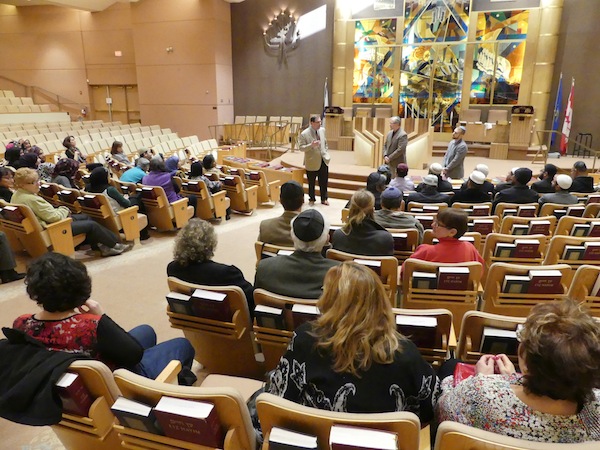
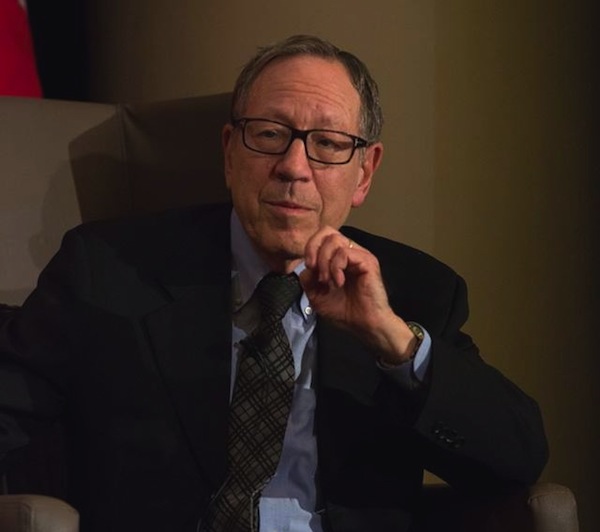
Irwin Cotler told those at the launch of the Pearson Centre for Progressive Policy’s Pursuing Justice Project on March 31 that his current focus is the Raoul Wallenberg Centre for Human Rights in Montreal. (photo by Dave Gordon)
Irwin Cotler was honored on March 31 for his dedication to human rights activism. Attendees at the Pearson Centre for Progressive Policy event learned how Jewish values drove, and intersected, with Cotler’s career in pursuing justice.
“My father used to say to me: the pursuit of justice is equal to all the commandments combined. This is what you must teach to your children,” said Cotler.
The gala at Toronto’s Omni King Edward Hotel served to launch the Pearson Centre’s Pursuing Justice Project, “which is focused on increasing the understanding of Canadians about justice, diversity and inclusion.” The centre describes itself as a centrist think tank, addressing policy issues related to justice, health and social services, with the goal “to engage Canadians in an active dialogue about a progressive future for Canada.”
Among the speakers offering introductory remarks at the launch were former prime ministers John Turner and, via video, Paul Martin.
“John Turner had the temerity to give me my first job out of law school,” Cotler shared.
In addition to serving as Liberal member of Parliament for Mount Royal in Montreal from 1999 to 2015, Cotler also served as federal minister of justice and attorney general during his career.
In a discussion with Indira Naidoo-Harris, Liberal member of the Legislative Assembly for Halton, Ont., Cotler spoke about a 10-year-old idea that never bore fruit, wherein justice ministers from Israel, the Palestinian Authority, Jordan and Egypt all agreed to convene with Canada’s justice minister, in Canada, to foster dialogue. A “justice summit” he dubbed it, “which I hoped would have a peace dividend.”
He would like the Trudeau government to revive the concept, because “educating each other in the culture of peace is important,” Cotler told the Independent. Palestinian incitement, in contrast, “is a threat to peace in the Middle East, threatens Palestinians’ right to self-determination … and glorifies terrorism.”
As an international human rights lawyer, Cotler served as counsel to many high-profile political prisoners, including South Africa’s Nelson Mandela and Israel’s Natan Sharansky, who was released from a decade in the Soviet gulag 30 years ago February, and became a member of the Knesset and an author.
Both former prisoners were beacons of “hope and the vision and the inspiration,” with respect to “two of the great human rights struggles of the second half of the 20th century,” Cotler remarked.
The release of political prisoners, he added, is “such an overriding commandment that you’re allowed to breach the Sabbath” to free them.
Cotler’s current undertaking is growing the Raoul Wallenberg Centre for Human Rights in Montreal, which he founded. Among its many objectives, he told the Independent, are “promoting human dignity, combating racism, hatred and antisemitism, and defending political prisoners.”
Dave Gordonis a Toronto-based freelance writer and the managing editor of landmarkreport.com.
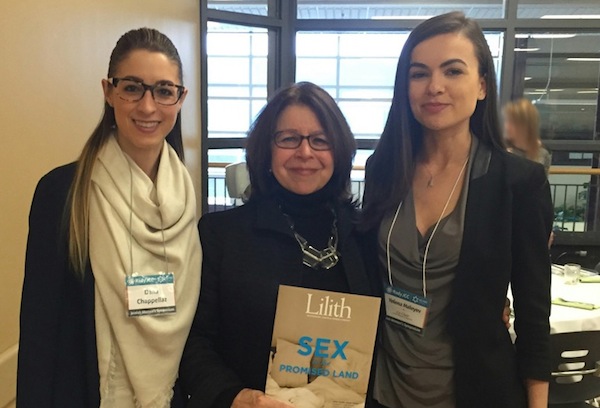
Left to right: Dana Chappellaz, Susan Weidman Schneider and Yelena Maleyev. (photo by Shayla Fink)
The first-ever Winnipeg Jewish Women’s Symposium was held at Rady Jewish Community Centre on April 9 and 10, bringing together women of all ages to explore the different ways in which women can make a difference in the Jewish and general communities.
The event was the inspiration of Rady JCC executive director Gayle Waxman and assistant executive director Tamar Barr.
“Gayle and Tamar approached me to co-chair the symposium on behalf of Rady in the fall of 2015, and it’s been a flurry of activity ever since,” said Lindsay Sawyer, a financial planner and a Rady JCC volunteer, who co-chaired the event with Yelena Maleyev, a product manager at Manitoba Telecom Service and a leader in National Council of Jewish Women (NCJW) in Winnipeg.
“We’ve taken great care to ensure that our speakers cover a wide range of topics to appeal to women of all ages in our community – from new volunteers to seasoned community leaders,” she said.
According to Sawyer, although women are talented, dynamic and committed people, they are still too often underrepresented at the board level of the Jewish community – something she and others involved in the symposium are setting out to change.
“If we don’t invite ourselves to shape the direction of the community we live in, we’ll wind up missing too many valuable voices at the table,” said Sawyer. “Our hope is to engage and inspire talented woman of all ages who, due to lack of opportunity, direction or support, may not yet be having their voices heard, while also celebrating the achievements of those who are playing key roles in their organizations.
“We are elated to have had Susan Weidman Schneider join us this year as our keynote speaker. Susan, an expat Winnipegger, is the founder and editor-in-chief of Lilith magazine, an award-winning Jewish women’s quarterly. It was our privilege to celebrate such an accomplished and dynamic talent and to be able to claim Susan as one of our own.”
Maleyev, who is Winnipeg NCJW’s treasurer as well as the creator of its young women professionals branch, also wants more women to get involved.
“We have seen successful events, such as SHE Day, grow over the years, and agreed that we should provide a similar opportunity for women in our community, but approach it from a Jewish perspective,” said Maleyev. “We aim to empower and educate the younger generation, while ensuring all women are involved and encouraged to remain involved. We want to match the energy of the younger generation with the experiences of those who have been in leadership roles for awhile now. Like Sheryl Sandberg mentions in her book Lean In – the more women help one another, the more we help ourselves. Acting like a coalition truly does produce results.
“We want to encourage the power of mentorship and how sharing our experiences at any age can help uplift one another,” she continued. “Women make up over half of the population and yet not even close to half the leadership roles in management or on boards. We need equal representation to ensure our voices are heard. We need mentors, sponsors, role models and supporters to help us achieve our professional goals, as well as balance in our personal lives.”
The symposium kicked off with Havdalah and a performing arts showcase on April 9 and, on April 10, the learning sessions took place. About 150 women attended.
“The performing arts showcase was absolutely exceptional,” said Sawyer. “It was honestly just an absolutely incredible experience to hear the stories of so many very talented and passionate women … about the importance of community and making sure our voices are heard. I left on Sunday with such incredible enthusiasm for both where our community is and where we’ll be going with the next generation of leadership coming into contributing volunteer positions.
“Certainly, at the top of my list, was one of the opening panels, with Dianne Glass, Debbie Hoffman, Laurel Malkin and Baillie Chisick. Their views of being a voice at the table and women in community leadership was so inspiring and uplifting.”
Sawyer also lauded Weidman Schneider’s keynote address about where women have come from and where they still need to make inroads.
“It’s my hope that this event will continue and that we can continue to reach out to our community and inspire others to join us in continuing to make our Winnipeg Jewish community a special and welcoming place,” said Sawyer.
Maleyev, who found the symposium “phenomenal,” said, “The panelists were all incredibly inspiring. They shared many personal and professional stories, and provided varied opinions and experiences…. Susan brought such good perspectives on the topic of feminism and urged us to be allies in our feminist journey. As well, attendees received many opportunities to mingle and network, and meet new people in the community.”
Maleyev is hopeful that, with support from women mentors, more young women will see that there is room for them to grow their skills and get involved with whatever organizations align with their values.
“Our very sincere thanks to the leadership of Gayle Waxman, Tamar Barr, Cindy Lazar [NCJW] and all our tremendously talented and dedicated volunteers in bringing this event to fruition,” said Sawyer.
How safe is our community? That’s a question all of us ask from time to time, some of us on a daily basis as we come and go from our synagogue or community centre, or drop our kids off at school.
On April 4, dozens of members of the Jewish community across Canada participated in a webinar called Protecting Our People and Places: Redefining Risk, presented by insurance and risk management firm Arthur J. Gallagher Canada, which works internationally and has a significant presence in Canada. Speakers included Nir Maman, a krav maga expert with a background in security and policing in North America, Israel and elsewhere; Max Hazin of Northern Force Security; and Sam Feldman, Vishal Kundi, Justin Priestley and Paul Bassett of Arthur J. Gallagher. The webinar promoted the company’s insurance and risk management services, but also provided basic risk management information and a variety of community resources.
All of the speakers stressed that Canada is not immune to terrorist attacks and active shooter incidents of the kind seen in the United States and Israel. However, the webinar began with statistics that put the warnings into perspective: Between 2000 and 2006, Israel had suffered 27,905 terror attacks killing 1,116 Israelis and injuring 8,800; from September 2015 to the webinar date, 34 people have been killed in terror attacks and 400 injured.
Total casualties: 1,150 killed and 9,200 injured. Since 1973 until 2016, there have been 38 Islamic extremist terror attacks in the United States. Total casualties: 3,282 killed and 9,285 injured. Since December 1999, there have been four plots to carry out intended terror attacks in Canada and three perpetrated terror attacks. Total casualties: two killed and three injured.
Topics in the webinar included how to make a physical location an unattractive target to terrorists, how to create levels of resistance to a threat and how to handle an active shooter situation. Maman was critical of the security in place at most Jewish organizations as being more symbolic than effective, and stressed the need for training and education so as to empower people to protect and, if needed, defend themselves and their communities.
In his weekly email message on April 15, Jewish Federation of Greater Vancouver chief executive officer Ezra Shanken noted, “Over the past two years we have seen a rise in terrorist activity worldwide, some of which has targeted Jewish communities, such as in Paris and Copenhagen. While there has not been and is not currently an increased threat to our community, we should not assume that these types of events could never impact us.
“For many years, our Federation has taken a proactive approach to community safety and, in that vein, we have established the Community Security Committee, chaired by Bernard Pinsky, which is focused on identifying and assessing opportunities to enhance our collective safety. The committee will update the community about any security concerns, and will ensure community institutions have the appropriate protocols and technology in place to ensure maximum safety.”
Rabbi Dan Moskovitz of Temple Sholom told the Independent after the webinar that security is a way of life for modern Jewish communities, and will remain so for the foreseeable future. “This is just the way it is now,” he said. “In Europe, this type of security has long been the status quo. I remember one visit where you couldn’t enter a synagogue without someone in an orange jacket asking you what your bar mitzvah parashah was.
“Despite the lower risk level in Canada,” he continued, “cameras, security guards and security measures need to be in place both to deter attackers and to give people peace of mind. Many communities, like ours, have security committees, which receive training and actively protect the community. Many, some of whom have a background in the Israeli army or police training, see this as a sacred duty, as their calling in the community.”
For those who would like more information on safety protocols for the Jewish community, a number of useful resources can be found at chesedfund.com.
Matthew Gindinis a Vancouver freelance writer and journalist. He blogs on spirituality and social justice at seeking her voice (hashkata.com) and has been published in the Forward, Tikkun, Elephant Journal and elsewhere.
As every year passes, more firsthand accounts of the Holocaust are lost. Carleton University has launched a new initiative to help preserve these important accounts for future generations.
Led by Mina Cohn, director of the Centre for Holocaust Education and Scholarship (CHES) within Carleton University’s Zelikovitz Centre for Jewish Studies, this initiative is hoping to raise $7,500 using Carleton’s Futurefunder crowdfunding platform to record and preserve the testimonies of Ottawa Holocaust survivors as oral histories.
The project will ensure the preservation of Ottawa Holocaust survivors’ accounts and their experiences before, during and after the Holocaust. These recorded testimonies will become a powerful pedagogical tool to be used in any educational institution or setting and will allow Carleton professors and students to explore online the unique power of survivors’ memoirs. The recordings and associated educational materials will form the basis of a special Ottawa-based Holocaust memorial project and will become a public resource freely accessible on the CHES website.
Each survivor has a unique and personal story to tell. These eyewitness accounts unite personal experience with the history of the period in a powerful way, creating a feeling of immediacy to the events, and there is an urgent need to record and preserve survivor accounts before it is too late. CHES is in contact with local Holocaust survivors and is already working with those interested in participating in this project.
The $7,500 to be raised will help cover the cost of producing, editing and arranging a public launch of the video testimonies of Ottawa Holocaust survivors. In the first round, CHES will record up to 10 different survivor testimonies, in a professional studio environment with the help of professional videographers. If sufficient funding is available, it will produce thematic videos on associated topics, such as life before the Holocaust in certain locations, camp experiences, child survivors, Jews in hiding, etc. Recording is scheduled to start in June 2016.
The unedited recording and videotapes will serve as resources for scholars, students, educators and the public, and provide glimpses into the individual lives during the Holocaust that cannot be obtained from documents or written records. Such testimonies are also an excellent resource for the development of anti-racism educational materials.
Why are boys three to four times more likely to be diagnosed with attention deficit hyperactivity disorder (ADHD) than girls, when studies have repeatedly shown that girls are just as likely to have it? According to psychiatrist Dr. Doron Almagor, this may be due to how it manifests differently in girls than it does in boys.
Almagor treats ADHD throughout the lifespan. He is also the president of the Canadian ADHD Resource Alliance (CADDRA), which is a Canadian body of physicians that sets the standards for treatment of ADHD in the country.
Dr. Doron Almagor (photo from Doron Almagor)
Originally from Israel, Almagor moved to Canada with his parents when he was 10 years old. During his training in child and adolescent psychiatry, Almagor became exposed to kids with ADHD.
“I found out, as I did my practice, that there was a really wide need for it,” he said. “It’s a very underserviced, under-recognized, underappreciated area within the Canadian health-care system and worldwide as well. I could see changes happening very quickly for people who may have been suffering for years and were then able to turn their lives around. So, that is something I became more involved in.
“I then became more involved with education over the years and really tried to promote the message that it’s something that’s under-recognized and easily addressed. Compared to other treatments in psychiatry, it tends to be much more effective, but underappreciated for being so.”
According to Almagor, one of the myths is that ADHD kids are hyperactive. The reality is that there are different types of ADHD, some of which have no hyperactivity associated with them at all. These used to be referred to as ADD (attention deficit disorder).
“When people hear ADHD, they may not identify themselves as having it or their children or family as having it, because they think hyperactivity has to be there,” said Almagor. “But, there are types of ADHD with no hyperactivity – that’s a more silent type and even more underappreciated.
“The problem with ADHD and all types of ADHD is that they’re defined by symptoms with attention, focus, and with the hyperactive-type problems, with hyperactivity and impulsivity. But these aren’t the real issues ADHD causes. The real issues are things like school failure, low self-esteem, social problems – things that evolve into other issues like depression and anxiety. It’s really the secondary effects of ADHD that are the real problems, rather than the pure attention or hyperactivity issues.
“If a child has ADHD and that causes self-esteem issues, they can’t focus, keep up with their peers, [they] have teachers who are negative about them, and people may say that they’re just being lazy and making careless mistakes. That’s going to be internalized into the child’s character. That will be part of their image of themselves. That’s going to affect how they relate to the rest of the world…. That’s going to be harder to fix as they get older. The earlier it can be addressed, the better.”
Learning disabilities often go together with ADHD. According to Almagor, when someone has been diagnosed with a learning disability, they should also be screened for ADHD, as 50% of those with a learning disability also have ADHD and vice versa.
If a parent is concerned about their child, his or her teachers are in a very good position to be able to gauge where the child is at, as they see them in a context of 30 other kids their age, he said.
“Often, parents may have a 7-year-old who can’t focus, but they may not know if that is the same as or similar to other 7-year-olds. Teachers are always consulted before making a diagnosis.
“Another good first step,” he continued, “is the child’s pediatrician, as many pediatricians are trained in the diagnosis and recognition of ADHD. Pediatricians may be able to diagnose it themselves or may have consultants they rely on, whether that is a child psychiatrist or specialist pediatricians (developmental pediatricians).”
Further testing may be needed to confirm an initial diagnosis, but this testing is covered by the public health-care system when prescribed by the child’s doctor. Psychiatric treatments may not be covered.
Another common misconception concerning ADHD is that medication is the only option, yet, that is only one of the potential treatments.
“Parents need to make sure the pediatrician is open and knowledgeable about ADHD,” said Almagor. “There are still some who don’t believe there is such a thing as ADHD or they’ll do a very quick assessment ruling ADHD out too soon without a full assessment.”
One of CADDRA’s missions is to educate physicians in making proper diagnoses, and providing proper treatment or referring people to the appropriate resources and experts.
CADDRA’s website provides a list of symptoms that people can access that might be helpful in trying to determine if you have a child with ADHD, but Almagor cautioned that these are all just initial screening tools that can only give an indication that further trained assessment may be needed.
“We can’t expect a 10-year-old to focus as well as a 19-year-old,” said Almagor. “Besides initial symptoms, like trouble focusing, secondary symptoms can include being very hesitant about being in school, being withdrawn about school and having low self-esteem about their abilities. These types of things are softer. They’d be good alerts that the child needs further assessment. Being behind in school is another one. But, it might not be ADHD. It might be a learning disability or something else, like depression.
“Girls tend to have the more silent type of ADHD – the inattentive type – so, not as visible. Inattention is internal – hesitancy, being withdrawn and being unsure of their abilities. These are often missed and that’s why girls are only diagnosed later in life.
“Often, when mothers bring in their daughters for assessment, they read about the diagnoses and they self-identify. I see a parent who will say, ‘Now that I’ve learned more about ADHD, my child has it and I realize I have it, too.’ It’s common as well because ADHD is about 80% genetic. So, often when there’s a child that has ADHD, one of the parents has it, too.
“I always ask and try to determine who else in the family might have ADHD and maybe encourage that they also seek out treatment, too. It’s important, as, if a parent is having ADHD symptoms themselves, it may make it harder for them to parent effectively and may make the child’s ADHD worse.
“Even when girls are hyperactive,” he continued, “they’re still often under-treated. They tend to be chatty girls in class and can’t sit still. Recent research from Denmark is showing that girls with ADHD have higher rates of effects of it than boys. So, they have higher rates of drug use and higher death rates, which may be because they’re not being treated.”
In early childhood, boys diagnosed with ADHD outnumber girls four to one, but the number of adult men and women are about equal. Overall, the number of people with ADHD has been steady for the past 30 years, according to Almagor, at around five percent. And, although Almagor said he sees many Jewish patients, he does not attribute this to there being higher percentages of Jews with ADHD as compared to the general population. Rather, he feels Jewish parents’ attentiveness to what is going on may be the cause of them bringing their kids in more often for treatment.
The way in which the condition and its treatment are perceived by the public, said Almagor, is one of the main problems, and it is a problem that may be causing harm to kids.
“I think people avoid treatment or avoid addressing it because of stigma, or they think the only option is medication,” he said. “They need to be aware that treatment for ADHD is what we call ‘integrated.’ We look at psychotherapy as well as medication choices. It can also be addressed without medication, which is often very helpful for the long-term well being of the child.”
Psychotherapy treatments may include a focus around self-regulation in cases with hyperactivity and impulsivity, or being able to learn to think before acting via exercises that include mindfulness and other ways to help children control their impulses. Other treatments for ADHD can include helping with executive functioning to improve organization, focus and the sequencing of tasks. For more information, visit caddra.ca.
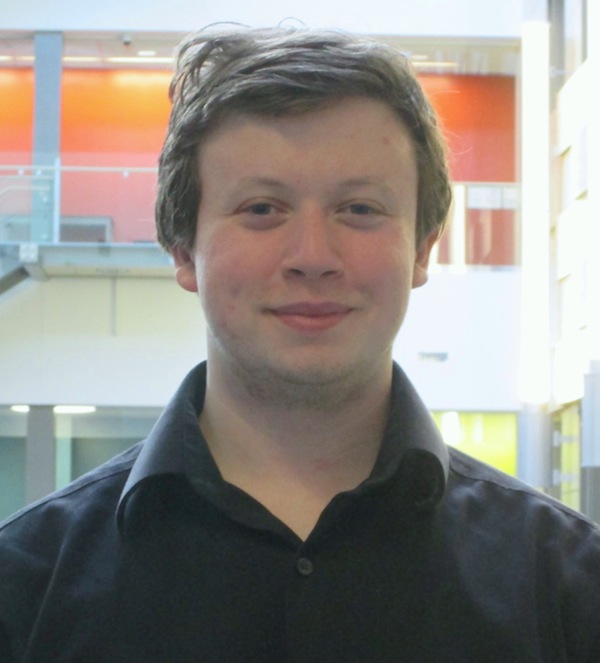
Raphael Hoult, winner of the inaugural Barry Rubin Prize Essay Competition. (photo from Raphael Hoult)
“A Game of Clocks: An Analysis of the Situation in the Middle East and Its Effects on Israel” by Winnipeg’s Raphael Hoult is the winner of the Centre for Israel and Jewish Affairs’ inaugural Barry Rubin Prize Essay Competition.
Hoult, a physics major at the University of Winnipeg in his second year of studies, conjured up a mind-bending theory about the stability of Middle East security and consulted expert sources for his essay.
In physics, Hoult’s interests lie in the field of quantum gravitation, which attempts to combine two major theories – those of general relativity and quantum mechanics.
“These two theories don’t play well together,” said Hoult. “They conflict in places. The biggest place they conflict is in that every force in the universe has been quantized, meaning that we’ve found a very small, discrete package of it in the universe. For example, electromagnetism is delivered by something called a photon. The other forces have something that delivers them, as well. But, with gravity, we’ve found no such thing yet. What we say is we haven’t been able to quantify it, though there are a lot of theories out there for how to solve that problem. There’s string theory. Another is loop quantum gravity, that attempts to bring some parts together.
“I want to help look for a theory of quantum gravity, so we can finally resolve this dilemma … combine the two theories into one bigger theory, a more complete theory. And, hopefully, that will give us a lot more insight into the way gravity works and allow us to do more with our understanding of gravity – to utilize it more, similar to the way our deeper understanding of electricity and magnetism has allowed us to do more intricate electronics in the past couple years.”
According to Hoult, this reconciliation of quantum mechanics and general relativity has been the Holy Grail of physics for the past 50-some years, and solving it will be huge for physicists and the world as we know it.
“The proposed theoretical messenger particle for gravity is the graviton, which is something we’ve not yet observed at all,” he said. “Quantum mechanics requires there to be a graviton…. General relativity in no way makes reference to a graviton.
“The main thing is quantum mechanics works really well with very small things, general relativity works really well for really big things. Things with a lot of mass are usually very large. The problem comes when you have things that are very massive and also very small, such as neutron stars or black holes. These are very dense, have a lot of mass and exert a lot of gravitational force, but they are also very small. In the case of a black hole, they are actually on the atomic level. So, quantum mechanics is very important to the way they work, but general relativity also is in play. When our two theories don’t work and they are supposed to be working at the same time, that’s a problem and something we want to fix.”
In addition to his knowledge of physics, Hoult is also well-versed in Israeli politics. “I’ve actually never taken a political science course at university,” he acknowledged, “but I went to Gray Academy [of Jewish Education in Winnipeg], so I had a very strong basis in knowledge about Israel. I had a good grounding there. I also read the Times of Israel and Haaretz every day.”
When Hoult saw an advertisement for the Barry Rubin Essay Competition on Facebook, it piqued his interest. The contest topic was, “What does the current regional turmoil in the Middle East mean for Israel?”
In his essay, Hoult said, “The three main critical points I talked about were the constancy of Hezbollah, Hamas and Daesh (the Islamic State in Iraq and Syria [ISIS]). I wrote about the fact that Hezbollah is involved in the war in Syria, specifically as affiliates of Bashar Al-Assad. They support him and are fighting on behalf of him. On the flipside, a branch of ISIS, called Al-Wilayat Sinai, is operating in the Sinai Peninsula desert against the Egyptians, making their lives very difficult. They’ve also struck up an alliance with Hamas.”
According to Hoult, the main three players in regards to Israel involve Hezbollah in the north, Hamas in Gaza and Al-Wilayat Sinai (Daesh) in the south. Hoult does not delve into the Iranian threat in his essay, apart from Iran’s role in supporting these groups.
“My hypothesis was that these three forces are connected to one another,” he said. “And, because of the ongoing campaign against ISIS, my hypothesis is that, as soon as that campaign succeeds and breaks down ISIS, all hell will break loose for Israel.”
Hoult explained that this theory takes into account Hezbollah’s huge military arsenal, which is estimated at around 100,000 rockets, and their ability to hit every point in Israel from Metula to Eilat, combined with the southern threat from Hamas and from the Al-Wilayat Sinai, which, so far, has been mainly fighting the Egyptians.
“Once ISIS collapses in the north, the Al-Wilayat Sinai … will suddenly be like a tentacle that has been cut off from the squid,” he said. “It will have no control and will be in desperate throes to stay alive, making it likely that it will involve at least a couple cross-border raids. If those involve any Israeli deaths, it will force Israel to respond, which is an issue, due to the fact that Israel can’t cross the border without Egyptian permission.
“There is also the fact that Hamas is having another military build-up,” he added.
Hoult predicts this will likely lead to another war in 2017 and, once that war is over, he said Hezbollah would have had ample time to gather its troops and possibly attack Israel from the north. “This is not a good thing for Israel, as Hezbollah is dead set on destroying Israel if they can,” he said.
As to why Hoult thinks his essay was selected as the winner, he said he is not sure, although he imagines it may have “had something to do with all the sources cited, creating a compelling likelihood of my hypotheses coming true.”
One of his many concerns is that “the primary backer of Hezbollah and Hamas is Iran. Iran has just had billions of dollars unlocked, due to the nuclear deal … which I’m not going to condemn or support, though I’m a little bit skeptical of whether or not unlocking those funds was a good thing.”
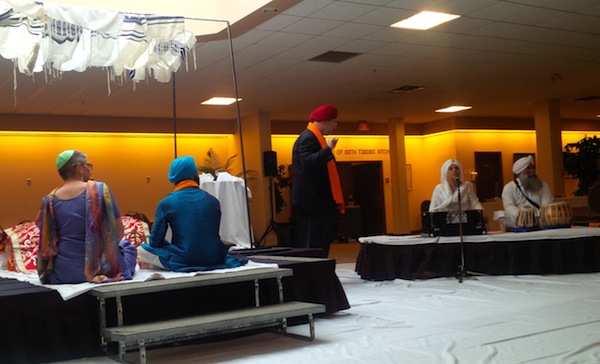
During mock weddings, participants learn about Jewish and Sikh rituals. (photo from Shaul Osadchey)
While Judaism is the main focus of any synagogue, and many stop there, that is not the case with Calgary’s Beth Tzedec Congregation. They have decided to take their Jewish engagement into the wider world and have hired scholars from other faiths to teach them about those faiths.
“There are a great number of religious traditions that are present in the community,” said the synagogue’s Rabbi Shaul Osadchey. “How do we learn about other people? How do we engage in conversation and interfaith relationships with people unless we know something about them? That’s the challenge.
“In thinking about that, which is fundamentally an issue of how we make Jews more religiously literate about other religions, the challenge is to do that in a way that people will come out and actually participate in the learning.”
Osadchey knew that if he left it to others to start the process, he’d be able to count participants on one hand – out of the 600 families that are a part of the synagogue.
“People aren’t going to initiate that,” said Osadchey. “People are intimidated going into other people’s houses of worship. They don’t find the time to do this on their own. The thought was, then, sanction it and bring it into the synagogue … making it ‘kosher’ in the sense that it’s acceptable for us to do. Secondly, it will be much more effective, because people will be much more comfortable coming into a familiar environment to learn about others.”
Osadchey was able to find someone in his congregation willing to support the cause, leading to the creation of the Lil Faider Interfaith Scholar in Residence Program.
“The idea was to allocate $10,000 a year for five years and pick five religions we wanted to examine, and invite a scholar or religious leader from the chosen tradition to be on our staff and teach within the synagogue for about 10 months (not over the summer).
“The first year, 2013-2014, we selected Sikhs. I thought that would be a good starting point because we know very little about Sikhs. They have a fairly significant amount of people in the Calgary community. Approximately 20,000 Sikhs live here, which is at least twice the size of the Jewish community, and they are very visible and yet kind of mysterious to us, we don’t know much about them.”
In his High Holiday sermon that launched the program, Osadchey invited attendees to learn about Sikhism. “All we know about them is they work at the airport, they
drive taxis and they wear a turban,” said Osadchey to congregants. “People kind of chuckled, and said, ‘Yeah, yeah. I know that.’ The point was, what do you know beyond that? The answer was relatively nothing. That’s not enough to engage people in conversation let alone collaborate in community activities.”
The synagogue hired Dr. Harjot Singh, a medical doctor and leader in the Sikh community. She presented lectures, followed by some experiential activities. One program was called Turban and Tefillin.
“That was pretty amazing, because it was a way in which we explored what the meaning of religious apparel is in our respective traditions,” said Osadchey. “The fact that we both cover our heads and wear identifiable religious objects was a starting point. During this program, all the Jewish participants were shown how to put on a turban and each of us was wrapped in one.
“We see turbans, but we don’t see them unwrapped … and now [we] understand how complicated it is for the novice to actually do that. Even though it only takes them three to five minutes to do, it’s quite an art. It was really quite wonderful to be wearing this turban and get a feel for what it’s like. Then, we wrapped them in a tefillin and they got an idea of what that was as a religious object.”
The congregation was invited into a gurdwara, the Sikh house of worship, and experienced a service. Then, they joined everyone in the langar, or common kitchen, where people can eat for free. Lastly, they finished the year off with a mock Sikh wedding and a mock Jewish wedding, for which they put up a chuppah, and presented the wedding rituals, acting them out and taking note of the similar and different rituals.
Casey Eagle Speaker welcomes Beth Tzedec’s interfaith learning group to a sweat lodge. (photo from Shaul Osadchey)
In 2014-2015, the synagogue focused on aspects of First Nations spirituality, inviting Casey Eagle Speaker and another teacher to give lessons on their culture.
“The year ended with a sweat lodge we went to, for us exclusively,” said Osadchey. “Afterwards, we sat around and passed the peace pipe together. People really learned a lot from that, as native spirituality is an oral tradition mainly. These are customs passed on and taught – sundance, sweat lodges and so forth – but they also have a very interesting perspective about the creator, nature and the role of people in terms of building community and families. That was quite eye-opening.”
This year, with all the new connections the synagogue has made with the Muslim community, they decided to focus on Islam.
“We didn’t start with Islam and we didn’t start with Christianity, because people probably would have said, ‘Oh, I know everything I need to know about Christianity, so I’m not going to show up,’” said Osadchey. But it was time to get to Islam, he said. “The next two years are going to be Hinduism and Buddhism.”
For Islam, the congregation selected Imam Syed Hadi Hasan of the Shia branch of Islam, who has a long history of interfaith work.
“What we did, however, was to respond to some of the naysayers and the skeptics by inviting a Jewish rabbi/scholar from L.A. after the imam had given about three lectures, and then we had Dr. Reuven Firestone come and speak,” said Osadchey. “He’s written books on Islam for Jews, about what Jews should know about Islam and what Muslims should know about Judaism. He’s very active in Muslim-Jewish dialogue. He came up and gave us a weekend of four lectures on different aspects of Islam and how we approach it. We invited our Islamic friends to come and many did. And, they were very impressed by his scholarship and knowledge of the Koran and so forth.”
At Chanukah time, the synagogue invited three imams to share their thoughts on religious freedom and join in the lighting of the chanukiyah, along with the rabbis. At the end, they all held up letters that spelled the phrase, “We refuse to be enemies.”
Osadchey said, “It was a powerful moment and brought Chanukah and the whole meaning of respect into a much different perspective.”
Imam Syed Hadi Hasan, right centre, takes Rabbi Shaul Osadchey, left centre, and some congregants on a tour of his mosque. (photo from Shaul Osadchey)
This March, the synagogue initiated the program Our House is Your House, which will be profiled in a future issue of the Independent.
Although Christianity is not one of the religions studied in the first five years of the program, the synagogue hopes to continue with a sixth year focused on Christianity. The program so far has been beneficial.
“It has given people permission to go out into the community and do things in a way they may have been hesitant to do before,” said Osadchey. “They have more confidence that they have the knowledge and the literacy to engage people.”
The scholars, too, gained much from the experience. “I was thrilled and amazed at that request and immediately accepted it,” said Hasan. “And I did my best to teach about Islam and answer all the questions from the participants of the five sessions I was part of.
“In the first session, participants were not very comfortable…. They were friendly, but they were a little bit formal in the beginning … but, gradually, we developed a friendship.”
Hasan is planning to bring Judaism into his mosque in a similar fashion, calling Beth Tzedec’s method “perfect and brilliant.”
He said, “We will be inviting Rabbi Osadchey for probably three to four sessions and he will be introducing Judaism…. When we are ignorant, when we don’t know each other, definitely, we have a lot of misconceptions. We are going to bring knowledge and awareness, and show that we are almost the same. We all work for the welfare of humanity and the universe. In this sense, we all are the same. In doing these programs, we are promoting peaceful coexistence and we are bringing harmony and unity within our communities.”
Speaker, who is a member of the Blood Tribe, which is part of the Blackfoot Confederacy in Alberta, echoed Hasan’s feelings, mentioning he found the experience very valuable.
“I enjoyed the hospitality and the openness that the people had,” said Speaker. “The congregation was very open in mind, body and spirit, very open to listening, to understanding who we are as a people, as indigenous people, and about the concerns or issues prevalent in society. They showed me a hunger to learn and to create an understanding, rather than just knowing.
“In our culture, we share openly to create an understanding and come together as human beings, rather than being separated by race, creed, color and religion. Those don’t work. We’ve seen the conflict that those create.
“They shared with me. They felt safe. They didn’t feel threatened. It felt more like family and how we do … the openness of sharing and expressing kindness, generosity and acceptance of each other was something they really came to be accustomed to. And, our style of ceremony, going into prayer and stuff like that, it’s so heart-warming.”
In 1999, Israeli-born longtime Winnipegger Talia Syrie spent her summer working as a tree planter in British Columbia. Trained as a heavy diesel mechanic, she was tree planting to pay off her student loans. A month into the summer, Syrie stepped on some broken glass and injured herself. Not yet ready to leave, however, she found work in the kitchen, helping feed 90 planting staff.
“I kind of endeared myself to the kitchen staff and they let me stay on,” said Syrie. “I realized, doing that, that I really enjoyed it, really liked cooking. I came back to Winnipeg and did that for the next year or two.
“I really liked the bush-camp cooking experience, when you’re out in the middle of nowhere and you don’t have the resources available to you that a regular kitchen provides. I liked that challenge.”
With this newfound passion, Syrie started working in the catering world. Then, a friend suggested that she open her own catering business.
With that, Syrie began searching for a commercial kitchen from which to work, eventually finding a small one at a downtown hotel. The owner offered her the kitchen, as long as she also agreed to open a restaurant at the hotel.
“There wasn’t anything like that in the neighborhood, on Main and Logan,” said Syrie. “It’s now the Red Road Lodge, but it used to be the Occidental Hotel. I had grown up in the North End, where my grandfather on my father’s side had a business. Today, too, I live quite close to there (in North Point Douglas).
“It felt nice to be working in that neighborhood, I was happy to do it. I didn’t really think that anyone would come into the restaurant. I thought it was going to be mostly for show and then we’d run the catering company and have this ‘fake’ restaurant.”
When Syrie first opened the Tallest Poppy, they only had three or four tables. As it turned out, these tables were always occupied, so they had to add more. In no time, the restaurant was so busy that Syrie did not have much time for catering.
“It was very challenging at the beginning, the restaurant industry,” she said. “Having little to no restaurant experience, there was a pretty steep learning curve. It was exciting and there was a lot of fun and a lot of things were great, but, in a lot of ways, it was pretty messy.
“I always say that I’m really grateful that we started out where we did. The North End is pretty forgiving, pretty gentle with us, so we were able to make mistakes and learn things.”
After a few years, Syrie found enough time to start developing the catering part of her business, doing office lunches, barbeques and small parties. “We also cater a lot of funerals,” she said.
“I love making party sandwiches,” added Syrie. “If I could do anything, I’d probably just make party sandwiches. That would be my dream job. I like the practical nature of a lot of catering. You have a whole bunch of people and they have to eat, people working that have to be fed.”
Syrie said her primal drive to feed people has its roots in her Jewish upbringing, being taught at an early age that the only way to really show someone you care is by feeding them.
“That’s the only way that really counts,” she said. “You buy somebody a car, it doesn’t matter. If you make them soup when they’re sick, that’s how they know you actually love them.”
About three years ago, a new community marketplace, Neechi Commons, opened in the neighborhood. The owners asked Syrie for help setting up their restaurant. She agreed, as she was happy to help a worthwhile project in her neighborhood. She ran both places for awhile and, later, decided to close the Tallest Poppy.
Once the Neechi Commons restaurant Come ’n Eat was up and running, Syrie opted to move on. She returned to British Columbia to do some consulting work for a friend and then returned to Winnipeg to find a new location to reopen the Tallest Poppy.
“I was walking down Sherbrook Street with a friend one day,” said Syrie, “and, as we were passing by the Sherbrook Hotel, he said, ‘I think that’s a restaurant … I think you should check that place out.’ All the blinds were shut. My friend said it used to be a Chinese food restaurant, but that there is nothing in there now…. I called and made an appointment to come down and take a look. The rest is history, as they say.”
Syrie reopened the Tallest Poppy in its new location last September. Not knowing the neighborhood well, she did not know if her concept would be a good fit, but she has found the people to be very welcoming, generous and kind.
Wanting to give space to the arts community, Syrie has offered her restaurant walls to local artists.
“I don’t know if I support the artists or they support me,” she said. “It’s important to me to have art around me all the time. It makes me feel better. It’s kind of selfish. The Winnipeg arts scene is so exciting. I work a lot and I’m stuck in my restaurant a lot of the time. I can’t always get out to gallery openings or go to shows. It’s really convenient for me to have them come do it right at my place.”
Syrie has formed a connection with a local company that displays art in public places, called Synonym Art Consultation, and the company organizes and programs all the restaurant’s art-related happenings. This includes a residency project that brings in an artist once a month to the restaurant to create art in the restaurant, while also interacting with clientele. “They are these super people doing this wonderful work,” said Syrie. “We sort of ride on their coattails. I’m very privileged and honored that they’re willing to work with us.”
The artists are varied, and some are performers.
“They come for two to three days, generally on the weekends, and people are able to engage them, which is a lot of fun,” said Syrie. “So, regular people having breakfast can come and talk to the artist about the work they’re doing.
“The artist has an opportunity to engage a lot of people they may not normally have access to. Their work is shown in the restaurant for a month, whatever it was that they built or did.”
The Tallest Poppy also hosts an after party on the first Friday of every month for people who go from gallery opening to gallery opening, including food and an arts presentation with DJs.
“A lot of things about Winnipeg make it really hospitable for independent business,” she said. “Our economy is pretty stable and there’s a bunch of hardworking people who are generally pretty down with jumping on board if you have a good idea. If I was going to do something else, this is the only place that makes sense for me to do it.”
Canada Revenue Agency has tax credits, deductions and benefits to help students. (photo from CRA)
The Canada Revenue Agency (CRA) has tax credits, deductions and benefits to help students, and here are some tips to ensure students get them. First, of course, is to file on time.
Most Canadian income tax and benefit returns for 2015 are due on April 30. However, since this date is a Saturday, CRA will consider your return as filed on time and your payment made on time if it receives your submission or it is postmarked by midnight on May 2, 2016. Self-employed individuals and their spouses or common-law partners have until June 15, 2016, to file their income tax and benefit returns, but any balance owing is still due no later than May 2, 2016.
Claim eligible tuition fees. You should have received an official tax receipt or a Tuition, Education and Textbook Amounts certificate from your educational institution with the total eligible fees paid for the tax year.
Claim the education amount. If you are a full-time student (or a part-time student who can claim the disability amount or has a certified mental or physical impairment), you can claim $400 for each month you were enrolled in an educational institution. If you are a part-time student, you can claim $120 for each month you were enrolled.
Claim the textbook amount. If you are entitled to claim the education amount, you can claim $65 for each month you qualify for the full-time education amount or $20 for each month you qualify for the part-time education amount.
Claim the interest paid on student loans. You may be able to claim an amount for the interest paid on your loan in 2015 for post-secondary education. You can also claim interest paid over the last five years if you haven’t already claimed it. Only interest paid on loans received under the Canada Student Loans Act, the Canada Student Financial Assistance Act, the Canada Apprentice Loans Act or similar provincial or territorial legislation for post-secondary education can be claimed.
Claim the public transit amount. If you use public transit, you may be able to reduce your taxes owing by claiming the cost of your transit passes (cra.gc.ca/transitpass). Keep your transit passes for local buses, streetcars, subways, commuter trains or buses and local ferries, and enter your total public transit amount on line 364 of Schedule 1, Federal Tax.
Claim eligible moving expenses. If you moved for your post-secondary studies and you are a full-time student, you may be able to claim moving expenses. However, you can only deduct these expenses from the part of your scholarships, fellowships, bursaries, certain prizes and research grants that has to be included in your income. If you moved to work (including summer employment) or to run a business, you can also claim moving expenses. However, you can only deduct these expenses from the net income you earned at the new work location. To qualify, your new home must be at least 40 kilometres closer to your new school or work location.
Claim the GST/HST credit. If you have low or modest income, you are a resident of Canada and 19 years of age or older, you may be eligible for the goods and services tax/harmonized sales tax credit. You do not have to apply for this credit – the CRA will determine your eligibility when you file your return and send you a credit notice if you qualify for it.
Claim child-care expenses. If you have to pay someone to look after your child so you can go to school, you may be able to deduct child-care expenses.
If you need help filing your return, and you have a modest income and a simple tax situation, volunteers from the Community Volunteer Income Tax Program may be able to prepare and submit your return for you. To find a free volunteer tax preparation clinic near you, go to cra.gc.ca/volunteer.
CRA’s secure My Account service is a one-stop shop for managing your tax and benefit information. Using My Account, you can track your return status, change your address, check your RRSP and TFSA limits, register for online mail, print proof of income, and so much more. When you register for online mail, CRA will no longer print and mail you eligible correspondence. Instead, CRA will send you an email when you have mail to view in My Account. You can also securely access your information with the MyCRA app (cra.gc.ca/mobileapps), which uses the same login information as My Account.
You can get your income tax refund and your credit and benefit payments directly paid into your account at a financial institution in Canada (cra.gc.ca/directdeposit). And, new this year, the CRA’s Auto-fill My Return service (cra.gc.ca/auto-fill) is available through some certified tax preparation software. This secure service automatically fills in certain parts of your income tax and benefit return.
If you are an international student studying in Canada, you first have to determine your residency status at cra.gc.ca/internationalstudents. You may owe taxes to the Canadian government and may qualify for GST/HST credit payments. If you have questions, call the CRA’s international tax and non-resident enquiries line at 1-800-959-8281.
Toronto Blue Jays new president and chief executive officer Mark Shapiro. (photo from Toronto Blue Jays)
The Toronto Blue Jays almost made it to the World Series in 2015. With spring training having just started, we’re crossing our proverbial fingers (in the most Jewish way possible) that we’ll see that same Blue Jay magic – and more – in the months to come. Eyes will particularly be on the new leader at the helm, Mark Shapiro, who officially joined the Jays as president and chief executive officer last fall.
Shapiro has arrived at a pivotal time for the franchise, which celebrates its 40th anniversary this season. Many are eager to find out in what direction he’ll take the team, but one thing is certain: he wants to win.
“Clearly, winning has to be the primary area of focus,” Shapiro told the Independent. “A relentless, obsessive commitment to building a winning team.
“Building a team isn’t just collecting talent,” he continued. “It’s about players that are committed, that are willing to take risks and commit to something bigger than themselves.”
He also said he wants to integrate more sports psychology into the team’s routine, and “build a business organization that obsesses about fan experience at every interaction and every touch point.”
Next on his list is Rogers Centre, which is in dire need of a renovation, one that may cost upwards of $400 million.
Shapiro, like anyone else who has experienced the dome, has been a fan of the awe-inspiring structure since his first Jays game, which was in 1989, soon after he completed his history degree at Princeton. “My memory is seeing this building and just being blown away at what an incredible engineering marvel it is,” he said.
Rogers Centre isn’t the only spot that needs an upgrade. The team’s spring training facility in Dunedin, Fla., is widely considered to be the worst in Major League Baseball. Shapiro has to choose between renovating or moving the Jays to a new facility when the team’s lease expires in 2017.
To make matters more difficult, team cornerstones José Bautista and Edwin Encarnación become free agents at the end of this year and the Jays’ stock of minor league prospects was depleted by last year’s trade deadline frenzy. Still, there’s every reason to believe Shapiro will hit it out of the park, given that he’s spent an entire lifetime surrounded by the game, its players, its strategy and its details.
Shapiro invested nearly a quarter-century with the Cleveland Indians, having worked his way up from player development to team president. It was there that the Sporting News named Shapiro Executive of the Year in 2005 and 2007.
His managerial style hasn’t changed all that much, he maintains. “If you have a moral compass and a set of well-defined values, those are going to be the determinacy of how you lead,” he said.
But baseball and Shapiro go farther back than Cleveland. Son of Baltimore attorney and sports agent Ronald M. Shapiro, the game was ingrained at a very early age.
“Baseball was a part of the fabric of my childhood growing up. It was a connection and a bond for me with my dad,” said Shapiro. “It’s hard to separate out baseball from my childhood, whether it was stickball, wiffleball, Little League or playing catch in the street. Maybe it was the fact that my dad, at some point in my adolescence, started representing Major League players and they started being part of my life. Baseball, informally or formally, was always a part of my life.”
Among his baseball heroes growing up was Baltimore Orioles’ Brooks Robinson, for “consistency, the way he treated people and his artistic style of play,” said Shapiro. Jewish ball player Al Rosen, aka “the Hebrew Hammer,” who played for the Cleveland Indians from 1947 to 1956, was also a role model.
The Hebrew Hammer wasn’t his only source of Yiddishkeit growing up. Shapiro said he was reared with a “strong Jewish identity,” associating most with the “education, culture, understanding of history, and the values intertwined in that history.” They include, he said, “work ethics, commitment to community, compassion and tolerance,” which, he said, were “defining attributes and values that were a part of my childhood.”
Shapiro and his wife Lissa Bockrath-Shapiro try to instil those same values in their children, son Caden, 13, and daughter Sierra, 11.
Even though today’s Jewish players are few and far between, every now and again Shapiro will run into a fellow Jew and shmooze.
“It’s obviously a rarity and, obviously, there’s a lot more front office guys, like Mike Chernoff [Cleveland Indians general manager]. When we saw a Jewish player, we’d always chuckle with pride at that player succeeding. It was a topic of conversation,” said Shapiro.
Cleveland player Jesse Levis and Shapiro used to kibbitz about being MOTs, members of the tribe. Since he began work in Toronto after the ball season was over, Shapiro has not yet met lone Jewish Jay Kevin Pillar.
Meanwhile, one item needs clarification. There’s been no shortage of times that Shapiro has been asked why he pronounces his name Sha-pie-roh instead of the usual Sha-peer-oh. For the record – and he wants to set the record straight – his name has always been that way.
“People say, ‘Are you trying to hide the fact that you’re Jewish?’ If I did, wouldn’t I call myself Smith?” he said with a laugh. “Come on, really, there’s got to be a better way to do that.”
The story is familiar to many: as immigrants coming through Ellis Island, there was a name change and a mispronunciation that stuck. Philadelphia and Cherry Hill, N.J., lay claim as the “only places in the world you’ll hear ShapIro spelled Shapiro, and you’ll hear Shapiro spelled Schapiro,” he explained.
To be sure, fans are less concerned about the name than they are about the game. And, if he could impart one message, it would be that he’s here to win.
“My favorite Blue Jays stories are waiting to be written,” he said.
Dave Gordonis a Toronto-based freelance writer whose work can be found in more than a hundred publications globally. He is managing editor of landmarkreport.com.