Examining the cosmos

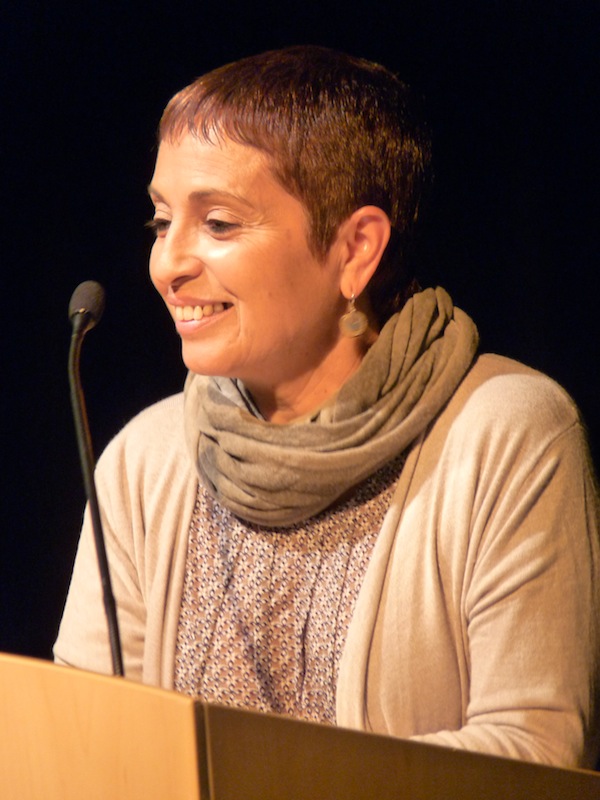
Prof. Victoria Kaspi, winner of the 2016 Gerhard Herzberg Canada Gold Medal for Science and Engineering. (photo from McGill University)

McGill University Prof. Victoria Kaspi – the first woman to win the Gerhard Herzberg Canada Gold Medal for Science and Engineering – says that her Jewish background and her parents’ support have had a lot to do with how much she has accomplished.

“Questioning is so inherently Jewish,” she told the Independent. “I think this builds personality, skill, and derived pleasure from talking and thinking. Jews are very studious, loving the books. For some people, it’s the Torah; for others, it’s different types of books … just really enjoying the process of studying, thinking and analyzing. I think that’s what my Jewish background has brought to my work.”

Neither of her parents were scientists. “I just really like it,” she said. “I grew up loving math. My parents were pretty hands off and they certainly never discouraged me. I was sort of an oblivious kind of kid, so if there were cultural signals that I shouldn’t go into science, I must have missed them.

“I think my parents built up my confidence. They never questioned my decisions. When I said I want to go into science, they never asked why I’d want to do that. They used to buy me lots of math toys and puzzles as a kid. Probably my mom encouraged me. She used to play lots of games with me.

“I’m sure I had encouragement from teachers along the way and family as well,” she added. Describing science as “always a great love,” she said it was neither forced on her or strongly encouraged as a study or career path. But Kaspi is aware of the societal pressures on women to not go into science, especially now, with her own daughters.

“They are sometimes subtle and pointing them out can be petty, but when you notice them as an overall trend – where there’s lots of little, tiny subtle signals that, in the end, register very large – I think that needs some work,” said Kaspi of the pressures. “Why I didn’t suffer from that? I’m not sure. I’m hoping that this will improve with time.”

Kaspi uses radio and X-ray telescopes to examine the behavior of neutron stars, using the cosmos as a lab to study the nature of matter in extreme environments.

“The sort of work I’ve done has involved different types of neutron stars,” said Kaspi. “One, in particular, that I’ve done is magnetars, which are neutron stars with very high magnetic fields. They sometimes explode randomly and are just really interesting to study. But there are other things, too.”

photo - A satellite picture of the island of Montreal with an illustration of a neutron star for comparison. While relatively small, neutron stars are so dense that just one teaspoon would weigh about a billion tons
A satellite picture of the island of Montreal with an illustration of a neutron star for comparison. While relatively small, neutron stars are so dense that just one teaspoon would weigh about a billion tons. (photo from NASA)

Neutron stars are stars that have collapsed and are very dense. A black hole is a star that has collapsed onto itself, due to gravity being so strong that nothing can escape from the surface, not even light; hence, the name, black hole. Neutrons are close cousins of black holes, but some light does escape from them.

“The typical neutron star has as much matter in it as half a million planet earths, but is crushed down to the size of a city,” said Kaspi. “We think a typical diameter of a neutron star is something like 20 kilometres.

“If you’ve crushed all that matter into the size of a small city, you have matter that is extremely dense. If you went up to a neutron star with a teaspoon and you took a teaspoon of the matter, it would weigh something like a billion tons.”

Kaspi said, “We don’t understand the physics of it very well, and that’s one of the things we are hoping to learn by studying them. When studying these objects, we use very powerful computers and algorithms, digital signal processing, there’s a lot of hard work and managing of big data.

“People who study pulsars are snapped up by software companies, because they are really good at developing algorithms, thinking out of the box and finding creative solutions to big data problems.”

Pulsars are rapidly spinning neutron stars and emit a bright beam of light. They are observed through their flashes. If you wanted to go flying around the galaxy and needed a useful, simple way to know where you are, you could use a pulsar. “They all pulse very regularly,” said Kaspi. “You can use that to know where you are in the galaxy and which direction you want to go.”

Kaspi’s research group has used neutron stars to confirm Albert Einstein’s theory of general relativity.

“As scientists, we don’t believe just because a theory is beautiful, it has to be right,” she said. “You have to test it with experiments. These neutron stars allow you to do phenomenal tests of general relativity. Was Einstein right or not? There are other theories of gravity and we can test those, too.”

One of the biggest projects Kaspi is currently working on in Canada is the building of the Chime Telescope in Penticton. She is also looking into “fast radio bursts.”

Of this phenomenon, Kaspi said, “It’s something that’s a big mystery right now that we don’t understand. Astronomers are pretty puzzled over these things. They are very short, a few milliseconds, bursts of radio waves, little blips in the sky that go off randomly but frequently. We think a few thousand go off across the whole sky every day. The first one was discovered a decade ago. Until now, only about 20 have been recorded.”

Kaspi has earned international recognition and numerous awards for her work over the years. As for receiving the Herzberg medal, she said she feels honored, and added, “I may be the first [woman] for this prize, but I won’t be the last. There will be many more women in the future.”

Rebeca Kuropatwa is a Winnipeg freelance writer.

Creating tech and jobs

Governor General of Canada David Johnston, left, with Chief Scientist of the State of Israel Avi Hasson. (photo by Sgt. Ronald Duchesne, Rideau Hall)

On March 1, Governor General of Canada David Johnston met Chief Scientist of the State of Israel Avi Hasson to discuss innovation and how Canada and Israel can enhance cooperation in this field. During Hasson’s visit, the Canada-Israel Industrial Research and Development Foundation released its latest impact report.

Established in 1994 under a formal mandate from the Government of Canada and the State of Israel, CIIRDF-funded projects cross many scientific disciplines, technologies and industrial sectors. These include biotechnology, agriculture, information and communications technologies, automotive, natural resource management, public safety and aerospace.

With base funding of $1 million per year from each of the governments of Canada and Israel, CIIRDF stimulates collaborative research and development between companies in both countries, with a focus on the commercialization of new technologies; pools Canadian and Israeli know-how to provide both countries with improved market access, sustainable competitive advantage and long-term market opportunity in global economies; strengthens ties between Canada and Israel, and delivers economic benefits to both countries; and leverages additional regional and sector-based funding that is matched by the government of Israel.

CIIRDF has engaged more than 1,000 participants in partnership development activities, including more than 400 industry leaders who actively contributed to R&D collaboration discussions. It has processed more than 230 bilateral R&D applications and funded 110 projects engaging more than 200 companies from Canada and Israel.

These alliances have enabled the joint development, marketing and sales of more than 50 technologically improved new products for global markets; generated $60 million in initial sales, and $300 to $500 million in additional economic value to collaborating companies; and created hundreds of jobs in both countries.

For the full impact report, visit racineinc.com.

From Orumieh to Winnipeg

Farhad Sultanpour of the Kurdish Association of Manitoba speaks to members of the Winnipeg Jewish community and others. (photo by Yolanda Papini Pollock)

According to Farhad Sultanpour of the Kurdish Association of Manitoba, Kurds are the largest nation of people without a state. The majority of Kurdish people, he said, live in a strip of land that stretches through Iran, Iraq, Syria and Turkey.

Sultanpour was speaking to a Winnipeg audience about the connections between Kurds and Israel at an event organized by Winnipeg Friends of Israel (WFI).

Sultanpour came from Orumieh, in east Kurdistan, the northwest part of Iran, and was brought up as a Sunni Muslim. He made his way to Canada in the late 1980s.

“In 1979, during my mid-teens, the Islamic Revolution began and the Kurds fought adamantly to protect and liberate their towns and villages against Iran’s leader, Ayatollah Khomeini, who was rising to power,” said Sultanpour.

During this time, Khomeini was stalling in the negotiations with Dr. Abdul Rahman Ghassemlou, the Kurdish leader, regarding the creation of a Kurdish autonomous state. What was actually happening, said Sultanpour, was that “Khomeini was reinforcing his revolutionary army. He led the invasion of the Kurdish territories, while declaring jihad to all Kurds. In 1989, the agents of the Islamic Republic of Iran assassinated Dr. Ghassemlou in Vienna, Austria.”

Sultanpour, who was 19 at the time, needed to make a decision – join Khomeini’s army or join the Kurdish Peshmerga.

“I chose to be a Peshmerga, fighting against Khomeini’s regime,” said Sultanpour. “After a year and a half, I went to the United Nations office in Ankara, Turkey, to apply for refugee status. A year and a half later, I was granted a refugee visa by Canada.”

Integration into Canadian culture was challenging for Sultanpour, mainly due to the language barrier. At the time, he hardly understood or spoke English, and had made the move alone.

Sultanpour has nothing but good things to say about Canada and the second chance at life afforded to him by Canadians. “I painstakingly pursue my English class and university courses for self-improvement,” he said.

He and his wife feel it is time to raise awareness about the plight of the Kurds, especially with the rise of ISIS.

“In the last 10 years, my wife and I have built three public schools, purchased a prefabricated trailer home-style classroom, and built a community centre near the city of Orumieh, in east Kurdistan-Iran,” said Sultanpour. “For the last 20 years, we have been helping, financially, 65 to 100 very poor families in Kurdistan.”

Sultanpour is now working to strengthen the Kurdish-Jewish connection in Winnipeg. He is saddened by the lack of knowledge about the Kurdish situation in the general public, as well as with federal public servants who have not heard about Kurds or Kurdistan.

He referred to an article in the Dec. 29, 2015, issue of Time Magazine: “Alan Kurdi was one of a million. In the summer of 2015, the 3-year-old Syrian boy of Kurdish origins and his family fled the war engulfing their country, hoping to join relatives in the safety of Canada. They were part of a historic flow of refugees from the Middle East to Europe this year, and they followed the dangerous route taken by so many others. In the early hours of Sept. 2, the family crowded onto a small inflatable boat on the beach of Bodrum, Turkey. A few minutes into the journey to Greece, the dinghy capsized. Alan, his older brother, Ghalib, and his mother, Rihanna, all drowned, joining the more than 3,600 other refugees who died in the eastern Mediterranean this year.”

Sultanpour said, “Alan, his brother, Ghalib, and mother, Rihanna, were identified as Syrian when, in fact, they came from Kobane, the Kurdish town invaded by Syria. The tragedy of the death of these three Kurdish people made Alan’s father, Abdullah, prefer to bury his family in Kobane and stay in his beloved motherland, Kurdistan. Up to their dying day, Alan, Ghalib and Rihanna were stripped of their identity and state.

“In the heart of the Kurds, the Kurdi family are Kurds from Kobane, Kurdistan,” he continued. “Alan’s dead body was the only Kurdish child seen by the world, not knowing that there were hundreds of thousands of Kurdish men, women and children who are dead and are dying in Kurdistan – the biggest nation without a state.”

Sultanpour, like many other Kurds, sees Israel and the Jewish people as their only allies in the Middle East. He sees Kurdistan and Israel living in a very hostile region with common enemies, with both nations finding Iran and ISIS as threats to their existence.

With only about 500 members of the Kurdish community in Manitoba, the Kurdish Association of Manitoba is looking to network with the local Jewish community to have a larger impact.

“Both Yolanda Papini Pollock of the WFI and Bernie Bellan of the Jewish Post and News have been instrumental in the speedy interconnection of the Kurds and Jewish people in Manitoba,” said Sultanpour.

The approximately 35 attendees at the event had many questions for Sultanpour about Kurdish-Jewish connections, Kurdish political parties’ relationships with one another, and Palestinian-Kurdish relations.

According to Sultanpour, many in attendance were surprised to know that the present Kurdish capital of Erbil was the capital city of Jewish Kurds from the end of the first century when some Kurds converted freely to Judaism.

“There were numerous questions about political and religious issues regarding the Kurds,” said Sultanpour. “It was very obvious that the attendees were happy to welcome the Kurds and that they could have accepted them earlier had they known about them sooner. But, it’s not too late to develop a much stronger bond with the Jewish people here in Winnipeg and increase the connection globally.”

In related news, another manifestation of Kurdish-Jewish friendship occurred in January, when Israeli Justice Minister Ayelet Shaked called for an independent Kurdistan, saying, “The Kurds are an ancient, democratic, peace-loving people that have never attacked any country. It’s time to help them.”

Rebeca Kuropatwa is a Winnipeg freelance writer.


Aftermath of trauma

Sometimes there are jokes about how we’re all emotionally damaged to some degree. It’s a serious problem for us, because we all lived through wars and terror attacks,” shared Canadian-Israeli Yolanda Papini Pollock of Winnipeg Friends of Israel (WFI) at a lecture co-hosted by WFI on Feb. 9.

The discussion, which focused on the topic The Psychological Impact of War and Terrorism: Coping with and Minimizing Trauma, was held with the local Canadian Associates of Ben-Gurion University of the Negev chapter, the Jewish Post and News and Congregation Temple Shalom, at the synagogue.

photo - Michel Strain
Michel Strain (photo by Rebeca Kuropatwa)

“I’ve worked with refugees for the last decade,” said Michel Strain of the Manitoba Immigrant and Refugee Settlement Sector Association. “All have come from countries affected by war and many have experienced trauma and torture, many living in refugee situations for many years.

“In my role in the employment program I worked in, I was often one of the first people the refugees began to trust. And, during this trusting relationship, I had the privilege of many individuals sharing their stories with me…. Their resiliency was resoundingly evident to me.”

Holocaust survivor Edith Kimelman spoke about dealing with her personal trauma. She was 16 years old when Germany invaded her small community in Poland.

“I stood at a neighbor’s window and watched my father being led away by soldiers, only to find him later in a field – dead and riddled with bullets,” she said. “It was beyond my young comprehension to understand that no one in our non-Jewish community of neighbors would help us bring him home. My childish belief was, once he returns to our house, he would return to life.

photo - Edith Kimelman
Edith Kimelman (photo by Rebeca Kuropatwa)

“To watch from our window, as Jewish neighbors were led behind a stable, shot and quickly buried gives me, to this day, nightmares. To find my mother so severely beaten that it led to her death will haunt me forever. I felt like I was punished, having to remain alive without her.

“When I had my own children, I lived in constant fear that something terrible would happen to them or to my husband, and that I would be unable to help them.”

Kimelman explained how this trauma has affected every aspect of her life, including, of course, her relationships with family and friends. While she fears she will leave her sons with the heavy baggage of her unfortunate experiences, she is confident that her fierce love for life and her survival will carry them through.

The keynote speaker of the event, BGU’s Dr. Solly Dreman, who was born and raised in Winnipeg before moving to Israel 50 years ago, was introduced by Dr. Will Fleisher, a local therapist experienced in working with traumatized youth and adults. Dreman is professor emeritus in BGU’s department of psychology.

Dreman has witnessed the long-lasting effects of terrorism. Decades later, “soldiers are having night terrors, night sweats, family difficulties, are unable to cope.”

He differentiated between war and terrorism, explaining that war is usually preceded by prior events and circumstances, while terrorism occurs suddenly, without warning, causing a different type of trauma. Unlike war, terrorism is not confined to a specific geographic arena or time dimension.

“The threat persists, the fears, uncertainty, the sense of helplessness,” he said. “Such attacks are looming over our heads all the time. You have the unbridled devils lurking in your soul forever. That’s going to serve as the trigger for anxiety, feelings of helplessness and inability to cope.

“People who have lost loved ones may have been witness to the event, and we all know the symptoms of survivor guilt,” he continued. “By escaping unscathed, they experience feelings of guilt that they came out alive. There’s research that shows that people who have been injured in a terrorism event after having lost a family member have less PTSD [post-traumatic stress disorder] than someone who comes out unscathed. Survivor guilt has been a major factor.”

photo - Dr. Solly Dreman
Dr. Solly Dreman (photo by Rebeca Kuropatwa)

Dreman pointed to the media as an aggravator in Israel, saying they continually expose the public to the horrific events, while frequently providing information that is unreliable and unconfirmed. He also said the general public, too, is responsible for watching, reading and listening to these reports more critically.

He spoke about his experiences with two separate terror incidents.

“Our initial therapeutic attempts were designed to deal with interpersonal things, like helping teachers in their contact with the young victim students, helping integrate them into the school system,” said Dreman.

The approach seemed to have worked for the first few years, but when Dreman went back to these families 10 years after the initial contact, he found them struggling with life and their interpersonal relationships.

“It was terrible,” said Dreman. “We failed. By the way, we got published in a very prestigious journal reporting on our failure. The conclusion, for those of you who are dealing with refugees or faced the Holocaust, is that there is a need for interpersonal intervention and getting back to business as usual.”

Dreman suggested that limiting media exposure may be helpful, as the constant repetition of the horror does not allow people to heal. But, on the other hand, he said it is important to not go completely off the grid, as that can cause anxiety to a breaking point that might create more trauma. A balance is needed, he said.

Dreman further advised that it is important to embrace life, that social support is a major factor in healthy adjustment.

“Be up front with your kids, explaining that you will do your best to protect everyone,” he said, “but don’t promise that nothing bad will happen, as that is a promise you may not be able to keep. We should allow kids the opportunity to express their fears, but not to dwell on them, as that will exacerbate the sense of trauma.

“Routine is very important – schoolwork, exercise, empowerment,” he added. “The only way to get that is establishing a routine in the face of incomprehensible uncertainty and trauma. Don’t send the kid to a shrink because, by doing that, you’re telling them you can’t manage things.”

Rebeca Kuropatwa is a Winnipeg freelance writer.

Safety in home births

With only about five percent of Canadians giving birth at home, one might think the practice is dangerous and that is why the number is so low. On the contrary. Studies show that, as long as the mother is at low risk, it is as safe to give birth at home as it is to give birth in a hospital.

Dr. Michael Klein is a family physician, pediatrician, newborn-intensive-care specialist, maternity care researcher and senior scientist emeritus at Vancouver’s Child and Family Research Institute.

“I am a part of a number of ongoing research projects,” said Klein. “We look at old and new technologies and assess them in relation to birth. I’m about normal birth – not complicated birth – keeping birth normal.”

photo - Dr. Michael Klein
Dr. Michael Klein (photo from Dr. Michael Klein)

In 2009, Klein worked on a study that looked at the safety of home births, evaluating three groups of births: home births by a midwife, hospital births by the same midwives, and a matched sample of physician births. The researchers looked at women who were identical in their risk profile and found that, regarding fetus development and the newborn baby, there was no difference in these three groups.

“Home birth seemed to be as safe as hospital birth, whether by the doctor or by the same midwife,” said Klein. “There are now two other studies from Ontario that show the same thing.

“Home birth is integrated within the health-care system in B.C.,” he continued. “Midwives are supported and part of the system, so when the midwife needs help from a hospital backup system, she gets it.

“Of course, what you also see is dramatically more interventions on the physician-hospital side than at home. And you find, interestingly, that the midwives – the same midwives delivering in hospitals – have results in terms of interventions of various sorts that are closer to the doctor’s side than they are to themselves at home.”

Klein attributes this observation to the influence of the hospital itself, a setting that is anxiety-driven. There may also be differences in the population, with women wanting a midwife in a hospital differently motivated from those wanting a midwife in a home setting.

In terms of the methodology of the study, it was very important that, once a woman was beginning her labor at home, no matter if the birth ended up being in a hospital or not, that she was counted in the home birth column or category.

“Roughly, a third of midwifery births will be home births,” said Klein. “That’s because this is what women are requesting. The model is what is called a ‘woman-centred model.’ If a woman wants a home birth and she meets the criteria in terms of her risk profile, then the midwife is obligated to deliver that service in the way she wants.

“I think there’s no question that we should have more home births. You may be unaware, but the minister of health in B.C. has supported that notion – that home births should be … I wouldn’t say promoted, but certainly made available.

“Women need to know what the options are and they need to know if they need help during labor that they will get it. A home birth, to be safe, needs to be within 30 minutes of an operating room. Contrary to what most people believe, things don’t suddenly go wrong. They evolve.”

Something else that can be a limiting factor in increasing home birth numbers is the lack of midwives across Canada.

“The joke is that you have to register with a midwife before conception,” said Klein.

In British Columbia, the midwifery class recently doubled in size. Why not quadruple the class size to keep up with demand? The simple answer is that the system is not currently able to support that, although it is estimated that a home birth costs the system between a third and half as much as a hospital birth.

“I think it’s too complex,” said Klein. “What we are talking about now is a serious planning exercise. That’s not happening. I think it will take time for the system to collapse a little bit more before it happens.

“The other player in all of this, which we haven’t talked about yet, is the doula. That movement is, of course, gaining more and more popularity. In some settings, it’s been so successful that some hospitals are supporting the doulas’ salaries.”

According to Klein, doulas are successful in lowering the caesarean-section rate and other interventions. “When you lower the c-section rate, it has a big impact on the hospital budget, because a person who has a caesarean stays twice as long in the hospital than one who has a vaginal birth,” he said.

Avoiding a c-section means less likelihood of a uterine scar in subsequent pregnancies. “Once a pregnant woman has a uterine scar, the whole reproductive trajectory is changed,” said Klein. “One is more likely to have a whole series of problems, complicated next pregnancies, placental attachment problems, ectopic pregnancies, stillborn births and infertility. With the c-section rate at four percent in home births and up to 30% in hospital births, that many more women will end up with a uterine scar and be at higher risk of complications.”

photo - Dr. Brian Goldman
Dr. Brian Goldman (photo from Dr. Brian Goldman)

Dr. Brian Goldman, an emergency physician at Mount Sinai Hospital in Toronto, and the host of White Coat, Black Art on CBC Radio One, has, for years, had an eye on the growing demand among women in Canada for licensed midwives.

“Midwives are experts in low-risk, uncomplicated births, as are family doctors,” said Goldman. “However, even though low-risk birth is a core part of the training of family physicians, very few of them want to attend low-risk births once out in practice.

“In Canada, we have a situation in which the vast majority of births – high-risk and low-risk alike – are attended by obstetricians. These specialists have tremendous knowledge, skill and experience which, in my opinion, is best put to use managing women who are likely to have a complicated pregnancy and birth. We need more professionals like midwives and family doctors to attend low-risk births.

“Most family doctors run busy practices and find it difficult for practice, family and social reasons to devote a significant amount of time to attending women in labor through the night. To me, midwives represent the likeliest prospect for increasing the pool of professionals qualified and interested in attending low-risk births.”

Rebeca Kuropatwa is a Winnipeg freelance writer.

Better ways to invest RRSPs

This RRSP season, you can give your portfolio a gift – the potential for better returns and reduced risk. (photo from 401kcalculator.org via Wikimedia Commons)

Many RRSP portfolios struggled in 2015 to produce returns sufficient for the goals of retirement building and wealth preservation. An over-reliance on equities, and particularly Canadian equities, left many RRSPs in negative territory and, so far in 2016, the stock market has continued to erode savings. But, this RRSP season, you can give your portfolio a gift – the potential for better returns and reduced risk.

The concept of what we call a registered retirement savings plan (RRSP) was introduced by the federal government in 1957 to encourage Canadians to save for their retirement. Although the rules have changed over the years, the basic benefits are every bit as valuable today as they were at inception: the ability to contribute pre-tax dollars and thereby reduce income for taxation, and the ability to compound gains within an RRSP while deferring taxes on the gains.

Many of us are good about setting up our RRSPs when we’re young, and dutifully contribute the maximum allowable each year. Typically, our RRSP accounts start out as just another brokerage account with an emphasis on long-only stock investing. But, by the time we reach our 40s, those RRSP dollars can start to add up. For top-earning Canadians contributing the maximum allowable, an RRSP account can hit $500,000 by middle age and keep going from there.

In addition, our risk tolerance changes as we age and our runway of remaining working years shortens. Conventional wisdom is that longer-term investment vehicles like RRSPs can take on more risk, as greater volatility over the long term often yields greater return. Unfortunately, this notion fails to anticipate how long it can take to overcome the drag of a negative year, and the fact that when a major loss occurs late in a life, there may not be enough time for wealth to catch up to needs. Consider, for instance, the unfortunate plight of anyone who had to rely on their RRSP in late 2008, before the Federal Reserve and its counterparts stepped in and refloated stock markets.

The collapse of stock markets in 2008 and 2009 prompted many to take their RRSP money out of the market and rethink their risk tolerance. The disappointment of 2015’s performance will likely reinforce that wariness of the equity markets. An RRSP that closely tracks the TSX would have been down 8.32% last year. That account will have to appreciate by 9.08% just to get back to the values at the beginning of last year. Given average return expectations of 8% per year, it will take 13 months just to recover, let alone get ahead. (And the numbers get worse if you go back further – the TSX is still below the high it reached in 2008.)

Even after our inauspicious start, 2016 may be a great year for equities, or it could be a repeat of 2015 (or worse). Either way, the safer, more reliable route to a more secure portfolio is to decrease downside volatility by employing two of the touchstones of risk mitigation: diversification and non-correlation. Both allow portfolios to absorb and offset downdraft periods, while benefiting from the correlation between return and risk (most assets with a higher-return profile also carry a higher-risk profile).

One of the greatest sources of volatility for a portfolio is the particular market or strategy it’s primarily invested in. The TSX, as an example, has historical volatility of more than 15%, which is quite high. To offset this inherent risk, it’s necessary to incorporate additional components that are both uncorrelated to the TSX and to each other.

Finding diversified, uncorrelated components is easier than you may think. There is a range of non-equity investment options available for RRSPs. Real estate, infrastructure and lower-risk funds of alternative funds can all be beneficial components of a balanced RRSP portfolio. Even the traditional RRSP component of Canadian equities can be turbocharged by replacing a long-only mandate with a long-short manager. And all of the above are available to accredited investors in bite-size pieces appropriate to an RRSP.

As with all portfolios, when constructing an RRSP portfolio, it’s important to distinguish the particular characteristics of each component so the portfolio achieves the greatest possible appreciation with the least possible risk. Real estate and infrastructure both have valued histories as long-term wealth generators with lower volatility, but they usually come with liquidity restrictions, and each is subject to cyclical trends. Funds of alternative funds can combine lower risk and reasonable liquidity while offering access to a range of investment themes far beyond the Canadian economy, an important way to break out of the limitations of living in a country that constitutes less than 3% of the world’s GDP. Long-short equity can achieve market neutrality and have great liquidity, but even some of the better Canadian funds can be highly volatile.

Your investment advisor should be able to suggest suitable choices for each component, and you can evaluate those recommendations (and come up with alternatives) by doing some internet research of your own. When assessing providers for each component, you and your advisor should consider the usual metrics such as beta, volatility, standard deviation, Sharpe Ratio and correlation to the TSX. While the names may be new to you, the concepts are easy to grasp and very useful when comparing performance over time. When it comes to choosing a fund of alternative funds, identify a manager with a proven record of nimbleness, as he or she will have to keep updating the mix of exposures to benefit from evolving market conditions.

Many pundits agree we are likely in the final innings of history’s longest equity bull market. Additional headwinds may result from bonds and credit, beginning a long overdue tightening cycle, which many are expecting will increase volatility. Now is the time for investors to rethink portfolio construction and embrace asset classes that are less influenced by the equity markets. Sophisticated investors like family offices and institutions embraced non-correlated alternatives decades ago. It’s time for the rest of us to catch up.

Ari Shiff is president and chief strategist of Inflection Management Inc. (inflectionmanagement.com), and manager of the Inflection Strategic Opportunities Fund. He has more than 20 years experience in hedge funds and can be reached at ashiff@inflectionmanagement.com or at 604-730-9147.

The business of agriculture

Arava International Centre for Agriculture Training executive director Hanni Arnon spoke to audiences across Canada as part of a Jewish National Fund nationwide tour. (photo by Rebeca Kuropatwa)

As part of a nationwide tour, with stops in Ontario, Manitoba, Alberta and British Columbia, Hanni Arnon, executive director of Arava International Centre for Agriculture Training (AICAT) of the Arava Development Co., introduced the training program to Canadian audiences.

In 1994, Arnon founded AICAT. The goal of the centre is to educate students from countries around the world on how to form successful agricultural businesses. Her cross-Canada talks – Feeding the World through Education – were organized by Jewish National Fund of Canada, its local branches and support from various other local Jewish organizations.

In her presentation in Winnipeg, Arnon shared her personal story about having been born and raised in Jerusalem. About 30 years ago, she chose to follow her dream and move with her husband, Moti, to the Arava region.

“We were looking for a life with challenges and fulfilment,” she said. “We wanted our children to grow up connected to nature and to be a part of a community that understands and appreciates the meaning of hard work, Zionism, solidarity and friendship.”

Some 900 families live in the central Arava, which is a desert. Given the harsh climate, general lack and poor quality of water, residents had little choice but to find creative solutions and overcome the daily difficulties they encountered. They have gathered more than 50 years of experience and research, with science as the foundation.

“With hard work, we made the desert bloom,” said Arnon. “We are the world leader in desert beautification and a prime example for effective water use. We have the ability to think outside the box and make the impossible possible.”

The global population is reaching more than seven billion, including 800 million people in poverty. Arnon is looking for a way to feed them by focusing on collaboration and the transfer of knowledge, which she feels will lead to empowerment and the opening of opportunities. She acknowledged that knowledge itself is not enough, that it needs to be coupled with training.

“For over 20 years,” she said, “AICAT has had the great privilege to bring every year, with the permission of the Israeli government, hundreds of students from 12 developing countries, such as Vietnam, Laos, Thailand, Nepal, Cambodia, South Sudan, Nigeria, Rwanda, Uganda, Ethiopia and Indonesia – a multitude of cultures, religions and nationalities that have participated in the unique program across borders.”

AICAT provides students with practical knowledge in everything from vegetable production to business management, marketing, research, technology and strategic thinking. The goal is for students to return home to “establish their own agriculture business and improve their farms,” said Arnon.

According to Arnon, AICAT – which has 40,000 graduates to date – teaches the most important lesson – that if you want something earnestly enough, you can make it happen. Every year, she said, she sees how, after 11 months, the students have a light in their eyes and are keen to apply the new ideas to helping their home countries.

“We give them hope and self-confidence to follow their dreams and improve their lives,” said Arnon. “They become entrepreneurs and future leaders of their countries.”

Arnon noted that not only do the students gain the knowledge and inspiration, but they go on to become goodwill ambassadors for the state of Israel. “They go home and talk about how much Israel means to them,” she said. “This is positive action on the Israeli side, which shows Israel in a different light.”

When Arnon was asked a question about cooperation with the Jordanians, she spoke about the different ways AICAT works with neighboring farmers. “Just to make sure you understand how close we are, the place where our fields end, this is the border,” she said. “It’s an open border with no fence. We have a peace agreement, so it’s a quiet border. We send our expertise to support farmers in Jordan. We are open for any collaboration with the Jordanians and would especially like cooperation with our neighbors.

“We also have a project [called] Clean Arava and we must do that together with the Jordanians, because we are so close to them. This is one of the projects we are doing together.”

Arnon explained that the Arava region is the biggest vegetable exporting area in Israel, producing more than 60% of the fresh vegetables Israel exports. The main crops are sweet peppers, tomatoes and melons, but they also grow flowers, grapes, mangos and dates. (The Arnon family owns a large date farm.)

As for the students involved in the project, Arnon noted that they pay for a one-way ticket to Israel, a medical exam and a passport. They can work while in Israel to earn their fare back home and tuition fees, while also taking home with them $2,000-$3,000 to help put into practice what they have learned.

“We see the impact on students,” said Arnon. “They are going back home as leaders, entrepreneurs, with knowledge, skills and money to start an agricultural business. Many of them, about 30%, continue on to higher education.”

The original inspiration for AICAT was the need to teach Thai workers in the 1990s about agricultural systems. Arnon, having been trained as a teacher for that work, immediately felt that a school should be created to teach the subject on an ongoing basis to as many students as possible.

AICAT presently teaches about 1,200 students per year, but Arnon is hoping to double that number with a new campus that will break ground in March.

As for funding, no government funding or support is provided, apart from providing the students with visas. It is JNF that provides support for facilities, dormitories and programs.

Ariel Karabelnicoff, director of JNF Manitoba and Saskatchewan, closed the Winnipeg event by sharing that the school has 80 students from Indonesia, an Islamic country with no diplomatic ties with Israel.

While in Winnipeg, Arnon also took time to speak to University of Manitoba students and visited the Canadian Museum of Human Rights. In Vancouver, hosted by JNF Pacific Region, she spoke at Temple Sholom, Beth Israel and Schara Tzedeck.

The talks were timed with the celebration of Tu b’Shevat and JNF’s fundraising campaign for a 6.5-kilometre park in Eilat. For more information on the campaign, email vancouver@jnf.ca or call 604-257-5155.

Rebeca Kuropatwa is a Winnipeg freelance writer.

A fighter for human rights

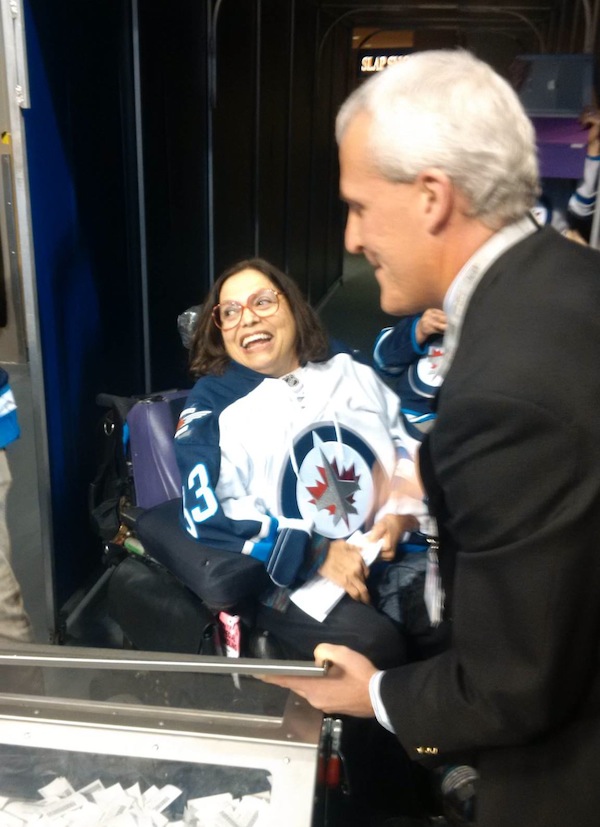
At a Winnipeg Jets game, Judith Heumann, U.S. special advisor on international disability rights, speaks to hockey fans and draws the winning 50/50 ticket. (photo from Judith Heumann)

The journey of Judith Heumann, U.S. special advisor on international disability rights, is featured in the Canadian Museum of Human Rights’ (CMHR) exhibit Turning Points of Humanity. On Human Rights Day, Dec. 10, Heumann visited CMHR, which is located in Winnipeg, and gave a talk on the disability rights movement.

Heumann is an internationally recognized leader in the disability community and a lifelong civil rights advocate. For more than 30 years, she has worked with various organizations and governments to advance the human rights of people with disabilities.

A daughter of Holocaust survivors and the oldest sibling of three who grew up in Brooklyn, Heumann had polio in 1949, when she was 18 months old. She has used a wheelchair ever since.

“My parents were Jewish German immigrants who came over when they were teens from Germany,” Heumann told the Independent. “During the war, my parents lost both of their parents and other relatives. Being Jewish was a big part of our family life, and also addressing issues around the Holocaust was important.

“My parents didn’t speak that much directly about their experiences. I did find out later that they were doing classes at a junior high, talking about their experiences living in Germany in the ’30s.”

Heumann’s first experience with discrimination due to her disability happened when she was 5 years old. Her mother took her to school and the school principal denied her admission because she used a wheelchair. The city sent a teacher to her house for home schooling for a total of 2.5 hours per week up until halfway through Grade 4.

“In that time period, my parents were looking for opportunities for me to be able to get into school,” she said. “I finally was able to get into school when I was in the middle of the fourth grade, but it was just segregated classes for disabled kids.

“My mother learned to become an advocate over the years. Not just for me, but working with other parents, and she and my dad were very important role models for me.”

It was Heumann’s parents’ advocacy that spurred her onto her own path of advocacy work in different communities in the United States, to start, and then in countries around the world.

photo - Judith Heumann meets with Manitoba’s Royal Canadian Mounted Police Chief Kevin Brosseau to discuss issues around persons with disabilities and the challenges they face in traveling
Judith Heumann meets with Manitoba’s Royal Canadian Mounted Police Chief Kevin Brosseau to discuss issues around persons with disabilities and the challenges they face in traveling. (photo from Judith Heumann)

At CMHR, Heumann spoke to about 200 people about the types of human rights violations disabled people experience and the need for good and enforced laws. She encouraged Canada to look at having laws similar to the United States’ Disabilities Act.

“This is so that there could be more uniformity in the country as far as construction and non-discrimination,” Heumann explained.

She added, “I know the Trudeau administration is looking at this as a possibility and I think Manitoba and [British Columbia] are also looking at this as provinces.

“I think Canada is doing good work in the area of disability,” she said. “I know people are very hopeful that the Trudeau administration will allow Canada to be more of a player internationally than they have been in the past number of years in the area of disability.”

Heumann has had her share of experiences with the lack of construction standardization in Canada, recalling a time when she was visiting a Holiday Inn on one of her business trips. Heumann’s staff confirmed her reservation and made sure to request a roll-in shower. When she checked in, she made sure the roll-in shower request was noted on paper, yet, when she got to the room, there was no roll-in shower.

“I thought they’d mistakenly put me in the wrong room,” said Heumann. “When I called the front desk, they informed me that they didn’t have any roll-in showers. I was told that although I requested it, they don’t have one. I asked when they were planning on telling me that they don’t have one, then I called the 1-800 Holiday Inn number to express my deep concern, because Holiday Inns in the United States are accessible. It’s one of the hotels that you can make a reservation at and ask for what you need, and they will tell you if they have it or not. The woman on the phone said, ‘Oh no. That’s not possible that you couldn’t get a roll-in shower at a Holiday Inn.’ She asked where I was and I told her Canada, and she said, ‘Oh, Canada.’

“It’s not at all to say that we don’t have all kinds of problems in the United States, too, but the problem in Canada is you don’t have uniformity in your new construction or modifications.”

A similar situation happened at the hotel in which Heumann was staying in Winnipeg. The room was great, except that it had an adjoining room with a door between the two that was too narrow for her wheelchair. Heumann could not get from one room to the other without having to exit and enter through the front doors. She used this as an example during her talk at CMHR.

Also during her stay in Winnipeg, Heumann went to her first hockey game. “I really felt the spirit of people in Manitoba when I gave a very brief response to a question asked by the commentator right before I pulled the ticket for the 50/50,” said Heumann. “He asked me about the State Department and what we were doing in the area of disability. I thought, nobody is going to listen, but when I left and we were going back to the hotel at the end of the game, it was clear people were listening. Some people came over and said they liked what I’d said. I didn’t care if they liked what I said, but I was impressed that they actually listened and took the time to say something. Manitoba was a great experience.”

Rebeca Kuropatwa is a Winnipeg freelance writer.

Calgary sponsorship efforts

Around the time of the High Holidays last year, Rabbi Shaul Osadchey, senior rabbi of Congregation Beth Tzedec in Calgary, had lunch with a congregant. Discussing various issues, they talked about the possibility of sponsoring a Syrian family.

“We decided to pursue that and have the congregation get on board and assume responsibility for a family,” Osadchey told the Independent.

With all enthusiastic and supportive of the idea, Osadchey gathered more information through Catholic Immigration Services (CIS). Later, he attended a workshop on how to sponsor a Syrian refugee family.

photo - Rabbi Shaul Osadchey of Congregation Beth Tzedec in Calgary
Rabbi Shaul Osadchey of Congregation Beth Tzedec in Calgary. (photo from Shaul Osadchey)

Through CIS, the rabbi was introduced to an executive of Armenian decent who had married a Jewish man and converted to Judaism. As the woman worked with Osadchey, she took a special interest in the congregation’s sponsorship and wanted to connect them to a particular family – a Christian Armenian family with relatives in Calgary who she personally knows.

“She had a personal connection and we thought that would be a good match, so we proceeded along those lines,” said Osadchey. “We were just simply committed to helping a Syrian refugee family and their religious background was of no particular relevance. We were prepared for Muslim or Christian, either one.” He explained that his congregation has been very active in building bridges in the local Muslim community.

After attending the workshop, the rabbi went back to the board with information about how the process works and the board unanimously passed the motion to adopt the family. Since then, they have been arranging all the paperwork, while the family to be sponsored is currently in Lebanon.

The congregation has been given some preliminary information about the family. “It’s a mother, a father and three children, ages 11 to three months old,” said Osadchey. “So, we’re preparing the various responsibility areas of helping them integrate in Calgary – things such as housing, clothing, food, transportation, jobs, and so forth.”

Osadchey has also reached out to Jewish Family Service Calgary to see if they can help with jobs; the parents are in the jewelry trade.

While the paperwork is being done, the community and congregation are offering support in many ways, from preparing to help with language needs, to collecting household furniture and other items the family may need.

While the local Armenian Christian community in Calgary is not very large (300 to 400 people), Osadchey thinks it is inevitable that the communities will form closer ties.

“I think, overall, the message that Beth Tzedec is sponsoring a family is very important, both for our members and for the community at large,” said the rabbi. “We are interested in this issue. We take it seriously. Jewish tradition calls on us to help refugees.”

Last month, leaders of Beth Tzedec had brunch with the refugee family’s Calgary relatives to learn more about them before they arrive in two or three months. It may take less time than that, depending on various factors.

“Still, we are pretty far along,” said Osadchey. “We have most of the financial commitment taken care of. It’s being underwritten primarily by one family, which is the original person I was speaking with who sort of launched the idea.”

But others in the congregation have also volunteered. For example, members of the congregation held a Chanukah party where, instead of giving gifts, they asked attendees to donate toward the sponsorship efforts. They raised $1,000.

The financial need for hosting a family of five is estimated by the federal government at $32,000, but Osadchey has been working with congregants, one of whom may be able to offer housing, which will substantially lessen this estimate.

“The $32,000 has already been raised, but we anticipate there will be other costs once they get here,” said Osadchey.

While the congregation is considering hosting more families in the future, they have decided to take it one family at a time, as this is a very new process for them.

“Somebody asked about that, and I said, ‘Go with the first family and see what the experience is like and, if we can continue to help and have support, we will do that,’” said Osadchey. “But, I anticipate it will be a very wonderful experience, both for the congregation and for the family.”

The response from the congregation has been overwhelmingly positive, and a number of prominent people have stepped forward and expressed their pride in the synagogue doing this. And the response has spilled over to Temple B’nai Tikva, which has spoken to Osadchey.

“They contacted us, but we already had the funding in place and were down the road in the process, so it wasn’t so critical that we had a partner,” he said. “We encouraged them to reach out and find someone else who might benefit from their help.”

Temple B’nai Tikva has set up a refugee assistance committee, which met last month. Committee representative Cynthia Simmons said that they have met with a couple of churches, and “we know we want to do something, but the exact nature of that something remains to be determined.”

Rebeca Kuropatwa is a Winnipeg freelance writer.

Welcome to Saskatchewan

It doesn’t require a big community to make big things happen. It just takes a few good leaders. And Saskatoon’s small Jewish community is a prime example.

JoAnn Jaffe is a University of Regina professor of sociology and social studies and leader of Congregation Agudas Israel’s social justice committee. Raised in Dayton, Ohio, she described herself as “not the most observant person in the world, but not the least either – raised in a somewhat secular Jewish home, but with consciousness of Jewish ethics.”

photo - Prof. JoAnn Jaffe, leader of Congregation Agudas Israel’s social justice committee
Prof. JoAnn Jaffe, leader of Congregation Agudas Israel’s social justice committee. (photo from JoAnn Jaffe)

In 2001, she helped form a Jewish-Muslim dialogue group in Saskatoon. Through this group, members of the synagogue and a mosque decided to join in an effort to bring a Syrian refugee family to Saskatoon.

Jaffe and another Agudas Israel member, Willow Allen, took the lead on the Jewish community side. “At one point, as we started to hear what was going on in Syria, Willow and I started thinking that it would be really great if the Jewish community could sponsor a family,” said Jaffe. “I also started hearing from other congregation and board members that they were very interested in doing this, too, so Willow and I attended a training done by the refugee sponsorship training program.”

They soon began thinking about getting the Muslim community to join them.

“We put together a proposal and presentation to the board of the congregation,” said Jaffe. “The board said they were very interested, especially if we could get the Muslim community on board. We see this as a value-added activity for us. Not only are we sponsoring this family – it is our ethical duty, what we are taught to do, welcoming a stranger and taking care of the needy – but, if we could do this with the Muslim community in Saskatoon, then we could build relationships, build the community, have each other’s backs. If problems arise, we already have relationships with each other and know each other. We have a way of working together. After all, events in the wider world tend to pull us apart.”

Once the Islamic Association of Saskatchewan accepted the invitation, it was a matter of putting together a joint steering committee with members from both communities in equal proportion. That committee would then work to involve other community members in all the different activities involved in sponsoring a family.

The joint committee – called Children of Abraham Refugee Sponsors of Saskatoon – decided fundraising should be divided between the two communities equally. Once that was decided, the synagogue was prepared to be responsible for the entire portion the Jewish community was to raise.

“They knew they weren’t going to be on the hook for that entire amount, but that’s a beautiful gesture of good faith,” said Jaffe. “Then, we started. We set aside a fund at the synagogue called the Tikkun Olam Fund that is now dedicated to our family.”

Earlier this year, B’nai B’rith announced in a committee meeting that they would match collected funds up to a total of $5,000. “There is a family here who owns a limousine service that, one evening, they took people around on tours of the Christmas lights and then donated all the money they made from that – $1,000 – and put that into our fund,” said Jaffe. “We now have over $12,000. We are looking to raise about $15,000 to be in a comfortable place.”

Further, the group is settling the terms of an apartment and continuing to mobilize their communities, with many people stepping forward to donate items for their home, clothing, housewares and more.

“It’s amazing,” said Jaffe. “Lots of people are volunteering to do tasks. Because we are hooked up with the Islamic Association, there are quite a few people who speak Arabic who volunteer to act as translators. One of the main people on our steering committee is originally from Lebanon, so, of course, she speaks Arabic as well. We feel like things are moving forward in a really great way. I feel optimistic about it. People are very dedicated to making this work.”

The Syrian family being sponsored has five children, as well as another on the way. Four were born in Homs, Syria, while the youngest child (2 years old) was born in Amman, Jordan – an indication to how many years they have spent in a Jordanian refugee camp.

They will be here by the end of the month, said Jaffe. “They know who we are. We know who they are. They know we are here and are sponsoring them.

“The husband was born in 1980, so he’s 35 years old, about. She [the wife] was born in 1988, so she’s 27. Her birthday was a couple days ago.”

Rebeca Kuropatwa is a Winnipeg freelance writer.