Canadian tributes to Peres

The Nobel Peace Prize laureates for 1994 in Oslo, from left to right: Palestinian Liberation Organization chairman Yasser Arafat, Israeli foreign minister Shimon Peres and Israeli prime minister Yitzhak Rabin. (photo by Saar Yaacov, GPO)

A towering figure, one among the founding generation of Israelis, Shimon Peres served as president, prime minister and in various key cabinet posts. He died Sept. 28 at the age of 93. Canadians joined in the international chorus of leaders mourning his death.

“Every so often, our lives are graced by the presence of truly remarkable individuals. They teach us invaluable lessons about compassion, fairness and generosity. They give us innumerable memories and a life of service that changes societies for the better,” said Gov. Gen. David Johnston.

“Shimon Peres meant so much to Israel, to Jewish people in Canada and around the world, and to the friendship between our nations. He called Canada an extraordinary friend during his state visit to our country in 2012, and I remember quite clearly the impression he left on me as a socially conscious man, driven by his love of Israel,” Johnston stated. “Though he is no longer with us, I hope that the legacy he left – as former president and prime minister of Israel and as a Nobel Peace Prize recipient – will let us strive for a better, more peaceful world. He will be missed and remembered by all those whose lives he has touched.”

Prime Minister Justin Trudeau issued a statement saying, “Shimon Peres was, above all, a man of peace and a man dedicated to the well-being of the Jewish people.

“Over the course of his long and distinguished life, Mr. Peres made enormous contributions to the founding and building of the state of Israel. He was devoted to promoting understanding between his country and its neighbors, and shared a Nobel Peace Prize for his efforts to create peace in the Middle East.

“Mr. Peres was an internationally respected statesman and a great friend to Canada. He visited our country often, and helped build relations that remain strong to this day.

“On behalf of all Canadians, Sophie and I offer our deepest condolences to the family and friends of Mr. Peres – and to the people of Israel. His legacy as a tireless advocate for peace will not be forgotten.”

Rona Ambrose, leader of the Official Opposition Conservative party, stated, “Few have accomplished more for the advancement of Israel and the Jewish people than Shimon Peres. His legacy spanned more than six decades in public service and as a political figure. He was a man who was the architect of Israel’s robust defence strategy, and someone who also won the Nobel Peace Prize in an attempt to find peace with the Palestinian people.

“Israel today is a steadfast ally to the West and all those who cherish democracy and pluralism. Israel’s strength is due in no small part to Shimon Peres and his foresight in advocating for peace while ensuring the nation he loved had the means to protect itself and its citizens in a turbulent world.

“Shimon Peres’ relationship with Canada was strong and lasting. In the 1950s, he visited Canada to secure assistance for the fledgling state. This soon cemented the special relationship between Canada and Israel, and he paid tribute to Canada on his 2012 visit when he said Canada is ‘an extraordinary friend’ and ‘never indifferent, never neutral.’”

Businessperson and former diplomat Arie Raif knew Peres well. He considered the Israeli leader his mentor and first met him as a teenager in the Israeli Knesset. Peres was a visionary, an elegant individual who never lost the common touch, who felt just as home with cooks and workers as with prime ministers and diplomats, he said.

Raif recalled an incident as a youth, when Peres visited the staff at the Knesset before Passover. He greeted them all with a warm embrace and wished them a happy holiday. Raif was able to meet the future prime minister, president and cabinet minister because his mother was the sous-chef in the Knesset at the time. Later, he would go on to work with Peres, and he opened the Canadian Peres Centre for Peace Foundation in Toronto.

Peres’ like will never be found again in Israel, Raif said. He possessed unique qualities that can’t be duplicated. As someone born in Europe, he brought something to Israel that the do-it-quick Israelis are lacking – a long-term vision for the country and the region.

Raif credited Peres with promoting peace and convincing his colleague, then-Israeli prime minister Yitzhak Rabin, to agree to the Oslo accords and shake Palestinian leader Yasser Arafat’s hand. That was something Rabin resisted for a long time.

Raif noted that, while a committed advocate for peace, in his earlier years, Peres played a key role in ensuring Israel possessed the means for its defence. In the 1950s, as director of the Ministry of Defence, “he made sure Israeli security forces got the best available weaponry and, according to the foreign press, he was the one who negotiated with the French for unconventional weapons” – Israel’s nuclear plant.

Canadian Jewish organizations also paid tribute to Peres.

“President Shimon Peres was a visionary, statesman, philanthropist and a giant of Israeli life whose private and professional accomplishments over seven decades read like the history of the modern state of Israel,” said David Cape, chair of the Centre for Israel and Jewish Affairs. “As a strong proponent of conflict resolution who earned a Nobel Prize for his efforts, Peres embodied the timeless aspiration of the Israeli people for a future in which their children will live in peace and security.”

“Shimon Peres was a vital force in shaping Israel,” said Julia Berger Reitman, chair of Jewish Federations of Canada-United Israel Appeal. “His contributions in the political and security fields are unparalleled. He was one of modern Israel’s defining figures.”

Friends of the Simon Wiesenthal Centre issued a statement offering its condolences and JSpaceCanada, a progressive Zionist organization, issued a statement saying it “mourns the passing of Shimon Peres, a source of optimism and inspiration for Israel and for the worldwide Jewish community…. He is mourned not only by Israel’s allies throughout the world but also by members in the Palestinian leadership who seek real peace.”

Meanwhile, Montreal MP Anthony Housefather addressed Parliament, noting that, “rarely does a man embody a country, but Shimon Peres was indeed such a man. He was a part of every bit of Israeli history, big or small, since before the nation was founded.

“Israel and the rest of the world lost an exceptional human being … a great statesman who dedicated his life to promoting peace and dialogue. He was a source of inspiration to many people all over the globe, myself included. Through his enduring commitment to the principles of justice and human dignity, he always worked in the best interest of his people.”

Also addressing Parliament, Toronto MP Michael Levitt said, “the international community has lost a giant.

“Shimon Peres was a peace builder, a public servant who embodied the boundless energy, optimism and desire of Israelis to seek peace in a region fraught with immense challenges.

“In his 66 years in public life, President Peres dedicated himself to fostering peace between Israelis and Palestinians, as exemplified in his leadership role in forging the Oslo accords.

“President Peres’ contributions extend far beyond peace and diplomacy. He was a driving force for innovation, inspiring Israelis to dream and think big. Unquestionably, his influence contributed in no small part to the rise of the ‘start-up nation.’… Israelis have lost a founding father, but his legacy will continue to shine.”

– A longer version of this article and more national Jewish news can be found at cjnews.com

Dialogue heads east

Belle Jarniewski (fifth from the left) is one of the co-founders, with Sumera Sahar (fourth from the left), Perry Kimelman and Dr. Rory Dickson of the Muslim-Jewish Dialogue Group of Winnipeg. (photo from Belle Jarniewski)

Started in Winnipeg last year after a visit from Rabbi Shaul Osadchey of Calgary’s Beth Tzedec, Belle Jarniewski and Perry Kimelman believe that a local dialogue group with Muslims and Jews will do a lot of good for both communities.

Jarniewski is chair of the Freeman Family Foundation Holocaust Education Centre, a position she has held since 2008. And, just recently, she began a two-year term as president of the Manitoba Multifaith Council, the first woman and the first Jewish person to hold that position.

“The Manitoba Multifaith Council had brought in Rabbi Shaul Osadchey of Calgary for its Multifaith Leadership Breakfast in 2015 and I was intrigued to hear how successful he had been in his own interfaith dialogue work and to hear how well he had reached out to the Muslim community there,” she told the Independent.

Jarniewski approached her synagogue with the idea of seeing if she could work with them to hold the kinds of events with which Osadchey had seen success, but received little interest. So, she decided to start a group independently of an institution.

photo - Belle Jarniewski
Belle Jarniewski (photo from Belle Jarniewski)

“Perry and I are also members of the Arab-Jewish Dialogue Group, which discusses (primarily) the Arab-Israeli conflict, but seems to eschew any real discussion of religion,” she explained. “Both of us have been active in interfaith work for quite some time and have many connections to wonderful people. We felt that was something that was missing. Once we realized that both of us had long been interested in starting just such a group, we put our heads together to see what would be the best way forward.”

Of course, to get the idea off the ground, they needed a Muslim partner or two. They found a perfect match in Sumera Sahar, a member of the Canadian Council of Muslim Women (CCMW). The second Muslim co-convener they found was Dr. Rory Dickson of the University of Winnipeg’s department of religion and culture. And, with that, the four set out to build membership, which is now a balanced mix of almost 40 Jews and Muslims (by invitation only). Members have been proposed by other members, as well as by the conveners.

“It is important that those who join are interested in dialogue with each other, are interested in religion and culture – our own and each other’s – and accept the very few rules we have imposed upon ourselves,” said Jarniewski.

These rules, she said, include “no discussion of politics – there is already another group established for that very reason – and, as well, both groups decided early on that we preferred not to involve clergy. If someone wishes to join, they must be referred through a member.

“We also have a closed group discussion through our private Facebook page, which seems to work very well. The ages of our members are from university through … well, I don’t ask … I would say in the 60s.

“The diversity of religion streams and origins of both Jewish and Muslim members contributes to some wonderfully rich discussions,” she continued. “The group is all about learning about each other’s religion and culture and each other, and getting to know one another. For far too long, Muslims and Jews have had, at best, a polite relationship with each other, but haven’t really gotten to know one another and learned just how much our two religions have in common.”

The group has held a number of evening get-togethers, learning about Sharia and halachah side by side. “The word Sharia evokes, for most Westerners, the most extreme form of Islamic law,” said Jarniewski, “but we learned that Sharia is far more complex than this simplistic interpretation.

“One night, we had Dr. Ruth Ashrafi talk about the role of women in Jewish law and Drs. Rory Dickson and Ahmet Seyhun lecturing on family law in Islam. On another night, we had a great discussion about halal and kashrut.

“At our very first meeting, one of our Jewish members, who hails from Iran, recited a Muslim prayer in flawless Arabic. What an icebreaker that was!”

Sahar told the Independent this group “is an important initiative and much needed, given the popular and often-unchallenged notion that somehow Jews and Muslims are historical and natural adversaries.”

Sahar is an executive member of CCMW’s Winnipeg chapter, the co-coordinator of a community food bank serving Arabic-speaking refugees and has recently been invited to sit on the board of the Manitoba Multifaith Council.

The core objective of the Muslim-Jewish dialogue group is that Muslims and Jews get to know one another directly without the filter of religious or political organizations. Sahar contends that most, if not all, group members believe that the group is a crucial step toward countering antisemitism and Islamophobia and, most importantly, to bridging communities.

Like Jarniewski, Sahar has made good friends and formed a much better understanding of the similarities both religions share, not just religiously, but also as minority religious communities.

“Being a minority community has its challenges, and both Jews and Muslims share similar anxieties and concerns,” said Sahar. “We share the struggle of gaining acceptance and inclusion without losing our religious values and identity. We are also subject to the question of representation – who speaks for us?

“Both communities are pluralistic and diverse but, as is the case with most minority groups, we are often represented in the media and popular discourse as a single voice. I was struck to learn that this issue is as much a source of frustration for the Jewish members of the group as it is for the Muslim members.”

The dialogue group has provided a platform to discuss such issues and suggest some strategies to overcome them. The convenors are pleased to see the sincerity with which group members have engaged with one another and are hopeful in their potential to build understanding.

“I feel that it is more important than ever to speak up when unfortunate statements are made in these rather difficult times that attack Muslims and Islam,” said Jarniewski. “These statements are generally mired in stereotypes and ignorance. It is important that our community realize they are received in the Muslim community in the very same way that the Jewish community is hurt by antisemitic comments.”

Jarniewski is well aware that, across Canada, there are Jewish-Muslim groups such as the one in Winnipeg who are coming together to engage in dialogue. “Little by little, groups such as ours will have a very positive effect,” she said.

Jarniewski quoted Catholic priest and Swiss theologian Hans Küng: “No peace among the nations without peace among the religions. No peace among the religions without dialogue between the religions. No dialogue between the religions without investigation of the foundation of the religions.”

Rebeca Kuropatwa is a Winnipeg freelance writer.

Two CJPAC programs

CJPAC is a national, independent, multi-partisan organization with a mandate to engage Jewish and pro-Israel Canadians in the democratic process and to foster active political participation. Among its programs are two aimed at younger community members, for which it is now accepting applications.

The CJPAC Fellowship is an intensive, yearlong program that provides university students with the tools to engage further in Canada’s democracy. It trains 45 of the top pro-Israel, politically engaged university students to become part of the country’s next generation of leaders, and provides the opportunity for fellows to enhance their understanding of all levels of government in the Canadian political system.

The program includes an exclusive national conference in Ottawa, where fellows meet with members of Parliament, senior political strategists and receive advanced campaign training. The conference will take place this year from Nov. 16 to Nov. 20, and attendance is required.

CJPAC welcomes applicants from Jewish and non-Jewish communities, all political parties and every region of Canada. All fellows must be pro-Israel and demonstrate a strong interest and experience in Canadian politics. Applicants must meet the following criteria:

  1. Be enrolled full time in an undergraduate or graduate program at a post-secondary institution for both semesters of the 2015-2016 academic year.
  2. Be Canadian citizen or permanent resident; unfortunately, CJPAC cannot accept exchange students.
  3. Be available to attend all five days of the national conference in Ottawa; no exceptions.
  4. Applicants cannot be employed in a political position at the federal or provincial level for more than four hours per week; unpaid volunteers in these offices will be considered.

The deadline to submit applications for the fellowship to cjpac.ca/cjpac-fellowship-program-application-2016-2017 is Sept. 30, 2016.

The CJPAC Generation program is designed to provide a select group of young, motivated and passionate high school students with the opportunity to become more politically involved.

Participants will gather with other students throughout the school year and meet with a variety of speakers. They will engage in discussions that will enhance their political knowledge and help cultivate their political opinions. They will make connections and expand their peer and professional networks – in turn, bolstering the voice of the Jewish community in Canada. The program culminates with a trip to Ottawa, where they will continue their engagement in the political process by meeting with elected officials and political staff.

Applicants must be Jewish high school students in grades 10-12, have an interest in politics and the Canadian political process and a commitment to attending monthly sessions, beginning in November 2016, and a trip to Ottawa in May 2017. Applications for the Generation program are due to cjpac.ca/cjpac-generation-student-leaders-program-application-2016-2017 by Oct. 14, 2016.

More survivor support

It was announced on July 29 that Holocaust survivors in Canada will now receive more aid to help them cope with financial burdens of basic needs such as food, medicine, medical care and living expenses.

The Azrieli Foundation has partnered with the Conference on Jewish Material Claims Against Germany (Claims Conference) to provide supplemental funding to Holocaust survivor programs that the Claims Conference established and has supported for two decades.

For 2016, the Azrieli Foundation is providing a total of $457,500 to four organizations to provide emergency financial assistance to Holocaust survivors: the Cummings Centre for Seniors in Montreal, Jewish Family and Child Service of Greater Toronto, Jewish Family Services of Ottawa and Jewish Family Service Agency in Vancouver.

Azrieli’s funding will add to the $23 million that the Claims Conference will distribute to 12 organizations throughout Canada, including the aforementioned four, for a wide range of services that aid survivors. The Claims Conference funds home care, medical care, medicine, food, transportation, emergency assistance and socialization for 3,000 survivors throughout Canada.

“The Azrieli Foundation has been an immensely valuable partner, working cooperatively with the Claims Conference and contributing to the welfare of Holocaust survivors in their time of need,” said Sidney Zoltak, a member of the Claims Conference board of directors and co-president of Canadian Jewish Holocaust Survivors and Descendants. “We wish to thank the Azrieli Foundation, not only for this generous contribution but also for the important project it oversees publishing survivors’ memoirs.”

The Holocaust Survivor Memoirs Program was established by the Azrieli Foundation in 2005 to collect, preserve and share the memoirs and diaries written by Holocaust survivors who came to Canada.

Organizations receiving the Azrieli funding for survivor services will report on their use of the grants through the Claims Conference online system, eliminating the need for the Azrieli Foundation to develop its own system for tracking its funding.

The Azrieli Foundation supports a wide range of initiatives and programs in the fields of education, architecture and design, Jewish community, Holocaust commemoration and education, scientific and medical research, and the arts. The foundation was established in 1989 to realize and extend the philanthropic goals of David J. Azrieli.

The Claims Conference (claimscon.org) represents world Jewry in negotiating for compensation and restitution for victims of Nazi persecution and their heirs. It administers compensation funds, recovers unclaimed Jewish property and allocates funds to institutions that provide social welfare services to Holocaust survivors and preserve the memory and lessons of the Shoah.

Fogel on health, Trudeau, BDS

Shimon Fogel, chief executive officer of the Centre for Israel and Jewish Affairs (photo from CIJA)

Shimon Fogel, chief executive officer of the Centre for Israel and Jewish Affairs (CIJA), was in Vancouver June 20 to speak at the Jewish Federation of Greater Vancouver’s annual general meeting. He spoke with the Jewish Independent prior to the gathering.

“CIJA does not regard itself as an independent organization with an independent ego,” he said. “We very much see ourselves as an internal mechanism of the community. We regard making a presentation at the AGM as addressing our stakeholders and providing an assessment of what value we add to the Federation program, and giving an opportunity to receive feedback.

“This takes us back to what the rationale was in consolidating different Jewish organizations together and the value of integrating all of the different silos that emerged in the Jewish community, for good reasons in their time,” he said, referring to the merging of Canadian Jewish Congress and the Canada-Israel Committee to form CIJA in 2011. “Integrating everything ensures that there is an holistic approach. It also provides us with an opportunity to show Canadians that we are not unidimensional. If I were just working within the Canada-Israel Committee, you would think that there were no issues of importance to me other than Israel, but the truth is that I am as seized with the issue of the protection of transgender rights as I am with immigration issues and having a meaningful response to the international refugee crisis.”

The dissolution of CJC and the CIC was controversial at the time, however, and there are community members who still feel their absence.

“We were never sanguine about people’s attachment to the CJC,” said Fogel. “It had a long and storied history. There were points during that history when the CJC shined as an example not just in Canada, but internationally. There was never an intent to diminish that or marginalize the importance that they had. The reality was that the political landscape changed, pressures within the community in terms of limited resources came to bear, and there was a need to eliminate the kind of competition that was emerging between one agenda and another…. Confusion was beginning about this alphabet of acronyms and who does what, and this made it obvious that there was real benefit in consolidation.”

The issues with which CJC dealt remain on CIJA’s agenda, said Fogel. “On balance, at any given time, we’re spending way more than 50% of our time and resources both staff and programming on things other than Israel,” he said.

As an example, the week prior to when Fogel spoke with the Independent, an interfaith coalition called on elected officials “to support a robust, well-resourced, national palliative care strategy.” CIJA was involved in this initiative.

“The recent discussion about physician-assisted dying (PAD) [prompted by Bill C-14] begs a larger question, one that we have been concerned about for a long time, but didn’t lend itself to the kind of focused attention that we were able to secure in the last few weeks,” explained Fogel. “All evidence, if we look at the countries that have adopted some kind of protocol with regard to PAD, points to the conclusion that almost no one in a given society accesses that option to manage their end-of-life situation.

“If we were to translate it to Canadian terms, I don’t know that we would have two dozen a year who would be availing themselves of that option. What that means is a need to ensure that resources are in place to provide support for the individual who is suffering the illness and, no less importantly, for their family members, the front-line caregivers, who are assisting and supporting the individual as they approach end of life. Because there was such a focus on PAD, we felt that it should not be lost in the course of the public policy debate that what’s really important for Canadians to appreciate is that as we are confronted by an aging population and we need to look at improving palliative care options. We had to wrap our heads around a national strategy that was going to ensure the same set of standards that are applied to other dimensions of the health-care system. A discussion now about palliative care is an important and therapeutic complement to the narrow-band discussion about PAD.”

Palliative care covers a much broader range of issues and affects a much larger group of people than PAD. With the aging population, said Fogel, “we have adult children who have become caregivers, who are being torn in multiple directions, between home responsibilities and work, between attending to their parents and attending to their children; it is costing them physically, emotionally and financially.

Accommodation in the workplace is not what it should be, and the provision of relief support is not there in an adequate way and, sometimes, not there at all; for example, in communities outside of the largest urban centres.

“We want governments to direct their attention to this. We are coming up to a new national-provincial agreement on the provision of health care in the next year or so. This is a health-care issue, not a social or political issue. It has to be seen as part and parcel of the package of health-care services that are provided, or there is no hope of getting it addressed in any kind of meaningful way.

“There are things that are unique to the Jewish community but most things are generic and we have to constantly reinforce that the experience of the Jewish community is simply a reflection of the broader experience within Canadian society,” he added. “Because we are a little more sophisticated in our infrastructure and the importance that we attach to communal organization, we are often at the leading edge of issues, so reaching out and partnering with others is both important to advance the issue and provides us with an opportunity to develop relationships that are important both for Canada as a society and for us.”

One of those to whom CIJA reached out was Prime Minister Justin Trudeau – well before he and the Liberal party were elected last fall.

“There were some challenging times a number of years ago and, in that period, the Conservative party asserted themselves as a party that was remarkably sensitive and responsive to the needs of the Jewish community, not just with regards to Israel but on issues of antisemitism and inclusion,” Fogel said. “That skewed things perceptually more than they might have been otherwise, but we’ve never stopped investing in the Liberal party.

“People like Justin Trudeau were individuals who we reached out to and brought to Israel long before he was a candidate. He went with his wife and then facilitated all of his advisers to participate in trips to Israel, so we greeted the new government knowing all of the principals and having developed a very, very close and positive relationship.

“That it’s a very different government is beyond question and that’s really genetic to their whole approach to things,” Fogel acknowledged. “They attach a great deal of importance to multilateralism and that’s distinct from the approach of the previous government, which was fond of saying that it was driven by principle and principle alone. The Trudeau government sees inherent value in partnering with other countries. That brings its own challenges because, when you are just responsible for your own opinion, you can articulate whatever opinion you want; when you want to join with others, it means accommodating different views, whether they are substantially different or it’s just nuance.

“That having been said, I think that the record over the last eight months has been remarkably strong. I’m fond of pointing to what many saw as a low point as proof that things really are quite good. You will recall back on International Holocaust Remembrance Day, some were quite upset that in the initial comment from the PMO [Prime Minister’s Office] there was no explicit reference to Jews. Now, I know how that happened. January is still very early days in the new government, they were still staffing up. This was a whole new government and really a whole new generation – 10 years is a long time in politics. Not everything was in place [for the Liberal government], and this was an absolutely honest oversight.

“The real test,” said Fogel, “wasn’t that a comment was released that didn’t include the word ‘Jewish’ – the test was that, within half an hour after we had flagged for them that this wasn’t being well received, a new statement was issued which was quite explicit. The degree of responsiveness that the government demonstrates for a concern expressed by the Jewish community is the real test for the quality of the relationship.”

CIJA does not take its relationship with the government for granted.

“We’re grateful for it,” said Fogel. “Even in terms of things that are Israel-related. We think the French-led initiative on an Israeli-Palestinian peace process is not just unhelpful, it has the potential to push back a peace process rather than serving as a catalyst for it. Now, because of Canada’s desire to be part of the international effort on anything, doesn’t matter what, Canada wanted to participate in a conference on that a few weeks back, which we accept because that’s the orientation of this government.

“What we had asked for was for Canada to advocate for a particular direction, and they were very responsive. They made the point about nothing replacing direct negotiations and that established resolutions like [the 1967 United Nations Security Council Resolution] 242 had to be seen as the foundation for anything going forward. For good measure, they threw in that Israel was their strong ally, language which does not go way back in Canadian descriptions of the relationship with Israel.

“I don’t think it’s going to remain so consistently good on each issue that comes up,” he cautioned. “I think there will be times we differ from the government. People find it a little hard to believe, but we differed from the last government too and the relationship was sustained notwithstanding.”

One issue on which the current and previous federal governments have agreed is their condemnation of the boycott, divestment and sanction movement against Israel. The issue is high on CIJA’s agenda, of course.

“I see the BDS movement as inherently toxic,” said Fogel. “I see it as antisemitic and I see it as a base, cynical strategy. What it does is exploit the natural and rightful resonance that human rights language has. The language of human rights has become almost a secular religion and it resonates with people so, when that is the language used in order to promote and advocate for something, the default inclination of most people of goodwill would be if not to embrace it, at least to refrain from criticizing it. Yet, we know that the genesis of the BDS movement is in anything but human rights, and core promoters don’t hide their core agenda to delegitimize, isolate and dismantle the Jewish state. What I’m gratified at is that the progressive majority have come to recognize that BDS is not about critiquing a particular Israeli government or position, it’s about denying the right to self-determination of the Jewish people in a way that differentiates from the way you would treat any other group. The way that it iterates antisemitic tropes has prompted many to push away from association with BDS, so I do take some encouragement from people finally starting to apply critical thinking to and connecting the dots and saying, no, this isn’t what it appears to be.”

When asked what are the most effective strategies for the Canadian Jewish community to fight against the negative aspects of the BDS campaign, Fogel said, “I don’t think it is limited to BDS – I think the best strategies to advance understanding boil down to three things.

“We have to be intellectually honest about who we are. The Jewish community offers something valuable to the larger society, and we should be eager to share that and to use that as a way to achieve the second thing, which is to partner with others. We have much more in common with others than that which separates us. We have a rich legacy to share. We have experiences that are instructive and helpful to others in terms of challenges that they face and, very often, we find ourselves in the position of providing advice and direction.

“The third is recognizing that we have to reach out to others on the basis of what is meaningful to them. I can feel whatever I feel about anything but I will never be able to present a persuasive argument if they can’t relate to the terms of reference. This has been, I think, both our greatest source of success and the greatest source of criticism from some sectors of the Jewish community. We can’t indulge in those emotionally satisfying but superficial arguments where we pound our fist on the table and say that we’re right because we have justice on our side; because, for most, that has no meaning and we’re simply relegated to the same place as our adversaries by those who can relate to neither. We have to communicate on the basis of shared values.”

Matthew Gindin is a Vancouver freelance writer and journalist. He blogs on spirituality and social justice at seeking her voice (hashkata.com) and has been published in the Forward, Tikkun, Elephant Journal and elsewhere.

Judaism beyond shul

Despite being unsure about God, Lawrence Hoffman embarked on his journey as a student in a New York rabbinical school nonetheless. The now-longtime rabbi has since authored more than 40 books and has been teaching at the Hebrew Union College in New York since 1973.

HUC is a seminary for Reform rabbis and cantors. Hoffman teaches courses in liturgy, worship, ritual, spirituality and theology – and, increasingly, synagogue transformation.

The synagogue transformation endeavor has Hoffman traveling constantly, both addressing congregations throughout North America and as a consultant aiding in transformation issues.

photo - Rabbi Lawrence Hoffman
Rabbi Lawrence Hoffman (photo from huc.edu)

In 1995, Hoffman began to suspect that synagogues were not keeping up with the changes in North Americans’ views of religion and that, as a result, they were in for some hard times.

“This was already evident the generation prior, the generation after the baby boomers,” said the rabbi. “I became convinced that synagogues needed to become what I came to call ‘spiritual and moral centres for the 21st century.’

“I co-founded something called Synagogue 2000 … investigating how synagogues might transform themselves into this kind of synagogue. It would involve a new kind of spiritual affirmation and a focus on what a spiritual mission might be for the synagogue … what synagogue life might become for the new century.”

After experimenting with these concepts via Synagogue 2000, Hoffman began traveling from place to place to help synagogues undergo the process. This has become his main passion.

As the rabbi teaches at a Reform seminary, most of his current work is with Reform congregations, but he has worked across the spectrum. “After all,” he said, “the impact of the environment and the new age is felt equally across the ranks of all synagogues.”

A recent visit to Winnipeg’s Temple Shalom was part of Hoffman’s initiative to spread the word and help communities that would otherwise not be able to afford his normal rates as a scholar-in-residence.

Hoffman – who is originally from Kitchener, Ont. – included the stop in Winnipeg on his way to a Western Canadian vacation with his wife.

“All my life, I wanted to see Western Canada and never had, and I decided it was time,” he said. “I realized I hadn’t seen Winnipeg after having arranged the vacation out West. I knew there was a small synagogue [Temple Shalom].… I phoned them, offering to come to Winnipeg and give them a lecture and meet the community…. In return, they were willing to show me around and host me.”

The rabbi spoke briefly at the synagogue during the erev Shabbat service on May 27. His topic was Authentic Jewish Spirituality. He returned the following evening to speak again.

“The idea was to investigate what might be a kind of Jewish spirituality that would go deep into Jewish text and practice,” said Hoffman. “A lot of people think that spirituality is equivalent to meditation, silence retreats, yoga … all of which is fine … and there are Jewish versions of that, which I applaud, but I think there are forms of Jewish spirituality that are connected more deeply with things that are consistently found often quite uniquely in Judaism, as a series of sects, practices, Jewish traditions, a deep way of looking at Jewish spirituality.”

Hoffman believes we are living in the third revolution, with the first having brought rabbinic Judaism and the second having been the development of modern denominations. This current revolution, according to Hoffman, is courtesy of technology, the baby boomers and other general changes with respect to religion in North America.

“I explored the new revolution we are living through, the excitement of it, and the opportunities and positive nature of what might result,” said Hoffman of his talks in Winnipeg. “We ended up with well over 100 people, which was quite amazing to me. In fact, I was able to see, through them and through the people who were kind enough to host my wife and myself, the vitality of the Jewish community in Winnipeg in a way that I never would have anticipated.

“The Temple Shalom Jewish community, at the moment, doesn’t have a full-time rabbi, so services were actually led by lay people, but they did a spectacular job. I was very impressed.”

Hoffman spoke about what he means when he says transformation – that, until recent years, most Jews would not have moved into a town without joining a synagogue, referring to this as “a Jewish civic duty.” But, today, Hoffman said, “What’s happening in the new world is that people like that don’t necessarily belong to a synagogue anymore. They associate the synagogue with what they call ‘religion,’ saying they are not religious. Instead, they say, they’re spiritual. Spirituality is rising and the claim that people are not religious is rising, as well.

“Synagogues need to transform themselves into places of serious Jewish identity through identification, this search for meaning … [in] so far as people can find meaning in synagogue and they don’t just join for their kids, because they think it’s the Jewish thing to do, then synagogues will do well.”

The actual transformation, Hoffman conceded, is a serious, difficult task that does not occur overnight.

“People were very interested in what I had to say, finding it exciting to be living in a moment of opportunity,” said Hoffman. “Not all of them saw it as a moment of opportunity. Many felt it was a difficult moment. For example, intermarriage is rising – some people see that as almost a death to Judaism. In my perspective, it’s just the opposite. I think it’s an enormous opportunity for us to reach so many new people. If people actually are intermarrying and then coming to synagogue with their spouse, it’s a wonderful opportunity. I think people were intrigued by the possibility and by my optimism.”

According to Hoffman, many synagogues are growing rapidly via Jews by choice.

Another issue that was discussed was how young people are not coming to synagogue, but how this is changeable. It’s just that, at the moment, they do not see a reason to attend, said Hoffman.

“The problem that people have when they say, ‘I’m not religious’ – and I’m talking largely about people who aren’t in the Orthodox camp – is that they assume that religious means keeping all of Jewish law,” he said. “They know they don’t do that, so they assume they’re not religious, but they may be religious in other ways. They may do this, but not that. They may show up on Yom Kippur. They have their own way of keeping Judaism, so it would be wrong to say they are not religious.

“Secondly, a lot of people think that to be religious means to belong to the institution. I talk about a deeply understood sense of being religious, in a spiritual sense … a sense in which Judaism, as a religion, provides meaning for people’s lives.

“One has to reevaluate what we mean by religion and help people find a way to associate with Judaism’s depths to give their life meaning and direction,” said Hoffman.

Ruth Naomi Livingston, a member of Temple Shalom’s board of trustees and a past president, was one of the Hoffmans’ hosts.

“I was raised in a secular Jewish home, but had a very religious grandfather who lived with us,” said Livingston. “I identified as Jewish by culture, rather than by religion. The topic [discussed by Hoffman] that resonated most with me was when he explained the basic differences between Judaism, Christianity and Islam. They are Hellenistic religions and are faith-based. To be a good Christian, one must believe in Jesus as a God; not to do so makes one a bad Christian or not one at all.”

Livingston came out of the experience feeling energized and empowered to follow the teachings handed down from her grandfather about the need for action in fixing the world to be a good Jew.

Of Hoffman specifically, Livingston added, “He was the most passionate and dynamic speaker I have ever seen. He had the crowd of about 90 people in the palm of his hand. There were people from a variety of synagogues present as well as several non-Jews.”

Rebeca Kuropatwa is a Winnipeg freelance writer.

Outlook’s final edition

The cover of Outlook magazine’s final issue features a painting by Lithuanian artist Yehuda Pen (1854-1937). The newspaper in the image, explains the caption, is Der fraynd (The Friend), which, “founded in 1903, was one of the major Yiddish newspapers of its day before it was closed down in 1913 by czarist censors.” For Outlook – “Canada’s only progressive Jewish periodical” – it wasn’t censors that caused its demise, but the economy, one that has seen many print publications close their doors.

“We have struggled uphill for quite awhile with the difficulties and expenses of sustaining a print publication with a small and specialized – although devoted – readership, and we must finally let go,” writes editor Carl Rosenberg in the magazine’s final issue, the Spring 2016 edition.

image - cover of Outlook magazine’s final issue“Looking back, we are proud of having given a home to diverse voices in the left and Jewish communities: liberal Zionist, non- and anti-Zionist, Yiddishist, Marxist, feminist, anarchist, environmentalist, social democratic,” he continues. “We have covered and reflected the Canadian and international scene, including labor struggles, environmental issues, women’s issues, issues of sexuality, gender, human rights and civil liberties. We have hosted lively, often impassioned, debates on many issues, and we hope they have usually been respectful as well.

“We have upheld a cultural heritage dear to most secular Jews – that of Yiddish language and literature. We have published works by and about a wide variety of Yiddish writers, men and women, and recounted the rich and dynamic history of the secular Yiddish culture that emerged in Eastern Europe a century and a half ago and has played such a large part in modern Jewish history and culture.

“We have remembered one of the greatest crimes in recorded history – the Nazi Holocaust or Shoah against the Jews of Europe, paying tribute to those who resisted against impossible odds. We have tried to draw universal lessons from this monstrosity, speaking out against racism, chauvinism and fanaticism of all kinds. On the Israeli-Palestinian conflict, we have supported the rights of both peoples to exist in peace and equality, while opposing violence on all sides, and we have opposed the decades-long Israeli occupation of the West Bank and Gaza and the systematic Israeli violation of Palestinian human and national rights.”

In an article by Leslie Dyson, managing editor Sylvia Friedman – whose involvement with Outlook goes back 43 years – explains a bit of the publication’s history. While she connected with the magazine in Toronto in 1973, it started in 1963, evolving, writes Dyson, “from an English-language insert in the Vochenblatt (Weekly Paper),” which closed its doors in 1978, “due to the ill-health of its editor, Joshua Gershman, who was also for a time the de facto editor of Outlook, where [Friedman] worked with him.

“In 1979, Friedman announced that she was moving with her family to Vancouver. It seemed that Outlook (known then as Canadian Jewish Outlook) would have to fold. Ben Chud and Hank Rosenthal, progressive Jewish activists in Vancouver, asked if they could jointly take over the role of editor and have Friedman manage the magazine in Vancouver – an arrangement that was accepted.”

The magazine describes itself as “an independent, secular Jewish publication with a socialist-humanist perspective.” Published six times a year, it had collectives in Ottawa, Toronto, Winnipeg and Vancouver. It has had an office in the Peretz Centre for Secular Culture (which used to be called the Vancouver Peretz Institute) since the late 1980s. Rosenberg became assistant editor in 1993 and editor in 1998.

“We didn’t follow a particular policy,” Friedman told Dyson, “but we have been critical of what’s happening in Israel, the States, Canada and B.C. I guess the focus has been on equality and principles of socialism. But even left-leaning governments never received blind support.”

Financed by fundraisers held in Vancouver, Winnipeg and Toronto; subscriptions; and funds bequeathed by “Joseph Zuken (a long-time openly communist city council member in Winnipeg) and Ben Shek (a professor, social justice activist, active member of the Toronto Jewish Folk Choir and regular contributor to Outlook),” making ends meet has always been challenging for Outlook. At its highest, circulation was 3,000 copies in the 1990s.

With older readers literally dying off and younger readers getting their information from the internet, plus constantly increasing printing and mailing costs, publishing the magazine just became too expensive.

The final issue features many comments from readers about what Outlook has meant to them, essays on such topics as the future of the NDP and the state of public broadcasting, and several book reviews.

Concern over incarceration

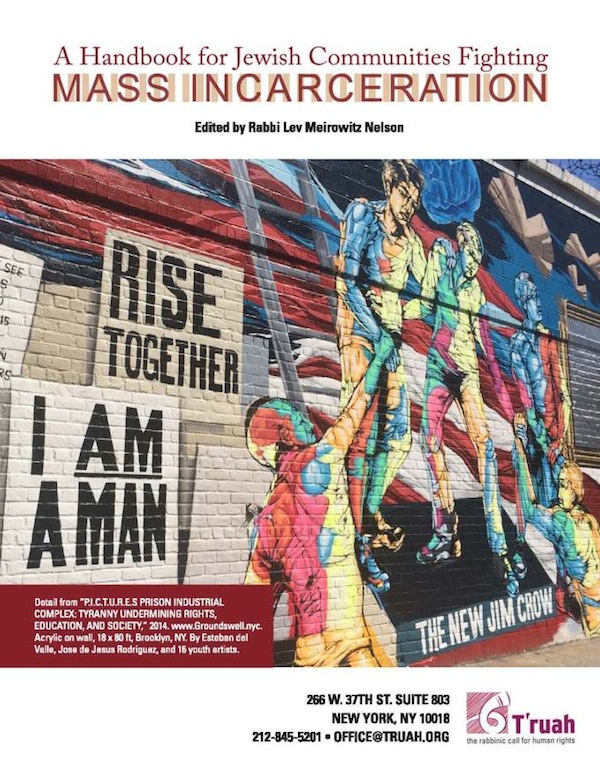
A new handbook published by T’ruah: The Rabbinic Call for Human Rights provides a resource for the Jewish community to press for change around the problem of mass incarceration in the United States.

“We are here to uphold ideas of redemption and mercy,” said T’ruah director of programs Rabbi Rachel Kahn-Troster, citing a colleague who described America’s prisons as having a “mercy deficit.”

The handbook is available for free download at truah.org/incarceration. It provides background and resources – steeped in Jewish texts and teachings – for Jewish communities to take action around these issues. Leading a network of 1,800 rabbis across North America, T’ruah aims to bring attention to an array of domestic social justice issues, as well as human rights for Israelis and Palestinians.

When it comes to mass incarceration, Canada doesn’t have the same problem, but we have similar societal ills when it comes to race, ethnicity and imprisonment – as well as problematic prison conditions themselves – that call out for redress.

The handbook initiative came out of T’ruah’s earlier work on ending solitary confinement. Over the last couple of years, Kahn-Troster has found the Jewish community to be increasingly receptive to grappling with issues around incarceration. Michelle Alexander’s book The New Jim Crow: Mass Incarceration in the Age of Colorblindness, which details the effect that mass incarceration – and the subsequent denial of civil rights for convicted felons – has had on the African American community, really opened people’s eyes, she told the Independent.

Why the term mass incarceration? Compared to other countries, the United States imprisons its population at alarmingly high rates: 698 out of every 100,000 citizens are behind bars. For comparative purposes, Canada’s per capita rate is 141 out of 100,000, according to Statistics Canada.

And then there is the problem of race. African Americans are six times more likely to be jailed than their white counterparts, yet crime rates are not necessarily different. According to American Civil Liberties Union data cited in the T’ruah report, despite equal rates of actual usage, a black person in America is 3.73 times more likely as a white person to be arrested for drug use.

In Canada, blacks are incarcerated at three times their rate in society, according to the Office of Correctional the Investigator of Canada (OCIC). And, while only four percent of the population of Canada is aboriginal, 25% of the prison population is aboriginal. Among the female prison population, fully 36% are aboriginal, and these percentages are only increasing, according to CBC News reporting from January of this year. For aboriginal adults in Canada, the incarceration rate is 10 times higher than for non-aboriginal adults, says OCIC. Maclean’s, in February, quoted criminologists describing Canadian prisons as the country’s new “residential schools.”

In addition, a report from Saskatoon and Regina, cited in the Saskatoon StarPhoenix, revealed that indigenous students are 1.6 times more likely to be stopped on the street than non-indigenous students. A Toronto Star analysis revealed that, in Toronto, blacks are three times more likely to be stopped by police than non-blacks.

As the Supreme Court of Canada has noted, “courts must take judicial notice of such matters as the history of colonialism, displacement and residential schools and how that history continues to translate into lower educational attainment, lower incomes, higher unemployment, higher rates of substance abuse and suicide and, of course, higher levels of incarceration for aboriginal peoples.”

The legacy of slavery in America looms large, and racial bias in the criminal justice system continues to haunt society. “People of color are more likely to be pulled over,” Kahn-Troster said. “The War on Drugs enables cops to search them. There’s a higher level of policing in black areas; there’s racial bias in jury selection; it’s easier to strike black people from juries; the sentencing is harsher if there’s a black perpetrator and a white victim than the other way around.”

In Canada, solitary confinement is an ongoing issue, as is overcrowding, concern over mental and physical health and rehabilitation, and an overall troubling rise in incarceration rates just as the crime rate lessens. Reporting in the Toronto Star puts the figure at a 17% increase in the federal prison population over the last decade.

With t’shuvah (repentance), cheshbon hanefesh (personal accounting), a questioning spirit and the search for social justice all core Jewish values, T’ruah’s initiative is laudable. It’s easy to look away – and harder to do the tough work of asking how we can both prevent harm to victims while improving our nation’s justice system to avoid discrimination and to shelter the most vulnerable.

Mira Sucharov is an associate professor of political science at Carleton University. She is a columnist for Canadian Jewish News and contributes to Haaretz and the Jewish Daily Forward, among other publications.

Many benefits of fair trade

Zack Gross on the way to see some fair trade sugar cane in Peru. (photo from Zack Gross)

According to Zack Gross, there is child labor and slavery associated with the production of chocolate, sugar and coffee – as well as with other commodities, from sport balls to clothing, crafts and carpets.

Gross, who is the fair trade outreach coordinator at the Manitoba Council for International Cooperation (MCIC), was speaking at a fair trade event held on May 29 by the Women’s League of Congregation Etz Chayim and the Winnipeg chapter of the National Council of Jewish Women (NCJW) at the synagogue.

MCIC is a coalition of about 40 international development organizations funded by both the provincial and federal governments, which helps support its member organizations’ overseas projects and educates Manitobans about global issues.

Gross grew up in Winnipeg and attended I.L. Peretz Folk School, where he was first introduced to social justice issues. He has worked in the anti-poverty field internationally for nearly 50 years. He is the current president of the Canadian Fair Trade Network, a national organization based in Vancouver, and, last fall, Fair Trade Canada honored him with a lifetime achievement award.

At the Etz Chayim event, Gross spoke about the growing fair trade market, including that it has recently become more mainstream and now has many items that are kosher-certified.

“Much of my work is making presentations to interested audiences, but I also meet with local businesses, government representatives, and any others who can help to increase fair trade purchases and procurement,” he said.

Fair Trade Manitoba is a program of MCIC. “We also have a Fair Trade Winnipeg steering committee, which is working with City Hall toward Winnipeg becoming a ‘fair trade city,’ a designation Brandon and Gimli in Manitoba have already reached,” said Gross.

“Fair Trade Manitoba began as a collaboration of people involved in local schools, unions, faith groups and NGOs who share a vision of creating a better world. Manitoba is seen as a leader in fair trade. Earlier this year, we organized a national conference that attracted over 350 people and, last month, we had 13 people, including my wife and myself, travel to Peru to visit fair trade co-ops (producers and processors).

“But also, in a less sensational way, fair trade can help poor farmers find new markets and make more money, so they can have schools and clinics in their communities, can use better environmental methods in their production, can use safer equipment and can contribute more to their local and national economies.”

Fair trade can also help create economic opportunities for women and youth who have no capital, he said.

“When people are shopping – what we call ‘voting with your dollars’ – they should look for the fair trade label when buying coffee, tea, sugar, chocolate, tropical fruits and many other products,” said Gross, who advised that consumers visit cftn.ca/products-companies for more detailed information.

He also suggested people make their schools, campuses, faith groups, workplaces and events fair trade, and referred those interested in doing so to fairtrade.ca.

Yelena Maleyev was a key member of the local NCJW in putting this event together.

“We are passionate about educating the public about global issues that affect us locally, like child slavery and human trafficking,” she said. “The Women’s League shares our passion for organizing educational events, so it was a perfect partnership.”

At a local event last year, NCJW focused on increasing awareness of human trafficking and child slavery. This year’s event continues that effort, as fair trade can reduce the incidence of both.

“There is a need for fair trade purchase decisions in our daily lives to ensure we reduce our harmful footprint on the world,” said Maleyev. “Keep in mind that purchasing fair trade not only helps the environment, it provides humane working conditions for those in the supply chain, ensures a living wage for the workers, does not allow for exploitation of women and children, and yields sustainable growth in the economies where these companies are located.

“The goal of ending child slavery goes hand in hand with the global goals of abolishing extreme poverty, protecting our environment and supporting women and families in the developing world. Children are the most vulnerable citizens of our world and, to protect them, we must ensure we do not support corporations that exploit them. If we, as consumers, make conscious purchase decisions daily, we can directly impact the economic sustainability of ethical corporations.”

About the Etz Chayim event, Gross said, “Ultimately, what struck me was a comment by one attendee … ‘Anyone who knows their Torah should be a strong supporter of fair trade.’ Amen to that!”

Rebeca Kuropatwa is a Winnipeg freelance writer.


Raising awareness of abuse

Earlier this year, Winnipeg’s Jewish Child and Family Services (JCFS) premièred the short film Not in My Family, to raise awareness on the topic of elder abuse.

JCFS executive director Al Benarroch greeted the approximately 150 attendees that filled the Berney Theatre of the Asper Jewish Community Centre on Feb. 13.

“This film serves as a springboard for discussion and to help educate groups on how they might handle the issue of elder abuse,” said Benarroch. “It also provides a lot of valuable resources available in our community. Along with the film, we’ve created a kit with a booklet that provides information and also a discussion guide with some specific questions to be used following the viewing of the film. We envision this package having widespread application as a tool for organizations and professionals who work with seniors, who are educators, and other community professionals in regular contact with seniors, either individually or in groups.”

Developed by the JCFS, the project was funded by the Government of Canada’s New Horizons for Seniors Program. The 13-minute video is available from the World Elder Abuse Awareness Day Manitoba website (weaadmanitoba.ca/resources.asp?t=4), as is the accompanying resource guide.

Following the screening was a panel discussion with Jamie Kinaschuk from A & O Support Services for Older Adults Inc.; Sharon Tod, chair of the elder law section of the Manitoba Bar Association; and Dara Maternick, coordinator of Prevent Elder Abuse Manitoba.

“Every situation is different,” said Tod. “So, you have to tailor the answer to the particular problem. It’s an excellent resource to have a lawyer that you trust. The other thing I will urge you to do is make sure you have everything in place early on in the process. I’m talking about powers of attorney. Because, if you do it while you are fully competent and can assess properly who is the best person(s) to be your attorney, that is way better than what we often see in my profession, which is someone who is already in the early stages of dementia and in a vulnerable position who is then talked into appointing someone as their attorney … who is the exact wrong person for the job.”

According to Canadian research, between four and 10% of seniors are subject to some form of abuse. In addition to that, experts believe that, for every report of elder abuse, there are another four cases that are never reported. Most of the seniors who reach out for help say they are being financially abused.

Maternick said the best way to deal with the problem is through a team approach that respects the individuals and their choices. “We are proud to be here today in partnership with the JCFS to launch this valuable resource,” she told attendees. The film and its guide were highlighted at World Elder Abuse Awareness Day (June 15) events.

As Benarroch opened the discussion for audience questions, an elderly woman asked how to deal with abuse by home-care workers.

Kinaschuk suggested contacting her case supervisor, saying that, if she fails to get somewhere with that route, she can always call their supervisor. Benarroch advised that she contact the JCFS to have their social workers help guide her through the process of launching a complaint if need be.

Another audience member shared his situation. “My father’s been taken for $95,000 in the past two years, sending money to Jamaica and Dubai,” he said. “While he has been talking about giving me power of attorney, he has the full capacity to do it himself. Where would I go with that?”

Tod suggested that the son talk to his father’s lawyer, and then went on to share a story about one of her own clients. “He was at a stage where he was vulnerable, but competent, so we couldn’t force him to do things he didn’t want to,” she said. “So, I sat down with him and his son. We had a discussion.

“It’s difficult to talk about, because he was embarrassed that he had been taken for this money. But, we did, we sat down and talked about it and, ultimately, what we did was, he agreed voluntarily that his son would take over his affairs under the power of attorney, and the son took a number of steps to prevent the father from being contacted by these scam artists again.”

The steps, according to Tod, included the son changing his father’s phone number to unlisted, having all of his father’s mail redirected to his home and ensuring that his father had access to only one bank account with a limited amount of money in it, so that, if he was taken advantage of, at least the loss would be limited.

In another situation, Tod was appointed with the power of attorney, to prevent a son from threatening his mom for money. “Now, when the son came to her, she could say that she doesn’t know where her bank is anymore, that he would have to talk to her lawyer,” said Tod.

Tod spoke about capacity and how difficult it can be to determine, pointing out that it is part of a lawyer’s responsibility. “Before we have people sign documents, we have to make sure we are comfortable that the clients understand what the documents mean,” she said. “But, there are different capacity tests for different legal documents that you sign.

“It’s even difficult for doctors to determine someone’s capacity. Some doctors say someone has capacity while other doctors disagree. It also depends on the specific thing you’re looking at. People may have fairly good cognitive function, but their judgment may be impaired.”

Family members or social workers usually end up making these determinations and, if there are concerns, a doctor should be consulted.

Kinaschuk pointed out that, when the abuser is a family member, it catches one off guard. “You don’t expect a family member to be the abuser, so your guard isn’t up,” he said. “In this case, in the film, the grandson is telling grandma, ‘No, you’re wrong, you didn’t give me the money.’ And, she’s like, ‘Maybe I didn’t.’”

Even when an abuse situation is identified, Kinaschuk added, it is still very difficult to take action, as the victims come up with excuses for their abusers. “They’ll say things like, ‘He or she is having a tough time. They just need a little help until they get a job.’ And, it goes on and on. We provide support, discuss options and help them recognize what’s going on, but it is up to them to take it further.”

According to Maternick, it takes a lot for people to reach out for help. “The type of circumstance for elder abuse will be different for everybody,” she explained. “It becomes very difficult to answer these questions because you need to dig into the situation to understand what’s happening. There’s complexity with all these issues.”

Maternick suggested that a good place to start is by calling the senior support line. “The reason that line is so important is because it allows you to access information and resources to better understand what your options are,” she said. “There is no single answer that’s going to apply to every situation.”

In British Columbia, the Jewish Seniors Alliance can be reached at 604-732-1555 and a list of where to go for help, including for instances of abuse, is available at jsalliance.org/resources/where-to-go. Among the contacts listed by the JSA is the B.C. Centre for Elder Advocacy and Support’s elder law clinic (604-437-1940 or via bcceas.ca).

Rebeca Kuropatwa is a Winnipeg freelance writer.