Skip to content
  • Home
  • Subscribe / donate
  • Events calendar
  • Business Directory
  • FAQ
  • News
    • Local
    • National
    • Israel
    • World
    • עניין בחדשות
      A roundup of news in Canada and further afield, in Hebrew.
  • Opinion
    • From the JI
    • Op-Ed
  • Arts & Culture
    • Performing Arts
    • Music
    • Books
    • Visual Arts
    • TV & Film
  • Life
    • Celebrating the Holidays
    • Travel
    • The Daily Snooze
      Cartoons by Jacob Samuel
    • Mystery Photo
      Help the JI and JMABC fill in the gaps in our archives.
  • Community Links
    • Organizations, Etc.
    • Other News Sources & Blogs
  • JI Chai Celebration
  • JI@88! video

Recent Posts

  • SFU honours Gloria Gutman
  • Lifting people’s spirits
  • Wedding a ray of light
  • Indigeneity and Zionism
  • Rule of law broken: councilor
  • Football and its roles
  • The burden of defence
  • Fish Café returns after fire
  • All right in what goes wrong
  • Nuns & mermaids at TUTS
  • Camp offers holiday retreat
  • Students and mentors inspire
  • Once-in-a-lifetime trip
  • 100 dancers, one heart
  • Money for the sciences
  • What “Jewish food” means
  • Have a cookie, schnitzel too
  • Federation now across BC
  • Israel fighting for its existence
  • Deal strengthens Iran
  • Patriotic belonging diminishes
  • A campaign to engage
  • Upstanders’ first live event
  • Responding to Carney
  • Having your own home
  • Music a family tradition
  • Musical to warm heart
  • Community milestones … June 2026
  • Sharing her passion for Israel
  • Or Shalom reopens its doors
  • JFS from past to future
  • Need holistic approach
  • Sharing stories, advice
  • Journalist shares fears
  • Skills to live together
  • Road to independence

Archives

Follow @JewishIndie
image - CJN box ad Rockowers 2026

Byline: Rebeca Kuropatwa

Overburdened system

Overburdened system

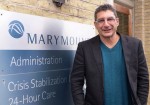
Mardy Yager, manager of fund development at Marymound. (photo from Mardy Yager)

Mardy Yager manages the resources of Marymound, the second largest agency in Manitoba that provides support to some of the province’s highest-needs kids. Every day, he has to deal with an overburdened social services system that is struggling to keep up with demand.

A lifelong Winnipegger, Yager has been working in the child welfare field for 26 years. He has been serving at Marymound for the past 15. “I began working frontline with the kids and now I’m the manager of fund development,” he said.

“I have a passion for the kids and intimate knowledge of the work, so I’ve been effective in raising funds and awareness for child welfare here in Manitoba,” he said of his choice of profession, “which isn’t historically a choice for most people.”

When he was 14, his father passed away. Although Yager is not a practising Jew, he feels strongly that his passion for service stems from his Jewish heritage and the example set by his father, who was vice-president of their synagogue, among other things.

Marymound was started in 1911 by Sisters of the Good Shepherd. Yager said he felt privileged to work alongside the sisters when he first began working there, and found their values to be the same as any other religion’s ethics. “You look after those less fortunate, you honor people’s differences, you celebrate other people’s religions,” he said. “Spirituality is very important, regardless of what faith you practise.”

The overwhelming majority of Marymound’s kids – 70% – are indigenous. As such, the focus of Marymound’s assistance is not so much about religion. “That’s kind of how the sisters looked at it as well,” said Yager. “The focus was more on spirituality and healing, and that’s what’s kept me here.”

Marymound’s staff is a mix of professionals with different cultural backgrounds, including indigenous, Christian, Muslim and Jewish. There are more than 300 full-time and another 200 other staff working with approximately 3,000 children annually.

Manitoba has the highest number of children in care (11,000) compared to any other province. For example, the province has almost double the number of Saskatchewan (6,000) despite the fact that the population breakdown of each province is similar.

“The system is overburdened here in Manitoba,” said Yager. “And it’s struggling to meet the needs of all those kids. Some are very high needs. A lot has to do with fallout from the residential schools. Lots has to do with our indigenous populations being marginalized over the decades.

“We also, unfortunately, did the 1960s scoop, where we pulled kids out of their homes and adopted them out to white families all over North America. We’re just starting to understand the issues and making some corrections as to how we approach the problems.”

Most of the kids Marymound works with are dealing with family breakdown, physical and sexual abuse, neglect and poverty. Some are battling mental illness, fetal alcohol syndrome and other issues that mainly afflict the most vulnerable segments of the population.

While Marymound has serviced Jewish kids and still does in their foster-care programs, those percentages are small.
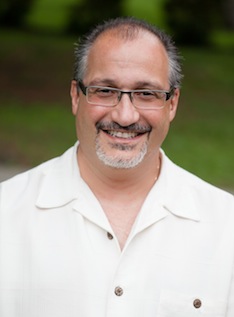
photo - Al Benarroch, executive director of Jewish Child and Family Services in Winnipeg
Al Benarroch, executive director of Jewish Child and Family Services in Winnipeg. (photo from Al Benarroch)

Al Benarroch, executive director of Jewish Child and Family Services (JCFS) in Winnipeg, knows all too well how Marymound and similar organizations help.

“They run some very specific programs around treatment for sexual abuse,” said Benarroch. “Working at JCFS, being a small sliver of child and family services in Manitoba, we work in our own community. But, in my past professional career, when I was in private practice, I used to see a lot of cases of sexual abuse – both in adults who are survivors … and also with youth and children who were in the welfare system because of that.”

But Benarroch was quick to point out that sexual abuse is the smallest percentage under the abuse category – at least on paper – with 10% or 12% of all reported cases of abuse being sexual abuse.

“There is a much higher number being reported of physical abuse, and the highest number is probably neglect,” he said. “What does that mean? Does that mean there’s less sexual abuse or does that mean that it’s underreported? The likelihood is, it’s most likely extremely underreported by virtue of its nature – the nature of the secrecy and the nature of the disruptive levels of trust that a person has when they’ve been victimized.”

While Benarroch said that anyone who can afford counseling can find it very readily, in general, accessing quality, well-trained therapists is difficult for those who are less financially well off.

“With JCFS, we deal with sexual assault very little for a few reasons,” he said. “Number one, our agency is almost exclusively serving the Jewish community. I’m not saying this doesn’t occur in the Jewish community but, as a cultural community, we don’t like to air our dirty laundry. So, as an agency, JCFS is constantly working on raising awareness about these issues so we can peel away those layers of secrecy.”

Benarroch said JCFS sees many more cases in which there has been high levels of neglect and dysfunctional parenting that usually stems from the parents’ past trauma, thereby impacting their ability to parent. In these cases, he said the parents can overcome their challenges and positively parent through talking about childhood experiences, which may involve physical or sexual abuse, to work through those traumatic experiences as adults.

“For me,” added Yager, “it’s always been about the kids and the kids don’t pick and choose. They are just here and we need to help them…. They didn’t ask for the things afflicting them…. We need to do our best to help them get a handle on the issues and go into the community in a productive way.

“Helping those less fortunate, who can argue with that? Right? Those are all things we should all be doing. That’s what makes our country as great as it is, because we focus not just on getting ahead, but on trying not to leave the less fortunate behind.

“I think the values we have here, at Marymound, even though it started from an order of nuns, those values cross all religions.” As an example, Yager said, “I know that philanthropy and caring for others are basic values that all Jews share. We’re quite charitable. It’s also part of the values that the Sisters of the Good Shepherd have provided to us at Marymound.”

For more information, visit marymound.com.

Rebeca Kuropatwa is a Winnipeg freelance writer.
Format ImagePosted on January 29, 2016January 26, 2016Author Rebeca KuropatwaCategories NationalTags Al Benarroch, JCFS, Jewish Child and Family Services, Mardy Yager, Marymound
Berlin’s House of One

Berlin’s House of One

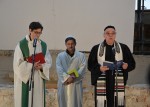
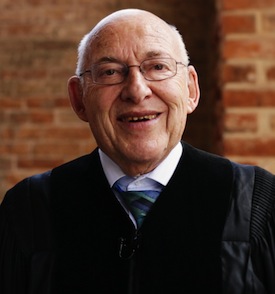
In Petriplatz, Pastor Gregor Hohberg, left, and Imam Kadir Sanci listen as Rabbi Andreas Nachama recites a prayer for peace. (photo by Frithjof Timm)

In the middle of Berlin, on the grounds of where a church was destroyed in the Second World War, a pastor, imam and rabbi are collaborating to create a new reality wherein Christianity, Islam and Judaism can be practised under the same roof.

“It seems so logical that something like this would take place, but it never has before,” said Rabbi Dr. Andreas Nachama who leads the only Reform congregation in Berlin, Sukkat Shalom (House of Peace).

Some congregations and groups of people refrain from intermingling out of fear of losing members to other groups. For Nachama and the other House of One proponents, this is not a concern.

“I think that the congregations are solid and I don’t think that this might turn out to be a problem,” he said. “We have a lot of experience from sharing a building with Catholics, Protestants and Jews, and we’ve never had that kind of problem. The problems we had were very secular and could be solved quickly with a short discussion – things like who is cleaning the toilets after congregation and so on.”

As for the risk of intermarriage, Nachama said intermarriages “take place because people are studying at the same university or classroom, sitting in the same office, or meeting in a restaurant or theatre. I haven’t had a single case where intermarriages originate from a Christian-Jewish dialogue group in all my years.”

photo - Rabbi Tovia Ben Chorin
Rabbi Tovia Ben Chorin (photo by UFA Lab)

The idea for House of One originated five or six years ago with Nachama’s predecessor, Rabbi Tovia Ben Chorin. He was working to bring the concept to life until he retired and moved back to Switzerland. Nachama has been involved with House of One since April 2015.

Nachama is no stranger to Christian, Jewish and Muslim trialogue. He has been involved in the field since 1972, starting at summer camps in western Germany, where a local school invited members of each of the three faiths to discuss common stories and problems.

As Nachama went on to take Jewish studies in university in the 1970s, he also took basic courses on Islam and Catholicism. Gaining a good understanding of these religions has enabled him to effectively introduce his congregation to interfaith interactions since 1999, bringing in his Islamic and Christian counterparts to teach in the synagogue alongside him.

The clergy meet on a regular basis, sometimes involving leaders in their respective communities, but always aiming to keep meetings to no more than 15 people. So, the interfaith groundwork began long before the excavations started in 2007 of Petriplatz, the site of the old church, among other structures, and a new House of God was being planned. The church wanted to build a house where the three religions would each have a holy space of their own.

“Each would have their own synagogue, mosque and church, working together in one building,” said Nachama. “But, everyone would follow his/her own faith tradition, so it was not about some new religion being created.

“Instead, the idea was to build a house of teaching, of worship, wherein the teaching might bring us together; the worship, everyone does for him/herself in his/her religion.

“We can do programs on some aspects of interest to many, like looking at the differences between kosher and halal. We can also offer teaching programs to the general public.”

Worship times do not seem to be an issue either, with the holy day for Muslims being Friday; for Jews, Saturday; and, for Christians, Sunday.

“But, what happens if Christmas Eve is on a Friday night or during Shabbat?” admitted Nachama. “We can always find problems in terms of holy days on the calendar. They will be solved, but it’s not so easy.”

According to Nachama, the most difficult challenge is in the area of politics. “Islam, in particular, is being taken as a hostage for Islamic fundamental brutality,” he said. “That makes it difficult, because those Muslims that we deal with are not part of that. It makes it difficult … in the public eye … to make it understandable that we, as individuals and as congregations here in Berlin, can cooperate and speak with each other, whatever happens.

“My congregation is very much involved in Christian-Jewish dialogue, and we also sometimes have teachings or panel discussions together with Muslims, so it’s not new to my congregation and, as far as I see, the other congregations have had experience in the field before as well.”

As far as reaching beyond congregational circles, Nachama understands all too well that if someone has prejudice, it is he or she who needs to be willing to open their eyes and ears to seeing the other side. “We can’t do it for them,” he said. “If they are willing, we then can try to show them how we see things.”

While the project is gaining momentum and more than a million euros have already been collected, much more is needed to even break ground on the building project.

Nachama anticipates that his congregants will have no problem with the move when the time comes. “We’ve moved already once and, when completed, either parts of the congregation will move or the whole congregation. It won’t be a problem.

“We believe this project is a result of the history in Berlin,” he continued. Given the history of antisemitism in Germany and the Holocaust, people want to create “a new page of history,” he said. “People really try to look for new ways of cooperation, coexistence and respect for other peoples and faiths.”

For more information or to join the project, visit house-of-one.org.

Rebeca Kuropatwa is a Winnipeg freelance writer.
Format ImagePosted on January 29, 2016January 26, 2016Author Rebeca KuropatwaCategories WorldTags Andreas Nachama, Christians, House of One, interfaith, Jews, Muslims, trialogue
Sponsoring Yazidi refugees

Sponsoring Yazidi refugees

Yolanda Papini Pollock, co-founder of Winnipeg Friends of Israel, which initiated Operation Ezra. (photo from Yolanda Papini Pollock)

The Jewish community in Winnipeg has ramped up its efforts to help the Yazidi people, including the sponsorship of families to the city.

“When you look at the plight of the Yazidi people, it kind of mirrors the Jewish reality of 1945,” said Al Benarroch, executive director of Winnipeg’s Jewish Child and Family Services (JCFS). “I’m not going to be one to say that it’s like the Holocaust, but the Yazidis have suffered, over the last 500-600 years, a very significant genocide.

“The Yazidi people have been displaced from that region of the world and have been heavily victimized, murdered and devastated in the millions. And they have nowhere to go to. So, our community and other communities across Canada have really taken this to heart saying, you know, it was a mere 70 years ago that we ourselves were in a similar situation.

“When we say ‘Never again,’ are we just talking about the Jewish people? We see that image of ourselves in the Yazidi plight, and we feel compelled to come forward and act on it. That’s been the message we’ve been putting forward in Winnipeg.”

The group that started this effort in the city is Winnipeg Friends of Israel (WFI), awakening the community to the Yazidis’ situation and the possibility of sponsoring Yazidi refugees to Winnipeg.

“When we heard about the Yazidi massacre in August 2014, we reached out to the Yazidi community,” said Yolanda Papini Pollock, WFI co-founder. “We wanted to hear about the Yazidi plight and support their community by raising awareness.”

WFI invited Nafiya Naso, a Yazidi spokesperson, to share her and others’ stories with the Winnipeg community at the Asper Jewish Community Centre in March 2015.

“After learning about the dire strait conditions of the Yazidis in refugee camps, it was clear to us that we could not sit aside and do nothing,” said Papini Pollock. “We decided to do more than just listen.”

The group initiated Operation Ezra with the goal of sponsoring at least one Yazidi family and of raising awareness of the Yazidis’ plight. They began by partnering with Bridges for Peace, Calvary Temple, the Mennonite Central Committee (MCC), and others. By December, $130,000 (enough for five-plus families) had been raised.

“When we heard Nafiya’s story, we recognized so many similarities to the plight of the Jewish people prior to the establishment of Israel and immediately empathized with her people,” said Papini Pollock. “The Yazidis are an ethno-religious minority and, just like the Jews, they are targeted solely because of their religious beliefs. Many genocide scholars perceive the Yazidis as victims of genocide. The Yazidis have been persecuted 74 times. At one point, there were more than 20 million Yazidis. Today, there are less than one million.”

The Jewish Federation of Winnipeg has helped raise the funds to sponsor as many families as possible and JCFS has taken on the responsibility of managing the resettlement and other services, allowing WFI to do what they do best – connecting on a personal level with people.

Since Operation Ezra was announced, the congregation of Shaarey Zedek has taken on sponsorship of two families under the initiative.

“Collectively, we’re talking about 35 individuals to date who have applications that are or will be submitted,” said Benarroch. “At this point, I think we’re talking about bringing in as many as 50 individuals.

“The more we fundraise, the more we can help. We’ve gotten a hold of many people who are donating furnishings, old televisions and bedding. Someone came forward and said they will donate through their manufacturing company quilts and coats. We are looking for warehouse space.”

The sponsorships are being done through MCC, as they are the only organization in the city that holds a sponsorship agreement with the federal immigration department. This is something Benarroch would like to see change, not due to any lack in MCC’s services, but as an added insurance. “Historically, there was Jewish Immigration Aid Services of Canada (JIAS),” he said. “Located in Toronto, they were the national office for Jewish immigration.

“Because it was a national mandate for that sponsorship agreement and the national office no longer exists, my understanding is that the sponsorship agreement had to be given up. So, now we no longer have a national sponsorship agreement for Canadian Jewish communities. God forbid if we should have a worldwide crisis and the Canadian Jewish communities would be challenged at a national level to take on Jewish refugees.”

While he has been exploring the options regarding making an application to have at least a local sponsorship agreement – “If history repeats itself, as it usually does, you should have that safety” – Benarroch stressed, “I think it’s been amazing to be able to work in partnership with those groups, with the Mennonite community. The Manitoba Multifaith Council sits at the table for Ezra. We get ourselves out there. It’s the right thing to do.”

Some of the most-asked questions by people considering joining the effort, Benarroch said, are “Who are the Yazidis? Are they Muslim? Are they Christian?”

His response is, “They are not Jewish, Christian or Muslim, yet they do share many interesting customs that have a foot in all of those religions. They celebrate their new year … I’m not an expert … in the spring, in their month of Nisan. We, as Jews, also have a month of Nisan. They pray several times a day towards the sun, much like Islam. Yet, they have no formal book or liturgy … no formal Koran, Torah, New Testament, whatever you’d like to call it. It’s an oral tradition.”

Papini Pollock, meanwhile, is finding it hard to wait for the first arrivals. “We will be involved in taking care of the families when they arrive to the best of our abilities,” she said. “We will work with the rest of the Winnipeg community to ensure the refugees have the most natural transition to Winnipeg and to Canada.”

For more information on Operation Ezra, visit jewishwinnipeg.org/community-relations/operation-ezra.

Rebeca Kuropatwa is a Winnipeg freelance writer.
Format ImagePosted on January 15, 2016January 15, 2016Author Rebeca KuropatwaCategories NationalTags Al Benarroch, immigration, JCFS, Jewish Child and Family Services, refugees, WFI, Winnipeg Friends of Israel, Yazidi, Yolanda Papini Pollock

Helping businesses expand

In August, the Jewish Independent connected with Gary Brownstone about a Winnipeg tech incubator he was working on called Eureka. In the short time since then, the entrepreneur has already moved on to his next adventure.

photo - Gary Brownstone
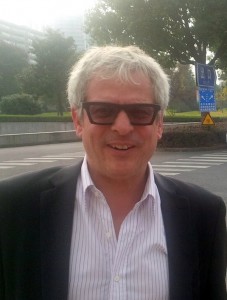
Gary Brownstone (photo from Gary Brownstone)

“Most of my career has been characterized by taking on multiyear projects,” said Brownstone. “In many cases, I’d be involved with or invest in small companies needing help growing to the next level. I’d grow them to the next level and then I would exit. But, generally, the projects I get involved in have a Point A and a Point B, and my mission is to take them from A to B.

“When I went to the Eureka Project, which was an incubator in Winnipeg that a group of individuals together with government and the U of M [University of Manitoba] had tried to launch, for all intents and purposes, [it] had failed. They hadn’t achieved what they’d set out to.”

Brownstone was brought onto the Eureka team to try to save it. They needed answers to three questions. Was there enough world-class talent in Winnipeg to make a venture like this worthwhile? Could the incubator help advance their causes and spin off commercial enterprises? And could Brownstone help make the operation sustainable?

“A big challenge with incubation is that early- stage companies can’t always afford to pay market rates for help, but governments don’t want to pick up the costs forever,” said Brownstone. “When I got to the project, the Manitoba government was covering about 90% of the operating budget.

“The first two [questions] we solved in a relatively short period of time. But, the sustainability issue was longer and … this year, we saw a third of those solved with the signing of a multiyear funding agreement with the province – with them only needing to cover about 30% of our operating budget.”

Seeing that a service like the one he was providing in Manitoba was needed everywhere in Canada, Brownstone move on to create a small practice under the name of LucraTech. He soon had several clients across Canada, the largest one situated in Vancouver, where he now spends about 60% of his time. The other clients are located in Manitoba, Ontario and Nova Scotia.

“I’ve got some associates that I bring into jobs as needed,” said Brownstone. “We are building up our business across Canada and have been for about six months now with some pretty decent success.”

The Vancouver-based company with which Brownstone is working is Canada’s largest technology incubation platform, Istuary Innovation Group. “This is a group of Chinese Canadians who see an opportunity to invest in or acquire Canadian technology for which there could be a market in China,” said Brownstone. “Their expertise is taking Canadian-developed world-class technology into China, where there’s a big market and hunger for this technology … so, these guys are trying to bridge the gap.

“Let’s say that you are an engineer and you have some unique approach to internet security, and they know that, today, in China, on an industrial level, there’s a huge demand for internet security. If they feel that your technology is suitable for that market, they will offer to do a deal with you, and they are very flexible about how they do that. They may offer you employment in one of their innovation labs or, if you had an existing company and were looking for investors, they would invest in you and help you access that market, or they could represent you on an agency basis.”

According to Brownstone, any Canadian technology looking for a home in the Chinese market can likely be aided by Istuary. He believes that Canada is in a unique position and has an advantage over other countries, due to the quality of its schools for engineering, computer programming and related fields, like clean technology and light sciences.

“There is also very strong R&D support in Canada, both federally and provincially,” said Brownstone. “The government will often match every dollar I invest. There is also a very strong tax-credit program, [and] rebates offered will sometimes offset the big costs of R&D.” As well, he added, Canada is an attractive place for developing technology at the moment with the low Canadian dollar compared to that of the United States.

LucraTech aims to take on a series of projects with each client and create a support team to work with that client, beginning by identifying a starting point and an end point.

“Typically, the companies we start working with are small,” said Brownstone. “They have some customers, they have some revenue, but they are trying to grow to the next level. Maybe you have a company that is doing $300,000 a year in revenue and you want to grow that to $3 million in the next couple of years. We create a road map and a plan that will get you from $300,000 to $3 million, and work with you to achieve that.

“By the time you are at $3 million, you’re probably at a size where you can get and manage the support talent in-house and you can now afford more full-time employees, so maybe we aren’t needed anymore at that level of expertise.”

LucraTech offers other services, as well, such as turnaround, wherein they take on medium-sized companies that, for one reason or another, have encountered some trouble and need help. In this scenario, LucraTech goes in and tries to fix the problem and make the company healthy again. Their typical timeline with clients can be anywhere from one to four years.

“If we believe in a company and the entrepreneur and we can add value to the whole equation, we are very flexible on how we work with companies and usually give them two or three choices. We know we will only get paid if the project goes ahead,” said Brownstone.

“Sometimes, we work just for success fees, where we set out to raise money for a company … sort of a finder’s fee. If we are successful, we get paid. If not, we don’t. Sometimes, we will work for a piece of the business or a small number of shares in the business. We’re really flexible. Once we believe in the concept and the entrepreneur, we will find a way to make it work, whether they have a lot or a little money.”

Rebeca Kuropatwa is a Winnipeg freelance writer.
Posted on December 18, 2015December 16, 2015Author Rebeca KuropatwaCategories WorldTags China, entrepreneurship, Eureka Project, Gary Brownstone, investment, LucraTech
Rehab centre fills gap

Rehab centre fills gap

Ian Rabb with his dogs Samson and Ariel. (photo from Ian Rabb)

After falling prey to the habit himself, being rescued by his family and brought back home to Winnipeg for recovery, Ian Rabb began giving back – not just to his supporting family and the Jewish community, but to the greater community of Manitoba.

Rabb knew how the system worked from personal experience, had learned its flaws and, after recovery, set about to fix it.

“What I noticed then was a broken system in Manitoba, where there was no continuity of care,” said Rabb. “People didn’t have the ability to have extended stays in any kind of stable environment and, as I started doing my research and working in the program, I was appointed to the board of directors of the Addictions Foundation of Manitoba.”

With help from his brother, Jeff, Rabb determined that the biggest problem was the lack of a safe house where recovering addicts could take their time and realign their lives after completing their residential treatment program, which comprises a couple of weeks of rehabilitation. He opened Two Ten Recovery, a men’s house of recovery, as well as Destiny House for women. Today, there are three homes with a total of 33 beds.

“Our aim is to help people stabilize their lives and get them back to being fully self-supporting citizens, having a better prognosis or outcome when they leave,” said Rabb. “We allow them up to two years in our homes, where they have to be working and self-supporting within three months. Our success rate is at about 83%. What we’ve learned over the last number of years is the longer we can stay connected to someone post-treatment, coming out of a treatment centre, the better our success rates will be.”

It was six years ago that Rabb began hatching a plan to open a 24-hour, full-service drug and alcohol rehab centre. Once the Addictions Foundation closed their detox clinic, it became clear that a detox centre was also needed. Aurora Recovery Centre was established.

“I realized one thing very early on – that there was desperate need for a medical detox program where anyone could access medical services at any time, for any substance, and be provided with a service that would help them get off that substance, ultimately moving to the next step, addiction treatment,” he said.

Another thing that was critical in Rabb’s mind was to eliminate the wait time. “You don’t have time to wait when it comes to addiction treatment,” he said. “When someone’s ready for treatment, they need to be able to access a treatment facility. That doesn’t exist here. There’s months-long wait.

“All across Canada, because of the epidemic of addiction, even private centres are having severe wait times. So, ultimately we’re scrambling for places to send people when they need immediate help.

“The best centre in the world is just south of us, in Minnesota.

It was the first one ever started. Our model (at Aurora) is replicating the Hazelden model of addiction treatment.”

Aurora Recovery Centre is located on 28 acres of land along Lake Winnipeg, just north of Gimli. It will start as a 76-bed primary care centre, with 16 beds devoted to medical detox and emergency situations.

“We will be able to handle the ongoing problems here in Manitoba and hopefully will be busy enough to expand,” said Rabb. “We have lots of acreage there. We’re opening smaller with the plan of creating a full campus.”

To manage the centre, Rabb hired Peter Connelly, a Manitoba-born and -raised clinical director who has worked at the Minnesota Hazelden recovery centre for the past 13 years.

“I really believe that more services are needed, not only in Manitoba, but also in Canada,” said Connelly. “It’s an exciting project. It’s going to provide people who obviously need help with programs, so that’s really my reason for coming back. I certainly have a passion for recovery.”

Apart from the detox unit, which Connelly views as critical, his focus will be on the continuum of care, as he believes that after-care is of vital importance – the available services once clients have completed their in-patient treatment.

“The reality is that in-patient treatment is very difficult,” said Connelly. “It’s about people making a change, about people learning the tools of recovery and taking these tools into the outside world and using them to deal with life, on life’s terms.

“Addicts, alcoholics, need structure. They need to take responsibility and be accountable. Once they finish in-patient treatment, those are the challenges they face, so after-care is critical.”

This is an area that Aurora aims to focus on, with a number of programs that aid patients, including the option of extended-care programming, sober-housing on site, and continued follow-up with clients after they leave the centre.

“We will be developing an extensive out-patient program, so those who’ve been through the program can continue having group sessions and individual counseling after they leave,” said Connelly. “Through a number of programs that we’re developing and have developed, we’ll have clients come back yearly for an annual reunion.”

The facility is privately funded; participants and/or their family members will need to pay for their treatment. But, the cost is all-inclusive, with no added fees. “At the end of your stay, you certainly won’t be getting a bill for additional charges,” said Connelly. The cost is determined on a case-by-case basis, dependent on treatment and other factors.

At Aurora, the aim will be to have no wait time. “This is critical,” said Connelly. “We all have a tendency to procrastinate and the addict/alcoholic has a tendency to change their mind. When someone finally makes a decision they need to go, or a family member helped them with that decision, we need to get them into treatment as quickly as possible.

“As we move forward, I think people will see that the programming we offer is certainly needed. We’ll see what kind of relationships develop from there.”

Aurora began accepting patients on Oct.16. For more information, visit aurorarecovery.com.

Rebeca Kuropatwa is a Winnipeg freelance writer.
Posted on December 18, 2015December 16, 2015Author Rebeca KuropatwaCategories NationalTags addiction, alcoholism, Aurora, Ian Rabb, recovery, rehab
Stories about diversity

Stories about diversity

Cynthia Fidel was the coordinator of AMIA’s literary contest, which resulted in the publication Primer Concurso de Cuentos Infantiles. (photo by Rebeca Kuropatwa)

When the AMIA (Asociación Mutual Israelita Argentina) bombing occurred in Buenos Aires on July 18, 1994, there was already tension in Argentina between different religious and other groups. The bombing was a sad reminder of the need for diligence – and creativity – in mitigating hatred and fear.

After the bombing, it was very difficult for people to feel comfortable enough to return to the AMIA building, especially parents with small children. Hence, the Jewish education advisor for AMIA, Gabriela Wilensky, developed a program called AMIA for Kids. On two Sundays a month, she brought in top performers to engage children and their parents in forming fresh connections between families and AMIA.

In 2014, Wilensky came up with the first literary contest for kids that would have them explore the concepts of culture and identity. The idea was to involve the greater Buenos Aires community by partnering with 40 public and private schools, with children of all religions. Recently, the literary contest coordinator, Cynthia Fidel, moved to Winnipeg with her family.

“This contest was part of the 20-year anniversary of AMIA, which happened in 2014,” said Fidel. It was open to children from 8 to 12 years old.

When all was said and done, Fidel and Wilensky received 200 story submissions. With the help of a couple of local children’s book authors, 10 winning stories were selected to be published in a book called Primer Concurso de Cuentos Infantiles (First Contest of Fairy Tales) that was published by MILA for Kids, a division of MILA publishing house.

“They talked about different problems, ideas and questions regarding cultural diversity and identity,” said Fidel. “The first prize went to a girl who wrote about cultural diversity. It’s a collection of certain ideas and questions but, above all, it’s a collection of all the incredible imaginations of the kids.”

Now there is talk of launching a second literary contest, because of the success of the first. “They were really happy about what happened with the kids,” said Fidel.

The contest, which was open to children of all origins and faiths, has sparked dialogue between the kids. The main talking point has been respecting each other’s ideas and understanding that agreement is not needed to achieve mutual respect. Fidel loosely translated one of the first lines in the book’s preface: “Nobody is the same, nor worse or better, just different.”

Primer Concurso de Cuentos Infantiles is 84 pages long and includes the 10 winning stories, as well as an extra story written by several children together.

“Some of the stories talk about some kind of conflict situation and how they solved that situation,” said Fidel. “A recurring theme revolves around how they solved it and prevailed using dialogue.”

An excerpt from the book, as translated by Fidel, reads: “There was a society where some people had curly hair, so they thought they had the right to have more time in front of the mirror, to comb their hair. But, others who had different kinds of hair thought they deserved more time. There were others who were taller and they thought they deserved to cut their hair, while short people didn’t deserve that right.

“Until, one day, a girl wished in her heart that everybody would become equal and have the same characteristics. The wish came true and the entire world became grey – colorless and boring. She wished again to have colors and differences in her world, and everybody got their characteristics back. But, now, everyone loved their uniqueness and celebrated others’ uniqueness, too.”

Fidel is a strong believer that adults can learn a great deal from children. “From my experience,” she said, “it is amazing what you can learn from kids and their reflections if you give them the opportunity to express themselves.”

Fidel said the literary contest is a great representation of AMIA as a whole, as their main principles revolve around democracy and pluralism, and creating spaces for all through communal living and coexistence. “They promote those values,” said Fidel. “I’m very proud to have worked there.”

Rebeca Kuropatwa is a Winnipeg freelance writer.

Format ImagePosted on December 4, 2015December 3, 2015Author Rebeca KuropatwaCategories WorldTags AMIA, Argentina, children's books, coexistence, Cynthia Fidel, Gabriela Wilensky, Primer Concurso de Cuentos Infantiles, terrorism

One generation to the next


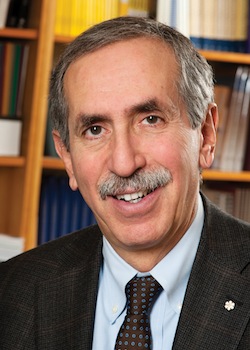
Current president and chief executive officer of the Canadian Institute for Advanced Research (CIFAR) Dr. Alan Bernstein has been a scientist all his life.

“When I was asked if I was interested in the [CIFAR] position, it was a natural evolution of my own journey through science, so I said yes immediately,” said Bernstein. “It’s a great organization and I’m having a tremendous amount of fun running it and making the kinds of changes I think are necessary to stay current and take CIFAR with the strengths when I started to the next level, which we are in the middle of doing.”

photo - Dr. Alan Bernstein was inducted into the Canadian Medical Hall of Fame earlier this year
Dr. Alan Bernstein was inducted into the Canadian Medical Hall of Fame earlier this year. (photo from Alan Bernstein)

For more than 30 years, CIFAR has been bringing some of the top researchers in Canada and around the world together to focus on worldwide challenges. It provides a space for sustained, small-scale, intimate conversations between groups of investigators that come from diverse disciplines and perspectives.

“We need to take risks,” said Bernstein. “We expect our researchers to take risks. Tough questions are always, by definition, risky.

“We’ve always been global in the sense that half our fellows come from outside Canada. We have 14 programs divided into three broad initiatives. One is a brain initiative. The second is around … the environmental and physical sciences. And, the third one is around building stronger societies. Within that, there are a number of programs. Each program typically has 20-30 fellows who meet on a regular basis and discuss issues around their particular program.”

One program concerns child and brain development. “There are about 25 people in that program and they range from pediatricians to fruit fly neurogeneticists, psychologists, epidemiologists, molecular biologists and policy people,” said the doctor.

While all of the 25 have their own particular research program, they come to CIFAR to focus on one question, which, in this case, is how do we optimize child and brain development?

Fifteen years ago, Bernstein became the first president of the Canadian Institute of Health Research, the national funding agency for health research. It was a job he had to create. Seven years later, he joined CIFAR.

During his first five years there, Bernstein also ran a lab. “My lab was in Toronto at the Mount Sinai Hospital, where I’d been the director,” he explained. “I just found that, after five years, I wasn’t being fair to the people in my lab in the sense that I just couldn’t devote the kind of time, energy and brainpower to my own scientists that they deserved … and that the science deserved. So, I made the tough decision after a year of agonizing about it, to give up my lab.”

When he closed his lab, Bernstein made sure that everybody had a job. Although the transition was quite traumatic for him at the time, he realized he was still a scientist, that he did not need to run a lab to be one.

“I still do, maybe more so than before, think very deeply about science and read much more widely now than I ever used to,” said Bernstein. “Before, I only read about health research things, but now I read about everything – from cosmology and gravity to successful societies, and childhood development.”

In April of this year, Bernstein was one of six inductees into the Canadian Medical Hall of Fame. Laureates “are individuals whose outstanding contributions to medicine and the health sciences have led to extraordinary improvements in human health. Their work may be a single meritorious contribution or a lifetime of superior accomplishments. Pioneers in their field, they are role models and inspiration to young Canadians to pursue careers in the health sciences.”

“I was deeply honored,” said Bernstein of being chosen. “It’s a high honor, indeed. I know a lot about the Hall of Fame because when I was the president of CIHR, I had to chair the selection committee.… I had a chance to go to a lot of the ceremonies.

“It’s one of those things that your colleagues bestow on you, so it was especially meaningful to me, as these are my colleagues, saying, ‘Alan, we think your contributions to Canadian medicine and health research have been at a calibre that you’re deserving to be inducted into the Canadian Medical Hall of Fame.’”

Some of Bernstein’s family was able to be at the April 23 ceremony – his wife, sister and son. “So, that was also very nice for me,” he said. “Actually, it was very nice to be in Winnipeg. The ceremony moves around from year to year and, this year, it was in Winnipeg.”

Bernstein had not been back to Winnipeg for a long time and was looking forward to seeing some familiar faces and places. And also some new ones, such as visiting the Canadian Museum for Human Rights. “That was an especially moving experience,” he said. “I’m sure it is for everybody who goes there. It’s incredible.”

For the induction ceremony, a video was made in which some of his former students were interviewed, as well as some colleagues from his time at CIHR.

“Sir John Bell, who’s a Canadian, but also the Regis Professor of Medicine at Oxford University – a very accomplished, very senior guy in the global medical scene – also said some nice words about me,” said Bernstein.

“It’s always interesting to hear what other people think about you. It was very meaningful to me that a couple of my students – a post-op in my lab and one who’d been a student with me – spoke. To hear what they had to say from their perspective about what it was like to be in my lab, that meant great deal to me.”

What Bernstein found most moving about the video was the message that it conveyed – that the most important legacy a scientist leaves behind is the training of his or her students.

“Science is never-ending, so the art of doing science has to be passed from one generation to the next,” said Bernstein. “That’s just a privilege, to be able to interact with and help introduce young people to science.”

Rebeca Kuropatwa is a Winnipeg freelance writer.
Posted on December 4, 2015December 3, 2015Author Rebeca KuropatwaCategories NationalTags advanced research, Alan Bernstein, CIFAR, Medical Hall of Fame
Klezfest in Winnipeg

Klezfest in Winnipeg

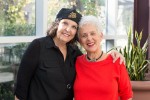
Winnipeg Klezfest co-producers Bev Aronovitch, left, and Miriam Bronstein. (photo from Rady JCC)

After attending the week-long KlezKanada Laurentian retreat near Montreal, Miriam Bronstein and Beverly Aronovitch wondered, why not do the same in Winnipeg? And so, they began planning – the city’s first Klezfest took place at the Rady Jewish Community Centre on Oct. 10 and 11.

Bronstein, a retired music and high school drama teacher who continues to perform at the Fringe Festival, is also very involved with Soup Sisters, an organization that makes soup for women’s shelters. Aronovitch is a jazz musician, producer and retired teacher.

As both Bronstein and Aronovitch are of Eastern European decent, klezmer spoke to them. “I’m a singer, she’s a piano player, so we thought it might be fun to go spend time in that scene,” said Bronstein. “I never realized that I actually speak Yiddish because, as I grew up, my mother spoke Yiddish with me, but I only answered her in English. So, it’s actually quite remarkable that I can speak Yiddish.”

Of the KlezKanada experience, Bronstein said, “It was life changing. It reconnected me with that Eastern European community. It was very, very cool.”

At KlezKanada, Aronovitch and Bronstein enjoyed seeing people of all ages, from toddlers to 90-year-olds, dancing to the music, as well as McGill University students taking a klezmer course.

“There were people from all over the world, musicians from all over the world, and they weren’t all Jewish,” said Bronstein. “It was just such a scene that both of us just said, ‘Oh my gosh! We have to do this in Winnipeg!’ We just took it on when we came home. We didn’t forget about it. We just pursued it.”

Although KlezKanada was a week long, Bronstein and Aronovitch felt that the first such festival in Winnipeg had to be shorter, at least for starters. They began by booking the world-famous Klezmatics from New York and, with the help of Winnipeg’s own Finjan – Kinzey Posen, Shayla Fink, Myron Schultz and Daniel Koulack – they put together a full day of festivities. It kicked off with a Saturday night Klezmatics performance, followed by several Sunday workshops, culminating in a concert led by members of Finjan and the Klezfest faculty.

“We had a wonderful workshop about great Yiddish composers and beginner klezmer playing sessions, and then a more advanced session called Readers’ Romp,” said Bronstein.

“One idea we had that is unique to Winnipeg was that we very much wanted to cross borders and recognize we have many ethnic communities in Winnipeg, so we had a workshop called Common Roots,” she said. “We got Ukrainian musicians and Romanian musicians. We brought people in from the city and the theme was ‘Weddings.’ They played what you’d play at a Ukrainian wedding and then the members of Finjan played what you’d play at a Jewish wedding.”

Bronstein would like to expand on the Common Roots concept next time, as there is a big Eastern European contingency in Winnipeg. She’d also like to see annual Mamaloshen Festival of Yiddish Entertainment and Culture attendees participate in Klezfest.

With their first Klezfest behind them, Bronstein said, “We’re just kind of basking in the glow. It was hugely successful. In the end, everybody was dancing in the foyer. It was so wild, it was so thrilling. People were so elated to be part of it. I taught at the Jewish day school here and there were 25 high school students who were part of the event.

“There were some people, some non-Jews – a considerable amount considering it’s Winnipeg and it’s a small community in general – but it would be nice if it was even more widespread. I think that, the more we do it, we increasingly make the name known, and it will open up even more to the general community.”

Bronstein and Aronovitch would eventually like to see participants get to a point where they are able to lead a performance at the end of the festival. Bronstein envisions this as “a participatory type of performance, where people who did dance classes can present what they learned and people who did the playing workshops can be a part of the band.”

She added, “It was a pleasure to work with our fantastic working committee and the Rady JCC. Without them, it could not have happened.”

Rebeca Kuropatwa is a Winnipeg freelance writer.
Format ImagePosted on December 4, 2015December 3, 2015Author Rebeca KuropatwaCategories MusicTags Beverly Aronovitch, Finjan, Klezfest, Klezmatics, Miriam Bronstein, Winnipeg
Videos teach sign language

Videos teach sign language

Israeli politicians learn to sign on the day that the Institute for the Advancement of Deaf Persons in Israel inaugurated a new online dictionary at the Knesset on Oct. 21. (photo from Institute for the Advancement of Deaf Persons in Israel)

A new online Israeli Sign Language (ISL) dictionary is helping people communicate by teaching hearing people via short video clips how to sign words. It is Yael Kakon’s vision come to life.

Kakon is the executive director of the Institute for the Advancement of Deaf Persons in Israel (IADPI).

“Our institute is working in several fields and one of them is to increase the use of sign language, especially with the people working with [those who are deaf], but also in the general population in Israel,” said Kakon, whose parents are deaf. “We have done several smaller dictionaries that were meant for specific industries. This is the first one that is online that people can reach anywhere.”

The previous dictionaries were on CD-ROM disks. These versions became outdated, as operating systems changed to the point that people could no longer use them.

There was a Signs in Crisis dictionary that was widely used by Magen David Adom and in hospitals. Signs of Judaism was another, as was Dictionary for Terminology, which was designed for high school science and math and was also translated into Arabic. The newest lexicon incorporates all of these versions, as well as additional words. Its video dictionary currently has just over 3,000 clips of signing in four languages: English, Hebrew, Arabic and Russian.

The limit on words and languages is because the cost was prohibitive to go further at the moment, said Kakon, who is hopeful that more clips will be added along the way.

Every 10th word out of the dictionary was chosen, followed by a manual check to ensure that all the important words were on the list. This is a systematic method that linguists use when compiling dictionaries, she explained.

“The translation into four languages was very complicated,” said Elias Kabakov, director of program development. “Even translation into Hebrew, because, if there are two languages, each one can have synonyms and each one can mean different things in different contexts…. English can have different context. It’s the same with Russian and Arabic. This must have delayed completion of the dictionary by two years. It’s not just a matter of translating a bunch of words, but making sure the intention of each sign was right.”

“Although we just started,” Kakon said, “I can tell you that there has been a huge celebration in the deaf community. People felt pride. They felt like a unit, a big unit, a unit that got a lot of attention.

“One deaf person came and told us that he came to work the day after the release, at the place he had worked for several years, and one of the workers, a hearing person, came to him and told him in sign language, ‘Good morning. How are you?’ And he was shocked, and said, ‘I worked here for seven years. He never came to me and told me good morning.’

“He continued by asking the person, ‘What’s going on? How do you know how to sign?’ And the answer was, ‘I looked on the dictionary.’ He was very proud to tell us the story.”

Kakon said that all the people in the videos are deaf, as IADPI gives priority to employing deaf professionals. “Although I sign very well myself, due to my parents being deaf, I will never be in the front, because I think the deaf person should be in the front and I can hear,” she explained.

According to its website, the dictionary was produced with contributions from Alex Garfeld and the late Prof. Miriam Shlesinger, “who actively supported linguistic accessibility for the deaf and the hard-of-hearing population of Israel.”

Visit isl.org.il to use the dictionary or get the Signs in Crisis app. For more information about IADPI, including information about donations, visit dpii.org.

Rebeca Kuropatwa is a Winnipeg freelance writer.

Format ImagePosted on December 4, 2015December 3, 2015Author Rebeca KuropatwaCategories IsraelTags deaf, Elias Kabakov, Sign Language, Yael Kakon
Israel as a problem, not a partner

Israel as a problem, not a partner

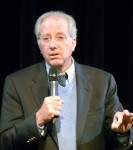
Ambassador Dennis Ross was in Winnipeg as part of the city’s Tarbut Festival to promote his new book. (photo by Rebeca Kuropatwa)

Ambassador Dennis Ross was in Winnipeg earlier this month to promote his latest book, Doomed to Succeed: The U.S.-Israel Relationship from Truman to Obama (Farrar, Straus and Giroux). He was one of the participants in the city’s Tarbut Festival.

Ross is the William Davidson Distinguished Fellow at the Washington Institute for Near East Policy, as well as a Distinguished Professor in the Practice of Diplomacy at Georgetown. He has been very involved in American peace efforts in the Middle East, especially during the administrations of presidents George H.W. Bush and Bill Clinton. Among other accomplishments, he helped Israel and the Palestinians reach an interim agreement in 1995, helped broker the Hebron Accord in 1997 and facilitated the 1994 Israel-Jordan peace treaty.

In his new book, Ross explores the attitudes and approaches of every U.S. president toward Israel, and the Middle East in general. He highlights some of the lessons that could have been learned from leader to leader, but were not, and how American presidents have shaped their country’s policies toward Israel.

Ross’ Nov. 15 talk in Winnipeg sold out a week in advance, with more than 200 in the audience at Rady Jewish Community Centre’s Berney Theatre. He began with a few words about the Paris terrorist attacks, describing them as “a sobering event.”

“This was an intelligence failure,” he said. “You had three terrorist cells that were able to operate, to acquire a substantial amount of weaponry, to wear suicide vests with explosives – to orchestrate, plan, and carry it out. My guess is they did rehearsals before they did this.”

Ross then discussed the spate of terrorist stabbings that has been occurring in Israel, referring to this as “a new normal” that we will need to get used to for the next while.

According to Ross, every administration, from Harry Truman to Barack Obama, has had people in the back office advising their president against siding with Israel. As such, to varying degrees, every president has considered Israel a problem, and not a partner.

“This mindset that tends to look at Palestinians and Arabs as something we have to be careful around … if we are going to be criticizing them, it will create a backlash against us … this is a mindset that has existed in every administration,” Ross said.

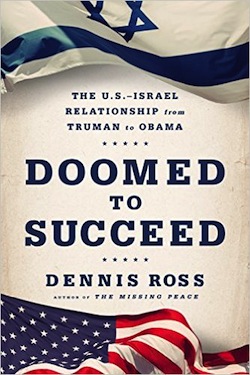
book cover - Doomed to SucceedIn his book, Ross conveys that the only American president who did not listen to these back-office advisors was Clinton, who saw the United States as Israel’s only friend.

“Because of that, we can have differences with Israel, but he [Clinton] believes that if we create a gap between us and Israel, it will give encouragement to Israel’s enemies,” said Ross. “With Clinton, the constituency existed, but it had no influence.”

Jumping from one president to the next, Ross provided glimpses of the eras and issues covered in his book. For example, Ross said, Ronald Reagan was “the only one to suspend [the supply of] F-16s to Israel as a punishment … because the Israelis bombed a [nuclear] reactor in Iraq. Reagan later acknowledges that it wasn’t a bad thing,” meaning Israel’s actions.

“Reagan goes back to his roots of being a very strong friend of Israel,” said Ross. “He feels a deep moral obligation to the state of Israel … going back to who he was, to his instincts. He believes the U.S. has a moral obligation to Israel.”

With the Reagan administration, Ross said, “For the first time, you have a constituency that arises with expertise that counters the other constituency, and sees Israel as a partner and not a problem … sees Israel as someone the U.S. should be working with.”

In Ross’ view, the constituency that views Israel as a problem has been guided by a set of assumptions that have endured since before Truman to today. In Doomed to Succeed, he lists three assumptions: “If you create distance from Israel, you’ll gain with the Arabs; if you cooperate with Israel, you’ll lose with the Arabs; [and] you cannot transform the Middle East unless you solve the Palestinian problem.”

Ross provided supporting evidence for each of these assumptions. “I’ll give you some examples from the book,” he said. “The most outrageous example was [Richard] Nixon. In March of 1970, Nixon decides to suspend F4 Phantoms to Israel. Now, I said that Reagan suspended F16s as a punishment. Nixon doesn’t do it as punishment. He’s trying to reach out to [Egyptian president Gamal Abdel] Nasser. He thinks if he suspends arms to Israel, he’ll gain with the Egyptians, gain with Nasser. What makes this an outrageous example is that he did it at the very moment that the Soviet Union was sending military personnel to Egypt.” While Nixon expected to be rewarded by Nasser, Nasser instead demanded more.

About the title of his book, Ross said, “Fundamentally, we [America] and Israel share interests and threats. That has always been true. It’s especially true now, as you look over the next 10 to 20 years, the struggle with ISIS and also Iran. We have two proxy wars. Who will dominate the region? The fighting is over identity. You fall back on the fundamental instincts.

“You have the Arab state system itself under threat now. Against that backdrop, there’s one state that actually has institutions – a rule of law, a separation of powers, independent judiciary, elections where the loser accepts the outcome, where there is freedom of speech, of assembly, and where women’s and gay rights are respected. Israel is the only democracy in that region and that’s why the title of the book is called Doomed to Succeed.”

The talk concluded with a few questions from the audience. Ross was asked about the Iranian nuclear deal and how he felt about it. Ross said he felt the deal needed tweaking to ensure a positive outcome.

“Sanctions would erode, eventually,” he said. “I still wasn’t prepared to favor the deal because, after 15 years, Iran gets treated as if it’s Japan or the Netherlands. They can build as large a nuclear infrastructure with no limitations at all. So, I identified, for me, five conditions that need to be met before I could support the deal. These conditions have to deal with how to bolster deterrents. I felt you can’t wait for 15 years to say, ‘Now, we are serious.’

“I wanted a firewall now if we see them moving toward a weapon. If we don’t do that, I can’t support it. I wanted us to make our declaratory policy much blunter, to make it clear they can’t use enriched uranium after 15 years. I wanted us to spell out now what happens if there are violations along the margins. For every transgression, there’s a price. They don’t escape. I wanted us to target new sanctions.

“I’ll tell you, the Iranians will cheat around the margins. They will test the verification. When they do, there has to be a price. If you buy 15 years, what do you do with it? I laid it out publicly before the deal was done. I wasn’t shy about this.”

In thanking Ross at the event’s conclusion, attendee Howard Morry said, “You asked the question, ‘Who has been the best friend to Israel for the past 30 years?’ It could be argued that you’ve been Israel’s best friend in the White House.”

Rebeca Kuropatwa is a Winnipeg freelance writer.
Format ImagePosted on November 27, 2015November 24, 2015Author Rebeca KuropatwaCategories BooksTags Dennis Ross, Doomed to Succeed, Israel, Obama, Truman

Posts pagination

Previous page Page 1 … Page 22 Page 23 Page 24 … Page 31 Next page
Proudly powered by WordPress