Skip to content
  • Home
  • Subscribe / donate
  • Events calendar
  • News
    • Local
    • National
    • Israel
    • World
    • עניין בחדשות
      A roundup of news in Canada and further afield, in Hebrew.
  • Opinion
    • From the JI
    • Op-Ed
  • Arts & Culture
    • Performing Arts
    • Music
    • Books
    • Visual Arts
    • TV & Film
  • Life
    • Celebrating the Holidays
    • Travel
    • The Daily Snooze
      Cartoons by Jacob Samuel
    • Mystery Photo
      Help the JI and JMABC fill in the gaps in our archives.
  • Community Links
    • Organizations, Etc.
    • Other News Sources & Blogs
    • Business Directory
  • FAQ
  • JI Chai Celebration
  • JI@88! video

Recent Posts

  • Eby touts government record
  • Keep lighting candles
  • Facing a complex situation
  • Unique interview show a hit
  • See Annie at Gateway
  • Explorations of light
  • Help with the legal aspects
  • Stories create impact
  • Different faiths gather
  • Advocating for girls’ rights
  • An oral song tradition
  • Genealogy tools and tips
  • Jew-hatred is centuries old
  • Aiding medical research
  • Connecting Jews to Judaism
  • Beacon of light in heart of city
  • Drag & Dreidel: A Queer Jewish Hanukkah Celebration
  • An emotional reunion
  • Post-tumble, lights still shine
  • Visit to cradle of Ashkenaz
  • Unique, memorable travels
  • Family memoir a work of art
  • A little holiday romance
  • The Maccabees, old and new
  • My Hanukkah miracle
  • After the rededication … a Hanukkah cartoon
  • Improving the holiday table
  • Vive la différence!
  • Fresh, healthy comfort foods
  • From the archives … Hanukkah
  • תגובתי לכתבה על ישראלים שרצו להגר לקנדה ולא קיבלו אותם עם שטיח אדום
  • Lessons in Mamdani’s win
  • West Van Story at the York
  • Words hold much power
  • Plenty of hopefulness
  • Lessons from past for today

Archives

Follow @JewishIndie
image - The CJN - Visit Us Banner - 300x600 - 101625

Author: The Editorial Board

Campus, church extremism

Last week, students at the University of British Columbia rejected a referendum question that would have urged the student society to boycott Israeli businesses and products.

But the news was by no means all good when the results came in last Friday night. In fact, more students voted yes in support of BDS (boycotts, divestment, sanctions) than voted no. The question was defeated effectively on a technicality, with the number of students voting yes failing to reach quorum. Therefore the question failed.

Students were asked: “Do you support your student union (AMS) in boycotting products and divesting from companies that support Israeli war crimes, illegal occupation and the oppression of Palestinians?” The yes side received 3,493 votes, 2,223 students voted no and 435 registered their abstentions. To pass, the vote required 4,130 yeses, representing eight percent of eligible students.

In this, too, there is good news and bad news. The low turnout indicates that students at the university have better things on their mind than the conflict between Israel and its neighbors. It has become increasingly clear in recent years that the anti-Israel movement on college campuses in North America is comparatively small. Yet the damage this narrow group of extremists can do to the comfort and security of Jewish and Zionist students – and to the broader objective of an inclusive, welcoming environment – has been serious and detrimental.

The BDS movement has had few tangible successes and plenty of failures, if measured by their effectiveness at actually boycotting, divesting from or sanctioning anything. What they have been wildly successful at is spreading messages that single out Israel as the fountainhead of all things evil.

Also mixed news is the fact that, while campaigns like BDS are finding it difficult to rustle up serious numbers of equally agitated fellow travelers, Jewish students, too, are challenged in finding substantial numbers of allies when confronted with a campaign of targeted aggression against the Jewish homeland. There might be only a few thousand out of more than 50,000 students who succumb to anti-Israel messaging, but there are even fewer who observe that messaging and are moved to come to the aid of Israel – and/or Jewish students – when it is attacked in this fashion.

Which raises another issue facing our Vancouver community.

Later this month, Canadian Friends of Sabeel will hold a conference on “overcoming Christian Zionism.” Sabeel describes itself as an “ecumenical Palestinian liberation theology centre” that is “working for justice, peace and reconciliation in Palestine-Israel.” In reality, it is a group that promotes a misrepresentation of events in the Middle East. The conference slated for Vancouver is explicitly aimed at undermining Israel among its North American Christian supporters.

Conservative Christians have been among Israel’s most reliable bloc of friends in troubled times. Like any bedfellows, the Zionist-Christian alliance brings with it complexities. While some Christians use Zionism as a back door to evangelizing or view Christianity as a “successor” religion to Judaism, for example, there are also many in the Christian Zionist movement who respect the integrity of Judaism.

The upcoming conference is co-sponsored by three Christian churches.

The United Church of Canada, for decades but especially in recent years, has adopted a heavily anti-Israel approach to global affairs. Their sponsorship of this event is not surprising. The Presbyterian Church in Canada is also supporting this event, though this, too, is not shocking, given that the American branch of the Presbyterian Church has been beset by anti-Israel agitation and last year voted to divest itself of some Israeli holdings.

What is surprising – and worrisome – is the role of the Anglican Church of Canada as co-sponsor of this conference. Two years ago, the church passed a resolution that made some attempts at balance but was marred by typical anti-Israel boilerplate. With their co-sponsorship of this Sabeel event, the Anglican church has thrown itself unequivocally off the fence.

There are parallels between these two developments – the UBC vote and the involvement of erstwhile moderate Christian groups in a blatantly anti-Israel conference. The fact is, probably most active Anglicans, Presbyterians and United churchgoers have no idea what their national bodies are up to. Of the millions of Canadians represented by these three denominations, the vast majority probably do not have an opinion on – or do not agree with – the approach of this month’s conference. As we saw at UBC, the anti-Israel movement tends to be a small group of zealots who get involved in a legitimate body and turn it into a platform, a rabidly anti-Israel tail wagging an otherwise amicable dog.

Like the impact of anti-Israel extremism on campus, the involvement of mainline Christian groups in this anti-Israel conference shows how a small group of dedicated individuals can create nasty, lasting divisions in a multicultural community.
Posted on April 3, 2015April 1, 2015Author The Editorial BoardCategories From the JITags Anglican Church, anti-Israel, antisemitism, BDS, Presbyterian Church, referendum, Sabeel, UBC, United Church of Canada3 Comments on Campus, church extremism

Biggest improbability?

In September of 1978, U.S. president Jimmy Carter was at his wit’s end after 12 days of face-to-face negotiations between himself, Egyptian president Anwar Sadat and Israeli prime minister Menachem Begin.

Neither party was at all inclined to make peace, both had legitimate grievances with the other nation, advisors were telling them peace was not possible and that the leader and the nation each man represented could not be trusted. Things got so heated that all three parties had packed their bags and prepared statements that the talks had failed. Cars were idling in the Camp David driveway and Marine One, the presidential helicopter, was being readied to return Carter to Washington empty-handed.

Failure then, in the midst of the Cold War, would have meant an opening for the further arming of Egypt by the USSR and the nuclearization of the Middle East, where ultimately the fanatical forces that were then lurking in the shadows could very well force the Superpowers into a feared nuclear standoff. This was much like what was happening in East and West Germany at the time, only in the hot desert sands of the Middle East, it was far more likely that tempers would boil over.

These were the stakes at Camp David. The proposition was that Israel give back the Sinai Desert, land it had captured in the Six Day War, land that served as their saving buffer zone in the Yom Kippur War just five years earlier. Land that contained settlements of Israeli citizens that Begin had pledged on his life never to abandon. To do all of that in exchange for a piece of paper that promised peace, signed by three men who did not trust each other.

No one thought it probable or possible, not between these three men, Begin and Sadat, who had spent a lifetime fighting each other, and Carter, who lacked power at home and credibility abroad.

And, yet, they signed a lasting peace treaty. Israel had been at war with Egypt in one form or another for literally millennia, since the days of Pharaoh. They have not been at war since and, next to Jordan, Egypt is Israel’s closest ally in the region today.

Mark Twain said, “History doesn’t repeat itself but it often rhymes.” No two eras or events are the same, but many if not all have similarities.

Three years before Camp David, president Gerald Ford had announced that the United States would be reevaluating its relationship with Israel because of Israel’s power play, along with France, in the Suez Canal. A crisis, if you recall, that nearly, like the Cuban Missile Crisis, was only a series of missteps away from another nuclear confrontation between the United States and the USSR.

You could not have had Camp David if you had not also had the sobering realization of the Suez Canal Crisis. Carter could not have pressured Begin to do the good and hard thing for the future of Israel if Ford had not created enough daylight between the United States and Israel for Begin to see the light at the end of the endless wars with Egypt tunnel.

“History doesn’t repeat itself but it often rhymes.” I am neither a politician, nor a political scientist – though in truth I have a degree in the latter and every rabbi must ultimately learn the skills of the former. I am a student and teacher of history, the history of our people both in the land and yearning for the Land of Israel – and in all that has happened in these past many years, really since the assassination of Yitzhak Rabin (alav ha’shalom), I hear the rhyme of history.

Call it “darkest before the dawn,” but while I am filled with worry, the seriousness of the matter gives me hope that it can no longer be ignored or put off. That the pressure of absolutes that made Camp David possible has returned to make peace between the Israelis and Palestinians possible, though still improbable once again.

The region and its people are under near-bursting pressure. But pressure such as faces Israel also clarifies priorities. The greatest achievements of diplomacy have often come in the face of the most extreme pressure or, as Carl von Clausewitz wrote, “War is diplomacy by other means.”

Let’s examine the pressures in play.

In Israel, the status quo between Israelis and Palestinians is set to devolve into a third intifada. Meanwhile, there is a seismic schism between the Jews in Tel Aviv who voted overwhelmingly for the left and the Jews in Jerusalem who voted overwhelmingly for the right. Israelis on left and right are living two different realities, and they want two different futures for themselves and for the Palestinians.

In the Arab world, the forces of fundamentalism have shaken what little remains of the nation-states from their complacency with and tolerance for radicalization. Arab armies are mobilized against radicalism and terror. Yes, there is a vacuum of leadership throughout the Arab world, including among the Palestinians – but that also creates space for a leader to emerge.

Outside of the Middle East there is a fundamental disagreement between Western democracies that want Israel to act more like them, and Israel that wants the West to see that the terrorist threat confronting its democracy today is coming to their shores tomorrow. And for much of Europe tomorrow is today.

Jews are under attack around the globe. Antisemitism has come out of hiding once again. Much of antisemitism is ignorance and, yet, where do we find it? Most shockingly in our institutions of higher learning, where, in the most distorted and twisted forms, they equate Jews with Nazis. We see this happening particularly in the BDS campaigns that are sweeping across North American university campuses and right here at the University of British Columbia. These same antisemites defend terrorists as “heroes,” inviting them as speakers on campus. The Talmud says, “olam hafouch,” the world is upside down. Indeed, bigotry masquerades as fairness.

The pressure is not only external; it is internal, as well. The relationship between Jews in the Diaspora and Jews in Israel is becoming a dysfunctional marriage. It’s not headed for divorce but maybe separate bedrooms, as each tries to focus on things they love about the other, even when they are disappointed in the other.

It seems hopeless, I know, this election result whether you are left or right – the winner of the election was “hopelessness” itself. As Binyamin Netanyahu declared, in his view, there will never be a Palestinian state while he is prime minister. Those who voted for him believe that to be true and those who voted against him believe that to be true. That is the very definition of being without hope.

There is no solution to this conflict in this neighborhood, in this region, in this time. And, with no Palestinian leader who can do the same, it’s just not possible.

And, yet, we said the same before Camp David. We never thought Rabin would shake Arafat’s hand or make peace with Jordan. That Sharon, who built the settlements in Gaza would dismantle them, and that it didn’t lead to civil war.

Begin, Rabin, Sharon. These were not peace seekers, these were warriors, evolved Hawks.

We are not ready for another Camp David today; Netanyahu is not anywhere near ready, and there is no leader on the other side who can be a Sadat or a King Hussein of Jordan, a warrior who has the credibility to make peace.

By the same token, the only one in Israel right now who has the credibility to make peace with the Palestinians is Netanyahu. If he signs off on it, the people will believe it.

We are in a dark period and it may get darker. The pressure on Israel will only increase. The choices the country will have to make are impossible to understand right now. Our own solidarity both with Israel and with each other as fellow Jews will be tested, and there will be cracks. But that is nothing new for us, or for Israel. We don’t always agree, as Jews here or there, past or present, we seldom agree. In the end, however, what we have always done is survive. There’s the biggest improbability of all: that we are still here.

Israel is 67 years old. By comparison, it took the United States 150 years to reconcile slavery, a process that included a civil war, incomprehensible social disorder and civil unrest. And the United States, which is almost 200 years older than Israel, is still not yet resolved on the issue of race, as Ferguson – among many other events – reminds us.

Canada could say some of the same about true reconciliation with First Nations. We are not yet there.

This election was part of the growing pains of a nation and, in the age of nations, Israel is barely a teenager. Israel is the bat mitzvah girl who stands proudly, if not ironically, before the congregation and declares, “Today, I am a woman!” And we all smile and say to ourselves, “Not yet, but today you gave us a glimpse of the woman you will one day be. It would be more accurate to proclaim, “Today, I will no longer act like a child.”

“The arc of history is long,” Martin Luther King Jr. preached, “but it bends toward justice.” That’s the history of the world and it’s the story of our people, a story we are telling again around our seder tables this week.

What do you take away from the seder? That Pharaoh was cruel? That slavery was terrible? Yes, but also that we were redeemed; that the pressure on Pharaoh ultimately helped him see the light.

“La’yehudim hayta orah” we sang just recently on Purim and every week, as we end Shabbat with Havdalah. “The Jews enjoyed light and gladness, honor and joy. May we, too, experience these same blessings.” In another dark time, when all hope appeared lost, there was light. Let there be light once again!

Dan Moskovitz is senior rabbi of Temple Sholom in Vancouver.

Posted on April 3, 2015April 1, 2015Author Rabbi Dan MoskovitzCategories Op-EdTags Anwar Sadat, Binyamin Netanyahu, Camp David Accords, Israel, Israeli-Palestinian conflict, Jimmy Carter, Menachem Begin, Middle East, peace
Mystery photo … April 3/15

Mystery photo … April 3/15

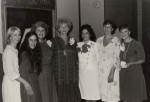
ORT Installation eve, 1983. (JWB fonds; JMABC L.14060)

If you know someone in this photo, please help the JI fill the gaps of its predecessor’s (the Jewish Western Bulletin’s) collection at the Jewish Museum and Archives of B.C. by contacting [email protected].

Format ImagePosted on April 3, 2015April 1, 2015Author JI and JMABCCategories Mystery PhotoTags JMABC, ORT
אורח הכבוד בערב הגאלה של קק”ל הוא שר החוץ לשעבר בירד

אורח הכבוד בערב הגאלה של קק”ל הוא שר החוץ לשעבר בירד

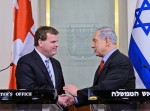
 שר החוץ הקנדי לשעבר ג’ון בירד, עת ביקר את ראש הממשלה בנימין נתניהו, בירושלים ב-20 בינואר השנה. בירד הוא אורח כבוד ‘בנגב דינר’ של קק”ל בוונקובר ב-7 ביוני. (צילום: Kobi Gideon-GPO via Ashernet)

מחלוקת בין ידידים: הרפר שוב תומך בהקמת מדינה פלסטינית בניגוד לנתניהו

ראש ממשלת קנדה, סטיבן הרפר, שנחשב לידיד הקרוב ביותר של ראש ממשלת ישראל, בנימין נתניהו, מקרב מנהיגי העולם, חלוק עימו בסוגיה מאוד משמעותית. בשיחה שהתקיימה בין השניים ביום ראשון שעבר, חזר והדגיש הרפר בפני נתניהו, כי הוא תומך בפתרון שתי המדינות והקמת מדינה פלסטינית לצידה של ישראל. הדברים נאמרו לאור הכרזת נתניהו ערב הבחירות בישראל, כי הוא מתנגד להקמת מדינה הפלסטינית וכי ימשיך את הבנייה בשטחים.

הרפר שוחח עם נתניהו לראשונה בטלפון לאחר ניצחונו בבחירות שהתקיימו לפני שבועיים, בזמן שהוא נערך להקמת הממשלה החדשה. מייד עם פרסום תוצאות הבחירות, שלח ראש ממשלת קנדה ברכות חמות לראש ממשלת ישראל היוצא והנכנס, והוסיף שהוא מצפה לעבוד ביחד עם הממשלה החדשה בישראל, וכי לישראל אין ידידה קרובה יותר מאשר קנדה. בשיחת הטלפון שוב בירך הרפר את נתניהו, וכן הבטיח כי קנדה תמשיך לעמוד במחוייבותה לדאוג לביטחונה של ישראל. וציין כאמור שהוא תומך בפתרון שתי המדינות.

אפשר לסכם את הפרק הזה ביחסי קנדה וישראל באמירה, כי הרפר מאז נבחר לרשות ממשלת קנדה (2006), ממשיך לעמוד לצידה של ישראל ומדיניותה בכל עניין. למעט שתי סוגיות עקרוניות משמעותיות: תמיכה בהקמת המדינה  הפלסטינית והתנגדות להמשך בניית ההתנחלויות בשטחים.

הערכה לידיד: אורח הכבוד בערב הגאלה של קק”ל הוא שר החוץ לשעבר בירד

סניף ונקובר של אגודת ידידי קרן קיימת לישראל (קק”ל) בקנדה בראשות אילן פילו, יקיים ערב גאלה מיוחד, בהשתתפות אורח הכבוד שר החוץ של קנדה לשעבר, ג’ון בירד. האירוע מתקיים לכבודו של בירד שנחשב לידיד קרוב מאוד של ישראל, וכמו ראש הממשלה סטיבן הרפר, עמד לצידה לכל אורך הדרך. בירד ביקר בישראל מספר פעמים וזכה לאירוח לבבי. האירוע במסגרת ‘נגב דינר 2015’ יערך ב-7 ביוני (יום ראשון) במלון ארבע עונות בדאון טאון ונקובר, ומחיר כרטיס 270 דולר.

קק”ל ונקובר תגייס תרומות לטובת הקמת פרוייקט בישראל שיקרא על שמו של בירד, ובשלב זה אין פרטים נוספים. כדי לקבל הכרה בפרויקט ע”י בירד יש לתרום לפחות 6,000 דולר.

קק”ל בקנדה יסדה את ‘נגב דינר’ עם הקמת מדינת ישראל ב-1948. האירוע מתקיים בכל רחבי קנדה מדי שנה להבליט את העשייה החשובה של קק”ל, לגייס כספים לטובת פרוייקטים בישראל, ולהעניק אות כבוד למי שעוזר ותומך בישראל.

בירד (45) פרש בראשית פברואר מתפקידו כשר החוץ בממשלת הרפר. בימים אלה הוא הצטרף לקואורפוריישן ‘בריק גולד’ (חברת כריית הזהב הגדולה בעולם), בתפקיד יועץ בינלאומי. הוא עבד בשירות הציבורי במשך כעשרים שנים, ושימש שר החוץ מאז 2011. קודם לכן החזיק בתפקידים בכירים שונים (בהם שר התחבורה ושר האנרגיה) בממשלות הרפר. ברד הוזכר לא פעם כמועמד להחליף את הרפר ביחד עם השר ההגנה, ג’ייסון קני, שגם הוא תומך גדול בישראל.

קק”ל שחוגגת השנה 114 שנים להיווסדה מקיימת שורה של אירועים בישראל. במסגרת זו אגודות ידידי קק”ל בעולם מארגנות מסע לישראל בן שמונה ימים, בחודש מאי (12-20). המשתתפים ישהו במלון מצודת דוד בירושלים. המסע יכלול מפגשים עם מספר אישים ובהם: נשיא המדינה, ראובן ריבלין וראש עיריית ירושלים, ניר ברקת. הסיורים יכללו בין היתר: ביקור בבסיס חיל האוויר, השתתפות באירועי יום ירושלים (ב-17 במאי), ביקור בתחנת הטלוויזיה של ערוץ החדשות באנגלית ’24 ניוז’, סיור ביקב, ביקור בשוק של יפו העתיקה, ביקור בבאר שבע ובנגב.

Format ImagePosted on March 31, 2015March 31, 2015Author Roni RachmaniCategories עניין בחדשותTags Binyamin Netanyahu, Jewish National Fund, JNF, John Baird, Negev Dinner, Palestinian state, Stephen Harper, בנימין נתניהו, ג'ון בירד, מדינה הפלסטינית, נגב דינר, סטיבן הרפר, קק"ל, קרן קיימת לישראל
Message to Vancouver

Message to Vancouver

Masha Shumatskaya’s visit here was part of an American Jewish Joint Distribution Committee tour of North American cities. (photo from Jewish Federation of Greater Vancouver)

All Masha Shumatskaya wants is for the fighting to stop so she can go home. The 24-year-old Jewish Ukrainian English teacher was living and working happily in the city of Donetsk until April 2014, when pro-Russian separatists arrived two hours north of her hometown and declared their intention to form a people’s republic.

Until that moment, her life had been quite ordinary. Shumatskaya, a slender beauty with gentle eyes, was one of some 15,000 Jews in Donetsk, a city that boasts a Jewish community centre, a Chabad-run synagogue, a kosher café and various Jewish youth and cultural groups. “I never once experienced antisemitism growing up there,” she said. “I was never afraid to say I was a Jew.”

By May 2014, the pro-Russian separatists had moved into Donetsk and were threatening the safety of civilians. They bombed the Donetsk airport and the violence forced the closure of many schools and business offices in the city. Shumatskaya and her friends began making plans to move to other cities in Ukraine, such as Kiev, Odessa and Kharkov. She chose Kharkov, five hours’ drive from Donetsk, leaving her parents behind.

But Shumatskaya is one of the lucky ones. There are some 7,000 Jews still living in the war zone in Ukraine, many of them elderly. They’re dependent on the Joint Distribution Committee’s aid for food, medical support, rental subsidies and basic necessities.

Shumatskaya was in Vancouver recently as a guest of JDC, where she met with Jewish Federation of Greater Vancouver representatives and media to tell her story. With her was Michael Novick, executive director of the American Jewish JDC in Bellevue, Wash. “The situation in Ukraine has become a high priority for the JDC,” he said. “It’s not just the Jews, mostly elderly, still living in the conflict zone, but also the 2,500 Jews who’ve fled and need assistance, and another 60,000 Jews we’ve been helping all along with basic humanitarian supplies.” The JDC estimates the cost of its monthly relief for these Jews to be more than $387,000 US.

The political unrest has had widespread effect. The Ukrainian economy has plummeted, the purchasing power of the Ukrainian currency, the hryvnia, has dropped more than 50 percent and inflation is between 25 and 30 percent. “A year ago, the average pension of an elderly person we were assisting was equivalent to $150 US. Today, that same pension is only worth $50 US,” Novick said. “People have lost their jobs, their businesses, and Jews who could previously take care of their own families are now coming to the JDC’s Hesed welfare centres.”

The JDC has 32 Hesed welfare centres in Ukraine, and 160 of them across the former Soviet Union. Among those Jews requiring their services in Ukraine, Novick said they represent “the poorest Jews on earth, living in really dire conditions. For them, the lifeline provided by Hesed in terms of supplemental, basic humanitarian assistance, is vital.”

He added that the emergency funds being supplied by JDC are not part of its budget. “But the situation in Ukraine is so dire that we’re not waiting – we’re simply spending money and hoping that individuals, federations and foundations that meet Masha and hear about this story will come to our assistance.”

Shumatskaya’s 10-day visit to North America included stops in Seattle, Vancouver, Los Angeles, Philadelphia and New York. Last year, JFGV made a $25,000 grant to JDC for its various programs.

As she looked to the future, Shumatskaya was uncertain what it would hold for her. “I feel attached to Ukraine and I feel some responsibility to help with what’s going on there,” she said. “If I had to leave Kharkov I don’t know where I’d go. But I know that I don’t want to become a war refugee again. Once in my life was quite enough.”

Her message to Vancouver’s Jewish community is twofold: a reminder that Jews are responsible for each other, and one of gratitude for the support she and her fellow Ukrainian Jews have all ready received.

“Without that support we literally would not have survived,” she said. “I wish we could finish this need for assistance fast, but it’s out of our hands. We’re praying every day that we can live in a peaceful country without the assistance provided by the JDC.”

Lauren Kramer, an award-winning writer and editor, lives in Richmond, B.C. To read her work online, visit laurenkramer.net.

Posted on March 27, 2015March 26, 2015Author Lauren KramerCategories LocalTags JDC, Jewish Federation of Greater Vancouver, JFGV, Joint Distribution Committee, Masha Shumatskaya, Ukraine
Make time for Elbow Room

Make time for Elbow Room

Allan Zinyk as Patrice, left, and David Adams as Bryan in Elbow Room Café: The Musical (Phase 1). (photo by Emily Cooper)

Allan Zinyk and David Adams are veritable doppelgangers for Patrice (Patrick) Savoie and Bryan Searle, who started the Elbow Room Café on Jervis Street in 1983. While the restaurant moved to Davie Street in 1996 and the couple has since taken on another business partner, the heart of the café is Savoie and Searle, and, for many people, “home” is wherever they are.

Elbow Room Café: The Musical (Phase 1) really captures the depth and warmth of their relationship with each other, as well as with their staff and customers. It is a fitting and well-deserved homage to two men who have not only built a successful business, but a community, not to mention raising tens of thousands of dollars over the years for the charity A Loving Spoonful.

The Studio 58 and Zee Zee Theatre collaboration is a work in progress, but its Phase 1 opening on March 21 was a pretty polished effort. It will be interesting to see what changes on the path to its final form. Already, the musical – book and lyrics by Dave Deveau, music and lyrics by Anton Lipovetsky, directed by Cameron Mackenzie – arouses a range of emotions, from belly laughter to touching sentimentality. The songs are catchy and singable, the characters are memorable and relatable, the choreography is appropriately silly and sexy.

photo - Mama Sutra and Earla are among the customers who witness all the drama at the café
Mama Sutra and Earla are among the customers who witness all the drama at the café. (photo by Emily Cooper)

Led by professional actors Zinyk and Adams, the Studio 58 cast was top-notch. The audience gets lost in the life dramas that take place at the café: Tim and Tabby, a tourist couple from Kansas who stop in for a bite to eat on their way to Stanley Park, and are introduced to a whole new world; will Jackie and Jill, broken up for 253 days, get back together, despite all they’ve said to each other and what has happened since their breakup?; will the shy girl (aka Menu) find love at the café?; and Amanda, who finds out as her bachelorette party comes to an end that her wedding won’t take place as planned. Then there’s Patrice and Bryan, both getting older and a little slower – what’s to become of the café once they are no longer able to run it?

These main storylines are all played out in front of an odd, and endearing, assortment of other customers. One of the many notable aspects of this musical is how the supporting cast reacts to what’s going on around them. The full-cast musical numbers are big and bold, and there are some unique roles, such as Autograph, who takes on the personas of various celebrities who have eaten at the café, Tom Selleck and Sharon Stone, for example.

Since the musical is only in the first of a planned three phases, it is likely that the stories, dialogue and/or music will change. Considering who’s involved in the production, however, it should only get better. Then maybe afterward they can start on Jewish Independent: The Musical.

Elbow Room Café is at Studio 58 until March 29. As the musical’s program notes, there is “coarse language and immature content.” For tickets and information, visit studio58.ca.

Format ImagePosted on March 27, 2015March 26, 2015Author Cynthia RamsayCategories Performing ArtsTags Allan Zinyk, Anton Lipovetsky, Bryan Searle, Cameron Mackenzie, Dave Deveau, David Adams, Elbow Room Café, Patrice Savoie, Studio 58
Sephardi group in Ottawa

Sephardi group in Ottawa

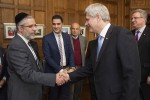
Rabbi Ilan Acoca, left, shakes hands with Prime Minister Stephen Harper on Parliament Hill. (courtesy of Prime Minister’s Office)

Last month, a Jewish delegation paid a visit to Parliament Hill with two main items on the agenda – educating the Canadian government about Sephardi Jewry in Canada and discussing Iran’s aim to obtain nuclear weapons.

The delegation included Sephardi community leaders, activists, philanthropists and spiritual leaders from across Canada. They met with the prime minister, various ambassadors and other dignitaries. The delegation was led by Yehuda Azoulay and Vancouver’s Rabbi Ilan Acoca of Congregation Beth Hamidrash, the only Sephardi synagogue west of Toronto.

A scholar, educator, author, activist and entrepreneur, Azoulay established the Sephardic Legacy Series: Institute for Preserving Sephardic Heritage. He envisioned the series as helping ensure future Sephardi publications, articles, lecture series, documentary films and research on Sephardi topics, and other works geared toward the benefit of Sephardi communities worldwide. It was the lack of general knowledge concerning Sephardi history, culture, Jewish law and other facets of Sephardi Judaism that prompted him to establish the organization. To date, Azoulay has authored five books and published more than 30 articles on various topics. In November 2013, he initiated a tribute luncheon to honor the contributions of Sephardi Jewry in America for members of the U.S. Congress.

The recent Parliament Hill delegation had as its primary goal to “create more awareness about Sephardic Jews in Canada by educating them about our history and our contributions to Canadian society,” Acoca told the Independent. “There are currently 55,000 Sephardic Jews in Canada and the number is growing. This is something that we related to the government.”

Acoca was born in Israel to parents of Moroccan descent. “I grew up in a typical, traditional Sephardic home,” he said. “Sephardic Judaism was an integral part of my upbringing.”

When Acoca was 13 years old, his family moved to Montreal, where he attended a Jewish high school. Growing up in Montreal’s Sephardi community, Acoca said, “helped me deepen my appreciation for my rich Sephardic ancestry.” Acoca eventually become a rabbi, fulfilling his grandfather’s wish that one of his descendants follow in his footsteps to the rabbinate, he said. In November 1999, Acoca and his wife Dina took on the roles of rabbi and rabbanit at Beth Hamidrash.

“Getting this responsibility made me more aware and passionate about my ancestry,” said Acoca. “My job enabled me to learn more about various Sephardic traditions and communities.”

Over the years, Acoca has added other aspects to his rabbinical role, teaching online, writing a monthly column in the Canadian Jewish News, heading the Rabbinical Council Sephardic Affinity Group, being an official Sephardi representative in Western Canada, and being the region’s Sephardi halachic authority.

Canadian human rights lawyer David Matas joined the group in Ottawa. Acoca described the importance of having Matas present in front of the House of Commons SubCommittee on International Human Rights about Iran’s intent to develop nuclear capability. During the presentation, Matas and Azoulay also conveyed some of the hardships that Iranian Jews “have faced and continue to endure.” (The full hearing is available at cpac.ca/en/programs/in-committee-house-of-commons/episodes/37646919.)

Matas gave six recommendations to the committee, which he shared with the Jewish Independent:

1. Expand the exceptions to sovereign immunity to catch Iranian human rights violations in a larger net. It should be possible for victims of the Iranian regime to sue in Canadian courts for the harm that the regime has done to them.

2. Ask for the extradition of Hassan el-Hajj Hassan, a Canadian citizen implicated in a Bulgarian bombing, from Lebanon to Canada. Under the Criminal Code, Canada has jurisdiction to prosecute him because he is a Canadian citizen, explained Matas. Canada does not have an extradition treaty with Lebanon, but the Extradition Act allows for extradition, even without a treaty, on a case-by-case basis by agreement with the state where the accused is found.

3. Support the suggestion that any arms agreement between Iran and foreign states include a human rights component parallel to that of the Helsinki Accord. “A regime hell bent on the destruction of Israel and the Jews should be kept as far away from weapons of mass destruction as possible,” said Matas. “A nuclear weapons agreement with Iran, if one can be reached, should not just prevent nuclear weapons capability. It should have a place for human rights.”

4. The European Union in July 2013 added the military wing of Hezbollah to its list of terrorist entities. Canada should urge the EU to list Hezbollah in its entirety, not just the military wing, as a terrorist entity.

5. As the lead sponsor to the United Nations General Assembly, Canada should strengthen the language of the resolution, even if it that means fewer votes. “While we would not suggest language so strong that the resolution would be lost, Canada today has some room for manoeuvre,” said Matas.

6. Encourage the Government of Canada to take into account all refugee populations as part of any just and comprehensive resolution to the Israeli-Palestinian and Arab-Israeli conflicts. “That, of course, includes 55,000 Jewish refugees from Iran, driven out of Iran by the regime of the mullahs,” said Matas.

It is also important to confront the myth that Israel is a Western, imperial, colonial enterprise – a myth that holds particular sway with the mullahs of Iran, Matas said. The reality is that Israel is in large measure composed of Jews from the Middle East, including Iran. “Unless the Palestinians themselves accept the reality of dual victimization, a meaningful peace becomes impossible,” he said.

The delegation met with MPs Tim Uppal, Denis Lebel, Jason Kenney, Peter Kent, John Carmichael, Mark Adler, Joyce Bateman and Irwin Cotler. Other members of the delegation, including Acoca, met privately with Prime Minister Stephen Harper.

“The government officials were extremely supportive and promised they will assist,” said Acoca. “We were ecstatic, definitely.”

Acoca is eager to create more awareness of Sephardi Jewry, the community’s needs and cultural differences, and to promote understanding. He is also looking forward to following up on the event and meetings, and hopes this delegation will become an annual occurrence. “I would like the Sephardic way and philosophy to be preserved and am working hard, together with my colleagues, to ensure a thriving future,” said Acoca.

For a short video clip from the group’s Parliament Hill visit, see this link (at 0:26): youtube.com/watch?v=AiZ9_4O936Q.

Rebeca Kuropatwa is a Winnipeg freelance writer.

Format ImagePosted on March 27, 2015March 26, 2015Author Rebeca KuropatwaCategories NationalTags Beth Hamidrash, David Matas, Ilan Acoca, Iran, Sephardi, terrorism
Imagination in full blooms

Imagination in full blooms

Lauren Morris (photo by Linda Lando)

Local artist Lauren Morris loves every aspect of her art form. “I even like the smell of paints,” she said in an interview with the Independent. “When I come to my studio, the smell jolts me into work. It’s like a kick-start to my imagination.” She added, “I didn’t start painting until I immigrated to Canada. I’m a graphic designer by education.”

Upon graduating as a graphic designer in her native Cape Town, she worked in her chosen field for awhile and then decided to see the world. She backpacked through Europe. “In Israel, I met an American girl in ulpan. We became friends, and she invited me to come to America. I thought I would only travel there for a few months but I stayed for five years. I found a job there as a magazine graphic designer. I also took some part-time art classes in Washington, D.C.”

Afterwards, she returned home and worked as a graphic designer for the book and magazine industry. She also started a family. Unfortunately, the political situation in South Africa was becoming increasingly unstable. Concerned about their growing children, the family decided to emigrate. They arrived in Vancouver in 2000.

“When we came,” Morris remembered, “I couldn’t find work as a graphic designer, so I started painting at home.”

Like any artist, she wanted to display her work, wanted people to see it and perhaps even buy it, but she was new in town, didn’t know anyone and had no connections in the local art community.

“I started hanging my paintings in coffee shops,” she recalled. “Some shops in Vancouver want to display and sell art, so they advertise on Craigslist. I looked for such ads, applied and my paintings sold very well in many of them. I wasn’t a snob. I would accept any offer. Most of my paintings sold not even through a coffee shop but through a fish and chips place in Kerrisdale.”

The sales were encouraging, so she rented a studio. “I wanted to be more professional,” she said with a smile. “But a studio cost money. To pay the rent, I started teaching.”

She still offers art workshops and she teaches mostly adults. “I love showing people what they can do. Some say: ‘Oh, I don’t know how to paint.’ They are wrong. Everyone can paint. They just need someone to guide them. Afterwards, they are amazed and awed by their own works. This is the most satisfying part of teaching – when my students discover things about themselves. It makes them happy and it makes me happy.”

Making people happy seems to be a requirement in her artistic approach: in her workshops, in the classes she taught at the Louis Brier Home and Hospital, and in her own personal art. That’s why flowers play such an important role in her creative output.

“Flowers make people happy,” she said. “When a painting of flowers hangs on a wall, it changes the feel and mood of a room, brightens it.”

Her flowers are not photographic. In fact, some of her paintings bear only a remote resemblance to real-life blooms. Her images lean towards the abstract, like symphonies of colors and shapes. Light and reflections, movements and shadows weave into interlacing harmony in her pictures, while flowers provide an inspiration.

“I don’t like to be too literal in my art,” she said. “Art is my imagination. It always springs from somewhere, from a point of reference, a photo I took or found online, or an idea I see in another artist’s work. Then I take my paintbrush and start building colors. Most of my paintings are color compositions. When I paint, I let my paintbrush take over. It’s like putting together a colorful puzzle, but I’m guided by my unconsciousness.”

Not only the colors but also the shapes of flowers attract Morris because they are so versatile.

“People see different shapes in my flowers,” she said. “Sometimes they see something I didn’t even know was there.”

Because of the expressionistic ideas of her paintings, she rarely works outside. “I tried,” she explained with a chuckle. “But I paint on the floor, on my knees, with the canvasses against the wall. It’s not convenient outside.”

Often, her process resembles a gym exercise, very physically taxing, so she doesn’t work for more than a couple of hours at a time. But she loves every minute of it. “When I see a painting unfolding, going in a certain direction, when my imagination flows, it’s the best moment for me.”

She enjoys listening to classical music while she paints, and the melodies seem to transfer to her canvasses. The different paints and hues splash and chase each other, like notes of a melody. The combined arrangement is invariably richer than its component parts, and the same is true for Morris’ paintings. Since her first coffee shop exhibit in 2001, her recognition in Vancouver has grown considerably. In the last few years, she has participated in Artists in Our Midst and the Eastside Culture Crawl. She has displayed her paintings in several group shows. And now her art is featured at the Sidney and Gertrude Zack Gallery. Her solo show, A Tapestry of Flowers, opened on March 18 and is on until April 12. For more on Morris’ work, visit lmdesignsstudio.com.

Olga Livshin is a Vancouver freelance writer. She can be reached at [email protected].

Format ImagePosted on March 27, 2015March 26, 2015Author Olga LivshinCategories Visual ArtsTags Lauren Morris, Tapestry of Flowers, Zack Gallery

Bibi’s self-made mess

Prime Minister Stephen Harper reiterated Canada’s support for a two-state solution in a conversation last week with Binyamin Netanyahu, the just-reelected prime minister of Israel.

The commitment to Palestinian self-determination was a subtle but clear message to the Israeli leader. Since Harper came to office, Canada has refrained from joining the global chorus of condemnation against Israel. Harper’s office issued a statement Sunday summarizing the remarks he shared with Netanyahu, which included congratulations on his success in the March 17 election.

Canada’s modest reminder to Netanyahu that the world expects a long-range resolution to the conflict that includes a Palestinian state reflects just one of the serious issues facing Netanyahu domestically and internationally.

The Israeli prime minister inherits – from himself – a political and diplomatic mess. In the last days of the election campaign, Netanyahu declared that a Palestinian state would not emerge on his watch. The context of the remarks may not have been quite as dramatic as media reports and global reaction suggest – he said they were premised on his assertion that the conditions were not ripe for a secure Palestinian state to emerge given the strength of adjacent Islamist regimes. And, in fact, immediately after the votes were counted, he began backpedalling.

But Netanyahu’s rhetoric is rarely subtle and he should not escape blame for his words and actions. On election day itself, Netanyahu sought to drive his supporters to the polls by warning of Arab-Israeli voters flocking to the polls in “droves” – a racist statement that pitted one group of Israeli citizens against another in ways utterly unbecoming the leader of a country.

Whatever it says about the Israeli electorate, these statements probably played a significant role in the surprise surge that delivered victory to Netanyahu’s Likud party.

Now that he is returning to office, Netanyahu has external as well as internal divisions to mend. Israel was already suffering from a lack of friends on the international stage before Netanyahu exacerbated already deeply strained relations with the American leader.

No one refutes the bad blood between Netanyahu and U.S. President Barack Obama, and both men bear blame for behaving like brats, rather than leaders of crucial allied states. But while Obama’s behavior toward Israel has looked passive-aggressive, Netanyahu’s behavior has been just plain aggressive, showing up in the American legislature to school the superpower on the subject of global politics.

Netanyahu may have revelled in the adulation of Republican and some Democratic lawmakers, but he was used as an obliging dupe in a domestic American partisan smackdown that verged on a constitutional calamity.

Now returning to office, Netanyahu faces a world even less amenable to his approach and weary of his belligerent manner. In these critical days of negotiation with Iran, Netanyahu is now trying to build bridges to the French leadership because he has lost leverage with the Americans.

In less than two years, the United States will have a new president, which will possibly reset the dynamic in the relationship, but the damage goes beyond a personal relationship.

Now that Israeli elections are over to Netanyahu’s satisfaction, perhaps he will allow his more diplomatic side to temper his politically expedient nature. The creation of his new coalition and cabinet will be the first major opportunity to read the tea leaves of his approach post-victory. We hope it signals a fresh approach.

Over the years, we have contended that Israeli decisions must be made based on Israeli needs, not on what makes it easiest for Diaspora Zionists to advocate for or defend Israel. But Netanyahu’s behavior during the election campaign has created genuine, real, not insignificant rifts between Israel and the people, like us, who are among its staunchest friends in the world.

It is up to Netanyahu now to demonstrate maturity and openness abroad and to repair the damage he has done domestically by pitting groups of Israelis against one another, by preordaining the failure of a two-state solution and for poking the country’s once-greatest ally in the eye.

Posted on March 27, 2015March 26, 2015Author The Editorial BoardCategories From the JITags Binyamin Netanyahu, Israeli elections, Stephen Harper, two-state solution
Hard-earned wisdom

Hard-earned wisdom

Seymour Bernstein, left, and Ethan Hawke. (photo from Ramsey Fendall/Risk Love LLC)

Two kinds of people will fall under the spell of Seymour: An Introduction, Ethan Hawke’s respectful and affectionate study of virtuoso pianist, composer and teacher Seymour Bernstein. Fans of classical music, of course, who will savor this ode to the beauty and craft of solo piano as 81 minutes of heaven. The other audience is anyone who ever wrestled with the pursuit of ambition, the hollowness of material success and the double-edged sword of uncommon talent.

Bernstein had all those things, but commercial pressures and the anxiety of going on stage whittled away the pleasure of playing concerts. At 50, he retired from public performance to compose and teach.

He had been aware for awhile, however, that he was unable to harmonize his career with the experience. After his celebrated 1969 performance at Alice Tully Hall in New York, he told the friend hosting the reception, “If you love me, you’ll never let me play in public again.”

To his friends, Bernstein is a mentor, philosopher and guru of how to attain satisfaction amid the vicissitudes of a life spent creating ephemeral art. Presumably that’s why Hawke, an actor and novelist, was moved to expose Bernstein’s hard-earned wisdom to a wider audience (without adding much in the way of inspired and/or distracting artistic flourishes).

Seymour: An Introduction opened March 20 for what will likely be a short run. That shouldn’t be interpreted as further evidence of the death of civilization, mind you, for classical compositions haven’t been America’s popular music since Elvis left Memphis.

Most of the film’s running time is devoted to the longtime Manhattan resident working with students and engaged in conversation, notably with the New York Times architecture critic and pianist Michael Kimmelman.

Bernstein is an astute teacher, and he’s exceedingly articulate on the subjects of music, discipline and education. But somewhere past the midpoint of the film he begins to seem less avuncular and more pedantic.

That stems, in part, from his willingness to talk about certain things – that we sense he’s expounded on countless times – while avoiding other subjects. There’s a clear limit to how much he’s going to reveal about himself, and how vulnerable he’ll be in front of the camera. He likes being revered, but on his terms.

All Bernstein says about his New Jersey upbringing is that there was no music in the house, and that his family didn’t own any records. He still bridles at the memory of his father’s perennial joke – “I have three daughters and a pianist” – as evidence that his old man couldn’t relate to him.

Perhaps it is this separateness, imposed on great talents by mere mortals, that pained Bernstein throughout his decades as a concert pianist. If so, why doesn’t this lifelong bachelor mention a single romantic relationship? Isn’t that an important element of living a satisfying life?

The one person who does merit his affection is the late, great English-Jewish pianist Sir Clifford Curzon, with whom Bernstein studied. That recollection has a self-serving coda, though, namely that Bernstein wrote a letter out of the blue to Queen Elizabeth that presumably contributed to Curzon receiving a knighthood.

That said, Bernstein is the teacher that everyone covets – knowledgeable, experienced, appreciative, precise, encouraging and invested. If you’re still recovering from the bark and bite of J.K. Simmons’ Oscar-winning turn in Whiplash, Seymour: An Introduction is the perfect balm.

Seymour: An Introduction is rated PG for some mild thematic elements.

Michael Fox is a writer and film critic living in San Francisco.

Format ImagePosted on March 27, 2015March 26, 2015Author Michael FoxCategories TV & FilmTags Ethan Hawke, Seymour Bernstein

Posts pagination

Previous page Page 1 … Page 570 Page 571 Page 572 … Page 649 Next page
Proudly powered by WordPress