Skip to content
  • Home
  • Subscribe / donate
  • Events calendar
  • News
    • Local
    • National
    • Israel
    • World
    • עניין בחדשות
      A roundup of news in Canada and further afield, in Hebrew.
  • Opinion
    • From the JI
    • Op-Ed
  • Arts & Culture
    • Performing Arts
    • Music
    • Books
    • Visual Arts
    • TV & Film
  • Life
    • Celebrating the Holidays
    • Travel
    • The Daily Snooze
      Cartoons by Jacob Samuel
    • Mystery Photo
      Help the JI and JMABC fill in the gaps in our archives.
  • Community Links
    • Organizations, Etc.
    • Other News Sources & Blogs
    • Business Directory
  • FAQ
  • JI Chai Celebration
  • JI@88! video

Recent Posts

  • Story of Israel’s north
  • Sheltering in train stations
  • Teach critical thinking
  • Learning to bridge divides
  • Supporting Iranian community
  • Art dismantles systems
  • Beth Tikvah celebrates 50th
  • What is Jewish music?
  • Celebrate joy of music
  • Women share experiences 
  • Raising funds for Survivors
  • Call for digital literacy
  • The hidden hand of hate
  • Tarot as spiritual ritual
  • Students create fancy meal
  • Encouraging young voices
  • Rose’s Angels delivers
  • Living life to its fullest
  • Drawing on his roots
  • Panama City welcoming
  • Pesach cleaning
  • On the wings of griffon vultures
  • Vast recipe & story collection
  • A word, please …
  • מארק קרני לא ממתין לטראמפ
  • On war and antisemitism
  • Jews shine in Canucks colours
  • Moment of opportunity
  • Shooting response
  • BC budget fails seniors
  • Ritual is what makes life holy
  • Dogs help war veterans live again
  • Remain vital and outspoken
  • An urgent play to see
  • Pop-up exhibit popular
  • An invite to join JWest

Archives

Follow @JewishIndie
image - The CJN - Visit Us Banner - 300x600 - 101625

Author: Mira Sucharov

Those who came before us

I was recently in Australia, where I presented at Limmud Oz, a Jewish festival of learning. One thing – among many – that struck me about the community was that, on more than one occasion, Limmud sessions or other parlor meetings opened with a public acknowledgment of the elders of the Gadigal people (in Sydney) and the Boonwurrung people of the Kulin Nation (in Melbourne).

Similar acknowledgments are becoming more common in locales across Canada – references to the Métis Nation at events in Winnipeg; the Musqueam, Squamish and Tsleil-Waututh in Vancouver; the Wendat, Anishewabe and Massasagua in Toronto; the Algonquin in Ottawa. But I have only heard this done once in a Jewish context – at a Jewish Voices for Peace event in Ottawa.

Ittay Flescher, a Jewish educator at Mount Scopus Memorial College, a day school in Melbourne, has been one of many educators to call for his school assemblies to open with a similar acknowledgment, and feature signs on classroom walls “acknowledging country,” in Australian parlance. His shul, Shira Hadasha, a partnership minyan, also incorporates such a statement in its Prayer for Australia.

Flescher has gone deeper in raising awareness, having introduced a Grade 9 aboriginal studies course. These students were in kindergarten when the government issued its historic 2007 apology for the Stolen Generations policies, whereby aboriginal children were taken from their parents to be raised by whites – Australia’s version of Canada’s terrible Sixties Scoop.

Named Yorta Yorta Beyachad (beyachad means “together” in Hebrew), the course is anchored in a little-known event that bound Australia’s Jewish community in Shepparton to William Cooper of the Yorta Yorta tribe. Having been one of the first to launch an aboriginal civil rights movement, in 1938, Cooper – a person with no status, no voting rights and no formal citizenship, as was the case among aboriginals in Australia at the time – turned his sights to another oppressed people. Appalled by the events of Kristallnacht, Cooper marched to the German consulate in Melbourne to present a petition denouncing “the cruel persecution of the Jewish people by the Nazi government of Germany,” an act of protest that stayed virtually hidden until it was discovered by a Melbourne archivist in 2002.

Each year, Flescher takes his students to Yorta Yorta country in partnership with the Australian Jewish social justice organization Stand Up. For three days, they meet with elders, learn traditional dances, discuss issues around identity, and deepen their understanding of aboriginal history. They visit Cummergunja, one of the Catholic missions where aboriginals were forcibly placed in 1889. They even visited Cooper’s grave where they recited Kaddish for the victims of the Shoah. “It was an incredibly moving and humbling experience,” Flescher said.

The Canadian Jewish community is beginning to tackle the issue as well. The CJN reported in May on a Jewish teen cultural exchange to the Nipissing First Nation Reserve. And, in response to the Truth and Reconciliation Commission, several Jewish groups, including Ve’ahavta, the Toronto Board of Rabbis, the Canadian Council for Reform Judaism and CIJA, signed a “statement of solidarity and action.” Bernie Farber, former head of Canadian Jewish Congress and now head of Mosaic Institute, has been at the forefront of moves to advance deep and thoughtful discussion about the fate of the First Nations.

These are all encouraging. And, like the dancing of the hands before reciting the Shabbat candle blessing or the kissing of the mezuzah before entering a room, there is something powerful about a ritual-like statement at the beginning of a Jewish gathering to acknowledge who came before us and how we can help repair the wrongs inflicted – even if most of us, or our ancestors, were fleeing our own private horrors when we arrived at the shores of this great country.

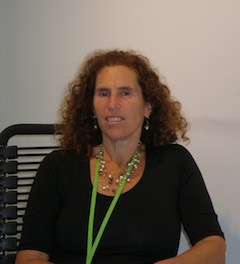
Mira Sucharov is an associate professor of political science at Carleton University. She is a columnist for Canadian Jewish News and contributes to Haaretz and the Jewish Daily Forward, among other publications. This article was originally published in the CJN.

Posted on August 26, 2016August 25, 2016Author Mira SucharovCategories Op-EdTags Australia, Canada, First Nations, reconciliation
From Mideast to the South

From Mideast to the South

Pericles is one of the best Bard on the Beach productions this season. (photo by David Blue)

If the thought of being transported to the mystique and exotic locales of the ancient Middle East appeals to you, then you must see Pericles, which is currently playing on the Howard Family Stage at Bard on the Beach, alternating with Othello.

Director Lois Anderson takes this rarely produced play – only once before in Bard on the Beach’s 27-year history has it been performed, and scholars believe Shakespeare only wrote the second half of it – and creatively turns it into something magical, with puppets, terra cotta figurines, white-faced ghostly creatures and billowy sheets that morph from crashing waves to animals.

As you enter the tent, your breath is taken away by Jewish community member Amir Ofek’s captivating set design: soft desert hues, Corinthian columns, red and gold brocade-tasseled tapestries, woven baskets and blown glass. John Webber’s warm lighting pervades the room. The mood is reinforced by Malcolm Dow’s exquisite sound design; a melodic fusion of traditional Middle Eastern fare. Before it even begins, the play is a visual and aural treat.

Pericles is the tale of the nautical odyssey of a wandering prince, the eponymous hero Pericles of Tyre (Kamyar Pazandeh), as told through flashbacks by narrator and healer Cerimon (David Warburton) in the temple of the goddess Diana to a young woman he has saved from a brothel. As he tells her, it all began with a trip to Antioch 15 years earlier, when our hero hoped to marry the princess of that city but had to flee for his life when he learned the secret of her incestuous relationship with her father.

Pericles’ escape takes him to many ports, culminating with a shipwreck at Pentapolis. There, he wins the hand of the princess Thaisa (Sereana Malani) in a jousting competition and sets sail with his new wife, now pregnant, to reclaim his throne in Tyre. Daughter Marina (Luisa Jojic) is born on the ship and Thaisa dies in childbirth. Pericles throws his wife’s body into the sea and heads to the nearest port, Tharsus, where he leaves Marina in the care of his longtime friend, Governor Cleon (Luc Roderique), and his wife, Dionyza (Jeff Gladstone in an interesting gender-role reversal).

Fast-forward 14 years. Marina has grown into a beautiful young woman. Dionyza, jealous for her own daughter’s betrothal chances, arranges for a servant, Leonine (Kayvon Kelly), to murder Marina. However, pirates kidnap Marina before the dastardly deed can be done. She is sold to a brothel, but keeps her virtue with eloquent talk, and captures the heart of Governor Lysimachus (also played by Kelly).

In the meantime, Pericles returns to Tharsus to reunite with his daughter but is told that she is dead. I stop here so as not to spoil a very surreal ending – you will have to see it to believe it.

All of the cast, many of whom play multiple roles, are outstanding but special mention must be made of Pazandeh, who runs the gamut of emotions from victorious suitor to grieving husband and father; Jojic, who gives the right touch of innocence to Marina; Warburton, with his wizardly tricks; Gladstone as a very creepy Dionyza; and Kayla Deorksen as Bawd, the flamboyant brothel owner.

Costumer Carmen Alatorre’s costumes are spot on with flowing robes of bright, textured fabrics: earth tones to represent the land and shades of blue, the sea; the main characters are contrasted by off-white ghostly spectres.

Pericles was one of Shakespeare’s most popular plays in its time and Anderson’s rendering makes it easy to understand why. The intimate setting of the Howard Family Stage is perfect for this showcase of hope, perseverance, redemption and ultimate reconciliation. I took my 11-year-old niece to opening night and she loved it. Of the four Bard productions, this one topped the list for me and it is highly recommended.

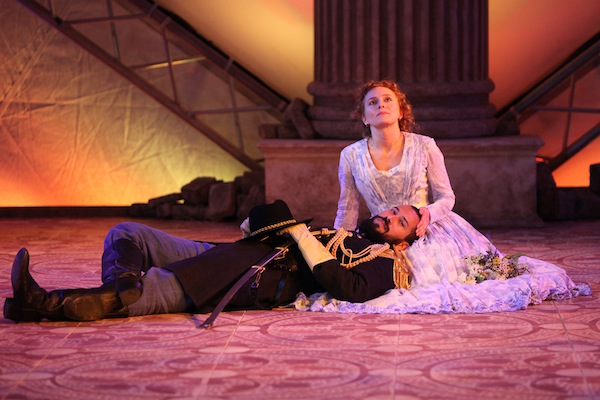
photo in Jewish Independent - Luc Roderique and Kayla Deorksen in Othello
Luc Roderique and Kayla Deorksen in Othello. (photo by David Blue)

Playing in repertory with Pericles on the Howard Family Stage, and featuring most of the same actors, is Othello, set in 1864 Charleston during the American Civil War.

What does it take to drive an intelligent, successful, respected man into a jealous husband capable of a murderous rage? A manipulative villain named Iago – and Othello really is the story of this vile person, who brings tragedy to all unfortunate enough to cross his path.

Directed by Bob Frazer – who played Iago in Bard’s last mounting of this work – this psychosexual drama gives a new perspective to the racism inherent in the testosterone-infused military world in which black Othello (Roderique) lives.

The story revolves around Othello’s rise to power in the union army and Iago’s (Kelly) planned revenge as he is passed over by General Othello for a senior position that is given to Cassio (Gladstone). To get even, Iago plants the seeds of doubt in Othello’s mind as to the fidelity of his new wife, Desdemona (a mixed racial union), accusing her of an intimate tryst with Cassio.

Slowly, Othello is convinced – a handkerchief allegedly found in his good lady’s room the final proof – that Desdemona has been untrue and, in a moment of murderous passion, strangles her in her canopied bed. Emilia (Jojic), Iago’s wife but also Desdemona’s maid and confidante, walks into this deathly scene, tells Othello the truth of the handkerchief and outs her husband for his role in the tragedy. Othello is overcome with grief and remorse and takes his own life.

Iago is a sadistic sociopath who manipulates those around him with his ersatz sycophantic charm. Kelly is sublime in this role – you love to hate him. Tall and slender, Roderique portrays a sympathetic Othello with a quiet sense of dignity and authority that disintegrates as we watch his metamorphosis into uncontrollable and lethal rage. Deorksen is a sweet-tempered but strong-willed Desdemona. Jojic gives a heart-breaking performance as a passionate and loyal servant torn between her duty to her husband and that to her employer. Lesser roles are ably played by Malani (Bianca), Andrew Cownden (Roderigo), Ian Butcher (Gratiano) and Shaker Paleja (Montano).

Costumer Marla Gottler provides crisp navy uniforms for the Union soldiers and gorgeous Scarlett O’Hara-type frocks for the ladies. Music is pure southern comfort with banjos strumming “Dixie.” Unfortunately, the set design is a problem. The same Ofek-designed Pericles set is used, and that Middle Eastern look with its columns and arches seems out of place in a moonlight and magnolias milieu. However, the minimalist use of props – a couple of boxes here, a table there – allows the audience to focus on the powerful words that make Othello one of Shakespeare’s most eloquent works.

This production is good, but it would have been so much better had it made more use of its Civil War setting, other than just to give a perfunctory nod to the fashion and music of the time.

Othello runs to Sept. 20 and Pericles to Sept. 21. For tickets and more information on these shows – and Romeo and Juliet and The Merry Wives of Windsor – visit bardonthebeach.org.

Tova Kornfeld is a Vancouver freelance writer and lawyer.

Format ImagePosted on August 26, 2016August 25, 2016Author Tova KornfeldCategories Performing ArtsTags Amir Ofek, Bard on the Beach, Civil War, Othello, Pericles, Shakespeare

Upgrades at L’Chaim

L’Chaim Adult Day Centre has completed upgrades to its outdoor seating area. Additions include a custom-built overhead awning and new patio furniture. The purchase of this equipment was made possible by a federal grant from Western Economic Diversification Canada’s Canada 150 Community Infrastructure Program, and a generous donation made in 2014 to L’Chaim in memory Dr. Betty Horodesky.

The infrastructure program was established as part of Canada 150 Celebrates, the federal government’s celebration of the 150th anniversary of Confederation.

“Investing in facilities that support a healthy and thriving community embodies the spirit of our Canada 150 celebrations and honors our diverse and inclusive nation,” said the Hon. Navdeep Bains, minister of innovation, science and economic development and minister responsible for Western Economic Diversification Canada. “By providing funding that enhances access to the outdoor space at L’Chaim Adult Day Centre, our government is helping seniors stay connected and active in their community.”

L’Chaim was established in 1985 and provides social, therapeutic and recreational services to the elderly in a safe, supportive environment. L’Chaim strives to improve the quality of life of its participants by providing a caring and stimulating group experience for those who might otherwise be socially isolated, while also providing support and respite for care-giving families and friends.

The new awning will provide shelter from the elements, allowing L’Chaim participants (and others) to enjoy the fresh air no matter the weather. The seating upgrades will ensure that participants are able to spend more time outdoors. Outdoor activities may now include arts and crafts, Friday Shabbat services, trivia, meals, and more. Recent research has indicated that the majority of adults spend 90% of their time indoors, and this percentage is expected to be even higher for people 65 and over, many of whom are living with mobility limitations. However, spending time outdoors is essential to maintaining good mental and physical health, and to ensuring a high quality of life.

Posted on August 26, 2016August 25, 2016Author L’Chaim Adult Day CentreCategories LocalTags JCC, renovations, seniors

Benefit of weekly fast

Recent studies are again pointing to the potential of weekly intermittent fasting, where one greatly reduces or eliminates calories on a set number of weekdays, to fight disease and prolong life. Jewish tradition has long advocated weekly intermittent fasting, though the practice has become rare today. Maybe it’s time to bring it back.

“Periodic fasting shows the most promise in getting rid of bad cells and making good ones for regeneration and can be applied to all kinds of diseases,” Valter Longo, director of the Longevity Institute at University of Southern California, told the Washington Post.

Variations of periodic fasting have become popular, such as the 5:2 diet, which advocates five days of normal eating and two days of restricting calories by 75%. Studies suggest that such fasting may be beneficial for treating autoimmune diseases, asthma, rheumatoid arthritis, metabolic syndrome, and even cancer.

The 5:2 diet is associated with Mark Mosley, a BBC journalist who popularized it in the United Kingdom. In the United States, a more restrictive version of the diet, known as the “every other day diet,” which advocates restricting normal calorie intake by 75% every other day, has been studied and championed by Dr. Krista Varady at the University of Illinois at Chicago. Though she cautions that the 5:2 diet will only work if one does not binge on the other five days, an effect she says is avoided more easily on the “every other day” fast for reasons still being studied.

All of this reminds me of the ancient Jewish practice known as the Behab fast. Behab is formed of the Hebrew letters bet-hey-bet, numerically two-five-two, which refers to the second day of the week (Monday), the fifth (Thursday) and again the second (Monday). Without the repetition of the Mondays, the name of the diet is basically the 2:5 diet (5:2 read from left to right, ahem), though there is no known connection between Moses and Mosley.

Despite there being other fast days during the Jewish year, growing up, I had never heard of any fasts outside of the dreaded Yom Kippur deprivation, and my family’s idea of intermittent fasting was restricting oneself to little noshes between fresses. On family vacations, the favorite topic around the restaurant table was where we were going to go for the next meal. If the Behab is correctly thought of as an Ashkenazi custom, my family had long forgotten it.

For centuries, the Behab fast was used in the Ashkenazi world for repenting for inadvertent sins throughout the week – “advertent” sins would get their own specific fasts. The choice of days corresponds to the days the Torah is read, not counting Shabbat, of course, when fasting is not done. The custom of reading Torah Monday and Thursday refers to the belief that those are the days of the week Moses ascended Mount Sinai and descended again, respectively.

Despite the association with Ashkenazi custom, the Behab fast goes back earlier than Jewish settlement in Europe and is probably the fasting mentioned in the New Testament, which Jesus criticized as an attention grab. The early Christian Didache, a manual of discipline that almost made it into the Christian Bible, admonishes its readers not to do as the hypocrites (read “Pharisees”) do and fast Monday and Thursday, but rather to fast Wednesday and Friday! Among Jews, the fast was eventually restricted to periods following Pesach and Sukkot and, in recent centuries, has become obscure.

The original purpose of the Behab fast was not weight loss, of course, but repentance and spiritual purification. Regardless of where one falls on the spectrum of Jewish belief, it’s easy to envision fasting a couple of days a week as an act of repentance in our (culinary) consumer culture, and one of walking more lightly on the burdened earth – and it just might add a few years to our lives.

Matthew Gindin is a Vancouver freelance writer and journalist. He blogs on spirituality and social justice at seeking her voice (hashkata.com) and has been published in the Forward, Tikkun, Elephant Journal and elsewhere.

Posted on August 26, 2016August 25, 2016Author Matthew GindinCategories LifeTags Behab, diet, fasting, health, Judaism, Mosley
Mystery photo … Aug. 26/16

Mystery photo … Aug. 26/16

Hillel House, University of British Columbia, circa 1990. (photo from JWB fonds, JMABC L.11126)

photo in Jewish Independent - These photos were taken at Hillel House, University of British Columbia, circa 1990
These photos were taken at Hillel House, University of British Columbia, circa 1990. (photo from JWB fonds, JMABC L.11122)

If you know someone in these photos, please help the JI fill the gaps of its predecessor’s (the Jewish Western Bulletin’s) collection at the Jewish Museum and Archives of B.C. by contacting [email protected] or 604-257-5199. To find out who has been identified in the photos, visit jewishmuseum.ca/blog.

Format ImagePosted on August 26, 2016August 25, 2016Author JI and JMABCCategories Mystery PhotoTags Hillel, JMABC
גלית ברעם נכנסה לתפקידה

גלית ברעם נכנסה לתפקידה

גלית ברעם אמדור נכנסה בראשית החודש לתפקידה החדש כקונסול הכללי של ישראל בטורונטו ומערב קנדה. (צילום: twitter.com/galibaram)

גלית ברעם אמדור נכנסה לתפקידה כקונסול הכללי של ישראל בטורונטו ומערב קנדה

גלית ברעם אמדור נכנסה בראשית החודש לתפקידה החדש כקונסול הכללי של ישראל בטורונטו ומערב קנדה. ממשלת ישראל אישרה בחודש ינואר השנה את מינויה של ברעם אמדור לתפקיד, עם שורה של מינויים בכירים נוספים בשירות החוץ. ברעם אמדור החליפה את די. ג’יי שניוויס, ששימש בתפקיד הקונסול של טורונטו ומערב קנדה מאז 2012.

ברעם אמדור תדבר על האירועים האחרונים בישראל והתוכניות שלה לגבי טורונטו ומערב קנדה, בשיחת ועידה טלפונית לחברי הקהילה היהודית ובעיקר לישראלים, ביום שישי הקרוב (26 בחודש), בשעה 9 בבוקר לפי שעון מחוז בריטיש קולומביה.

לברעם אמדור (שדוברת גם אנגלית ורוסית) ניסיון רב ועשיר במשרד החוץ והיא החזיקה בשורה של תפקידים בכירים בישראל ומחוצה לה. בין היתר: שימשה כמנהלת המחלקה של התחום הפלסטיני ושיתוף הפעולה האזורי במשרד החוץ (במשך כשנתיים וחצי). לפני כן שימשה בתפקיד הקונסול של ישראל ברוסיה, אוקראינה ובלארוס (משך כשנה וחצי), הקונסול של ישראל בשגרירות ישראל בוושינגטון (במשך כשלוש שנים), הקונסול של ישראל בשגרירות ישראל בקהיר (במשך כשלוש שנים), סגן מנהל תחום מרכז אסיה במשרד החוץ (במשך כשלוש שנים), ומזכיר ראשון בשגרירות ישראל במוסקבה (במשך כחמש שנים).

חתונה הפכה לסיוט: צעירה שנערכה להתחתן עם אהובה גילתה שהוא נשוי ויש לו שני ילדים

זוג צעיר בגילאי השלושים מאזור ונקובר נערך למסד את מערכת היחסים ביניהם, ולהתחתן החודש בריצ’מונד. הצעירה הוציאה למעלה מעשרים אלף דולר על מתנות, תכשיטים וכל מה שצריך לחתונה, והזמנות לאירוע נשלחו לאורחים. אך 11 יום לפני החתונה הכלה המיועדת גילתה שבעלה לעתיד הוא בעצם גבר נשוי ויש לו אף שני ילדים.

הזוג הכיר לפני שנתיים באמצעות אתר אינטרנט להכרויות. הם בילו הרבה ביחד ובספטמבר לפני שנה בעת טיול ליפאן, הצעיר הפתיע את אהובתו והציע לה להתחתן והעניק לה טבעת. מאותו רגע החלו השניים לתכנן החתונה במרץ. לאט לאט החלו לצוץ בעיות שונות מצדו של הגבר, אך אשתו לעתיד לא חשבה שיש לכך משמעות. פעם אחת הוא סיפר לה שהוריו שגרים בהודו לא מאושרים כל כך מהחתונה, כיוון שמשפחתה לא מספיק עשירה. לאחר מכן הוא סיפר כי אמו חלתה במחלה חשוכה והמשפחה במצב נפשי קשה. למרות כל הבעל לעתיד ביקש מאשתו לעתיד שלא להפסיק בהכנות לחתונה אלה להמשיכן כמתוכנן.

האמת על מצבו התגלתה לאחר שפגישה מתוכננת בין משפחות שני הצדדים שבועות ספורים לפני החתונה לא יצאה אל הפועל. משפחת הכלה הבינה שמשהו מוזר קורה והחליטה לנקוט מעשה. הוריה, אחיה והיא עצמה נסעו לאבוטספורד לראות את קרוביו של חתנה. את דלת בית המשפחה פתחה אישה שהציגה עצמה כשאשתו של החתן, מזה 13 שנה. הכלה המיועדת שהייתה בשוק ביקשה מאשתו להציג לה תמונות מהחתונה שלהם. פתאם הופיעו בסלון שני ילדיו הקטנים של הבעל (בגילאי 4 ו-10) שכל כך דומים לו, כך שלא היה צריך בהוכחות נוספות להוכחת המירמה. לאחר מספר דקות הגיע הגבר הנשוי שהוא גם החתן המיועד ונאלץ להתמודד עם התקפות הזעם מצד שתי הנשים בחייו. הוא לא הפסיק להתנצל וכמעט כרע על ברכיו, וטען להגנתו שהמניע להתנהגותו נובע מהעובדה שהוא לקה במחלת נפש.

הכלה נערכת בימים אלה להגשת תביעה כספית נגד אהובה הרמאי, בהיקף כ-53 אלף דולר, לכסות את כל ההוצאות הגבוהות שנגרמו לה עקב החתונה שלא יצאה אל הפועל.

Format ImagePosted on August 24, 2016August 24, 2016Author Roni RachmaniCategories עניין בחדשותTags Baram, consul general, Israel, marriage, Vancouver, wedding, ברעם, החתונה, ונקובר, חתונה, ישראל, כקונסול הכללי
Community art for the Zack

Community art for the Zack

(photo from jccgv.com)

The upcoming show at the Sidney and Gertrude Zack Gallery, which features 45 community artists who have donated their work, is a fundraiser for the gallery.

“The idea for the show belongs to Shirley Barnett,” said gallery director Linda Lando in an interview with the Independent. “We wanted to showcase the works of the people who do art for the joy of it, not professional artists. Shirley also made a donation towards the show.”

Lando explained the process leading to the exhibit, which opens Aug. 31.

“I purchased 45 11-by-14-inch wood panels and sent a group email to the gallery email list. The artists got the panels for free and, if their art sells, they will get a tax receipt. The price for every piece is the same, $125, and the proceeds of all sales will go to the gallery. The theme of this art show is ‘Renewal.’ It’s a very broad theme that allows for many interpretations.”

Jewish Independent photo - Linda Lando, director of the Sidney and Gertrude Zack Gallery
Linda Lando, director of the Sidney and Gertrude Zack Gallery. (photo by Olga Livshin)

Lando doesn’t think that the universal size and shape of the panels limits artists’ creativity. “Just the opposite: it’s a challenge.”

The response to the email was overwhelming. Lando had to turn away people who wanted to participate. The demographics of the show’s contributors are broad.

“A lot of word of mouth helped spread the news about the show,” she said. “Among our participants are people who are involved with the gallery, some who exhibited with us before, while others haven’t. There are several poets from the Pandora Collective, members and non-members of the JCC and some mother-daughter duos. Most of them are not professional artists, but the works that have already started to arrive are amazing and very diverse. I hope we sell most of them.”

The Independent spoke with a few of the exhibit’s artists.

“I have always been interested in arts: painting, poetry, etc.,” said Carl Rothschild, a child psychiatrist with more than 40 years of experience, who is about to retire. “I published two books of my poetry and visual arts.”

Rothschild considers himself an amateur artist but he has already participated in several shows at the Jewish Community Centre of Greater Vancouver and sold a few paintings. When Lando asked him to participate in the fundraiser, he was thrilled. His piece is already at the gallery.

“I decided to participate in this show because I am always painting and because Linda asked me,” he said. “My small piece is called ‘The Backyard Garden in a Box.’ I am endlessly fascinated by the little landscapes around me. My small garden, with crocosmia flowers, attracts a hummingbird each summer. Sometimes, the bird comes with his mate and, on this occasion, as I stood motionless and watched, he came over and hovered for a few seconds about a foot from my head before passing me as safe.”

Another participant, Liz Koerner, retired a few years ago from working in a law office. “I am a professional artist in the sense that I get paid for some of my work, but I started down this path as a hobby,” she said. “Over the past 15 years, I have done dozens of commissions.”

Like the other contributors, Koerner learned about the show from Lando’s email. “I met Linda years ago, when I would take my mother into her gallery, and they always had lively discussions about the paintings and the artists. My mother has since passed on and, at her request, we gave Linda a number of art books from her collection.”

When Koerner decided to participate in Renewal, she chose the theme of spring. “Spring is a wonderful time of renewal and rebirth in nature,” she explained. “My painting is almost done. I needed to leave it while I complete a rush commission, then I will get back to it and finish it soon.”

Sandi Bojm’s piece is also a work in progress. She works part-time as a speech language pathologist and as a therapist, which allows her the time to explore her other interests, including art and writing. “I don’t consider myself an amateur artist; nor am I a professional,” she said. “Perhaps chronically ‘emerging.’”

Over the years, Bojm has taken art classes at Langara College and with private mentors. She met Lando through the Zack Gallery.

“I support the gallery and participated in last year’s community show/fundraiser,” she said. “Linda and I have shared ideas this past year for the next upcoming show, regarding community engagement and participation, and, at the same time, offering a fundraising opportunity for the gallery. It is exciting that it is now coming to fruition.”

Her own piece will be an amalgam of abstract and landscape. “I have just completed an intensive painting workshop on abstraction of the landscape and decided to expand on that,” said Bojm. “I have been intrigued in the past, in my walks through the woods, with the presence of logs and stumps that have nurtured new growth; nursing logs, I believe they are called. This is the image I am exploring in its relationship to renewal.”

A show as a gallery fundraiser is not a new concept. The Federation of Canadian Artists, for example, holds their fundraiser, Paintings by Numbers, annually, but their event is much more expensive for art lovers, and they feature well-known and established artists in their galas.

“Giving the local community artists the opportunity to shine, and making all the paintings affordable to everyone might be unique in Canada,” said Lando. “The idea was not only to engage the community artists but to bring in their families and friends to the gallery, to show them that it is their gallery, too.”

Renewal will run to Sept. 11. There is a free reception at the Zack, with the artists in attendance, on Sept. 8, starting at 7 p.m.

Olga Livshin is a Vancouver freelance writer. She can be reached at [email protected].

Format ImagePosted on August 19, 2016August 18, 2016Author Olga LivshinCategories Visual ArtsTags fundraising, Lando, Zack Gallery
Hebrew school in Okanagan

Hebrew school in Okanagan

Left to right, reciting the Four Questions at the Okanagan Jewish community’s Passover celebration: Adarah Challmie, Ben Levitan, Jordan Spevakow, David Spevakow, Samara Levitan, and Kate Spevakow. (photo by Misty Smith)

Kelowna’s Jewish community may be small, but it’s poised for growth. The latest development: an expansion of its Hebrew school’s curriculum.

Led by the family of David and Natalie Spevakow, who moved to Kelowna from Calgary some 13 years ago, Hebrew classes were first provided last year. Now, more Jewish content will be added to the lessons, as well.

At the moment, the Spevakows are spearheading this task. Parents lead classes every Monday after school, with kindergarten to Grade 3 first, followed by grades 4-to-7. The parents rotate each week, teaching the kids about Jewish traditions and the Hebrew language, prayers and blessings. Currently, there are 14 students in total (two of whom are Spevakows).

“Trying to have a Jewish life in a small community can be a challenge,” said Natalie Spevakow. “I would say our congregation at the Okanagan Jewish Community Centre is about 100 members, but only 25 to 30 are active members.

“We have a visiting rabbi who comes once a month, Rabbi [Shaul] Osadchey from Beth Tzedec congregation in Calgary. We set this up to bridge the gap with our communities, and that’s been wonderful. With us having young families, we’ve all decided that it’s important that we get together, and we wanted to build a Jewish community for ourselves and our kids.”

The Spevakows are looking to hire a part-time teacher to start in September and work through June. They are searching for a creative, energetic person knowledgeable in Hebrew and the Jewish traditions to teach children ages 4 to 14. The position involves two hours of teaching a week, plus preparation time, and the teaching material is provided. In addition to an hourly wage, the teacher would receive a free annual family membership to the Okanagan JCC. (Interested readers should call Anne at the OJCC, 250-862-2305.)

“All of our parents just want our kids to be with other Jewish children and get a sense of what it is to be Jewish,” said Spevakow.

“We also try to get together with our Hebrew school every few months for a potluck,” she added. “When we have the visiting rabbi come, we do a potluck with the rabbi and do services with our children and our families as well. We make that a time to get together and bring the community together.”

photo in Jewish Independent - Dressed for Purim, left to right: in the front row, Bria Tizel, Anderson Parnes, Kate Spevakow, Ryder Golbey, Skyla Golbey and Chase Golbey; in the back, Jordan Spevakow, Abbey Parnes and a friend, and Adarah Challmie
Dressed for Purim, left to right: in the front row, Bria Tizel, Anderson Parnes, Kate Spevakow, Ryder Golbey, Skyla Golbey and Chase Golbey; in the back, Jordan Spevakow, Abbey Parnes and a friend, and Adarah Challmie. (photo by Natalie Spevakow)

As of now, all the children involved in the school are Canadian-born, but there are Israeli-born children who will be joining classes when they come of age. The class curriculum is a combination of programs that the Spevakows sourced online with guidance from Osadchey. Parents are encouraged to take material home to practise during the week.

“The learning works better if they do take stuff home,” said Natalie Spevakow. “I know, for the little guys, they’re just learning the Hebrew letters and can repeat the words they learned…. We try to make it hands-on and more fun for them.”

Looking ahead, Spevakow feels that the Jewish community is growing, anticipating that one day it will be big enough to warrant more frequent visits from Osadchey.

“But, right now, with our smaller numbers, it’s very difficult for us to finance having a rabbi here all the time,” she said. “As is, we’re making it work, getting our kids educated and getting the resources we can.”

The older students are learning to lead Friday night services, with the goal of having them lead a service by May 2017, and then again, have them lead a service with Osadchey.

“We’re not on our own, trying to make things up on our own,” she said. “It’s just a matter of people making time for their kids, so the program works. I think all the parents recognize they want this for our kids and are willing to put in their time.

“We used to do it on weekends, but, with so many of us really big into skiing, it wasn’t working out. So, weekdays are definitely working better for us.”

They also recognize there may be some older members of the community who may be interested in helping with classes, so they hope to bridge the gap and find ways to bring them in, too.

“There’s something to be said about a small community, in that you really get to know all your members,” said Spevakow. “They truly do become an extension of your family. You realize that anything you’d like to see happen, things that, in a larger community you might have taken for granted because it’s available, in a small community may not exist yet…. Connecting on a deeper level with the people in our community, figuring out the assets that each can bring to the table, has really benefited our community. Knowing everyone’s faces really helps.”

Rebeca Kuropatwa is a Winnipeg freelance writer.

Format ImagePosted on August 19, 2016August 18, 2016Author Rebeca KuropatwaCategories LocalTags continuity, education, Hebrew, Judaism, OJC, Okanagan
Summit’s sage advice

Summit’s sage advice

Gwyneth Paltrow, left, and Zooey Deschanel at the Sage Summit in July. (photo by Dave Gordon)

Some 15,000 entrepreneurs gathered in Chicago July 26-29 for the Sage Summit, to hear keynote speakers, network and browse the exhibitors’ stations, which spanned the length of 10 football fields, according to Sage chief executive officer Stephen Kelly, who oversees the accounting software giant.

Celebrity speakers included entrepreneurs and actors Gwyneth Paltrow, Zooey Deschanel and Ashton Kutcher, all of whom have Jewish connections.

Paltrow, most known lately for her role as Pepper Potts in the Iron Man film series, was also the head of Goop, which touts itself as a “weekly lifestyle publication.” (She left the publication days after the Summit.)

photo - Some 15,000 entrepreneurs gathered in Chicago July 26-29 for the Sage Summit
Some 15,000 entrepreneurs gathered in Chicago July 26-29 for the Sage Summit. (photo by Dave Gordon)

“The more you create a vision of where you’re going, the more you can create a vertical. Where do you want it to be, where do you imagine it to be, and ask people ‘where do you want it to go?’ – that’s how you form an execution strategy,” she advised entrepreneurs at the Chicago gathering.

She also offered a morale boost for budding entrepreneurs.

“Unwavering self-belief is everything. Everyone’s going to tell you why you can’t do it, and you have to know in your bones that you can do it … and take disappointments with as much grace as you can,” said the actress, whose late father, film director Bruce Paltrow, was Jewish.

Paltrow’s co-panelist, Deschanel of television’s New Girl, is founder of the website Hello Giggles, an online magazine for young women launched five years ago and acquired by Time Inc. in 2015. She has also invested in a hydroponics company that grows sustainable and eco-friendly organic food.

“Trust your gut and be yourself – and watch your bottom line. Customers will thank you for that,” said Deschanel, who converted to Judaism last November.

Chiming in about knowing one’s limits – and about social media engagement – was Kutcher, who has invested in high-tech ventures including Skype, FourSquare and Airbnb.

“I learned by sitting in the rooms being the dumbest person in there and asking a lot of questions,” he said.

Kutcher last year married Jewish actress Mila Kunis. He has been a student of kabbalah and has visited Israel several times.

“I was aggressively into social media early on,” he said at the summit. “From a business perspective, I think it’s valuable from a customer service, customer relations perspective. Building a social media environment for their feedback in a dramatic and visible way creates transparency and delivers a high-quality product and service. From a marketing perspective, if used right, it can be beneficial.”

But, he noted, there’s a critical caveat regarding marketers.

photo - Aston Kutcher with Yancey Strickler of Kickstarter
Aston Kutcher with Yancey Strickler of Kickstarter (photo by Dave Gordon)

“They come up with these elaborate social media marketing plans, which inevitably fail along the way,” he said, “because marketers tend to forget it’s a conversation, and they don’t account for feedback.”

Kutcher cautioned against having fingers in several social media platforms, noting it’s more about quality than quantity.

“I feel a lot of people aggressively chase the latest in social media marketing and waste a lot of time in it. It’s this sort of race to be on the cutting edge, but, in another sense, it’s time on inefficient platforms. It’s like in acting – the fans don’t go to the actor, the actor should go to where the fans are.”

Twitter, Instagram and Facebook already have “huge swaths of people and have really great tools for targeting,” he added.

Co-panelist Yancey Strickler, one of the three founders of Kickstarter, which he described as “the world’s largest funding platform for creative projects,” has also been the crowdfunding site’s CEO for the past three years.

Despite Kickstarter’s online base, Strickler had his own warning about social media.

“I think social media is bad for our brains, and it’s hard to have introspection on these platforms.… I wouldn’t doubt, in 20 years, if they found what social media does to our brains is what smoking does to our lungs.”

“I’m worried about my brain now,” Kutcher retorted.

Dave Gordon is a Toronto-based freelance writer whose work has appeared in more than a hundred publications around the world. He is the managing editor of landmarkreport.com.

Format ImagePosted on August 19, 2016August 18, 2016Author Dave GordonCategories WorldTags Ashton Kutcher, entrepreneurship, Gwyneth Paltrow, investing, Sage Summit, Zooey Deschanel
Goodnight boredom

Goodnight boredom

Left to right: Kazz Leskard (Iago), Claire Rice (Desdemona) and Courtney Shields (Constance) in Awkward Productions’ Goodnight Desdemona, Good Morning Juliet. (photo by Derek Fu)

Have you ever wished you could change the course of a play, making the plot … well … just a little bit different?

What would have happened if someone had told Othello that Iago was tricking him? What if Romeo and Juliet hadn’t died? Would the plays have been successful as comedies and not tragedies?

These are the questions taken on in Awkward Productions’ Goodnight Desdemona, Good Morning Juliet, part of the first annual Fakespeare Festival.

Written by the award-winning Ann-Marie MacDonald, Goodnight Desdemona is an outlandish and hilarious romp that follows associate professor Constance Ledbelly (Courtney Shields), who is trying to prove a peculiar notion.

Doing her PhD in Shakespearean literature, her thesis revolves around a made-up tome written in code, called the Gustav Manuscript. She believes the work proves that Othello and Romeo and Juliet were originally written by an author who had included a wise fool and that the plays were supposed to be comedies. Shakespeare, she posits, got rid of the fool, turning them into tragedies. If she can only decipher the code, she can find out the identity of the fool and that will lead her to the original playwright.

The theory is laughed at by her colleagues, including a professor for whom she works (and with whom she is in love), who takes advantage of her desire to please him by having her write all his papers. Her work garners him a post at Oxford, which she believes she deserved, and, to top it off, he is running off with another woman, leaving her alone and out of a job.

Disgusted with herself, feeling hurt and betrayed, she begins to trash her office and finds herself transported into the world of Shakespeare, first landing in Othello, when Iago is about to trick Othello into thinking Desdemona has been unfaithful, and next in Romeo and Juliet, as Tybalt is about to kill Mercutio.

Like Alice in Wonderland, Constance is at first bewildered by her surroundings, but, as she is an expert in Shakespeare, she easily comes up with a backstory and picks up the language of the time. She impresses everyone with her knowledge and is accepted as a contemporary, allowing her to proceed on her quest to find the fool that Shakespeare had eliminated and, from there, find the real author.

But, her presence changes the course of events, and the two tragedies become comedies. This is where the play really takes off.

While in Venice, she reveals Iago’s trickery and befriends Desdemona, who, in turn, helps Constance find her own confidence, but also encourages her to revel in killing, which turns Constance’s stomach (being a vegetarian) and causes her to question her usefulness.

“Next to Desdemona, I’m roadkill,” a dejected Constance laments.

In Verona, the turn of events leads to a squabbling marriage between Romeo and Juliet, both of whom fall in love with Constance, leading Romeo to dress in drag, thinking Constance is a lesbian. The thought excites Juliet, who revels in the idea of a girl-on-girl tryst.

The hilarity of these ludicrous set-ups is enhanced by the dazzling wordplay that infuses MacDonald’s script. A “creep” becomes a “base annoysome knave,” for example. Calling herself an academic from Queens, Desdemona believes that Constance is referring to the queen of the Amazons and treats her as one. When Constance appears in Verona, she’s wearing pants and is mistaken for a boy, with uproarious results.

In the end, Constance finds her fool in an unexpected place (alas), and returns home with the confidence to finish her paper, academic derision be damned.

Though the dialogue is lightning-fast and the one-liners are nonstop, Shields carries the weight of the wordy script brilliantly. Jewish community member Zach Wolfman as Mercutio (as well as numerous other characters) calls upon his Shakespeare training to add his own comedic nuance to the production.

It’s not surprising that MacDonald has won several awards for this literary tour de force, including a Governor General’s Award and Canadian Authors Association Award. It is definitely one not to miss.

The Fakespeare Festival features Goodnight Desdemona, as well as Titus Andronicus: The Light and Delightful Musical Comedy of Titus Andronicus. Both plays run at York Theatre, 639 Commercial Dr., until Aug. 28. Tickets are available from tickets.thecultch.com or 604-251-1363.


Baila Lazarus is a freelance writer and media trainer in Vancouver. Her consulting work can be seen at phase2coaching.com.

Format ImagePosted on August 19, 2016August 18, 2016Author Baila LazarusCategories Performing ArtsTags Awkward Stage, Desdemona, Fakespeare, Othello, Romeo & Juliet, Shakespeare

Posts pagination

Previous page Page 1 … Page 493 Page 494 Page 495 … Page 661 Next page
Proudly powered by WordPress