Skip to content
  • Home
  • Subscribe / donate
  • Events calendar
  • News
    • Local
    • National
    • Israel
    • World
    • עניין בחדשות
      A roundup of news in Canada and further afield, in Hebrew.
  • Opinion
    • From the JI
    • Op-Ed
  • Arts & Culture
    • Performing Arts
    • Music
    • Books
    • Visual Arts
    • TV & Film
  • Life
    • Celebrating the Holidays
    • Travel
    • The Daily Snooze
      Cartoons by Jacob Samuel
    • Mystery Photo
      Help the JI and JMABC fill in the gaps in our archives.
  • Community Links
    • Organizations, Etc.
    • Other News Sources & Blogs
    • Business Directory
  • FAQ
  • JI Chai Celebration
  • JI@88! video

Recent Posts

  • Story of Israel’s north
  • Sheltering in train stations
  • Teach critical thinking
  • Learning to bridge divides
  • Supporting Iranian community
  • Art dismantles systems
  • Beth Tikvah celebrates 50th
  • What is Jewish music?
  • Celebrate joy of music
  • Women share experiences 
  • Raising funds for Survivors
  • Call for digital literacy
  • The hidden hand of hate
  • Tarot as spiritual ritual
  • Students create fancy meal
  • Encouraging young voices
  • Rose’s Angels delivers
  • Living life to its fullest
  • Drawing on his roots
  • Panama City welcoming
  • Pesach cleaning
  • On the wings of griffon vultures
  • Vast recipe & story collection
  • A word, please …
  • מארק קרני לא ממתין לטראמפ
  • On war and antisemitism
  • Jews shine in Canucks colours
  • Moment of opportunity
  • Shooting response
  • BC budget fails seniors
  • Ritual is what makes life holy
  • Dogs help war veterans live again
  • Remain vital and outspoken
  • An urgent play to see
  • Pop-up exhibit popular
  • An invite to join JWest

Archives

Follow @JewishIndie
image - The CJN - Visit Us Banner - 300x600 - 101625

Author: Alexis Pavlich

Serving Israel with their life

Serving Israel with their life

From left to right: Murray Palay, Canadian Friends of the Hebrew University national chair; Israel Defence Forces Unit 669 reserve combat soldiers Leehou Porat and Gai Ben Dor; Prof. Yaacov Nahmias, director of the Alexander Grass Centre for Bioengineering at Hebrew U; 669 reserve combat soldiers Bar Reuven and Dotan Braun; CFHU Vancouver chapter president Randy Milner; and CFHU national vice-chair Phil Switzer. (photo from CFHU Vancouver)

Dina Wachtel, executive director of Canadian Friends of the Hebrew University’s Western region, describes the recent fundraising event that attracted more than 300 people to Congregation Beth Israel on July 17 as “a wonderful success.”

The sold-out event raised scholarship funds for outstanding student-soldiers. These individuals are pursuing degrees at the Hebrew University of Jerusalem, as well as performing their miluim, or reserve duty, in the Israel Defence Forces’ elite airborne rescue and evacuation unit known as “669.” The Vancouver event drew a diverse and engaged crowd from the community and included academics and members of local search and rescue groups.

Prof. Yaakov Nahmias, director of the Alexander Grass Centre for Bioengineering at the Hebrew University, kicked off the formal part of the evening’s program with an overview of Hebrew U’s history and accomplishments. Founded in 1918 – 30 years before the establishment of the state of Israel – by illustrious historical figures, such as Albert Einstein, Sigmund Freud and Chaim Weizmann, Hebrew U ranks as one of the world’s leading universities and boasts seven Nobel Prize laureates. According to Nahmias, “when Hebrew U calls, you answer!”

The Grass Centre was established in 2010. Nahmias, who was at Harvard University before returning to Israel, has won several academic awards for his work in liver research and he is particularly proud of the centre’s successes in “educat[ing] a new generation of multidisciplinary innovators and entrepreneurs at the cutting edge of biotechnology and medical science.” He noted that the centre’s 44 affiliated faculty members undertake research that winds up in the world’s leading scientific journals; interest-catching pursuits such as building a liver outside of a body, predicting in vitro fertilization pregnancy rates, and determining “idiosyncratic drug toxicity” (hitherto unexpected adverse reactions to drugs).

Nahmias also outlined the “startup” element of the centre’s work – an aspect that appeals to students with academic ambitions, as well as giving them market experience and engendering an entrepreneurial spirit. The Israeli government has invested $20 million US in BioJerusalem, or “Silicon Wadi,” to support technological innovation. The outcome? Israel is a global leader in medical devices and pharmaceuticals, he said, and this attracts intellectually curious science students who are also seeking opportunities in business, medicine and engineering. The biodesign program feeds directly into Israel’s economic success and reputation as a technological powerhouse. Remarkable and revolutionary projects to date, he said, include the creation of a specialized infrared gun to facilitate intravenous insertions; digitally made dentures that are inexpensive and quick to produce; and a new 60-second life-saving procedure that improves stabbing victims’ chances of survival by preventing suffocation caused by collapsed lungs.

Nahmias concluded his presentation by highlighting bioengineering as “one of the most fascinating areas, especially for the future of Jerusalem as a city and Hebrew University as the leading university in Israel.” He announced that plans are underway to build a large, new institute on the Givat Ram campus to house the biodesign program.
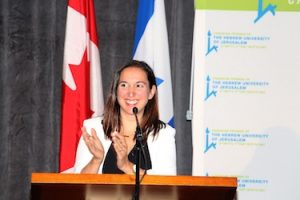
photo in Jewish Independent - Event emcee and Hebrew University alumna Nava Rosenberg
Event emcee and Hebrew University alumna Nava Rosenberg. (photo from CFHU Vancouver)

The evening’s lecture was punctuated with a musical interlude from Vancouver-based Israeli composer and guitarist Itamar Erez. Recipient of the Landau Prize in 2014, as well as the ACUM Prize for special achievement in jazz, Erez’s musical talents blend jazz, flamenco and the sounds of the Middle East.

Following Erez’s performance, four extraordinary young Israelis took centre stage. They detailed their personal experiences serving in the IDF’s 669 and how the service has impacted their lives.

The unit, which accepts only 50 recruits each year out of 10,000 applicants, was established in 1974 following the Yom Kippur War. It is referred to as the “guardian angel of the Jewish people” because it rescues soldiers and civilians alike, both within and beyond Israel’s borders. The unit’s motto is, “Thou didst call in trouble and I rescued thee” and, in the last 40 years, the unit has rescued more than 10,000 injured and saved thousands of lives. Rescue operations are generally extremely difficult and dangerous.

Bar Reuven, Leehou Porat, Dotan Braun and Gai Ben Dor impressed upon the crowd the unique and challenging lifestyle of a Unit 669 reservist, who is “on-call 24/7” and serves an average of 30 to 45 days a year “in peacetime.” When summoned, a civilian university student is instantly transformed into an elite reservist on a mission that can be anywhere in the world. All personal commitments are immediately set aside.

According to Reuven, 27, who served as an officer in 669 and founded an alumni association designed to provide much-needed support to discharged soldiers from 669 transitioning to civilian life, you “can go from eating shakshuka [in Tel Aviv] to Gaza in 30 minutes.”

Thirty-year-old Braun, a fifth-year medical student at Hebrew U and a reserve combat soldier and paramedic in 669, recounted walking to class in July 2012, when he received a command to present himself on base within the next 30 minutes. He soon learned that he would be traveling to Burgas, Bulgaria, to treat and evacuate some 42 Israeli tourists who had been targeted in a bus bombing. (Tragically, five Israelis and a Bulgarian bus driver were murdered in that terror attack.)

Serving in the 669 instils Braun with a profound sense of pride in Israel, as “there is no other country that cares about the security of all its citizens and at all times,” he said. He – like others in 669 – is also called upon to come to the aid of non-citizens in life-threatening situations, including rescuing sailors in the Mediterranean or treating casualties of natural disasters in far-flung corners of the world.

Braun emphasized that life for 669 reservists, in particular, “is never routine.” Porat, 28, who is both a reserve combat soldier in Unit 669 and a student at Hebrew U, underscored this fact by recounting – with the aid of select video footage – a harrowing evening of back-to-back rescue missions that included evacuating an Israeli soldier from Gaza who had been gravely wounded in an axe attack; responding to a serious car accident that caused seven fatalities; assisting a pregnant Bedouin woman in the advanced stages of labor and whose house had just been washed away by floods; and rescuing a number of individuals trapped in or on cars swirling in raging floodwaters and high winds.

Despite the challenges of balancing the responsibilities of school, work, family, volunteerism and reserve duty, Reuven, Porat, Braun and Ben Dor were all steadfast in their commitment to their unit, and to serving their country and fellow citizens in times of crisis.

It was evident that these four speakers have indeed internalized the core values of the unit, described by Reuven as assisting those in need, social responsibility, and helping make Israel and her people stronger. He engages these values to guide him in managing his Cat 669 Alumni Association, a group that provides emotional, psychological and financial guidance, career mentoring and other material support to fellow unit members transitioning – sometimes with great difficulty – to civilian life. This group also draws upon its superior skill set to “pay it forward” in local communities by, for example, teaching emergency first aid.

Thirty-two-year-old Ben Dor is an accountant and lawyer at KPMG in Israel. As part of 669, he is another example of the positive contributions that 669 reservists make to Israeli society. An avid long-distance runner in his teens, Ben Dor responded to an online ad seeking “a runner with soul.” Beza, a blind Ethiopian immigrant wanted to take up running, and Ben Dor (and his father, also a runner) coached Beza over the next several years. Beza competed in a number of international marathons, and ultimately qualified to compete at the Beijing Paralympics, representingIsrael. Ben Dor, his father and Beza have since climbed to Everest Base Camp together and Ben Dor has established an Israeli not-for-profit organization called 180 Degrees, which hosts running groups for people with physical or cognitive disabilities.

Listening to these four young Israelis who are serving their country in truly meaningful ways and learning about the cutting-edge research taking place at the Hebrew University, it is not surprising that the evening’s fundraising event – to support the reserve soldiers in Unit 669 studying at Hebrew U by relieving them of financial worries – was a “wonderful success.”
Format ImagePosted on August 19, 2016August 18, 2016Author Alexis PavlichCategories LocalTags CFHU, fundraising, Hebrew University, IDF, Israel Defence Forces, medicine, R&D, soldier-student
VHA pays tribute to Segals

VHA pays tribute to Segals

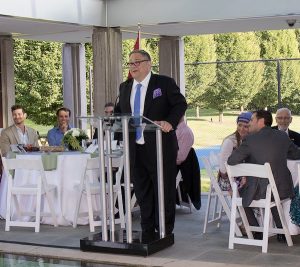
Vancouver Hebrew Academy head of school Rabbi Don Pacht, right, presents Joseph and Rosalie Segal with a Stanley Cup-inspired Kiddush cup. (photo by Jocelyne Hallé)

Vancouver Hebrew Academy has outgrown its current facility and is looking to build a new school. It’s in the early stages of a capital campaign to raise $18 million, of which almost 15% has been pledged to date. Its annual Summer Garden Party added to those funds – and it also celebrated the school’s impact, the broader community, and Joseph and Rosalie Segal for their “lifetime of commitment to our Jewish future.”

The party was held on July 21 at the home of Lorne and Mélita Segal. The other event ambassadors were their siblings: Norman and Sandra Miller, Dr. Mark and Tracey Schonfeld, and Gary and Nanci Segal. The night was emceed by Howard Blank and catered by Chef Menachem.

photo - Emcee Howard Blank in action
Emcee Howard Blank in action. (photo by Jocelyne Hallé)

The evening’s program noted that VHA’s facility, which it rents from the Vancouver School Board, “doesn’t provide the space and the tools for modern education,” and doesn’t allow for growth. “The main building was built in the 1940s. Three portables have been added. The current 12,000-square-foot space is insufficient and well below the area standards recommended by the Ministry of Education for elementary schools.” VHA’s vision? “A new home for Torah education.”

Starting off the formal portion of the evening, Elizabeth Nider, co-chair of the VHA board of directors, thanked Joe and Rosalie Segal, “not just for being our honorees, but for providing an inspiration and example to our community of what it means to give.” She said this is a value that the teachers and staff of VHA are effectively imparting to students.

By way of example, Nider related the story of what happened three years ago, when her father-in-law, Marvin Nider, was diagnosed with pancreatic cancer. Her son, Yosef, who was 6 at the time, asked her and her husband what he could do to help. Over the course of a few weeks, Yosef planned and held a violin concert, raising more than $10,000 for the B.C. Cancer Foundation, “knowing that this money might not help his grandfather, but would maybe help others with cancer in the future.”

The most meaningful part for the family, she said, was that her father-in-law could watch the concert on Facetime from his hospital bed. “To us, giving back means giving and not expecting anything back. It means giving because you know it’s the right thing to do. And I thank Vancouver Hebrew Academy for teaching our children the importance of giving, and I also thank Joe and Rosalie for leading by example.”

In his dvar Torah, Rabbi Don Pacht, VHA head of school, gave a brief lesson on the mitzvah of charity, “the commandment to give and to offer assistance.” One of the most known lessons is that of the half-shekel, he said. “Everyone in the community was invited to participate and the funds raised would be incorporated into the treasury of the Temple and would benefit the entire community equally.”

“Charity is a two-way street,” he added, talking not only about those who give – making special mention of the evening’s honorees – but the receivers. “For those of us who do receive, it creates an obligation, wherever possible, for us to give back. And that is the value we try to impart at the Hebrew Academy for our families, for our students.”

VHA class of 2008 alumna Kira Smordin said, “VHA gave me the values and the skills of a Torah education, a love for my Jewish heritage, the ability to navigate across the broad spectrum of the Jewish world and the tools to engage and thrive in the secular one.”

Smordin spoke of a couple of teachers in particular who inspired and encouraged her to become a teacher herself.

“This past April,” she said, “I finished my second year of a five-year dual degree arts and education program at Queen’s University in Kingston, Ont.”

As part of the curriculum, she has to do an annual teaching practicum and, this year, she chose VHA. “My teaching practicum was the perfect opportunity for me to give back to a school and a community that has given so much to me,” she said, adding that the most important lessons she learned at VHA were about chesed (compassion) and tzedakah (charity), and that the Segals “are those lessons come to life for me…. You demonstrate by example what it means to give back. You set the bar high and challenge all of us to reach for it.”

Judy Boxer-Zack, VHA class of 1996, added her reflections.

She compared a community to an orchestra, in which everyone has a part to play. She then shared why VHA is close to her heart, and a bit about Chimp (Charitable Impact), the organization for which she works.

At VHA, she said, students were taught to treat everyone with respect, dignity and a sense of inclusiveness. “What naturally flowed from this for us was a distinctive sense that we had a responsibility for our local and broader communities. This was one of the many ways that VHA was setting the stage to inspire the next generation of Jewish leaders.”

And it specifically inspired Boxer-Zack in her career path. She has worked for a variety of nonprofits, leading up to her job at Chimp, and she was visibly proud to introduce Ariel Lewinski, vice-president of Chimp, who was the next speaker.

Recently, Lewinski and his wife, Rachael, had met with Joe Segal, learning a bit about Segal’s life and business endeavors. “What struck me,” said Lewinski, “is how Mr. Segal was so proud to mention that his children and grandchildren have carried on in this tradition of giving back, and thus creating a family legacy of giving.”

Lewinski noted, “We are all here tonight, in some capacity, because we value the importance of Torah education and recognize that, regardless of how each of us chooses to raise our children, a Torah education and an institution that serves that purpose is at the foundation of any vibrant and diverse Jewish community.”

Lewinski’s wife is a VHA alumna and currently sits on the executive board; his mother-in-law, Ruth Erlichman, was the board’s first president and currently sits on the board of governors; and his son, Yaakov, will be starting school at VHA in September. He said that he and his family are such strong supporters of VHA because not only does it provide a strong Torah education but also an excellent secular education.

Lewinski spoke about Chimp, and its objective of reversing the trend of declining charitable giving in Canada by creating and nurturing “a culture of giving by making charity accessible and an everyday part of life.” Everyone at the garden party was given a $100 gift from Chimp to give to any charity, or charities. During the proceedings that followed, Hodi Kahn challenged attendees to give to VHA, saying that the Kahn Family Foundation would match all donations, up to $10,000. As of Tuesday, with 15 days left in the fundraiser, more than $17,000 of the $20,000 goal had been donated.

photo - Dr. Peter Legge and his wife, Kay, provided a copy to every family in attendance of his book Lunch with Joe
Dr. Peter Legge and his wife, Kay, provided a copy to every family in attendance of his book Lunch with Joe. (photo by Jocelyne Hallé)

Another type of donation was also presented during the evening, with Dr. Peter Legge and his wife, Kay, providing a copy to every family in attendance of his book Lunch with Joe, which features a biography of Joe Segal, shares some of Segal’s philosophies on business and life, and includes the stories of more than 90 people who have had the chance to lunch with Segal at the Four Seasons Vancouver.

Addressing the honorees, Erlichman said she has had many meetings with Joe Segal over the last 18 or so years. “I always came away not only with material support, but practical suggestions to move the needs of our school forward,” she said. “You and Rosalie have been and continue to be incredible mentors – so many of us have benefited from your leadership and generosity of spirit.”

Pacht then presented the Segals with a Stanley Cup-shaped Kiddush cup. Just as the blessing over the wine helps us transition into Shabbat, said the rabbi, “you have also taught us how to take the mundane and to elevate it to the spiritual. The way that your family supports the community is exceptional in every way. It’s inspiring for every one of us here, and countless generations of children and families at the Vancouver Hebrew Academy have felt and will always feel the impact of your family.”

The inscription on the cup recognizes the Segals’ “lifetime of commitment to our Jewish future.”

When Joe Segal spoke, he acknowledged that, while he and his wife had received many accolades during the night, they were not the only ones deserving. “Everybody in this room, I’m sure, has had a special affinity,” he said, “something that was important to them [to support]…. The important thing in life is to do what you can. And the measurement is not how you do it or how big you do it, but doing it the right way.”

Segal described VHA as a “very worthy institution” because it is a “nurturing breeding ground of understanding and of belonging and of responsibility.”

He added – sharing part of a conversation from earlier that day – that Jews comprise such a small percentage of the world’s population. And so, he said, holding back emotion, “This is directed to you, Rabbi Pacht, because what you’re doing is so important – you’re planting the seeds for the evolution and the continuation of the race. Thank you.”

Format ImagePosted on August 19, 2016August 18, 2016Author Cynthia RamsayCategories LocalTags education, fundraising, Hebrew Academy, Pacht, Segal, Torah, VHA
New b’nai mitzvah app

New b’nai mitzvah app

(screenshot from mitzvahtools.com)

Mitzvah Tools 2.0 aims to make every aspect of bar and bat mitzvah preparation easier for everyone involved. The app schedules meetings, keeps track of progress, enables long-distance learning, organizes essential information like the Torah portions and honors at the ceremony, and makes resources for studying available to the student. The architect of the app is Rabbi Dan Moskovitz of Temple Sholom, who is founder and chief executive officer of Mitzvah Tools.

Moskovitz’s interest in digital Torah education tools goes way back. He has been a computer geek since his own bar mitzvah, which took place in the days of the Atari 400. In rabbinical school, he developed software to help him with the Jewish calendar and, while working in a Los Angeles synagogue in 1998, he created a database to track the progress of children studying for their b’nai mitzvah. In 2003, he developed Mitzvah Tools 1.0, a much more limited version of the current platform.

screenshot - from mitzvahtools.comMitzvah Tools 2.0, which was released in June, was developed with the help of Cantor Mark Britowich, director of sales and operations at Mitzvah Tools, who has more than 20 years of experience in b’nai mitzvah education. Vancouver’s Mark Fromson was the project manager and Australia-based Salim Jordan led an international team of programmers.


Mitzvah Tools was completely updated to help synagogues prepare their b’nai mitzvah students. According to the app’s website, “the original was locked in the rigidity of fixed browser widths and ’90s graphics. We kicked some new life into this trusty tool with a fresh identity and comprehensive design system to define its look and feel.”

The entire b’nai mitzvah educational team can interact using Mitzvah Tools to manage the study process together. Each student’s resources and their assignments can be accessed, and the student can attach recordings and send them to their tutor to review. Tutors and other team members can work from any location, and Mitzvah Tools enables video chats between tutor and student.

The app’s multimedia resource bank includes the chanting of every Torah and Haftorah portion. Recordings of prayers, various Torah commentaries and pages of the Tikkun (a book of the text as it appears in the Torah scroll) can all be stored and shared, as well as any other relevant files. All members of the team can communicate with each other, and students and parents can communicate with their team members, as well, with privacy settings available to restrict who can access different conversations.

Since its release in June, Mitzvah Tools is already in some 30 congregations. For more information, visit mitzvahtools.com.

Matthew Gindin is a Vancouver freelance writer and journalist. He blogs on spirituality and social justice at seeking her voice (hashkata.com) and has been published in the Forward, Tikkun, Elephant Journal and elsewhere.

Format ImagePosted on August 19, 2016August 25, 2016Author Matthew GindinCategories LocalTags app, bar mitzvah, bat mitzvah, Mitzvah Tools, Moskovitz, Torah

BDS infiltrates Greens

In a turn of events that party regulars and, really, no Canadians anticipated, Elizabeth May is spending her vacation this week considering whether to resign as leader of the Green Party of Canada.

The impetus, apparently, is her party’s decision at its recent convention to adopt a resolution that attacks Israel and calls for boycotting, divesting from and sanctioning the Jewish state. It’s all part of a movement (shorthanded BDS) that hides behind the language of human rights to separate Israel from the community of nations, while ignoring not just the atrocities perpetrated by the Palestinian governments of Hamas and Fatah but also the most serious human rights abuses in the world.

May made it clear before the convention that she opposed the resolution, though most delegates probably did not realize it was a stay-or-quit litmus for the leader. After the vote, May complained that the issue was not subjected to a fulsome debate at the convention and that she did not have the opportunity to explain why she opposed the policy and why delegates should join her in rejecting BDS. Still, most delegates would surely have known how their leader – who earlier this year was endorsed in a leadership review with a whopping 93% – stood on the issue, given extensive media coverage.

There was something odd even in some of the remarks by opponents of the BDS policy, which emphasized the electoral albatross BDS would hang around the party’s neck, rather than the inherent immorality and hypocrisy of BDS. Critics seemed to assume BDS is a vote-loser, but is this assumption based on the fact that informed Canadians would oppose the movement? Or on the stereotype-founded idea that messing with the “Zionist lobby” is a no-win proposition? This may be unfair criticism if we assume rational people equate immoral, hypocritical policies with electoral failure.

May has spent a decade attempting to put the Green Party of Canada on the political map and succeeded, in 2011, in becoming the first Green MP elected to Canada’s House of Commons. She was reelected in 2015. She is almost certainly the only Green party public figure most Canadians can identify. Without her at the helm, the party would lose its sole recognizable face.

After the convention vote, May said there were plenty of issues she was happy to defend going into the next federal election, but BDS is not one of them. The anti-Israel movement has put her in this spot and it is an object lesson for Canadian politics more broadly.

BDS is a parasitic movement, attempting to infiltrate vulnerable hosts like the Green party and other well-intentioned trade unions, academic groups and social justice movements with an ideology that is not progressive at all, but anti-democratic and anti-intellectual.

BDS, and the anti-Israel movement more broadly, has attempted and in many cases succeeded in convincing progressive Canadians that they share values and ideals. Had the Green party engaged in the fulsome debate May says she wishes had happened, there would have been an opportunity to point out that BDS presents a one-sided, unbalanced interpretation of events that does not advance peace, that demonizes Israel and that makes common cause with the world’s most misogynist, homophobic and illiberal forces.

It was when the New Democratic Party of Canada was at its lowest ebb, in the 1990s and early 2000s, that the party’s policy was co-opted by extremists who used the language of human rights to advance an anti-Israel agenda that was anything but rights-oriented. Since then, the anti-Israel movement (because, as we have reiterated here, “pro-Palestinian” does not do justice to the injustices the movement excuses) has tried to graft itself onto any emerging cause.

It began, most visibly, with the eccentric Queers Against Israeli Apartheid – who privilege official Palestinian oppression of LGBTQ people over the reality that Israel is (at the very least) an oasis of freedom for gay people in a desert of sexual repression – and has spread to other movements, including Black Lives Matter.

Black Lives Matter, a desperately necessary effort to confront police violence and systemic discrimination against African-Americans, recently adopted a manifesto rife with boilerplate loathing of Israel and attestations of support for the national cause of Palestinians. Black Lives Matter has no foreign policy, except inasmuch as smearing Israel constitutes a worldview.

Why? Because the anti-Israel movement is adept at playing on the guilt of progressive people and movements to advance an agenda that is, at root, backward, violence-justifying and ignorant of history.

The BDS movement succeeded in co-opting the Green party into adopting its regressive position and now, depending on May’s decision on her future, may have done irreparable harm to the party, as BDS continues to harm the prospect of peace in the Middle East and a better life for Palestinians, the ostensible beneficiaries of the movement.

Posted on August 19, 2016August 18, 2016Author The Editorial BoardCategories From the JITags anti-Israel, BDS, boycott, Elizabeth May, Green party

More survivor support

It was announced on July 29 that Holocaust survivors in Canada will now receive more aid to help them cope with financial burdens of basic needs such as food, medicine, medical care and living expenses.

The Azrieli Foundation has partnered with the Conference on Jewish Material Claims Against Germany (Claims Conference) to provide supplemental funding to Holocaust survivor programs that the Claims Conference established and has supported for two decades.

For 2016, the Azrieli Foundation is providing a total of $457,500 to four organizations to provide emergency financial assistance to Holocaust survivors: the Cummings Centre for Seniors in Montreal, Jewish Family and Child Service of Greater Toronto, Jewish Family Services of Ottawa and Jewish Family Service Agency in Vancouver.

Azrieli’s funding will add to the $23 million that the Claims Conference will distribute to 12 organizations throughout Canada, including the aforementioned four, for a wide range of services that aid survivors. The Claims Conference funds home care, medical care, medicine, food, transportation, emergency assistance and socialization for 3,000 survivors throughout Canada.

“The Azrieli Foundation has been an immensely valuable partner, working cooperatively with the Claims Conference and contributing to the welfare of Holocaust survivors in their time of need,” said Sidney Zoltak, a member of the Claims Conference board of directors and co-president of Canadian Jewish Holocaust Survivors and Descendants. “We wish to thank the Azrieli Foundation, not only for this generous contribution but also for the important project it oversees publishing survivors’ memoirs.”

The Holocaust Survivor Memoirs Program was established by the Azrieli Foundation in 2005 to collect, preserve and share the memoirs and diaries written by Holocaust survivors who came to Canada.

Organizations receiving the Azrieli funding for survivor services will report on their use of the grants through the Claims Conference online system, eliminating the need for the Azrieli Foundation to develop its own system for tracking its funding.

The Azrieli Foundation supports a wide range of initiatives and programs in the fields of education, architecture and design, Jewish community, Holocaust commemoration and education, scientific and medical research, and the arts. The foundation was established in 1989 to realize and extend the philanthropic goals of David J. Azrieli.

The Claims Conference (claimscon.org) represents world Jewry in negotiating for compensation and restitution for victims of Nazi persecution and their heirs. It administers compensation funds, recovers unclaimed Jewish property and allocates funds to institutions that provide social welfare services to Holocaust survivors and preserve the memory and lessons of the Shoah.

Posted on August 19, 2016August 18, 2016Author Claims ConferenceCategories NationalTags Azrieli Foundation, Holocaust, Shoah, survivors

A call to community seniors

Recently, I met an old friend. During our conversation over coffee, he asked if I was still involved with the Jewish Seniors Alliance of Greater Vancouver. “Of course,” I said. With a funny look on his face, he said, “You are putting a lot of time into this work.”

His remark and the look irritated me quite a bit, and I said, “Joe, you are probably 10 years younger than I am, you have your wife and children near you, you are a lucky man. You are also financially independent. It may be possible that you are not aware and possibly don’t care about what is happening around you – you are complacent.”

Let me bring Joe – and you – up to date.

There are several hundred elders in our community who are poor, lonely, marginalized or abused. JSA is making every possible effort to find these isolated individuals in order to help them.

In its outreach and advocacy programs, JSA is contributing to the well-being of countless elders with our educational programs. We reach out to these people through our two forums and four Empowerment Series sessions yearly; through our Senior Line magazine, which is published three times a year and contains current, relevant and well-research articles; and by means of our website, which not only informs but entertains.

And Joe, why should your indifferent attitude change? You are OK and you believe that JSA has nothing to offer you. But, there are hundreds of seniors giving of their time and wisdom to help other seniors. Something else you should know Joe – sooner or later, almost every senior needs help.

At our annual general meeting in September, JSA will be honoring a few individuals selected by their organizations for their extensive volunteer work for Vancouver’s seniors. And Joe, please note that JSA’s events are cost-free and are not fundraisers. Our outreach programs have a preventive focus, so that people like us remain functioning and enjoying a healthy life for as long as possible.

And Joe, if you think that this is all, let me tell you about our Peer Support Program, which JSA started almost four years ago.

Our two professionals have trained more than 100 senior volunteers to be peer counselors: to give emotional support, to conduct weekly visits at seniors’ homes and to make weekly phone calls. The peer counselor takes a 55-hour training course, and the callers and visitors take a 17.5-hour training course.

These trained volunteers come from every walk of life and different cultural backgrounds, and they speak many languages. They have a clean police record and they sign a confidentiality agreement. Their commitment to JSA is for at least one year. To date, we have more than 50 volunteers servicing more than 150 families.

JSA also provides referrals to seniors and their families, enabling them to access benefits and services offered by the municipal, provincial and federal governments. JSA’s bereavement support program helps seniors, either individually or in a group setting.

Last year, JSA trained 11 seniors to be ambassadors for creating awareness of senior abuse in homes and institutions. They talk to individuals or groups of seniors, and more than 300 seniors have benefited so far from this program.

Frankly, Joe, I shudder at the thought of what would happen if JSA were unable to provide these unique services in our community. We are in contact with 5,000 seniors, and we are doing our best to inform, educate and entertain them.

Seniors have the untapped power to help themselves politically. Unfortunately, this power is being wasted by either disinterest or failing to act. Only 650 to 700 seniors have chosen to be members of JSA, although it costs a mere $18 a year.

JSA must exist, grow and be able, with the support of the community, to provide these services. However, community involvement and financial support and interest are crucial. Without volunteers, nothing would be possible!

How about you Joe? You are not involved in anything right now – perhaps it is about time to start giving of yourself to our community?

Serge Haber is president emeritus of Jewish Seniors Alliance of Greater Vancouver. A version of this article was originally published in the June issue of the organization’s magazine, Senior Line.

Posted on August 19, 2016August 18, 2016Author Serge HaberCategories Op-EdTags advocacy, JSA, seniors, volunteering
Roth film now playing

Roth film now playing

In Indignation, Logan Lerman plays model student Marcus Messner. (photo from indignationfilm.com)

For his directorial debut, veteran producer and writer James Schamus chose a Philip Roth novel set during a turning point in the Jewish-American experience.

Indignation unfolds in 1951, when opportunities and prospects for young Jewish professionals were just beginning to expand in the United States.

“You discover when you start to inhabit that world that there was a genuine sense of optimism, a genuine belief that belonging in this country was possible and real and happening,” said Schamus, 57. “And, on the other hand, you have all the traumas associated with the experiences of extended families in the Holocaust disappearing and a political culture in this country that was bizarrely – especially if you’re of my age, and you didn’t experience it but you realize that your parents did – about as openly antisemitic as you can imagine.”

Schamus cites the covenants for real estate developments that excluded Jews, and the quotas for Jewish students at Ivy League universities. So, Marcus Messner, the protagonist of Schamus’ insightful and moving film adaptation of Roth’s 2008 autobiographical novel, is fortunate to receive a scholarship from a small college in Ohio. He has to travel some distance from his New Jersey home, but not as far as the young Americans fighting in Korea.

A model student, Marcus (Logan Lerman) believes that college – and the world – is a meritocracy, and his brains and hard work will push him forward. His parents worry that he has little margin for error, and dread any disruption, such as Marcus’ involvement with an alluring blond named Olivia Hutton (Sarah Gavon).

“One of the great crises as articulated by the characters in the book is, ‘Oh Lord, my son is dating a shiksa,’” Schamus said with a smile in an April interview before he showed his film at the San Francisco International Film Festival. “The kind of psychic and carnal energy created by that dynamic drives a lot of Roth, but really a lot of the work of most major Jewish-American male artists of mid-century America. It’s a bit of a trope.”

But Schamus, who does inordinate research for all his screenplays, found much more to plumb in Indignation. He realized that the author subtly drew Olivia as a parallel to Roth’s contemporary, Sylvia Plath.

“One of the things that drew me was a spark of recognition that, in this late novel, Roth is going back to a much earlier time than he often [does], that he’s connecting with a generation that we often don’t realize that he’s part of,” said Schamus. “While Roth is growing up in very, very Jewish Newark, N.J., up the road a few towns is Allen Ginsberg, who’s a few years older. In fact, Ginsberg’s aunt was Roth’s English high school teacher.

“So, Indignation, to me, is more than a tip of the hat to, ‘I saw the best minds of my generation, dot, dot, dot.’ It’s the same subject. These were those best minds who were destroyed by precisely the system that Roth rails against in the book.”

Schamus, who grew up Jewish in Los Angeles and has lived and worked in New York for many years, wrote and produced most of Ang Lee’s films, from Pushing Hands through Taking Woodstock. He also headed Focus Features for many years, earning a reputation as a staunch and astute supporter of independent filmmakers. (He financed and distributed the Coen brothers’ A Serious Man, among other titles.)

Well-versed in the etiquette of adaptation, Schamus reached out to Roth as Indignation was about to go into production.

“You don’t adapt one of the world’s greatest writers and not get a little nervous,” said Schamus. “I grit my teeth and sent him the script before we started shooting, which was scary because, if he’d had a violently negative reaction, it would have put me in the pickle of probably not making the movie, to be honest. Philip did me one of the greatest favors anybody’s ever done a filmmaker, and that is he refused to read it.”

At press time, Indignation was screening at Cineplex Odeon International Village.

Michael Fox is a writer and film critic living in San Francisco.

Posted on August 19, 2016August 18, 2016Author Michael FoxCategories TV & FilmTags antisemitism, Indignation, Philip Roth, Schamus
Armstrong lecture

Armstrong lecture

Buzz Aldrin addresses the 2016 session of the International Space University at the Technion-Israel Institute of Technology in Haifa. (photo from Technion via Ashernet)

On July 20, 1969, Neil Armstrong became the first human to set foot on the moon; he was followed by Buzz Aldrin, while the third member of the team, Michael Collins, orbited the moon in the expedition’s command module.

On July 26, Aldrin addressed the 2016 session of the International Space University at the Technion-Israel Institute of Technology in Haifa. Aldrin serves as chancellor of the ISU and, at present, the ISU’s summer program is being held at the Technion.

“We were given an opportunity to land on the moon, and the opportunity became a landmark event that changed the history of mankind,” said Aldrin in his lecture. “Four hundred thousand people were involved in the success of this mission and a half billion people were watching us making history,” he added. “When we returned from there, we were greeted as heroes, but the world cheered not only us but what we represented – conquering the impossible.”

Looking beyond the moon, Aldrin would like to see humans having a permanent presence on Mars by 2040 – to this end, he founded the Buzz Aldrin Space Institute in Florida.

Format ImagePosted on August 19, 2016August 18, 2016Author Edgar AsherCategories IsraelTags Aldrin, astronaut, space, Technion
This week’s cartoon … Aug. 19/16

This week’s cartoon … Aug. 19/16

For more cartoons, visit thedailysnooze.com.

Format ImagePosted on August 19, 2016August 18, 2016Author Jacob FoxCategories The Daily SnoozeTags protest, rally, thedailysnooze.com, time travel
עליית מחירי הנדל”ן

עליית מחירי הנדל”ן

מחירי הנדל”ן בוונקובר ממשיכים להשתולל. (צילום: Cynthia Ramsay)

עליית מחירי הנדל”ן בעולם: ונקובר ראשונה, טורונטו רביעית ותל אביב במקום השבעה עשר

מחירי הנדל”ן בוונקובר ממשיכים להשתולל ועד כה לא נמצא פתרון להרגיע את השוק החם ביותר בעולם כיום. לכן לא מפתיעה העבודה שוונקובר נמצאת במקום הראשון בעולם, מבחינת עליית מחירי הנדל”ן בשנה האחרונה. זאת, לפי דו”ח שהכינה החברה הבריטית נייט פרנק שמתייחס למחירי הנדל”ן בשלושים ושבע ערים שונות בעולם, בין החודשים יוני 2015 ליוני 2016.

במקום הראשון נמצאת כאמור וונקובר שמחירי הנדל”ן בה עלו בשיעור מטורף של 36.4% בשנה האחרונה (בחצי השנה האחרונה המחירים עלו ב-22.2% וברבעון האחרון המחירים עלו ב-13.4%). לאור זאת החליטה ממשלת מחוז בריטיש קולומביה להטיל החודש (ב-2 באוגוסט) מס בשיעור של חמישה עשר אחוז על זרים שרוכשים נדל”ן כאן. עדיין לא ברור כיצד ישפיע מס זה על המחירים של הנדל”ן בוונקובר בשנה הקרובה. לאנליסטים אין דעה אחידה בנושא ואף אחד לא רוצה להתנבא. בעיר השנייה היקרה בקנדה מבחינת הנדל”ן עוקבים העוסקים בתחום אחר מה שיקרה בוונקובר, לאור המס על הזרים. ויתכן וגם ממשלת מחוז אונטריו תנקוט במדיניות דומה.

תשע הערים היקרות בעולם מחבינת הנדל”ן אחרי ונקובר: במקום השני – שנחאי (22.5%), במקום השלישי – קייפטאון (16.1%), במקום הרביעי נמצאת טורונטו עם עלייה של 12.6% (בחצי שהשנה האחרונה המחירים עלו ב-9.1% וברבעון האחרון המחירים עלו ב-6.6%), במקום החמישי – מלבורן (11.0%), במקום השישי – סידני (10.2%), במקום השביעי – טוקיו (9.2%), במקום השמיני – גואנגג’ואו (8.8%), במקום התשיעי – סינגפור (7.9%) ובמקום העשירי – סיאול (7.0%). במקום השבעה עשר והמכובד נמצאת תל אביב תל אביב עם עלייה של 3.5% (בחצי השנה האחרונה המחירים עלו ב-3.3% וברבעון האחרון המחירים עלו ב-1.5%). בין הערים הבולטות אחריה: במקום השמונה עשר – לוס אנג’לס (3.1%), תשעה עשר – מונקו (2.8%), במקום העשרים ואחד – ציריך (2.6%) במקום העשרים וחמישה – ג’נבה (0.7%), במקום העשרים ותשעה – ניו יורק (-0.5%), במקום השלושים – לונדון (-0.6%), במקום השלושים ושלושה – פריז (-2.7%) ובמקום השלושים ושבעה והאחרון – הונג קונג (-8.4%).

לפי החלוקה לאזורים בעולם עליית המחירים של הנדל”ן הגבוהה ביותר נרשמה דווקא באוסטרליה (11.0%). אחריה: במקום השני – צפון אמריקה (10.0%), במקום השלישי – אפריקה (9.0%), במקום הרביעי – אסיה (4.0%), במקום החמישי – המזרח התיכון (3.0%), במקום השישי – אירופה (1.0%) ובמקום השביעי והאחרון – רוסיה (-5.0%).

לקסוס מריח מדי: דוב רעב פירק רכב לאחר שמצא בו אוכל

photo - from West Vancouver Police Department via dailyhive.com
(צילום: West Vancouver Police Department via dailyhive.com)

דוב גדול ורעב פירק רכב וגרם לו נזק גדול לאחר שהריח שיש בו אוכל. אילו ממצאי חקירה מהירה של משטרת העיר ווסט ונקובר. בעלי הרכב המפואר מסוג לקסוס השאירו את האוטו עם האוכל באחת החורשות, ויצאו לטיול רגלי עם בני המשפחה בהר הסמוך. לאחר מספר שעות הם חזרו לרכב ונדהמו לראות שהוא פרוץ וניזוק קשות. השוטרים שהוזעקו למקום פתחו בחקירה ולפי הסימנים הגסים והברורים של הפורץ שלא חשש להשאיר עקבות בכל מקום, הם הבינו שמדובר בדוב שהסתובב באזור. הדוב הריח שיש ברכב שקית עם אוכל והשאר ידוע. עלות תיקון הרכב מוערכת בלמעלה מעשרת אלפים דולר.

מפקח במשטרה אומר: “לא מומלץ להשאיר דברי אוכל ברכבים. דובים הם חיות חזקות מאוד ובמיוחד כהם רעבים, חלון של רכב, או דלת הם לא ממש מחסום בפניהם והם יעשו הכל כי להגיע אל האוכל”.


Format ImagePosted on August 17, 2016August 17, 2016Author Roni RachmaniCategories עניין בחדשותTags bear, Lexus, real estate prices, tax, דוב, לקסוס, מחירי הנדל"ן, מס

Posts pagination

Previous page Page 1 … Page 494 Page 495 Page 496 … Page 661 Next page
Proudly powered by WordPress