What is anti-Zionism?

Last year, the Students’ Society of McGill University, in Montreal, barred the reelection of three Jewish members of the board of directors. The issue, according to a report undertaken on behalf of the university, was not the students’ Jewishness, but their Zionism. It was, the report concluded, a political issue, not one of discrimination against Jews. There is a great deal to unpack in this story.

B’nai Brith Canada has launched a petition calling for a comprehensive investigation into antisemitism on the campus, noting that the SSMU incident was far from the only concerning episode in recent years.

Sometimes, antisemitism is unequivocal. Swastika graffiti and statements that overtly target Jews for condemnation or murder are uncontestable. But, in many cases, unwitting perpetrators are so unaware of the history of antisemitism and its associated symbols and tropes that they employ antisemitic concepts without consciously knowing it. For example, many images and much of the language of the anti-Zionist movement dovetails with traditional images of scheming Jews merely recast as scheming Zionists or Israelis. Note the term “Israel lobby,” which does not imply a legitimate political position but rather suspect coercion.

With the McGill situation, part of the problem is that “anti-Zionism is not antisemitism” is often stated as a self-evident truth. A more accurate statement would be “anti-Zionism is not necessarily antisemitism.” Because, sometimes it is. For example, the most casual perusal of online discussions about Israel turns up volumes of images evoking blood libels of the Middle Ages. And the equation of Zionism with Nazism, which can plausibly be denied as explicitly antisemitic, intentionally rubs salt in the most painful of Jewish historical memories. Label such comments as one will, they have the very deliberate effect of inflicting pain on Jews.

And this is the important point here. People can defend their positions by saying that their criticisms are of Israel, not of Jews; that their positions are political, not based on ethnicity or religion. But, as we have said in this space before, outcome matters as well as intent. Israel may be the intended target but Jews feel the effects.

It doesn’t matter that not all Jews are Zionists. It would not matter even if most Jews opposed Zionism. The fact is that opposition to the existence of a Jewish state – which is the definition of “anti-Zionism” – is arguably de facto antisemitic. There are all sorts of defences, of course. Some people claim to oppose all forms of nationalism, yet the practical application of their ideology is to start by boycotting the Jewish state rather than, say, the Mexican, Malaysian or Dutch nations. As well, opposing Zionism, while knowing the historical impacts of Jewish statelessness, including history that took place in the memory of living generations, could be viewed as such disregard for Jewish individual and collective security as to be antisemitic.

Others claim they support Israel’s right to exist, but then take positions that defy these words, such as denying Israel’s right to defend itself, which in effect is a denial of, if not statehood outright, the right of Israeli citizens to live free from terrorist murder and missiles. What name should we give that?

When Jews say they feel singled out because of their Jewish identity or because of their support for a Jewish state, they are met with responses ranging from outright denial of the legitimacy of their experiences to accusations that they are fabricating their concerns as a political weapon. The idea that anti-Zionism is not rife with antisemitism would be more believable if its purveyors acknowledged that such a thing does exist, and condemned it.


A need for ethical guidelines

This time of year, we read Torah portions in the Book of Leviticus. It’s full of information about how to do sacrifices at the Temple in Jerusalem. It’s a good reminder – things have changed in the Jewish world, haven’t they? Perhaps we don’t need details for how to do a sin offering, an offering of well-being or for first fruits? Then again, maybe we do.

Huh? No, I don’t mean we need to learn to kill animals to sacrifice them. However, the rituals described in Leviticus have become guidelines for other things we do. For instance, it’s common to make a donation to a synagogue in honour of someone, or to express gratitude for a return to good health, a success at work or a family celebration. There are modern interpretations for some of these rituals, including the need to do something to repair things when feeling guilt or after committing a sin.

Parts of Leviticus offer us good metaphors … reminders that we can apply to other things in Jewish life.

I receive an email newsletter from the Jewish news organization JTA. One of the articles that popped up was about fundraising: “Women in Jewish fundraising say harassment is pervasive.” I followed the link. It turns out that fundraisers for Jewish organizations and in the nonprofit world are mostly women.

Donors? You guessed it, are predominantly men. Just like in other parts of the #MeToo professional world, many Jewish fundraisers have tolerated widespread harassment in order to do their jobs. If you don’t bring in the money, it’s hard to keep your fundraising job. These fundraisers have told hair-raising tales of stalking, requests for dates or sexual favours and dangling professional opportunities “if only” the woman professional would “cooperate.”

Most of us don’t want to imagine that one’s body has to be part of a professional encounter in the fundraising arena, unless perhaps your wife, daughter, mother or sister is a sex worker (and Jewish tradition has plenty of those. Read the Bible for more on that). Imagine if your daughter, recently graduated from university, went to lunch for her job at a Jewish nonprofit. A grey-haired man sat next to her, put his chequebook down, stuck his hand up her thigh under the table, and let her know that there would be more money to come if she just went out with him.

Disgusting? Yes. These days, there are laws that say both men and women deserve the same fair pay for their work and freedom from harassment on the job.

Oh, come on, some say – this doesn’t happen in the Jewish world. Well, it does. Jews can be alcoholics, drug addicts, adulterers, criminals and more. We are people. People aren’t perfect. We commit sin, and feel guilty. (Remember those Temple sacrifices?)

The sad part is that, in many ways, we groom children to be cooperative, to respect adults in their community, to listen and obey us even if they don’t know everyone’s name. This grooming, particularly for girls, starts young. This sometimes results in bad things happening. Young women tolerate a lot before they realize something bad happened and they should complain.

As someone who used to teach full-time (and a mom), I see things that make me scared in this regard. Imagine free-range preschoolers and elementary schoolers, left to roam in a Jewish community building without adequate parental supervision. Adults offer them candy or encourage them to find their parents, but no one leads them directly to the children’s activity or to their parents. Never mind the potential for accidents or getting into mischief … worse happens.

This situation is ripe for a predator to step in with candy and lure a child away. This is how horrible, life-altering, illegal things happen to children. When I mentioned this concern aloud, the response was: “Oh, kids roam around. It’s always been this way.” Really? Thank goodness that, in Jewish tradition, we evolve and change. Even the most traditional among us don’t do sacrifices anymore. We no longer sweep childhood sexual abuse under the rug. We no longer think it is OK for women to earn less, or that they must tolerate sexual harassment on the job. We no longer think it is OK for male donors to expect they can get away with this, if only they write a big cheque.

The key to changing a culture that allows sexual predation is in Leviticus, too. The instructions for sacrifice are well laid out and clear to follow. There’s a set of steps and a ritual to each one. In the JTA article written by Debra Nussbaum Cohen, she outlines some of the new efforts to make organizational and structural change to these interactions between funders and donors. This includes laying out ethical guidelines when it comes to sexual harassment and abuse, specifically addressing the power imbalance between fundraisers, who solicit donations to keep their jobs, and funders, who hold the purse strings.

Judaism has plenty to offer when it comes to respecting someone’s body, modesty and personal space. If we know the rules to appropriate behaviour, we recognize that we can do a lot to make modern environments safer and more ethical. We also must be aware that harassing fundraisers (who happen to be women), paying our Jewish professionals (who are often women) inadequately, or failing to provide our children Jewish “safe” spaces are not acceptable ways to behave as Jews.

If Jewish tradition alone doesn’t matter to some? Many of these behaviours are also illegal. We may mourn the loss of the Temple and pray for its return. However, I vote to exchange Leviticus’s ritual steps for bloody sacrifice with those ethical behavioural guidelines for donations that emerged from the rabbinic age. We can ritualize good behaviour around tzedakah (charity) instead.

Joanne Seiff writes regularly for CBC Manitoba and various Jewish publications. She is the author of three books, including From the Outside In: Jewish Post Columns 2015-2016, a collection of essays available for digital download or as a paperback from Amazon. See more about her at joanneseiff.blogspot.com.

Team Kosher at work

Team Kosher are Marat Dreyshner and Barbi Braude. (photos from Dreyshner and Braude, respectively)

Within three months of its launch, more than 700 people in the Greater Vancouver area had signed up to receive Team Kosher Vancouver’s weekly e-publication. The people behind the initiative, Barbi Braude and Marat Dreyshner, say they’re just getting started.

The weekly newsletter primarily features information on kosher products available at the Marine Drive location of Real Canadian Superstore. It highlights specials and new products, and includes community announcements and recipes.

“This is a community-based service,” said Braude. “We would like to use our newsletter to inform the community of events as well as using it as an educational tool about kashrut.”

Braude maintains that people think keeping kosher is difficult and expensive and Team Kosher wishes to change people’s minds by showing them the plentiful, affordable and healthy options available at Superstore. “It’s easy to know what’s in the store with this weekly newsletter,” she said.

Before the e-initiative, Dreyshner – who works at the Marine Drive location – said he spent hours every week answering individual inquiries via text, phone and email. “I wanted a way to reach the community as a whole rather than answering individual questions and, after several conversations with Barbi, Team Kosher was born.”

Dreyshner has been the bakery and grocery supervisor for kosher products at Superstore for several years. He orders the products, acts as mashgiach (kashrut supervisor) and produces a line of freshly baked goods – “I’m very proud of my hand-rolled sourdough bagels that have been at Superstore for a number of years now,” he said.

Ensuring that the kosher section – which is, coincidentally, in Aisle 18 – is stocked with the products people want is a complicated task. Dreyshner collaborates with several vendors in Eastern Canada, New York and Israel to get the products in and personally stocks the shelves. He said the support of former store manager Remo Mastropieri and current store manager Carlo Fierro has enabled the kosher program at the Marine Drive Superstore to grow and thrive.

The number and variety of products continues to increase, especially around the holidays. Braude said the store devotes a section right at the entrance to special holiday food. At Purim, there was a selection of hamantashen and she is anticipating more than 200 products for Passover.

To reach more Jews, Dreyshner advises other Loblaws-owned stores in Metro Vancouver on what kosher products to carry. But the local Jewish community is not the only target for this team.

“We have reached out to the Seventh Day Adventists and are looking at vegan associations. We provide a service to kosher visitors and others with dietary challenges,” explained Braude.

She said that, because kashrut supervision is an extra level of oversight, many people feel kosher food is safer, healthier and of higher quality. Many of the products that come from Israel meet the needs of vegans and, she said, when products are labeled parve, those with dairy issues can rest assured the item is dairy-free.

As Team Kosher continues to grow its database and reaches more people, Dreyshner and Braude want feedback from the community.

“I stress to people that they can reach out to me to make sure we have products at the store they want instead of making an unnecessary trip to find their favourite products out of stock,” said Dreyshner.

“We care about the Jewish community and wanted to work to get the word out that Superstore is making a huge effort to bring our community high-quality, specialty kosher products,” said Braude. “Superstore is very involved with a variety of events in our community and the whole community needs to appreciate that because we all benefit.”

With Passover approaching, Dreyshner added, “We look forward to continuing to provide the best resource for kosher food and holiday specialties.”

For more information or to sign up for the Team Kosher weekly newsletter, contact teamkoshervancouver@gmail.com, follow them on Instagram or sign up with Kosher Chef on Facebook.

Michelle Dodek is a freelance writer living in Vancouver.

Alberta’s Jewish home

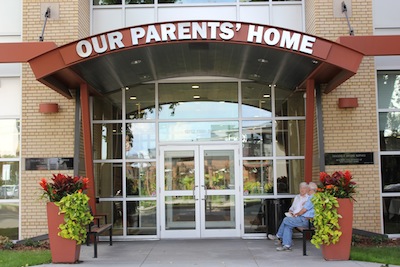
On the 14th floor of Edmonton’s Our Parents’ Home, one can enjoy panoramic views. (photo from OPH)

In 2015, Edmonton opened Our Parents’ Home (OPH), still the only kosher seniors home between Winnipeg and Vancouver. OPH offers 80 independent living suites and 50 Alberta Health Services supportive-living units.

Lesley Jacobson assisted Irving Kipnes on the project for more than a decade, until recently retiring.

Jacobson grew up in Sydney, Australia. She made her way to Calgary in the early 1970s, a place she called home for 27 years, before moving to Edmonton some 20 years ago. “I was always involved in [Jewish] federations in some way or the other,” she told the Independent.

About 12 years ago, Jacobson began working for Delcon Development, which was founded by Kipnes.

“Irv is one of the major proponents of this [OPH] project, and has been on the committee working to develop this facility for over 20 years,” said Jacobson.

The project was incorporated as a nonprofit organization under the Society Act of Canada in 1996, and obtained a charitable number from Revenue Canada that same year.

“It wasn’t until about a dozen years ago, after fundraising and much discussion about what the project should entail that the committee determined to move ahead,” said Jacobson. “Irv took the lead in that, and started investigating sites and plans seriously.”

The committee included Jewish community members who felt it was important that Edmonton have a facility that caters to the needs of Jewish seniors.

It took several false starts before a site was secured, detailed drawings were developed and a $6 million grant was secured under the Affordable Supportive Living Initiative of the Alberta government at the time. Construction began in 2012 in a prime location on Jasper Avenue, at the corner of 119th Street, next door to Beth Shalom Synagogue.

photo - Our Parents’ Home in Edmonton opened in 2015
Our Parents’ Home in Edmonton opened in 2015. (photo from OPH)

The original name chosen was the Hebrew, Beit Horim, which means Our Parents’ Home. “Once we started building and dealing with contractors, banks, etc. … many of the non-Jewish professionals who we were working with had trouble with the pronunciation…. So, we dropped the Beit Horim and just became Our Parents’ Home,” said Jacobson.

While the residence caters to Jewish seniors wanting a place to live where they can keep kosher, the home does offer menu options for people of all religions and has a non-kosher kitchen as well.

At press time, there were 17 independent living suites available (one- and two-bedroom apartments), while the supportive-living space – the units overseen by Alberta Health Services – was running at full capacity.

“They have a two-year waiting list of people trying to get into the supportive-living space,” said Jacobson. “If someone needs to be in assisted living, wants to be at OPH and they are Jewish, we try to get them to the top of the list. But, we have no control over that, because it’s mandated and controlled by Alberta Health Services…. On the independent living side of things, people are self-sufficient. The rent includes 20 meals per month, so people have that option … while those living in supportive care are provided with all meals and snacks.”

The home’s 50 supportive-living units cover three floors, which are staffed by care personnel 24/7. The two memory care floors are secured, so residents cannot leave those levels unless accompanied by someone with a fob. A third floor is for residents in need of care but with no memory issues.

Since the facility is open to the general public, regardless of religion, there are varied faith-based offerings. While there is a rabbi-led Shabbat service offered on the third Friday of each month, there is also hymn singing once a month led by a non-Jewish chaplain and a variety of other programs.

“We had beautiful seder [last] year and several non-Jewish residents of our community came, because they were interested,” said Jacobson. “People can come to whatever program they wish.”

Jacobson, while not on staff at OPH, worked with the staff to ensure the place became all that it was intended to be by the other committee members.

“It was exciting to be on the committee designing the building, to sit with the architects and interior designers,” said Jacobson. “We chose designs and fabric for the furniture, picked colours and selected the china and silverware. It was a pleasure to facilitate meetings with such dedicated and enthusiastic board members.”

According to Jacobson, when you walk into the OPH building, “it’s like walking into a boutique hotel. It doesn’t look like an old folks’ building. We have modern art on all the walls and, from the common rooms on the 14th floor, one can enjoy panoramic views of downtown Edmonton and the beautiful river valley. You walk into the dining room and it’s like walking into a first-class restaurant … linens on the tables to complement the china – no paper napkins.

“Seniors come here to live, not to die,” she stressed. “During the summertime, we take people from the memory care floors to walk in the neighbourhood, through the green streets. There are many activities designed to physically, socially and intellectually stimulate our memory care residents.

“Our independent residents live the lives they’ve always lived – they go to the opera or ballet, the gym, to their friends and to family. If they need a ride, we have a car that will take them. They live independent lives and, as a plus, enjoy all the extra activities provided – the book club, bridge club, fitness room, movies, social programs, etc.

“The people who have been involved are to be commended for their vision and enthusiasm,” said Jacobson. “Special credit needs to go to Tulane Rollingher, who conceived the idea in the very beginning, way back in the 1990s, of having a Jewish home. She was the very first person to start getting this group together.”

Rebeca Kuropatwa is a Winnipeg freelance writer.

A sapling grows in Jerusalem

A sapling seeded by Anne Frank’s horse-chestnut tree in Amsterdam is growing at Yad Vashem, near its International Institute for Holocaust Research. (photo by Gil Zohar)

treJerusalem and its environs have many historic trees, including the grove of gnarled olives in the Garden of Gethsemane, under which Jesus may have sheltered two millennia ago; the looming cypress planted by Godefroy de Bouillon, today the site of Hôpital Saint Louis, but where French knights camped in 1099 during the first Crusade; and the 700-year-old Kermes Oak that stands alone in Gush Etzion, south of the city. And now, there is another – a sapling seeded by Anne Frank’s white horse-chestnut tree in Amsterdam, which is growing at Yad Vashem, near its International Institute for Holocaust Research.

Initially, Yad Vashem was concerned that the chestnut tree would not acclimate to Jerusalem’s long, dry summers, but it is doing well.

For more than two years until her arrest on Aug. 4, 1944, Frank (1929-1945) hid in her family’s secret annex at Prinsengracht 263-265. Through a window in the attic that was not blacked out, she admired the chestnut tree, planted around 1850, that stood in the courtyard of a neighbouring residential block, at 188 Keizersgracht just north of the landmark Westerkerk. The tree was her only connection to the outside world and the changing seasons.

Frank wrote about the tree three times in her diary. On the last occasion, on May 13, 1944, she observed: “Our chestnut tree is in full bloom. It’s covered with leaves and is even more beautiful than last year.”

A month earlier, on April 18, 1944, she wrote: “April is glorious, not too hot and not too cold, with occasional light showers. Our chestnut tree is in leaf, and here and there you can already see a few small blossoms.”

The first reference was on Feb. 23, 1944, when Frank noted: “The two of us [Peter van Pels and Frank] looked out at the blue sky, the bare chestnut tree glistening with dew, the seagulls and other birds glinting with silver as they swooped through the air, and we were so moved and entranced that we couldn’t speak.”

For decades, the storied tree was cared for by Amsterdam’s Pius Floris Tree Care at the behest of the city’s Central Borough Council. In 2005, it was determined that the tree was ailing, and valiant efforts were made to save it.

In the meantime, Anne Frank House asked permission of the tree’s owner to gather and germinate chestnuts. The saplings – grown and cared for by Bonte Hoek Nurseries – were donated to schools around the world named after Anne Frank, and other organizations. In 2009, 150 saplings of the tree were donated to Amsterdamse Bos woodland park.

A sapling was recently planted in Vienna’s 2nd district – a neigbourhood that had many Jewish residents before the Anschluss in 1938. Another was planted in Ajaccio, Corsica, to honour the Righteous Among the Nations there. And 11 chestnut trees are growing in the United States, including one at Manhattan’s Liberty Park commemorating 9/11, thanks to the sapling project of the New York-based Anne Frank Centre for Mutual Respect.

As for the original tree, in 2008, the Support Anne Frank Tree Foundation placed iron struts around it to prop it up, hoping the tree would remain standing for further decades. But it was already too rotten. During a violent rainstorm on Aug. 23, 2010, the tree collapsed together with the girders supporting it, leaving a one-metre high stump.

On its website, the Dutch-based Support Anne Frank Tree Foundation responds to the question, was the battle to save the tree all for nothing?

“The answer is a resounding no!” they say. “The tree and the struggle to preserve it … has fulfilled an important task in an extraordinary manner: the reawakening of the world’s collective memory of the Holocaust and a call for tolerance and mutual respect. The seedlings planted all over the world will continue to spread the message, a grand and dignified final stage in the life of this tree. This would not have happened were it not for the battle for its preservation.”

Gil Zohar is a journalist based in Jerusalem.

The wrap dress began it all

Diane von Furstenberg was born Diane Simone Michelle Halfin in Brussels, Belgium. (PR photo)

Character. Intelligence. Strength. Style. That makes beauty.” These timeless words of wisdom were expressed by the iconic Diane von Furstenberg.

Born Diane Simone Michelle Halfin in Brussels, Belgium, 18 months after the liberation of Auschwitz – where her mother, Lily Nahmias, was among those interned – von Furstenberg was taught from a young age, “Fear is not an option.” Following this motto has helped her become a legendary designer, with a business that was worth some $300 million in mid-2017, according to Forbes.

image - Diane von Furstenberg made the cover of Newsweek, among other publications, in 1976
Diane von Furstenberg made the cover of Newsweek, among other publications, in 1976.

Von Furstenberg married Austro-Italian Prince Egon von Furstenberg in 1969. Soon thereafter, in 1972, she introduced her blueprint classic wrap dress. She made the cover of Newsweek, among other publications, in 1976, after selling five million dresses worldwide. Today, the quintessential wrap dress is on display at the Costume Institute at the Metropolitan Museum of Art, as von Furstenberg has been a major contributor to women’s fashion.

It was crucial, on a personal level, for von Furstenberg to be financially independent. She never wanted to rely on a husband or anyone else to pay her bills. Divorcing in 1972, she was determined, as a single mother of two, to make her dreams come true. A degree in economics helped her land a job as an apprentice in a textile house, which was where she learned the art of fabrics.

Von Furstenberg’s passion for prints began when she received the gift of a Pucci-designed outfit from a lover. And the idea of the silk, jersey wrap dress came to her when she saw Julie Nixon Eisenhower on television donning a wrap top with a skirt.

The wrap dress was considered both ageless and timeless: worn by women of varying cultures and sizes, from working women to the more wealthy. The wrap dress became a symbol of independence and power for a generation of women.

During this time, while ascending in her career, von Furstenberg lived a vibrant life. She had relationships with both men and women, she dressed the famous and traveled the world. She found love again with her present husband, Barry Diller. Though she had to relinquish the title of princess, she was still deemed royalty in the fashion business.

And her empire extended through the years to other domains. She wrote several books, including the memoir The Woman I Wanted to Be. She started a collaboration with the Gap, designed rooms and suites for Claridge’s hotel in London and starred in her own reality show, House of DVF.

Life was not without its challenges. She has battled cancer and, at one point, almost lost her business, but von Furstenberg prevailed.

The importance of her Jewish heritage became publicly apparent in the 1980s. It was then that she began her longtime commitment to preserving the memory of the Holocaust, and she became a prominent fundraiser for the United States Holocaust Memorial Museum in Washington, D.C.

Von Furstenberg is a philanthropist, giving back through various initiatives. For her, the empowerment of women has always been at the forefront – “Every woman can be the woman she wants to be!”

Ariella Stein is a mother, wife and fashion maven. A Vancouverite, she has lived in both Turkey and Israel for the past 25 years.

VR is coming to your home

Inception’s collaboration with FashionTV brings viewers backstage. (photo from Inception)

Netflix has become the go-to service for finding the latest and greatest movie and television programming. An Israeli startup called Inception wants to do the same for virtual reality.

The Tel Aviv-based company operates as both a production studio and an aggregator of curated virtual reality (VR) content. On Feb. 6, it announced the launch of a new channel to introduce more VR into the news experience, offering 360 top Associated Press (AP) videos across a broad spectrum of historical, cultural and social topics. The channel can be downloaded from the Inception app across platforms including Oculus Rift, HTC Vive, Microsoft MR, Samsung Gear, Google Daydream, iOS and Android.

Inception, which first caught Israel21c’s attention at the launch of the Tower of David Museum’s Innovation Lab last fall, received a $15 million investment in August 2017 from European television conglomerate RTL Group. The Series A round also included angel investors James Packer, Gigi Levy-Weiss and iAngels.

RTL’s FreemantleMedia owns the rights to dozens of big-name television shows, which helps explain where Inception is going. For example, Inception wants to use VR to transport viewers truly behind the scenes of the reality TV program The X Factor. Imagine standing beside the singer – or sitting with the judges watching the performance – in a 3-D immersive and interactive environment. Right now, that experience has to be pre-recorded but, someday, VR users will be able to jump into a program as it happens.

Live streaming is “already technically available today and we believe that, with the right content it will become mainstream,” Inception chief executive officer Benny Arbel told Israel21c.

Or, here’s another scenario. Imagine exploring in virtual reality the Shadow Monster’s tunnels in the Upside Down on the hit Netflix show Stranger Things.

“The beauty of VR is that it lets you actually enter a new location or scene,” said Arbel, “whether you’re a spectator or a participant.”

Inception’s focus on serialized TV sets it apart from other VR companies like Within and Here Be Dragons, which produce beautiful but mostly one-off VR experiences. Among the dozens of VR entries on Inception’s website are collaborations with Time Out for virtual walks through exotic locations (from Thailand to Tel Aviv) and FashionTV, where you can sidle up to a super-model as she heads down the catwalk.

Inception has standalone projects, too: a partnership with Pitchfork is the driving force behind the pop culture magazine’s new VR Music Channel. And Inception is developing a VR experience that transports visitors to the world of medieval knights at Jerusalem’s Tower of David Museum.

It’s the episodic content that gets Arbel most excited. With Time Out, he said, “we continuously add new content about different city locations and venues. We hope users will start using these channels for their city updates instead of existing TV or the web.”

If and when they do, it’s likely to start with a “360” experience, which Arbel called “the biggest enemy of VR.” He explained that 360s are flat, non-interactive videos that allow you to explore VR on your computer, often via YouTube. While Inception makes 360 video versions, too, Arbel said, “It’s a necessary evil, a way of promoting what we do to everyone.”

photo - Inception’s collaboration with Time Out brings virutal reality to virtual tours
Inception’s collaboration with Time Out brings virutal reality to virtual tours. (photo from Inception)

Inception’s VR content is video-based. Depending on which way you turn your head or make a gesture, a new video will be triggered. This is a bit reminiscent of Israeli pop-star-turned-startup-maven Yoni Bloch’s Interlude, now renamed Eko, which develops tools for making interactive (though not VR) videos.

Inception was founded in 2016 by Arbel, Dana Porter, Effi Wizen and Nitzan Shenar. The company’s 30 employees are spread out in offices in London, New York and Los Angeles, in addition to the Tel Aviv headquarters.

Inception is “platform agnostic,” Arbel stressed. That means its content “will play well with all the different kinds of headsets out there,” including Oculus, which Facebook acquired for some $3 billion in 2014, as well as Samsung’s Gear, the HTC Vive and Microsoft MR.

Some of these devices operate by placing one’s mobile phone into the headset, but those aren’t so popular or user-friendly. “People don’t like giving their phone to someone else,” said Arbel. “The most interesting segment is the standalone headsets, where there’s no phone or computer required; the graphic engine is built into the device and it’s connected to the cloud via wi-fi.”

Arbel added that new and improved headsets come out every few months and the next generation of the Oculus may be the “hero device that changes things for everyone.” According to Statista, the installed base of VR headsets is projected to grow to 37 million by 2020.

What about the kind of virtual experiences made terrifying by science-fiction TV shows such as Black Mirror, where the VR is broadcast directly into a user’s mind without the need for goggles or other external hardware?

“We know for a fact that what we are seeing today is just early days of VR form factors,” Arbel said. “We are sure hardware will change dramatically and become much easier for us to include as part of our daily lives. Precisely because of this, we make sure that our content can be viewed on any type of device – even the futuristic ones.”

In the meantime, and for those without a headset, Inception’s VR experiences are available on the Apple and Android app stores. For more information, visit inceptionvr.com.

Israel21c is a nonprofit educational foundation with a mission to focus media and public attention on the 21st-century Israel that exists beyond the conflict. For more, or to donate, visit israel21c.org.

Finding the future in the past

Left to right: Michael Rubenfeld, Mary Berchard and Katka Reszke in We Keep Coming Back, which plays March 13 and 14 as part of the Chutzpah! Festival. (photo by Jeremy Mimnaugh)

At first, we expected the piece to focus mainly on the past and how sad the absence of Jewish life in Poland is. After going and also spending more time in Poland, we now propose that it is through focusing on the present and future, with an aim at building positive perspectives, that will ultimately lead to transformation and genuine healing,” said Michael Rubenfeld about We Keep Coming Back, which plays at the Chutzpah! Festival March 13 and 14.

Rubenfeld created the multimedia work with Sarah Garton Stanley, as well as his mother, Mary Berchard, and filmmaker and translator Katka Reszke. Rubenfeld and Garton Stanley are co-directors of Selfconscious Theatre. We Keep Coming Back is based on a trip that Rubenfeld and his mother took to Poland in 2013.

“It was always our intention to make a piece of theatre and the trip was connected to a desire to explore intergeneration trauma and, also, more specifically, the problems in my relationship with my mother that stem from unresolved trauma and disconnect from our family’s roots in Poland,” said Rubenfeld. “So, the trip was an experiment of sorts; to see if going to Poland with my mother, visiting her mother and father’s hometowns and going to Auschwitz, would give us the opportunity to mourn together, which might also bring us closer together.”

According to a blog on Selfconscious Theatre’s website, after surviving the Holocaust, “Berchard’s family moved from Poland to Sweden, where she was born. They then immigrated to Canada in 1951, where she grew up and eventually had a son, Michael.”

Rubenfeld and Berchard were in Poland for about two weeks. “My mother has since been back three or four more times, and I now have a home in Poland with my wife,” said Rubenfeld – the couple lives in both Krakow and Toronto. “We’ve toured We Keep Coming Back to Poland three times,” he added.

The project has worked to bring mother and son closer.

“It’s been really nice for us to have a piece that we do together,” said Rubenfeld. “It gives us an excuse to spend time together to do something we know we’re going to enjoy. It’s also given us commonality, which has been really essential for our relationship.

“My mother has always been very supportive, though we don’t always have a lot in common. This project has changed that. We also now have Poland in common, and our mutual interest. My mother really loves it in Poland. She’s also become quite interested in uncovering more about our history and has started researching and archiving our family tree. It’s brought her a lot of happiness and has been a really healing thing – which, in general, has been good for our relationship as well.”

We Keep Coming Back “speaks so openly and honestly about what it means to love a parent, or to be loved by a child, and how so many of the resources for a good and enduring love were torn apart by the Holocaust and all of the horrors, throughout the generations that linger,” said Garton Stanley, who is also associate artistic director of English theatre and interim facilitator for indigenous theatre at the National Arts Centre in Ottawa.

“Honestly, as someone on the ground since the get-go, I was most curious about Michael’s developing love for Poland and how, over the course of the play’s creation, he not only fell in love with a Jewish woman from Poland but that he now lives there,” she said. “Michael and I are very interested in the line between fiction and reality and the space for realizing possible worlds through dramatic form. Michael now speaks some Polish. He’s making deep-rooted reconnections and helping contribute to a vibrant Jewish life in Poland.”

Garton Stanley and Rubenfeld met just over 10 years ago, after she saw him in a show. “He was performing in it with my partner at the time,” she said. “He was amazing. We became fast friends shortly thereafter.”

At Selfconscious Theatre – which they started together – the two have also co-created The Book of Judith; Mother, Mother, Mother; and The Failure Show.

For We Keep Coming Back, Garton Stanley is not only co-creator but the director. “My co-creation,” she explained, “was part facilitator, part conceiver, part devisor, part writer, part mediator, part friend and always enthusiast.”

How Reszke became involved in the production is a little more circuitous and fortuitous.

“Once we decided to take the trip to Poland, we connected with a producer named Evelyn Tauben, who was doing research around contemporary Jewish Poland,” explained Rubenfeld. “Through Evelyn initially, we started learning about the renaissance of Jewish culture in Poland, which, at the time, I knew nothing about. Once learning about it, we determined that it was important to us that we engage with it on our trip, and that’s when Katka came into the picture.

“We knew we needed a translator to join us, and we also knew we wanted to document the process. We joked that it would be incredible if we could find someone who could both translate, film and be a Polish Jew who might want to collaborate with us artistically. On a lark, we Googled ‘Polish, Jewish, filmmaker,’ and that’s how we discovered Katka. We sent her an email, and one thing led to another.”

“Mary Berchard and Katka Reszke,” added Garton Stanley, “are fascinating performers and neither of them has any training in this area. Their stories and their curiosity combine with Michael’s to create a new family. And this feels like one of the piece’s hidden successes.”

As for what has most surprised her about the project, she said, “That we are still doing it and learning from it. And learning from the audiences whose histories intersect with Michael’s, Mary’s and Katka’s own generational challenges and traumas. And that the piece resonates as deeply as it does. It has a beautiful heart and this is always surprising, in the best way.”

“I believe that, in our desire to never forget what happened during the Holocaust, we have also forgotten that Poland was one of the most important contemporary homelands for the Ashkenazi Jewish people for over 500 years,” said Rubenfeld. “So much of our contemporary culture was bred in this land, and we forget that the Jewish people were happy living in Poland before the war. We are raised to think of Poland as only the place of tragedy. While I understand why, I think that it’s essential to remember and celebrate a time when there was such vibrant Jewish culture. Most was destroyed because of the war, and it’s impossible to not feel sad. But, as we move into the future and the pain continues to recede, it is just as important to remember the incredible prewar Polish Jewish world of Poland. It was very profound.”

For tickets to We Keep Coming Back at the Rothstein Theatre, and for the full Chutzpah! schedule, visit chutzpahfestival.com.

Music to say thank you

Anna Levy  (photo from Yarilo Contemporary Music Society)

My mother’s maiden name was Levy, my dad’s surname was also Levy. My story is about life. None of my family was killed during the Holocaust. I am alive because I grew up in a small European country, Bulgaria, that – despite being Nazi-aligned – managed to save all its Jews during the Second World War. And I – and many others – will be saying thank you through music this spring in a major concert marking the 75th anniversary of this historic series of events, for which we are so grateful.

During the Holocaust, Bulgaria had a complex record. While it is responsible for deporting 11,000 Jews from Bulgarian-occupied territories, most of whom were murdered at Treblinka, it defied Hitler and saved all 50,000 of its Jews, among which was my family.

In 1943, the complicated diplomatic manoeuvres of the Bulgarian parliament, led by Dimitar Peshev, along with civil disobedience and the strong official opposition of the Bulgarian Orthodox Church, resulted in the cancellation of the deportation that was planned for March of that year.

In June 1943, then German ambassador to Bulgaria, Adolf Heinz Beckerle reported to Berlin, “The Bulgarian society doesn’t quite understand the real meaning of the Jewish question … so the racial question is totally foreign to them,” and he complained that the Bulgarian people lacked “the ideological enlightenment that we [Germans] have.”

In 1996, Jewish National Fund named a forest in honour of Bulgaria, with memorial plaques dedicated to Peshev, the Bulgarian Orthodox Church and to King Boris.

This year marks the 75 years since the salvation of Bulgarian Jews during the war and preparations are underway in Bulgaria, Israel and in other countries to mark this anniversary.

In Vancouver, on May 27, Project Tehillim will take place at the Orpheum Annex. Twenty-three professional musicians will participate in the program featuring Tehillim, which was written by one of the most famous living Jewish American composers, Steve Reich. This event should occupy a central place in Metro Vancouver’s cultural life, as the work is unique, rarely performed and difficult to put together.

Tehillim,” explains Reich, “is the original Hebrew word for Psalms. Literally translated, it means praises, and it derives from the three-letter Hebrew root ‘hey, lamed, lamed’ … which is also the root of halleluyah.”

In his notes on the website of classical music publishing company Boosey & Hawkes, Reich also writes, “One of the reasons I chose to set Psalms as opposed to parts of the Torah or Prophets is that the oral tradition among Jews in the West for singing Psalms has been lost. (It has been maintained by Yemenite Jews.) This meant that I was free to compose the melodies for Tehillim without a living oral tradition to either imitate or ignore.”

That said, he notes, “The rhythm, of the music here comes directly from the rhythm of the Hebrew text and is, consequently, in flexible changing meters.”

Tehillim is deeply rooted in ancient Hebrew traditions from biblical times. This is not music of contemporary daily life, but instead conjures the timeless and eternal. This work is a deep reflection of Jewish tradition presented in a modern way.

The budget for this large-scale project is more than $20,000: for musicians’ fees, theatre rental, scores, instrument rentals and other expenses. To help raise these funds, the Yarilo Contemporary Music Society – of which I am co-artistic director with Jane Hayes – is holding the concert Lest We Forget, on Sunday, April 8, 3 p.m., at Pyatt Hall, with the support of the Peretz Centre for Secular Jewish Culture.

The fundraising concert features classical masterpieces. The centrepiece of the program – which will be performed by Angela Cavadas (violin), Rebecca Wenham (cello), Johanna Hauser (clarinet) and me on piano – is Tchaikovsky’s Piano Trio in A Minor, written in memory of his Jewish friend Nikolai Rubinstein. In addition, there will be music by Jewish composers Srul Irving Glick (Suite hébraïque) and Ernest Bloch (Prayer).

Both concerts – Tehillim and Lest We Forget – highlight the spiritual qualities of the Jewish people. In the words of the non-Jewish author Milan Kundera about the importance of Jews in Europe: “Indeed, no other part of the world has been so deeply marked by the influence of Jewish genius. Aliens everywhere and everywhere at home, lifted above national quarrels, the Jews in the 20th century were the principal cosmopolitan, integrating element in Central Europe: they were its intellectual cement, a condensed version of its spirit, creators of its spiritual unity. That’s why I love the Jewish heritage and cling to it with as much passion and nostalgia as though it were my own.”

I love the Jewish heritage with a passion, as well, and it is “our own.” I hope that other members of the Jewish community will become Yarilo’s partners, and help us make Project Tehillim a worthy thank you. To contribute to the project, visit gofundme.com/2018-my-jewish-story-is-for-life; the campaign includes a third concert, which is planned for October. For tickets to the April 8 fundraising performance at Pyatt Hall, visit yarilomusic.com.