Retribution and restoration

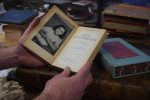
Hidden in the spine of a 1947 edition of Anne Frank’s The Diary of a Young Girl, in its original Dutch, is a piece of paper with the German words, “Die Vergeltung,” or retribution. (photo by Shula Klinger)

I ran into Richard Smart in North Vancouver in early September. It was at Urban Repurpose, a nonprofit store that sells used building materials and an eclectic mix of donated household items. Many of these items are vintage and, if you’re interested in local history or looking for artistic inspiration, it’s also a treasure trove.

Employing skills handed down over three generations of his family in England, Smart restores and sells antique books using tools that have “barely changed for centuries.” And, since a homeschooling mom never misses an opportunity to educate the children, I asked him if we could come by the Old English Bindery to see him at work. In mid-October, he invited us to see how a broken book could be repaired.

Smart showed us book presses, tools for applying gold leaf to the bindings of books, piles of ancient, beautifully decorated papers and, of course, the books themselves – travel writing, fiction, nonfiction, massive tomes of human anatomy, bigger than any book you’d see in print nowadays. He also applied gold leaf to the kids’ index fingers, which delighted us all.
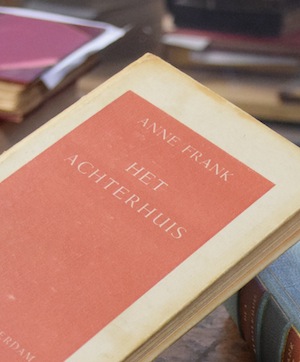
photo - Het Achterhuis. Anne Frank’s The Diary of a Young Girl
Het Achterhuis. Anne Frank’s The Diary of a Young Girl. (photo by Shula Klinger)

Just before we left, Smart showed me a small, bubble-wrapped book. I looked down as he held it out. Its title: Het Achterhuis. Anne Frank’s The Diary of a Young Girl.

“It’s a first edition,” he said. There was a pause, to let this information seep in. He pointed to the front left edge. “I only did minor repairs on it, here.”

I stared at my hands, holding this 1947 edition of The Diary of a Young Girl, in its original Dutch. Looking down, just breathing. Thinking about how, a mere two years before this book was published, Anne and her sister Margot were still alive. In captivity, but alive. Anne was still writing, contemplating the nature of the human soul.

A moment later, Smart pointed to the inside of the spine, where it had separated from the contents. “Look at that,” he said, and pointed to some words in German: “Die Vergeltung.”

“I looked it up,” he said, and here he became animated. “It means retribution. Or payback.”

I was already choking back the emotion of holding this 70-year-old edition of The Diary, but now this?

I asked how the text had gotten there, when the book had come apart, if it had been placed there during the original binding.

“Bookbinders often used scraps of paper to pad the inside of a spine,” he explained. “But to choose this particular piece of paper? Just think about that.”

By then, my head was full of questions, all competing for my attention. Unfortunately, my two children were also competing for my attention. The little one was extremely curious about the book presses, but the big one was edging toward the door. Also, as interested as they are in world history, this wasn’t the time to tell them about the Holocaust, so we left.

Over the next few days, I learned more about the book’s earlier life and Smart’s plans for its future. “This book needs to go back to its community,” he said. When asked if it there had been any fanfare at the Dutch auction, he said, “It was just an ordinary estate sale.”

Since the original dust jacket was missing, Smart has made a case for it. Working to match it to the cover’s original colour, he chose a pale blue leather inlay for the lid and patterned, or “paste,” paper for the sides.
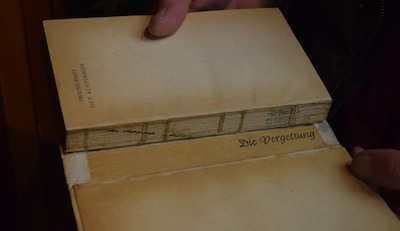
photo - In the spine of this 1947 edition of The Diary of a Young Girl is a piece of paper with the German words, “Die Vergeltung,” or retribution
In the spine of this 1947 edition of The Diary of a Young Girl is a piece of paper with the German words, “Die Vergeltung,” or retribution. (photo by Shula Klinger)

I also wrote to Anne Frank House in Amsterdam. Gertjan Broek replied, saying, “There are still a few mysteries around the first edition of Anne Frank’s Het Achterhuis.” He agreed that “randomly available” pages from other books were often used to pad spines – “paper was a scarce resource in those years,” he noted.

This was probably the case with the page used in Smart’s edition of Het Achterhuis. Die Vergeltung was published in Bayreuth, Germany, in 1941 and reprinted in 1944. In Broek’s view, the typefaces were a match. Broek didn’t know if this was true for all of the 3,000 books in this first run, but he said he’d ask his colleagues.

A few days – and a good deal of anxious email-checking – later, Broek wrote again. “Three experts in book restoration have told me they have never seen a first edition copy of Het Achterhuis with this kind of print.”

And that is where the story rests, for now. I would love to paint a more detailed picture of the bookbinder at a workbench in 1947. I picture hands cutting out a page of that German book, laying it into the backbone of Anne’s book. Was the bookbinder just doing a job, or taking a degree of satisfaction in leaving a deliberate, but hidden, commentary inside this now-iconic piece of work?

There’s another layer to the tale.

In an age where people are rushing around permanently plugged into an online world, bookbinders like Smart have an unusual job. Every day, instead of racing ever forwards, he steps into worlds that have passed, touches books first purchased by people who haven’t lived for centuries. As he preserves their books, it’s as if he offers a passage between their time and ours.

Amid all of these remarkable works, Anne’s stands out as a beacon. “Books like Anne’s make this work worthwhile,” said Smart, who is keen to sell his copy of Het Achterhuis, but to an organization, not a private individual. “I had an offer on it but I refused it,” he said. “I have my heart set on it going into an institution that will display the story.”

So, in preserving precious books, Smart is doing far more than simply offering a service, repairing material goods. He is acting as a guardian of history.

Smart also wonders about the binder of this copy of copy of Het Achterhuis, “the moment of looking for a spine liner and putting that particular one in. What was going through his mind, in 1947?” On reading this in Smart’s email, I replied that, really, the book was priceless.

Later that day, he emailed again. “This one copy is priceless, as you say. Not financially but historically. Just imagine the story told by everyone that sees this book in a museum. It would bring people in, just to see this, and talk about it. That is worth so much for everyone in this world.”

Responding to my expression of gratitude for his professional conscience, he said, “Faith is everything.”

Shula Klinger is an author, illustrator and journalist living in North Vancouver. Find out more at niftyscissors.com.

Imagining a different future

ChiZine Publications is preparing to publish a new book: Other Covenants: Alternate Histories of the Jewish People, the first-ever anthology of Jewish alternate history stories, to be edited by Mark Shainblum and Andrea D. Lobel. Contributors already confirmed include science fiction masters Harry Turtledove and Jack Dann.

Shainblum and John Dupuis forged a new trail in Canadian literature in 1998 with Arrowdreams, Canada’s first alternate history anthology. Now Shainblum and Lobel propose to do the same for Jewish literature, and explore the rich possibilities of Jewish roads not taken.

Shainblum was born and raised in Montreal, where he and illustrator Gabriel Morrissette co-created the comics series Northguard and Angloman. Shainblum has published science fiction in various magazine and anthology markets, and he also co-edited Superhero Universe: Tesseracts Nineteen, in 2016, with Claude Lalumière.

Lobel has worked as a writer and editor for more than a decade, winning two industry awards. An ordained rabbi, she also holds a master’s in religious studies (McGill University) and a PhD in religion (Concordia University). She has taught at both McGill and Concordia. Her book Under a Censored Sky: Astronomy and Rabbinic Authority in the Talmud Bavli and Related Literature is forthcoming from Brill Publishers in 2018.

Other Covenants is open to submissions of short fiction, through Sunday, Feb. 4, 2018, at 11:59 p.m., Eastern Time. Submissions must be between 1,000 and 10,000 words in length, and may be in English or French (the book will be published in English and authors will be responsible for translations). Original stories are preferred, but the editors will consider reprints of significant works on a case-by-case basis. Payment will be eight cents (Canadian funds) per word. Authors may be from anywhere in the world and do not need to be Jewish.

Many individual stories of Jewish alternate history have been published over the years, but Other Covenants will be the first themed anthology collecting such stories under one cover.

Some possible themes to explore are: What if the Holocaust had never happened? What if Joseph’s brothers had not sold him into slavery in Egypt? What if the state of Israel had been established in Uganda? What if Jesus’s followers had not broken with Judaism? What if Jews had proselytized their faith door-to-door for a thousand years? What if the Romans had not destroyed Jerusalem and the Second Temple? What if Judaism became the dominant Western religion, but was riven by conflicts between the Temple priesthood and reformist rabbis? What if the Spanish Inquisition had never occurred? What if Napoleon had not smashed down Europe’s ghetto walls?

Full submission guidelines and the online submission system are at chizinepub.com/other-covenants-alternate-histories-of-the-jewish-people. Stories must not be submitted by email – they must go through the submission system.

History is constantly new

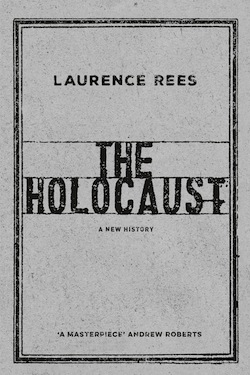
Laurence Rees, former head of BBC TV History and author of the award-winning book Auschwitz, has written a very compelling and authoritative “new” history of the Holocaust, based on 25 years of research, and on many personal meetings with survivors and perpetrators – The Holocaust: A New History (Public Affairs, 2016).

The “new-ness” of Rees’ book is evidenced in the 100 pages of footnotes, which contain more than 100 references to “previously unpublished testimony,” plus new evidence from heretofore unrecorded diaries, speeches, stenographic reports, Wehrmacht soldiers’ letters, journals, private conversations and interviews. Add to this the results of “hundreds” of visits Rees made to exact killing locations, all of which have their first exposure here.

As with other great one-volume histories of the Holocaust, such as Martin Gilbert’s The Holocaust (1986) and Raul Hilberg’s The Destruction of the European Jews (1961), Rees’ history is difficult to read – not because of the writing (Rees’ prose is more engaging than either Gilbert’s or Hilberg’s) but because of what the reader has to face in reading about the Holocaust. The cold, impersonal, machine-efficient systematization of genocide; the brutality, the humiliation, the sadism and the ear-piercing silence of the church: all are offered here in unremitting detail. The silence of the world-at-large is also indicted here – as one survivor told Rees about her “liberation”: “What liberation? No one wanted us. There was no Israel, no England, no America and no Canada, with its wide open spaces.”

book cover - The HolocaustRees lays his cards on the table in his prologue: “make no mistake about it – the Holocaust is the most infamous crime in the history of the world.” Rees’s words echo almost exactly the words of Winston Churchill in July of 1944.

To his credit, Rees sees through the usual “excuses” for the Judeocide – that is, need for “Lebensraum,” for “ridding of the world of a bacillus” or for the preventing of a Jewish plot for world domination. Rather, says Rees, the perversions which truly fueled the killing machinery were mad racism thoroughly laced with sadism and opportunity for profit.

On the usual controversial points: first, Rees agrees with Ian Kershaw that “No Hitler, No Holocaust”: no one who studies Holocaust history, he says, “can help but conclude that Hitler was primarily responsible for the Holocaust.” Second, Rees sides persuasively with the “functionalists” rather than the “intentionalists,” an old dilemma among historians of the period wrestling with the idea of whether the Judeocide was planned out in advance (“intentionalism”), or just came about piecemeal (“functionalism”). Third, as mentioned, Rees is adamant that the Holocaust was unique: “a crime of singular horror in the history of the human race.”

Rees is particularly, and rightly, harsh on the slavish complicity of the Dutch civil service (75% of the Dutch Jewish population perished) and the atrocious treatment of Jews in Vichy France, and bitterly condemns the hideously self-serving complicity of the Romanians in joining up with the German Nazis. But he saves his bitterest attack for the end of the book, vehemently accusing the Hungarians of a major crime for allowing what he rightly refers to as the “Hungarian Catastrophe.” (Nor does Canada escape indictment: Rees reminds us of Mackenzie King’s loud admiration of Hitler in the late ’30s, and of the antisemitic pronouncements of Canada’s Immigration Branch in 1938, preventing any Jewish immigration to Canada.)

Rees has some interesting insights on the “Danish Rescue” – the spiriting away to Sweden of almost all of Denmark’s Jewish citizens. Jews were thoroughly integrated into Danish society, and there had been a great number of intermarriages between Jews and non-Jews in Denmark. In never-before-published interviews, Rees offers heart-warming evidence of the bravery of Danish non-Jews in warning, hiding and planning passage for their Jewish neighbours. As a result, says Rees, when the Germans called, “most of the Danish Jews were not at home.” Rees offers “no simple explanation of why this happened in Denmark and nowhere else,” but he guesses that the Nazi functionary (Werner Best), known to have warned the Danish police about the upcoming “Action” in October of 1943, may have been motivated by the need to “avoid bad feeling” in a country that was supplying considerable food supplies to the Reich. No less of a motivating factor, Rees further conjectures, was the fact that Best, who had been appointed in his 20s to a judgeship, was intelligent enough to foresee the Nazis’ future defeat and subsequently “needed to start improving his CV as far as the Allies were concerned.”

Rees’ book reminds us, then, that history, ironically, is always “new” – and we are, therefore, reminded to constantly view it, and to re-view it, through ever-changing historical lenses.

Graham Forst, PhD, taught literature and philosophy at Capilano University until his retirement and now teaches in the continuing education department at Simon Fraser University. From 1975 to 2010, he co-chaired the symposium committee of the Vancouver Holocaust Education Centre.

Grandparent parents

This past summer, the topic of grandparents parenting their grandchildren was front and centre at the Jewish Child and Family Services Winnipeg (JFCS) annual general meeting. The Independent spoke recently with a couple of the participants in the June event.

Corinne Ackerman, 73, was joined by her husband, Harvey, 75, at the AGM. The couple has two grown children – a son who lives and works in Auckland, New Zealand, and a daughter who lives in Winnipeg. Seven years ago, their daughter’s family began experiencing difficulties, to the point that Manitoba Child and Family Services (CFS) became involved.

“Harvey and I were aware there were problems in their home, but we didn’t know how bad,” Corinne told the Independent. “We got a phone call from our daughter, saying that CFS was coming to the school to apprehend their three boys. And, of course, when I heard that, I just was absolutely stunned…. I grabbed my car, went to the school and met the social worker. I said, ‘You’re not taking them. I’m their grandmother and they are coming with me.’”

Everyone ended up at CFS, which then evaluated the possibility of the Ackermans taking charge of their grandsons. “They came to our apartment. They checked it,” said Corinne.

By that evening, all three boys were with their grandparents in their apartment. However, said Corinne, “We had them here with us for about 10 to 12 weeks. They [CFS] wouldn’t let us keep them. You can’t have three children in a two-bedroom apartment.

“At that point, friends of mine … and even the principal at the kids’ school called me … and said to call JCFS. It took a lot for me to do that. You become so embarrassed. Harvey and I were just mortified.

“I did, and God bless Emily Shane [who was then at the helm of JCFS]. She sent workers and the process began. They found a foster home for the three boys, but it very quickly deteriorated. It was just awful.”

Ian, now 14, the youngest, was having the most trouble. He also needed some major dental work. All of those involved decided it would be best if Ian went back to live with his grandparents. Ian’s brothers are now 18 and 20.

“I don’t even remember how it all happened, but the agreement was, the boys were going to another foster home and Ian would stay with us,” said Corinne. “And he’s been with us now since he was 7 years old.”

The Ackermans have made a point of assuring Ian that his parents and brothers love him.

“I think that he knows that he’s loved and that we still love his mom, dad and brothers,” said Corinne. “Ian would like to be home with his mom and dad if it was possible. But, I think he’s pretty happy here. And, for as long as he needs us to be here, we are going to try to take care of him.”

While there were some hurt feelings within the family when all of this happened, of course, everyone has made amends for Ian’s sake. They all speak regularly, and Ian visits his mom and dad regularly.

When asked about the difference between raising your own kids versus raising your grandchildren, Corinne said, “Well, when you raise your grandchildren, you get a better appreciation for the love you have. I love my daughter, I love my son, I love my in-laws, but you love your grandchildren on a different level, and we just adore Ian. At times, he’s very difficult, but at times, he’s an absolute blessing.”

The Ackermans have had to realign their lives in order to parent their grandson. It was a drastic change and they depend on JCFS for respite.

“We are not people who go out all the time, but it does cut down on the freedom to do so,” said Corinne. “But, we’re OK with that. Ian is important enough to us that it’s worth it.

“Ian has some challenges in school and that makes it quite difficult for any parent. We’ve done our best to get him the help he needs, and I can say that JCFS has been fabulous. Ian had a reading clinician, as he had a little speech impediment, and now it’s gone. JCFS has been wonderful with whatever Ian has needed.

“There are issues when a child is taken from their parents, and issues before that, and they’ve been very helpful throughout,” she continued. “As far as Harvey and I, when I really have it up to my head … I’ll give the social worker a call and she’s always there to help and give advice.

“Ian is the most invaluable young man because, whatever we do for him, he does back for us tenfold. He’s a wonderful kid. A million foster homes are wonderful, but family is family and there’s a difference.”

The other panelist at the JCFS AGM was Karla Berksen, 73, who also took in her two grandchildren seven years ago. Berksen was awarded custody because her daughter was unwell and her husband could not care for the kids.

Berksen and her partner of many years, Arthur Chipman, took in the children when Paige was 4 and Jacob was 8. At the time, Berksen was a newly retired financial planner and was spending part of her winters in Mexico.

“My daughter was still alive when I got the kids,” Berksen told the Independent. “She wasn’t a very well person, so we spent a lot of time with her. When they came to me, they were just dropped off. Arthur’s been quite amazing, because people my age don’t think this is something they want to do for their retirement. But, this is what we’re doing, although Arthur is still working.”

Both children attended and graduated from Brock Corydon School’s Hebrew immersion program. “Jacob had his bar mitzvah two years ago and Paige will have her bat mitzvah in March,” said Berksen.

“I feel very grateful to have the kids. It makes me a little tired sometimes. But, as I said at the JCFS AGM, I’ve only had two anxieties in my whole life. One was nine months after I stopped smoking – I had an anxiety attack realizing I wasn’t going to have a cigarette again. The other one happened a couple years after I got the kids, and I realized that I’m going to have teenagers again. That’s my biggest fear – going through the teen years again. You can only build them up, but they have to take charge and you never know what will happen.”

Berksen said both of her grandchildren are very talented. Her grandson is a gifted musician who is self-taught on the saxophone, drums, guitar and piano, with plans to one day become a studio musician and music teacher; he also enjoys playing hockey. Berksen’s granddaughter loves the arts and curling. Both kids spend part of their summers at Camp Massad.

Although Berksen hopes one day to again spend time in Mexico, her current priority is to raise her grandchildren up through their university studies. “I don’t see it as my life being on hold,” said Berksen. “This is it. This is my life and I enjoy it for the most part. I enjoy watching these two kids grow up. They keep me alive and busy.”

Rebeca Kuropatwa is a Winnipeg freelance writer.

Keeping children safe

Bracha Goetz reads from one of her recent books to her two grandchildren. (photo from Bracha Goetz)

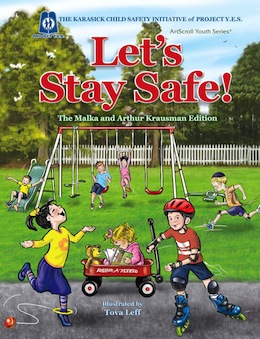
Many of us were raised to not talk to and be wary of strangers, but the sad fact is that kids are much more likely to be taken advantage of or abused by someone they know and think they can trust. This reality was the driving force behind Bracha Goetz’s book Let’s Stay Safe, which was published in English in 2011, and just came out in Yiddish this summer, as Zai Gezunt.

Born in Queens, N.Y., Goetz graduated from Harvard and started on the road to becoming a psychiatrist before heading to Israel for what was to be one summer. However, while in Israel, she become observant, and ended up staying. There, she did a further 11 years of study, got married and had a family.

Goetz and her family have since moved to Baltimore, where she coordinates a Jewish Big Brother Big Sister (JBBBS) program. As well, she writes children’s books and, to date, has published 36 of them. “They are all spiritual children’s books,” she said. “Originally, I was just writing Jewish children’s books, but now I’m also writing spiritual children’s books for anybody.

“I always wanted to write spiritual books for everyone, but I just recently found a publisher that was interested. It’s not easy. It took a long time, but I’m very happy to do that, because, although these are Jewish concepts, they are also actually universal concepts that I’d love to share with any child.

“I try to write books that I wished I could have read as a child, to answer the spiritual questions I had as a child that weren’t answered,” she continued. “They were answered for me when I was 22, but I try to write about the deepest spiritual concepts on a simple level so any child can understand them. I also try to do it in a joyful, delightful way, so that it can go right into their soul.”

In her role at JBBBS, Goetz witnesses firsthand how sexual abuse affected children. This made her think about how she was teaching her own children about such dangers.

“I realized that I didn’t raise my children with an awareness about it,” she said. “I taught my children about ‘stranger danger,’ but, when they were little, we weren’t as aware as we are today that, with most sexual abuse, the perpetrators are known to the children; that’s how they get access. It’s rare that it’s a stranger. It’s most commonly someone the child already knows. There was no book like this in the Orthodox community and some of the books (in the general community) are not culturally relevant for Orthodox people.”

photo - Let’s Stay Safe, which was published in English in 2011, and just came out in Yiddish this summer, as Zai Gezunt
Let’s Stay Safe, which was published in English in 2011, and just came out in Yiddish this summer, as Zai Gezunt.

Goetz wanted to write a book that would be accepted by the Orthodox Jewish community specifically, as the subject tends to be less discussed in these communities. So, she wrote Let’s Stay Safe, but could not find a publisher. That is, not until Rabbi Yakov Horowitz, dean and founder of Yeshiva Darchei Noam in Monsey, N.Y., agreed to help and got the book accepted by ArtScroll.

“He really worked at it, and it was a really groundbreaking book,” said Goetz. “There was nothing like it out there. We wanted readers to understand that these were additional normative safety rules that needed to be adhered to by children to be safe. Of course, the book is also for parents, because, when parents read it to their children, they also gain an awareness.

“It’s not a good idea to leave the safety responsibility of children up to the children. It’s the parents’ responsibility. But, the parents also need to teach the awareness to their children and remind them about it every so often. As they come upon new circumstances, they need to review the guidelines.”

To take the book a step further, especially in Chassidic communities, Horowitz spearheaded a Yiddish version. “In certain Chassidic communities,” explained Goetz, “their mother tongue is Yiddish. We wanted to reach as many people as possible, so that they would bring this book into their homes and share it with their children. Even the pictures were altered to be more Chassidic-looking. We don’t want anything to stop the Yiddish-speaking population from getting this information.”

One of the concepts Goetz wanted to stress in the book was that children speak with a parent even if somebody touched them inappropriately a long time ago. It is important for these experiences to be told, she said, so that survivors can heal, and also so that the perpetrators cannot continue abusing children.

Another concept she wanted to convey clearly is not to trust someone just because she or he is dressed in Orthodox clothing, as that does not automatically mean they are safe people.

“There’s one picture of an older teenaged boy at a camp,” Goetz said, by way of example. “Many times, it’s a familial problem, where it’s an older brother, an uncle, a step-brother who is the perpetrator. Just this week, I was in a community different than I was usually in, but the people knew I was the author of the book … and, this happens a lot, people come to me with questions. I was outside watching my grandchildren and a mother came by and said, ‘Does this seem right? There’s a teenaged boy and he’s playing with all these little children. He’s playing ball with them. He doesn’t live in this community. And why is he here? He’s Orthodox, as well, just as the children, but he didn’t know any of them. Why was he playing with them?’ I said that’s definitely a red flag.

“This kind of awareness was not typical before the Let’s Stay Safe book was published. The incident illustrates the impact that the book has had. Now, there is a general awareness in our community, because there has been consciousness-raising on the issue of child sexual abuse.”

Books written by Goetz are appropriate for kids ages 2 and up, but are better starting at the ages of 3 or 4.

“This book is often read to 4- to 8-year-olds but, the truth is, older children love reading this book, too,” said Goetz. “And what I find so interesting is that a lot of children tell me it’s their favourite book of mine, which I never expected because it’s all about rules and guidelines. But, they love it. It gives them a sense of safety and security, and children ask for it as their bedtime story.”

Other books written by Goetz touch upon topics like eating healthily (and enjoying it), teaching children sensitivity, and teaching people how to interact more naturally with children with special needs.

Rebeca Kuropatwa is a Winnipeg freelance writer.

Talk of death is healthy

Mike Goldberg, community outreach and education coordinator at Palliative Manitoba. (photo from Mike Goldberg)

Despite the fact that the vast majority of us have lost a loved one, fear and misunderstanding often complicate the grieving process, according to Mike Goldberg, community outreach and education coordinator at Palliative Manitoba.

“Death is not a part of our culture,” said Goldberg. “We tend to revere youth and vitality over age and wisdom, as opposed to Eastern cultures.”

Goldberg, who grew up through the Jewish school system in Winnipeg – attending Ramah Hebrew School and Gray Academy of Jewish Education – earned his master’s degree in gerontology from the University of Regina. He gives many presentations and talks to people in different communities about palliative care and what he describes as “our death-denying society” – and how we can positively change that culture. He also facilitates educational programs at Palliative Manitoba for healthcare aides and support workers; assists people with intellectual disabilities; works with members of First Nations communities; and facilitates grief support groups for kids ages 9 to 12 (called Kids Grieve Too) and 13 to 17 (called Teens Grieve Too).

There was a time when people “just aged in place and the family took care of them at home … and there was nothing else to say about it,” said Goldberg. “That was just the way things were done. But, now it’s more commonplace to see somebody who is getting older being supported in a healthcare facility, a seniors care home.

“It certainly has to do with technology and the economy. You don’t see a lot of people with families that have one primary breadwinner, while the others are able to support family members who are elderly or sick in the family. Everybody seems to have to work, right?”

He said that more Eastern cultures, and sometimes South American ones, can be “more communal and more of a collective society.” He said, “I think we’d like to think we’re communal and collective in Canada, but we’re very much individualistic and self-reliant here. And, we’re very similar to the U.S. in that way.

“We don’t really have a lot of space to care for our elderly family members when it comes to the aging process, so we’ve established these support systems outside the home. And then, it sort of perpetuates itself – this cycle of having the aging experience happen outside the home … and the dying experience happens outside the house. And that has contributed to a fear or denial of death. It just doesn’t happen in our purview.

“If a person is approaching end-of-life, if they have a terminal illness or if they simply have a life-limiting illness … if they need extra supports at their place of residence, we can connect a worker to them to meet with them at home and to provide a supportive presence, to be a companion with them,” he said about Palliative Manitoba.

“For those looking for grief support,” he continued, “we have volunteers that can call you and have a conversation over the phone with you about once a week. Again, they’re not there to provide advice, they’re just there to listen and provide a supportive presence. We find the most appropriate way to support somebody through grief is to listen to them.”

Goldberg is a proponent of inviting open conversations about death and dying, and of exposing kids to death, grief and loss at a young age, not sheltering them. He suggested being as direct as possible with kids and with anyone you meet in terms of language, while also being hyper-aware of word usage – not using euphemisms and metaphors concerning death.

“It’s difficult to talk about death, because it’s something that is going to happen to all of us and represents this unknown,” he said. “But, it’s universal and, to better support each other, we need to talk about it.

“We also need to educate professionals working in this field, who are supporting those approaching end-of-life. These are the people on the ground, experiencing life and death every day. They need to have a high quality of understanding of how to communicate, what the right and wrong things are to say, and being better listeners.

“That’s really crucial,” he stressed. “It doesn’t matter what role you have in society – a nurse or whoever – if we just became better at listening to each other, then that would go a long way in having more direct conversations about death and dying, and changing the culture around it.

“The thing that I’ve come to understand working in this field is that it’s not homogenous emotions we experience. It’s a wide variety of emotions and sometimes a rollercoaster of emotions. The grieving process is not the five-step staircase we tend to think it is. It’s a fluid process that you could go back and forth between the stages.

“There’s certainly a lot of hope in grief and in death,” he said, “and I see that when people tell me that they couldn’t imagine doing what I do, because of the sadness that comes along with grief. I just tell them that I’m able to be with people in one of the most important and sacred times of their life, at the end of life. And, to be able to work with somebody and hear their stories and be with them is a privilege.

“The reality is, everybody grieves differently. There’s no right or wrong way. It’s just however you’re able to make sense of what’s going on.”

Rebeca Kuropatwa is a Winnipeg freelance writer.


ביקור חשוב

נציגי הפדרציה היהודית של ונקובר ביקרו בישראל, ברשות הפלסטינית ובירדן. (צילום: twitter.com/JewishVancouver)

משלחת של הפדרציה היהודית של אזור מטרו ונקובר בשיתוף פעולה עם המרכז לעניני ישראל והיהודים בקנדה, חזרה מביקור חשוב בישראל, ברשות הפלסטינית ובירדן. בראש המשלחת עמדה יו”ר מועצת המנהלים של הפדרציה היהודית, קרן ג’יימס. כן השתתפו בה המנכ”ל, עזרא שנקן, היו”ר לשעבר סטיבן גרבר והיו”ר של המרכז, דיוויד קייפ.

המשלחת מסרה בדיונים שניהלה עם נציגים שונים מישראל את תמיכתה בישראל ואת הרצון להגיע לשלום באזור. הפגישות התנהלו בין היתר עם בכירים במערכת הפולטית בישראל. ובהם: שר התשתיות הלאומיות, האנרגיה ומקורות מים, יובל שטייניץ (ממפלגת הליכוד), שרת המשפטים, איילת שקד (ממפלגת הבית היהודי), סגנית שר במשרד החוץ, ציפי חוטובלי (ממפלגת הליכוד) וסגן השר לעניינים דיפלומטיים במשרד ראש הממשלה, מיכאל אורן (ממפלגת כולנו). כן התקיימה פגישה עם נציג האופוזיציה יו”ר מפלגת יש עתיד, יאיר לפיד. בנוסף התקיימו פגישות עם שגרירת קנדה בישראל, דבורה ליונס והקוסטוס (שומר המקומות הקדושים) של הכס הקדוש בישראל הפורש, האב פיירבטיסטה פיצאבלה.

נציגי הפדרציה היהודית לקחו חלק בישיבת חבר הנאמנים של הסוכנות היהודית לארץ ישראל, שדנה במשמעות החוק של ממשלת ישראל בנושא הגיור (המאפשר לרבנות הראשית בישראל סמכות בלעדית בהליכי הגיור), וכן בהשעיית ההסכם לגבי סידורי התפילה בכותל המערבי (“מתווה הכותל”), על ידי ראש הממשלה, בנימין נתניהו, עקב לחצן של הפלגות החרדיות יהדות התורה וש”ס. כידוע יו”ר הסוכנות היהודית, נתן שרנסקי מתנגד להשעיית סידורי התפילה החדשים וחוק הגיור. יצויין עוד כי שני נושאים אלה מטבע הדברים מעסיקים רבות יהודים הגרים בישראל ומחוצה לה, שלא נמנים על הזרם האורתודוכסי (בהם רפורמים וקונסרבטיבים).

המשלחת התשתפה גם באירוע הרשמי בכנסת לזכרו של ראש הממשלה לשעבר, יצחק רבין ז”ל.

נציגי הפדרציה היהודית והמרכז לענייני ישראל והיהודים יצאו לרמאללה ושם נפגשו עם ראש הממשלה של הרשות הפלסטינית, פרופסור ראמי חמדאללה. הנציגים מסרו לחמדאללה את תמיכתם בהסכם השלום בין הצדדים, וכי על הרשות הפלסטינית לקבל את הצעתה של ממשלת ישראל לחדש את המשא ומתן בנושא השלום. הם ביקשו מראש ממשלת הרשות הפלסטינית לעשות יותר כדי להילחם בהסתה ובטרור. בפדרציה היהודית מציינים בהקשר זה כי החשוב היה להם להסביר ישירות לראש הממשלה הפלסטינית מהיא העמדה של היהודים בתפוצות בנושאי השלום וישראל.

כן נפגשו נציגי המשלחת בעמאן עם ראש הלשכה המלכותית של ירדן ולשעבר ראש ממשלת ירדן (בשתי קדנציות), ד”ר פיאז א-טראונה. המשלחת הציגה לפניו מסרים דומים לאלה שהועברו לראש הממשלה הפלסטינית, תוך הדגשה שעל המנהיגים הערבים להפעיל לחץ על הרשות הפלסתינית לעשות יותר כדי להילחם בהסתה ובטרור. וכן להניע את הרשות לקבל את עמדת ישראל ולחדש את המשא ומתן לשלום. בישיבה עם ד”ר א-טראונה נכח גם שגרירה של קנדה בירדן, פיטר מקדוגל.

בפדרציה היהודית מבקשים לציין כי מידע בדבר שתי הפגישות עם ראש הממשלה הפלסתיני, ועם ראש הלשכה המלכותית של ירדן, נמסר לממשלות קנדה וישראל, שאף הביעו תמיכה בהן.

קדמו לפגישות בישראל, ברשות הפלסטינית ובירדן, ביקור בלונדון שכלל פגישות של נציגי המשלחת המשותפת עם נציגים של ראשי הקהילה היהודית. הדיונים כללו בעיקר את נושאי הגברת הביטחון והמלחמה באנטישמיות. המשלחת השתתפה גם באירועי מאה שנה להצהרת בלפור עם שר החוץ הבריטי, בוריס ג’ונסון, שנערכו בלשכת יושב ראש בית הנבחרים הבריטי, ג’ון ברקו. המשלחת ביקרה עוד בבית קנדה בלונדון ונפגשה עם נציגו מטעם ממשלת קנדה.

Jersey Boys at Queen E.

The Four Seasons of Jersey Boys sings “Sherry.” (photo from Broadway Across Canada)

The multiple-award-winning Jersey Boys comes to Queen Elizabeth Theatre Nov. 14-19. The musical about Frankie Valli and the Four Seasons was written by Jewish community members Marshall Brickman and Rick Elice.

Elice spoke to the Jewish Independent by phone from New York. He and Brickman were friends well before they became writing partners on the musical and other projects.

“We became friends somewhere in the ’90s, 1997-’98, around there, and Jersey Boys didn’t present itself as an opportunity until 2002, although we didn’t really do anything about it until the very end of 2003,” said Elice, noting that the day prior to our interview, Oct. 17, marked the 13th anniversary of the very first production of Jersey Boys, which opened at the La Jolla Playhouse in 2004.

When Elice was asked to write the musical, he asked Brickman to collaborate with him.

“I had spent a couple of decades in advertising and I was no longer doing that,” he explained. “I was working at a movie studio in California and a former client called – this was right after Mamma Mia! had opened on Broadway – and he said, ‘Hey, I have the rights to the Four Seasons’ music.’”

Initially, Elice thought he meant Vivaldi’s “Four Seasons.” After setting him straight, the former client asked, “‘Well, would you be interested in doing the Mamma Mia! [concept] with the music of the Four Seasons?’ And I said, ‘No, somebody already did that, somebody already did Mamma Mia!’”

But Elice agreed to have lunch with Valli and Bob Gaudio, principal songwriter of the Four Seasons, and he called Brickman.

He and his friend “had been flirting with the idea of maybe writing something together,” said Elice, “which we assumed would be a screenplay because I was working at a studio and Marshall is, of course, an Oscar-winning screenwriter of some renown; I mean, he’s a legend. And I said, ‘Suppose we were to write a Broadway musical?’ And he said, ‘I’ve never written a Broadway musical.’ ‘Well, neither have I! But no one’s going to pay us anything, so we’ll just be wasting our own time and maybe we’ll have some fun. Let’s go to lunch and see what these guys are like.’”

During lunch, they asked Valli and Gaudio what it was like growing up in New Jersey, said Elice. “They started to tell us these jokes and anecdotes that were so, by turn, hilarious, tragic, stunning, but all of them engaging and compelling. We found ourselves leaning forward like anyone would when being told a really good story. And we said, ‘Hey guys, if you wanted to do this, if you wanted to do your warts-and-all life story, life of the group, that would be something that would be interesting because, look at us, we’re on the end of our seats. Other people would probably respond similarly, too.’… And they said, ‘OK, go ahead, knock yourself out. If we like what you do, then we’ll give you the gig.’”

Valli and Gaudio liked the first few scenes that Elice and Brickman wrote, so the writers began shopping the musical around. “The stars were in alignment,” said Elice, “as we wrote in the show.” The perfect producers, a director and venue were all lined up. “The only thing we didn’t have was the show,” he said. But, within a couple of months, he and Brickman had completed a script and, by August 2004, the production was in rehearsal in Southern California.

“And audiences loved the show from the very first performance,” said Elice. “We were always there in the back with our pads, ready to edit and make changes and do all the things in previews you’re supposed to do, but the show was really solid. Fundamentally, the show didn’t change. We improved certain things about it but there was no big surgery to be done on anything.”

He attributed the success to the music, which “underpins all our lives,” and to the fact that the group’s story is “a compelling one.”

“That’s always the secret to good theatre,” he said. “Tell a good story with characters the audience cares about.”

He also credited director Des McAnuff with being “a great visionary and a great field marshal for the project. He created this rocket ship that we all got on. It was a super-happy experience that could have amounted to nothing, and it ended up changing all of our lives.”

photo - Rick Elice, left, and Marshall Brickman, co-book writers of Jersey Boys
Rick Elice, left, and Marshall Brickman, co-book writers of Jersey Boys. (photo by Joan Marcus)

Part of the happy experience was writing with his friend.

“Writing for the theatre is like talking something into existence,” said Elice. It’s much harder to talk something into existence when you’re talking mainly to yourself, working as the sole writer, he said. “What I love about working with Marshall is that he taught me that, before you do anything, you take very long walks together and talk and talk and talk and talk, until you know how the characters sound, you know how to voice them, you know what happens, you’ve argued about plot and story and then, at some point, you have nothing left to do but sit down and actually write it. But the writing itself, the act of writing, is a product of extensive thinking and arguing and talking.”

There were no rules or a specific format for how the collaboration worked, said Elice. “If he wanted to write a scene, he would; if I wanted to, I would; then we would swap. And then, eventually, we were together combing through it.”

Elice said that he and Brickman weren’t involved in the making of the film version of Jersey Boys, which was directed by Clint Eastwood. “Generally, what the theatre offers that the film doesn’t offer is the live event,” said Elice.

He explained, “The existence of theatre ought to have ended by now – there are many, many other things to do. The theatre is expensive, it only happens in certain places at certain times of the day, it’s not convenient, it’s not particularly user-friendly as a medium, and yet it still exists. It’s actually doing better now than it did last year and, the year before that, it did better than the year before that, etc. So, why is that the case? Because, I think, we’re hardwired as a species – you and I and everyone around us – back to the days when cave-dwellers sat around fires and told each other stories. We like the idea of sitting in the dark and being told stories and experiencing them with other people sitting in the dark at the same time, experiencing the same story that will never be told in exactly the same way because it’s never the same. While the material may be the same, the performing of it is different, the audience is different, the chemistry in the room is different – everything changes.

“Each performance of a live event is a unique performance … and somewhere in there, somewhere in that unique experience, is something that’s thrilling for us,” he continued. “And what Des does specifically with Jersey Boys is to create a variety of roles for the audience because you’re not just sitting watching a show – you’re also the audience in the saloon, you’re the audience in the recording studio, you’re the audience at the concert, you’re the audience at the stadium. And there’s alchemy that happens with Jersey Boys on stage, where the audience, I think, really forgets that they’re watching actors playing these four guys and begins to believe that they are the Four Seasons and we are the people watching them. And so, the audience responds like they would at a rock concert, and not like they would do politely at a Broadway musical.”

He added, “It also happens to be a feel-good show and, as the world winds its way, a feel-good experience doesn’t feel out of sorts, because the rest of our days, we’re constantly facing greater challenges individually and collectively…. There are problems, there are bad things, so, you go to the theatre and feel good, it feels like a nice gift to give people.”

On Oct. 17, Jersey Boys’ 13th anniversary, a new company started rehearsals for another run of the show, said Elice. He dropped in to say hello to everyone and let them know of the significance of the day. “It’s a little like teaching,” he said. “If you’re a teacher, every year, the students stay the same age and you keep getting older … and I feel a little bit that way about Jersey Boys companies. I show up on the first day of rehearsals and, at the first production [in 2004], I was the same age as everybody in the show, and now I’m this old guy, because so many years have gone by but, of course, we’re still telling the story of a boy band, so you’ve got a cast in their 20s, and that’s a misty distant memory for me now.”

For tickets to Jersey Boys in Vancouver, visit ticketmaster.ca or call 1-855-985-5000.

What if shul had been sold?

Congregation Emanu-El in Victoria is the subject and setting for The Original Deed, which opens Nov. 15. (photo by Sid Tafler)

Established in 1863, Congregation Emanu-El in Victoria is the oldest synagogue in continuous use in Canada. As the saying goes, if those walls could talk. Well, journalist and author Sid Tafler, a longtime member of Emanu-El, has given them a voice, of sorts.

Tafler, who has worked in theatre as a writer, actor and producer, has created The Original Deed, an historical drama about the synagogue.

Despite being such a landmark, Emanu-El “was nearly lost forever a generation ago, when a move was afoot to sell the old building and relocate to the suburbs,” reads the description. “The play tells the story of Sam Abelman, a Holocaust survivor and downtown jeweler, who fights to save the shul from the wrecking ball, while his son Morry tries to sell out and move the congregation to the suburbs. As the father/son struggle reaches a climax, Sam invokes ‘the Original Deed’ and a ghostly figure from his past emerges to salvage his dreams and his memories.”

Performed in the sanctuary, it features Toshik Bukowiecki as Sam, Zuzana Macknight as Rivka Abelman and Bobby Cleveland as Jack Abelman. John Roebuck plays Morry, while the rest of the Abelman clan is performed by Maureen Van Wyck as Leah, Annika Hupp as Esther, Nolan Hupp as Young Sam, and Ava Fournier, 12, who plays Ellen. Bill Taylor takes on the character of Phil Cogan, the lawyer.

“The play is set circa 1980,” Tafler told the Independent. “I say circa because the issue of selling the shul was discussed a number of times over 15 to 20 years, so 1980 is an average.”

photo - Sid Tafler
Sid Tafler (photo from Sid Tafler)

Tafler mined the synagogue’s archives and online historical information, as well as the book Sefer Emanu-El, which was published by the synagogue on its 150th anniversary in 2013.

“I found that much of the written history about the shul is about the dynamic era of the founding in 1863 and the colourful figures of the gold rush and late 19th century,” said Tafler. “There is comparatively little about recent history. Some older members of the congregation knew about the proposed sale, which was discussed at board meetings, but not much detail about the how and why – specifically, why the idea was dropped.”

Tafler was inspired “by the intrigue and thinking behind this idea of selling the shul and moving to the suburbs, which many communities have done. When it first came up, the building was not the lovely restored heritage landmark it is now. It was covered in stucco and the ceiling had been lowered to exclude the balcony.”

In the real-life situation, there were proposals to buy an old church or to purchase land near the Jewish Cemetery on Cedar Hill Road, said Tafler.

“I created a family called the Abelmans to embody this story,” he explained. “Sam, an aging Holocaust survivor, is desperate to keep the old building, while his son Morry, head of the building committee, wants to sell out and move to a waterside location in Gordon Head (near the University of Victoria). Everyone gets involved: Sam’s wife Rivka, his granddaughter Ellen, his other son Jack, a wanderer; even his lawyer, Phil Cogan, who holds his finger to the wind and listens to his mother to decide which side he’s on.

“The stakes are very high for Sam,” said Tafler. “As a boy, he looked out the window of his home in Germany and saw his shul being destroyed on Kristallnacht. Soon after, he was shipped off to England in the Kindertransport, and never saw his family again.”

In addition to the history, Tafler said he was “also inspired by Zelda Dean, Emanu-El’s theatre maven, who suggested I write a play about the shul.”

It took two years and nine months for this production to go from idea to the stage, he said. “But, in some ways,” he said, it took 20 years. “My last play, Ghost on the Road, was produced at the Victoria Fringe Festival in 1997.”

The Abelmans are not real people, said Tafler, “but I have grown up with Holocaust survivors and their children and grandchildren from my earliest years. When I was still a toddler, my parents took in two teenage survivors from Hungary, a boy and a girl, who lived with our family in Montreal for a few years. In school, many of my classmates’ parents were survivors and I heard these stories firsthand. Here in Victoria, the survivors were a major presence in our shul.”

So, on whom is Sam based?

photo - Sam (played by Toshik Bukowiecki) and his granddaughter Ellen (Ava Fournier) listen for the sounds of voices in the synagogue walls in The Original Deed, at Congregation Emanu-El this month
Sam (played by Toshik Bukowiecki) and his granddaughter Ellen (Ava Fournier) listen for the sounds of voices in the synagogue walls in The Original Deed, at Congregation Emanu-El this month. (photo by Gayle Mavor)

“Sam Abelman is one part Jack Gardiner. One part Peter Gary. One part Willy Jacobs. One part Ray Rose. One part each of my grandfathers, Sam Tafler and Eli Shetzer,” said Tafler. “But mostly, Sam, the lead character in The Original Deed, is himself, played by Victoria actor Toshik Bukowiecki.

“Jack, Peter and Willy were Holocaust survivors and members of our shul at different times,” Tafler explained. “They taught us about terrible loss and despair, redeemed by liberation, healing and building a new life.

“Ray was born in Victoria in 1920 and operated Rose’s Jewelers on Douglas Street, a business started by his father Joseph in 1912. He was a bombardier in the RCAF in the Second World War and flew 33 missions over Europe,” said Tafler.

“Sam and Eli were both born in shtetls in the Ukraine and immigrated to Canada in the early 20th century. They found work and raised families in Montreal and their many descendants now live across North America.”

As to some of the reasons Morry, or community members like him, wanted to abandon the historic building and move to the suburbs, Tafler provided several excerpts from the play, all spoken by Morry (Morris):

  • “‘… there’s not enough room in this building. We can’t keep holding seders and Hebrew classes in this little space.’ (gestures at back, behind pews)”;
  • “It’s a new age, Dad. We need a real school if we expect the kids to keep coming.”
  • “Dad, this building is old, it’s small, there’s no room for a school, for offices.”
  • “(At the site in Gordon Head): ‘Use your imagination. Two lovely, modern buildings. A social hall, parking lot over there. Open space for the kids. And for expansion.’”

The Original Deed runs at Congregation Emanu-El Nov. 15-16 and 18-19, at 7 p.m. Tickets ($20/$15) are available at Ticket Rocket, ticketrocket.co/event/details/101436/the-original-deed.