Skip to content
  • Home
  • Subscribe / donate
  • Events calendar
  • News
    • Local
    • National
    • Israel
    • World
    • עניין בחדשות
      A roundup of news in Canada and further afield, in Hebrew.
  • Opinion
    • From the JI
    • Op-Ed
  • Arts & Culture
    • Performing Arts
    • Music
    • Books
    • Visual Arts
    • TV & Film
  • Life
    • Celebrating the Holidays
    • Travel
    • The Daily Snooze
      Cartoons by Jacob Samuel
    • Mystery Photo
      Help the JI and JMABC fill in the gaps in our archives.
  • Community Links
    • Organizations, Etc.
    • Other News Sources & Blogs
    • Business Directory
  • FAQ
  • JI Chai Celebration
  • JI@88! video

Recent Posts

  • האלימות בישראל מורגשת בהרבה מגזרים
  • טראמפ עוזר דווקא לנושא הפלסטיני
  • New rabbi settles into post
  • A light for the nations
  • Killed for being Jewish 
  • The complexities of identity
  • Jews in time of trauma
  • What should governments do?
  • Annie will warm your heart
  • Best of the film fest online
  • Guitar Night at Massey
  • Partners in the telling of stories
  • Four Peretz pillars honoured
  • History as a foundation
  • Music can comfort us
  • New chapter for JFS
  • The value(s) of Jewish camp
  • Chance led to great decision
  • From the JI archives … camp
  • עשרים ואחת שנים להגעתי לונקובר
  • Eby touts government record
  • Keep lighting candles
  • Facing a complex situation
  • Unique interview show a hit
  • See Annie at Gateway
  • Explorations of light
  • Help with the legal aspects
  • Stories create impact
  • Different faiths gather
  • Advocating for girls’ rights
  • An oral song tradition
  • Genealogy tools and tips
  • Jew-hatred is centuries old
  • Aiding medical research
  • Connecting Jews to Judaism
  • Beacon of light in heart of city

Archives

Follow @JewishIndie
image - The CJN - Visit Us Banner - 300x600 - 101625

Tag: writing

Persistence a common theme

Persistence a common theme

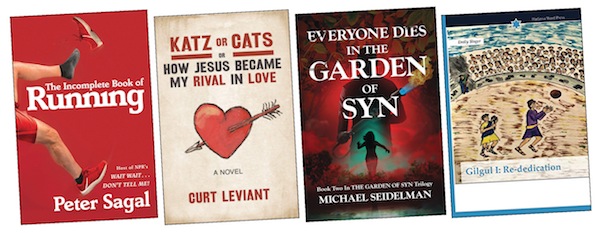
There is a bounty of books to read and review at the Jewish Independent. One of the many perks of my job is that I have so much culture literally at my fingertips. But, given the weekly deadlines and other demands of running a newspaper, I can’t always be au courant. So, hopefully I will be forgiven for reviewing four books published last year for this Passover issue: a memoir, a work of fiction (perhaps 😉 and two young adult novels. I’m excited to report that two of the books were written by people who have written for the JI and one was written by a local community member.

My favourite podcast is Wait Wait … Don’t Tell Me! And, even though I don’t run, one of my favourite magazines is Running Room. I’m not sure how I got onto their mailing list, but I always enjoy reading people’s inspirational stories of why they started running, I like the recipes and nutritional advice and the training tips, which are useful for other types of exercise. Anyway, all that to say I was excited when the host of Wait Wait, Peter Sagal, who is Jewish, came out with his new book, The Incomplete Book of Running (Simon & Schuster, 2018).
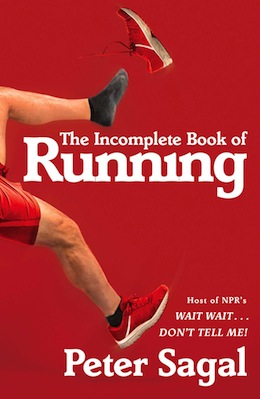
book cover - The Incomplete Book of RunningSagal shares personal stories about why he started running, some of the marathons in which he has participated and people he has met along the way, notably a couple of runners who were blind (or almost), for whom he acted as a guide. Scattered throughout, he offers various facts and figures about running; its health benefits, as well as its downsides (I did not know about, to put it delicately, the digestive issues long-distance runners can face). He speaks somewhat vaguely but openly about the dissolution of his first marriage and he is refreshingly honest about his struggle with depression.

Running has helped Sagal deal with difficult circumstances, and continues to not only be a form of exercise for him, but something that informs how he lives. Among other things, running has taught him persistence and has made him more courageous; it has contributed to his “faith in the possibility of positive change” and his realization of just how enduring is love.

I admit that, despite Sagal’s enthusiasm, reading about multiple marathon experiences, as a non-runner, got a little tiresome. And the book isn’t chronological, so I wasn’t always sure of what point we were at in Sagal’s life. But, those minor criticisms aside, I enjoyed the book a lot, especially Sagal’s conversational style of writing and his humour. Having listened to him almost every week for so many years, it felt, at times, that he was right there, telling me his story; that I was listening to him, rather than reading him.

* * *

There is no doubting that Curt Leviant is a talented writer, that he has a wicked sense of humour and a heightened sense of observation and awareness. Katz or Cats; Or, How Jesus Became My Rival in Love (Dzanc Books, 2018) is his most recent of many novels and fans will not be disappointed.

A book editor, John, and a writer, Katz, meet on the subway. On their commutes into New York, Katz shares what is ostensibly his brother’s love story, though it may be Katz’s. Part of the novel’s plot revolves around just how true, or fictional, is the story of Katz’s brother, who also goes just by his surname, Katz.
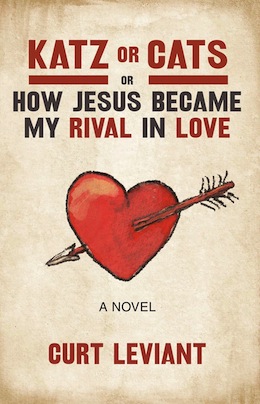
book cover - Katz or CatsAs the story goes, Katz (or Katz) meets a woman on a train. Maria is supposedly a devout Christian, but she has no trouble permitting a stranger to put his arm around her on first meeting, nor having sex pretty soon thereafter with said stranger, Katz, who she thinks might be married. Their relationship – and the novel – comprises much sex, a lot of talking about sex and many discussions about religion – Jesus, specifically, and Maria’s recurring feelings of guilt for not being what she thinks a good Christian should be.

As Katz relates the tale to John, the editor interjects every once in awhile to question apparent contradictions or errors in the telling. Some aspects – Katz’s marital status, for instance – remain unclear, and purposefully so.

Ironically, perhaps, given that the premise of the novel is a writer telling a story to an editor, Katz or Cats would have benefited from some tighter editing. More than one topic recurs and some points are made multiple times. While Katz’s wit and intelligence provide much to think about, I didn’t find him to be a sympathetic character, so “listening” to him became difficult. And, while I’m not a huge fan of political correctness, I found his treatment of Maria to be condescending and rude at times, and some of his quips to be on the edge of disrespectful towards other cultures. Though Katz refers to Maria more than once as smart, her waffling and some of her responses to Katz – and his reactions to her – don’t really support that notion.

Overall, while provocative in many ways, I found Katz or Cats to read like a book from another era. Many male writers, from Seneca to Henrik Ibsen to Thomas Mann to Leviant himself, come up in conversations in the novel, reinforcing my feeling that this book would be most appreciated by older, male readers. But I could be wrong. When I shared my views with Leviant – who regularly writes for the Jewish Independent’s holiday issues (see page 34 of this issue, for instance) – he shared that a similar novel of his, translated into French, got great reviews from young women critics.

* * *

Ever since reading No One Dies in the Garden of Syn in 2016, I have been waiting for the second book of local writer Michael Seidelman’s trilogy featuring teenage heroine Syn. And, late last year, my wait was over.
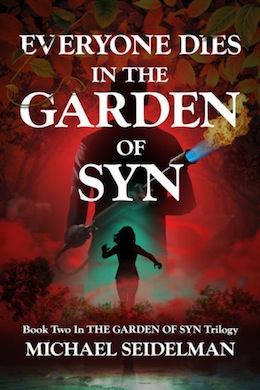
book cover - Everyone Dies in the Garden of SynEveryone Dies in the Garden of Syn (Chewed Pencil Press, 2018) starts with a violent prologue that both heralds what’s to come and starts to explain the “Creepers” – weird-looking creatures that seem to be combinations of two people or a person and an animal or insect – we met in the first novel.

In the introductory pages of Everyone Dies, Seidelman, in addition to moving the story along, reminds readers of what has come before. The action in this book centres around Syn’s need to rescue her sister, who has been kidnapped by Cole, a “boy” who befriended and then betrayed Syn – or, from his point of view, was befriended and betrayed by Syn.

Still missing as Everyone Dies starts are Syn’s parents, who disappeared when she was 5. Because of Syn’s actions in the first book, the garden, which once had healing powers – “no one dies” – has lost them, so now “everyone dies,” or can die, in the garden. Therefore, the situation is that much more dangerous now for Syn, who suffers from cystic fibrosis. Whereas she didn’t have to worry about her health in the first novel, it becomes another thing she has to battle in the second.

And there is many a battle in Everyone Dies, and lots of running and chasing. There were a few times I lost track of which universe (there are multiple) we were in, and, sometimes, who was fighting whom, but the action moves along and the tension builds. There’s a wonderfully satisfying twist at the end. And so begins the wait for Book 3.

To read more about Seidelman’s first Syn novel, visit jewishindependent.ca/first-book-of-trilogy-now-out.

* * *

“When my 13-year-old son devoured Bulfinch’s Mythology after reading Rick Riordan’s Percy Jackson, I realized we need an exciting, thought-provoking series based on Jewish history, something that will send our kids reaching for a Torah, a Talmud or a Book of the Apocrypha,” wrote Emily Singer to the Jewish Independent in an email about her new book, Gilgul I: Rededication (Hadassa Word Press, 2018).

Singer, who lives in Israel, is a writer and a high school teacher. When she and her family lived here, she taught at Vancouver Talmud Torah. She has written several articles for the Jewish Independent so, when she contacted the paper about Gilgul, I happily agreed to review it.
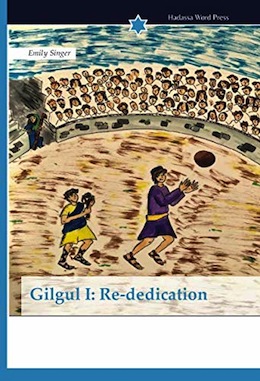
book cover - Gilgul INot surprisingly, knowing Singer’s skill as a writer, Gilgul is a compelling and radical take on the Chanukah story. While all the book’s hero David wanted to do was to play the game skyros with his friends, the game takes on a deadly seriousness for the 15-year-old when King Antiochus sacks the Temple and starts a war against the Jews.

David must be smart, brave, strong and compassionate to stay alive and save his family and his people. He must figure out who to trust, and the fact that it’s not always clear who the good guys and bad guys are adds tension and meaning to the novel. Even with the help of his equally heroic sister Leya, some unexpected courageous allies and a little magic, David has his work cut out for him. Gilgul will leave readers thinking anew about Chanukah, the rededication of the Second Temple, the Maccabees, the miracle of oil, and more.

Format ImagePosted on April 12, 2019April 17, 2019Author Cynthia RamsayCategories BooksTags Curt Leviant, Emily Singer, fiction, Gilgul, memoir, Michael Seidelman, Peter Sagal, Syn, writing, young adults
Spotlight on Israeli culture

Spotlight on Israeli culture

Shira Geffen shares how she met her husband, Etgar Keret, in the film Etgar Keret: Based on a True Story, which screens Nov. 14. (photo from facebook.com/etgarkeretfilm)

“I want to write stories so the readers will like mankind a little bit more,” says Israeli writer Etgar Keret in the documentary Etgar Keret: Based on a True Story. Similarly, as depicted in another film, the Israel Museum aims to uplift and educate visitors with its artistic, cultural and historical displays, and The Museum offers a glimpse into the breadth of its collections and the diversity (and quirkiness) of its employees. Both of these award-winning films screen during the Vancouver Jewish Film Festival, which started this week.

Danish filmmakers Stephane Kaas (director) and Rutger Lemm (writer) do an excellent job of introducing viewers to what makes Keret tick. They do so using a creative mix of interviews with Keret and his family, friends and colleagues; reenactments of sorts of a few key points in Keret’s life; and a few of Keret’s stories, the portrayal of which is mainly done in animation. Not surprisingly for anyone who has read Keret’s short stories, there are several laugh-out-loud moments in Etgar Keret: Based on a True Story, but there are also sombre elements, as we learn about how Keret has been impacted by tragedy, including the suicide of one of his best friends.

One of the funniest scenes is when Keret shares his first story with his brother, Rodi (Nimrod). Rodi brings his dog along for the walk and, after he finishes reading Keret’s story and praises it, he asks whether the typed copy he’s holding is the only copy. When Keret says no, Rodi uses the paper to pick up his dog’s poo. Perhaps a lesson in humility, Keret explains that it was at this moment he realized that a story is not in the piece of paper on which it has been written or typed – once a story has been read, it is in the mind of the reader. Keret calls this ability of a writer to transfer their ideas to another person a “super power.”

While many of Keret’s stories have gloomy aspects to them, the stories as a whole generally leave readers feeling good. He describes his stories as “an advertisement for life,” saying that he writes to answer the question of why he wants to live.

“I think the need to tell stories is, basically, the need to put a structure to the reality around you. And I feel that the more chaotic and the less sense it makes, the stronger the need I have to tell a story about it,” he explains in the film.

Etgar Keret: Based on a True Story screens Nov. 14, 8:45 p.m., at Fifth Avenue Cinemas (19+), following the 22-minute short Large Soldier, directed by Noa Guskov. “It’s 1973 and all that Sherry, a 15-year-old Israeli girl, wants is a boyfriend,” reads the synopsis of the film, which is in Hebrew with English subtitles. “A letter exchange with an unknown soldier makes her believe that it’s going to be her first love. But what will happen when the imaginary soldier becomes real?”

* * *

photo - A scene from The Museum, which screens Nov. 17
A scene from The Museum, which screens Nov. 17. (photo from goelevent.com)

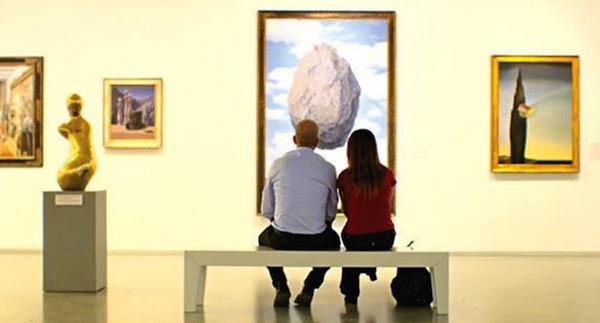
The opening of Ran Tal’s documentary The Museum grabs viewers’ attention: a black screen, the sound of footsteps, some shuffling about, then a woman asks a man, “What do we have?” “That’s a huge painting,” he begins. When the scene is revealed, we see the man and woman sitting on a bench, looking at the painting, but the woman seeing it only through his eyes, as she is blind. Later in the film, this woman is part of a group of blind people visiting the museum – she and others touch various sculptures, feeling how the works are made.

The Museum makes clear the enormous responsibility and privilege of caring for, handling and presenting art and artifacts. Over a period of one-and-a-half years, Tal interviewed several museum staff – including a security guard who is also a cantor; the institution’s kashrut inspector, who notes that “a museum doesn’t replace spirituality”; and the then-museum director, who sadly had to miss his mother’s funeral because it took place on the day the museum reopened after an extensive renovation. Tal also films visitor interactions over that time, and highlights a 50th anniversary event (in 2015) featuring Prime Minister Binyamin Netanyahu and members of his government. Netanyahu remarks that the museum shows three things: “One is our bond to this land in a very dramatic display, and one of humanity’s most significant archeological finds, the Dead Sea Scrolls. Another is the great cultural treasure of the Jewish people in Israel and the world over, which symbolizes our contribution to humanity.”

Admittedly, The Museum only touches upon more serious concerns – there is a scene where a group of museum staff discusses a collection of traditional Palestinian clothing that is in storage, and the potential impacts of displaying (and not displaying) them – but it at least does bring up such issues, which will hopefully open the door for more in-depth discussion.

The Museum screens on Nov. 17, 6:45 p.m., at the Rothstein Theatre. For the full festival schedule and tickets, visit vjff.org.

Format ImagePosted on November 9, 2018November 7, 2018Author Cynthia RamsayCategories TV & FilmTags arts, culture, Etgar Keret, Israel, Israel Museum, short stories, Vancouver Jewish Film Festival, VJFF, writing
Writers inspire, support

Writers inspire, support

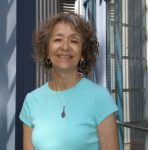
Carol Weinstock (photo by Olga Livshin)

Carol Weinstock only started delving into poetry a few years ago, around the time she joined a writing group. “I was a journalist before I retired,” she told the Independent. The group has motivated her try other forms of writing.

“The core is about five or six people,” Weinstock explained. “They come to almost every meeting. Others come and go. There are men and women, mostly retired. They write in different genres. Some write poetry, like me. Others write memoirs or short stories. One is writing a novel. One woman is a professional artist, but she wants to expand her creative output, to add writing to her range of expressions.”

Diane Darch, another member, recalled how it all started. “Sometime in 2012, people in the programming committee of False Creek Community Centre discussed the need for more programs for seniors, the 55+ group. Several possible programs were considered, including bowling and mahjong, but they finally settled on a writing group, a self-directed program. It officially began in January 2014 with a handful of enthusiastic people, each with an interest in writing for fun, for growth and for sharing a part of themselves.”

Darch has been with the group from the beginning. “I personally joined because I was interested in writing,” she said. “I learned from others’ types of writing and from critiques. It did put some pressure to write either at home or during the sessions. Sometimes, we arranged our own sessions, when the community centre was not available. Friendships were formed because we shared our personal writings. It is a fun group, non-threatening, and gives lots of encouragement to all levels. The group validated my writing.”

A year ago, she moved to Victoria. “I saw the group grow to a healthy dozen, change because of various commitments, then sadly go back to too few,” said Darch. “I’m no longer a regular member and I miss it. I do drop in when I’m back in Vancouver.”

Weinstock is one of the group’s first members, joining in its first year, and she’s been a steady participant since. “Our meetings usually have a structure. It’s flexible, not rigid, but it forces us all to write. First, we talk, share what’s happening in our lives, the books we read. Then someone brings a prompt, and we write for about an hour. Then anyone who wants can share their writing, and we all discuss it. It’s a very supportive environment.”

Weinstock attributes her writing of poetry to the group’s influence. “Poetry is a new form for me,” she said. “Before I retired, I worked as a freelance journalist for various California papers. I also taught journalism at a community college. I never wrote poetry or fiction. After I retired, I returned home to Canada. Then I joined this writing group and I wanted to try something different. And the group helps. It provides me with a scheduled time and place to write and the prompts. I might not have written so much if not for the group. I’m not sure.”

She doesn’t only write to the group prompts. “Sometimes, I would read a news article and a political or social problem would catch my attention. I would write a poem,” said Weinstock, whose journalistic inclinations frequently push her towards controversial or humanitarian issues, concerning some obscure corners of the world. She recalled one such occasion: “I read this story about the plight of the shrimp farms in Asia, and it touched me deeply. I wrote a poem. Other times, I would write something more personal but, in general, I don’t like writing about my personal stuff.”

Poetry is a way for Weinstock to express herself, her thoughts, emotions and ideas in a concise and organized way. A few months ago, the writing group came up with the prompt to write about what Canada means to each of the members, in celebration of Canada’s 150th birthday.

“I started with something different, but it didn’t work,” said Weinstock of the poem she wrote for the occasion. “Then I decided to go with concrete things: what we eat, what we wear, where we live, and the poem unfolded…. I showed it to my friends, and they liked it. One of my friends, Debby Altow, is active in the Jewish community in Vancouver. She regularly reads the Jewish Independent, and she asked if I would mind sending my poem to the paper. I read the paper sometimes, too. Of course, I said yes.”

Each group member participated in the exercise. Some wrote poetry. Others wrote essays. Now, all those pieces of Canada-inspired writing are on display at False Creek Community Centre. Everyone coming into the centre passes by them as they walk down the hallway leading to the reception desk. Some people even stop and read a few.

Olga Livshin is a Vancouver freelance writer. She can be reached at [email protected].


We are Canadian

Beret, turban, skullcap,
Babushka, hijab, headband.
No matter what hat we wear,
We are Canadian.

Fry bread, falafel, poutine,
Pizza, curry, Kraft dinner.
No matter what food we eat,
We are Canadian.

France, Britain, India,
Ukraine, China, Jamaica.
No matter where we come from
We are Canadian.

Ucluelet, Cape Breton, Moose Jaw,
Attawapiskat, Yellowknife, Flin Flon.
No matter where we live,
We are Canadian.

Teacher, nurse, farmer,
Reporter, welder, programmer.
No matter what work we do,
We are Canadian.

Blending, fusing,
Reconciling, adapting.
We work, sweat, dream together
To create one Canada.

– Carol Weinstock, June 2017

Format ImagePosted on September 15, 2017September 14, 2017Author Olga LivshinCategories Arts & CultureTags Carol Weinstock, poetry, seniors, writing

Posts pagination

Previous page Page 1 … Page 3 Page 4
Proudly powered by WordPress