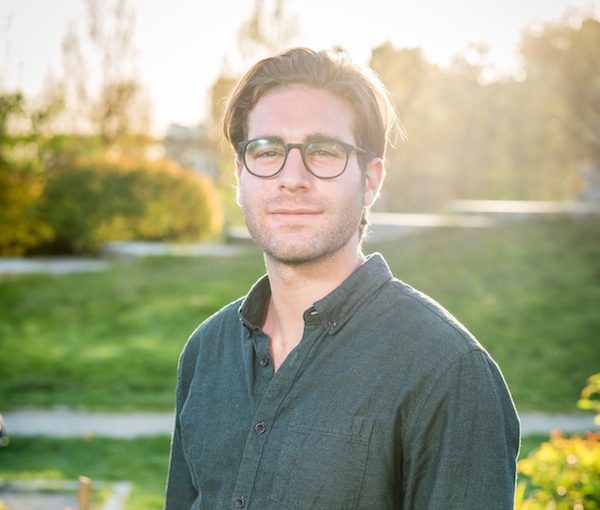
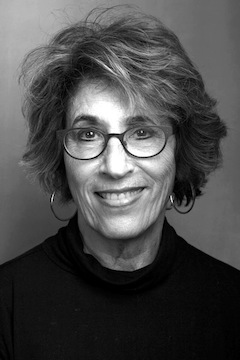
Aaron Friedland, creator and host of the podcast Impact in the 21st Century. (photo from Aaron Friedland)
If you’re looking for a new, uplifting podcast to cast away the oppressive weight of pandemic blues, consider Impact in the 21st Century, recently launched by Vancouverite Aaron Friedland. The Vancouver-based founder of the Simbi Foundation, which promotes literacy and education worldwide, felt it was time to give voice to the inspiring things that people are doing.
“There’s a lot of really bad news and horrible things going on and, as a species, we seem to be more interested in those stories,” Friedland told the Independent in a recent interview. “There are lots of podcasts available that celebrate big businesses and a very capitalist ideology. Our goal is to help showcase the amazing, impactful things that many brilliant people are doing and that often go unnoticed, and to mainstream what positive impact really means.”
To date, Friedland has interviewed Neil deGrasse Tyson, an astrophysicist and scientific educator; David Suzuki, an academic, broadcaster and environmentalist; Maryanne Wolf, a Jewish author and Harvard academic researching the brain; Ndileka Mandela, the granddaughter of Nelson Mandela; and Alex Honnold, a rock climber and subject of the movie Free Solo. “It’s so nice to be the one doing the interviewing, and the people I’m speaking with are such brilliant minds with brilliant insights to share,” Friedland said. “I feel deeply privileged to be getting that information firsthand.” The plan is to release a new podcast every two to three weeks.
The Royal Bank of Canada has sponsored Impact in the 21st Century, but Friedland said he’s always looking for more sponsors. “Our goal is to reach a point where we have enough podcast sponsors that, with each episode we release, we can build another Bright Box,” he said. The Bright Boxes, which cost $55,000 per box, are classrooms comprised of shipping containers, refurbished with solar technology and aimed at enhancing learning in overcrowded classrooms in places that have little or no access to electricity.
Friedland’s next podcast will be an interview with Canadian cultural anthropologist Wade Davis. His dream interviewees are Elon Musk and David Attenborough, but he’s biding his time until those happen. “It could be they’re not ready yet,” Friedland quipped. “We look for subjects who have a track record of creating longstanding positive impact, and whose vision and values really align with ours.”
Listeners can stream Impact in the 21st Century anywhere they access their podcasts, or online at simbifoundation.org.
Lauren Kramer, an award-winning writer and editor, lives in Richmond. To read her work online, visit laurenkramer.net.
Awhile back, friends invited me to a writers group. Although I told them that I wasn’t quite the right fit for the group, they convinced me to go.
The meeting was nearby. I enjoyed walking on a cold, dark and starry night. Yet, the meeting’s “gatekeeper” told me that I wasn’t eligible for their future gatherings, as I didn’t (yet) write or edit in their genre. Instead, she invited me to another writers event in October. (I’m not on the social media lists for these types of things, as I tend to focus on writing deadlines and my household – and I’m introverted.)
The event, titled Diaspora Dialogues, took place on a Friday and Saturday. Although it might been possible for me to attend some parts of it, I saw only one gathering that interested me. Called Vulnerability and the Public Space, it boasted a live podcast, but it was held on Saturday afternoon. As someone who writes on religious issues in the public sphere, it seemed relevant. However, I saw no way that I could pull off attending – Saturday is a family day for us. After we go to services, I’m often feeding everyone a big lunch and playing with kids afterwards. (In an ideal world, we’d even take a nap!) To go, I’d have to have given up my day off and commit to attending on Shabbat.
This “diaspora” event, which seemed designed for Canadians of colour, was scheduled at a time when Muslims might be busy (Friday afternoon) and on Shabbat, when Jewish families might be busy with family or synagogue or both. It wasn’t inclusive of religious diversity. It excluded any person who might be both religiously observant and a Canadian minority.
Even the event’s title puzzled me, as the first dictionary definition for diaspora usually references the historical dispersal of the Jewish people outside of Israel. The “scattering of a people outside their original country to other places” is a secondary definition. So, OK, this was a secondary use of the definition, fine.
I resolved my personal conflict. I emailed one of the organizers to point out the discrepancy. Although I write about vulnerable religious issues, often in the public space, I wouldn’t be able to attend this “diaspora” event, as its timing excluded Canadian religious minorities. No matter, though, perhaps I could access the podcast online later? Where, I asked her, could I locate the podcast link?
I received no reply. The podcast never appeared online.
We celebrate our religious freedom on Chanukah. It’s the chance to rededicate our spaces to Jewish practice. However, the holiday’s origins are a tale of struggle between minorities and the majority: Jewish assimilationists, religious fundamentalists and the Seleucid empire’s religious majority (aka the Greeks, or the Assyrians). We remind ourselves of this in each generation – we can’t take religious freedom or Jewish practice for granted.
There has been a huge rise in antisemitic activity. Identifiable Jews or Israelis are now often targeted, assaulted and harassed throughout the world.
A far more subtle and insidious change has also happened in terms of Jewish identity. Now, U.S. President Donald Trump has decided, via presidential order, to define Jewish students as an ethnic or racialized “national”group that, theoretically, can’t be discriminated against. Yet, the definition alone is a worrying precedent.
Take a look around you at any Chanukah event. We’re not one race by any (purely artificial and historic) definitions. We aren’t one homogenous ethnic group, even if we might have been thousands of years ago. Just ask those who argue about doughnuts versus latkes or other holiday foods. What or who defines us? We’re now facing new identity definitions – as delineated from the outside.
We are a diaspora religious minority group that evolves and changes. We haven’t disappeared despite changing definitions.
Chanukah’s a minor holiday on our calendar. It celebrates clinging to our freedoms in a dark world. It relies on a subtle understanding that not all discrimination is based on racism. It implies that religious, ethnic or racial background alone doesn’t solely define someone’s minority status.
A true acknowledgement and respect for religious freedom is one that practises intersectionality instead.
What is intersectionality? Our identities – racial, sexual, class, gender, religion, nationality, etc. – are complex and changing. We are each the result of several roads, always under construction, that meet in one huge intersection.
As Jewish North Americans, living in the Diaspora, we’re more than one ethnicity, gender or race. Together, we celebrate our tradition and identity as a triumph over adversity. We just may have to celebrate with an understanding that we’re no longer included in some folks’ definition of diaspora and, hence, excluded from the narrative. Heck, I cannot even access the podcast about the narrative!
Wishing you a very happy, inclusive Chanukah from my family to yours. Have a great winter break, one where you feel included! May it be full of light, joy and peace.
Joanne Seiff has written regularly for CBC Manitoba and various Jewish publications. She is the author of three books, including From the Outside In: Jewish Post Columns 2015-2016, a collection of essays available for digital download or as a paperback from Amazon. Check her out on Instagram @yrnspinner or at joanneseiff.blogspot.com.
At the University of British Columbia on Nov. 21, Prof. Robin Judd will speak on What’s Love Got to Do With It? Jewish War Brides and North American Soldier Husbands after the Second World War. (photo from Robin Judd)
Prof. Robin Judd noticed that a significant number of the earliest Holocaust memoirs written by women were penned by “war brides” who had married American, Canadian or British soldiers.
In the course of teaching about the Holocaust at Ohio State University, the coincidence struck her and, as happens in research, led her onto a new topic. She is nearing completion on a book about the experiences of Jewish women – and a few men – in Europe and North Africa who married Allied service personnel and moved to Canada, the United States or Britain. She will give a guest lecture on the subject at the University of British Columbia next week and the public is welcome to attend.
The lecture is titled What’s Love Got to Do With It? Jewish War Brides and North American Soldier Husbands after the Second World War, and Judd told the Independent that love certainly played a key role, but some of the other factors at play also interest her.
“What prompts individuals from radically different cultures, who may not necessarily speak the same language, what prompts them to create relationships with one another and long-lasting relationships, relationships that are going to result in marriage and then bring the civilians to Canada, Britain or the United States?” she asked.
Most of the soldiers that Judd is studying were Jewish themselves, though there are exceptions to the rule.
In some cases, the wives would arrive in the new country before or otherwise apart from their new husbands or fiancés. An entire infrastructure was in place to accommodate and integrate them.
“The war brides, particularly if you come to the United States or to Canada as a war bride, first you live with other war brides at least temporarily in a kind of war bride home or war bride camp and you travel on a war bride ship and there are particular Red Cross workers who teach English and show films and cooking classes,” she said.
If the fiancés or husbands were not yet decommissioned or were traveling with their units, the brides may have found themselves in the position of living with their new in-laws.
“These were not the spouses they were planning for their sons,” Judd comments. “And all of a sudden here you have this woman show up. You are processing stories that you are hearing about the war and all of a sudden here comes this person and you might not be able to communicate, you might not have a shared language, you might not know how to even ask questions about what this person had experienced.”
Feeling isolated and foreign, some of these women used the opportunity to express their experiences privately, to themselves, in writing.
“Some of the women that I’ve spoken to have told me that they used that time to write out their story, to put it to paper, because they needed to kind of get it out and there was no one with whom they could talk, literally,” she said. “But then, as they began to create networks, make new connections, maybe by that point their now-husbands have returned to Canada, Britain or the U.S., a number of them tell me that they then destroyed them.”
By an apparent coincidence, though, Judd concluded that it was disproportionately the women who had married soldiers who were among the first to publish English-language Holocaust memoir narratives for general readers in the 1970s and ’80s. She has a theory about this, but admits she could be wrong: these may have been some of the first women who were asked to speak about their early life and Holocaust experiences to Jewish women’s groups, federations and other community audiences, acclimating them to become among the first to put them on paper for general readers.
“But, again, I could be completely wrong,” she said.
Judd’s lecture is supported by a Holocaust education fund in UBC’s department of history to support undergraduate education on the Holocaust. The fund supports a biannual lecture, alternating years with the Rudolf Vrba Memorial Lecture, and is incorporated into an undergraduate course, History of the Holocaust, taught by Prof. Richard Menkis, who is also chair of the committee that manages the fund. The public is welcome to attend on Thursday, Nov. 21, 5-6:15 p.m., at Buchanan D217 at UBC.
Judi Majewski can help you express what you’d like to say in writing. (photo by Pat Johnson)
Want to write your thoughts down but you’re not so good with words? Need to write a difficult letter? Want to record some memories? If you need a ghostwriter to help you express what you need to say – no matter what it is – a volunteer is ready and willing.
Judi Majewski has been offering the free service at the Isaac Waldman Jewish Public Library since the summer. She hopes readers of the Independent might know someone who can use her help.
“I thought, I know people struggle with this, so I would love to help people,” said the former public school teacher. Writing comes easy for her, she said, something she knows is not the case for everyone.
People for whom English is not a first language might benefit from her help, Majewski said, but she’s excited to help anyone.
“I think anybody, really, who wants to tell a story, who wants to record a memory, record their family history, write a eulogy. And anybody who struggles with putting things down on paper – I think there are a lot of people like that,” she said.
Publishing has never been a desire for her, she said, she just enjoys writing as a way of communicating feelings and thoughts.
“I have written the occasional difficult letter,” she said. “Sometimes your emotions are so involved and sometimes I think people can use help.”
She knows her challenge is to capture the voice of the person for whom she is writing.
“I want it to be in their voice. I think that’s going to be the interesting challenge for me, to see if I can do that, to see if it speaks for them,” she said. “That’s very important.”
Her husband told her she could make a business out of it, but she doesn’t want to go into business. She’s just happy to help, she said.
He offered some other advice, too.
“My husband says I express myself much better in the written word,” she said laughing. “Sometimes we think maybe we should just write to each other.”
To contact Majewski, visit her at the Waldman Library, in the Jewish Community Centre of Greater Vancouver, until Dec. 11, where she will be every other Wednesday, at 1:30 p.m., or email her directly at judimajewski@gmail.com.
Want to make a difference in the lives of Israeli teens? Consider joining Israel Connect, a program where local volunteers connect online, one-on-one, via Zoom (a video conferencing app), with Israeli high school students who want to improve their English conversation and reading skills. The program starts at the end of October and is sponsored by Chabad Richmond. It entails a half-hour per week commitment.
“We’re looking for volunteer retirees, seniors or adults with flexible schedules. No previous tutoring experience is necessary and the curriculum is provided,” said Shelley Civkin, local coordinator of the program.
“We’re looking for Jewish adults who are fluent English speakers, have basic computer skills and own a computer with a camera,” said Civkin. Volunteers can do this from home and technical support is available if needed. Time preferences of volunteers will be coordinated beforehand and sessions take place in the morning between 7 and 11 a.m. any day from Sunday to Thursday. Volunteers will be trained in how to download and use Zoom.
“It’s a very meaningful, practical way for community members to support Israel,” said Rabbi Yechiel Baitelman of Chabad Richmond. “You’ll be doing a mitzvah, while investing in Israel and its young people. Plus, good English skills will give them an advantage in accessing post-secondary education and getting better jobs.
“English proficiency is crucial to Israeli students, since it accounts for a third of their entrance exam marks for university,” he added. “Partnering with the Israeli Ministry of Education, the Israel Connect program targets teens from disadvantaged neighbourhoods in Israel. The tutoring sessions are vital to students’ upward mobility in terms of education and jobs, which is why this program is so vital.”
“Most volunteers really enjoy helping their Israeli students and make great connections with them. It often goes beyond simply tutoring the curriculum and turns into friendship and mentorship,” said Civkin. “This kind of one-on-one tutoring makes a significant difference in their lives, both educationally and personally. It’s hard to estimate the impact of this tutoring on Israeli youth, but we know it’s significant. And it’s incredibly satisfying to know that you’re doing something concrete to help Israeli students improve their lives. Several tutors have visited their students on trips to Israel, and keep in touch beyond just the school year. Building relationships is an integral and highly satisfying part of this program.”
For more information, contact Civkin at 604-789-5806 or civie1956@gmail.com.
Ken Hughes infuses his paintings with messages. (photo by Olga Livshin)
Ken Hughes has always been fascinated with typography. “Since childhood, letters of the alphabet have intrigued me,” he said in an interview with the Independent.
“Public lettering is a centuries-old method of civic communication, both official and informal,” he said. “It goes back to Mesopotamia. By Greek and Roman times, public writing – inscriptions on buildings, commercial graphics, signs, epitaphs on tombs, graffiti – was common. The messages could be political or commercial, funerial or commemorative, religious or frivolous. In more contemporary times, particularly in Europe, public inscriptions have undergone a revival.”
The artist draws from this rich tradition for his paintings and his new show at the Zack Gallery, Ancient Writings in Contemporary Contexts, opens next week. A collection of inscriptional paintings, beautiful and evocative, colours and shapes of the images enhance and deepen the meanings of the lettering, and every piece tells a story.
Before retiring, Hughes was a professional graphic designer. He taught graphic design for years at Emily Carr and Kwantlen universities. He turned to art five years ago.
“Inscriptions – texts expressed formally or otherwise in different alphabets or languages – are a major source of inspiration for my paintings,” he said. “This particular exhibition’s goal is to visually express texts related to Jewish beliefs and culture. Some of the paintings have writings in the Hebrew alphabet. Others have transliterated Hebrew using the Roman alphabet.”
He explained that the messages in his paintings come from various sources: the Hebrew Bible, fiction and nonfiction by Jewish writers, as well as quotes by famous people, all related in one way or another to Jewish culture.
“I don’t speak Hebrew,” he said, “but I have friends who do. I always ask them to check the writing before I incorporate it into my paintings.”
In his work, the esthetics of the letters are intertwined with the message of the citation used. He has been collecting quotes, personal mottos, sayings and other forms of public texts for a long time. “I sing in a choir, and much of choral music is liturgical,” he said. “It has incredible messages, many of them in Latin. I also read a lot and get my messages from books, from newspapers, from common idioms.”
In 2002, Hughes took a yearlong sabbatical from teaching to prepare for what he does now.
“I traveled through Europe – Poland, France, Turkey, Belgium, Greece and Israel,” he said. “I took photos of the public inscriptions on civic buildings, in churches, at cemeteries. I wrote down quotes from illuminated manuscripts in national libraries. There are incredible inscriptions on the tombstones in Budapest, where many famous Hungarians are buried. Jewish cemeteries have beautiful inscriptions in Hebrew.”
Sometimes, a line of text or a quote stays in his memory or in his notebooks for decades before appearing in one of his paintings. Many of his pieces are sad, executed in a darkish palette, underscoring words of deep emotion: grief, fear, despair, memories of hard times and bleak thoughts. But there is hope and joy, too, and Hughes uses bright and colourful compositions to accentuate those messages.
One of his uplifting works, a multi-paneled cycle based on the story of Genesis, with Hebrew lettering dancing across the panels, is decorative as well as informative. The series will be in the exhibit at the Zack.
“Alphabets are amazing inventions, incredible almost,” Hughes said. “They allow people to communicate ideas with just a few symbols. And they are all different – the Roman alphabet, the Cyrillic letters, the Hebrew. In all cases, letters by themselves mean nothing; they’re just symbols. But a combination of letters, a phrase, could have profound meaning.”
When Hughes starts working on a piece, he approaches it as a designer, with a typographer’s attention to detail. He makes many sketches while investigating each idea. What colours should be employed and in what combinations? What is the best number of panels for this message and the most expressive configuration to highlight the meaning of the words? Even the font used can make a difference.
“Some letters look better in a rounded font; others need a blockier typeface,” he said. “The positioning of the letters and the words could be of paramount importance in my paintings. They constitute the composition. And, of course, the message itself often dictates the font type.”
There are not many artists in Canada who dedicate their art to this kind of painting.
“I wanted my paintings at the Zack,” Hughes said. “I don’t want to display at commercial galleries. I think my works are much more suited to schools, churches or community centres.”
Ancient Writings in Contemporary Contexts runs from July 25 to Aug. 25. To learn more, visit kenhughes-art.com.
Olga Livshin is a Vancouver freelance writer. She can be reached at olgagodim@gmail.com.
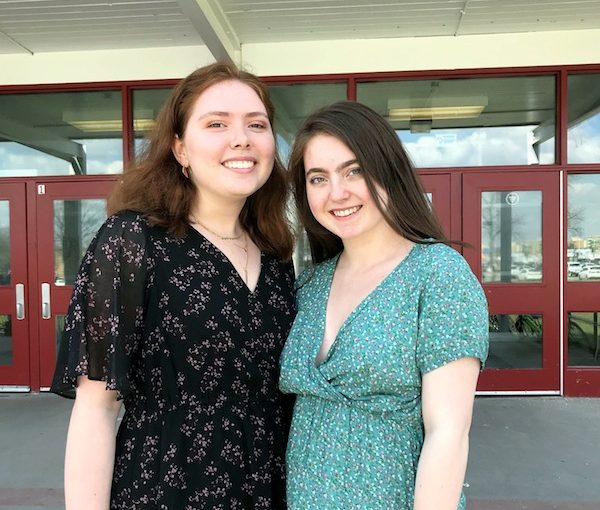
Katie Delay, left, and Sunny Enkin Lewis are co-presidents of Grant Park High School’s Students for Social Justice. (photo from Sunny Enkin Lewis)
Earlier this year, Winnipeg Grade 12 student Sunny Enkin Lewis won first prize for her age group in A&E network’s contest Lives That Make a Difference. The contest receives hundreds of submissions from all over Canada.
“The prompt [for the contest] is along the lines of, ‘Write an essay about someone who has made a significant contribution to Canada in 2018,’” Enkin Lewis told the Independent. “So, I wrote about Autumn Peltier, who – I believe she’s 15 now, around there – is an indigenous water keeper. She’s an activist for clean water in indigenous communities in Canada. She’s spoken at the UN, she’s spoken to Prime Minister Justin Trudeau. So, she’s done a lot of amazing activism.”
Peltier is Anishinaabe and is from the Wikwemikong First Nation on Manitoulin Island in northern Ontario.
“I chose her for a couple reasons,” said Enkin Lewis, who was born in Toronto, but has lived in Winnipeg for the past 10 years. “First of all, I think her cause is really important in Canada. I’ve always been really upset with Canadian society and government, because we tend to look at ourselves as pretty flawless in terms of human rights. And, it is true that the quality of life for Canadians, overall, is really good. Yet, there are people, a lot of people, who don’t have the most basic of their needs met – water and shelter … and I think she has brought more awareness to that.”
In her essay, Enkin Lewis points out that Peltier not only stands up fearlessly for this cause, but that she does so from a unique worldview as an Anishinaabe person.
“She thinks of water as deserving of rights,” said Enkin Lewis. “That’s not something we would generally think of and I think it’s a really strong statement – that someone can stand up and speak of things in a way that contrasts the common logic of general Western ideas. I think that helps validate indigenous worldviews in a Western context a little more. Also, I was just inspired by her, as a young woman. I think it’s so important that young people’s voices are heard and that’s how I believe change will happen the fastest – if young people are given a platform and are accepted and respected – and she really embodies that.”
As for as why Enkin Lewis’s essay may have been chosen, she said, “I think my choice of person was really relevant in Canada today, especially since, now, I think, there’s a big focus on indigenous rights, and I think it was maybe a bit refreshing to see someone like that. I haven’t read the other people’s essays, and they didn’t tell me why mine was specifically chosen … just that they thought it stood out.”
Growing up, Enkin Lewis learned that “a big thing in Judaism is valuing life over everything, and knowing the value of human life. And, I think a big part of Judaism is also just respect for people and … everyone should have a good quality of life.
“The fact that, here, in Canada, there are people who don’t have their basic needs met, I think that’s not OK in Judaism. I think it’s important for other cultures to listen to each other, just as I think it’s important for Christian people to listen to Jewish people. And, I think it’s important for Jewish people to listen to indigenous perspectives. As a European Jew, I’m not native to this land … and it’s important to respect the people who are the caretakers of this land and who have been for thousands of years.”
Last year, Enkin Lewis led the organizing of a social justice conference at Grant Park High School, which, in turn, led to the development of a student social justice club at Grant Park. Enkin Lewis and co-president Katie Delay created the club and, because they and the teacher involved in helping to form the group will have left the school by the start of the next school year, Enkin Lewis hopes the younger members will pick up the ball.
“I think our club is very student-centred, very much about what we care about right now, and it gives me and other people an opportunity to get involved in a safe and constructive way,” she said.
As Grant Park has many newcomer Yazidi students, events organized by the club have been focused on building community awareness of the Yazidi situation.
“We did a drive for school supplies for underprivileged students in Winnipeg, and the biggest thing we’ve done is organize a coffeehouse and a couple other events for Yazidis with the help of a local organization called Operation Ezra. We had a bake sale where we sold traditional Yazidi foods, a Yazidi dance class to educate people about the culture, etc. I find that people are not really aware of what’s happening to the Yazidi people.
“We had a coffeehouse in the evening and invited community members, students, parents, anyone to come. There were student performers and a speaker talking about what’s happening, and a Yazidi performer.”
Enkin Lewis’s essay win comes with a $3,000 cheque for her and a $1,000 cheque for her school. She plans to follow her family’s Jewish custom of donating a portion of everything they earn. “I haven’t narrowed it down to a specific organization yet,” she said, “but I’m going to donate it basically to her [Peltier’s] cause – water in indigenous communities. Other than that, I will probably put it toward my education.”
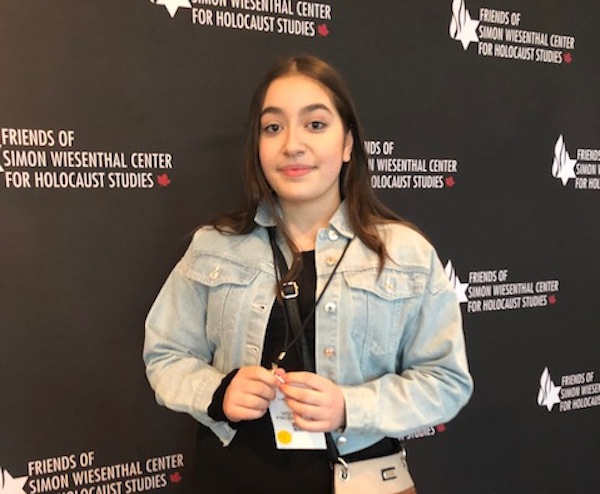
Deema Abdel Hafeez placed third in the Friends of Simon Wiesenthal Centre for Holocaust Studies’ annual speech contest. (photo from Janet Lee Elementary School)
Every year, the Friends of Simon Wiesenthal Centre for Holocaust Studies puts out a call to Ontario students in grades 6 to 8 to submit a speech reflecting on a quote of Holocaust survivor Simon Wiesenthal, z”l. This year, the quote selected was, “I believe in the good in people,” and students were encouraged to think about how to make the world a better place.
Deema Abdel Hafeez, a Grade 8 student at Janet Lee Elementary School in Hamilton, Ont., entered the contest, the first round of which was in February. Hafeez comes from a Palestinian family who moved to Canada 20 years ago.
“When I heard the quote, I didn’t want to just base it on the good in people … unicorns, rainbows,” Hafeez told the Independent. “I, more so, attacked the quote. I was like, you cannot believe in the automatic good in people, because it takes time to find the good in people.
“I wrote about my Islamophobic experiences. I was saying that you have to define the word ‘good’ to believe in the good in people. And, you have to become the good yourself before you can assume the good in other people.”
Hafeez shared that, while her school is pluralistic, with students of many different faiths, racism still very much exists.
“All the racist slurs and things like that, that’s how I attacked the quote,” said Hafeez. “I talked about how my family can’t go out without [experiencing it] … how my mom is being told to go back to her own country, or how anyone wearing religious clothing … is attacked in social standing … and how things are at a disadvantage for people like us. Obviously, it’s not as bad as it used to be, but, as a world, we need to try to change more.”
Hafeez said one of her Muslim neighbours had been badly beaten, to the point that he had almost died, just because he is a Muslim.
In the classroom, Hafeez has witnessed hate. “People mention jokes on social media and like things like that, and they talk about different colours of skin as if following a stereotype… and it’s, like, you’re funny, but you’re not … it’s just rude.”
When asked about how her parents felt about her entering the competition, Hafeez said she had entered without their knowledge. “It wasn’t because they wouldn’t have allowed me to,” she said. “But, I kind of just entered without telling anyone. At home, we talk about the Palestine-Israel conflict a lot, because we have a lot of family in Palestine. We can’t hate a whole group of people, because that’s hypocritical and we’re nice people … so, we don’t hate Israeli people. I have a lot of Israeli friends and I’m Palestinian. It’s cool, because, I feel like, with the Palestinian-Israeli conflict, there’s a way we can live in harmony, both nations living in the same land.”
Hafeez is a member of the school group Making a Difference.
“We do a lot of fundraisers and things like that,” she said. “I volunteer my time while making projects for my school and having the whole school getting involved in these projects. That’s how … I think I’ve become ‘the good,’ in my opinion. I find good as not seeing other people as objects and not labeling them and things like that … becoming the good is more mental to me. You can’t judge anyone. You can’t say, this person is good or bad. You can define yourself and, if you believe you’re doing the best you can at being good … if everyone did that in the world, then we’d live in a better place.”
Hafeez said she watches the news a lot and feels there is far too much violence that results from people judging others.
“I’m not talking about politics,” she said. “If everyone just stopped judging other people based on their religion, colour, sexual orientation … if everyone just focused on themselves, then our world wouldn’t be as hateful a place as it is right now.”
Hafeez practised her speech with her eight siblings.
“I feel like the hardest part for me was just managing my time and how I was supposed to practise my speech, and do all the things for my speech while I also have school, sports, classes … that was the hardest part,” said Hafeez. “The speech itself came easy for me. It is my own thoughts and is everything I’d thought about before. I stayed up late at night thinking these thoughts. I already knew what I wanted to say, so, on the stage, I wouldn’t be reading off a paper. I’d be talking about what I’ve been thinking about.”
The practise paid off. Hafeez was among 10 students chosen to attend a workshop and have their speeches taped as part of the semifinals on March 3 at the Friends of Simon Wiesenthal Centre in North York, a suburb of Toronto. A panel of judges then selected five students for the finals on March 28 at the Toronto Centre for the Arts. Hafeez placed third, winning an iPad.
Hafeez and her school have sent the Simon Wiesenthal Centre a grant application in the hope of organizing a peace summit, incorporating some anti-Islamophobic and anti-discrimination workshops for area schools.
Hafeez is already thinking about what types of activities she would like to undertake in high school, next year, such as starting up a group for change.
“I feel like, when I do that, I’ll be introduced to everything else I can do at my high school,” she said. “I have a lot of siblings, know a lot of teachers. I feel like it won’t be hard, to use my voice to reach people in high school.”
Meanwhile, Hafeez will find good use for her new iPad.
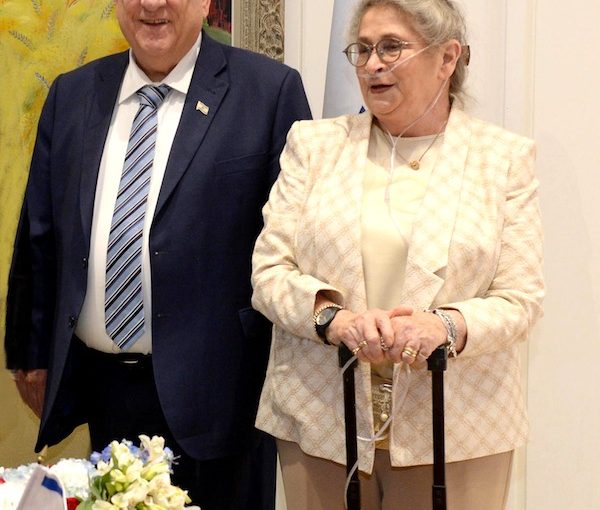
Israeli President Reuven Rivlin and his wife, Nechama, in Jerusalem in May 2018. (photo from Ashernet)
Nechama Rivlin died June 4 at Beilinson Hospital in Petah Tikva, at the age of 73. She had undergone a lung transplant operation three months ago because of pulmonary fibrosis. She received a lung from Yair Yehezkel Halabli, 19, of Ramat Gan, who drowned in Eilat. President Rivlin extended his family’s thanks to the Halabli family, “who donated their late son Yair’s lung, for their inspiring nobility and wonderful deed.”
Nechama Rivlin was born in 1945 in Moshav Herut in the Sharon region. She completed high school at the Emek Hefer Ruppin Regional School. In 1964, she began studying natural sciences at the Hebrew University of Jerusalem. After graduating, she worked at the Hebrew University of Jerusalem as a researcher in the department of zoology, and other departments. In addition, she studied modern, classical and ancient art. In 1971, she married Reuven (Rubi) Rivlin and settled in Jerusalem. They have three children and many grandchildren; she was sister to Varda.
Rivlin’s fondness for Hebrew literature and art led her to write from time to time about writers and artists, who particularly appreciated the posts she published on the official Facebook page of the president. She generally began her posts with the words, “Hello everyone, Nechama here,” and signed them “Yours, Nechama.” In 2018, she established the President’s Award for Hebrew Poetry.
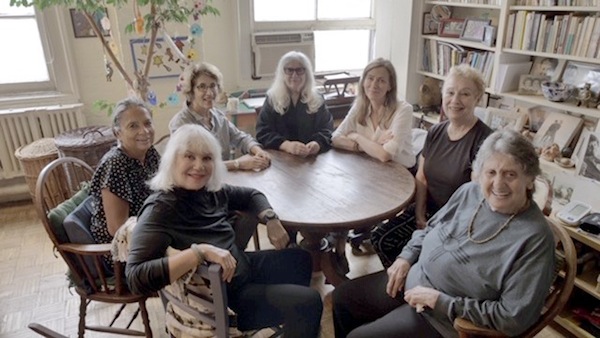
“Stories Around the Table” meets a couple of times a year to present and critique their writing. (photo from Karen Ludwig)
Today, at Karen Ludwig’s home in New York, the actor, director and teacher regularly leads a group of women in story sharing.
Ludwig, whose father is from Winnipeg but whose family origin is Russian, grew up in San Francisco. “It was a very antisemitic San Francisco town,” said Ludwig of the time. “And the German-Austrian Jews kind of ran the city, and they looked down on Russian Jews.
“We had a rabbi in my temple, Emmanuel, who used to say, ‘Hear, o-Is-roy-ale,’ and I never knew he was actually saying ‘Israel.’
“My mother would speak in a whisper, ‘Is she Jewish? Is he Jewish?’ I never heard the word ‘Jew’ out loud until I came to New York. Then, someone asked, ‘Are you Jewish?’ And, I said, ‘Hey, take it easy.’ But, New York is a Jewish town.”
Ludwig’s parents were amateur actors, acting in synagogue plays, and her family regularly went to see musicals and plays together in San Francisco. Ludwig knew that, when her parents were on stage, they had such a good time and she wanted to be up there with them.
When she was 14, Ludwig subscribed to Theatre Arts Magazine. The late Anne Bancroft was on one cover; she was in the play The Miracle Worker and was making the sign of the letter “L” for love.
“There was something about that picture that was magnetic,” Ludwig told the Independent. “I thought, that’s what I want to do.”
New York-based Karen Ludwig leads a writing group for women. (photo by Frankie Alduino)
Cabaret was all the rage and Ludwig went to see a show with her then-boyfriend. She enjoyed it so much that she went to see it again on her own a couple more times and the lead performer, Kaye Ballard, noticed her.
“She came out one time,” said Ludwig, “and saw me and said, ‘What, do you sleep here, kid?’ And, I was born. I thought, ‘That’s it. I’ve been recognized.’ And, I became a follower of hers, because … I loved anybody who made me laugh.
“She met me for coffee a couple months later, very graciously. And, she said, ‘If you’re serious about being an actress, don’t go to college. It won’t do you any good. Go to New York while you’re young and study.’ And so, I did, [after] I went for one year of San Francisco state college. I played the lead in a play called The Wingless Victory, by Maxwell Anderson, and I thought, well, this is easy.”
Ludwig went on to perform in other plays – some on Broadway and some off-Broadway. She even had the chance to work with Bancroft, and they became friends.
This is what led Ludwig to start her women’s group for actors who could write.
While the group took a hiatus for several years, Ludwig restarted it two years ago. They meet every Wednesday and write about topics that are rarely discussed or written about by men.
Ludwig said she developed her writing skills out of necessity. “I did it because I was tired of waiting around for parts, because, as I got older, as a woman, parts became fewer and fewer. So, I decided to write my own show about my career – who I met, who I worked with and, then, another thread through it was my mother and my relationship with her. And the show was very successful.”
Ludwig won a one-night space rental in a competition at Joe’s Pub at the Public Theatre and so performed her stand-up show on that one night. She described it as a wonderful but terrifying experience. Later, for almost two weeks, her show ran at another little studio in the city.
One of the pieces of history that Ludwig shared in the show was her experience playing Ethel Rosenberg in the movie Citizen Cohn. She was very involved in it, even raising money for the Rosenberg Foundation for Children, which “supports children whose parents are incarcerated,” said Ludwig. “I did all kinds of research about how Ethel Rosenberg died, and how many volts of electricity she had to have to still her heart, and then I showed the clip of it in the show I did. I did quite a bit about Ethel Rosenberg and the two boys she left behind, and that she, in fact, was not guilty.”
In her writing group, Ludwig prompts participants each week with a topic to help them focus their writing on different aspects of their lives. This brings about a variety of views on any given topic and the women push one another to dig more deeply than they would on their own.
“There are things that happen in a room with just women that don’t happen with men,” said Ludwig. “So, I thought we would take advantage of that. I use prompts like…. ‘My mother walked into my bedroom and said….’”
Living in the Westbeth Artists Housing complex allows Ludwig to have a big table, so the group has dubbed their meetings, “Stories Around the Table.” They present and critique their writing about twice a year and the subject matter ranges from family to politics to hair and beyond.
Ludwig began her teaching career in Israel. “I kept saying, ‘This country isn’t going to affect me that much,’” recalled Ludwig. “I’m a Reform Jew. What do I care really about Israel? But, from the moment we landed at the airport and they started singing, I began to weep, and weep and weep. And then, there’s a clip of me going toward the Wailing Wall. Again, I’m saying, ‘This doesn’t affect me. It has no meaning for me.’ And, before you know it, I’m davening. It was hard for me to leave Israel, because the actors were saying, ‘You’re a Jew. You should stay here and teach. This is your place to teach us what you know.’ It was very hard to leave; I did love it there.”
In a way, Ludwig’s Israel encounter parallels what she aims to get her writers to experience in their sessions – to discover a connection, to one another, to their past, to the world.
“The whole idea is about sharing each other’s feelings and thoughts about what’s going on … so you don’t feel so isolated,” said Ludwig. “There isn’t a goal exactly. It’s just about the sense of feeling united, together … critiquing each other’s work. And, if we don’t understand something, we talk about it.
“There’s a certain kind of pressure that’s off. There’s a certain feeling of generosity. Really, how many feelings are universal? There’s not that much that separates us, really, in terms of human experience.”