Skip to content
  • Home
  • Subscribe / donate
  • Events calendar
  • Business Directory
  • FAQ
  • News
    • Local
    • National
    • Israel
    • World
    • עניין בחדשות
      A roundup of news in Canada and further afield, in Hebrew.
  • Opinion
    • From the JI
    • Op-Ed
  • Arts & Culture
    • Performing Arts
    • Music
    • Books
    • Visual Arts
    • TV & Film
  • Life
    • Celebrating the Holidays
    • Travel
    • The Daily Snooze
      Cartoons by Jacob Samuel
    • Mystery Photo
      Help the JI and JMABC fill in the gaps in our archives.
  • Community Links
    • Organizations, Etc.
    • Other News Sources & Blogs
  • JI Chai Celebration
  • JI@88! video

Recent Posts

  • Federation now across BC
  • Israel fighting for its existence
  • Deal strengthens Iran
  • Patriotic belonging diminishes
  • A campaign to engage
  • Upstanders’ first live event
  • Responding to Carney
  • Having your own home
  • Music a family tradition
  • Musical to warm heart
  • Community milestones … June 2026
  • Sharing her passion for Israel
  • Or Shalom reopens its doors
  • JFS from past to future
  • Need holistic approach
  • Sharing stories, advice
  • Journalist shares fears
  • Skills to live together
  • Road to independence
  • Cutting grass with scissors
  • Zionism as a solution
  • Deceit, desire & the divine
  • Reclaiming sacredness
  • Creative project ideas
  • Summer squares and cobbler
  • Thou shalt … summer commandments
  • Legal help for students
  • Revisiting myth of Lilith
  • Wrong person rebuked
  • Canada’s mixed messages
  • Questions for museum
  • Symposium on antizionism
  • Making soccer political
  • CJPAC lauds Pulver’s impact
  • City recognizes Vrba’s legacy  
  • Organ donation saves lives

Archives

Follow @JewishIndie
image - The CJN - Visit Us Banner - 300x600 - 101625

Tag: theatre

Unique coming of age

Unique coming of age

Richard Newman and Gina Chiarelli in Bar Mitzvah Boy, at Pacific Theatre until April 14. (photo by Damon Calderwood)

The number 13 means different things to different people. To a baker, it’s that extra pastry that he adds to a dozen; to the superstitious, it’s considered bad luck to the extent that some buildings do not have a 13th floor. To a Jewish boy, it means his right of passage into manhood, a journey fraught with both angst and joy.

But what if you missed that momentous occasion, for whatever reason, and now, as a grandfather, as your grandson’s bar mitzvah approaches, you have an urgent need to have a bar mitzvah ceremony? This premise forms the basis of local playwright Mark Leiren-Young’s Bar Mitzvah Boy, a two-hander being staged at the intimate Pacific Theatre in Vancouver until April 14. It won the American Jewish Play Project’s prize for best new Jewish play last year, with successful staged readings in New York, Boston and Charlotte, N.C.

Joey Brandt (Richard Newman) is a successful Vancouver divorce lawyer who wants to study privately with Rabbi Michael (Gina Chiarelli) in order to have his bar mitzvah before his grandson’s big day. He is surprised to learn that she is female, and even more surprised when she refuses him as a student, suggesting that he join Cantor Rubin’s bar mitzvah class instead. Joey is obviously a man used to getting his way and, not surprisingly, his stint in Rubin’s class turns into a fiasco, as Joey disrupts the class and takes all the boys out for Hawaiian pizza (you know, the kind that has ham on it). The rabbi eventually relents, in light of both Joey’s advocacy skills and a big donation to the synagogue’s renovation fund.

The chemistry between the two actors is palpable. The audience is led through a witty pas de deux, and both teacher and student experience personal metamorphoses through their weekly interactions. Joey – who has not been to shul for 52 years – learns to put on tefillin, as well as studying the liturgy and history of his people, in a crash course in Judaism. Meanwhile, the somewhat bohemian rabbi (she jogs and smokes marijuana – for “medicinal purposes” only) works through her own demons, which include an almost-12-year-old daughter with cancer and a husband who cannot cope with the illness. In an engaging twist, the professional roles reverse as the players grapple with the existential question of whether G-d is a metaphor or a real entity on which to base our faith.

Newman, who says that he is “Jewish on both sides” is stellar in his role as Joey (and his Hebrew is not too bad, either) but it is Chiarelli who steals the show with her sublime portrayal of a working mom having to deal with a sick child and an unsupportive husband. Kudos to Chiarelli, who is not Jewish, but who has mastered the dialogue and rituals of the script.

The set design is sparse but effective. One side is a backlit bimah with a lectern and a dove-shaped eternal flame hanging above. The other side does double duty as the rabbi’s study (replete with a library that includes Kosher Sex by Rabbi Shmuley Boteach and the Kama Sutra) and Joey’s office. The costumes are simple and the music – klezmer, what else.

Leiren-Young peppers the play with local references that will resonate with some of the community audience – names like Cantor Rubin, Rabbi Solomon, Schara Tzedeck, the astronomical prices of the real estate – some contemporary quips about the Broadway musical hit Hamilton and singer Kenny Rogers, and a multitude of Jewish clichés. He is the master of witty repartee, as anyone will know who has seen his play Shylock, which was, most recently, at Bard on the Beach last year.

“I had a truly crazy bar mitzvah at the Beth Israel,” said Leiren-Young when asked in an email interview by the JI about his own bar mitzvah experience. “There was a snowstorm and my mom’s car was hit en route to the shul for Friday night services. After that, standing at the bimah

and singing was easy! I drew a lot of inspiration for this play from real experiences – a mix of my own and stories from friends – but I just realized I left out the snowstorm. Maybe that’ll go in the movie.”

As to whether or not you have to be Jewish to get the play, he said, “No more than you have to be Catholic to ‘get’ Doubt or Mass Appeal or Sister Mary Ignatius (three ‘Catholic’ plays I love). But there are definitely moments that will hit harder for a Jewish audience and, I suspect, there will be jokes only Jewish audience members will laugh at.”

It is somewhat ironic that the world première of this play is being held in the basement of an Anglican Church, but that is part of its cachet.

The audience take-away from any play is deeply personal but, as Joey says in his bar mitzvah speech at the end of this journey into his faith: today, I am a man here to honour my family and ancestors, to celebrate being a Jew and becoming a member of a community with all the rights and responsibilities that go along with that membership. And, to that, we say, amen.

For tickets, visit pacifictheatre.org or call the box office at 604-731-5518.

Tova Kornfeld is a Vancouver freelance writer and lawyer.

Format ImagePosted on March 30, 2018March 29, 2018Author Tova KornfeldCategories Performing ArtsTags Judaism, Mark Leiren-Young, Pacific Theatre, religion, Richard Newman, theatre
Miller play remains relevant

Miller play remains relevant

Arthur Miller’s Incident at Vichy is set in a Nazi detention centre in Vichy France, where a group of prisoners are being held. (photo from Theatre in the Raw)

Theatre in the Raw is bringing Arthur Miller’s Incident at Vichy to the Studio 16 stage April 11-22.

The play was chosen and recommended to the theatre’s board of directors in 2017, said Jay Hamburger, artistic director of Theatre in the Raw and director of the theatre’s production of Incident at Vichy. “It had been a piece that had been suggested previously as well,” he said. “But, with the recent political developments in the U.S. as well as worldwide, I felt that, as a theatrical piece, it spoke closely to issues today perhaps even more so than when it was written in the 1960s, and these events were behind the popular consciousness in some way.”

In Incident at Vichy, Miller – whose most popular plays include Death of a Salesman, The Crucible and A View from the Bridge – explores our moral responsibility to act in the face of intolerance and hate. The one-act play, which was first performed in 1964, is set in a Nazi detention centre in Vichy France, where a group of prisoners are being held. “Their unease, fear and confusion is stirred up as they contemplate what may divide or unite them. And what fate awaits them,” reads the press material.

Panel discussions will follow each performance and explore the question, Can it happen here?

“That is the overall and main question placed before the audience as well as to ourselves,” said Hamburger. “Can fascism, or a wave of totalitarian, racially dividing politics take place in Canada? We see fragments of such distressing political and socially oriented movements happening worldwide. Even in the U.S., so close to Canada, there are semblances of divide and conquer. Sadly, it seems to come from the current administration in Washington, D.C. This is cause for real concern.

“Now more than ever this may be the time to warn people that eternal vigilance is key to the well-being of our daily lives, especially given the rise of violent hate crimes against Jews, Muslims, South Asian and First Nations communities, even in Canada…. The play finds a way to touch on economic and class concerns related to the increasing gap between the rich and the poor. It notes that certain people are at an insurmountable disadvantage in seeking ways to survive. Certain characters in the play point out the way prejudices are manufactured and fomented, often condemning people because of misconceived notions concerning races of people, ethnicities or religions.”

Incident at Vichy doesn’t only examine how genocide can happen, however, but what people could do to prevent it.

“Each character in the play has their own experience and background in relation to being interrogated for being Jewish or perhaps seen as an ‘undesirable’ in some way,” explained Hamburger. “The play is basically a dramatized account of events that took place in 1942 in the unoccupied ‘free zone’ of Vichy France,” he said, and it presents many of the attitudes that “people had who weren’t quite ready to accept the extent of what was happening around them until it is completely undeniable – and too late.

“It also includes as an important aspect the perspectives of characters who are non-Jewish Germans, and Austrians as well,” he added. “It implores members of the society to not be complacent in the face of governments and demagogues that wish to grab power by lying and oppressing the large swaths of society.

“A question and statement is placed forward within the play: who is responsible for such horrendous acts of cruelty leading to genocide? At what point must one consider themselves also responsible? The play suggests it is for all in society to give a damn or have a sense of responsibility to such terrible events. There is an important act of human kindness in the play, but I won’t give away the ending here. But, obviously, Miller is writing about shattering events, with shreds of hope that a holocaustal deluge will not repeat itself, that such human massacres will not happen again.”

Audiences should come away from Incident at Vichy with some answers, but perhaps as many questions about the nature of evil, how we perceive it and deal with it.

“I think the play is trying to answer the question, How did things get so far out of hand without people rising up and stopping the madness?” said Hamburger. “The play tries to answer that question, even though you get the impression of how relentless the evil and suffering was once certain powers were in control and the momentum of a horrific madness got going…. I think the play insists that ordinary people are instrumental in realizing evil actions, without necessarily wanting to see the bigger picture themselves. Thus, a vigilant eye is necessary on governments and draconian racial laws implemented upon a citizenry. Such policies must be watched, debated and fought against in a fair and free manner without fear of punishment or reprisal.”

photo - Theatre in the Raw artistic director Jay Hamburger directs the theatre’s production of Incident at Vichy
Theatre in the Raw artistic director Jay Hamburger directs the theatre’s production of Incident at Vichy. (photo from Theatre in the Raw)

Theatre in the Raw’s mission statement is on their website. Part of it is to be “risk-takers, willing to give exposure to voices seldom heard, striving for artistic excellence, in the presentation of unusual, awakening and exchanging theatre.”

“We are an independent grassroots theatre that has been in production and functioning for 24 years, residing on the Eastside of Vancouver,” said Hamburger. “We have produced comedies, tragedies, radio play works, original one-acts and full-length mainstage plays, as well as original and revived musicals of quality and enjoyment. Our process is to take the art of theatre and performance seriously and to present it first on a local level to Vancouver audiences and then beyond.”

The audition process for Incident at Vichy started seriously in early January and continued to the end of February.

“We saw dozens of actors (actually over 50 for weeks on end) that also included an extensive call-back set of days,” said Hamburger. “A few actors were called in to audition because I attended the unified general auditions that the Greater Vancouver Professional Theatre Alliance provides for theatre company members in the province. That proves an invaluable resource for those involved in the theatre arts.”

Rehearsals started at the end of February and will continue until the opening of the play on April 11 at Studio 16, which is housed in La Maison de la francophonie de Vancouver. “We are meeting three to four times a week, as well as individual meetings and sessions with each of the 15 actors cast in the show,” said Hamburger.

Incident at Vichy features some longtime Theatre in the Raw company members, he said, naming Roger Howie, Jacques Lalonde, David Stephens, zi paris, Brian Leslie, Stanley Fraser, Michael Kruse-Dahl and Ralston Harris. Hamburger is also part of the cast, as are Rob Monk, Julie Merrick, Daniela Herrera Ruiz, Laen Avraham Hershler, Giuseppe Bevilacqua and Simon Challenger, with Amanda Parafina as stage manager.

“We are fortunate to have such a dedicated and hardworking group of able thespians on the boards for the April run of the show Incident at Vichy,” said Hamburger, adding that fellow Jewish community member Cassandra Freeman also has been helpful.

“Cassandra has been an invaluable advisor and advocate for a number of years with Theatre in the Raw,” he said. “She has been a coordinator with the Tuesday night Vancouver Actor’s Drop-In sessions. We have cast at times from those evening sessions for some of our shows. She is a creative writer and has made the effort to report about Theatre in the Raw in a column or two she does for the press.”

Tickets for Incident at Vichy are $25/$22 and can be purchased from theatreintheraw.ca or 604-708-5448.

* * *

In his interview with the Jewish Independent, Jay Hamburger, artistic director of Theatre in the Raw and director of the theatre’s production of Arthur Miller’s Incident at Vichy, said, “A question and statement is placed forward within the play: who is responsible for such horrendous acts of cruelty leading to genocide? At what point must one consider themselves also responsible? … There is an important act of human kindness in the play, but … Miller is writing about shattering events, with shreds of hope that a holocaustal deluge will not repeat itself, that such human massacres will not happen again.”

Hamburger added, “The sentiment reminds and brings forth four related historical quotes that speak directly to significant parts of the play”:

“How can we expect righteousness to prevail when there is hardly anyone willing to give himself up individually to a righteous cause. Such a fine, sunny day, and I have to go, but what does my death matter, if, through us, thousands of people are awakened and stirred to action?” – Sophie Scholl, a member of the anti-Nazi White Rose group, who was executed for treason by the Nazis

“Of course, the terrible things I heard from the Nuremberg Trials, about the six million Jews and the people from other races who were killed, were facts that shocked me deeply. I was satisfied that I wasn’t personally to blame and that I hadn’t known about those things. I wasn’t aware of the extent. But, one day, I went past the memorial plaque which had been put up for Sophie Scholl in Franz Josef Strasse, and I saw that she was born the same year as me, and she was executed the same year I started working for Hitler. And at that moment I actually sensed that it was no excuse to be young, and that it would have been possible to find things out.” – Traudl Junge, one of Adolf Hitler’s secretaries

“I don’t believe that the big men, the politicians and the capitalists alone are guilty of the war. Oh, no, the little man is just as keen, otherwise the people of the world would have risen in revolt long ago!” – Anne Frank

“I’ve found that there is always some beauty left – in nature, sunshine, freedom, in yourself; these can all help you. Look at these things, then you find yourself again, and God, and then you regain your balance. A person who’s happy will make others happy; a person who has courage and faith will never die in misery!” – Anne Frank

Format ImagePosted on March 30, 2018March 29, 2018Author Cynthia RamsayCategories Performing ArtsTags Arthur Miller, genocide, Holocaust, Jay Hamburger, theatre
The prayers within the walls

The prayers within the walls

Nolan Hupp and Annika Hupp play two schoolchildren who protest to save the shul in The Original Deed. (photo by Gayle Mavor)

When Rabbi Shlomo Carlebach, z”l, sometimes known as the “Singing Rabbi,” visited Victoria on a concert tour in the 1960s, he heard about a plan to move the city’s downtown synagogue, Congregation Emanu-El, to the suburbs. According to local lore, the singer/songwriter’s impassioned advice to the shul community was, “Don’t sell the place. There’s too many prayers in the walls!”

In The Original Deed, staged for the first time last month by the play’s author, Sid Tafler, a similar thought emerged from the lips of the story’s main character, Sam Abelman, played with pathos and humour by Toshik Bukowiecki.

Sam, an amalgam of several longtime Victoria residents, invited his granddaughter, Ellen (delightfully portrayed by Ava Fournier), to listen as they walked together through the synagogue on a wet November day.

All Ellen heard was the sound of traffic outside. Sam smiled and said he heard people praying, even though the two of them were the only living souls walking around the old shul.

The plan of Sam’s son, Morris, to sell the old synagogue puts him at odds with his father, who had his heart set on restoring it. Their struggle fills most of the play, providing a perfect storm of difficult family dynamics made even more poignant by Jewish geography.

An active city-centre heritage synagogue is rare in Canada. During the last half-century, most urban Jewish communities moved to the suburbs, but not Victoria. This play helps us imagine why.

photo - Zuzana Macknight plays Rivka Abelman
Zuzana Macknight plays Rivka Abelman. (photo by Penny Tennenhouse)

Performed at Congregation Emanu-El, the action unfolded within the synagogue’s sanctuary, mystically directed from the bimah by the ghost of Sam’s wife, Rivka.

The role of Rivka was tenderly portrayed by Zuzana Macknight, an accomplished Czech actress forced from her homeland in 1968 after it was invaded by the Soviet Union and its Warsaw Pact allies. Macknight expressed a deep affinity for Rivka’s emotional journey through life as a child Holocaust survivor. Rivka felt such a passion for peace in her family that she managed to influence the play’s happy outcome from beyond the grave.

The greatest magic in this play swirled around its youngest actors. As Sam tells his granddaughter the story of his solo escape from Germany on a Kindertransport train to England during the Second World War, Nolan Nupp stole the show as Sam’s younger self. Nolan is a natural as Young Sam, who gave his bewildered little sister, Esther (played by Nolan’s real sister, Annika), a candy to help her remember him, as their mother tearfully forced them apart at a German train station.

In another flashback, Nolan communicated the horror Sam experienced as he watched the destruction of his beloved German synagogue during Kristallnacht, the Night of Broken Glass, which unmasked the Nazis’ murderous intent in November 1938.

All four child actors staged a protest as Victoria Hebrew School students, chanting and waving signs proclaiming, “Save our Shul,” dressed as the elders who inspired them.

Although you may have missed this heart-warming show, which only ran four nights to packed houses in Congregation Emanu-El’s storied sanctuary, you can still visit. Come for Shabbos on a Saturday morning when you can hear prayers in the walls and add your own.

Shoshana Litman, Canada’s first ordained maggidah (female Jewish storyteller), lives in Victoria.

Format ImagePosted on December 1, 2017November 29, 2017Author Shoshana LitmanCategories Performing ArtsTags Emanu-El, history, Original Deed, Sid Tafler, theatre, Victoria
Brave choice to stage Taken

Brave choice to stage Taken

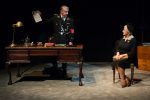
A scene from United Players’ production of Taken at Midnight, which is at the Jericho Arts Centre until Nov. 26. Seen here are Brian Hinson as the Nazi Dr. Conrad and Suzanne Ristic as Irmgaard, Hans Litten’s mother. (photo by Nancy Caldwell)

As a Jew, a lawyer and a child of a Holocaust survivor, I am embarrassed to say that I had never heard of Hans Litten until I saw United Players’ production of Taken at Midnight, which runs to Nov. 26 at Jericho Arts Centre.

Litten was a brilliant young Jewish-German lawyer, known for his defence of opponents of the Nazi movement. In 1931, he had the audacity to subpoena Adolf Hitler as a witness in the trial of four Nazis charged with murder, and subjected him to a grueling three-hour cross-examination, exposing the Nazi party for what it really was – a murderous bunch of thugs. Litten called Hitler “a cross between Baron Munchhausen and Attila the Hun.”

Unfortunately for Litten and the world, within two years Hitler was in power and he started to exact his revenge on his opponents. At midnight on Feb. 28, 1933, after the Reichstag (German parliament) fire, Litten, along with thousands of others, was arrested or, as the Nazis euphemistically called it, taken into “protective custody” at a series of concentration camps. Litten became known as “Hitler’s personal prisoner” – the cocky Jewish lawyer who had dared to expose the Fuhrer’s weaknesses – and, over the years, was subjected to brutal torture and unspeakable degradation as punishment. Despite the valiant efforts of his mother, Irmgaard, to obtain his release over the five years of his incarceration, Litten ultimately committed suicide in Dachau in 1938, which was a bit messy for the Nazis, as they wanted their political prisoners to die accidentally or naturally, not by taking their own lives.

The irony is that Litten was not technically Jewish. His mother was not Jewish and his father had converted to Christianity (to make things easier). As Litten says in the play, “I am an atheist Jew and, prior to that, I was an atheist Lutheran.” Of course, that made no difference to the Nazis, who went back three generations to ferret out Jewish blood.

Playwright and filmmaker Mark Hayhurst’s 2010 BBC films The Man Who Crossed Hitler and To Stop a Tyrant planted the seeds for this staged work. It had its West End (London, England) debut in 2014. Reviewers called it a “masterpiece of theatre not to be missed.” Now, United Players has taken on the formidable task of presenting this gripping story to Vancouver audiences. From the minute you walk into the theatre, the dark, shadowy, stark set – an elevated wooden platform fronted by barbed wire positioned between two floor-to-ceiling red banners emblazoned with black swastikas – is a harbinger of the grim things to come.

The entire cast, mostly comprised of veteran actors, is stellar and, as an ensemble, makes this a truly remarkable theatrical experience. Particular mention has to be made of the two main protagonists – Suzanne Ristic as Irmgaard and Sean Anthony as her son. Ristic is sublime in her portrayal of this strong, heroic woman who takes on the Gestapo establishment in a relentless battle to free her son. She often takes centre stage to talk directly to the audience, thereby breaking down the fourth wall, making for a very intimate encounter. And Anthony plays his difficult role with dignity, yet shows uncompromising defiance. We ache as we watch his physical and mental decline – his transformation from ordinary citizen to bloodied, head-shaven prisoner; a business suit to the striped concentration camp uniform, replete with the obligatory yellow Star of David.

Supporting, but not lesser, performances come from the rest of the cast.

photo - Irmgaard Litten (played by Suzanne Ristic) tries everything to save her son Hans (Sean Anthony) from the Nazis in Taken at Midnight
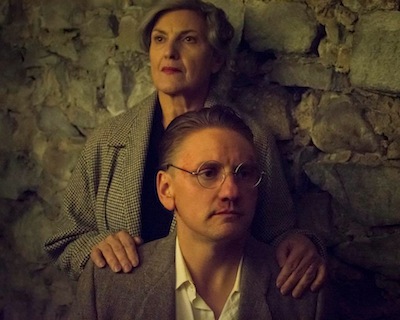
Irmgaard Litten (played by Suzanne Ristic) tries everything to save her son Hans (Sean Anthony) from the Nazis in Taken at Midnight. (photo by Nancy Caldwell)

Brian Hinson as Dr. Conrad, Irmgaard’s Gestapo contact, portrays a man of culture and intelligence who appreciates this feisty woman and appears to feel affection for her. The scene where they share an ice cream on a summer’s afternoon in a park seems incongruous, juxtaposed against the darkness of this play. Yet it speaks to some form of humanity even in the worst of times.

Litten’s cellmates – Erich Muhsam, an anarchist (played by Richard Hersley) who refers to Hitler as “the Austrian transvestite,” and Carl von Ossietzky, a newspaper editor and winner of the 1935 Nobel Peace Prize (played by Jewish community member Michael Kahn) – show the camaraderie and trust that can evolve from difficult circumstances. The triumvirate produces an amusing reenactment of Hitler’s cross-examination, providing an island of levity in their sea of despair.

Douglas Abel plays Fritz Litten, Hans’ father, as a calm counterpoint to his wife’s intense persona. John Harris, with his posh English accent, is Lord Clifford Allen, an English diplomat, patrician and pacifist who Irmgaard seconds in her quest for her son’s freedom. Allen is able to secure a meeting with Hitler to discuss the matter, but to no avail. Allen’s political attitude highlights the European appeasement zeitgeist of the early 1930s – that Germany was just experiencing growing pains and Hitler was an effective statesman, not a threat to the world. If only it had been so.

The play provides an historical lesson in the rise to power of the fascist Nazi regime and the consequences of speaking truth to power, but, at its heart, it is the story of the love of a mother for her son and her fight, at great personal risk, to try and save him.

As director Michael Fera, states in his notes, this is “an informative and deeply engrossing play about the high price paid for resisting tyranny,” and is as relevant today as it was in 1933. “People are living it now, again. History is repeating itself in many ways.”

Taken at Midnight is a tough watch and an emotional ride but well worth a trip to the Jericho Arts Centre. Kudos to artistic director Andree Karas for having the courage to stage this work. The show runs to Nov. 26, Thursdays to Sundays, 8 p.m., with 2 p.m. matinées Nov. 12, 19 and 26. For more information, visit unitedplayers.com or call 604-224-8007, ext. 2.

Tova Kornfeld is a Vancouver freelance writer and lawyer.

Format ImagePosted on November 10, 2017November 9, 2017Author Tova KornfeldCategories Performing ArtsTags Holocaust, Jericho Arts Centre, Nazis, theatre, United Players
Merging psychology, acting

Merging psychology, acting

Jed Weiss plays Mr. Gibson in UBC theatre’s production of Wives and Daughters. (photo from UBC theatre)

University of British Columbia’s theatre program has a tradition of presenting historical plays. The current production, Wives and Daughters, based on an 1860s serial novel by Elizabeth Gaskell, was adapted by Jacqueline Firkins and directed by Courtenay Dobbie. It promises to be “a charming romp of love convoluted by hidden desires and expectations.”

One of the actors in Wives and Daughters is Jewish community member Jed Weiss. In his final year at UBC, Weiss will graduate in May 2018 with a dual degree in psychology and acting. A transplant from California, he moved to Vancouver in 2013.

“I first moved here to go to UBC,” he told the Jewish Independent. “And I would definitely like to continue living here for awhile after graduating. I’ll always go back to Northern California to visit, but Vancouver is a second home to me. Part of what made UBC so attractive was the tuition price. I was able to finesse a dual citizenship a month before I applied here, thanks to my awesome mom, who kept her Canadian citizenship after moving to the States.”

Since his arrival, he has been very busy with work and study. Among other activities, he was a radio host for several years. “Between 2013 and 2016, I was hosting my radio show called Crescendo on the UBC radio station CITR 101.9. It went live for one hour every Sunday night. The program played eclectic music, starting with chill and down tempo, and building in intensity through the hour. I also used the time on the show to interview local bands, which was a really fun time. It was a live show, which was later podcasted, and some of the shows are archived on the website. Sadly, during the last couple years, I’ve gotten increasingly busy with acting and music and had to let go of the show, but I still drop by to support the station.”

He also donated his time to the nonprofit organization Generocksity.

“Generocksity is a nonprofit organization that originated at UBC and has since spread internationally,” he explained. “Its purpose is to create philanthropic opportunities, increase philanthropic culture, and throw live events featuring local musicians, with every dollar made from those events benefitting a local charity. A few years back, I worked as a talent coordinator, so I spent time reaching out to Vancouver comedians and musicians to volunteer their time to perform at our events to benefit local charities. At this point, I can only help out when I’m not too busy. I almost feel like Generocksity’s dead-beat stepdad, but I’d encourage everyone to look into them.”

When asked about acting, and what attraction it holds for him, Weiss said, “As an actor, you get to be whoever you want. You get to lose yourself in the escapism while simultaneously chasing this high of complete connection with an audience. It didn’t occur to me as a viable option until my ninth grade drama class and, since then, it’s been step by step. In 10th grade, I had to inform both my wrestling coaches that I was quitting mid-season to join the cast of my high school’s production of Beauty and the Beast, which were two very ‘fun’ conversations. After high school, I began working with the UBC Players Club and other campus productions. Eventually, a close friend of mine pushed me to audition for the UBC BFA program, and the rest is history.”

Weiss enjoys both of his areas of study. “If I can make enough money from acting to feed, house and at least partially clothe myself, I’d be set! That being said, I would honestly feel that something was missing if I didn’t spend some time continuing to study psychology. I wouldn’t even mind Frasier-ing it and landing a radio or podcast psychology advice show that would utilize both of those fields,” he said, referring to the main character’s jobs on the television comedy Frasier, which ran from 1993 to 2004.

Weiss said that psychology is a useful skill for an actor, and that the opposite is also true. “There has been a rise in the implementation of theatre into therapy,” he explained. “There is significant power in using theatre and performance in clinical settings, so it’s great to see theatre being recognized for how therapeutic it can be.”

As for UBC’s current production, Weiss said Wives and Daughters “is based in a small English town in the 1830s, centred on a determined girl, Molly, who is reaching for adulthood. It’s a very period-specific piece, but it does a great job of relating to the universal human experience of family dynamics. Our crew and production team have done a phenomenal job of helping create this universe through the use of costuming, lighting, sound and stagecraft.”

Weiss plays Molly’s father.

“I play Mr. Gibson, the town doctor and Molly’s widowed father,” said Weiss. “I read the novel and also watched the BBC adaption, then researched what medical knowledge was available to doctors in the early Victorian England. You need the research to fuel the technique but you can’t play any of the research during the actual performance. You play the wants of this person filtered through his age and the time period. Mr. Gibson may want to tell someone else to get lost, but with his 1830s gentility, he would word it in the kindest and most astute way possible.”

Weiss is passionate about theatre. He likes everything about it: researching, rehearsing, performing. And, of course, the audience response. “Nothing beats the visceral elation of connecting with an audience,” he said. “A group of people connected to the story you are telling and [the] feedback of connecting with that focus is an incomparable high.”

In addition to all of these pursuits, Weiss is part of a local band, Cheap Flavor. So, what does he want to be?

“I want to be freakin’ everything!” he said. “The hardest part of growing up for me has been acknowledging that I can’t do everything. I’ve been able to trim it down to acting, school and music only, and forcing myself to focus on those areas, but it’s always a work in progress. In the future, I would like to keep up with psychology, acting and music equally, and, when it comes time to let one of those fields go, I’ll have to make peace with that sacrifice.”

Wives and Daughters runs until Nov. 25 at Frederic Wood Theatre, UBC. For tickets and more information, visit theatrefilm.ubc.ca.

Olga Livshin is a Vancouver freelance writer. She can be reached at [email protected].

Format ImagePosted on November 10, 2017November 9, 2017Author Olga LivshinCategories Performing ArtsTags Jed Weiss, theatre, UBC
Orwell’s vision timeless

Orwell’s vision timeless

Bernard Cuffling as George Bowling in Leslie Mildiner’s adaptation of George Orwell’s Coming Up for Air, at Kay Meek Studio Theatre Nov. 16-25. (photo by Stephen Courtenay)

Award-winning actor Bernard Cuffling portrays George Bowling in Leslie Mildiner’s award-winning adaptation of George Orwell’s Coming Up for Air. Presented by Kay Meek Studio Theatre and One-O-One Productions, the one-man stage play opens Nov. 16.

First published in 1939, Orwell’s novel centres on 45-year-old insurance salesman George Bowling, “who makes an escape from ‘Hilda and the kids’ in London for a few days following a win at the races,” explains the promotional material. “George visits his boyhood village in an attempt to recapture childhood innocence, but finds it changed beyond recognition by the effects of modern life. His feelings of loss are intensified by the threat of war looming on the horizon.”

“Prose is the most intimate of writing – nothing separates the writer from the reader. Plus, there are no physical limitations to the setting, time, etc.,” Mildiner, a member of the Jewish community, told the Independent about the challenges of taking a novel and turning it into play. “Theatre is both a physical medium and collaboration. Physically, the storytelling is constrained by the limits of the performance space, restrictions of real time and the physical limitations of the actor/s in that space. So, the challenge is to take the unbridled narrative possibilities of prose and contain them on stage. Specifically, a stage play can only cover so much of the story unraveling over the length of a novel, so large sections of the narrative have to be edited or tossed aside. But, thankfully, whatever the medium, all stories have a beginning, middle, end – or three acts. What’s lost [are] certain subtleties and nuances of the story. What’s gained: the director (me!), actor and designers get to bring the story to life whatever way we choose.”

photo - Leslie Mildiner
Leslie Mildiner (Courtesy of Kay Meek Studio Theatre)

As a teenager, living in Britain, Mildiner published his first novel; he published his second novel when he was 22. In those years, according to his bio, he “was immersed in the British fringe theatre/alternative comedy scene as a writer and performer. On arriving in Vancouver in the early ’80s, he was drawn to the scene here when he was engaged as a comedy performer at Expo 86.” His scripts have been produced by Vancouver companies like Arts Club, Touchstone and the Firehall Arts Centre, and across Canada. He has also written for TV animation shows, including Kid vs. Kat and Class of the Titans.

So, what interested him in adapting a novel and, in particular, Coming Up for Air?

“The main character George Bowling’s struggle to do ‘the right thing,’” said Mildiner. “He’s a bit of an ass – and you probably wouldn’t want to meet him in real life – but he has a solid moral core and struggles against his need to be ‘the messenger,’ the canary in the coal mine. I found this fascinating. Also, it makes him a modern-type anti-hero. Also, because he is flawed, the audience get to see themselves reflected in him when he is forced to make choices.”

The anxieties and tensions described in Coming Up for Air are still relevant, almost 80 years after its publication.

“Coming Up for Air was published in 1939, a couple of years after Orwell’s experiences in the Spanish Civil War, where he witnessed the hope of people’s revolution turn into totalitarianism, with the threat of Hitler and Germany looming,” explained Mildiner. “In 2017, post-9/11, we live in an increasing paranoid world where even in the West, individual rights (seem) to be eroding. Plus, we have an unstable, narcissistic leader of the Free World, daily making attacks against minorities and those with no power, blaming ‘the Other’ for everything that’s wrong. Also, with the [President Donald] Trump insistence that everything in opposition is ‘fake news,’ including his own lies, Orwell’s ‘Newspeak’ has been brought to life.”

That said, added Mildiner, “Despite Trump, international terrorism, racism, corporate mentality and consumerism, I don’t think Orwell predicted the rise of modern humanism – our real desires and efforts to look after each other. For example, the conservation movement, eco-awareness, fight for indigenous rights, children’s rights, [the] LGBT movement.”

But Orwell did foresee many aspects of the future accurately.

“In seemingly incidental ways,” said Mildiner, “Coming Up for Air is prophetic: the main character encounters urbanization (his small village is now a large suburb), box stores – he complains about new chain stores and the advent of fast food joints. ‘Everything is streamlined and sleek – comfort doesn’t matter,’ he complains at one point. People from that era would be appalled at the idea of an eatery posting signs telling you [that] you can only stay for a set period of time!”

Coming Up for Air runs at Kay Meek Studio Theatre in West Vancouver Nov. 16-25. Tickets ($29-$45) can be purchased at kaymeek.com/coming-up-for-air.

Format ImagePosted on November 10, 2017November 9, 2017Author Cynthia RamsayCategories Performing ArtsTags George Orwell, Kay Meek Studio Theatre, Leslie Mildiner, theatre
Jersey Boys at Queen E.

Jersey Boys at Queen E.

The Four Seasons of Jersey Boys sings “Sherry.” (photo from Broadway Across Canada)

The multiple-award-winning Jersey Boys comes to Queen Elizabeth Theatre Nov. 14-19. The musical about Frankie Valli and the Four Seasons was written by Jewish community members Marshall Brickman and Rick Elice.

Elice spoke to the Jewish Independent by phone from New York. He and Brickman were friends well before they became writing partners on the musical and other projects.

“We became friends somewhere in the ’90s, 1997-’98, around there, and Jersey Boys didn’t present itself as an opportunity until 2002, although we didn’t really do anything about it until the very end of 2003,” said Elice, noting that the day prior to our interview, Oct. 17, marked the 13th anniversary of the very first production of Jersey Boys, which opened at the La Jolla Playhouse in 2004.

When Elice was asked to write the musical, he asked Brickman to collaborate with him.

“I had spent a couple of decades in advertising and I was no longer doing that,” he explained. “I was working at a movie studio in California and a former client called – this was right after Mamma Mia! had opened on Broadway – and he said, ‘Hey, I have the rights to the Four Seasons’ music.’”

Initially, Elice thought he meant Vivaldi’s “Four Seasons.” After setting him straight, the former client asked, “‘Well, would you be interested in doing the Mamma Mia! [concept] with the music of the Four Seasons?’ And I said, ‘No, somebody already did that, somebody already did Mamma Mia!’”

But Elice agreed to have lunch with Valli and Bob Gaudio, principal songwriter of the Four Seasons, and he called Brickman.

He and his friend “had been flirting with the idea of maybe writing something together,” said Elice, “which we assumed would be a screenplay because I was working at a studio and Marshall is, of course, an Oscar-winning screenwriter of some renown; I mean, he’s a legend. And I said, ‘Suppose we were to write a Broadway musical?’ And he said, ‘I’ve never written a Broadway musical.’ ‘Well, neither have I! But no one’s going to pay us anything, so we’ll just be wasting our own time and maybe we’ll have some fun. Let’s go to lunch and see what these guys are like.’”

During lunch, they asked Valli and Gaudio what it was like growing up in New Jersey, said Elice. “They started to tell us these jokes and anecdotes that were so, by turn, hilarious, tragic, stunning, but all of them engaging and compelling. We found ourselves leaning forward like anyone would when being told a really good story. And we said, ‘Hey guys, if you wanted to do this, if you wanted to do your warts-and-all life story, life of the group, that would be something that would be interesting because, look at us, we’re on the end of our seats. Other people would probably respond similarly, too.’… And they said, ‘OK, go ahead, knock yourself out. If we like what you do, then we’ll give you the gig.’”

Valli and Gaudio liked the first few scenes that Elice and Brickman wrote, so the writers began shopping the musical around. “The stars were in alignment,” said Elice, “as we wrote in the show.” The perfect producers, a director and venue were all lined up. “The only thing we didn’t have was the show,” he said. But, within a couple of months, he and Brickman had completed a script and, by August 2004, the production was in rehearsal in Southern California.

“And audiences loved the show from the very first performance,” said Elice. “We were always there in the back with our pads, ready to edit and make changes and do all the things in previews you’re supposed to do, but the show was really solid. Fundamentally, the show didn’t change. We improved certain things about it but there was no big surgery to be done on anything.”

He attributed the success to the music, which “underpins all our lives,” and to the fact that the group’s story is “a compelling one.”

“That’s always the secret to good theatre,” he said. “Tell a good story with characters the audience cares about.”

He also credited director Des McAnuff with being “a great visionary and a great field marshal for the project. He created this rocket ship that we all got on. It was a super-happy experience that could have amounted to nothing, and it ended up changing all of our lives.”

photo - Rick Elice, left, and Marshall Brickman, co-book writers of Jersey Boys
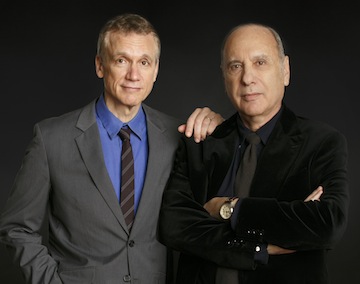
Rick Elice, left, and Marshall Brickman, co-book writers of Jersey Boys. (photo by Joan Marcus)

Part of the happy experience was writing with his friend.

“Writing for the theatre is like talking something into existence,” said Elice. It’s much harder to talk something into existence when you’re talking mainly to yourself, working as the sole writer, he said. “What I love about working with Marshall is that he taught me that, before you do anything, you take very long walks together and talk and talk and talk and talk, until you know how the characters sound, you know how to voice them, you know what happens, you’ve argued about plot and story and then, at some point, you have nothing left to do but sit down and actually write it. But the writing itself, the act of writing, is a product of extensive thinking and arguing and talking.”

There were no rules or a specific format for how the collaboration worked, said Elice. “If he wanted to write a scene, he would; if I wanted to, I would; then we would swap. And then, eventually, we were together combing through it.”

Elice said that he and Brickman weren’t involved in the making of the film version of Jersey Boys, which was directed by Clint Eastwood. “Generally, what the theatre offers that the film doesn’t offer is the live event,” said Elice.

He explained, “The existence of theatre ought to have ended by now – there are many, many other things to do. The theatre is expensive, it only happens in certain places at certain times of the day, it’s not convenient, it’s not particularly user-friendly as a medium, and yet it still exists. It’s actually doing better now than it did last year and, the year before that, it did better than the year before that, etc. So, why is that the case? Because, I think, we’re hardwired as a species – you and I and everyone around us – back to the days when cave-dwellers sat around fires and told each other stories. We like the idea of sitting in the dark and being told stories and experiencing them with other people sitting in the dark at the same time, experiencing the same story that will never be told in exactly the same way because it’s never the same. While the material may be the same, the performing of it is different, the audience is different, the chemistry in the room is different – everything changes.

“Each performance of a live event is a unique performance … and somewhere in there, somewhere in that unique experience, is something that’s thrilling for us,” he continued. “And what Des does specifically with Jersey Boys is to create a variety of roles for the audience because you’re not just sitting watching a show – you’re also the audience in the saloon, you’re the audience in the recording studio, you’re the audience at the concert, you’re the audience at the stadium. And there’s alchemy that happens with Jersey Boys on stage, where the audience, I think, really forgets that they’re watching actors playing these four guys and begins to believe that they are the Four Seasons and we are the people watching them. And so, the audience responds like they would at a rock concert, and not like they would do politely at a Broadway musical.”

He added, “It also happens to be a feel-good show and, as the world winds its way, a feel-good experience doesn’t feel out of sorts, because the rest of our days, we’re constantly facing greater challenges individually and collectively…. There are problems, there are bad things, so, you go to the theatre and feel good, it feels like a nice gift to give people.”

On Oct. 17, Jersey Boys’ 13th anniversary, a new company started rehearsals for another run of the show, said Elice. He dropped in to say hello to everyone and let them know of the significance of the day. “It’s a little like teaching,” he said. “If you’re a teacher, every year, the students stay the same age and you keep getting older … and I feel a little bit that way about Jersey Boys companies. I show up on the first day of rehearsals and, at the first production [in 2004], I was the same age as everybody in the show, and now I’m this old guy, because so many years have gone by but, of course, we’re still telling the story of a boy band, so you’ve got a cast in their 20s, and that’s a misty distant memory for me now.”

For tickets to Jersey Boys in Vancouver, visit ticketmaster.ca or call 1-855-985-5000.

Format GalleryPosted on November 3, 2017November 4, 2017Author Cynthia RamsayCategories Performing ArtsTags Broadway Across Canada, Franki Valli, Jersey Boys, Marshall Brickman, music, Rick Elice, theatre
What if shul had been sold?

What if shul had been sold?

Congregation Emanu-El in Victoria is the subject and setting for The Original Deed, which opens Nov. 15. (photo by Sid Tafler)

Established in 1863, Congregation Emanu-El in Victoria is the oldest synagogue in continuous use in Canada. As the saying goes, if those walls could talk. Well, journalist and author Sid Tafler, a longtime member of Emanu-El, has given them a voice, of sorts.

Tafler, who has worked in theatre as a writer, actor and producer, has created The Original Deed, an historical drama about the synagogue.

Despite being such a landmark, Emanu-El “was nearly lost forever a generation ago, when a move was afoot to sell the old building and relocate to the suburbs,” reads the description. “The play tells the story of Sam Abelman, a Holocaust survivor and downtown jeweler, who fights to save the shul from the wrecking ball, while his son Morry tries to sell out and move the congregation to the suburbs. As the father/son struggle reaches a climax, Sam invokes ‘the Original Deed’ and a ghostly figure from his past emerges to salvage his dreams and his memories.”

Performed in the sanctuary, it features Toshik Bukowiecki as Sam, Zuzana Macknight as Rivka Abelman and Bobby Cleveland as Jack Abelman. John Roebuck plays Morry, while the rest of the Abelman clan is performed by Maureen Van Wyck as Leah, Annika Hupp as Esther, Nolan Hupp as Young Sam, and Ava Fournier, 12, who plays Ellen. Bill Taylor takes on the character of Phil Cogan, the lawyer.

“The play is set circa 1980,” Tafler told the Independent. “I say circa because the issue of selling the shul was discussed a number of times over 15 to 20 years, so 1980 is an average.”

photo - Sid Tafler
Sid Tafler (photo from Sid Tafler)

Tafler mined the synagogue’s archives and online historical information, as well as the book Sefer Emanu-El, which was published by the synagogue on its 150th anniversary in 2013.

“I found that much of the written history about the shul is about the dynamic era of the founding in 1863 and the colourful figures of the gold rush and late 19th century,” said Tafler. “There is comparatively little about recent history. Some older members of the congregation knew about the proposed sale, which was discussed at board meetings, but not much detail about the how and why – specifically, why the idea was dropped.”

Tafler was inspired “by the intrigue and thinking behind this idea of selling the shul and moving to the suburbs, which many communities have done. When it first came up, the building was not the lovely restored heritage landmark it is now. It was covered in stucco and the ceiling had been lowered to exclude the balcony.”

In the real-life situation, there were proposals to buy an old church or to purchase land near the Jewish Cemetery on Cedar Hill Road, said Tafler.

“I created a family called the Abelmans to embody this story,” he explained. “Sam, an aging Holocaust survivor, is desperate to keep the old building, while his son Morry, head of the building committee, wants to sell out and move to a waterside location in Gordon Head (near the University of Victoria). Everyone gets involved: Sam’s wife Rivka, his granddaughter Ellen, his other son Jack, a wanderer; even his lawyer, Phil Cogan, who holds his finger to the wind and listens to his mother to decide which side he’s on.

“The stakes are very high for Sam,” said Tafler. “As a boy, he looked out the window of his home in Germany and saw his shul being destroyed on Kristallnacht. Soon after, he was shipped off to England in the Kindertransport, and never saw his family again.”

In addition to the history, Tafler said he was “also inspired by Zelda Dean, Emanu-El’s theatre maven, who suggested I write a play about the shul.”

It took two years and nine months for this production to go from idea to the stage, he said. “But, in some ways,” he said, it took 20 years. “My last play, Ghost on the Road, was produced at the Victoria Fringe Festival in 1997.”

The Abelmans are not real people, said Tafler, “but I have grown up with Holocaust survivors and their children and grandchildren from my earliest years. When I was still a toddler, my parents took in two teenage survivors from Hungary, a boy and a girl, who lived with our family in Montreal for a few years. In school, many of my classmates’ parents were survivors and I heard these stories firsthand. Here in Victoria, the survivors were a major presence in our shul.”

So, on whom is Sam based?

photo - Sam (played by Toshik Bukowiecki) and his granddaughter Ellen (Ava Fournier) listen for the sounds of voices in the synagogue walls in The Original Deed, at Congregation Emanu-El this month
Sam (played by Toshik Bukowiecki) and his granddaughter Ellen (Ava Fournier) listen for the sounds of voices in the synagogue walls in The Original Deed, at Congregation Emanu-El this month. (photo by Gayle Mavor)

“Sam Abelman is one part Jack Gardiner. One part Peter Gary. One part Willy Jacobs. One part Ray Rose. One part each of my grandfathers, Sam Tafler and Eli Shetzer,” said Tafler. “But mostly, Sam, the lead character in The Original Deed, is himself, played by Victoria actor Toshik Bukowiecki.

“Jack, Peter and Willy were Holocaust survivors and members of our shul at different times,” Tafler explained. “They taught us about terrible loss and despair, redeemed by liberation, healing and building a new life.

“Ray was born in Victoria in 1920 and operated Rose’s Jewelers on Douglas Street, a business started by his father Joseph in 1912. He was a bombardier in the RCAF in the Second World War and flew 33 missions over Europe,” said Tafler.

“Sam and Eli were both born in shtetls in the Ukraine and immigrated to Canada in the early 20th century. They found work and raised families in Montreal and their many descendants now live across North America.”

As to some of the reasons Morry, or community members like him, wanted to abandon the historic building and move to the suburbs, Tafler provided several excerpts from the play, all spoken by Morry (Morris):

  • “‘… there’s not enough room in this building. We can’t keep holding seders and Hebrew classes in this little space.’ (gestures at back, behind pews)”;
  • “It’s a new age, Dad. We need a real school if we expect the kids to keep coming.”
  • “Dad, this building is old, it’s small, there’s no room for a school, for offices.”
  • “(At the site in Gordon Head): ‘Use your imagination. Two lovely, modern buildings. A social hall, parking lot over there. Open space for the kids. And for expansion.’”

The Original Deed runs at Congregation Emanu-El Nov. 15-16 and 18-19, at 7 p.m. Tickets ($20/$15) are available at Ticket Rocket, ticketrocket.co/event/details/101436/the-original-deed.

Format ImagePosted on November 3, 2017November 3, 2017Author Cynthia RamsayCategories Performing ArtsTags Emanu-El, history, Original Deed, Sid Tafler, theatre, Victoria
Victoria is alive and kicking!

Victoria is alive and kicking!

Dulcinea Langfelder, being carried by Eric Gingras, in Victoria, which is at Massey Theatre for two shows only next week. (photo from Dulcinea Langfelder & Co.)

Victoria is coming to New Westminster next week for two shows only. Created and performed by Dulcinea Langfelder, a versatile dancer, multimedia performer and award-winning choreographer from Montreal, Victoria is about old age and young spirit, about laughter in the face of tragedy.

Langfelder started her life in New York. She studied ballet and pantomime, singing and acting. After a few years in Europe, including London and Paris, she moved to Montreal in 1978 to join La Troupe Omnibus. Since then, Montreal has been her home. In 1985, she founded her own company, Virtuous Circle Dance Theatre. In 1997, the company changed its name to Dulcinea Langfelder & Co.

Langfelder loves Montreal and can’t imagine living anywhere else. “The city is effervescent, young culturally compared to New York or Paris,” she said. “Fewer boundaries between categories, and close enough to New York to visit my mom. Why on earth would I want to live elsewhere?”

The same philosophy applies to her choreography and performing. Why on earth would she do anything else? “For the moment, I can still do what I love to do, and I believe that it’s important to see older people on stage. Art has always been the most effective way to influence our attitudes. Victoria gives voice to those who have ‘disappeared’ through aging – but we are still alive and kicking!”

Although it’s hard to pinpoint Victoria’s exact theatrical classification, Langfelder said, “It is a multidisciplinary and multimedia work for the stage. There really is no major discipline. I work with the elements on my palette: movement (I guess I do always put that one first), text, humour, dramatic – through line, projected imagery, music and a bit of puppetry. Everything is choreographed, not just the movement.”

The heroine, Victoria, is “a wheelchair-bound 90-year-old, suffering from the loss of memory, autonomy and just about everything else,” reads the press release. But Langfelder melds poignant and funny in this show of an elderly woman’s courage. Victoria premièred in 1999, and Langfelder told the Independent about its origins.

“In 1994, an actor friend of mine, Charles Fariala, who also worked as an orderly and knew that I have a penchant for tragicomedy, called me to say, ‘You must meet Victor, an old man in a wheelchair who’s lost his memory; sometimes I wonder if he’s just gaga or if he’s discovered Nirvana.’ I immediately responded, ‘We’ll call her Victoria!’ I was intrigued by the question: Where do we find our mental victory when we we’ve lost our physical power?”

Inspired by the concept, Fariala and Langfelder started working on the project. “Charles wrote pages of text, which I re-worked,” said Langfelder. “I also incorporated a lot of text that came from Angel Petrilli, a woman who became the principal model for the character, although there were other people as well, including my own father. But this piece is multidisciplinary and multimedia, so the ‘script’ is composed of text, choreography, song and projected imagery. It was written in concert with all of my collaborators; I created the choreography.”

One of the most unusual aspects of the show is that the protagonist is bound to her wheelchair. “It is hard to tame the wheelchair beast,” Langfelder admitted, “but fascinating for a mover!”

The show’s success and longevity – 18 years now – surprises even its creator. “I didn’t think it would fly at all, with such taboo subject matter,” she said. “But I discovered that audiences had been starving to have this conversation in a non-depressing way. While treating this subject as accurately as I can, Victoria is an uplifting piece, because there really are rich, poetic and hilarious moments when dealing with dementia and the end of life. We just underline those moments, without taking the subject matter lightly.”

Like every performer, Langfelder knows that art must change with time, that an actor should be flexible in her communication with different audiences. Victoria is no exception to this rule. “It changed a lot in the first years,” Langfelder explained, “then subtle changes. It adapted to different languages and cultures, though it clearly reminds us of what we have in common around the world. We’ve done this piece everywhere from Japan to Zimbabwe, in seven languages.”

One of the latest changes was adding another actress to play the title role. “I recently realized that this piece could live longer than I will,” said Langfelder. “I trained Anne Sabourin in the role. She plays Victoria in French.”

Langfelder herself plays Victoria in English in every show, in every country, and the reception has been overwhelmingly favourable, but that is not enough for the actress. “The Victoria project is about touring the piece for the general audience it was designed for,” she said. “Plus, we work hard to get those who can most benefit, and are the least likely to frequent the theatre: seniors and family/professional caregivers. The way we get them to the theatre, and Victoria can’t be done anywhere else, is that we go to them first. We offer workshops that answer their immediate needs, like non-verbal communication, movement for seniors and seminars on creativity, humour and dementia. Then we use the opportunity to make them understand that theatre can actually be useful, even more useful than workshops. We invite them to the theatre.”

Like her heroine, Langfelder meets her challenges with a smile. “I love making people laugh at difficult situations,” she said. “It makes me feel useful. My father’s last words to me, before his stroke, were in response to me complaining about my challenges. He said, ‘You mustn’t get discouraged, because what you do is so important! You put human dilemma on stage and allow us to laugh at it; what could be more important than that?’ I had just begun working on Victoria, and he never saw it. I become him when I play Victoria.”

Victoria is at the Massey Theatre in New Westminster on Oct. 27 and 28. For tickets, visit ticketsnw.ca or call 604-521-5050.

Olga Livshin is a Vancouver freelance writer. She can be reached at [email protected].

Format ImagePosted on October 20, 2017October 19, 2017Author Olga LivshinCategories Performing ArtsTags aging, dementia, Dulcinea Langfelder, theatre
Relatable dysfunction

Relatable dysfunction

The Beacham family. Back row, left to right: Seth Little as Guy, Nick Beacham’s partner; Jordon Navratil as Nick; Mia Ingimundson as Norris Beacham, the daughter; and Chris Walters as Kevin, Norris’ husband. Seated are Howard Siegel as the patriarch of the family, Glen, and Anna Hagan as the matriarch, Bonnie. (photo by Ellie O’Day)

Homeward Bound by Elliott Hayes is about death and relationships. And family dynamics. Jewish community member Howard Siegel plays the father, Glen Beacham, in Western Gold Theatre’s production that opens today, Oct. 6, and runs until Oct. 29 at Pal Studio Theatre.

Set in 1990, Glen and Bonnie Beacham have invited their adult children (a son and a daughter) and their respective partners for dinner – and an announcement, publicist and Jewish community member Ellie O’Day told the Independent. Homeward Bound “is a dark comedy,” she said, “but also plays with the ways we talk to each other but don’t always really listen.”

“Every family has a time when they get together. Ours was Shabbat,” said Siegel. “No matter where we were or how busy our week was we had to be home Friday for dinner. We ate at the dining room table instead of our usual place in the kitchen, and talked, or argued, but that was our family time. If there was chicken soup, we were having roast chicken; if it was vegetable soup, it was brisket. While the Beachams are getting together on a Sunday and it may not be as regular as my childhood was, dinner with the family is no less important and the news of the week is going to change all their lives.”

Of the plot, O’Day added, “Dad, who happily distracts himself with crossword puzzles, is apparently not well…. Mother distracts herself by constant chatter (where will they go on their next holiday? Dad is totally noncommittal)…. Meanwhile, the gay son’s partner is late for this Sunday dinner … and the daughter is trying unsuccessfully to hide the deterioration of her marriage.”

Siegel described the character of Glen as a “glib, funny, highly educated” man who “has provided a substantial middle-class standard of living for his family.” He said, “My father aspired to these qualities, but it was his struggle, so I wasn’t able to model Glen after my dad. However, finding the love for his family that perhaps isn’t so clear in the text is important to me and to the play. That was very apparent in my experience in my parents’ home.”

He added about the Beachams, “This is a family like so many families we know or grew up in. The parents have to accept choices their children make whether they like or understand them; they accept them out of love and perhaps duty. The kids bicker, but would defend their sibling to anyone if push came to shove. Deep in this family’s dysfunction is a connection that we all should be able to understand.”

Homeward Bound runs Oct. 6-29, Tuesday-Saturday, 7:30 p.m.; Saturday-Sunday, 2 p.m.; and Oct. 19, 2 p.m., at Pal Studio Theatre, 581 Cardero St. Tickets are $32/$27 from 604-363-5734 or homeward. brownpapertickets.com.

Format ImagePosted on October 6, 2017October 5, 2017Author Cynthia RamsayCategories Performing ArtsTags Ellie O’Day, family, Howard Siegel, theatre

Posts pagination

Previous page Page 1 … Page 11 Page 12 Page 13 Next page
Proudly powered by WordPress