Interior perspective of The Evidence Room, with models of an Auschwitz gas column and gas-tight hatch, plaster casts and a model of a gas-tight door. (photo by Fred Hunsberger, University of Waterloo School of Architecture)
Visitors to the Royal Ontario Museum (ROM) will see an obscene display among the collections of dinosaur fossils, Egyptian mummies and suits of armour – a scale model of a gas chamber of the kind used at Auschwitz, where more than one million Jews were murdered between 1942 and 1945.
The Evidence Room exhibit, as it is named, consists of white plaster replicas of elements of the Nazi death camp murder machine, including the steel mesh columns through which pellets of Zyklon B insecticide were lowered to asphyxiate the prisoners locked inside the gas chambers. Similarly, it depicts the heavy door, which was bolted from the outside.
The exhibit features a reproduction of the original architectural drawings prepared by German architect, engineer and SS-Sturmbannführer Karl Bischoff, who served at Auschwitz as chief of the Central Construction Office of the Waffen-SS.
Visitors to ROM will note the meticulously planned airtight seal around the gas chamber’s door to prevent toxic leaks, and the grill-covered peephole that allowed dignitaries to watch the prisoners die.
“To understand this room … we first have to acknowledge that it’s related to the most murderous place,” said the exhibit’s creator, Robert Jan van Pelt, at a ROM Speaks lecture on June 27.
Van Pelt’s grisly display is the first in a ROM series intended to engender discussion of contemporary issues. And the issue here is forensic architecture, a relatively new field that uses planning and design tools to understand human rights abuses, in this case genocide.
For van Pelt, a Dutch-born architect who teaches at the University of Waterloo, The Evidence Room represents the culmination of two decades of work.
Van Pelt served as an expert witness during a trial, in London in 2000, in which Holocaust-denier David Irving unsuccessfully sued Emory University professor Deborah Lipstadt for libel after Lipstadt, in a book, called out the pseudo-historian’s falsehoods. Irving famously quipped “No holes, no Holocaust.”
Van Pelt testified that indeed there were apertures in the gas chambers’ ceilings through which poison pellets were dropped. His testimony led to his 2002 book The Case for Auschwitz: Evidence from the Irving Trial.
The 592-page volume greatly impressed Alejandro Aravena, curator of the 2016 Venice Architecture Biennale. The Chilean, who was awarded architecture’s Pritzker Prize for his work transforming slums and making architecture a tool of justice and social change, commissioned van Pelt to create an exhibit explaining the workings of an Auschwitz gas chamber. A model was on display at last year’s Venice Biennale.
In preparing for the current exhibit at ROM, van Pelt – together with colleagues Donald McKay, Anne Bordeleau and Sascha Hastings – wrote a supplementary book, The Evidence Room, published by the New Jewish Press in association with the University of Toronto’s Anne Tanenbaum Centre for Jewish Studies.
“It is difficult to imagine the details of a gas chamber, where humans were locked in to die,” says one Holocaust survivor quoted in van Pelt’s new book. “One has to feel the double grates that protected the bucket filled with poison pellets from the desperate hands of the condemned, peer into the bucket, imagine the pellets melting away, the poison oozing out of them.
“I knew a good deal about the Auschwitz-Birkenau murder factory,” says the survivor, “but the gas column really shocked me. Because of what I had read about people thinking they were going into a shower room, I had always imagined the gas being dispersed by sprinklers. Touching that construction had a profound effect on me – a new visceral recognition all these years later.”
And what of the pristine white plaster van Pelt and his architecture students used to build the reproduction?
For me, it jarringly evoked a sense of peace and innocence. But, as well, it called to mind that those murdered in the gas chambers defecated and urinated as they died and that Sonderkommandos (a special unit of slave labourers who removed gassed corpses and hauled them to the crematoria) had to whitewash the gas chambers after each usage.
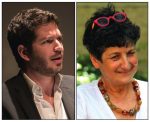
Lior Schillat of Jerusalem Institute for Policy Research and Maya Halevy of Bloomfield Science Museum Jerusalem will speak at Jerusalem of Gold: Capital of Innovation & Tech on July 16. (photos from CFHU Vancouver)
“Hebrew University is probably the only university that ‘founded’ a state rather than vice versa, as the cornerstone for the university was laid on July 24, 1918, and, on April 1, 1925, the Mount Scopus campus was opened,” Dina Wachtel, Western region executive director, Canadian Friends of the Hebrew University, told the Independent. “The contemporary history of the city of Jerusalem and the story of the Six Day War is intertwined with the story of the university – what better way to celebrate that than by bringing in four of Jerusalem’s change-makers?”
The July 16 TED Talk-style event at the Jewish Community Centre of Greater Vancouver – hosted by CFHU, the Jerusalem Foundation and JCCGV – “is a celebration of the start-up nation and the role the city is playing in becoming a centre for innovation and technology,” said Wachtel. “Thus, it is also the story of how innovation improves the lives of humanity in this world regardless of boundaries of any kind: geographical, political, ethnic, religious.”
At the event called Jerusalem of Gold: Capital of Innovation & Tech, the speakers will be Lior Schillat, director general of Jerusalem Institute for Policy Research; Maya Halevy, executive director of Bloomfield Science Museum Jerusalem; Yonatan Avraham, student ambassador of HUstart, the university’s entrepreneurship centre; and Tamir Huberman, vice-president of business development and information-technology director of Yissum, the technology transfer company of Hebrew U. The Jewish Independent interviewed each of the presenters in anticipation of their Vancouver visit, and will feature Schillat and Halevy this week, and Avraham and Huberman on July 7.
Schillat will talk about Jerusalem’s Population: What Does the Future Hold? But first, what about the Jerusalem of the past – what would have inspired a Canadian Jew to make aliyah 50 years ago?
Actually, said Schillat, in the 20th century, the biggest wave of immigrants from countries such as Canada came right after the Six Day War.
“If you’re Canadian and you’re making aliyah in ’67 and you’re choosing Jerusalem for your home, I guess the main reason you would do that would be because of the spiritual effect the glorious victory of 1967 would have on you,” said Schillat.
“If you are a bit more practical, you also understand that, with this victory, Jerusalem, for the first time since 1948, became again the centre of the country … centre in the geographical meaning and also the centre of attention as to what was going on in the country.”
Fifty years later, he said, while “we still haven’t reached some kind of stability in the situation in Jerusalem,” the city “is one of the most interesting … cities in Israel, and why is that? First of all, it’s Jerusalem, meaning it’s beautiful, it has stories that are in the heart of billions of people all over the world…. I would say the Jerusalem brand is stronger than any other brand in Israel, including the Israeli brand itself…. So, if you would come to Jerusalem, it would be because you want to spend your life in a way that is a bit more meaningful than … in any other city in Israel, in any other Western country.”
In Jerusalem, he said, “from the moment you wake up until the moment you go to sleep, you live for something, for an idea. It’s true for everyone – of course it’s true for religious people, but it’s also … true for secular people. Life here just has much more meaning. You know, it’s not for nothing that Jerusalem is 10% of the Israeli population but 25% of civic society organizations are based here. And if you look at Israel’s biggest struggles or debates, many of them were generated from the Jerusalem society.”
Jerusalem is a completely different city than it was 50 years ago, said Schillat. “Jerusalem is one of the most advanced high-tech ecosystems in the world today…. When you look at the numbers, you see that, today, Jerusalem is considered among the 30 biggest ecosystems in the world. And some of the researchers even say that they would consider it for next year among the 20.”
It’s not the tech hub that Tel Aviv is, he acknowledged, but, in proportion to its population, Jerusalem rates high on the tech scene. And this shouldn’t be surprising, he said.
“People here are using their minds all the time, and high-tech is exactly that – it’s how you use your mind in order to create gain, in order to create technology that could help better the world…. The number of technological companies in this city has more than doubled in the last four years. The number of employees in high-tech is growing 15% every year for the last three years.”
Schillat gave as the best example of Jerusalem’s growing prominence in this area the recent acquisition by Intel of Jerusalem-based company Mobileye for $15.3 billion. Not only that, he said, but Intel also has decided to base in Jerusalem its international research and development centre for autonomous cars.
“I don’t see the Jerusalem of the future as being another New York or another Frankfurt or another Tel Aviv; it won’t be a financial centre. I see it as a city of knowledge; of creating fruits from thinking, from knowledge, from discussion. And I also think that Jerusalem is facing now the amazing challenge, and very hard challenge, of integrating into this group of thinkers and builders the more weak populations…. The real test for Jerusalem for the next 50 years would be, ‘Did you integrate the Charedi groups, did you integrate the Arab groups into this economic development model of a city of thinkers, or did you just go with this idea by yourself, meaning just a small elite group of thinkers went with it by themselves and left the majority of the city behind?”
One facility that is trying to integrate various population groups is Bloomfield Science Museum. Founded and operated by the Jerusalem Foundation and HU, the museum is supported by the national and municipal governments. Its website describes science “as a common language that disregards physical borders, cultural and religious differences and enables dialogue among participants with a common interest and diverse backgrounds.” Halevy will talk on the topic Raising a Start-up Nation.
“There is much research that shows that young kids love science and science classes,” she said, “but they don’t see themselves in a STEM [science, technology, engineering and mathematics] career, mainly because they believe that having a STEM career is being a scientist, which they think it is to work alone in a lab, and can be relevant only to the best scholars. Our role is to show the variety of opportunities that STEM learning can open for them in a future career.”
Bloomfield serves as a lab and hub for education programs, she said. “As a lab, we develop new approaches, new pedagogy, new tools, and we test those with a variety of people, as we are also a hub for all the communities in Jerusalem.”
The museum collaborates with institutions around the world, as well. A current exhibit that will travel to Ottawa, among other places, is the Bicycle Exhibition 2 x 200. The new Canada Science and Technology Museum is set to open in November after extensive renovations and the exhibit is scheduled to arrive there after a few other stops.
The idea for the exhibit came when Halevy was on a visit to Ottawa in October 2015, at the request of then-Israeli ambassador to Canada Raphael Barak, “who wished to develop cooperation among cultural institutions from Canada and Israel.”
Visiting the museum while it was under renovation, Halevy saw the collection of bicycles it had in storage and learned that 2017 would mark 200 years since this invention.
“So we decided to focus our cooperation on a bicycle exhibition,” she said, “to use their collection and to add interactive exhibits – we are very experienced in this field – and the idea was that we will develop and build the whole exhibition in Jerusalem and later on it will travel to Ottawa.
“We were lucky to find two more partners, from Germany and Italy, that loved the concept of the exhibition and that wished to join us, so the tour will start in Jerusalem, will move to Bremen (July 2018) and then to Naples (July 2019) and will end in Ottawa (2020). We were also approached by other museums that wish to present the exhibition after the partners’ tour ends.”
Bloomfield signed a letter of intent with Ontario Science Centre last year. “The main idea is to develop our cooperation around the culture of innovation and to start developing this culture from an early age, as the future of both our economies is based today on innovation and entrepreneurship,” explained Halevy. “We plan to develop together an interactive exhibition and special programs for young children and youth and to connect them to each other. We wish to open the exhibition and launch the programs in 2018 – 70 years to the establishment of Israel. During my time in Toronto, I will have a meeting with the CEO and president of the Ontario Science Centre, Dr. Maurice Bitran, to discuss it more in-depth.”
As for other collaborations with Canadian institutions, Halevy said, “We might develop new collaborations on my tour, as I plan to visit my colleagues from Calgary and Vancouver.”
Jerusalem of Gold: Capital of Innovation & Tech is open to the public. Tickets are $45, though Wachtel said, “Students who are interested in coming to the event are welcome to register at our office and receive a free ticket.” For tickets, the speakers’ bios and other information, visit cfhu.org, email vanc@cfhu.org or call 604-257-5133.
Kat Romanow is director of food programming at the Museum of Jewish Montreal. (photo from Kat Romanow)
Kat Romanow has taken upon herself the challenge of teaching people more about Jewish food in one of Canada’s most Jewish cities.
“I started studying Judaism in my undergrad and, at the end of it, food was something that sparked my interest,” said Romanow. “I ended up going to Boston for a summer to do an internship and it was there that all of this coalesced.
“Jewish food is what I want to study academically. I also felt a connection to Judaism – Shabbat dinners, shul … I get the non-academic Jewish things, and it was there I realized I felt a deep connection to it. That’s when I knew I wanted to convert. It’s a connection I didn’t necessarily feel in Catholicism, but I found in Judaism – the community, rituals … things that really speak to me and bring meaning to my life.”
Romanow was born and raised in Montreal and is currently the director of food programming at the Museum of Jewish Montreal, where she runs and manages Fletchers, the museum’s restaurant.
Founded in 2010, the museum offers walking tours of historic Jewish neighbourhoods, numerous online exhibits and a large oral history collection. And, now that they have a physical space – which they acquired about a year ago – they also offer lectures, workshops and pop-up exhibitions.
Romanow majored in Jewish food history at Concordia University and, in conjunction with the museum and a friend, developed a walking tour called The Wandering Chew.
“We aimed to teach people about lesser-known Jewish food traditions through pop-up dinners, cooking workshops and other food events,” said Romanow. “That’s where I got the cooking experience, holding pop-up dinners for 30 to 40 people. We’d find the community we wanted to explore, interview people from the community, including getting their recipes, put together a menu and do a dinner.”
The goal was to expand people’s knowledge about Jewish food. “Here, in Montreal, you automatically think of bagels and smoked meat,” said Romanow. “But, our aim was to go beyond that and show people that Jewish food is very diverse and is made up of a lot of different cuisine and dishes.”
At Fletchers, they serve foods during the day that draw from the flavours of the diverse communities highlighted on the walking tours. And, in the evening, one can find a variety of workshops, meals and cookbook launches.
Romanow has been selected to represent Montreal at the ROI (Return on Investment) Summit in Jerusalem July 2-6. The summit brings together 150 of the brightest Jewish minds from around the world to brainstorm ideas for the future.
“I’m really excited,” said Romanow. “It’s also my first time going to Israel. For the summit, I’m most excited about getting to meet all these other young Jews doing really cool projects … making connections and sharing ideas. We’ll learn from each other and build off of what we’re all doing. So, I think, coming out of this, I’ll be full of new ideas and inspiration. I’ve already received emails and I can see potential future collaboration.”
Romanow is planning to stay in Israel after the summit, to visit the country, experience the Israeli food scene and get some new ideas for Fletchers.
Something she has found lately is that people in their 20s and 30s are becoming more open to exploring different ways of making the food they grew up with different, putting their own mark on it.
“There’s now a community of younger Jews who are reintroducing people to what Jewish food is,” said Romanow. “I want to keep adding to the menu and keep holding more and more events, so that people can really engage with their Jewish identity through food on a regular basis.
“But, I also aim to write a cookbook about exploring Jewish food in the Diaspora. That’s what I’ve been doing with the Wandering Chew. I think the cookbook is the next step. I’m in the process of writing the proposal, so hopefully in the next few years it will come out.”
For now, Romanow plans to delve deeper into local Jewish food history, as she balances running Fletchers, the Wandering Chew dinners and walking tours of the local Jewish food scene, which are called Beyond the Bagel.
Through Beyond the Bagel, Romanow said, “We go to places like Schwartz’s and we eat bagels. But, I did all kinds of archival research and oral history interviews … and so you get to go deeper into the history of these places.
“At our space (at the museum), we also have a boutique where we sell things related to Jewish history and Montreal – books, locally made products. And we use it as an event space … concerts, lectures and many more.
“Right now, we have Yiddish classes there, too, and photo exhibits that change throughout the year related to Jewish culture. We’re not a traditional museum, one that you go into and look at objects. You can come to the space, grab a bite, browse the boutique and also go on one of the walking tours or onto the website.”
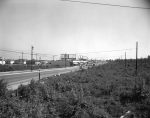
Cambie Street, looking south from 41st Avenue, 1952. (photo from City of Vancouver Archives via jewishmuseum.ca/oakridge)
On Nov. 23, the Jewish Museum and Archives of British Columbia had both its annual general meeting and launched its newest online exhibit, Oakridge.
JMABC board president Perry Seidelman called the AGM to order and noted a major absence.
“Forty-five years ago,” he said, “Cyril Leonoff became our founding president and was at our side throughout all of those years. However, sadly, this ongoing support ended this year with Cyril’s passing. There is so much that can be said about Cyril but tonight I will only say that he has been and will continue to be missed. It goes without saying that we would probably not be here tonight if it was not for Cyril Leonoff.”
Seidelman then went on to list some of the year’s accomplishments, including ongoing speaking engagements and historical tours, as well as the recording of 35 new oral history interviews and the digitization of “various family fonds, the Mountain View Cemetery Restoration Committee fonds and the Temple Sholom fonds.”
He noted that the digitization of “the oldest books from Congregation Emanu-El (1861 through 1901 approximately)” was complete and they will be online soon, that several online exhibits had been mounted during the year, and that the museum’s “largest collection by far, the Canadian Jewish Congress, Pacific Region, fonds, has begun to be processed, with immense research potential.”
The museum handled hundreds of research requests, he said, and “received donations ranging from fiction manuscripts to synagogue records to WWII records.”
Seidelman noted that longstanding JMABC member (and a past president) Bill Gruenthal was recognized by “Jewish Seniors Alliance for years of extraordinary volunteer work” and that archivist Alysa Routtenberg had “recently completed her first year as archivist as Jennifer Yuhasz’s successor. It has proven to be a nearly seamless transition with a continuing and increasing inflow of documents and interviews and regular transmission of the vast history of which we are guardians.”
He thanked JMABC administrator Marcy Babins, JMABC coordinator of programs and development Michael Schwartz, Shirley Barnett for her leadership in the restoration of the Jewish section of Mountain View Cemetery, Cynthia Ramsay for editing the JMABC’s annual journal, The Scribe, and donors and funders, including the Jewish Federation of Greater Vancouver. He bid farewell to three members of the board – Barnett, Chris Friedrichs and Barbara Pelman – and welcomed four new members: David Bogoch, Alan Farber, Alex Farber and Carol Herbert.
After the AGM was the Oakridge launch.
“With this exhibit,” said Schwartz, “we set out to document an important period in our community history; a moment when a population boom coincided with financial stability and postwar optimism to cause our community to grow both in size and stability in a way rarely seen before or since. This era set a new foundation for our community that we have built upon and relied upon ever since.
“This exhibit places this period in context with events happening both before and since. It asks why and how many Jewish families and institutions chose to establish themselves in Oakridge.”
Compiled over two years, the Oakridge research team was Erika Balcombe, Junie Chow, Elana Freedman and Josh Friedman, with Schwartz. A large portion of the exhibit comprises oral history interview excerpts from community members Harry Caine, Vivian Claman, Irene and Mort Dodek, Gail Dodek Wenner, Wendy Fouks, Debby Freiman, Sarah Jarvis, Ed Lewin, Sandy Rogen, Ken Sanders, and Seidelman.
“Irene deserves double thanks,” said Schwartz, “as we have included an excerpt of an interview that she carried out with Bea Goldberg and Marjorie Groberman in 1996. Naturally, I thank Bea and would certainly thank Marjorie were she still with us.”
Schwartz also gave thanks to JMABC colleagues Babins and Routtenberg, as well as Yuhasz, “each of whom devoted much time and energy to this project,” and the board of directors.
At the turn of the last century, explained Schwartz, “there were essentially two interconnected Jewish communities: the affluent Reform Jews in the West End and the Orthodox, working-class Jews in the East End, what today we call Strathcona…. Over time, the Jews of the East End grew more financially stable and began to relocate to the new neighborhood of Fairview in the 1920s and ’30s.”
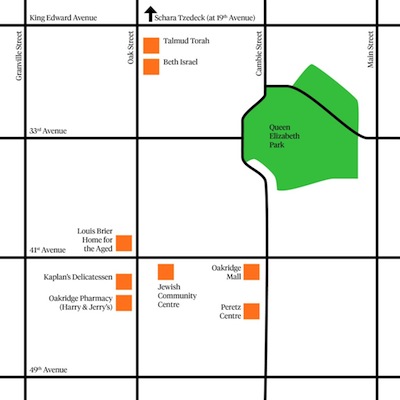
He noted, “If the Great Depression hadn’t hit, it seems likely that Oak and 12th Avenue would have been the heart of the Vancouver Jewish community. Instead, campaigns to build Beth Israel, Talmud Torah and a new Schara Tzedeck were put on hold until after the war. All three projects were completed in 1948. By that time, the city had continued to expand southward, so these three facilities were built closer to King Edward Avenue.
Oakridge Mall at 41st and Cambie opened in 1960 and provided a commercial hub for the neighborhood, which attracted many young families – Jewish and not – to the area. (image from jewishmuseum.ca/oakridge)
“This southward shift was further encouraged by another important event,” he continued. “In 1950, the CPR, the Canadian Pacific Railway, released a parcel of land stretching from 41st Avenue and Granville Street to 57th Avenue and Main Street. The city identified the middle third of this land for residential development and worked with Woodward’s and other developers to construct Oakridge Mall as an anchor for the new neighborhood.
“This neighborhood didn’t attract exclusively Jews, but it arrived at a perfect moment for our community.”
There was a lot of material from which the researchers had to choose. “The work was to pare it down to a manageable size, a representative cross-section of the community,” said Schwartz. “As you can imagine, everyone we spoke to had a very different experience. For instance, Vivian Claman and Ed Lewin shared with us the experience of survivor families.”
In the exhibit, said Schwartz, Lewin comments, “The survivors and their children were almost like a sub-community of the Jewish community. We kind of did everything together, we were like an extended family.”
“In general, the Baby Boomers we spoke to had happy memories of their childhoods,” said Schwartz, giving the example of Claman.
“We played in the street – we would be gone all day,” she says in the exhibit. “We played kick the can! I mean, those were the days that you would go outside and you would just play till it was dark or till your parents yelled and said come in for dinner. There was a lot of hanging out.”
That’s not to say everything was perfect. Schwartz noted Mort Dodek’s comments in the exhibit.
“One other thing that you have to understand is that there was a lot of antisemitism at that time,” says Dodek. “There were people who were uncomfortable living in Shaughnessy, a lot of Jewish people were not comfortable there. The Shaughnessy Golf Course was there, and it was restricted, no Jews were allowed to join that club.”
And Irene Dodek notes, “When we first moved to Vancouver in 1947, my parents went out with a real estate man to look at a house at 25th between Oak and Granville, and the real estate agent told my father, ‘This is a good neighborhood because no Jews or Chinese are allowed.’”
Schwartz also pointed out that there were divisions within the Jewish community, citing Seidelman and Mort Dodek’s comments from the exhibit.
“The rabbi of Schara Tzedeck would not go to Beth Israel, would not be seen to enter, whereas today they have the Rabbinical Association, all the rabbis get on really well together and they seem to respect each other’s different levels of observance, whereas in those days they didn’t,” says Seidelman.
“If you want to talk about splits in the community,” says Dodek, “there was a terrific split between the people who were involved with the Peretz shul and people who were involved with, say, Talmud Torah…. It was not religious and believed that the main language to speak for a Jewish person was Yiddish. And, of course, the people at the Talmud Torah, the language to speak, of course, with the establishment of the state of Israel, was Hebrew.”
“Another theme that emerged through our interviews,” said Schwartz, “was the way gender roles were changing and have changed since the 1960s. Men always worked outside the home, but women rarely did. This was beginning to change, but very slowly. Without full-time jobs, women had the time to dedicate to volunteer organizations like Hadassah and National Council of Jewish Women. Both organizations accomplished a great deal in the 1950s, ’60s and ’70s, but have struggled in the years since, as fewer young women have the time to devote to this type of work.”
For anyone wanting to know more about the role of women in the community, Schwartz recommended the museum’s 2013 exhibit More Than Just Mrs., which can be found online.
“Oakridge, like each of our exhibits, serves three functions,” said Schwartz, listing those functions: a chance to grow the museum’s archives, to increase awareness of the JMABC and of Jewish life in the province, and to reflect on how the community has changed over time.
For the Oakridge exhibit, he noted, the majority of the oral history interviews “were undertaken by volunteer and student interns, giving them valuable experience in the art and science of oral history interviews. Thanks to projects like this, including other exhibits and our annual journal, The Scribe, our oral history collection has grown substantially in recent years, bringing our current total to 762 interviews.
“Just this month,” he added, “we held two interviewer training sessions as the first phase of our Southern African Diaspora Oral History Project…. Through this project, we intend to interview hundreds of community members who arrived here from South Africa and the neighboring countries in the 1970s, ’80s and ’90s.”
With respect to increasing awareness, Schwartz said, “Many of you will remember the launch of our modern architecture exhibit New Ways of Living back in January of this year. This event had an attendance of over 150 people, many of whom were not Jewish and found out about the event through our partners, Inform Interiors and the UBC School of Architecture and Landscape Architecture. Similarly, our 2015 exhibit, Fred Schiffer: Lives in Photos, attracted more than 800 people over its two-week run, again with much thanks to our partners, Make Gallery and Capture Photography Festival…. Each new exhibit has a specific thematic focus which draws in a new audience.”
As for reflection on the Oakridge years, Schwartz pointed to the expansion of the Jewish community. “Families,” he said, “have settled into neighborhoods throughout the city and the region in general.”
Referring to the Oakridge area, he concluded, “[I]f fewer and fewer Jews live in this neighborhood, does it make sense for the Oak Street corridor to remain the hub of much Jewish activity? This remains to be seen.”
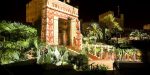
A scene from Migdal David’s The Night Spectacular: the Queen of Sheba with her entourage. (photo by Amit Geron)
While growing up in the United States, my friends and I never seemed to tire of asking each other, “Who is the Lincoln Memorial named after?” and “Who is buried in Grant’s Tomb?” The point of asking these silly questions seemed to be their obvious answers. When you grow up, however, you learn that the truth is not always so clear. Take, for example, Jerusalem’s Tower of David, also called David’s Citadel. King David, for whom it is apparently named, had nothing to do with the tower or any other part of this historic structure.
The tower is actually part of a medieval fortress that contains architectural additions from later periods. It is located near Jerusalem’s Jaffa Gate, which is the most trafficked entrance to the Old City. The tower is so well-recognized, it appears emblematically in countless Jerusalem paintings and photographs.
Early Byzantine Church fathers misinterpreted Josephus Flavius’ writings, ascribing the Tower of Phasael, from King Herod’s time, to King David. To further complicate the issue, Muslims also associated the Herodian tower with King David. They named their mihrab (prayer niche) Nabi Daud, David the Prophet. Later still, 19th-century Western Christians labeled the Turkish minaret added to the Mamluk mosque the Tower of David. This wrong name is what the tower is still called.
Tower of David Museum’s mission, in contrast, has evolved over time and various administrations. When the museum first opened in 1989, the aim was to present Jerusalem in all the years of its existence. Today, that is still a large part of the museum’s objective, but staff now creatively focus on familiarizing the public with the building complex’s amazing and lengthy physical presence. No easy job in an historic structure bound by preservation guidelines, in a city that has supreme importance to several of the world’s major religions and dates back to the second millennium BCE.
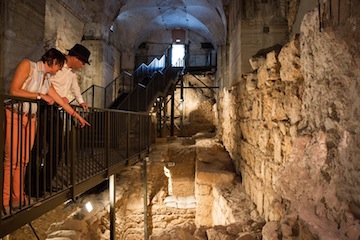
One of the new must-see additions is the Kishle. The discovery of the Kishle – when the Turkish Ottomans built a prison there in the mid-1800s, the Kishle referred to soldiers’ barracks – was accidental, but the follow-up to this archeological find has been careful and meticulous. What has recently been opened to the public is a continuous cut-away, or time line, of Jerusalem. The excavations reveal Jerusalem from as early as the sixth century BCE. It likewise shows walls from the time of King Herod – some of Herod’s huge building stones from the last quarter of the first century BCE are also still in place to the right of the museum’s main entrance by Omar Ibn El-Khattab Square – as well as evidence from the Middle Ages. Of particular importance is the discovery of a wall from the First Temple period, which adds to our knowledge about the city wall’s ancient route. Walking outdoors to the Kishle exhibit is an adventure in and of itself, as visitors traverse a dry moat that surrounds the Citadel. Also outdoors are finds going all the way back to the Second Temple period.
Excavations of the Kishle. (photo by Oded Antman)
The museum makes an effort to present Jerusalem from a variety of angles. Take, for example, the current temporary exhibit, Camera Man. In this wonderful photo display, we are able to see Jerusalem over 50 critical years of existence, a time in which its rulers switched hands three times, from Turkish rule to British rule to state of Israel rule. But the beauty of this show is that it zeroes in not on the wheeler-dealers of these various administrations, but rather on the daily life of the average Jerusalemite.
Relatedly, the museum seeks ongoing public involvement. Hence, it has taken two rather bold steps: it has taken part of the Camera Man exhibit out of the museum complex, mounting some of the photos in the centre of town, in close proximity to busy Machane Yehuda Market. A second significant step – that dynamically changes the exhibit, even as it is being shown – relates to the museum’s invitation to Jerusalem residents to send photos from their own family albums. Thus, with this participation, the exhibit is frequently being updated.
But the museum has not limited itself to just presenting Jerusalem’s history through photography. In the past year, it has gone digital in a big way. Families with elementary school-age children may now pay a small additional fee to tour the museum with enhanced iPad technology. In the Hebrew version of the award-winning Swipe the Citadel – an English version is in the pipeline – the family joins in the search for an archeologist’s young missing daughter. The virtual family and the real visiting family travel through the museum’s many old stone corridors looking for the girl. At the end of the adventure, virtual father and child are reunited, and visitors have been exposed to Jerusalem’s long and amazing history. There are currently six other apps for improving the on-the-grounds museum experience, including a digital detective game to discover who built the tower. A preview of what is available can be seen at tod.org.il/en/todigital.
The museum is always thinking of new ways to reach families. With this in mind, it has started hosting a new outreach program that allows families with children with special needs to participate as a family unit. The whole family attends and each member of the family engages to the extent to which he or she can. The museum already has a quiet room and a time-out room, and has been consulting with specialists to further develop meaningful family experiences.
While the Night Spectacular is an established program for Jerusalem tourists, readers might not know that there have been incredible outdoor evening concerts in the museum complex. These concerts have varied, from large events of hundreds of people listening to classical music, to smaller events of international liturgical music.
In the past, Tower of David Museum has hosted some incredible events for Jerusalem’s ethnically diverse population. For example, in 2000, Washington state artist and craftsman Dale Chihuly put this question to the people of Israel: “What’s incredibly hard to make, but all too easy to break?” Through his installation at the museum, Chihuly showed there is more than one way to solve this riddle, but his simple, yet thoughtful, answer was: “glass and peace.” The artist has donated some of his work to the museum.
While there may be a question about the museum’s name, there is no question you have to check it out the next time you are in Jerusalem.
Deborah Rubin Fieldsis an Israel-based features writer. She is also the author of Take a Peek Inside: A Child’s Guide to Radiology Exams, published in English, Hebrew and Arabic.
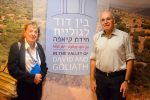
The author, Sybil Kaplan and Prof. Yosef Garfinkel at the opening of the exhibit In the Valley of David and Goliath, now at Bible Lands Museum in Jerusalem. (photo by Barry A. Kaplan)
“As the Philistine moved closer to attack him, David ran quickly toward the battle line to meet him. Reaching into his bag and taking out a stone, he slung it and struck the Philistine on the forehead; the stone sank into his forehead, and he fell face down on the ground. So, David triumphed over the Philistine with a sling and a stone; without a sword in his hand, he struck down the Philistine and killed him.” (1 Samuel 17:48-50)
Most of us have read or heard the story of David and Goliath, and some of us have even visited where the battle took place. But now we all have the chance to learn more. On Sept. 5, In the Valley of David and Goliath opened at Bible Lands Museum in Jerusalem. Presented to the public for the first time, the exhibit will be on display until September 2017.
Khirbet Qeiyafa (Fortress of Elah), 20 miles southwest of Jerusalem, on top of a hill overlooking the Valley Elah, was excavated by Prof. Yosef Garfinkel from 2007 to 2012. Garfinkel is the Yigael Yadin Chair in Archeology of Israel at Hebrew University and director of excavations at Khirbet Qeiyafa.
This fortified city was across from Gath, the Philistine city where Goliath lived when he came out to face the Israelites. The evidence indicates that the city was a military outpost for the House of David. In David’s day, the Valley of Elah served as a neutral zone between the Israelites and the Philistines. Excavators discovered a large cache of weapons in Qeiyafa, which Garfinkel identifies as “an area of conflict between two political units.”
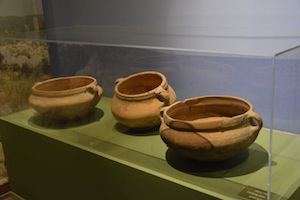
Cooking pots were among the many items on display. (photo by Barry A. Kaplan)
Based on carbon-14 dating performed on 28 olive pits, archeologists believe the city lasted from 1020 to 980 BCE. Items found at the site strengthen the connection to King David and religious practices described in the Bible. As well, according to Garfinkel, this Iron Age town was described in the Bible as the location of the battle between David and Goliath 3,000 years ago.
In an interview with Erin Zimmerman for CBS News in 2013, Garfinkel maintained that Khirbet Qeiyafa was a Jewish city for four reasons.
“It has a big casement city wall and houses abutting the city wall,” he said. “This is known from four other sites, so now we have five sites. All these five cities are in Judah, none of them is in Philistia. This is really typical Judean urban planning.”
Second, the bones found in the city all come from kosher animals.
“We have sheep, goat, cattle, but we have no pigs and no dogs,” he said. “On the Philistine side, they consume pigs and also dogs. Up to 20% of the animal bones at Philistine sites are pigs, but here, nothing.”
And, according to Garfinkel, a found pottery shard, also known as an ostracon, is the earliest example of Hebrew writing ever unearthed. On it are written commandments to worship the Lord and to help widows, orphans and slaves.
“It started with the word ‘al ta’as,’ which means ‘don’t do,’ and ‘ta’as,’ ‘to do,’ is only in Hebrew. It’s not Canaanite and not Philistine,” he explained.
Finally, Garfinkel said the absence of idols – which would have been in abundance in other places – points to a Jewish city.
“If you go to Canaanite temples of the Late Bronze [Age], you will find a lot of human and animal figures, but not in Khirbet Qeiyafa. So, the people here really obeyed the biblical taboo on graven images,” he said.
Garfinkel pointed out that, “in the absence of idols, there were religious shrines, and the models predate Solomon’s Temple by about 40 years, yet they match the Bible’s description of the Temple, down to the triple-framed doors. They’re the first physical evidence of Jewish worship in the time of King David.”
Part of the exhibit at the Bible Lands Museum are the two inscriptions that were found – one on a jar and one inscribed with ink on a pottery shard – which contain the distinctly identifiable Hebrew words for “king,” “don’t do” and “judge.”
Among the other objects on display are storage jars, water basins, a model of a house, hundreds of pottery vessels, jar handles with finger impressions, cooking pots and jugs, and the bowl that contained the olive pits.
Most amazing is a stone model shrine, which reflects a Mesopotamian architectural-style before the era of King David, but which probably inspired the look of the palace built by Solomon, David’s son. Features of the model are mentioned in biblical references to King Solomon’s Temple, built decades later.
For Hebrew-speakers traveling to Israel in the near future, exhibit curators will be giving behind-the-scenes tours in Hebrew on Oct. 7, Nov. 11 and Dec. 16.
Sybil Kaplanis a journalist, foreign correspondent, lecturer, food writer and book reviewer who lives in Jerusalem. She also does the restaurant features for janglo.net and leads walks in English in Jerusalem’s market.
Museloop’s app that it created for Israel Museum. (photo from Museloop via Times of Israel)
How do museums and other purveyors of history attract visitors and make the past relevant, especially as people come to expect more and more digital experiences?
Perhaps surprisingly, Werner W. Pommerehne and Bruno S. Frey recognized the problem more than 36 years ago. In their article “The museum from an economic perspective,” which was published in the International Social Science Journal in 1980, they stated:
“Museum exhibitions are generally poorly presented didactically. The history and nature of the artists’ work is rarely well explained, and little is offered to help the average, uninitiated viewer (i.e., the majority of actual and potential viewers) to understand and differentiate what is being presented, and why it has been singled out. Accompanying information sheets are often written in a language incomprehensible to those who are not already familiar with the subject. There is no clear guidance offered to the collections, and little or no effort is made to relate the exhibits to what the average viewer already knows about the history, political conditions, culture, famous people, etc., of the period in which the work of art was produced.”
Keren Berler, chief executive officer of Israeli start-up Museloop recently put the problem into current perspective. Younger visitors, she noted in an Israeli radio interview this past June, find museum visits passive and boring. She said, especially when seeing museum art exhibits, young people need something more to draw them into what they are seeing. So, her company has designed a museum-based application for iPhone and Android use. The application includes games, such as find-the-difference puzzles, plus information about the artist, all of which will hopefully make the visitor better remember the art and some facts about it.
Interestingly, in describing the games, two of the attributes she mentioned were competitiveness and the ability to take “selfies.” Children as young as 8 or 9 years old can use the app on their own, but younger children would need an adult to assist them.
Right now, the Museloop app focuses on Israel Museum’s under-appreciated (read: under-visited) permanent art collection. This exhibit includes the works of a number of “heavies,” such as Marc Chagall, Claude Monet, Pierre-Auguste Renoir, Paul Cézanne and Paul Gauguin. The goal is to make the experience so appealing that young visitors will then want to visit other museums. Since Israel Museum is paying the start-up for the development and use of the app, visitors benefit by having free use of it.
In contrast, Tower of David Museum has its own in-house digital department. This department has developed its own applications for heightened exhibit viewing.
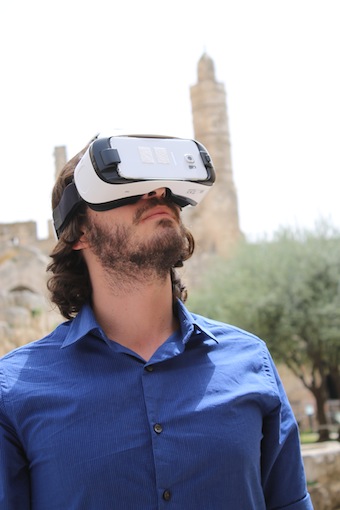
Virtual reality in the actual reality of Tower of David Museum. (photo from Tower of David Museum)
According to Eynat Sharon, the head of digital media, her department takes into consideration the visitor’s total museum experience. This experience consists of three overlapping circles: the pre-visit, in which a person visits either the museum’s website or mobile site; the actual physical visit; and the post-visit, in which the person digitally shares with friends and family on Facebook, Instagram and other social media what they encountered at the museum. The museum’s technical equipment and apps may be rented by museum visitors for a small fee.
Are these new applications then to be applauded? Some people still need convincing. Last year, art critic Ben Davis reflected on news.artnet.com, “For many, many viewers, interfacing with an artwork through their phone trumped reflecting on its themes. In effect, now every art show is by default a multimedia experience for a great portion of the audience, because interaction via phone is a default part of the way people look at the world.”
Dan Reich, who is the curator and director of education for the St. Louis Holocaust Museum and Learning Centre, said, “Personally, I am not big on technology. You end up with lots of button-pushing but not necessarily a lot of education. As a museum, we are pretty low-tech. We have an audio tour of the permanent exhibit, several stops in the museum where you can press buttons and hear testimony, an interactive map and – more recently – added an interactive screen entitled ‘Change Begins With Me,’ which deals with more recent or contemporary examples of hate crimes and genocide. We have been digitizing our collection of survivors’ testimonies. We have testimonies edited to different lengths. Generally, survivors like to be recorded, knowing their words are being preserved.”
And recent comments on TripAdvisor show that museums don’t necessarily have to be high-tech to succeed in their mission.
Visitors, for example, gave the St. Louis Holocaust Centre high marks.
Other Holocaust learning centres, however, have started taking current technology through uncharted waters. The USC Shoah Foundation now uses holographic oral history. According to Dr. Stephen Smith, the foundation’s executive director: “In the Dimensions in Testimony project, the content must be natural language video conversations rendered in true holographic display, without the 3-D glasses. What makes this so different is the nonlinear nature of the content. We have grown used to hearing life histories as a flow of consciousness in which the interviewee is in control of the narrative and the interviewer guides the interviewee through the stages of his or her story. [Now] with the … methodology, the interviewee is subject to a series of questions gleaned from students, teachers and public who have universal questions that could apply to any witness, or specific questions about the witness’ personal history. They are asked in sets around subject matter, each a slightly different spin on a related topic.” One educator confided that, while the technology is “creepy,” the public apparently likes it.
So, how do museums cope with the possibility that the medium in and of itself becomes the message? In other words, how do museums keep their audiences from being distracted by the technology? At the same time, how can museums survive financially if they follow goals that differ substantially from those of visitors, funders and other supporters?
A few months ago, Canadian entrepreneur Evan Carmichael offered guidelines at an Online Computer Library Centre conference. His suggestions seem applicable to museum administrators as well: express yourself, answer their questions, offer guidance, involve the crowd, “use your audience to create something amazing … create an emotional connection, get personal, and hold trending conversations, go to where things are happening, be there.
Time will tell whether the advent of museum-related high-tech will realize Don McLean’s 1971 tribute to Vincent Van Gogh’s art: “They would not listen, they did not know how. Perhaps they’ll listen now.”
Deborah Rubin Fields is an Israel-based features writer. She is also the author of Take a Peek Inside: A Child’s Guide to Radiology Exams, published in English, Hebrew and Arabic.