Experience both land & spirit

(photo from Chabad Richmond)

Chabad Richmond is leading a trip to Israel called The Land & the Spirit Israel Experience. People from across the Lower Mainland are invited to participate in this educational journey to Israel and Judaism’s most holy and historical sites.

March 4-13, 2018, participants will be taken on a five-star experience that feeds their heart, mind and soul, creating lifelong and life-changing memories. “This is an opportunity to see Israel as never before. This trip includes many unique features you will not find on any other trip of its kind,” said Rabbi Yechiel Baitelman, director of Chabad Richmond.

Sponsored by the Jewish Learning Institute, the trip includes:

Journey of learning: Explore Israel’s soul. The Jewish Learning Institute will bring Judaism’s rich history to life as travelers discover the origins of our nation and the spiritual secrets of Israel’s holy sites.

Israel today: Hear from chief rabbis, military brass and top political leaders. The group will be addressed by Israel’s leaders and gain an insider’s view of modern-day Israel’s challenges and triumphs.

Mission of solidarity: Head to the frontlines of Israel’s fight for survival. The trip is highlighted by a visit to the beleaguered community of Hebron, and an intimate barbecue with Israel Defence Forces soldiers and officers, where participants will be able to express their support to our brothers and sisters.

Travel in luxury: There will be concierge service from the moment you arrive, first-class hotel accommodations, five-star gourmet meals, and the very best Israel has to offer in education and entertainment.

Registration for the 2018 trip is well ahead of the pace of recent trips, so interested community members are encouraged to register soon. “This is not a fundraising trip,” emphasized Baitelman, “and no solicitation will be done on this trip.”

For more information and to view the itinerary online, visit landandspirit.org. For more information, contact Baitelman at rabbi@chabadrichmond.com or 604-277-6427.

Cycling with Israeli veterans

Beit Halochem Canada, Aid to Disabled Veterans of Israel, held its 10th annual Courage in Motion Oct. 22-26. (photo from Beit Halochem Canada)

In this year’s Courage in Motion, 75 Canadians, including nine from Western Canada, cycled alongside 85 Beit Halochem members with disabilities on a five-day ride through northern Israel, concluding in Tel Aviv. Group activities followed each day’s ride, including a visit to an army base, a night walking tour of Tiberias, wine-tasting and an evening with Israeli veterans, who shared their personal stories.

This year, more than $500,000 was raised to purchase much-needed equipment for Israel’s five Beit Halochem centres, and support their ongoing cycling programs. For more information and photos, visit courageinmotion.ca.

A homemade taste of Israel

You don’t have to go to Israel to savour the perfect Israeli sufganiyot. (photo from IMP)

Here is a favourite Israeli Chanukah recipe courtesy of Tnuva, an Israeli company that makes kosher cheese and dairy products.

ISRAELI MINI SUFGANIYOT
(12 servings)

3 1/2 cups flour
1/4 cup sugar
1/2 tsp dry yeast
1 1/4 cup of 1% milk, lukewarm
2 tbsp butter
1 egg, at room temperature
oil for frying
8 tbsp sugar
1 tbsp cinnamon

In a small bowl, mix together yeast, milk and eggs.

In a separate bowl, mix half a cup of flour with the sugar. Then add in the yeast mixture and blend together. Add in the remaining flour and continue stirring until the dough is elastic.

Cover the bowl with a towel and let the dough rise for about an hour or until the dough has doubled in volume.

On a floured surface, roll out the dough to about half an inch thick. Make circles using a medium-sized cookie cutter.

Place the dough patties onto a well-floured baking tray and let them rise again until they have doubled in volume (about an hour).

Heat oil in a medium saucepan and fry the dough patties until they are golden on both sides.

Mix remaining sugar and cinnamon and coat the sufganiyot with the mixture.

Preparing for extended stays

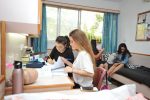
The foreign students dorm at Naale Elite Academy. (photo from IMP Media Ltd.)

While Israel draws substantial numbers of tourists due to its rich history, diverse culture and range of naturally beautiful locations, the country also plays host to thousands of high school and college students from North America, the United Kingdom, the European Union, South Africa and Russia because of its innovative educational programs.

Two of the world’s Top 100 universities, Hebrew University and Technion, are located in Israel, as are respected secondary school programs, highlighted by Naale Elite Academy’s free (i.e. scholarship) Jewish high school program, which provides students with a unique opportunity to actually “touch” the Technion during their teen years.

In order to make the best physical and fiscal transition to Israeli society, here are some steps you can take so that your day-to-day experience will be as pleasant and fruitful as it can be. 

Step 1: The right visa

To visit Israel, whether it is for a short- or long-term stay, you must have an entry visa. For a tourist planning a long-term stay in Israel, there are different types of visas available. An extended visa allows for more benefits; for example, working, voting, health insurance.

“If you are coming on an educational program, the school will likely set up a visa for you to pick up from Misrad Hapnim, Israel’s Ministry of Interior, within the first few weeks of your arrival,” said Michele, a mother with children studying in Israel and a student there herself.

If not, tourists can obtain an entry visa – usually for up to three months – which can then be extended for an extra two years. Temporary residents and students can apply for a further extension for up to five years.

Step 2: Health insurance

Bituach Leumi, the National Insurance Institute of Israel, provides basic medical coverage to all Israeli residents. For non-residents such as students, diplomats, et al, there is legislation allowing them to register for the same coverage as Israeli citizens.

After being in Israel for six consecutive months, you can go to the regional Bituach Leumi office with documentation of your temporary status in order to enrol in your choice of kupat cholim (health maintenance organization, HMO). Students can apply for subsidized enrolment with a stamped letter from their accredited educational institution. Alternatively, or additionally, there are private healthcare options available to tourists, students and temporary residents.

Step 3: Banking

Banking in Israel is very different than banking in most countries. From cheques, to credit cards, fees and transfers, even Israelis find the system challenging.

The two major issues that non-residents face with banking in Israel are opening an account and/or transferring money from their country of origin.

Dr. Robert Lubin, managing director at Technion’s Ruth and Bruce Rappaport Faculty of Medicine, has been working with students on long-term programs in Israel for many years. He explained how what was once a sore point for students managing their finances in Israel has changed for the better. “A service called OlehPay has been a game-changer for most of our students,” he said. “Between them and the cooperation of our local bank discount branch, transferring money from the U.S.A. is easy and practically seamless – that was not the case just a few years ago.”

Step 4: Transportation

Israel’s public transportation is the preferred method of transportation in the country. According to Sammy Schwartz, a student from abroad studying at Naale Elite Academy’s Aniere program, “Getting around Israel is really easy even if you’re struggling with the language.”

Almost every Naale and Technion student who frequents the public transportation system in Israel uses the Rav Kav “smart card” that can be loaded with a variety of travel fare options. There are many benefits to getting a personalized card, such as being able to access the money on it if it gets lost or stolen, as well as the discounts that apply to students and senior citizens. The card is free and can be obtained at any Rav Kav station with a passport.

Schwartz also recommended downloading the Moovit app. “Moovit tells you how to get exactly where you need to go in real time, with bus, cab and train options. That, combined with Rav Kav, makes traveling around Israel really simple,” he said.

For tourists or temporary residents who will be driving, whether via a rented or purchased car, they can use a valid foreign driver’s licence for up to one year following their entry date.

Step 5: Phone plans

Having a smartphone is a must. Aside from allowing you to stay in touch with family and friends, smartphones are necessary for navigating your way through an unfamiliar area, for accessing your email, social media and numerous messaging platforms, and for keeping abreast of the latest news and alerts. All you need to sign up for one of the many phone plan options in Israel is your passport and a credit card.

Catherine Green is a freelance reporter and PR expert.

Balfour is but one milestone

This year marks the 100th anniversary of the Balfour Declaration, a cause for commemoration and even celebration on the part of Jewish activists worldwide.

The Balfour Declaration refers to a short letter from Lord (Arthur) Balfour, former U.K. prime minister and then-foreign secretary, to Lord (Lionel Walter) Rothschild. In it, Balfour declared that the British cabinet had approved a statement that the government favoured the establishment of a Jewish national home in what was soon to become the British Mandate of Palestine.

The implications of the declaration have been debated by pro- and anti-Israel activists for, well, an entire century. For many in the pro-Israel community, the declaration is akin to a Magna Carta for the Zionist movement: an affirmation – from the very authority that would oversee the territory – that Zionism was indeed a worthy enterprise.

Without diminishing this sentiment, I offer my interpretation of the Balfour Declaration and what it teaches us about pro-Israel advocacy today.

The Balfour Declaration was a strategically vital recognition of the right of the Jewish people to self-determination – and one that clearly affected the course of history. But Balfour did not establish our national rights, which pre-existed the declaration. These rights have always been rooted in the natural right of every nation to shape its own identity and achieve self-determination in its ancestral land.

This is not a minor distinction. We dare not confuse the validation of our rights with the source of our rights. Indeed, our detractors falsely do so. In their minds, if the Balfour Declaration can be dismissed as a “colonial” statement, the rights of the Jewish people to which it speaks can be similarly undermined.

It’s this sort of nonsense that suggests Jewish history in the land began in 1917. To believe it, one would have to ignore the mountains – and caverns – of archeological and historical evidence that confirm a Jewish presence in the land for millennia. In addition to various non-biblical documents confirming Jewish indigenous roots in Israel, the Bible itself is widely recognized – even by ardent atheists – as a historical chronicle of a particular people in a particular land.

As Shimon Koffler Fogel, chief executive office of the Centre for Israel and Jewish Affairs (CIJA), recently observed, the Balfour Declaration was “one milestone among many that confirm the moral, historic and legal right of the Jewish people to self-determination in our ancestral land. Just as many states endorsed the Balfour Declaration at the time, the international community’s support for the national liberation of the Jewish people after centuries of exile has been expressed time and again.”

Fogel further noted that, in a similar vein, November also marks “the 70th anniversary of the UN partition resolution of 1947, which expressly called for the creation of a Jewish state.”

The Balfour Declaration matters today precisely because it is more important than ever that we show how our fundamental rights as a people are backed by international consensus. The declaration is not the linchpin of this recognition but rather a signpost on the road to achieving widespread affirmation of our rights.

Every year, CIJA brings approximately 200 Canadian leaders and future leaders (almost all of whom are non-Jewish) on fact-finding missions to Israel. As someone who heads an annual trip of post-grad students, I can tell you that most Canadians – including those sympathetic to Israel – are not particularly interested in what a British lord had to say about the region a century ago.

But what they do care about, and what makes them more receptive to understanding the strong legal and moral foundation for Israel’s existence, is that many global figures and organizations (including the United Nations) have echoed these rights. In this regard, Balfour is an important thread of the historic fabric.

The importance of non-Jewish validators applies to many pro-Israel advocacy issues, such as Israel’s right to define itself as a Jewish homeland, the dangers of BDS (the movement to boycott, divestment from and sanction Israel) or the threat posed by Israel’s neighbours. On these and other topics, our target audience is generally more receptive to our perspective when we can demonstrate that it is one shared by others, including governments and leaders around the world.

Balfour matters, but we should remember why. The declaration serves not as the basis for modern Israel’s existence but as a key witness to the abundant evidence – irrefutable, millennia-old proof – of the right of the Jewish people to self-determination.

Steve McDonald is deputy director, communications and public affairs, at the Centre for Israel and Jewish Affairs. Follow him on Twitter at twitter.com/koshermcdonald.

Women lead way to peace

Yael Deckelbaum is using her musical talents and connections to help Israelis and Palestinians press for peace. (photo from Yael Deckelbaum)

Yael Deckelbaum is using her musical talents and connections to help lead thousands of Israeli and Palestinian women to peacefully press for the end of the fighting between their two peoples via March for Hope.

Deckelbaum’s celebrity status in Israel and around the world – through performances with known local artists and bands such as Shlomo Artzi and Machinah, as well as her career with Habanot Nechama and solo albums – helps draw a crowd. Her involvement in the cause began when she joined forces with Daphni Leef, an Israeli activist for social justice.

“I’d sit with her and tell her she’s a better person than I am,” said Deckelbaum. “She was always talking about how we have to change things in Israel – going around in many places in Israel, meeting people, listening to them and trying to learn … what’s wrong and trying to fix things. I decided to take a caravan, go through Israel, sell CDs, maybe bring a sound system, perform … see people from a different angle. Daphni decided to join me. From this idea, it became 20 people, two caravans … a journey we did for 45 days in 40 different places across Israel.”

They met many Israelis from various cities and villages, and Deckelbaum gained a new perspective. Everywhere they went, she would sing and Leef would speak to the people after every show.

“That’s when I decided I would dedicate myself, using music as an instrument, toward change … not just be an instrument for supporting my existence … but to spread a message and how I believe this world should be. [It] was a big turning point in my path,” Deckelbaum told the Independent.

A year later, one of Deckelbaum’s friends shared an email about Women Wage Peace.

“A lot of times, us musicians, we get invited, we go, sing and leave,” said Deckelbaum. “We feel good about it. But, this time, I felt like I had to meet them. A few days later, I was sitting at a table with women from Women Wage Peace. They told me about this march they were planning – a group of mothers who, in the period of military operation, were experiencing terror at home, fear … mothers sitting at home, knowing their sons are somewhere and not knowing if they’d come home from war.

“One of the founders told me she said to herself that she would never forget this feeling of terror, that she can’t sit anymore and do nothing about it. She urged us to do something radical, extreme, because something had to change. She couldn’t live with the feeling of helplessness anymore.”

At one point, Women Wage Peace fasted for 50 days outside the prime minister’s house, demanding a mutual agreement between Israel and Palestine be made.

“They told me they were already connected with Palestinian women who feel the same,” said Deckelbaum. “And then, on Oct. 19, 2016, 1,000 Palestinian women marched with us together in the Dead Sea [area] – the lowest place of the earth. I started to cry, as it touched me in a deep place.

“Many years ago, I had this vision of women marching together … not something I can explain…. Then, I met these women [who] told me about this, and it was coming true. And, it has an energetic meaning that it happened in the lowest place on the earth – women marching to the belly of the earth. So, I cried and offered to give my music to the cause.”

Deckelbaum invited more artists to join and sing, and became the march’s artistic director. She began with songs like “Give Peace a Chance” and “Hallelujah,” and then wrote originals herself. “The melody and the lyrics just came,” she said. “And the ‘Prayer of the Mothers’ was born, directed by Astar Elkayam.”

Deckelbaum was inspired by a message that had been sent to march organizers by Leymah Gbowee. Gbowee is a Liberian woman who led a women’s peace movement, which helped bring an end to the Second Liberian Civil War in 2003, after 13 years of fighting.

“I felt something very real is happening, that I have a chance to do this,” said Deckelbaum. “I put it into the song clip, so you can hear her speaking. And she sang, ‘As the world we live in, peace is possible / Only when women of integrity and faith stand up for the future of their children.’”

This year, Women Wage Peace planned a second march, dubbed, “The Journey to Peace,” which started in the south of Israel near the Gaza border on Sept. 24 and ended in Jerusalem. Other events have followed, and will continue, throughout Israel. The peak of it was on Oct. 6 in Jaffa/Tel Aviv, with a march that Deckelbaum helped organize, “colourful with dancers, musicians, and drummers – happy and hopeful,” she said.

On Oct. 8, there was an event in the desert with Palestinian women. The previous year, 1,000 Palestinian women came. This year, there was twice that number, and the hope is that, each year, it will grow.

“These are the miracles we’re all waiting for – peace between Israel and Palestine, and between and within ourselves and amongst us as people,” said Deckelbaum. “Women Wage Peace isn’t only about making peace with Palestinian women. It’s about making peace between all kinds of women in our society and different places.”

Deckelbaum learned there is a global women’s revolution. She heard of a march in Washington, D.C., in which she participated, and another in Zurich, at which she was invited to sing.

After the video of “Prayer of the Mothers” was released, more marchers all over the world were set into motion. Deckelbaum is now working on a project called Women of the World Unite.

“I believe that women from all over the world are sharing this message, a hope for peace – a message that’s inclusive of all human beings,” she said. “We need women to be more involved in managing the ways of the world – not only by raising children, but also by engaging in the system and how things will work.”

The Jewish Independent spoke over the phone with Deckelbaum when she was in Switzerland doing concerts with an ensemble of religious and secular Jewish, Muslim and Christian women called Prayer of the Mothers Ensemble. It involves 14 women, carrying the message of female empowerment, revolution, evolution and peace.

Rebeca Kuropatwa is a Winnipeg freelance writer.

Giro d’Italia’s “Big Start” in Israel

Sylvan Adams, 58, is funding the construction of the Middle East’s first Olympic velodrome, slated to open in Tel Aviv in May 2018. (photo from margolin-bros.com/en/project/Velodrom)

In Europe, the Giro d’Italia bicycle race ranks in status with baseball’s World Series or hockey’s Stanley Cup. Since the beloved Italian sports extravaganza’s initial race in 1909, the multi-stage race has never started outside Europe – until now. Next May, the annual event’s starting flag will be waved in the Holy City, thanks in big part to Sylvan Adams – the Montreal billionaire now living in Tel Aviv who himself is a competitive bicycle racer.

Adams, 58, is funding the construction of the Middle East’s first Olympic velodrome, slated to open in Tel Aviv in May 2018, in time for the Israel-based initial part of the 23-day Giro d’Italia. The Israeli team is all but guaranteed to receive one of four wildcard invitations for the race.

The bike-racing stadium, called simply the Velodrome, is part of the National Sports Centre being built by the Tel Aviv Foundation, by Mazor-First Architects. Located on Bechor Shitrit Street in the Hadar Yosef neighbourhood, the complex will gentrify a once-impoverished area. Budgeted at $11 million, the 7,100-square-metre biking facility will be jointly owned by the Olympic Committee of Israel and the Tel Aviv Municipality.

Adams, who made aliyah in December 2015, is honorary president of the organizing committee of the race’s “Big Start” in Jerusalem.

The three-week Giro is widely considered the most beautiful of cycling’s three Grand Tours, ahead of the sporting leviathan of the Tour de France and Spain’s lower-key Vuelta a España. Ministers from Israel and Italy met at Jerusalem’s Waldorf Astoria Hotel in September to sign an agreement that the opening three stages of next year’s Giro will be held in Israel.

Like the other Grand Tours, the modern editions of the Giro d’Italia normally consist of 21 daylong segments (stages) over a 23-day period that includes two rest days. All of the stages are timed to the finish, each stage’s time added to the previous. The rider with the lowest total time is the leader of the race and gets to don the coveted pink jersey, called maglia rosa, worn by the leader of the general classification.

Adams, who has until recently been publicity shy, today lives in a penthouse overlooking the Mediterranean and Tel Aviv’s sea-side bicycle path. A two-time world outdoor cycling champion in his age category, his most recent title was won at the World Masters Championship, held in Manchester, England, in November 2015. Adams, who began cycling competitively more than two decades ago, is a six-time Canadian and 15-time Quebec champion. He won four gold medals at two Pan-American meets, and a total of five golds at the 2009 and 2013 Maccabiah Games.

His dream is to turn Tel Aviv into “the Amsterdam of the Middle East,” i.e. a city as bike-friendly as the Dutch capital. He believes something similar can be done in Tel Aviv, where traffic congestion and a parking shortage are reaching a crisis, as more and more motorists come in from “satellite” cities.

“Petach Tikva, for example, is eight kilometres from the heart of Tel Aviv. That can take an hour to drive some mornings. By cycling, it is 20 to 30 minutes,” he said.

Adams first visited Israel nearly four decades ago. He and his wife of 33 years, Margaret, a native of London, England, met while volunteering on a kibbutz.

Now retired, Adams has given up his involvement with the family business, Iberville Developments Ltd., the real estate giant founded after the Second World War by his father, Marcel Adams, a Romanian-born Holocaust survivor. The younger Adams was its chief executive officer and his son Josh, one of his four children, is now running the company, one of the largest owners of commercial properties in Quebec.

Gil Zohar is a journalist based in Jerusalem.

ביקור חגיגי

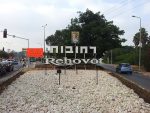
נציגי קהילת יהודי טורונטו ביקרו בשכונת אבן גבירול בעיר רחובות שאותה הם מאמצים. (צילום: Little Savage)

ראשי קהילת יהודי טורונטו קיימו בשבוע שעבר ביקור חגיגי בשכונת אבן גבירול בעיר רחובות שבמרכז הארץ (במישור החוף הדרומי), אותה הם מאמצים כבר שנים רבות. ביקור קודם של ראשי הקהילה היהודית באבן גבירול התקיים לפני שתיים עשרה שנים.

האימוץ כולל תרומות נרחבות לתמיכה בתושבי לאבן גבירול (ובשמה הקודם כבר גבירול) מכל הגילאים. הוא כולל: הקמת בית הספר בשכונה (בשנת 1988) על שם ראש הממשלה לשעבר מנחם בגין – שכולל חטיבה הצעירה וכן משמש את לתמידי המגזר החרדי, מתנ”ס, מרכז יחודי לגיל הרח, מרכז שכונתי לבני גיל הזהב וכן מלגות לסטודנטים מקומיים.

בביקור הפעם נכחה משלחת גדולה של ראשי קהילת יהודי טורונטו שמנתה שלוש מאות וחמישים איש. אותם קיבלו בברכה בין היתר ראש העיר רחובות רחמים מלול, סגניו עו”ד מתן דיל וזהר בלום, יו”ר ועדת שכונת אבן גבירול גבי גולן (המנהל קשר קבוע ומתמשך עם ראשי קהילת טורונטו) וכן חברי מועצת העיר תל אביב איטח רונן ואמיר רונן.

המשלחת מטורונטו השתתפה בטקס חגיגי לחנוכת הכיכר בצומת הרחובות יוני נתניהו ובן גוריון (במערב רחובות) על שם יהדות טורונטו. זאת כדי לבטא את הקשר החזק והעמוק בין תושבי שכונת אבן גבירול לבין קהילת יהודי טורונטו. לאחר הטקס התקיים אירוע ברחבה המרכזית של בית הספר על שם בגין, שכלל הפנינג גדול עם מאות מתושבי השכונה.

בתום האירועים אמר ראש העיר מלול: “אנו מוקירים את ראשי הקהילה היהודית בטורונטו על תרומתם הגדולה לשכונה ולעיר רחובות. הקשר הפורה הזה הביא ברכה גדולה בליבה של השכונה המתפתחת הזו. לשותפות זו בינם

לביננו יש משמעות ערכית, חינוכית ולאומית. אם בתפוצות ואם בישראל כולנו עם אחד”.

כפר גבירול וכיום שכונת אבן גבירול נקראת על שמו של הרב שלמה אבן גבירול, שהיה מגדולי המשוררים והפילוסופים היהודים בימי הביניים. לפני מלחמת העצמאות שכן במקום הכפר הערבי אל-קוביבה (בערבית הכוונה לכיפה קטנה או קציצה), שחלקו ננטש וחלקו פונה מידי תושביו (במסגרת מבצע ברק של חטיבת גבעתי במאי 1948). השכונה מורכבת מאוכלוסייה מגוונת של יהודים מהמזרח והמערב. תחילה היא אוכלסה ביהודים שעלו מבולגריה ולאחר מכן מיהודים שהגיעו מתימן. בשנות השישים הגיעו יהודים שעלו ממרוקו, בשנות השבעים יהודים שהגיעו מברית המועצות לשעבר, ולאחר מכן יהודים שעלו מאתיופיה. במשך השנים לאור עליית מחירי הנדל”ן באזור תל אביב עברו להתגורר בשכונה זוגות צעירים, בעיקר במגדלי הדיור החדשים של חברת הבנייה אביסרור.

השכונה ידעה שני פיגועים בשנת 1955: חולית מודיעין ממצריים רצחה בחודש פברואר תושב מקומי. לאחר מספר חודשים באוגוסט חוליית פדאיון רצחה אף היא תושב מקומי.

קצת היסטוריה: בני שבט היין התיישבו באזור קוביבה במאה השלושה עשר, על שרידים של כפר מתקופת הברונזה. השבט הגיע בנדודיו מחצי האי ערב. בהמשך ניצבה במקום העיר אלתקה (אחת מערי הלווים). בתקופת השלטון העותומאני רכשה קרן קיימת לישראל כששת אלפים ושלוש מאות דונם מאדמות הכפר קוביבה. האדמה חולקה לארבעה צרכים עיקריים: לגידולים חקלאיים, לגידולי מספוא, לגידולי שלחין (פרדסים וירקות) וכן לגידולי כרמים (אדמה זו התאימה אף לבנייה).

ברחובות שהוקמה בשנת 1890 מתגוררים כיום כמאה וארבעים אלף תושבים. היא נחשבת לעיר השניים עשר בגדולה בישראל. למעלה מעשרים אחוז מהתושבים הם עולים כאשר רובם (בדומה לשכונת אבן גבירול) הגיעו מברית המועצות לשעבר מתימן וכן מאתיופיה.

Resettling Eretz Yisrael

Alison Pick discusses her new novel, Strangers with the Same Dream, at the Cherie Smith JCC Jewish Book Festival Nov. 25. (photo by Emma Lee)

“Here they were, she thought, in this remote land of Palestine, far from their homes and families. They had left their lives as they knew them to turn the Balfour Declaration, and the idea of a homeland for the Jews, into truth. They were strangers with the same dream…. But this was the thing: Zionism was not just an idea. It was something that was happening, now and now and now. It was something she could make happen.”

So thinks Ida, one of the three main characters in Alison Pick’s latest novel, Strangers with the Same Dream (Knopf Canada, 2017). Pick will be in Vancouver to open the Cherie Smith JCC Jewish Book Festival on Nov. 25, 7:30 p.m., at the Rothstein Theatre. Appropriately enough, the title of her conversation with Jerry Wasserman is Idealism vs. Reality.

Ida has come to Palestine, to Eretz Yisrael, the Land of Israel, on her own from Russia, having seen her father killed and knowing that the brutal attackers also raped her mother; her sister, “Eva, thank God, had been at school.”

It is 1921. Ida is part of the Third Aliyah, one of many other young idealists, most of whom had no idea at the harsh conditions that awaited them – the heat of the dessert, the abundance of malaria-spreading mosquitoes, the backbreaking work, the relinquishment of individuality and, of course, their new Arab neighbours, who were displaced by their arrival.

The leader of Ida’s particular group is David, who immigrated during the Second Aliyah, in 1910. He “had helped establish the moshava [settlement] at Kinneret, planting eucalyptus trees along the muddy banks, negotiating with the fellaheen [farmers]. Ida heard he had traveled the entire length of Eretz Yisrael on horseback, meeting the Arabs in every tent and marketplace, learning their various customs so as to help in the purchase of land.”

And there is David’s wife, Hannah, who, “like David, had arrived in the Second Aliyah, which meant the halutzim [pioneers] instantly respect her.” While the “historic speeches fell to David; Hannah was left with the logistics.” For example, Hannah was the one to request that the new olim (immigrants) voluntarily surrender all of their valuables “to the enterprise they were building together. She did not want strangers circulating like policemen to take each other’s belongings. Especially not after what so many of them had been through in Czarist Russia.”

photo - Strangers with the Same DreamStrangers with the Same Dream is divided into three sections, each of which is written from the perspective of one of the three protagonists – Ida, David and Hannah – about the same series of events.

“Following the writing of my memoir Between Gods, I was very interested in the relationship between truth and memory, and the ways in which different people (family members, as one example, or characters) experience the same events very differently,” Pick told the Independent. “I love to challenge myself with each new book and so I decided to try and tell the same story through three different sets of eyes. I wanted the reader to have the pleasure of seeing things the characters did not; that is, miscommunications, misunderstandings, falsely attributed motivations.”

The protagonists could be considered archetypes of a sort. “Although I didn’t set out to write it that way,” said Pick, “Hannah certainly has some of the Mother in her, and Ida has the Maiden. David, I suppose, could be seen as a Trickster, although that might be a generous way to characterize him.”

The novel is introduced by a short prologue, written in the voice of a ghost – a former halutza – who sets up the narrative and then enters it occasionally.

“The ghost is a link between the past and the present,” explained Pick. “Because the three narrative voices were necessarily so limited, I wanted an additional over-arching outside view – outside of time, even – who could reflect both backward and forward. I was also thinking about the idea of haunting – that Israel today (as with Canada, as with many other places) is haunted by history, by the very real lives of those who came before us and influence how we live and how we understand our own stories.”

Pick chose to set the novel in 1921 for a number of reasons.

“I’m not an historian, although I do love writing historical fiction – and, while there is a lot of leeway in fiction as a genre, it is important to me to get the historical facts right. So, I set relatively narrow parameters for myself – all the action takes place roughly over the course of one year. The kibbutz in Strangers with the Same Dream is fictional, but it is loosely based on Kibbutz Ein Harod, established in 1921. While there had been other, smaller attempts at kibbutzim, Ein Harod was the first attempt on a bigger scale, and it is a kibbutz that has, still today, a mythical presence in the collective psyche of Israel.”

The novel took Pick about three years to write, and she did research in Israel.

“At Kibbutz Ein Harod, there is an incredible archive about the early years of kibbutz life,” said Pick. “I was able to access first-person diaries, many written by the female pioneers, which I had translated from Hebrew. Both the translator and the archivist herself were wonderful sources of information about the early years, and they introduced me to an elderly man (who has sadly since passed away), who was there at the establishment of the kibbutz in 1921. So, I read, I researched, I listened, I imagined. And then I tried to breathe life into a world of the past, to bring it to life for readers today.”

While some readers might find the ghost an intrusive presence, I found the novel completely engaging, in part because it shows some of the grim realities the halutzim faced, not only from the land and their Arab neighbours, but from one another. Readers will be able to picture what it was like in those early days. If I wasn’t sure before, I am now that I would have made a poor halutza – the hard work and strange surroundings wouldn’t have been nearly as daunting as the high risk of malaria and the challenges of living in a collective with few resources. I came away from the novel with more admiration for (most of) those who worked to make the idea of Zionism a reality. At least one reviewer, though, has imputed an anti-Zionist message to the novel.

“I confess I have been surprised by the (few) reviews that take the novel as anti-Zionist,” said Pick. “Perhaps I’m naïve – and I am certainly a newcomer to Judaism, which is no secret – but I adore Israel. I traveled there three times during the writing of the book and, each time, I fell more madly in love with the place.

“It did not occur to me that exploring the psyche of those early Zionists – who at the very least did realize that the place they were ‘settling’ was already populated – would be construed as anything other than telling the simple truth. I did not start out with a political message and, indeed, I think to do so is anathema to good fiction. The role of art, as I see it at least, is to open, to unravel, to make space for more questions rather than to judge, decide or condemn. Although one of the characters [David] is decidedly a villain, albeit I hope one in whom the reader sees humanity, the other two main players (Hannah and Ida) are, to my mind, hugely sympathetic. Everyone in the novel – Jews and Arabs alike – are simply trying to make do in a both remarkable and remarkably difficult situation.”

For tickets to hear Pick, and for the full book festival lineup, visit jewishbookfestival.ca.

ביקור חשוב

נציגי הפדרציה היהודית של ונקובר ביקרו בישראל, ברשות הפלסטינית ובירדן. (צילום: twitter.com/JewishVancouver)

משלחת של הפדרציה היהודית של אזור מטרו ונקובר בשיתוף פעולה עם המרכז לעניני ישראל והיהודים בקנדה, חזרה מביקור חשוב בישראל, ברשות הפלסטינית ובירדן. בראש המשלחת עמדה יו”ר מועצת המנהלים של הפדרציה היהודית, קרן ג’יימס. כן השתתפו בה המנכ”ל, עזרא שנקן, היו”ר לשעבר סטיבן גרבר והיו”ר של המרכז, דיוויד קייפ.

המשלחת מסרה בדיונים שניהלה עם נציגים שונים מישראל את תמיכתה בישראל ואת הרצון להגיע לשלום באזור. הפגישות התנהלו בין היתר עם בכירים במערכת הפולטית בישראל. ובהם: שר התשתיות הלאומיות, האנרגיה ומקורות מים, יובל שטייניץ (ממפלגת הליכוד), שרת המשפטים, איילת שקד (ממפלגת הבית היהודי), סגנית שר במשרד החוץ, ציפי חוטובלי (ממפלגת הליכוד) וסגן השר לעניינים דיפלומטיים במשרד ראש הממשלה, מיכאל אורן (ממפלגת כולנו). כן התקיימה פגישה עם נציג האופוזיציה יו”ר מפלגת יש עתיד, יאיר לפיד. בנוסף התקיימו פגישות עם שגרירת קנדה בישראל, דבורה ליונס והקוסטוס (שומר המקומות הקדושים) של הכס הקדוש בישראל הפורש, האב פיירבטיסטה פיצאבלה.

נציגי הפדרציה היהודית לקחו חלק בישיבת חבר הנאמנים של הסוכנות היהודית לארץ ישראל, שדנה במשמעות החוק של ממשלת ישראל בנושא הגיור (המאפשר לרבנות הראשית בישראל סמכות בלעדית בהליכי הגיור), וכן בהשעיית ההסכם לגבי סידורי התפילה בכותל המערבי (“מתווה הכותל”), על ידי ראש הממשלה, בנימין נתניהו, עקב לחצן של הפלגות החרדיות יהדות התורה וש”ס. כידוע יו”ר הסוכנות היהודית, נתן שרנסקי מתנגד להשעיית סידורי התפילה החדשים וחוק הגיור. יצויין עוד כי שני נושאים אלה מטבע הדברים מעסיקים רבות יהודים הגרים בישראל ומחוצה לה, שלא נמנים על הזרם האורתודוכסי (בהם רפורמים וקונסרבטיבים).

המשלחת התשתפה גם באירוע הרשמי בכנסת לזכרו של ראש הממשלה לשעבר, יצחק רבין ז”ל.

נציגי הפדרציה היהודית והמרכז לענייני ישראל והיהודים יצאו לרמאללה ושם נפגשו עם ראש הממשלה של הרשות הפלסטינית, פרופסור ראמי חמדאללה. הנציגים מסרו לחמדאללה את תמיכתם בהסכם השלום בין הצדדים, וכי על הרשות הפלסטינית לקבל את הצעתה של ממשלת ישראל לחדש את המשא ומתן בנושא השלום. הם ביקשו מראש ממשלת הרשות הפלסטינית לעשות יותר כדי להילחם בהסתה ובטרור. בפדרציה היהודית מציינים בהקשר זה כי החשוב היה להם להסביר ישירות לראש הממשלה הפלסטינית מהיא העמדה של היהודים בתפוצות בנושאי השלום וישראל.

כן נפגשו נציגי המשלחת בעמאן עם ראש הלשכה המלכותית של ירדן ולשעבר ראש ממשלת ירדן (בשתי קדנציות), ד”ר פיאז א-טראונה. המשלחת הציגה לפניו מסרים דומים לאלה שהועברו לראש הממשלה הפלסטינית, תוך הדגשה שעל המנהיגים הערבים להפעיל לחץ על הרשות הפלסתינית לעשות יותר כדי להילחם בהסתה ובטרור. וכן להניע את הרשות לקבל את עמדת ישראל ולחדש את המשא ומתן לשלום. בישיבה עם ד”ר א-טראונה נכח גם שגרירה של קנדה בירדן, פיטר מקדוגל.

בפדרציה היהודית מבקשים לציין כי מידע בדבר שתי הפגישות עם ראש הממשלה הפלסתיני, ועם ראש הלשכה המלכותית של ירדן, נמסר לממשלות קנדה וישראל, שאף הביעו תמיכה בהן.

קדמו לפגישות בישראל, ברשות הפלסטינית ובירדן, ביקור בלונדון שכלל פגישות של נציגי המשלחת המשותפת עם נציגים של ראשי הקהילה היהודית. הדיונים כללו בעיקר את נושאי הגברת הביטחון והמלחמה באנטישמיות. המשלחת השתתפה גם באירועי מאה שנה להצהרת בלפור עם שר החוץ הבריטי, בוריס ג’ונסון, שנערכו בלשכת יושב ראש בית הנבחרים הבריטי, ג’ון ברקו. המשלחת ביקרה עוד בבית קנדה בלונדון ונפגשה עם נציגו מטעם ממשלת קנדה.