Winning with grace

It was the model of dignity and decorum in a ludicrous situation. When Israeli judoka Tal Flicker won a gold medal last week at the Judo Grand Slam in Abu Dhabi, in the United Arab Emirates, his excitement was diminished by the Emirati host federation. Because of Flicker’s nationality, the UAE refused to play the winner’s national anthem or raise his nation’s flag. Instead, while the gold medal winner stood under a flag of the International Judo Federation and the federation’s theme song played, Flicker had to quietly sing his own private rendition of Hatikvah, the Israeli anthem.

Similarly, when Israel’s Tohar Butbul beat an Emirati judoka, the defeated competitor turned his back on Butbul’s extended hand, carrying through the tournament’s motif of betraying the values of judo in particular, and sports more generally.

Israel went on to win five medals in all at the tournament, with the rudeness by Emirati organizers repeated again and again. (The Israeli team was also forced to remove their nation’s flag from their uniforms.) Yet Flicker’s grace, and that of the other winners, was a model that Israelis and Jews worldwide – indeed, anyone with a smidgen of sportsmanship – should admire.

In what was a small consolation, two senior Emirati sports officials later apologized to the head of the Israeli judo delegation for the loser’s refusal to shake Butbul’s hand. But there has been no apology for the larger silliness around the Israelis’ participation in the competition.

In an ideal world, international sports federations and other bodies would reward behaviour like the UAE’s by preventing them from hosting major events for a specific period and demanding in advance that the most basic tenets of sportsmanship be respected by any country that hopes to host.

In the bigger picture, the incident demonstrates the absurd treatment Israel receives in the international community more broadly. The latest example, which also happens to involve the UAE, occurred on Monday in Paris at the 39th general conference of UNESCO, the United Nations Educational, Scientific and Cultural Organization. The UAE struck a commemorative medal to mark the renovation of UNESCO’s conference room. The medals feature a portrait of Hamdan bin Rashid Al Maktoum, the UAE’s finance minister (a keepsake for sure!) and one was left on the desk of every UNESCO member-state except … the Jewish one.

“The state of Israel has no need for gifts,” said Carmel Shama-Hacohen, Israel’s ambassador to UNESCO, “but this ugly and uncivilized step, here in the world’s organization for culture and education, which follows the outrageous treatment of our judokas during the tournament in the UAE’s capital, shows how much hatred, incitement and dark mentality surround these people.”

And so it seems.

Balfour after 100 years

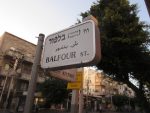
Balfour Street in Jerusalem. (photo by Pat Johnson)

One hundred years ago, on Nov. 2, 1917, one of history’s most consequential letters was typed. Simple and short, the Balfour Declaration, as it would become known, is a central artifact in the history of Zionism, the state of Israel and the ongoing conflict over claims to the land on which Israelis and Palestinians reside.

The letter from the British foreign secretary, Lord Arthur Balfour, was addressed to Lord Walter Rothschild, a leader in the Zionist Federation of Great Britain and Ireland. It informed Rothschild that the British cabinet had approved this one-paragraph statement:

“His Majesty’s government view with favour the establishment in Palestine of a national home for the Jewish people, and will use their best endeavours to facilitate the achievement of this object, it being clearly understood that nothing shall be done which may prejudice the civil and religious rights of existing non-Jewish communities in Palestine, or the rights and political status enjoyed by Jews in any other country.”

The letter was enormously historic for a number of reasons, not least that the first Zionist Congress had taken place a mere 20 years earlier, the first tangible expression in two millennia that the Jewish people should reasonably anticipate self-determination in the land of Zion. And now one of the world’s great powers was on record as supporting the endeavour.

The letter was also hugely presumptuous because the area in question was still under the control of the Ottoman Empire. The Ottomans would not be thoroughly vanquished by the British-French-Russian allies until 1918. Yet the allies were so confident of eventual victory that the secret Sykes-Picot Agreement of 1916 was already (on paper) carving up the region between the European powers.

Nevertheless, the document stood as a testament to British allegiance to the Zionist ideal in the interwar period. That allegiance, of course, amounted to very little in practical terms. In response to Arab protests (including mass murder in Hebron in 1929), the British froze Jewish migration to Palestine at the very moment in history when it was more urgently necessary than ever. The Holocaust – which can be said to have begun in earnest on Kristallnacht, Nov. 9, 1938, 21 years to the day after the Balfour Declaration was made public – occurred, of course, because of the Nazis’ Final Solution. But it could only have occurred in the enormous extent that it did because no other nation on earth would welcome the imperiled Jews of Europe. Palestine was the most obvious place for them to go, but British resolve folded in the face of Arab protest and Jews were trapped in Europe, where six million would die.

Likewise, the British commitment to Zionism amounted to nothing when it mattered again after the Holocaust. Still preventing widespread Jewish migration to Palestine, the British eventually gave up on the entire enterprise and threw the troubled land into the lap of the newly founded United Nations. The UN, for its part, eventually passed the Partition Resolution that would have seen two states – one Jewish, one Arab – formed in Palestine.

The reality remains that one significant sub-clause of the Balfour Declaration stands out to the contemporary eye. The statement that “nothing shall be done which may prejudice the civil and religious rights of existing non-Jewish communities in Palestine” would certainly be viewed by many as remaining unfulfilled. The civil rights of non-Jewish citizens of Israel are protected in law, but serious inequalities remain. More significantly, the statelessness and associated lack of civil rights experienced by Palestinians in the Israeli-controlled parts of the West Bank would certainly not live up to the well-intentioned words of Balfour.

Some say the British government should apologize for their role in advancing an independent Jewish state. British Prime Minister Theresa May batted that one back in a letter to her party’s Conservative Friends of Israel, saying, “We are proud of our role in creating the state of Israel.… The task now is to encourage moves toward peace.”

If apologies are in order, the British government might consider apologizing for giving little but lip-service to the Zionism enterprise throughout the 20th century.

The Balfour anniversary is an interesting time to reflect on history – and the past has an important role to play in informing us of the present. But, as always, we should keep our focus on the future.

Israelis design beauty

Albi Serfaty with the Lucky Lamp. (photo from Aqua Creations)

When Renee Switzer launched the SwitzerCultCreative showroom in 2016, she was adamant that they include pieces by Israeli furniture and lighting designers, giving them a Canadian stage exclusive to Vancouver.

“I visited the New York showroom of Aqua Creations in 2015, and their designs completely blew me away,” said Switzer of the Israeli brand. “The same with Hagit’s [Pincovici] furniture, that reflect beautiful craftsmanship made in Italy and have never been seen here before.”

Together with her son, Adam Bellas, and daughter, Jennifer Wosk, the third generation of a legacy begun by their grandfather in the 1960s, Switzer is delving into modern, high-end furniture collections for Vancouver interiors.

It’s impossible to look at Aqua Creations’ lamps, lighting installations and furniture without feeling a sense of wonderment. The urge to curl up in the enveloping Gladis Lounge Chair in the SwitzerCultCreative showroom is overpowering. When co-founder Albi Serfaty heard my confession, he laughed in agreement. “This is what art is all about,” he said, Skyping from his home in Tel Aviv. “There must be this emotional connection, both for me as a designer, because I’m passionate about my work, and hopefully from our pieces as interior décor in a home, a restaurant or hotel.”

What began in 1994 as a small atelier in Tel Aviv is now a global brand with an Aqua Creations showroom in New York and their lighting installations worldwide, including 1 Hotel, Brooklyn; Savoy Hotel, Seychelles; and Hotel Okura Fukuoka, Japan.

As a photographer and designer, Serfaty re-interprets organic forms and abstract sea life into lighting and furniture. Morning Glory Floor Lamps, in silk over metal, when illuminated, seem to take on an otherworldly beauty all their own. Collections since 1994 show a definite evolutionary progression, with current geometric shapes like the Simon Says Yes Pendant, part of Aqua Creations’ Mino Collection. Whether as a singular hanging pendant or grouped together as colourful wall mounts, as shown in the SwitzerCultCreative showroom, they add a sculptural yet functional addition to interiors.

If you can imagine thousands of magnified neurons under a microscope, you will see the genesis of the Mimosa Collection. Composed of laser-cut galvanized metal, sprayed with clear polymer, the hand-sculpted shades transmit a dreamy, calming light.

The Lucky Lamp wall fixtures are Serfaty’s newest iteration, using groundbreaking technology in which each sustainable and dimmable light is controlled by a micro-computer that alters colour, motion and intensity.

“I’d love to collaborate in the future with a fashion designer like Missoni,” confided Serfaty, “and, at some point, build a place that combines home, work and studio in one location.” He added, “I’m like a sheep dog in that way – I like everything together.”

* * *

When Hagit Pincovici was a little girl in her grandparents’ atelier in Tel Aviv, she remembers the exhilaration of playing with and running between colourful sheets of Plexiglass that would eventually be moulded into trays, frames and furniture by her artisan grandparents.

photo - Flamingo Storage Side Table, by Hagit Pincovici
Flamingo Storage Side Table, by Hagit Pincovici. (photo by Fabrizio Checchi)

“When my grandfather left Romania for Israel, he brought the recipe for making Plexiglass and I remember it was a kind of paradise looking through all the colourful pieces,” said Pincovici, now third-generation maker, in a Skype interview while she was visiting Tel Aviv.

It’s not entirely coincidental, then, that her multi-hued Art Deco-inspired furniture evokes a modern twist on a bygone era. Pincovici’s From Above Coffee Table from the Eclipse Collection is a geometric Carrara marble “moon” integrated into an abstract path of black shadow and coral sun in lacquered wood on a brushed brass base. Flamingo Storage Side Table, also from the Eclipse Collection, is a stunning sculptural platform perched atop stilt-like legs inspired by its namesake; a secret compartment rotates out to store jewelry, if placed in a bedroom, or becomes a handy bar for drinks, sure to spark conversation in the living room. The Metaphysics Sideboard is Pincovici’s take on elegance. The blue and black lacquered geometric wood console designed at multiple heights is mounted on brushed brass and immediately recalls the glamour of the 1920s and ’30s. “I love the thin minimalist lines just bordering on the decorative,” she explained.

After working her way up as head of product development for Aqua Creations in Israel and organizing their exhibition at the annual Salone del Mobile, in Milan, Pincovici decided to relocate to Italy, “where I fell in love with the Italian spirit of creativity,” not to mention her husband, Fabrizio Checchi.

She opened her own design studio in the furniture district of Brianza in 2014, where she sketches her designs by hand. The furniture is made with traditional craftsmanship and sold internationally. When not working on her first collection of lighting, Pincovici is also an instructor at NABA (Nuova Accademia di Belle Arti) in Milan.

“You know, we [Israeli] designers are like chameleons,” said Pincovici. “I don’t think we share a common style but we do share that drive to create and, in Italy, they really appreciate that approach.”

* * *

London-born Eli Chissick of Chissick Design is waxing poetic about wood. Skyping from his home-studio near Tel Aviv, the award-winning designer is concerned about the environment, recycling and products that will increase the mobility of people with disabilities.

photo - Gradient Cocktail Table by Eli Chissick
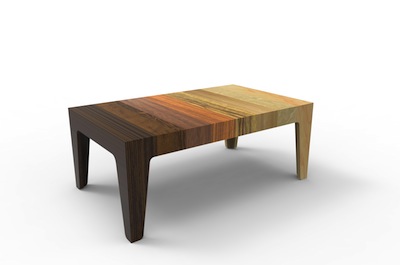
Gradient Cocktail Table by Eli Chissick. (photo from Chissick Design)

Unlike the vast forests found in Canada, trees are not harvested for the lumber industry in Israel and wood is usually imported. That forces the industrial and product designer to be ingenious about scavenging off-cuts and repurposed wood from carpentry floors. “It’s a magical transformation when I sort what is usually thrown out, then press it into large sheets from which I create my furniture,” said Chissick.

The results are as sculptural as they are utilitarian. Mosaica, from Chissick’s Wood-Con-Fusion series, is a coffee table (or bench) composed of more than 2,000 intricate puzzle pieces of multi-coloured wood. The Marmelade coffee table is a mouth-watering compote of wood with inlaid lime-, raspberry- and white-striped Formica laminate. It’s built on wheels for easy manoeuvring in any space.

“I’m really excited about working with Renee at SwitzerCultCreative because I’m now able to send my furniture designs created on the computer to her and then have many pieces handmade in British Columbia with the same quality as in Israel,” said Chissick.

Those pieces include the Gradient Cocktail Table, handcrafted from eight types of veneer juxtaposed from light to dark in wenge, imbuia, American walnut, teak, African walnut, anigre, white oak and maple. Mirror 2012, from Chissick’s Wood-Con-Fusion series, is set in a painted and lacquered salvaged wood frame and can be customized in various colours. (It was a 2015 platinum winner at the U.S. ADEX Awards for Product and Project Design.)

He’s also a proponent of TOMS (Tikkun Olam Makers), a global movement of makers who donate their specialties to create solutions for people struggling with a debilitating problem. Over three days, 100 designers, engineers and techies meet with potential users personally then brainstorm in small groups and set to work making prototypes. Chissick has participated in these “Makeathons” in both Tel Aviv and San Francisco, resulting in a walker that allows a person to navigate stairs, a door opener for someone who has quadriplegia, and a digital hand and a high-tech go-cart for a child with disabilities, to name only a few.

Switzer, who has visited Israel several times, is planning a scouting trip there in 2018. “It gives me tremendous personal gratification to showcase such talented makers,” she said.

For more information, visit switzercultcreative.com or call 604-736-3020.

Laura Goldstein (lauragoldsteinwriter.com) was an arts publicist and writer in Toronto for 22 years before moving to Vancouver. She’s a frequent contributor to the Globe and Mail’s design section, Westcoast Homes & Design, Canadian House & Home and Destination BC, among many others. A highlight of her career was covering the Royal Tour in Vancouver last year.

Eat bugs to repair the world?

Burgers made with insect protein, and no meat. (photo from Eran Gronich)

While the thought of eating insects or worms may sound outlandish or disgusting to many of us, there is growing support for doing just that.

In less than 25 years, the world will have nine billion people living on it. As things stand, there is not enough space or resources to support conventional protein production – beef, chicken, fish, etc. – for that many people. One solution that has been brought to the fore is that we can start eating insect protein. And now, the Israeli company Flying Spark is raising capital to make this a reality.

Leading the charge is Eran Gronich, a serial entrepreneur, and his partner, entomologist Dr. Yoram Yerushalmi.

“When I was looking for my next project, looking into all kinds of ideas, start-ups, etc., I came across a TED Talk in which this university professor was talking about the world having nine billion people by 2040,” said Gronich. “He was talking about all the damages of livestock farming – causing global warming, [using] 70% of growing seed, oceans over-fished…. He was saying the best solution is switching to insect consumption … and, I don’t know why, but I was fascinated. I started to learn about it…. When I realized I don’t know anything about insects, I found my partner, Dr. Yerushalmi, and together we started Flying Spark.”

They chose the larva of fruit flies to work with because it has a number of benefits, such as high values of protein, iron, calcium and magnesium. Its fat is unsaturated and, unlike some other insects, a fruit fly has no cholesterol.

The fruit fly uses less than one percent of water and land resources, has hardly any waste and 100% of the larva can be used. The lifespan of the larva is only six days and it multiplies 15 times in that time.

As it’s a vegetation-eating fly, it is a safe insect to use. No antibiotics, hormones or additives are used in the growing process, and the insect does not share any diseases with human beings.

photo - Flying Spark’s Eran Gronich
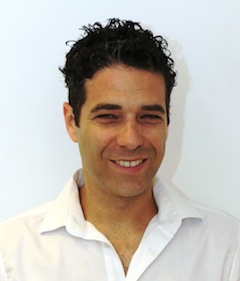
Flying Spark’s Eran Gronich. (photo from Eran Gronich)

Gronich and Yerushalmi’s project was chosen as the winner of a mass accelerator challenge in Boston. “We spent four months in Boston working on accelerating the growth of the company,” said Gronich. “We raised some money there from investors and sent it to Israel. We developed the farming and ecosystem technology around farming the larva, reducing the cost.

“In the food lab, we developed the process that’s basically taking the larva and turning it into high-quality, 70% protein powder and high-quality oil. Also, we worked on all kinds of applications and the functionality of the protein powder. We made all kinds of products just to prove the point that you can make almost anything out of our materials – bread, pasta, cereal, cakes, whatever. And, also, achieve meat replacement, even milk, with more protein than cows.”

As it turns out, the larvae will be fed by fruit surpluses, which, according to Gronich, exist everywhere. “They are in every country and also throughout the supply chain – surplus that the farmer or grocery chain has,” he said. “It’s good food, but doesn’t look so good anymore. So, we developed this formula – based on feeding software – to calculate the right percentage … to get the nutritional diet needed.”

Gronich is working with several major food manufacturers, trying out various applications, with varying degrees of success.

According to Gronich, the product is not kosher and his market is not yet in Israel, though he does have some Israeli and Jewish backers. One of his backers is the Strauss Group, which invested money and provides support with offices, labs and a lot of technical support for marketing and networking with institutions worldwide.

“For Strauss, it’s a financial investment,” said Gronich. “Strauss believes insects will be a part of the human diet in the near future and decided to invest in the best company.”

Another important collaboration in which Flying Spark is involved is with IKEA. “IKEA, eight months ago, [invited] all kinds of start-ups to apply for special programs focused on making the world a better place, especially sustainability aspects. Thirteen hundred companies applied from about 80 countries around the world; they chose 10. We were lucky enough to be one of those 10 companies. So, we started a three-month program. My partner is in Sweden right now, in the IKEA centre, and the goal of the program in the end is to have a product made from our material in the IKEA restaurant.”

Gronich is currently working on designing Flying Spark’s first production facility in Israel, with operations scheduled for the end of 2018. “Now, we are raising three and a half million dollars to build the facility, which will be in Ashdod,” said Gronich.

While selling the product to the Western world is a bit tricky, in the Eastern world or in South America, insects are eaten regularly. So, heading east with their product is an obvious choice.

As for the West, Gronich said, “Now, people from Western countries … when I’m explaining to them about the larva – about how it cleans itself and its nutritional value – people understand it. They get that it is one of the best sources of protein. If you’re comparing it to shrimp or other kinds of seafood, it looks much better. It definitely looks much better than a dead chicken. And millennials are very much aware of what they put into their bodies, and aspects of food and farming, so it’s easier.”

Flying Spark was very happy with their positive reception in Boston. There, more than 85% of millennials told them they had no problem tasting it. And, when they gave people samples, the reaction was positive.

“Now, we’re working with companies that have heard about us through PR,” said Gronich. “Multinational companies approached us and the conversations with them have all been focused on nutritional value – source of the protein, they don’t care about it…. We call it the industrial approach. We’re not serving the insect in its original form. We’re turning it into a white powder and are selling it to regular, traditional food manufacturers – and there is a need for this product.”

Rebeca Kuropatwa is a Winnipeg freelance writer.


Win 2 free film tickets!

A Heartbeat Away follows Save a Child’s Heart pediatric cardiologist Dr. Akiva Tamir to Africa on a medical screening mission to find children in need of lifesaving heart surgery. (photo from Save a Child’s Heart Canada)

Jewish Independent readers can win two tickets to the Nov. 2 Vancouver premiére of the documentary A Heartbeat Away at Scotiabank Theatre. Simply email editor@jewishindependent.ca by Wednesday, Oct. 25, 5 p.m., to be entered in a draw. The winner will be contacted.

A Heartbeat Away, by Tal Barda and Noam Pinchas, follows Save a Child’s Heart pediatric cardiologist Dr. Akiva Tamir to Africa on a medical screening mission to find children in need of lifesaving heart surgery – surgery that is not accessible in Tanzania, where, every day, five children die from heart disorders and rheumatic heart disease. In the documentary, Tamir and his team examine hundreds of children, although only a handful can receive the treatment that will save their lives. When 6-year-old Julius arrives at the clinic in critical condition, Tamir is forced to choose whether to operate on the child, who has very little chance of surviving. Tamir and his team take viewers on an emotional rollercoaster, as they deal with the most serious question of who to treat. The experienced physicians find it hard to detach from the emotional bond they share with their small patients.

The documentary focuses on the challenges of receiving adequate health care in developing countries, and the challenges providers face when so many are in need – how do they pick who to treat?

According to Marni Brinder Byk, executive director, Save a Child’s Heart Canada, “Congenital heart disease is responsible for more deaths in the first year of life than any other birth defect. Due to a high prevalence of acquired and congenital pediatric heart disease in developing countries, and a lack of skilled medical personnel dealing in pediatric cardiac care, there are thousands of children in need of cardiac intervention, and hundreds of medical personnel living in developing countries that require advanced training.”

To date, she said, the Israel-based Save a Child’s Heart has “provided care to over 4,400 children from 55 countries in Africa, Asia, Eastern Europe, the Caribbean, South and Central America, and the Middle East.”

In an interview with Eretz Magazine, Barda, who also directed the documentary, said, “The first thing that the documentary film needs to give the viewer is information. However, for me, the next move is touching the individual’s story…. My dream is to have as many people as possible watch this movie. The story comes from a different world, creates a sense of acquaintance and a better way of coping and looking at things…. There is something very powerful in this story, which is happening in the current dire reality of Israel and the world. It is about people who are taking their professional skills and doing something good with them. They go out of their comfort zone and do something for the benefit of the other. These doctors are taking care of all hearts, simply because they are beating hearts.

“The message here is very powerful, in my opinion,” she continued. “The organization is taking care of all children: Israelis, Africans, Palestinians….” To view the official trailer of A Heartbeat Away, visit vimeo.com/151644429.

The Nov. 2 screening event in Vancouver is chaired by Lana Pulver. It starts at 6:30 p.m. with a wine and cheese reception, followed by the screening of the documentary and a question-and-answer period with a panel of experts on pediatric global health and cardiac treatment. Tickets are $36, with all proceeds benefiting Save a Child’s Heart. To purchase tickets or make a donation, click here or call toll-free 1-844-924-9113.

America’s UNESCO exit

The United States and Israel will withdraw from UNESCO. The United Nations Educational, Scientific and Cultural Organization is one of the most impressive and vital global agencies addressing international cooperation on this range of human endeavours. Unfortunately, like the United Nations itself, which exemplifies unfulfilled promise, it has been coopted into the service of Israel-hating forces.

UNESCO does vitally important work advancing education as a basic human right, fostering cultural diversity and dialogue, and promoting heritage as “a bridge between generations and peoples.” It is also committed to “full freedom of expression; the basis of democracy, development and human dignity.”

The irony here is that, by succumbing to the influence of Israel-bashers, UNESCO is in cahoots with countries that betray the most basic concepts of free expression and democracy.

The U.S. State Department announced last week that it would quit UNESCO and, while insisting that Israel was unaware of the impending announcement and that the decision was uncoordinated between the two countries, Israel’s Prime Minister Binyamin Netanyahu announced that Israel would follow its ally and also leave the agency.

Coincidentally or deliberately, UNESCO elected its first Jewish director general just days after the United States’ announcement. France’s former minister of culture, Audrey Azoulay, was elected to the leadership role, outpolling the Qatari perceived frontrunner, in a vote by UNESCO’s executive last Friday.

The United States was in arrears to UNESCO to the tune of $550 million and even a U.S. State Department spokesperson didn’t deny that money figured into the calculation. The United States stopped paying its dues to UNESCO in 2011, when the agency admitted “Palestine” as a full member state.

In July, UNESCO declared Hebron an endangered World Heritage site, diminishing the Jewish people’s ancient and contemporary connections to the city, home to the tombs of the Patriarchs and Matriarchs.

UNESCO has also adopted resolutions that call Jerusalem “occupied” territory, acknowledge Muslim but not Jewish historical connections to the Temple Mount area and repeatedly reinforced a common Palestinian position that Jews have little or no historical connection to the land of Israel.

The question is, do you stay and fight or give up and decamp in protest? A similar paradox occurred at the United Nations-sponsored World Conference Against Racism, in Durban, South Africa, in 2001. When it became clear that the event had been commandeered not only by anti-Zionist elements, but by some of the most antisemitic forces in the world, the United States and Israel walked out. Canada stayed. The Liberal government of the time justified the decision by saying they could remain as a voice of critical reason. There are legitimate cases to be made for both positions.

In choosing to leave the organization as a member but remain as an observer state, the United States found the right balance. They can continue to make their opposition to UNESCO excesses heard, without countenancing them morally or financially.

At least, that is how it would work in a world in which Donald Trump was not president of the United States. In this, as in so much, Trump changes everything. While the administration’s decision on UNESCO may be a decent one, in context with other decisions of the Trump administration, it becomes part of a retraction of American influence in and engagement with the world. Trump is motivated by spite, not by principle. While another president could have made the same move and explained it as a principled defence of the country’s most important ally in the Middle East, this president’s lack of principle and surfeit of malevolence relocates even defensible positions into a constellation of petty pique. Despite its manipulation by anti-Zionist ideologues, UNESCO remains an invaluable institution, doing much good work in the world. Even while maintaining observer status, the U.S. decision is likely to be read by critics not as a repudiation of what UNESCO does wrong, but as part of an ongoing American trend against all that is good in culture, science and education.

Context matters. Like Richard Nixon in China – OK, perhaps not really like that, but at least in the respect that a president with some credibility in areas relevant to UNESCO could get away with repudiating it – a president Hillary Clinton (or Bill Clinton, or Barack Obama) could have withdrawn from UNESCO and not made their country look like a collection of petty Philistines. When a president who has little demonstrated respect for culture, education or science withdraws from a global organization dedicated to these pursuits, it probably legitimizes UNESCO more than it delegitimizes it.

Worse for Jews, this tight friendship between Trump and Netanyahu reinforces perceptions of the Jewish people – or, at the very least, the Jewish state – as ideologically entwined with a figure who seems destined to go down as the most ineffectual and destructive president in American history. Not an enviable place to find oneself.

Mimicking silkworms

A silkworm viewed with an infrared camera. The pale elongated cavity is the silk gland. (photo from © 2017 Natural Materials Group)

Scientists have designed microscopic silk capsules that mimic, on a very small scale, the structure of silkworm cocoons. The capsules can serve as a protective environment for the transport of sensitive “cargo” such as natural silk proteins, antibodies or other delicate molecules. The collaborative research – which was performed by an international team of academics from the Weizmann Institute of Science in Israel; the universities of Cambridge, Oxford and Sheffield in the United Kingdom; and the ETH in Switzerland – may lead to a host of applications in the cosmetics, food and pharmaceutical industries, particularly in the delivery of drugs within the body. The findings were reported this summer in Nature Communications.

The use of natural proteins from which silkworms and spiders spin their elastic fibres has been limited, as these proteins have a tendency to clump together once extracted. Until now, researchers have been using chemically processed silk fibres, which have different mechanical properties and are relatively inert compared to the natural ones. Dr. Ulyana Shimanovich – then a postdoctoral fellow supervised by Prof. Tuomas P. J. Knowles at Cambridge and now head of a new lab in Weizmann’s materials and interfaces department – decided to find out what keeps the natural silk proteins from clumping together in the animal prior to the spinning.

The silk proteins are stored in liquid form in the silkworm’s glands before they are spun into the threads used to construct the cocoons. To imitate the natural process of structuring silk protein into protective capsules, the researchers used the principles of microfluidics, a field that deals with the control of fluid flow parameters on the micron-scale level. They placed proteins extracted directly from the glands of silkworms inside microscopic channels on a chip made of a silicon-derived polymer and caused the protein molecules to self-assemble into a gel-like material, exactly as in a silkworm. The gel formed microscopic capsules; within these capsules, the rest of the protein stayed protected as a solution, as it does in the animal’s gland. By controlling the viscosity of the silk protein solution and the forces acting upon it, the researchers have been able to control the capsules’ shape (round or elongated) and size: from 300 nanometres to more than 20 micrometres. Inside these artificial capsules, the natural silk proteins remained intact for an unlimited amount of time without losing their properties or ability to function.

“Making synthetic capsules is normally a complex and energy-intensive process,” explained Shimanovich. “In contrast, silk capsules are easier to produce and require less energy to manufacture. Moreover, silk is biodegradable.”

The tough silk capsules may be used to protect sensitive molecules, such as antibodies and other proteins, preventing them from losing desired qualities. The capsules can be employed, for example, to deliver drugs or vaccines intact to target organs. In particular, said Shimanovich, they may help develop future therapies for neurodegenerative diseases: because the capsules can penetrate the blood-brain barrier, they may enable the development of new treatment for these diseases.

As well, since the capsules are biodegradable, they may have multiple uses. For example, they might be employed in the food industry to incorporate healthful oil particles into bread or other products. Potential applications for natural silk proteins stored inside the new capsules include the development of skin treatments for burns or cosmetic use, and the design of strong elastic fibres for tissue engineering – for example, for the fabrication of improved biological implants.

The research team included Dr. Simone F. Ruggeri, Dr. Erwin De Genst, Dr. Thomas Mueller, Dr. Teresa P. Barros and Prof. Christopher M. Dobson of Cambridge; Dr. Jozef Adamcik and Prof. Raffaele Mezzenga of ETH Zurich; professors David Porter and Fritz Vollrath of Oxford; and Dr. Chris Holland of the University of Sheffield. Shimanovich’s research is supported by the Benoziyo Fund for the Advancement of Science; the Peter and Patricia Gruber Awards; and Georges Lustgarten.


A novel born of heartbreak

Nathan Englander will be in Vancouver on Oct. 22 to discuss his latest novel, Dinner at the Center of the Earth, at a salon hosted by the Cherie Smith JCC Jewish Book Festival. (photo from Cherie Smith JCC Jewish Book Festival)

You won’t have to travel to the centre of the earth to meet award-winning, bestselling American author Nathan Englander. On the afternoon of Sunday, Oct. 22, he will be in Vancouver for a writers salon hosted by the Cherie Smith JCC Jewish Book Festival.

The Jewish Independent spoke to Englander by phone last week. He had just arrived in Seattle by train, his flight there having been canceled. In the midst of a tour for his latest novel, Dinner at the Center of the Earth (Alfred A. Knopf, 2017), he spoke to the JI between back-to-back events.

Englander’s novel is a compelling read in which he explores the Israeli-Palestinian conflict via five characters. To simply quote from the publishers, who sum it up succinctly: “A prisoner in a secret cell. The guard who has watched over him a dozen years. An American waitress in Paris. A young Palestinian man in Berlin who strikes up an odd friendship with a wealthy Canadian businessman. And the General, Israel’s most controversial leader, who lies dying in a hospital, the only man who knows of the prisoner’s existence.”

Each of these characters is fascinating, and Englander displays a remarkable talent for being able to put himself inside people’s heads, to clearly and realistically explain their feelings, their motivations. The characters both set events in motion and are carried along by events out of their control. One of the main characters, “the General,” lies in a coma and yet Englander fully develops him as a living, breathing human being.

The General is obviously based on former Israeli prime minister Ariel Sharon, who died in 2014 after having been in a coma since 2006. Englander’s character is a large man, he has been in a coma for years, he once ruled the country and was a tough, controversial military figure (“an unrelenting warrior”), his wife was named Lily, one of his sons was shot and killed, etc., etc. Nonetheless, Englander was adamant that the character not be seen as Sharon, but as “inspired” by him.

Englander said he knew people would come “locked and loaded with [their] politics to this story…. I thought it was really important that, wherever the parallels are [from] one reality to my fictional reality, that my general be his own character … so that I could fully empathize and fully get into his head. Even for me, I needed to build my own person, whatever the warring personal parallels are.”

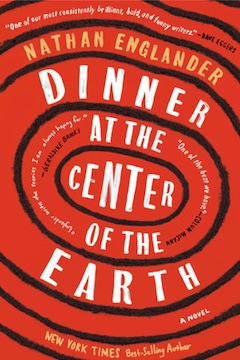
book cover - Dinner at the Center of the EarthReading Dinner at the Center of the Earth, one does get the impression that Englander was trying to sort out his own views about the conflict, rather than make any pronouncements or come down on any particular side.

“It was imperative to me that this not be didactic and not be a big lecture,” he said. “I have a 500-page version of the book that I cut in half. I just wanted it to be story-driven and character-driven, for people to be able to enter into the discussion or to reflect on where they entered the book and where they left it, on their own positions.”

For his part, he said he’s learned a lot about the book from being on the road. One of his first tour events was with fellow writer Jonathan Safran Foer, who commented on the parallels between the dinner of the book’s title and a dinner that takes place between the guard and the prisoner; an aspect that Englander hadn’t considered. “I wish I had been smart enough to consciously think of it,” he said, “but the subconscious takes care of that for you.”

While Englander insists that “there’s no position in this book,” one woman, after a tour event, argued that it takes “a position on peace,” that it’s hopeful about the prospect. From this and other exchanges, Englander admitted, “I really do believe that the more it [peace] seems impossible, the more I believe we have to make it possible.” But, he said, about writing any messages into the book, “I can’t tell you how much of it was conscious intent versus subconscious work. For me, all my conscious intent was this idea of it to land on no side, for us to explore.”

For Englander, two lessons learned from being a reader himself helped shape this novel. One is that a well-functioning book represents a shared experience between an author and a reader. “I used my brain to write it and then there’s this physical thing that you can pick up and read,” he said, and so, in writing Dinner, he fought “against all punditry and ‘mansplaining’ and lecturing and … didactic” inclinations.

The other aspect he keeps in mind while writing, he said, is all the unanswered questions he had as a boy growing up in a religious environment. “It’s the books where people were brave enough to wrestle with the questions that changed me. All of the books that changed my life, that saved me, none of them had answers, they just were by authors who truly were willing to wrestle with terrifying questions. So, for me, I really wanted to structure this [novel] to swing back and forth and back and forth…. I wanted to mirror the circles of the conflict, these unending cycles.”

The story of Dinner at the Center of the Earth had been percolating since Sharon became prime minister of Israel in 2001. About the Second Intifada and Sharon’s election win, Englander said, “That was my first adult political heartbreak of that size…. All those years of work [on peace], it was right there.”

The more distant we get from peace, he said, the more “you may think it’s impossible, but it was really right there for the taking. I just couldn’t shake it. I was desperate to explore this unending conflict. So, yes, it may be just the tiniest glimmer of optimism [in the novel] but I do think it’s optimistic in the end, however dark some of the turns are.”

He hasn’t been writing the novel for 16 years, of course. He had the idea and needed a structure for it, which he found on his last book tour, while in Israel. The front page of the newspaper he was reading had a story on “Prisoner X, this Australian guy [who had a life] so similar to my life in a lot of ways – maybe he got more Zionism and I got more Bible but [he was] a religious, Anglo Jew who ends up moving to Israel.” This man not only “adopted an ideology” but joined Mossad, did “scary deep undercover stuff and then becomes a traitor.” His situation made Englander wonder, “What would it take to flip someone for empathy, out of feeling for the other side? That’s what would interest me,” so Prisoner X became Dinner’s Prisoner Z.

The other notion about Prisoner X that intrigued Englander was that the public only found out about Prisoner X’s existence after the man hanged himself. “He only lived in the moment he died, and there was no X and no cell until the moment he hanged himself.”

Englander’s imagination seems to know no bounds. His stories and novels are set in various countries (Russia, Israel, United States, Argentina, to name a handful) and his characters range from an Orthodox rabbi who supplements his income by being a mall Santa Claus – one of the many people readers meet in Englander’s first book, the collection of short stories For the Relief of Unbearable Urges (Alfred A. Knopf, 1999) – to the General of Dinner, his fourth book. Englander is also working on a second play because, he joked, with 10 years between his first and second book, he had to tell people he “wrote book” for a living and, since his first play in 2012, he’s been writing “books and play.”

One theme that runs through all his work, regardless of form, topic or setting, he said, is that they explore “grey space, or Schrödinger’s cats, multiple realities.”

“As the books go by, I see that I’m clearly … obsessed with this grey space, which I think is probably from having a black-and-white education and growing up in a black-and-white reality,” he said. “Especially now, I can’t understand people who can’t see the other side.”

By way of example, he said, “I learned that in Israel, where I was a Jew living in Jerusalem, whose holy site was the Temple Mount … it became clear to me this wasn’t a disagreement, or something on a spectrum, that my Palestinian neighbour, she is living in Al-Quds and Haram al-Sharif is her holy site. We were living in the same physical space but in literally separate realities.”

This is also the case in the United States now, he added. “There are regular citizens that, because of the dual realities we now have here … you could show them two pictures of an inauguration, one with more people and one with less, and you’d have regular folks say, yes, the picture with less people has more people in it. That’s not an opinion, that’s inhabiting a different reality.”

Human beings can make anything happen, said Englander. “We’ve sent people to the moon and brought them back,” he said, and our cellphones have far more power than did any Apollo mission. So, you want to make peace? “Everyone knows the math there. Don’t anybody pretend they don’t know who’s going to trade what. There are some very minor, tweakable things. Don’t tell me everybody doesn’t know what they need to do to make that peace happen tomorrow, if they wanted it to happen.”

Englander immerses himself in his work. For The Ministry of Special Cases (Alfred A. Knopf, 2007), a novel about Argentina’s Dirty War, he did years of research. “You need to own that world,” he said, in order “to drop my own ministry on top of that city [Buenos Aires].” He said it is akin to being an artist in, say, Cubism: “You need to know how to paint before you can put both eyes on one side of the face.”

With Dinner at the Center of the Earth, Englander said he was returning to familiar ground, which required much less research.

“I’ve had so many different sides of the experience, from the Jerusalem of the Bible that I had my whole life, to living in Israel in the First Intifada to getting a degree in Judaic studies to living in Israel for another five years, to watching the news a million hours a day to reading the papers.” He’s also on the faculty of New York University, which has taken him to cities like Paris and Berlin, both of which are integral places in his latest novel. “I was very interested in exploring territories that felt like ‘my territories,’ including historical [ones],” he said.

For things he didn’t know, he sought advice, such as speaking to a doctor friend about what it means to be in a coma and learning about boats and the mechanics of sailing from people who knew about those things.

As for the writing of the book and how it came out, he said that he reworked the rough draft of the novel for almost a year, while he and his family were in Zomba, Malawi, where his wife, Rachel, was doing research for her PhD. “It was an extraordinary place for me to be, somewhere so far and so radically different from my own realities and where I’d lived…. It was a very special place from which to imagine these places and draw off memory.”

The pre-book festival salon will take place Oct. 22, 2-4 p.m., at a private residence (address will be given to ticket buyers). Tickets are $72, which includes copy of Dinner at the Center of the Earth and a reception. Visit jewishbookfestival.ca to reserve your place at the salon and for more information about this year’s festival, which takes place Nov. 25-30.

Krembo Wings unites

Members of Krembo Wings’ Kiryat Shmona branch enjoy one of the weekly activities. (photo from Krembo Wings)

Claudia Koby co-founded Krembo Wings, the only youth movement open to all youth, regardless of ability level. It was her son, Kfir, who inspired her – seeing him battle severe disabilities and his intense desire to be part of society at large.

Kfir’s friendship with a girl without disabilities changed his and his family’s life to such a degree that his mother decided to find a way to give other kids with disabilities and their families the same simple but incredible gift.

Krembo Wings was established in 2002, growing to 11 branches serving 300 kids by 2010. That was when Merav Boaz (affectionately nicknamed “Boozy”) joined as vice-president. To date, the movement has 61 chapters.

“I knew I could give a lot from my knowledge and experience, to make the movement known in the public eyes and ears … a new idea that was not in existence in Israeli society before,” Boaz told the Independent. “I wanted everybody to know what the Krembo Wings are doing, to see how well they change the world and society. It was like a fire in my heart.

“When I joined, almost no one knew about Krembo Wings…. Today, the movement has 6,000 kids involved – from the special needs kids to the able kids that help them be part of a life-changing movement.

“It’s the kids who run the branches, guided by adults. We give them the power to do so. It’s a lot of thinking to make it happen – to do the seminars really productively, to make them understand they can create their own reality. I think that, because of the kids, we’ve made this breakthrough, this change. From a local initiative, we became a national youth movement.”

When someone has a child with a disability, said Boaz, one of the parents usually stops working and starts taking care of the child, “they look for treatment and doctors to make things better.”

When the parents take their child to register in kindergarten, she said, “They tell you he doesn’t fit, that he can’t be with other children – the ‘regular,’ ‘normal’ children – because of the disability. From this point on, you have a kid who leads a different life within the shawl of society. They don’t belong and are not a part of the kids’ society – don’t go to school with their brothers and sisters, don’t enjoy the after-school programs…. A lot of the parents don’t take the kids outside to the mall or to cafés because of their different behaviour, like slapping hands or making noises. You feel that it’s not right that you’re there…. All of a sudden, you have a kid who doesn’t have a right to take part.”

Often, children in this situation are sent to a different school. In Israel, the school is usually not in the same neighbourhood or city where they live. So, they do not make many friends and, when they become adults, few people will hire them, because no one knows them.

“Why are we so surprised that no one will hire a person with a disability?” asked Boaz. “They don’t know how, were never shown how. We want to change that one day.

“I think the next school established in Israel will be a school with kids of all abilities. We won’t have special education schools separated…. We want the kids to go to the same school and do after-school programs…. When they grow together, they will live together in the same community and care for one another. Then, it won’t be hard for a hospital, for example, to hire a secretary who is blind.”

The disability does not need to – and should not – define the person, she said. And this is where Krembo Wings helps.

“It’s good for them to know other kids, to know and develop social skills, and be part of society,” said Boaz. “How would they know how to behave in a café or at a playground if they’ve never even tried it, practised it, because they’re separated?”

Boaz shared the story of a dad from Krembo Wings’ summer camp who has twin girls, one of whom was born with cerebral palsy and has difficulty walking, so she uses a wheelchair.

“When they go out together, nobody would even notice or try to talk to the twin in the wheelchair, because – automatically – people think she’s not well in her brain,” said Boaz. “Nobody is patient enough to talk to her. No kid stops to get to know her. But, at Krembo Wings, everyone knows her. She has so many friends now, but never in her life did she have friends before. She says, ‘Krembo Wings is my life. It’s where I’m loved by other kids.’”

When kids come to Krembo Wings once a week, they feel a sense of belonging, they sing songs and play together.

“When you accept, you don’t hate. When you don’t judge, you’re tolerant of others, you become more forgiving.”

“You can see how they don’t judge, they include – not because the teacher told them and not because they read it on the walls of the school,” said Boaz. “They practise it and it becomes a part of their souls, lives and values. When you accept, you don’t hate. When you don’t judge, you’re tolerant of others, you become more forgiving.”

The children without disabilities help ensure that their mentees take part in activities. “They learn to be creative, to work with the ability that each person has,” said Boaz, and this “improves their skills and their school success. They are better friends to … friends, to their parents. It’s amazing. Imagine them as grown adults in society – they will care more.”

Parents of children who aren’t able to communicate at Krembo Wings say how big the impact is – their kids do better at school, have more self-esteem and improved communication – from being in an environment of acceptance.

“I had a 16-year-old counselor, able-bodied, who wrote an email saying that, at school, they asked him to write an essay about the person who has influenced his life the most,” said Boaz. “And, he was thinking of his grandfather, a Holocaust survivor, who was a kid when the Nazis came to Poland. He lost all of his family, but he survived. Then he thought about his mom, who had breast cancer – a survivor, too. But, he decided to write about [another] person who influenced his life, because he learned from him what the meaning of being a hero is – of knowing how to deal with tough situations, to be resourceful, smart, full of life and always positive. That person’s name is Don and he’s 10 years old. He has severe cerebral palsy. He tries every day to get up and walk. He tries to practise how to talk with a speech therapist every day, because he wants to be understood. The 16-year-old said that Don taught him the most how to be a hero – disability or not.”

For brothers and sisters of children with special needs who are in Krembo Wings, Boaz said, “They say that, for them, it’s the first time they’re not ashamed to be the brother or sister of a kid with a disability. One girl wouldn’t invite people to her house. Her brother would make gestures no one could understand. She said she prevented her friends from coming to her house. She didn’t want them to know. With Krembo Wings near her house, the youth came to meet him and she saw two girls her age, able-bodied, good-looking, popular, talking to her brother, communicating. She said she was shocked. When her brother started going to Krembo Wings, he came back so relaxed, so happy, like he had had a break. She felt it – the missing piece in his life was filled…. When she came to Krembo Wings and joined in, she had members to mediate activities and, through her connections to another mentee child, she got closer to her own brother…. She learned how to communicate, to be tolerant, to listen – and that it’s OK if he’s like that…. She now knows he has the right to be a part of society and she has the tools to help change things…. More than they have a right, there’s so much they can give to society.

“We believe this change starts with kids. But, it also changes the parents … these same parents who had problems finding a kindergarten. As one of the mothers shared, for the past 15 years, she has been told how her kid does not fit in anywhere, yet no one could tell her where he does fit. All of a sudden, there are Krembo Wings … kids pleading with her to let them take her son to an activity. We pay for transportation, pick them up for three hours and return him satisfied, happy.

“I saw a mother crying, saying the counselor told her she could go do whatever she wanted to do, that they would take care of her kid. She said, ‘I don’t remember what I like to do, how to be alone without her … I’m always taking care of everything … I don’t have friends anymore.’ It changes [a] parent’s life as well.”

“This platform is not only good with or without special needs, it’s good for any society. If it’s not Jewish and Arab, it’s Bedouin and Christian. The kids get tools and values they need. It just happens. It’s more natural for kids than separation.”

When Krembo Wings wanted to open a branch in Lod, city officials recommended they open two branches to avoid mixing Arabs and Jews, but Krembo Wings refused, saying they do not believe in separation of any kind. The city officials conceded and said they could try, but to not expect it to work.

“We opened one and it was a big success,” said Boaz. “So, this platform is not only good with or without special needs, it’s good for any society. If it’s not Jewish and Arab, it’s Bedouin and Christian. The kids get tools and values they need. It just happens. It’s more natural for kids than separation.”

The Vancouver connection

The Kiryat Shmona branch was started in the nearby mechina (pre-army training program) in kibbutz Maayan Baruch before the Jewish Federation of Greater Vancouver took it under its wing, providing space in Kiryat Shmona’s Beit Vancouver for the branch to run its activities. The Federation has also provided funding of $26,000 a year for the last two years.

“They were so sensitive toward the kids’ needs and really understood,” said Boaz. “When you have donors, sometimes the donor – out of good will – starts interfering with the way you deal with the activity or the money or whatever – but Vancouver never did that.”

According to Candace Kwinter, chair of Jewish Federation’s Israel and overseas committee, “Krembo Wings is an incredible program. It enables every child living with any type of disability to take part in enjoyable social interactions between one another and their able-bodied peers and become part of community life in Israel. As a federation, we’re proud to support this program, which is based in Beit Vancouver, and empower both the participants and the volunteers.”

Kwinter quoted one of the mothers of Krembo Wings in Kiryat Shmona, whose daughter has Rhett syndrome. “When Tom was invited to join Krembo Wings,” said the mother, “I tried to explain to the young counselors that it’s difficult to interact with her…. She doesn’t speak and interactions are complicated…. They continued smiling and said that they believe it will be worth our while, that the activities are fun and there are a lot of other children and youth at the branch, with and without disabilities. I said yes, even though I was confident they would give up quickly.

“Today, after Krembo Wings has been in our lives for almost two years, I can confidently say that, where therapists and professionals failed, a group of motivated youth filled with faith and love have succeeded. They have filled Tom’s life with happiness, friends, laughter and songs – and have made our lives infinitely better…. It is an essential part of our family.”

Even with a budget of 22 million shekels (more than $7.7 million Cdn) and 61 branches, Krembo Wings has long waiting lists and not enough money to open new branches. Half of its revenue comes from the Israeli government and municipalities and the fees they collect from members who are able to pay; they subsidize everyone who cannot pay. The other half of the budget comes from fundraising. For more information, visit e.krembo.org.il.

Rebeca Kuropatwa is a Winnipeg freelance writer.

A look back at the year 5777

September 2016, Jerusalem. At the funeral of former president and prime minister Shimon Peres, U.S. President Barack Obama offers a tissue to Peres’ son Chemi. (all photos from Ashernet)

In reviewing the Jewish year 5777, one name stands out – Binyamin Netanyahu. Despite having to fend off accusations of various wrongdoings at home, the Israeli prime minister has had a successful diplomatic year.

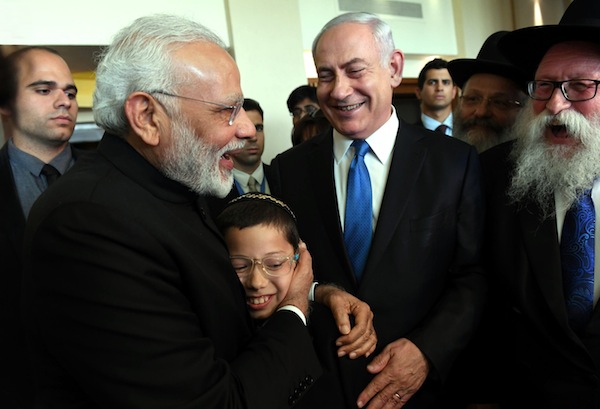
This year, Israel welcomed U.S. President Donald Trump and India’s Prime Minister Narendra Modi. Modi’s visit marked the first time since the foundation of the state of Israel that a sitting Indian prime minister had visited. Meanwhile, Netanyahu was warmly received by China in March and, a month prior to that, by Australia. Closer to home, he established good relations with Greece and Cyprus.

In September 2016, Israel bade a final farewell to former president and prime minister Shimon Peres. His funeral was attended by many sitting and former heads of state, including former U.S. presidents Barack Obama and Bill Clinton.

Last December, the Israel Air Force received its first F-35 fighter plane from the United States. In January, settlers in the West Bank outpost of Amona fought with police following a court order that declared Amona an illegal Jewish settlement.

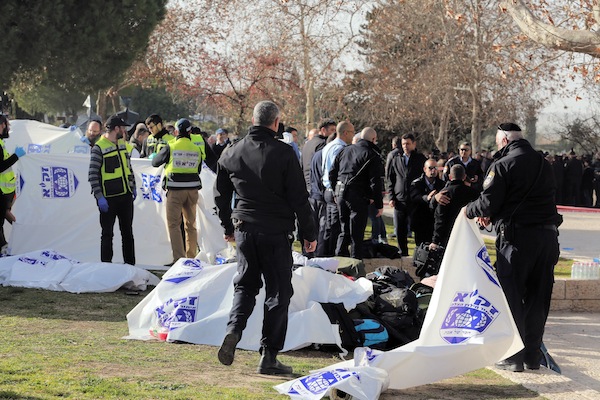
On Jan. 8, four people were killed when a released Arab prisoner ran a truck into a group of people on the Armon Hanatziv Promenade in Jerusalem. This act of murder was referred to as the “truck intifada.” In Gaza, Hamas activists handed out sweets in celebration. This method of terror was soon to be repeated many times in countries all over the world.

At regular intervals during the year, announcements were made concerning important archeological finds all over Israel. Israeli law states that the Israel Antiquities Authority must be notified as soon as there is indication of archeological remains and that, only after specialist examination and, if necessary, excavation, can the development proceed.

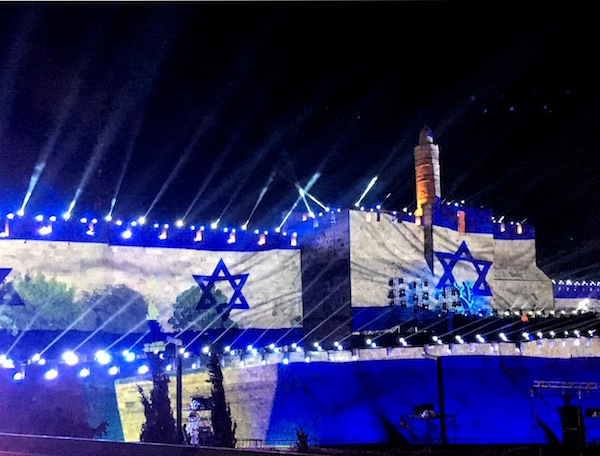
The year also saw the celebration of the 50th year since the reunification of Jerusalem in the Six Day War ( June 1967).

It has been an outstanding year for Israel’s high-tech sector. In particular, 2017 saw the largest business deal in Israel’s history when Mobileye was bought by Intel for some $15 billion.

The Jewish year ended with a bit of confusion, as the region once again became unsettled as Iran attempts to get a stronger foothold in Syria, along with their continued efforts to arm Hezbollah.

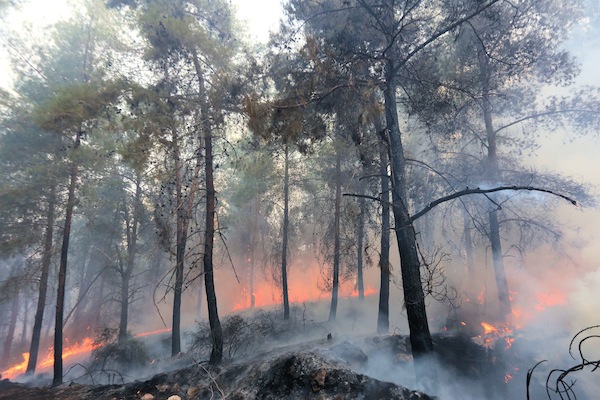
photo - November 2016. A serious fire breaks out near Latrun in the Jerusalem corridor following yet another dry, hot summer. Some 140 firefighters are needed to bring the blaze under control.
November 2016. A serious fire breaks out near Latrun in the Jerusalem corridor following yet another dry, hot summer. Some 140 firefighters are needed to bring the blaze under control.
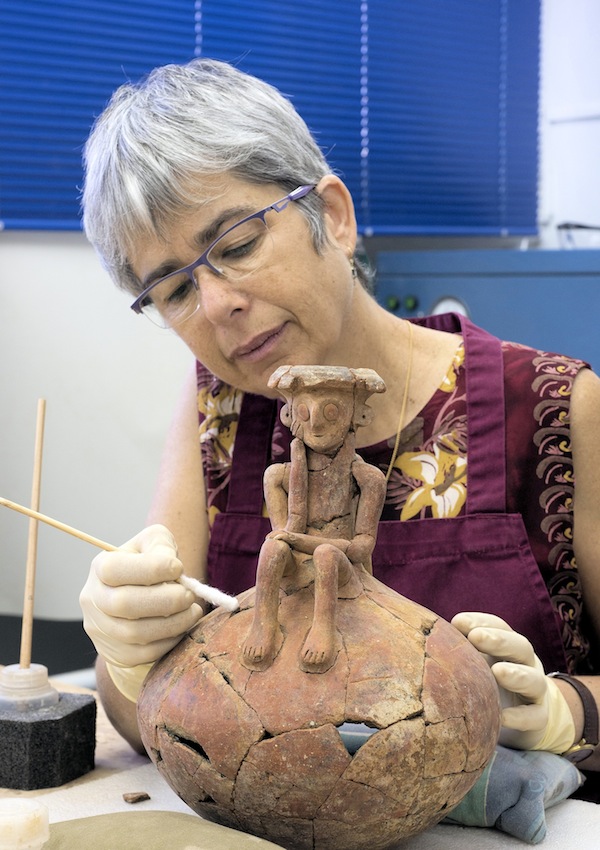
photo - November 2016. A high school student taking part in an organized excavation in Yehud, near Ben-Gurion International Airport, finds a 3,800-year-old jug from the Middle Bronze Age, seen here during its restoration.
November 2016. A high school student taking part in an organized excavation in Yehud, near Ben-Gurion International Airport, finds a 3,800-year-old jug from the Middle Bronze Age, seen here during its restoration.
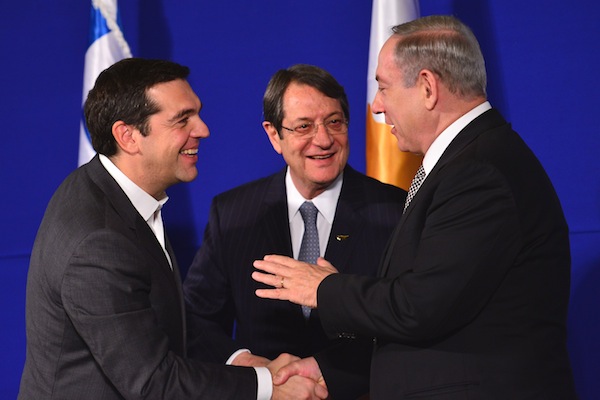
photo - December 2016, Jerusalem. Left to right: Greek Prime Minister Alexis Tsipras, Cypriot President Nicos Anastasiades and Israeli Prime Minister Binyamin Netanyahu hold historic tripartite talks to improve cooperation between the three eastern Mediterranean countries
December 2016, Jerusalem. Left to right: Greek Prime Minister Alexis Tsipras, Cypriot President Nicos Anastasiades and Israeli Prime Minister Binyamin Netanyahu hold historic tripartite talks to improve cooperation between the three eastern Mediterranean countries.
photo - December 2016. The first of 50 F-35 stealth fighters arrive in the Israel Air Force base in Nevatim. The IAF was the first air force outside the United States to receive this state-of-the-art fighter plane
December 2016. The first of 50 F-35 stealth fighters arrive in the Israel Air Force base in Nevatim. The IAF was the first air force outside the United States to receive this state-of-the-art fighter plane.
photo - January 2017. Four pedestrians are murdered in Jerusalem’s East Talpiot neighbourhood by a truck driven at speed; 13 others are injured. The terrorist is shot dead by police
January 2017. Four pedestrians are murdered in Jerusalem’s East Talpiot neighbourhood by a truck driven at speed; 13 others are injured. The terrorist is shot dead by police.
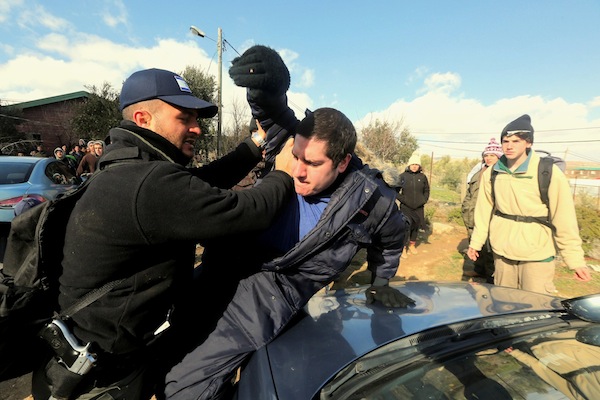
photo - February 2017. Following a High Court ruling, the illegal Jewish settlement of Amona, 20 kilometres north of Jerusalem, is forcibly evacuated by police and security forces. The court ruled that the settlement had been established on Palestinian-owned land
February 2017. Following a High Court ruling, the illegal Jewish settlement of Amona, 20 kilometres north of Jerusalem, is forcibly evacuated by police and security forces. The court ruled that the settlement had been established on Palestinian-owned land.
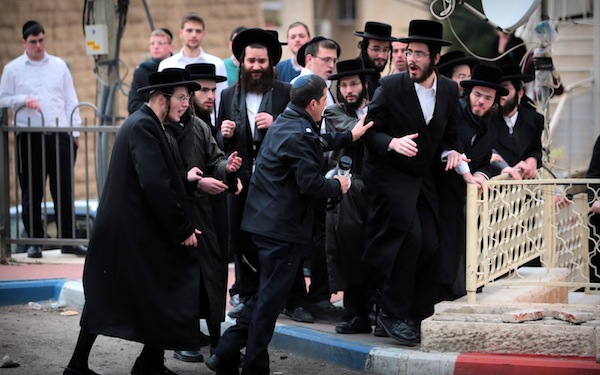
photo - February 2017. Some ultra-Orthodox riot over government insistence that all able-bodied young men be drafted into the army. While heads of many Charedi yeshivot have encouraged their students not to report to induction centres, there are many Israel Defence Force units that have ultra-Orthodox soldiers in their ranks
February 2017. Some ultra-Orthodox riot over government insistence that all able-bodied young men be drafted into the army. While heads of many Charedi yeshivot have encouraged their students not to report to induction centres, there are many Israel Defence Force units that have ultra-Orthodox soldiers in their ranks.
photo - February 2017. Binyamin Netanyahu is the first incumbent Israeli prime minister to officially visit Australia. The picture shows Netanyahu and his wife Sara at the Sydney Jewish School of Moriah
February 2017. Binyamin Netanyahu is the first incumbent Israeli prime minister to officially visit Australia. The picture shows Netanyahu and his wife Sara at the Sydney Jewish School of Moriah.
photo - March 2017. Prime Minister Binyamin Netanyahu with Chinese President Xi Jinping. Netanyahu, together with a business delegation, made the visit to China to expand trade between the two countries
March 2017. Prime Minister Binyamin Netanyahu with Chinese President Xi Jinping. Netanyahu, together with a business delegation, made the visit to China to expand trade between the two countries.
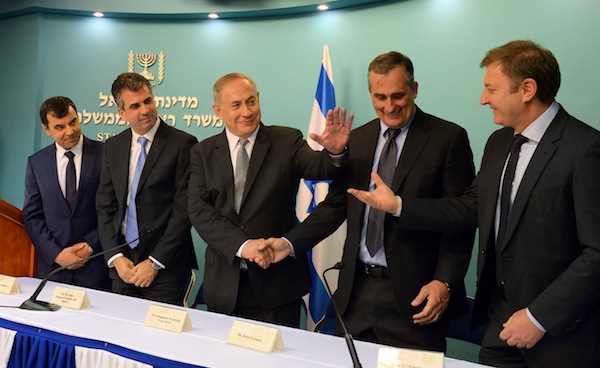
photo - March 2017. Mobileye is bought by Intel, but the headquarters of the company will remain in Jerusalem. Left to right are Amnon Shashua, Eli Cohen, Prime Minister Binyamin Netanyahu, Brian Krzanich and Ziv Aviram
March 2017. Mobileye is bought by Intel, but the headquarters of the company will remain in Jerusalem. Left to right are Amnon Shashua, Eli Cohen, Prime Minister Binyamin Netanyahu, Brian Krzanich and Ziv Aviram.
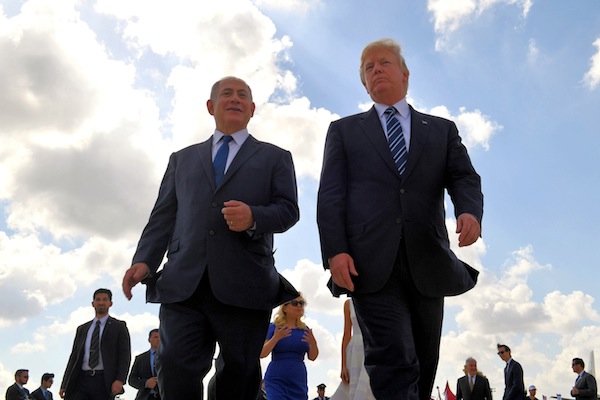
photo - May 23, 2017. U.S. President Donald Trump, seen here with Prime Minister Binyamin Netanyahu, made Israel one of the first overseas countries he visited since becoming president
May 23, 2017. U.S. President Donald Trump, seen here with Prime Minister Binyamin Netanyahu, made Israel one of the first overseas countries he visited since becoming president.
photo - May 2017. On May 20, Jerusalem was illuminated to celebrate the 50th year of the city’s reunification following the Six Day War
May 2017. On May 20, Jerusalem was illuminated to celebrate the 50th year of the city’s reunification following the Six Day War.
photo - July 2017. Indian Prime Minister Narendra Modi, left, becomes the first sitting Indian prime minister to officially visit Israel. Accompanied by Prime Minister Binyamin Netanyahu, Modi meets with Moshe Holtzberg, 10, who survived the terrorist attack that killed Moshe’s parents and seven others at Mumbai’s Chabad House in November 2008
July 2017. Indian Prime Minister Narendra Modi, left, becomes the first sitting Indian prime minister to officially visit Israel. Accompanied by Prime Minister Binyamin Netanyahu, Modi meets with Moshe Holtzberg, 10, who survived the terrorist attack that killed Moshe’s parents and seven others at Mumbai’s Chabad House in November 2008.