Skip to content
  • Home
  • Subscribe / donate
  • Events calendar
  • Business Directory
  • FAQ
  • News
    • Local
    • National
    • Israel
    • World
    • עניין בחדשות
      A roundup of news in Canada and further afield, in Hebrew.
  • Opinion
    • From the JI
    • Op-Ed
  • Arts & Culture
    • Performing Arts
    • Music
    • Books
    • Visual Arts
    • TV & Film
  • Life
    • Celebrating the Holidays
    • Travel
    • The Daily Snooze
      Cartoons by Jacob Samuel
    • Mystery Photo
      Help the JI and JMABC fill in the gaps in our archives.
  • Community Links
    • Organizations, Etc.
    • Other News Sources & Blogs
  • JI Chai Celebration
  • JI@88! video

Recent Posts

  • Legal help for students
  • Revisiting myth of Lilith
  • Wrong person rebuked
  • Canada’s mixed messages
  • Questions for museum
  • Symposium on antizionism
  • Making soccer political
  • CJPAC lauds Pulver’s impact
  • City recognizes Vrba’s legacy  
  • Organ donation saves lives
  • Theodore’s March premiere
  • A healing Shabbaton
  • Supplying healthy food
  • A chime of metal tags
  • Yellowknife seder a first
  • Ishai energizes, unifies
  • A Lag b’Omer to remember
  • Expanding the healing
  • Hannah Senesh – a unique hero
  • Community milestones … May 2026
  • Sharing her testimony
  • Fall fight takes leap forward
  • The balancing of rights
  • Multiple Tony n’ Tina roles
  • Stories of trauma, resilience
  • Celebrate our culture
  • A responsibility to help
  • What wellness means at JCC
  • Together in mourning
  • Downhill after Trump?
  • Birth control even easier now
  • Eco-Sisters mentorship
  • Unexpected discoveries
  • Study’s results hopeful
  • Bad behaviour affects us all
  • Thankful for the police

Archives

Follow @JewishIndie
image - The CJN - Visit Us Banner - 300x600 - 101625

Tag: history

Golden discovery

Golden discovery

A Hellenistic-era golden earring, discovered in the Givati Parking Lot in the City of David National Park. (photo from IAA courtesy Ashernet)

A Hellenistic-era golden earring, featuring ornamentation of a horned animal, was discovered in the Givati Parking Lot in the City of David National Park encircling the Old City walls. The discovery was made during archeological digs carried out by the Israel Antiquities Authority and Tel Aviv University. According to the researchers, “It is unclear whether the gold earring was worn by a man or a woman, nor do we know their cultural or religious identity, but we can say for certain that whoever wore this earring definitely belonged to Jerusalem’s upper class. This can be determined by the proximity to the Temple Mount and the Temple, which was functional at the time, as well as the quality of the gold piece of jewelry.”


Format ImagePosted on August 24, 2018August 22, 2018Author Edgar AsherCategories IsraelTags archeology, history, IAA, Israel, Israel Antiquities Authority, Tel Aviv University
Peretz Centre alumni reunite

Peretz Centre alumni reunite

From generation to generation: A Peretz Centre reunion attendee pauses to send a text while walking through an exhibit of archival photos. (photo from Peretz Centre)

On June 20, Vancouver’s Peretz Centre for Secular Jewish Culture held its first-ever reunion of alumni.

The enthusiastic crowd at the reunion, which took place in the Ben Chud Auditorium of the institute’s home on Ash Street, included those who had attended at each of the centre’s locations over the years. When it was founded in 1945, the Peretz Centre offered preschool and after-school classes in Yiddish and Yiddishkeit in the basement of the old Jewish Community Centre at Oak and 11th Avenue, but soon the members purchased a house on Broadway near Alder (now the site of a liquor store and a high-rise). It operated there for 15 years, and it had more than 100 students when it moved to its current location.

The Peretz Centre is dedicated to non-political, secular Jewish and progressive education. Speaking at an open mic, alumni, many now seniors, shared stories dating back to the early days. They recalled a warm sense of community and an education that lived up to the centre’s progressive ideals, including the principle of tikkun olam, the duty to work with others to heal the world. The reunion also provided an opportunity for many to thank the activists who established the centre and for years have dedicated themselves to sustaining it. Some of those first-generation leaders were able to attend the reunion, including Seemah and Harold Berson, Galya Chud, Arlene Jackson and Claire Osipov. Some alumni traveled from out of town to attend, from Winnipeg, Calgary and Denver.

Among the attendees were graduates from the Peretz’s secular B’nai Mitzvah Program, which continues to be one of the centre’s most important offerings. The program approaches Jewish identity through a range of topics, including genealogy and family history, Jewish history and culture, ethics, traditions, Yiddish and Hebrew language studies and more. Avrom Osipov, a Peretznik who in the mid-1960s was the first to complete a Peretz bar mitzvah, spoke at the open mic about the controversy the program caused at the time. The idea of a secular bar or bat mitzvah was new and challenging, he said, even attracting some attention from the local news media.

Reunion attendees enjoyed a display of archival photos from the old days, and Peretz graduates provided much of the entertainment, including emcee and magician Steven Kaplan (aka “the Maestro of Magic”), saxophonist Saul Berson and singers Lisa Osipov-Milton and Sheryl Rae. Pianists Nick Apivor and Wendy Bross Stuart accompanied. The reunion wrapped up with a rousing singing of the old Peretz Shule Hymn, the chorus of which is, “Yud Lamed Peretz a likhtiker kval / tsint unzer hartz on fun dor tsu dor / di tsukunft fun folk balaykht un bashtralt / es vinkt shoyn di nayer kayor” (“This school, our shule, may it blossom and grow / It was built with great effort and love / To teach all the youth who are placed in our care / About ethics and justice for all.”

Paul Headrick is a Vancouver novelist and short story writer. He attended classes at the Peretz Centre in the early 1960s.

Format ImagePosted on July 20, 2018July 18, 2018Author Paul HeadrickCategories LocalTags history, Peretz Centre, reunion, secular Judaism
Mystery photo … July 20/18

Mystery photo … July 20/18

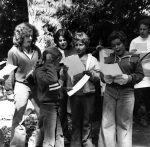
Camp Miriam, 1979. (photo from JWB fonds, JMABC L.09623)

If you know someone in this photo, please help the JI fill the gaps of its predecessor’s (the Jewish Western Bulletin’s) collection at the Jewish Museum and Archives of B.C. by contacting [email protected] or 604-257-5199. To find out who has been identified in the photos, visit jewishmuseum.ca/blog.

Format ImagePosted on July 20, 2018July 18, 2018Author JI and JMABCCategories Mystery PhotoTags Camp Miriam, history, Jewish museum
Archeological cliff-hanger

Archeological cliff-hanger

Dr. Yinon Shivtiel, left, and Dr. Danny Syon inside the cave where large wine jars, a cooking pot and other pottery more than 2,000 years old were salvaged two weeks ago in a joint operation of the Sefad Academic College, the Israel Antiquities Authority (IAA), the Israel Cave Research Centre and the Israel Cave Explorers Club. (photo by IAA from Ashernet)

photo - The pottery was found in a cave high on a sheer cliff, under an overhang
The pottery was found in a cave high on a sheer cliff, under an overhang. (photo by IAA from Ashernet)

In 2017, Dr. Yinon Shivtiel, a speleologist and senior lecturer at Sefad, conducted a survey in Western Galilee, aided by the Israel Nature and Parks Authority, to locate caves that served as shelters and hiding places. He discovered a cave high on a sheer cliff, under an overhang, which contained ancient pottery vessels. “As a first impression,” said Dr. Danny Syon, senior archeologist with the IAA, “the finds seem to date to the Hellenistic period: between the third and first centuries BCE…. We assume that whoever hid here escaped some violent event that occurred in the area. Perhaps by dating the vessels more closely, we shall be able to tie them to a known historic event. It is mind-boggling how the vessels were carried to the cave, which is extremely difficult to access. Maybe an easier way that once existed disappeared over time?”

Format ImagePosted on July 13, 2018July 11, 2018Author Edgar AsherCategories IsraelTags archeology, history, Israel, pottery
Line 41 through ghetto

Line 41 through ghetto

An historical photo of Line 41 blending into a drawing of the buildings and street. (photo by Marek Iwicki, drawing Tanja Cummings)

The Line 41 streetcar ran through Lodz Ghetto (Litzmannstadt). Established by the Nazis in 1939, 180,000 Jews and 5,000 Sinti and Roma were imprisoned there, in plain site of the streetcar passengers. As these travelers went about their daily routines for the next several years, 46,000 people died from hunger, disease and violence in the ghetto and practically everyone else was deported to Auschwitz or Chelmno extermination camps. By August 1944, fewer than 900 prisoners remained; the Soviet army arrived in January 1945.

The documentary film Line 41 focuses on the story of two men: Natan Grossmann, who survived the ghetto, and Jens-Jurgen Ventzki, whose father was the Nazi mayor of the city. It will see its Canadian première on July 11, 7:45 p.m., at Vancity Theatre. The screening will be followed by a discussion between Berlin-based director Tanja Cummings and Prof. Richard Menkis, associate professor of modern Jewish history at the University of British Columbia.

“I was interested in participating,” Menkis told the Independent, “because I am a Holocaust educator, quite simply. As such, I think it is important to engage the different ways of approaching the Holocaust…. I teach the course on the Holocaust at UBC, have published on aspects of the Holocaust and have worked on museum exhibitions. I am also interested in film representations – especially in documentaries – so I am glad to be involved. The film raises several important issues, especially about ‘bystanders,’ and I look forward to having a conversation about the film and its themes.”

Released in 2016, Line 41 has screened in Germany, Poland, Austria, Romania, the United States and Australia. The film took about nine years to make, with the initial idea for it coming in 2007.

“Everything started by reading the 1937 novel by Israel Joshua Singer, Di brider Aschkenasi [The Brothers Ashkenazi],” Cummings told the Independent. “It was this great novel that raised my interest in Lodz in the very first place and it made me travel there in 2008 or so.”

Cummings was initially interested in Lodz before the Second World War. “The history of Lodz was very much influenced by German, Polish and Jewish populations since the early 19th century,” she explained. “In a positive way, one could say that these groups worked together to transform a small village into a major European centre of textile production within a few decades.”

Known variously as “the Manchester of Poland” and the “Eldorado of the East,” she said, “Immigrants from all over Europe came to this ‘Promised Land.’ This term was actually coined for this city by [Nobel Prize-winning author] Wladyslaw Reymont in a novel of that title…. Later on, the famous Polish filmmaker Andrzej Wajda made a feature film out of it, with, again, the same title (or, in Polish, Ziemia Obiecana).

“So, it was Germans, Jews, Poles and also Russians who dominated the development of Lodz. Knit together – through trade, business, politics and bureaucracy – every group played its specific role, and made up what was and still is called ‘the Lodz man,’ ‘Lodzermensch,’ a ‘man’ of special wit of life and street smarts, so this fascinated me.”

Over time, her focus shifted.

“I tried to meet witnesses of German, Polish and Jewish background who, through their family background, would be able to tell me about these prewar times,” she said, “but, ‘naturally,’ all their stories circled around the era in which this world of the Lodzermensch was destroyed – by the invasion of the German Wehrmacht, the Second World War and the times of the ghetto. This is what their stories focused on, as they themselves had experienced it as young adults, teenagers, children. Through meeting these witnesses and hearing their powerful, shattering stories, it became clear that one must record them and their stories so that they would reach a larger audience. And, early on, it was clear to me that we should try to find witnesses – last witnesses – of these various groups: roughly, the victims, the perpetrators, the bystanders.”

Cummings said, “When you walk through Lodz today or through the area of the former ghetto for that matter, which formed a large part of this city, you realize that many of the buildings, streets, backyards, hallways and flats do not seem to have changed since the time of the war…. In many streets, time seems to stand still. The buildings still stand in their roughness, but the people of the ghetto of 1940 until 1944 (or early 1945) are gone. Yet, people live there today and seem to be oblivious to what happened in their streets, flats, courtyards.

“This is especially painful if one can connect certain buildings with specific stories of people and families – through the narratives told to us; through historical literature and through diaries or other reports, for example, Berlin Jewish families whose deportation has been traced, the places where they ‘lived’ in the ghetto and what happened to them, which tragedies evolved, which terror was inflicted upon them there, or in the camps, such as Kulmhof [Chelmno] or Auschwitz.

“A key moment that shocked me deeply was when, in 2010 or 2011, a Lodz German in his early 80s – not the one whom we see in the film – walked us through streets of the former ghetto area and he showed to us the street where the streetcar line ran through, coming from the ‘free’ part of the city. This was the first time I had ever heard about this streetcar,” said Cummings. “And he told us he had been a passenger in this streetcar many times, and that the ghetto was plainly visible to him and anybody who took this streetcar – not once, many times. And, while he told us this, streetcars passed by. In Lodz, the past is very present,” as it is elsewhere, in places like Berlin, and all over Europe.

“Since that day with this elderly Lodz German (who, after the war, did not leave this city) I tried to find more witnesses from this period of the war who would tell their stories from their own perspectives: Jewish survivors of the ghetto, but also Germans and Poles who lived around the ghetto which was hermetically closed and isolated over the course of four years. Germans and Poles, what did they see, what did they know? What was told in families, at school? What was the atmosphere in the city back then?

“The ghetto was a different matter altogether, and the narratives very much circled around survival, hunger and nightmarish scenes, but also culture, resistance – so many efforts to stay human.

“As for the main protagonist, Natan Grossmann, who was a teenager during ghetto times, we also tried to find out – together with him – about the fate of his older brother. To Natan, since the day his brother vanished in March 1942 in the ghetto, he had no clue what had happened to him.”

In the main phases of filming, from 2011 to 2013, about 120 hours with witnesses was recorded, after which it was decided the documentary would focus on Grossmann and Ventzki.

“When we started, we had no clear vision of what [the witnesses] would tell us, or where we would go with them, where they would lead us – all these things developed in the process of filming – or what we, together with the protagonists, would find out, what we would learn from them,” said Cummings.

When Grossmann arrived in the British Mandate of Palestine in 1946, she explained, “he felt he was ‘reborn’ there and crossed out the past from his mind. He suppressed what had happened to him in Lodz Ghetto, in Auschwitz, other camps in Germany, the death march…. He crossed this out from his daily life and did not talk about it. He did not look for his brother Ber, whose fate was unknown to him, except one attempt, when he visited Auschwitz in the 1980s but could not find any records there on his brother.”

Only because Grossmann was persuaded “to travel with us to Lodz in 2011, visit archives and connect with historians there, did we, together, finally find out what happened to his older brother Ber.”

In the film, Grossmann searches “not only for his brother, but also for the graves of his parents, who were murdered in the ghetto, and for photographs of anybody from his once-large family, as he has none of his close family.”

Ventzki, the second main protagonist, is the son of Werner Ventzki, a Nazi official and German mayor of Lodz (then Litzmannstadt) during the German occupation. “So, the son goes on a journey as well,” said Cummings, “but from a completely different perspective – as son of a perpetrator fighting a silence, the silence in his family, and trying to find ways of dealing with the fact that his father was a Nazi perpetrator, and his mother, too.”

photo - Director Tanja Cummings with Jens-Jurgen Ventzki, one of the two main protagonists in the documentary film Line 41
Director Tanja Cummings with Jens-Jurgen Ventzki, one of the two main protagonists in the documentary film Line 41. (photo by Marek Iwicki)

During filming, Ventzki and Grossmann were kept apart. “We traveled with them separately,” she said, “as we felt then it may be too intense and heavy for both of them. Only much later, [while the film was] in the editing room already, in 2013, we decided we should try to have them meet (and start filming again).”

The meeting took place at Ventzki’s home in Austria. “In the film, you can see their first-ever meeting, moments of this meeting, which, in the film, form the most powerful and, for some, unbearable moments in the film, towards its end. In fact, these moments were the starting point of a … deep friendship between these two men.”

The film isn’t intended to be “a ‘didactic play’ or tell audiences what to think,” said Cummings, “but rather to ask questions, as the film does…. I would be glad if this kind of curiosity and openness is transmitted to the audiences.”

While the film deals with historical issues, it does so, for the most part, through “the two main protagonists, who used to stand on different ‘sides of the fence’: victims and perpetrators. But the film is not about reconciliation, but rather about meeting and listening to each other. If audiences feel how important that is, or feel the power of what happens there or may happen there, that would be wonderful. And this reaches out beyond the ‘topic’ of the Shoah or Holocaust – there is something universal about it.”

For more information, visit linie41-film.net. For tickets to the screening and discussion, which is being presented by the Vancouver Foreign Film Society, go to viff.org. Vancity classifies the film as suitable for ages 19+.

Format ImagePosted on July 6, 2018July 5, 2018Author Cynthia RamsayCategories TV & FilmTags history, Holocaust, Litzmannstadt, Lodz, Richard Menkis, Shoah, Tanja Cummings
A life of music and activism

A life of music and activism

Gary Cristall (photo by Brian Nation)

‘My Jewish identity has always been associated with the struggle for basic human values and rights and freedoms,” said Gary Cristall, co-founder of the Vancouver Folk Music Festival, in conversation with the Jewish Independent. “I thought that was the centre, was the core of being Jewish. That was the way I was raised and the stories that were told. I had two identifications with being Jewish – one was social justice, and the other was culinary. I worshipped at Schwartz’s Deli in Montreal.”

A longtime advocate for both the arts and progressive politics, whose passion was forged in the Canadian left of the 1950s and ’60s, Cristall is a cultural pioneer. He co-founded the Vancouver Folk Music Festival in 1978, later serving as its coordinator and artistic director until 1994.

As well as being an educator, activist and promoter, Cristall has fought for artists, struggling to win them professional respect while also defending their rights to fair fees and copyright ownership. For his range of work, he was awarded an honourary doctorate by the University of British Columbia in 2015 and was recognized as an outstanding alumnus of Simon Fraser University in 2017.

Cristall sees his involvement in activism and folk music as natural outgrowths of the culture in which he was raised. “Jews played a major role in folk music in this country, and in the States,” he said. “There were around 50 Jews who invented folk music. It was a conspiracy that was so successful no one understood what had happened.”

Cristall estimates that about 10,000 people attended the first Vancouver Folk Music Festival in 1978. This year’s festival, which takes place July 13-15, is expected to draw more than 35,000 people to Jericho Beach, where the event has been located since 1979. Seven stages are set up in the park and every available inch of parking space in the neighbourhood disappears. This year’s festival will present more than 50 concerts or workshops by artists from around the world, as well as an artisan market and a range of food vendors.

Beyond the festival, Cristall has served in the Canada Council for the Arts and was the founding president of the Public Service Alliance of Canada.

“When the CCA hired me, I was getting tired, getting ready to leave the festival, wondering what I would do next,” Cristall said. “When I saw the job ad, I thought, they’ll never hire me, but they’ll interview me and I’ll get a free trip to see my mother in Toronto. But they were looking to make a change, and they were interested in me because I was a shit-disturber and a rabble-rouser. They called my bluff, and said, ‘OK, you want to change things, come work for us.’”

Today, Cristall is at both Douglas College and Capilano University, where he teaches Canadian cultural policy and arts administration. He has spent 18 years working on a history of folk music in English-speaking Canada, which, he joked, is “1,200 pages written so far, a few hundred pages left to go.”

Asked about what he’s looking forward to at the festival year, Cristall reeled off a list of a dozen performers and what’s special about them. Among them, he mentioned Rodney Crowell, “a brilliant songwriter”; Guy Davis, a “great blues player, son of Ossie Davis and Ruby Dee, left-wing Harlem artists going way back”; Les Poules à Colin, “young people who are the children of that first revival generation of Quebecois folk music”; the Dead South, “Saskatchewan bluegrass”; Dálava, “a Moravian group doing avant-garde classical and folk and jazz music”; Dori Freeman, whose hometown, Galax, Va., “was a centre of old-timey music”; Vancouver’s Gord Grdina, who “plays the oud and is a brilliant guitar player, got a Juno, plays with a 10-piece band”; A Familia Machado, a “great guitar player playing with two members of his family from Brazil”; and Archie Roach “from Australia, a senior aboriginal songwriter.”

As he spoke, the enthusiasm poured off of him. Cristall is clearly still a man who loves music. “They’re the real thing,” he said. “That’s what I like about the folk festival, it’s the real thing.”

In his list of highlights, Cristall notably passed over most of the more well-known acts playing at the festival, names like Art Bergmann, Ry Cooder, the Mariel Buckley Band, Neko Case and indigenous artist and 2018 Juno nominee Iskwé. “What I love about the folk festival is not just seeing the big names, but seeing someone I never heard of before and come home loving,” said Cristall.

How does the world look to a longtime activist like Cristall? What’s his advice to the next generation?

“My hope is very much alive,” he said. “My Zaida was imprisoned for political activism, and he escaped and came to Canada. I’ve been active since 1965. We have to keep on fighting, nothing says we’re going to win quickly. I’m not pessimistic. Every movement has its ups and downs and nobody said that we were going to win fast and easy. My advice to younger people is get involved, educate yourself, learn and fight. That also connects to the kind of music [at the festival], both implicitly and explicitly – the music is a struggle to survive against the behemoth of capitalism and the fact that those artists have survived is a cultural victory. Hey, it’s too late to be pessimistic.”

For the full festival lineup and tickets, visit thefestival.bc.ca.

Matthew Gindin is a freelance journalist, writer and lecturer. He is Pacific correspondent for the CJN, writes regularly for the Forward, Tricycle and the Wisdom Daily, and has been published in Sojourners, Religion Dispatches and elsewhere. He can be found on Medium and Twitter.

Format ImagePosted on July 6, 2018July 5, 2018Author Matthew GindinCategories MusicTags activism, folk music, Gary Cristall, history
Mystery photo … June 29/18

Mystery photo … June 29/18

Beth Israel Synagogue, 1972. (photo from JWB fonds, JMABC L.09793)

If you know someone in this photo, please help the JI fill the gaps of its predecessor’s (the Jewish Western Bulletin’s) collection at the Jewish Museum and Archives of B.C. by contacting [email protected] or 604-257-5199. To find out who has been identified in the photos, visit jewishmuseum.ca/blog.

Format ImagePosted on June 29, 2018June 28, 2018Author JI and JMABCCategories Mystery PhotoTags Beth Israel, history, Jewish museum, youth
טראמפ צריך ללמוד היסטוריה

טראמפ צריך ללמוד היסטוריה

נשיאה לשעבר של ארצות הברית, ביל קלינטון, מגיע לוונקובר לקדם את ספרו החדש ‘הנשיא נעדר’, שיצא לאור בימים אלה. עם קלינטון יתארח הסופר ג’יימס פטרסון, שהוא שותפו בכתיבת הספר.

טראמפ צריך ללמוד היסטוריה: טען קנדה שרפה את הבית הלבן בזמן שזו הייתה בריטניה

נשיא ארצות הברית, דונלד טראמפ, מוכיח שוב שהוא אינו יודע היסטוריה וכרגיל מעוות עובדות לצרכיו האישיים והפוליטיים. הפעם מדובר באירוע שקרה רק לפני כמאתיים שנה אותו טראמפ הזכיר, וטעה בעובדות. בשיחת טלפון כועסת עם ראש ממשלת קנדה, ג’סטין טרודו, שהתקיימה בסוף מאי, במסגרת מלחמת הסחר בה פתח הנשיא האמריקני, אמר בין היתר טרודו: האם אנו קנדה מהווים סיכון לביטחון הלאומי לארה”ב כפי שאתה אומר, כדי להצדיק את המכסים שהטלת על הסחורות שלנו? טראמפ השיב בשאלה: האם לא אתם שרפתם את הבית הלבן במלחמת 1812? טראמפ קצת התבלבל כיוון שהכוחות הבריטים הם ששרפו את הבית הלבן ב-1814 במסגרת מלחמת 1812, לאחר שהאמריקנים התקיפו את אזור יורק באונטוריו, שהיה אז מושבה בריטית.

טראמפ שוב הפך את עצמו לבדיחה באמצעי התקשורת האמריקניים, ששאלו שוב ושוב כיצד הידידה הקרובה ביותר קנדה, מהווה סיכון לביטחון הלאומי של ארה”ב?

הנשיא לא נעדר: ביל קלינטון מגיע לוונקובר וידבר על ספרו החדש ועל צפוי שגם על הנשיא הנוכחי

נשיאה לשעבר של ארצות הברית, ביל קלינטון, מגיע לוונקובר לקדם את ספרו החדש ‘הנשיא נעדר’, שיצא לאור בימים אלה. עם קלינטון יתארח הסופר ג’יימס פטרסון, שהוא שותפו בכתיבת הספר. פטרסון והנשיא לשעבר ידונו ארוכות בספר החדש, באופן כתיבתו והחיבור היחודי ביניהם. נראה שהשניים יעסקו במישרין או בעקיפין גם בנשיא השערורייתי הנוכחי של ארה”ב, דונלד טראמפ, שניצח את אשתו של ביל הילרי קלינטון, בבחירות שהתקיימו לפני כשנה וחצי. צפוי שגם לקהל הרחב תהיה אפשרות לשאול שאלות בנושאים שונים. האירוע היחודי יתקיים במרכז הקונגרסים של ונקובר (באולם הבולרום המערבי), ביום שישי ה-29 בחודש, החל משעה 4.05 אחר הצהריים. נותני החסות: תחנת הטלוויזיה גלובל בי.סי, עיתון הוונקובר סאן ועיתון סטאר – מטרו ונקובר. שבוע קודם לכן ב-22 ביוני, יתקיים אירוע עם קלינטון בלבד במרכז התערוכות של טורונטו (באולם בינפילד סנטר), החל משעה 7.30 בערב. נותן החסות עיתון הטורונטו סטאר. מחירי הכרטיסים לכל אחד מהאירועים: 99 דולר, 159 דולר, 249 דולר והיקר שבהם לווי.איי.פי 1,895 דולר.

הספר ‘הנשיא נעדר’ (בהוצאת אלפרד קנוף וליטל ובראון) הוא מותחן בידיוני שעוסק בחטיפה של נשיא ארה”ב, אך כולל גם תכנים אמיתיים מעניינים שכוללים מידע על מה “קורה מבפנים” ומאחורי הקלעים בבית הלבן, בליווי מתח ודרמה למכביר. מדובר ברומן הראשון של קלינטון, שכאמור אותו הוא כתב ביחד עם פטרסון האמריקני, הנחשב לאחד מהסופרים המצליחים ביותר בעולם, ומטבע הדברים לאחד ממוכרי הספרים הגדולים בעולם. פטרסון הגדיר את העבודה עם קלינטון: “שיא הקריירה שלי והגישה לסינון מיד ראשונה תרמה באופן ייחודי לכתיבת הספר הזה”.

קלינטון (בן ה-71) שימש נשיאה הארבעים ושתיים של ארה”ב, במשך שתי קדנציות מטעם המפלגה הדמוקרטית. קודם לכן הוא שימש מושל מדינת ארקנסו. שיעורי התמיכה בקלינטון (הפופולריות שלו בקרב הציבור) היו גבוהים מאוד, גם עם סיום תפקידו. על הקדנציה השנייה שלו העיבה פרשת מוניקה לווינסקי, אך קלינטון ניצל מניסיון ההדחה של חברי המפלגה הרפובליקנית. בימים האחרונים שודר ראיון עם קלינטון ברשת אן.בי.סי האמריקנית, בו הוא ציין כי אינו חייב התנצלות ללווינסקי. הוא הוסיף כי גם בעידן הנוכחי (של ‘המי טו’) הוא לא היה מתפטר. לדבריו הוא הודיע באופן פומבי על כך שהוא מצטער על מעשיו אך לא דיבר עם לווינסקי.

Format ImagePosted on June 13, 2018June 8, 2018Author Roni RachmaniCategories עניין בחדשותTags Bill Clinton, books, Donald Trump, history, James Patterson, United States, ארצות הברית, ביל קלינטון, ג'יימס פטרסון, דונלד טראמפ, היסטוריה, ספרים
Holy colour of blue

Holy colour of blue

A tallit’s tzitzit with threads dyed in tekhelet blue produced from Murex trunculus snails. (photo from Ptil Tekhelet/Eugene Weisberg)

There’s only one thing missing from the comprehensive temporary exhibit Out of the Blue, which opened June 1 at the Bible Lands Museum Jerusalem (BLMJ) – the reek of the workshops along the Mediterranean coast of Phoenicia and Israel that produced the prized dyes known in antiquity as tekhelet and argaman.

Researchers at the Jerusalem-based foundation Ptil Tekhelet (Blue Thread) maintain that some 8,000 Murex trunculus mollusks were needed to produce a single gram of the luxury pigment. A demonstration of the malodorous dyeing process was carried out – in the garden of the museum – with one of the marine gastropods. A person can only imagine the stink of many thousands of the rotting sea creatures.

The Out of the Blue exhibit documents the significance of tekhelet, together with the Tyrian purple called argaman in the Torah, from antiquity to the present. Not coincidently, the exhibit opened in honour of Israel’s 70th anniversary. It traces the heavenly blue from the time it was a colour revered by the ancient Israelites and other early peoples of the Near East to its use for Israel’s national flag.

“This special exhibition looks at the magnificence as well as the significance of the colour blue in the ancient world, and ties the blue dyed threads mentioned in the Bible and extra-biblical texts to the very design of the flag of the state of Israel today. BLMJ is proud to be the one museum in the world that highlights the relevance and continuity of the roots of civilization in this region and their impact on our world today in a universal and non-sectarian way,” said museum director Amanda Weiss.

Out of the Blue spotlights ancient Near East cultures’ fascination with the colour as a symbol of divinity. In the Egypt of the pharaohs, Mesopotamia and Canaan, lapis lazuli imported at great cost from Afghanistan was used for cultic purposes.

The BLMJ exhibit continues with the lucrative imperial purple dye industry of the ancient Phoenicians, whose name means the “Purple People.”

But, for this reviewer, the core of the exhibit deals with the dyeing of sky blue tzitziyot (ritual fringes affixed to Jews’ tallitot, prayer shawls). In the eighth century, following the Arab takeover of the Levant, that technology was lost. As a result, Jews were compelled to wear white rather than blue ritual fringes on their prayer garments. Research to rediscover the lost dyeing process of the biblical commandment became synonymous with Zionism, the Jewish people’s return to their biblical homeland.

For more than 25 years, Ptil Tekhelet has dyed hundreds of thousands of sky blue tzitziyot coloured with murex snails’ distinctive tint. The azure tzitziyot remind worshippers of the sea, the sky and God’s sapphire-hewn throne, according to Tannaite sage Rabbi Meir, who was a disciple of Rabbi Akiba.

The exhibit includes a collection of the snail (hilazon) shells excavated at Tel Shikmona near Haifa, and dating back to the 10th through seventh centuries BCE, according to Yehuda Kaplan, one of exhibit’s three curators.

“You can see that, for some of them, there is a breach in the shell,” he said during a press tour of the exhibit. It was from those holes that a gland from the snail was extracted, with each yielding only a “minuscule” amount of the rare and highly coveted dye’s raw material.

“These snails, the Murex trunculus, probably about 4,000 years ago it was discovered that they could produce magnificent dyes with the most beautiful colours, dyes that were fast on wool, never faded. And that was something in the ancient world that was simply unheard of, it was priceless,” said Dr. Baruch Sterman of Ptil Tekhelet, co-author of the book The Rarest Blue: The Remarkable Story of an Ancient Colour Lost to History and Rediscovered.

photo - Baruch Sterman of the Ptil Tekhelet foundation, and co-author of the book The Rarest Blue
Baruch Sterman of the Ptil Tekhelet foundation, and co-author of the book The Rarest Blue. (photo by Gil Zohar)

At some point, added Sterman, those dyed fabrics were “worth up to 20 times their weight in gold.”

Other artifacts on display include garment fragments discovered at Masada during archeological excavations in the early 1960s. More than 30 years later, tests using high-performance liquid chromatography (HPLC) proved the cloth had been dyed with a murex solution.

Out of the Blue concludes with the flag flown outside the United Nations in New York in May 1949, when Israel was accepted as a member state of the international body. A second Israeli flag on display was carried into orbit aboard the American Apollo spacecraft, which docked with the Soviet Soyuz rocket on July 17, 1975, in the first international manned space flight.

Sterman’s nonprofit amuta (foundation) is based on the research, in the 1980s, of Otto Elsner, a chemist at Ramat Gan’s Shenkar College of Engineering and Design, who discovered that, if a solution of the purple dye made from the hypobranchial gland of the Murex trunculus was exposed to the sun’s ultraviolet rays, it would turn a deep shade of blue.

Popularizing that knowledge has been a slow process. According to the Talmud, tekhelet is a specific azure dye produced from a sea creature known as a hilazon. Rabbinic sages ruled that vegetable indigo dyes were unacceptable.

Over the past 150 years, several marine creatures were proposed for reviving the biblical process of dyeing the tassels, among them one favoured by Israel’s first chief rabbi, Isaac Herzog, father of Israel’s sixth president, Chaim Herzog. Rabbi Herzog, who completed his PhD at the Sorbonne in Paris in 1914, believed that the violet pelagic snail, Janthina janthina, was the source of the ritual tekhelet.

Another theory was proposed half a century earlier by Rabbi Gershon Hanokh Leiner, known as the Radzyner Rebbe, who produced blue dye from the black ink of the Sepia officinalis (the common cuttlefish). But chemical analysis identified his dye as Prussian blue, an inorganic synthetic colour derived from iron filings and not from the squid itself.

That dispute continues to reverberate: most of the blue-coloured tzitziyot worn in Israel today are dyed from the inexpensive cuttlefish, acknowledged Ptil Tekhelet. (The tekhelet factory in Radzyn near Lublin in Poland was destroyed during the Holocaust, and the technology was lost but was revived in Israel after 1948 thanks to the prewar research of Chaim Herzog.)

The rediscovery of tekhelet has almost messianic implications – one rabbinic source notes, “The revelation of the hilazon is a sign that the redemption is shining near.”

According to the museum, “The tekhelet blue, which reminded every Jew of their connection to God, remained in the memory of the [Jewish] people and became an integral part of the national symbol of the state of Israel.”

Gil Zohar is a journalist based in Jerusalem.

Format ImagePosted on June 1, 2018May 30, 2018Author Gil ZoharCategories IsraelTags history, Jerusalem, Judaism, museums, tekhelet
Genocide still happening

Genocide still happening

Polish-Jewish lawyer Raphael Lemkin was the first to use the term “genocide.” (photo by Moidov)

The word “genocide” was conceived by Polish-Jewish lawyer Raphael Lemkin to describe the attempt of the Ottoman Empire to efface Armenians from Turkish society. He articulated the empire’s actions as a specific category of crime – one that could be named, analyzed, resisted and penalized by the global community.

Lemkin was born in 1900 on a small farm near the Polish town of Wolkowysk. As a young man, he heard that as many as 1.2 million Christian Armenians were killed by the Ottoman Empire, the population of which was mainly Muslim. He also knew of the pogroms and violence against his own people, of course, but it was the situation of the Armenians that led him to the idea of a change in international law that could address such violence.

When the German army invaded Poland, Lemkin fled Europe for safety in the United States. He began teaching at Duke University and, in 1942, he joined the war department, where he documented Nazi atrocities. This led to the 1944 book Axis Rule in Occupied Europe: Laws of Occupation, Analysis of Government, Proposals for Redress, wherein Lemkin first introduced the word “genocide.”

“By ‘genocide,’ we mean the destruction of a nation or of an ethnic group,” Lemkin wrote. “Generally speaking, genocide does not necessarily mean the immediate destruction of a nation, except when accomplished by mass killings of all members of a nation. It is intended rather to signify a coordinated plan of different actions aiming at the destruction of essential foundations of the life of national groups, with the aim of annihilating the groups themselves. Genocide is directed against the national group as an entity, and the actions involved are directed against individuals, not in their individual capacity, but as members of the national group.”

Lemkin later worked on the Nuremberg trials, where he succeeded in getting the word genocide included in the indictment. Genocide was not yet a legal term, however, and the verdict at Nuremberg set a precedent only for war crimes. While in Nuremberg, Lemkin learned of the death of his parents, who, along with 49 other family members, were killed by the Nazis.

Lemkin was determined to see genocide added to international law and, after his return to Europe, he began agitating for this at the meetings of the then newly established United Nations. His efforts to enlist the support of national delegations and influential leaders eventually bore fruit. On Dec. 9, 1948, the United Nations approved the Convention on the Prevention and Punishment of the Crime of Genocide. As of December 2017, 149 states, including Canada, had ratified or acceded to the treaty.

Lemkin committed the rest of his life to convincing nations to pass legislation supporting the convention. He died in 1959, “impoverished and exhausted by his efforts,” according to Lemkin House, an American sanctuary for asylum seekers named in his honour.

At the 2005 World Summit, all member states of the United Nations endorsed the Responsibility to Protect (R2P) doctrine, which Canada was instrumental in promoting – on paper, at least, it carries Lemkin’s vision forward.

“The international community,” states the doctrine, “through the United Nations, also has the responsibility to use appropriate diplomatic, humanitarian and other peaceful means … to help protect populations from genocide, war crimes, ethnic cleansing and crimes against humanity … we are prepared to take collective action, in a timely and decisive manner … on a case-by-case basis and in cooperation with relevant regional organizations as appropriate, should peaceful means be inadequate and national authorities manifestly fail to protect their populations from genocide, war crimes, ethnic cleansing and crimes against humanity.”

This article was being written as almost one million Rohingya refugees were preparing to celebrate Ramadan in the camps of Cox’s Bazar, in Bangladesh – 700,000 of them have fled Myanmar since August 2017, running from what several international observers have called genocide. Yet Canada, and many others, including the UN, have shied away from using Lemkin’s term to describe the situation.

Modern Turkey still denies the Armenian genocide that was instrumental in inspiring Lemkin’s efforts. And, although some countries, notably Germany and Rwanda, have made attempts to deal with their past, with the crimes committed by their governments and civilians, the fight to prevent, identify, resist and respond effectively to genocide remains relevant.

Matthew Gindin is a freelance journalist, writer and lecturer. He is Pacific correspondent for the CJN, writes regularly for the Forward, Tricycle and the Wisdom Daily, and has been published in Sojourners, Religion Dispatches and elsewhere. He can be found on Medium and Twitter.

Format ImagePosted on June 1, 2018May 30, 2018Author Matthew GindinCategories WorldTags genocide, history, Raphael Lemkin, United Nations

Posts pagination

Previous page Page 1 … Page 47 Page 48 Page 49 … Page 57 Next page
Proudly powered by WordPress