Community honours and reunions

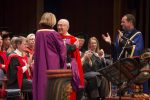
Honourary degree recipient Robert Waisman, centre, is congratulated by University of Victoria chancellor Shelagh Rogers as UVic president Jamie Cassels, right, applauds. (photo from UVic Photo Services)

The Vancouver Holocaust Education Centre extends a mazal tov to board director and longtime volunteer Robert (Robbie) Waisman, who received the degree of honourary doctor of laws from the University of Victoria on June 13.

Waisman was one of the “Boys of Buchenwald” before he was liberated from the concentration camp, eventually emigrating to a new life in Canada, where he built a successful career and now dedicates himself to Holocaust education. He is a community leader, a philanthropist, a founder and past president of the VHEC, and an extremely effective educator who promotes social justice and human rights for all by sharing his experience as a child survivor.

Audiences impacted by Waisman’s VHEC outreach activities include thousands of British Columbian students each year, as well as students and community groups throughout Canada and the United States. He has served as a mentor to survivors of the Rwandan genocide who were wanting to share their eyewitness accounts. Also notable, Waisman was inducted by the Truth and Reconciliation Commission as an Honourary Witness in 2011, and has spoken alongside First Nations leaders and survivors of residential schools about reconciliation and healing.

***
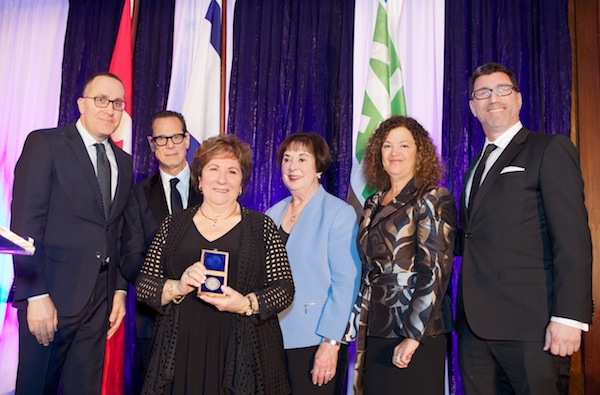
photo - Left to right: Ilan Pilo, JNF, Pacific Region, shaliach; David Goldman, JNF-PR president; Ilene-Jo Bellas JNF-PR past president; Bonnie Belzberg, JNF Canada national vice-president; Wendy Eidinger Spatzner, JNFC national president; and Lance Davis, JNFC chief executive officer
Left to right: Ilan Pilo, JNF, Pacific Region, shaliach; David Goldman, JNF-PR president; Ilene-Jo Bellas JNF-PR past president; Bonnie Belzberg, JNF Canada national vice-president; Wendy Eidinger Spatzner, JNFC national president; and Lance Davis, JNFC chief executive officer. (photo by Robert Albanese)

Dedicated teacher, outstanding volunteer, loving daughter, sister and wife, Jewish National Fund of Canada Bernard M. Bloomfield Medal for meritorious service recipient Ilene-Jo Bellas can be called a “Woman for All Seasons.”

A retired high school teacher, Bellas taught English and theatre arts for 32 years in the Delta School District. She directed more than 100 popular plays and musicals at Delta Secondary School in Ladner. Many of her students have graduated to become successful actors, writers, directors and educators, and they keep in touch with their first teacher/director. She was president of the Association of B.C. Drama Educators, and was instrumental in procuring funding for and in the designing of Genesis Theatre, a fully professional theatre in Ladner.

Bellas was born and raised in Vancouver. She attended Sir Winston Churchill High School and Schara Tzedeck Synagogue Religious School. She developed her strong community commitment through youth activities in Young Judaea, Camp Hatikvah, Camp Biluim and working as a camp counselor. In university, she was involved in the Student Zionist Organization and held leadership roles in Hillel. She became a charter member and eventually president of Atid chapter of Hadassah-WIZO Vancouver; she also served as the Vancouver council vice-president.

Since her retirement in 2003, Bellas has used her many talents and skills to serve her community: three years as secretary of the Jewish Seniors Alliance, four years on the board of the Louis Brier Home and Hospital and president of the ladies’ executive of the Richmond Country Club. She also directed musical shows at Vancouver Talmud Torah, produced souvenir books, chaired and worked on dinner committees for Congregation Schara Tzedeck, Vancouver Talmud Torah, Israel Bonds and the JNF. In 2013, Bellas and her husband Joel, z’l, were awarded the Betzalel Award at Schara Tzedeck Synagogue. Most recently, she chaired a very successful fundraising gala for RAPS (Regional Animal Protection Society).

Bellas served as president of JNF Pacific Region from 2012 to 2015. She remains active to this day, continuing as a board member, chairing and co-chairing Negev Dinner committees and producing the souvenir books. Bellas is on the national board of JNF and states that she is very proud to be part of such a proactive organization for the benefit of the state of Israel.

Bellas attributes much of the success of her stellar volunteer career to the loving support and encouragement she received from her beloved husband Joel, z’l.

***

photo - The June 28 event honouring Dr. Saul Isserow raised more than $3 million for two initiatives
The June 28 event honouring Dr. Saul Isserow raised more than $3 million for two initiatives. (photo from CFHU)

Hebrew University of Jerusalem is known for innovation. With nine Nobel Prize and Fields Medal winners among its alumni and being ranked 12th in the world for biotechnology patent filings, there is an abundance of creativity and ingenuity emanating from the university. It should come as no surprise then that the Canadian Friends of Hebrew University (CFHU) co-convened a fundraising event honouring cardiologist Dr. Saul Isserow on June 28. Hosted by CFHU and VGH & UBC Hospital Foundation in the Landmark Aviation Hangar at YVR, the casual-chic event – which sold out just weeks after it was announced – hosted a capacity crowd of 500-plus people.

The huge walls of the hangar were draped and a lighting and sound system had been installed along with a cabana that was a full-service bar. There were five food stations, including one serving South African specialties. One wall of the hangar was open to the runway and a private jet was on display to top off the evening’s decor.

Among other things, Isserow is director of the Vancouver General Hospital Centre for Cardiovascular Health, director of cardiology services at University of British Columbia Hospital and medical director of Sports Cardiology B.C.

“It’s not in my nature to be fêted in this way,” said Isserow in his address, stressing that the evening was intended to be a fun night to celebrate the achievements of the cardiac team with whom he works, as well as his heartfelt support and love for the state of Israel.

There were more than three million reasons for celebration by the end of the night – to be exact, $3,046,350 was raised to support two initiatives. The money will be divided between CFHU’s Inspired by Einstein student scholarship program and, locally, Isserow’s Sports Cardiology B.C. program at UBC Hospital. Barbara Grantham, chief executive officer of the VGH & UBC Hospital Foundation expressed her gratitude to Isserow for agreeing to be honoured at this event. She said Isserow is a humble man who works tirelessly for his patients and credits his team for his successes.

A short video tribute to Isserow and his journey from South Africa to Canada revealed that he and his wife, Lindsay, began their lives in Canada in Nipawin, Sask. His journey from rural Saskatchewan to the upper echelon of Vancouver’s cardiology community is a testament to his talent and perseverance.

In addition to Grantham and Isserow, CFHU national board chair Monette Malewski gave brief remarks, which were followed by a performance by the Emily Chambers band while dinner was served. The crowd was treated to a short African drumming performance prior to a brief address by Ambassador Ido Aharoni, who spoke about the strong connection between the principles of Hebrew University founding member Albert Einstein and Hebrew U’s function as a launch pad for creative innovation in all areas. After Isserow addressed the group, the evening was rounded off with a DJ and dancing.

***
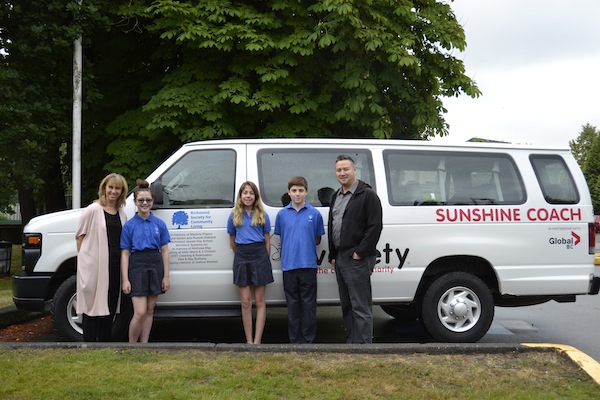
photo - Sunshine Coach
(photos from RJDS)

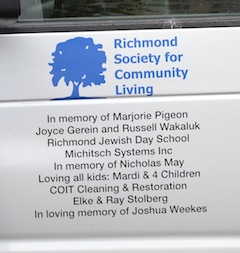
photo - Sunshine Coach inscriptionFor the past few years, Richmond Jewish Day School’s Student Council committee has been collecting donations to support different charities throughout the Lower Mainland. As part of their ongoing fundraising, the school was able to donate $1,150 to the Variety Club Sunshine Coach program and the school’s name was recently inscribed on the side of a 15-passenger Sunshine Coach, which will be used by Richmond Society for Community Living. The vehicle will transport youth with diverse abilities to various programs throughout the city.

***
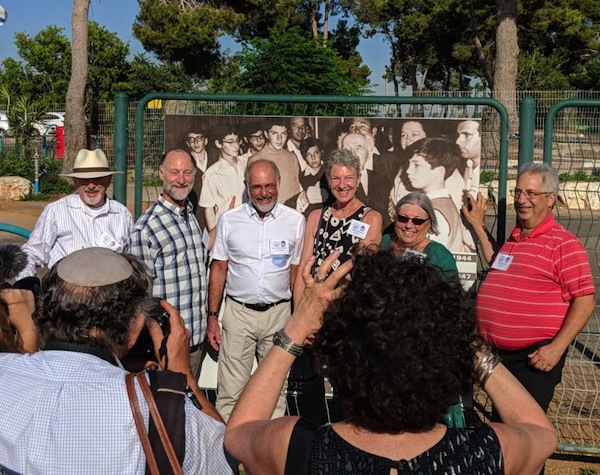
photo - From left to right, Rabbi Shawn Zell, Maury Miloff, Sam Petuchowski, Tessa Hoffman, Esti Friedman and Allan Pollack stand in front of their class photo, taken with David Ben-Gurion
From left to right, Rabbi Shawn Zell, Maury Miloff, Sam Petuchowski, Tessa Hoffman, Esti Friedman and Allan Pollack stand in front of their class photo, taken with David Ben-Gurion. (photo by Noam Ziv)
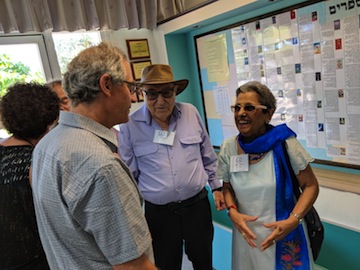
photo - Aliza and Joe Ziv, who now live in Israel, speak with Vancouver dentist Dr. Brian Goldenberg. Aliza Ziv was Goldenberg’s Grade 1 teacher at Vancouver Talmud Torah
Aliza and Joe Ziv, who now live in Israel, speak with Vancouver dentist Dr. Brian Goldenberg. Aliza Ziv was Goldenberg’s Grade 1 teacher at Vancouver Talmud Torah. (photo by Noam Ziv)

Last month, several Canadians – or former Canadians – attended the 50th anniversary of Hadassim Children and Youth Village in Israel. Reunion organizer Rabbi Shawn Zell and the other attendees were among the first young Diaspora Jews to spend a year in Israel on a sponsored program – in their case, one organized by Canadian Hadassah-WIZO.


 

Raising funds for basics

Phillipa Friedland is trying to raise funds to sustain basic facilities at the Population and Immigration Authority in B’nei Brak, where thousands must go to renew or obtain visas to remain in the country. (photo from gofundme.com/restrooms-for-refugees-israel)

When she left Vancouver for Israel more than a year-and-a-half ago, Phillipa Friedland, 54, became involved in social activism. Today, she is trying to raise funds to sustain basic facilities like toilets and seating at the Population and Immigration Authority (PIBA) in B’nei Brak, where thousands must go to renew or obtain visas to remain in the country. The Independent interviewed Friedland recently to find out more about her involvement.

Jewish Independent: When did you learn about the work of the Population and Immigration Authority?

photo - Phillipa Friedland
Phillipa Friedland (photo courtesy)

Phillipa Friedland: I met an Eritrean refugee at the passport office when my daughter Eli and I lived in Israel in 2014, and we became friends. At the end of February, the Israeli government abruptly closed the South Tel Aviv PIBA office and left a note in Hebrew, not the first language of any refugees, stating that the PIBA office had moved to B’nei Brak, to a very large, barren parking lot in an industrial part of the city. I went with my friend to hand in his form and he waited in line six times, just to hand in the paper.

JI: You’re not happy with the facilities PIBA is providing. Why?

PB: The B’nei Brak municipality refuses to provide shade, toilets, water or seating for those who wait in line. Once refugees gain entry, there are ablution facilities and seating. However, there are approximately 40,000 refugees and the only places to apply for or renew visas are in Eilat and B’nei Brak. Knowing that thousands of people would converge on these centres, the government should have done infrastructural planning to accommodate such numbers.

Activists at the site have confided that, since the government closed the detention centres and refugee prison, they are using PIBA as a “soft” place to repel the refugees. They can no longer threaten them with prison or repatriation to a third African country, since these negotiations fell apart when it was revealed that these are not safe-haven countries for refugees. So, the goal is for the refugees to become so frustrated and disheartened by the visa process that they will voluntarily leave.

JI: How many asylum seekers are using PIBA in B’nei Brak, and where are they from?

PB: Most Sudanese have left Israel, so most of the PIBA users are from Eritrea. Some days, there are over 1,000 people there, though, in recent days [in late May], the number has dropped dramatically, as more refugees are given visas. Families are provided with six-month visas and single men are given two-month visas. They are required to take off work and are not paid when they leave to wait for a visa. By contrast, in many countries, a visa application can be obtained online.

JI: Are these asylum seekers also refugees, or a mixture of both?

PB: The Israeli government says they are all economic migrants. It has granted asylum to 11 people – a very poor showing for a country of refugees ourselves. The government … considers them infiltrators. In fact, the education minister declared openly on public TV that the migrants are infiltrators. It stuns me that a nation that promised to never forget has an education minister that has forgotten the persecution the Jews experienced.

JI: What are you doing at PIBA?

PB: After visiting the PIBA in B’nei Brak, I was compelled to take action. I was reviled by apartheid South Africa, and taught about the perils of discrimination and racism for 15 years at the Vancouver Holocaust Education Centre. I could not just watch quietly.

I decided to sponsor two toilets for a month in the barren parking lot where the refugees line up. These cost $600 per month. I also bought 10 benches, seating for only 50 people. Unfortunately, this is all that I could personally afford.

The toilets were so direly needed that, after three days at the site, I paid additional fees to have them emptied, as the company I lease them from only empties them once a week. Myself and an Eritrean lady, Sabrina, clean them when we are on-site, replenish the toilet paper and spray them with toilet spray.

I realized that I could not sustain this expense every month on my own, as I am an immigrant and earn a salary commensurate with working in a nonprofit organization. So I decided to start a GoFundMe Campaign called “Restrooms for Refugees.” So far, I have raised [almost $3,000]. The Good People Fund run by Naomi Eisenberg in New Jersey is donating $1,800 over three months. [gofundme.com/restrooms-for-refugees-israel]

The B’nei Brak site has been running very effectively thanks to amazing Eritrean volunteers who ensure the lines run smoothly and that people get a turn. One of them is Michael, who left Eritrea after 15 years in forced military conscription; he had 10 years still to complete. His back has many scars from being tortured in the military. He left his wife and four children behind and hopes to come to Canada, where his brother is living.

JI: What do you want Jewish Vancouverites to know about this? Why is it important to you personally, and why should it be important to us?

PB: I believe that, as Diaspora Jews, we have rose-coloured glasses on when it comes to Israel. I love and support Israel, however that does not mean I support racist and discriminatory government policies. Eighteen Jewish U.S. Democratic senators spoke out about Israel’s refugee policy and 400 rabbis, pilots, teachers and other groups spoke out vehemently against the deportation policy the government was adopting. Since Israel first accepted and then rejected the UN’s offer to Israel regarding the refugees, there has been no new Israeli policy. The refugees essentially live in limbo, renewing their visas and being treated with no dignity.

I believe we should treat everyone with dignity. I know that, being such a small country, Israel cannot open its doors to an unlimited number of people. However, those strangers within our Jewish borders should be treated with care, as commanded 37 times in the Torah.

Lauren Kramer, an award-winning writer and editor, lives in Richmond. To read her work online, visit laurenkramer.net.

Kick scooting for a school

Gil Drori and Bex Band are kick scooting down the West Coast to raise money to build a school in Tanzania. (photo from Gil Drori)

Gil Drori and Bex Band are en route to the Mexican border. They left from Vancouver last month. What’s newsworthy is how and why. They will be making the journey entirely by way of kick scooter – that’s right, not electric scooter, but kick scooter, the glorified skateboard with safety rails, and they will be doing so to raise money for a school in Africa. They are calling their adventure Kicking the States.

“We decided to do a charity challenge like no other that would help raise money to build a school in a poor village in Tanzania. We visited the village and the half-built school last year and saw the reality and hardship that the children are living in,” Drori told the Jewish Independent in an email interview. “It wasn’t easy to see but we wanted to do something positive, which is how the idea for Kicking the States came about.”

The journey is about 2,500 kilometres long and will take the couple three months. It is, as they say, “entirely muscle-powered.” Drori and Bend have had to pack very lightly to fit all their gear into their modified front pannier, so they are carrying just a tent, sleeping bags and a spare change of clothes.

“When we first thought of the idea, it seemed an impossible challenge, which is exactly why we went for it,” Drori told the JI.

Drori was born in Jerusalem and grew up in Zichron Yaakov. He met Bend while traveling in Guatemala. He’d recently finished his army service and Bend, university. Despite having completely different backgrounds, they “instantly clicked.” They now both live in the United Kingdom, where Bend comes from, and call London home, although they still visit Israel regularly. They recently celebrated their third wedding anniversary.

A kick scoot journey of this kind has never been attempted before, so there are no precedents, and Drori and Bend are learning as they go. “It’s a real adventure!” said Drori.

They hope to raise a total of $10,000 along the way, through sponsorships and by delivering free talks at events for which admission is by donation.

Two years ago, Drori and Bend were working regular jobs, Drori in IT and Bend in teaching. They decided to leave the city life to hike the Israel National Trail, having never done anything like it before. It took two months to complete and, from that point, they have been attracted to adventure as a way of exploring and seeing of what they are capable. They now both work as digital nomads, which gives them the flexibility to keep taking on new challenges, like Kicking the States.

“I think the simplicity of traveling with just a bag with everything you need and working your body each day is really appealing,” said Drori.

Before taking on their latest adventure, they did a four-day mini-trip on scooters, which showed them that it was possible.

“We’ve had a tough but great first two weeks on the expedition,” said Drori. “Physically, it has been very demanding and we have been scooting distances of 30 to 50 miles a day [50 to 80 kilometres], so are left achy and tired. Hills also pose a challenge and we have to get off and push the scooters uphill, which is not easy with all our gear attached.”

Most days, Drori and Bend have no idea of where they’ll be sleeping that night. They have been reliant on people offering to host them, as well as staying at campsites and even sleeping in the yards of strangers. “It has been quite tiring sometimes, living with that uncertainty each day,” said Drori, “but we are trying to embrace the excitement that that also brings.”

The two have faced setbacks every day so far, from road blockages, wrong turns, running low on food and fatigue. Drori said focusing on the money they have raised is what gets them through.

“The children we met in Tanzania are living in real hardship and their only hope of escaping is by getting an education,” said Drori. “They are fed two meals a day at the school, learn to read and write, leave with qualifications and, more important than that, confidence in themselves. We believe that every child should have a right to an education no matter what their circumstances, which is why we are so passionate.”

Drori said they have been surprised by the amazing people they have met along the way. “It’s been the absolute highlight,” he said. “Such kind and wonderful people who, despite us being strangers, have hosted us for a night, fed us or made generous donations to the charity. We’ve met people from all walks of life and have heard so many interesting stories. It sounds cliché, but it restores your faith in humanity. People really are good!”

Drori stressed that 100% of the money raised goes directly to the school. “We really hope that people will support us and get behind this cause,” he said.

People can donate at justgiving.com/kickingthestates.

Matthew Gindin is a freelance journalist, writer and lecturer. He is Pacific correspondent for the CJN, writes regularly for the Forward, Tricycle and the Wisdom Daily, and has been published in Sojourners, Religion Dispatches and elsewhere. He can be found on Medium and Twitter.

Record-breaking Courage

The 2018 Courage to Come Back Award recipients, left to right: Suzanne Venuta (mental health), Josh Dahling (addiction), Ingrid Bates (medical), Jim Ryan (physical rehabilitation) and, in front, Alisa Gil Silvestre (youth). (photo by Norman Tam)

photo - The event was chaired by Lorne Segal, pictured here with his wife, Mélita
The event was chaired by Lorne Segal, pictured here with his wife, Mélita. (photo by Alex Law)

A record $3.1 million was raised at the 20th anniversary Courage to Come Back Awards on May 10 at the Vancouver Convention Centre. The event was chaired by Lorne Segal, president of Kingswood Properties Ltd., and more than 1,800 people gathered to celebrate the extraordinary stories of triumph over adversity of the five awards recipients. Funds raised will go directly to Coast Mental Health to support those living with mental illness.

This year’s recipients were Josh Dahling (addiction), Ingrid Bates (medical), Suzanne Venuta (mental health), Jim Ryan (physical rehabilitation) and Alisa Gil Silvestre (youth). Venuta captured the essence of the evening: “If there’s only one thing you remember from my speech tonight, may it be this: that connections save lives. It did mine. Connections are what hold hope together and hope allows us to dream.” For more inspirational stories, visit couragetocomeback.ca/2018-recipients.

Each year, Coast Mental Health (coastmentalhealth.com) provides services to more than 4,000 people living with mental illness so they can find a meaningful place in their communities – a place to live, a place to connect and a place to work.

Record-breaking Federation campaign

Alex Cristall, chair of the 2017 Jewish Federation of Greater Vancouver annual campaign, with Federation board chair Karen James, centre, and Megan Laskin, women’s philanthropy chair. (photo from JFGV)

The Jewish Federation of Greater Vancouver annual campaign surpassed its 2017 goal and generated $8.7 million to meet community needs, including $850,000 in targeted funding. An additional $1.1 million in funding was generated outside the campaign for specific projects. Nearly 500 new or lapsed donors were inspired to give for the first time or to renew their giving, which is a record.

As the local community’s primary fundraising initiative, the annual campaign supports programs and services delivered by 35 partners locally and globally, reaching thousands of community members who rely on them.

Targeted funding supports specific programs that address particular community priorities. Many steadfast supporters of the campaign have the capacity and motivation to fund such projects or programs and Federation works with these donors to connect them to the priorities that align with their philanthropic interests.

Exceeding the campaign goal and growing the donor base positions Federation and its partners to continue to address the many needs identified in Federation’s 2020 Strategic Priorities. It’s a clear indication that partner agencies can continue to rely on the campaign as a consistent source of ongoing funding.

“The strong campaign achievement means we can make an impact on the issues of affordability and accessibility of Jewish life, which affect people across our community,” said Alex Cristall, chair of the 2017 Federation annual campaign.

In the emerging Jewish communities outside of Vancouver, Federation is focused on extending its reach and that of its partners to develop grassroots Jewish programming, such as its Connect Me In initiative. In Vancouver, with its very high cost of living, the focus is on keeping the cost of Jewish programs and services low, and on funding more robust subsidies for those who need additional help.

“At its heart, Jewish life is about community, and this year’s campaign reflected that. We could not have achieved this incredible result without the support of our nearly 3,000 donors. I would like to extend a huge thank you to everyone who donated,” said Cristall.

Overall, Federation generated an unprecedented $18.5 million this year. This includes a record $8.7 million in contributions to endowment funds at the Jewish Community Foundation, along with the $8.7 million campaign total and the additional $1.1 million in targeted funding.

“Diversifying the ways in which Jewish Federation generates funds is a key factor in being able to address growing and evolving community needs,” said Karen James, Federation’s board chair. “Jewish Federation is adapting to changing philanthropic trends and working proactively with donors to meet these needs. At the same time, we continue to deliver a strong annual campaign that benefits thousands of people, and that is great news for our community.”

Brier biannual campaign

“Louis Brier is in a pivotal point in planning for the future through its redevelopment activities,” said David Keselman, chief executive officer of the home and hospital. (photo from Louis Brier)

The Louis Brier Home and Hospital was started in 1945 by what was then the Hebrew Men’s Cultural Club. The club dreamed of creating a home for Jewish seniors in Vancouver and, in 1946, opened its doors to accommodate 13 residents. Since that time, the facility has grown, changed locations and expanded its services. The Louis Brier is now home to 215 residents, is in contract with Vancouver Coastal Health and is part of a continuum of care known as the Snider Campus, which includes the Weinberg Residence next door.

“Louis Brier is in a pivotal point in planning for the future through its redevelopment activities,” said David Keselman, chief executive officer of the home and hospital. “We are forging relationships with major funders, politicians and academic organizations to facilitate research and best practices.”

Keselman, a registered nurse by training, has been working in the healthcare industry for almost 30 years. He has held a range of progressively more complex and complicated roles, and has worked across the entire spectrum of care – from academia, to acute care, home and community care, public health, and long-term care.

Over the last couple of years, Keselman has been leading the Louis Brier’s efforts to become a leading force in elder care in British Columbia. To help achieve this goal, the Louis Brier Jewish Aged Foundation runs a biannual campaign to raise funds to support the Louis Brier’s work and activities.

“Louis Brier offers a range of services across a continuum of care and provides assisted living services as part of the Weinberg Residence,” explained Keselman. “With the exceptional and generous help of the foundation and with the auspice of a resident- and family-centred care philosophy, Louis Brier Home and Hospital offers a range of unique and significant culturally relevant programming … as well as recreational and rehabilitation activities that are available in very few, if any, other long-term care facilities, custom-tailored to the needs of the residents, their health goals and wishes.”

Regarding this year’s campaign, which started April 16 and runs to June 4, Keselman said, “Of course, we’d like to raise as much as possible. However, as this is a biannual campaign, the goal is to raise at least $1 million.”

He said that, “with the support of the Louis Brier board and the foundation board,” the home has been able to launch “unique and essential programs aimed at supporting the delivery of high-quality care, ensuring that we follow best practices and evidence-informed practice for the best outcomes. Examples of these programs are the quality and risk and resident experience portfolio, and the infection prevention and control practitioner…. We established both of these, signalling a significant change in focusing on the delivery of quality care.”

photo - David Keselman, Louis Brier Home and Hospital CEO
David Keselman, Louis Brier Home and Hospital CEO. (photo from Louis Brier)

The Louis Brier has also continued to develop their recreational, rehabilitation and chaplaincy services. It has purchased a range of equipment to ensure its residents are safe, including wander guard alarms, and it has improved the library and updated the furniture in its lobby and lounge.

“We continue looking for opportunities to enhance the resident experience at the Louis Brier, and are planning to renovate the clinical space, with specialty services provided, such as, dental, ophthalmology and podiatry,” said Keselman.

“There was also a significant investment in staff education and resident programming to ensure we deliver the best care possible and expose our residents to the best available resources, programs and activities,” he added.

Although the Louis Brier does not currently have any vacancies, it also does not have a waiting list.

Access to the home’s publicly funded beds is managed by Vancouver Coastal Health and, although Jewish residents do have priority for cultural and religious reasons, the beds are open to all elderly individuals who require the services and environment of a long-term care facility within Vancouver Coastal Health’s catchment area.

The Louis Brier “is an organization that lives its vision and mission daily and without any hesitations,” said Keselman. “And, despite limited resources, the Louis Brier can proudly say that its services, resources and activities are second to none while, through its foundation, board of directors, physicians, staff and leadership, it continues to search for ways to constantly improve and be a leader in elder care. I’m extremely proud of being the CEO and part of this organization.”

For more information, visit louisbrier.com and, if you go to the bottom right-hand corner of the screen, you can submit a request for a tour.

Rebeca Kuropatwa is a Winnipeg freelance writer.

A need for ethical guidelines

This time of year, we read Torah portions in the Book of Leviticus. It’s full of information about how to do sacrifices at the Temple in Jerusalem. It’s a good reminder – things have changed in the Jewish world, haven’t they? Perhaps we don’t need details for how to do a sin offering, an offering of well-being or for first fruits? Then again, maybe we do.

Huh? No, I don’t mean we need to learn to kill animals to sacrifice them. However, the rituals described in Leviticus have become guidelines for other things we do. For instance, it’s common to make a donation to a synagogue in honour of someone, or to express gratitude for a return to good health, a success at work or a family celebration. There are modern interpretations for some of these rituals, including the need to do something to repair things when feeling guilt or after committing a sin.

Parts of Leviticus offer us good metaphors … reminders that we can apply to other things in Jewish life.

I receive an email newsletter from the Jewish news organization JTA. One of the articles that popped up was about fundraising: “Women in Jewish fundraising say harassment is pervasive.” I followed the link. It turns out that fundraisers for Jewish organizations and in the nonprofit world are mostly women.

Donors? You guessed it, are predominantly men. Just like in other parts of the #MeToo professional world, many Jewish fundraisers have tolerated widespread harassment in order to do their jobs. If you don’t bring in the money, it’s hard to keep your fundraising job. These fundraisers have told hair-raising tales of stalking, requests for dates or sexual favours and dangling professional opportunities “if only” the woman professional would “cooperate.”

Most of us don’t want to imagine that one’s body has to be part of a professional encounter in the fundraising arena, unless perhaps your wife, daughter, mother or sister is a sex worker (and Jewish tradition has plenty of those. Read the Bible for more on that). Imagine if your daughter, recently graduated from university, went to lunch for her job at a Jewish nonprofit. A grey-haired man sat next to her, put his chequebook down, stuck his hand up her thigh under the table, and let her know that there would be more money to come if she just went out with him.

Disgusting? Yes. These days, there are laws that say both men and women deserve the same fair pay for their work and freedom from harassment on the job.

Oh, come on, some say – this doesn’t happen in the Jewish world. Well, it does. Jews can be alcoholics, drug addicts, adulterers, criminals and more. We are people. People aren’t perfect. We commit sin, and feel guilty. (Remember those Temple sacrifices?)

The sad part is that, in many ways, we groom children to be cooperative, to respect adults in their community, to listen and obey us even if they don’t know everyone’s name. This grooming, particularly for girls, starts young. This sometimes results in bad things happening. Young women tolerate a lot before they realize something bad happened and they should complain.

As someone who used to teach full-time (and a mom), I see things that make me scared in this regard. Imagine free-range preschoolers and elementary schoolers, left to roam in a Jewish community building without adequate parental supervision. Adults offer them candy or encourage them to find their parents, but no one leads them directly to the children’s activity or to their parents. Never mind the potential for accidents or getting into mischief … worse happens.

This situation is ripe for a predator to step in with candy and lure a child away. This is how horrible, life-altering, illegal things happen to children. When I mentioned this concern aloud, the response was: “Oh, kids roam around. It’s always been this way.” Really? Thank goodness that, in Jewish tradition, we evolve and change. Even the most traditional among us don’t do sacrifices anymore. We no longer sweep childhood sexual abuse under the rug. We no longer think it is OK for women to earn less, or that they must tolerate sexual harassment on the job. We no longer think it is OK for male donors to expect they can get away with this, if only they write a big cheque.

The key to changing a culture that allows sexual predation is in Leviticus, too. The instructions for sacrifice are well laid out and clear to follow. There’s a set of steps and a ritual to each one. In the JTA article written by Debra Nussbaum Cohen, she outlines some of the new efforts to make organizational and structural change to these interactions between funders and donors. This includes laying out ethical guidelines when it comes to sexual harassment and abuse, specifically addressing the power imbalance between fundraisers, who solicit donations to keep their jobs, and funders, who hold the purse strings.

Judaism has plenty to offer when it comes to respecting someone’s body, modesty and personal space. If we know the rules to appropriate behaviour, we recognize that we can do a lot to make modern environments safer and more ethical. We also must be aware that harassing fundraisers (who happen to be women), paying our Jewish professionals (who are often women) inadequately, or failing to provide our children Jewish “safe” spaces are not acceptable ways to behave as Jews.

If Jewish tradition alone doesn’t matter to some? Many of these behaviours are also illegal. We may mourn the loss of the Temple and pray for its return. However, I vote to exchange Leviticus’s ritual steps for bloody sacrifice with those ethical behavioural guidelines for donations that emerged from the rabbinic age. We can ritualize good behaviour around tzedakah (charity) instead.

Joanne Seiff writes regularly for CBC Manitoba and various Jewish publications. She is the author of three books, including From the Outside In: Jewish Post Columns 2015-2016, a collection of essays available for digital download or as a paperback from Amazon. See more about her at joanneseiff.blogspot.com.

2018 CHW campaign begins

Canadian Hadassah-WIZO’s 2018 annual campaign, Come Together, Right Now, began on March 1 in support of various CHW projects. This pillar of CHW’s fundraising efforts provides $1.5 million in support of children, healthcare and women in Israel and Canada.

CHW is a non-political, nonpartisan national network of dedicated volunteers and professionals who believe that the advancement of childcare, education, healthcare and women’s issues transcends politics, religion and national boundaries.

Over the last century, CHW has been involved in all aspects of Israeli life, supporting women, children and families around the world. CHW’s support has strengthened, and continues to strengthen, the very fabric of Israeli society.

“I can give you 161,453 reasons to be proud of being a donor to Canadian Hadassah-WIZO (CHW),” said Debbie Eisenberg, CHW national president. “It’s really quite simple: this is the number of lives CHW positively impacted in Israel just this past year. This is the difference you made through your generous support of CHW.”

“For me, the theme for this year’s annual campaign encompasses everything that our supporters do for CHW,” said Alina Ianson, CHW national executive director. “Each person has their own reason for supporting the work of CHW, but when we come together, we make a statement about our belief in endorsing the mission of CHW.”

For information on the projects CHW supports, and to contribute to the Come Together, Right Now campaign, visit chw.ca.

Reinvention of Salomé myth

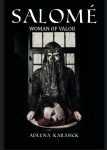
For the past five years, Jewish community member Adeena Karasick has been working with Grammy Award-winning composer/trumpeter Frank London on Salomé: Woman of Valor, a total art experience, groundbreaking in its interplay of poetry, music, dance and film.

Karasick’s libretto, which she will perform live, is a mix of historical, pop cultural, midrashic and kabbalistic references. The score blends Arabic, klezmer, jazz and Bhangra musics by the recently knighted (for his contribution to world music) London; performed with Indian percussionist virtuoso Deep Singh and Middle Eastern keyboard player Shai Bachar; dance created and performed by two dancers on the New York scene, (fellow Jewish community member) Rebecca Margolick and Jesse Zaritt; video by Elizabeth Mak, which deconstructs Charles Bryant’s 1923 silent film Salomé; and directed by Alex Aron, co-creator of A Night in the Old Marketplace.

After years of research, learning there was no basis for the way Salomé has been historically represented, Karasick wanted to re-insert Salomé back into her rightful place in history as a powerful revolutionary. She refutes Oscar Wilde’s misogynist and antisemitic interpretation, and has translated the myth to (no surprise!) one of female empowerment, socio-political, erotic and esthetic transgression.

Creating a work of this scope is an enormous undertaking, and the creative team has launched a Kickstarter campaign to raise money for the production’s world première at Vancouver’s Chutzpah! Festival, and then to take Salomé: Woman of Valor on tour internationally. The total project budget is more than $40,000 and the team needs to raise at least $20,000 to make its vision a reality. Each $180 gets the creative team an additional hour of time in the studio.

There has been nothing quite like this – poetry as a spoken word opera of exceptional scale and scope. Salomé: Woman of Valor offers new ways of seeing, reminding us how there is never one story or perspective to be told and allowing the unvoiced be celebrated and heard.

All donations are tax-deductible. To donate, visit kickstarter.com/projects/womanofvalor/salome-woman-of-valor. The all-or-nothing campaign deadline is Jan. 12.

Help share aliyah story

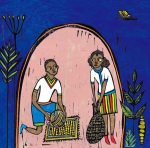
An illustration from Yerus Goes to Jerusalem. (photo from Sid Tafler)

The Ethiopian aliyah to Israel inspired people around the world when it was first revealed in the 1980s. Today, there are 125,000 first-, second- and third-generation Israelis from Ethiopia.

The story of the courage and determination of the community to return to Eretz Yisrael after 2,000 years of isolation from the rest of the Jewish world is told in the beautiful children’s book Yerus Goes to Jerusalem. About a young girl’s experience making the difficult journey from her village in Ethiopia, the award-winning book, written in Hebrew and illustrated by Ethiopian artist Moran Yogev, is well known to thousands of Israeli students and their parents. A new crowdfunding campaign will translate it into English, to make it accessible to Jewish schoolchildren everywhere, so they can share in the triumph of the Ethiopian community in achieving their dream.

Everyone is invited to join this venture with a donation of any amount, large or small. Only $20 will reserve one of the first copies of Yerus Goes to Jerusalem published in English for your children, grandchildren or your synagogue or Hebrew school.

This campaign is led by Dror Yisrael, a service organization in Israel, and a committee of organizers, mostly in Israel and the United States, including Sid Tafler of Victoria, the only Canadian on the committee.

To donate to the crowdfunding campaign, which ends Dec. 1, and for more information, visit jewcer.org/project/yerusgoestoyerusalem or facebook.com/yerusgoes. For the options of how to donate after Dec. 1, email Gilad Perry at gilad@drorisrael.org.il.