Skip to content
  • Home
  • Subscribe / donate
  • Events calendar
  • News
    • Local
    • National
    • Israel
    • World
    • עניין בחדשות
      A roundup of news in Canada and further afield, in Hebrew.
  • Opinion
    • From the JI
    • Op-Ed
  • Arts & Culture
    • Performing Arts
    • Music
    • Books
    • Visual Arts
    • TV & Film
  • Life
    • Celebrating the Holidays
    • Travel
    • The Daily Snooze
      Cartoons by Jacob Samuel
    • Mystery Photo
      Help the JI and JMABC fill in the gaps in our archives.
  • Community Links
    • Organizations, Etc.
    • Other News Sources & Blogs
    • Business Directory
  • FAQ
  • JI Chai Celebration
  • JI@88! video

Recent Posts

  • BGU fosters startup culture
  • Photography and glass
  • Is it the end of an era?
  • Taking life a step at a time
  • Nakba exhibit biased
  • Film festival starts next week
  • Musical with heart and soul
  • Rabbi marks 13 years
  • Keeper of VTT’s history
  • Gala fêtes Infeld’s 20th
  • Building JWest together
  • Challah Mom comes to Vancouver
  • What to do about media bias
  • Education offers hope
  • Remembrance – a moral act
  • What makes us human
  • המלחמות של נתניהו וטראמפ
  • Zionism wins big in Vegas
  • Different but connected
  • Survival not passive
  • Musical celebration of Israel
  • Shoppe celebrates 25 years
  • Human “book” event
  • Reclaiming Jewish stories
  • Bema presents Perseverance
  • CSS honours Bellas z”l
  • Sheba Promise here May 7
  • Reflections from Be’eri
  • New law a desecration
  • Resilient joy in tough times
  • Rescue dog brings joy
  • Art chosen for new museum
  • Reminder of hope, resilience
  • The national food of Israel?
  • Story of Israel’s north
  • Sheltering in train stations

Archives

Follow @JewishIndie
image - The CJN - Visit Us Banner - 300x600 - 101625

Tag: dance

Supported by paper, by fragility

Supported by paper, by fragility

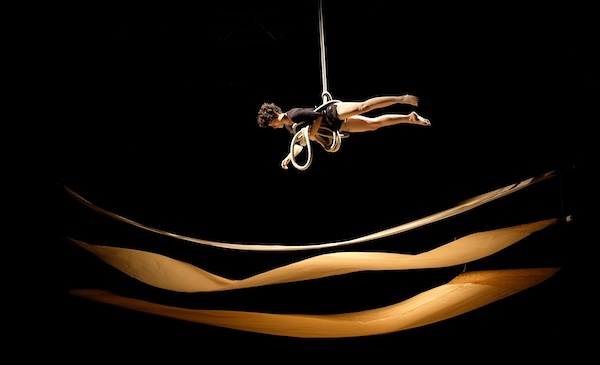
Inbal Ben Haim in Pli, which will be at the Vancouver Playhouse Feb. 2-3. (photo by Loic Nys)

Imagine flying through the air on … paper?! That’s just what the circus artists do in Pli, which is being co-presented by the PuSh and Chutzpah! festivals Feb. 2-3 at the Vancouver Playhouse.

The show’s concept came from Israeli French circus artist Inbal Ben Haim, who performs the work with Domitille Martin and Alvaro Valdes. Ben Haim has always been attracted to working with various materials. In her first show, Racine(s), which means “root(s)” in French, soil was used as “poetic matter to talk about the connection of human beings with the earth and [their] homeland,” Ben Haim told the Independent. Racine(s) premièred in 2018.

“But my story of paper started from a workshop I had while I was in CNAC [Centre national des arts du cirque], with the artist Johann Le Guillem. In the point of view of Johann, circus is a ‘minor practice’ – a practice that has never been made, that no one’s practising anymore, or that it is very rare. He asked us to prepare a small presentation … and I wanted to work with paper, to create a huge bird of paper and to fly on it. Well, I didn’t manage to do it, but I started sculpting the paper and made a paper puppet, which I suspended in the air and climbed on it.”

“A little bit later,” she continued, “I met Alexis Mérat, who is a paper artist [and who used to perform in Pli], and we figured out we do the same gesture with our hand – he is crumpling, and I am hanging from my rope. So, we wanted to try to do the two actions at the same time – to crumple and suspend. We were sure that the paper would break, but when we discovered that hanging from paper was possible, it inspired us a lot in the poetical point of view of this image – putting your body, your weight, your life, on something so fragile as paper. In a way, it’s a human action that we all do sometimes. It seemed to us that we absolutely needed to continue this research.”

As they did, Ben Haim said it became clear that they had to involve Martin, who she knew from Racine(s). Martin is not only a performer but a scenographer and one of Martin’s specialties is creating a set that is also circus apparatus, said Ben Haim. “This is how we started to work together.”

Ben Haim studied both visual arts and physical practice, and the visual circuses she creates are a melding of those two passions.

“I was always a hyperactive child,” she said. “I did sports, athletics and martial arts since [I was] very young. But, when I discovered circus practice, and especially aerial acrobatics, I found a space of quiet, of high intensity in a calm place. I found a different relation to gravity and to the body, and also a practice that was very physical but at the same time poetic and interior. It touched me deeply.”

Ben Haim said she wasn’t scared the first time she climbed a rope or was suspended from a trapeze. “I was used to climbing on very high places – trees, mountains, and so on,” she explained. “My parents tell that when I was 1 year old, they found me one day up on a ladder – which means I learned how to climb before I knew how to walk.”

It’s only as she has worked longer in the profession that she has felt more fear. “I get to be more aware of all the risks we take, not only in the acrobatic act but in the hanging and rigging – this is where most of the accidents happened,” she said. “I get to be more and more careful with age and with experience.”

Ben Haim moved to France in 2011 to pursue her art and training, first at Piste d’Azur: Centre régional des arts du cirque PACA, then the CNAC de Châlons-en-Champagne, from which she graduated in 2017. Her bio also notes that “she developed a teaching method for therapeutic circus and worked in various contexts in Israel and France. By blending circus, dance, theatre, improvisation and visual arts, Ben Haim has created her own form of poetic expression. Largely inspired by the human bond made possible by the stage, the ring and the street, she aims to create strong connections between the audience and the artist, the intimate and the spectacular, the earth and air, and the here and there.”

This interplay of connections is evident in Pli and how Ben Haim, Martin and Mérat worked together.

“In the moment we discovered that hanging and climbing on paper was possible, we dove into this research, and we wanted to discover and understand all the possible ways to do that,” said Ben Haim. “We did a lot of experiments which are visual and physical, but also mechanical. Alexis is an engineer, so he held all this point of view that finally makes all that we do quite safe.

“We were creating nine apparatus of hanging on paper in different ways, and we observed how the body changed the paper,” she continued. “We created also many scenographies from paper in which I entered to transform them, getting in a different relationship with the matter…. I metamorphose it, and then it holds me differently – it becomes a duet with lots of listening and care.

“In parallel, we were creating costumes from paper, we made lots of sound work, [registering] the different sonorities of paper to compose the music and doing … research on the possibilities of lighting paper on stage. We can say that the paper guided us in this journey.”

Jessica Mann Gutteridge, artistic managing director of the Chutzpah! Festival, was drawn to Pli right away when she was introduced to it by the PuSh Festival, whose director of programming is Gabrielle Martin.

“Chutzpah! and the PuSh Festival share many common interests in terms of the kind of work we present and have been looking for opportunities to work together,” said Gutteridge. “PuSh knows that Chutzpah! has a particular interest in presenting Israeli artists, as well as audiences who are interested in dance and innovative performance, so this project was an excellent opportunity for us to join forces and co-present.”

The 2023 Chutzpah! Festival, which took place just last month, “included a project that centred on long sheets of paper used to create visual artworks on scrolls, with professional and community artists exploring the centuries-old art form of crankies,” said Gutteridge. “This resonance with Inbal’s work creates a lovely bridge to our winter Chutzpah! PLUS collaboration with the PuSh Festival.” (Crankies are a centuries-old artform in which an illustrated scroll is wound on two spools set in a viewing window.)

Chutzpah! took place as the Israel-Hamas war continued, and the probability is that the war will still be going on when PuSh begins Jan. 18.

“We can say that art is not saving anyone’s life in times of war, so what is its power in front of violence?” responded Ben Haim when asked the role of the arts, even in times of conflict.

“I believe that art has the power to bypass the mind and touch beyond it – the heart, the emotions, the curiosity, our sense of humanity,” she said. “Art has the chance to connect us – above the definitions and identities, as nationality, history and politics. And can connect us into something bigger than what we think we are, something which is common.”

She said, “As someone who searches more for solutions than accusations in any conflict (personal or geopolitical), I search the space of connection moreover than the reasons of separation. I believe that that’s the only way we can find peaceful and respectful solutions for all sides. I feel the need of being able to deeply see each other, human beings, beyond the grief, the fear, the sadness. I think art offers us this kind of space, where we can feel all humans, and experience ourselves as a connected grid. It is not the ‘solution,’ but I think it’s a good starting point, especially in our days.”

Having lived for many years in Israel, in a region of recurring conflict, Ben Haim said, “I know how persistent experiences of fear, pain, loss and distress make us become less and less sensitive, and more into defensive and violence. It happens in order to protect ourselves from those difficult experiences, and it is common for all sides. But, in the long run, it is devastating, for ourselves and for our partners. 

“Even in the middle of a storm of violence, I think art helps us keep a space of sensibility in this crazy world,” she said. “An untouched place where we can simply be, observe, experience, feel. To marvel in front of some piece of beauty, beside the destruction. Having, for short moments, a sense of hope. To feel the strength in the subtlety, in vulnerability, the power in the creative act, in being alive. And this sensibility can be a window of connection. A thread to follow slowly and gently.”

Pli is 60 minutes with no intermission and the teaser can be viewed on YouTube or Vimeo. It is recommended for ages 11+. For tickets to the Feb. 2-3 shows at the Playhouse (in-person and livestream), visit pushfestival.ca. 

Format ImagePosted on December 15, 2023December 14, 2023Author Cynthia RamsayCategories Performing ArtsTags Chutzpah! Festival, circus, dance, Inbal Ben Haim, Jessica Mann Gutteridge, paper, Pli, PuSh Festival
Art that makes people think

Art that makes people think

Domitille Martin in Pli, part of the PuSh International Performing Arts Festival, which runs Jan. 18 to Feb. 4. (photo by Lucie Brosset)

PuSh International Performing Arts Festival returns to Vancouver Jan. 18-Feb. 4. The mid-winter event that delivers innovative, contemporary works asks the questions, “Can a live art festival be a ritual for social change? A cultural strategy? A means to rethink history while imagining possible futures?” Participating artists include Jewish community members and a production presented with Chutzpah! Festival.

Vancouver’s Vanessa Goodman (Action at a Distance) is co-creator with Tangaj Collective (Simona Deaconescu, from Romania, and Gaby Saranouffi, from Madagascar) of BLOT, Body Line of Thought: “Our bodies are strong and fragile. BLOT redefines how we see our physical selves and their relationship to the world. In a stark set reminiscent of a science lab, two dancers observe the intricacies of the body and using salt, microbiome and physiology demonstrate how interconnected we truly are.”

BLOT will be presented Jan. 22-23, 7:30 p.m., at Left of Main, with a post-show talkback after the Jan. 22 production.

PuSh, with SFU Woodward’s Cultural Programs & Touchstone Theatre, presents Toronto-based theatre company Human Cargo’s The Runner, Jan. 24-26, 7:30 p.m., at SFU Goldcorp Centre for the Arts. The play description reads: “When Jacob, an Orthodox Jew, makes a split-second decision of who to help, his world comes crashing down. Urgent, visceral and complex, The Runner invites us into a nuanced exploration of our shared humanity and the value of kindness.”

In Pli, by France’s Les Nouvelles Subsistances (Inbal Ben Haim, Domitille Martin and Alexis Mérat), “paper becomes a playground. This visually stunning, philosophical work considers risk and transformation, as told through a circus artist moving through a set made entirely of paper – like a vast, changing sculpture. The relationship between body and paper offers a new conversation about the relationship between strength and vulnerability.”

Presented with Chutzpah! Festival, the circus/dance Pli runs Feb. 2-3, 7:30 p.m., at Vancouver Playhouse and Feb. 2-4 online.

In all, PuSh features 17 original works from 15 countries, including four world premières and seven Canadian debuts. The works presented offer personal accounts of resistance and acts of vulnerability, and push us to examine our relationship to themes such as migration, displacement, labour, injustice and artificial intelligence.

Events include Club PuSh, a casual atmosphere where people can connect with artists and party with fellow festival-goers; the PuSh Industry Series, which, in partnership with Talking Stick, stimulates dialogue with attendees during the second week of the festival; youth programming for participants aged 16 to 24; and, in partnership with Playwrights Theatre Centre, free artistic consultations with visiting dramaturgs representing diverse artistic points of view and cultural contexts.

Tickets for PuSh range from $16.75 to $39, with a top-tier seating option of $69 for Pli at the Playhouse, and PuSh passes for people who want to see multiple shows. To buy tickets, visit pushfestival.ca or call the festival audience services line at 604-449-6000.

– Courtesy PuSh International Performing Arts Festival

Format ImagePosted on November 24, 2023November 23, 2023Author PuSh FestivalCategories Performing ArtsTags Chutzpah! Festival, circus, dance, Human Cargo, Les Nouvelles Subsistances, PuSh International Performing Arts Festival, theatre, Vanessa Goodman
Melding multiple forms of art

Melding multiple forms of art

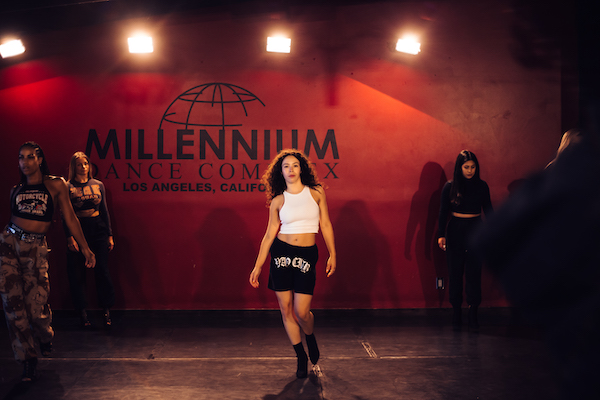
Karina Bromberg during Eden Shabtai‘s Elevate Intensive in Los Angeles in August 2022. (photo from Karina Bromberg)

“I think the difference between my dream as a kid and my wanting to do this professionally was getting to experience the behind-the-scenes of what it means to be a professional dancer and choreographer,” Karina Bromberg, 21, told the Independent. “I fell in love with the journey towards the ‘goal’ of being in a movie or on stage and that’s what made me want to keep pursuing this career path.”

Bromberg is the producer and director of the rishon series, which integrates choreography with live music, videography, photography and fashion. The first iteration, rishon.1, was held this past June and rishon.2 will take place at SKL Design+Vision in Burnaby on Oct. 14, at 1:30 p.m.

“Drawing from the knowledge acquired during the creation of rishon.1 and a careful analysis of the final product, my focus for the second instalment has primarily been on elevating the visuals displayed on screen, refining the choreography and creatively designing the performance space,” Bromberg shared with the Independent.

“Given that rishon serves as a platform for emerging and diverse creatives to converge, the cast for rishon.2 is intentionally different, maintaining a commitment to inclusivity and diversity. While the overarching goal and concept remain consistent,” she said, “the skills honed from the first iteration have empowered me to progress and further enrich what rishon offers to both the audience and the dedicated crew involved.”

The idea for rishon came in 2021, when Bromberg and a friend, during a freestyle session, gave each other different objectives to dance.

“I noticed I would analyze and apply the objective to my dance through the senses: How does it look? How would it feel? What smell would it have? Does it make a sharp, or soft sound?” said Bromberg, who is originally from Karmiel, Israel. “It was then that the idea to create something that will somehow involve the five senses formed. Months of pondering the idea led me to realize it needed to evolve into an in-person showcase, which later took the name rishon, meaning ‘first’ in Hebrew.”

Wanting to stage something different, Bromberg searched for venues that would allow audience members to stand amid the artists. “The ultimate goal,” she said, “was to create an immersive and intimate environment where both the audience and the artists were on the same level. Concurrently, I began working closely with TRS, a music artist, and was involved in campaigns for a fashion brand; getting to know artists from different industries, I saw the potential to bring us all together in one space. I expanded on rishon’s creative framework by bringing in the elements of live music, fashion design, modeling and video content of art created for screen.”

Bromberg has been dancing seriously since the age of 5, doing competitive aerobics in Israel, and, at 12, starting “hip-hop, house, popping and dancehall classes at the local dance studio,” she said. “I was dancing competitively at dance competitions like Hip Hop International in Israel and, upon immigrating to Canada, I stopped for about a year. It took me and my parents some time to understand how things work here and to find a studio we could afford and I could easily commute to alone. So, in the meantime, I learned routines off YouTube and danced in my living room.”

Bromberg was 14 when her family moved to Vancouver, and she admits to having been “resistant and closed-minded about the move … but my parents strived and worked hard to open up more doors and provide a better future for me and my younger brother.

“The story of why Vancouver is pretty funny,” she added. “My mom liked to go on Google Earth and see different neighbourhoods and, when she saw the Science World ball, she decided we were going to Vancouver. It was pretty, and less cold than the rest of Canada – which, coming from Israel, was important to us!”

Bromberg’s resumé now includes dancing in Netflix, Paramount+ and CW productions.

“In 2019,” she said, “there was a big audition for Christmas Chronicles 2, choreographed by Chris Scott. Unrepresented by a dance agency, I attended the audition and made it to the last round. I remember having a lot of fun, but I didn’t set my expectations too high. Two months later, while visiting my family in Israel, I received an email confirming that I had booked the job. It was such a proud and surreal moment. Being my first job, I absorbed a wealth of knowledge and remain thankful for the opportunity extended to me.

“The onset of COVID-19 resulted in a work hiatus until 2021, when I was directly booked for a short dance scene in Honey Girls. Being unrepresented at the time, I diligently pursued and submitted self-tapes to anything I could find. In the same year, I booked Monster High, my biggest commercial job to date. It was three months in length, and one of the best times of my life. I was invited back to dance in Monster High 2 in the beginning of 2023 and, following this gig, I was able to get represented by a local dance agency. I recently wrapped up filming for Riverdale Season 7, Episode 14, marking another milestone in my journey.”

Bromberg said she has always loved performing and would help choreograph end-of-the-year shows in her elementary school back in Israel. “I’ve just always had a pull to perform and dance and move my body,” she said. “I’ve always dreamed of being on the big stages or in music videos ever since I was allowed to watch MTV, but I think the dream became something more solid and realistic in my mind in 2021 when I was visiting LA to perform at a showcase. I have been training with a company based in LA since May 2020, four to five times a week over Zoom in my room or garage. The opportunity to work with the choreographer in person and to be in the room with people I look up to, I remember feeling so in my purpose and starting to believe even more that this is what I am supposed to be doing.”

Falling in love with the journey towards her goal includes a commitment to creating. She has videos on her website of solo dances that she has choreographed.

“I wanted to practise dancing for the camera, as well as start investing in my own ideas,” she said. “I often have a vision for visual art that can be made when I listen to songs, and I enjoy directing these videos and filming them, so I made a promise to myself to go through with every idea that doesn’t leave my mind and I have the itch to create.”

Several of the videos feature the music of Baby Keem.

“The production on the songs and Baby Keem’s delivery have stuck out to me since the first time I heard him, and the pull to choreograph and create to his music has been unstoppable since,” she explained. “I recently watched an interview with him, where he talks about constantly living in his art and taking inspiration from anything he does … and I feel very much the same. I go to concerts and watch for the creative direction, the choreography, the show flow, or I will put on a movie or a TV show and look at angles it was shot from and the editing. I am constantly playing music no matter what it is I’m doing and I often hit the ‘go to radio’ feature on Spotify to discover new artists and genres to continue the creative flow and keep an open mind. The inspiration comes from everything I do, consume and engage with.”

In this context, it is easier to see how Bromberg conceived and mounted the multifaceted rishon.

“From a technical standpoint, bringing rishon.1 to fruition in June required extensive research, numerous emails, location scouting, securing funds and making quick adjustments,” she said. “It was a significant learning experience for me, considering I had never organized an event before…. Building a team was crucial to me, and each member brought unique and specialized knowledge, contributing to the success of the show.

“Reflecting on the process, I almost forget the hard and consistent efforts, along with the many no’s I encountered while seeking funding and assembling my team,” she said. “Looking back, the overwhelming feeling is how right everything felt…. Creatively, outlining the show came naturally.  I knew I wanted the soundtrack to be one album, and the ideas just flew to me. I went with my first thought, leaving no room for second-guessing. Whenever anxiety or ‘imposter syndrome’ crept in, I looked back at the progress I’d made, refocused on the work, and found it dissipating.”

For more about Bromberg, visit karinabromberg.com. For tickets to rishon.2, go to eventbrite.com.

Format ImagePosted on October 12, 2023October 12, 2023Author Cynthia RamsayCategories Performing ArtsTags choreography, dance, Karina Bromberg, multimedia, rishon.2
Multidisciplinary approach – When the Walls Come Down

Multidisciplinary approach – When the Walls Come Down

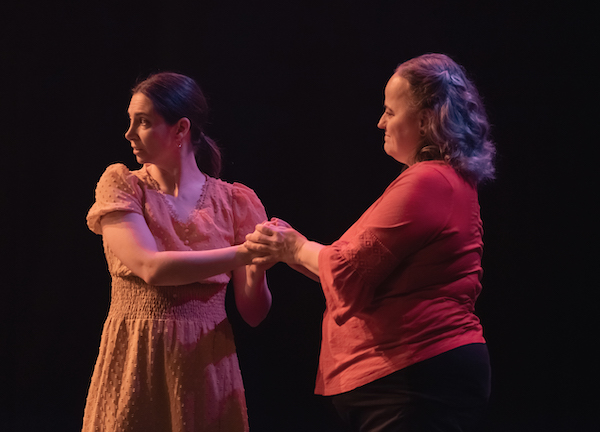
Racheal Prince, left, and Caroline Hébert in When the Walls Come Down, which is at the Rothstein Theatre Nov. 8 and 10. (photo © iiiiportraits)

“I think the performance is a really fun way to learn a little bit about Deaf culture,” Caroline Hébert, the lead actor and inspiration for When the Walls Come Down, told the Independent. “I hope people can make the time to try something different and I look forward to meeting some new people at the Chutzpah! Festival.”

When the Walls Come Down (WTWCD) will see three performances at the Rothstein Theatre next month, as part of the festival. A collaboration from Vancouver’s Dance//Novella, led by Racheal Prince and Brandon Lee Alley, the work highlights moments in Hébert’s life, “shed[ding] light on stereotypes and difficulties faced by many Deaf Canadians and tell[ing] a story of resilience and love,” according to the press material. It is performed with movement, music, projections and lighting, and in ASL with English voiceovers.

“Racheal and Brandon and the WTWCD team have been learning ASL,” said Hébert. “It’s really inspiring to me to see a group of people who want to create an environment where we can share ideas and our culture. I want to participate in more collaborations as I continue my journey as a Deaf actor. This is my first time stepping into a leading role for a one-hour show. I think, at first, I wasn’t really sure if this is something I could do. Over time, I realized that I can do it, and I can connect to many different people through my art form.”

The creation of WTWCD began in 2020, said Prince and Alley, when “our curiosity led us to explore the fusion of ASL and dance, with a strong desire to collaborate with a Deaf actor and blend their creative ideas with ours. Caroline was recommended to us by Chis Dodd, director of SOUND OFF. What intrigued us further was her last name, Hébert, which happened to be the maiden name of Racheal’s grandmother. This unexpected connection felt like a sign. After a video-translated conversation with Caroline, we realized that she possessed a compelling story that needed to be shared, so we quickly chose her as the central character for the work.”

As for her decision to be that central character, Hébert said, “I was interested in trying something new and I thought why not!? I did dance a little when I was a child so maybe that was also part of the reason?”

WTWCD debuted as a live-streamed performance during the 2021 Vancouver International Dance Festival (VIDF), which made it “challenging for us to establish a direct connection with the audience and gauge their reception of the work,” said Prince and Alley. “However, we knew this work had the potential of uplifting and illuminating a traditionally marginalized community, so we kept refining and building upon our initial ideas.”

In 2022, they received an invitation to perform WTWCD in Edmonton at the SOUND OFF festival, the first time the piece was presented in a live setting. “To our astonishment, the audience responded with thunderous stomps and a standing ovation. It was truly incredible to witness the profound connection the work had with the Deaf community,” they said.

In addition to that positive reaction, the pair won the 2023 VIDF Emerging Choreographic Award. “To us,” they said, “this award emphasized the collaborative and harmonious aspect of the work’s creation, transcending our roles as individual choreographers.”

Both creatives multitasked to make WTWCD. Prince and Alley choreographed the work; they played a part in the storyline creation and development with Hébert and her daughter, Anna-Belle Hébert, all four of whom perform the piece; Alley composed the music and Prince did the costume and set design. Other key contributors are lighting designer James Proudfoot, assistant lighting designer Chengyan Boon, and mentors and coaches Chris Dodd and Landon Krentz.

“Being a contemporary dance company, one of our goals was to find innovative ways to convey the music to a Deaf audience,” said Prince and Alley. And it was Alley who “came up with the idea of using a playful animation to advance the storyline and evoke the emotional essence of the music.

“To realize this vision, we collaborated with the Vancouver Film School,” they said. “We pitched our ideas to them, leading to the organization of a competition involving five different groups. Each group listened to our concepts and then presented us with small animations. After careful consideration, we selected the group that we believed best captured the essence of the work and the nuances of the music. They went on to create the animations that will be showcased during the performance.”

Listed on Dance//Novella’s website are producer Jill Tao, designer/animators Kanako Takashima and Cecilia Cortes, animation lead Arturo Acevedo and storyboard artist/designer Heena Yoon.

An integral part of this project has been Anna-Belle Hébert.

“She is a CODA (child of Deaf adult), fluent in ASL, QSL, English and French,” explained her mother. “Anna-Belle understands who I am and the story I want to share because it’s partly her story too. In the beginning, I recommended that Racheal and Brandon reach out to Anna-Belle to see if she would like to join the process, which they enthusiastically agreed to. In the performance, she is my voice over actor, but has also been a huge part of the creative process. She really helps bridge the gap between our ideas and how they can connect to hearing and Deaf people at the same time.”

Both Prince and Alley talk about how much they have learned while creating WTWCD. “One significant revelation for us,” they said, “was the realization that ASL and English are two distinct languages. Initially, we attempted to transcribe everything in an effort to ensure clarity, but this approach only seemed to confuse Caroline further. With the guidance of a specialized ASL coach, Caroline developed a unique method for documenting the script on paper. This breakthrough allowed her to memorize and retain everything effortlessly while making it her own.”

Prince and Alley had nothing but good things to say about Hébert.

“Caroline is an incredibly generous and patient collaborator,” they said. “During our rehearsals, we frequently paused our creative process to listen to stories from Caroline’s life. Each story offered us a glimpse into the experiences of a Deaf child, mother and student, which ultimately became the core of our creative journey. The exchange of knowledge and personal narratives became the driving force behind our work, giving it profound meaning for our team.”

When the Walls Come Down is at the Rothstein Theatre Nov. 8 and 10, at 8 p.m., and there is a special matinée for school groups grades 6 and up on Nov. 9, 11 a.m. (contact [email protected] for more information about that). The show runs 60 minutes with no intermission. For tickets, visit chutzpahfestival.com.

Format ImagePosted on October 12, 2023October 12, 2023Author Cynthia RamsayCategories Performing ArtsTags ASL, Brandon Lee Alley, Caroline Hébert, Chutzpah!, dance, Deaf culture, Racheal Prince, Rothstein Theatre
Honouring ancestors’ stories

Honouring ancestors’ stories

Juan Villegas rehearsing Edictum, choreographed by Vanessa Goodman, which is about Villegas’s Sephardi ancestry. The work is part of Dancing on the Edge’s EDGE One July 6 and 8 at the Firehall Arts Centre. (video still from Vanessa Goodman)

“I am very happy to be able to share my work and talk about Sephardic Jews, as I am doing a lot of research and I am discovering a lot about my own culture and where it comes from,” Juan Villegas told the Independent about Edictum, a new work with Vanessa Goodman about his family heritage, an excerpt of which he will perform at this year’s Dancing on the Edge July 6 and 8. “Throughout history, the Jewish community has suffered a lot and I am very happy to be able to pay respect, honour, shed some light and help tell the story of my ancestors,” he said.

Villegas and Goodman had already started their collaboration when Villegas found out that his ancestors were Spanish Jews who, following the Alhambra Edict of Expulsion in 1492 and the persecution of Jews by the Spanish Inquisition, sought refuge in Colombia.

In 2015, Spain passed legislation to offer citizenship to members of the Sephardi diaspora, but the window of opportunity to apply was only a handful of years and Villegas’s family missed it. However, they did apply to Portugal, which passed a similar law, also in 2015. Given the number of applicants, it could be several years before the family finds out. For the application, certified records were needed, so Villegas’s siblings hired a genealogist.

“They did both of my parents’ family trees and both ended up having the same ancestor – Luis Zapata de Cardenas, who came to Antioquia, Colombia, from Spain in 1578 and whose family had converted to Catholicism in Spain,” he said. “What is unclear to me is whether Luis Zapata de Cardenas was a practising Jew and was hiding it or if his family back in Spain became Catholic and raised him Catholic. I find it very hard to believe that people fully converted to Catholicism, as religion is so embedded in one’s culture and must be very difficult to switch by obligation. So, this is probably when they started disguising some Jewish rituals as Catholic, which happened a lot in Colombia.”

Villegas left Colombia in 2003, at the age of 18, concealing from his family his real reasons for leaving.

“I told them that I was going to only be in Canada for eight months to study English and then come back to Colombia,” he shared, “but deep inside I knew that I wanted to find a way to stay in Canada. I am gay and had a hard time growing up in Colombia – without realizing it, I was also escaping from a traumatic childhood, as I had been sexually abused and bullied at school. I was lucky enough that my parents helped pay for ESL studies in Canada and then I was able to do my university studies in Vancouver at Emily Carr University.”

After getting a bachelor’s degree in design from Emily Carr, Villegas worked at a design studio but was let go when the economy collapsed in 2008. He took about a year to figure out what he wanted to do next.

“I had a lot of unresolved trauma and I think it was a combination of having the time and (unconsciously) wanting to be healed from trauma that I started taking yoga and dance classes,” he said. “I met a dance artist named Desireé Dunbar, who had a community dance company called START Dance and she invited me to join her company. Vanessa [Goodman] had just graduated from the dance program at SFU and she was in the company also, this was back in 2009. Then, in 2010, I joined the dance program at SFU and Vanessa came to choreograph for us a couple of times. I always loved working with her and I felt like I connected with her.”

Graduating from SFU with a diploma in dance, Villegas moved to Toronto, where he danced for a few years. When he returned to Vancouver in 2017, he started following Goodman’s work. Intrigued, he asked if she would choreograph something for him and she agreed.

“And that piece that we created was about family,” he said, “but we left it at that, because I did not get the grants I needed to continue the work. So, when I discovered about my Sephardic Jewish ancestry, I pitched the idea to her and she agreed (without me knowing that she also has a Jewish background).”

video still - Juan Villegas rehearsing Edictum
Juan Villegas rehearsing Edictum. (video still from Vanessa Goodman)

Everything fell into place, he said, including some funding, so they took up work again this year on Edictum, which is Latin for order or command. The project was always intended to be a solo for Villegas, and they had started by “diving into his family history and the names of his ancestors to build movement language,” said Goodman.

“Since his family found that they have Jewish ancestry and were a part of the diaspora from Spain and Portugal in the 1400s, we found it very relevant to revisit the starting material and expand on this history inside the work,” she said. “I was raised Jewish culturally and we found, through conversations about our family rituals in relation to culture, food and celebration, there were some very interesting links between his family’s expressions of their identity and mine. We have woven these small rituals into the piece and have found a very touching cross-section of how this can be shared through our dance practice in his new solo.”

Goodman is also part of plastic orchid factory’s Ghost, an installation version of Digital Folk, which will be free to visit at Left of Main July 13-15. It is described on plastic orchid factory’s website as “a video game + costume party + music and dance performance + installation built around the desire to revisit how communities gather to play music, dance and tell stories.”

“I began working with plastic orchid factory on Digital Folk in the very early days of its inception,” said Goodman. “James [Gnam] and Natalie [Purschwitz] began researching the work in 2014 at Progress Lab, and I was a part of that initial research for the piece. Since then, the work has been developed over a long period of time with residency creation periods at the Cultch, at Boca del Lupo, at the Shadbolt, at SFU Woodward’s, and it has toured Calgary and northern B.C. This work lives in several iterations, but the Ghost project is a beautiful way for the work to live in a new way one more time. The cast got together at Left of Main in December of 2022 and filmed the piece for this upcoming iteration…. It is exciting to see a work have such a rich life with so many incredible artists who have been a part of this project.”

Dancing on the Edge runs July 6-15. It includes paid ticket performances at the Firehall Arts Centre, where Edictum will be part of EDGE One, and offsite free presentations, such as Ghost. For the full lineup, visit dancingontheedge.org.

Format ImagePosted on June 23, 2023June 22, 2023Author Cynthia RamsayCategories Performing ArtsTags ancestry, Catholicism, Colombia, dance, Dancing on the Edge, DOTE, Edictum, family, history, Juan Villegas, Judaism, Portugal, Spain, Vancouver, Vanessa Goodman
Flamenco of contrasts

Flamenco of contrasts

Lili Flamenco / Liat Har Lev performs two solos in the Dance Centre’s Open Stage Edition #3 on May 6, 8 p.m. (photo from Lili Flamenco)

The Scotiabank Dance Centre’s Open Stage Edition #3 on May 6 includes two solos choreographed and performed by Lili Flamenco / Liat Har Lev: We Shall Not Forget, dedicated to the six million Jews killed in the Holocaust, and Lemons, in the flamenco style Alegrias, which means “happiness” in Spanish.

“Although my family was not directly affected by the Holocaust, growing up in a Jewish family I heard and learned about it…. I created this piece with the hope that I and the audience will connect to the experience of the victims and survivors on a deeper level and remember what they endured just because they were Jewish,” Har Lev told the Independent.

In contrast, she said, “Lemons has an uplifting, joyful mood and a vibrant rhythm, harmony and pulse. It has more of a traditional flamenco flavour and will be performed with a guitarist [Peter Mole] and singer [Pat Keith]. It is inspired by my personal artistic journey and celebrates optimism and grit. I chose to perform it in conjunction with We Shall Not Forget because it has a lighter mood … and is completely different stylistically.”

Har Lev performed We Shall Not Forget last year as part of the Dance Centre’s International Dance Day events. (See jewishindependent.ca/a-celebration-of-dance.)

“I started developing We Shall Not Forget in 2020 during the pandemic with the support of the 12 Minutes Max program. I had access to support and feedback from facilitators, I received subsidized studio space at Scotiabank Dance Centre, and had the opportunity to participate in an informal public showing which, unfortunately, had to be featured on Zoom because of the pandemic. I never actually performed We Shall Not Forget to a live audience.”

In addition to Har Lev, Open Stage Edition #3 features dance works by Kiruthika Rathanaswami and Malavika Santhosh (in the classical Indian dance style of bharata natyam), Lili Shilpa Shankar (bharata natyam) and Voirelia Dance Hub (contemporary dance). For tickets, visit thedancecentre.ca.

Har Lev will also be performing at the Festival of Israeli Culture at the Jewish Community Centre of Greater Vancouver on May 14.

Format ImagePosted on April 28, 2023April 26, 2023Author Cynthia RamsayCategories Performing ArtsTags Alegrias, dance, Festival of Israeli Culture, flamenco, Holocaust, Liat Har Lev, Lili Flamenco, Scotiabank Dance Centre
Learn klezmer dancing

Learn klezmer dancing

Kol Halev Performance Society in action. (photo from Kol Halev)

On May 7 at White Rock South Surrey Jewish Community Centre, Kol Halev Performance Society is holding a two-hour klezmer dance workshop, which is open to kids 8 and up, adults and seniors. And you don’t have to be Jewish to enjoy klezmer – this workshop is open to all!

In the workshop, participants will learn traditional and contemporary klezmer dances (traditional dances of Jewish celebrations originating in Eastern Europe) and read excerpts from The Kugel Valley Klezmer Band by children’s book author Joan Stuchner, in a joyous celebration of music, dance and storytelling. The instructors are Hadas Klinger (dance) and Tom Kavadias (theatre).

Klinger currently teaches recreational Israeli dance to adults at Richmond’s Congregation Beth Tikvah and at the Louis Brier Home, as well as jazz and Israeli dance instruction and choreography to K-6 kids and preteens. She has led Israeli dance workshops and drama workshops at a variety of youth summer camps, and has performed in Miami representing the Jewish Community Centre of Greater Vancouver as part of Maccabi Artsfest.

Kavadias has been involved in community theatre since 1985 as an actor and director, and he has worked with adults, teens and children. He has acted with Metro Theatre, Stage Eiren, Theatre North Van, and United Players.

There is no charge for the workshop, which takes place from 3 to 5 p.m., but registration is required by emailing [email protected] or via wrssjcc.org.

White Rock South Surrey Jewish Community Centre is located at 3033 King George Blvd. For questions about the dance program, call Sue Cohene at 604-889-4337. For other questions, call the WRSSJCC at 604-541-9995.

– Courtesy Kol Halev

Format ImagePosted on April 28, 2023April 26, 2023Author Kol Halev Performance SocietyCategories Performing ArtsTags dance, education, family, klezmer, theatre
Celebration of Israeli culture

Celebration of Israeli culture

Mark your calendars for May 14. The Festival of Israeli Culture, a one-day free series of events at the Jewish Community Centre of Greater Vancouver, is a multicultural celebration of music, dance, art, sports, food and drink.

photo - Kids enjoying last year's Festival of Israeli Culture
Kids enjoying last year’s Festival of Israeli Culture. (photo by Galit Lewinski)

Get ready for community drumming by the Drum Café, Israeli dance, Mediterranean belly dancing, flamenco and the Israeli Choir, followed by a sing-along with well-known Israeli musician Elad Shtamer. And that’s not all! Join Maccabi-Mania with gym-based activities for all ages, the sassy sesame cooking workshop, intuitive painting, and calligraphy workshops.

photo - Dancers at last year's festival
Dancers at last year’s festival. (photo by Galit Lewinski)

For adults, there is a range of 19+ programs, including an Israeli wine tasting and cocktail party to sample some arak-based cocktails (arak is an alcoholic drink made primarily with aniseed and grapes) followed by an exhibition of video art from Bezalel Academy of Art and Design in Israel.

photo - Music is a part of the celebrations
Music is a part of the celebrations. (photo by Galit Lewinski)

In addition to the performances and activities, the festival will have a market featuring a variety of eats from local vendors and food trucks, along with hand-poured candles, jewelry, clothing, arts and crafts, Judaica, and more.

The Festival of Israeli Culture on May 14 runs from 11 a.m. to 5 p.m. at the JCC. While all events are free of charge, food donations to the Jewish Food Bank are encouraged. For more information, visit israelifestival.com.

– Courtesy Jewish Community Centre of Greater Vancouver

Format ImagePosted on April 28, 2023May 7, 2023Author Jewish Community Centre of Greater VancouverCategories Performing ArtsTags dance, food, Israeli culture, JCC, music
Powerfully against othering

Powerfully against othering

Into the Little Hill runs May 19 and 20 at SFU Goldcorp Centre for the Arts, Fei and Milton Wong Experimental Theatre. (photo by Flick Harrison)

“Into the Little Hill is a powerfully emotional opera,” soprano Heather Pawsey told the Independent.

Pawsey is the artistic director of Astrolabe Musik Theatre, which, with Simon Fraser University Woodward’s Cultural Programs, is presenting the opera’s Canadian première May 19-20. A multidisciplinary, modern take on the medieval story of the Pied Piper of Hamelin, Into the Hill features two singers, three dancers and live music. Written by English composer George Benjamin with libretto by Martin Crimp, Jewish community member Idan Cohen of Ne.Sans Opera and Dance is the local production’s director and choreographer.

“From the moment I first heard Into the Little Hill, I knew I had to have dancers in the production,” said Pawsey. “My company, Astrolabe Musik Theatre, has been experimenting with dance and movement in classical music, in varying degrees, for over 10 years now. Dance and movement are such normal, natural, innately human ways of expression, yet we see it so rarely in opera and classical music.”

When she heard Into the Little Hill, she said, “I literally saw the dancers in my mind … and knew that this was the perfect opera to intentionally incorporate them as amplifications of the characters, as commentators on the story, and as true partners with the singers (who are also precisely choreographed).”

After that, she was just “waiting for the perfect person with whom to work.” And she found that person in Cohen – his company, Ne.Sans, exists to reimagine and reconnect opera and dance.

“When Idan and I met in Amsterdam in 2018 on an opera I was singing and he was directing, I knew at the first rehearsal that he was the person I’d been waiting for: someone who knows music, who knows dance, who can work with professional dance artists and with singers who may have little or no dance training, and whose knowledge and experience come together in a profound understanding of the possibilities of singing and dance.”

“We’ve connected on so many levels,” said Cohen of Pawsey, who introduced him to Into the Little Hill. “Since then,” he said, “we’ve enjoyed many long conversations about this wonderful opera that is so close to both our hearts. I am so excited to finally be able to share our version of this brilliant work.”

“As far as I know,” said Pawsey, “l’Opéra de Montréal is the only other company in Canada to have produced one of George Benjamin’s operas (Written on Skin, his second). In 2014, I watched Written on Skin on MediciTV and literally got goosebumps. Singing contemporary music is a huge part of my career, yet I had never heard of this composer nor heard music anything like his: crystalline, precise, profound, spare, yet filled with emotion, colour, shadow, passion and power. I looked him up immediately and discovered that Into the Little Hill was (at that time) the only other opera he’d written…. I knew then that I had to produce (and sing!) it; that it would have dancers; and, voilà! A decade later, here we are. This opera speaks so profoundly against ‘othering.’ I know that people will come away having experienced something powerful, intense and beautiful.”

Pawsey and mezzo-soprano Emma Parkinson sing all six of the opera’s characters.

“One of the things I love the most about Into the Little Hill is its exquisite precision,” said Pawsey. “Vocally, orchestrally, dramatically, dramaturgically there are no extraneous notes, no extraneous words, and the power of this concentration is intensified by having only two singers portray all the roles. We aren’t distracted by multiple singers coming on and off the stage, nor by the differing ranges and timbres of their voices – we have focus.

“We also have gender-neutrality, something that is difficult to achieve in traditional opera, where characters’ genders have historically been determined by voice-type (ie. tenor, soprano, etc.). Having only two singers sing all the roles makes gender, sexual orientation or how one presents to the world irrelevant, and leaves the make-up of the characters to each individual audience member’s imagination. As an artist, it frees me from having to imagine or recreate assumptions about how ‘men’ or ‘women’ move, behave and speak (sing), and allows me to enter fully into what that character is actually expressing. My hope is that this also helps audiences to identify more freely with the characters.”

The opera speaks to Cohen on many levels.

“As a queer artist, a descendant of Holocaust survivors, coming to Canada from Israel/Palestine, I have always valued the importance of raising voices of underserved communities and to acknowledge our troubled past, learn from it, and aspire to do better,” he said. “I chose to leave my country in search of a better future and, as I arrived in Canada in 2017, I was amazed to find how relevant the history of Canada is to my own, from multiple angles, both as the oppressed and the oppressor, often against my will.

“My work is embedded in this life experience and perspective, and I am passionate in telling classical stories through alternative lens,” he continued. “Into the Little Hill is such a powerful opera that speaks of the human condition in a very creative way. There are different ways to speak of the tragic history of Western culture, and one of the reasons I chose to be an artist is because I see the importance of speaking of the violence and hurt, and to fight against discrimination.

“This opera is such a great, complex example of the fact that there is no one source of harm, and not one source of knowledge and perspective,” he said.

Critics have generally lauded Into the Little Hill, though some have expressed concern over the way in which the story is told.

“The narrative style of this opera imposes a certain detachment or distancing,” Pawsey said. “Traditionally, opera is all about emotion – big, huge, dare I say OPERATIC emotion! Here, Martin Crimp’s libretto uses Brechtian techniques (such as the Narrator directly addressing the audience, breaking the fourth wall, etc.) to discourage the audience from becoming too emotionally involved. Brecht used these techniques to encourage a deeper focus on the socially significant aspects of the story. This is particularly relevant in this opera’s tale of ‘who are we labeling as the “rats” in our society, what are we willing to do to get rid of them and what happens when we refuse to “pay the piper,” ie. take responsibility for the consequences of our actions?’

“Detachment, distancing – this is what we, as humans, do when we label, when we ‘other,’ when we divide into ‘us’ and ‘them.’ It’s a part of the de-humanizing process, which allows us to plan or to undertake horrific acts. But this is not to say that audiences will feel emotionless at the end of Into the Little Hill,” she stressed. “Fascinatingly, the muting of emotion evoked for individual characters and their stories makes us feel even more deeply and keenly the emotion of the story overall and how its outcome affects all the characters – and, by extension, us.”

Into the Little Hill takes place at SFU Goldcorp Centre for the Arts, Fei and Milton Wong Experimental Theatre. Conductor Leslie Dala is music director for the production, whose orchestration includes bass flute, basset horns, mandolin and banjo. Lighting design is by Victoria Bell, with costume design by Elena Razlog. The dancers are Juolin Lee, Daria Mikhalyluk and Hana Rutka.

For tickets and more information, visit littlehill.eventbrite.ca.

Format ImagePosted on April 28, 2023April 26, 2023Author Cynthia RamsayCategories Music, Performing ArtsTags Astrolabe Musik Theatre, dance, Heather Pawsey, Idan Cohen, Into the Little Hill, Ne. Sans, opera, theatre
Destruction and rebirth

Destruction and rebirth

Grass is Green is at the Rothstein Theatre on April 25. (photo from Una Productions)

B.C. Movement Arts and Chutzpah!PLUS present the Canadian première of Grass is Green in Vancouver and several other B.C. locations, starting April 25.

Grass is Green is an evening-length work from San Francisco- and New York City-based UNA Productions. Performed by six dancers and drag queen/cellist/pianist Rose Nylons, Grass is Green considers cycles of destruction and renewal both within humanity and the land of which humanity is a part. The highly physical and exuberant work embodies a cycle of rebirth, representations of queer intimacy, and moments of communal joy, grief and connectivity.

The choreographer of Grass is Green is Chuck Wilt, in collaboration with the performers, who are Wilt, Nylons, Kira Fargas, Dominica Greene, Dasol Kim, Rebecca Margolick and Hadassah Perry. The music is by Nylons, Donna Summer, Sylvester, DJ Koze and Nils Frahm, Julia Wolfe and Matthew Welch, and Michael Nyman.

Grass is Green is the first partnership of B.C. Movement Arts (BCMA) and the Chutzpah! Festival. BCMA was founded by artistic and executive director Mary-Louise Albert, the former director of Chutzpah!, which is now led by artistic managing director Jessica Gutteridge, who has been at the helm since 2020.

Grass is Green takes place at the Rothstein Theatre on April 25, 7:30 p.m. For tickets, go to chutzpahfestival.com or call 604-257-5117.

It moves on to Sointula April 27-28, Alert Bay April 29, Port Hardy April 30 and Campbell River May 2. For more details on and tickets for these shows, visit bcmovementarts.com or call 604-970-3206.

– Courtesy B.C. Movement Arts

Format ImagePosted on April 14, 2023April 12, 2023Author B.C. Movement ArtsCategories Performing ArtsTags B.C. Movement Arts, Chutzpah! Festival, dance, Grass is Green

Posts pagination

Previous page Page 1 Page 2 Page 3 … Page 10 Next page
Proudly powered by WordPress