Skip to content
  • Home
  • Subscribe / donate
  • Events calendar
  • Business Directory
  • FAQ
  • News
    • Local
    • National
    • Israel
    • World
    • עניין בחדשות
      A roundup of news in Canada and further afield, in Hebrew.
  • Opinion
    • From the JI
    • Op-Ed
  • Arts & Culture
    • Performing Arts
    • Music
    • Books
    • Visual Arts
    • TV & Film
  • Life
    • Celebrating the Holidays
    • Travel
    • The Daily Snooze
      Cartoons by Jacob Samuel
    • Mystery Photo
      Help the JI and JMABC fill in the gaps in our archives.
  • Community Links
    • Organizations, Etc.
    • Other News Sources & Blogs
  • JI Chai Celebration
  • JI@88! video

Recent Posts

  • Legal help for students
  • Revisiting myth of Lilith
  • Wrong person rebuked
  • Canada’s mixed messages
  • Questions for museum
  • Symposium on antizionism
  • Making soccer political
  • CJPAC lauds Pulver’s impact
  • City recognizes Vrba’s legacy  
  • Organ donation saves lives
  • Theodore’s March premiere
  • A healing Shabbaton
  • Supplying healthy food
  • A chime of metal tags
  • Yellowknife seder a first
  • Ishai energizes, unifies
  • A Lag b’Omer to remember
  • Expanding the healing
  • Hannah Senesh – a unique hero
  • Community milestones … May 2026
  • Sharing her testimony
  • Fall fight takes leap forward
  • The balancing of rights
  • Multiple Tony n’ Tina roles
  • Stories of trauma, resilience
  • Celebrate our culture
  • A responsibility to help
  • What wellness means at JCC
  • Together in mourning
  • Downhill after Trump?
  • Birth control even easier now
  • Eco-Sisters mentorship
  • Unexpected discoveries
  • Study’s results hopeful
  • Bad behaviour affects us all
  • Thankful for the police

Archives

Follow @JewishIndie
image - The CJN - Visit Us Banner - 300x600 - 101625

Tag: Chanukah

Northern lights

Northern lights

(photo from facebook.com/liatg)

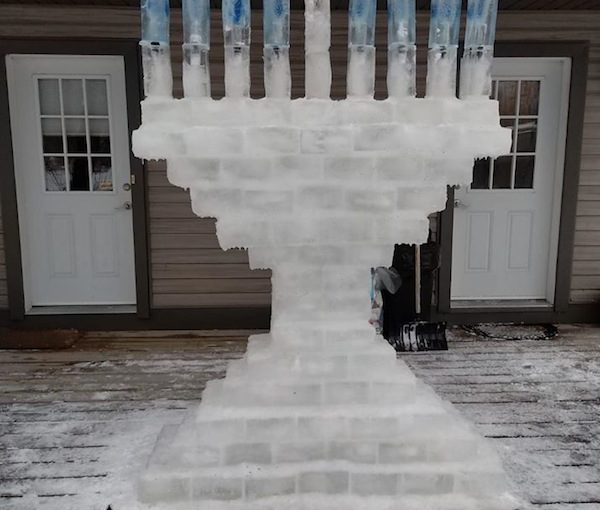
Benji Goldstein, who lives in Sioux Lookout with his family, is a full-time doctor working in indigenous communities in northern of Ontario. He has created for Chanukah an almost six-foot chanukiyah out of ice, improving his 1.0 version from two years ago to this 2.0 model, which stands on a big block of ice. The bricks were frozen in milk cartons, which he collected over time, and the structure weighs 400 kilograms. It will be lit every night of the holiday from his mobile phone.

The Jewish Independent found out about Goldstein’s creation from local community member Tamara Heitner, who shared with us the Facebook post of Goldstein’s sister-in-law, Liat Goldstein.

Format ImagePosted on December 13, 2019December 12, 2019Author Liat GoldsteinCategories Celebrating the HolidaysTags art, Benji Goldstein, Chanukah, chanukiyah, Ontario

Renewal requires courage

Did you notice what a great day it was today? Rain or shine, there are lots of people out there who are so happy you are alive. Besides yourself, I mean. I bet you did some things today that added to that number.

I’m feeling pretty good myself, remembering stuff from my youth. In December, we light the candles marking Chanukah, the Festival of Lights, as it is called. I always liked this holiday as a kid, along with Rosh Hashanah, because there were good things to eat at the party we always had. And older people in the family gave you money, Chanukah gelt. I hope they still do that, although I haven’t heard much about it since the kids got big and left home to form their own households.

Many people – unless they have Jewish neighbours or notice the lights around Christmas time – don’t know about Chanukah because it is not in the Bible, and because the events surrounding it happened later. After the empire forged by Alexander the Great broke up, the piece in which Israel was included was under the rule of kings named Antiochus.

These kings liked to fancy themselves gods. One of them put a statue of himself in the Jewish Temple. This was just too much for the Israelites and they rose up under the leadership of the Maccabees – Mattathias and his five sons – and drove out their Greek rulers.

Chanukah is about renewal, because that’s what the holiday celebrates, the renewal of the Temple in Jerusalem after the land was freed. Current Israel is part of that same story, as the ingathered exiles renewed national life on their land. Our national renewal is an assertion that our past is merely prologue, with the full story yet to be written.

Jewish history of the recent two millennia may not illustrate it, but Jews can be fighters when roused. The self-rule reestablished back then was ultimately surrendered to Roman rule, when they lost their unity. But Jews kept on fighting to achieve independence until, finally, the Romans used their power to exile Jews from their land. We must remember that the Romans executed Jesus because they feared that he would lead such a revolt, but the Jews continued their opposition after his death.

It took 12 legions to pacify the Jews – Rome conquered the Britons with only two legions. The Romans exiled the survivors to secure their rule, but the power of the religious ideas spawned in Israel conquered Rome itself a hundred years later. Those ideas were borne into exile by Jews who proved to be among the first martyrs.

More recent Jewish military history, in Israel – leaving aside the resistance without weapons in the Warsaw Ghetto, holding off the Nazi soldiers for weeks – proves that Jews can be fierce fighters.

The whole idea of renewal excites the blood. Renewal can make you feel like you can cancel out all the ills of the past, as if they never really happened. One can turn a corner and start out fresh. It is an idea around which one can rally believers, as has been done in so many places at so many different times.

Many people have fought and died in defence of renewal. It is at the heart of every movement that seeks to channel people’s efforts for change. It can be local, regional, national or global. It can have a religious or patriotic motivation. Its beauty is that it can have its origin in the lives of each and every one of us.

Change is not easy. We may be very unhappy with important elements of our lives, but taking drastic action to materially transform our lives takes courage and, often, an acceptance of the risk of substantial loss. Some of us may have done this at some time in our lives and not even appreciated that we were risking all for renewal.

It may not have been on a battlefield, but I consciously sought to renew my life when I reached out at the age of 70. I reached out to seek a relationship with a person I had known only superficially more than 50 years earlier as a teenager. The object of my continued memory and attention, my future bride, mustered up the courage to take me on as an unknown quantity, and her courage has enriched both our lives.

Truth be told, the times that haunt us most in our lives are those when we did not “seize the bull by the horns” and do the thing we really wanted to do. But, in the end, failing to act for lack of courage, or for some other reason, we settled for less than we ached to reach for. We can count every one of those times in our mind’s eye. Don’t we agonize sometimes about those steps not taken? We can never know for sure what the ultimate outcome would have been.

Looking out through the windows of my eyes, seeing the young and not so young, I am filled with enthusiasm for the future. I see the possibilities we all face in our lives to reengineer what the future holds for us.

There is so much happening out there of which I may have no understanding. What I do know is, if we really put our minds to it and concentrate on this renewal business, we can be sure to make our tomorrows fantastic.

Happy renewal in whatever calendar you follow, wherever in the world you are!

Max Roytenberg is a Vancouver-based poet, writer and blogger. His book Hero in My Own Eyes: Tripping a Life Fantastic is available from Amazon and other online booksellers.

Posted on December 13, 2019December 12, 2019Author Max RoytenbergCategories Celebrating the HolidaysTags Chanukah, conflict, history, lifestyle
Holiday of light, community

Holiday of light, community

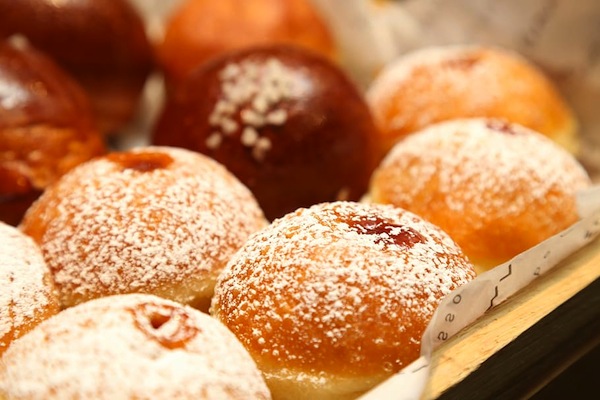
In recent years, sufganiyot have easily become the unsung heroines of new Chanukah traditions. (photo from piqsels.com)

Full disclosure, Chanukah has always been my favourite holiday. It has all the things a good holiday needs: dark wintery nights, deep-fried oily foods, magical lights, melancholy songs and cozy family time.

As a child, I looked forward to latkes and gatherings round the stove at my grandparents’ house, homemade sufganiyot – the jam-filled deep-fried doughnuts, consumed exclusively and excessively on this holiday – and the week-long vacation from school. Needless to say, my romantic view of Chanukah was somewhat tarnished as I reached adulthood only to realize that Chanukah is considered a vacation for schoolchildren; for university students and working normal folk, it’s business as usual, plus sufganiyot, plus kids. Living in Israel, a country that demands a lot of sobering up as you reach adulthood, I still count this as one of my top three.

The origin story of Chanukah frames it as a holiday of miraculous intervention. Chanukah songs and school teach us that this holiday is all about chasing away the darkness – most appropriate, given its wintery timing – and the Maccabees and their ferocious war of rebellion against the Greek-Hellenistic Seleucid Empire. We have the admirable protagonist of Judah Maccabee, waging his David vs. Goliath-like war against the archvillain of tyrant Antiochus IV Epiphanes, famous in Jewish lore for his relentless persecution of the Jews. And, of course, there’s the miracle of the oil: as the victorious Jews returned to purify the recaptured Temple, the tiny amount of oil they had miraculously lasted for the eight days it took to do so. This talmudic tale is the source of the modern eight-day celebration of Chanukah centred on the ritual of lighting the chanukiyah, adding a candle with each day.

These mythical tales reinforce the traditional Jewish narrative of a war of independence, and the few fighting and winning against the many, with the aid of a heavenly power. As a Jewish holiday, Chanukah joins the lore of religious and cultural oppression, a fierce tale of valour with a great hero in Judah Maccabee, and a grand finale celebrated in the Temple. Its roots also lent themselves perfectly to creating the holiday’s traditions; the oil from the lamp becoming a staple in both foods and in lighting the chanukiyot, when those were still oil-based, as well as holiday songs equating this religious war with chasing away the darkness.

With time and as with many holiday traditions, the modern celebrations of Chanukah grew to outshine these origin stories. This is partly helped by the holiday’s lack of family traction – no vacation time for grownups, no prescribed big family meals like on Rosh Hashanah or Passover – leaving more room for personal traditions to form and for purchasable items or foods to take centre stage. Our traditions become lighting the candles with our roommates or sharing fancy doughnuts with our work colleagues.

For me, the loose nature of Chanukah tradition also represents the growing pains of adulthood, as we’re freed to make, or burdened with constructing, our own traditions with our own families and friends. A lot of this comprises practical choices, like who to celebrate with and where, but, in the broader perspective, this is our way of connecting, or disengaging, from our community. A way of choosing our group of peers, perhaps redefining some set-in-concrete values we never considered were malleable along the way.

Chanukah provides us with an opportunity to redefine some of those traditions along with their meaning, reshaping them according to our personal beliefs and faith. Take the Chanukah narrative, for example. Do we continue to raise our children on tales of Jewish plight and persecution, of wars as heroic, of the Temple as an utmost goal worth sacrificing our lives for? Are stories of male combative heroism the most important lesson we want to teach the next generation? Is religious separatism still an essential value, or how do we tell this tale while encouraging pluralism and tolerance? And where are all the women in these stories? (There is the tale of Judith and her beheading of opposing military leader Holofernes, which is a rare account of female heroism in a terribly masculine world.) Essentially, how do we create a more challenging version of the holidays and still allow our children, and ourselves, to enjoy these traditions, not losing our sense of community as we go?

In a way, it’s fitting that the main paraphernalia of Chanukah – the chanukiyah, has also historically been a vessel for establishing Jewish identity in the Diaspora. As one of the few items used in Jewish ritual that doesn’t have a Christian parallel (like a censor or chalice, for example), the artists making these objects were free to use any type of decoration, as there was no risk the object would be mistaken for a non-Jewish item. Thus we find chanukiyot with the eagle of the local Austro-Hungarian emperor, architectural flourishes resembling renowned local structures – be they churches or mosques – or even the Chanukah tale of Judith beheading Holofernes. There are Moroccan chanukiyot made of reused sardine cans, as this was a predominantly Jewish industry, Italian chanukiyot featuring animal hybrids and putti (baby angels common in Italian

Renaissance and Baroque art) and Israeli chanukiyot with the Israeli flag. (The Israel Museum has an impressive collection of Chanukah lamps, museum.imj.org.il/stieglitz.)

As the questions of reestablishing our communal and individual identity remain, the grounding of Chanukah in our everyday world is often found in much more earthly places. In recent years, sufganiyot have easily become the unsung heroines of new Chanukah traditions. Bakeries and cafés are finding ways to make their doughnuts progressively outrageous with each passing year, adapting them to the millennial taste for opulence, decadence and quick satisfaction, since who knows what tomorrow might bring. It might not be a perfect solution, but it is undeniable that existential quandaries are best answered while consuming vast amounts of deep-fried, sugary foods while singing songs in the candlelight.

Avia Shemesh is an art history PhD student, studying medieval Spanish art, and living in central Israel. She is passionate about anything to do with art and culture, and loves to write about the ways we interact with the visual world around us and with one another. When not working or writing, she likes to travel, bake and go to yoga classes, like the borderline millennial she is.

Format ImagePosted on December 13, 2019December 12, 2019Author Avia ShemeshCategories Celebrating the HolidaysTags Chanukah, chanukiyah, Judaism, lifestyle, tradition
Courage, particularity

Courage, particularity

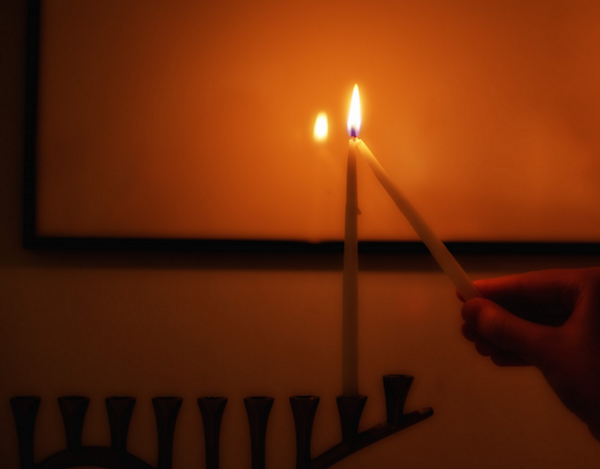
The chanukiyah is an expression of Jews’ commitment to place the particular into the mainstream of history. (photo from pxhere.com)

Jewishness is not merely determined by a biological accident. It involves commitment and dedication to the spiritual worldview contained within the vast literature produced through Jewish history. Without Torah – however understood – Jewish identity lacks a vital and ultimate purpose. Torah saves Jewish identity from being reduced to pure secular nationalism or racist folk sentimentality.

During the Chanukah period, one is challenged to reflect on the two main motifs of this festival: the Maccabean struggle and the rekindling of the menorah. A Jew can draw inspiration from his people’s courage to revolt against religious tyranny and from his being a member of a community that nurtures its national identity on the basis of a spiritual vision of life.

The Maccabean revolt is a compelling symbol not because of chauvinist nationalist tendencies but because of the values and way of life that this revolt aimed to preserve. The Maccabean revolt expressed intense loyalty and passionate dedication to monotheism and mitzvot. The courage, commitment and heroism of the Maccabees should not, however, be divorced from that for which they fought.

One of the distortions of modern existentialism is the exaltation of the virtues of sincerity, devotion, authenticity, etc., irrespective of their specific content. The sincerity of the Nazis in no way mitigates their barbarity and depravity. Subjective attitudes are important aspects of human behaviour only if their content is worthwhile and significant.

It is ludicrous to celebrate Maccabean courage and devotion without seriously considering the underlying values that motivated them to persevere in their struggle. In order to appreciate the full importance of the Maccabean victories over the enemies of the Judaic tradition, we must understand the basic values of that tradition.

The lights of the Chanukah menorah symbolize the strength to remain different and the right to sustain particular values and loyalties in a world in which one is different and often isolated. Placing the Chanukah menorah near the window for all to see represents the great message that Jews convey to the world: we choose not to hide the flame of our spiritual tradition within the secluded confines of our people, our family, but rather we wish to have our flame radiate light in the marketplaces of history. The Chanukah menorah is a concrete expression of Jews’ commitment to place the particular into the mainstream of history, to enter the marketplace with dignity and integrity.

To love Judaism, one must Jove Jewish particularity. This love is expressed by a passionate involvement with Jewish history and with efforts to enhance the well-being of the particular people who are the living carriers of the Judaic tradition.

Chanukah focuses attention on the problematic issues involved in the survival of a community within a world whose values and cultural rhythms seem so dissimilar and foreign to its own. How can one sustain the vitality of the intimate family in an impersonal world of mass culture? How can one keep alive a vital interest in that which is unique to one’s particular culture and experience if one allows modern technology to bring a diverse array of values and cultures into one’s private home?

Some Jews believe that cultural particularity is incompatible with modern mass culture and that the bonds holding together the family of Judaism cannot bear the stress caused by exposure to the cultural rhythms of the broader culture. According to this school of thought, Chanukah celebrates the Maccabees’ courageous repudiation of the world culture of their time, Hellenism. “Hellenistic” and “Hellenization” have become derisive terms that connote the assimilating Jew, the cultural opportunist without deep roots in his community’s value system.

Those who accept this assessment of Judaism in the modern world turn to social and cultural separation in order to secure Judaism’s survival. Withdrawal into well-defined ghettos, the total rejection of secular learning even remotely related to cultural values, banning television sets in one’s home or any form of alien culture – all these build up the walls insulating this vulnerable community from the threatening world outside. Radical separation is the way these people express their will to survive.

Others are skeptical as to whether this approach can succeed. Modern communication technology makes it impossible to escape acculturation to modern Hellenism. It is, in their opinion, futile to resist. We should accept our fate and accommodate ourselves to the inevitability of our assimilation.

A third option rejects the defeatism of the latter point of view and also the separatism of the former. This approach questions the belief that Judaism has always survived because of its radical separation from the surrounding culture. Chanukah does not commemorate a total rejection of Hellenism but, as Elias Bickerman shows in From Ezra to the Last of the Maccabees, the revolt focused specifically on those aspects of foreign rule that expressly aimed at weakening loyalty to the God of Israel.

The Maccabees rejected the paganization of Judaism. They were selective in their attitude to Hellenism: they rejected what was considered to be inimical to the continuity of Judaism and incorporated within their way of life what was compatible with Jewish values and practices.

To determine the criteria of such a cultural selection is undoubtedly difficult. Can one ever determine the point beyond which outside cultural influences destroy an individual’s character and identity?

Maimonides’ thought was clearly enriched by his exposure to the writings of Aristotle, Ibn Vaja and Al Farabi. Soloveitchik was enriched by Kierkegaard, Kant and Hermann Cohen. These two great teachers who strengthened Jewish particularity by their halachic teachings are examples of cultural openness and of the intellectual and spiritual enrichment that results from exposure to non-Jewish intellectual and spiritual frameworks.

The major question that we must ponder on Chanukah is whether the Jewish people can develop a profound personal identity that will enable it to meet the outside world without feeling threatened or intimated. The choice need not be ghettoization or assimilation. Can we absorb from others without being smothered? Can we appreciate and assimilate that which derives from “foreign” sources, while at the same time feel firmly anchored to our particular frame of reference?

Chanukah is a time to reflect on such questions. How we answer them will influence our priorities, the types of families and institutions we build, and the character of the leaders we train.

The destinies of both Israel and the Diaspora depend on how solidly we build Judaic values into the core of our identities, so that Jews will be able to interact with the world from a position of dignity and rootedness. The modern return to Jewish nationhood is incomplete and destined to end in assimilation, if we do not witness a modern return to the values for which the Maccabees fought.

Jewish chauvinism and mistrust of the world is lessened when we experience the joy of mitzvah. Intense Judaic learning in the spirit of Maimonides and Soloveitchik is the key to integrating Jewish particularism with modernity. Israel’s great gift to the Jewish world is that it enables us to realize that ghettoization or assimilation are not the only choices possible in the modern world.

Rabbi Prof. David Hartman (1931-2013) was founder of the Shalom Hartman Institute. This essay on Chanukah, one of several on the holiday, dates to 1980. This and other writings have been brought to light by SHI library director Daniel Price. Articles by Hartman, z”l, and other institute scholars can be found at shalomhartman.org.

Format ImagePosted on December 13, 2019December 12, 2019Author Rabbi Prof. David Hartman SHICategories Celebrating the HolidaysTags Chanukah, Judaism, modernization, tradition
Spinning joy for Chanukah

Spinning joy for Chanukah

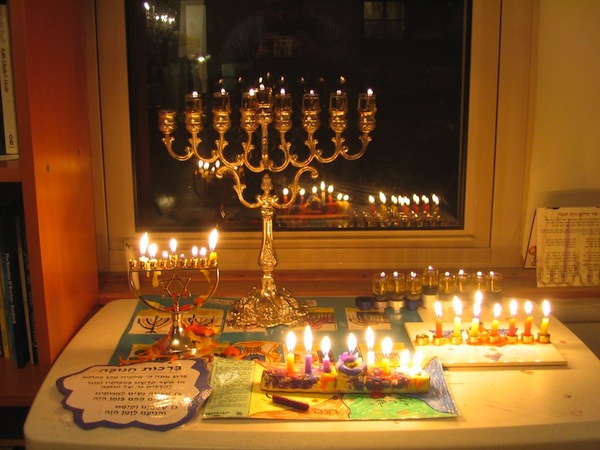
The lights of chanukiyot could be seen in the neighbourhood windows. (photo by Neil Harris/uberdox.aishdas.org)

There once was a dreidel named Dreidelhead. Dreidelhead had three brothers and lived with his parents in Flushing, N.Y. His first name was Noon but everyone just called him Dreidelhead because his head and body were shaped like a big dreidel. His three brothers were named Gimel, Hay and Shin.

Dreidelhead’s parents taught all of the children how to sing, dance and, of course, spin. So, during the holiday of Chanukah, all four children would sing, dance and, of course, spin at Chanukah parties and celebrations in their neighbourhood. Noon, Gimel, Hay and Shin would link their arms together and dance around the chanukiyah, singing Chanukah songs. It was quite a sight to see, the four dreidel brothers dancing together and spinning around the table. Everyone, especially children, loved to watch them.

Dreidelhead, like his brothers Gimel, Hay and Shin, was named after a Hebrew letter. Each brother had their letter stitched onto the front of their shirt, so that, when people saw them standing together, people would be reminded of the great miracle that occurred.

Dreidelhead’s letter, Noon, represented the word nes, miracle. Gimel’s letter represented gadol, which means great. Hay’s letter represented hayah, which means happened, and, finally, Shin’s letter, which is one of the last letters of the Hebrew alphabet, represented sham, the Hebrew word for there. So, when Noon, Gimel, Hay and Shin stood together, they reminded people that Nes gadol hayah sham, a great miracle happened there, in Israel, many years ago.

On the first night of Chanukah, after lighting the candles and singing songs, and before they were about to eat the scrumptious latkes that their mother and bubbie had made, Dreidelhead’s zaide would always tell the boys the story of the miracles that took place during the Festival of Lights. As their mom put down a plate of golden brown potato pancakes on the table and some sticky jelly doughnuts, their zaide recounted the tale of a band of Jewish rebels named the Maccabees, who were led by Mattityahu, a Jewish priest, and his five sons.

“A long time ago,” Zaide began, “there was an evil king of Syria named Antiochus, who forbade the study of Torah and wanted Jews to bow down to idols and eat pork. He also put idols right in the Holy Temple in Jerusalem.”

“I’d rather eat latkes and jelly doughnuts than pork,” Dreidelhead announced as he glanced hungrily at the plate of steaming latkes and sufganiyot.

“Yeah, me too,” chimed in Hay.

“Well, you’ll be eating some soon, just let your zaide finish his story,” Dreidelhead’s mom interjected.

“But, we already know the story of Chanukah,” Dreidelhead whined. “We learn it in Hebrew school every year.”

“I know you do,” Zaide patiently replied. “So, nu, if you know the story, tell us what happened next.”

“Well, um, the Maccabees, who were led by Judah the Maccabee (the Hammer) overthrew Antiochus and came to the Holy Temple to light the menorah and to cleanse it of all of the idols that were placed in it. When they came to light the menorah, there was only enough oil to last one night, but a miracle occurred and the oil lasted for eight days and eight nights,” Dreidelhead replied all in one breath.

“And so what do we do to commemorate the miraculous victory and the miracle of the oil?” Zaide asked.

“Well,” replied Dreidelhead, “uh, well, we light the candles for eight nights and put the chanukiyah in the window, we tell the story of Chanukah and eat potato latkes fried in oil. And we can also eat jelly doughnuts fried in oil. That’s what they do in Israel. Oh, yeah, and dreidels like us spin on Chanukah!”

“Don’t forget the part about the Chanukah gelt,” Gimel said.

“Oh, yeah,” said Dreidelhead. “We also get money or Chanukah gelt.”

“That’s true,” Zaide replied. “But, try to remember, boys, that the most important part of Chanukah is not getting money or presents, but lighting the candles, remembering the story and the miracles, and spinning for children during Chanukah. In fact, before your bubbie and I came to America, we would spin for all of the children in our little village in Russia on Chanukah.”

“Your zaide’s right boys,” Bubbie piped in. “And, back in the Maccabees’ time, according to an old legend, we dreidels were used to warn students studying Torah that Antiochus’s troops were coming.”

“So our ancestors helped save people’s lives – they were heroes!” exclaimed Hay.

“That’s right,” Dreidelhead’s father acknowledged. “So, you boys should be proud to be dreidels. Anyway, after you thank your bubbie and zaide for their wonderful Chanukah stories, I want you to wash your hands and then you can eat. You’ll need lots of energy if you’re going to dance for the boys and girls in the neighbourhood tonight.”

Later that evening, the dreidel brothers roamed the neighbourhood searching for Jewish families who were celebrating Chanukah. They were easy to find. The dreidels just looked for houses that had a chanukiyah displayed on the windowsill. They knocked at people’s doors and announced in unison, “Happy Chanukah! It’s the dreidels!” If there were any children in the household, they would jump up and down and shout at the top of their lungs, “The dreidels are here! The dreidels are here!” The children would plead with their parents to invite the dreidels into their home. Once inside, the dreidels would spin and sing for the children, just as their parents and grandparents did before them.

And so, during the eight nights of Chanukah, while the candles were burning, Dreidelhead and his brothers would dance and spin, bringing joy wherever they went.

David J. Litvak is a prairie refugee from the North End of Winnipeg who is a freelance writer, former Voice of Peace and Co-op Radio broadcaster and an “accidental publicist.” His articles have been published in the Forward, Globe and Mail and Seattle Post-Intelligencer. His website is cascadiapublicity.com.

Format ImagePosted on December 13, 2019July 2, 2020Author David J. LitvakCategories Celebrating the HolidaysTags Chanukah, dreidel, fiction, Judaism

Some Chanukah trivia

  1. What does the word Maccabee mean?
  2. Who were the five sons of Mattathias?
  3. What is a Chanukah lamp called?
  4. What are the letters on a dreidel outside of Israel? Inside Israel?
  5. In which book of the Bible do we read the story of Chanukah?
  6. Who was Judith and why is she mentioned on the Shabbat of Chanukah?
  7. What was Mattathias’s wife’s name?
  8. How many candles are in a box of Chanukah candles?
  9. Why do we give gelt on Chanukah?
  10. How many years occurred between the desecration of the Temple and the killings in Modiin by Mattathias and the Maccabee uprising?
  11. According to Jewish custom, what kind of oil should be used for the Chanukah lights?
  12. Why were the schools of Hillel and Shammai in disagreement about Chanukah?
  13. What is unique about the mitzvah of kindling Chanukah lights?
  14. How should one popularize the mitzvah of lighting the candles for Chanukah?
  15. What king ordered the people of his kingdom to become Greek in religion and culture?
  16. Why don’t Jews celebrate the things really done by the Maccabees?
  17. Why did Judah Maccabee want this holiday celebrated for eight days?
  18. Who were the Hasmoneans?
  19. How long did the war continue after the Temple was rededicated?
  20. How did each of the Maccabean brothers die?

 Trivia answers

  1. One tradition says it means hammer and was applied to the Maccabee family because of their strength. Another says it stands for Mi kamocha baelim Adonai, Who is like you among the great ones, O G-d?
  2. Judah, Jonathan, Jochanan, Eleazar, Simeon
  3. Chanukiyah
  4. Nun, gimmel, hay, shin; nun, gimmel, hay, po
  5. The story does not appear in any book of the Bible. It is found in Maccabees I and Maccabees II, part of the Apocrypha, books not included in the Bible.
  6. Judith was a Hasmonean woman, whose story is a book of the Apocrypha. She saved her town from destruction by killing the general in charge.
  7. No one knows because she is never mentioned in the books of Maccabees.
  8. 44
  9. During the Middle Ages, adults began to play games on Chanukah. In the 1700s, children began to play dreidel and were given coins for playing.
  10. One year
  11. Olive oil
  12. Hillel wanted one light on the first night and additional lights added each night. Shammai wanted eight lights on the first night and one subtracted each night.
  13. Even if one does not have food to eat, one should beg or sell their clothing to buy oil and lamps to light for Chanukah.
  14. Place the lights at or near the outer part of the door facing the street or in a window facing the street.
  15. Antiochus Epiphanes
  16. The rabbis did not want military battles commemorated, so they created the story of the oil being found by the Maccabees and lasting eight days.
  17. Because the men had been fighting at the time of Sukkot and had not celebrated it, they decided to commemorate that holiday by observing this one for eight days.
  18. The Maccabees were part of the House of Hashmon and called Hasmoneans, a title of honour that denoted its high standing.
  19. The war continued 127 more years.
  20. Judah was in battle and his unit became sandwiched between two enemy divisions. Eleazar was under attack by a unit on elephants – he thought the king or general was on a particular elephant so he thrust a sword into the elephant and it fell on him and crushed him. Yochanan was attacked by a tribe near the Dead Sea. Simeon was entertained by his son-in-law, made drowsy from wine and assassinated by the son-in-law’s accomplices. Jonathan was put to death by the Syrian king Tryphon.

Sybil Kaplan is a journalist, lecturer, book reviewer and food writer in Jerusalem. She created and leads the weekly English-language Shuk Walks in Machane Yehuda, she has compiled and edited nine kosher cookbooks, and is the author of Witness to History: Ten Years as a Woman Journalist in Israel.

Posted on December 13, 2019December 12, 2019Author Sybil KaplanCategories Celebrating the HolidaysTags Chanukah, history, Judaism, Maccabees
OJC busy and growing

OJC busy and growing

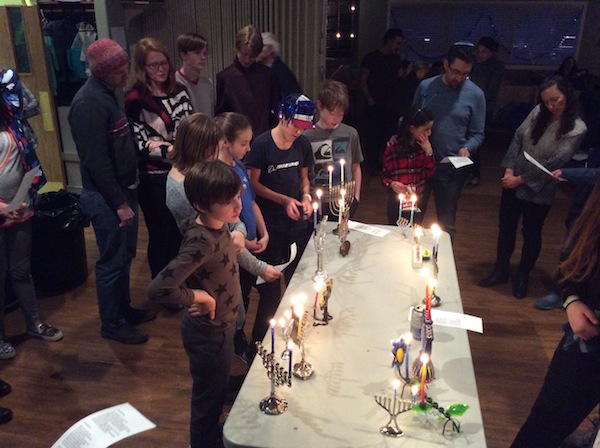
Members of the Okanagan Jewish Community came together to celebrate Chanukah. (photo from OJC)

The Okanagan Jewish Community in Kelowna has been keeping a busy schedule. Bolstered by many new members who have moved to the region – word has gotten out … who wouldn’t want to live here? – the community is growing both in numbers and in strength.

photo - The Tu b’Shevat seder on Jan. 20 was attended by 30 members
The Tu b’Shevat seder on Jan. 20 was attended by 30 members. (photo from OJC)

Traditional events such as the High Holidays – with visiting rabbis Larry and Linda Seidman from California – Sukkot and a Chanukah party attended by 80, started out our Jewish year. Of particular note was a Tu b’Shevat seder on Jan. 20, led by OJC member Barb Pullan, which was attended by 30 members. Everyone gathered to celebrate trees and discuss their importance to the preservation of life. We ate specific fruits representing those grown in Israel, drank wine or grape juice, recited blessings, told stories and sang songs. This definitely will be a repeat event in 5780.

Shabbat services were led by visiting Cantor Russ Jayne from Calgary in October and November, along with other services led by local community member Evan Orloff.

A Movie Night (The Boys: The Sherman Brothers Story) was presented on Nov. 9. The screening was organized by OJC member David Spevakow and took place at the Okanagan College Theatre, with almost 200 guests in attendance. We hope to continue the movie nights on a regular basis.

New programs this year have included:

  1. Coffee, cake and cultural anthropology talks. I gave the first talk, on my experience meeting with the Jews in Gondar, Ethiopia. The second session was presented by Murray Oppertshauser, a retired Canadian diplomat, who spoke about his many postings throughout the world. Further talks are planned.
  2. Several intercultural “meet and greets” have been planned with various cultural/ethnic groups in town.
  3. The OJC participated in Taste of Home, a Kelowna community event, in which various ethnic communities in the city participated by selling a sampling of their ethnic food, and with ethnic dancing. We contributed 340 cheese knishes prepared by our members under the direction of Barb Finkleman. Our local Israeli dance group provided the entertainment.

Future events include a ball hockey tournament, Purim, Passover, regular meetings of the Ladies Group, the continuation of the Hebrew school, and our annual golf tournament in the summer.

The OJC is searching for a full-time resident rabbi. We are in the process of having several candidates come out for a Shabbat weekend, after which the community will decide which spiritual leader best fits our needs.

If you’re visiting Kelowna or, better still, moving here, contact the OJC at 250-862-2305 or [email protected].

Steven Finkleman is one of the original members of the Okanagan Jewish Community, having arrived in 1982. He has acquired lots of memories over the years. Currently retired, he has been serving as the president of the OJC since October 2018.

Format ImagePosted on February 22, 2019February 21, 2019Author Steven FinklemanCategories LocalTags Chanukah, Judaism, Kelowna, OJC, Okanagan, Tu b'Shevat
Sharing holiday spirit

Sharing holiday spirit

Left to right: Archbishop JohnMichael Miller, Dr. Gregg Gardner, Fr. Nick Meisl, Dr. Jay Eidelman and RabbiJonathan Infeld. (photo by Rabbi Adam Stein)

“This is a unique opportunity to learn and growtogether. What better way to open ourselves to that holiday spirit, to welcomethe mysterious and send away the fear of the unknown,” said Congregation BethIsrael president Helen Pinsky in introducing the Dec. 5 program at thesynagogue on Chanukah and Christmas, which was co-hosted by Beth Israel and theRoman Catholic Archdiocese of Vancouver.

After the lighting of a giant electronic chanukiyah by Rabbi Jonathan Infeld, the reciting of the motzi by Archbishop of Vancouver John Michael Miller and a latke-laden dinner, the crowd moved into the sanctuary to hear three scholars: Dr. Gregg Gardner, Diamond Chair in Jewish Law and Ethics at the University of British Columbia; Fr. Nick Meisl, a professor at St. Mark’s College; and Dr. Jay Eidelman, who lectures on the Holocaust and Jewish history at UBC.

Infeld started things off with a short talk.

“The neighbourhood we grew up in, in Pittsburgh, was 50% Jewish or Catholic,” he said. “The kids did not refer to themselves as Jewish or Christian but as ‘Chanukah’ or ‘Christmas.’ We don’t love this, but it shows that the holidays have a particular power.”

Noting that, for many Jews and Christians of the past, neither Chanukah or Christmas were important as religious holidays, the rabbi quoted a documentary he had watched that argued that Charles Dickens had created Christmas, quipping that maybe Dickens “created Chanukah as well, in its modern version.”

Gardner spoke on the origins of Chanukah, noting it was a festival created by the Maccabees to mark their military successes against the Greeks in an effort to preserve traditional Jewish culture. “Ironically,” he said, “creating a holiday to honour yourself is, in fact, a very Greek thing to do.”

The “subversive” rabbis of later generations altered the holiday to downplay its militaristic elements and its focus on the Maccabees, Gardner explained, replacing that with a focus on God’s miraculous intervention in the miracle of the oil that burned for eight days in the rededicated Temple.

In his remarks, Meisl said the balloon of his “naive beliefs” about Christmas popped when, in the course of his studies, he learned that Dec. 25 was not Jesus’s birthday, but rather a date chosen for other reasons. He explored the theories linking the day to the ancient Roman Saturnalia festival of late December, or the Dec. 25 holiday of Sol Invictus (Unconquerable Sun). With humour, he quoted the ancient Christian theologian Origen, who questioned whether Jesus’s birthday should be celebrated at all, noting that, in the Hebrew Bible, only “bad people celebrate their birthdays.” In seriousness, he said it seems that it was around 336 CE that Christians began celebrating Jesus’s birthday on Dec. 25.

Eidelman took to the podium to the sound of the 1970s classic “Eight Days of Chanukah” by Sharon Jones and the Dap-Kings, while changing from his suit jacket to a tacky Chanukah sweater, in the style of the dreaded Christmas sweater. His speech covered various historical and pop-culture themes related to the two holidays, with a focus on how Jews have imagined and reimagined Chanukah “as a way to define ourselves spiritually and a way to claim space in a culture largely based on Christian customs.”

After a short question-and-answer period in which people asked about the development of certain Chanukah customs and the role the story of the Maccabees has played in the Christian tradition, among other things, the archbishop wrapped up the event.

“This has been a wonderful evening of sharing the joy we each feel in the holidays with each other,” said Miller, who made a point of thanking everyone involved in the event by name, right down to the members of the catering and kitchen staff.

“The event was a splendid manifestation of the ties that bind Christians and Jews together in an age-old spiritual heritage,” Miller told the Jewish Independent by email. “Such occasions foster friendships and mutual understanding, and my hope is that they continue. I am very grateful to Rabbi Jonathan Infeld for his leadership role in interfaith relations.”

Matthew Gindin is a freelance journalist, writer and lecturer. He is Pacific correspondent for the CJN, writes regularly for the Forward, Tricycle and the Wisdom Daily, and has been published in Sojourners, Religion Dispatches and elsewhere. He can be found on Medium and Twitter.

Format ImagePosted on December 14, 2018November 6, 2023Author Matthew GindinCategories Celebrating the HolidaysTags Chanukah, Christianity, Christmas, interfaith, Judaism
Community milestones … archery, Carter Wosk awards, Lamplighters, Chanukah at Kollel

Community milestones … archery, Carter Wosk awards, Lamplighters, Chanukah at Kollel

Adi Shapira (centre) willcompete in archery in the 2019 Canada Winter Games.

Adi Shapira, 16, is an up-and-coming athlete in the sport of archery. In Grade 10, she is part of the SPARTS program at Magee Secondary School, which is open to students competing in high-performance athletics at the provincial, national or international level, as well as students in the arts who are performing at a high level of excellence.

Since being introduced to archery only 18 months ago, Adi has climbed in the ranks, winning two gold medals in the 2018 B.C. Winter Games in the cadet category (15-17 years old) of Olympic recurve bow.

On Nov. 24, Adi won the qualifying tournaments against other female archers ages 15 to 20 and will be representing the province of British Columbia in the female recurve category in the Canada Winter Games in Red Deer, Alta., in February 2019.

The games’ website notes this is “the largest multi-sport and cultural event for youth in Canada and the largest event to be hosted in Red Deer’s history.” It will feature more than “150 events in 19 sports and a major arts and cultural festival” and welcome “up to 3,600 athletes, managers and coaches and more than 100,000 spectators.”

***

Left to right: BillPechet, Afshin Mehin, Claudia Schulz and HenryNorris.

Awardees of the Carter Wosk Awards in Applied Art and Design were honoured for their creative excellence at the 14th annual awards presentation Nov. 29. Bill Pechet, the architect for the restoration project of the Jewish section of Mountain View Cemetery and the renovation of the Schara Tzedeck Chapel and grounds, received the 2018 B.C. Creative Achievement Award of Distinction.

Pechet has dedicated himself for more than 30 years to creating environments that bring people together in refreshing and unexpected ways. He has made his mark on public spaces across the country through his street furnishings, lighting, urban infrastructures, public art and memorial design. Many of his contributions can be found around the Lower Mainland, including seating and lighting on Granville Street and the Shipyards in North Vancouver. In all his projects, he has extended the possibilities of merging social space with sculptural invention and sound ergonomics.

Since 2000, as a faculty member of the architecture and environmental design programs at the University of British Columbia, Pechet has encouraged his students to consider how manners of contemporary urban social practice intersect with material and spatial invention, all impacting the experience of the built world.

As an artist and mentor, Pechet frequently lectures on the critical role that public space plays in healthy and vibrant cities. His work emanates from a desire to generate a generous sense of simultaneous recognition and pleasurable strangeness in the public realm, giving individuals the permission to see the world as a little bit wondrous.

The Carter Wosk Awards for Applied Art and Design celebrate British Columbians who, through their creativity, contribute to the cultural economy of the province. Each year, up to three recipients are chosen by jury and each is awarded $2,500. This year, the winners were Afshin Mehin (wearable technology), Henry Norris (furniture design) and Claudia Schulz (hat design).

The awards honour excellence in art with a practical or functional application and are named in honour of philanthropist, academic and visionary Dr. Yosef Wosk and for educator, designer and curator Sam Carter.

***

The 2018 Young Lamplighter Award was presented to Ethan and Simoana Dreyshner.

On Dec. 9, at the Centre for Judaism’s public menorah lighting at Semiahmoo Shopping Centre in South Surrey, the 2018 Young Lamplighter Award was presented to Simoana and Ethan Dreyshner for their dedication to community and those less fortunate. They have raised funds and given of their time and energy to various important causes, including the Jewish Food Bank, B.C. Lung Association, First Call B.C. and the Louis Brier Home and Hospital.

Parents (Marat and Ella Dreyshner) and grandparents were on hand at the ceremony. Dignitaries in attendance included MLAs Marvin Hunt (Surrey-Cloverdale) and Tracy Redies (Surrey-White Rock), Langley Mayor Val van den Broek, Langley Councilor Rudy Storteboom, White Rock Deputy Mayor Helen Fathers and Surrey Councilor Linda Annis.

Cantor Yaakov Orzech lit the menorah and led the Chanukah songs, and Adina Ragetli played the harp. In the “human menorah” presentation (written by Simie Schtroks as a response to the Pittsburgh shootings), Louise Stein Sorensen, Moshe Fidelman, Joanne Yaakov, Marat Dreyshner, Ettie Shurack, Ethan Dreyshner, Bayla Shurack and Schtroks each kindled a flame with a message. Dean Donnelly entertained the children, and winners of last year’s Lamplighter, Emily and Jessie Miller, were there to pass the torch forward.

***

Right to left, Kollel Rabbi ShmuliYeshayahu, Vancouver Mayor Kennedy Stewart’s chief of staff Neil Monckton andStewart share a moment with some of the many party-goers. (photo by AlanKatowitz)

On Dec. 2, the first night of Chanukah, the Ohel Ya’akov Community Kollel hosted its Annual Latke Vodka party at the Maple Grill.


Format ImagePosted on December 14, 2018December 12, 2018Author Community members/organizationsCategories LocalTags Adi Shapira, archery, Bill Pechet, Carter Wosk Awards, Centre for Judaism, Chanukah, Community Kolllel, Ethan Dreyshner, Kennedy Stewart, Lamplighter Award, Simoana Dreyshner, Winter Games

Love the stranger, the “other”

Chanukah came early this year, and I hope you had a fun one. Now that it’s almost over, it can be a long dark vacation for those of us who do not observe anything on Dec. 25.

I say this because, although my family is clearly in the “Chanukah only” category, I know other families handle this differently. Some families are multifaith and observe several winter holidays. There are even (this was a surprise to me) Modern Orthodox Jewish families who have used Dec. 25 to create an entirely kosher Christmas dinner – because everyone had the same day off of work. Some Jewish people choose to observe aspects of Christian or pagan holidays, and, well, that’s up to them. It’s not the custom in my home, but we’re all lucky to be in a place where we are free to choose our own traditions.

A strange thing happened to me this fall. A friend of a friend put together a “women-owned businesses” shopping guide. It had a hashtag of #ShopWithHer. My work includes writing and editing, which can be hard to advertise. The other part is that I write downloadable knitting patterns. That means knitters, or those who love them, can go online and download a pattern I wrote for the price of a big cup of coffee. It’s not a huge earner, but I have a “woman-owned” business, so I asked to be included.

The emphasis of the guide’s creator was to highlight women and minorities. It was the week after the Pittsburgh massacre, so when I got to that question, I said something like, “I’m Jewish and an immigrant and now a dual-citizen. I moved from the U.S. to Canada.”

Why did I mention being Jewish? Jews are a minority in North America. While it has been popular in recent years to downplay any issues of our minority status, the truth is that there are still challenges to being Jewish here. For instance, violence like in Pittsburgh – and the assumption that, if we want to pray in peace, we should be hiring armed security.

If we just go back in history a little ways, we should think about quotas at universities, country clubs and other organizations that didn’t admit Jews at all. There were countless other places with no formal policy, but where folks made sure that we knew we didn’t belong.

For those who think that’s all in the past, I can say sarcastically, sure it is – my father’s university (Duke) had quotas when he attended it. The Women’s Junior League in Virginia did not accept “our kind” when I was a kid. The issue of “anti-Jewish” or antisemitic discrimination is not new, nor is it going away. The recent rise of hate crimes is well-documented in the news. Some American universities and colleges are canceling study-abroad programs to Israel, or their faculty members refuse to write letters of recommendation to Israeli study-abroad programs. I get e-newsletters from JTA and other Jewish organizations – and the news is clear.

When the #ShopWithHer guide came out, I was excited – and then shocked – to see my entry. Where other minorities were labeled “WOC” for “Woman of Colour” or “LGBT” or “Disabled,” mine read “Immigrant, Other.”

I’m proud of being Jewish and it’s not a part of my identity that I hide. I shouldn’t need to feel ashamed of it. I’m also well aware of our minority status, particularly when we’re surrounded by a holiday that celebrates the birth of another religion’s messiah. However, I didn’t include my business in this guide so I could be made “other” all over again. Why was I labeled “other”? Was it an attempt to protect me from hate? Or do I belong to a category that the guide’s creator didn’t feel was valid?

“Othering” isn’t my invention – if you’ve taken social science, religious or cultural studies, philosophy, history or other humanities classes at a university, you’ve likely heard of it. There are academic conferences and teacher in-services on the topic. A simple definition? It’s the action of deciding someone else is different or alien to you, “not one of us.” It’s a very primitive tribalism that helps people survive in adverse conditions. Some theorists think it references early human civilization, and others think it comes from times of war, famine and other natural disasters.

You can read about the “in group” of the Israelites and “others” in the Torah. There’s a lot of tribalism at work in some of our most common stories of identity. At the same time, we’re reminded, “You should love the stranger,” for “We were strangers in the land of Egypt.”

That’s right, Jewish tradition teaches us to love the “other.” In the face of increased hate crimes, discrimination and erasure, it can be hard work to keep reaching out and loving others. Perhaps it is ignorance that allows our identities to be ignored or disregarded; I’d like to think that, because the alternatives aren’t nearly as harmless.

It feels awful to have one’s own religious tradition erased. This time of year, it happens a lot. We’re faced with holiday greetings, music, customs, lights and foods that aren’t ours. When Chanukah is long over, it also feels ridiculous to wish someone or thank someone for a “Happy Chanukah,” even though it’s well-intentioned.

I’m still struggling with what to say to this shopping guide’s organizers. Saying nothing is an option, as is trying to engage in a dialogue. Maybe it’s enough to send along a copy of this column. There are so many ways to divide and diminish others, rather than celebrating and boosting our identities and differences. Chanukah is a holiday that, unmistakably and militantly, celebrates religious freedom. Perhaps it’s time for us to be our own modern version of Judah Maccabee, strong in the face of dangerous discrimination, but also trying to embrace the Jewish notion of loving the stranger rather than “othering” her.

Joanne Seiff writes regularly for CBC Manitoba and various Jewish publications. She is the author of three books, including From the Outside In: Jewish Post Columns 2015-2016, a collection of essays available for digital download or as a paperback from Amazon. See more about her at joanneseiff.blogspot.com.

Posted on December 7, 2018December 4, 2018Author Joanne SeiffCategories Op-EdTags Chanukah, culture, minorities, othering

Posts pagination

Previous page Page 1 … Page 3 Page 4 Page 5 … Page 11 Next page
Proudly powered by WordPress